



Abstract
Social scientists have long debated the impacts of foreign investment for developing countries. However, the relationship between foreign investment and child mortality is still heavily contested among comparative international social scientists despite decades of research. I bring new cross-national evidence to bear on this contested debate, where the competing arguments of neoclassical economic theory and foreign investment dependency theory are evaluated using fixed effects, dynamic, and two-stage least squares panel regression models. I find that inward foreign direct investment stock exerts a beneficial effect on child mortality in less-developed countries, net of relevant statistical controls. These results are also robust to a variety of regression diagnostics and alternative choices of econometric specification. These findings contribute to a growing body of literature finding that traditional sociological measures of foreign direct investment—in some cases—generate beneficial effects in less-developed countries.
Keywords
Social scientists have long sought to understand the impacts of economic globalization for less-developed countries (also referred to as developing countries). There are numerous striking empirically evident global economic processes occurring (i.e. trade and foreign credit), but the long-term accumulation of foreign direct investment (FDI) in less-developed countries has arguably attracted the most theoretical and empirical attention over the years by comparative international social scientists (e.g. Bornschier and Chase-Dunn, 1985; Chase-Dunn, 1975; Firebaugh, 1992, 1996; Dixon and Boswell, 1996; Kentor, 1998, 2001; Clark and Cason, 2015; Clark and Kentor, 2022; Clark and Kwon, 2018; Curwin and Mahutga, 2014; Kentor and Boswell, 2003; Sanderson and Kentor, 2009). Within this body of literature, the implications of FDI for child mortality in less-developed countries remain heavily contested among comparative international social scientists despite decades of research into this relationship (e.g. Alam et al., 2016; Burns et al., 2017; Chiappini et al., 2022; Shandra et al., 2005; Wimberley, 1990; Sommer, 2022). Comparative international social scientific debates regarding FDI and health in developing countries may also speak to broader conversations regarding global health, especially with the recent global COVID-19 pandemic.
In this analysis, I present new cross-national evidence regarding the effects of FDI on child mortality in less-developed countries, 1990–2019. Following a discussion of the public health literature regarding the causes of child mortality, I briefly describe neoclassical economic theory and foreign investment dependency theory. I then describe the data, dependent variables, explanatory variable of interest, control variables, and methodology of the analysis. Next, I summarize the major findings of the analysis. I then discuss the significance of the results in the discussion and conclusion.
The causes of child mortality
A review of the public health literature indicates that scientific understandings of the causes of child mortality in comparative international context have remained quite stable over time. This body of literature has generally established that various infectious diseases (i.e. pneumonia, diarrhea, malaria, injury, meningitis, measles, etc.), pre-term birth complications, birth asphyxia, trauma, undernourishment, and congenital anomalies are prominent causes of under-five deaths (Bryce et al., 2005; Liu et al., 2015; World Health Organization, 2023). This literature also suggests that access to basic lifesaving interventions such as vaccinations, adequate nutrition, and social services (i.e. pay for healthcare) can save children’s lives (Liu et al., 2015; World Health Organization, 2023).
FDI: boon or bane?
In this section, I briefly outline the opposing predictions of neoclassical economic theory and FDI dependency theory. FDI is an investment made by a resident in one economy (direct investor or parent enterprise) with the objective of establishing a lasting interest in an enterprise that is a resident in another economy (direct investment enterprise or foreign affiliate) (UNCTAD, 2021). Concrete examples of FDI are arguably not quite intuitive for a lay social scientific audience, but FDI is often somewhat equated with transnational corporations as much of inward FDI into host countries is provided by transnational corporations (Bornschier and Chase-Dunn, 1985). Some examples of transnational corporations are Amazon, Walmart, and Nike. Please note that, when investigating a potential statistical relationship between inward FDI stock and child mortality in less-developed countries, the arguments touched on below are commonly invoked to motivate either a positive or inverse correlation between the variables of interest (inward FDI stock and child mortality). Of course, the research design of this cross-national, longitudinal statistical analysis cannot speak to how FDI impacts health in less-developed countries and the description of these arguments should not be taken as necessarily endorsing any statement, but I draw on these common theoretical arguments to derive relevant statistical propositions. I now turn to the discussion of neoclassical economic theory.
Neoclassical economic theory
Neoclassical economic theory posits that foreign investment should exert a statistically significant beneficial effect on health outcomes in less-developed countries. One reason to expect the aforementioned relationship is the hypothesized effects of foreign investment on economic growth. The relationship between economic development and social welfare/health outcomes in less-developed countries is one of the most well-established findings in the comparative international social sciences (e.g. Clark, 2011; Cole, 2019; Firebaugh and Beck, 1994; Shandra et al., 2005, cf. Brady et al., 2007; cf. Burroway and Hargrove, 2018). At times, many less-developed countries may not have the domestic resources to meet their economic growth goals. For example, the now classic Harrod–Domar growth model posits a direct relationship between a country’s output growth (g) and net amount of savings (s), via the following equation (Todaro and Smith, 2020): g = s / c. In the Harrod–Domar model of economic growth, c is the national capital-output ratio (Todaro and Smith, 2020). If a country’s gross domestic product (GDP) per capita annual percentage growth goal is, say, 3 percent and the same country’s c is 2, then the needed annual rate of saving to achieve their goal is 6 percent. If the same country’s domestically mobilized savings amounts to, say, only 3 percent of their respective GDP, then this country can be in a better position to reach their target GDP per capita annual growth rate by filling the savings gap through FDI. Thus, the first reason to expect that foreign investment exerts a beneficial effect on health outcomes in less-developed countries is the role foreign investment hypothetically plays in filling “savings gaps” and contributing to economic growth. Of course, the FDI and economic growth relationship has attracted considerable debate in the comparative international social sciences (e.g. Firebaugh, 1992, 1996; Dixon and Boswell, 1996). Also, engaging this classic argument is not to suggest that economic growth/ GDP is a stand-in for child health outcomes. However, in a review of literature that investigates the foreign investment and economic growth relationship from 1994 to 2012, Almfraji and Almsafir (2014) conclude that, although a handful of studies find a negative or null effect, most studies find a positive significant relationship between FDI and economic growth. Thus, neoclassical economic theory might argue that, with the conclusions posited by studies such as Almfraji and Almsafir (2014), there is more scientific confidence that FDI benefits economic growth in less-developed countries. The resulting economic growth, as the logic provided by neoclassical economic theorists goes, would then benefit child mortality.
Another reason to expect that foreign investment exerts a beneficial effect on health outcomes in less-developed countries is the potential effects of foreign investment on a country’s balance of payments (Vernon, 1971). The balance of payments is a summary statement of a country’s financial transactions with the outside world. A country has a surplus when the current account has a positive balance or an excess of revenues over expenditures. A country has a deficit when the current account has a negative balance or an excess of expenditures over revenues. FDI is thought to help erase deficits in a country’s balance of payments current accounts and alleviate deficits over time through the generation of export earnings (Todaro and Smith, 2020). Potential positive effects of foreign investment on a country’s balance of payments can then affect the expenditures allocated to social and health services, which has intuitive implications for health outcomes (O’Hearn, 1989). In sum, neoliberal economic theory posits that foreign investment has positive effects on a country’s balance of payments, which can then affect the health outcomes I focus on in this analysis.
Another argument made by neoclassical economic theory is that foreign investment can positively affect the amount of locally raised taxes in a host country. Transnational corporations are generally thought to be quite productive relative to indigenous industry (e.g. Curwin and Mahutga, 2014; Li and Liu, 2005). Thus, the governments of a host country may be better able to generate public financial resources for social and health services, development projects, and other public goods by taxing the profits of transnational corporations and potentially benefiting from “spillover” effects (e.g. Todaro and Smith, 2020). The availability of additional public resources can then affect health outcomes in less-developed countries. For example, taxes on transnational corporation profits may help keep social and health services well-funded, which would then affect child mortality. Also, the governments of less-developed countries may have more funding for development programs (roads, infrastructure, etc.) that contribute to economic growth, which would then affect child mortality.
Other lines of neoclassical economic thought suggest that transnational corporations may affect health outcomes by transferring skills, knowledge, and know-how about business operations and advanced technology to less-developed countries (e.g. Taylor and Driffield, 2005; Todaro and Smith, 2020). In addition to providing financial resources to less-developed countries, multinational corporations are thought to fill gaps in managerial experience and entrepreneurial ability by educating their workforce. Employees in transnational firms are also thought to gain experience in operating large-scale businesses through learning by doing. For example, employees of transnational firms may learn how to contact overseas banks, learn international marketing practices, and help operate advanced technologies. It is thought that these skills and know-how leak out to the domestic economy when transnational corporate employees start their own businesses or gain employment in domestic industry. FDI is also thought to bring advanced, productive technology to a host country, which may spill over into the domestic economy and make domestic investment more productive (e.g. Li and Liu, 2005; cf. Dixon and Boswell, 1996). More productive domestic industry may then further contribute to economic growth. Increases in economic growth, as the logic goes according to neoclassical economic theory, would then increase the number of goods and services available in a domestic economy that may save a child’s life (see the causes of child mortality section). Economic growth can also increase wages in a polity, which may decrease child mortality rates as individuals are able to purchase goods and services that decrease child mortality.
Other arguments regarding the beneficial effects of foreign investment on health outcomes focus on the broader societal changes thought to be induced by foreign investment. Foreign investment and concomitant urban development can generate a “city lights” effect (Evans and Timberlake, 1980), where poor individuals residing in rural areas of a host country might move to the urban areas of a host country in part to secure more “promising” wage-employment than wage-employment opportunities in rural areas of a host country (Stokes and Anderson, 1990). Neoliberal economic theory suggests that these processes might increase an individual’s access to medical services, thereby affecting health outcomes in less-developed countries. Also, individuals moving from rural areas of a host country to urban areas of a host country are speculated to be employed in low-paying service sector jobs (Stokes and Anderson, 1990). Neoliberal economic thought posits that some wages, although far from ideal, might somewhat increase access to interventions that can save a child’s life, especially as child mortality in developing countries can generally be prevented with cost-effective interventions (e.g. Liu et al., 2015).
Additional arguments in the neoclassical economic literature are as follows. One is that FDI may increase wages and employment in a host country (e.g. Feenstra and Hanson, 1997). In neoclassical economic literature, it is generally argued that foreign industry is more economically productive than domestic industry. For example, the OECD (2002: 68) writes that “FDI generally does make a positive contribution to both factor productivity and income growth in host countries, beyond what domestic investment normally would trigger.” Increases in economic output are then generally argued to be associated with increases in wages (e.g. Firebaugh and Beck, 1994) and, as a logical extension, employment opportunities in a host country (e.g. Chiappini et al., 2022). Increases in wages and employment are then argued to allow individuals to purchase the goods and services that may benefit their health such as food, health services, safer and cleaner neighborhoods, and so forth.
Another reason to expect that FDI exerts a beneficial effect on child mortality according to neoclassical economic theory is improved working conditions. This argument begins with the premise that less-developed countries historically focus on labor-intensive production. Foreign industry is thought to bring in capital-intensive production processes to a host country. Of course, working in, say, a capital-intensive manufacturing plant is challenging, but it is argued that such work is much more conducive to positive health than, say, working in labor-intensive agriculture with little to no physical capital (i.e. tractors) (Taylor and Driffield, 2005).
The goal of this analysis is to investigate a potential statistical relationship between inward FDI stock and child mortality in less-developed countries, but it is also important to draw on qualitative, case-studies to provide an imagery of potential on-the-ground dynamics underlying the reported statistical associations. Please note that the use of such case-studies is not to imply causality or make claims of a smoking-gun example. Rather, per an anonymous reviewer’s suggestion, case-studies can give some insight into how FDI possibly impacts child mortality. Neoclassical economic literature points to cases where FDI benefits a host country in some capacities such as the “Asian Tiger” economies. For example, it is often noted that the Malaysian state of Penang created over 200,000 jobs for domestic populations by attracting FDI over the course of a couple of days in the latter half of the 20th century (International Labor Organization (ILO), 1998). Similarly, others point to Singapore, which reportedly increased the quantity and quality of jobs within their borders by-way of FDI (ILO, 1998). Others point to Latin American countries such as Costa Rica. For example, in 1997, the United States–based transnational corporation Intel created a manufacturing plant in Costa Rica. It is argued that the influx of this FDI contributed to economic growth by increasing economic productivity and creating linkages with domestic producers and suppliers (Jenkins, 2005). Increased national economic productivity is, as the logic goes, associated with increases in wages (Firebaugh and Beck, 1994). Then, increases in wages allow for domestic populations to purchase more goods and services that save a child’s life. Using similar logic, the creation of linkages with domestic producers and suppliers generates jobs for domestic populations, which then allows such individuals to purchase more nutritious food for their family and purchase health care services (i.e. immunizations, doctor visits, etc.).
In sum, neoclassical economic thought posits a diverse set of ways in which FDI is thought to affect health outcomes in less-developed countries. Some of the most often-cited mechanisms in the context of health outcomes are related to the effects of foreign investment on economic growth, a country’s balance of payments, a country’s tax revenue, and a country’s knowledge gaps and technological know-how. Thus, neoliberal economic thought would posit that FDI stock as a percentage of GDP exerts a statistically significant beneficial effect on country-level health outcomes in less-developed countries. In the subsequent analyses, I evaluate the predictions of neoclassical economic theory. I now turn to a discussion of FDI dependency theory.
Foreign investment dependency theory
Foreign investment dependence is one of the most intensely debated forms of international economic dependence in the comparative international social sciences (e.g. Bornschier and Chase-Dunn, 1985; Chase-Dunn, 1975). Typically, social scientists investigating the impacts of foreign investment on developing countries draw on the theory of foreign capital dependence, which is also related to world-systems analysis (e.g. Wallerstein, 2004) and dependency theory more broadly (e.g. Cardoso and Faletto, 1979; Frank, 1967). The theory of foreign capital dependence argues that dependence on foreign capital to stimulate economic development can make a host country more vulnerable to global political-economic processes in addition to foreign investment being associated with a variety of negative externalities, with both of the aforementioned mechanisms then affecting the social structure of a host country (Kentor, 2001). Much empirical research investigates the effect of foreign investment on economic growth, income inequality, overurbanization, and other outcomes (e.g. Alderson and Nielsen, 1999; Bornschier and Ballmer-Cao, 1979; Bornschier and Chase-Dunn, 1985; Bornschier et al., 1978; Chase-Dunn, 1975; De Soysa and Oneal, 1999). Overall, a rich body of social scientific research empirically demonstrates the effect of foreign investment on a variety of outcomes in developing countries.
The governments of less-developed countries are often in desperate need of foreign investment to stimulate economic development (e.g. Dixon and Boswell, 1996; Frey, 2003). Generally, it is assumed that foreign investment will stimulate economic development. On the flip side, it is speculated that foreign investors want to maximize the profits from their investments in addition to constantly searching for countries with cheaper labor, lower labor regulations, and lower environmental regulations (McMichael, 2012). With the aforementioned global political-economic processes in mind, the governments of a host country can provide concessions to foreign investors in the form of the free repatriation of profits, tax breaks, and the free import of industrial inputs to foreign investors to attract foreign investment (Dixon and Boswell, 1996; Kentor, 2001; O’Hearn, 1989). Some of the aforementioned concessions can then affect the tax base within a country, which could then affect the funding of health services that reduce child mortality (Shandra et al., 2010). Also, some of the regulatory concessions described above can hamper domestic industry, which then negatively affects the domestic accumulation of capital and economic development in the long run (Bornschier, 1980). In addition to the aforementioned processes, developing countries also face pressure from global financial institutions such as the World Bank and International Monetary Fund to provide “favorable business conditions” to foreign investors in exchange for loans (McMichael, 2012). Favorable business conditions can mean keeping minimum wages low or relaxing labor laws/regulations, which can then affect child mortality in developing countries as individuals have less money for necessities. Developing countries also face pressure from global financial institutions to reduce funds for health care services and social services more broadly in exchange for loans, with the reduction of funds for social services potentially increasing child mortality in less-developed countries (McMichael, 2012). Overall, there are a variety of theoretical reasons to expect that foreign capital penetration is positively associated with child mortality in developing countries.
Foreign investment is also associated with changes in the social structure of a host country that can then affect child mortality. Samir Amin’s concept of disarticulation is of direct relevance here, where disarticulation generally refers to the “juxtaposition of economic sectors with different levels of development and productivity” (Stokes and Anderson, 1990: 63). Foreign investment-stimulated economic sectors are highly productive and capital-intensive. However, foreign capital-stimulated economic sectors are argued to generate little employment and low wages (Stokes and Anderson, 1990). Also, economic sectors that are not stimulated by foreign investment cannot provide many inputs to the foreign capital-stimulated economic sectors, thereby limiting forward linkages and backward linkages (O’Hearn, 1989). Coupled with concessions to foreign investors by the governments of less-developed countries such as the free import of inputs, transnational corporations may import inputs required for production, which can then hurt domestic industry and economic development in the long run (Dixon and Boswell, 1996; O’Hearn, 1989). The negative effects of foreign capital dependence on economic development/growth can then affect child mortality in developing countries since much cross-national research finds economic development is inversely associated with child mortality (e.g. Pandolfelli and Shandra, 2013). In addition to the different levels of productivity of foreign capital-stimulated economic sectors and economic sectors not stimulated by foreign investment, foreign investment also creates a “city lights” effect, where individuals residing in rural parts of a host country migrate to the city in hopes of securing a better life (Evans and Timberlake, 1980; Stokes and Anderson, 1990). Partially because foreign investment generates little employment, the individuals that do migrate to the city remain marginally employed in the service sector, which “intrinsically has a wide income distribution” (Stokes and Anderson, 1990: 64). Low wages can affect the goods and services individuals can purchase, which can then affect child mortality in less-developed countries. Also, foreign investment can lead to the “emergence of an export-oriented economy [that] diverts land from food production to commercial purposes, [thereby] reducing the amount of food available for local consumption” (Shen and Williamson, 1997: 670).
Others argue that FDI may actually decrease wages and employment in less-developed countries. Such dynamics are argued to occur because of disarticulation, which generally refers to the “juxtaposition of economic sectors with radically different levels of productivity” (Stokes and Anderson, 1990: 66). The imagery of disarticulation is as follows. Foreign investment-stimulated economic sectors are argued to be very productive but generate few jobs because of their tendency to be capital-intensive. Also, especially with threats of capital flight (e.g. Wallerstein, 2005) workers might see their wages drop over time with regulatory concessions to foreign investors (Vijaya and Kaltani, 2007).
Another argument is that working conditions and health behaviors may worsen over time with the long-term accumulation of FDI in less-developed countries. I draw on a classic case-study to illustrate this point. For example, Jeffrey Ballinger’s classic The New Free-Trade Deal article published in (1992) documented the exploitative conditions in a Nike subsidiary. He notes that an Indonesian women migrating to the city in search of a better life and jobs are paid so low in these foreign factories that they are malnourished and that their wages only allow them to rent dilapidated housing without running water or electricity (Ballinger, 1992). More recently, Frey (2003), documents that foreign firms operating along the Mexico–US border in Tijuana frequently expose workers—especially women and children—to dangerous pollutants that have dramatic implications for their health. Of course, one cannot generalize beyond these individual casestudies, but these examples are commonly invoked to provide imagery to foreign investment dependency arguments in the context of population health.
Summary of propositions
I derive the following propositions from the above discussion.
Neoclassical economic theory: inward FDI stock exerts a beneficial effect on child mortality.
Foreign investment dependency theory: inward FDI stock exerts a detrimental effect on child mortality.
The analysis
Data
Here, I draw on two commonly used country-level panel datasets, which are the World Bank’s World Development Indicators and the United Nations Conference on Trade and Development (UNCTAD, 2021; World Bank, 2021). The data on foreign investment come from the United Nation’s Conference on Trade and Development Stat Database (UNCTAD, 2021). The rest of the data come from the World Bank’s (2021) World Development Indicators. I identified countries as developing countries if they are not classified as “high-income” in the World Bank’s (2021) income classification of countries. Table 1 provides descriptive statistics and correlation matrix for the analysis. Supplemental Appendix A lists the countries included in the analysis. The use of the UNCTAD (2021) data (ends at 2019 in this year) and the use of real GDP per capita (PPP) (begins at 1990) limit the temporal scope of the analysis from 1990 to 2019, but see Model 2 of Table 10 for results that use real GDP per capita in US dollars (extra 10 years of data).
Descriptive statistics and correlation matrix.
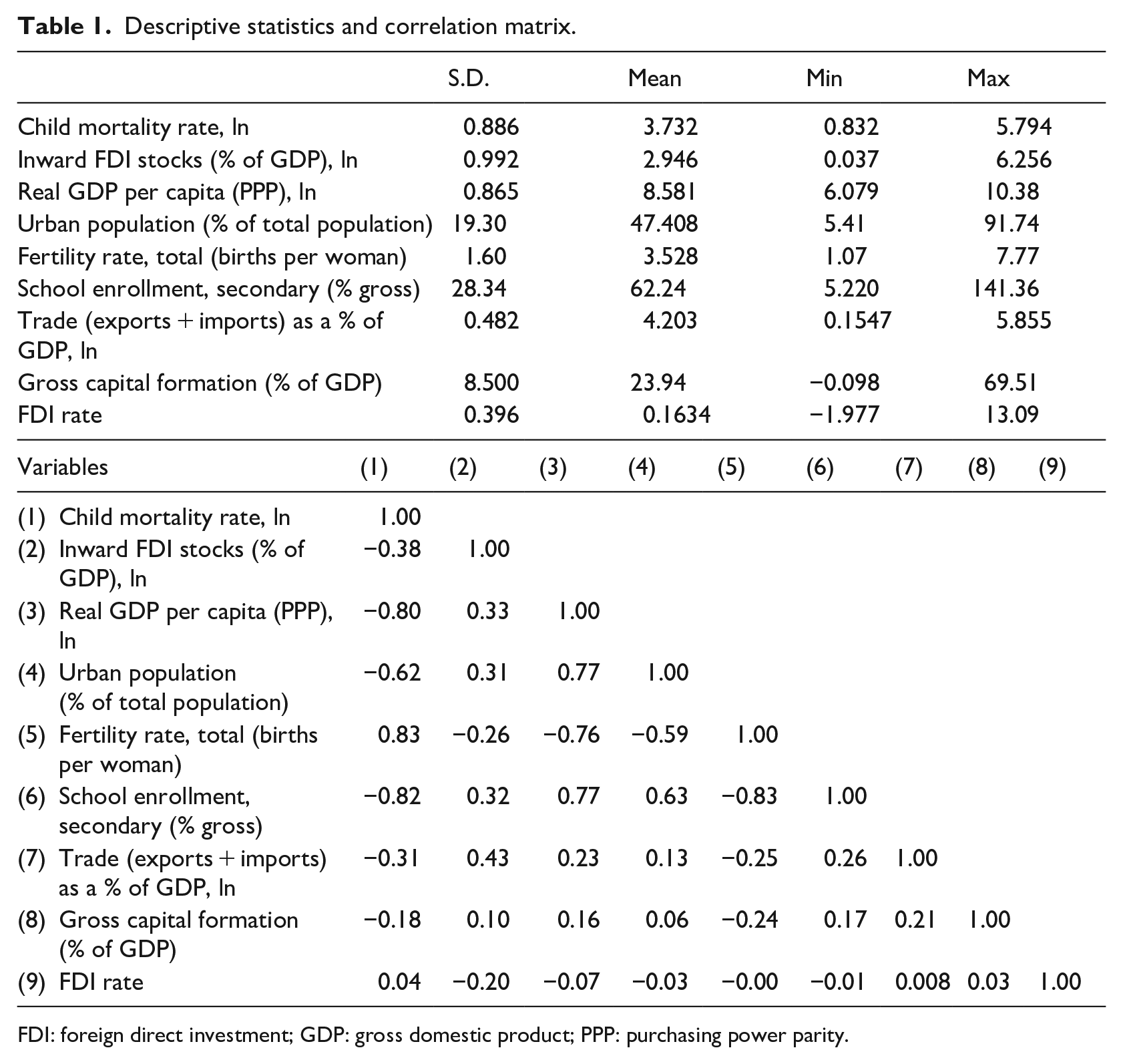
FDI: foreign direct investment; GDP: gross domestic product; PPP: purchasing power parity.
Response variable of interest
Child mortality
Social scientists gauge the health of a country’s population in a variety of ways. Child mortality rates are commonly used in comparative international social scientific studies of health and illness to approximate the health of a country’s population (e.g. Shandra et al., 2005). The response variable of interest is the natural logarithm of child mortality, which is expressed as a rate per 1000 live births. More specifically, the child mortality rate per 1000 live births is the number of deaths that occur in a given country before an individual reaches the age of five. I take the natural logarithm of this variable to address skew. These data are provided by the World Bank’s (2021) World Development Indicators.
Explanatory variable of interest
Foreign capital penetration
Inward FDI stock as a percentage of GDP (ln) is the explanatory variable of interest. I take the natural logarithm of this variable to address excessive skew. This measure is one of the most commonly used measures of foreign capital penetration in the comparative international social sciences (Dixon and Boswell, 1996; Kentor and Boswell, 2003; Mahutga and Bandelj, 2008). This measure captures the extent foreign investors dominate the economy of a host country (Kentor and Boswell, 2003: 302).
Other theoretically relevant factors
Economic development
I control for the natural logarithm of real GDP per capita (PPP), which is one of the most common control variables in quantitative cross-national research. These data were obtained from the World Bank’s (2021) World Development Indicators. There are a variety of reasons to expect economic development exerts a beneficial effect on child mortality in less-developed countries. One is the broader societal changes associated with economic development such as national infrastructure (e.g. roads, railways) and urbanization. Another reason is increased wages. Economic development is associated with increased wages (e.g. Firebaugh and Beck, 1994). Also, previous scholarship finds that economic development exerts a beneficial effect on child mortality and related measures in less-developed countries (e.g. Brady et al., 2007; Firebaugh and Beck, 1994; Shandra et al., 2005).
Urbanization
I also include a measure of urbanization, which is urban population as a percentage of total population. Including this measure is quite common in cross-national analyses of social welfare outcomes in less-developed countries. These data come from the World Bank’s (2021) World Development Indicators. Previous scholarship suggests that individuals residing in urban areas have better work opportunities and might earn higher wages than those in rural areas of a country (Bloom et al., 2008). Cities may also provide access to resources (i.e. water, social services) that may save a child’s life (Shorette and Burroway, 2022). I thus posit that urban population as a percentage of total population exerts a beneficial effect on child mortality.
Total fertility rate
I also control for a country’s fertility rate. Previous literature would suggest that fertility will be positively correlated with child mortality in developing countries as additional children in a family already deprived of resources can decrease the attention, resources, and care devoted to each child (Austin and Hof, 2023; London, 1988; Shen and Williamson, 1997). These data were also obtained from the World Bank’s (2021) World Development Indicators.
Secondary education
I also control for secondary school enrollments as a percentage of gross, which is another common control variable when analyzing the predictors of health outcomes in developing countries (e.g. Mejia, 2022a; Shorette and Burroway, 2022). Increased education is associated with parents seeking modern medical services for themselves and their children (Caldwell, 1979; Cleland and Kaufmann, 1998). Thus, I posit that secondary school enrollments as a percentage of gross exerts a beneficial effect on child mortality in less-developed countries.
Trade openness
Trade (imports + exports) as a percentage of GDP (ln) measures a country’s integration into the global economic trading system (Mejia 2021b). World-systems analysis/dependency theory posit that trade exerts a harmful effect on child mortality as unequal exchange in the world-system occurs through trade (e.g. Bunker, 1985; Emmanuel, 1972). Classic scholarship (e.g. Ricardo, 1817), however, suggests that trade exerts a beneficial effect on child mortality in developing countries as trade contributes to economic development, which can then reduce child mortality in developing countries. These data were retrieved from the World Bank’s (2021) World Development Indicators.
Domestic investment
It is standard to control for domestic investment when investigating the impacts of foreign investment in developing countries (e.g. Dixon and Boswell, 1996) as the key contention between neoclassical economic theory and dependency theory is that the source of investment does matter. Domestic investment is expected to be correlated with decreased child mortality as it is a key component of the Harrod–Domar model of economic growth (Todaro and Smith, 2020). Economic growth is then thought to benefit child mortality. I thus include a measure of gross capital formation as a percentage of GDP in the analyses. These data were obtained from the World Bank’s (2021) World Development Indicators.
FDI rate
I also control for FDI rate, which is inward FDI flow divided by inward FDI stock. Firebaugh (1992:125) writes that “Investment rate should be included routinely in panel and rate models.” Others might argue against controlling for FDI rate as Dixon and Boswell (1996) addressed the methodological issues raised by Firebaugh (1992). However, I opt for a more conservative approach and include FDI rate as a regressor in the analyses. The literature appears somewhat unclear as to how FDI rate (inward FDI flow / inward FDI stock) may affect child mortality, but to be consistent with the two theoretical paradigms of focus here, neoclassical economic theory might argue that increases in FDI rate are inversely associated with child mortality as additional inflows might increase economic productivity. Economic productivity might increase the goods and services that are available for purchase. Foreign investment dependency theory might posit that inflows of FDI (relative to the overall long-term accumulation of FDI) might increase child mortality as multinational firms expand their operations. This may abruptly displace domestic populations and thereby increase chances for child mortality (i.e. families having to move as a multinational firm expands their operations with the additional inflow of FDI) (Arrighi et al., 2010; Bair et al., 2019).
Methodology
In this analysis, I analyze the cross-national, longitudinal data through fixed effects (FE) estimation with robust standard errors clustered by country in all the reported models. The presence of country heterogeneity can cause bias when conducting pooled ordinary least squares (OLS) estimation of panel data (Wooldridge, 2009). FE estimation is a common way of addressing unobserved heterogeneity (

Countries are indexed by i, time is indexed by t, and
Results
Table 2 reports the child mortality analysis findings. The most substantial finding of Table 2 is that the unstandardized coefficients for FDI stock as a percentage of GDP are negative in direction and statistically significant in all the reported models. In Model 8, a 1 percent increase in FDI stock as a percentage of GDP is associated with a 0.0886 percent decrease in child mortality. As expected, I find that the unstandardized coefficients for economic development exert a beneficial effect on child mortality across the models reported in Table 2. The unstandardized coefficients for urban population as a percentage of GDP do not consistently reach statistically significant across all the models reported in Table 2. The coefficients for fertility are positive in direction and statistically significant across the relevant models of Table 2. I thus appear to find empirical support for the theoretical arguments outlined above regarding the detrimental effects of fertility on health outcomes (London, 1988; Shen and Williamson, 1997). Secondary school enrollments exert a statistically significant negative effect on child mortality across Models 5–8, which is quite consistent with previous research (e.g. Mejia, 2022a). The unstandardized coefficients for trade (exports + imports) as a percentage of GDP do not reach statistical significance across all of the models this variable is included in. Surprisingly, gross capital formation as a percentage of GDP does not exert a statistically significant effect on child mortality across Models 7–8. FDI rate does also not appear to exert a significant effect on child mortality in less-developed countries. Model 8 reports an R2 within of 0.814, which explains arguably much of the amount of variation within countries. Figure 1 illustrates the finding from the statistical relationship of interest: inward FDI stock (% of GDP) and child mortality.
The effects of foreign capital penetration (ln) on child mortality (ln) in less-developed countries, 1990–2019: fixed effects panel regression models.
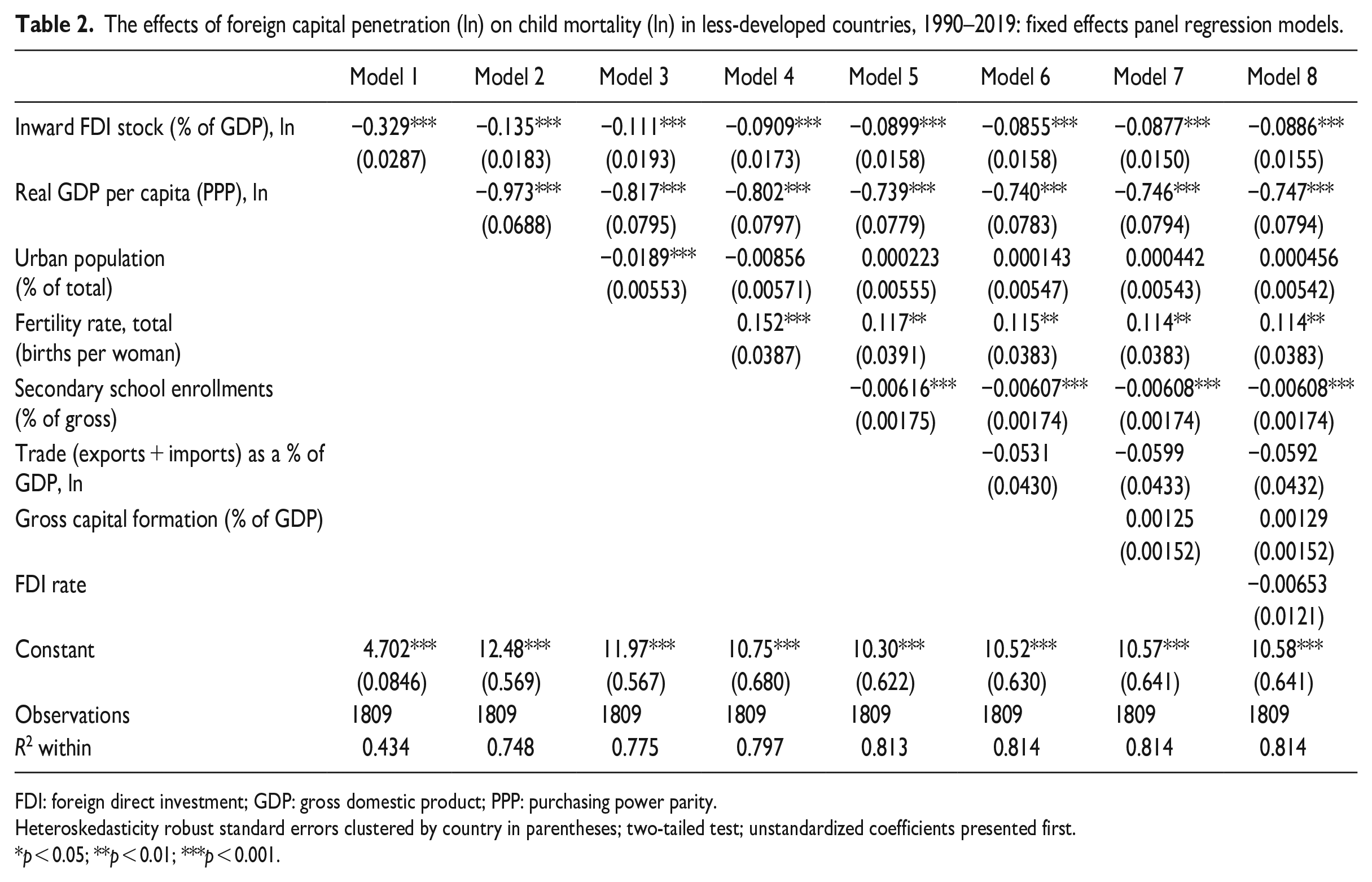
FDI: foreign direct investment; GDP: gross domestic product; PPP: purchasing power parity.
Heteroskedasticity robust standard errors clustered by country in parentheses; two-tailed test; unstandardized coefficients presented first.
p < 0.05; **p < 0.01; ***p < 0.001.
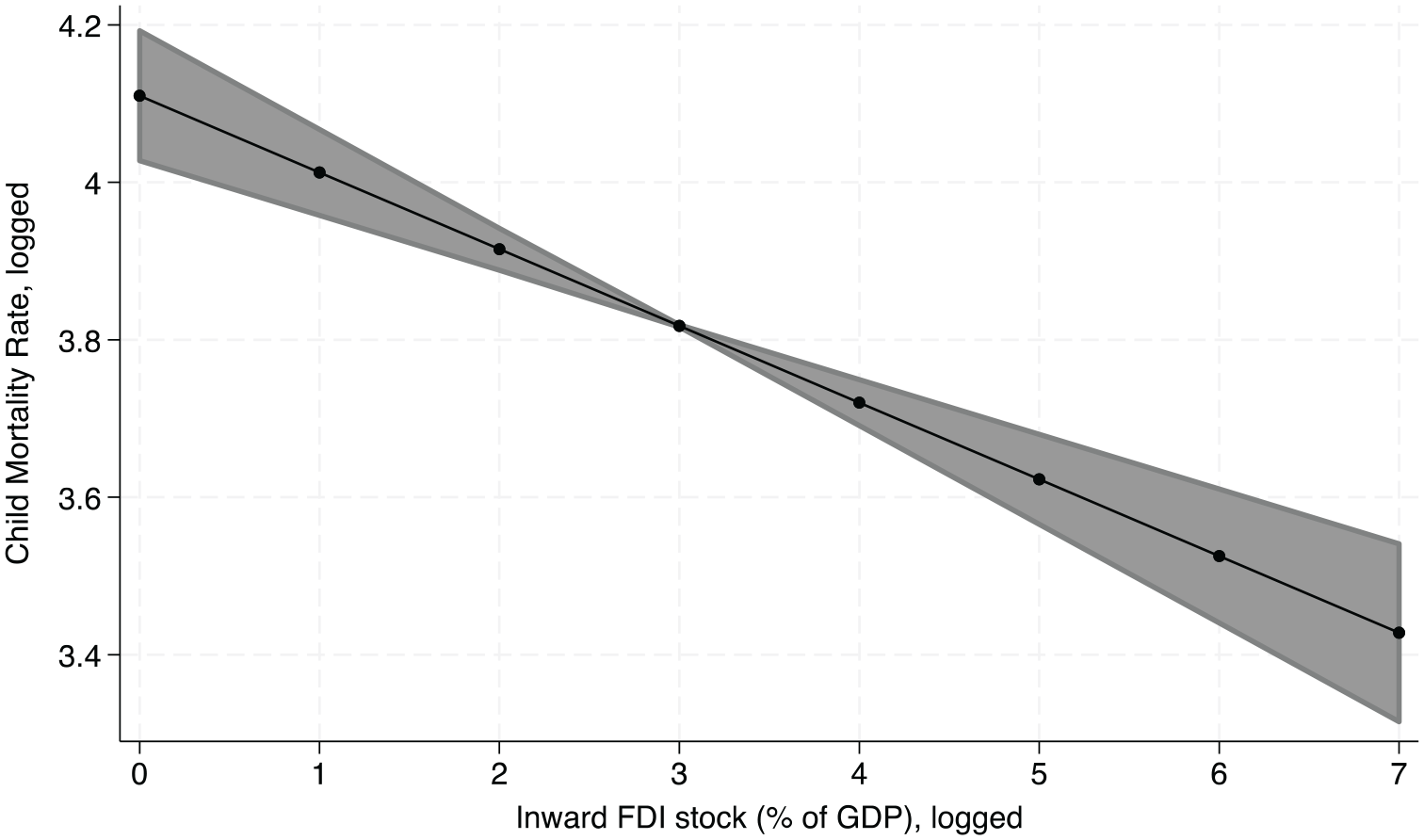
Predicted value of child mortality (with 95 CIs) given values of inward FDI stock (% of GDP).
I now turn to concisely unpacking the results from the robustness checks presented in Tables 3 to 11. These tables report analyses that include a variety of model specifications per the helpful suggestions of six anonymous reviewers. Throughout the analyses reported in Table 3, inward FDI stock appears to be consistently inversely associated with child mortality in less-developed countries. The rule of law and control of corruption do not appear to impact child mortality in less-developed countries. Among the interaction terms with various world regions, the East Asia & Pacific interaction term is statistically significant. However, an F-test of the direct effect and interaction term did not reach statistical significance, suggesting that inward FDI stock does not exert a significant effect in the East Asia and Pacific region. The Europe and Central Asia interaction term is significant and an F-test of the direct effect plus the interaction term reached statistical significance, indicating that inward FDI stock has a larger effect in this specific world region (I offer some theorization of these effects below). Table 4 includes additional suggested covariates: interaction terms between other world regions (Models 1–4), international health non-governmental organizations (HINGOs) (Model 5), and inward FDI flow as a percentage of GDP (Model 6). In Model 3 of Table 4, I find a significant interaction term between inward FDI stock and the South Asia region. An F-test of the direct effect of inward FDI stock and the interaction term did not reach statistical significance (inward FDI stock + inward FDI stock × South Asia), suggesting that inward FDI stock does not have an effect in the South Asia region. The findings reported in Tables 3 and 4 regarding interactions with specific world regions deserve more extensive theorization in a future analysis, but it could be that dynamics of the world economy are changing where FDI has beneficial implications or null impacts for specific regions of the Global South rather than having a uniform beneficial impact in less-developed countries. In Model 5 of Table 4, I find support for world society theory (e.g. Cole et al., 2023; Meyer et al., 1997; Zapp, Frank, and Marquez 2023; Mejia 2020), where HINGOs are inversely associated with child mortality. It appears that inward FDI stock as a percentage of GDP continues to be associated with decreases in child mortality in less-developed countries, per Model 6 of Table 4.
The effects of foreign capital penetration (ln) on child mortality (ln) in less-developed countries, 1990–2019.
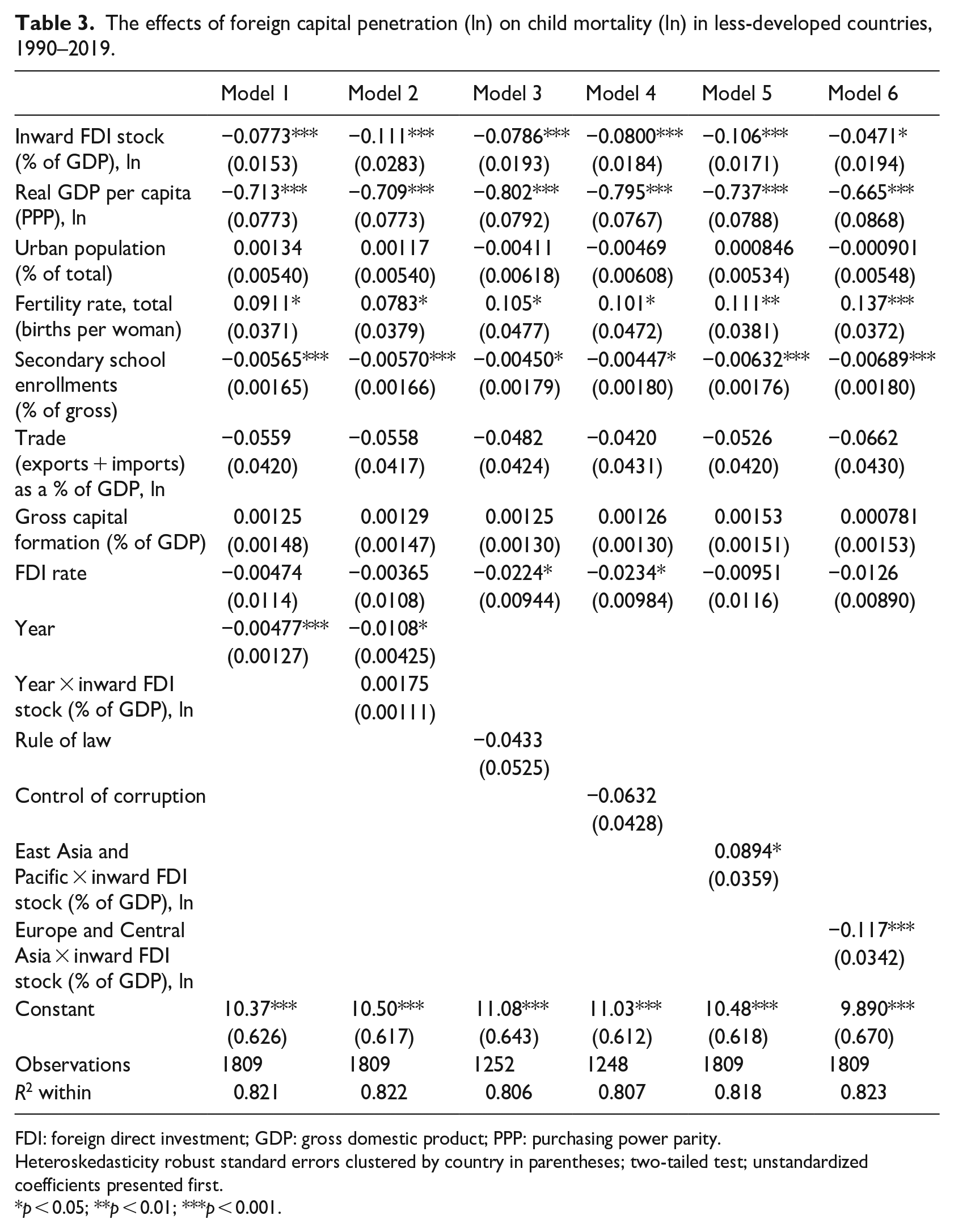
FDI: foreign direct investment; GDP: gross domestic product; PPP: purchasing power parity.
Heteroskedasticity robust standard errors clustered by country in parentheses; two-tailed test; unstandardized coefficients presented first.
p < 0.05; **p < 0.01; ***p < 0.001.
The effects of foreign capital penetration (ln) on child mortality (ln) in less-developed countries: fixed effects panel regression models, 1990–2019.
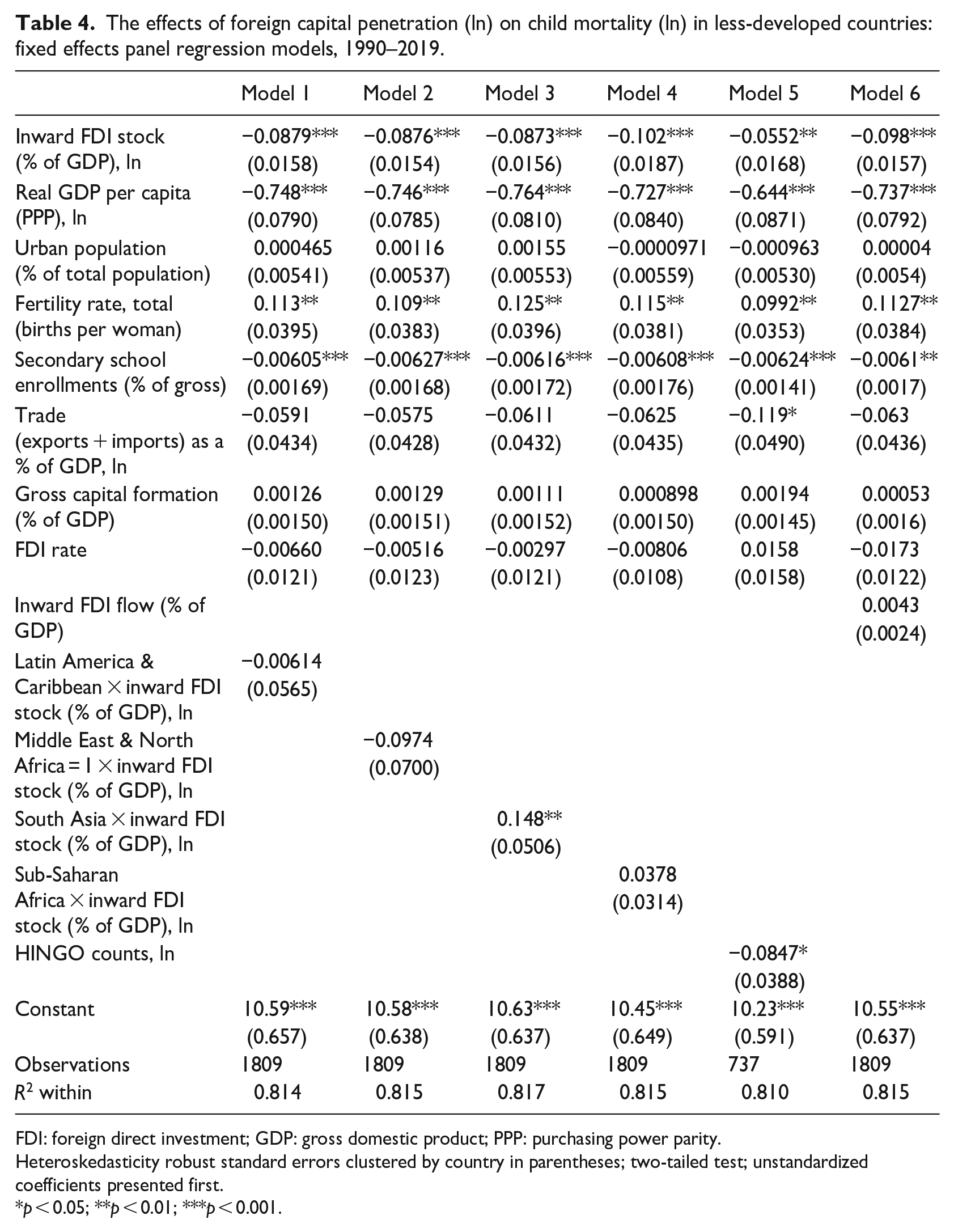
FDI: foreign direct investment; GDP: gross domestic product; PPP: purchasing power parity.
Heteroskedasticity robust standard errors clustered by country in parentheses; two-tailed test; unstandardized coefficients presented first.
p < 0.05; **p < 0.01; ***p < 0.001.
Unstandardized coefficients from fixed effects panel regression models.
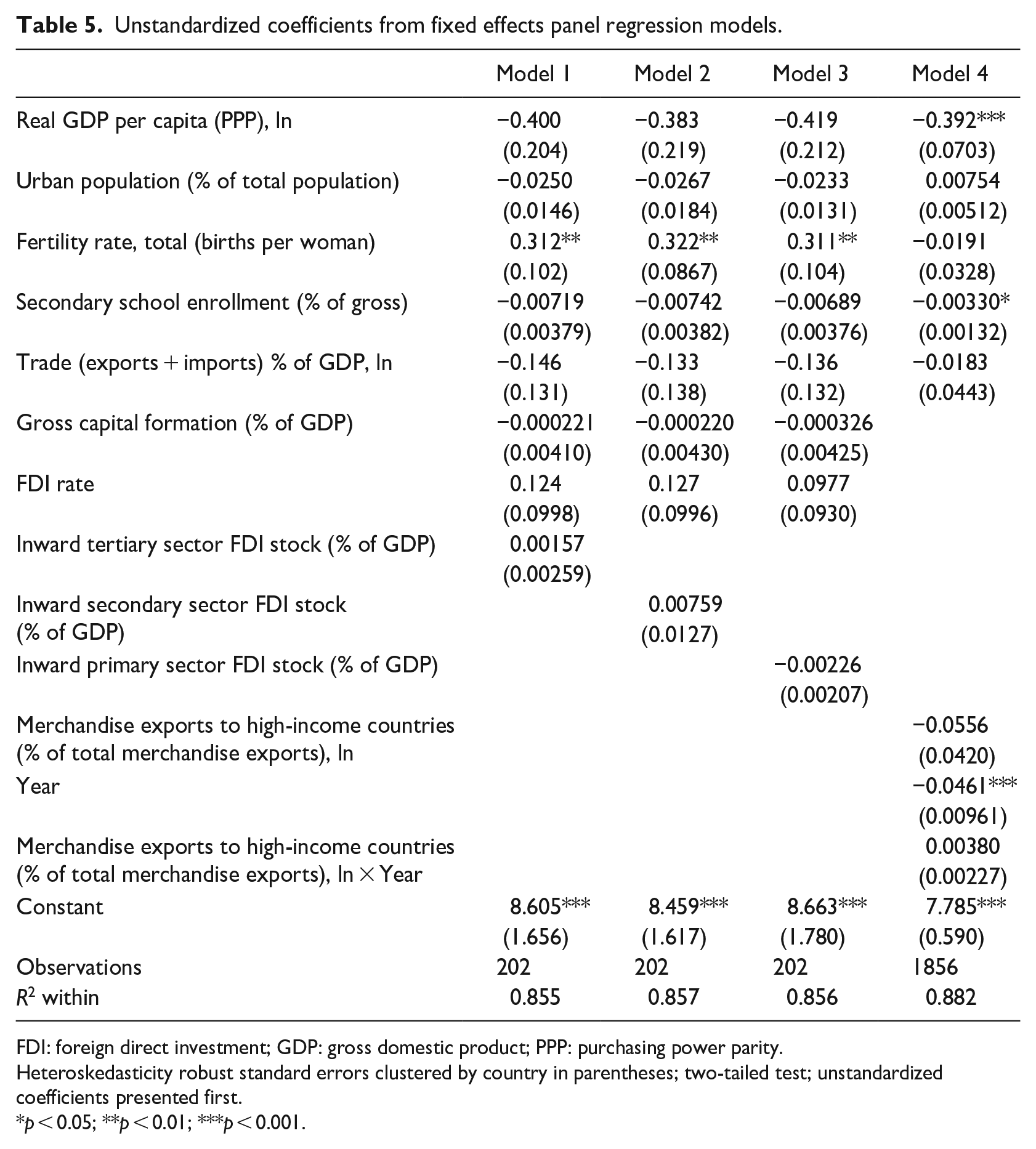
FDI: foreign direct investment; GDP: gross domestic product; PPP: purchasing power parity.
Heteroskedasticity robust standard errors clustered by country in parentheses; two-tailed test; unstandardized coefficients presented first.
p < 0.05; **p < 0.01; ***p < 0.001.
Unstandardized coefficients from fixed effects panel regression models.
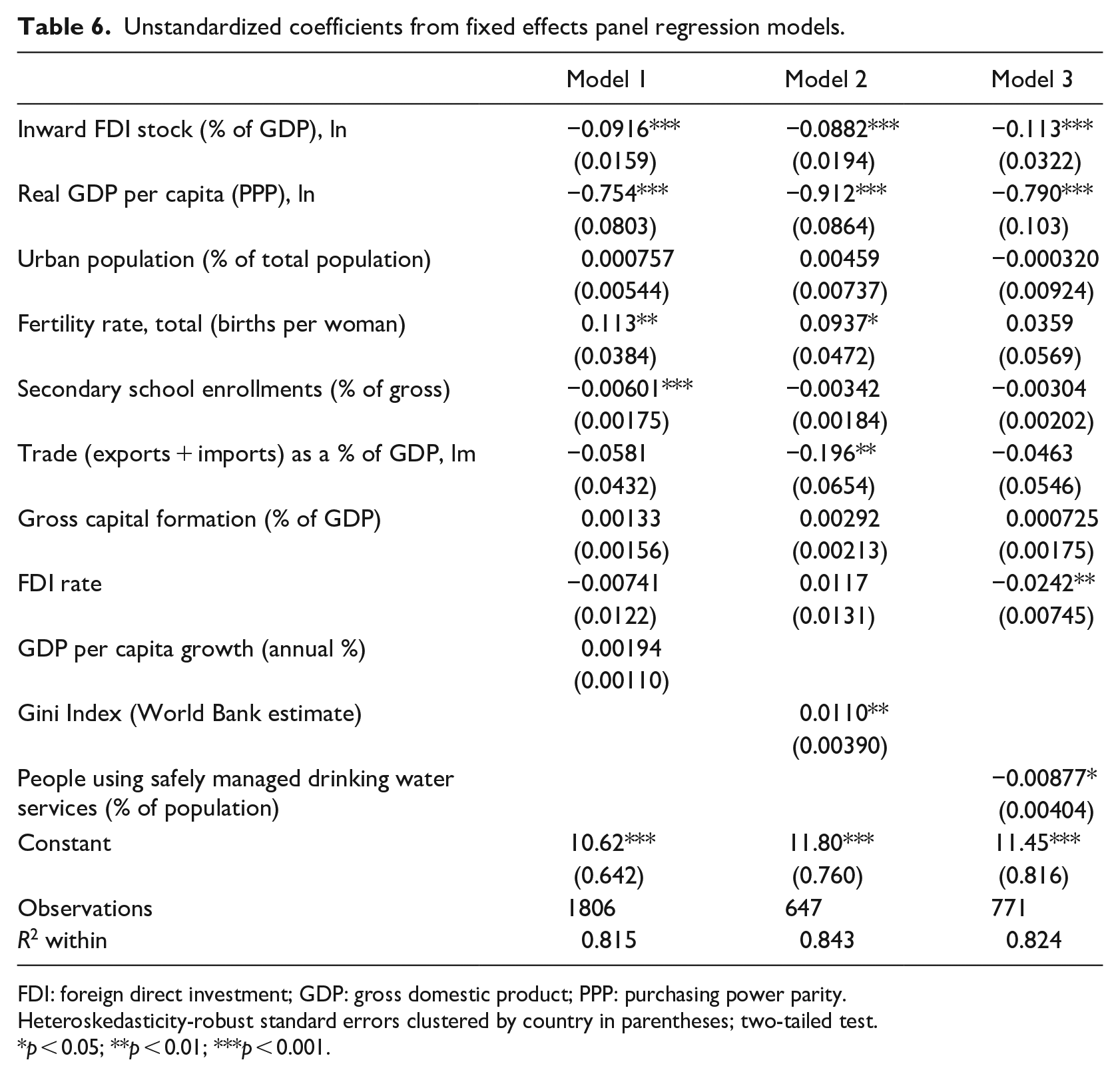
FDI: foreign direct investment; GDP: gross domestic product; PPP: purchasing power parity.
Heteroskedasticity-robust standard errors clustered by country in parentheses; two-tailed test.
p < 0.05; **p < 0.01; ***p < 0.001.
Unstandardized coefficients from fixed effects panel regression models.
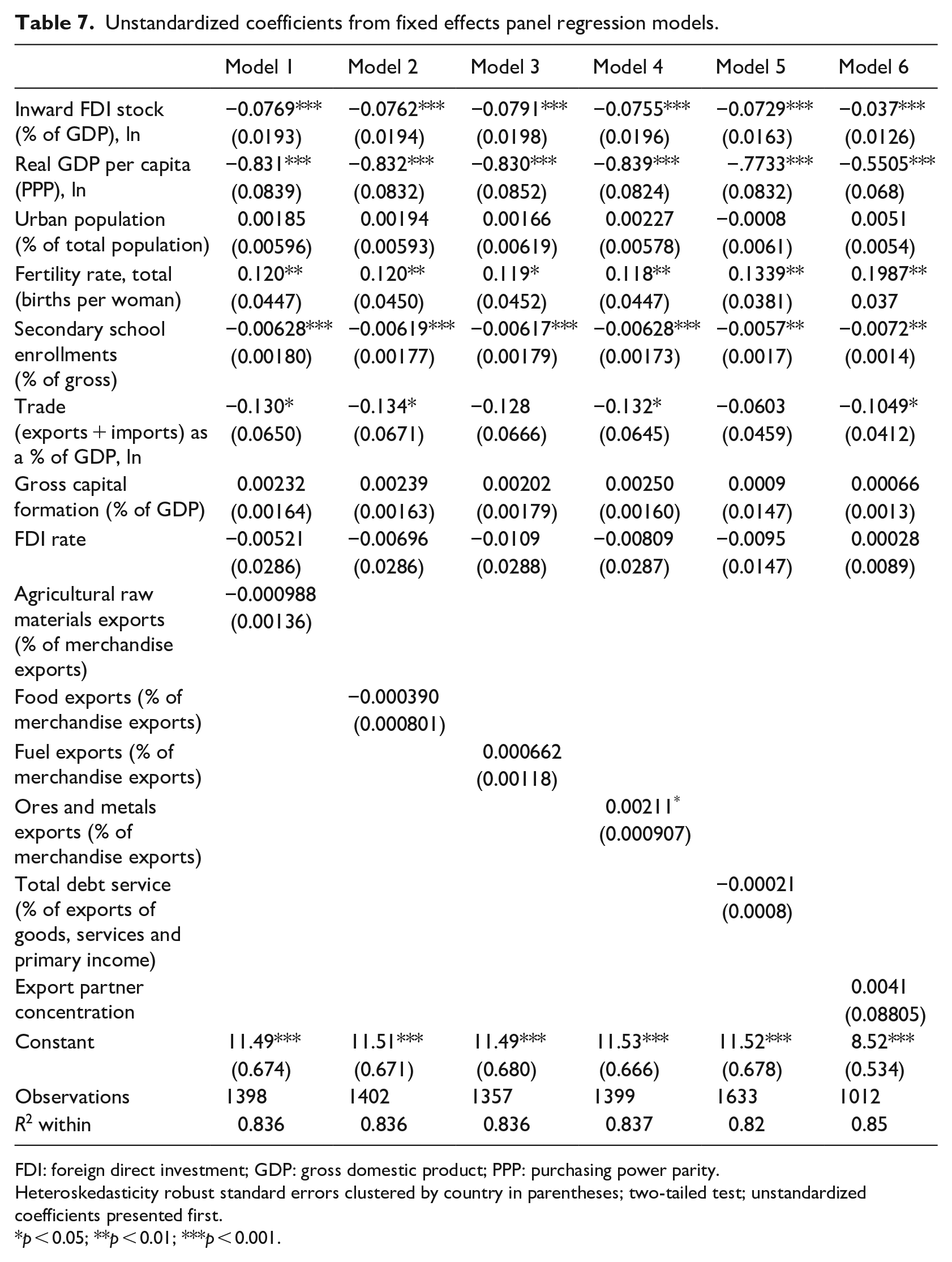
FDI: foreign direct investment; GDP: gross domestic product; PPP: purchasing power parity.
Heteroskedasticity robust standard errors clustered by country in parentheses; two-tailed test; unstandardized coefficients presented first.
p < 0.05; **p < 0.01; ***p < 0.001.
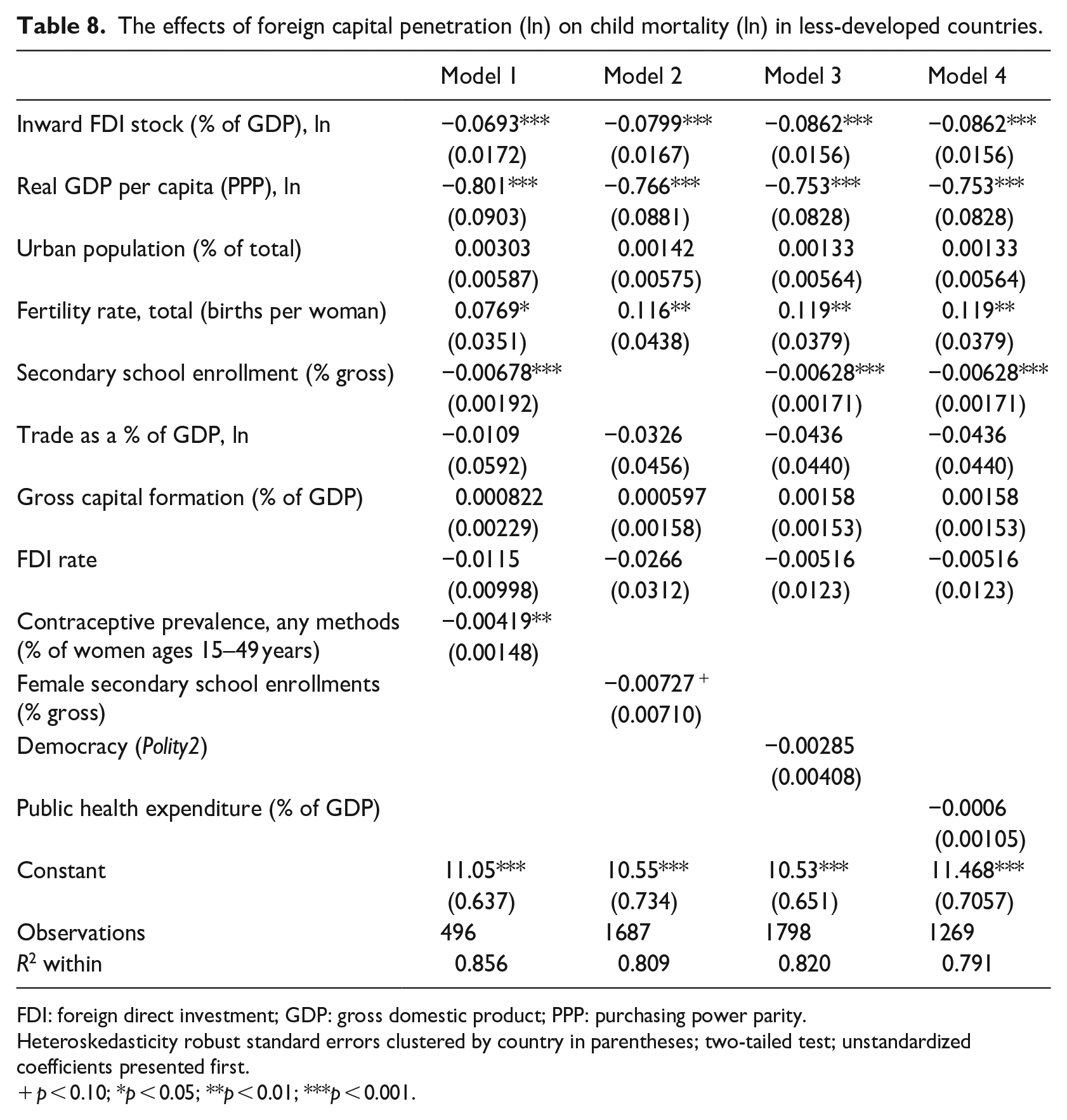
The effects of foreign capital penetration (ln) on child mortality (ln) in less-developed countries.
FDI: foreign direct investment; GDP: gross domestic product; PPP: purchasing power parity.
Heteroskedasticity robust standard errors clustered by country in parentheses; two-tailed test; unstandardized coefficients presented first.
p < 0.10; *p < 0.05; **p < 0.01; ***p < 0.001.
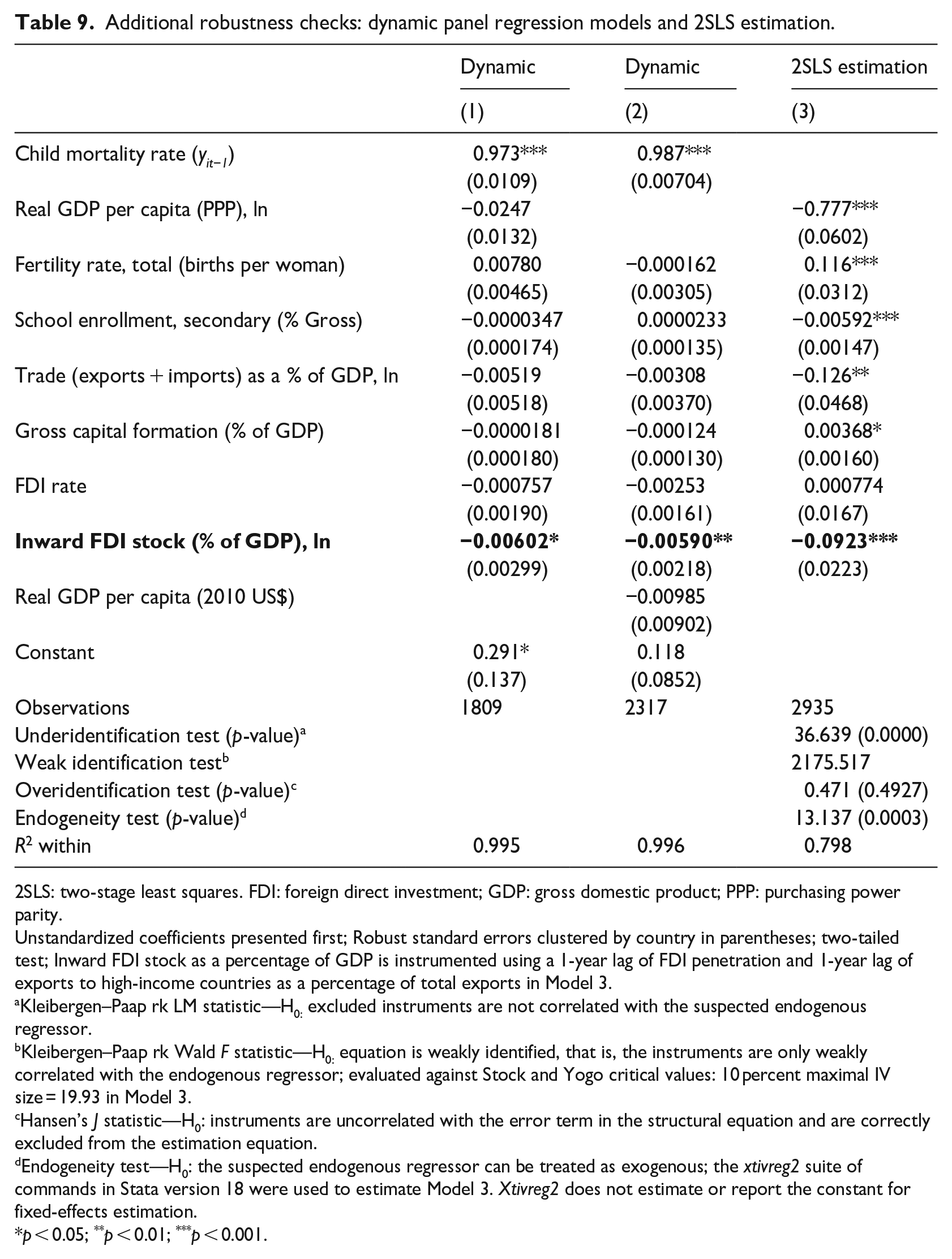
Additional robustness checks: dynamic panel regression models and 2SLS estimation.
2SLS: two-stage least squares. FDI: foreign direct investment; GDP: gross domestic product; PPP: purchasing power parity.
Unstandardized coefficients presented first; Robust standard errors clustered by country in parentheses; two-tailed test; Inward FDI stock as a percentage of GDP is instrumented using a 1-year lag of FDI penetration and 1-year lag of exports to high-income countries as a percentage of total exports in Model 3.
Kleibergen–Paap rk LM statistic—H0: excluded instruments are not correlated with the suspected endogenous regressor.
Kleibergen–Paap rk Wald F statistic—H0: equation is weakly identified, that is, the instruments are only weakly correlated with the endogenous regressor; evaluated against Stock and Yogo critical values: 10 percent maximal IV size = 19.93 in Model 3.
Hansen’s J statistic—H0: instruments are uncorrelated with the error term in the structural equation and are correctly excluded from the estimation equation.
Endogeneity test—H0: the suspected endogenous regressor can be treated as exogenous; the xtivreg2 suite of commands in Stata version 18 were used to estimate Model 3. Xtivreg2 does not estimate or report the constant for fixed-effects estimation.
p < 0.05; **p < 0.01; ***p < 0.001.
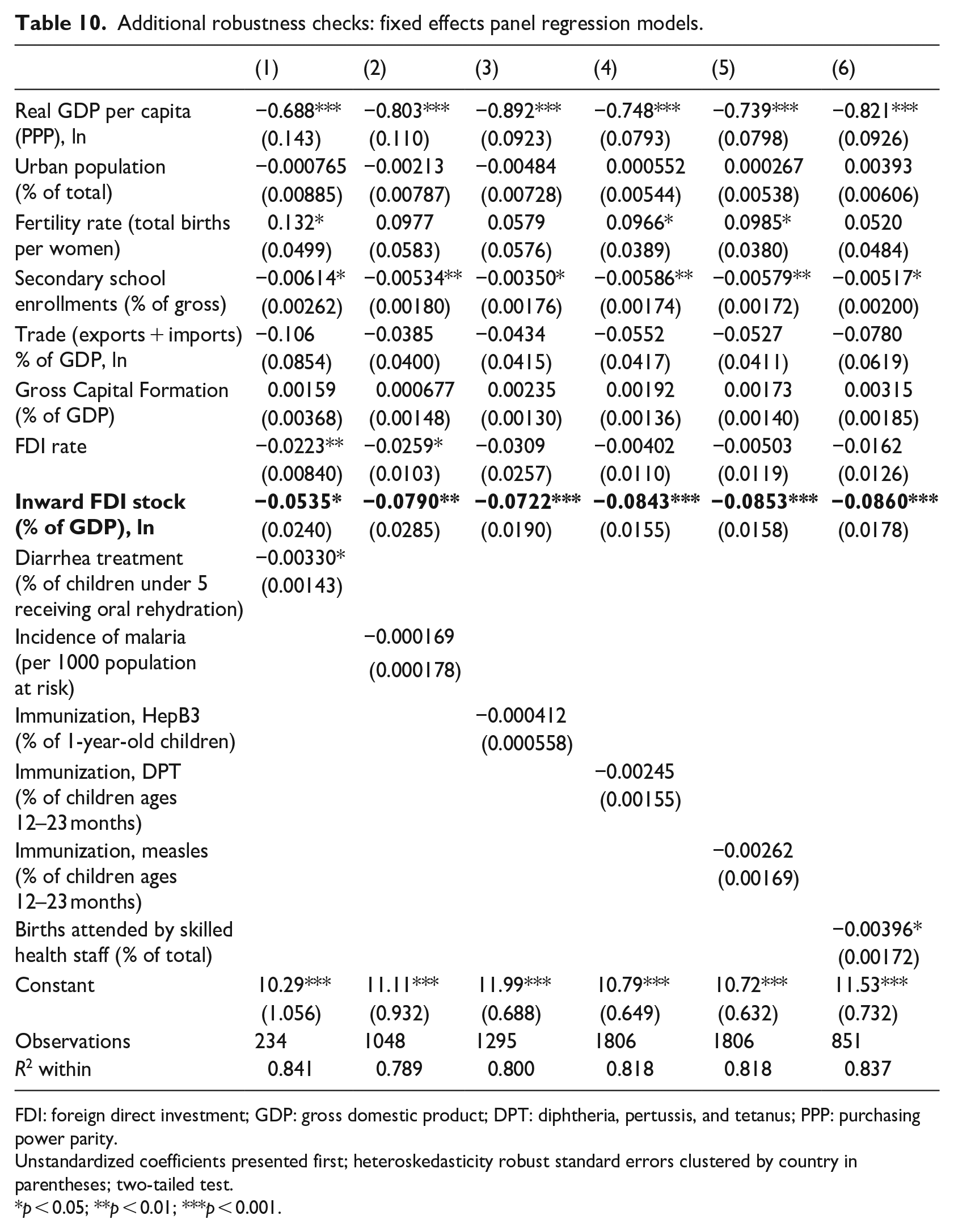
Additional robustness checks: fixed effects panel regression models.
FDI: foreign direct investment; GDP: gross domestic product; DPT: diphtheria, pertussis, and tetanus; PPP: purchasing power parity.
Unstandardized coefficients presented first; heteroskedasticity robust standard errors clustered by country in parentheses; two-tailed test.
p < 0.05; **p < 0.01; ***p < 0.001.
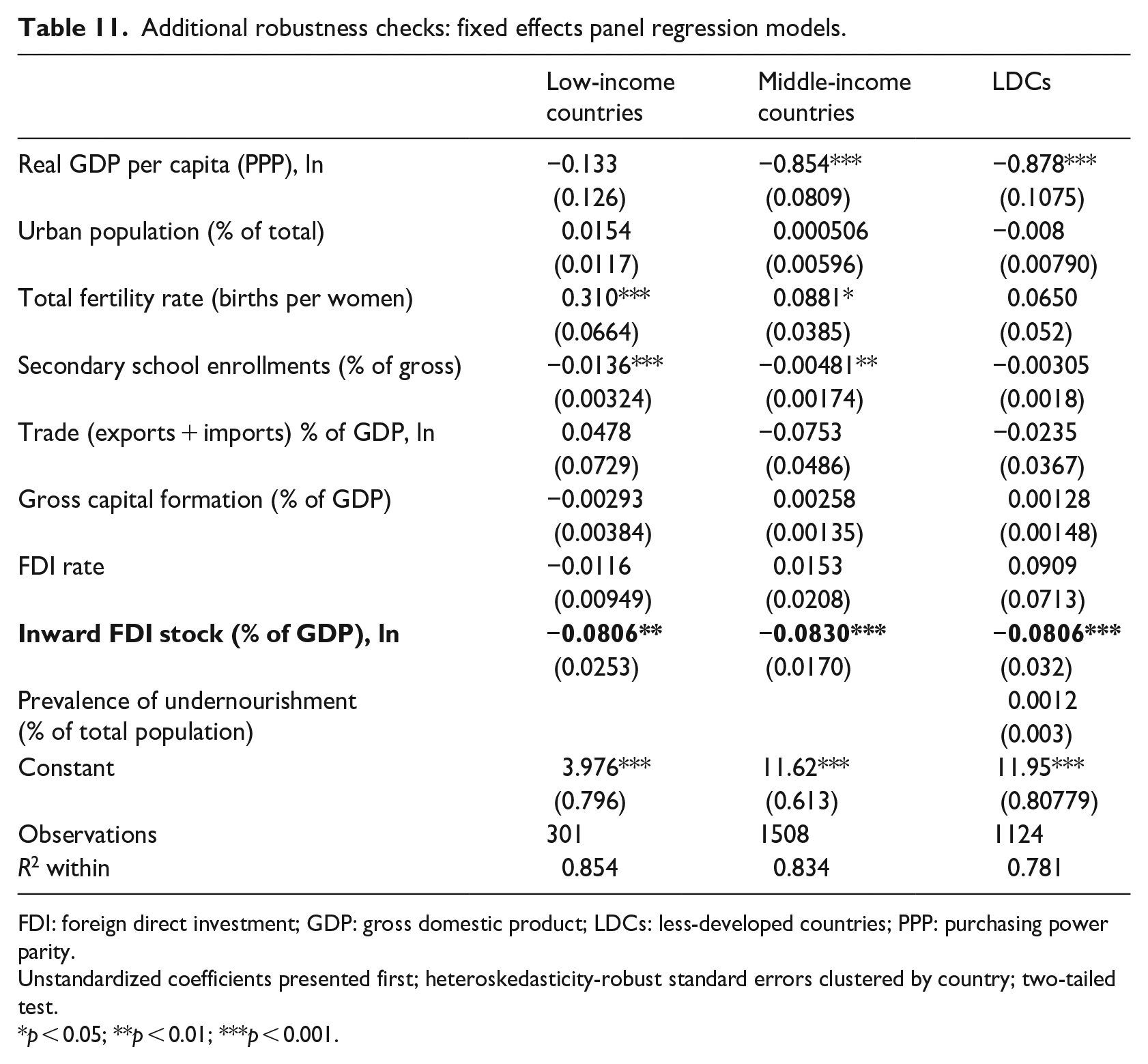
Additional robustness checks: fixed effects panel regression models.
FDI: foreign direct investment; GDP: gross domestic product; LDCs: less-developed countries; PPP: purchasing power parity.
Unstandardized coefficients presented first; heteroskedasticity-robust standard errors clustered by country; two-tailed test.
p < 0.05; **p < 0.01; ***p < 0.001.
Table 5 incorporates sector-specific measures of inward FDI stock, per the International Trade Centre. Each measure of sector-specific inward FDI stock does not appear to be statistically associated with child mortality in less-developed countries, but it should be noted this source of data, while used in more contemporary analyses of sector-specific FDI (Long et al., 2017; Mejia, 2022c) is incredibly sparse. Thus, caution should be made when making broader inferences about the impact of sector-specific FDI on child mortality as much more expansive cross-national and longitudinal data are needed for social scientists to make more definitive conclusions about these complex relationships. Per an anonymous reviewer’s interest specifically in this measure, the vertical flow of exports from developing countries to high-income countries and the interaction term with year do not appear to be statistically associated with child mortality in less-developed countries. The year dummy variable is negative in direction and statistically significant, indicating that time has a significant impact on child mortality in less-developed countries. Turning to Table 6, inward FDI stock appears to remain inversely associated with child mortality in less-developed countries, net of these additional robustness checks. Economic growth does not reach statistical significance, while increases in income inequality exert harmful impacts on child mortality. People using safely managed drinking services is inversely associated with child mortality, which suggests that access to drinking services can save children’s lives in less-developed countries. Turning to Table 7, I continue to observe that inward FDI stock is inversely associated with child mortality in less-developed countries throughout Table 7. However, some important findings emerge from these robustness checks: ore and metal imports appear to be the only measure of trade that exerts a significant effect on child mortality. These results regarding this measure of trade thus contribute to an emerging body of literature suggesting that dynamics of international trade exert harmful effects on numerous important outcomes (e.g. Mejia, 2022a, 2023a; Sommer et al., 2020, 2021). Total debt service does not appear to be individually statistically associated with child mortality in less-developed countries, which differs from the findings of more recent research on debt dependence (Mejia 2023b).
I now turn to Table 8. Out of the control variables from these robustness checks reported in Table 8, only contraceptive prevalence exerts a beneficial impact on child mortality. This could be because increases in the use of contraceptives decrease the number of children being born into an already resource-scarce family, which then decreases the chances for preventable child deaths. Female secondary school enrollments do not reach statistical significance here, but it should be noted that this unstandardized coefficient has a p-value of 0.051. Democracy and public health expenditures do not appear to independently exert a significant effect on child mortality, which differs from findings suggesting these covariates have implications for child mortality (Mejia, 2022a; Sommer et al., 2015). Inward FDI stock (% of GDP) appears to be inversely associated with child mortality in less-developed countries.
Table 9 reports additional robustness checks on the issues of reverse causality and endogeneity per an anonymous reviewer. One way of addressing reverse causality is including a lagged value of the dependent variable as a covariate. Doing so violates the strict exogeneity assumption of FE estimation (Wooldridge, 2009), but the resulting Nickell bias (Nickell, 1981) diminishes as T (the number of years in a sample) increases and becomes inconsequential as T reaches 30 (Schofer and Longhofer, 2011). With essentially 30 years in the central analyses, the inclusion of a 1-year lag of child mortality does not bias the results reported in Model 1 of Table 9, but, as an extra precaution, I estimated models that have a temporal scope of 1980–2019 (T = 39). The central analyses range from 1990 to 2019 because I use real GDP per capita in PPP dollars and such data begin in 1990 (this measure of GDP per capita is more appropriate for analyses of social welfare in less-developed countries), but the real GDP per capita in US dollar data begins in 1980, thus allowing for an additional 10 years of data to be analyzed. The results from these dynamic panel regression models are reported in Models 1 and 2 of Table 9, respectively. The substantial findings appear to hold: inward FDI stock is inversely associated with child mortality in less-developed countries.
Another issue in the econometric analysis of panel data is endogeneity, where the suspected endogenous covariate (here, inward FDI stock) is potentially correlated with the idiosyncratic error term. Conducting 2SLS estimation hinges on having appropriate instrumental variables that meet two criteria (Wooldridge, 2009): instrument exogeneity and instrument relevance. I use a 1-year lag of inward FDI stock (% of GDP) and a 1-year lag of the merchandise exports to high-income countries (% of total merchandise exports) measure from the World Bank’s (2021) World Development Indicators as instruments for the suspected endogenous covariate (inward FDI stock as a % of GDP). In two-stage least squares (2SLS) estimation, the potentially endogenous variable (in this case, FDI penetration) is regressed on the exogenous covariates and the selected instrumental variables in the first stage (Wooldridge, 2009). In the second stage, the response variable (here, child mortality) is regressed on the exogenous covariates and potentially endogenous variable (FDI penetration), although, in the second stage, FDI penetration is replaced with the fitted values of FDI penetration from the first stage (Wooldridge, 2009). It is also important to statistically test for instrument exogeneity (uncorrelated with the error term) and instrument relevance (correlated with the FDI penetration measure) (Wooldridge, 2009). The diagnostics reported in Model 3 of Table 9 confirm that the selected instruments meet instrumental variable criteria. I reject the null hypothesis of zero correlation between the excluded instruments and the suspected endogenous variable (Kleibergen–Paap rk LM statistic 36.639 and p-value of 0.0000). It appears that the instruments are sufficiently correlated with the potentially endogenous variable (FDI penetration) as the Kleibergen–Paap rk Wald F statistic is 2175.517, which is above the conventional threshold of 10 (Stock et al., 2002) and above the Stock–Yogo weak ID test critical values (10% maximal IV size of 19.93 in Model 3). The overidentification test evaluates the joint null hypothesis of instrument exogeneity and that the excluded instruments are correctly excluded from the estimated equation. I fail to reject this null hypothesis (Hansen’s J statistic is 0.471; p-value is 0.4927). Results from Model 3 of Table 9 indicate that inward FDI stock as a percentage of GDP is inversely associated with child mortality in less-developed countries, net of relevant statistical controls.
Table 10 reports additional robustness checks per editorial suggestions to control for factors deemed relevant by public health literature. I continue to find that inward FDI stock (% of GDP) is inversely associated with child mortality in less-developed countries in Models 1–6 of Table 11. Diarrhea treatment appears to be inversely associated with child mortality. This finding makes sense as, in less-developed countries, child mortality can be prevented with basic interventions. Increases in diphtheria, pertussis, and tetanus, measles, and hepatitis B vaccinations do not appear to be associated with child mortality. Births attended by skilled staff, however, appear to be inversely associated with child mortality as arguably predicted by public health literature. Table 11 reports analyses of middle-income and low-income countries specifically per the suggestions of an anonymous reviewer. Inward FDI stock (% of GDP) continues to be inversely associated with child mortality in less-developed countries. Public health literature suggests that undernourishment is a major cause of undernourishment, but I do not find empirical support for these sentiments, according to Model 3 of Table 11.
Discussion and conclusion
The central contribution of this analysis is the finding that FDI exerts beneficial impacts on child mortality in less-developed countries. Important work has been done on the issue I focus on here, but this analysis improves upon the limitations of previous research on the same topic. I include a more accepted measure of foreign capital penetration (inward FDI stock / GDP rather than the PEN measure or inward FDI flow) than previous research (e.g. Burns et al., 2017; Wimberley, 1990). Second, I analyze more contemporary cross-sectional longitudinal data than previous research (e.g. Burns et al., 2017; Shandra et al., 2005; Wimberley, 1990). Third, contrary to much of the previous research on the topic I focus on here, I estimate panel regression models that account for unobserved heterogeneity. Not accounting for unobserved heterogeneity causes bias in pooled OLS regression estimates (Wooldridge, 2009: 457). Fourth, I use much more expansive cross-sectional longitudinal data than much of the previous research on the same topic. Fifth, and perhaps most importantly, I account for the methodological concerns expressed by Firebaugh (1992). It is difficult to identify why the results presented here differentiate from the findings of classic dependency studies (e.g. Shandra et al., 2005) and one cannot safely make such inferences from this cross-national, longitudinal statistical analysis, but these improvements over previous literature provide some possibilities.
This analysis makes numerous contributions to the sociology of health, global and transnational sociology, political-economic sociology, and the comparative international social sciences more broadly. First, this analysis illustrates how macro-sociological approaches to the study of health can finetune our understanding of issues such as child mortality in less-developed countries, where analysis results illustrate how particular aspects of economic globalization affect national-level health outcomes. Second, I engage sociological debates regarding global economic integration. Without a doubt, one of the most intensely debated forms of world economic integration is foreign capital penetration (e.g. Bornschier and Chase-Dunn, 1985; Chase-Dunn, 1975; c.f. Firebaugh, 1992, 1996; Dixon and Boswell, 1996; Kentor, 1998, 2001). I contribute to this ongoing debate and area of scholarly discussion by investigating the effect of foreign capital penetration on child mortality in developing countries. Results indicate that foreign capital penetration is inversely associated with child mortality in developing countries, which contradicts the findings of previous research and provides support for neoclassical economic theory (e.g. Shandra et al., 2005; Wimberley, 1990). The central contribution of this analysis is thus that I contribute to an emerging body of comparative international work suggesting that traditional sociological measures of FDI—in some cases—exert beneficial effects in less-developed countries (Chiappini et al., 2022; Herzer and Nunnenkamp, 2012; Mejia, 2022b, 2023c). More recent studies also appear to find that FDI exerts beneficial effects on similar measures of mortality (e.g. Alam et al., 2016; Burns et al., 2017; Chiappini et al., 2022; Sommer, 2022), but I posit that more research is needed to give even further confidence to the findings I present here or contradict them. Also, additional qualitative research is needed to untangle how foreign investment affects the country-level health outcomes I focus on in this analysis. It is the author’s hope that this analysis helps reinvigorate scholarly dialogue regarding the impacts of foreign investment on social welfare in developing countries. Indeed, informing policy that improves the lives of marginalized populations should be at the heart of comparative international development studies.
There are other noteworthy findings worth discussing. I consistently find that economic development is inversely associated with child mortality in developing countries, which is quite consistent with the theoretical predictions of modernization theory and previous cross-national research (e.g. Brady et al., 2007; Clark, 2011; Cole, 2019; Firebaugh and Beck, 1994; Shandra et al., 2005). I also find that total fertility exerts a statistically significant positive effect on child mortality, which aligns with the findings of previous cross-national research (e.g. Shandra et al., 2010). Also corresponding with the findings of previous research, secondary school enrollments as a percentage of gross is inversely associated with child mortality in developing countries. I consistently find that domestic investment does not exert a statistically significant effect on all three mortality measures, which is quite surprising considering that I consistently find that foreign investment is inversely associated with child mortality. FDI rate does not exert a statistically significant effect on child mortality.
Analysis findings engage multiple scholarly discussions in comparative international research and the social sciences more broadly. I engage debates concerning the intranational factors affecting child mortality in developing countries. For example, there is debate concerning the effect of economic development, fertility, and education on social welfare outcomes in developing countries (e.g. Brady et al., 2007; Clark, 2011; Firebaugh and Beck, 1994; Fuchs et al., 2010; Kentor, 2001; Shorette and Burroway, 2022).
Another area of scholarly debate concerns itself with the effect of trade on social welfare outcomes in developing countries. Classic scholarship (e.g. Ricardo, 1817) posits that trade can increase economic development as developing countries pursue their “comparative advantage” in the global economy. The positive association between trade and economic development then affects social welfare in less-developed countries. World-systems analysis/dependency theory, however, posit that less-developed countries are subjugated to the least profitable production processes in the world-system (Wallerstein, 2004). In addition, the products less-developed countries import are overvalued while their exports are undervalued, which is a process called unequal exchange (Emmanuel, 1972). Other world-systems analysis/dependency theorists suggest that there is also an ecological unequal exchange occurring through trade, which hampers future development opportunities in less-developed countries (e.g. Bunker, 1985). While some quantitative cross-national research finds that trade is positively associated with hunger in less-developed countries (e.g. Austin, McKinney, and Thompson, 2012), I contribute to this area of social scientific inquiry by investigating the effect of other measures of global political economic integration on social welfare outcomes. I find that export intensity and export partner concentration do not exert a statistically significant effect on child mortality in less-developed countries. Numerous indicators of export commodity concentration have null effects on child mortality, but I find that ore and metal exports are positively associated with child mortality in less-developed countries. The central findings of this analysis indicate that inward FDI stock exerts beneficial effects on child mortality, but I find empirical support for critical global political economic thought specifically with this measure of trade dependence.
There are other important points to clarify about the analysis. First are the limitations about what one can infer from a statistical analysis of the foreign capital penetration and child mortality relationship. I find that inward FDI stock is inversely associated with child mortality in less-developed countries, but it is important to note that such statistical association is essentially all that one can infer from the statistical analysis. Foreign capital penetration is one form of world economic integration and a facet of economic globalization, but one cannot infer that economic globalization as a whole is beneficial for less-developed countries. Indeed, there are numerous forms of global economic integration and supplementary analyses suggest that ore and metal exports are associated with increases in child mortality. Answering the broader question of whether economic globalization is beneficial or harmful is incredibly complex. Second is that it is the author’s hope that the analysis findings are not interpreted as a critique of foreign investment dependency theory. I find support for neoclassical economic theory here in the specific context of FDI, but other important work has found that foreign capital penetration exerts harmful effects on various important outcomes (e.g. Clark and Cason, 2015; Clark and Kwon, 2018; Long et al., 2017; Mejia 2021a, 2021c). With such findings, I thus advocate for a holistic view of the scholarly evidence when making broader inferences about the implications of FDI and economic globalization. The research question motivating this analysis is whether FDI is a boon or bane for child mortality in less-developed countries, but it is my view that answering the question of whether economic globalization in its entirety is a boon or bane is much more complicated than a zero-one dichotomy. Third are the theoretical contributions of the analysis. More social scientific research is needed on the impacts of FDI in less-developed countries before one can infer generalizable premises from the available empirical evidence, but I believe the theoretical contribution of this analysis is that our understanding of the impacts of foreign direct investment specifically might not be as monolith as commonly thought. Of course, this is not to say that foreign capital penetration always generates beneficial effects (see Clark and Cason, 2015; Clark and Kwon, 2018; Curwin and Mahutga, 2014; Mahutga and Bandelj, 2008), but evidence appears to be building that traditional sociological measures of FDI (inward FDI stock/GDP) can sometimes have beneficial implications for less-developed countries.
Supplemental Material
sj-docx-1-cos-10.1177_00207152231188405 – Supplemental material for Globalization, foreign direct investment, and child mortality: A cross-national analysis of less-developed countries, 1990–2019
Supplemental material, sj-docx-1-cos-10.1177_00207152231188405 for Globalization, foreign direct investment, and child mortality: A cross-national analysis of less-developed countries, 1990–2019 by Steven A. Mejia in International Journal of Comparative Sociology
Supplemental Material
sj-docx-2-cos-10.1177_00207152231188405 – Supplemental material for Globalization, foreign direct investment, and child mortality: A cross-national analysis of less-developed countries, 1990–2019
Supplemental material, sj-docx-2-cos-10.1177_00207152231188405 for Globalization, foreign direct investment, and child mortality: A cross-national analysis of less-developed countries, 1990–2019 by Steven A. Mejia in International Journal of Comparative Sociology
Supplemental Material
sj-docx-3-cos-10.1177_00207152231188405 – Supplemental material for Globalization, foreign direct investment, and child mortality: A cross-national analysis of less-developed countries, 1990–2019
Supplemental material, sj-docx-3-cos-10.1177_00207152231188405 for Globalization, foreign direct investment, and child mortality: A cross-national analysis of less-developed countries, 1990–2019 by Steven A. Mejia in International Journal of Comparative Sociology
Footnotes
Acknowledgements
The author thanks Evan Schofer, Wade M. Cole, David J. Frank, Ann Hironaka, and Andrew K. Jorgenson for assistance with the analysis. The author also thanks editor Phillip A. Hough and the six anonymous reviewers for very helpful suggestions to improve the article.
Funding
The author(s) received no financial support for the research, authorship, and/or publication of this article.

Supplemental material
Supplemental material for this article is available online.
References
Supplementary Material
Please find the following supplemental material available below.
For Open Access articles published under a Creative Commons License, all supplemental material carries the same license as the article it is associated with.
For non-Open Access articles published, all supplemental material carries a non-exclusive license, and permission requests for re-use of supplemental material or any part of supplemental material shall be sent directly to the copyright owner as specified in the copyright notice associated with the article.
