



Abstract
This study explores functions of labor market institutions in perpetuating earnings gap between different categories of workers with focusing on people’s views of earnings gap between regular and non-regular workers in Japan, South Korea, and the United States. An original cross-national factorial survey was conducted to measure the extent to which respondents admit earnings gap among workers with different characteristics. We found that Japanese and South Korean respondents tended to justify the earnings gap between regular and non-regular workers. In Japan, non-regular-worker respondents accepted the wide earnings gap against their economic interests, which was explained by assumed difference in responsibilities and on-the-job training opportunities. Specific institutional arrangements contribute to legitimating earnings gap between different categories of workers by attaching status value to the categories.
Keywords
Introduction
Contemporary scholarship of income inequality shows large inequalities in earnings based upon workers’ gender, education, and occupation (Budig et al., 2021; Mouw and Kalleberg, 2010). However, workers do not perceive all income gaps as indicative of income inequality as social problems. Numerous scholars have analyzed the conditions under which income gap becomes viewed as “legitimate” by the public at large. Some studies have used public opinion surveys to understand respondents’ opinions regarding income gaps between workers by their occupations (Kelley and Evans, 1993, 2009; Osberg and Smeeding, 2006). Other studies have analyzed data from factorial surveys that asked respondents to evaluate the level of earnings considered appropriate for fictitious workers with various attributes (Auspurg et al., 2017; Jasso, 1994; Shamon and Dülmer, 2014). These studies point out that people generally accept a certain amount of earnings differences between workers, which is commonly referred to as a “just earnings gap,” according to the amount of human capital required in an occupation (Kelley and Evans, 1993, 2009; Osberg and Smeeding, 2006). Assuming that it is difficult to solve income inequality when it is not regarded as problematic (Costa-Lopes et al., 2013), these studies suggest that some sorts of income inequality may be perpetuated through being legitimated on a certain condition, with earnings being the major source of income for a significant percentage of the population.
However, these studies have been inadequate in two ways in explaining how earnings inequality among workers is legitimized. First, few studies have examined the just earnings gap according to job-related factors other than occupation. Consequently, the possibility that the earnings gap based on other categorizations of workers, such as the distinction between workers with different labor contracts, that is, indefinite and fixed-term contracts, is regarded as legitimate, has not yet been fully examined. Second, existing studies have largely focused exclusively on a single country, such as the United States (US) and Germany, and only a handful of studies have conducted the international comparison of just earnings and legitimation of earnings inequality (Evans et al., 2010; Larsen, 2016; Osberg and Smeeding, 2006). Furthermore, these exceptional cross-national studies have focused on cross-national differences in the degree of the just earnings gap rather than differences in which characteristics of workers are allowed to cause earnings gaps. As we discuss in the next section, institutional factors provide conditions that make earnings gap between certain categories of workers perceived as legitimate. In other words, institutional factors function to “justify” earnings inequality. Therefore, further cross-national comparative studies among countries with different institutional arrangements are necessary to understand how earnings gap among various categories of workers is legitimized. 1
To fill this knowledge gap, we explore how labor-market-related institutional factors provide conditions where earnings gap between regular and non-regular workers with different labor contracts in Japan, South Korea, and the US seem legitimate to different extents. 2 The type of employment, namely, the distinction between regular and non-regular employment based on the difference in labor contracts, originally simply means different terms of contracts and working hours. However, how it is embedded in other institutions in society such as institutions on skill development and corporate welfare differs between these three countries. As discussed below, the way the type of employment is embedded in other institutions seems to attach different “status values” to the distinction between regular and non-regular employment to a large degree in Japan and to a weaker degree in South Korea; this is not observed in the US. We conducted factorial surveys in these three countries to obtain respondents’ evaluations of the just earnings of a fictious worker with different attributes, one of which is type of employment, that is, the distinction between regular employment with indefinite contract and non-regular employment with fixed-term contract. We examined whether the different institutional conditions of the three countries influence its citizens’ perceptions of just earnings of the two types of employment. Furthermore, we tested whether different status values attached to each type of employment mediate these relationships. Through these analyses, we obtained new knowledge on how institutional settings shape social groups which serve as units of inequality by attaching values to the different categories of workers and justifying earnings gaps between them. This study contributes to current scholarship on income inequality by suggesting that certain labor-market-related institutions shape and reproduce income inequality among different categories of workers through legitimating it. In other words, this study enhances our understanding, from a comparative perspective, of why income inequality between workers of specific characteristics is likely to be perpetuated in some countries.
Institutional arrangements and legitimation of earnings inequality
Theories on just earnings evaluation
Social identity theory and reward expectation theory are the main theories used to assess the amount of earnings that citizens perceive should be paid (hereinafter referred to as “just earnings”) to a person with specific characteristics or in specific positions. These two theories assume the basis of the people’s reaction to the earnings gap differently. Social identity theory (Shamon and Dülmer, 2014; Tajfel et al., 1971) assumes that people favor their in-group members over the out-group members to enhance their self-esteem as a group member. According to this theory, people are more likely to consider the higher earnings of others as just when they share particular characteristics with them. Some empirical studies have shown results that are consistent with the assumptions of social identity theory. For example, female respondents make more favorable allocations for a female over a male vignette than their male counterparts do 3 (Shamon and Dülmer, 2014).
Furthermore, other studies have found results that contradict social identity theory (Auspurg et al., 2017; Jasso, 1994); in these studies, both male and female respondents regard as just that the wages of men are higher than those of women. This shared view of the just earnings gap between male and female workers can be explained by reward expectation theory, which is based on status value theory (Berger et al., 1968, 1985; Ridgeway, 1991). According to status value theory, members of a disadvantaged group do not always consider having lower earnings than that of an advantaged group as unjust. When a characteristic that separates these two groups holds a status value shared in society, people perceive their lower wages as just. This shared perception of the different value of workers according to a state of a certain characteristic, that is, “consensual cultural belief” as conceptualized by Ridgeway (1991: 368), forms the reward expectation of how much workers should be paid according to their characteristics (Berger et al., 1985). When a certain state of characteristic involves a higher status value, workers with the less valued state of characteristic expect lower earnings than that of workers with the higher valued state. This is how disadvantaged group members perceive being paid lower wages than that of the advantaged group members as just.
According to Ridgeway (1991), this shared perception is rooted in the structure of a society; such a perception forms and spreads through “structurally constrained” everyday interactions (p. 370). Suppose there are two social groups in the society—Group A is in an advantageous position and Group B is a subordinate position. Thus, members of Group A have more resources than members of Group B; this helps the former to produce better results at work than the latter. Although Group A’s better outcomes are due to their advantageous position, people’s repeated experiences of superior results from Group A members create a shared perception that Group A members are more competent than Group B members. In summary, preceding differences in structural positions between groups, that is, structural inequality, create a shared perception that legitimates a wage gap between these social groups. In other words, institutions that form inequality function to justify and maintain it. Therefore, different characteristics are associated with different expectations among societies, and the structure of a just earnings gap differs between societies.
Reward expectation theory has limitations despite its potential to explain why disadvantaged people accept earnings inequality. It focuses on a shared perception associated with competence and ability. In other words, it assumes that people perceive earnings inequality as legitimate when this disparity reflects differences in productivity. However, this kind of equity is not the only principle for the basis of people’s evaluation of earnings distribution. For example, the family based need is supposedly one of the critical criteria for earnings distribution, although there is heterogeneity in the extent to which people regard it as important (Evans et al., 2010; Shamon and Dülmer, 2014). Moreover, according to the theory of compensating wage differentials, wages are also determined by the toughness and unpleasantness in performing a job (Rosen, 1986). An experimental study of status hierarchy in a small group showed that a member who is perceived to have group-oriented motivations and makes self-sacrifices for a group is positively evaluated by other group members; thus, such a member gains a status in the group (Willer, 2009). It suggests that people might think it just to reward workers who are perceived to accept poor working conditions, such as mentally and physically stressful activities and an inflexible work-time schedule. Therefore, we suggest that in addition to competence and ability, there is a need to extend the range of values attached to workers to discuss other domains of workers’ characteristics. Based on the discussion of the need-based or compensating wage differential, a shared perception that associates different amounts of family needs and different extents of demanding working conditions with a worker with a specific state of characteristic may shape reward expectations among workers.
Institutional justification of earnings gap between regular and non-regular workers
The current global socioeconomic conditions require organizations to be increasingly flexible. For the purpose, firms must increase the number of flexible workers, such as part-time and fixed-term employees who can be easily hired and fired depending on the economic situation (Buchholz et al., 2009; Kalleberg, 2000). These flexible workers are generally categorized as non-regular workers, in contrast to stable, regular workers.
The earnings of non-regular workers are much lower than that of regular workers in some countries. As the distinction between regular and non-regular employment originally implies only a difference in working conditions, such as flexibility and stability of employment, it does not necessarily generate an earnings gap between them. However, in Japan, for example, the earnings gap between regular and non-regular workers is significantly large as compared with that in other countries (Organisation for Economic Co-operation and Development (OECD), 2017). Such a large earnings gap between regular and non-regular workers can also be observed in South Korea, which has relatively similar labor market institutions (Shin, 2012). According to our analysis of the 2011–2012 data of The Program for the International Assessment of Adult Competencies (PIAAC), the ratio of the average earnings of non-regular workers with fixed-term, temporary, and apprentice contracts 4 to that of regular workers with indefinite contract is only 77.6 percent in South Korea and 79.0 percent in Japan, even after controlling for other conditions, such as gender, occupation, age, and education, while the same ratio is recorded at 92.7 percent in the US. 5
As we discussed in the “Introduction” section, earnings inequality is likely to be reproduced when it is justified (Costa-Lopes et al., 2013). Thus, the existence of a large earnings gap in Japan and South Korea may suggest that their institutional settings have generated the shared perception that attaches status value to the distinction between regular and non-regular employment, and the assumptions justify the earnings gap between them. To explore possible institutional settings that facilitate citizens’ acceptance of a large earnings gap between regular and non-regular workers, we first look into the institutional settings in Japan, subsequently examining those in South Korea and the US. We first look into Japan instead of South Korea because the earnings gap between regular and non-regular employment in the latter emerges between firms, especially between large firms with stable employment, and small firms with less stable employment (Jung, 2007). Conversely, it occurs mainly within firms rather than between firms in Japanese firms (Takahashi, 2018). Given such differences, Japan is more likely to have institutional settings justifying differentiated earnings between regular and non-regular workers as compared with that in South Korea.
Consequently, we focus on two mechanisms, namely, legitimation by different skills and competence and legitimation by different roles in a household, through which institutional conditions justify the earnings gap by attaching different assumptions to regular and non-regular employment in Japan. For each mechanism to work, we point out a main institutional factor, which generates the shared perception to justify the earnings gap between regular and non-regular employment, and a background institutional factor, which is a necessary condition for the main institutional factor to be able to justify the gap.
Legitimation by different skills and competence
The most valid reason to justify the earnings gap among workers will be the difference in the level of their skills and competence. We argue that one of the mechanisms of legitimating the earnings gap is that the assumed difference in skills and competence is attached to the positions of regular and non-regular employment, consequently justifying the earnings gap between them. The main institutional condition for this mechanism is whether the employment system generates an assumption about the different on-the-job training (OJT) opportunities and different competitiveness in recruitment between regular and non-regular workers, and the background institutional condition is whether or not the rigidly demarcated jobs are absent.
In Japan, the demarcation and assignments of jobs in the workplace are relatively fluid (Aoki, 1988). Therefore, workers are required to undertake different types of jobs depending on the needs at any given time. In such a setting, workers’ skills and competence cannot be evaluated based on the contents of their jobs, unlike in most Western countries. Rather, Japanese firms have determined wages for employees by directly evaluating their skills, particularly firm-specific skills acquired through OJT under the practice of long-term employment (Inagami and Whittaker, 2005; Koike, 1988). These facts are consistent with Marsden’s (1999) arguments on comparative employment systems, wherein the tasks are allocated, and consequently, the different wages are paid, in accordance with the employee’s competence rank in Japan. However, Japanese firms provide different opportunities for OJT according to the status of employment: Regular workers, who are expected to work for a long time with full commitment to the firm, can enjoy more OJT opportunities than non-regular workers with fixed-term labor contracts 6 (Sano, 2012). Furthermore, Japanese firms set a different selection process for regular and non-regular workers; this process is much more competitive for the former than for the latter to ensure that they hire highly qualified people who can develop their ability through OJT and handle various kinds of tasks in the firm.
In summary, employment systems in Japanese firms allocate more opportunities for skill development to regular workers than non-regular workers and set more rigorous standards for recruitment of regular workers than non-regular workers. Under the condition wherein employees’ skills and competence are evaluated not by their jobs but by their skills acquired through OJT under the absence of rigid demarcation and assignment of jobs, there may emerge the shared perception that the skills and competence of regular workers are much higher than those of non-regular workers, which justifies the earnings gap between the two types of workers. The case of Japan shows that the two institutional conditions, that is, the assumed difference in OJT opportunities and competitiveness in recruitment between regular and non-regular workers as the main condition and the absence of rigidly demarcated jobs as the background condition, are important for the earnings gap based on the type of employment to be justified by the difference in regular and non-regular workers’ skills and competence. We can conclude that both conditions are strongly met; therefore, the possibility that the earnings gap between regular and non-regular workers is justified through the above mechanism is expected to be high in Japan, as shown in the left half of Table 1.
Institutional conditions and possibility of legitimation of earnings gap between regular and non-regular employment.
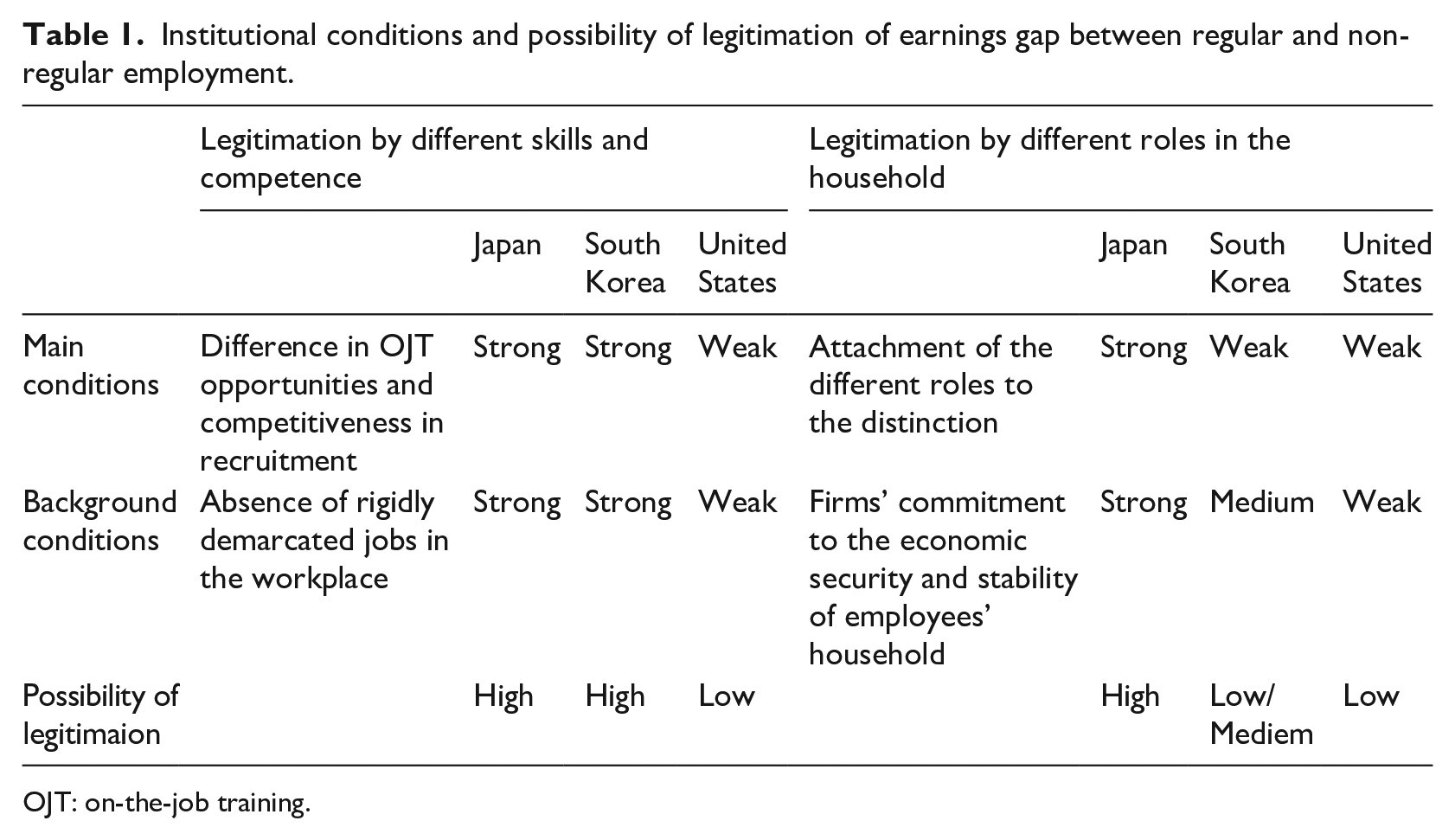
OJT: on-the-job training.
In South Korea, although the government has attempted to standardize jobs and the skills necessary to perform the jobs by developing the National Competency Standard (OECD, 2016), the job demarcation and assignment in the workplace is not significantly rigid and there is space for workers’ wages to be paid directly based on their personal skills and competence; this is partly because Korean firms have modeled their personnel system after that of Japan’s in the previous century (Ahn, 1982). Moreover, non-regular workers are recruited through a different process from regular workers and the selection process for regular workers is much more competitive than that for non-regular ones in large firms and the public sector in South Korea. Under these conditions, the possibility that the distinction between regular and non-regular employment is justified by the difference in employees’ skills and competence is also expected to be high. 7
In the US, firms can determine wages of employees directly based on their jobs rather than based on the estimation of their skills and competence, owing to the rigid job demarcation and assignments. Since employees’ skills and competence are already defined as job requirements, there may be little need to measure them and reflect them in the wages. This is harmonious with the fact that jobs are classified, and consequently wages are differentiated, by work post attributes in the US, while they are classified and differentiated by worker attributes, such as competence rank, in Japan (Marsden, 1999). Under the situation where job demarcation and assignments are rigid, the recruit process or OJT opportunities between regular and non-regular employment do not largely differ among those with the same job. Thus, the possibility that the assumed difference in skills and competence justifies the earnings gap between regular and non-regular employment is expected to be low in the US.
Legitimation by different roles in a household
The second possible mechanism is that the assumption of the different roles in a household, that is, the main breadwinner responsible for making a living and the auxiliary breadwinner responsible for doing housework, is attached to the positions of regular and non-regular employment, and different wages are paid to them according to the different roles. The main institutional condition for this mechanism is whether the different roles in a household are attached to the distinction between regular and non-regular employment, and the background institutional condition is whether firms have strong commitment to the economic security and stability of employees’ households.
One source of the different roles in a household is the gender division of labor, wherein the female member of the couple does housework and childcare, while the male member is responsible for financially supporting the family. If married females enter the labor markets as part-time or fixed-term workers, which are compatible with their responsibilities of housework and childcare, the distinction between regular and non-regular employment becomes closely associated with the different roles in a household. In Japan, this occurred in the 1980s, when the country experienced a shortage of labor. Through this process, there has emerged the assumption in Japan that regular employment is an employment opportunity for the main breadwinner of the household and non-regular employment is an employment opportunity for the auxiliary breadwinner 8 (Brinton, 1993). Similarly, older workers beyond the retirement age and students, who are assumed to be supported by their children or parents, respectively, have been hired as fixed-term or part-time employees based on the same assumption. Although Japanese firms, which are committed to the economic security and stability of their employees’ families, guarantee high wages and job security to regular employees, they pay low wages to non-regular employees considering their different roles in the household (Osawa, 2011). This is possible because the different roles in the household are interpreted as the difference in duties and responsibilities of employees in the workplace and the difference functions as the reasoning to justify the earnings gap between regular and non-regular employment. While regular workers are expected to obey the directive for working overtime and face job rotation, which are often required by Japanese firms, non-regular workers are exempted from such duties and responsibilities due to their responsibility of managing family affairs (Hisamoto, 2010; Imai, 2011a). Such an assumed difference in duties and responsibilities can justify the wide earnings gap between them based on the logic of compensating wage differentials theory (Rosen, 1986). The above case of Japan shows the two institutional conditions, the attachment of the different roles to the distinction between regular and non-regular employment as the main condition and the firms’ strong commitment to the economic security and stability of employees’ household as the background condition, are crucial in order for the earnings gap based on the type of employment to be justified. 9
The above two conditions are diverse in the three countries examined in this study as shown in the right half of Table 1. Looking at the ratios of workers with a fixed-term contract by gender and age groups based on our analysis of the 2011–2012 PIAAC data (Figure 1), the ratios largely differ between the middle-aged males and females in Japan, implying that the different roles in the household based on gender division of labor are strongly connected to the distinction between regular and non-regular employment. Conversely, the ratios do not differ as significantly by gender in South Korea and the US. Thus, the attachment of different roles in the household based on gender division of labor to the distinction between regular and non-regular employment is weak in South Korea and the US. It is expected that significant differences in the extent of duties and responsibilities between regular and non-regular employment do not occur in South Korea and the US, unlike in Japan.
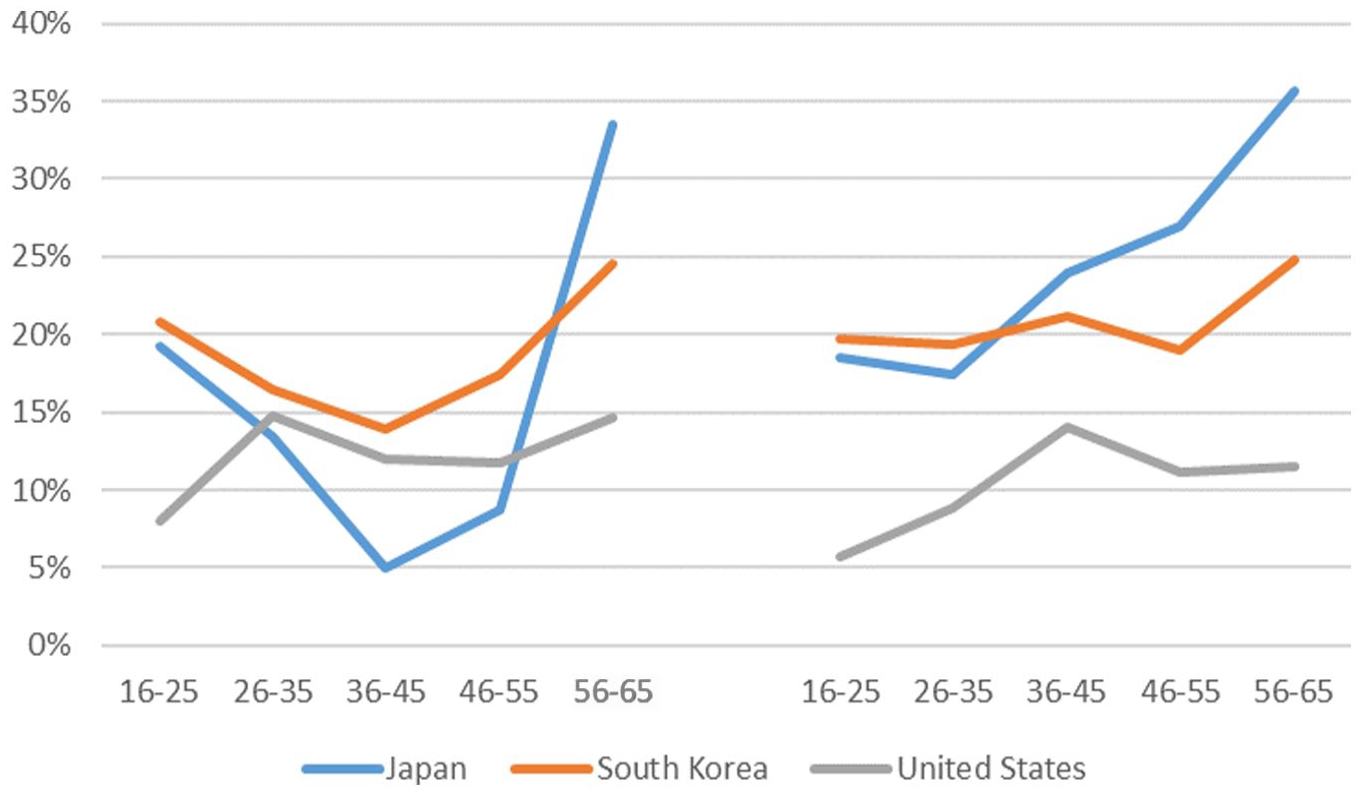
Ratios of workers with a fixed-term contract by gender and age groups.
Similarly, firms’ commitment to the economic security and stability of employees’ households in the US is much weaker than that in Japan, because the US has been characterized as a liberal market economy in which the market mechanism plays a critical role in facilitating access to resources that people need to make a living (Esping-Andersen, 1999; Estevez-Abe et al., 2001). In South Korea, corporate welfare is observed in some large-scale firms; however, the enthusiasm for following corporate welfare policies is not as strong as that in Japan, as is exemplified by many layoffs of middle-aged regular employees in South Korea (Jung and Cheon, 2004). Thus, firms’ commitment to the economic security and stability of employees’ households in South Korea is positioned at a medium level between Japan and the US.
In summary, the possibility that the earnings gap between regular and non-regular employment is justified by the assumed difference in roles in the household is expected to be high in Japan, while it is low in the US and low to medium in South Korea. Although previous literature on just earnings evaluation has limited the scope of investigation to the difference in skills and competence as a main factor of justifying earnings gap among workers, other conditions, such as the difference in workplace duties generated by different roles in household, may also play the role of justifying earnings gap. This article contributes to the existing literature by expanding the scope and exploring the possibilities of earnings gap justification by factors other than the skills and competence of workers.
Hypotheses development
Whether and how the abovementioned institutional arrangements in the three countries affect the evaluation of just earnings of regular and non-regular workers depend on theoretical perspectives. Specifically, the predictions based on social identity theory and status value theory, discussed in section “Theories on just earnings evaluation,” are different to each other.
From the perspective of social identity theory, which asserts that people favor their in-group members to enhance their self-esteem as a group member, we can hypothesize that in all the three countries just earnings of non-regular workers is evaluated more highly by respondents in non-regular employment than those in regular employment, and vice versa. In this case, the institutional settings of the countries will not affect the evaluation of gap in just earnings because respondents evaluate just earnings based on their own interests rather than the status value attached to the positions.
Hypothesis 1: Regardless of the institutional settings of the country, respondents in non-regular employment only accept smaller or no gap in just earnings between regular and non-regular employment than respondents in regular employment in all three countries.
From the perspective of the status value theory, the evaluation of just earnings can be affected by the institutional conditions. Thus, we can expect that respondents admit the wider gap in just earnings between regular and non-regular workers in countries where the institutional conditions attach any significant status value, in other words, different characteristics that can be ranked in some ways to the positions of regular and non-regular employment, than in countries where they do not. Under the institutional arrangements of Japan, the earnings gap between regular and non-regular employment can be justified due to the assumed difference in roles in a household, as well as that in the skills and competence of workers, attached to the distinction between the two types of employment. This may be also the case in South Korea, wherein the distinction is expected to accompany the differences in workers’ skills and competence; in the US, the possibilities of justification of the earnings gap between regular and non-regular workers are low because the distinction does not imply the difference in roles in a household or skills and competence.
Hypothesis 2: Respondents in Japan and South Korea, that is, the countries that have institutional arrangements that can justify the earnings gap, accept the wider earnings gap between regular and non-regular employment than those in the US, which has no similar institutional setting.
According to status value theory, we can also expect that in Japan and South Korea, respondents in non-regular employment evaluate the gap in just earnings between regular and non-regular employment as wide as those in regular employment. This is because the values attached to the distinction between regular and non-regular employment in their institutional arrangements justify the earnings gap between them significantly, to the extent that the mechanism of just earnings evaluation favoring their in-group members, as assumed by social identity theory, does not operate. Therefore, Hypothesis 1, which is based on social identity theory, differs from Hypothesis 3, which is based on status value theory, in that whether respondents in non-regular employment only accept smaller earnings gap in all three countries (Hypothesis 1) or accept the same earnings gap in some countries (Hypothesis 3) as compared with those in regular employment.
Hypothesis 3: Respondents in non-regular employment evaluate the gap in just earnings between regular and non-regular employment as wide as those in regular employment in Japan and South Korea, where the institutional arrangements strongly justify the earnings gap.
While the above hypotheses predict the same results for both Japan and South Korea, the extents and mechanisms of justification of earnings gap between regular and non-regular employment may differ in these two countries due to the difference in institutional conditions, such as the assumptions about the roles in a household attached to the positions. We also explore whether there exist any differences in the extents and the mechanisms of justification of earnings gap between the two countries.
Data and methods
Data
The data for this study were obtained from the “2018 SARI (Sociological Analysis of Reward Inequality) Survey,” a web survey that was conducted in August 2018. Respondents were survey takers registered with a research company. We limited our sample to those who were currently employed and aged between 30 and 59 years. 10 The sample size was 2487 in Japan, 2031 in Korea, and 1879 in the US.
The main part of this survey consisted of questions on respondents’ evaluations of the just earnings of various fictitious workers by using the factorial or vignette survey method. A factorial survey is a survey method that enables the inclusion of the general population as its sample instead of a specific homogeneous population in a laboratory setting (Auspurg et al., 2017; Sauer et al., 2011). It presents sets (vignettes) of fictitious but concrete situations that consist of various factors and asks respondents to evaluate each vignette (Atzmüller and Steiner, 2010; Sauer et al., 2011; Wallander, 2009). We can construct vignettes in a way that factors have no correlation with each other, which enables us to precisely detect the unique effects of a factor independently of the others. Owing to this advantage, it becomes possible to disentangle the effects of type of employment on just earnings from those of gender by using factorial survey data, although both factors are complexly intertwined in the real world. 11
In this survey, the following six attributes described the vignettes of workers whose effects on just earnings were evaluated: 12 age (28 years old/43 years old), gender (male/female), education (high school/vocational school or vocational junior college or community college/university), type of employment (regular employee without a fixed-term contract/contract employee), occupation (programmer/stock person), and family (unmarried/married with two children). Concerning the type of employment, we chose a fixed-term employee as an example of non-regular employment, who is similar to the regular employee in terms of working hours but differs only in terms of labor contract period to explore to what extent the difference in labor contract accompanies the earnings gap between workers. 13 The total vignette universe was 96 (= 2 × 2 × 3 × 2 × 2 × 2); it was divided into six subsets with 16 vignettes, each of which was randomly assigned to the respondents. 14
Figure 2 shows an example of a vignette. As shown in the figure, a brief vignette text describing a fictitious worker was presented to the respondent. Below the text, a table summarizing the worker’s attributes was also shown. Respondents were subsequently asked how much they thought this worker should be paid. 15

Example of a question on just earnings.
This survey also asked for the respondents’ assumptions about the differences in the levels of “obligations for doing sudden overtime and/or work over the holidays,” “opportunities for job experience and training,” and “ability to learn a new job and to perform it well” between workers with different attributes. It also included questions about respondents’ attributes and job conditions, including the type of employment.
Methods
We conducted multilevel analyses by country to examine how the level of just earnings differed according to the vignette attributes and interaction between the vignette and respondents’ attributes (see Figure 3). The dependent variable was the logarithm of the just earnings 16 of the various vignettes answered by respondents. The independent variables at level 1 (vignette level) were dummy variables for the six factors that constructed the vignettes: age, gender, education, type of employment, occupation, and family of fictitious workers. The independent variables at level 2 (respondent level) were personal and job-related variables of the respondents coded to harmonize with the corresponding vignette attribute variables: age (less than or equal to 35/over 35), gender, education, type of employment (regular/non-regular employment), occupation (manual/non-manual), and family (having a child(ren)/having no children). The logarithm of respondents’ individual annual income was also included as an independent variable at level 2.
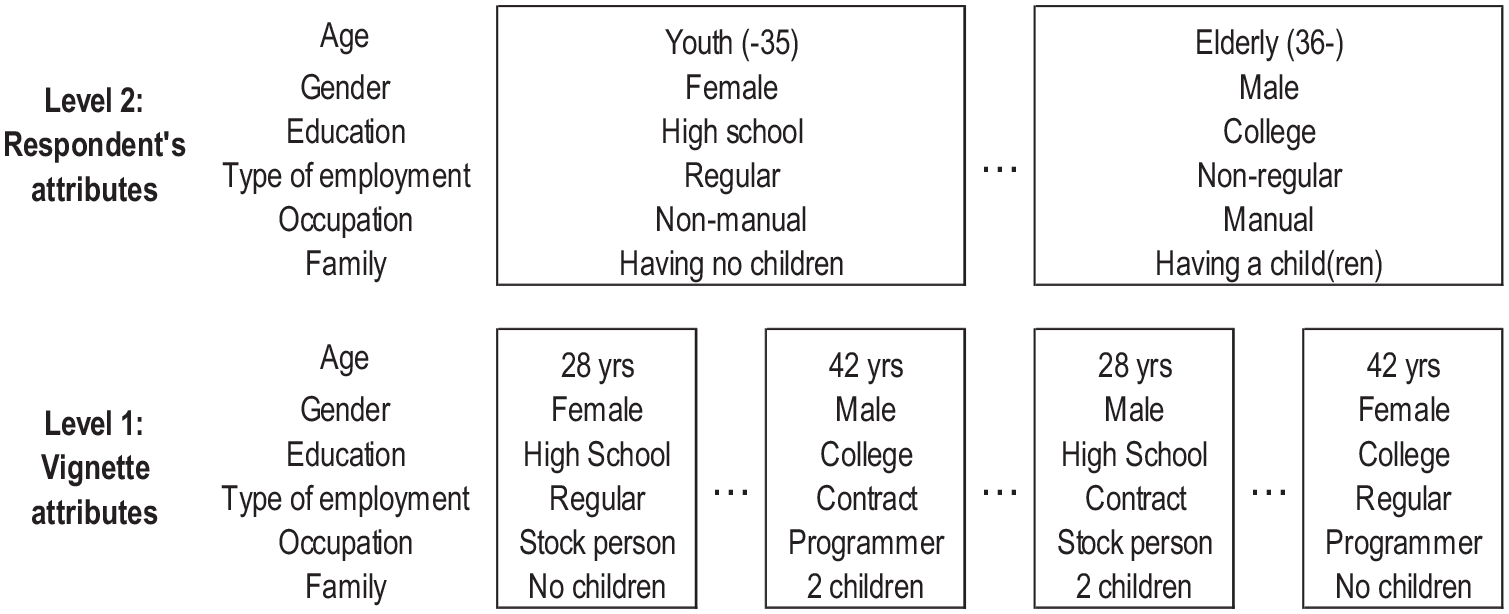
Structure of data for the multilevel analysis.
Based on the results of the model without interaction terms, we first examined the main effect of vignette attributes to test Hypothesis 2. A significant main effect of a vignette attribute implies that respondents think that the earnings of workers should differ according to the factor. Therefore, if the dummy variable of non-regular (contract) workers has a significant negative effect, it means that respondents in the country think that the just earnings of non-regular workers is lower than that of regular workers.
Subsequently, we added the interaction terms between a vignette attribute and the corresponding attribute of a respondent to the model to test Hypotheses 1 and 3. If the interaction term between a contract-worker vignette and a respondent in non-regular employment has a significant effect, a respondent in regular employment and another in non-regular employment think differently about the level of the just earnings gap between a regular-worker vignette and a contract-worker vignette.
We also added variables for respondents’ assumptions about the difference in the levels of duties, opportunities for skill development, and abilities according to vignette attribute, and their interaction effects with vignette attributes. By adding these variables, we were able to observe the changes in the main and interaction effects of the factor to examine to what extent the acceptance of earnings inequality, if there exists any, can be explained by the respondents’ assumptions about the differences in duties, opportunities, and abilities between regular and non-regular workers. If the main and interaction effects decrease when the variable regarding the assumption is added, the assumed difference contributes to the acceptance of the gap in just earnings by legitimating the earnings inequality.
Results
Main effects of vignette attributes
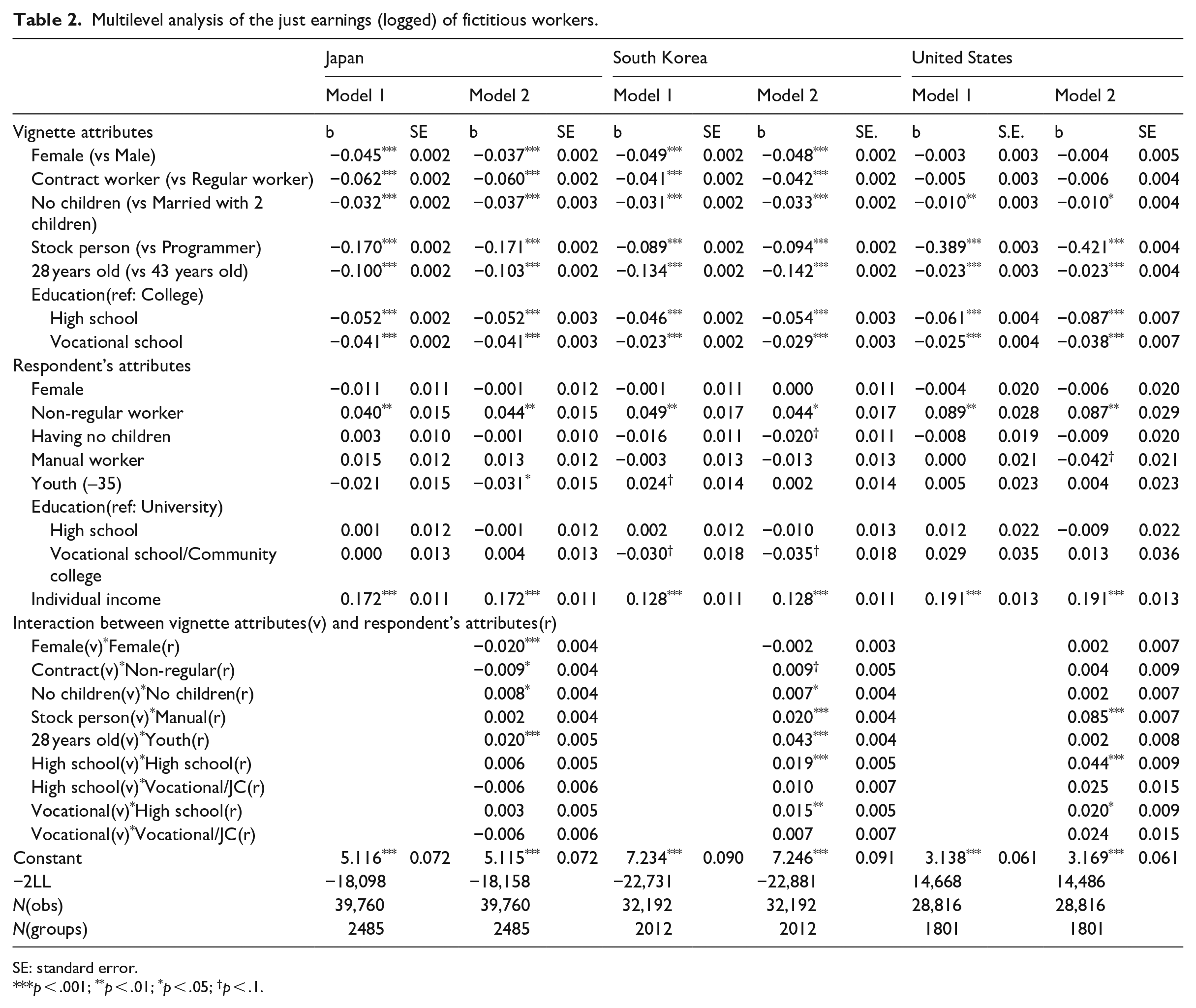
Table 2 shows the results of the multilevel analysis in the three countries. Model 1 was the model that included only the main effects of the vignette and respondents’ attributes as controlling variables. The effects of the type of employment of the vignette differed between the US and other two countries. Although the contract-worker vignette variable had no significant effect on the just earnings of workers in the US, it had significant negative effects on the just earnings of workers in Japan and South Korea. This means that in these two countries, people think that the just earnings of contract workers are lower than that of regular workers. On the basis of these results, we can conclude that earnings gaps between these groups are accepted as just in Japan and South Korea but not in the US. Especially in Japan, the effects of the type of employment were the third largest among the factors; a just earnings for contract workers were lower than that for regular workers by 6 percent. Thus, these findings support Hypothesis 2.
Multilevel analysis of the just earnings (logged) of fictitious workers.
SE: standard error.
p < .001; **p < .01; *p < .05; †p < .1.
Among the other main effects of vignette attributes, gender shows similar results. While the female-worker vignette variable had no significant effect on just earnings in the US, it had significant negative effects on just earnings in Japan and South Korea, implying that just earnings for female workers is assumed to be lower than that for male workers only in these countries. Conversely, we find that all of the “28 year-old,” “stock person,” “high school graduate,” and “vocational school graduate” vignette variables had significant negative effects in all three countries. Based on the results, people commonly think that the earnings of 28 year-old workers compared with that of 43 year-old workers, the earnings of stock persons compared with that of programmers, and the earnings of high school and vocational school graduates compared with that of college graduates, should be lower. We can conclude that the effects of human capital-related attributes on just earnings were consistent among the three countries. 17
Being unmarried without a child had negative effects on just earnings in all three countries. People think that workers who do not have a child should be paid less than those who have two children. This finding suggests that the concept of need-based earnings is accepted in all three countries, although the effect size was small.
Interaction effects between a vignette and respondents’ attributes
Model 2 of Table 2 included the interaction terms between a vignette and respondents’ attributes in the same aspect, such as between the contract-worker vignette and a non-regular-worker respondent, 18 in addition to their main effects. We coded the dummy variables of a vignette and respondents’ attributes so that a disadvantageous position in the earnings structure of these societies, such as that of non-regular workers, takes the value of 1. Therefore, a positive effect of the interaction term means that respondents in a disadvantageous position think that a narrower earnings gap between the advantaged and disadvantaged groups is just than those in an advantageous position do. According to social identity theory, which assumes people evaluate distributive justice in a way that is favorable to them (Shamon and Dülmer, 2014), therefore, we can expect that the interaction terms between a vignette and a respondent’s attributes have positive effects in all countries (Hypothesis 1). Conversely, according to status value theory, we can assume that the interaction terms do not have positive effects in countries where earnings gaps are justified (Hypothesis 3).
Looking at Table 2, the coefficients of the interaction terms between a vignette and respondents’ attributes were positive in South Korea and the US, as expected in Hypothesis 1. Especially, there were relatively large coefficient values for interaction terms between the stock person vignette and a manual worker respondent, whereas that interaction effect was not statistically significant in Japan. In the US and South Korea, disadvantaged groups do not accept their lower wages as just while they share the views of “just wage gap” with advantaged groups in Japan. Rather, there were significant negative interaction effects between a contract-worker vignette and a non-regular-worker respondent, in addition to that between a female-vignette and a female respondent, in Japan. These negative effects mean that non-regular-worker respondents are more likely to think that a wider earnings gap between regular and contract workers is just than are regular-worker respondents. In other words, in Japan, non-regular-worker respondents, who receive lower earnings than their counterparts on average, more strongly accepted the gap according to the type of employment, even though it was against their own interests. These results indicate that different hypotheses are supported in the three countries: Hypothesis 1 is supported in the US and South Korea while Hypothesis 3 is supported in Japan.
Assumed differences between regular and non-regular workers
According to status value theory, acceptance of the earnings gap is caused by shared perceptions that associate specific characteristics and values such as competence and duties with specific groups. Thus, we can assume that perceived differences in values between regular and non-regular employees can mediate the cross-national differences in non-regular workers’ acceptance of the earnings gaps between these two groups. To test the validity of this assumption, we explore the effects of the assumed difference in opportunities for skill development, potential abilities to learn a new job, and duties in the workplace between the two groups, that is, the status values attached to the positions of regular and non-regular workers.
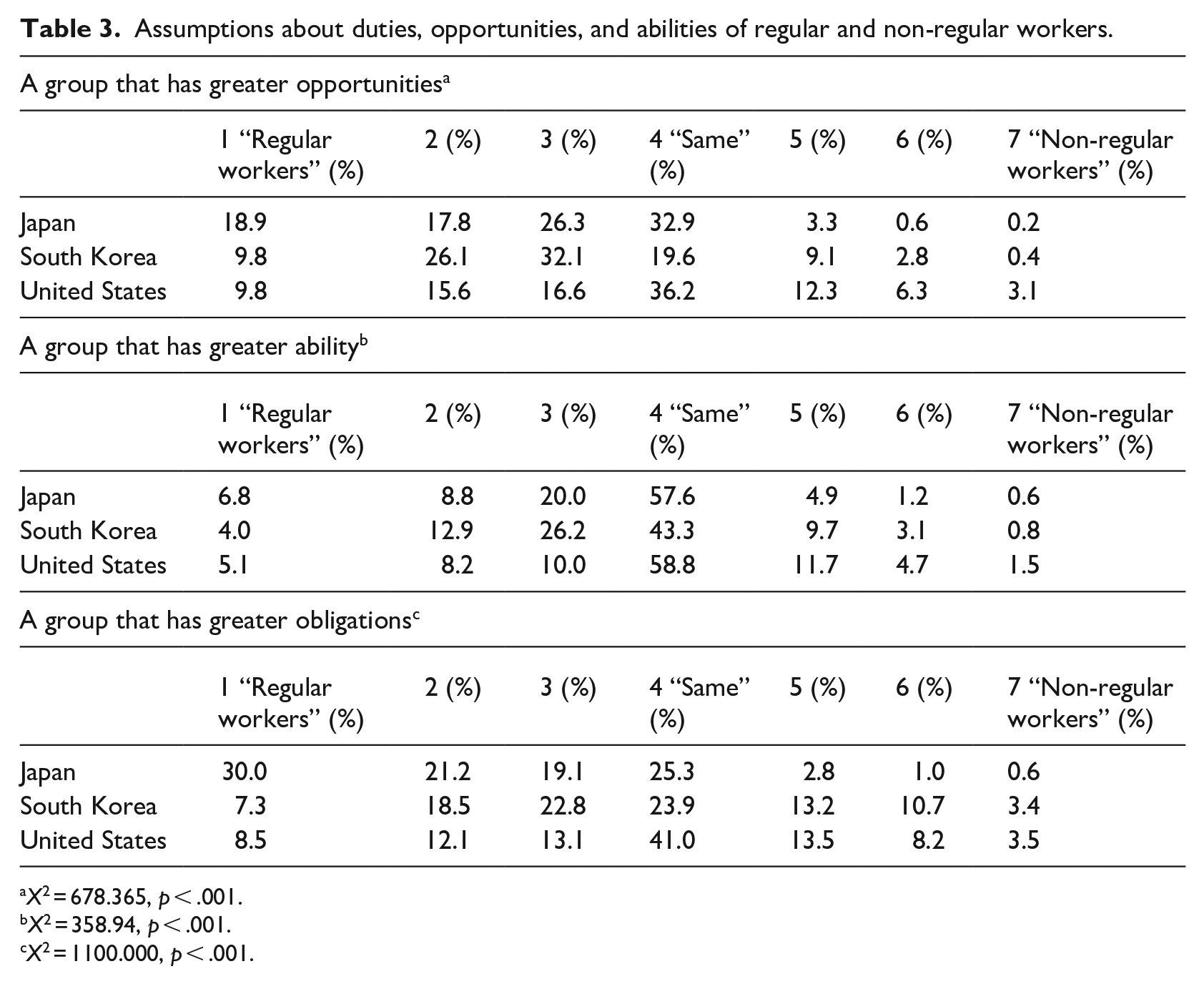
Table 3 shows the responses to the question, “From the regular and non-regular employee groups, which group, on average, do you think has greater opportunities for job experience and training?” based on a seven-point scale. Of the total number of respondents, 63 percent of Japanese and 68 percent of South Korean respondents thought that regular workers have greater opportunities for job experience and training while only 4 percent of Japanese and 12 percent of South Korean respondents assumed that non-regular workers with fixed-term contract have greater opportunities. When compared with the US (42% vs 22%), we can see that there is a stronger assumption in Japan and South Korea that regular employees have greater opportunities for skill development than non-regular employments. Similarly, Table 3 shows that in Japan (36% vs 7%) and South Korea (43% vs 16%), respondents who assumed that regular workers have a greater ability to learn to execute a new job and to perform it well are higher in number than those who assumed that non-regular workers have the same ability; the difference is smaller in the US (23% vs 18%). The assumptions regarding different skills and abilities can be associated with the distinction between regular and non-regular workers because this distinction is used to hierarchically categorize employees in Japanese and South Korean firms, where the demarcation of jobs is weak.
Assumptions about duties, opportunities, and abilities of regular and non-regular workers.
X2 = 678.365, p < .001.
X2 = 358.94, p < .001.
X2 = 1100.000, p < .001.
Table 3 shows the responses on obligations for doing sudden overtime and/or work over the holidays between regular and non-regular workers. Approximately 70 percent of Japanese respondents thought that regular workers have a greater obligation to work overtime and on holidays while only 4 percent assumed that non-regular workers have greater obligations. When Japan is compared with South Korea (49% vs 22%) and the US (34% vs 25%), we can see that there was a stronger assumption in Japan that regular employees, instead of non-regular (contract) workers, should accept overtime work. The distinction between the two types of employees, which technically denotes only the difference in the period of the labor contract, was accompanied by an assumed difference in duties in Japan.
Changes in effects by adding variables on respondents’ assumptions
We examined whether respondents’ assumptions explain the gap in just earnings between regular and non-regular workers in Japan and South Korea and the over-acceptance of this gap by non-regular-worker respondents found in Japan. To this end, we added the interaction terms between the contract-worker vignette and respondents’ assumptions about opportunities, abilities, and duties to the model. We subsequently observed the changes in the effects of the contract vignette as well as the interaction term between the contract-worker vignette and non-regular-worker respondents.
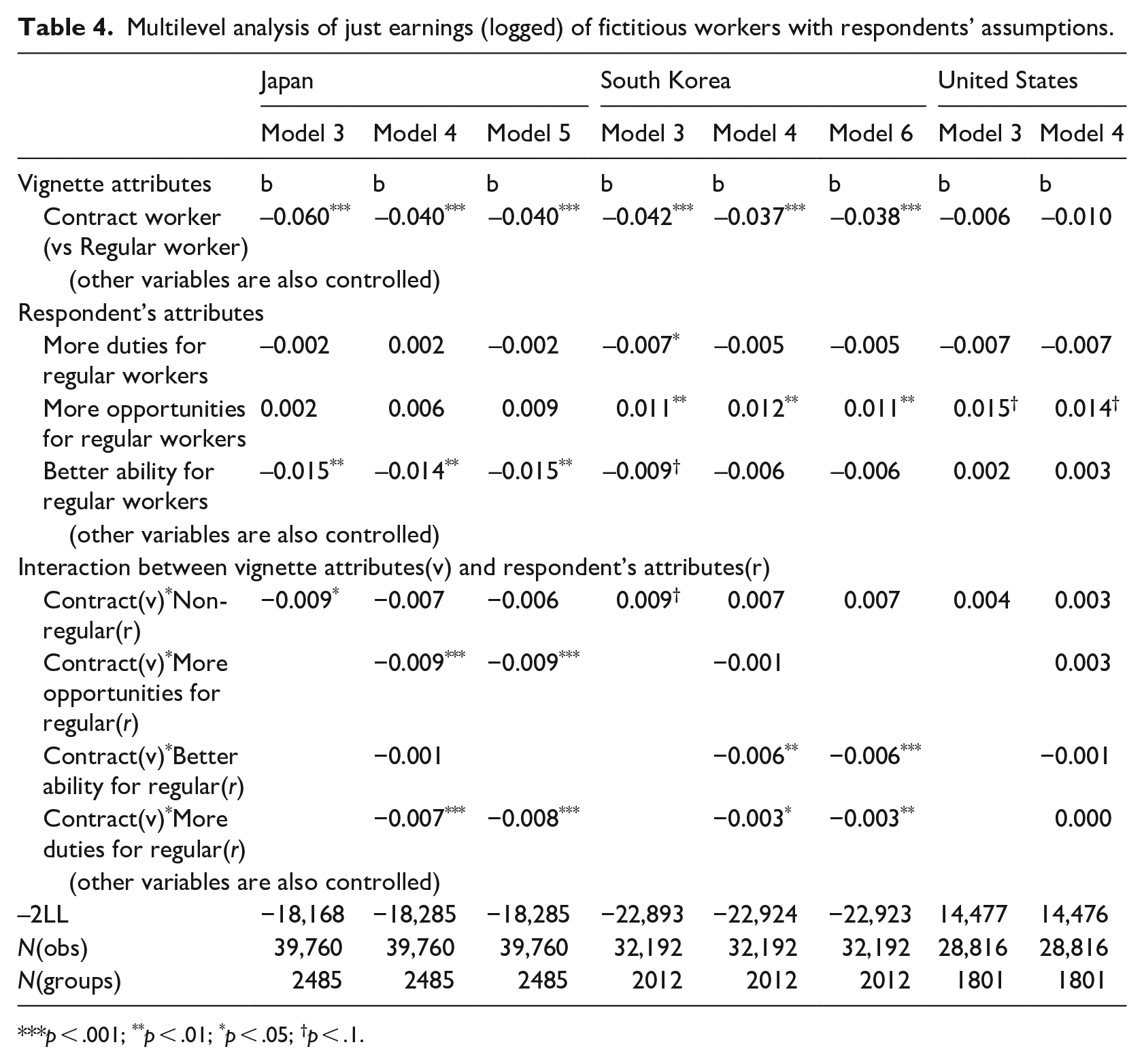
Table 4 shows the results. Model 3 was the baseline model constructed by adding variables of respondents’ assumptions about the opportunities, abilities, and duties of regular and non-regular employees to Model 2 in Table 2. As in Model 2, we can observe negative coefficients for the main effect of the contract-worker vignette in Japan and South Korea, and for the interaction effect between the contract-worker vignette and a non-regular-worker respondent in Japan; no significant coefficient values were observed in the US.
Multilevel analysis of just earnings (logged) of fictitious workers with respondents’ assumptions.
p < .001; **p < .01; *p < .05; †p < .1.
Model 4 included the interaction terms between the contract-worker vignette and respondents’ assumptions about duties, opportunities, and abilities. For Japanese respondents, the interaction terms about opportunities and duties in these models had significant negative effects, whereas that of abilities did not have any effect. This implies that those who assume that regular employees have more opportunities or duties think that there should be a wider earnings gap between regular and contract workers. In other words, the assumed differences in opportunities and duties serve as reasons for justifying the gap in just earnings between regular and non-regular employees in Japan.
We can examine to what extent these assumed differences explain the acceptance of gap in just earnings and its over-acceptance by observing the changes in the coefficients for the main effect of the contract-worker vignette and the interaction effect between the contract vignette and non-regular-worker respondents. In comparing Model 5, which includes two interaction terms that had significant effects in Model 4, with the baseline model (Model 3), we can observe that the main effect of the contract-worker vignette decreased by 34 percent, from −0.0604 to −0.0396. This means that 34 percent of the gap in just earnings between regular and non-regular employment (observed among regular-worker respondents) was explained by the tendency of respondents, who assume that regular employees have more duties or opportunities, to think that a wider earnings gap between the two types of employment is just. Similarly, a decrease in the effects of the interaction term between the contract vignette and non-regular worker respondents, from −0.009 in Model 3 to −0.006 in Model 5, indicates that the same tendency explained a substantial part of the over-acceptance of the just earnings gap by non-regular-worker respondents.
In South Korea, the interaction terms between the contract-worker vignette and respondents’ assumptions about abilities and duties had significant effects in Model 4, although the coefficient for duties was much smaller than that in Japan. Notably, the main effect of the contract-worker vignette did not change as much as its Japanese counterpart when adding these interaction variables: only 10 percent decreased from Models 3 to 6, with only two significant interaction terms. This implies that the tendency to think about the gap in earnings should be wider among those who assume that regular employees have more duties; further, better abilities did not explain the gap in just earnings between regular and non-regular employees in South Korea as largely as that in Japan.
In the US, all the interaction terms between the contract-worker vignette and respondents’ assumptions about opportunities, abilities, and duties are non-significant. This means that the respondents’ assumptions do not affect the evaluation of just earnings of regular and non-regular workers.
Discussion and conclusion
This study explored the extent of the gap in just earnings according to the different labor contracts and examined whether and how labor-market related institutional factors influence people’s perceptions on the earnings gap between the types of employment in Japan, South Korea, and the US by attaching certain status values to each type of employment. We assume that Japanese and South Korean labor-market-related institutional arrangements “justify” earnings gap between regular with indefinite contract and non-regular workers with fixed-term contract. Based on the multilevel analysis of the data from the cross-national experimental survey we conducted, we found that Japanese and Korean respondents think that there should be a significant earnings gap between regular with indefinite contract and non-regular workers with fixed-term contract. Thus, we can conclude that the earnings gap between regular and non-regular workers is accepted as just in Japan and South Korea, which have the institutional arrangements that contribute to the legitimation of the earnings gap, as the status value theory predicts, while this is not the case in the US.
Furthermore, there is a large difference between Japan and South Korea in terms of who accepts the earnings gap. In Japan, respondents in non-regular employment think that the earnings gap according to the type of employment should be wider than those in regular employment. This implies that the status value theory applies to the earnings gap between regular and non-regular employment in Japan, to the extent that even those in a disadvantaged position strongly accept the earnings gap against their own interests. We did not find such a tendency in South Korea—compared with regular-worker respondents, non-regular-worker respondents accept the narrow earnings gap as just. This is consistent with the social identity theory.
The above difference between Japan and South Korea may be explained by the differences in assumptions that justify the earnings gaps in each country. The assumption about varying duties and responsibilities can be attached to the distinction between regular and non-regular workers only under the institutional conditions of Japan, while the assumption about different skills and abilities can be applied to both South Korea and Japan. Whereas the assumed difference in skills and abilities between regular and non-regular workers is the hierarchical difference, the assumption about varying duties and responsibilities is rather a horizontal difference in that some workers may prefer the fewer duties and responsibilities of a certain job despite it paying less. As our study shows, some extent of over-acceptance of the earnings gap between regular and non-regular workers by non-regular-worker respondents is explained by the assumptions about horizontal difference in duties as well as the vertical difference in skills in Japan. Based on the results, we argue that the earnings gap that is justified not only by vertical but also by horizontal difference can be accepted even by workers in a position with less earnings, leading to the stable reproduction of the inequality.
Our analysis of the three countries with different institutional arrangements indicate the significant role of institutional arrangements in legitimating income inequalities among various groups in the labor market by attaching status value to specific categories of workers. In Japan and South Korea, the institutional conditions legitimate the income gap according to the difference in type of employment, a different categorization of workers from that based on occupation. Moreover, our findings also show the importance of status values other than the ability and competence that justify the earnings gap. The income inequality between regular and non-regular workers is legitimized not only by the difference in abilities based on the logic of human capital theory as assumed by previous studies on just income, but also by duties and responsibilities based on the different logic in Japan. Based on our findings, we can expect that the earnings gap between regular and non-regular employment is more durable in Japan than in the other two countries. We conclude that categories of workers other than occupation can function as the unit of salient and stable inequality in the labor markets by being legitimated under certain institutional arrangements.
Our study has some limitations. We examine people’s views of the earnings gap between regular and non-regular workers in a specific setting, such as, difference between regular and contract workers who are either a programmer or a stock person in a large firm. Furthermore, we only focus on the just earnings of fixed-term workers within the various forms of non-regular employment. Thus, there exists a possibility that people react differently to earnings gap based on the type of employment in a different form and setting. We need to test the generalizability of our results in other forms and settings. Despite these limitations, our study brings an important insight for the study on earnings inequality by showing the significant roles of institutional settings in not only forming inequality but also perpetuating it through its legitimation. More comparative studies should be conducted to understand how earnings inequality emerges and is reproduced in a specific institutional arrangement.
