



Abstract
Based on survey data from representative national samples of young people, we compared the impact of nine different factors of emigration desire among young people from 10 countries of Southeast Europe. The results show that (1) the impact of factors of necessity decreases with higher levels of Human Development Index (HDI), while factors of ambition tend to have stronger impact. We also found that across all 10 countries, (2) the experience of having been abroad is the strongest predictor of higher emigration desire, and that (3) the emigration desire of young people tends to decrease with higher levels of HDI.
Introduction
Understanding the factors affecting the migration of young people is an extremely important topic for both politicians and researchers. Contemporary research follows the line of most migration studies, focusing explanations primarily on economic factors such as employment and income opportunities (Eichhorst et al., 2013; Rodríguez-Pose & Vilalta-Bufí, 2005; Van Mol, 2016). Research specific to migration of young people also considers factors such as education and training as important driving forces (Dustmann and Glitz, 2011; Smith et al., 2014). Other important factors, such as identity (Jones, 1999), cultural capital (Lulle et al., 2019; Rye, 2011), factors tied to young people’s “project of the self” (Thorn, 2009), and various motives and intentions that cause young people to migrate (Baláz et al., 2004; Smith et al., 2014) are rarely researched, however, and these topics remain underexplored.
This is so even though the need for a broader multidimensional approach is obvious. Many contemporary studies show youth migration to be a complex set of socio-cultural (macro), familial (meso) and individual (micro) factors mutually interconnected and expressed as a motive to migrate. For example, Horváth (2008), while focusing on westward migrations of Romanian young people in the changing economic environment since 1990, discovered a nexus of macro-, meso-, and micro-level factors. Although economic and cultural factors play an important role, specific family situations and prolonged transition to adulthood, together with self-perception as “would-be migrants,” appear as crucial motivations for migration. A similar complex relationship between macro-, meso-, and micro-level factors can be found in a study by Crivello (2011), which shows how persistent structural inequalities induce youth migration for education—young people and their parents merge migration and education into a unique model of intergenerational dependency mitigating family poverty, and these practices become an important collective response. Although some studies focus on important issues like locality, attachment, kinship, and social class (Jamieson, 2000; Rye, 2011), these studies remain rare, and the need for sophisticated, in-depth analysis persists (Gibson and Argent, 2008).
While much attention has been given to various aspects of Eastern European emigration and immigrants in Northern and Western Europe, the complex constellation of factors influencing emigration of young people and differences between Eastern European countries has received relatively little attention. Existing research within the region of South Eastern Europe (SEE) shows emigration of young people from the region to be fuelled predominantly by economic uncertainty combined with negative perceptions of the home country and positive perceptions of the European Union (EU; Lavrič, 2019), resulting in brain drain in the home countries (Lavrič, 2019; Valenta and Ramet, 2011). Over the past two decades, youth emigration increased in the six Western Balkan (WB6) countries—Albania, BiH, Kosovo, Macedonia, Montenegro, and Serbia. Travel was facilitated thanks to the visa liberalization regime that these countries have with the EU. Youth emigration has been a problem for some time in the other SEE countries that are currently members of the EU, especially Romania and Bulgaria. Yet the picture of youth migration in SEE remains incomplete, and to fill it out, cross-national samples of these countries along with a compilation of the broader set of factors influencing migration of youth should be analyzed. Based on this recognition, we strive to contribute by providing an important perspective on youth migration derived from a cross-national sample of countries in South Eastern Europe. By introducing often overlooked yet important factors, for instance, measurements of European identity and views on the future of the EU, we offer an outline to further the understanding of East-West migration within the EU.
Three theoretical approaches and their limitations
Research into factors affecting migration involves a number of theoretical models, but since these emerge within specific empirical, conceptual, and disciplinary boundaries, they render a unified theory of migration impossible. A group of models is based on a dyadic approach to factors influencing migration. One of the earliest is the neoclassical approach, where push factors are understood as factors influencing a person to leave his or her country of origin, while pull factors are those drawing a person to a specific destination country. Push factors often include economic and socio-political austerities, natural disasters, family-related hardships and lack of opportunities for personal development, while pull factors include greater economic and socio-political security and other comparative advantages tied to a destination country. However, this conceptual frame does not include other crucial factors affecting migration such as perceptions (Bjarnason and Thorlindsson, 2006; Delanty et al., 2008; Krivonos and Näre, 2019), patterns of media use (Dekker and Engbersen, 2014), intentions for acquisition of human and cultural capital (Lulle et al., 2019; Waters, 2008), study and life perspectives (Biondo, 2012), and other micro-level characteristics, thus rendering the neoclassical approach very narrow in its focus.
To integrate macro and micro factors, several studies have focused on factors of necessity and opportunity. Within this model, factors of necessity are usually tied to individual experiences of economic deprivation, while opportunities present a potential for favorable escape from a difficult situation via migration (Maritz, 2004; Williams, 2008). In other words, within this model, migration emerges as realized opportunity to migrate, based on the presence of certain factors of necessity. While it is clear that migration cannot occur without opportunity, the assumption that necessity is always the root cause of migration is problematic. People can migrate for different reasons: because they want to change their lifestyle (Benson and O’Reilly, 2009) or fulfill an ambition. While this approach successfully combines macro- and micro-level factors of migration, it still fails to recognize more subjective factors like perceptions, identities, or ambitions of individuals. It also makes it very hard to include some other crucial factors of emigration, such as patterns of media use (Dekker and Engbersen, 2014) or previous experiences of migration/mobility (Haug, 2008).
A two-step model that showed some success in overcoming these issues was introduced by Carling (2002). Its framework is based on the distinction between wishing and being able to migrate, therefore focusing analysis on a conceptual pair of aspirations and abilities in researching migrations. This model can accommodate important macro factors, such as economic or environmental situation, and micro factors, including aspirations of individuals. The basis of this model is a conceptual recognition that migration is influenced by both personal and contextual factors, with two constituent elements at its core, aspirations and abilities to migrate. Aspiration is in its broadest sense defined as “a conviction that migration is preferable to non-migration,” thus varying in the degree and including both elements of choice and coercion (Carling and Schewel, 2018: 946). The concept of aspiration divides a population into two categories, those with no aspirations to migrate, preferring to stay (voluntary non-migrants) and those who aspire to migrate, but lack the opportunity (involuntary non-migrants). Both groups are influenced by two sets of factors: (1) social, economic, and political aspects of their emigration environment and (2) individual characteristics influencing preferences to either stay or migrate. While the interplay of both sets of factors results in the creation of aspirations, these may or may not be enough to trigger actual migration. In this model, a second step is needed: the ability to migrate. As in the case of aspirations, the ability to migrate also emerges conditioned by macro- and micro-level factors. Therefore, in its broadest sense, the ability to migrate can be defined as the “capacity to convert wishes (aspirations to migrate) into reality, given context-specific obstacles and opportunities” (Carling and Schewel, 2018: 955). While this approach, compared with the previous two described, offers a much wider understanding of factors influencing individuals’ decisions on migration, it still makes it hard to classify certain factors into one of the two categories. Should we consider, for example, previous experiences of migration/mobility as a factor of aspiration or as a factor of ability? Some proponents of this approach suggest that the distinction between aspirations and abilities is often not clear in terms of specific empirical concepts (Carling, 2002; Carling and Schewel, 2018).
Factors affecting contemporary youth migration in 10 SEE countries
We focus on the interplay of factors affecting emigration in 10 South Eastern European countries by asking three research questions (RQ):
RQ1. What are the strongest predictors of emigration among young people across the countries of South Eastern Europe? The aim of RQ1 was to broaden the spectrum of potential factors affecting the desire to emigrate among young people and their complex interplay. Based on several studies emphasizing the impact of established social networks abroad and relevant knowledge and skills applicable for future migration (Baláz et al., 2004; Kahanec and Fabo, 2013), we hypothesized that (H1) the experience of being abroad is among the strongest predictors of emigration desire across the 10 countries observed.
RQ2. How does a country’s Human Development Index (HDI) influence emigration desire of young residents? Within RQ2, we hypothesized that (H2) the potential for youth emigration decreases with an increase of socioeconomic development as measured by HDI. This hypothesis is grounded in studies of the nexus between migration and HDI that suggest a negative correlation between the two (Kandemir, 2012; Mihi-Ramírez and Kumpikaite, 2014; Sanderson, 2010; Sok, 2017; Yang, 2009). HDI is a composite statistical index of life expectancy, education, and income used to rank countries according to human development (Human Development Reports (HDR), 2018), which indicates quality of life (Ravlik, 2014). Thus, we expect countries with a higher HDI score to attract migrants from countries with a lower score, since migration is perceived as providing an opportunity for improvement of income, education, and social engagement and ultimately a better life. Several studies support this assumption (Ravlik, 2014; Sanderson, 2010); the most influential, by United Nations Development Programme (UNDP, 2009) in Human Development Report 2009, states that “More than three quarters of international migrants go to a country with a higher level of human development than their country of origin” (p. 2).
RQ3. How do the effects of different predictors of emigration desire differ in relation to the level of socioeconomic development of the sending countries? Our basic assumption is that (H3) factors of necessity are more present among youth from countries with lower HDI, while factors of opportunity tend to be stronger in countries with higher levels of HDI. Although no study has yet, to our knowledge, directly addressed this issue, it is likely that the motivation for emigration changes with the level of economic prosperity. We argue that this change occurs not only in quantitative but also in qualitative terms. More specifically, people from poorer social environments will more often have to leave their countries for purely existential reasons, out of necessity. On the other hand, people from more prosperous countries might still emigrate, but less out of existential necessity and more because of a search for better opportunities in life.
Method
All analyses in this study were based on survey data gathered in the project “Youth in Southeast Europe 2018,” which was commissioned by the Friedrich-Ebert-Stiftung (FES) and conducted in early 2018 in 10 countries of Southeast Europe: Albania, Bosnia and Herzegovina (BiH), Bulgaria, Croatia, Kosovo, Macedonia, Montenegro, Romania, Serbia, and Slovenia. The study was granted ethical clearance from the FES project management advisory board and was reviewed by a consortium of representatives from participating partner organizations. Additional institutional clearance was obtained from the Center for the Study of Post-Socialist Societies (CePSS) at the University of Maribor. Ethical clearance and both reviews were obtained prior to data collection.
Sample
In each country, surveys were based on representative randomized or quota samples of young people between the ages of 14 and 29. Samples were stratified along key socio-demographic characteristics such as age, gender, region, and type of settlement. Depending on the established practice and judgment of polling agencies, stratification criteria slightly differed across countries. For example, in Slovenia, the target population was first stratified according to 12 statistical regions and 5 types of settlement, which resulted in 32 independent strata. Next, a two-stage sampling method was implemented within each stratum. First, target settlements (primary sampling units) were randomly selected from the complete list of settlements corresponding to particular statistical regions and settlement types (stratum). Second, respondents were then chosen from the selected primary sampling units according to the pre-set quota requirements. The average response rate was 64%, varying from 38% in Kosovo to 83% in Macedonia. The polling agencies assured us that the structure of the sample did not differ significantly from the structure of the population in terms of gender, age groups, and size of settlement. Since some minor deviations did occur in Albania, Bulgaria, Croatia, Kosovo, Romania, and Slovenia, data were weighted to better fit the target population of young people in these countries. The size of weights was rather small, ranging from 0.52 to 1.86. This indicates that there was a very good fit between the structure of the population and the structure of the samples in terms of the basic criteria mentioned above.
For the purpose of this study, we limited our analyses to a sub-sample of 20–29 year olds to focus only on the population that predominantly contemplates independent (rather than tied) migration. The basic characteristics of this sample are presented in Table 1.
Basic demographic characteristics of the sample, by country.
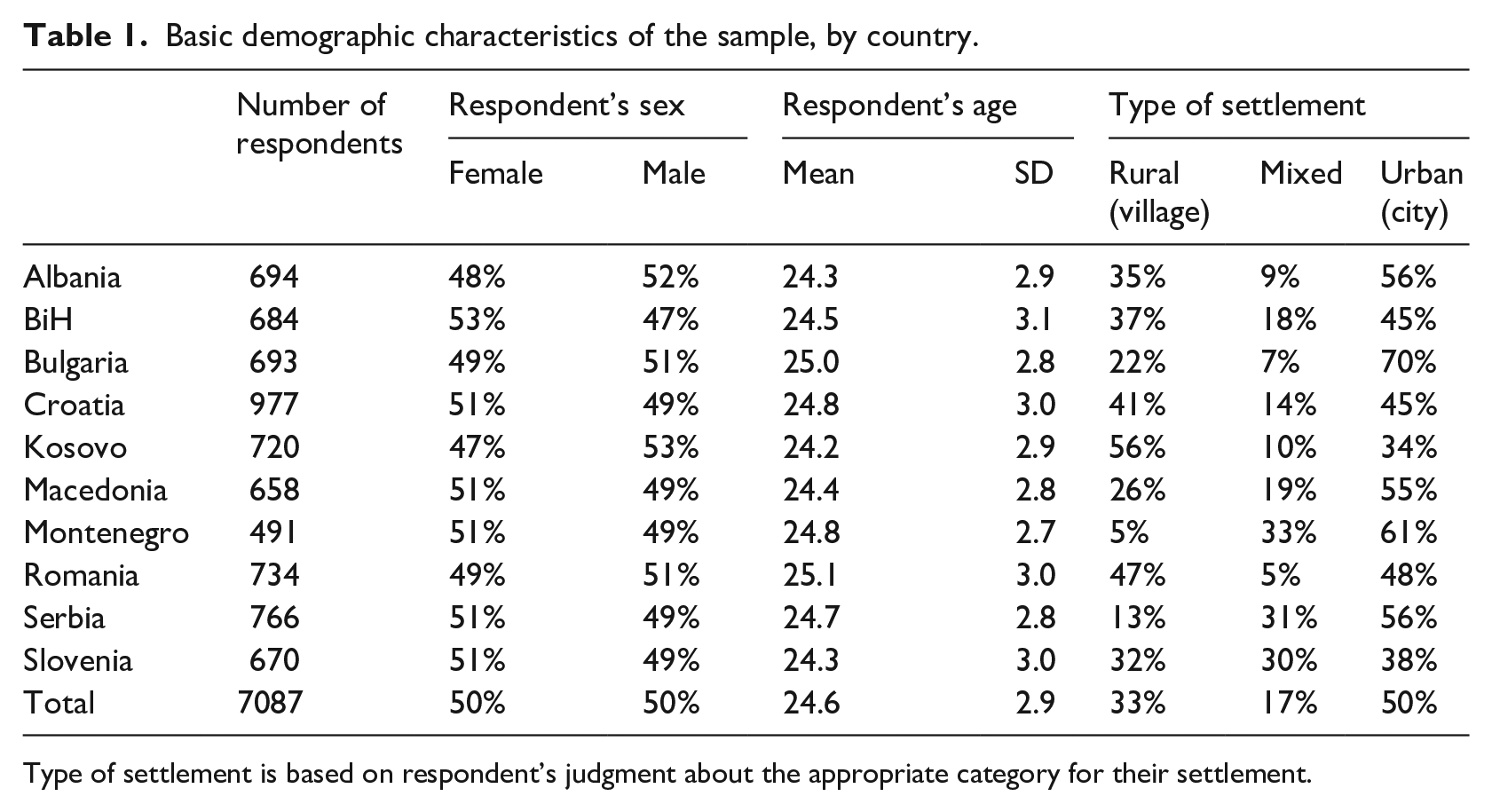
Type of settlement is based on respondent’s judgment about the appropriate category for their settlement.
Instrument and data collection
The same core questionnaire with 127 questions, many of them consisting of several Likert-type items on a scale from 1 to 5, was administered in each of the 10 countries. The questionnaire was constructed in English by a wide team of experts and then, using a forward-backward procedure, translated into local languages. It was designed very broadly to shed light on all major issues in relation to young people’s lives in the region. Within this framework, mobility and migration represented two of the central topics. In all countries, face-to-face interviews were carried out using the Computer Assisted Personal Interviewing (CAPI) method.
Measures and analytical procedures
To assess the effects of different factors on emigration intentions, we used multiple linear regression as our central analytical tool. The dependent variable in our regression models was based on a survey question that asked: “How strong is your desire to move to another country for more than six months (emigrate)?” The possible answers ranged from “1—I do not intend to emigrate” to “5—Very strong.” We got 6719 valid answers and 368 missing values (including “don’t knows”) within this question. The average value at the level of the sample was 2.29 (SD = 1.437), ranging from 1.55 in Romania to 2.89 in Albania.
The independent variables were chosen on the basis of the existing literature and the variables available in the data set, whereby only variables with not more than 5.5% of missing data were used. For the purposes of easier interpretation and standardization, we decided to dichotomize all the independent variables. The threshold for dichotomization within individual variables was set based on the frequency distribution of a given variable; we strove for a distribution with approximately one fourth of respondents in the category “1.” We selected the following dichotomized variables, indicating the presence (1) or absence (0) of a certain condition:
Being from a poor household—this selection is grounded in the logical assumption that respondents coming from deprived households aspire to improve their situations and are likely to considering migration. Value 1 was ascribed to those respondents who met two conditions. First, they described the financial situation of their family as (a) not having enough money for basic bills (electricity, heating, etc.) and food, (b) having enough money for basic bills and food, but not for clothes and shoes, or (c) having enough money for food, clothes, and shoes but not enough for more expensive things (refrigerator, TV, etc.). The second condition was having 5 or fewer of 10 listed household possessions (a house or apartment, a mobile phone, personal computer, an Internet connection at home, a bicycle, a motorcycle, an air conditioner, a dishwasher, a washing machine, a car). In all 10 countries, 20.9% of respondents met these conditions. Altogether, 349 respondents did not provide all of the desired valid answers within this category.
Being NEET (not in employment, education, or training)—a youth-specific measure of social exclusion which, following the logic of improvement by seeking new opportunities for employment, education and training through migration, fits well into the category of aspirations. A value of 1 was ascribed to young people whose answers suggested that they were (1) unemployed and (2) not enrolled in any kind of education or training. In all 10 countries, 16.8% of respondents fell into the category of NEET, while 123 (1.7%) did not provide all of the desired valid answers within this category.
Negative perception of the home country’s future—this category consisted of respondents who (1) see the future of their country as “worse than now” in general terms and (2) at the same time assess that the economic situation of people living in their country will decline. In the regional sample, 15.4% of respondents matched these two criteria, while 87 (1.2%) did not provide a valid answer to this question.
Having been or being in tertiary education—selection of this item is based on the assumption that being in tertiary education as stemming from individuals’ personal ambition while at the same time presenting a set of capacities and opportunities, both on the level of the individual (such as foreign language skills) and institutions (such as established institutional foreign exchange programs). Since many of our respondents were too young to have finished tertiary education, we combined this category of those who (1) had completed any kind of tertiary education or (2) were enrolled in any kind of tertiary education. In all 10 countries, 52.9% of respondents fell into this category, while 302 (4.3%) did not provide valid answers to both survey questions involved.
Having a mother with at least tertiary education—this variable was taken as a proxy of cultural capital. Mother’s education was used because of high levels of missing data in relation to the father’s education. There were 18.9% such respondents in the entire sample, while the missing data were 3.0% in this case.
High importance attached to career—this item was selected because it is a compound of specific motivational factors which are closely related not only to education and cultural capital but also to migration (Carling and Schewel, 2018; Mata-Codesal, 2015; Van Hear, 2014). Respondents who chose option “5” responding to the question of the importance of a career in their lives (1 = “not at all important”; 5 = “very important”) were included in this category. They represent 58.4% of the sample. The number of missing cases was 1.4% for this variable.
Having been abroad for more than 6 months—this item was selected following the argument that actually having been abroad provides both experience of migration and knowledge about the required preparation for migration and its outcomes, thus increasing one’s chances of succeeding abroad in the long term and making emigration an attractive option. Respondents who answered “Yes” to the question whether they had been abroad for more than 6 months were added to this category. They comprise 13.0% of the sample, while the number of missing cases was 136 (1.9%).
Having been abroad for educational purposes—a closely related concept, even more clearly pointing to foreign countries being more attractive to a young person. The correlation with the previous measure of being abroad for more than 6 months is substantial (r = 0.313, p < 0.01), but still within an acceptable range that enables these as two separate independent variables. This category comprised 11.6% of respondents in the sample. The number of missing cases was 5.2%.
Having a strong European identity—this concept functions as a potential motivational factor for emigration since as many as 99.4% of respondents who had some ideas about their target countries chose at least one European country and 98.6% chose at least one EU member country. The variable was based on the question “How much do you see your-self as a European?” and those answering “Completely” on a 1 to 5 scale were considered as having a strong European identity. There were 29.8% such respondents in the sample, while the number of missing cases was 2%.
In addition to these variables, we also used gender, age, and settlement size as control variables in our regression models. Summary statistics are presented in Table 1. We considered these three variables as standard demographic variables that are generally controlled in statistical analysis. 1
Analytical procedures included zero-order correlations, multiple linear regression, and linear mixed model regression. We used only variables with a low percentage (less than 5.5%) of missing data. In linear regression analyses, we applied listwise deletion to handle missing cases. Altogether, 5689 cases were analyzed in the linear models, from 277 in Montenegro to 875 in Croatia. In the case of mixed models, 5594 cases were analyzed in the linear models, from 277 in Montenegro to 891 in Croatia.
Results
In the first step of our analysis, we computed zero-order Pearson correlations between all variables that were included in a regression model within the second step.
Table 2 shows that the strongest predictor of emigration desire is Having been abroad for more than six months (r = 0.220, p < 0.01), followed by Having been abroad for educational reasons (r = 0.190, p < 0.01). These two variables are also those with the strongest mutual correlation (r = 0.313, p < 0.01). The fact that there are no correlation coefficients with values exceeding 0.320 indicates that the set of variables is not problematic for a regression model in terms of multicollinearity. Thus, we proceeded with multiple linear regression analyses, where the issue of multicollinearity was also checked in another way.
Pearson correlations between all variables in the regression model, entire sample of 10 countries.
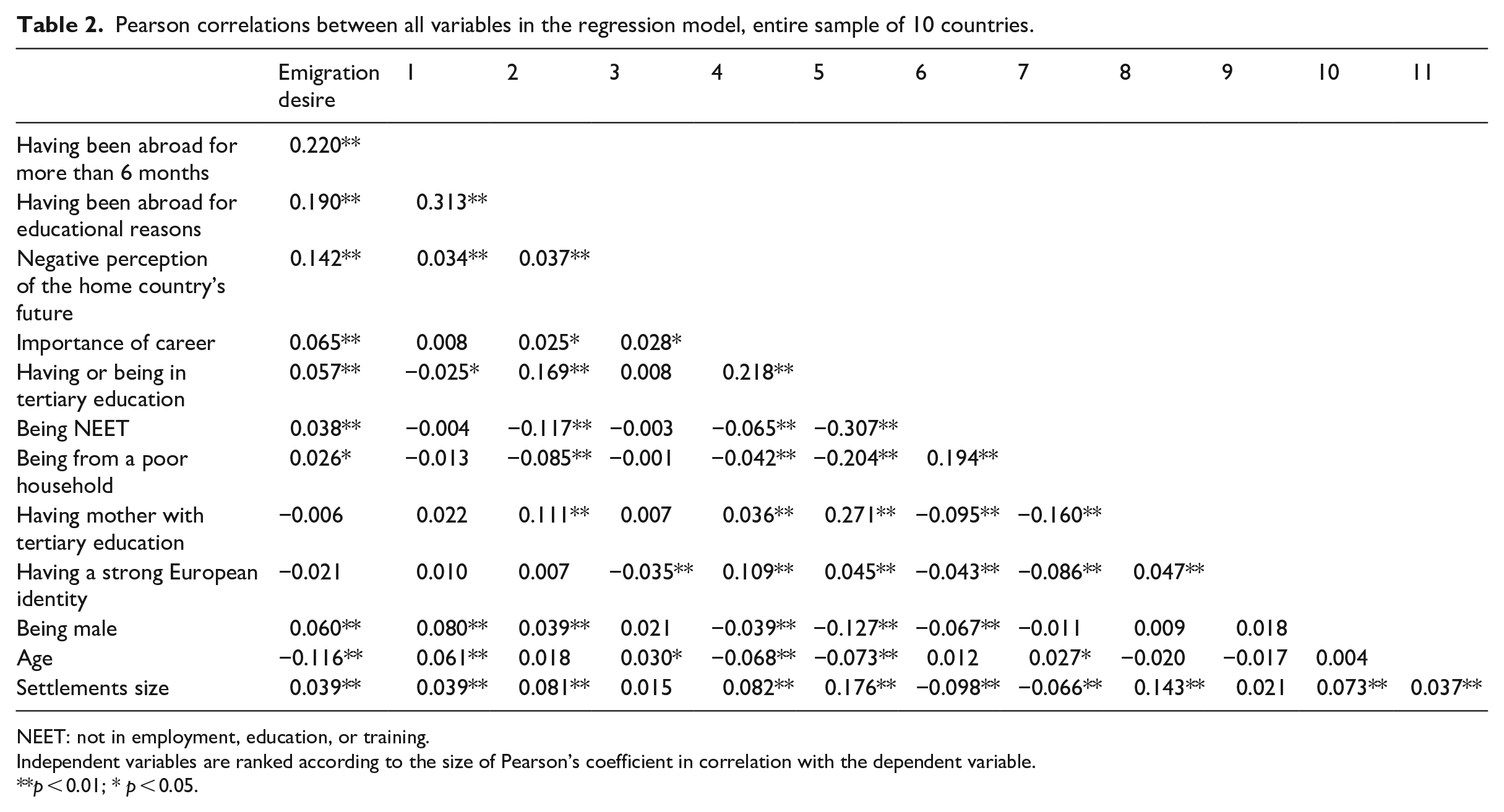
NEET: not in employment, education, or training.
Independent variables are ranked according to the size of Pearson’s coefficient in correlation with the dependent variable.
p < 0.01; * p < 0.05.
All the variables were entered into a linear regression model with migration desire as dependent variable and the other nine variables as independent ones (Table 3). Respondent’s sex, age, and size of residence were also added as control variables. The regression model for the entire sample of 10 countries was controlled for respondents being nested in individual countries.
Results of multiple regression analyses for emigration desire as dependent variable, by country.
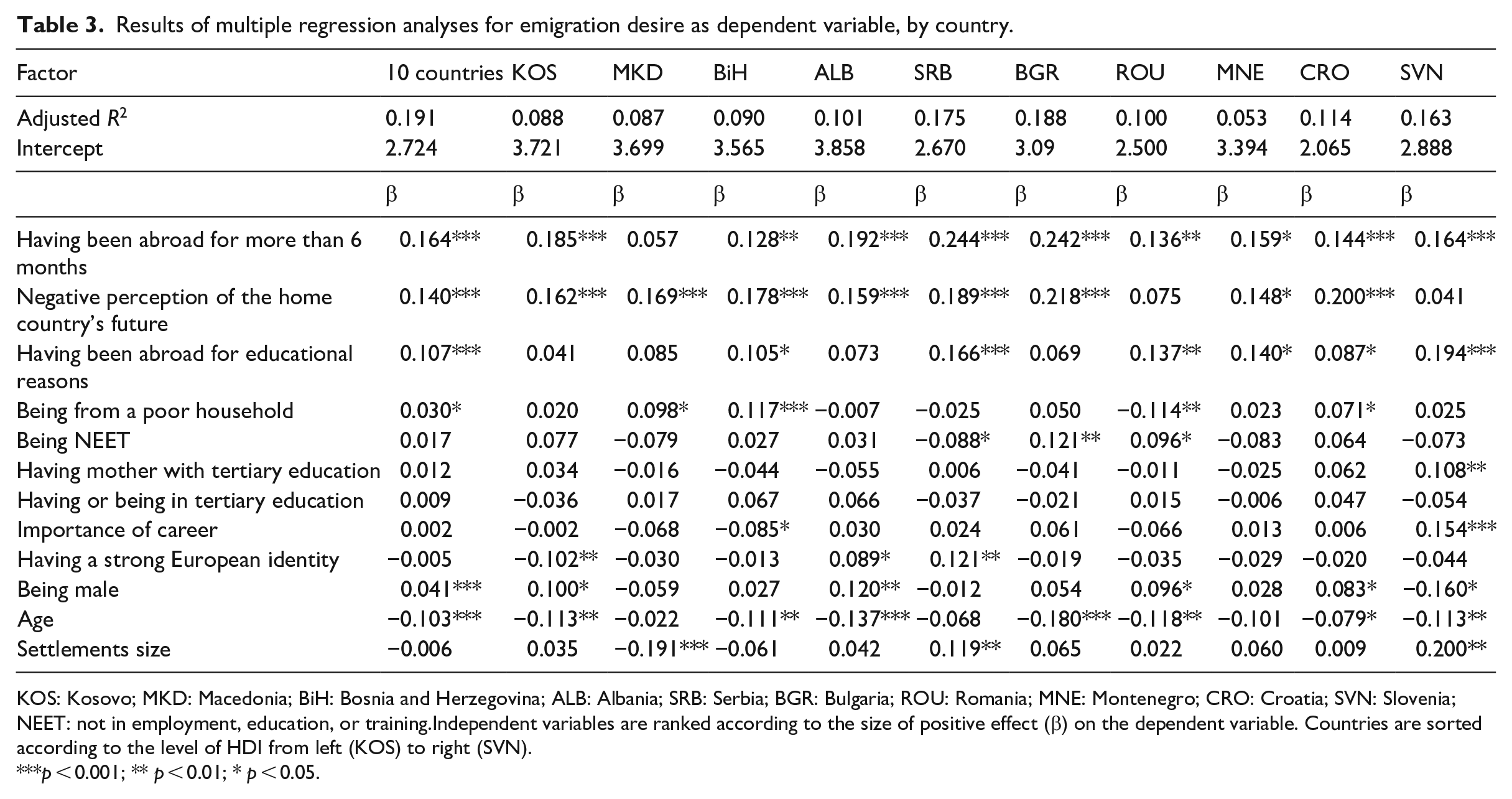
KOS: Kosovo; MKD: Macedonia; BiH: Bosnia and Herzegovina; ALB: Albania; SRB: Serbia; BGR: Bulgaria; ROU: Romania; MNE: Montenegro; CRO: Croatia; SVN: Slovenia; NEET: not in employment, education, or training.Independent variables are ranked according to the size of positive effect (β) on the dependent variable. Countries are sorted according to the level of HDI from left (KOS) to right (SVN).
p < 0.001; ** p < 0.01; * p < 0.05.
Assumption testing for appropriateness of the data for a regression analysis was carried out for the entire sample of 10 countries. During the procedure, four cases (respondents) were removed based on a case-wise diagnostics indication that the predicted values of the dependent variable in these cases differed from the observed values by more than three standard deviations. After these cases were removed, assumption testing confirmed the statistical adequacy of the regression model in all accounts. The model fit based on F-ratio was good (p < 0.01) and Cook’s distance was well within the acceptable range (0 to 0.02). As for multicollinearity, all VIF (Variance Inflation Factor) values were below 2, indicating that the model was sound in this regard.
Looking at the results of the entire sample within Table 3, we can now provide answers to our first research question (RQ1). In line with H1, we observe that having been abroad for more than 6 months is the strongest predictor of emigration desire (β = 0.164, p < 0.001). Not far behind, we find having been abroad for educational reasons (β = 0.107, p < 0.001). Taken together, this confirms our first hypothesis: at least among the dependent variables observed, the experience of staying abroad is the strongest predictor of young people’s likelihood to emigrate from countries of Southeast Europe.
The second important finding within our RQ1 is that negative perception of the home country’s future is the second strongest predictor of emigration desire (β = 0.140, p < 0.001). This suggests that, at least at the level of pooled sample of 10 countries, negative perceptions of the home country’s future are the strongest motivational factor among push factors, factors of necessity, or factors of aspiration. In contrast, the two theoretically more important predictors from this group, coming from a poor household and being NEET, are very weak or not even statistically significant.
Comparing results across individual countries, we observe significant differences. The experience of being abroad and negative perception of country’s future are among the two strongest predictors of emigration desire in the 10 countries observed. North Macedonia stands out with a nonsignificant impact of experiences of being abroad and a very strong negative impact of perception of the home country’s future (β = 0.169, p < 0.001). On the other hand, Slovenia and Romania show a statistically nonsignificant impact of negative perception of the country’s future but, at the same time, a very strong impact of both measures relating to the experience of being abroad.
Moving to RQ2, we tested the hypothesis (H2) that living in a country with higher HDI tends to reduce the level of emigration desire of individuals. As discernible from Table 4 (see Model 1), the impact of HDI on emigration desire is indeed negative, though not very strong (β = −0.165, p < 0.05). Thus, our hypothesis is confirmed.
Mixed linear models of emigration desire in socio-economic context (HDI), entire sample of 10 countries.
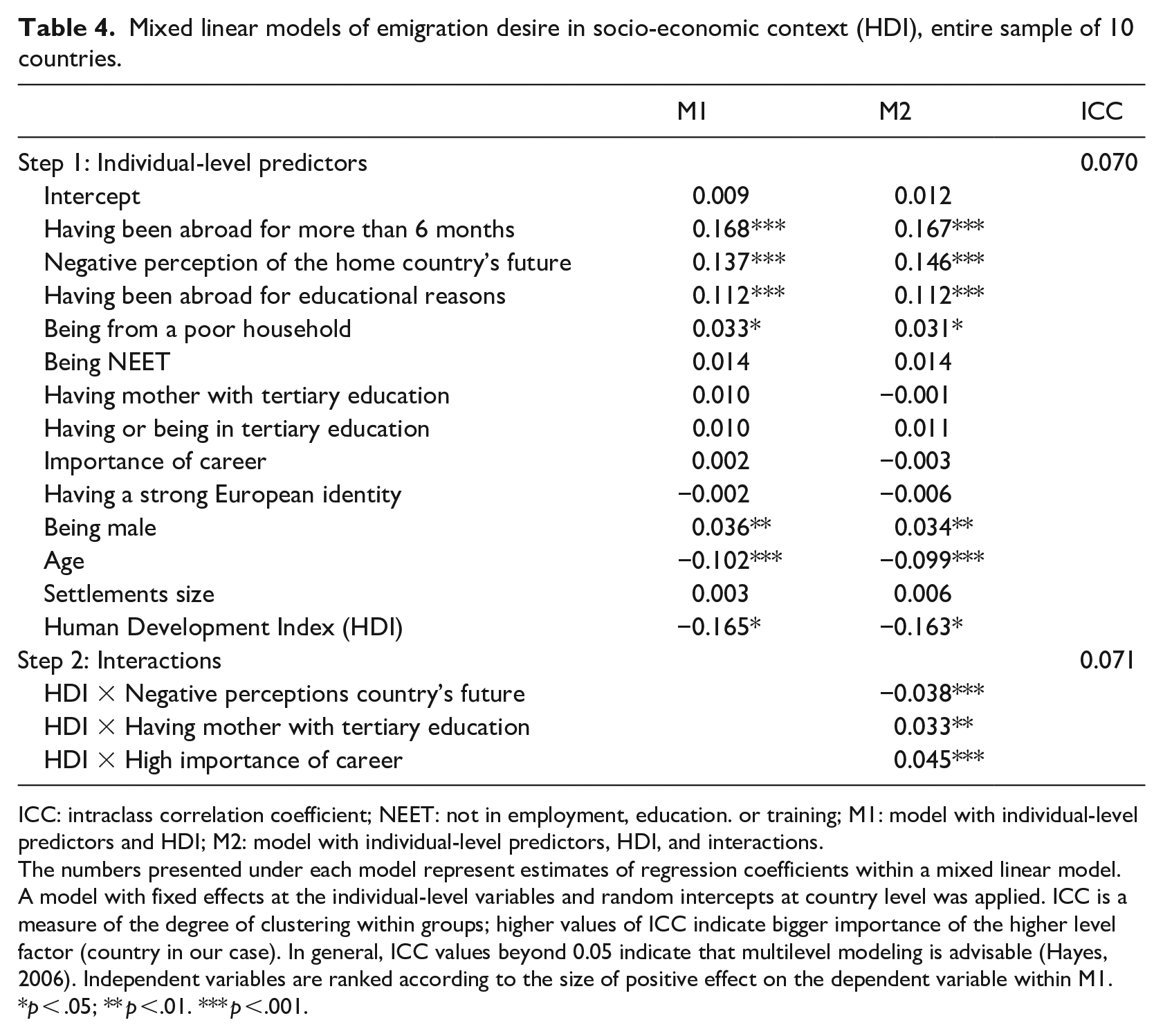
ICC: intraclass correlation coefficient; NEET: not in employment, education. or training; M1: model with individual-level predictors and HDI; M2: model with individual-level predictors, HDI, and interactions.
The numbers presented under each model represent estimates of regression coefficients within a mixed linear model. A model with fixed effects at the individual-level variables and random intercepts at country level was applied. ICC is a measure of the degree of clustering within groups; higher values of ICC indicate bigger importance of the higher level factor (country in our case). In general, ICC values beyond 0.05 indicate that multilevel modeling is advisable (Hayes, 2006). Independent variables are ranked according to the size of positive effect on the dependent variable within M1.
p < .05; ** p <.01. *** p <.001.
Finally, within our third research question, we tested the moderation effects of HDI on the relationship between the individual-level independent variables and emigration desire. For this purpose, we computed interaction terms for combinations of HDI and each of the independent variables in the model. On this basis, we ran a mixed model regression analysis with all the independent variables and all interaction terms. A model with fixed effects at the level of individual variables and random intercepts at the country level was applied and all the variables were standardized to get estimates that are comparable to the regression coefficients in Table 3. Table 4 presents results for the impact of all predictors and all the interaction terms that proved to be statistically significant (see Model 2).
Our findings in relation to interaction terms reveal a relatively clear pattern. On one hand, negative perception of own country’s future as the only significant predictor with a negative value of interaction term (β = −0.038, p < 0.001) clearly indicates motivations related to undesirable situations in the home country. On the other hand, the two variables with the highest positive values (ascribing high importance to a professional career, β = 0.045, p < 0.001; having a mother with tertiary education, β = 0.033, p < 0.01) can be interpreted as indicating the motivations of personal ambition. The two groups of factors are not easily classified in accordance with any of the binary approaches to factors of migration. It appears clear at first glance that the one factor with negative coefficients is closer to the group of factors of necessity and aspiration, while the two factors with the strongest positive effect are closer to the factors of opportunity and ability. Given the content of the items found in each category, we decided to label the first category as “factors of necessity” and the second as “factors of ambition.”
The negative coefficient in relation to the negative perception of one’s own country’s future as a factor of necessity suggests that this kind of factor tends to be a stronger predictor of higher emigration desire in less socio-economically developed environments, that is, societies with lower values of HDI.
As can be seen from Figure 1, high negative perceptions of one’s home country’s future are related to much higher emigration desire in countries with low HDI, while the effect is weaker in most socio-economically developed countries. The opposite is the case if we observe the effect of career importance as an example of factors of ambition.
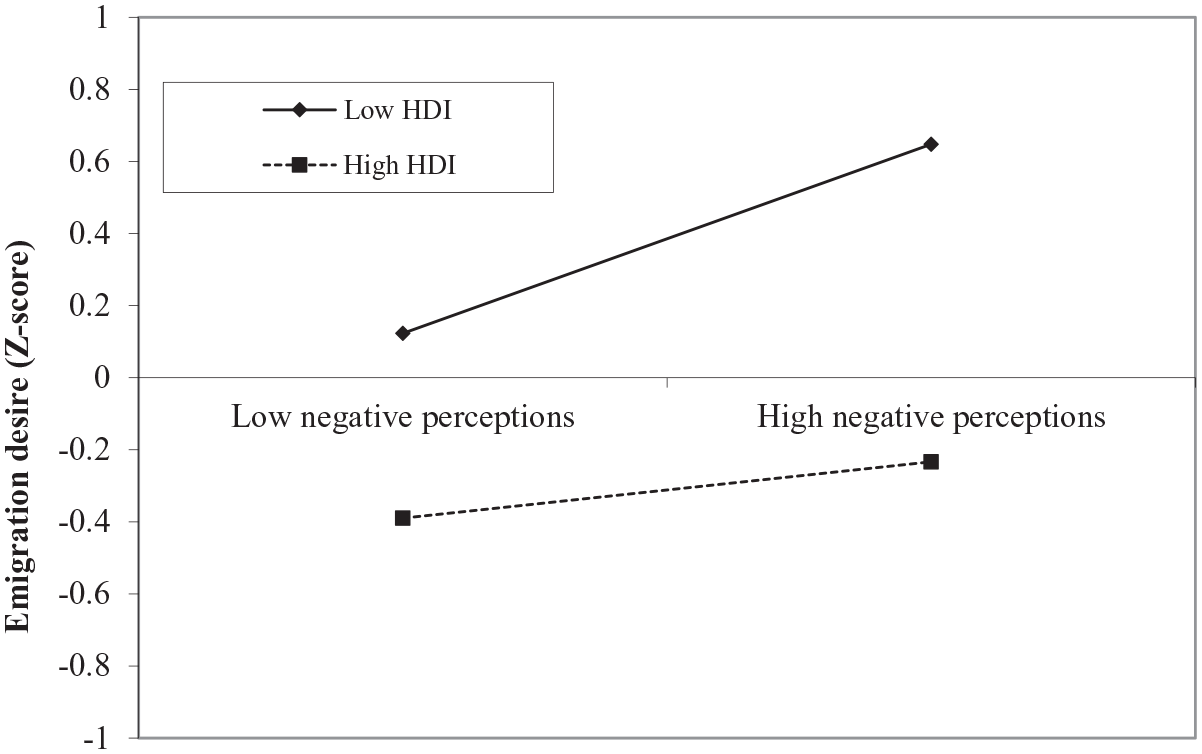
Interaction plot of the link between negative perception of own country’s future and emigration desire.
Figure 2 shows that the importance attached to career substantially increases emigration desire among young people from most developed countries, while the opposite is the case among young people from countries with low levels of HDI.
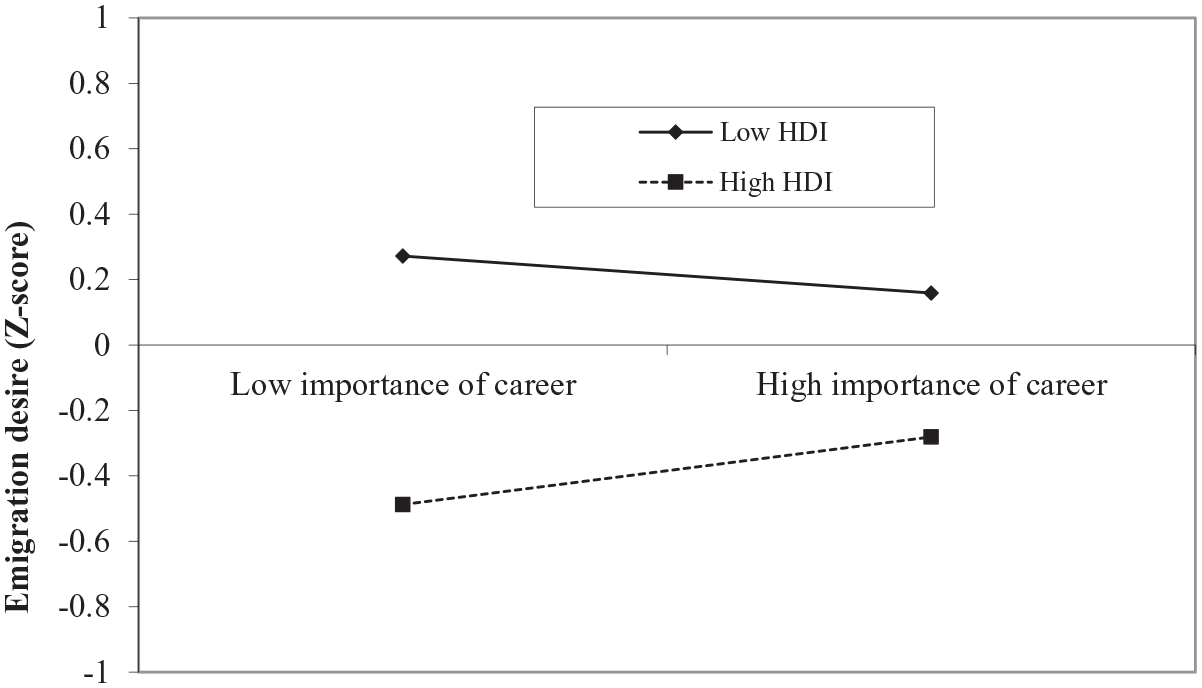
Interaction plot of the link between importance of career and emigration desire.
We can thus confirm our third hypothesis (H3), that factors of necessity are more present among youth from countries with lower HDI, while factors of opportunity (narrowed down to factors of ambition) are stronger in countries with higher levels of HDI. We can illustrate this by comparing the impact of two variables in two very different countries. In Kosovo, which has the lowest level of HDI in the sample, negative perception of the home country’s future is a significant predictor of emigration desire (β = 0.162, p < 0.01), while in Slovenia, a country with the highest value of HDI, it is very weak and not statistically significant (β = 0.041, p > 0.05). On the other hand, high importance of career turns out to be a significant predictor of emigration desire (β = 0.154, p < 0.01) in Slovenia, while in Kosovo this is not the case at all (β = 0.002, p > 0.05).
Thus, in line with H3, our analyses suggest that the level of socio-economic development in a country impacts not only the likelihood of young people emigrating but also the reasons why they intend to emigrate. The more socio-economically developed a society is, the more young people emigrate out of ambition and the less out of necessity.
Conclusion
Our findings can be summarized in three main points. First, the level of socio-economic development in a country affects the emigration desire of young people in two important ways. The first effect is quantitative and is unsurprising. We found a negative correlation between the level of development as measured by HDI and emigration desire among young people. This link has been demonstrated many times and is usually explained within the context of emigration driven by differences in levels of development, which results in migration “for a better life” (Kahanec and Fabo, 2013; Wallace and Stola, 2001). The second identified effect of HDI is qualitative and much more interesting. Increases in levels of socio-economic development tend to cause a shift in factors influencing migration, in particular, a shift from migration out of perceived necessity to migration based on ambition. No other study has yet found such a tendency. This has to do with the fact that existing dyadic models make it virtually impossible to differentiate between factors of necessity and factors of ambition. We believe that our research points to the importance of keeping empirical research relatively flexible in relation to existing models.
The finding that an increase in HDI leads not only to a decrease in emigration but also to a qualitative change in motivation for migration explains high levels of emigration from some countries that are relatively well developed. Slovenia is a good example. Within our sample, Slovenia has the highest HDI but also surprisingly high levels of emigration desire among young people, surpassing less-developed countries such as Croatia, Romania, or Bulgaria. Slovenian youth migration stands out by reason of the virtually non-existent role of factors of necessity and a pronounced role of factors of ambition. This can be explained by Slovenia’s proximity to socio-economically more developed Western Europe. Within the EU, Slovenian young people can freely seek career challenges and opportunities. Since Slovenia is a fairly well-developed country, necessity is rarely an important reason for emigration, but young Slovenians are well-equipped with both human and economic capital and are able to improve their careers by moving to neighboring countries. Our results suggest that ambition is an important engine of emigration.
Our second major finding pertains to the strongest predictor of emigration desire across the 10 countries observed, previous experience with migration. Young people who had had the experience of having been abroad for more than 6 months had a much higher emigration desire compared with those without such an experience. This is consistent with other studies emphasizing the high impact of social capital in the form of established social networks abroad and cultural capital, and in the form of relevant knowledge and skills applicable for future migration (Baláz et al., 2004; Kahanec and Fabo, 2013).
The most obvious limitation of our findings is the fact that our sample is limited to 1o SEE countries. We regard our results as valid within this region, but one should be cautious when generalizing to other countries. Future research should test our findings on a wider sample of countries.
