




Abstract
This article examines the extent to which science, technology, engineering, and mathematics (STEM) subject choice in upper secondary education explains gender differences in STEM enrollment in higher education. We adopt a cross-country approach using Germany, Ireland, and Scotland as three case studies. These countries differ in terms of both the degree of subject choice offered in upper secondary education and the relevance for higher education admission of having studied specific school subjects. Using datasets of young people from all three countries, our results indicate a stronger mediation of school subjects for Scotland than in Germany and Ireland and a remarkable gender gap in STEM enrollment in all three countries. We conclude that females studying science subjects within upper secondary education appears to be a necessary but not a sufficient condition to ensure gender equality in progression to STEM fields.
Introduction
It is widely acknowledged that men and women differ markedly in their choice of field of study in higher (tertiary) education. Men are more likely to choose engineering, science, or math fields, whereas women more often opt for humanities, education, and arts (e.g. Barone, 2011; Charles and Bradley, 2002; Jacobs, 1996; OECD, 2015; Smyth and Steinmetz, 2008; Xie et al., 2015: 340ff). These gender-specific preferences are already evident at secondary level (e.g. Tai et al., 2006), and previous research has shown that gender differences in the secondary subjects chosen are a strong predictor of field of study decisions in postsecondary education (e.g. Chachashvili-Bolotin et al., 2016; Mann and DiPrete, 2013; Morgan et al., 2013; Riegle-Crumb et al. 2012).
Previous research explaining gender differences in choice of subject or field of study has mainly focused on micro-processes such as gender-specific cognitive ability, self-efficacy in different subject domains, gender role socialization, and gender beliefs and stereotypes (e.g. Charles and Bradley, 2002; Jonsson, 1999; for a recent review, see Wang and Degol, 2017). Moreover, prior comparative research on gender differences in field of study choice has often highlighted the importance of labor market structures and economic conditions, thus explaining variation of field of study choice by expected later labor market returns (e.g. Charles and Bradley, 2002, 2009; Moorhouse, 2017; Zafar, 2013). Labor market opportunities and career aspirations have also been used as an explanation for the gender gap in science, technology, engineering, and mathematics (STEM) enrollments (e.g. Tai et al., 2006; Xie and Shauman, 2003). However, this literature rarely considers the features of national education systems as a potential explanation for this gap (Ayalon and Livneh, 2013). In our article, we focus on how country-specific curriculum requirements in secondary school may contribute to gendered choices in higher education. In particular, we are interested in the extent to which (gendered) choice of STEM subjects at school contributes to explaining the gender gap in STEM enrollment in higher education.
We use survey data from Germany, Ireland, and Scotland as a set of comparative case studies. These three countries have distinct institutional settings in upper secondary education and in curriculum requirements for access to higher education. On one hand, the Scottish education system is characterized by a good deal of flexibility in school subject choices, which leads to large variation between students in the number and types of subjects taken in the final school exams. Given that universities specify particular groups of subjects for admission purposes, this results in certain students being unable to access some subject domains (such as STEM) if they have not taken related subjects at upper secondary level. On the other hand, in Ireland and Germany secondary school students are more limited in their subject choices due to the existence of compulsory core subjects (e.g. mathematics and, in Germany, also one science). School subject choice also has limited or no formal relevance for higher education entry purposes in these countries. Against the background of these country differences, the comparison between Scotland, Ireland, and Germany allows us to examine the role of upper secondary school curricula in (gendered) choices in tertiary education: Do gender differences in enrollment in STEM fields in higher education vary between Scotland, Ireland, and Germany? Do the three countries vary in the extent to which the school subjects taken matter for gender differences in STEM enrollment?
Hence, our article aims to contribute to the increasing interest in country differences in the factors that affect gendered choices in higher education and, in particular, institutional explanations of gender differences in study choices (e.g. Werum and Baker, 2004; Yazilitas et al., 2013: 533ff; see also Ayalon and Livneh, 2013; Charles and Bradley, 2009). Comparing students’ chances of entering STEM fields in higher education in three countries with different degrees of subject choice in upper secondary education and different links between school subject choice and higher education entry allows us to provide initial evidence on the influence of school curricula on higher education choices and how it may vary between countries. Linking gender differences in secondary school subjects with gender differences in field of study is also highly relevant for education policy as it identifies potential institutional levers to encourage women’s participation in STEM fields in higher education.
Our article is structured as follows: We first discuss the role of upper secondary education in later educational choices with particular emphasis on school subject choice in upper secondary school and (gendered) field of study choice in higher education. We then provide some information about the educational system of the three countries examined. To test our hypothesis, data from three nationally representative School Leavers Surveys were harmonized for our analyses. We find that women are less likely than men to enroll in STEM fields of study in all settings. In all three countries, taking more STEM subjects at school is predictive of entering related fields within higher education, and this pattern holds for different STEM specifications. As expected, STEM school subjects are a stronger mediator of gender differences in STEM fields in Scotland, followed by Ireland and Germany.
The role of secondary school in gendered choices in higher education
Gendered patterns in field of study have been found in almost all Western countries: the profile of students taking engineering, sciences, or math is predominantly male, whereas women are overrepresented in fields like humanities, arts, and education (e.g. Barone, 2011; Charles and Bradley, 2009; Iannelli and Smyth, 2008; OECD, 2015; Smyth and Steinmetz, 2008; Van Langen et al., 2006). Moreover, this pattern has not changed much during the last decade (e.g. OECD.Stat, 2019). Only a few studies consider the institutional setting of the educational system as one of the drivers of gendered choices in higher education. Among them, some comparative studies have taken into account features of the higher educational system, such as its size, its structural diversification, and/or the share of female tertiary participation (e.g. Charles and Bradley, 2002, 2009; Iannelli and Smyth, 2008; McDaniel, 2010; Moorhouse, 2017; Ramirez and Wotipka, 2001; Smyth and Steinmetz, 2008). In these studies, it is argued that, on one hand, the expansion of women’s participation in higher education may empower them to pursue nontraditional, gender atypical fields. On the other hand, the more options to specialize are available, the more likely students might be to express their (gendered) preferences, which in turn may result in more gender segregated field choices. In their comparative studies, both Charles and Bradley (2002) and Moorhouse (2017) find no significant effect of female participation in higher education on sex segregation by field of study, at least in industrialized countries, but diversification of higher education serves to increase sex segregation. These studies explain sex segregation in terms of features of the higher education system. However, orientations to particular fields may already be formed before the point of higher education entry. Surprisingly, research on gendered choices of fields of study mostly neglects an analysis of the role of upper secondary education and, in particular, the linkages between school curricula and higher education. Related to that more general (macro) question of how institutional features affect gender patterns in higher education, in our article we focus on the individual (micro-) level and examine the extent of cross-country variation in the way in which secondary school choices affect later enrollment.
In the following sections, we review previous empirical studies related to these issues, focusing on two types of contributions. First, we present studies that examine whether and how gendered patterns in school subjects may translate into gender differences in field of study. Second, we summarize the results of the few comparative studies which investigate the relationship between school curricula and field of study in higher education. Drawing from both strands of research, we analyze the relevance of school subjects for enrollment in different fields of study in higher education and how this relationship may vary between countries with different institutional education settings.
School subjects and (gendered) STEM enrollment
Schools can inspire, reinforce, or discourage students’ interest in pursuing a STEM field of study in higher education. In general, school provision of subjects allows students to become familiar with the contents, demands, and challenges of related fields of study, ultimately affecting a student’s choice set. Exposure to STEM subjects in school may allow students to discover (new) interests and to acquire STEM knowledge. Hence, greater exposure to STEM studies in school may enhance students’ interest and competences in STEM subjects resulting in higher enrollment rates in STEM fields in higher education.
In contrast, limited exposure to STEM studies, which may occur in systems where studying a STEM subject is not compulsory and students are allowed to specialize in specific subjects, may lead to lower levels of STEM enrollment. If students have the option of selecting their subjects, they can seek more intensive exposure to subjects in which they are interested, in which they are most likely to succeed or they deem to be more relevant for their future. In addition, not taking STEM subjects at school may disqualify students from taking particular fields in higher education and/or create challenges for them in studying such subjects without an adequate foundation in the discipline.
Regarding gender differences, giving greater choice to students may lead to stronger gendered patterns in subjects if boys and girls are more likely to behave consistently with gender norms. In addition, girls might be more likely than boys not to opt for sciences as they have been found to be less confident in their ability net of actual achievements (Jonsson, 1999). On the contrary, restricting gender-typical course-choice patterns in school and requiring all students, men and women, to take advanced math and sciences subjects may have a positive impact on women’s future choice set, on their experiences, and competencies in STEM, leading to higher female STEM enrollment (Legewie and DiPrete, 2014a; Reinhold et al., 2018; Wang and Degol, 2017: 130; Xie and Shauman, 2003).
However, empirical evidence regarding whether and how exposure of women to math and science subjects at school translates into less gender difference in STEM enrollment is mixed, Legewie and DiPrete (2014b) examined provision of math and science in US high schools and found that the stronger the math and science orientation of the school’s curriculum, the smaller the gender gap in intentions to major in STEM fields (see also Levine and Zimmerman, 1995). In contrast, some studies in Europe show that encouraging women to take science subjects in school does not necessarily increase subsequent female enrollment in STEM fields. A curriculum reform in England in 2006 and 2008 (the Triple Science policy) increased the number of female students taking up science subjects (Homer et al., 2013), but this increase did not translate into growing participation in STEM higher education (Broecke, 2013). On the contrary, according to Broecke (2013), increased learning intensity in sciences significantly affected the chances of doing a STEM degree in higher education for men only. The same gender pattern of men benefiting from intensified courses is reported in three studies examining recent curriculum reforms in upper secondary education in Germany (Biewen and Schwerter, 2019; Görlitz and Gravert, 2018; Hübner et al., 2018). In contrast, in the Netherlands a curriculum reform making math and science courses compulsory led to an increase in the number of female students both participating in STEM exams and entering science-related fields of study (Van Langen et al., 2008).
Curriculum, enrollment requirements, and gendered patterns of field of study
School curriculum as well as higher education entry requirements varies across countries as does the importance of choices made at school for enrollment in specific fields. First, educational systems differ in the extent to which they require students to take particular core school subjects and in the degree of specialization offered in school. Second, educational systems vary in entry requirements for higher education. On one hand, school subjects may have no impact on enrollment if standardized secondary school certification (e.g. the German Abitur or the Italian Diploma di Maturità) solely determines eligibility to enroll in higher education. On the other hand, having successfully mastered specific school subjects (such as the English A-levels or the Scottish Highers) might be a prerequisite for enrollment in specific fields. Hence, the stronger the relation of (gender-specific) choices in schools and entry requirements, the stronger the relevance of school subjects for gender differences in higher education.
In previous research, a few comparative studies have focused on the impact of differentiation and standardization of educational systems on gender differences in expected and actual employment outcomes. In a study of 12 countries, Iannelli and Smyth (2008) observe that gender segregation at upper secondary level tends to be greater in countries with highly differentiated educational systems. They conclude that having to make earlier choices appears to reinforce “gender-appropriate” patterns of subject selection. Similarly, Sikora and Pokropek (2011) and Han (2016) also examine differentiation in educational systems and how it affects career expectations using PISA data. Both studies show that the greater the number of different schools types offering distinct pathways (e.g., vocational or academic), the larger the gender gap in STEM occupational aspirations. The degree of standardization of education systems has been found to affect gender differences in math test scores. Using data from 32 countries of the TIMSS (Trends in International Mathematics and Science Study) study, Ayalon and Livneh (2013) report that a higher level of standardization in secondary education, as measured by the use of national examinations, is associated with a reduced gender gap in math test scores because it helps ensure similar exposure of students to math knowledge. Similarly, Yazilitas et al. (2013), in their review, also conclude that patterns of educational choice in schools are found to be more gendered in countries in which students are given more freedom to choose between alternative trajectories, a pattern that Abbiss (2009: 345) calls the “paradox of choice.” In addition, gendered choices in school are assumed to be strongest the earlier curricular decisions have to be made (Jacobs et al., 2002; Scheeren et al., 2018).
Summing up previous research, single-country studies observe that in England and Germany (but not in the Netherlands) intensive compulsory science and math for all students does not reduce the gender gap in STEM fields in higher education, whereas cross-country analyses indicate that less standardized and more differentiated systems, and systems characterized by greater flexibility in school subject choice, offer more opportunities for (gender-typical) specialization, that is, less exposure of women to science and math, resulting in larger gender differences in STEM enrollment.
In our article, we provide a further contribution to the existing comparative research on gender segregation in higher education. In contrast to previous studies, we are less interested in comparing institutional characteristics and country patterns of STEM enrollment at the macro level, but rather we are interested in country variation in the role of school subjects for individual choices at the micro level.
School curriculum and higher education access in Germany, Ireland, and Scotland
In this section, as background information we discuss the specific features of secondary and higher education in Germany, Ireland, and Scotland regarding school curriculum, requirements and the relevance of school subjects for admission to higher education.
Germany
In the highly differentiated tripartite system of Germany, pupils are selected into different school tracks early, commonly at the age of 10 in most German federal states (Bundesländer). Only the highest track, the Gymnasium, leads directly to the Abitur, which is a prerequisite for enrollment in higher education. 1 Every Gymnasium student follows more or less the same curriculum until grade 10/11 (age 15/16) with no capacity to opt out of particular subjects. In the last 2 or 3 years of school, there are some possibilities for specialization but any freedom of choice is limited by a number of compulsory core subjects and restrictions on taking subject combinations covering courses from different domains (e.g. foreign languages, STEM subjects, and social sciences). In most federal states, math, German, and at least one science subject are among the core courses. Beyond attending core courses, students have to choose two to three advanced courses with intensified learning and longer instruction hours. To acquire the Abitur, students must take (at least) three written exams and one oral exam in different subjects, among them the two advanced subjects. Access to tertiary education is determined by the acquisition of the Abitur only, disregarding subject choice. If there are restrictions in admission, for example, in competitive fields such as business and administration, psychology, or medicine, they are based on the overall final grade. In sum, Germany can be characterized by low flexibility in subject choice and few opportunities for specialization, and no field-specific relevance of subjects for higher education enrollment.
Ireland
Young people in Ireland make the transition from primary to secondary school at around 11 or 12 years of age. There are three kinds of secondary school: voluntary secondary, vocational, and community/comprehensive. The school types differ in their funding and governance arrangements but fall within the same curriculum and examination structure. Lower secondary education comprises a 3-year phase, culminating in a nationally standardized exam, the Junior Certificate. For this leaver cohort, students were required to study six core subjects (including math, English, and Irish). The remaining subjects studied reflected the interaction of school provision and student choice, though almost all students choose a science subject. At lower secondary level, young people could study Irish, English, and math at higher, ordinary, or foundation level while the other exam subjects could be taken at higher or ordinary level. Students typically took 11 or 12 subjects in the Junior Certificate exam. 2 The 2-year upper secondary program usually culminates in the Leaving Certificate exam (there is also a Leaving Certificate Applied program, chosen by 6–7% of students). Students typically take seven exam subjects for the Leaving Certificate; Irish and math can be taken at higher, ordinary, or foundation level, and the remaining subjects at higher or ordinary level. As at lower secondary level, young people are required to study Irish, English, and math. Places in higher education are allocated through a centralized system which considers students’ grades in the Leaving Certificate (i.e. the results for the “best” six subjects) as the main criterion for admission. Given the importance of grades, there is a “points race” in terms of access to higher education, especially in relation to more prestigious fields of study like medicine. Similar to Germany, flexibility in subject choice is relatively low, given that Irish, English, and math are core subjects for all students, and the subjects taken have only a marginal effect on being eligible for entry to specific fields in higher education.
Scotland
The Scottish educational system is comprehensive and compulsory until the age of 16. It includes 7 years of primary education (P1–P7) and 6 years of secondary school (S1–S6). At the end of compulsory education, in S4 all pupils sit their first set of national exams. At the time of the cohorts analyzed in this article, on average eight subjects were studied at this point with English and math compulsory. In S5 and S6, students generally take subject-specific exams called Highers and Advanced Highers that are required to enter higher education. In these years there are no compulsory subjects and there is considerable flexibility in the number, levels, and types of subjects that students can take in their final secondary school exams (on average students take five Highers). This leads to clear variation in subject choices among secondary pupils which ultimately generates marked differences in the chances of entering higher education (Iannelli et al., 2016). In Scotland (as in the rest of the United Kingdom) universities set their own entry requirements. Generally, universities expect prospective candidates to take between three and five Highers during S5 (Johnson and Hayward, 2008). Studying STEM subjects at school is an essential prerequisite to entering STEM fields of study in higher education. The most prestigious universities often require more Highers/Advanced Highers and higher grades in specific subjects. Recently, the most prestigious, research-intensive universities in the United Kingdom even published a document which lists eight subjects, STEM subjects included, as facilitating access to their programs (Russell Group, 2015). Compared with Germany and Ireland, Scotland shows the highest degree of flexibility in subject choice in secondary school and the strongest link between subjects taken at the end of secondary school and access to specific fields of study in higher education.
Cross-country hypothesis
Taking into account our theoretical considerations about the relation between school subjects and (gendered) STEM enrollment in higher education and the specific features of the national education systems in the countries under investigation (see “Germany,” “Ireland,” and “Scotland” sections), we expect the role of school subjects for STEM enrollment to be largest in Scotland due to the greater flexibility in subject choice together with the importance of certain subjects (i.e. “facilitating subjects”) for admission to higher education in Scotland, that is, upper secondary subject selection is expected to be the strongest mediator for gender differences in STEM fields in Scotland. In an intermediate position is Ireland where choices are less open and math is compulsory for all students. Hence, the relevance of school subjects for explaining gendered choices in higher education is expected to be smaller than in Scotland. Finally, in Germany the wide array of core school subjects, concomitant with no consequences of subject choice for university admission, leads us to expect the smallest mediating role of school subjects for gender differences in STEM fields.
Data and methods
In our empirical analyses we use national longitudinal surveys of secondary school leavers that we harmonized to answer our research questions and test our cross-country hypothesis. All three datasets are nationally representative surveys of secondary school students who left upper secondary education between 2000 and 2004, which provide detailed information on respondents’ subjects studied at school and, for those who enrolled in higher education, their field of study. While the Irish and Scottish School Leavers Surveys contain data for students who left school with and without qualifications (“school leavers”), the German data include only those who have successfully graduated from upper secondary education and attained the Abitur (“school graduates”) approximately 6 months before the survey. We restrict the German sample to students aged under 21 years and exclude students who had attained vocational training or work experience before school graduation (in total 16% of the original sample). The German analysis sample consists of 6,106 upper secondary school graduates; of those, 4,253 are already enrolled in higher education or intend to enroll soon. For Ireland, we use data from the Irish School Leavers’ Survey, a nationally representative survey of young people who graduated from secondary school in the previous academic year. For comparability, we use the 2001 and 2005 school leaver cohorts leaving us with 1,883 individuals, out of which 1,019 enrolled in higher education. For Scotland, we combined the 2001 and 2005 Scottish School Leavers’ Surveys, nationally representative longitudinal surveys of young people in S4 (i.e. fourth year of secondary school coinciding with the end of compulsory education) followed until 1 year after completion of secondary school when they are aged 18–19. 3 The combined sample size of Scottish upper secondary school leavers consists of 5,725 respondents, out of which 3,534 enrolled in higher education. 4
Our main outcome of interest is enrolling in a STEM field as opposed to enrolling in a non-STEM field. The three national surveys recorded field of study using slightly different classifications, creating challenges for comparison. In addition, the operationalization of fields of study is not trivial as different classifications may result in different results (Charles and Grusky, 1995). Hence, we decided to use four different specifications in our analyses: First, we code a broad category of STEM versus non-STEM. STEM fields encompass the sciences (physics, chemistry, biology, and related fields); several technical fields; and engineering, math, and IT. We then discuss estimation results using STEM plus medicine and health-related fields (STEM+M) as well as results for sciences only, and for engineering and technology (ET). Table A1 in the Supplemental Appendix illustrates our different specifications.
Enrollment patterns in higher education differ across the three countries. We observe a much higher proportion of enrollment in higher education in Germany (71% of upper secondary school graduates with Abitur) compared with Ireland (53% of school leavers) and Scotland (57%), see Table A2 in the Supplemental Appendix. This difference reflects the strong selectivity into the academic track in Germany in comparison with the greater rates of eligibility to enter higher education among upper secondary leavers in Ireland and Scotland. Hence, in our multivariate analyses we take into account possible country-specific selection into higher education (see below).
Our main independent variables are gender and choice of STEM school subjects. The latter is measured using a categorical variable comprising three categories: zero, one, and two or more STEM subjects. The classification of what counts as student choice of STEM subjects at school needs to reflect institutional differences between the three education systems. Thus, in Germany where math and one science subject is compulsory, we count the number of STEM subjects on the basis of the first and second subject of the final exams as these subjects involved 2 years of more intensive instruction. 5 In the Irish and Scottish case, we count the number of STEM subjects taken but, as all students study math in Ireland, we count taking math at higher level as a STEM subject. In Scotland, given that only math taken at Highers and Advanced Highers level matters for entering STEM fields in higher education, we only include math taken at these levels in our categorical variable.
Parental social class is included as a possible confounder affecting both school subject choice and field of study in higher education. Parental social class is measured via the European Socio-Economic Classification (ESEC) (Harrison and Rose, 2006), which we summarize in two broad categories: ESEC 1 and 2 (higher and lower salariat) versus ESEC 3 or below (intermediate occupations and lower). 6 Finally, we account for upper secondary grades in our selection models. In Germany, we use the final grade in the Abitur. In Ireland, grades achieved in the Leaving Certificate are translated into a total score equivalent to that of the Universities and Colleges Admissions Service (UCAS) used in Scotland. All three country measures of school grades have been standardized. Table 1 shows the distributions of the relevant variables for higher education entrants. Descriptive statistics for the full three samples are reported in Table A2 in the Supplemental Appendix.
Descriptive statistics: higher education (HE) entrants.
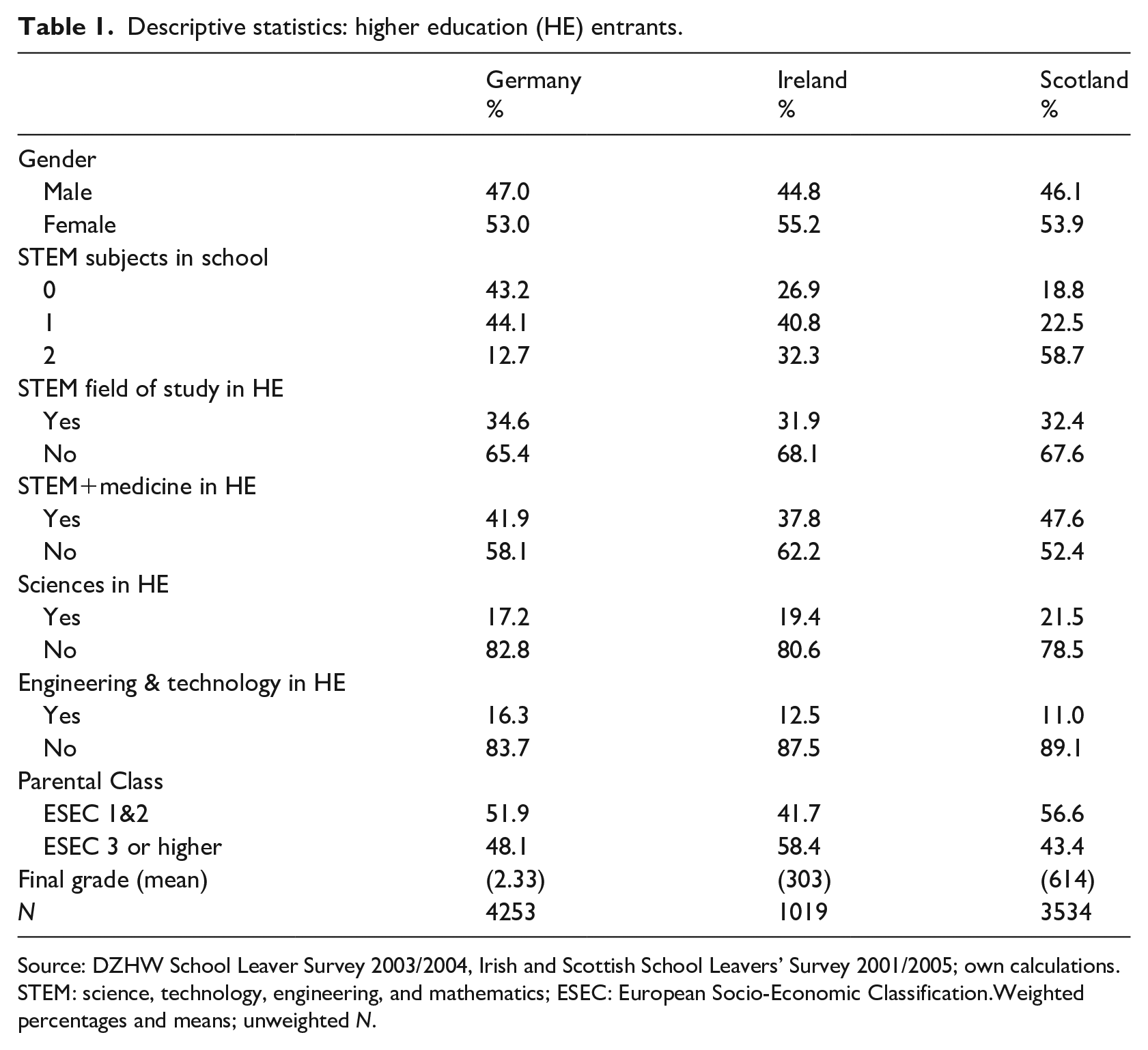
Source: DZHW School Leaver Survey 2003/2004, Irish and Scottish School Leavers’ Survey 2001/2005; own calculations.
STEM: science, technology, engineering, and mathematics; ESEC: European Socio-Economic Classification.Weighted percentages and means; unweighted N.
In our multivariate analyses, we conduct regression models for each country separately. We first account for country-specific selection into higher education, that is, different probabilities of enrollment in the three different countries. We do so by applying the two-stage estimation procedure proposed by Heckman (1979). Therefore, we first estimate the probability of being enrolled in higher education via a binary probit model which includes all variables which are part of the model of interest, with one additional variable only present in the selection model acting as an instrument. The instrumental variable should affect the probability for the outcome of the first equation, but should not have any direct effect on the second. Following suggestions from previous methodological literature dealing with selection bias in educational transitions (Holm and Jæger, 2011), we use grades as an instrumental variable. Looking at bivariate associations, in Scotland and Ireland grades do correlate with higher education entry (Cramér’s V = 0.48 and 0.52 respectively) but less so in Germany (0.27, grades measured in quantiles). Grades and choosing a STEM field are only weakly related in all three countries (Germany: Cramér’s V = 0.04, Scotland: 0.05, Ireland 0.11). The first-stage regression is conducted to derive some information about potential sample selection into enrollment. Using the results of the first-stage regression, so-called Inverse Mills Ratios are estimated, which essentially show the probability that a student decides to enroll over the cumulative probability of a student’s decision. When the coefficient on the Inverse Mills Ratio is positive (“positive selection”), this means that, without the correction, in our main model we would estimate upward-biased coefficients, while a negative coefficient (“negative selection”) results in downward-biased estimates. We derive Inverse Mills Ratios separately for each model specification in each country. Subsequently, in the second step, we estimate the probability of studying a STEM field in higher education via a probit model where the Inverse Mills Ratio is added as an additional explanatory variable to control for potential endogeneity of enrollment into higher education and field of study choice, that is, that part of the error term for the decision to enroll is related to the chosen field of study. We also provide results of models without taking account of possible selection into higher education in Supplemental Appendix Table A7.
Finally, we provide a more explicit decomposition of the total effect of gender using the KHB decomposition method (Breen et al., 2013) using the same regression models as above. The KHB method estimates the direct and indirect effects for nonlinear probability models, breaking down the contribution of each estimated category of the mediator (in our case, number of STEM school subjects) to the overall mediation. We report the average partial effects (APEs) which convert the probit coefficients on the probability scale.
In the “Results” section, we first provide descriptive analyses of the gender gap in STEM school subjects and enrolling in STEM fields distinguishing different specifications of field of study (see section “Gender differences in STEM school subjects and enrollment in STEM fields in higher education”) and gender differences in enrolling in different STEM subfields (see section “Gender, STEM school subjects, and field of study choice”). Empirical results for our main research question on the mediation of gender differences in STEM enrollment by STEM subjects at school are presented in section “The role of school subjects as mediators for field of study choice.”
Results
Gender differences in STEM school subjects and enrollment in STEM fields in higher education
Table 2 shows the odds ratios of men taking no, one, or two STEM subjects at upper secondary level compared to women in the three countries (see Supplemental Appendix Table A3 for percentages). It is worth remembering that these odds are based on the choice of advanced courses in STEM in the three countries (i.e. first and second subject of the final exams in Germany, math at higher level and other STEM subjects at ordinary or higher levels in Ireland, and Highers and Advanced Highers in Scotland). The gender gap in favor of men is highest in Germany, where the chance of men taking one STEM is 1.66 times higher than the chances of women. In Ireland, the pattern is reversed with women being even more likely than men to take up STEM subjects (odds ratio = 0.65), largely driven by a high share of females enrolling in biology. Gender differences are smallest in Scotland, with men’s chances of taking STEM subjects in school 1.21 times the chances of women.
Odds ratio of men versus women choosing STEM subjects in upper secondary school.
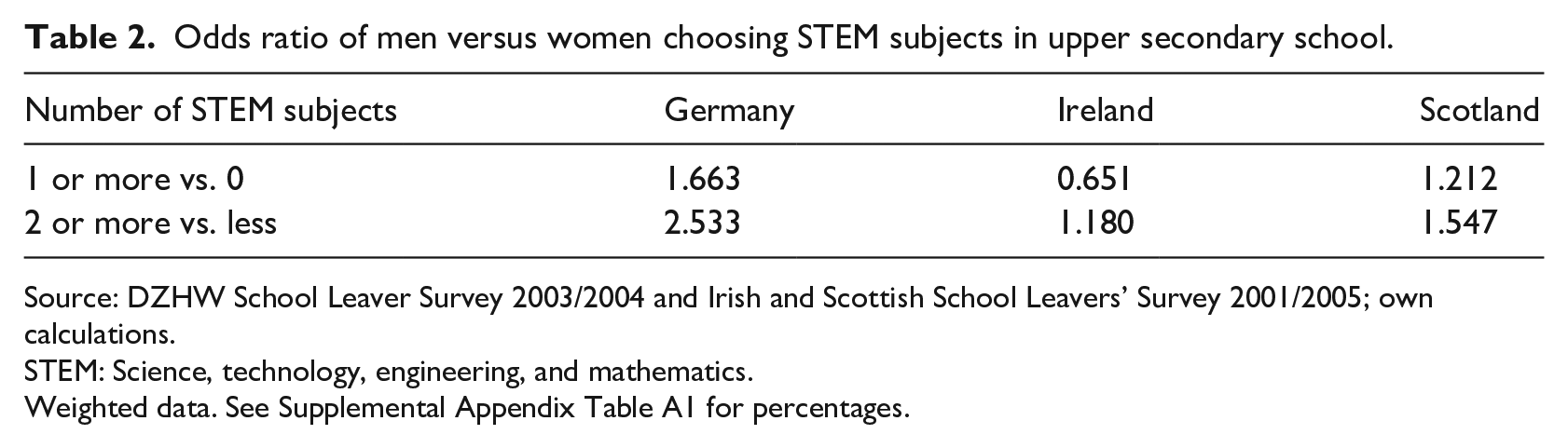
Source: DZHW School Leaver Survey 2003/2004 and Irish and Scottish School Leavers’ Survey 2001/2005; own calculations.
STEM: Science, technology, engineering, and mathematics.
Weighted data. See Supplemental Appendix Table A1 for percentages.
In contrast to upper secondary subjects, gender patterns in enrolling in different STEM subfields in higher education are similar across the three countries (Figure 1). We distinguish four specifications for field of study: STEM, STEM+M, sciences, and ET. Adding medicine and health-related fields to STEM (STEM+M) increases the share of women enrolled, in particular in Scotland, whereas female participation is lowest in ET in all three countries. Comparing male and female enrollment, the gender patterns are particularly pronounced for STEM, sciences, and ET (see Table A4 in the Supplemental Appendix). The percentage point difference between male and female STEM enrollment amounts to 29, 27, and 28 percentage points in Germany, Ireland, and Scotland respectively; for sciences it amounts to 11, 8, and 11 percentage points; and for ET to 18, 19, and 17 percentage points. In STEM+M the gender gap is largest in Germany with 26 percentage points, lowest in Scotland with 15 percentage points and Ireland in-between with 20 percentage points.
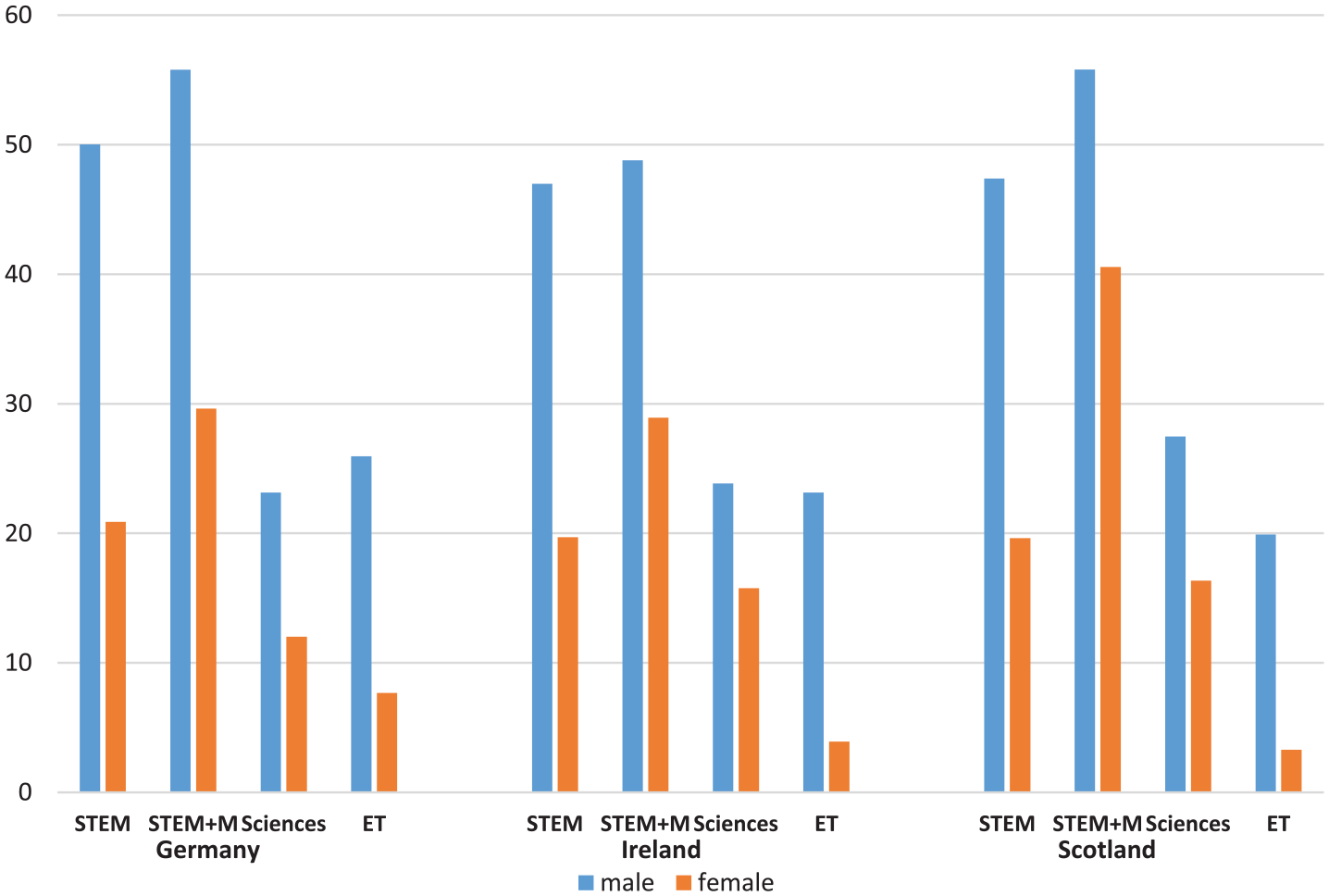
Gender differences in enrollment in higher education for STEM, STEM plus medicine and health-related fields (STEM+M), sciences, and engineering and technology (ET).
Gender, STEM school subjects, and field of study choice
In the next step, we model entry into higher education and field of study choice in a selection model using grades as an instrumental variable. We run models for four STEM subfield specifications separately in all three countries. As before, we distinguish STEM, STEM+M, sciences, and ET.
Before turning to gender differences in field of study choice in higher education, we look at the results of the selection equation, that is, the first step in the two-stage estimation procedure. Results for the selection model are shown in Table 3. In particular, we are interested in the effects of STEM subject choice at school on higher education entry. 7 Our results indicate that in all three countries STEM school subjects increase the probability of being enrolled in higher education.
Enrollment in higher education (results from the first regression model of the two-step probit estimation procedure).
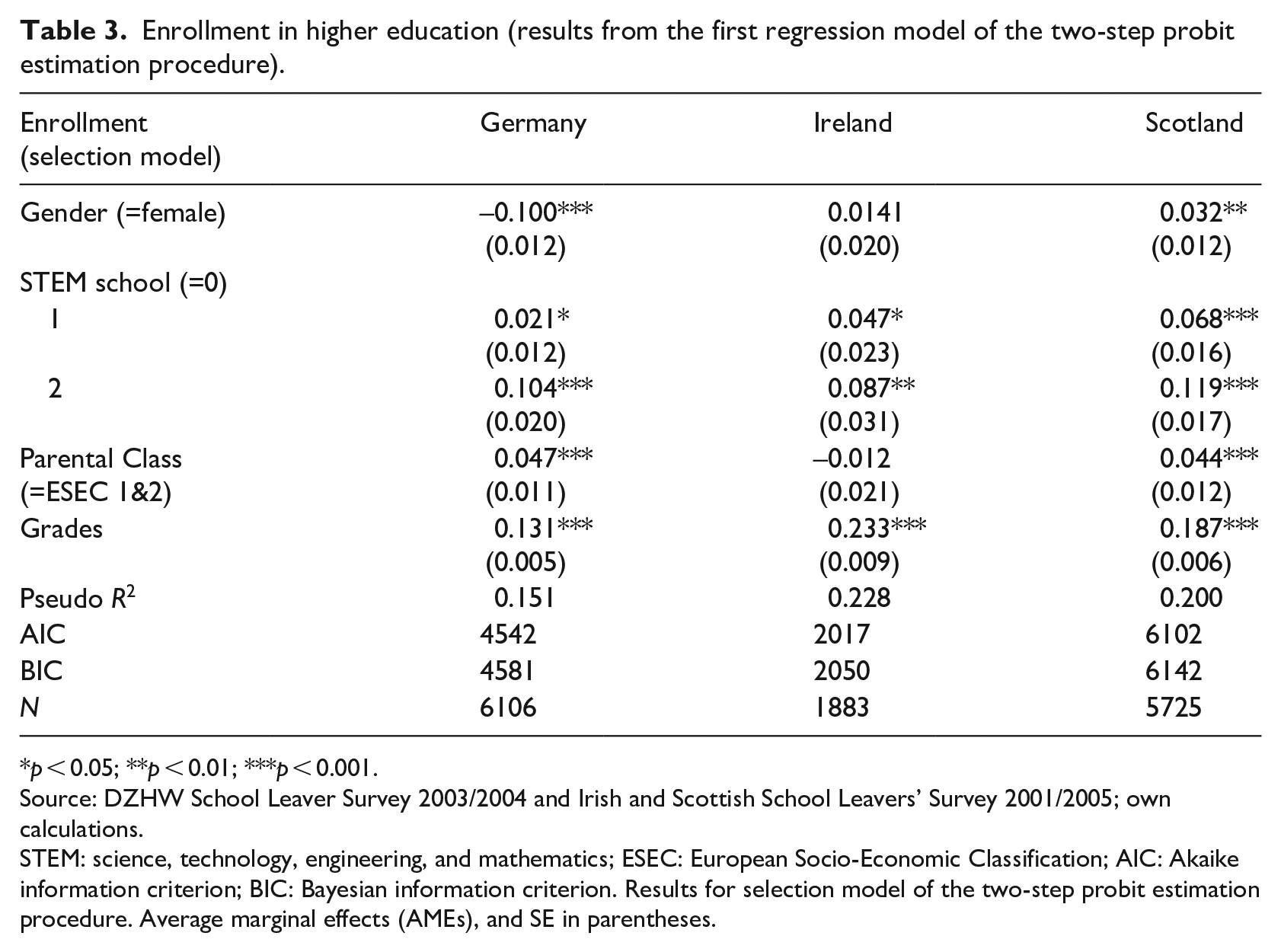
p < 0.05; **p < 0.01; ***p < 0.001.
Source: DZHW School Leaver Survey 2003/2004 and Irish and Scottish School Leavers’ Survey 2001/2005; own calculations.
STEM: science, technology, engineering, and mathematics; ESEC: European Socio-Economic Classification; AIC: Akaike information criterion; BIC: Bayesian information criterion. Results for selection model of the two-step probit estimation procedure. Average marginal effects (AMEs), and SE in parentheses.
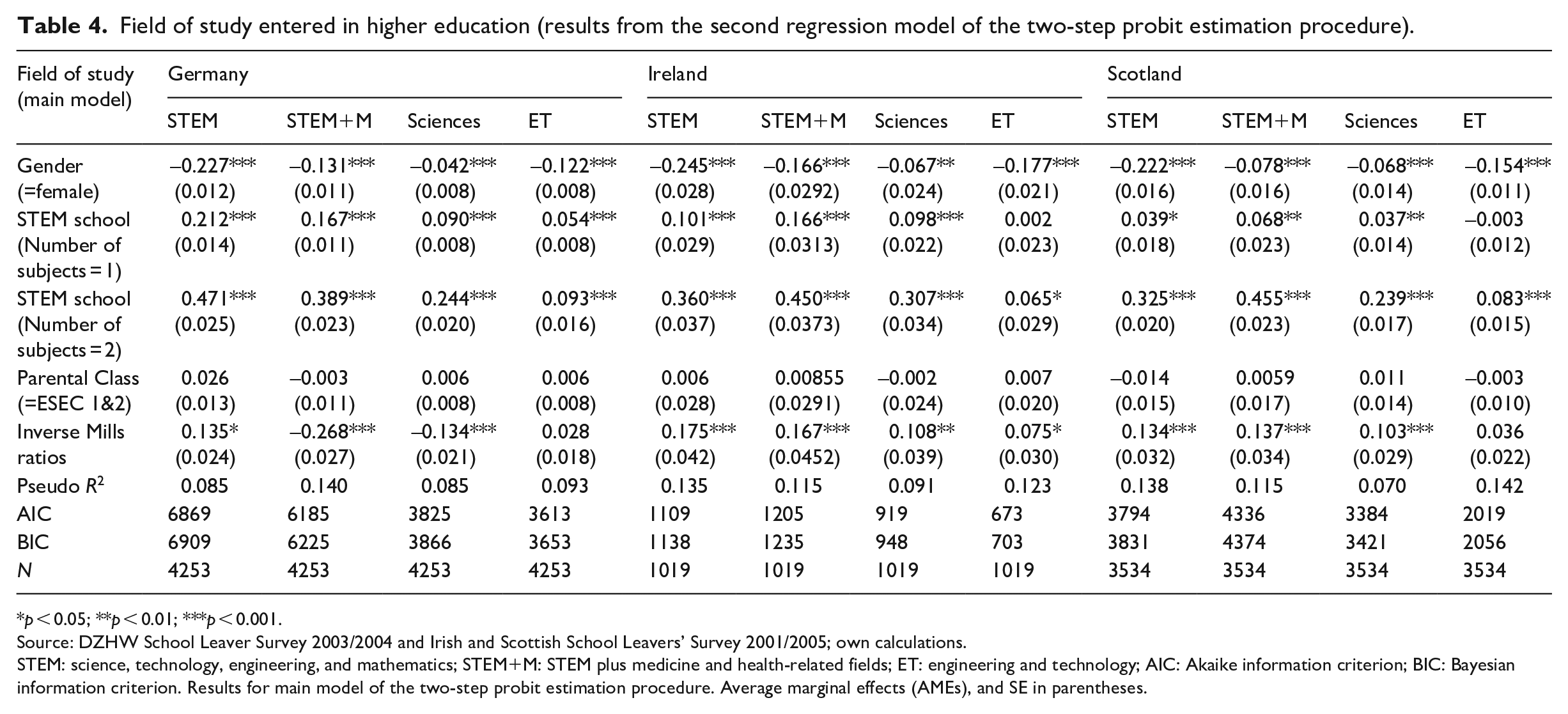
We now turn to gender differences in fields of study in higher education. Table 4 shows the results of the main model (i.e. the second step in the two-stage estimation procedure) with four different specifications of our independent variable, separately for each country. We present predictions based on average marginal effects (AMEs).
Field of study entered in higher education (results from the second regression model of the two-step probit estimation procedure).
p < 0.05; **p < 0.01; ***p < 0.001.
Source: DZHW School Leaver Survey 2003/2004 and Irish and Scottish School Leavers’ Survey 2001/2005; own calculations.
STEM: science, technology, engineering, and mathematics; STEM+M: STEM plus medicine and health-related fields; ET: engineering and technology; AIC: Akaike information criterion; BIC: Bayesian information criterion. Results for main model of the two-step probit estimation procedure. Average marginal effects (AMEs), and SE in parentheses.
We see that in all three countries women are less likely to choose STEM fields, regardless of how they are defined. Gender differences are highest for the “traditional” STEM specification. When adding medicine and health-related fields to this specification, the negative association reduces. This is because the gender difference in studying medicine and related fields is in favor of women, which in turn weakens the initial negative association. However, when breaking down the initial broader definition of STEM into its two main subfields (i.e. sciences and ET), the gender gaps are considerably larger, more than double, in ET than in sciences.
As expected, having studied STEM subjects at school (especially two STEM subjects) positively affects field of study choice as students are more likely to enroll in a STEM field in higher education. A positive effect of STEM subjects in school is found in all three countries. Comparing the different subfields, in Germany, the estimated coefficient of two STEM subjects is strongest for the broad STEM field classification, whereas in Ireland and Scotland it is largest for STEM combined with medicine and health-related fields of study. In Germany, medicine is among those fields with restricted access by final grades—while in Ireland and Scotland entry to medicine is also based on having studied key “facilitating” subjects. ET entry is less related to prior STEM subjects in school than is the case for the sciences. This might be due to less common and less specific technical subjects offered in school compared to sciences such as biology, chemistry, and physics which are commonly studied in school.
We run additional analyses including an interaction of gender and STEM subjects at school. The size of the main gender effect in these models increases, but we find no significant interaction in any of the three countries (see Table A6 in the Supplemental Appendix). Hence, our results indicate that the positive effect of STEM school subjects for STEM enrollment is the same for male and female students. 8
Summing up the results, we find highly consistent patterns across different operationalizations and across countries: STEM subjects at school are important for higher education entry and for field of study choice, in particular having more intensively studied two STEM subjects at school. More specifically, our results suggest that STEM school subjects matter least for ET in all three countries, and in Scotland and Ireland, the strongest effects can be observed for STEM plus medicine and related fields. However, a significant gender gap in STEM enrollment across all STEM subfield specifications remains, and therefore gender differences in enrollment cannot be fully traced back to different exposure to STEM subjects at school.
The role of school subjects as mediators for field of study choice
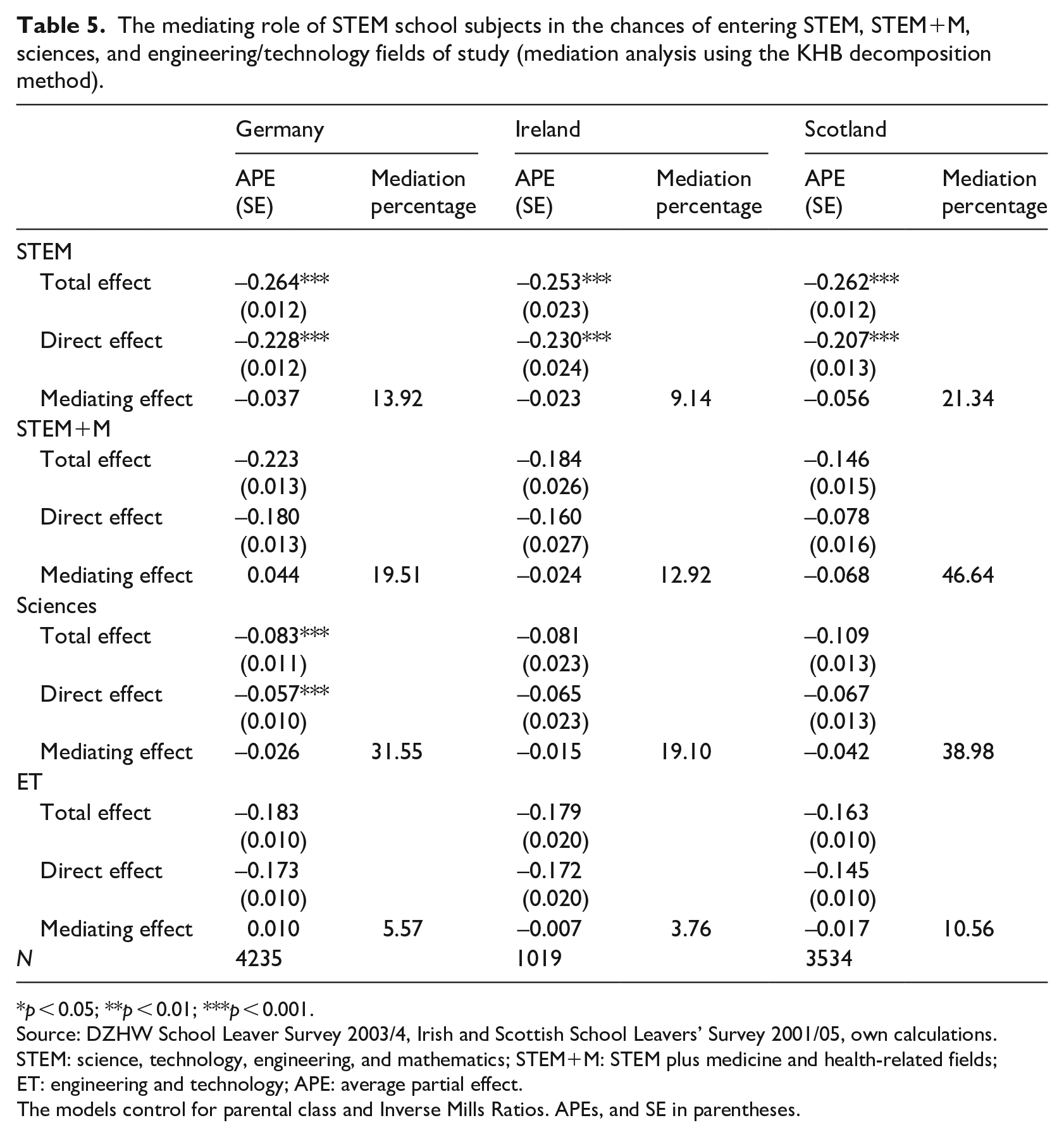
Finally, we run decomposition analysis using the KHB decomposition for the different field of study specifications (Breen et al., 2013). Table 5 shows the decomposition results. The country pattern regarding the mediation of school subjects for gender differences in field of study choice in higher education is similar across all tables. We observe the largest mediating effect of school subjects in Scotland, lowest in Ireland, and Germany in-between. Comparing the different specifications, for enrollment in STEM+M of study, school subjects play the largest role for the observed gender gap (Scotland: 47 percent, Germany: 20 percent, Ireland: 13 percent), whereas for ET the mediating effect of school subjects is much lower in all three countries (mediation percentage in Scotland: 11 percent; Germany: 6 percent, Ireland: 4 percent).
The mediating role of STEM school subjects in the chances of entering STEM, STEM+M, sciences, and engineering/technology fields of study (mediation analysis using the KHB decomposition method).
p < 0.05; **p < 0.01; ***p < 0.001.
Source: DZHW School Leaver Survey 2003/4, Irish and Scottish School Leavers’ Survey 2001/05, own calculations.
STEM: science, technology, engineering, and mathematics; STEM+M: STEM plus medicine and health-related fields; ET: engineering and technology; APE: average partial effect.
The models control for parental class and Inverse Mills Ratios. APEs, and SE in parentheses.
Hence, the results of the decomposition analysis indicate that school subjects do play a role in STEM enrollment in all three countries. However, no clear country pattern can be observed. We considered Germany and Scotland to be most different in terms of flexibility of school subjects and higher education admission criteria with Ireland in-between, but this ranking is not reflected in the results of the decomposition analyses.
Summary and discussion
Despite the fact that gender equalization or even reversal of the gender gap in higher education participation has occurred in many industrialized countries, consistent gender segregation by field of study within the higher education sector has been documented by many researchers. Women are underrepresented in STEM fields of study with consequences for later labor market outcomes (the gender wage gap being the most prominent) and for broader society, considering that science, technology, and engineering are regarded as key drivers of future economic growth.
In recent years increasing attention has been paid to country differences in horizontal gender segregation in higher education. Our study contributed to this research by looking at the relevance of secondary school curricula for gender differences in higher education and their variation across countries. In particular, we examined the role of STEM school subjects in subsequent STEM enrollment. We choose Germany, Ireland, and Scotland as a set of comparative case studies. Whereas young people in Scotland have the greatest freedom of choice of subjects but the most strict entry criteria for STEM fields, Ireland is characterized by a lower degree of choice than Scotland and access to higher education is based almost exclusively on grades while Germany has least freedom of choice with all students taking some STEM courses and subject choices playing no role in higher education admission.
Using school leavers’ data from the three countries and a two-step selection estimation procedure, we first looked at the extent to which gender and upper secondary subject choice influence subsequent entry to STEM fields of study distinguishing four different specifications of STEM. In all three countries women are less likely to enroll in STEM fields of study, though there is considerable between-subfield variation, that is, a relatively smaller gender gap in STEM+M, and a larger gender gap in enrollment in ET. Second, we found that taking more STEM subjects at school is predictive of entering related fields within higher education, and this pattern is consistently found for all four STEM specifications. However, it appears that taking STEM subjects within upper secondary education is a necessary but not a sufficient condition to ensure women’s progression to STEM fields as the gender gap persists. In addition, the positive effect of STEM school subjects on STEM enrollment does not differ between men and women. This means that women taking up STEM subjects at school are not more STEM-focused than their male peers. The relevance of STEM subjects at school for gendered choices in higher education varies across countries as STEM school subjects are a stronger mediator of gender differences in STEM fields in Scotland, followed by Ireland and Germany.
By exploring different STEM specifications, our results indicate that studying STEM subjects in upper secondary school is more linked to certain fields of studies than others. For example, the lower mediation power of school subjects in explaining the gender gap in enrolling into ET suggests that other factors discourage women from enrolling in these fields over and above not having previously studied STEM in school. Recent studies examine, for example, the role of gendered preferences of risks and (financial) returns that may particularly deter young women from ET but attract men to these fields (Fervers et al., 2020) and discuss cultural barriers and stereotypes associated with particular STEM school subjects (e.g. Makarova et al., 2019).
We note some limitations of our study and avenues for future research. First, STEM is not a homogeneous field, with important gender differences in the selection of life sciences and physical sciences at secondary and post-secondary level (see, for example, Sikora, 2014) or regarding math orientation of different STEM subfields (Ganley et al., 2018). To address these differences, we have applied four different specifications but, due to the small sample sizes for certain fields, our data did not allow us to go into more detail. A future replication of our analyses with—not yet available—richer datasets and more countries involved would be desirable to be able to better identify the causal processes at play. Second, with the available school leavers’ data we cannot trace the longer term trajectories of attitudes and behaviors as young people move through and beyond the school system. Longitudinal analyses may also help to identify the interaction between taking specific school subjects, (changes in) student attitudes and subsequent STEM enrollment. For students who have a strong preference for STEM anyway, course-taking in school may matter less than for initially less determined students. However, it might be expected that any cross-national differences in these attitudes and behaviors would be shaped, at least in part, by the institutional structures discussed in this article (i.e. the degree of flexibility in choosing STEM school subjects and the importance of these for admission into a STEM field of study in tertiary education). Notwithstanding these limitations, our results on the strong role of studying STEM subjects in secondary school in STEM enrollment in higher education indicate that a country’s secondary school system and its linkage to higher education may shape educational choices at tertiary level. Our results encourage further comparative research on whether and to what extent choices in secondary school precondition field of study choices in higher education—and potentially other outcomes in higher education such as (field-specific) academic success. However, our finding that total enrollment in STEM does not differ much between the three countries suggests that, in general, different mechanisms in field of study choice are at play beyond the country-specific structures of secondary and tertiary education.
Nobody would disagree that men and women should have the freedom to choose subjects and fields of study or work according to their preferences. However, institutions may extend or limit experiences that may alter orientations, preferences that in turn may affect actual choices. Identifying such features of the education system might help policy makers to target specific education policies to reduce gendered patterns of field of study choice. There is some evidence from other studies that it is experience of, rather than mere exposure to, science subjects that makes a difference to later choice of subjects; thus, more engaging science teaching and the promotion of STEM-related activities tend to enhance the proportion of young people taking the subject (Smyth and Hannan, 2006; Wang and Degol, 2017). In addition, schools with more extensive curricular and extracurricular provision of STEM subjects and activities may be successful in reducing the gender gap in STEM achievement (Chachashvili-Bolotin et al., 2016; Legewie and DiPrete, 2014b). There are important implications for policy, especially in a context where many Western countries have adopted initiatives to encourage young women into STEM fields (see, for example, UNESCO’s For Women in Science Programme, or the controversial European Commission’s “Science: It’s a Girl Thing!”). Such initiatives have been attempted since (at least) the 1970s, but they have rarely been systematically evaluated. Our results highlight the role of school subjects in later STEM enrollment but also how specialization in school contributes to the gender gap in STEM in higher education. Hence, providing positive STEM experiences in school, in particular to girls who are less likely to voluntarily opt for STEM subjects, might be fruitful in increasing girls’ interest in STEM. In contrast, general interventions not specifically targeted at girls may result in a persistent or even greater gender gap due to higher male enrollment (cf. Fervers et al., 2020).
Young people’s aspirations may also be shaped by existing labor market structures, including the level of occupational segregation by gender and in particular, the extent to which same-gender role models are apparent in STEM fields (e.g. Gaskell, 1984; Moorhouse, 2017). Furthermore, occupational aspirations are established relatively early so that young women and men may have particular jobs and/or fields of study in mind even before exposure to STEM at upper secondary level (Legewie and DiPrete, 2014a; Sikora and Pokropek, 2012). It is an open question whether and how the changing labor market and employment opportunities in the course of the current rapid digital transformation and digitalization will attract more students—of both genders—into STEM fields. All of this suggests the need for a broader conceptual framework as well as empirical research which comprehensively takes account of the role of labor markets, school structures, and individual experiences in shaping gendered subject choices.
Supplemental Material
Appendix_R3 – Supplemental material for Secondary school subjects and gendered STEM enrollment in higher education in Germany, Ireland, and Scotland
Supplemental material, Appendix_R3 for Secondary school subjects and gendered STEM enrollment in higher education in Germany, Ireland, and Scotland by Marita Jacob, Cristina Iannelli, Adriana Duta and Emer Smyth in International Journal of Comparative Sociology
Footnotes
Acknowledgements
Previous versions of the article were presented at the SLLS Conference, Dublin, October 2015, and at the AQMeN conference, Edinburgh, October 2016. Thanks to Ibrahim Demirer for supporting data preparation in Germany and to the members of the AQMeN (Applied Quantitative Methods Network) research center strand “Education and Social Stratification” for critical and helpful comments.
Funding
The author(s) disclosed receipt of the following financial support for the research, authorship, and/or publication of this article: This work was conducted within the research center AQMeN (Applied Quantitative Methods Network) and supported by the Economic and Social Research Council (Grant No. ES/K006460/1).

Supplemental material
Supplemental material for this article is available online.
Notes
References
Supplementary Material
Please find the following supplemental material available below.
For Open Access articles published under a Creative Commons License, all supplemental material carries the same license as the article it is associated with.
For non-Open Access articles published, all supplemental material carries a non-exclusive license, and permission requests for re-use of supplemental material or any part of supplemental material shall be sent directly to the copyright owner as specified in the copyright notice associated with the article.
