




Abstract
Online reading behavior can be regarded as a ‘new’ form of cultural capital in today’s digital world. However, it is unclear whether ‘traditional’ mechanisms of cultural and social reproduction are also found in this domain, and whether they manifest uniformly across countries at different stages of development. This article analyzes whether the early home literacy environment has an impact on informational online reading behavior among adolescents and whether this association varies between countries with different levels of digitalization and educational expansion. Data from the 2009 Programme for International Student Assessment (PISA) were used for the empirical analyses. The results of regression models with country-fixed effects indicate a positive association between literacy activities in early childhood and informational online reading at age 15. This association was quite stable across countries. These findings are discussed in light of cultural and social reproduction theory and digital divide research.
Introduction
Literacy is essential for a child’s development and wellbeing, even in today’s digital world (Chiu and McBride-Chang, 2010; Notten and Kraaykamp, 2009a; Organisation for Economic Co-Operation and Development (OECD), 2011). It may in fact be especially so today, since modern countries are also referred to as ‘information-based societies’, in which reading and information gathering are highly relevant skills. However, these activities now take place largely via digital applications. Overall, accessing information and reading online are thought to be beneficial for young people’s development and (later) success in life, as they enhance knowledge, expand cognitive development, broaden worldviews, and enlarge educational and labor market opportunities (Attewell et al., 2003; DiMaggio and Hargittai, 2001; Paino and Renzulli, 2013). As with offline reading activities, online reading behavior tends to be differentiated among youngsters according to their family backgrounds (Hargittai and Hinnant, 2008; Leu et al., 2015; Notten et al., 2009; OECD, 2011). Hence, ‘new inequalities’ may arise that lead to unequal prospects in, for instance, educational and occupational careers (e.g. DiMaggio and Bonikowski, 2008; Warschauer and Matuchniak, 2010). Of course, the question may be asked of how these ‘new inequalities’ emerge and whether ‘traditional’ mechanisms of social reproduction are also at work in this ‘new’ domain.
In order to analyze adolescents’ online reading behavior, we elaborate on the large body of existing research on ‘offline’ reading behavior and reading proficiency and apply it to online reading behavior. A dominant factor in the development of reading habits is the early reading socialization experienced in the family home (Bus et al., 1995; Whitehurst and Lonigan, 1998). Following Bourdieu’s (1977) theory of cultural and social reproduction, provision of a stimulating literacy environment in early childhood, for instance, by reading aloud or playing word games, can be regarded as a core mechanism for the intergenerational transfer of parental cultural capital. However, it is unclear whether this ‘traditional’ mechanism of social reproduction is also relevant to online reading behavior. In this article, we address this association between the home literacy environment in early childhood and online reading behavior in adolescence. More concretely, we focus on the parent–child interactive (intentional) aspect of the early home literacy environment, as in reading books together, playing word games, and singing songs, since these activities seem most determinant in the process of reading socialization (e.g. Kloosterman et al., 2011; Yeo et al., 2014).
Social inequality is observed particularly for ‘informational’ or ‘highbrow’ traditional (i.e. offline) reading activities, and these reading activities, more than ‘recreational’ or ‘lowbrow’ reading, are most beneficial for success in today’s societies (e.g. Notten and Kraaykamp, 2010; Van Deursen and Van Dijk, 2016). Therefore, we focus here on ‘informational’ online reading behavior (i.e. reading for information on the Internet), which has become a well-established concept in research on online reading and digital divides (Coiro, 2012; Leu et al., 2009). Informational online reading behavior includes activities such as reading news online and searching for information online (Gil-Flores et al., 2012; OECD, 2011). Our first and general research question is as follows: To what extent does the home literacy environment in early childhood stimulate informational online reading behavior in adolescence? Here, we also analyze whether the early home literacy environment mediates at least some part of the association between parental cultural capital and adolescents’ informational online reading behavior and whether the link between the early home literacy environment and students’ online reading behavior is mediated by students’ offline reading (offline reading skills, reading behavior, and attitude toward reading).
The second research question addresses variations between countries in the association between the early literacy environment and later online reading behavior. Prior research on parental reading socialization suggests that the home literacy environment has a more pronounced positive effect on children’s school performance in more developed countries than in less developed countries (Chiu and McBride-Chang, 2010; Notten and Kraaykamp, 2010; Park, 2008). As to online reading, countries’ level of digitalization might be especially crucial in this regard. A comparison of countries at different stages of digitalization might therefore reveal differences in the relation between early parental literacy socialization and adolescents’ online reading behavior. This leads to our second research question: To what extent does the relation between the early home literacy environment and adolescents’ informational online reading behavior differ between countries at different stages of digitalization? It can be expected that – also in the digital domain – when ‘basic needs’ are fulfilled (i.e. when access to the Internet is widespread), differentiation occurs at the ‘next level’, in this case, differential use of the Internet (Park, 2008; Van Deursen et al., 2015).
We use Bourdieu’s (1977) theory of cultural reproduction as our theoretical framework and combine it with digital divide research (e.g. DiMaggio and Hargittai, 2001; Halford and Savage, 2010) to explain social inequalities in adolescents’ informational online reading behavior. Although online reading behavior can be regarded as a ‘new’ form of cultural capital (Paino and Renzulli, 2013), we argue that the ‘traditional’ mechanisms of cultural reproduction are also at work in this domain. We test this expectation using 2009 data from the OECD’s Programme for International Student Assessment (PISA) in combination with country-level information from the World Bank. Concretely, we analyze whether a stimulating literacy environment in early childhood is positively associated with informational online reading behavior at age 15, and whether this association is stronger in countries with higher levels of digitalization (i.e. Internet diffusion). Our study’s main contribution lies in its combining the well-established role of the early home literacy environment in reproducing social inequalities with the more recent literature on online reading behavior and emergence of ‘new’ inequalities in the digital domain.
Theoretical framework and previous research
Digital divides and online reading behavior
The ongoing development and diffusion of new information and communication technologies has led to ‘new’ inequalities. Differences in access to the new technologies was one of the first inequalities observed, spurring the notion of a ‘digital divide’ in the 1990s (Compaine, 2001). For example, individuals with a higher education and higher income were more likely to have access to the Internet at that time (National Telecommunications and Information Administration, 1999). However, with increasing Internet coverage in private households, this ‘first digital divide’ is largely overcome in ‘digitalized’ countries. The widespread access to all kind of knowledge and information was initially believed to lead to more social equality in information-based societies (see, for example, Compaine, 2001; Peter and Valkenburg, 2006). However, more recent research finds other dimensions of digital inequalities related to differences in usage and skills, which form the core of the so-called ‘second digital divide’ (DiMaggio and Hargittai, 2001; Hargittai and Hinnant, 2008; Van Dijk, 2005, 2012).
Research on the second digital divide shows a clear association between individuals’ socioeconomic status (SES) and their Internet behavior and digital skills. For example, Bonfadelli’s (2002) study observes, ‘More educated people use the Internet more actively and their use is more information oriented whereas the less educated seem to be interested particularly in the entertainment functions of the Internet’ (p. 65). Such social differences in Internet usage patterns tend to persist until today; some authors even find increasing inequality in ‘what we do online’ (Van Deursen et al., 2015: 259). This inequality is consequential because exactly those informational online reading activities that are more frequently performed by individuals with higher SES are also more ‘capital-enhancing’. Van Deursen et al. (2015) argue that these kinds of activities ‘[increase] opportunities in the offline world, while recreational Internet activities [are] less likely to enhance capital’ (p. 261). Thus, social differences in informational online reading behavior likely strengthen social inequality.
Finally, we must stress that not only individuals’ online reading behavior is socially stratified but also the skills necessary for online reading (Van Deursen and Van Dijk, 2015). Studies show many similarities between offline and online reading (Coiro, 2011b), and findings largely confirm that students’ offline reading proficiency is positively associated with their current online reading activities (see, for example, Coiro, 2011a; Gil-Flores et al., 2012). However, compared to offline reading, online reading has additional elements, such as navigation of search engine results, comprehension of wiki entries, and critical evaluation of the source of information on a webpage (Leu et al., 2009, 2011). Informational online reading behavior thus requires the integration of new online reading skills with traditional offline reading skills. Hence, to find, read, and learn from information on the Internet, traditional reading skills might not be sufficient, but they are indispensable (Coiro and Dobler, 2007). Because of this importance of offline reading for online reading, our later empirical analyses account for the mediating role of individuals’ offline reading skills, behavior, and attitudes.
Bourdieu’s theory of cultural reproduction and early reading socialization
The transmission of cultural capital from parents to children in the (early) socialization process is a core element of Bourdieu’s (1977, 1986) theory of cultural and social reproduction. We focus here on cultural capital in the embodied state, which includes cultural skills and knowledge as well as tastes and attitudes. According to Bourdieu, this kind of cultural capital is needed to succeed in the educational system. However, it ‘can only be produced by family upbringing’ (Bourdieu, 1977: 494), stressing the importance of an early beginning of this process (Bourdieu, 1986: 246). Thus, the transmission of cultural capital in the early home environment is considered a core mechanism for the reproduction of social inequality.
Regarding young people’s reading behavior and skills, this cultural capital transmission process mainly takes place via the home literacy environment. Parents engage in actual teaching and instruction (e.g. reading to their children, teaching the alphabet), and they also serve as role models for their children (e.g. by exposing children to their own daily reading habits and attitudes). Empirical studies confirm that parents with more cultural capital (e.g. more books at home) conduct these kinds of stimulating familial activities more frequently than parents with less cultural capital (e.g. Myrberg and Rosén, 2008, 2009; Notten and Kraaykamp, 2009b). Hereby, parents not only stimulate the cognitive development of their children but also shape their children’s attitudes toward reading (Evans et al., 2010; Kloosterman et al., 2011). Following Bourdieu’s arguments about the importance of an early beginning of the cultural capital transfer process, and taking into account that socialization processes start at a child’s birth, it seems reasonable to assume that the early home literacy environment has an especially strong effect on children’s reading behavior.
This mechanism is confirmed empirically in a vast array of studies (for an overview, see Bus et al., 1995; Whitehurst and Lonigan, 1998). Many researchers demonstrate a correlation between the home literacy environment at kindergarten age and children’s later reading attitudes and behavior (Baker et al., 1997; Klein and Kogan, 2013; Sénéchal, 2006). Influences into adulthood are even demonstrated. For example, Nagel and Verboord (2012) report a strong effect of the reading socialization climate in the parental home on the frequency of book reading by adolescents and young adults. A longitudinal study by Schoon et al. (2010) found effects of the literacy environment in early childhood on adult literacy at age 34.
Cultural reproduction and online reading behavior
We apply Bourdieu’s theory of cultural reproduction to online reading and argue that online reading behavior is an important form of cultural capital in today’s digital world. Paino and Renzulli (2013) similarly applied Bourdieu’s cultural capital theory to young people’s computer proficiency. They argued that ‘students who possess knowledge of computers and other digital devices […] are presenting themselves as culturally competent members of our information-age society’ (Paino and Renzulli, 2013: 126). Hence, familiarity with online reading activities, and especially informational online reading behavior, seems a relevant form of cultural capital for a child’s beneficial development and (future) educational success (see also DiMaggio and Hargittai, 2001; Thiessen and Looker, 2007). Lacking such online reading preferences, and corresponding proficiency, might therefore limit children’s future success and wellbeing.
Of course, the question of whether the same mechanisms of cultural reproduction established for ‘offline’ reading behavior can also be found in the domain of informational online reading behavior arises. We expect this to be the case. We argue that the specific skills and attitudes children acquire during their early reading socialization are also useful for online reading. However, as set out above, we expect this path to be at least partly mediated by children’s offline reading. Moreover, in high SES families, where the parents possess a larger stock of cultural capital, early reading socialization is provided more often (Myrberg and Rosén, 2009; Notten and Kraaykamp, 2009b). And since early literacy activities likely stimulate informational online reading, we consequently expect that early reading socialization might mediate the influence of parents’ cultural capital on their children’s online reading.
The relevance of the ‘traditional’ intergenerational transfer of cultural capital has not yet been studied in relation to this ‘new’ form of cultural capital. Building on prior research (López-Sintas et al., 2012; Paino and Renzulli, 2013), the current study seeks to explain social divides in informational online reading behavior and its development by integrating cultural reproduction theory and digital divide research.
Regarding our application of Bourdieu’s theory to informational online reading and in line with prior research, we formulate three hypotheses:
H1. A strong home literacy environment in early childhood is positively associated with students’ informational online reading behavior in adolescence.
H2. The influence of parental cultural capital on students’ informational online reading behavior is (at least partly) mediated by a stronger home literacy environment in early childhood.
H3. The effect of a strong home literacy environment in early childhood on students’ informational online reading behavior is (at least partly) mediated by students’ (offline) reading skills, attitudes and behavior.
In studying online reading behavior, the availability of computers and the digital climate in the parental home have to be considered. Prior research shows benefits of (early) computer use at home for children’s literacy skills (i.e. letter knowledge) as well as children’s reading, word recognition, reading comprehension, and online reading proficiency (Attewell et al., 2003; Castles et al., 2013; Lee and Wu, 2012). Thus, to avoid spurious conclusions in our study and to exclude an alternative mechanism, we take account of the digital climate within adolescents’ family home.
Country differences in the relation between early home literacy and online reading
In recent cross-national comparative research on reading, marked differences were found between countries in the influences of the early literacy environment, parents’ attitudes toward reading, and the number of books in the home on children’s reading skills (Barone, 2006; Chiu et al., 2012; Hampden-Thompson et al., 2013; Marks, 2005; Myrberg and Rosén, 2008). However, we might ask whether these country differences can be attributed to particular country characteristics and whether they also pertain to informational online reading behavior. We are not aware of any previous studies of country differences in the association between the (early) home literacy environment and children’s online reading behavior. However, research on digital divides and cultural reproduction suggests some argumentation and expectations in this regard.
According to digital divide research, computer and Internet access was initially limited, and the preserve of the higher social strata in society. However, the ongoing process of digital development has made all kinds of assets (like computer hardware and Internet access) available to the larger population. As a consequence, the initial social divide in digital access (i.e. the first digital divide) gradually disappeared. This corresponds to the ‘diffusion of innovations model’ (Rogers, 2003) and the ‘normalization model’ from digital divide research (see, e.g. Peter and Valkenburg, 2006), which hold that (social) inequalities in online access eventually disappear.
However, recent research suggests that with the spread of digital access and the closing of the access gap, a second digital divide emerges: inequality in digital behaviors and skills. This inequality is highly correlated with social stratification in different countries (see, e.g. DiMaggio and Hargittai, 2001; López-Sintas et al., 2012; Van Deursen and Van Dijk, 2015). Furthermore, parental socioeconomic position and socialization are demonstrably important in shaping and differentiating children’s online behaviors in countries with different levels of development and Internet diffusion (Leu et al., 2015; López-Sintas et al., 2012; Notten et al., 2009).
According to the social and cultural reproduction perspective, parental investments may be more pronounced and rewarding in more developed and digitalized countries, where children’s basic needs in the digital domain are met (i.e. access to computer hardware and the Internet; see also Paino and Renzulli, 2013; Park, 2008). For ‘offline’ reading, some scholars argued that in contexts where educational resources and opportunities are more accessible (which they are in more developed countries), high SES parents with higher levels of cultural capital may further stimulate their children’s development (e.g. through reading activities at home) to retain their elite position. For instance, Chiu and McBride-Chang (2010) found that cultural communication within the parental home is more strongly linked to children’s reading skills in countries with a higher gross domestic product (GDP) per capita. Hence, previous findings suggest that the effect of family factors and the home literacy environment is greater in countries with a higher level of cultural and economic development (Notten and Kraaykamp, 2009a; Park, 2008). So, in line with Bourdieu’s notion of cultural cleavages, a similar argument can be made regarding online reading: In countries with a higher level of digitalization, when the ‘basic needs’ are met in the digital domain (i.e. access to hardware and the Internet) and the first-level digital divide is (mainly) overcome, an even stronger social differentiation may occur with regard to digital behaviors and skills (the second digital divide). The influence of (early) reading socialization on online reading behavior in adolescence, especially informative online reading behavior, may therefore be greater in countries with a higher rate of Internet diffusion. This leads to our next hypothesis:
H4. The positive relation between a strong early home literacy environment and students’ informational online reading behavior is more pronounced in more digitalized countries.
To sum up, we combine the literature on (early) parental reading socialization with digital divide research, thereby applying a well-known mechanism for the reproduction of cultural and social inequality to the digital domain. Concretely, we analyze the association between the home literacy environment in early childhood and adolescents’ informational online reading behavior and also test whether this association varies between countries depending on countries’ level of digitalization. This latter research question may also provide an indication of whether we should expect rising digital inequalities in the future.
Data, methods, and measurements
Data
The main source of data for this study was the 2009 OECD PISA. PISA measures the school performance of 15-year-olds by means of standardized tests. In addition, PISA administers student and parent surveys to gain a detailed picture of student and family characteristics (see also http://www.oecd.org/pisa/). Our research uses data from both the student survey and the parent survey. Students were sampled via a two-stage design. First, in each country, a minimum of 150 schools was selected. Next, thirty-five 15-year-olds were randomly selected from each school (stratified sampling). Our focus on the influence of the early home literacy environment restricted us to use only countries that voluntarily administered the parental questionnaire, which includes questions about early literacy activities (this is also why we used PISA 2009 rather than PISA 2012, which lacks these data). The questions on early literacy environment were available for 13 countries: Chile, Croatia, Denmark, Germany, Hong Kong-China, Hungary, Italy, Korea, Lithuania, Macao-China, New Zealand, Panama, and Portugal. 1 In these countries, students took home the questionnaire to be filled in by their parents, though not all parents completed the survey (12.8% missing). We used only cases with parent interviews available.
Next, we linked the PISA data to two country-level indicators (from the World Bank) that appear particularly relevant to online reading behavior and representative of a country’s level of development: a country’s level of digital development and educational expansion. Because of the limited number of countries, we cannot generalize our findings to all countries (i.e. worldwide). We omitted from our analyses students who reported never having used a computer (1.2% of the respondents) and those with missing values on one of the included variables. Robustness checks showed that taking account of the missing values (including missing values on the parent interviews) by multiple imputation (MI; Rubin, 1987) did not affect the conclusions. Our final sample consisted of 72,841 respondents in 13 countries.
Measurements
Dependent variable
For our dependent variable, informational online reading behavior, students were asked about their engagement in the following online activities: (1) reading e-mails, (2) chatting online (e.g. via MSN), (3) reading news online, (4) using an online dictionary or encyclopedia (e.g. Wikipedia), (5) searching for online information to learn about a particular topic, (6) taking part in online group discussions or forums, and (7) searching for practical information online (e.g. schedules, events, trips, and recipes). Answer categories were (0) ‘don’t know what it is’ and ‘never or almost never’, (1) ‘several times a month’, (2) ‘several times a week’, and (3) ‘several times a day’. Prior research on the same items distinguished between informational and recreational or social online reading activities (Gil-Flores et al., 2012; Lee and Wu, 2013; OECD, 2011), and we followed this established differentiation. Of course, some of the items are rather ambiguous in this respect (e.g. reading e-mails might be an informational or a recreational activity). Using the same data, Gil-Flores et al. (2012) and Lee and Wu (2013) identified items (3), (4), (5) and (7) as belonging to a factor representing informational online reading behavior, and we followed this procedure and interpretation. 2 We created an additive index measuring informational online reading behavior by taking the mean of these four items (re-scaled to a value range 0–12). Its Cronbach’s alpha of 0.77 and ordinal alpha of 0.79 (Zumbo et al., 2007) indicate an acceptable internal consistency.
Individual-level independent and control variables
Early home literacy environment
Parents were asked how often they, or someone else in their home, undertook the following activities during the child’s first year of education (International Standard Classification of Education 1 (ISCED 1)): (1) reading books, (2) telling stories, (3) singing songs, (4) playing with alphabet toys, (5) talking about things they had done, (6) talking about what they had read, (7) playing word games, (8) writing letters or words, and (9) reading aloud signs and labels. Answer categories were (0) ‘never or hardly ever’, (1) ‘once or twice a month’, (2) ‘once or twice a week’, and (3) ‘every day or almost every day’. An exploratory factor analysis revealed only one dimension. 3 We constructed a scale measuring early home literacy environment by taking the mean of all nine items (re-scaled to a value range 0–27) (Cronbach’s alpha: = 0.80; ordinal alpha = 0.88).
Parental cultural capital
Parental cultural capital is represented by parents’ educational level and the number of books at home. Parental educational level was measured by the highest parental education in years, ranging from 3 to 18 years of education. Students were asked to indicate the number of books at home, not including magazines, newspapers, and schoolbooks. The number of books in the home is an established indicator for parental reading attitudes and a ‘scholarly culture’ at home, net of parental educational level (Evans et al., 2010; Marks, 2005). Answer categories ranged from (0) ‘0–10 books in the home’ to (5) ‘more than 500 books in the home’. We used this as a quasi-metric variable but also tested an alternative version with dummy variables, which yielded the same results (a very linear pattern).
Another family feature included was parental occupational status, which is a relevant element of parental SES and measured by the highest parental score on the International Socio-Economic Index of Occupational Status (ISEI) (Ganzeboom et al., 1992), ranging from 16 to 90. We also included family structure, indicating whether the respondent lived in a (1) ‘single parent family home’, a (2) ‘two-parent family home’, or a (3) ‘mixed family home’.
Students’ reading behavior, attitude and skills
We measured offline reading skills by students’ reading test scores. This variable was created by taking the mean of five plausible values gauging students’ reading proficiency. Offline reading behavior was measured by the time students generally spent reading for enjoyment. Answer categories were (0) ‘I do not read for enjoyment’, (1) ‘30 minutes or less a day’, (2) ‘more than 30 minutes to less than 60 minutes a day’, (3) ‘1 to 2 hours a day’, and (4) ‘more than 2 hours a day’. Reading attitude was measured by 11 items indicating how much the respondent enjoyed reading (e.g. ‘I read only if I have to’, ‘reading is one of my favorite hobbies’) with answer categories ranging from (0) ‘strongly disagree’ to (3) ‘strongly agree’. Negative items were reversed. We constructed a scale measuring attitude toward reading taking the mean of all 11 items (re-scaled to a value range 0–33) (Cronbach’s alpha = 0.88; ordinal alpha = 0.91).
Digital or online resources at home
Students were asked how many computers there were within the family home to derive the number of PCs at home. Answer categories were (0) ‘no computer’, (1) ‘one computer’, (2) ‘two computers’, and (3) ‘three or more computers’. The variable Internet access at home indicates whether students had Internet access within their family home. Answer categories were (0) ‘no access’ or (1) ‘access at home’. In addition to online resources at home, the PISA 2009 dataset includes a measure of students’ digital skills, that is, test results from the Electronic Reading Assessment (ERA). However, the ERA module was conducted in only 7 of our 13 countries, so we could not use these scores for our analysis. Sensitivity analyses including the ERA test scores as an additional control variable in those 7 countries did not change our results.
Further control variables
Respondents’ age is a linear variable ranging from 15.25 to 16.33 years. Respondents’ gender indicates whether the student was (0) ‘male’ or (1) ‘female’.
Country-level variables
Level of digitalization and development
The level of Internet diffusion indicates the percentage of Internet users within a country in 2009 (Internet use per 100 inhabitants; The World Bank, 2015a).
We also included a more global measurement of a country’s level of development specifically related to ‘information-based’ societies as a control variable. This was a country’s level of educational expansion or tertiary education, measured by the gross enrollment ratio in tertiary education in 2009 (The World Bank, 2015b). 4 This ratio measures the total enrollment in tertiary education (ISCED 5 and 6), regardless of age, expressed as a percentage of the total population of the 5-year age group following on from secondary school leaving. Note that this ratio may therefore exceed 100 percent (see Table 1).
Descriptive statistics.
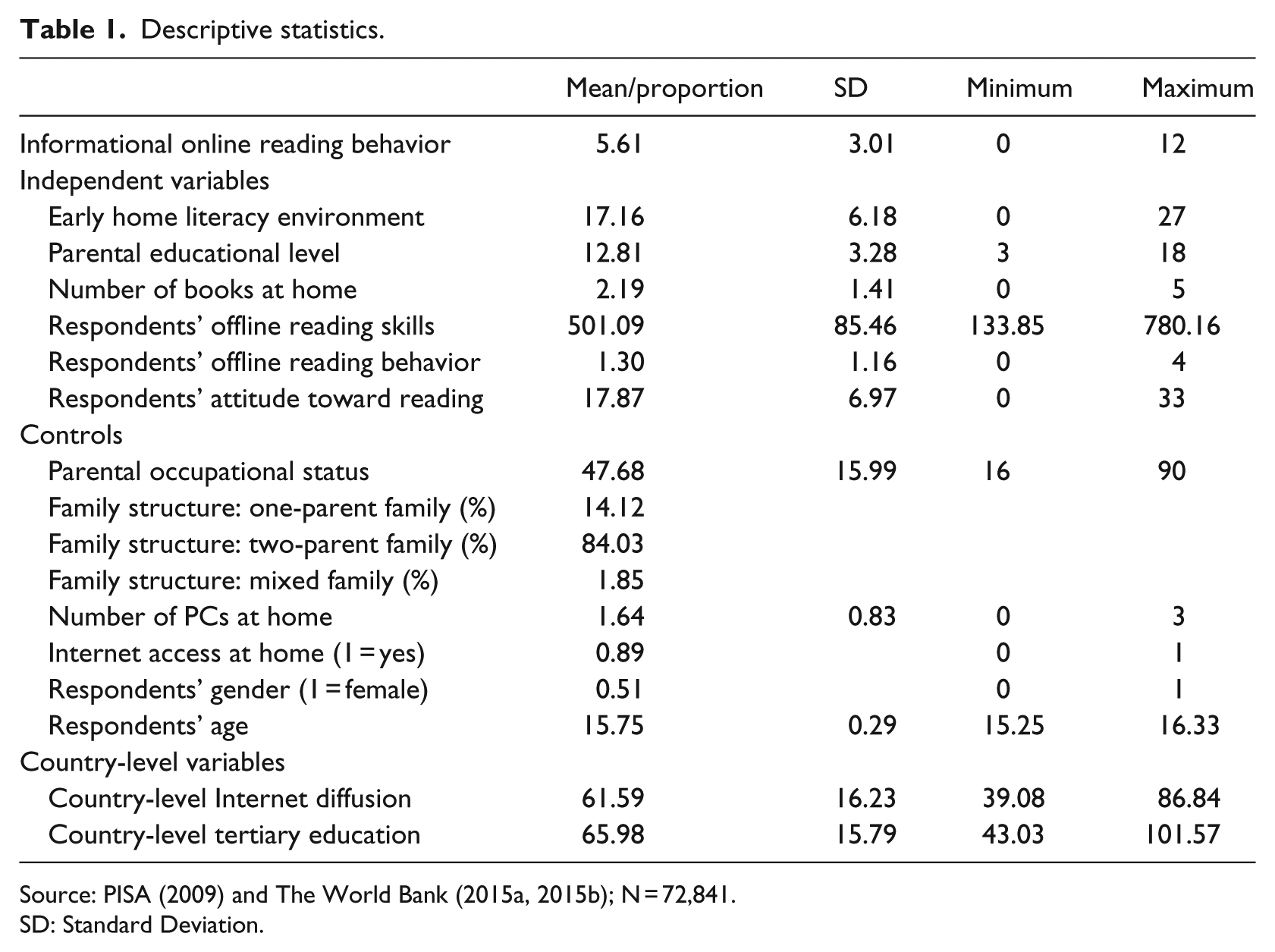
Source: PISA (2009) and The World Bank (2015a, 2015b); N = 72,841.
SD: Standard Deviation.
For inclusion in the analyses, all metric individual variables were z-standardized, and country-level variables were centered to the arithmetic mean. Table 1 presents an overview of all model variables; Appendix 1 presents additional descriptive information per country. 5
Method and plan of analysis
The aim of our study is to gain greater insight into the impact of early home literacy activities on students’ online informational reading behavior and to determine how this relation is affected by a country’s level of digitalization. We therefore employ ordinary least squares (OLS) regression models with fixed country-effects and cross-level interactions (see Bol et al., 2014; Möhring, 2012). This methodology accommodates the fact that the countries are rather dissimilar in multiple domains (e.g. economics, politics, and culture). The fixed effects of the countries, by including country dummies in all models, capture all of the between-country heterogeneity. Therefore, in regression models with country-fixed effects, the main effects of country-level characteristics are excluded. However, the moderator effect of macro-level characteristics (here, country-level characteristics) can be estimated in fixed effects models by means of cross-level interactions. The cross-level interaction effects then estimate possible differences in the effects of individual-level variables by country characteristics, which addresses our second research question. Therefore, we include cross-level interactions between country characteristics and early home literacy activities. In order to take into account the hierarchical data structure with students nested in schools, we used clustering for schools in all models.
We estimate five models. The baseline or null model includes the country-fixed effect, that is, all the country dummies. Model 1 adds all control variables and parental cultural capital. Model 2 additionally includes early home literacy activities, which is the focus of our research. Model 3 adds students’ offline reading skills, reading attitudes, and reading behavior in order to test the extent that the impact of early home literacy activities runs indirectly via offline reading. Additionally, mediation tests are performed (not presented) using the method proposed by Karlson, Holm, and Breen (KHB) (Kohler et al., 2011), comparing model 1 to 2, and model 2 to 3. Model 4a and 4b use the same individual-level variables as model 2, but add cross-level interactions between early home literacy activities and level of digitalization and tertiary education (country-level variables). The findings of the country-level fixed effects models appear robust across the 13 countries included; stepwise deletion of countries as well as using a subset of only European countries did not affect our main conclusions. 6
Results of country-level fixed effects models
Individual-level results
Table 2 presents the results of the regression models with country-fixed effects. In the null model, the country-fixed effects account for 3 percent of the total variation in students’ informational online reading behavior. Apparently, students from different countries do not differ much in their informational online reading behavior. Next, in model 1, parental cultural capital and all control variables are included. The results indicate that students from parental homes with higher levels of cultural capital, that is, having parents with a higher educational level (b = 0.038) and more books at home (b = 0.090), are more avid online informational readers than students from families with lower levels of parental cultural capital. These findings indicate a positive and direct correlation between cultural resources within the parental home and students’ informational online reading behavior.
The association between the early home literacy environment and adolescents’ informational online reading behavior.
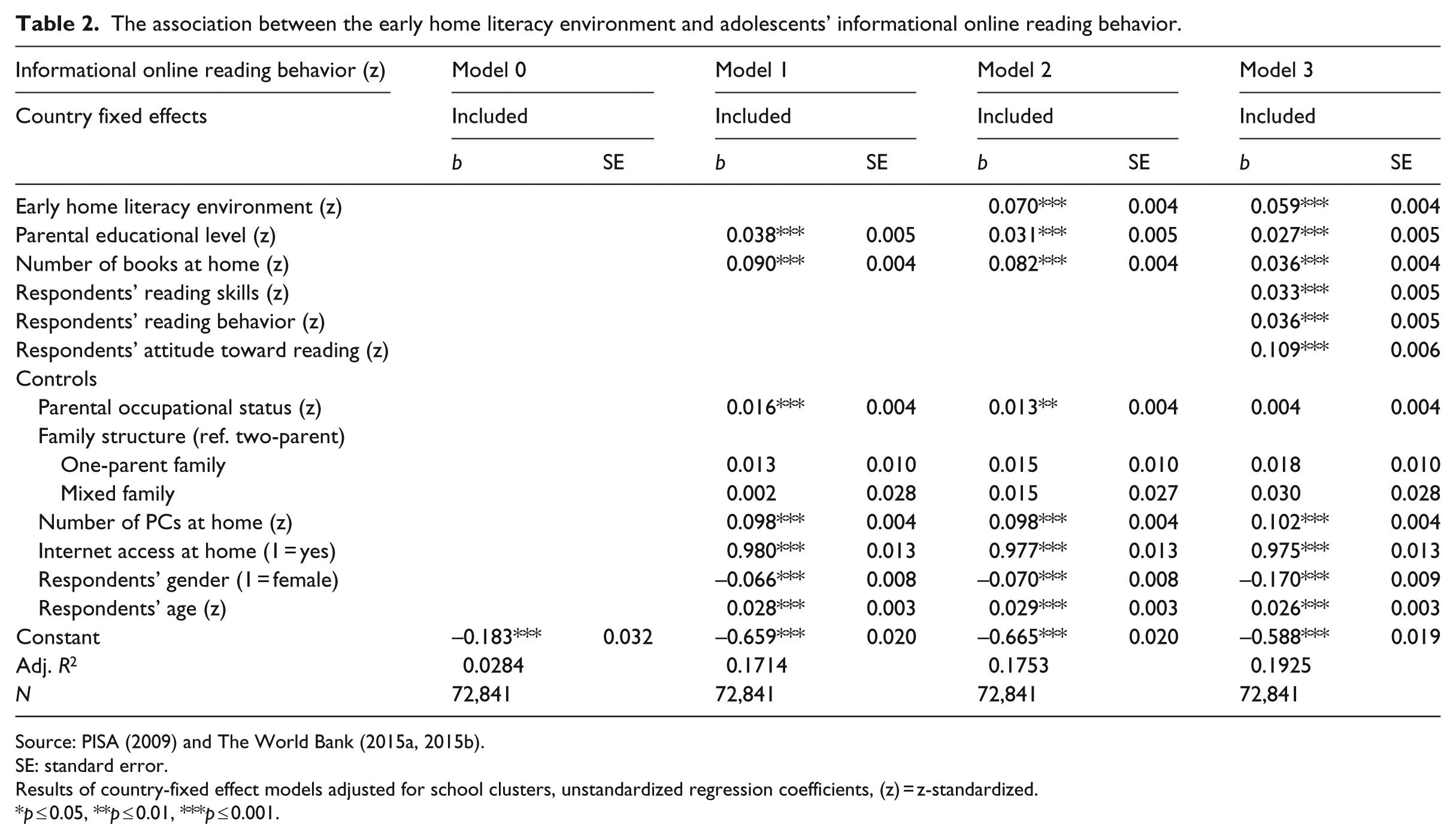
Source: PISA (2009) and The World Bank (2015a, 2015b).
SE: standard error.
Results of country-fixed effect models adjusted for school clusters, unstandardized regression coefficients, (z) = z-standardized.
p ≤ 0.05, **p ≤ 0.01, ***p ≤ 0.001.
Parental occupational status positively correlates with online reading behavior, as well as Internet at home and the supply of computers at home. Moreover, boys and older students are more avid online readers than girls and younger students.
In model 2, early home literacy activities are additionally included. First, the findings show a significant and positive correlation between parental early home literacy activities and students’ informational online reading behavior, corroborating hypothesis 1. 7 An increase in early home activities by 1 standard deviation is associated with an increase in students’ online reading behavior of 0.070 standard deviations (= a 14th of a standard deviation). This effect therefore seems rather modest in size. However, also the effect size of the number of computers at home (one of the most important control variables) is only a 10th of a standard deviation (b = 0.098) in this model and therefore not much larger. Moreover, robustness checks indicate that the early home environment is significantly associated with each of the online reading activities included in our measure of informational online reading behavior.
Overall, these results indicate a positive and direct correlation between early parental reading socialization and students’ online reading behavior. Moreover, in line with hypothesis 2, parental cultural capital, represented by parental educational level and number of books at home, is partly mediated by early reading socialization. Comparing model 1 to model 2, a mediation analysis shows that 18.6 percent of the effect of parental education and 9.4 percent of the effect of the number of books on online reading behavior are mediated by the early home literacy environment (both indirect effects are significant with p ≤ 0.001). This seems in line with Bourdieu’s cultural reproduction theory, since the reduction of the effects of parental cultural capital is quite substantial although not very large.
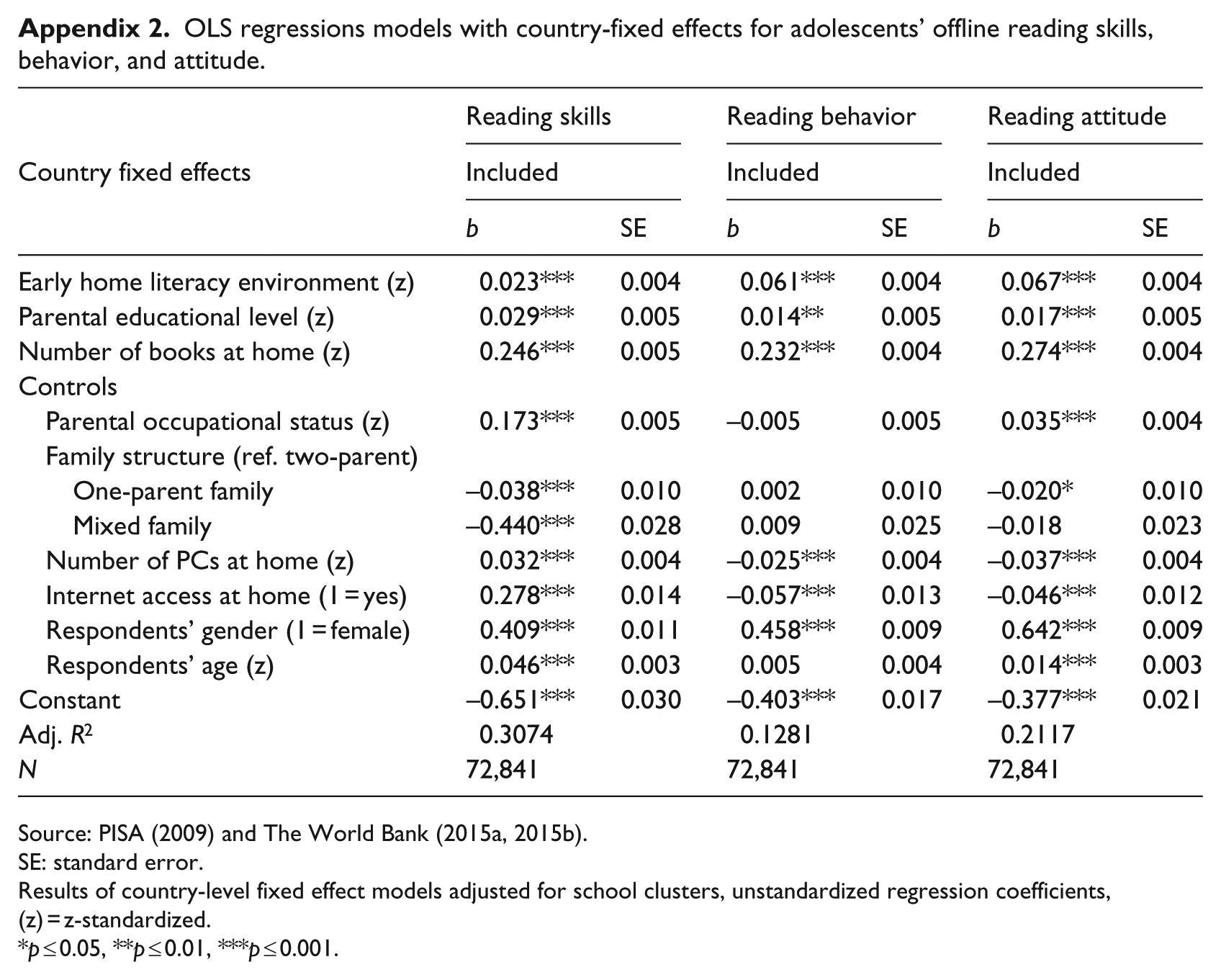
In model 3, we add students’ offline reading skills, reading behavior, and reading attitude. All three indicators positively relate to informational online reading. Hence, students who are better and more frequent and enthusiastic readers also tend to show more informational online reading. Moreover, the regression coefficient of early home literacy is reduced compared to model 2. Comparing models 2 and 3, a mediation analysis shows that adolescents’ reading skills, reading behavior, and attitude toward reading together mediate 14.7 percent of the effect of the early home literacy environment on adolescents’ online reading behavior. Adolescents’ attitude toward reading alone mediates 10.5 percent, while the mediation via reading behavior (3.1%) and reading skills (1.1%) is very small. However, all these indirect effects are statistically significant (p ≤ 0.001). Thus, hypothesis 3 is, in principal, supported by these results – however, the mediation effects are rather small. Even when controlling for students’ offline reading skills, behavior, and attitude, the direct effect of the early home literacy environment remains significant. Hence, early literacy activities in the parental home seem to have a lasting direct effect on online reading behavior and, though to a far lesser extent, also an indirect effect via students’ offline reading skills, behavior, and attitude (see also Appendix 2). Note that the relation between parental cultural capital and online reading is partly mediated by students’ offline reading: 10.8 percent of the effect of parental education and 56.5 percent of the effect of the number of books is mediated by students’ reading skills, behavior, and attitude (comparison between model 2 and model 3, p ≤ 0.001).
In general, our findings agree with Bourdieu’s notion of cultural reproduction and social differentiation in cultural tastes and with previous research on the intergenerational transmission of cultural and media preferences.
Results on country differences
Next, we conducted a more in-depth exploration of possible between-country differences in the relation between early home literacy activities and students’ informational online reading behavior. Table 3 presents the results. In model 4a and 4b, the cross-level interactions between early home literacy and a country’s level of digitalization and tertiary education are included. The results show that the impact of early home literacy on informational online reading behavior remains quite stable across countries with different levels of development (non-significant cross-level interactions). A robustness check including interactions between a country’s level of digitalization and all control variables leads to the same findings. This means that early reading socialization at home positively correlates with informational online reading behavior, apparently regardless of a country’s level of digitalization or educational expansion (i.e. developmental level of information-based society). The findings indicate a rather similar degree of social inequality in the intergenerational transmission of informational online reading behavior across countries with different levels of development. To conclude, we do not find that the relation between a positive early home literacy environment and online reading behavior becomes stronger if a child grows up in a more digitalized society, which contradicts hypothesis 4.
The association between the early home literacy environment and adolescents’ informational online reading behavior depending on countries’ level of digital development.
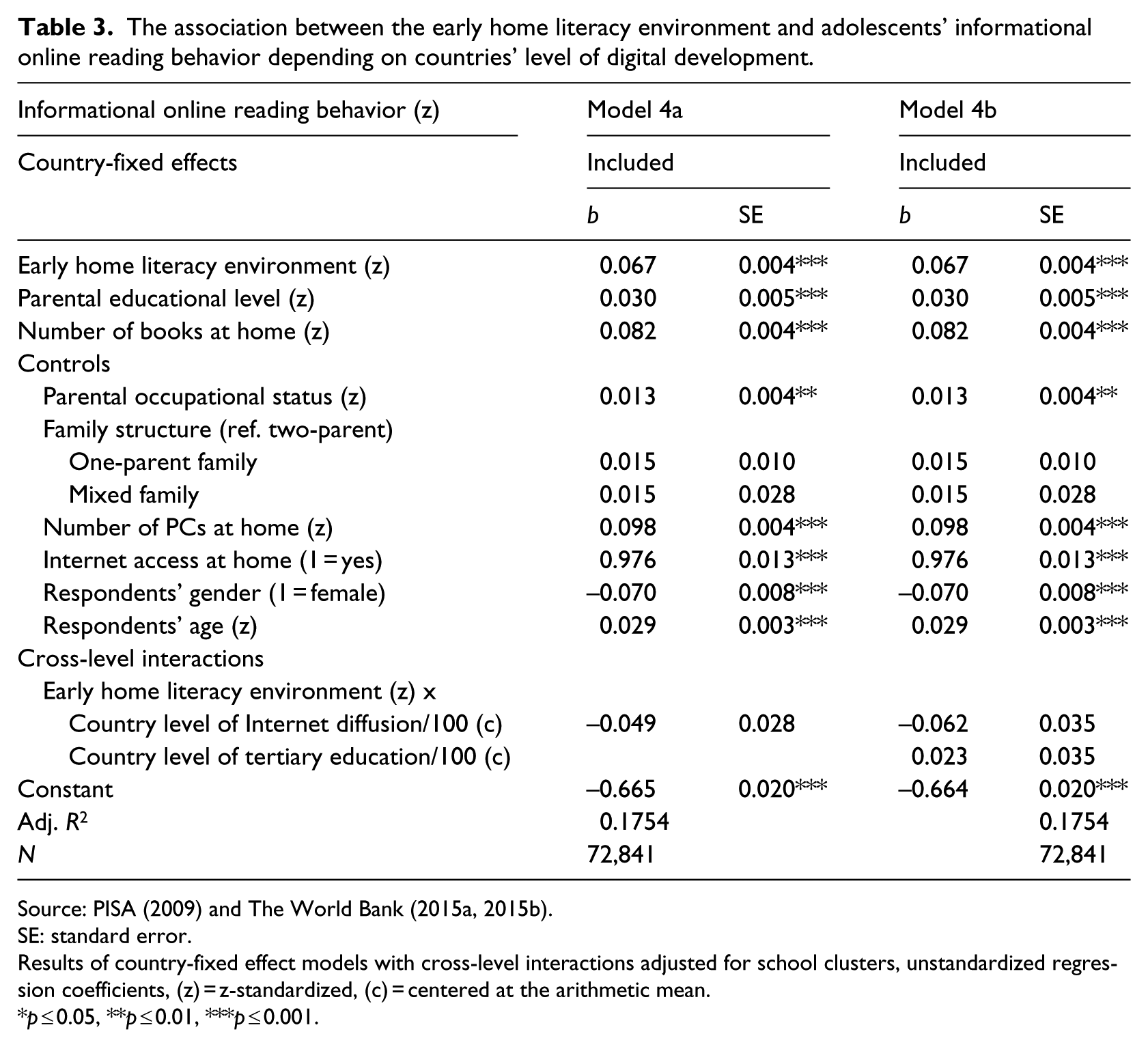
Source: PISA (2009) and The World Bank (2015a, 2015b).
SE: standard error.
Results of country-fixed effect models with cross-level interactions adjusted for school clusters, unstandardized regression coefficients, (z) = z-standardized, (c) = centered at the arithmetic mean.
p ≤ 0.05, **p ≤ 0.01, ***p ≤ 0.001.
Conclusion and discussion
This research aimed to gain greater insight into the association between early reading socialization in the family home and informational online reading behavior in adolescence, as well as to determine country differences in this association. In framing our research model, we relied upon the literature on the role and lasting effects of home literacy and parental reading socialization on children’s ‘traditional’ or ‘offline’ reading behavior and skills. In formulating our hypotheses, we used Bourdieu’s (1977) theory of cultural reproduction in combination with digital divide research. This study serves to advance existing literature by integrating the established role of the early home literacy environment in reproduction of social inequality with more recent findings on online reading and digital divides. To test our hypotheses, we used 2009 data from the OECD’s PISA, in combination with country-level information from the World Bank.
Our results suggest several conclusions. First, we find a positive correlation between early parental reading socialization and adolescents’ informational online reading behavior. Thus, early reading socialization, as in home literacy activities such as reading aloud and playing word games, seems to predict online reading. This indicates that early home literacy activities are relevant and might lastingly stimulate children’s online reading behavior. We also find some evidence that the home literacy environment in early childhood explains a (small) part of the relationship between parental cultural capital and students’ informational online reading behavior. Students from families with higher educated parents and with more books at home were more avid informational online readers, in part because their parents actively stimulated reading in early childhood. Next, we find a positive relation between students’ offline reading and their informational online reading behavior. That is, students who are better and more frequent offline readers, and who have a positive attitude toward reading, are also more avid online informational readers. Moreover, offline reading skills, behavior, and attitude mediate a (small) part of the impact of an early home literacy environment on informational online reading behavior. We must therefore conclude that children from families where early home literacy activities are common become more avid readers, both offline and online. Overall, our findings suggest that the traditional mechanism of cultural reproduction also underlies differentiation in online behaviors.
We furthermore explored if, and to what extent, the relation between early home literacy activities and students’ informational online reading behavior varies across countries with different levels of digital development. We find that the influence of the early home literacy environment is quite uniform across countries and does not vary with countries’ levels of Internet diffusion or tertiary education rates. Our results therefore suggest that social inequality in informational online reading is rather persistent, in line with findings from research on the second digital divide. Note, however, that this inequality is not growing, as one would expect according to the cultural reproduction hypothesis. Hence, children receiving more reading guidance in early childhood become more frequent informational online readers – independent of their country’s level of digital development. On one hand, this is positive, since the social gap in informational online reading is not widening. On the other hand, children do not have equal opportunities, since our findings show that mastery of informational online reading, which is essential in today’s knowledge-based societies, is highly socially stratified.
Although we must formulate our conclusions with care, since we analyzed a limited number of countries, our findings suggest a ‘new’ expression of established social inequalities. Moreover, since online informational reading behavior is indispensable in today’s information societies, social differences herein may lead to inequalities in other domains, such as health, educational success, and work status. We might therefore conclude that our study has produced evidence of the notion of persistent inequality and continuation of the old-fashioned intergenerational transmission of reading behaviors into the digital domain. First, it shows that those who experience a stimulating ‘traditional’ offline early home literacy environment are more inclined to read information online. Second, it shows that this inequality persists, even in more developed countries. Future research might expand on this work by incorporating digital and online literacy activities in the home in early childhood. For instance, do digital picture books and other digital educational tools that parents share or provide to their young children also lastingly affect and stimulate children’s offline and online reading skills and behavior? What is the relative importance of such online reading activities compared to ‘traditional’ offline reading activities? Also, since present generations grow up with social media use, future research could also include recreational or communicational online reading activities in the study of intergenerational transmission of inequality.
Finally, some limitations of our study bear mentioning. We were forced to restrict our sample to the 13 countries that had included questions about early literacy activities in the PISA parent interview. Thus, our results cannot be generalized worldwide. This underpins the relevance of future research on a larger sample of countries. Another limitation is that the questions on early home literacy activities were asked retrospectively; however, they were asked separately (i.e. independently) from the questions on adolescents’ reading activities. Although many studies have been performed with this particular measurement of early home literacy, one must still be aware of possible memory bias, which may cast doubt on the accuracy of the answers. Longitudinal data would be preferable but are very difficult to collect in a cross-national design. Furthermore, the cross-sectional nature of the data does not allow for claims to be made on causal relationships. Instead, all the associations found should be regarded as correlational and interpreted with care. This problem affects all cross-sectional studies. In the current study it means that, though we find support for the hypothesized underlying causal mechanism, more experience with informational online reading might to some extent also stimulate adolescents’ offline reading.
Despite these limitations, our research has produced a number of new insights. First, this study constitutes the first country comparison of the association between early reading socialization at home and online reading behavior in adolescence. It finds some evidence of a positive association between conditions in the family home in early childhood and informational online reading at about age 15. The association, moreover, seems quite stable across the countries examined. This may indicate that ‘traditional’ mechanisms of cultural and social reproduction are still at work in our digitalized world, though this preliminary finding warrants replication and further development in future research (preferably with longitudinal data).
Footnotes
Appendix
OLS regressions models with country-fixed effects for adolescents’ offline reading skills, behavior, and attitude.
| Country fixed effects | Reading skills | Reading behavior | Reading attitude | |||
|---|---|---|---|---|---|---|
| Included | Included | Included | ||||
| b | SE | b | SE | b | SE | |
| Early home literacy environment (z) | 0.023*** | 0.004 | 0.061*** | 0.004 | 0.067*** | 0.004 |
| Parental educational level (z) | 0.029*** | 0.005 | 0.014** | 0.005 | 0.017*** | 0.005 |
| Number of books at home (z) | 0.246*** | 0.005 | 0.232*** | 0.004 | 0.274*** | 0.004 |
| Controls | ||||||
| Parental occupational status (z) | 0.173*** | 0.005 | −0.005 | 0.005 | 0.035*** | 0.004 |
| Family structure (ref. two-parent) | ||||||
| One-parent family | −0.038*** | 0.010 | 0.002 | 0.010 | −0.020* | 0.010 |
| Mixed family | −0.440*** | 0.028 | 0.009 | 0.025 | −0.018 | 0.023 |
| Number of PCs at home (z) | 0.032*** | 0.004 | −0.025*** | 0.004 | −0.037*** | 0.004 |
| Internet access at home (1 = yes) | 0.278*** | 0.014 | −0.057*** | 0.013 | −0.046*** | 0.012 |
| Respondents’ gender (1 = female) | 0.409*** | 0.011 | 0.458*** | 0.009 | 0.642*** | 0.009 |
| Respondents’ age (z) | 0.046*** | 0.003 | 0.005 | 0.004 | 0.014*** | 0.003 |
| Constant | −0.651*** | 0.030 | −0.403*** | 0.017 | −0.377*** | 0.021 |
| Adj. R2 | 0.3074 | 0.1281 | 0.2117 | |||
| N | 72,841 | 72,841 | 72,841 | |||
Source: PISA (2009) and The World Bank (2015a, 2015b).
SE: standard error.
Results of country-level fixed effect models adjusted for school clusters, unstandardized regression coefficients, (z) = z-standardized.
p ≤ 0.05, **p ≤ 0.01, ***p ≤ 0.001.
Funding
The author(s) received no financial support for the research, authorship, and/or publication of this article.
Notes
Supplementary Material
The Online Appendix is available for this article online.
References
Supplementary Material
Please find the following supplemental material available below.
For Open Access articles published under a Creative Commons License, all supplemental material carries the same license as the article it is associated with.
For non-Open Access articles published, all supplemental material carries a non-exclusive license, and permission requests for re-use of supplemental material or any part of supplemental material shall be sent directly to the copyright owner as specified in the copyright notice associated with the article.
