




Abstract
As quantum technologies rapidly develop, collaboration between actors is often positioned to strengthen national quantum ecosystems and establish specialized national clusters. Such collaborations include state and non-state actors who engage in decision-making across international borders. These collaborations can be contextualized and analyzed through a quadruple helix model that comprises four interconnected sets of actors: academia, industry, government, and civil society. This study uses this model and social network analysis to examine the Canadian quantum technology ecosystem and collaboration between public and private actors and international partnerships with other middle power states, with a focus on Canadian-German partnerships. The findings highlight the interconnectedness of global networks, the governance of technology-specific connections within ecosystems, and the effectiveness of clusters for knowledge and innovation transfer. This study emphasizes the role of trade missions and small and medium-sized enterprises in the rapidly evolving landscape of technology development.
Keywords
Great power states increasingly appreciate the dependent relationship between national quantum technology ecosystems and global competitiveness. 1 With the goal of enhancing prosperity and security, states have prioritized investments in these ecosystems to maximize the development and commercialization of quantum technologies (QT) knowledge and products by winning the ‘quantum race.’ 2
Generally, quantum technologies use the principles of quantum mechanics to perform difficult tasks that are impossible or inefficient for existing technologies to accomplish. Generally, there are three types of technologies: communications, computing, and sensing, with capabilities in optimization, simulations, secure communications, and precision sensing. These technologies are increasingly the subject of defence cooperation, security, and bolstering economic prosperity through national quantum strategies and programs. 3 Recent interventions on the topic of national approaches to quantum technology policy have focused on the roles of public actors, including at national and provincial levels, in configuring private sector actors into clusters through national strategies, investments, and partnering missions with like-minded states. 4 Recognizing the centrality of private sector actors in this global competition, the evolving relations between the public and private sectors and the roles of state and non-state actors in managing the trajectory of technologies, especially through networks, have become increasingly controversial. 5 In the context of quantum, collaboration between industry, academia, civil society, and government not only focuses on cooperation towards technological advancement, 6 but also has implications for power projection in the world.
This paper contributes to understanding how the capabilities of quantum technologies translate to power for states through networks and actor connectivity within clusters and ecosystems. We examine the potential of using novel methodologies and methods (i.e., the quadruple helix [QH] and social network analysis [SNA]) to identify key actors and evaluate the effect of the structure on their behaviours, with a focus on their choice of partners. We use this meta-level path of inquiry to assess control over networks and clusters, analyze how connectivity strength is translated into power, and how these goals are managed by cooperating allies. Additionally, we examine how various actors configure national programs, interactions, and arrangements between actors to manage the complexities of quantum technology ecosystems both domestically and globally.
This paper proceeds as follows. In the next section, we set the current geopolitical context for our investigation, develop our argument in support of emphasizing innovation ecosystems, and explain the effect of such systems on how we think about power projection. Following this, we introduce the concepts of actor connectivity, clusters, and ecosystems, and link them to the distribution of power through capabilities and partnerships. We then investigate the interdependencies between two states, Canada and Germany, as part of our broader objective to examine the influence of quantum technology ecosystems and capabilities and capacity-building as conduits of power distribution. The subsequent section introduces our methodology and methods, and presents the study's key findings. This is followed by sections covering study limitations, potential avenues for future research and policy implications.
Creating, projecting, and sustaining power: the interdependence of technology, ecosystems, and consequential actors
The rapid advancement of quantum presents unique governance challenges because these technologies have the potential to impact many fields, such as defence, healthcare, and manufacturing, by enhancing capabilities that lead to increased efficiency and competitiveness. Ultimately these capabilities can be used to project power in the world by states. For example, in a defence context, quantum computers have the potential to solve complex optimization problems that could enhance logistical capabilities with impact on mission planning, operations, and deployment, among other areas. 7 This capability could enhance a state's military power. Similarly, quantum sensing technologies have the potential to enhance the efficiency of the production and manufacturing processes through high-precision anomaly detection. This capability could aid in quality assurance and process monitoring and ultimately create value for companies involved in advanced manufacturing. 8 Evaluating a state's economic and military power through technological capabilities is a way to determine their governance roles in defining order in the international system; however, in an increasingly complex world, more nuance is needed beyond identifying capabilities.
Capabilities include technology, but also implicate actors and networks that control the flows of power, innovation, knowledge, and capital. The actors that operate within and between networks play important roles in capacity-building and governance in contributing to the world order. Instead of solely focusing on technological capabilities that may enhance state power in the world, we examine the interdependence of key actors through their interactions on diverse issue areas. This framing is more reflective of a multiplex world than focusing exclusively on assessing economic and military power through state-accumulated capabilities. 9
Multiplexity, in contrast to an international system defined by multipolarity, is characterised by many actors—beyond and including great powers and emerging states as well as corporations, transnational non-governmental organizations, international and regional institutions, among others. 10 An international order defined by multiplexity is also marked by interconnected economic relationships through global production networks and supply chains and other challenges across borders. 11 As Amitav Acharya describes it: “A multiplex world is a world of interconnectedness and interdependence.” 12 In this interconnected world, problems requiring global governance, such as economic and security issues, become more complicated as actors bring diverse motivations to the table while seeking new partnerships. These broader issue areas, and the networks that form around them, are centres of control as state and non-state actors engage in geopolitics increasingly defined by connectivity strength.
Partnerships and connections form patterns of interdependence, where interactions between actors are focused on building capacity, and influence is achieved through interaction capacity. 13 Amitav Acharya, Antoni Estevadeordal, and Louis W. Goodman propose using the multiplexity concept to better understand the nature of the current global order, mainly to assess whether it is characterized by cooperation or competition, and the nature of the relationships therein. 14 Issue-focused partnerships play a role in governance by creating and sustaining patterns of interdependence between diverse actors. Identifying and examining both the issue area and the interconnected networks of actors involved in building the capacity to address it reveals the nature of the multiplex world. One way to evaluate the strength of partnerships is to examine the level of connectivity between actors. Understanding actor connectivity can reveal key linkages within networks, including invisible relationships and well-connected stakeholders. Beyond identifying stakeholders, mapping actors within networks can also reveal hidden power dynamics and bottlenecks relevant to how power is projected and sustained within the international system.
Connectivity strength and quantum
Control over networks is a way to translate connectivity strength to economic and military power. Seth Schindler et al. show that competing great powers are connected to private sector actors through many networks, including in finance and technology. 15 States compete to shape the nature of these networks through the integration of state-based actors to centralize economic power, yet private sector companies are not passive extensions of the state, nor do they solely reflect national and international efforts to project and maintain geopolitical power. 16 The centrality of private sector actors into networks can benefit state and non-state actors in projecting geopolitical power and reaching new markets respectively.
Despite global multiplexity, existing state-led competition still contributes to defining the parameters of the international order. 17 This competition establishes control over networks by incorporating the interdependency and connectivity of actors into state spheres of power through restructuring networks, creating alternative networks, or managing the conditions of actor participation and network integration. 18 Indeed, while control of networks may provide a strategic advantage for states to gain and project powers and private sector actors to gain privileged access to markets and increase profit, interconnectedness also has its risks.
Networks can be security risks when ‘weaponized.’ 19 Although focusing on economic networks, Henry Farrell and Abraham Newman show that managed networks can be a strategic advantage for states as when asymmetries are created between actors. Asymmetries within network structures—where some actors, knowledge, and goods are restricted—can be used as leverage to coerce relations with other states. 20 Exercising control over networks by extracting information or identifying and exploiting vulnerabilities can impose political and financial costs for other states. 21 Private sector actors can also use weaponized interdependence to impose risks, increase dependencies, and expand markets for their products, thus contributing to the multiplexity of the world order. For instance, multinational corporations (MNCs) exert significant influence as sponsors, providers, and inhibitors of governance through their extensive resources, transnational reach, and ability to shape industry-aligned norms. Firms situated within clusters have access to specialized, highly skilled workers and suppliers, 22 thereby using their position and authority within the network to gain a strategic advantage to reach new markets, increase profit, or push out competitors. In contrast, small and medium-sized enterprises (SMEs) may not have the power to organize networks to their benefit due to their niche market focus and reliance on external knowledge for growth and scalability, which drive their contributions. 23 The organization of knowledge, technologies, consequential actors, and partnerships within and across ecosystems and clusters can affect international knowledge sharing, research cooperation, and technological development.
As previously discussed, the potential capabilities of quantum technologies may magnify risks and opportunities for interdependence within innovation networks for state and private sector actors. Considering the national security and economic benefits of harnessing the capabilities of these technologies for states and the private sector, staving off malign interference by controlling the innovation networks is a way to maintain and project power in the world. Additionally, leading research within innovation ecosystems through collaboration is a way for states and non-state actors, like research institutes and academia, to influence the trajectory of technology development. 24 These academia-led collaborations can also lead to asymmetries in the innovation ecosystem where certain actors are excluded, receive funding and international recognition, and publish. 25 Leading science collaborations has consequences for relations between states as competition for the development of the capabilities’ emerging and disruptive technologies is a source of competition between states through the perceived strength of national innovation ecosystems.
The interdependence of ecosystem actors collaborating to enhance capabilities to create profit and project power in the world constructs and sustains ecosystems. Seeing the potential of quantum technologies to impact multiple sectors, both state and private sector actors have increased their funding in the technologies year over year. For example, global investment volumes increased from US$1.3 billion in 2023 to US$2 billion in 2024. 26 Although the private sector leads investment, 27 public funding is increasing, with governments investing US$34 billion in quantum development so far. 28 For example, Canada, one of the top quantum technology-related investors per capita, 29 announced in January 2023 that it would allocate C$360 million to its national quantum technology ecosystem as part of the National Quantum Strategy to foster the growth of industries as innovations begin to transition from research to commercialization. 30 Many other states, such as Japan, the United Kingdom, and Germany, 31 and MNCs such as IBM, Google, and Microsoft, have invested substantially in research and development (R&D), particularly in quantum computing, to foster the development of commercially viable products for the global market. 32 Cultivating domestic and bilateral partnerships between actors involved in development is often used as a strategy to advance technological breakthroughs. Increasingly, these partnerships emerge from innovation clusters composed of start-ups, research centres, academic institutions, and investors and are actively cultivated with funding from regional and national authorities. 33 For example, Csenkey and Graver argue that Canada's quantum strategy may prioritize the development of innovation hubs and regional research zones, potentially favouring large universities, and suggest that Canada is positioning itself as a global leader in quantum through science diplomacy, leveraging international collaborative grants, and R&D trade missions with like-minded states such as Germany. 34
These clusters are webs of relationships between actors, with some actors exerting greater influence than others on a specific issue area. These influential actors shape strategic directions for value creation, establishing best practices for knowledge discovery, and defining the nature of interactions among other ecosystem members. 35 These actors are what Amitav Acharya, Antoni Estevadeordal, and Louis W. Goodman refer to as ‘consequential’ 36 because they impact the ordering of the issue area and the nature of the interactions within these networks. The continual change of engaged actors and shifting relationships within networks complicates the extent of ecosystems as government priorities shift investments, funding, and other supports. 37 While knowledge transfer connects ecosystems and ecosystem partners across national boundaries, the effectiveness of this transfer depends on the types of partnerships involved. 38 For example, is the nature of the interactions within the innovation ecosystems conducive to equal distribution of capabilities, or is it limiting, and if so, to which actors? A focus on assessing connectivity can contribute to understanding an actor's influence within clusters, and ultimately their method of ordering the issue area and organizing cooperative arrangements therein. 39
Thus far, research has focused on the United States' network strength in a number of sectors, partnership and collaboration with allies, and in comparison, to competitors. 40 Although the United States is a strong state actor in defining, projecting, and sustaining power in the world, more research is required on the extent to which other consequential actors translate power within networks. By identifying and analyzing the interdependence of actors within national technology ecosystems and the bilateral partnerships between middle powers, it is possible to show how states navigate competition for power and strategic advantage without threatening the global dominance of great powers in the international system.
Case study: Canada and Germany
This study focuses on two middle power states to accomplish this goal: Canada and Germany. These countries have strong bilateral relations and a shared commitment to science, technology, and innovation development. They also benefit from research institutions, leading universities, expanding innovation ecosystems, and highly skilled workforces, which provide numerous partnership opportunities. 41 Both Canada and Germany are major investors in quantum technology-related research and are developing ‘quantum valleys’ (centres of quantum-related innovation and expertise) that seek to build capabilities and manage the risks associated with emerging and disruptive technologies. 42 Both countries have a long history of bilateral diplomatic engagement, including through trade and innovation partnerships such as the Canada–European Union Comprehensive Economic and Trade Agreement. 43 Both countries are democratic states, share similarities in democratic processes, and cooperate within broader governance frameworks. Beyond formal partnerships, the two states share another dimension of cooperation by finding common ground or having complementary policies on global issues. 44
The foundation of a collaborative approach to science and technology development, support for national ecosystems, and balancing the security risks and economic rewards of quantum technology between Canada and Germany provide sufficient consistencies to build a clearer understanding of the evolution of the ecosystem within a multiplex system. The entryway to examining the connectivity between the two ecosystems is through bilateral ties built on the shared goals of security and prosperity, but also through the selection of consequential actors. Global Affairs Canada's Trade Commissioner Service led Canada's mission to Germany, and Canada selected Germany as a partner due to its expertise in innovation ecosystems and its advancements in science and technology, which are particularly evident in its major research institutions and universities. 45 This mission aimed to foster collaborative industrial R&D efforts between Canadian and German SMEs and researchers and enhance Canada's understanding of Germany's quantum technology landscape, with a focus on future commercialization prospects, as part of the Canadian government's broader objective of specifying priorities related to R&D, industry, supply chains, end users, and the exploitation of technology. 46
The Canada–Germany partnership highlights how states can make use of their international partnerships to evaluate national ecosystems and incorporate their partner's best practices by facilitating interdependence with allies to strengthen networks. We focus on two efficiency measures plus a density measure, which, when combined, enable us to infer the level of connectivity effectiveness. We identify central actors within the national quantum technology ecosystem to assess their influence within newly expanded cross-regional clusters. This analysis uses the QH as a guiding model and applies SNA as the primary methodological tool.
Methodology and methods
Quadruple helix
The QH model is well established in the innovation ecosystem and technology management literature 47 and reflects the multiplex world where diverse state and non-state actors are interconnected through issue-specific challenges. The QH is based on the triple helix 48 that includes three actors—academia, government, and industry—but goes further to add civil society while seeking to understand the linkages between actors 49 and the interdependence between technology capabilities development, transfer, and commercialization. This model also allows for the classification of certain actors, which helps us assess their level of connectivity, and ultimately their leadership within the networks. 50
We identify four node types, with each type corresponding to a helix present in the QH model—government, academia, industry, and civil society—to further assess their individual strength as consequential and connected actors within the ecosystem. For the purposes of this study, ‘government’ includes all federal-level departments and agencies within the state. Instead of using the term ‘university’ to categorize a QH node, 51 we use ‘academia’ in an attempt to capture the breadth of actors within that sphere and their relationship to R&D. This includes individual academics or internal research laboratories or institutes that we were unable to distinguish as subcategories. ‘Industry’ includes companies of all sizes, but we distinguish between them by using the Organisation for Economic Co-operation and Development (OECD) ‘enterprises by business size’ indicator. 52 We understand ‘civil society’ dynamically as being organizations comprised of actors that aim to connect or support other actors based on the perception of the public or civic good, such as social and economic development. 53 In this case, these actors can cut across spheres 54 and seek to connect academia, government, and industry to advance partnerships and cooperation in the QT ecosystem. The nodes in our network thus represent different actors within the ecosystem and the edges between nodes represent the connections and partnerships between the various actors in our dataset. These connections include QT-related public announcements of collaborations, funding from the government, connections between leaders within companies and academic professors and researchers in the field, journal articles published by researchers at quantum-related companies, and the membership of these actors within various consortia and associations.
When not coupled with precise measurements of innovation networks, the conceptual vagaries of the QH model and complex network of actors limit the application of the model to provide real measurements of the innovation network, and as a result, the application of this model is limited to broader thematic analyses of the different types of actors in the network. 55 However, applying SNA tools that allow for sampling and measuring the actual innovation ecosystems overcomes these limitations, leading to a more rigorous examination of network structures and actors. By combining the QH model with SNA techniques for studying, visualizing, and modelling innovation ecosystems, we strengthen our measurement tools to identify and examine innovation networks. The QH model therefore grounds our study of the dynamics of innovation ecosystems by focusing on actors’ connections rather than solely on investment amounts and policy documents.
Data collection and analysis
Our dataset is composed of connections and partnerships between various actors in the Canadian quantum technology ecosystem, with the goal of analyzing the different groups of actors within and between national ecosystems. We use the NetworkX package in Python 56 and separate our analyses into three levels: network, group, and node.
Network-level analysis involves computing measures for an entire network of connections to provide metrics to assess interactions. 57 Three network-level measures network density, global efficiency, and local efficiency 58 (defined in Table 1) to assess the efficiency of information transmission within the entire national quantum technology ecosystem and subnetworks of German and Canadian actors with connections to Germany. This focus allows us to identify where strong interferences and collaboration exist within the networks and subnetworks. A focus on subnetworks allows us to interpret whether the network is cohesive and collaborative, and provides supporting evidence for evaluating actor configurations. Group-level analysis allows for an examination of different groups of actors within the whole network by using density and global efficiency metrics. 59 This focus allows us to focus on the details of the interdependencies within the networks, including regional linkages or partnerships focused on quantum technology challenge areas.
Definition and interpretation of each measure used in our analysis.
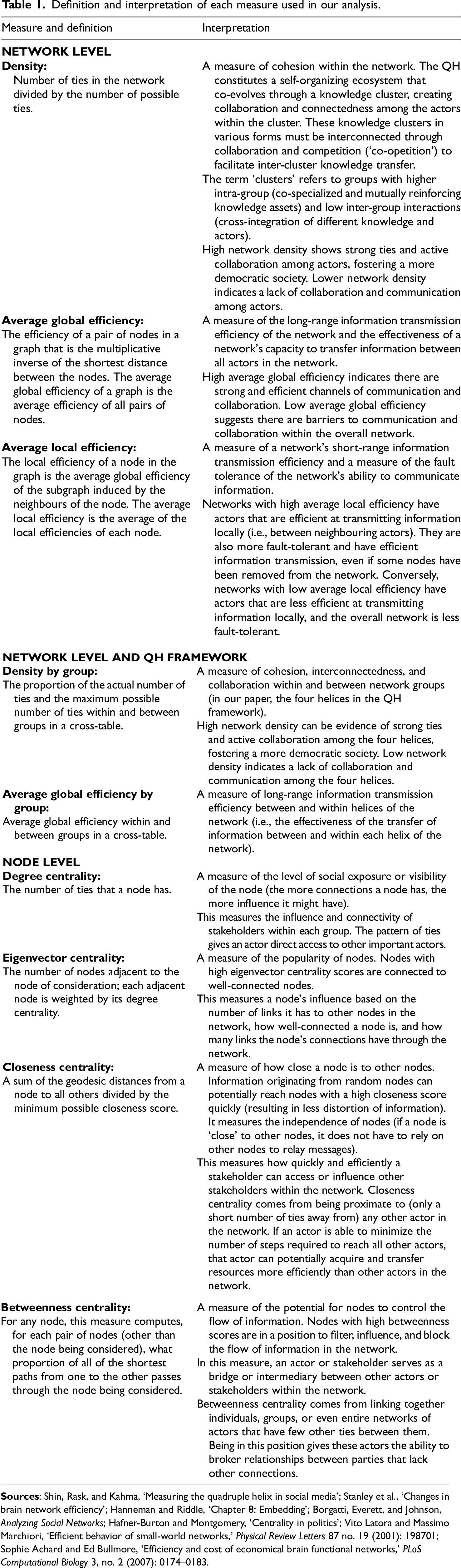
Node-level analysis provides metrics for evaluating nodes to identify influential actors within a social network. 60 We use four node-level centrality measures: degree, eigenvector, closeness, and betweenness 61 (Table 1). Centrality metrics have their limitations—namely, that different centrality metrics capture different aspects of an actor's importance within a social network. 62 We attempt to mitigate this limitation by investigating multiple centrality metrics and finding consensus; however, adapting or creating measures that directly assess the influence of nodes in the network could be an avenue for future exploration. 63 These node-level measures enable us to understand the major actors within the national quantum technology ecosystem, to situate their roles in R&D and within the overall network, and to evaluate their potential influence on governance. As with the network-level measures, we compute these node-level measures and analyze them to find major trends within the results.
We produce node-level measures for each type of node within our network, to identify the top five central nodes in each of the four helices within the QH model, and distinguish consequential actors within the overall ecosystem and their capacity to manage technology and transmit knowledge within and across borders.
Using the Python ipysigma package, we generated visualizations of the full network of the national quantum technology ecosystem (Figure 1), the network of the partnering mission to Germany (Figure 2), and the network of Canadian companies that have connections with Germany (Figure 3). 64 This map demonstrates the complexity of the networks and their overall formation into larger interdependent ecosystems, and identifies the composition and density of clusters.
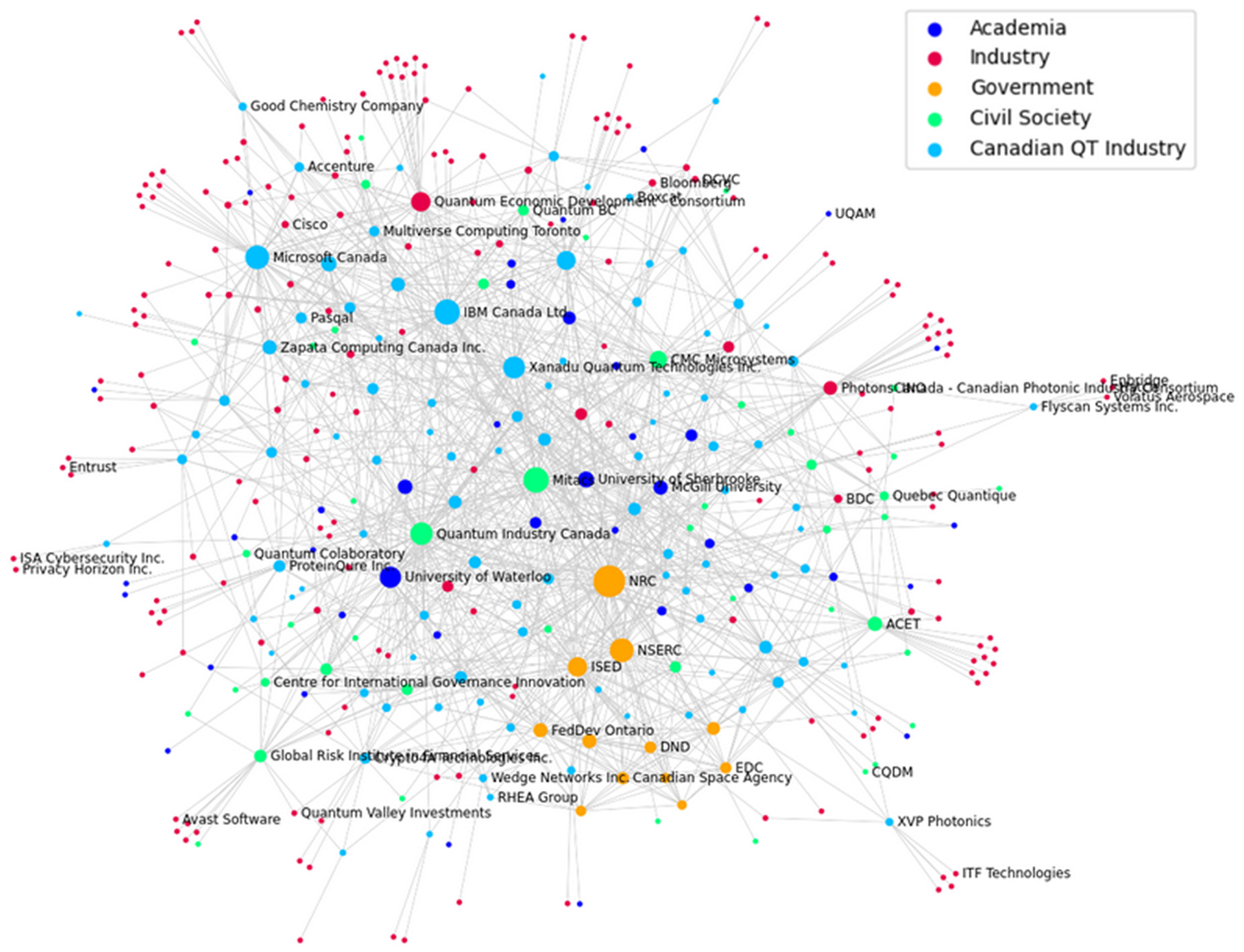
Network visualization of the national QT ecosystem.
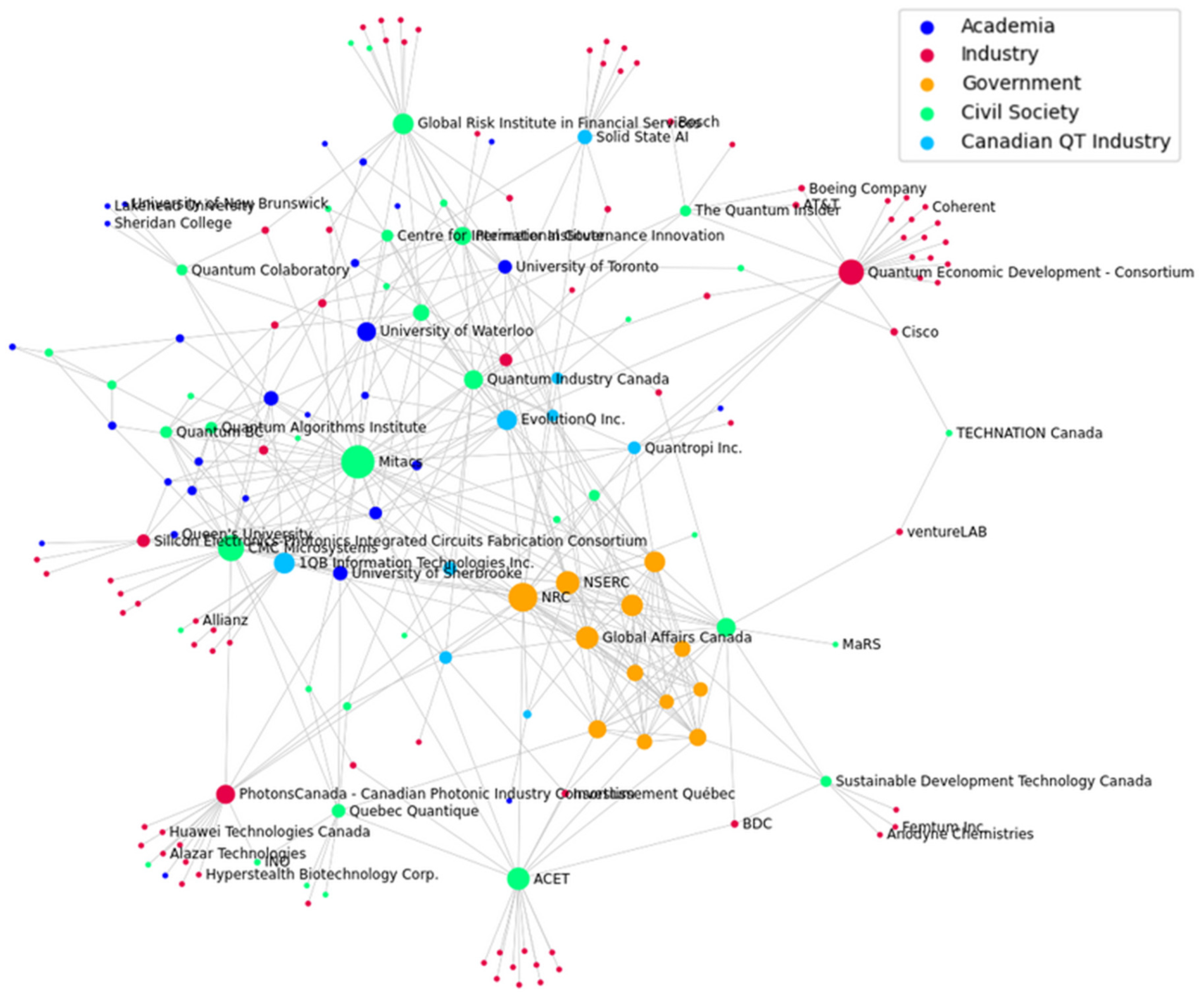
Network visualization of the companies involved in the Canadian quantum partnering mission to Germany.
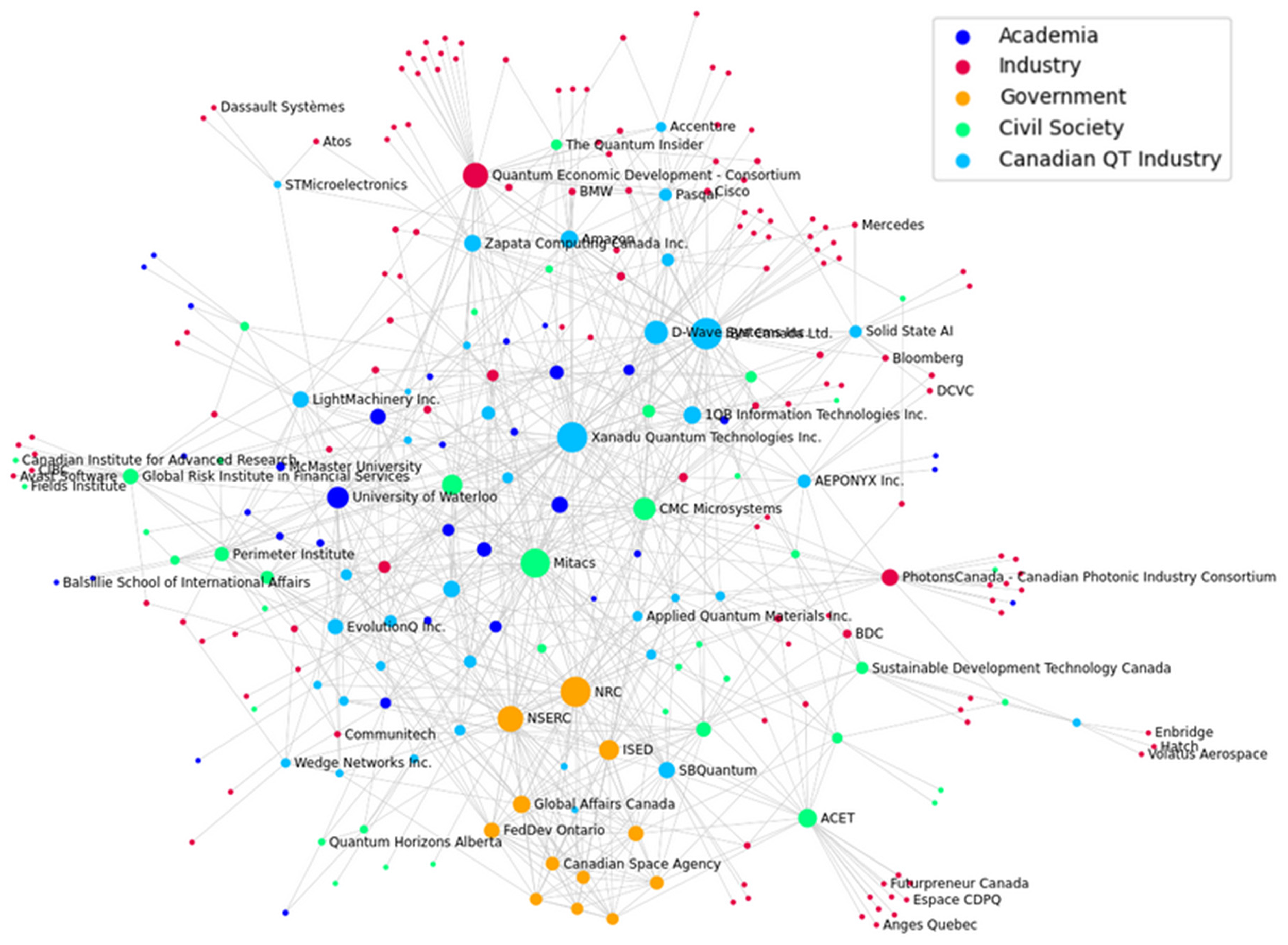
Network visualization of Canadian companies connected to German QT companies.
Mapping the social network of the Canadian quantum technology ecosystem using a ‘snowball sampling’ method, our dataset consists of actors in the national ecosystem and lists associated partnerships and their connections. 65 For example, we started out with an initial list of well-established actors in the Canadian ecosystem (e.g., 1Qbit, D-Wave Systems, evolutionQ, Nord Quantique, Quantropi, Xanadu Quantum Technologies, and Quantum BC), as well as Canadian quantum technology companies involved in the R&D partnering mission to Germany, and expanded the sample as new information emerged. We reviewed each of these companies’ websites to find organizational charts and information on company personnel, and examined relevant news articles and scholarly publications by researchers from these companies to identify connections with other quantum technology-related businesses in Canada and with academic institutions. We also captured connections between firms in the sector and academia through professors and researchers who are leaders in the field (either as leaders in quantum technology companies or as academia-based consultants). We also examined quantum-focused industry consortia like the Quantum Economic Development Consortium (QED-C) and Photons Canada to capture smaller medium-sized companies within the ecosystem. As Francophonie contributions and elements generally tend to be overlooked in research in the Anglosphere, 66 we tried to accurately represent Québec's quantum ecosystem by incorporating organizations like Québec Quantique and INO (Institut national d’optique) to fully flesh out our dataset's representation of companies in Québec's quantum ecosystem. We repeated these steps to determine connections between civil society actors as well as connections between civil society actors and actors in academia, industry, and government.
To establish connections between Canadian actors and the government, our main sources of data were Canada's business registries; the Innovation, Science and Economic Development Canada (ISED) federal corporation database; Partnerbase; the Canadian Quantum Directory; the Natural Sciences and Engineering Research Council of Canada (NSERC) awards directory; and a search of the federal Open Government grants and contributions portal. 67
In Table 1, we define the different measures used in the analysis of the network data. Through QH and SNA techniques, we use these measures to assess the value created by actor partnerships. We use the different network-, group-, and node-level metrics to contextualize bilateral cooperation between Canada and Germany. We also use the networks to compare the connections of the companies that were included—versus not included—on the partnering mission to Germany. In addition, we analyze companies with connections to Germany and contrast the results of the different measures with companies that do not have such connections.
Limitations
We encountered three main limitations in the data collection process. First, data indicating the strength of a connection and data on the associated monetary values of every connection were either unavailable or insufficient. We also did not collect or measure data about repeated collaborations. For example, a company might have multiple collaborations with another actor, but we considered this to be one collaboration in our dataset. Data about connections in academia are more granular relative to other types of connections (i.e., within government, industry, or civil society) because these connections often involve only individual researchers or small groups of researchers working in industry or civil society organizations.
Second, due to the types of connections in the dataset, it was not possible to assign every connection to a specific time period, as temporally specific information is not always available. As such, our dataset is static and measures the national quantum technology ecosystem from 2010 to 2023. This time period is based on the availability of dates for the sources, as information often did not include explicit start and end dates.
Finally, certain actors may not publicly disclose their partnerships with other actors. As mentioned, our data were curated from various online public databases and data sources; thus, we do not claim that our dataset captures the complete quantum technology ecosystem. Rather, we suggest it sufficiently represents connections within the ecosystem to justify our analysis.
Results and discussion
Our results demonstrate that although global networks serve as central hubs that coordinate innovation, knowledge exchange, and collaboration across multiple locations, the level of cooperation between actors within clusters is not always equal. This inequality may signal that some actors cannot fully access the benefits of the technological capability, which may ultimately affect their ability to secure funding from the government and larger companies. It may also be indicative of the influence of certain actors over others and exercises of asymmetrical power in and across the networks. Practically, our study reveals two important themes: low levels of cooperation between group-level actors and varying levels of diversity among actors at the national ecosystem and QH levels. Methodologically, our results suggest that a combination of an SNA and a QH provides a model for studying the connections between actors involved in emerging technology R&D, innovation, knowledge, and power projection within and between national ecosystems, to assess and visualize control of networks as power projection while representing the diverse state and non-state actors that affect network governance.
Low levels of cooperation
We found low levels of cooperation between groups of actors in the overall network. Looking at the two group-level measures (density and global efficiency) for the overall network, we found that the maximum achieved value of density by group is 0.037681 and the maximum achieved value of global efficiency by group is 0.203724. Comparing these values with the density and global efficiency values found in other similarly sized networks, 68 we found there is an overall low level of collaboration between the different helices within the Canadian quantum technology ecosystem. Table 2 presents the results of the incorporation of the QH model into the SNA of the national ecosystem. Each row and column represents a helix in the QH model. The bolded numbers indicate both the lowest and the highest values for each network-level measure.
Results for QH framework incorporating network-level measures.
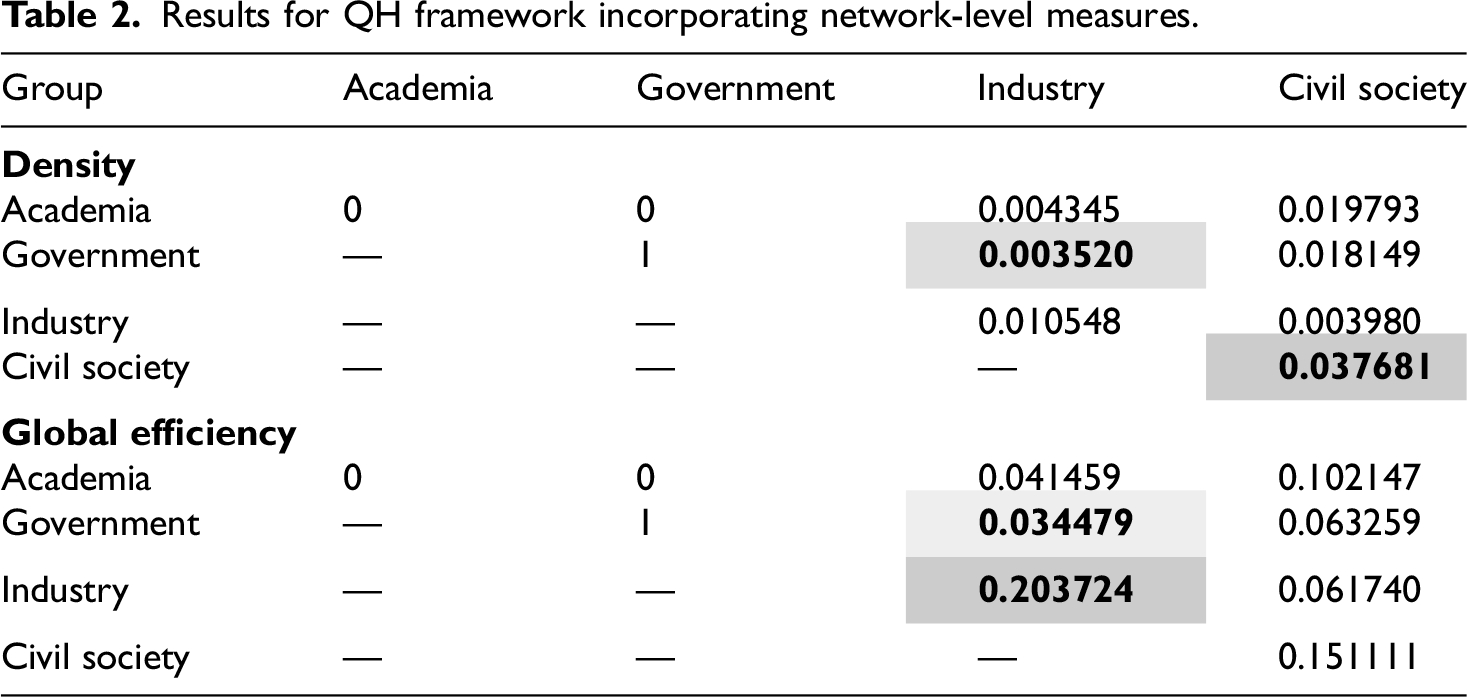
Analyzing the values of the group-level metrics for each helix indicates efficacy levels of the information transmitted between the helices. There was a lack of publicly available information about internal cooperation within the academia and government helices. Of primary importance to our study is the focus on other non-state actors, such as those in industry and civil society; therefore, we emphasized the collection of publicly available information about actors in those two helices.
Connections between civil society actors are the densest within the QH configuration of connections in the national quantum technology ecosystem, whereas industry–government connections are the least dense. This suggests that civil society actors might be closely connected because they are often driven by the shared objective of addressing common social issues. Similarly, industry–industry connections are closely connected because they are driven by shared goals of enhancing profitability, commercializing products, and scaling operations. Conversely, industry–government connections exhibit weak density and global efficiency levels, possibly due to the absence of established government connections among certain companies. This emphasizes the significance of fostering strong connections between actors to show they are essential to generating knowledge, developing goods and services, and accessing new markets. Both civil society and industry actors frequently collaborate in areas where they possess strengths in providing services or goods to fill governance gaps.
Tracing actor arrangements through the partnering mission to Germany
Table 3 presents the results of the three network-level measures across the national quantum ecosystem and the subnetworks within the ecosystem .
Raw numerical results of network-level measures by subnetwork.
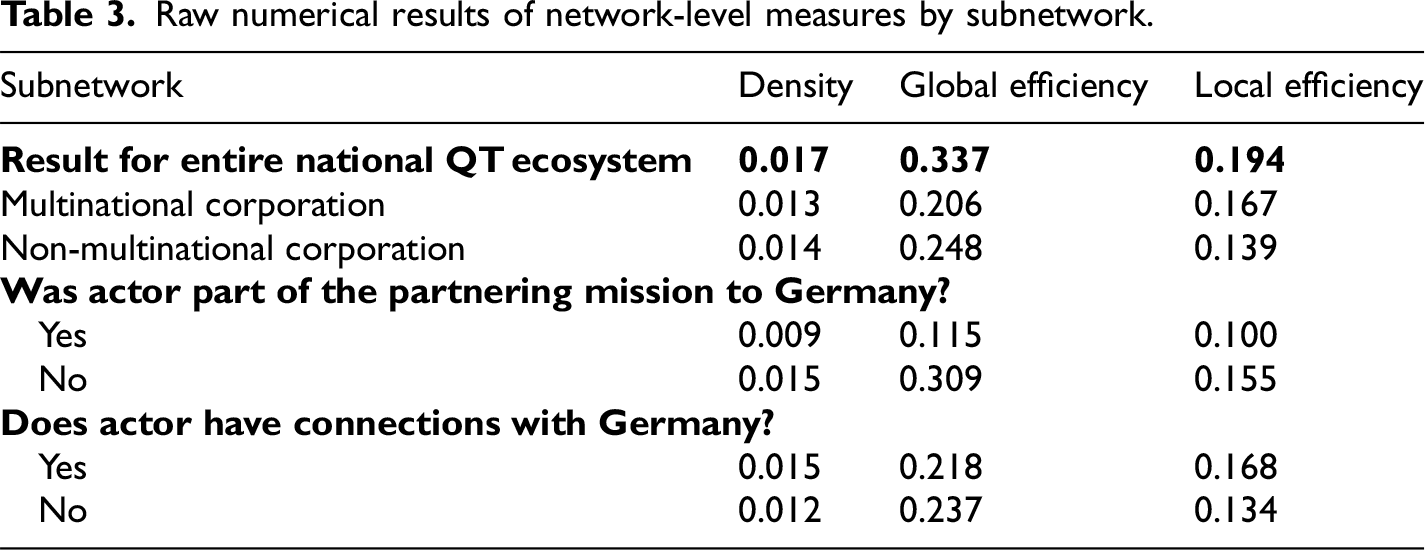
The three network-level measures (density, global efficiency, and local efficiency) quantify overall information transmission efficiency and have theoretical maximum values of 1. The results of our analysis reveal that the overall efficiency of information transmission within the ecosystem is low. The values for density, global efficiency, and local efficiency are all relatively low compared with values found in other similarly sized networks: for the whole network, the values are 0.017 for density, 0.337 for global efficiency, and 0.194 for local efficiency. 69 This means that actors within the ecosystem do not transmit information efficiently. The same results apply to the efficiency of information transmission within the partnering mission to Germany, with values of 0.009 for density, 0.115 for global efficiency, and 0.1 for local efficiency. Two possible explanations for these results are that the many competing priorities between actors with no clear alignment of objectives make areas of cooperation difficult to define and that the development of the technology is too nascent for the global market to have already integrated specific products.
Although the network-level measures quantify the efficiency and amount of information exchange within the various networks to assess efficacy, the results in Table 3 are not directly interpretable for the subnetworks. By thinking of the whole ecosystem as defining a maximum achievable efficacy level for information transmission and interpreting the network-level measures of the subnetworks as proportions relative to this maximum achievable efficacy level, we can evaluate the efficacy levels of the subnetworks more effectively. Table 4 presents the network- and subnetwork-level results as a proportion relative to the network-level measures for the whole national quantum technology ecosystem.
Results of network-level measures as a proportion of entire national QT ecosystem.
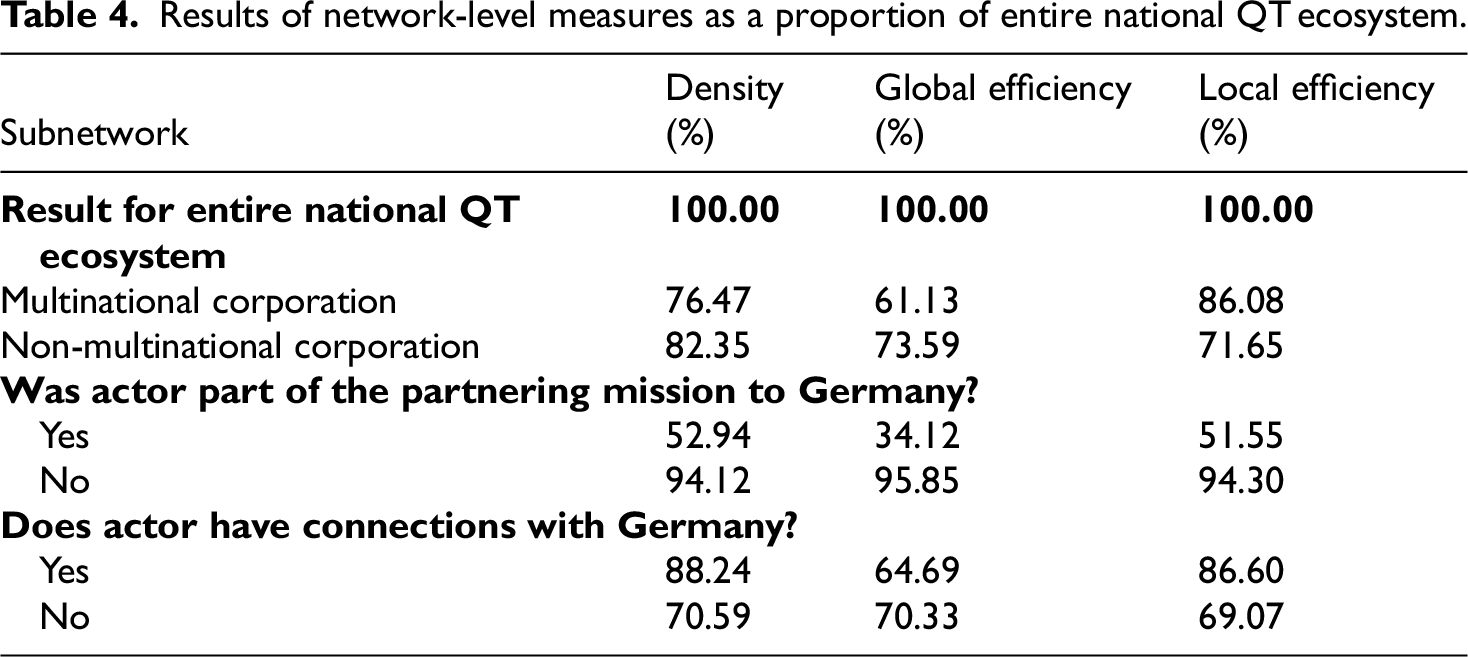
Our analysis finds that the subnetwork consisting of the actors within the partnering mission to Germany consistently had the lowest information transmission efficacy levels for all three network-level metrics relative to the whole national quantum technology ecosystem, achieving 52.94 percent, 34.12 percent, and 51.55 percent of the density, global efficiency, and local efficiency values for the whole network, respectively. In contrast, we found that the subnetwork consisting of actors not included in the partnering mission to Germany had the highest relative levels within the entire national ecosystem for all three network-level metrics, achieving 94.12 percent, 95.85 percent, and 94.30 percent of the density, global efficiency, and local efficiency values for the whole network, respectively.
In line with our focus on exploring the role of private actors such as MNCs, and connecting the ecosystems in Canada and Germany, we list the actors that participated in the Canada and Germany quantum partnership program as well as their helix category and size, and whether or not they are an MNC, where applicable (Table 5) for ease of analysis.
Actors in partnering mission to Germany by size and helix category.
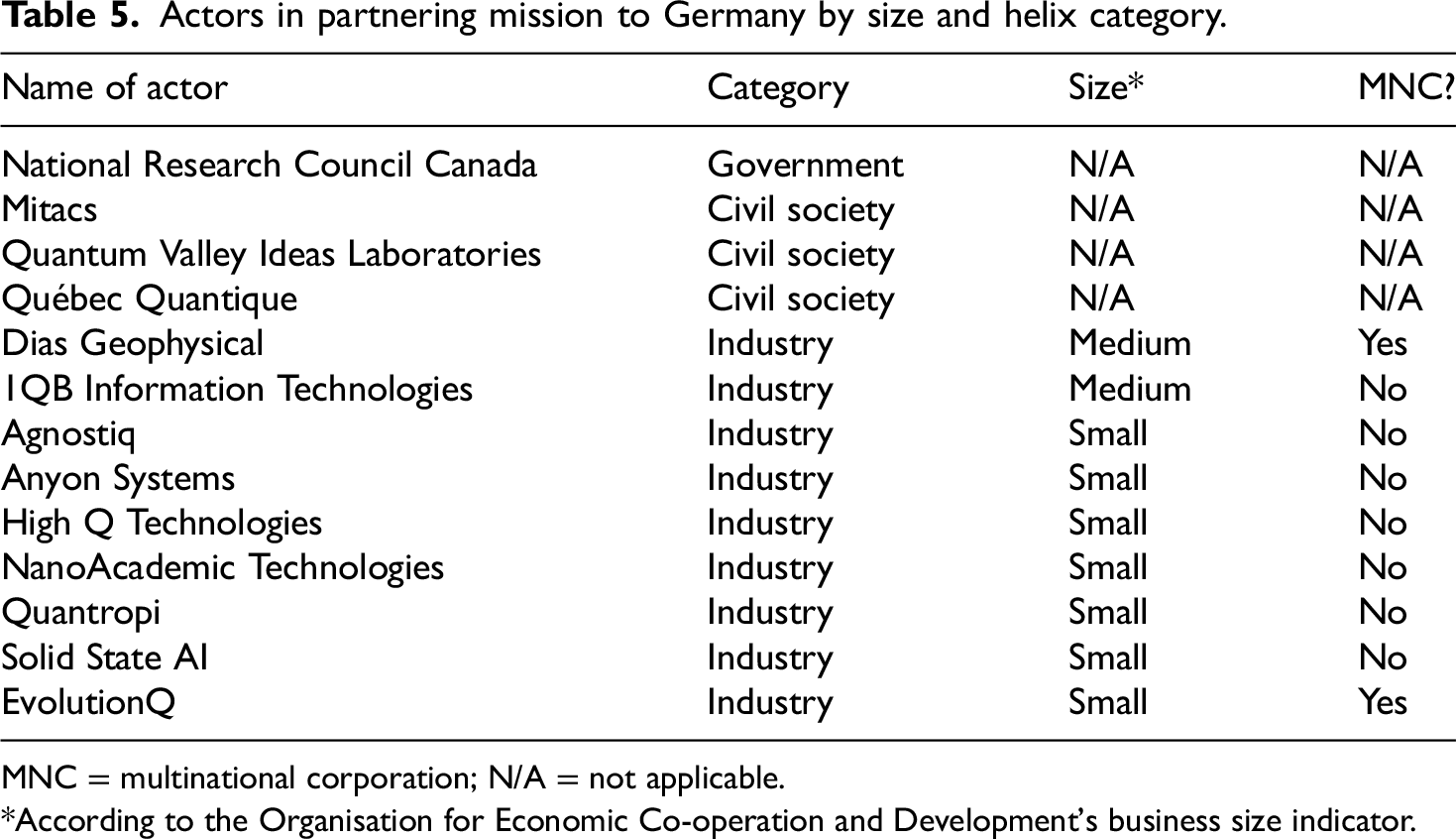
MNC = multinational corporation; N/A = not applicable.
According to the Organisation for Economic Co-operation and Development's business size indicator.
We find that the companies participating in the partnering mission to Germany exhibit lower levels of information transmission relative to the entire network. Most actors are industry actors, and all industry actors in the program are SMEs (according to the OECD definition of size). 70
Actors that were not involved in the partnering mission to Germany had a higher overall level of connectivity in their social networks, as was noted by the results in Table 4. This discrepancy may be the result of the overall size of the mission, which captures only a small portion of the overall network. Perhaps the role of this mission was not to capture a representation of the entire ecosystem but to support primarily non-MNC companies in Canada. If so, this suggests that one of the goals of the mission may have been to facilitate SME connections between the Canadian and German markets. In that case, we suggest that SMEs are a vehicle for establishing connections between states and their national quantum technology ecosystems. States that foster connections with other states through SME partnerships may also intend to increase capability-building initiatives by fostering connections with smaller companies as the technologies continue to be developed. Perhaps this connection could create early pathways for entry into the global market. The focus on SMEs within the partnering missions may also point to their perceived potential for fostering future connections between innovation ecosystems and their perceived role as important knowledge connectors that can link or transcend global and local networks.
Key actors in the national QT ecosystem and the partnering mission to Germany
In Figure 4, we show the top five actors from each node-level measure of the entire national quantum technology ecosystem to demonstrate the diversity of key actors within that ecosystem representing all four helices of the QH. We identify four consistently central actors (MNC and non-MNC) from industry, government, and civil society. Refer to Table 1 for the definitions and interpretations of each centrality metric.
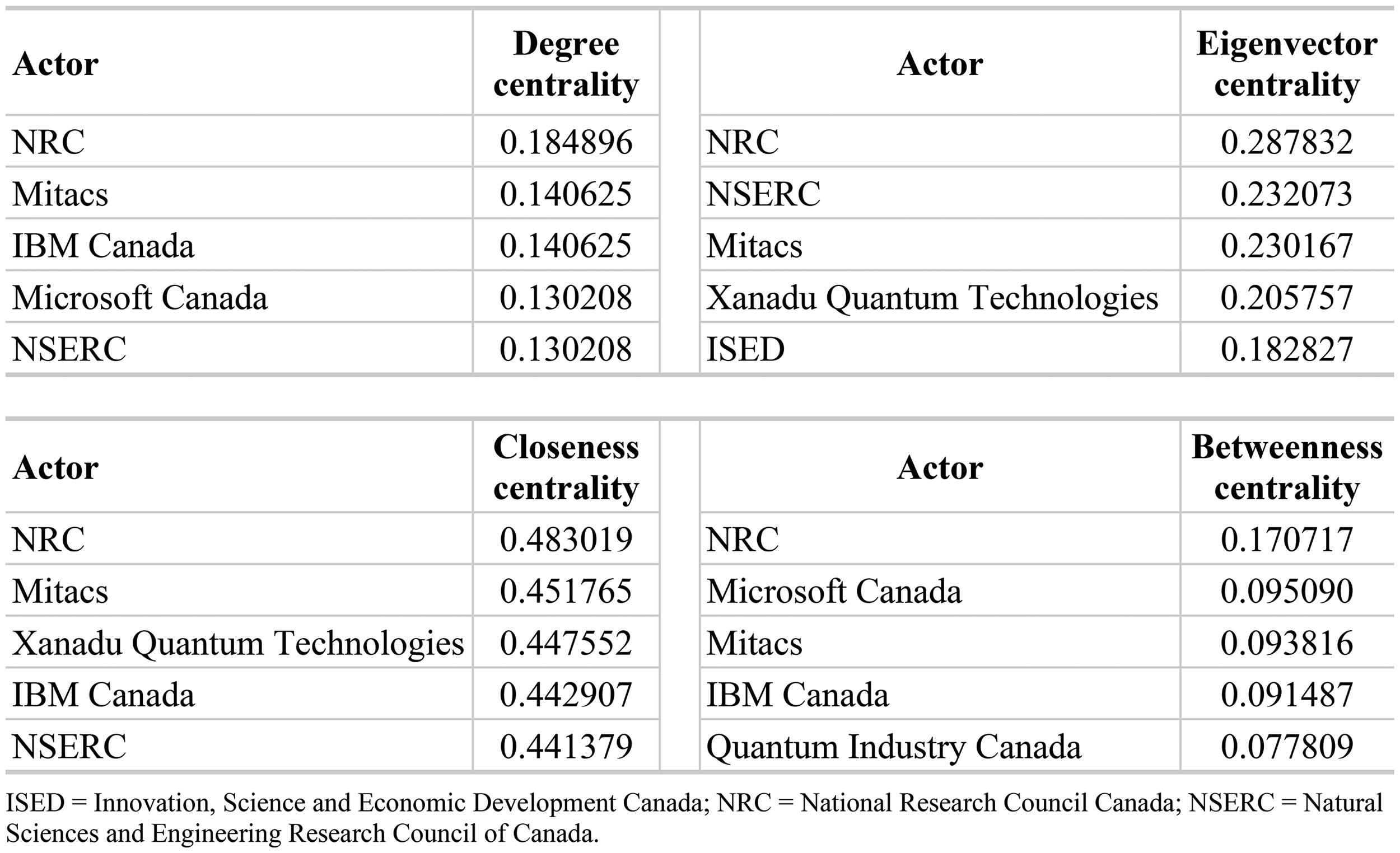
Top five centrality scores across four node-level metrics (all helices).
The node-level metrics show some consistent patterns. The National Research Council Canada (NRC) and Mitacs are in the top five nodes for all four node-level metrics used, which may indicate an emphasis on investing in quantum research and the importance of connecting certain actors across helix categories, especially industry and academia. 71 Other actors, such as IBM Canada and NSERC, are in the top five nodes for three of the four node-level metrics used. The difference between the two actors is that NSERC scored higher in the eigenvector centrality metric, whereas IBM Canada scored higher in the betweenness centrality metric. This suggests that, as actors within the national quantum technology ecosystem, NSERC links well-connected actors, whereas IBM Canada serves as an intermediary connection between actors in general. This could be due to previous connections established through participation in past government funding initiatives or outreach. In the case of IBM Canada, the company has connections with many smaller companies through, for example, its quantum programming software, Qiskit. IBM Canada also has access to more mature quantum-computing infrastructure in the form of the IBM Quantum platform. 72 The company's access to core quantum technologies may incentivize other private sector actors to seek collaborations with IBM Canada, which may explain this actor's high degree of centrality.
Incorporating the QH model into our analysis of the node-level metrics within the national quantum technology ecosystem, we identify the central actors within the industry helix, providing a more granular and detailed analysis of the key industry actors in the ecosystem (Figure 5 and Table 6). In Table 6, the participants shown are connected to at least 15 percent and up to almost 85 percent of the key actors we identified. The table also lists their connections and helix categories.
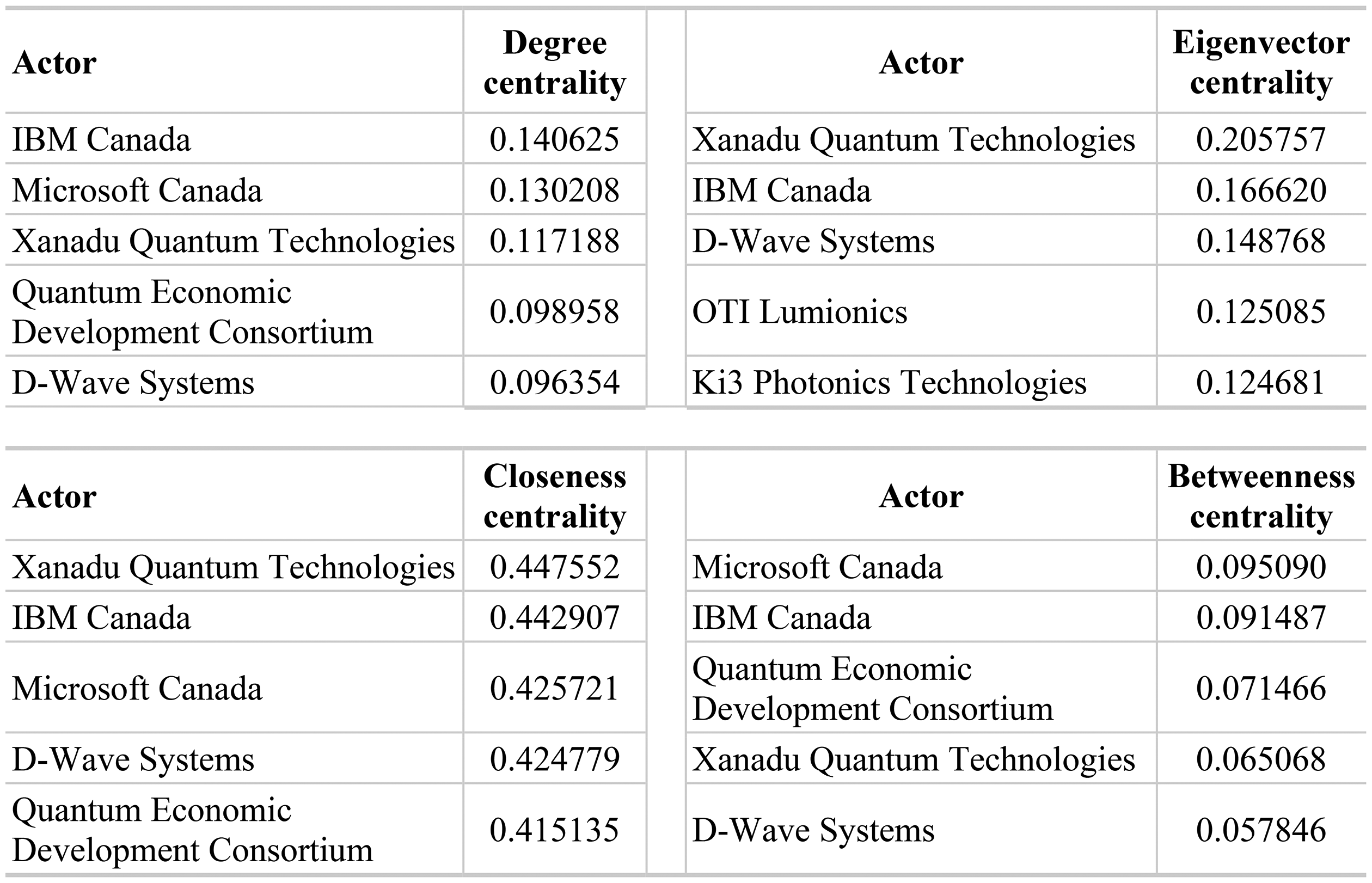
Top five actors for the four node-level metrics (industry helix).
Level of connection by participant in partnering mission to Germany.
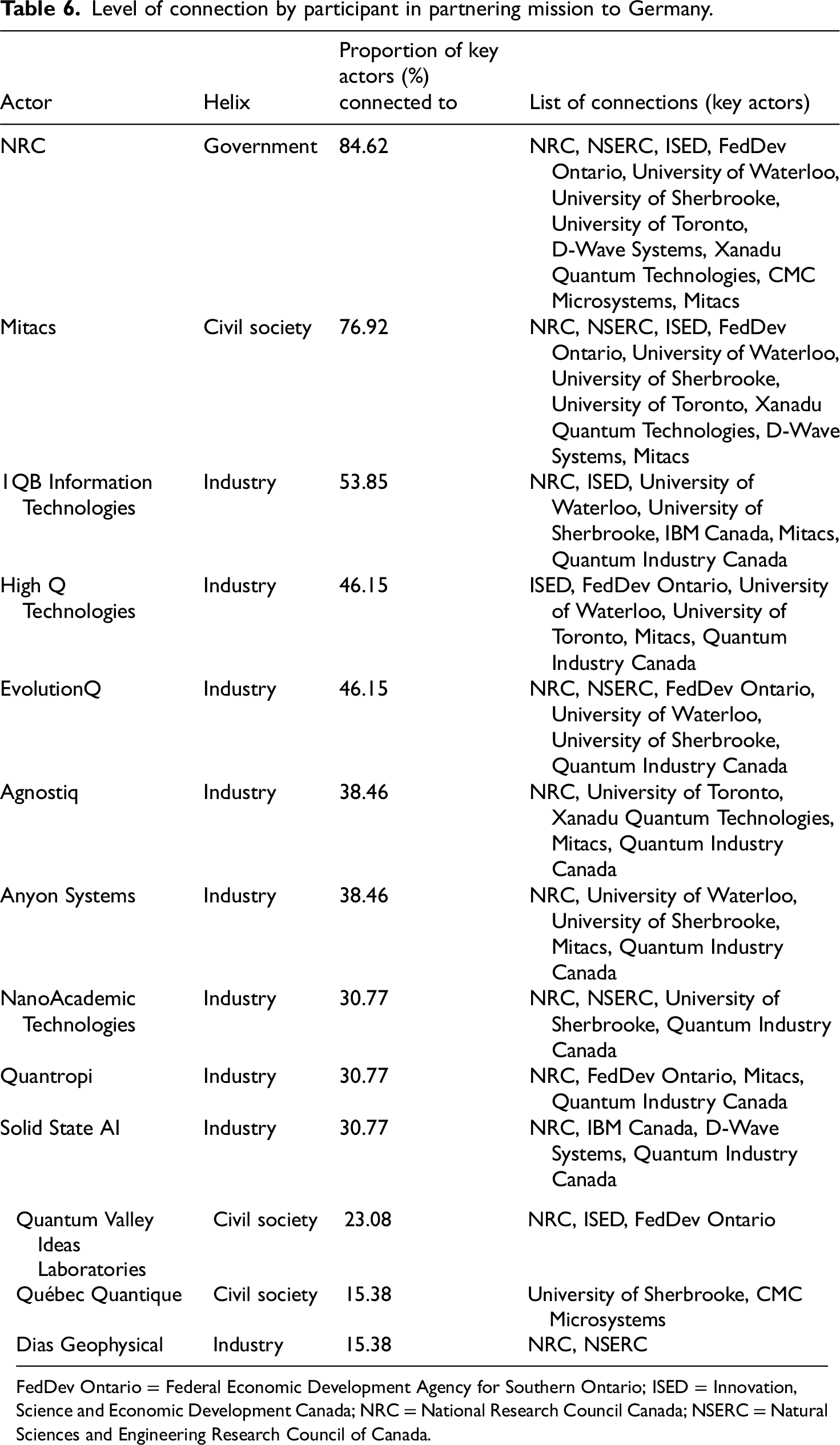
FedDev Ontario = Federal Economic Development Agency for Southern Ontario; ISED = Innovation, Science and Economic Development Canada; NRC = National Research Council Canada; NSERC = Natural Sciences and Engineering Research Council of Canada.
We identified the following central actors within each helix category of the national quantum technology ecosystem:
Industry: IBM Canada, Xanadu Quantum Technologies, D-Wave Systems Academia: University of Waterloo, University of Sherbrooke, University of Toronto Government: NRC, NSERC, ISED, Federal Economic Development Agency for Southern Ontario (FedDev Ontario) Civil society: Mitacs, Quantum Industry Canada, CMC Microsystems
Not all actors are equal or consequential within the industry helix category. Those with access to usable products have stronger links within the network—for example, companies with usable quantum programming software stacks, such as Qiskit (IBM Canada), PennyLane (Xanadu Quantum Technologies), and Leap (D-Wave Systems). We look at their connections to the actors that participated in the partnering mission to Germany to contextualize how well the actors in that mission are connected to central actors in the overall national quantum technology ecosystem. Seeing how connected the actors in that mission are to the central actors in the Canadian quantum technology ecosystem reveals the goals of the partnering mission beyond a focus on SMEs. For each actor in the partnering mission, Table 6 lists percentages indicating how connected the actor is to the key actors that were identified through the incorporation of the QH model in our node-level analysis and specifies these connections.
Two specific actors, NRC and Mitacs, are key players in the QH and the partnering mission to Germany. NRC is associated with government funding for research, and Mitacs connects academia and industry actors through collaborative funding projects. Out of the nine industry actors in the partnering mission, we found that 1QBit Technologies, evolutionQ, and High Q Technologies are the top three industry actors by way of their connections to other key actors in the national ecosystem. Two of the three industry actors that participated in the partnering mission to Germany that are the most connected to key actors in the ecosystem are SMEs; only evolutionQ is an MNC. The most central industry actors in the national quantum technology ecosystem (IBM Canada, Xanadu Quantum Technologies, and D-Wave Systems) are not connected to the industry actors that participated in the partnering mission to Germany. While almost all industry participants in that mission were SMEs, medium-to-large companies and MNCs are the top actors in the national ecosystem. The emphasis on SMEs as part of the partnering mission to Germany may show that more connections between states are fostered through smaller companies than through MNCs. We interpret that the goal of that mission was to cultivate state-specific innovation by including smaller companies with low levels of connectivity overall. Many of these smaller companies focus on quantum communications and sensing, which are listed as priority areas within the National Quantum Strategy. This suggests that the Canadian government may have viewed the mission as a way to advance its National Quantum Strategy and promote the growth of SME companies, in order to accelerate and diversify its options when it came to the commercialization of specific quantum technologies. As the state seeks to configure the orientation of the network in pursuit of certain objectives, other actors can tangentially or directly benefit from this ordering process as they seek to advance their independent objectives.
The effective governance of clusters is crucial for managing the interplay of technologies, actors, knowledge, and value creation within an ecosystem. The results of our study ultimately demonstrate that specific actors (namely, MNCs and organizations like Mitacs) and the perceived role of SMEs are key to facilitating interconnections both within and between networks and national innovation ecosystems focused on quantum technologies. However, while the government works to foster the involvement of SMEs in trade missions, these actors are not significantly influential within the national innovation ecosystem. Rather than showing the configuration of the technology network as an ecosystem of equally connected actors, our research shows that relations between actors through their inclusion or exclusion from partnerships is an attempt to orient the network to a preferred actor. SMEs are small and less consequential actors within the network, and their ability to compete to establish centrality is limited. This dynamic between connections, influential or not, matters as part of a multiplex world because these connections in clusters and networks within the larger ecosystems can serve as the foundation for continued bilaterial relations between cooperating allies beyond quantum technologies.
Limitations and future research
The limitations to our study provide opportunities for further analysis and future research. Given limited publicly available information, our dataset may not represent the complete ecosystem in Canada and the connection with Germany. Additionally, many regional clusters exist within the national quantum technology ecosystem and receive additional sources of support from provinces. While our study did not delve into provincial clusters, previously investigated by Csenkey and Graver, 73 a provincial-focused analysis could be valuable in the future, especially as more provinces publicly disclose information about specific programs and cluster-focused investments. For example, Québec's quantum ecosystem receives support from the provincial government and Québec International. Future research could focus on the internationalization of province-specific clusters within a country and explore the connections outside of national-level initiatives by, for example, examining missions that are part of a specific provincial ministry of international relations. Additionally, our dataset and analysis of networked connections may be further enhanced by extending the temporal and contextual parameters of the ecosystem beyond our focus early in the development of the technologies.
Future research could revisit the results with new parameters and a broadened interpretation of the QH categories. For example, in our research on the Canadian quantum computing ecosystem, we frequently saw that venture capital and investment firms like Sherbrooke Innopole, Quantum Valley Investments, and 8VC played a role in the initial establishment of quantum technologies. In the QH, venture capital and investment firms would be associated with the industry helix, yet their roles and responsibilities might require the creation of a subcategory. We also note that the dataset for the partnering mission to Germany includes only companies that were accepted for inclusion in that initiative. Future studies could investigate whether that mission's inclusion and exclusion parameters aided in the successful establishment of network connections between Canadian SMEs and public and private sector actors in Germany or the European Union. A complementary study could also further identify and assess the connections between the SMEs within that mission and any industry–government partnerships that were created outside the mission, such as through National Quantum Strategy funding. Future research could follow these connections through other partnering initiatives, such as missions to South Korea 74 and France, 75 and compare centrality measures.
Policy implications and conclusion
Collaboration between diverse actors is important for the continued development of quantum as the technology matures and discussions about its application and responsible use become more pertinent. By applying SNA to the QH model, we ascertain that multiple actors within the Canadian network compete and cooperate to promote products, ideas, and values. Using the case study of two cooperating states through the Canadian partnering mission to Germany, we show that private sector actors largely operate in isolation within regional knowledge and technology clusters, with low levels of collaboration between industry, academia, and government entities. High levels of interrelation within the network would suggest that certain actors are vying for dominance to shape partnerships, exclude rivals, and control the flows of information, innovation, and knowledge. Although the partnering mission to Germany largely focused on SMEs, our network analysis found that SMEs’ limited connections to other system actors, and therefore limited capacity to transfer knowledge within and between clusters, reduces their influence. Yet, their preferential selection and inclusion by the state through the partnering mission to Germany may indicate the emerging role of SMEs as potentially important actors in the future growth of innovation, beyond bringing new products to the international market. An alignment of their core values could be a way for the diverse actors within national, regional, and international knowledge and technology ecosystems to bolster their connections with other state and non-state actors. Clusters could facilitate growth in other geographic regions and add value by fostering an environment conducive to creating innovation that benefits not only economic sectors, but also society at large through responsible technology governance.
Our study highlights the pivotal role that industry actors within national quantum technology ecosystems play in establishing connections between states. Despite their limitations described above, SMEs remain key drivers for generating employment, cultivating highly skilled workers, and fostering innovation during the early stages of technology development. Canadian SMEs have played a role in international partnerships through their contributions to innovation and knowledge transfer in emerging markets. For example, small regional companies specializing in quantum technologies in areas such as computing, sensing, materials, and communication managed to access the German market because they were selected to join an international partnership focused on facilitating knowledge exchange and R&D in the technology field. To facilitate these partnerships, these companies may require additional government support in the future to ensure their viability and continued connection to international markets as they attempt to navigate complex international markets and secure future funding. To enable SMEs to engage in multi-year R&D collaborations and commercialization efforts, a clear long-term commitment from governments is essential. State actors could ensure SMEs have the capacity to collaborate and compete effectively as governance partners in connecting and strengthening technology ecosystems. Moreover, partnerships could attempt to define priorities, organizational goals, and desired outcomes to foster strong connections to advance core values aligned with responsible technology governance.
Footnotes
Acknowledgements
The authors would like to thank Jörg Broschek for his insightful comments on an earlier version of this paper, Julie Clark, Brenda Adams, the peer reviewers for their invaluable feedback, and the IJ editorial team, especially Elliot Gunn, Asa McKercher, Leah Sarson, and Elena Vardon. This work was supported by a Department of National Defence Mobilizing Insights in Defence and Security Targeted Engagement Grant [grant number: 22-2-08] awarded to Kristen Csenkey through the Balsillie School of International Affairs. The views expressed in this article do not represent those of the Canadian Department of National Defence nor the Canadian Armed Forces.
Data availability
Data will be made available on request.
Declaration of conflicting interests
The authors declared no potential conflicts of interest with respect to the research, authorship, and/or publication of this article.
Funding
The authors disclosed receipt of the following financial support for the research, authorship, and/or publication of this article: This work was supported by a Department of National Defence Mobilizing Insights in Defence and Security Targeted Engagement Grant awarded to Kristen Csenkey (Balsillie School of International Affairs). The opinions expressed in this article are those of the authors.
