



Abstract
In November 2022, Canada launched its Indo-Pacific strategy to support long-term growth, prosperity, and security in the region for Canadians. This paper suggests that Canada should make Indonesia a strategic partner in the region in the current context of the Indo-Pacific strategy. Trade is key, and Indonesia is a rising global player in the region for growth and opportunity due to its size, population, and diversity. To do so, Canada needs to address five strategic areas: invest in and improve bilateral relations; ratify the Comprehensive Economic Partnership Agreement (CEPA); proceed with a robust follow-up trade mission; provide a unique pathway for Indonesians to immigrate to Canada; and relocate Indo-Pacific strategy coordination efforts to Indonesia.
In November 2022, Canada launched its Indo-Pacific strategy to promote and support long-term growth, prosperity, and security, and to deepen linkages with the region. Encompassing forty economies, over 4 billion people, and C$47.19 trillion in economic activity, the Indo-Pacific is the fastest-growing region in the world and home to six of Canada's top thirteen trading partners: India, China, Japan, South Korea, Taiwan, and Vietnam. 1 As Jess Dutton, Canada's ambassador to Indonesia, has noted, “Canada as a Pacific nation needs to truly be part of the region and partner with our allies and friends in the Indo-Pacific, and of course, Indonesia is at the top of the list.” 2 As it implements its Indo-Pacific strategy, Canada should make Indonesia a strategic partner in the region. To do so, Ottawa needs to address five strategic areas: increased bilateral relations; a dedicated trade agreement; in-country trade missions; investment in immigration; and the relocation of Indo-Pacific coordination efforts to Indonesia.
Canada in the Indo-Pacific
Canada's historical role in the Indo-Pacific has been shaped by Commonwealth connections, natural diversification, and expansion as major world events led to globalization and the creation of international institutions. Canada is a Pacific nation, so ties to the West Coast have been solid and essential. Canadian interest peaked in 1997, then cooled off slightly due to the Asian financial crisis, which caused increased risk. Still, the Indo-Pacific is reemerging as an essential region for the federal government and the Canadian business community, particularly due to its potential to drive growth and diversification of trade partners in an increasingly fragmented and complex trading environment. The Indo-Pacific strategy attempts to reimagine Canada's relationship with the region to reduce dependence on China, balance involvement with India, and establish a stronger connection with ASEAN, including Indonesia.
Canada has many interests in the Indo-Pacific region. In its entirety, the region is Canada's second-largest regional export market after the United States. Canada's fundamental interests revolve around trade in goods and services, and encompass many sectors: education, health services, food, agriculture, fisheries, natural resources, critical minerals, energy, financial services, advanced manufacturing, and green infrastructure. 3 Canada should aim not only to increase its trade in the region, whether in goods or services, but also to diversify its trading partners there. This is of particular importance due to Canada's past heavy reliance on China for various goods, and on India for students and labour. In recent years, there has been a deterioration of relations with both India and China, harming supply chains and the inflow of students and labourers for Canada.
In contrast, an exciting development is Indonesia's growing significance. Canada and Indonesia established formal diplomatic relations in 1952, three years after Indonesia officially gained independence. Relations cooled after the 1997 Asian financial crisis, a key moment in the region, especially for Indonesia. It resulted in the fall of Suharto, the president for thirty-two years, and the May 1998 riots in Indonesia. From 2010 onwards, Canadian diplomatic relations have dealt with Indonesia largely within the framework of the Association of Southeast Asian Nations (ASEAN). As early as 2015, Canadian policymakers suggested that Canada make Indonesia a strategic partner, but moves in this direction were hindered by limited knowledge about the country—with just a few committed academic community leaders and business executives in a few sectors, including coffee, footwear, apparel, and fish products. 4 Canada's current Indo-Pacific strategy has primarily kept Indonesia within ASEAN, with a modest attempt to identify it as a priority partner in the ASEAN community by showing that Canada is willing to negotiate a dedicated free trade agreement with Indonesia and establish a dedicated regional trade commissioner in Jakarta.
Instead of this hesitant approach, Canada needs to focus on Indonesia more clearly in its strategy to elevate it to the level of strategic partner. It calls for a more clearly defined narrative on Canada's bilateral relations and continued investment in trade with Indonesia. Indonesia is a good next choice as Canada seeks to diversify away from China and India. While relations with these countries must be maintained and improved, Canada's bilateral relations with both countries have reached a level of maturity where simple bilateral measures may not improve and advance Canada's regional position in the Indo-Pacific.
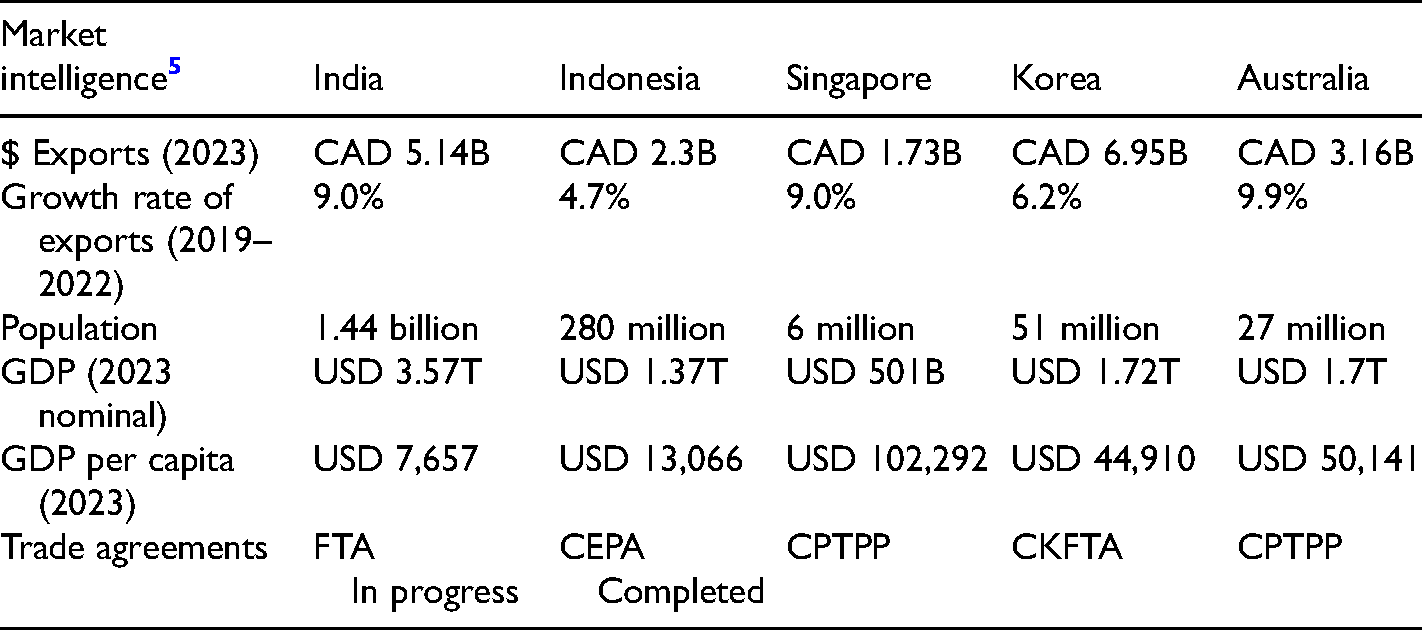
Simply liberalizing trade, increasing immigration from and to the country, or continuing a positive dialogue are not the only means of improving Canada's bilateral relations with Indonesia. Naturally, when one country is singled out over others in the region for priority treatment, the others will wonder why they were not selected. Other countries have stronger ties with Canada that may make them seem more suitable for strategic status—and some already hold some form of strategic status with Canada, such as Japan, Korea, and Australia. The Philippines may also seem like a strong choice within ASEAN, given the size of the Filipino diaspora in Canada and the fact that the two countries have had friendly relations for seventy-five years. But with trade the key element of the Indo-Pacific strategy, and with Indonesia a rising player in the region, deepening Canadian-Indonesian relations is Ottawa's next step in terms of economic growth and opportunity.
The Indo-Pacific strategy outlines five interconnected strategic objectives: 1) to promote peace, resilience, and security; 2) to expand trade, investment, and supply chain resilience; 3) to invest in and connect people; 4) to build a sustainable and green future; and 5) to present and show Canada as an active and engaged partner to the Indo-Pacific. 6 These broad, overarching goals serve to guide Canadian federal agencies, businesses, research institutes, and universities in their approach to the region. While the goals are ambitious and noteworthy, Canada has yet to devote the attention and resources to implementing the strategy. Jeremy Paltiel, a senior fellow at the Institute for Peace and Diplomacy, suggests that Canada is not a credible partner of any significance in the region. The Justin Trudeau government, which drafted the Indo-Pacific strategy, failed to follow through with concerted action. 7 This is seen not only with Indonesia but with other countries in the region. With a new Canadian government forming following the 2025 federal election, the Indo-Pacific strategy needs another look, with a special emphasis on making Indonesia a strategic partner.
Canada's policy goals relating to Indonesia
The prioritization of Indonesia as a strategic partner would fit with Canada's existing approach in the region. After all, in September 2023 Canada entered into a strategic partnership with ASEAN, specifically dealing with ASEAN's Political Security Community (APSC), Economic Community (AEC), and Socio-Cultural Community (ASSCC). 8 Further, when Indonesia is discussed by Canadian policymakers, it is as a priority partner within ASEAN. However, Canada needs to make Indonesia a strategic partner, full stop. That means a partnership with increased diplomatic engagement and strengthened bilateral relations, where dedicated individual attention is paid on a direct foreign policy level and not just through the lens of ASEAN.
From a trade perspective, a strategic partner is given increased attention, promotion, and investment, with preferential treatment over other countries in the region. As Canada attempts to move away from a heavy reliance on China and India, Indonesia is well-positioned to become a strategic partner, one with whom Canada can pursue new sources of growth for its economy and diversify trade—which is needed more than ever, given tariffs and tariff threats from US President Donald Trump.
While China and India once were the preferred countries with whom Canada could diversify its economy, Canadian relations with them have deteriorated in recent years. Canada's arrest of Huawei CFO Meng Wanzhou in December 2018 resulted in direct trade retaliation from China. 9 China has also recently retaliated against Canadian products following Ottawa's 2024 imposition of tariffs on Chinese electric vehicles. As for India, the 2023 killing of Sikh activist and Canadian citizen Hardeep Singh Nijjar in Surrey, British Columbia, Canada resulted in diplomatic fallout, including the expulsion of top diplomats by both India and Canada, and direct diplomatic retaliation by India. To capitalize on the Indo-Pacific strategy, Canada must make Indonesia a priority, as it once did China and India.
Though prioritizing Indonesia would be a bold move, Wendy Dobson suggested in 2016 that it was possible, provided, in part, that the Indonesian government undertook reforms. 10 For Jakarta, that means accepting international standards and enforcing them to demonstrate a commitment to eliminating corruption, efforts that were undertaken by President Joko Widodo. The question is whether the new government of Prabowo Subianto will return to corruption and the old ways of politicking that have long made it difficult for Canada to enhance and encourage trade with Indonesia. Corruption has been a persistent problem in Indonesia. In Transparency International's 2023 corruption perception index, Indonesia was rated 115 out of 180 countries, with a score of 34 out of 100. 11 In addition to corruption, Indonesia needs to work on liberalizing its trade agenda, ensuring it is more open to trade with, and investment from, countries like Canada. So far, the new government under President Subianto is continuing in the direction of President Widodo's administration, appearing to support Canada's existing initiatives with Indonesia, including the Canada–Indonesia Comprehensive Economic Partnership Agreement (CEPA) and the recent Team Canada trade mission to Indonesia.
Given the nature of its economy, trade is hugely important for Canada, and the Indo-Pacific strategy focuses on key arrangements to enhance and encourage more trade in the region. Canada is a member of the Comprehensive and Progressive Agreement for Trans-Pacific Partnership (CPTPP), along with ten other Pacific countries and the United Kingdom. While there is overlap between the CPTPP and ASEAN, the majority of ASEAN countries are not part of the CPTPP. Another regional arrangement is Asia-Pacific Economic Cooperation (APEC), a forum for twenty-one member countries that promotes free trade throughout the Asia-Pacific. Notably, it includes China and Russia, but not India. The Indo-Pacific Economic Framework (IPEF), an economic initiative launched in 2022 by the Joseph Biden administration, has fourteen member states, notably excluding China but including India. Canada is not currently a part of the IPEF, but it has support from the member constituents to join. Canadian businesses need help liberalizing and incentivizing trade in the region, specifically in Indonesia, Thailand, and the Philippines. As a result, Canada is negotiating separate agreements with ASEAN and Indonesia, which shows how serious it is about overcoming barriers to trade in the region. The complexity and diversity of Indonesia pose challenges for Canada, but the country offers immense opportunities for trade and growth in industries that Canada knows well. There is an ongoing dialogue between the countries on food security, energy transition, critical minerals, and infrastructure investment. 12 The question is, can Canada compete in Indonesia's market in these areas with other significant traders worldwide? The answer is yes, it can compete in those four areas in Indonesia, if it makes Indonesia a strategic partner. Yet, as it stands, the Indo-Pacific strategy makes little room for Indonesia.
Putting Indonesia into the indo-pacific strategy
There are several areas where Canada's Indo-Pacific strategy falls short of what is required if Canada is to truly capitalize on the growing region—and in particular, if it is to make Indonesia a critical part of the strategy. First, in the area of governance, there are four areas where the strategy needs improvement: the Indo-Pacific stakeholder advisory committee, financial accountability, coordination of implementation, and the importance of cultural differences.
The Indo-Pacific Advisory Committee was established in June 2022 to support the development of the strategy; however, it no longer exists. 13 With fourteen members, the committee was tasked with providing non-binding advice and recommendations to Global Affairs Canada (GAC) as it created the flagship new strategy for the region to diversify away from China. The committee's mandate was to provide independent perspectives and recommendations on Canada's Indo-Pacific strategy directly to the minister of foreign affairs of Canada. The need became evident in 2019 when China detained Canadians Michael Spavor and Michael Kovrig and put trade restrictions on Canadian pork and canola seeds in retaliation for the arrest of Meng Wanzhou in December 2018. The three chairs of the committee were Janice Stein, political scientist at the University of Toronto; Pierre Pettigrew, former Liberal foreign affairs minister under Paul Martin; and Farah Mohamed, a women's rights activist and long-time Liberal staffer. 14 Representatives of the private sector, civil society, and government were also included on the committee to reflect the diverse perspectives of Canadians from across the country. The committee, though, noticeably lacked dedicated Indonesian country experts and was only a one-time committee to create the strategy. This paper suggests the need for an Indo-Pacific stakeholder advisory committee to continue with annual check-ins after progress updates, and for dedicated Indonesian subject matter experts to be included on the advisory team.
From a financial perspective, the Indo-Pacific strategy suffers from a lack of investment. At the outset in 2022, the Trudeau government devoted C$2.3 billion over five years to advance five interconnected strategic objectives and deliver on twenty-four initiatives across seventeen federal departments and agencies. 15 While a detailed budget was not provided publicly, this roughly equates to C$460 million a year, C$19 million per initiative per year, or C$27 million per agency per year. This funding is insufficient given the number of departments involved and the size of the “region,” which encompasses the two largest countries in the world and over 4 billion people. In terms of accountability for both implementation and monitoring of funds, there is a Treasury Board-mandated interdepartmental governance structure to ensure coordination of the strategy's implementation at the assistant deputy minister and director general levels, along with a special envoy for the Indo-Pacific with responsibility for the implementation of all five pillars. There is also a new Indo-Pacific trade commissioner with a coordinating responsibility for pillar two, the trade pillar. A progress update on the strategy released in November 2023 gave a one-year review of the progress made on all the strategic initiatives, and showed that progress had been made on critical initiatives. Those related to Indonesia included situating the new Indo-Pacific trade commissioner in Jakarta, opening an EDC office in Jakarta, and advancing the Canada–Indonesia CEPA. 16
What is needed to ensure a continued understanding of how to successfully implement the strategy, both economically and diplomatically, is a critical, independent strategy evaluation and an independent value-for-money audit. The auditor general's office may not include the strategy in its schedule, so obtaining an independent evaluation from experts elsewhere—such as European Union countries or Australia, which also have significant ties to the region—is recommended. The evaluation should identify how much funding is allocated to specific departments, agencies, and countries in the region, and how much value is obtained from that investment. There has been insufficient prioritization, action, and spending on Indonesia to make it a strategic partner, and significant work needs to be done to build this relationship. It recommends that Canada hire a dedicated individual for Indonesia under the Indo-Pacific trade representative to help advance the relationship. This position, likely titled the Indo-Pacific strategic partner advisor, could be a two-year post, and would differ from the position of Indonesian trade commissioner.
In terms of dedicated new positions built into the strategy, no new agency has been established at this point. There should be a concerted effort to use existing federal departments and agencies unless there is a clear business case to do otherwise. However, this makes it challenging to coordinate the implementation of the strategy across departments and keep the government accountable. The special envoy for the Indo-Pacific is responsible for implementing all five pillars. The role is currently held by Ian G. McKay, who was appointed in April 2023, adding to his duties as ambassador to Japan. As noted earlier, in terms of accountability for both implementation and monitoring of funds, there is a Treasury Board-mandated interdepartmental governance structure to ensure coordination of the strategy's implementation at both the assistant deputy minister and director general levels. 17 The headquarters-based director general for the Indo-Pacific strategy also leads the Indo-Pacific Secretariat. 18 In September 2023, Paul Thoppil became the new Indo-Pacific trade commissioner with a coordinating responsibility for pillar two, the trade pillar. Indonesia continues to have a dedicated trade commissioner service and office with a team of seventeen staff.
Are these efforts sufficient to diversify and move away from regional dependence on China? It remains to be seen, and this point was not addressed in the one-year update. The dedicated Indo-Pacific trade commissioner position located in Jakarta is a positive step, but the region is vast, requiring considerable travel; how much can one person accomplish? He is not held accountable for the implementation of the strategy, nor is he a critical strategic advisor. Rather, he is a trade representative, so the role appears more like a trade promotion role and less like a trade policy role or position of accountability for the Indo-Pacific strategy. His specific role is described as having coordinating responsibilities for pillar two, trade. No direct ties have been identified between his role and the advisory committee or the secretariat. Is he feeding into the policymaking machine or just promoting the strategy? This paper argues that while the positions created are helpful, they are too headquarters-focused, stretched too thin, or too narrowly focused on trade promotion. The Indo-Pacific team needs to be dedicated to implementing the strategy. Hence, it is necessary for all team members to be located within the region, specifically in Indonesia, where they can form “Canada's Indo-Pacific Strategy Centre.”
In reaching out to Indonesia, Canada must recognize cultural differences. Indonesia is predominantly Muslim, while in Canada, only 4.9% (approximately 1.8 million people) identify as Muslim, according to the 2021 Canadian census. This is up from 2.0% in 2001, and is expected to double again by 2030. One area where this cultural difference creates a challenge in trade discussions is in Islamic banking. Islamic banking is Sharia-compliant finance that essentially prohibits usury or interest paid on all loans of money and investments in businesses that provide goods or services considered contrary to Islamic principles. Attempts to develop Islamic banking in Canada have often been overlooked by existing conventional banks in Canada. They are also under the radar of international Islamic banks due to the relatively small size of Canada's Muslim population. 19 The federal government recognized this in the 2024 budget and introduced measures to expand access to alternative financing products, like halal mortgages. 20 Since the Asian financial crisis, Islamic banking has become the backbone of Indonesia's financial services industry, creating stronger ties to other Islamic countries. Funding and financing for significant infrastructure projects in Indonesia often come from the global Islamic community. It would appear there are ties within that community that require further research and understanding for Canada to adequately engage with a market that is dominated by Islamic banking and sees Islamic banking as a stronger option than those from non-Islamic countries as a result of the Asian financial crisis from 1997.
Canada's Indo-Pacific strategy is secular; it does not mention the importance of cultural matters in these types of alliances and partnerships. Canada must become more attentive to Indonesian societal structures, establish trusted partnerships, and promote mutual understanding. Gender relations are also complex in Indonesia, and Canada should not be looking to assert its views on these issues in the country. Some areas have a more traditional patriarchal societal structure, as in more conservative Muslim countries. However, one area in Sumatra has a matriarchal society, and another region, Bali, tends to be perceived as having more egalitarian gender roles. Generally, when considering business in Indonesia, the focus is on Jakarta, Surabaya, or Bali, the major urban centres and tourism hotspots. Regional differences in Indonesia are real, and a one-size-fits-all approach is not suitable. In Indonesia's food business, an understanding of halal certifications is also crucial. In summary, cultural matters pose challenges to working with Indonesia, and Indonesia's stronger ties to Muslim countries will put Canada at a relative disadvantage when working with it.
Another way for Canada to become more successful in Indonesia is to utilize the Indonesian diaspora to help bridge the cultural gap. However, as the diaspora in Canada is small, Ottawa will also need some critical trusted partners in Indonesia. This can only be done with offices in the country and working directly in the country as EDC now does.
Beyond governance issues, situating Indonesia within the Indo-Pacific strategy also means seriously addressing the issues of trade agreements and trade missions. In terms of the former, Canada has attempted to overcome major trade barriers with India by creating an Early Progress Trade Agreement (EPTA) as a step toward a CEPA. This approach could also work in other regions. It is more of a building-block or solidifying-early-wins approach, ensuring the work of extensive trade negotiations benefits stakeholders earlier rather than waiting for an entire agreement to be completed. Canada has two trade agreements in the works in the ASEAN region: one with the whole bloc of ASEAN, and one with Indonesia specifically. These agreements would capitalize on, and seek to deepen, the existing Canadian-Indonesia trade relationship. Globally, Indonesia is Canada's nineteenth largest trading partner, and Canada is Indonesia's fifteenth largest trading partner. Within Southeast Asia, however, Indonesia represents Canada's largest trading partner. It is essential for supply chains in the region, which is one of the reasons for a dedicated agreement.
In its approach to signing trade agreements, Canada seeks to protect certain essential labour rights, environmental sustainability requirements, and interests related to women, indigenous peoples, small and medium enterprises, and the middle class, making an agreement to liberalize trade with Indonesia important. 21 Some of these requirements may impede a trade agreement, including those on gender and indigenous peoples. Canada should look to international standards on both matters. Despite its interests, Indonesia has not always been interested in liberalizing trade, but this has changed in the last twenty years. It has entered into key deals with other advanced economies independent of ASEAN, such as its agreement with the European Free Trade Association (EFTA), which was signed in 2018 and came into force in 2021. Canada has now substantively completed its agreement with Indonesia, but it will take until later in 2025 to finalize the ratification process.
Meanwhile, trade promotion has been the focus of three dedicated trade missions in 2024—Malaysia, Vietnam, and South Korea—and is an essential tool for helping major companies solidify their presence in a region and improving smaller companies’ chances of reaching new markets they might not otherwise have access to. Canada has also completed its trade missions to the Philippines and Indonesia in late 2024. Initially, the Indonesia stop appeared to be a brief two-day addition to the Philippines trade mission. However, officials took the opportunity to present the completed CEPA—though it still requires some editing, translation, and ratification and is not expected to go into force until 2025. This preliminary trade mission was a major milestone in Canada–Indonesia trade relations, but it should be followed up with a dedicated trade mission to the country if Canada is serious about expanding trade there. Media coverage of the event was limited, so it is difficult to gauge its impact, but Canada made the effort and showed up with the key minister involved. Perhaps Indonesia will begin to enjoy Canada's beef and include it in their national lunch programme, as one of the updates out of the mission suggested.
Another area where the Indo-Pacific strategy needs improvement both overall and vis-à-vis Indonesia is in the area of implementation. It is a five-year strategy seeking to advance five interconnected strategic objectives and deliver on twenty-four initiatives across seventeen federal departments and agencies. This is quite a task from a coordinating perspective. But the complexity of the task reflects the fact that Canada needs to make up for lost time. Frankly, Canada is not seen as a major player in the Indo-Pacific region, instead playing more of a supporting role to the major powers. The Indo-Pacific strategy is meant to alter this perception, and a focus on Indonesia will help.
Increasing Canada's economic engagement with Indonesia is a practical and mutually beneficial approach to advancing its role in the region. One of the government agencies that has significant engagement with this strategy is EDC, which opened offices in Jakarta in September 2023, and Seoul in October 2023. A notable early achievement for EDC in Indonesia was signing a memorandum of understanding (MoU) with PT Indonesia Infrastructure Finance to accelerate Canada's participation in infrastructure development in Indonesia. Another MoU was signed with PT Sarana Multi Infrastruktur (Persero) to increase collaboration to support the energy transition to net-zero emissions by 2060. 22 These are setting the groundwork for Canadian businesses to come in and help the country with its infrastructure needs, whether engineering, cleantech, digital, or energy transitions such as phasing out coal. Canada has recognized strengths in engineering and infrastructure. EDC is creating export opportunities for the Canadian infrastructure sector in Indonesia for firms like AtkinsRéalis Group (formerly SNC-Lavalin). This is seen as a collaborative effort, as Indonesia's infrastructure needs are growing rapidly. Pre-Covid-19, Indonesia's infrastructure was estimated to need C$507 billion in investment. 23
Increased collaboration between EDC and trade commissioner services within Indonesia and Canada is a necessity. So is sharing information on what the Canadian business community can offer Indonesia and on what kinds of arrangements would enable the business community to succeed. To reiterate, Canada needs to move Indonesia into the position of strategic partner, specifically using the trade pillar as the platform to advance this bilateral relationship. The question, however, is whether Indonesia will agree to be a strategic partner—or whether this is a misallocation of Canada's foreign policy resources. It appears that Indonesia has an interest, given that it agreed to the CEPA at the recent APEC summit and ceremonially signed it during the Team Canada trade mission. Both President Subianto and Prime Minister Justin Trudeau were willing to work together to move the CEPA forward. Whether this is sufficient to elevate the relationship to a strategic level remains to be seen, particularly as Indonesia has just become a member of the BRICS bloc. 24 Canada is putting its foot forward and signalling to Indonesia that it is more important than the other ASEAN countries, and that Canada wants to work with it separately as well as within ASEAN. This move is important, as bilateral diplomatic efforts to improve and update relations based on how the country wants to be treated in the global community are essential to ensure engagement between the countries remains positive and continues with a growth mindset. Positive bilateral relations matter in the region, especially given some of the difficult developments with other BRICS nations in the past few years, such as China and India. Canada is recognizing that Indonesia is seeking to distinguish itself from other ASEAN members and is considered among the world's leading developed and emerging economies.
Beyond major national trade liberalization agreements, Canada must adopt a comprehensive approach that considers critical minerals, as discussed between the presidents; as well as food security; energy transition; and infrastructure needs in the country. Unfortunately, infrastructure does not seem to be as high a priority for the new Indonesian government as a national nutritious lunch programme for students. Canada should also help with this new initiative at any level it can, from providing direct agriculture inputs to strengthening food security supply chains. To make this possible, Canada's ministry of agriculture should open a satellite office in Jakarta to create linkages. It is important to critique the strategy to identify suggestions that could enhance the overall approach to implementation. While brief, this has been a useful look at the strategy's key governance aspects and trade policy instruments, as well as its implementation.
Implementation suggestions
Canada's relations with Indonesia are often grouped with those of ASEAN countries, but there is a need to elevate relations to the level of a strategic partnership. To do so practically, Canada needs to tackle five strategic areas: increased bilateral relations, a dedicated trade agreement, in-country trade missions, investment in immigration, and relocation of coordination efforts to the country. This will require increased time, funding, and efforts in the four core principles of diplomacy with Indonesia: communication, building relationships, negotiation, and promoting interests, specifically using trade as the platform. This also means educating Canadians about our new strategic partner in the Indo-Pacific, Indonesia.
First, Canada must ensure a strong and healthy relationship with the new Indonesian government at all levels—national, provincial, regency or city, district, and village or subdistrict. This will require more resources to be invested in improving relations, and specific events and collaboration efforts to be included in the implementation plan to demonstrate the strengthened partnership between Canada and Indonesia. The engagement would include government organizations such as EDC; Immigration, Refugees and Citizenship Canada; FinDev Canada; trade-related organizations such as the Canada Chamber of Commerce; and academic and research institutions such as the University of British Columbia, McGill University, University of Toronto, York University, and Humber College. People-to-people connections must also be strengthened. Canada should focus on three critical areas:
Indonesia–Canada Plan of Action for 2022–2025: In early 2025, an evaluation should be done on the Indonesia–Canada Plan of Action for 2022–2025. In addition, a value-for-money audit on the first two years of Canada's Indo-Pacific strategy should be conducted by an independent evaluator from another country, focusing on efforts related to Indonesia and on how bilateral relations are being developed through the strategy. A more detailed public budget and spending analysis per region, department, or agency is also necessary to help inform how to invest strategically to make Indonesia a strategic partner. This would be used in 2025 to help inform the Indonesia–Canada Plan of Action for 2026–2030. Indo-Pacific Stakeholder Advisory Committee regional expertise: The Indo-Pacific Stakeholder Advisory Committee should be expanded to include two individuals with specific ties to Indonesia. Providing advice to those accountable for both the implementation and monitoring of funds, this committee needs expertise on Indonesia. One appointee should be a former diplomat with a deep political understanding of Indonesia. The other should be a businessperson with relevant experience working in Indonesia—someone who understands the cultural barriers to entering the Indonesian market, but will not stand to profit personally from the appointment. These subject matter experts will help inform Canadian decision-makers on improving and enhancing relations with Indonesia and making Indonesia a strategic partner. Someone like Dino Patti Djalal may be suitable. Canadian-educated, he is Indonesia's former Indonesian ambassador to the United States and vice foreign minister. In a vetting process, it would be important to assess how the new government views him and the extent of his current involvement in shaping foreign policy. Connected with this is the building of critical linkages between the stakeholder advisory committee and the Indonesian embassy, consulate, and diaspora communities in Canada, specifically the Indonesian Canadian Chamber of Commerce (ICCC) and Indonesian Student Associations across various campuses in Canada. If the diaspora communities cannot provide the level of engagement on matters necessary for the committee, Canada should obtain trusted local partners in Indonesia. Establishing these linkages will help build an understanding of what has been attempted in the past, the level of success of those efforts, and how similar barriers are experienced in the current sociopolitical environment. Importance of cultural differences: Cultural differences, including language and faith, must be factored into working with Indonesia. In a world where interference is pervasive, Canada needs to distinguish between legitimate foreign influence and illegitimate foreign interference. Working with a Muslim-majority country adds to the complexity, given the prevalence of anti-Muslim narratives and disinformation, which can heighten social tensions and deepen divisions in Canadian society.
25
This has to be mitigated to foster positive relations and expand trade. Doing so will require more support from academics and culturally appropriate promotion by trade commissioners, including efforts to improve understanding of halal certification, Islamic banking, and other societal norms within Muslim communities. The suggestion is to strengthen ties with trusted local partners and agents of all faiths in the country. These trusted local partners would include academic partners for education and research linkages, trusted imans and faith leaders in the Christian and Hindu communities for matters of religious importance. Strengthening these ties means including them in conferences and workshops held in both Indonesia and Canada. This could mean financial support or a specialized visa process for travel to Canada for these engagements, as it has been noted within the Indo-Pacific community in Canada that it is often difficult to secure participation from Indonesian leaders at such events. In addition, it is essential to create more opportunities for the general Canadian public, especially younger generations, to learn about Indonesia. This will require more funding and expansion of 1) academic programmes and 2) economic and cultural activities programmes. Funding academic programmes: While the federal government should not micromanage university programming, it should increase funding for dedicated Indonesian and Bahasa studies programmes within Asian Studies institutes at Canadian universities and colleges. The Canadian Council for Southeast Asian Studies (CCSEAS) should expand its mandate to include specialized programmes on Indonesia. An Indonesian language programme was launched at the University of Victoria in 2023, but it is small. The University of British Columbia, the University of Toronto, York University, and McGill University all have some form of Asian studies institute, but these centres’ focus remains broad. In the past, Humber College has hosted several Indonesian teams and conducted multiple projects in Indonesia, specifically focused on technical and vocational education and training (TVET); however, linkages with universities appear weak or non-existent. Another example is McGill's Institute of Islamic Studies (IIS), which is strongly committed to building and maintaining a programme and community in which Muslims and non-Muslims are afforded dignity and respect.
26
However, the IIS neither specifically focuses on Indonesian Muslim communities, nor offers programming related to modern business and trade, so there is a definite need for greater collaboration with the Indonesian business academic community. An Indo-Pacific Regional Connectivity Envelope totalling C$11.7 million over four years was announced in October 2024, but it applies to the whole region. Similarly, the Indo-Pacific Scholarships and Fellowships for Canadians Program (IPSFC), valued at approximately C$10 million over three years (2025–2028), also serves the whole region. Therefore, in addition to the funds awarded through these two initiatives, this paper suggests the creation of two research chairs in different academic institutions dedicated to fostering and improving the working relationship between Canada and Indonesia, at an estimated cost of C$5 million each, for a total of C$10 million. Funding economic and cultural programmes: Programs should support Indonesian market expansion, key start-ups, and research projects to connect Canada with Indonesia in 2025. Cultural enrichment efforts could include promoting Indonesian food, fashion, and tourism at summer festivals across Canada, as well as supporting the growth of Indonesian restaurants. The suggestion is to start with $15 million in seed funding for these programmes, which could take the form of festival sponsorships and small business loan programmes for Indonesian restaurants, clothing stores, and start-ups.
Second, Canada should look to finalize the CEPA with Indonesia, and have it ratified by both countries and come into force by the end of 2025. Work on the ASEAN trade agreements should continue, targeting completion by the end of 2026.
Third, the 2024 trade mission to Indonesia should be seen as an exploratory and introductory mission. A more robust trade mission should be planned for early 2026, involving the prime minister and at least four provincial premiers, with 200 to 300 select businesses and key stakeholders. Site visits should include Jakarta, Bali, Medan, Surabaya, and, if possible, Kalimantan. At least $1.3 million in existing funding should be allocated to help support businesses participating in and around the event, to ensure it is recognized as a platform for positive deal-making, progress, and growth for both countries—with appropriate due diligence done before the visit.
Fourth, Canada should prioritize immigration efforts between Indonesia and Canada, particularly in the area of student visas, temporary workers, academic and research partners, and investment partners. The suggestion is to create a dedicated pathway within existing programmes to provide the opportunity for applicants from Indonesia to succeed here in Canada. An express entry programme tailored to Indonesian applicants would be a strong option. This is especially important given the small number of applicants admitted annually and the understanding that, if they are selected for a permit, Canada is there to support them through the process. Despite the cap imposed in January 2024, Canada should continue to reserve international student visas for Indonesians. In 2023 and 2024, Canada issued over 1 million study permits to international students, of which only approximately 2,000 went to Indonesians. 27 Indonesia does not currently rank among the top twenty source countries for international students in Canada. Therefore, if Canada is serious about strengthening its relationship with Indonesia, Indonesia should be excluded from the new cap. This means existing allocation targets for Indonesia would be preserved, and even expanded, within the new cap rules.
Fifth, Canada's regional Indo-Pacific coordination efforts should be located in Indonesia in their entirety, including moving the entire Indo-Pacific team to Jakarta by late 2026, with a special celebration during the Team Canada mission. They would need to be in the region for at least six months of the year, in order to enable timely, in-person responses. A home base located in Jakarta, rather than Ottawa, would provide greater regional capacity. At least C$0.5 million in existing funding should be earmarked to support this. Having four senior, seasoned Indo-Pacific team members in the region is necessary to change the dynamic of how Canada operates there, sending a strong message that the Indo-Pacific is critical to Canada and that Indonesia is a new strategic partner for the region. The team would include the special envoy for the Indo-Pacific, the assistant deputy minister of the Indo-Pacific, the director general of the Indo-Pacific, and the trade commissioner for the Indo-Pacific, who is already there. They would form a new Canada Indo-Pacific Strategy Centre. Additional capacity should be added at lower levels in Jakarta. Adding the suggested dedicated advisor for Indonesia under the trade representative will help solidify progress in the relationship by the end of 2025. This Indo-Pacific strategic partner advisor could be a two-year position. Although the role appears to have already been included in the budget, its focus must shift to making more substantial gains in building Indonesia into a strategic partner. In addition, support for collaboration between EDC and trade commissioner offices, and coordination with various levels of Indonesian government and relevant organizations, should be increased, with the goal of pursuing at least eight more strategic MoUs, particularly in the areas of agriculture and food security. To summarize, the implementation suggestion focused on five strategic areas: increased bilateral relations, a dedicated trade agreement, in-country trade missions, investment in immigration, and relocation of coordination efforts to the country.
Conclusion
Canada needs to focus on Indonesia more clearly in its Indo-Pacific strategy by elevating the country to a strategic partner. Doing so is a necessary step for Canada as it seeks to continue diversifying its trade and investment. Trade is key, and Indonesia is a rising global player that presents the best next step for Canada in the region for growth and opportunity due to its size, population base, and diversity. It can do so specifically through investing and improving bilateral relations, ratifying the Comprehensive Economic Partnership Agreement, proceeding with a follow-up trade mission in 2026, providing a unique pathway for Indonesians to immigrate to Canada, and relocating Indo-Pacific strategy coordination efforts to Indonesia. The total amount of funding suggested in this paper is C$48.5 million. Of that, C$25 million is to be new funding for two research chairs and seed funding for start-ups and cultural events, along with C$23.5 million of existing funding for the Indo-Pacific Regional Connectivity Envelope, Indo-Pacific scholarships and fellowships, the next trade mission to Indonesia, and relocation efforts.
The vision is for Canada and Indonesia to continue strengthening their relationship and grow trade in a trusted partnership with mutual goals of peacefully helping each other and the world with regional security. Indonesia has long been seen as a peaceful player in its region, as has Canada in its region. In a strengthened partnership, the two countries can help each other navigate the evolving world order as Trump's presidency develops and Russia continues to form advanced alliances that threaten peace and stability. All of this can be done while advancing the goal of continued peaceful trade between the Indo-Pacific region and North America.
Footnotes
Declaration of conflicting interests
The author declared no potential conflicts of interest with respect to the research, authorship, and/or publication of this article.
Funding
The author received no financial support for the research, authorship, and/or publication of this article.

Notes
Author Biography
Kevin Dyck, CPA, CA, CIA, MPA. He has an Honours Bachelor of Business Administration from Wilfrid Laurier University. He is a chartered professional accountant, chartered accountant, and a certified internal auditor. He has worked for Ernst & Young and The Mastercard Foundation, and has over ten years of experience managing international non-profit financial teams, including working and spending time in Khartoum, Sudan and Kathmandu, Nepal. He recently completed a Professional Master of Public Administration at Queen's University, focusing his research on Indonesia.