




Abstract
There is growing consensus that Canada needs to “do more” in the Indo-Pacific region as it becomes the centre of gravity in a changing international landscape—a landscape challenging several traditional assumptions about the nature and configuration of global power which Canadian foreign policy has rested upon for decades, specifically due to the emergence of Sino-American rivalry. It is clear Canada needs a regional approach which is rooted in and better informed by geopolitical considerations, but there remains an absence of analytical frameworks to compare and evaluate alternative approaches. In addressing this void, this paper sketches out and compares four possible orientations Canada could pursue towards the Indo-Pacific region: Minimal Engagement, US-Aligned Confrontation, Regional Multilateralism, and Selective Minilateralism. Remaining agnostic about which one(s) Canada should choose, the paper is designed to highlight the stark trade-offs Canada must increasingly confront as it navigates this uncertain environment.
The last decade has seen a noticeable change in Canada’s engagement with the Indo-Pacific region, specifically a broadening from a near-exclusive fixation on trade, with a particular focus on China, towards more inclusion of, and interest in, diplomatic and security concerns. These pursuits seem to signal a desire by Canada to regain a regional presence which is long-term and multifaceted. However, there remains no clear rationale as to why this is important and what it is meant to achieve, especially in an environment of increasing competing demands in other foreign policy areas. As a result, whether this activity solidifies into a durable trend or is simply another short-lived spike of interest periodically punctuating the history of an otherwise low priority area for Canadian foreign policy is yet to be determined. Canadian strategic focus has historically, and remains, fixated on North America and the North Atlantic which has inhibited development of a robust approach towards the Indo-Pacific region. 1
Many analysts argue this deficiency must be rectified as the Indo-Pacific region is becoming the new centre of political, security, and economic gravity in the global system which demands Canada have a robust regional strategy of engagement towards it. 2 Failure to do so will permanently sideline Canada and its interests in the region, resulting in it becoming a laggard in its relationships with traditional allies, close partners, and emerging regional powers, and ultimately undermining its role as a meaningful player globally in general. 3 At present, Canada is moving in this direction with the current government developing an Indo-Pacific strategy. This process involves, and is a top priority for, several ministries including Global Affairs Canada and the Department of National Defence, as outlined in their current mandate letters.
We seek to contribute to this ongoing discussion by conducting a comparative analysis of various possible geopolitical orientations Canada could take toward the Indo-Pacific. The four options presented below are based on foreground assessments about critical uncertainties regarding global political, security, and economic trajectories. Our aim is to stimulate debate beyond the generalized consensus emerging that Canada needs to “do more” for three reasons. First, we wish to avoid prescriptions that are just modest deviations from the status quo, which limits thinking about real alternatives and what factors those would be based on. Second, there is a dearth of analysis about what the rationales and effects would be if Canada were less, not more, involved in the region. There is a bias that Canada must become more involved, usually at all levels, in the region, which has largely avoided critical examination of why this is so. Finally, analyses tend to focus on goals and interests and tactics to achieve them, rather than starting with broader assessments and comparisons of possible trajectories of geopolitical and economic uncertainties which are increasingly defining the global environment. Dealing with environmental uncertainties is a perennial issue in the development and conduct of foreign policy, as these rarely become entirely unambiguous enough to make decision-making self-evident. 4 However, what makes the uncertainties facing Canada more pressing and concerning than most previous periods in the post–World War II era is their number, simultaneity, and interlinkages which challenge a number of core foundations—the nature and role of the United States, the global balance of power, and the durability of international order and Canada’s role in it—which have anchored Canadian foreign policy for decades.
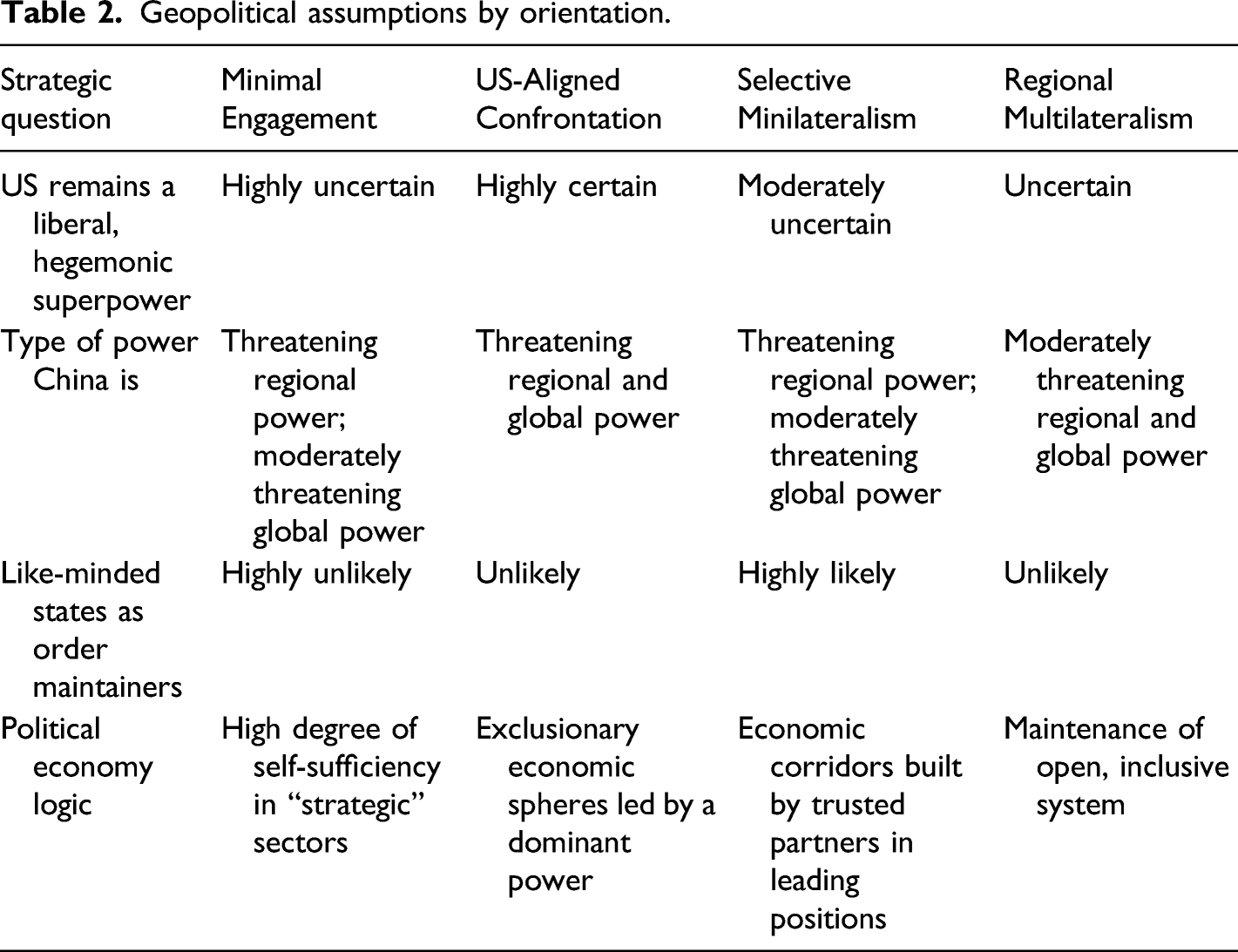
Many of these uncertainties will persist for some time and are intimately embedded within the evolution of the Indo-Pacific region. As a result, we assess that a “wait and see” posture—avoiding determining and pursuing a regional approach until these environmental factors become less ambiguous—is not advisable. 5 Canada must make some level of assessment about the future trajectories of these factors in order to ground and guide any regional approach. These uncertainties are (1) whether the United States remains a committed liberal hegemonic superpower; (2) what type of power China is becoming; (3) whether “like-minded” states can be order managers and maintainers on their own; and (4) what the dominant logics governing, and patterns characterizing, the regional/global political economy will be.
All these factors are part of the broader phenomenon of growing Sino-American rivalry that links the global and regional levels within the Indo-Pacific region together, which is currently unique amongst regions in this regard. The emergence of Sino-American rivalry as a system-level feature of, and force in, global politics is the impetus for a re-examination of Canada’s Indo-Pacific relations. Regional relations are, and should be, based on more than Sino-American rivalry, but it is a common paradigm which all regional states are adapting to, including by determining the nature and trajectory of regional order building with ramifications extending far beyond its geographic boundaries. For this reason, Canada needs a more comprehensive Indo-Pacific approach. Regaining presence is not a sustainable approach as it is largely hollow in substance, and risks cratering in on itself given the lack of strategic foundations to its purpose. Such foundations need to be informed by, and operate within, updated geopolitical considerations which reflect the altering global and regional strategic landscapes.
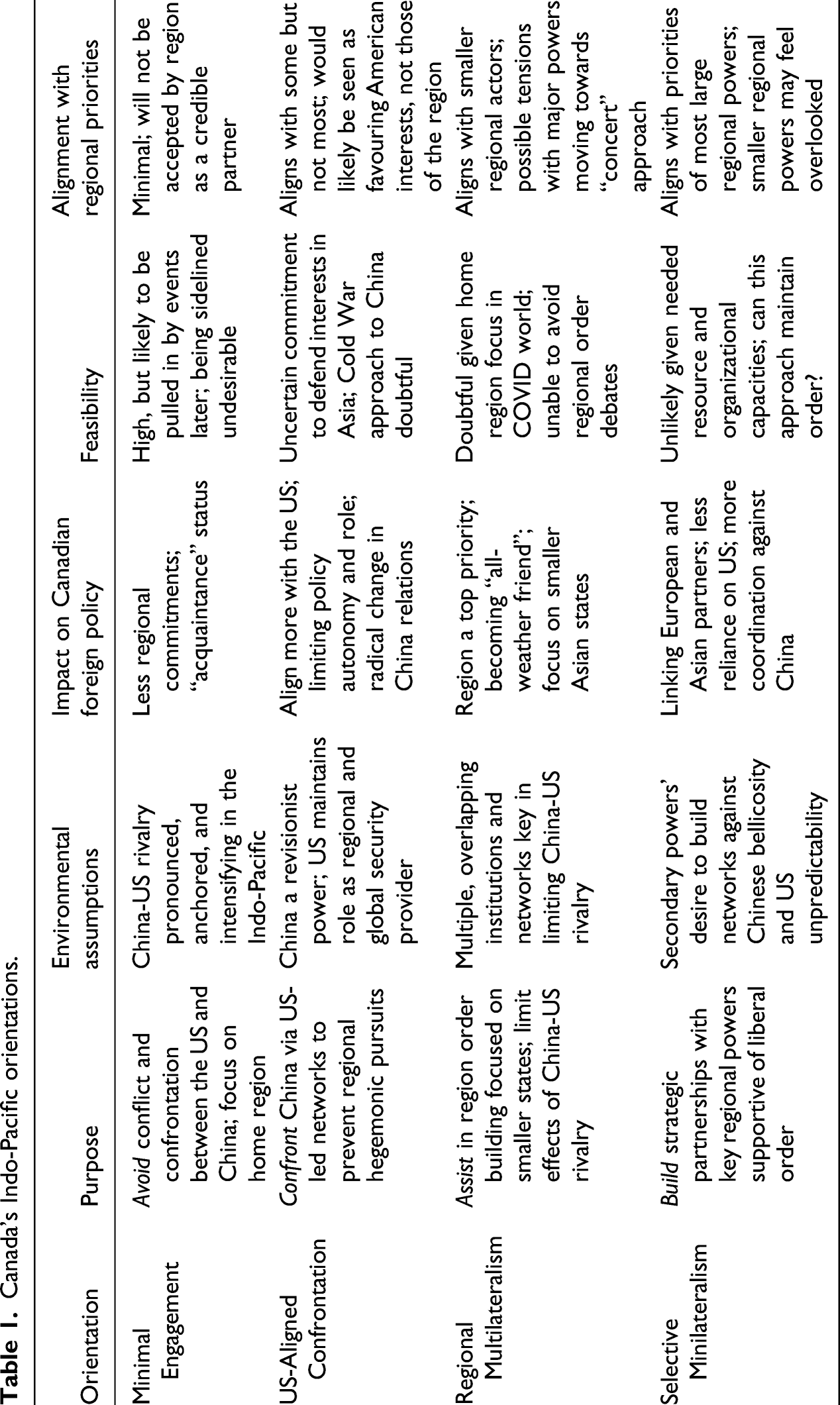
This paper explores four possible orientations Canada could adopt towards the Indo-Pacific region: Minimal Engagement, US-Aligned Confrontation, Regional Multilateralism, and Selective Minilateralism. A common set of factors is employed to illuminate differences in assumptions, logics, practices, and trade-offs associated with each. These factors are purpose, environmental assumptions, impact on existing Canadian foreign policy, feasibility, and alignment with regional priorities. On the latter point, the focus is on the priorities of regional states (recognizing they are not a monolith) and not on those of the US or China. Several major Asian powers are increasingly working together in response to changes in the balance of power associated with the rise of China and the US role in the region, shaping the geopolitical environment rather than being simply onlookers and subordinate players in the growing Sino-American rivalry. 6 The paper does not determine which orientation Canada should adopt, but rather advocates for the need for these types of exercises—thinking about real strategic alternatives to, not slight deviations from, the status quo—during this period of structural change and uncertainty in which there is no self-evident, silver-bullet solution. Decision-makers need to make assessments about these matters to ground and guide policy and action moving forward or risk have their decision-making and action space truncated by events and the actions of others taking over.
Canada’s current regional approach: Re-establishing presence
Canadian engagement with the Indo-Pacific has a checkered history featuring some periods of great activity, but it has never been a top-tier priority, with fluctuations largely being a function of the availability of capacity rather than deliberate elevation as a high-level interest. 7 Recent decades have continued this cycle of boom and bust. The 1990s witnessed what former Canadian diplomat Marius Grinius called Canada’s “Golden Age of Asia,” defined by multi-pronged and sustained engagements, including Canadian participation in the establishment of the Association of Southeast Asian Nations (ASEAN) Regional Forum (ARF); the South China Sea Dialogues; facilitating a number of regular dialogues between state, academic, and societal counterparts; peacekeeping forces to the UN mission in East Timor; and active promotion of trade, specifically “Team Canada” missions to China. 8 These efforts had begun to erode, however, by the 2000s with Canada focused on North American economic integration via NAFTA, 9/11 and the resultant War on Terror, and an overall reduction in foreign engagements as a result of the 2008 recession and subsequent budgetary cutbacks. Trade promotion and pursuits, however, continued, and in many ways became Canada’s de facto regional policy. 9
The pendulum has swung back towards augmented engagement in the 2010s with a continued focus on free trade deals (including with South Korea, the Trans-Pacific Partnership, and now-defunct talks with China) alongside renewed diplomatic efforts to be included in the region’s premier forums and increased military deployments, exercising with regional militaries, and participating in international security missions. In addition to attempts to further governmental, military, and industry ties, people-to-people relations are increasingly becoming important to Canadian-Asian relations, including via growing numbers of foreign exchange students and Canadians of Asian descent. 10 While awaiting a regional strategy, the current government committed to becoming a “reliable player” in the region in its 2017 defence strategy. 11
The current Canadian approach to the Indo-Pacific can be defined as one seeking to regain presence through a more multifaceted form of engagement. Whether this will alleviate concerns regional states have regarding Canada’s capacity-based, rather than interest-based, approach to engagement is yet to be seen. Canada’s tenuous commitment to the region has resulted in its continued exclusion from full participation in numerous high-level venues such as the East Asia Summit and the ASEAN Defence Ministers’ Meeting Plus. Canada faces a choice about whether it will work to develop and institutionalize a coherent and credible approach to the region, or simply leave it to the whims of when and whether it has excess capacity to do so away from its core regional priorities and pursuits anchored in and around North America and the North Atlantic. Structural changes, specifically Sino-American rivalry, that are currently impacting, and will continue to impact, the foundations of Canadian foreign policy in general, and its Indo-Pacific relations in particular, should be the strategic impetus for determining a long-term geopolitical orientation towards the region.
Need for a rethink: Strategic uncertainties stemming from Sino-American rivalry
The growing centrality of Asia in global security and economics has in part been anchored in stable relations between the US—the world’s sole remaining superpower and primary regional security provider—and China—the world’s largest and fastest rising power who has become central in regional economic networks. Not being naïve in understanding the durable, entrenched authoritarian nature of the communist regime and the real security differences between the two, successive American administrations over a number of decades believed that these tensions could be well managed and that China, given the benefits accrued from participation, would over time come to be more of a supporter of the system and a stakeholder of its management, albeit under US leadership. 12 Today that approach is collapsing due to the changes in the internal nature of both China and the US politically, their respective relationships to the international order, and the burgeoning rivalry between them, in Asia and elsewhere. 13 As a result, the Sino-American relationship is entering an era of post-engagement—an era whose exact trajectory remains unclear, but wherein confrontation and exclusion will most likely become more prominent features of their relationship. While a superpower struggle akin to the Cold War appears at present unlikely, these two powers increasingly view each other as their primary adversary and unavoidable challenger to the achievement of their grand strategic interests. 14
Navigating through such change and uncertainty inherent in the relationship between the world’s two most powerful states is something Canada, and other states, must do to adapt to this changing strategic reality. There are four key strategic questions which Canada needs to make some sort of assessment about in order to inform what geopolitical orientation Canada should adopt towards the Indo-Pacific region. These questions are: 1) Will the United States maintain its global leader and Western hegemonic roles and remain a committed ally and benevolent continental security partner to Canada?
15
Many in the West were relieved that the US under the Biden administration appears to be going “back to normal” in terms of working with allies as privileged partners after the Trump presidency which relegated them to marginal status. During the latter’s tenure, there were a plethora of debates in academic and government circles about whether and how to adapt the entirety of Canadian foreign policy to dealing with the possibility of drift and antagonism becoming more dominant features in the US-Canada relationship if the US increasingly became less liberal and more hostile to its traditional allies and partners.
16
These types of analyses in Canadian foreign policy discussions have largely disappeared since Biden’s assumption of the presidency.
17
However, it remains to be seen if the latter was an aberration or not, given uncertainties about the trajectory and effects of ongoing domestic political polarization and debates about its hegemony which may alter how the US pursues global affairs with allies and institutions moving forward.
18
2) What kind of power will China become and what challenges will it pose? It is evident there are growing incongruencies and tensions between China’s grand designs and existing US-dominated regional and global political, security, and economic structures.
19
As a result of these tensions and its growing military and economic power, there are concerns about the level of ambition and risk-taking China will pursue moving forward. For example, will it increasingly employ coercive methods to achieve its interests, possibly leading to the establishment of its own hegemonic system, which is separate, and oppositional to, the current web of liberal, global political and economic networks? Or will China continue to largely pursue its interests within existing regional and global frameworks and structures, showing a willingness to compromise with others as a function of self-interest and necessity in avoiding being completely balanced against by regional powers and the US? A key litmus test is whether China will be willing to find ways to connect its Belt and Road Initiative (BRI) with emerging regional political structures around a “Free and Open Indo-Pacific,” or whether it will continue to see the latter as hostile towards it. Canada has experienced firsthand this more coercive and assertive China, whose actions have begun to alter views of Beijing as a desirable trade and international partner to one posing an increasing risk to Canada and its interests, which must be countered and safeguarded against.
20
3) Can “like-minded” powers work together in a more concerted way as order managers in the absence of a status-quo hegemonic power and/or intense rivalry between the leading great powers?
21
In particular, can these powers push back against exclusionary schemes that could stem from opposing US and Chinese hegemonic projects, or will their space for manoeuvre be increasingly squeezed as alignment pressures grow?
22
Whether these powers can alleviate differences among themselves, pool resources together, and devise a jointly-believed-in and realistic strategy to offer order provision and leadership at regional and global levels, is unclear.
23
With the absence, and in some cases obstructionism, of American leadership under the Trump administration and the growing belligerency of China, Canada looked to strengthen relations and international efforts with other like-minded, mostly Western, states to preserve the liberal nature of international order which had benefitted them greatly through institutional arrangements not predicated on US leadership or in some cases even involvement.
24
These efforts, though, largely dissipated with the Biden administration assuming office, under the assumption that this represented a definitive return of reliable US leadership. 4) What are the future logics and characteristics of the Indo-Pacific, and global, political economy? There appears to be a large rethink in many states, most prominently the US but also a growing number of Western states and China, about the prosperity and security benefits of a global, open trading and investment regime, defined in larger measure by transnational supply chains, which have been extended tremendously since the end of the Cold War in scope and intensity.
25
Sino-American rivalry, while not the only factor, is severely challenging to the economic globalization project, but it is unclear what the exact structures and logics of political economic networks will (d)evolve into within this more competitive environment between the world’s two most powerful states and largest economies.
26
As a function of these tensions, there are growing calls in Canada for an ever-increasing number of areas, including high-end research and technology, infrastructure, and some natural resources, to fall under more robust national security rules to ensure protection against economic coercion from and providing material benefit to adversarial powers, with China top of mind, and/or excessive reliance on a single, such as the US, or small group of partners whose reliability is in question.
27
Concerns about supply chain resiliency during the ongoing COVID-19 pandemic have furthered these sentiments.
The four geopolitical orientations described below differ in how they answer the above questions and how much emphasis they place on the relative importance of each. This is not an exhaustive list of all possible courses of action Canada could adopt but rather the most probable ones we assess based on enduring realities which limit reasonable possibilities it is assumed Canada would consider and pursue, except in the most extreme scenarios involving massive changes to international, and especially domestic, realities. As a result of these factors, some orientations have not been explored, including: 1. Alignment with China (which would involve complete abandonment of the US relationship) 2. Non-alignment and neutrality (which would involve revoking existing alliance commitments and leaving many privileged forums and groupings within the West) 3. Looking-inward orientation (which would involve moving towards a pseudo-autarkic political economy and security posture)
For the purposes of this paper, geopolitical orientation has four defining features, staking out a middle ground between an issue-specific policy and grand strategy. First, it is coherent in showcasing the logic of, and linkages between, strategic environmental assessments, purpose, and action. Second, it is mutually supportive in meaningfully informing and tethering various state activities within broad common goals and frameworks. Third, it is flexible in illuminating the broad parameters of Canadian policy and action while allowing for manoeuverability in addressing specific issues. Finally, it helps create credibility in both domestic and regional audiences of expectations regarding Canadian (non)involvement in the region and the requisite level of resourcing and commitment to do so.
Minimal engagement
A Minimal Engagement orientation is premised on the Indo-Pacific region remaining a second-tier priority within Canadian foreign policy. Serious consideration must be given to adopting an orientation where Canada normalizes a low-level, low-commitment engagement approach not out of habit but in order to support a number of interests. This is not a call for complete retrenchment, but rather for avoiding overcommitting to a region where Canada’s focus and presence has been wildly inconsistent. This is particularly so as the Indo-Pacific region is undergoing fundamental change geopolitically in terms of regional actors increasingly debating how and maneuvering to construct new regional ordering principles, institutions, and relations to ensure stability throughout. China promotes the Belt and Road Initiative as a de facto organizing principle of regional integration, whereas other regional powers like Japan, India, and Australia emphasize a “Free and Open Indo-Pacific” (FOIP) construct. While there are variations among these, in general the FOIP is a “rules-based” order where openness of the maritime commons, respecting state sovereignty, and great power restraint from imposing a hierarchical order are seen as critical to ensuring a stable region where layers of “many belts and many roads” preclude the ability of one power to dominate the region. 28 The US has its own FOIP construct, which shares many similarities with those proposed by others, but with a far more confrontational and exclusionary focus against China which is seen as a revisionist power. 29 Others, such as some ASEAN states, support the notion of the Indo-Pacific region but are uncertain of the merits and purposes of a “free and open” one. Specifically, there are concerns that the FOIP is largely anti-China by design—and thus potentially more a source of tension than cooperation—and undermines the centrality and autonomy of ASEAN as a regional player, given that the architects of this concept are major powers outside of Southeast Asia who are creating new institutions and arrangements, like the Quad, which are not ASEAN-based. 30 China has refused to entertain the FOIP construct, for while many regional states have evolved their original FOIP visions to be more conducive to China playing a meaningful role within them, Beijing still sees it as largely a new concert system comprised of democracies which are largely united in restraining, and possibly containing, China’s growing power and influence. 31 Canada must decide if and how it wants to participate in such processes regarding the ongoing political, economic, and security structuring of the region.
Firstly, Canadian trade and security interests remain heavily anchored in North America and the North Atlantic, thus consuming the majority of foreign focus and resources. Attempts at trade diversification, currently and in the past, have never truly pulled Canada away from dependence on an integrated North American economy, particularly with the US. Furthermore, the conduct of most security operations and practices remains largely with the US and NATO. It remains questionable if Canada, acting on its own accord, could simply layer on top of this intensely tethered Western network of connections another web of interactions with the Indo-Pacific region, or if a decisive shift in political, economic, and security priorities and capacities from one to the other would be necessary. Such a process would be made easier if existing Western institutions that Canada is a member of, such as NATO, decided to become more involved and active within the Indo-Pacific. China is a growing concern and focus for NATO which will most likely feature prominently in the next iteration of the organization’s Strategic Concept. This does not automatically translate, however, to the Indo-Pacific becoming a new theatre of priority for NATO operations and engagements. This is because the Alliance is increasingly focused on growing regional security concerns and the fact that NATO can assist in countering China by ensuring commonality of industrial, cyber, and economic policies which prevent unwanted Chinese strategic intrusion into these spaces rather than out-of-area military deployments. 32 As well, a number of recent developments such as re-evaluation of continental security requirements to address a number of traditional and non-traditional security challenges; 33 growing tensions between Russia and NATO in Europe; the legacy of the “America First” strategy of the Trump administration, defined by trade protectionism and the questioning of alliance commitments; and domestic and continental responses to the COVID-19 pandemic, have re-centred Canada’s energies on these traditional areas and relationships. Even though the Biden administration has worked on restoring alliance commitments and relationships, given the polarized and divided nature of the US political context, Canada may be looking to lessen security dependence on the US. 34 Furthermore, Biden’s domestic policy is likely to continue focusing on a “Made in America” economic approach requiring Canada to continue to focus and negotiate entry into these plans.
Secondly, a policy of minimal engagement would avoid entanglement in areas of longstanding tensions between China and the US, including in issues such as the South China Sea and Taiwan. Canadian military assets would still deploy to the region, but perhaps with qualifications about their operating areas and commitments to only conduct specific missions and duties. Avoidance of these specific issues and areas would obviate the need for Canada to develop positions on a number of legal and security matters, including Freedom of Navigation Operations which could have ramifications in the Arctic. Canada could, however, offer to help cover security provision in other regions like the Arctic and Europe to ease any American pressure for assistance and commitment in the Indo-Pacific region. While continuing defence relations with existing partners to preserve membership in important organizations such as Five Eyes, Canada would avoid trying to advocate for inclusion in emerging regional security arrangements such as the Quad, specifically as it is unclear whether such organizations will become more comprehensive and binding in terms of commitments to other members in the future.
Furthermore, Canada, wary of reliance on China (and others) for certain products and services, may decide to focus on re-shoring certain supply chains at home rather than expanding or configuring them through trade networks in the Indo-Pacific and elsewhere. China is seen as a revisionist challenger, but not an existential one that requires direct involvement in Asia to counter, given the presence of the US and other capable regional powers to balance against it. Rather, Canada can focus on ensuring that China does not gain influence and presence which is seen as threatening in regions closer to home like in the Arctic, which may align with US preferences with allies “covering off” their home regions rather than trying to coordinate among them and regional allies in Asia. 35
Thirdly, amidst this period of enhanced strategic rivalry and increasing willingness of powers like China and the US to employ a range of coercive methods to ensure compliance, Canada may decide that a more modest and less ambitious foreign policy focus is required. Such an approach links the two reservations listed above—shoring up the North America/North Atlantic base while avoiding strategic entanglements in Asia—with a closer-to-home approach, possibly including developing greater economic and security autonomy away from an unpredictable US. Such a position appeared to be emerging from Australia, which was increasing its defensive self-sufficiency but narrowing geographical focus towards Southeast Asia and the South Pacific to prepare for an environment of increased Chinese assertiveness and uncertain American commitment to being the region’s security provider. However, with the recent creation of the Australia–United Kingdom–United States (AUKUS) agreement, centred on US transfer of high-end military weaponry, technology, and overall integration of defence industrial bases between the three partners, Australia appears to have moved back towards deeper alignment with the US as the strategic anchor of its defence strategy. 36 In any event, during such periods of structural change, traditional “middle powers” like Canada, used to focusing on a more international, expeditionary level, may realize they need to be more committed at home rather than developing new and extensive overseas engagements, and have more autonomous diplomatic, economic, and military capacities and policies. 37
Despite these concerns, several factors make it unlikely that Canada will adopt a posture of minimal engagement. Firstly, it remains questionable whether Canada can adopt a “light” approach to the region and still expect to benefit from trade/investment opportunities and diplomatic interactions. Minimal engagement would result in Canada being an acquaintance to the region, which would change the respective operating assumptions of both Canada and countries in the region. For example, there may be greater pressure from allies to develop a more coherent and unified policy and practice in the Indo-Pacific, including contingency responsibilities in the event of a conflict or severe crisis. More indirectly, regional developments may place Canada in a dilemma regarding remaining relevant within existing security organizations. For example, Canada’s standing within Five Eyes may lessen given that three of its five members—the US, the UK, and Australia—are increasingly working together not only to develop nuclear-powered attack submarines for Canberra (an asset which would also be ideal for Canadian operations in the North American Arctic) but to harmonize their industrial and cyber asset bases and defences within AUKUS. 38 As a result, Canada could be relegated to a peripheral member of these groupings, and not invited to, or even considered for, future joint security endeavors. As well, as Canada begins to navigate a world of structural change and great power competition placing large strains on the current international order, working with other powers broadly supportive of the status quo will be critical. Many of these powers are not just in Europe, but in Asia as well—including Japan, South Korea, Australia, and to some degree, Indonesia and India. These powers are becoming increasingly powerful not just as regional actors but as global participants (such as in forums like the G20), and thus a minimal engagement approach may stymie the furthering of relations with these states.
US-aligned confrontation
A US-Aligned Confrontation orientation would elevate the Indo-Pacific region to a high priority in Canadian foreign policy, assessing the structural changes—namely the rise of China—within the region as having clear, direct, and long-lasting ramifications for Canadian prosperity and security. Under this orientation, China would be treated as a systemic rival whose ambitions and practices are designed to bring about a different regional and international order contrary to current liberal principles, practices, and institutions. As a result, Canada would deepen regional alignment with the US, given it is the only power able to organize and underwrite a sustained effort to prevent Chinese regional hegemony, thereby eliminating a possible springboard for Beijing to fulfil more global hegemonic ambitions. 39 Such an orientation, therefore, is not simply based on a desire to avoid a backlash in bilateral relations should Canada not align, but more importantly would be based on viewing China as a serious challenge which necessitates deeper alignment with the US even amid concerns about the polarizing nature of its domestic politics and future as a hegemonic power.
The US views the tensions in its relations with China (and Russia) as not just tactical or issue-specific in nature, but as rather strategic in that these regimes are comprehensively opposed to American power, leadership, and the “rules-based international order.” As a result, a more expansive strategy of competition is developing across many domains, not just military. While the Biden administration appears to be gravitating towards the term “strategic competition” as opposed to “great power competition” (in part to distance itself from the latter concept given it was developed and employed by the Trump administration), which includes a more nuanced appreciation of the need to develop new ways to further relations with Beijing on mutual interests and maintaining stability overall as they increasingly become rivals, the general emphasis on confrontation and exclusion against these powers as the central anchor in American national security appears to be solidifying as a long-term trend. For example, the trend of sharp increases in defence spending continues under the Biden administration, designed to help ensure the US will “win” this competition by remaining the undisputed military and technological power in the world. 40 There remain, though, uncertainties about how exactly the US will pursue this grand strategy, including the demands and pressures on allies and others to follow suit and support their ordering and network preferences to marginalize and exclude China. 41 With that in mind, however, the current American FOIP strategy is largely exclusionary in its pursuits, as it sees China as a revisionist power to be confronted and resisted. 42
Adoption of this orientation would result in a number of largescale changes in Canada’s regional activities. First, Canada would look to reroute critical supply chains to bypass China, and severely limit Chinese entities operating in “strategic” industries and areas in Canada such as the Arctic. This would insulate Canada from coercive exploitation and blunt China’s ability to develop an economic hegemony around controlling sensitive supply networks to create new ones with the support and guidance of the US, a significantly costly move to incentivize businesses to relocate and/or focus elsewhere. 43 While the US remains reluctant to join the Comprehensive and Progressive Agreement for Trans-Pacific Partnership (CPTPP), it is anticipated to increasingly work with regional allies and partners in building technological and military-industrial corridors which exclude China from key sectors. Second, Canada would become an active participant in regional institution building which heavily restricts or excludes China, reducing its ability to manipulate or assume a commanding position within the region. Third, Canada would augment its military engagements with regional partners, particularly those affected and concerned by increased Chinese military power and pressure. Examples could include more advocating for more formal linkages with, or being made a member of, the Quad (Plus) and/or an expanded AUKUS-type grouping, and regular deployment of military units to the region facilitated by the relocation of most naval and air power to the West Coast, stationing naval assets as part of the US Seventh Fleet in Japan, and operating in joint/coalitional contexts in regional hotspots like the South China Sea. Canada could collaboratively work with regional partners in arms sales and procurement projects, including weapons systems and platforms effective in operating in an anti-access/area denial environment like missile defence, unmanned vehicles, and submarines. As well, Canada may investigate whether to establish defence pacts or even formal alliances with Asian states, like Japan and Australia. Many of these efforts, though, would be led by, and run through, the US—the only power capable of organizing networks of regional alignments against China given its material capabilities, history in the region, and existing security and political networks.
A US-aligned confrontation orientation entrenches an overt balancing approach, with heavy elements of a containment style strategy, to the region for Canada in order to counteract China’s ability to alter economic and security networks decisively in its favour. Despite lingering concerns about American regional commitment, especially after the Trump presidency, the central security structure remains the hub-and-spoke defence system which runs through, and is backed up by, American power. While new networks such as the Quad are forming between Asian states, they are currently aimed at augmenting this core rather than replacing it. The US, in short, is the indispensable power which alone can lead and organize those that are wary of growing Chinese power.
There would be significant risks and costs, however, were such an orientation adopted. First, and most significant, would be a complete, fundamental transformation of relations with China, and the question of whether Canada is willing to bear the expected backlash from Beijing with the more direct imposition of security issues as a defining feature of any new relationship; a test case of such changes is currently ongoing in Australia. 44 Second, any moves by the US to return to a Cold War strategy of containment against China defined by growing exclusion from economic and security networks and requiring near full alignment by allies will be difficult to pursue, especially if Washington maintains a protectionist agenda which precludes joining and being a leading member of regional trade and investment pacts like the CPTPP, and may unnecessarily augment tensions with Beijing. This is because China is already an integrated power in the world’s most important political and economic networks, with many US allies and regional partners having deep trade and investment ties with Beijing, thus necessitating Washington to develop far different strategies to compete against Beijing. 45 Even though some states have made moves to lessen their dependence on critical supply chains from China, this does not mean they are seeking a full-scale decoupling. This is evidenced by the recent signing of the Regional Comprehensive Economic Partnership, by some measures the largest trade deal in history (despite India pulling out and the US being a non-participant), demonstrating China’s continued inclusion in regional trade rules writing and organization. 46 Third, it is unclear if Canada is ready to fully commit to defending allies and sea lanes in Asia as it is in Europe, where it regularly deploys military forces due to deeply held governmental and societal acceptance of the need to support allies there. Fourth, rerouting specific critical economic supply chains away from China would encounter a number of obstacles, including the ability of the government to get buy-in from the business community to pursue such a strategy given the practical and political limits of state intervention in the economy in Canada. As well, the expansion of economic, scientific, and even educational sectors deemed “strategic” requiring tighter rules around Chinese participation may become more a function of ensuring complementarity with American standards rather than stemming from independent Canadian assessments of the risks China poses within these.
Finally, there is a risk of losing autonomy as an independent actor, depending on how closely Canada aligns its regional approach with the US. Ties that are too close may result in Canada being seen as simply an appendage of American power, excluding other possible roles and de facto adopting American positions on security issues with implications for the Indo-Pacific region and beyond. Taking on this role explicitly may also result in domestic political backlash (particularly in the event of an election of another Trump-like government in the US) and alienation from other allies. Deeper military involvement by Canada with and through the US partnership needs to be deeply scrutinized as new strategic concepts and operational doctrines such as “integrated defence” increasingly inform American approaches to, and expectations of, allies in the region. 47 As well, trepidations exist as to the future of the US’s regional role and presence, oscillating between abandonment and excessive imposition of an anti-China containment policy. With respect to the latter, there are concerns that aggressive American moves towards selective economic decoupling, pushing allies to deny Chinese companies access into their critical infrastructures, and an increasingly military-centric view of great power/strategic competition informing regional policies threaten to fracture the region into spheres of influence based on these exclusionary pressures which many in the region do not want, especially within Southeast Asia. Many Asian states are looking to avoid exclusively aligning with either the US or China in terms of security and economics, as was the dominant pattern of superpower-secondary/minor power relations during the Cold War. Instead, many want to ensure an inclusive regional order is developed that is minimally acceptable to both, meaning readjustment of roles and expectations by China and the US, and ensuring their autonomy to the furthest extent possible. 48 Aligning too closely with the US to balance China, therefore, risks undermining Canada’s room for manoeuvre and relationship-building in the region, especially with non-US allies.
Even among American treaty allies, it is unclear the degree to which the US is willing to move from being the central actor and leader in regional security ordering to a “peer” in a less hierarchical, more institutional diverse, and diffuse security environment in which regional powers assume more leadership roles and duties. While asking allies to do more “burden sharing” has been a constant concern, the US has never really expressed a view of wanting, encouraging, or enabling its allies to become more autonomous actors and leaders in regional security matters, within or beyond US-dominated networks. 49 The uncertainty around the conceptual and practical adjustments required for such a shift between the US, its allies, and other major powers such as India may be another strong deterrent for Canada to not align too closely with Washington. While these powers share similar concerns about China with the US, they are unwilling at present to pursue the confrontational and exclusionary FOIP version advocated by Washington.
Regional multilateralism
A Regional Multilateralism orientation hews most closely to Canada’s declaratory presence approach to the region over the past several years, including a renewed determination to seek and gain acceptance in a plethora of multilateral institutions which evolved throughout the 2000s when Canada was largely absent in the region, such as the East Asia Summit. Such efforts are aimed at regaining acceptance and inclusion in assisting in regional organization construction, a role Canada held in the 1990s as evident in its importance in establishing the ARF and the South China Sea Dialogues. While relations with China, the US, and major powers like Japan are vital and would be maintained, the emphasis would be more on regional forums and institutions which are inclusive and in general ensure the presence and involvement of smaller regional states.
Regional multilateralism is focused on Canada playing an active role in regional matters based on the retention of a number of long-held regional principles which have guided institutional development over the past number of decades. This includes maintaining an open region for trade and investment, inclusiveness of membership and participation in security, political, and economic institutions, and preserving the autonomy and role of smaller powers, specifically within ASEAN. 50 The overall goal would be to support regional institution-building that is not anti-China in focus but rather constructs a regional order that is minimally acceptable to both the US and China. Doing so will help ensure China’s rise is not completely revisionist, and will ideally generate support and compromise from Beijing for the regional order and the fact that the US maintains its key role as a regional security provider but with necessary adjustment to support growing roles for others like China in ordering the region. This orientation is based on the assumption that the region is moving towards multi-polarity, where many regional states have continued, and wish to continue, to further relations with both China economically and the US security-wise, and the best way to marginalize (not eliminate) strategic tensions and rivalries is to build layers of complex and overlapping political, economic, and security networks and relations which preclude the ability of any power to construct a unilateral hegemony, insulate against attempts at hard decoupling, and prevent pressures for exclusionary-based alignments with either China or the US heightening the zero-sum framing and interpretations of issues of disagreement. Regional multilateralism, as well, helps guard against turning the region into a great powers concert, and has been argued by some as the only way to create a manageable, stable regional order in a multi-polar system where a handful of states are regional order managers. 51
Priorities under this orientation would include gaining acceptance into all major forums which are inclusive of both the US and China to ensure continued dialogue and relationship-building. The focus would be on demonstrating that Canada is a committed partner by being present and active in a secondary and supportive role rather than developing and acting on a rolodex of specific policy positions on regional ordering and security relations which risks alienating partners and boxing in Canada’s room for political manoeuvre given its limited presence, power, and influence regionally. 52 Regional multilateralism aims to create, strengthen, and further relations with regional states’ leaderships, militaries, and businesses, but also people-to-people relations as well, in order to reinforce an open economic framework reflecting liberal values. As a result, Canada would invest in facilitating multi-level relations, including resumption of Track 1.5/2 forums (creating spaces for government, academic, and community members to hold regular and honest discussions regarding regional matters, educational and scientific programs and partnerships, and support other government pursuits like sister-cities). 53
At first glance, regional multilateralism seems the obvious orientation to pursue, locking in Canadian participation in the region through multiple streams of effort, focusing on secondary and smaller powers who have been the institutional innovators over the past number of decades, and avoiding being stuck between China and the US in their burgeoning rivalry, thus ensuring a degree of autonomy. Whether, however, Canada can be deeply engaged in the region and remain agnostic about the specific order constructed is questionable as a number of regional powers are increasingly proposing their visions for a FOIP region. 54 This term layers a normative framework (Free and Open) to an existing move towards acceptance of a new extra-regional system (Indo-Pacific) given the increasing connections, flows, and interlinked balances of power between these two maritime-regional complexes. FOIP is not originally nor solely an American concept, but rather is part of a growing debate between a few Asian powers who use the same term but have different conceptions of it, including India and Japan. 55 Others remain skeptical of the benefit of the FOIP ordering vision and associated new regional minilateral groupings such as the Quad, including many ASEAN states which see these moves as diluting their centrality in regional affairs and possibly undermining organizational unity. China is outright hostile to FOIP as a concept, interpreting it as laying the foundations of a containment strategy against them. 56
With so many significant powers engaged in the FOIP discussion, can Canada afford to remain ambivalent, or will it face increasing pressure to articulate its own specific interpretation of the region and what its major defining political characteristics are? Recent government communications by some ministers indicate the FOIP concept will be part of the Indo-Pacific strategy currently being developed. 57 Doing so may set up a move towards confrontation with China and its vision of regional order increasingly anchored in the BRI, though not necessarily wholly aligned with the US as Canada could gravitate towards an alternative FOIP vision or develop its own. Some scholars have promoted the establishment of an “Indo-Pacific Charter” which any state, large or small, could sign on to as a commitment to collectively promote and defend common values and interests. 58 There is a risk, however, that such a move, depending on the membership criteria and purpose of the network, would be seen by Beijing (and possibly other authoritarian powers like Russia) as the springboard for the eventual development of formal alliance against them. Another option advocated by some scholars is the articulation of an “inclusive and diverse,” as opposed to “free and open,” Indo-Pacific with a specific focus to ensure ordering is not anti-China and simply an extension of US hegemony, but enshrines the importance and centrality of smaller states, including those which are not democratic, and organizations as meaningful and equal participants in these processes. 59 However, commenting on the specifics of regional order and the values underpinning it legitimates reciprocal behaviour for external actors in other regions like the Arctic where various visions and normative structures of order are gradually emerging. 60
Another concern is whether Canada is able and willing to deploy the resources, focus, and energies required to become a constant, deeply involved, and accepted regional participant. This will most likely have to involve a seismic transformation in economic, foreign, and military priorities and lines of efforts. Such a multi-decade transformation would require durable and committed bipartisan political support. This seems highly unlikely given the growing “home focus” demands outlined in the minimal engagement orientation pertaining to domestic challenges associated with COVID-19 and climate change, as well as continental and NATO defence issues pertaining to North America and Europe. As well, the question must be asked as to whether it is feasible and effective to become more engaged and involved with multiple partners at multiple levels. It is easy to insist that Canada should further efforts with this or that country, forum, or institution, given its “strategic” importance, but if everything is important, then, in a real way, nothing is.
Selective minilateralism
In a Selective Minilateralism orientation, Canada would focus on building strong relationships with specific regional major powers which are critical actors not only in the region but also at the international level, such as Japan, Australia, India and Indonesia. These powers are the leading regional actors in furthering the FOIP construct as a way to ensure their continued importance and autonomy in regional, and international, affairs via the continuation and furthering of a largely liberal order. The goal would be strengthening such relationships in order to create a small but close-knit club of actors working together to diversify each other’s trade and investment patterns and build an active political and security network to push back against any attempts at unilateral regional building by China based on the BRI, and address in part concerns about the US’s approach and commitment to its alliance relationships and order maintenance in general. Building such strategic partnerships serves a dual function of anchoring Canadian regional involvement as well as assisting in policy and position coordination at international levels to counteract and withstand the most negative excesses of the strategic rivalry between China and the US which is becoming manifest in multiple domains and regions.
Many secondary powers are worried about China’s actions and intentions, yet at the same time they also share important misgivings about the direction American strategy was moving in countering Beijing under the Trump administration—one which was becoming increasingly erratic, transactional, and unilateral in nature. Many US allies and partners were concerned that the US under the Trump administration was no longer a constructive hegemonic power. That is, that the US was not focused on order provision—building, maintaining, and ultimately defending an international order that enjoys widespread support among secondary powers. Instead, they feared the US was now fixated solely on confronting and containing China, threatening to reduce all of Washington’s foreign policy to this one objective, even at the expense of order maintenance and provision. This new grand strategy manifested in the abdication of global leadership in addressing a number of pressing non-traditional security challenges such as infectious diseases and climate change, to say nothing about its heavy-handed and highly transactional approach to its many allies.
There are signs the Biden administration is bringing US foreign policy “back to normal” after the disruptive Trump era, specifically by strengthening bonds and collaborating with allies on coordinating approaches towards China (and Russia). These are welcome developments for US allies. However, there are uncertainties for allies in Europe and Asia on the degree and tactics used to conform to Washington’s policy preferences. 61 As well, many allies were deeply shaken by the tone and behaviour of the Trump administration. 62 It remains unclear if the Trump administration’s approach was a simple aberration or indicative of a future trajectory wherein the US fundamentally rethinks the nature of, and approach to, its hegemonic role and relationship with its allies, including the growing use of coercion to ensure compliance from them. 63 As a result, allies and other regional powers most likely will continue to coordinate efforts amongst themselves as they no longer wish to rely solely on the US, given their desires for more power and agency in line with their rising economic status and defence capabilities. The recent signing of the Reciprocal Access Agreement by Japan and Australia, furthering defence ties and commitments between them, indicates such moves among regional powers to work more directly with one another and not just with, or through, the US. 64 The US, furthermore, continues to lack a regional economic strategy for the Indo-Pacific, which limits its credibility in any attempts to pursue economic policies which heavily restrict or exclude China.
Selective minilateralism is not necessarily about building a third bloc to counter China and the US, but given the erratic and coercive behaviour of the latter under the Trump administration, there is a growing urge for secondary powers to work more directly and in concert with one another on a number of issues. This would help to develop off-ramps if traditional US-led institutions and networks become too restrictive, collapse, and/or to push back against American unilateralism in the hopes of assisting a course correction in Washington’s strategic thinking, including in part by demonstrating more burden-sharing being undertaken by allies and partners. 65 Such a grouping of states, therefore, is not just about organizing to pressure and balance China, specifically by increasing the costs of coercive behaviour to alter the calculus in Beijing in its foreign engagements, but as well it is about promoting a system where those states occupy greater positions of power and agency. 66 Doing so will require the US to adjust its grand strategic psychology from being the indispensable (and only) leader to being more of a peer, even though it will remain materially preponderant for decades to come.
Furthermore, selective minilateralism could be a catalyst for enhancing relations between allies in Europe and Asia, adding the latter into existing Western-dominated organizations and/or creating entirely new ones. Examples would include expanding the G7, inviting Japan to the Five Eyes, and exploring the practicability of the UK’s advocacy of a D-10. This approach may help synthesize Canada’s strong European and North Atlantic relations with a policy of building and entrenching relations with several emerging Asian powers, combining economic and security matters into a coherent political approach.
Canada would need to determine the number and intensity of the partnerships it can realistically pursue. Movement towards greater alignment with the small group of powers promoting the FOIP, for example, would most likely diminish relations with those regional states which favour more traditional, inclusive, ASEAN-centred groupings. As well, the current movement for greater relations between the spokes of American hegemony is largely driven by centrifugal forces—concern around Chinese coercion and American hegemonic alienation—and not necessary by centripetal forces of attraction due to complementary economic, political, and strategic end-states and objectives. Therefore, the degree to which these relationships can be developed and institutionalized in a deep and meaningful way requires overcoming obstacles and challenges in these relationships. Specifically, whether common strategic concern against something—aggressive great powers and their rivalry with each other—can lead to a common strategic purpose for something—agreeing to build new relations and networks—is uncertain. India is an interesting case in this respect, for while it has slowly begun to further political and security relations with other Asian powers concerned about China, such as Japan and Australia, whether it would agree to deep involvement in an alternative economic and security order, specifically one premised on defence commitments to others, remains doubtful. Nevertheless, India’s change in posture from non-alignment to strategic autonomy does signal an enhanced willingness to coordinate with other powers in the region, and the US, across several domains. 67 This includes limited defence agreements with respect to training, logistics, and information-sharing as a broadly aligned effort to preclude the possibility of Chinese hegemony, but with India retaining significant decision-making powers on how to pursue this on its own terms with limited hard commitment with others.
As well, it remains highly uncertain if a group of secondary powers, geographically dispersed with varying levels of economic linkages between them, can maintain, especially in the long term, a regional and international order which is largely liberal in the absence of the US leadership. 68 American hegemony, specifically within the North Atlantic and its alliances in Asia, is pillared not just on its preponderance of capabilities but also on the regional political and military networks, and at an international level the economic ones, which they have built by positioning themselves in central nodes of these systems making others dependent on them. Attempts to rewire these networks around the US by secondary powers would require not just massive resource investments but highly coherent and coordinated organization and the adoption of a leadership mindset none of these actors currently possess, Canada very much included. 69 The Indo-Pacific appears to be an ideal region to further a return to a middle-power diplomacy role for Canada, working with other like-minded partners in navigating and trying to stem the excesses of great power rivalry on global stability and order. 70 However, Canada must be conscious of the fact that promotion of a rules-based order is in many ways becoming indistinguishable from promotion of maintenance and expansion of American hegemony, possibly prematurely closing off areas and partnerships to re-conceptualize a new regional order in light of changes in the balance of power. Central to this discussion must be determining whether the maintenance of the liberal order is not only possible but desirable in the current environment.
Working with leading regional powers such as Japan and India which continue to flesh out and work together towards a FOIP order which is more receptive and accommodative, compared to the US version—including towards the necessary inclusion of China in this ordering project—on the surface seems like a better route for Canada to pursue to alleviate these concerns. Competition, as well, between the BRI and FOIP may produce benefits for regional states, such as creating diverse options in terms of economic projects. 71 However, it remains highly uncertain if Beijing is willing to compromise and work with these structures and frameworks, as this would require moving past seeing them as simply a “democracy concert” underpinned by and furthering American power and influence, aimed at inhibiting their rise to a place of centrality in Asian, and international, order. For example, as currently constituted, many of these FOIP visions see China as a partner rather than a core leader of normative and institutional creation. The inability by regional powers to work towards meaningfully integrating these ordering pursuits leaves them vulnerable to continued co-optation into the larger strategic rivalry between the US and China becoming the dominant regional organizing principle.
Conclusion
Canada’s Indo-Pacific orientations.
Geopolitical assumptions by orientation.
One element missing from this analysis is value promotion, specifically pertaining to human rights and democracy advocacy. Canada faces difficult choices in terms of promoting values and interests within Asia, especially if it wishes to build more substantive ties with both regional forums and individual states. 72 Put simply, Canada is unlikely to be welcomed with open arms as a trusted partner if it pushes what it believes to be best in terms of human rights and democracy promotion if this is in conflict with the values and interests of local actors. This is not to say that policy should reflect an indifference to these concerns (such as the situations of the Rohingya ethnic cleansing and the subsequent military coup in Myanmar or Hong Kong, and the Uighurs in China), but that Canada will need to be strategic and judicious about how, when, and with whom these concerns are shared. We should also not fall into the trap of assuming all regional actors share the same underlying values and concerns, even as they may align with Canada on some key issues. There needs to be scrutiny of what “like-minded” entails if we increasingly orient regional and international engagements towards groupings of states which fall under this umbrella term. Policymakers must be honest and clear-eyed about how much of a divergence from our values and norms will be tolerated in the interest of accomplishing other objectives in partnership with regional states. As well, too much of an emphasis on norm promotion and values proselytizing could be interpreted as papering over a lack of effort and resources on the part of Canada in helping address regional economic and security matters. Such concerns have been a longstanding point of contention within the study of Canadian foreign policy in general. 73
Relations with Taiwan are an example of the challenges encountered in squaring values considerations with geopolitical realities. Taiwan is a de facto state which Canada does share much in common with values-wise but must nevertheless tread cautiously in working with. All four of the orientations presented above would have effects on Canada’s relationship with Taiwan and acting on and within the bounds of Ottawa’s interpretation of the One China Policy. Minimal engagement and US-aligned confrontation would most likely have the largest effects on the military and security realms, such as the former motivating extreme caution in sailing Canadian naval forces in proximity to Taiwan (specifically through the Taiwan Straits), 74 whereas the latter could lead to discussions of how to develop formal security relations with Taiwan, possibly in some form of trilateral exercise with the US. It is important to realize, however, that the US has historically preferred security matters with Taiwan to remain a strictly bilateral issue between these two as Washington maintains its dual-deterrence approach in China-Taiwan relations (deterring the former from using force to reclaim the latter, and deterring the latter from declaring de jure independence). 75
Canadian efforts towards furthering relations with Taiwan would most likely be better served by non-military means, though there may be interesting collaboration possibilities to learn from Taiwan in how it has pushed back against Chinese “grey zone” tactics in terms of cyber, economic coercion, and influencing domestic politics. 76 Specifically, a regional multilateralism and/or selective minilateralism approach could see Canada trying to find common purpose with other regional states to explore ways to further include Taiwan in political and economic forums, not as an aggressive act towards China but in recognition of the positive contributions the island-nation could make in these. Canada’s support of international efforts to get Taiwan observer status in the World Health Organization, particularly given its successful COVID approach, is in line with this sentiment. These efforts do not conflict with Canada’s One China Policy, and Ottawa should not be afraid to further these initiatives when it makes sense to do so.
When discussing the likelihood that any of the orientations discussed above can provide sufficient guidance through the thorny geopolitical questions that confront Canada’s relationship with Asia, it is important to bear in mind that there is no silver bullet. Each approach contains attendant costs and trade-offs, as well as assumptions about the wider geopolitical environment and its future in a highly uncertain context. These approaches vary in their level of ambition, their privileging of certain actors over others, and their overall goals. Major structural uncertainties at both the system and regional level will remain for the foreseeable future. As a result, the ability for Canada to retain a second-mover, wait-and-see posture is increasingly becoming constrained and ill-advised, for it may take time before such factors become clearer. Waiting for such clarity to emerge risks Canada’s approach being “chosen for us” by the narrowing of options due to the actions and interactions of others operating through these uncertain spaces of such great power relations, security and economic networks, and the structure of the international order in general. Instead, Canada should begin serious deliberations about how to operate within such uncertain factors and develop approaches in which to ground, give coherence to, and provide resourcing towards, policy and action with the assumption that such uncertainty may persist well into the future.
Canada maintains an “easy rider” mentality when it comes to the material resourcing of the instruments of Canadian foreign policy such as military power, foreign aid, and diplomatic capacity. This has been the result of a durable, long-term effort to strike the right balance between developing just enough of these assets to be seen as a credible partner towards allies (specifically the US), and more limitedly internationally writ, to enjoy the political, economic, and security benefits of the global system and Western pacts while directing as much of its resourcing and focus on domestic social programs as possible. 77 Such a strategy has overall worked quite well, but given the structural uncertainties facing Canada currently in the global system, there is a growing need to augment these foreign policy resources in general. This reality may prove to be the most difficult challenge to overcome and the defining influence on whether Canada can successfully develop and pursue a coherent, mutually supportive, flexible, and credible Indo-Pacific orientation.
Footnotes
Declaration of conflicting interests
The author(s) declared no potential conflicts of interest with respect to the research, authorship, and/or publication of this article.
Funding
The author(s) received no financial support for the research, authorship, and/or publication of this article.

Notes
Author Biographies
Adam P. MacDonald is a PhD Candidate in the Department of Political Science at Dalhousie University.
Carter Vance is a former Junior Research Fellow with the NATO Association of Canada and holds an MA in Political Economy from Carleton University.