



Abstract
Two hundred years after its founding, Columbia University celebrated its bicentennial with yearlong activities, and on its Charter Day of 31 October 1954 gathered some of the most prominent political dignitaries in the Western world. Historian John Bartlet Brebner provided an opening address wherein he asked his esteemed audience to admit to uncertainty, search out knowledge, and accept a posture of humility on the world stage. Brebner had taken part in Columbia University's intellectual mobilisation during the Second World War. After the war, he held discreet consultations with British statesmen, yet reserved a prudent tone to remind leaders not to abandon self-doubt or fall recklessly into being led by pride. The advice was timely back in 1954, and seventy years on, the professor's counsel has aged well.
John Bartlet Brebner (“Bart” to his friends) is commonly known among Canadian scholars of history for his famous metaphor, “The North Atlantic Triangle,” which he used to entitle his book on North American history in 1945. 1 The book was part of a series funded by the Carnegie Endowment for International Peace, and Brebner's account was unique in that it spanned several centuries, from 1492 to 1942, and depicted Britain's role in the interplay between the United States and Canada, while conceptually boosting up Canada's position as an interlocutor between the great powers. Historians have been interested in the metaphor's longevity, particularly in Canada, and Brebner is remembered with admiration in Canadian historiography for his academic contribution. 2 There is more to Brebner, however, and familial records coupled with his own fastidious letter-writing have enabled more information to emerge on this revered scholar, who was not just a veteran, or an academic, or a political activist, but a wise source of counsel to world statesmen at a time in history when the world was teetering between two sides.
On 31 October 1954, Columbia University's Charter Day, 8,000 esteemed foreign and local scholars and some of the world's most prominent political dignitaries ascended the steps of the Cathedral Church of St. John the Divine—which was itself an architectural triumph exhibiting a splendid mixture of Romanesque, Byzantine, and Gothic styles—located a few blocks between the Columbia University campus and Central Park. They entered the cathedral's cruciform design, to be seated in the long arm of the nave. Among the guests sat Queen Elizabeth the Queen Mother of Britain, West German Chancellor Konrad Adenauer, Secretary-General of the United Nations Dag Hammarskjöld, and the atomic scientist known as the “father of the atomic bomb,” J. Robert Oppenheimer. Brebner, titled as Gouverneur Morris Professor of History, delivered the opening address. 3 Good-humoured, lanky in stature, and with nearly thirty years of experience addressing students at Columbia University, Brebner faced his distinguished audience with a carefully prepared speech entitled “The Common Ground in Humility” wherein he asked them to humbly query their self-assured notions of what is right with words borrowed from Victorian-era poet Lord Alfred Tennyson: “There lives more faith in honest doubt, believe me, than in half the creeds.” 4
Around the time of Brebner's speech, the anti-communist crusade was seeping into the lives of Western scholars, making the free pursuit of knowledge increasingly dangerous, as suspected leanings or affiliations could send careers cascading shamefully into the gutter. Communist enemies abroad loomed large on the strength of stout affirmations, and scholars who queried basic assumptions found themselves shifting uncomfortably into terra incognita as they grappled with uncertainties without the buttressing of collegial support. “Today,” he reminded his guests, “scholars and friends of scholars are alarmed by the world they live in and by the threats that it utters against the life of the sensibilities and of the mind.” His bravery to approach the topic was commended, and in the audience was former Democratic presidential candidate Adlai E. Stevenson, who had endured a barrage of accusations directly from Republican senator Joseph McCarthy. Brebner's speech was not simply a nod to the Democrats in the audience; it was a scholarly plea for the free pursuit of knowledge, for the reassessment of foes both imaginary and real, and for his countrymen and allies from afar to take a pensive gait in their steps toward world leadership.
Seventy years on, the message of Brebner's important speech remains pertinent—a strident plea in front of some of the world's most prominent leaders to pursue knowledge, acknowledge uncertainty, and tread conscientiously into the future. Brebner urged a reckoning with the basic sin of intolerance and the assumption of being “right”: “Let us then, for our part, exalt and extend our knowledge by all means, but let us also constantly assert our uncertainties, our ambiguities, and therefore our eternal need to know and to think more.” In his address, which in its grand religious setting may have resembled a sort of sermon, he appealed for knowledge to permeate and inform action, knowing all too well (as a veteran of the First World War) the outcome of quick action and inadequate deliberations.
Brebner's background as an intellectual steward
Brebner's connections in elite transatlantic gatherings stemmed from an interesting career as a scholar and war veteran. In 1915, as a young man from Toronto, he served with the General Hospital Canadian Expeditionary Force in Macedonia, motivated by an opportunity to see the world and have an adventure. He ended up dispensing mail, serving lemonade, and tending to the men sickened with pneumonia and dysentery, before contracting malaria himself. 5 He entered St. John's, Oxford in 1919 on a veteran's scholarship and began a degree in Modern History, rounding off his Oxford experience with the athleticism gained by rowing on the River Thames. The elaborate carved stonework, fan-vaulted passages, and spacious gardens at Oxford impressed upon him a sense of grandeur, as did the ideas that circulated in the intellectual niches. Among his esteemed professors and visiting lecturers, he had the pleasure of meeting T.E. Lawrence (“of Arabia”) one evening in a private room with members of a British Empire club (the Raleigh Club), and was enthralled by the veteran's stories of Arabia and his geopolitical concerns about the region. 6 In the smoking room at Trinity College, these young men could stay up late and socialize with one another, emboldening them with an enduring sense of activism.
Brebner earned a BA in History in 1920, and a BLitt in Modern History from St. John's in 1925. He subsequently accepted a position as a faculty lecturer at Columbia University, and became familiar with the work of his senior colleague, James T. Shotwell, a fellow Canadian from Toronto who had been friendly with Brebner's father, and had served with President Woodrow Wilson's high-powered group of intellectuals making up the “Inquiry” at the Paris Peace Conference of 1919. 7 Shotwell was a liberal activist, committed to a peaceful world order based upon a strong Anglo-American dyarchy. Along with elite members from within the British delegation, most notably Lionel Curtis as chief social architect, he worked tirelessly to create two central branches on both sides of the Atlantic to foster an Anglo-American foreign policy elite, and formulate the “right” public opinion. As fruits of their efforts, Chatham House in London was erected in 1920, and the Council on Foreign Relations in New York City came into being soon afterward in 1921, acting as a “telephone exchange between the few hundred men in each country who administer foreign affairs and create public opinion on the subject.” 8 Combining scholarly pursuit with a wider activism in world affairs brought real hope that “the right” opinions could take seed and grow, and that the ultimate backbone of a peaceful world order, envisioned as a firm Anglo-American partnership, would strengthen over time. Chatham House provided a conduit to shape public opinion through commonly read newspapers like The Times and The Observer. Similarly, the Council on Foreign Relations produced an elite journal, Foreign Affairs, which ultimately “enlightened” and “educated” the broader masses. 9
Brebner's interest in international affairs led him to voluntarily visit the Soviet Union in the summer of 1927 with a non-Communist group of American trade unionists. He paid for his own way to avoid being indebted to anyone, his intent for the trip being to go “after facts and present them and let other folk interpret them.” 10 Ten years after the Bolshevik Revolution, Soviet Russia was an oddity to explore, and he was able to meet both Stalin and Trotsky, even interviewing the latter. Eventually, his unusual “gallivanting in Russia” (as he would later describe it) would pose difficulties for him during the McCarthy era, 11 but he was committed to the endurance of the Anglo-American dyarchy.
As the threat of the outbreak of another war in Europe materialized, Shotwell's commitment to an enduring peace is evident in his book, On the Rim of the Abyss, published on the precipice of the Second World War: To get rid of war as the instrument of policy is the hardest and greatest task that the civilized world has ever set itself. It cannot be achieved overnight. Generations or even centuries will pass before the new era of ‘a warless world’—a phrase so glibly used, so little weighed—will firmly be established. … It will come even if world wars should occur again, like the waves returning on a shore from which the tide is slowly but surely receding.
12
Clarence Streit, who had been a correspondent for The New York Times, subsequently published Union Now, which advocated a federal union across the Atlantic Ocean to link together the United States, Britain, and other democratic nations in Western Europe. 13 The idea proved hugely popular on both sides of the Atlantic, and its merits were discussed in the first transatlantic radio debate ever held, furnishing peoples’ minds with the possibility of such a commitment. 14
The commencement of the war brought these goals to the forefront, and British Prime Minister Winston Churchill sent William Stephenson, a Canadian, to New York City in the summer of 1940 to start up the British Security Coordination (BSC), an offshoot of the Secret Intelligence Service (SIS), which operated discreetly out of the Rockefeller Center. The headquarters of the BSC appeared to the public inconspicuously as the “British Passport Control Office.” 15 It is suggested from family remembrances that Brebner visited these headquarters; 16 and one might even infer that he began his citizenship change around this time to justify these excursions. Part of the effort of the BSC, in collaboration with the American intelligence agency, the Office of Strategic Services (OSS), was to organize American public opinion to build support for aid to Britain. Wartime reading material for the American public, such as Time, Fortune, LIFE, National Geographic Magazine, and the prestigious journals Foreign Affairs, the New Republic, and The Round Table, often came with inserted maps which laid the conceptual groundwork for forging a common “Atlantic area” in American minds. 17
Over the course of the war, the Anglo-American relationship grew stronger, helped along by endeavours spearheaded by the British Ambassador to the US, Philip Kerr (Lord Lothian), who delivered a succession of persuasive speeches in American cities encouraging American entry into the war. 18 Kerr also laid the groundwork for the Destroyers-for-Bases deal in September 1940, writing enthusiastically to his American counterpart, Secretary of State Cordell Hull, “This exchange is a big thing. It really links the U.S.A. and the British Empire together for defence.” 19 As Britain continued to lose its young men on the battlefields, and its hard currency due to the “Cash and Carry” program, Churchill embarked on his quest to write letter after letter to President Franklin Roosevelt requesting aid. Operating out of London, Edward Murrow broadcasted live on the Columbia Broadcasting System (CBS) for American listeners, beginning with the simple words, “This is London,” and eliciting much sympathy for the duration of the Blitz from September 1940 to May 1941. With the shifting American mental landscape, Roosevelt was able to extend aid in the form of Lend-Lease, explaining to Americans that it was akin to “lending a hose to a neighbor” when that neighbour's house was on fire. 20
Even after they were brought into the war by the attack on Pearl Harbor and Hitler's declaration of war against the United States in December 1941, Roosevelt continued to convince Americans that their fates were entwined with the success of their Western European counterparts; during an unprecedented pre-announced radio broadcast in February 1942, he urged Americans to look at the maps that were commonly included as supplements in leading magazines thanks to government sponsorship. 21 During that fateful year, Columbia University sprang into the war effort, allocating twelve buildings for the purpose of housing and training more than 20,000 officer candidates for the US Navy. Healthy young men marched in uniform to attend classes, and a campus hospital was created to treat injuries once they were back from fighting overseas. The war effort had a discreet side on campus too, such as the nuclear fission experiments conducted in the physics laboratory in the basement of Pupin Hall once the aptly named “Manhattan Project” was underway. As overseer of the world's first nuclear bombs, American physicist J. Robert Oppenheimer directed the Manhattan Project's Los Alamos laboratory in New Mexico, taking up the position in 1942 and mobilizing efforts among his scientific team to build a weapon that would gain an advantage for the Allies in the war.
Brebner, who had become an American citizen in May 1942, worked on shaping American public opinion, using penmanship and radio waves to advocate for resolution of the war through Anglo-American allied victory. With Allan Nevins, Carnegie fellow and Brebner's Columbia colleague, he produced The Making of Modern Britain, 50,000 copies of which were printed in 1943—with more to follow in 1944—as part of the Armed Services Editions, a series of books published for American servicemen sent to Britain. American listeners were also educated on their northern neighbour through five radio programs Brebner delivered through the National Broadcasting Corporation (NBC). 22
Brebner also produced North Atlantic Triangle, published in 1945 after the war, which revealed Britain as an actor in Canada-US relations throughout North American history. 23 Shotwell encouraged Brebner throughout the project, praising him for his clarity and “courageous interpretation” 24 which promoted Canada's status conceptually. Lester B. Pearson, Canada's ambassador to Washington, found the conceptual triangle agreeable; he had been friends with Brebner since they were stationed together in Salonika (Thessaloniki) during the Great War—a city Pearson remembered as “a very unattractive place and the last spot in the world where one would choose to ‘settle down’” 25 —and their warm relationship continued throughout their careers. In New York City in February 1946, Pearson summarized Canada's postwar position neatly as “wedded, bigamously … to London and New York.” 26 The configuration of the “triangle” would become a popular construct in Canadian historiography; metaphors have a habit of remaining in people's minds. A month later, Churchill would deliver his “Iron Curtain” speech in Fulton, Missouri.
Brebner found the “Iron Curtain” an “unfortunate image,” believing that words should be more carefully selected in the postwar climate, given their divisive impacts. Speaking in April 1947 to the Society of Older Graduates of Columbia University, he expressed his sense of foreboding about “the popular fallacy of the Two Worlds—West versus East, Capitalism versus Socialism, Democracy versus Despotism, Individualism versus Collectivism. … After our happy intoxication from the repeated toasts … we are sunk in a morning-after hang-over and convinced that we have disposed of one enemy only to create another.” 27 As much as Brebner would have preferred for absolutes and metaphors of “polar opposites” to remain outside of the public imagination, he was forced to watch that language gather momentum around him.
As the concept of an “Atlantic area” comprising Western Europe and North America was gaining traction, Columbia University gained a new president. Wartime general in the Battle of Normandy, Dwight D. Eisenhower took up the position of university president in 1948, and at his inauguration promised his audience that communism would be studied at the university: There will be no administrative suppression or distortion of any subject that merits a place in this University's curricula. The facts of communism, for example, shall be taught here—its ideological development, its political methods, its economic effects, its probable course in the future. The truth about communism is today an indispensable requirement if the true values of our democratic system are to be properly assessed. Ignorance of communism, fascism, or any other police-state philosophy is far more dangerous than ignorance of the most virulent disease.
28
A staffer for The New York Times wrote enthusiastically of the university's new president: “General Eisenhower has taken Columbia the way he took the Normandy Beach. … [T]he entire university population of 35,000—students, professors, officers, trustees and janitors—has happily surrendered and adores its new conqueror.” 29 Yet the intention to learn earnestly about communism was suppressed. Bipolar tension increased, marked by the suspicious death of Czechoslovakian foreign minister Jan Masaryk in 1948, the victory of the Chinese Communists in 1949, and the outbreak of war in Korea in 1950. Increasingly, Eisenhower shifted mental gears from the university presidency toward his campaign to become “leader of the free world” in the struggle against communism. Republican senator Joseph McCarthy had, in his landmark West Virginia speech in 1950, voiced an urgent need to address the division across the world as an “all-out battle between communistic atheism and Christianity.” Eisenhower bristled quietly over McCarthy's outbursts, listened to the counsel of his brother Milton, and took up his appointment as Supreme Allied Commander in Europe (SACEUR) by the end of the year.
Brebner visited London in April 1951, staying at The Cavendish, a prestigious—yet discreet—hotel favoured by Edwardian aristocracy and royalty. The location was kept semi-secret: only visitors who knew the proprietress, Rosa Lewis, were permitted to cross its threshold, even though the building stood a mere block from Piccadilly on Jermyn Street, the city's busiest thoroughfare. The exterior of the hotel was modest and inconspicuous, but inside Lewis had filled the rooms with antiques from London's famous auction houses—with some items rumoured to have been provided by Edward VII and Lord Ribblesdale. Lewis typically sat in the cluttered reception room with a bottle of champagne at her elbow to receive old friends and visitors who had been recommended. She treated Winston Churchill with matronly affection, having known him since he was a young “copper-top,” in the days when she helped his mother, Lady Randolph Churchill, with parliamentary dinners. Anthony Eden, Britain's foreign secretary, was similarly familiar with The Cavendish from childhood, as his father had kept a suite there. The hotel's walls were adorned with several hundred pictures and newspaper clippings of famous friends who had gathered there over the years. Brebner was welcomed in the “coffee room” where he invariably enjoyed mingling with titled men who were eager for a role in behind-the-scenes politics. 30
A couple of months after Brebner's London visit, a classified despatch from the Canadian Department of External Affairs reached the heads of Canadian overseas posts with strict instructions not to refer openly to Brebner's cornerstone work—that is, to the existence of an “inner triangle” among Britain, the United States, and Canada. To do so, the despatch warned, would diminish the overarching aim of developing a formal transatlantic alliance between North American and European powers, and could lead to the formation of a second triangle, comprising a “Franco-German-Italian group” dominated by the Germans. 31 The broader North Atlantic Community project was in a critical phase of its momentum, and advocates did not want to imagine its fracturing into competing “triangles” or spheres of influence. During a visit to Western Europe in July 1951, Pearson, then Canada's minister of external affairs, met with various European leaders to determine the scope of the community's membership; he also met with Churchill at the House of Commons in London where the wartime leader expressed his earnest concern that the defence of the North Atlantic Community was of the utmost importance.
Churchill was re-elected as Britain's prime minister later that year, and he made plans to address the US Congress shortly afterward, as he had done twice before during the war. The British political presence in the United States, and its efforts to promote cohesiveness in defence, were marked not only by Churchill's impending speech but by Eden's receipt of an honorary doctor of laws degree at Columbia University in January 1952. It was Brebner who accompanied the British foreign secretary up the steps of Low Memorial Library, and placed the honorary academic hood upon his shoulders as he received the degree from Columbia University's acting president, Grayson Kirk. Brebner remarked that it was upon Eden's “understanding, vision, and strength that so many of our hopes for tolerable existence now depend.” Eden, in turn, called upon Western democracies to “build up sufficient strength to deter aggression” and seek lasting peace through negotiation, backed up by strength. 32
There was another matter that preoccupied the British at this time—particularly the securing of oil in Iran, now that nationalist Premier Mohammed Mossadegh was making his intentions known about nationalizing the Anglo-Iranian Oil Company (AIOC). The presence of Eden and Churchill at Columbia University in January had been explained to the public as important for “top-level conferences” on renewing the flow of Iranian oil to bring prosperity to the Persian people and add to the economic resources of the world. 33 In what amounted to joint British and American intervention, the top-secret Operation Ajax, implemented in August 1953, was made to look like an indigenously Iranian coup d’état that toppled Mossadegh's government. 34 A week after Eden's visit to Columbia University, he accompanied Churchill to Washington, where the latter appealed to his American congressional audience “not for gold but for steel,” as equipment was needed for Britain's rearmament in light of the volatility of the Cold War environment.
Churchill was intent on preserving Britain's pre-eminence in the world, and the Conservative Party saw to it that challenges to the established “order” were dealt with—forcibly, if necessary. In Kenya, a state of emergency was declared in October 1952 as the local Mau Mau committed violence against British settlers and loyalists; in Malaya, “communists” who threatened the rubber plantations—and their profitability to the British Empire—were likewise harshly suppressed. The young Queen Elizabeth II, having come to the throne after the death of her father King George VI in 1952, had to rely on Churchill's support and enduring adoration. Their world, as threatened as it was by postwar upheavals, communist subversion, and contrasting efforts to gain autonomy over natural resources, could at least be defended by an ongoing commitment to the old order of business.
The joint conduct of Anglo-American foreign policy on defence matters and securing the Atlantic area had repercussions for decades to come. Eisenhower's ascension to the presidency of the United States in January 1953, after a landslide victory, set into motion a range of protective manoeuvres around the world, even after Josef Stalin's death a few months later. Health issues would restrain both Eden and Churchill that same year, with Eden undergoing a routine cholecystectomy which left him compromised after the surgeon's knife “slipped,” and Churchill suffering a severe stroke a couple of months later (which was concealed from the public). Eisenhower displayed his commitment to preserving “order” even beyond the Atlantic area, working closely with Allen Dulles, head of the Central Intelligence Agency (CIA), and John Dulles, secretary of state—as evidenced by interventions in Guatemala and Indochina in 1954.
It was disorder that ensued, however. The strategy to resist communist expansion led to an almost evangelical mission to rid the world of communists, an ordeal the Americans had endured in their own country during the communist “witch-hunts” under McCarthy. A political cartoon featured that year in the London News Chronicle illustrated the recklessness of McCarthy's methods: the image depicts him as a blundering elephant, with Eisenhower sitting atop him while reading a book titled “How to Win Votes” and the surrounding scene in trampled disarray (Figure 1). 35
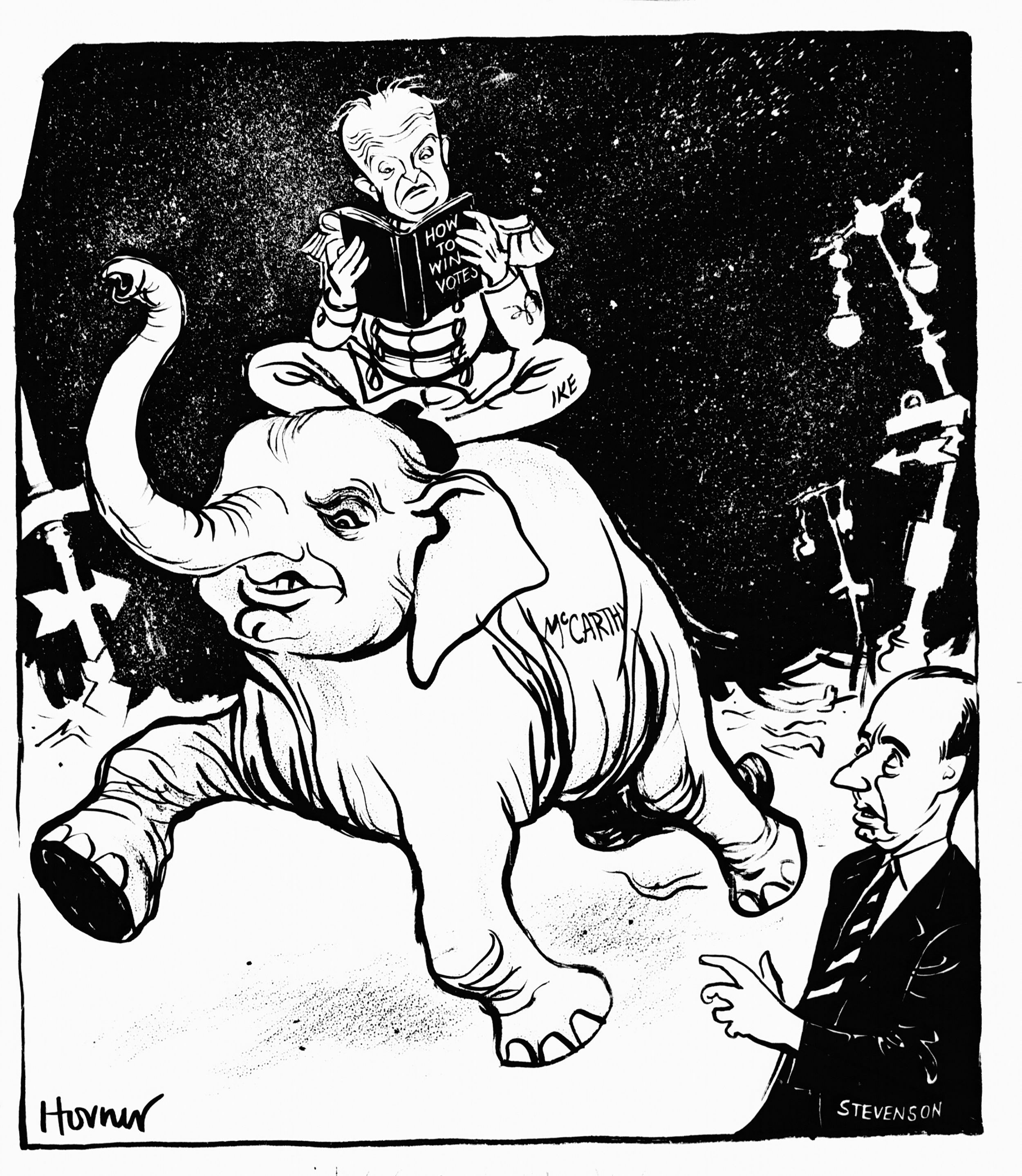
Rogue elephant.
The heedless violence suggested by the cartoon was about to break upon the world. American-induced regime-change in Guatemala over ten days in June 1954 was conducted covertly to uphold the public sanctity of American virtue, but the unfortunate consequences on local Guatemalans would last for three decades in the form of civil war. As for America's assumption of the conflict in Indochina following the French defeat at Dien Bien Phu that spring, the rest of the world watched aghast as the American initiative to prop up South Vietnam resulted in violent turmoil for the next twenty years.
Columbia University's bicentennial celebrations
The year 1954 was undeniably a fateful one for world politics, and it coincided with the Columbia University Bicentennial celebrations. In the city of New York, the university hosted a year-long celebration to mark the milestone of 200 years since its founding in 1754. The theme of the Bicentennial, “Man's Right to Knowledge and its Free Use Thereof,” was intended to attract foreign scholars and political dignitaries to the city, where the intellectual riches of American education would be showcased through a series of carefully curated workshops, lectures, academic conferences, panel exhibitions, musical concerts, theatre performances, television programs, radio broadcasts, and convocation ceremonies. Years in the making, and orchestrated in the charged atmosphere of the Cold War, the Bicentennial was meant to demonstrate the advantages of the American way of life to the rest of the world, a sort of public relations exercise that received the approval of Congress.
In the Morningside Heights neighbourhood of Manhattan stands the Cathedral Church of St. John the Divine. Its construction began in the 1890s, just as Americans were becoming comfortable with grandiose visions of their country in world affairs, so it seems fitting that this religious site became a meeting ground for those seeking respite, not only from daily tribulations, but from an increasingly turbulent and encroaching world. On 31 October 1954, in front of 8,000 guests and esteemed political dignitaries, Brebner seized his moment to speak, delivering a firm reprimand of the anti-communist repression that had beleaguered his countrymen. Brebner encouraged his audience to revisit the phrase, “I could be wrong,” and to use it more frequently “to make it a still commoner saying.” During recent years, a hurricane of investigations and persecutions has lashed those parts of the earth where men in political authority have conceived themselves to be compelled to maintain one set of values and to attack all others. Throughout these operations, nothing has been more dreadful than the common assumption that every man must at all times be ‘right.’ Surely this intolerance of variation is hubris—the insolent vainglory and self-assurance that the Greeks denominated the basic, the suicidal, sin. In our time this sin may take the form of worshipping the power over nature or over human nature, or the deification of a man, an economic entity, a political party or a nation state.
Turning to the field of nuclear fission and fusion—an area that was all the more alarming as the Americans produced the hydrogen bomb in 1952, shortly before the Soviets did in 1953—Brebner contended that “our circumstances appear to favor pride, to encourage the growth of that arrogance.” The knowledge in this field represented a symbol of power “whose use depends on human vacillations between pride and humility.” Oppenheimer, the former director of the Los Alamos laboratory, was sitting in the audience, his first public appearance since having been stripped of his security clearance by the Atomic Energy Commission (AEC) at the end of 1953 over his alleged contributions to communist causes, particularly his brother's and wife's membership in the Communist Party as far back as the 1930s. Oppenheimer faced a shocking charge that he had tried to stop or delay the development of the hydrogen bomb by opposing the project and persuading other leading scientists not to work on it. 36 Brebner reminded the audience that mankind has “for thousands of years, somehow barely escaped destruction from the evil in his nature,” and that humility has enabled mankind to survive, by recognizing the limits of his powers and the wisdom in using them. The historian's plea to champion humility over pride was timely. A friend of Brebner's from the Department of Chemistry at the University of Toronto wrote to him afterwards with the “heartiest congrats” for his “magnificent effort”: “It was a great job—not a cliché in it from end to end—something that needed badly to be said in just the way you said it.” 37
After the speech, Brebner returned to the University of Cambridge, where he was serving as the visiting Pitt Professor of American History between 1954 and 1955. The New York Times reprinted his speech in its entirety, and Brebner's influential friend at CBS, Edward Murrow, gave it generous airtime on the radio. Brebner received accolades from colleagues and friends; for instance, Jacques Barzun, his Columbia colleague who helped pioneer the genre of cultural history, wrote to him, saying, “[W]hat an exquisite speech you made at St John's,” and praising his wisdom. 38 Barzun would go on to write an overview of Western cultural history spanning centuries, observing that the achievement of initiating conversation and making “two thoughts grow where only one grew before” is one of the most esteemed roles of a critic. 39 In this role, Brebner earned his praise.
Seventy years later: paying homage to the past?
After Brebner's oration, the university's Glee Club launched into a rendition of “Let Us Now Praise Famous Men,” and a procession of honorary degrees was conferred. Among the dozens awarded were honorary doctor of laws degrees presented to Queen Elizabeth the Queen Mother; David Rockefeller, director of the Council on Foreign Relations; Adlai E. Stevenson, former presidential candidate; Dag Hammarskjöld, the UN secretary-general; Paul-Henri Spaak, Belgian foreign minister; and West German chancellor Konrad Adenauer. Already endowed with positions of considerable influence, these transatlantic political figures were ceremoniously entrusted with shaping the postwar world. The possibility of a “thaw” was symbolically displayed at the ceremony in the Cathedral of St. John the Divine, as two Soviet scholars were also in attendance: the historian Boris Rybakov and the biochemist Andrey Kursanov. The following year, in the spirit of reciprocity, Brebner was one of two delegates from Columbia University to formally attend Moscow State University in celebration of its bicentennial anniversary.
Seventy years on, the legacy of the stronghandedness of the 1950s and the earnest visionaries of the transatlantic alliance weighs heavily upon this generation. Transatlantic efforts to resist Russia's full-scale invasion of Ukraine since February 2022 have been inconclusive. Iran's fundamentalism continues to deter Western advances from exploiting its resources, and its retaliatory missile strikes against Israel in April 2024 were a reminder to Western leaders that provocations will not go unanswered. In an unprecedented joint public paper and televised appearance in September 2024, CIA director William Burns and Sir Richard Moore, chief of Britain's Secret Intelligence Service, declared that “the international world order … is under threat in a way we haven’t seen since the Cold War.” One may easily despair over the unravelling “order” in world affairs; however, hope should be allowed to prevail. For if we look back to Brebner's observations, pursue knowledge, and adopt a posture of humility, we may recognize the reward in finding “man's best common ground.”
Footnotes
Declaration of conflicting interests
The author declared no potential conflicts of interest with respect to the research, authorship, and/or publication of this article.
Funding
The author received no financial support for the research, authorship, and/or publication of this article.
