



Abstract
Does personal contact between allied service members and local citizens result in greater public acceptance of foreign military presence? To what extent do members of the host nation's domestic society assess favorably the forward deployment of allied military personnel on their own national territory? Substantial scholarly literature has probed these types of questions in the context of US globe-spanning military deployments. This study, however, departs from the US-centric approach and focuses on the deployment of a middle power. In the presented analysis, we examine the Canadian approach to “winning hearts and minds” in Latvia. In 2023, upwards of 800 Canadian troops were stationed in Latvia. Using original survey data, we measure local citizens' attitudes towards the Canadian-led battlegroup. Our results speak to the fact that Canadian and other foreign armed forces' presence in Latvia is generally accepted by the wider society. Despite Moscow's active attempts to cultivate anti-NATO sentiments, the Latvian public welcomes the stationing of Canadian troops on the country's soil.
Introduction
To what extent does a host nation's domestic society favour the deployment of allied military personnel on their national territory? Does personal contact between allied service members and local citizens result in greater public acceptance of a foreign military's presence? Substantial scholarly literature has probed these types of questions in the context of US military deployments. This study, however, departs from the US-centric approach and focuses on the deployment of a middle power: Canada. In this analysis, we examine the Canadian approach to “winning hearts and minds” in Latvia. Using original survey data, we measure local citizens’ attitudes towards the Canadian-led battle group in Latvia. The decision to form this military mission was reached at NATO's Warsaw Summit in 2016. As part of NATO's designed enhanced Forward Presence (eFP) model, Canada assumed the status of lead framework nation. Since 2017, more than eight hundred Canadian troops, together with other NATO armed forces, have been stationed at Camp Adazi, just outside the nation's capital, Riga. Similar eFP formations in Estonia, Lithuania, and Poland are led by the UK, Germany, and the US respectively.
For both Ottawa and Riga, this mission is a significant undertaking. As underscored by the Kevin Rex, Canadian ambassador to the Baltic states from 2018-2022, due to the deployed armed forces, Latvia has become home to the single largest Canadian presence anywhere in the world. The footprint here, he adds, is “larger than our presence in Brussels, Paris, Tokyo, or Beijing.” 1 According to Christian Leuprecht et al., while in terms of total troop numbers the presence in Latvia “may not be comparable to Canada's Cold War deployment to Germany, on a per-capita basis, Canada's commitment to Latvia actually surpasses the proportion of Canadian troops stationed in Europe during the Cold War.” 2 With approximately 130 family members of the mission residing in Latvia, Canadian kids are now the most commonly represented nationality in the international school of Latvia. 3 Against this backdrop, Ambassador Rex noted: “We have become part of the community in a way that is unprecedented since the independence of Latvia.” 4
The Latvian political elites have welcomed the presence of the Canadian-led battle group. After all, Latvia, similarly to the other two Baltic countries, is heavily reliant on allies for territorial defence. Lawmakers have traditionally viewed NATO involvement in the region as the best insurance against external aggression. 5 For this reason, it should not come as a surprise that Riga has been keen on strengthening ties with Ottawa. Latvia's prime minister, for instance, has hailed the Canadian footprint in the region as “extremely valuable.” 6 It is safe to say that the Latvian government desires more, not fewer, Canadian soldiers in the country. The eFP mission has opened up various avenues of cooperation between the two countries in areas such as culture, trade, and education. Canadian and Latvian politicians have regularly spoken about a host of unexpected benefits and positive “spillover effects” stemming from the Canadians’ presence in Latvia.
Still, just because the Latvian political classes have welcomed the Canadian troops does not guarantee that the same sentiments have filtered through the whole society. Scholarly literature suggests that troops’ local interactions can significantly shape how the wider society perceives them. Regarding the presence of foreign troops, it is not uncommon to have significant differentiation between governmental attitudes and perceptions of local citizens. Various social and ethnic groups within the state may view the presence of foreign military personnel in different lights. As Kent Calder observes in his work, for the host nation populace, foreign bases and military personnel can “present inconvenience, civic nuisance, and occasionally danger,” and for that reason, they “are almost invariably unpopular at the grassroots level.” 7 Underneath high-level alliance politics, host communities have oftentimes pushed back against what they perceive to be unwanted intrusions in their daily lives. 8
Moreover, Latvia has a sizeable Russian-speaking minority, which traditionally has espoused a more critical view towards NATO and its presence in the country. As argued by Juris Pupcenoks et al., in ethnically diverse states like Latvia, threat perceptions at the societal level can be at odds with attitudes at the state level. 9 Moreover, when it comes to the Canadian-led eFP battle group, Russian-linked sources have made active attempts to “muddy the waters” by spreading false narratives. Such activities, specifically aimed at Russian speakers in Latvia, have sought to undermine the local public's trust in the Canadian deployment and NATO as a whole. Put differently, while at the political elites’ level the presence of Canadian armed forces is undoubtedly highly appreciated, the same cannot be automatically assumed for local host communities.
In this paper, we examine the Canadian-led battle group, its interactions vis-à-vis the host nation public, and the attitudes that this has generated. Why did we select this particular case study? To begin with, the Canadian presence in Latvia is curious, as Canada is by no means a “natural” ally of the Baltic Sea region. While the other two lead framework nations in the Baltics, the UK and Germany, are situated in the broader neighbourhood and have long-established relationships with their hosts, Canada, located oceans away, can be considered a newcomer to the region. As Alexander Lanoszka observes: “Canada does stick out among the four Framework Nations in the Alliance's eFP as having the least obvious interests in improving northeastern European security.” 10 Moreover, due to the presence of a sizable Russian-speaking minority, Latvia as a state receiving foreign troops is in itself a curious object of analysis. The share of Russian speakers in Latvia is “approximately 37 percent, compared to 27 percent in Estonia and 7 percent in Lithuania.” 11 In sum, the case study enables us to explore military-civilian dynamics in an empirical context that has not yet been widely examined.
The paper proceeds as follows. We first survey the broader literature concerning foreign troop deployments and their often-fraught relations with citizens of the host country. In doing so, we identify an understudied dimension in the scholarship, namely the lack of case studies outside the US context. To address this shortcoming, we evaluate the relations of Canadian troops with their hosts. The empirical analysis then details the approach that Ottawa has assumed to “win over” the Latvian population. As such, it sheds light on the Canadian public diplomacy campaign, aimed at engaging the local civilian population. Moreover, the analysis also discusses active Russian attempts to put the mission in a negative light as well as Canadian efforts to counter such narratives. To test the success or failure of Canada's approach, we then introduce our original survey data that reveal local citizens’ attitudes towards Canadian and foreign military personnel presence in the country. With the help of a nationally representative polling survey involving 1,002 respondents, we seek to provide a granular assessment of how the Canadian-led battle group has registered with the citizens of the host nation. In the end, we chart avenues for further research and briefly discuss possible future trajectories and challenges of the eFP deployment in Latvia.
Foreign troop deployments and host nation public attitudes
Foreign military bases and troops that accompany them have attracted considerable scholarly interest. The bulk of this literature concerns the US presence around the world. This is hardly surprising given that Washington operates a network of some eight hundred foreign military outposts in different corners of the globe. In this context, scholars have examined how US's overseas military presence has interacted with foreign investment, trade, crime, labour rights, and the environment, to name just a few examples. 12 Forward-based deployments can vary sharply in terms of their size and scope. They can appear in the form of “Little Americas,” such as the bases in Germany and Japan, where thousands of US troops and their family members reside in sprawling garrisons that closely resemble American towns. On the other side of this spectrum, one can find a few dozen US troops guarding military installations in remote locations. 13
A prominent sub-section of this field deals with anti-base movements against the presence of foreign troops that have sprung up in different countries. 14 Historically, foreign-based militaries have had fraught relationships with their hosts. Even populations that are heavily dependent on the protection of outside parties can develop strong resentments towards the presence of foreign soldiers on their soil. Apart from fostering feelings of imposition on national sovereignty, a foreign military's presence can inflict upon local citizens all kinds of day-to-day problems such as military-related accidents, environmental degradation, and traffic jams. A foreign military presence, irrespective of its size, can “harm local communities in ways that locals do not easily forget.” 15
Research suggests that high-profile accidents can shift public opinion about the presence of foreign troops in a short period. As Calder notes: “Catalytic incidents, such as crimes and accidents, transform base politics from a matter of shadowy behind-the-scenes deal making into matters of public interest.” 16 It is important to note that different layers of the host nation society can experience a troop presence in markedly different ways. Discussing US military deployments, Alexander Cooley makes an insightful observation: “For some a basing agreement with the United States is a guarantee of security and alliance, whereas for others it may be a political endorsement of the ruling regime or a lucrative economic opportunity. Some politicians regard an American base as a symbol of violated national sovereignty, US imperialism, and political struggle, whereas others aren’t particularly bothered by its presence or regard it as a routine matter for technocrats to manage.” 17 Some of the research concerning US military deployments have suggested that minority communities of host nations can be less favourably disposed toward such armed presence. 18
Foreign armed forces can be deeply enmeshed in the wider society of the host nation, or their presence can be purposefully segregated and shrouded in secrecy so as not to inflame tensions with locals. In Turkey, for instance, the US government at one point attempted to camouflage its military presence by allowing its military personnel to wear civilian clothing rather than their uniforms. 19 At times, it is the host nation's government that is not keen to see its population directly engage with foreign soldiers. In the 1960s, the Icelandic government, unwilling to see relations between Icelandic women and US service members, imposed harsh measures on off-base movements of US troops. 20
When it comes to host nation public attitudes, scholars have theorized conditions under which citizens are more likely to view foreign militaries in a favourable or unfavourable light. In his work, Calder argues that the spatial distribution of bases within the host country has a profound effect on public attitudes toward foreign troops. He proposed a “contact hypothesis” in which he maintained that “base-community conflict is a function of how frequently and intensely base inhabitants and the general host-nation community interact.” 21 He rationalized that friction is more likely to occur if members of US bases have more contact with local citizens. The guiding assumption behind this hypothesis was that “American soldiers tend to be young, active, and often culturally insensitive, making it likely that personal contact with local citizenry will lead to conflict.” 22 While acknowledging that manifold factors can shape host country sentiment towards foreign military personnel, nonetheless he found support for the contention that “substantial base presence in or near heavily populated areas” is more likely to result in negative attitudes towards the troops. Other studies have similarly argued that more frequent foreign troop-civilian contact “is more conducive to tensions.” 23
Recent scholarship, however, has challenged this military-civilian contact hypothesis. In a major work involving fourteen countries, Michael A. Allen et al. analyzed how social and economic interactions with US military personnel shaped the host country publics’ views regarding American presence in their country. Their findings indicate that “contact with US military personnel or the receipt of economic benefits from the US presence” correlated with stronger local support for the US presence in the country. 24 “Increased contact between deployed military personnel and host-state civilians has a net-positive effect on host-state civilian perceptions of the US and US actors,” the authors concluded. They described such everyday encounters between the two sides as opportunities to build “bridges and bonds,” dynamics that supposedly work towards breaking down stereotypes and negative attitudes. 25 While clearly not every individual level encounter produces positive sentiments, on the whole, greater personal contact with US military is expected to generate more welcoming attitudes.
To enrich the study of foreign-based troops and host nation public attitudes, this paper moves away from the US-centric lens. Canada's military presence in Latvia offers an ideal case study for comparing how the previously depicted military-civilian dynamics play out in an entirely different setting. To the best of our knowledge, only one poll so far has specifically touched upon the Canadian presence in Latvia. In 2016, Latvian residents were asked their opinion about the pending deployment of the Canadian Armed Forces to their country. In the poll, 43 percent of respondents said they approved of the forthcoming deployment, 30 percent stated that they remained neutral on the matter, and 17 percent expressed a critical view of it. 26 While useful, this poll captured attitudes towards the Canadian military while no troops were actually deployed in Latvia. Five years have passed since then. Deployed military personnel and local citizens have had sufficient time to cross paths in their daily activities, allowing us to make a more empirically sound appraisal of the interactions and perceptions of local citizens toward their “armed guests.”
The Canadian approach to winning hearts and minds
This section scrutinizes the approach Canada has taken regarding its engagement with the host nation. From the first days of deployment, Canadian diplomatic and military personnel have undertaken active outreach at a local level. When it comes to the previously discussed contact hypothesis, Canada has followed the logic that a public presence and close people-to-people interaction will lead to more positive societal attitudes towards the eFP military deployment. Speaking in 2018 before NATO's Defence and Security Committee, Canada's commander of the battle group emphasized that an important dimension of the mission was to gain the trust of Latvia's ordinary citizens and keep intact the reputation of the eFP. 27 To that end, Canadian representatives have proactively strived to increase the public's awareness of their multinational battle group. From playing friendly hockey matches and cleaning up litter in cities to visiting schools and universities, public appearances of Canadian personnel have been a regular feature across Latvia. 28
On the outreach front, the Canadian embassy in Latvia has led the way. It has implemented a special programme entitled “12 in 12,” in which Canadian representatives committed to visiting twelve different places in Latvia in twelve months. “Such trips would include our personnel and vehicles. We would do political and cultural outreach, receptions, public lunches, vehicle displays, and business meetings,” as former Canadian ambassador Rex explained the programme. 29 In his view, involvements of this nature have worked towards demystifying Canada as a country and its military presence in Latvia. In particular, the embassy has endeavoured to reach places outside the capital of Riga and engage Russian speakers about the Canadian and allied mission in Latvia. 30 Such community outreach events have been widely shared via Canadian, Latvian, and NATO social media sites. Indeed, regarding media exposure, officials have sought to maintain high visibility regarding the eFP forces and their daily routine. 31 Further, stationed allied military personnel are encouraged to leave the military base in Adazi and explore the host nation on an individual basis. According to Jesse van Eijk, head of the eFP battle group, broader engagement with the host nation is very much encouraged. “We are not only here to be a small NATO element that is sitting in the base and training,” he explained, adding, “Soldiers have free time to integrate into Adazi and even Riga. We go out there, we go to restaurants, concerts, participate in sports.” 32
The host nation's government appears to be fully on board with this approach. Discussing the eFP mission, the Latvian minister of defence underlined: What our international troops are doing is a great thing because they are diplomats. They are in perfect contact with our societies. They are assisting in different social events and they are greeted by our communities. There is a nice interaction. We have to popularize that.
33
Importantly, the Canadian-led battalion has managed to steer clear of public incidents, which cannot be said about the other two eFP deployments in the Baltics. Estonian media, for instance, has reported on violent brawls involving British troops based in Tapa, a town hosting the NATO military base. Incidents have included some disorderly drunk behaviour and fights between off-duty British soldiers and local residents. 35 In another instance, French soldiers, who are also part of the UK-led battle group in Estonia, allegedly displayed drunk and inappropriate behaviour on a train bound to Tapa. 36 As a lead framework nation in Lithuania, Germany has also not managed to escape bad publicity. In 2021, a tank platoon was recalled by the German Federal Ministry of Defence due to allegations of sexual assault involving a fellow soldier, as well as incidents of racist and anti-Semitic remarks. 37 Weighing in on the misconduct within the armed forces stationed in Lithuania, Germany's then defence minister, Annegret Kramp-Karrenbauer, tweeted that such occurrences risked damaging the country's good reputation. 38 In comparison to their equivalents in Estonia and Lithuania, the Canadian-led battle group has avoided such public military-civilian altercations. As Toms Rostoks, a Latvian scholar, points out, since 2017 the Latvia-based battle group has been spared of negative publicity as “there have been no major incidents involving troops from the represented nations.” 39 In 2018, Canada's commander of the mission warned that “major crimes” and “unprofessional behaviour” by armed forces could be one of the paths leading to mission failure. 40 More than five years since it was first put in place, the Canadian-led battalion has so far managed to steer clear of noteworthy public incidents.
Countering Russian disinformation efforts
When it comes to the Canadian and allied military presence in Latvia, an external actor, namely Russia, has sought to insert itself into the battle of narratives. Shortly after their deployment to Latvia, Canadian Armed Forces faced a torrent of state-funded Russian media attempts to discredit and distort their presence in the country. That said, Canadian personnel appear to have anticipated such malicious disinformation attempts. As put by then chief of defence staff Gen. Jonathan Vance, Canadian authorities knew that there would be concerted efforts “to make it appear that Latvia doesn’t want us there.” 41 In this respect, Canada's mission in Latvia stands out amongst other eFP framework nations in that it has set up a special task force headquarter in Riga. While all eFP battle groups are rotational in nature, Task Force Latvia was put in place as a permanent liaison, thus assuring continuity of communications. Alexander Lanoszka, who has written extensively on this topic, argues that this innovative task force has not yet received the appreciation it deserves both in NATO and Canadian military circles. 42 Within this task force, Canada has established a special strategic communications cell to better track, comprehend, and counter the threat posed by hostile narratives from Russia. For the Canadian Armed Forces, this was “the first operational StratCom capability” ever fielded. 43 Such efforts speak to the fact that Canadians have taken seriously the task of winning “hearts and minds” in Latvia.
The key objective of Russian government-linked media has been to foster anti-allied sentiment and drive a wedge between deployed military personnel and the host population. Hostile narratives from pro-Kremlin sources have claimed that Canadians are being accommodated in luxury apartments at Latvian taxpayer expense and that its military personnel walk around the city space with their guns loaded, thus posing a grave risk to the local civilian population. 44 Moreover, Russian-controlled media have mocked the Canadian-led mission as “comical” and militarily weak. 45 As observed by Stéfanie von Hlatky, who conducted research fieldwork in Latvia, a key angle pushed by the Russian sources has been to “undermine the masculinity of the Canadian Armed Forces.” 46
While after the initial wave of Russian-sponsored narratives in 2017 such attempts had somewhat subsided, they regained momentum in 2020 when the Canadian-led battle group in Latvia became a target of a COVID-related disinformation campaign. According to the Canadian representatives, stories that had originated in Moscow claimed that allied military personnel in Camp Adazi had experienced an unusually high number of cases of the virus, a claim that was completely dismissed by the eFP leadership. 47 Here, it is worth noting that as a target, the Canadian-led battle group has not been an exception, as other NATO deployments in Estonia, Lithuania, and Poland have come under equally intensive Kremlin-linked disinformation campaigns. 48 Such attempts have tried to weaken the public's support of allied presence in their territory. In summarizing Russian endeavours to paint the deployment in a negative light, the Latvian ambassador to Canada remarked: “The Kremlin will ensure that the state-sponsored media conveys the sense that Canadians and Canada are getting involved and entangled in the wrong place at the wrong time, and that it would be better if they concentrated on hockey.” 49 It is also worth noting that the Russian disinformation campaigns have been geared particularly towards the Russian-speaking minority in Latvia. 50
Results of a public opinion survey in Latvia
The previous sections have detailed Canada's approach vis-à-vis the host nation. The presented material suggests that Canadian diplomatic and military personnel have undertaken a proactive stance by engaging various segments of Latvian society. Equally, Canadians have stayed vigilant in the informational space, tracking and countering the tide of Russian misinformation. The following survey results allow us to gauge just how successful the Canadian approach to winning “hearts and minds” in Latvia has been. To that end, we designed an original face-to-face omnibus survey in Latvia that was carried out in the first half of December 2022. 51 The multi-stage stratified random sample included 1,002 respondents who were interviewed at their homes in all regions of Latvia. One third of the respondents were from the Latvian capital Riga, a region where the Adazi international military base is located.
We first assess the extent to which foreign troops deployed in Latvia have encountered members of the Latvian population. In the survey, we asked whether in their daily activities, Latvian residents have personally encountered NATO allied troops and, if so, whether they had a positive, neutral, or negative view of the troops. Note that we did not ask about the Canadian troops but NATO troops more generally to make it easier to respond, as not all civilians might be able to tell the difference between multilateral troops. Indeed, during some of the public outreach events, Canadians are joined by personnel from other deployed eFP countries. According to Canadian diplomatic representatives, it is even preferable that a diverse group of eFP country representatives appear in the public together. 52 That said, due to the fact that Canadians represent the largest share of the multinational troop deployment, it is safe to say that our poll, at least in part, reflects local attitudes towards Canadians and their leadership abilities in the country.
Our results are summarized in Graph 1. Of all respondents, 24 percent had an encounter with NATO troops in their daily activities. If we were to look at the region of Riga only, this percentage would be somewhat higher at 34 percent. Three percent were in the residual category (i.e., found it hard to tell). This means that a large majority, almost three quarters of the population, had no contact that they were aware of. While this number seems large, we must keep in mind that the number of NATO eFP troops that are present in Latvia at any given time is only around 1,700. Of the 24 percent of the total sample who encountered NATO troop members in their day-to-day activities, more than half were left with a positive view (133 out of 239 respondents), about one fourth with a neutral view (64), and 15 percent (42) expressed a negative view.
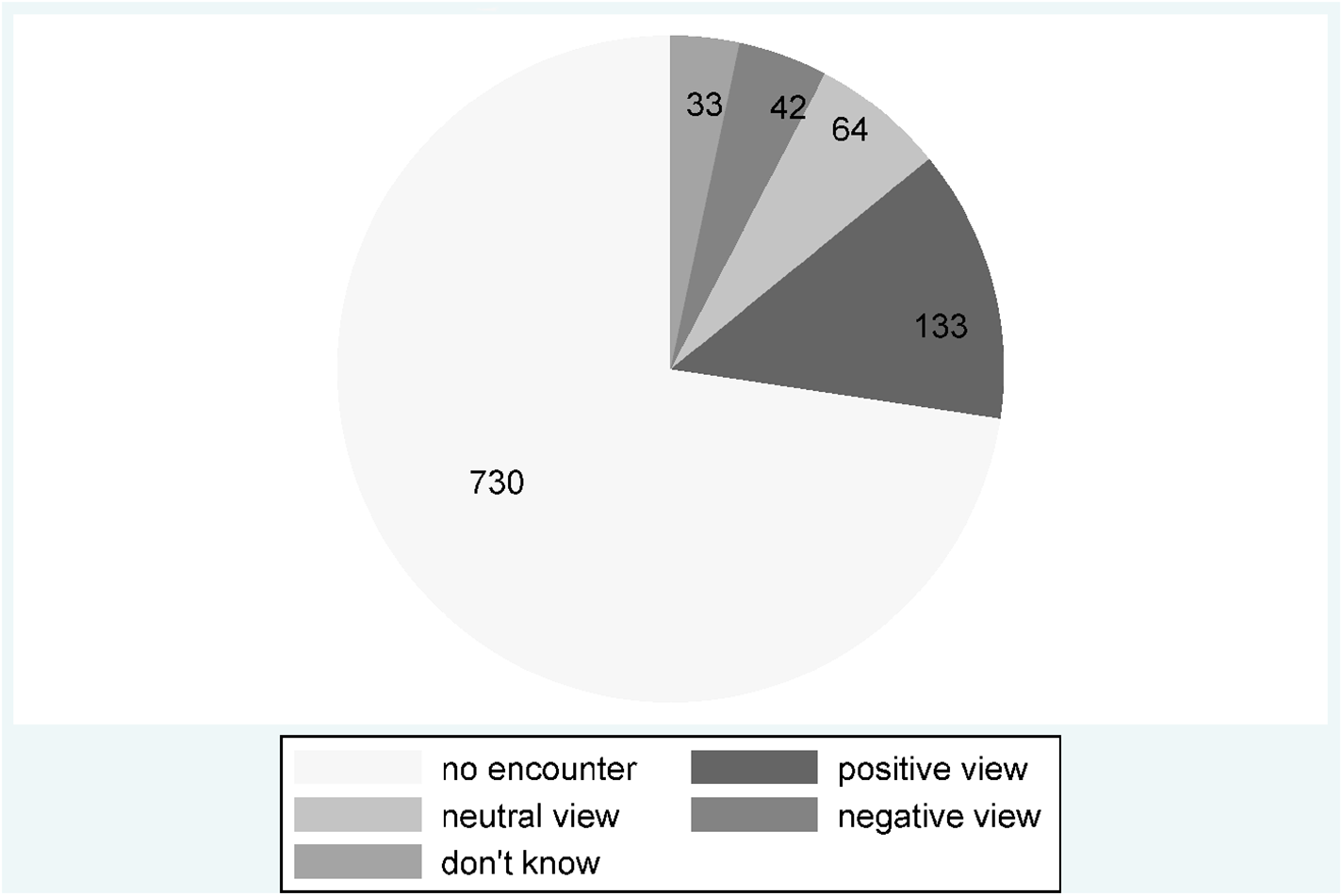
Encounter and view of NATO troops. Note: This graph represents responses to the question: “In your daily activities, have you personally encountered the presence of NATO allied troops in Latvia? If yes, what is your view of them?”
Whether the respondent encountered a NATO troop member also matters in how they think about the troops’ social integration. When asked whether it is important for NATO allied troops in Latvia to be integrated into the nation's social life and not restricted to the military barracks, most respondents agreed or strongly agreed, a total of 46.5 percent. There is, however, a difference when we split the sample according to whether the respondents had an encounter (see Graph 2). On both sides of the graph, we have roughly a normal distribution, but support for more integration is more pronounced when the respondent had an encounter before: altogether, 55 percent of respondents who encountered troops either strongly or rather agreed, versus 44 percent who had not come into contact with military personnel. The difference is even more striking for the share who disagreed with more troop integration into social life: 14 percent of those with contact, versus 27 percent of those who observed no contact, either strongly disagreed or rather disagreed that more integration into social life is important. 53 These findings, though limited, support the argument found in the scholarly literature that personal encounters correlate with stronger support for the presence of foreign troops in the country. 54
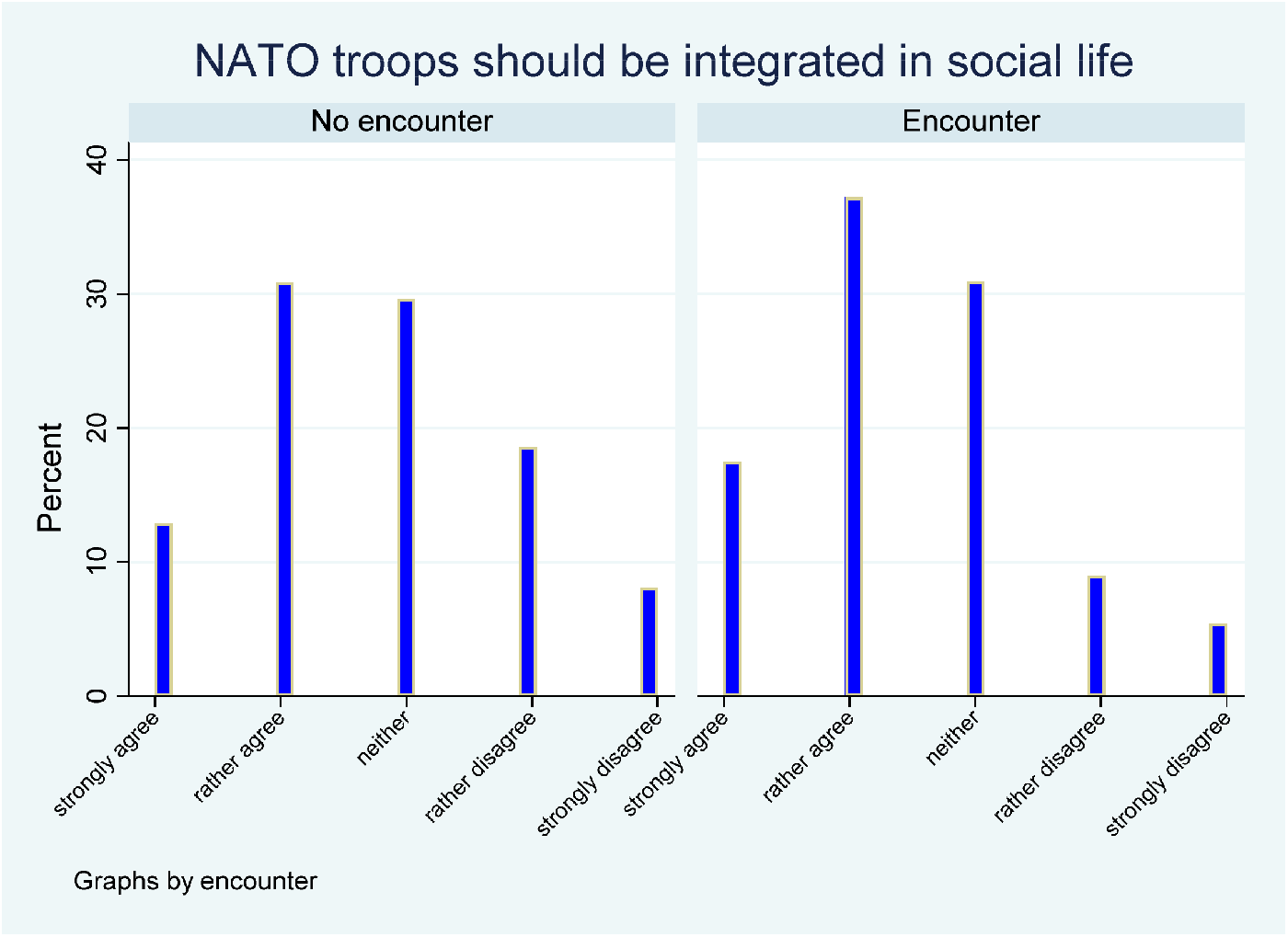
Desirability of social integration depending on troop encounter. Note: Participants responded to the following statement: “It is important for NATO allied troops in Latvia to be integrated into nation's social life and not be restricted to barracks.”
Furthermore, as we were interested in how the Canadian troops in particular are perceived, we also asked which words best describe the Canadian troop presence currently stationed in Latvia. Multiple answers to the question were possible. As evident in Graph 3, Canadian troops are mostly described as “professional” and “friendly.” Few respondents considered them to be “hostile” or “untrustworthy.” Many respondents opted for the residual answer categories: “none of the options provided” or “hard to tell.” If we were to divide the graph based on whether the respondent identified themselves as Latvian or Russian speakers, the overall pattern would look about the same; however, the positive description of the Canadians is much more distinct among the Latvian speakers as opposed to the Russian speakers. In both samples the percentage of respondents who consider the Canadian troops as “hostile” or “not to be trusted” is relatively small. 55 The Latvian-speaking group displays a pattern very similar to Graph 3. The Russian ethnic sample is different insofar as there is a greater share of respondents who find it “hard to tell” (34 percent as opposed to the Latvian sample of 22 percent) and fewer respondents who describe the Canadians as “professional.” Still, 31.7 percent of Russian-speaking respondents describe the Canadian troops as “professional” and 11.8 percent as “friendly” (compared to 54.8 percent and 24.7 percent among the Latvian speakers). Altogether, Canadians are mostly described in positive terms.
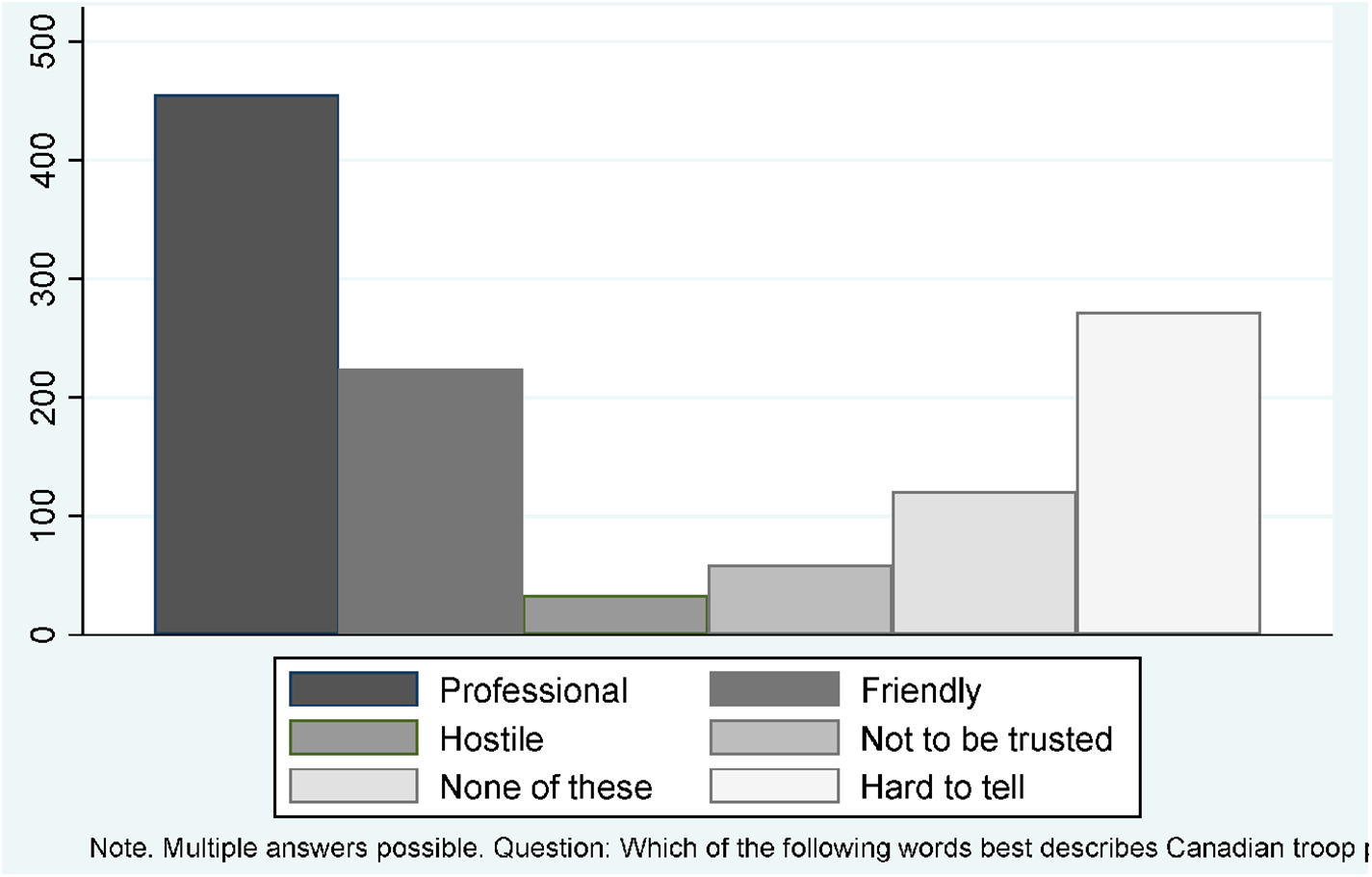
Description of Canadian troop presence. Note: Multiple answers were possible in the following question: “Which of the following words best describes Canadian troop presence currently stationed in Latvia?”
Finally, in Graph 4 we strived to evaluate to what extent the presence of Canadian troops in the country increases the sense of security among the respondents. Specifically, when asked which nation or nations’ military presence makes one feel more secure, we can observe very different patterns among Latvian and Russian speakers. 56 By far, most Latvian-speaking respondents (42 percent) chose the presence of multinational NATO forces. US troops fared strongest, with 18 percent of respondents preferring their presence, followed by the Canadians with 10 percent of responses, and the German troops with 3 percent. 57 It is important to note here, however, that even the Canadian leadership readily admits that its military presence is no substitute for the heavy lifting that the US does in the Baltic region. “No one should ever compare their military to the one of the US, there is no point quite frankly,” the former Canadian ambassador to Latvia noted in an interview. 58 The Canadian mission has not attempted to become the functional equivalent of the American forces in the region. In sum, it is clear that Latvian speakers feel safest with the presence of multilateral troops. Only 6 percent of respondents would feel safest if no military were present in the country. About one fifth of the respondents found this question hard to answer. 59
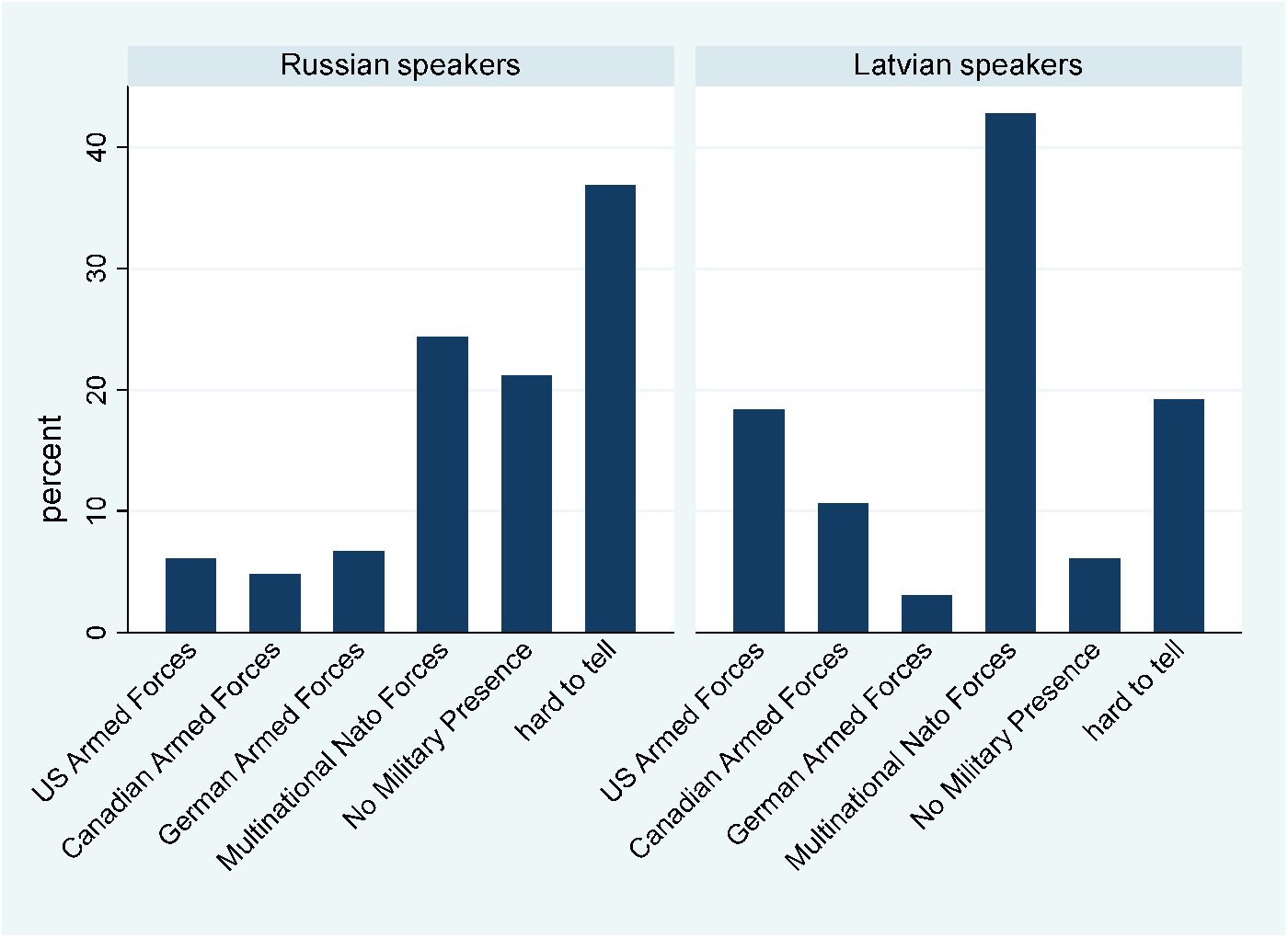
Feeling of security depending on ethnicity. Note: Respondents were asked: “Which type of military presence in the country would make you feel more secure?”
The picture, however, is quite different among Russian speakers in Latvia. Most respondents find it “hard to tell” (36.8 percent). One fourth of the Russian-speaking respondents (24 percent) also feel safest with the presence of multinational NATO troops, in addition to the approximately 17 percent that opted for either a US, Canadian, or German presence, which taken together comprises a sizeable portion of Russian speakers who are not susceptible to the Kremlin narrative. Respondents are least likely to associate the presence of Canadian troops with a sense of security (with the US receiving 6.1 percent of responses, Germany 6.7 percent, and Canada 4.8 percent). On the other hand, about 21 percent of Russian speakers in Latvia would prefer to have no military presence. While this number appears noteworthy, it generally matches the broader body of scholarship that has identified differences between Latvian- and Russian-speaking communities and their views concerning foreign and security policy. Russian-speaking respondents in Latvia hold more negative views towards Western-based institutions such as NATO and their presence in the country. As a practical matter, this finding also suggests that Canadian representatives, to increase overall support for their presence in Latvia, should first and foremost concentrate their efforts on Russian-speaking communities.
In sum, our polling survey lends credence to the notion that Canada, as a lead framework nation, has been quite successful in its public diplomacy campaign to win over the local population. Most Latvian residents approve of the NATO allied troop presence in the country and are open to their further integration into society. Canadian military personnel are overwhelmingly assessed as professional and friendly. The polled residents prefer to see the presence of multinational troops in the country. On balance, it must be noted that in our analysis we detected some differences in attitude among the Russian speakers, who show less enthusiasm for any type of NATO allied presence in the country. This finding, however, should not be conflated with the expectation that the eFP battle group is likely to be engulfed in organized protests. As argued by Alexander Lanoszka and Michael Hunzeker, while in countries such as Latvia there are differences of perception concerning troop deployments among certain segments of the society, “no local riots and agitation in the Baltic region have broken out that could have ensnared local NATO forces.” 60 Rather, our findings suggest that Canadian representatives may have to continue to actively reach out to the ethnic Russian community.
The eFP battle group and future research agenda
With the launch of Russia's war in Ukraine in February 2022, Canada announced the renewal of its military presence in Latvia a year ahead of schedule. During NATO's 2023 summit in Vilnius, Ottawa further declared its plans to more than double the number of Canadian troops in Latvia, thus having eventually “up to 2,200 persistently deployed Canadian Armed Forces members” in the country. 61 In this context, the Latvian government has already set its sights on building two new military bases to accommodate greater inflow of foreign troops. Here, it is worth noting that in 2017, when Canadian forces were first deployed to Latvia, they were placed in an already established military base in Adazi. Put differently, the initial arrival of Canadian soldiers did not significantly alter the local surroundings. In comparison, these two new bases will be built from the ground up, thus potentially interfering with the local population on a significantly greater scale.
The Latvian Ministry of Defence has already made some promises vis-à-vis these intended military outposts. Officials have argued that the foreign troop presence will boost regional growth, trigger greater job creation locally, and increase surrounding real estate values. The ministry has vowed to accomplish this with as little disturbance for the local community as possible. 62 However, during the public meeting between the ministry representatives and local residents, the latter raised numerous concerns regarding the foreign troop presence. 63 Once these new military bases are completed and multinational troops transferred, it may be useful to re-run population surveys in order to gauge the extent to which the locals have accepted allied presence, and also to assess more thoroughly the type and intensity of encounters. While the presented material has painted an overwhelmingly positive picture of allied personnel and its engagement with the wider Latvian society, the challenge for the Canadian military will be to sustain that positive interaction in an entirely different regional setting.
Moreover, when it comes to future research agendas, a more comparative approach among the eFP battle groups may also yield some useful findings. Notwithstanding some incidents involving the British military personnel, the UK leadership likewise has sought to actively promote local engagement opportunities with regular visits to schools and English-language lessons in universities. 64 As the commander of the British-led eFP, Col. Giles Harris, put it: “We are engaged in an essentially human business…. We are here to become part of the fabric of the defence of this country, and you can’t do that without getting to know the people. 65 Now that the eFP battalions have been further implemented on NATO's southern flank, it would also be worth looking into to what extent other nations have taken over and replicated the “Canadian playbook” regarding public outreach. Future researchers may want to probe these dimensions in greater detail.
Conclusion
Since 2017, Latvia has witnessed an unprecedented influx of Canadian and other foreign military troops on its soil. From initially having a single Canadian government official in the country in 2016, with the introduction of the eFP battle group, Latvia today hosts around eight hundred Canadian service members. This number is likely to double in the near future. Reflecting upon this development, the then Canadian ambassador to Latvia, while underscoring that it is not in the Canadian character to boast, nevertheless proudly declared that Canada has become a “big deal here” in Latvia. 66
In this article, we have analyzed the approach that Canada, as a lead framework nation of the eFP battle group, has taken to engage residents of the host state. With the help of an original polling survey, we then assessed how foreign military presence has registered with the Latvian population. Our results speak to the fact that Canadian and other foreign armed forces’ presence in Latvia is generally accepted within society. The Latvian public has largely a positive view of the foreign troops. Most agree that foreign troops should integrate into social life and not stay in their military compounds only. By and large, Canadian troops are seen as professional and friendly. A relatively large portion of Latvian society favours multilateral or individual NATO country troop deployment. Equally, though, it must be noted that the Russian-speaking minority appears to be less enthused about any type of foreign military presence. However, their relative skepticism has not translated into organized calls to “evict” the Canadian-led eFP battalion. There have been no notable altercations between the eFP battle group troops and host nation civilians.
The Canadian leadership has implemented a robust public outreach programme that emphasizes face-to-face interaction with the local population. The state secretary for the Latvian Ministry of Defence, for instance, has praised the Canadian-led battle group and its interaction with the host nation population: “Five years into this mission, the battle group has become a part of our society. Soldiers have been participating in cultural and social events across the country. They have been engaged with different parts of society and they have been accepted,” he noted. 67 Our survey generally supports this claim.
Russia's full-scale war against Ukraine has only reinforced the notion among Latvian officials that their security relies on a robust allied presence. At this juncture, lawmakers in Latvia are often pleading for more allied “feet on the ground,” not fewer. 68 That being said, scholarly literature offers numerous cautionary tales regarding possible military-civilian frictions emerging on a local level. As new NATO military bases are set to be built in Latvia in 2024, and foreign troops move further outside the capital, it will be well worth monitoring how this adaption takes place on the ground and how relations with local communities develop.
Lastly, while Moscow's attempts to cultivate anti-NATO protests in the Baltics have so far not borne fruit, one should not expect that such attempts will abate any time soon. In 2023, international investigative reporters, for example, brought to light confidential documents compiled by the Kremlin. They revealed that one of the key objectives for Russia in the Baltics has been to foil the construction of NATO military bases and shape public opinion in a manner as so to increase the undesirability of allied forces in these countries. 69 For Canadian representatives, this means that the mission of winning hearts and minds is hardly over.
Footnotes
Declaration of conflicting interests
The authors declared no potential conflicts of interest with respect to the research, authorship, and/or publication of this article.
Funding
The author(s) disclosed receipt of the following financial support for the research, authorship, and/or publication of this article: This research has been funded by the Federal Ministry of Education and Research in Germany (BMBF) [01UC2102].

Notes
Author Biographies
Andris Banka is a senior researcher and lecturer at the Interdisciplinary Centre for Baltic Sea Region Research (IFZO) in Greifswald, Germany. He holds a Ph.D. in Politics and International Relations from the University of Birmingham, U.K.
Margit Bussmann is Chair of International Relations and Regional Studies at the University of Greifswald. She is currently focusing her research on security and cooperation in the Baltic Sea region.