



Abstract
This article draws on Walter Bagehot's distinction between efficient and dignified institutions to examine an understudied facet of the monarchy in Canada: the Crown's role in Canadian foreign policy. The Canadian Crown acts in global affairs in two ways: through the efficient prerogative powers of the Crown exercised by Cabinet, and by means of the dignified “public diplomacy” performed by the office of the governor general. The article demonstrates that the Crown's prerogative powers remain the underlying authority that Canadian governments exercise when pursuing foreign policy objectives and acting in the world. The article then traces the growth of the vice-regal office's foreign policy functions, as well how the governor general's public diplomacy efforts contribute to Canada's global engagement. The article concludes with a brief discussion of King Charles III's place in Canadian foreign affairs as the head of state of multiple, independent realms.
With Queen Elizabeth II's death and King Charles III's accession to the throne, debate about the monarchy's future in Canada has been revived. Canadians are largely indifferent toward the monarchy, which suggests that the institution is vulnerable. 1 Given that the monarchy is protected by the Canadian constitution's most stringent amending formula, however, it is unlikely that Canada will become a republic any time soon. The Crown in Canada is here to stay, a reality that a growing body of scholarly literature on the monarchy reflects. 2 This literature highlights the continuing importance of the Crown as a Canadian institution, notwithstanding waning interest in the monarchy and the royal family. While these studies of the Crown have been rich and in-depth, the institution's role in Canadian foreign policy has received less attention. This article aims to address this gap, focusing on two aspects of the Crown's importance in Canadian international affairs: 1) how the Crown's prerogative powers contributed to Canadian autonomy following the First World War and how they currently underpin executive discretion in Canadian foreign policy; 2) the governor general's growing contribution to Canadian public diplomacy.
In examining these two facets of the Crown's role in Canadian foreign policy, we rely on Walter Bagehot's distinction between “efficient” and “dignified” institutions. Efficient institutions, Bagehot argued in his seminal 1867 book, The English Constitution, are those through which the British state “works and rules,” whereas dignified ones “excite and preserve the reverence of the population.” 3 In Bagehot's view, while the governing cabinet of ministers is an efficient institution exercising executive powers and functions, the monarchy in whose name the cabinet governs is a dignified institution that attracts affection and loyalty. According to David E. Smith, Canada's foremost scholar of the Crown, Bagehot's categories apply imperfectly in a Canadian setting, since the lack of a resident monarch makes the dignified aspects of the Crown less salient. 4 When examining the Crown's role in Canadian foreign policy, however, the distinction between efficient and dignified institutions remains a useful analytical framework. The legal authorities and instruments of “hard power” that the government uses to act in the world can and should be distinguished from the “tools of public affairs, media relations, strategic communications, advocacy campaigns, cultural promotion, educational exchanges, and international broadcasting” that form a state's public diplomacy and “soft power.” 5 While Bagehot understood dignified institutions as being directed at a domestic audience, the concept should apply to those institutions that are appealing to foreign audiences as well.
The value of studying the Crown's prerogative powers and the governor general's contributions to public diplomacy is reinforced by recent controversies surrounding both. In its 2019 report on the intelligence activities of the Department of National Defence and Canadian Armed Forces, the National Security and Intelligence Committee of Parliamentarians questioned the contemporary legitimacy of the Crown's prerogative powers, arguing that they should no longer serve as the authority to conduct defence intelligence overseas. 6 Whether one agrees with the Committee or not, the role these powers played in fostering Canadian autonomy and their current scope and use in Canadian foreign affairs merits deeper study and analysis. The governor general's official travel, in turn, has attracted attention of late, with critics questioning the cost associated with these trips. 7 Examining the purpose of the governor general's official travel and the trends associated with the use of this office in public diplomacy therefore adds context to this public discussion.
The article begins with an analysis of the efficient component of the Crown, the prerogative powers exercised by Cabinet. The Crown's prerogative powers, it is argued, were instrumental for the achievement of Canadian autonomy following the First World War and remain the underlying authority that Canadian governments exercise when pursuing foreign policy objectives. Next, the article considers the governor general's role in Canadian foreign affairs, as the dignified element of the Crown's contribution. The article traces the growth of the vice-regal office's foreign policy functions, as well as how the governor general's public diplomacy efforts contribute to Canada's global engagement. The article concludes with a brief discussion of the King's place in Canadian foreign affairs as the head of state of multiple, independent realms.
The efficient executive Crown
Section 9 of the Constitution Act 1867 (originally the British North America Act 1867) vests Canada's “Executive Government and Authority” in the sovereign. In addition, section 15 states that “The Command-in-Chief of the Land and Naval Militia, and of all Naval and Military Forces, of and in Canada, is hereby declared to continue and be vested in the Queen.” These two constitutional provisions establish the underlying structure of the executive power in Canada and the authority under which the Canadian cabinet conducts foreign affairs. 8 Of course, it is not obvious why this is the case according to a literal reading of these sections. To understand how and why these sections operate today, it is necessary to examine the evolution of responsible government in the Westminster tradition, as well as the development of Canada as an independent state with a constitutionally recognized separation of powers.
English monarchs once reigned and ruled. Kings and queens headed the English state and were personally involved in the affairs of government. As established by the Magna Carta and later constitutional developments, English monarchs did so with the advice of their council. Starting in the thirteenth century, parliaments were also summoned to provide the sovereign with funds, to act as a high court, and, eventually, to pass legislation. In the seventeenth century, relations between the Crown and Parliament broke down, as Charles I tried to govern independently of Parliament and the parliamentarians sought to extend their control over the affairs of English government. Civil war ensued, which saw the parliamentary cause victorious, followed by the execution of Charles I and the abolition of the monarchy. While the monarchy was subsequently restored under Charles I's son, Charles II, the return to the status quo ante was short-lived. In 1688, Charles II's brother and successor, James II, was compelled to flee England, whereupon parliamentary leaders invited William and Mary of the Netherlands to take the Crown. This “Glorious Revolution” was completed the following year, with the passage of the Bill of Rights establishing the supremacy of Parliament over the Crown. 9
While the 1689 settlement ensured that the scope of the Crown's authority was henceforth subject to parliamentary delineation, it did not end the monarch's role in government. Rather, the events of 1689 affirmed that the Crown governed, while Parliament set the financial and legislative parameters within which government operated. The need to keep Parliament onside, however, was critical, so much so that monarchs were effectively obliged to have as ministers those who could manage that body. This necessity would give rise to the position of prime minister, that individual who could lead the government and effectively manage Parliament. Coupled with the constitutional doctrine that ministers were responsible for the acts of the Crown, a reflection of the principle that the “king could do no wrong,” the importance of managing Parliament led to ever more governing power resting with these servants of the Crown, rather than the monarch themselves. 10 The 1689 settlement and the constitutional developments that followed it, therefore, entrenched the sovereignty of the Crown-in-Parliament, both in a formal sense in terms of the legislature supremacy over the law and in terms of having the Crown's ministers sitting in Parliament and securing its confidence.
Ministerial control of government was completed in the nineteenth century. By the time Canada was confederated in 1867, the political rules of the British constitution demanded that monarchs name as their ministers those who sat in Parliament and could command the confidence of the elected House of Commons. The requirement to maintain the confidence of the Commons was reinforced by other constitutional conventions, notably that ministers were constitutionally responsible for their portfolios and accountable to Parliament for their responsibilities. Cabinet, as the collective body of ministers headed by the prime minister, in turn, became responsible and accountable for all affairs of government. Executive power remained in the hands of the monarch, formally speaking, and government was conducted in the sovereign's name, but true authority now belonged with ministers holding the confidence of elected members of parliament. This was the constitutional setting that led to Bagehot's distinction of the “effective” cabinet and “dignified” monarchy. It was also the constitution that Canada emulated under the preamble to the British North America Act 1867, which provided that the newly confederated Dominion would have a “Constitution similar in principle to that of the United Kingdom.” 11
Yet Canadian cabinets could not claim equal powers to those of the United Kingdom. Canada remained a colony in 1867, after all, albeit a self-governing one. It is in this context that sections 9 and 15 of the British North America Act 1867 were written. The decision to vest executive power in the Queen meant that the British cabinet could still have a say over Canadian affairs, as indicated by sections 56 and 57 of the Constitution Act 1867, which authorized the Queen's vice-regal representative in Canada, the governor general, to disallow and reserve bills of the Canadian parliament at the behest of ministers in the United Kingdom. Section 15, moreover, ensured that British military commanders could defend Canada using both imperial and local forces under a single chain of command. 12 Canadian legislatures, it should further be noted, could not pass legislation that ran counter to British law. Under the British Colonial Laws Validity Act 1865, colonial legislation that was at odds with acts of the parliament of the United Kingdom was void.
Underpinning this colonial status was, again, the preamble to the British North America Act 1867, which provided that the self-governing Dominion was united “under the Crown of the United Kingdom of Great Britain and Ireland.” This preambular clause had two effects: first, Canada remained under the sovereignty of the Crown of the United Kingdom, and second, that ultimate authority over the Dominion resided with the British Crown-in-Parliament. In matters of executive government, such as foreign and defence affairs, the British cabinet could exercise the Crown's prerogative powers for Canada. These are powers that belong to the Crown in its own right as recognized by common law, as opposed to authorities that have been granted to the executive by Parliament. Among other things, this meant that the British government negotiated treaties for Canada, as happened with the 1871 Treaty of Washington, and that Canada was at war when the British cabinet advised the sovereign to issue a declaration of war, as occurred in the First World War. Unity of command during the First World War, moreover, ultimately rested with the reality that Canada and Canadian military personnel served under the prerogative-based supreme military command authority of the King of the United Kingdom. 13 Similarly, the Imperial War Cabinet, which brought the Dominion's prime ministers under the collective leadership of the British prime minister for the prosecution of the war, reflected their common ministerial service to a single, unified Crown.
The fact that the British cabinet exercised the Crown's prerogative powers for Canada is significant here. When exercising prerogative powers, ministers were (and are not today) relying on authority granted by Parliament but are instead relying on powers that belong to the Crown in and of itself. The history, legitimacy, and logic of leaving the underlying authority for foreign and defence affairs on a prerogative basis is a subject for other studies. 14 What matters in this context was that these prerogatives powers were exercised by the Crown on the advice of ministers as per constitutional convention, rather than on the basis on a statutory framework. This seemingly trivial point would be critical for the evolution of Canadian autonomy in matters of foreign affairs and defence.
In the aftermath of the First World War, political leaders sought to establish a unique international personality for Canada. Canadians had made significant sacrifices during the conflict, wartime conscription had deeply divided English and French Canadians, and the struggle had stirred economic hardship and upheaval. Given this effort, Canadian politicians felt that the country should no longer be seen as a mere colony of the British Empire, at least rhetorically. The British government was not opposed to the idea, provided that the Dominions reinforce the United Kingdom's position in peace negotiations. Accordingly, Canada sent a representative to the negotiations of the Treaty of Versailles that formally ended the war, though the country's signature was as a subset of the British one. Canada would also join the League of Nations in its own right in 1920.
Imperial unity proved elusive after First World War, as demonstrated by two Imperial Conferences in 1921 and 1923, both of which failed to achieve consensus on important questions. At the 1926 Imperial Conference, the British and Dominion governments agreed to principles of equality of status and autonomous action as between their states. They now moved toward a system of governance where the Dominions remained under the Crown of the United Kingdom in law, but with each Dominion government advising the Crown autonomously concerning its domestic and foreign affairs. 15 In effect, Dominion prime ministers and cabinets would be exercising the Crown's prerogatives in their jurisdictions through this autonomous advice; the constitutional convention that the Crown acts on the advice of ministers was thereby transformed such that the Crown would only act of the advice of the ministers of the Dominion whose affairs were affected, or whose policy objectives were advanced, through the exercise of the prerogative.
Indeed, as Anne Twomey has noted, the practical effect of the 1926 Imperial Conference was a conventional division of the Crown. While the United Kingdom and Dominion governments still spoke of a united Crown, in reality the Crown and its sovereign authority were being partitioned. The penultimate step in this process, the one that preceded full independence but granted the Dominions complete autonomy, was the Statute of Westminster 1931, which terminated the Colonial Laws Validity Act 1865 and provided that British law would henceforth only extend to the Dominions through their request and consent. 16
Two events would soon highlight Canada's new autonomy. The first was the abdication of Edward VIII in 1936. Rather than simply accept that the British abdication act applied automatically applied to Canada, the government of Prime Minister William Lyon Mackenzie King demanded that the law be extended to Canada under the “request and consent” provision of the Statute of Westminster 1931. While the Statute spoke of a united Crown, the Canadian government insisted that the laws pertaining to royal succession were independent in each realm. 17 Second, and more consequential, was the Second World War. Unlike in 1914, the King's declaration of war for the United Kingdom did not extend to Canada. As per the agreement of the 1926 Imperial Conference, only the Crown's Canadian ministers could advise the King on the exercise of a prerogative for Canada. The prerogative to declare war, arguably the most important of all the Crown's powers, could only be exercised for Canada on the advice of the Canadian cabinet. In that sense, the King's Canadian declaration of war, issued one week after the British declaration, made concrete Canada's de facto status as an independent state. 18
Canadian autonomy expanded rapidly following the Second World War, establishing Canada as an independent state for all intents and purposes. Canada was a founding member of the United Nations and the North Atlantic Treaty Organization in 1945 and 1949, respectively. A distinct Canadian citizenship was established in 1947. The Judicial Committee of the Privy Council ceased to be Canada's highest court of appeal in 1949. Bilateral defence cooperation between Canada and the US deepened significantly in the 1950s with the establishment of the North American Air Defence Command, which saw an American commander and Canadian deputy commander answering to both the American president and Canadian prime minister. In 1965, Canada adopted a new flag that does not feature the Union Jack. By the late 1960s, a steady momentum toward complete legal independence from the United Kingdom began to build. While the federal parliament could achieve full legal independence on its own under the provisions of the Statute of Westminster 1931, the Supreme Court of Canada found that constitutional convention demanded that the provinces provide meaningful consent. Following tense negotiations between the federal and provincial governments in 1981, an agreement was reached to patriate the Canadian constitution and achieve de jure independence from the United Kingdom. On 29 March 1982, royal assent was granted to the Canada Act 1982, a British law that ended the United Kingdom parliament's ability to legislate for Canada and established a new Canadian constitutional framework, including the Constitution Act 1982 and the renaming of the British North America Act 1867 to the Constitution Act 1867. On 17 April 1982, Queen Elizabeth II proclaimed the Constitution Act 1982 in person in Ottawa.
The Queen's in-person proclamation of the Constitution Act 1982 reinforced that, while Canada was now a fully independent state, it remained a constitutional monarchy. Indeed, the process of patriating the constitution further entrenched the monarchy in Canada. As part of the patriation negotiations between the federal government and the provinces, it was agreed that alterations to the offices of the Queen, governor general, and provincial lieutenant governors would be subject to the most stringent constitutional amending procedure. Transforming Canada into a republic would therefore require a national consensus. 19 Canada's monarchy, moreover, was now understood to be a national institution, rather than a colonial one. As part of an effort to preserve their rights and ties to the British Crown, a First Nations group had sought to block the patriation of the Canadian constitution in the English courts. In a seminal ruling of the English Court of Appeal, it was found that the Queen of Canada was entirely distinct from the Queen of the United Kingdom in matters of law and government. This ruling concretized in law the conventional division of the Crown that had taken place since the end of the First World War. When she proclaimed the Constitution Act 1982, therefore, Queen Elizabeth did so as the Queen of Canada. 20
The powers of the Canadian Crown, moreover, remained unchanged by the patriation. In fact, the prerogative powers of the Crown were granted greater importance under Canada's new constitutional framework. Prerogatives tied to the functions of the Queen and her viceregal representatives as heads of state, such as the dissolution of Parliament and appointment of first ministers, became protected from statutory displacement by the unanimous amending procedure surrounding their offices. As a result, these “head of state” powers are harder to change or remove in Canada than in the United Kingdom. 21
Although they were not similarly protected by the amending procedures, the “executive” prerogatives of the Crown were retained and continue to underpin the Canadian government's authority over foreign affairs. Interestingly, these executive powers have garnered a remarkable degree of deference from Canadian courts, which is a surprising development. 22 After patriation, the country moved from being under the supremacy of the British parliament to being under the supremacy of the Canadian constitution. This greatly increased the authority of the courts in Canada, particularly since the Constitution Act 1982 included a Charter of Rights and Freedoms. Legislation and executive actions would now be subject to judicial review for compliance with the Charter. Over the next decades the courts’ influence expanded significantly as they enforced Charter rights. Yet with this expanded power came a recognition that the unique spheres of the legislative and executive branches of the state had to be respected by the courts. A Canadian separation of powers doctrine was soon articulated, one that built on pre-existing principles Canada inherited from the United Kingdom. The historic privileges of Parliament would be respected by the judiciary, including the prohibition on the courts interfering in parliamentary proceedings and the right of legislative houses to manage their own affairs and members. Similarly, while all executive actions have been declared reviewable for constitutionality, government decisions made under these “executive” prerogative powers have benefitted from the longstanding idea that they are political questions or matters of “high policy” that are not amenable to judicial intervention. 23 While the courts have made clear that decisions made under the prerogative are not immune from judicial review, they have nonetheless been approached with caution by the courts.
The first significant judicial review of the Crown's executive prerogative for foreign affairs after patriation occurred in Operation Dismantle v. The Queen (1985). The case involved a group of civil society organizations attempting to prevent American cruise-missile testing in Canada on the grounds that it violated section 7 of the Charter, the “right to life, liberty, and security of the person and the right not to be deprived thereof except in accordance with the principles of fundamental justice.” The Supreme Court of Canada ultimately dismissed this claim, but the case shed important light on the nature of the executive's foreign affairs powers post-patriation. In her decision in this ruling, Justice Wilson noted that the federal government's prerogative powers to conduct foreign and defence affairs were provided by section 9 and 15 of the Constitution Act 1867, the executive power and command-in-chief provisions. 24 This not only indicated that the Crown's prerogative powers remained in place but that they were tied to the executive's constitutional functions. This finding has been subsequently supported by Justice David W. Stratas of the Federal Court of Appeal in two cases. In Entertainment Software Assoc. v. Society of Composers (2020), for example, he observed that the Crown prerogative is “a power explicitly preserved by section 9 of the Constitution Act, 1867.” 25 In the case of Canada (Prime Minister) v. Khadr (2010), moreover, the Supreme Court made an implicit connection between section 9 of the Constitution Act 1867 and the foreign affairs prerogative when it spoke of a “constitutional responsibility of the executive to make decisions on matters of foreign affairs in the context of complex and ever-changing circumstances, taking into account Canada's broader national interests.” 26 In addition, the Court noted that the Crown's prerogative remains that underlying source of the government's authority over foreign affairs. “The prerogative power over foreign affairs,” the Court found, “has not been displaced by s. 10 of the Department of Foreign Affairs and International Trade Act, R.S.C 1985, c. E-22,” 27 the parliamentary statute that grants the minister of foreign affairs with specific authorities in this area. The Crown's prerogative, these rulings therefore found, remains the power that the federal cabinet and government exercise when they act in world.
Operation Dismantle further shaped how the courts would approach reviews of decisions made by the executive under the prerogatives for foreign and defence affairs. Justice Bertha Wilson observed that the courts’ role is not to question the wisdom of the executive policy choices in this area: “if the Court were simply being asked to express its opinion on the wisdom of the executive's exercise of its defence powers in this case, the Court would have to decline. It cannot substitute its opinion for that of the executive to whom the decision-making power is given by the Constitution.” 28 Instead, the role of the judiciary is to determine “whether any particular act of the executive violates the rights of the citizens….it is our obligation under the Charter to do so.” 29 Wilson's finding that the legal source of executive action would have no bearing on its reviewability followed similar rulings in the United Kingdom and was seen as important victory for the rule of law and the protection of fundamental rights. As noted, however, when the executive has pointed to the prerogative as the authority behind its actions, the courts have remained remarkably deferent. In matters ranging from port visits by allied nuclear-powered vessels (Vancouver Island Peace Society v. the Queen [1999]), to the denial of honours to Canadian citizens by a foreign state (Black v. Chrétien [2001] 54 O.R. [3rd] 215, 199 DL.R. [4th] 228 [C.A]), to the recalling of ambassadors (Copello v. Canada [Minister of Foreign Affairs] 2003 FCA 295, [2004] 1 F.C.R. D-24), to international military deployments (Blanco v. Canada 2003 FCT 263, [2003] 4 F.C. D-57; Turp v. Chrétien [2003], 111 C.R.R. [2d] 184 [F.C.]), Canadian courts have been deferential toward policy decisions involving the exercise of the foreign and defence prerogatives. In the Khadr case, moreover, the Supreme Court found that the appellant's Charter rights had been violated, yet the justices chose not to impose a remedy owing to the executive's responsibilities and functions under the foreign affairs prerogative. 30 As Paul Daly quipped, when the Crown prerogative is invoked, the Canadian government benefits from “royal treatment” by the courts. 31
The exact scope of the Canadian executive's prerogative powers over foreign affairs is difficult to articulate. While new prerogatives cannot be created, these powers are inherently malleable, adjusting to new realities and circumstances, and filling gaps and silences that have been left in parliamentary statutes. Prerogative underpins the government's authority to engage in diplomacy, broadly defined. It also authorizes the executive to negotiate, sign, and ratify treaties and other international agreements, including agreements and memoranda of understanding. International military deployments are authorized under the prerogative, as are aspects of defence intelligence and the intelligence activities of the foreign affairs department and privy council office that supports the prime minister. 32 Were Canada to establish a foreign intelligence service, moreover, it could technically do so through the prerogative. While it may no longer be legal under the UN Charter, the prerogative remains the authority to formally declare war for Canada. 33 The Canadian state might also be able to rely on the prerogative to take certain measures necessary to defend itself during a crisis or conflict, notwithstanding the existence of the Emergencies Act that provides the government with significant authority here. Perhaps most importantly, if and when its actions in the field of foreign affairs are challenged in the courts, the Canadian executive would make the case that it acted under the authority of the prerogative. This not only speaks to the deference that the prerogative still enjoys, but it underscores how the Crown's powers continue to animate the Canadian government's approach to the world.
In sum, Crown prerogative powers that were once exercised by the monarch, which later passed to ministers, then subsequently divided between the realms, are now the source of the “efficient” executive's authority for foreign affairs in Canada.
The dignified viceregal Crown
The role Canadian governors general have played in exercising the dignified role of the Canadian Crown in global affairs has evolved considerably, particularly over the last fifty years. Formally advised by the prime minister and the minister of foreign affairs, governors general have been invited to participate more broadly by travelling to foreign countries as an official representative of Canada at the head-of-state level. This has taken place under the radar and has not attracted significant attention. This evolution expanded exponentially during the service of Adrienne Clarkson, Michaëlle Jean, David Johnston, and Julie Payette, and increasingly forms a core part of the contemporary duties of the position.
Since the Statute of Westminster 1931 and the arrival of foreign diplomats in Ottawa in greater numbers, governors general already played a key role in accepting their letters of credence or commission. Credential letters were signed by the sovereign until 1978 and addressed to the sovereign until 2005. 34 The delegation of this full authority increased clarity around the role of the governor general ranking as head of state, which was significant in diplomatic terms. 35 One of the key considerations in the 1970s and 1980s in selecting countries suitable for visits was to ensure that the governor general's status was appreciated and that honours would be accorded like other heads of state during their visits.
As a result of the Statute of Westminster 1931, there was also an increase in the frequency and number of heads of state visiting Ottawa and other parts of Canada for whom the governor general has acted as host. Many of these programs involve tête-a-têtes or courtesy calls, where official talking points drafted by government officials provided to the governor general reinforce and advance Canadian foreign policy objectives. A mention of an issue at the level of the head of state is noticed in the conduct of foreign relationships and notes of these interactions are taken on both sides.
Canadian autonomy and independence in foreign affairs also resulted in the need for representation in world capitals in addition to diplomatic offices, as well as the rise in the importance of public diplomacy in a media age. Public diplomacy, which is akin to the dignified role in domestic affairs in a foreign policy setting, is often defined as a more transparent means by which a sovereign country communicates with the public in other countries, aimed at informing and influencing audiences overseas for the purpose of promoting the national interest and advancing foreign policy goals. Public diplomacy is often thought to include activities such as educational and visitor exchanges, cultural events, and media. These tactics have the aim of enhancing the “sending” country's image or reputation to help shape the wider public policy environment in the “receiving” country. 36
The Crown's representative, considering their related domestic duties, is often well placed to promote these kinds of activities in a non-partisan way, particularly in cultural affairs. Successive Canadian governments have turned to the governor general to play this role, given the multiple demands on the prime minister's time with summits, the many multilateral organizations of which Canada is a member, the ongoing need for the prime minister to undertake politically important visits as the leader of a G7 country, and trade promotion. Only the governor general can be accorded the full panoply of pomp and circumstances, military salutes, and flag-bedecked streets, which tends to create some attention for the visiting country.
The first occasion on which a Canadian governor general was received as a state visitor occurred when Lord Tweedsmuir undertook a state visit to the US president in 1937. 37 This was followed by President Franklin D. Roosevelt inviting Lord Athlone to pay a formal visit in 1945, a few weeks before the president's death. These were major opportunities for Canada's profile, and Prime Minister Mackenzie King, as part of the entourage, was given prominence on the US agenda given the pomp and events at the White House as well as the convening power of the presidency. Since then, US invitations have not been as forthcoming, given the US interest in dealing directly with the elected leadership, aside from hosting monarchs who are well known in the US. In this respect, Queen Elizabeth II was received in her capacity as Queen of the United Kingdom when visiting the US.
A reinterpretation of the governor general's role also began in the late 1960s, concurrent with the advent of public diplomacy. In his official biography, Roland Michener reported that the Queen encouraged him to go abroad and visit as the Canadian head of state, as she was unable to represent Canada on state visits. She thus encouraged to the Government of Canada to send him on these visits. 38 Pierre Trudeau was enthusiastic about this newfound purpose for the office, but noted that care would have to be taken as the constitutional issue of the governor general acting as a representative of the Queen should be understood by the country selected for these visits. 39 This was a concern expressed by Mitchell Sharp, the then foreign affairs minister who was not convinced of the utility of these visits, a view shared by the Department of External Affairs at the time. Initially, countries were selected based on their understanding of the vice-regal role, either as members of the Commonwealth or monarchies themselves, and those countries which would accord the governor general their due treatment as a head of state.
By the late 1970s, the views of the Department of External Affairs had evolved such that a briefing note on “Official Travel by the Governor General” noted that “Canadian precedents indicate that such a (State) visit can be valuable in forwarding or consolidating. . .Canadian political, trade, cultural and other objectives particularly when its significance is appropriately presented and properly understood in the host country and at home.” 40
A review of official travel undertaken by Canadian governors general observed that within the past one hundred years, official travel has increased from less than one or two interactions abroad to close to ten or more per time in office in the 1970s and 1980s. This further grew to twenty trips abroad for each five-year period in office by the end of the century (Figure 1). In the twenty-first century, the last two governors general before Mary Simon undertook at least seven or eight visits on average per year, completing close to fifty visits or more throughout their terms in office (Table 1).
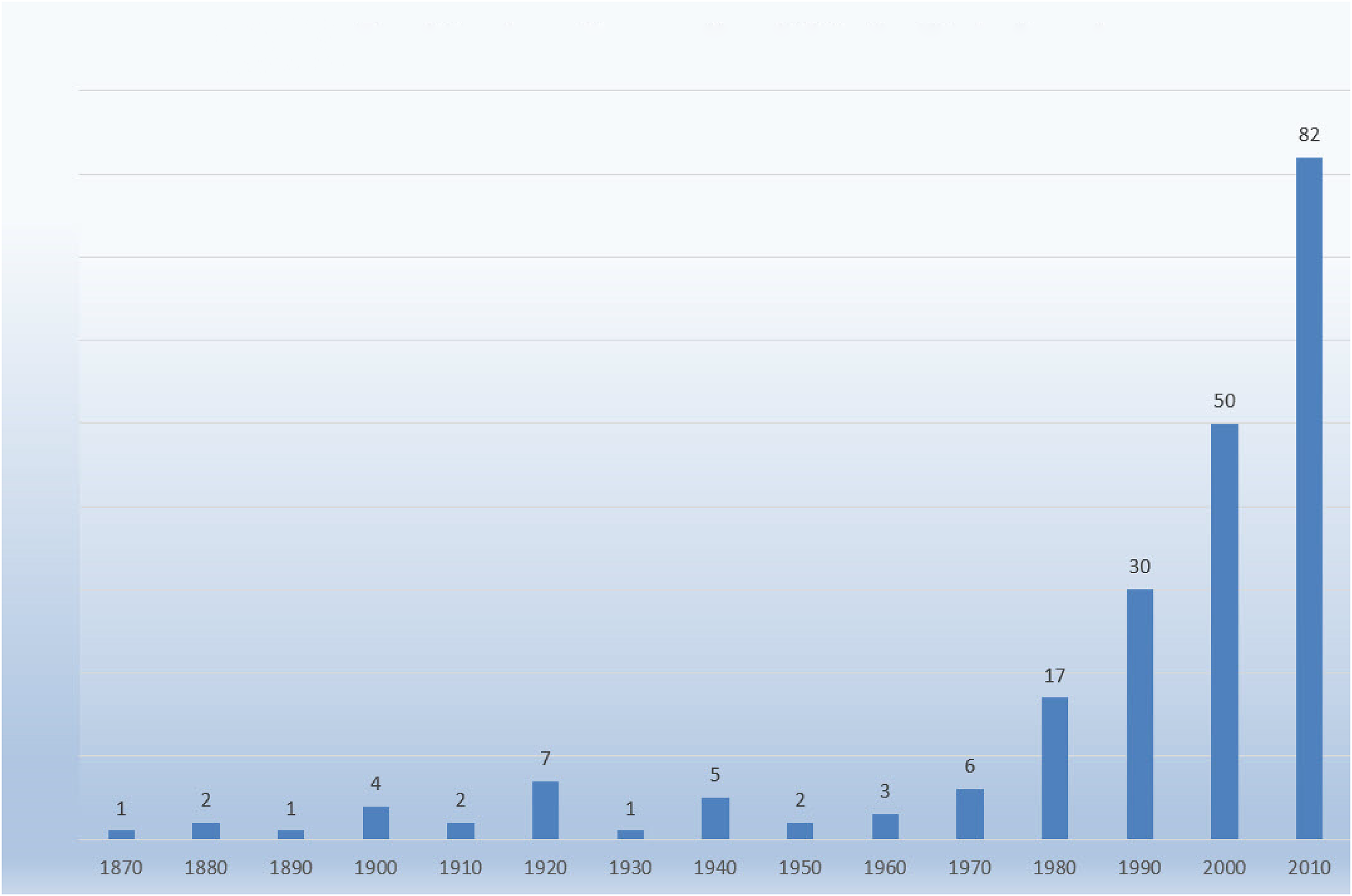
Total number of international visits by governor general, by decade.
Number of visits undertaken by governor general, by type of visit (1931–2020) (post–Statute of Westminster).
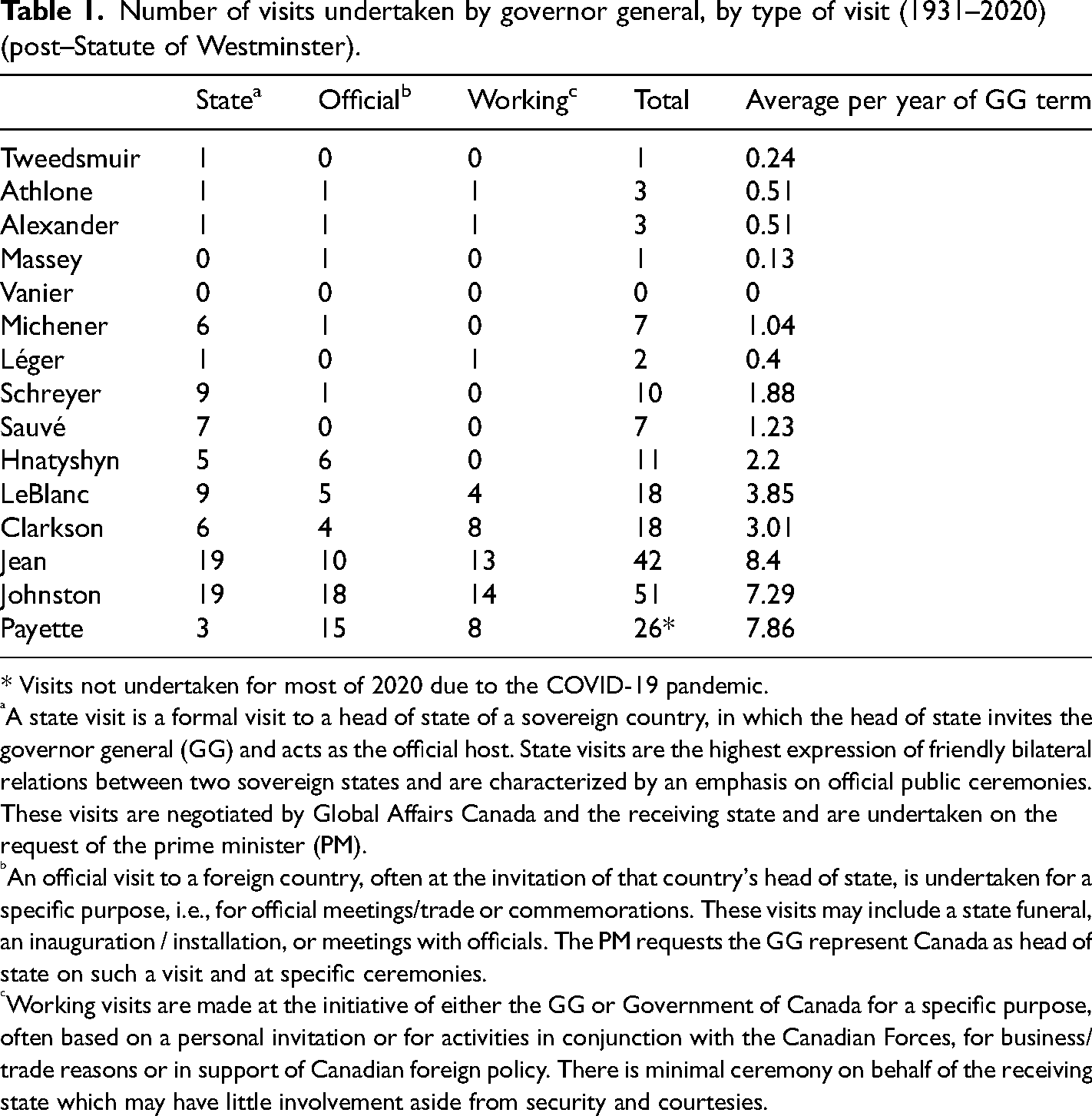
* Visits not undertaken for most of 2020 due to the COVID-19 pandemic.
A state visit is a formal visit to a head of state of a sovereign country, in which the head of state invites the governor general (GG) and acts as the official host. State visits are the highest expression of friendly bilateral relations between two sovereign states and are characterized by an emphasis on official public ceremonies. These visits are negotiated by Global Affairs Canada and the receiving state and are undertaken on the request of the prime minister (PM).
An official visit to a foreign country, often at the invitation of that country's head of state, is undertaken for a specific purpose, i.e., for official meetings/trade or commemorations. These visits may include a state funeral, an inauguration / installation, or meetings with officials. The PM requests the GG represent Canada as head of state on such a visit and at specific ceremonies.
Working visits are made at the initiative of either the GG or Government of Canada for a specific purpose, often based on a personal invitation or for activities in conjunction with the Canadian Forces, for business/trade reasons or in support of Canadian foreign policy. There is minimal ceremony on behalf of the receiving state which may have little involvement aside from security and courtesies.
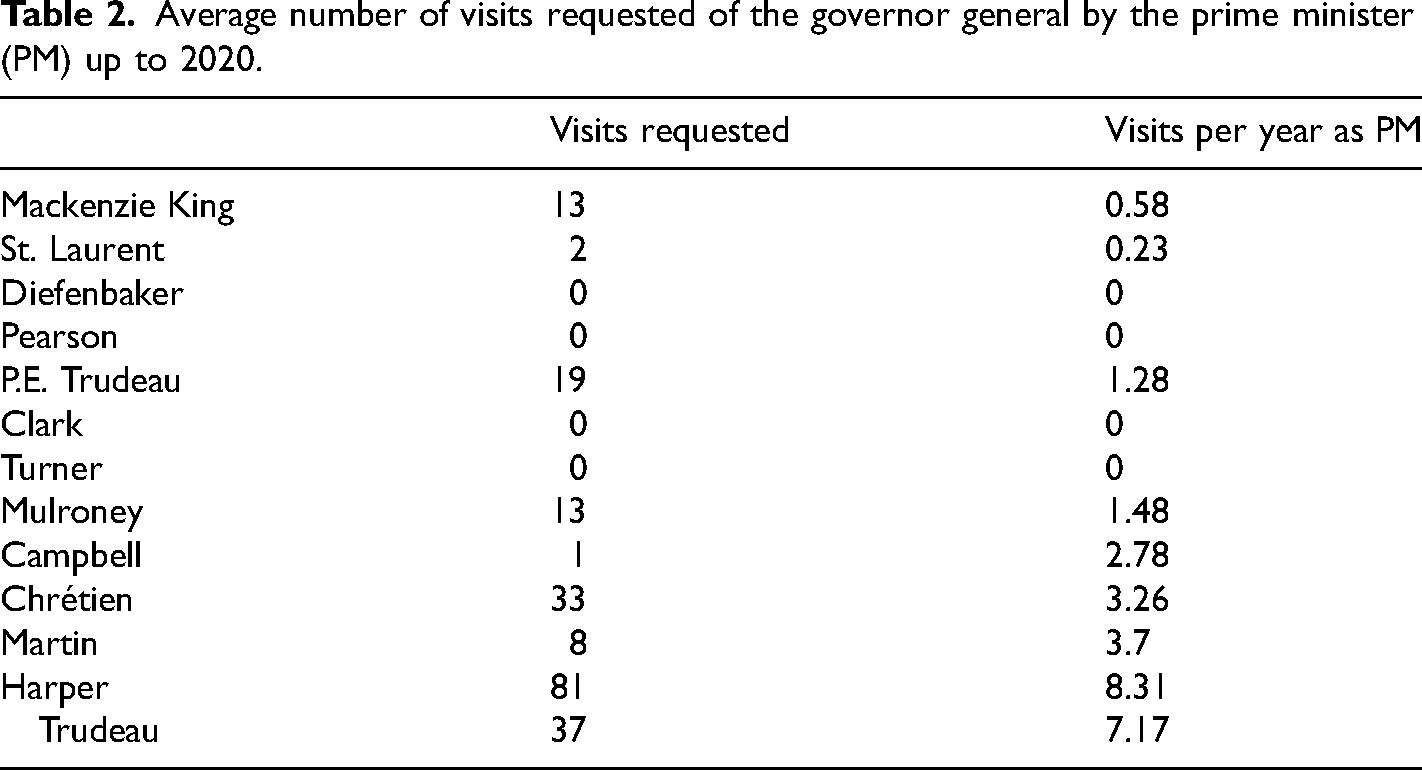
Official interactions at the head of state level are categorized as state, official, or working visits, the latter for specific commemorative or celebratory occasions in addition to support of the Canadian Armed Forces as Commander-in-Chief. Up until the time of Brian Mulroney, prime ministers were advising between one and two visits per year. Mulroney's successor suggested three or four visits per annum, which became the norm. During Stephen Harper's premiership up to eight missions abroad per year were requested of the governor general (Table 2) and this seems to be continuing under Justin Trudeau. 41
Average number of visits requested of the governor general by the prime minister (PM) up to 2020.
The personalities and priorities of the governor general and prime minister have played a significant role in why, where, and to what extent these visits have been undertaken. Some prime ministers have spent more time on foreign relations and have been more open to a role on the world stage than others. The head of state rank, as opposed to the prime minister's standing as head of government, matters where Canada wishes to be positioned in the front row and the governor general may be a more appropriate choice.
The life experiences and reputation of governors general is important in determining where they have the credibility and knowledge to project Canadian values aboard. Adrienne Clarkson was well-versed in knowledge of and support to culture, while Michaëlle Jean came to the office as an immigrant from one of the poorest countries in the Western hemisphere, and one which had been the beneficiary of extensive Canadian development aid. David Johnston had extensive contacts and visibility in post-secondary education and with business and philanthropy, while Julie Payette was internationally known as an astronaut and in science. Successive governments have leveraged these backgrounds and their brands in projecting Canadian foreign policy objectives, but also the image of Canada abroad. Accompanying delegations are also an important aspect of Canadian visits abroad—governors general are usually accompanied by a minister to address political issues, as well as parliamentarians and cultural figures. This enables engagement and networking on many levels. Where a foreign head of state is also a head of government, it has been considered desirable to ensure that there can be substantive talks with a minister of the Crown who is part of the delegation.
In addition to state visits, which are an expression of good relations between states, governors general have also represented Canada at other highly visible public ceremonies. These have included state funerals, historic military anniversaries in which Canada played a major role, inaugurations, significant national anniversaries, international sporting events, and, on occasion, trade and business events where the prime minister was not available. In some ways, the governor general has taken the place usually reserved for a US vice-president—conducting foreign travel and attending ceremonies for which the president does not have the time or inclination. 42
As noted, when the foreign role was being expanded it was felt that the governor general was a good option to represent Canada in countries with a similar form of governance, such as in a Commonwealth country, a parliamentary democracy, or a constitutional monarchy. As late as 1980, External Affairs felt that preference in visits should ordinarily be given to countries where the head of state plays a role not dissimilar to that of the governor general. This has not been the case in recent years. A review of countries visited suggests that more than half of visits abroad have been made to republics, many of which have an executive presidency, while only a third of the countries visited were other realms, constitutional monarchies, or parliamentary democracies (Figure 2). Governors general have also spent more time in member states of La Francophonie than the Commonwealth.
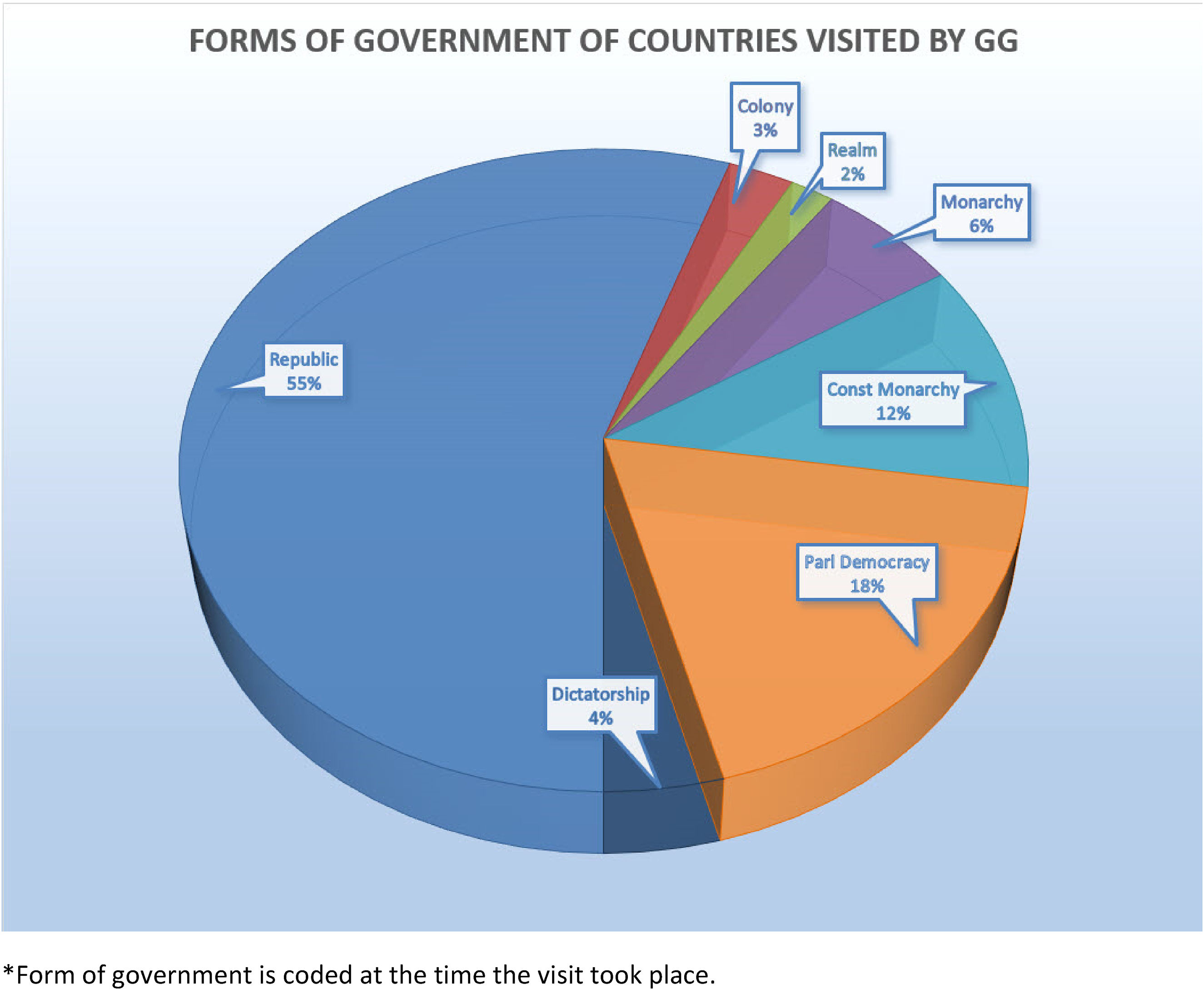
Form of government* of countries visited by the governor general.
Countries which have received the most vice-regal attention are those in which Canada has important political or trade relationships, such as the US, France, Mexico, China, Italy, the Netherlands, Germany, and other European and South American countries. In all, more than seventy-five different countries have been visited by a governor general in the past fifty years, although this does not always come to public attention, except where cost or ill-chosen remarks have become news. Countries that share Canada's past as a Dominion, particularly Australia and New Zealand, have taken note of this development and evolution. One can see in the approach of their own governors general that this has impacted the role and foreign ministries in Canberra and Wellington, as well as in other smaller realms, that are increasingly looking to their governors general to make foreign visits.
Governors general also have increasingly received heads of state and government in Canada as a diplomatic courtesy, and to reflect the priorities of the Canadian government. These interactions have also increased exponentially from occasional to more than ten each year in Ottawa for both ceremonial visits as well as more political ones, including summits. At a time when the governor general increasingly is travelling abroad, the reciprocity which is inherent in state visits is evident. There is very much an “I visit you, you visit me” approach. These exchanges and series of public events and media exposure ensure that Canada gains visibility in the country, and with the diaspora who are represented in an increasingly multicultural Canada.
As part of the Empire with a governor general who represented both the sovereign and British government, it would have been unthinkable for a vice-regal to perform this kind of political role in the past, at least to the extent it is undertaken today. But with the encouragement of a non-resident sovereign and the assertion of Canadian autonomy and later independence, the Crown's place and importance in this aspect of statecraft is now undertaken by the King's Canadian representative on a routine basis. Visits which are undertaken benefit from the rank of the governor general as the de facto head of state in the international context. Canada's own image and role in the international community at the level of sovereign states necessitates full representation and visibility on occasions which are deemed important by the government of the day, according to its priorities.
With the change in the status of Canada from colony to independent realm, and the importance of Canada being fully represented at home and abroad in the same way as other countries, the dignified role has been given new meaning and re-created for the governor general in modern-day Canadian foreign affairs.
Conclusion
Cabinet and the governor general are the principal actors through which the Canadian Crown is involved in foreign affairs, the former exercising efficient powers and the latter acting in a dignified public diplomacy capacity. Given that both the cabinet and governor general act in the King's name, however, it is worth asking what role, if any, the sovereign himself plays in Canadian foreign policy. As discussed, in matters of law and government the King of Canada is considered a separate and distinct office from that of the King of the United Kingdom. The conceptual division between these two capacities reflects the divisibility of the Crown that gradually took place following the First World War and that allowed Canada to become a de facto independent state prior to the formal patriation of the Constitution in 1982. This would suggest that the King might be able to serve as a Canadian foreign policy actor in his own right.
The sovereign has represented Canada abroad in a few instances over the years, such as when Edward VIII dedicated the Vimy Memorial in France in the presence of the president of France and with Canadian ministers in attendance. The Queen rededicated this monument in the same circumstances in 2007. In 1939, during the Royal Tour, George VI spoke before a joint session of the US Congress making clear he was speaking as King of Canada—not that the US media noticed this distinction. Similarly, the Queen's two speeches at to the UN General Assembly were organized as speeches from the head of state of the various realms in both 1957 and 2010. On other occasions, the Queen has presided at Canadian cemeteries in France where she received French political figures.
Following the changes in the signing of Letters of Credence in 1977, the Queen also delegated full authorities for the signing of treaties to the governor general, who has exercised this responsibility or been advised to further delegate it to ministers or heads of mission. Prior to this, the Palace was fully involved in these documents and kept abreast of Canadian developments in this regard.
In reality, however, the conceptual distinction between the King of Canada and the King of the United Kingdom is difficult to sustain once the activities of the living, breathing person of the monarch are in question. Being resident in the United Kingdom, the King's roles and duties as the British head of state take precedence over those he has in his other realms, where his vice-regal representatives are empowered to perform these functions. The King is briefed on the affairs on the British state and government to a degree that he is not with respect to his other realms, and he is widely recognized as the King of the United Kingdom by foreign states. This does not mean that the King does not act on the advice of the first ministers of his other realms with respect to the Crown's role in their states. Nor does this suggest that the King lacks interest in his other realms. It is simply a reflection of the fact that he is, first and foremost, the King of the United Kingdom.
The Canadian Crown is more of a constitutional and institutional fact than a personal presence. Although it manifests itself in global affairs through the efficient decisions of the prime minister and Cabinet, and the increased international dignified role of the governor general, the King himself has a limited role to play. It is unlikely that this dynamic will change under Charles III's reign; on the contrary, it will likely be amplified.
Footnotes
Declaration of conflicting interests
The authors declared no potential conflicts of interest with respect to the research, authorship, and/or publication of this article.
Funding
The authors received no financial support for the research, authorship, and/or publication of this article.

Correction (January 2024):
This article has been updated with minor grammatical or style corrections since its original publication.
Notes
Author Biographies
Richard Berthelsen is an independent scholar based in Toronto, Ontario. He has served four governors general and lieutenant governors and participated in organizing royal tours and ceremonies across Canada since 1978.
Philippe Lagassé is associate professor and Barton Chair, Norman Paterson School of International Affairs, Carleton University.