




Abstract
Since 2013, combat services have been increasingly exchanged on the market. This development is puzzling since the practice emerged despite an anti-mercenary norm banning such services, and without any revision of the norm. The article argues that the combat market is not a deliberate design, but the result of strategic interaction. For some, compliance with the anti-mercenary norm is the best strategy, while for others, violating the norm is best. However, once the norm violation occurs, it is in the interest of all actors to maintain a façade of compliance. Non-compliant actors benefit from the combat services, and compliant actors do not have to engage in costly sanctioning of the norm violation, and avoid the reputational costs associated with non-enforcement. The article employs game theory to investigate the strategic interactions of actors across eleven combat contracts from 2013 to 2019.
Keywords
In February 2018, operators of a Russian private military and security company (PMSC) attacked a US military outpost in Syria. The event was a strong indication of a significant development: combat services are frequently and regularly exchanged on the market. 1 The exchange of combat services is surprising as it runs counter to an established norm—the anti-mercenary norm. The norm reflects a longstanding aversion—going back at least to the beginning of the nineteenth century—of international society to private force providers. 2
Violations of the norm are not a new phenomenon. In the 1960s and 1970s, when groups of mercenaries were participating in civil wars in Congo and Angola, an extensive international debate developed. As a result, the UN General Assembly and the UN Security Council issued several resolutions condemning the practice, describing mercenaries as dangerous criminals. At the same time, the international community started to develop the UN International Convention against Recruitment, Use, Financing and Training of Mercenaries and the Organization of African Unity Convention on Mercenaries. 3 Later, in the mid-1990s—when the market for force experienced a quantum leap, turning into a corporate market, and PMSCs provided combat services on a highly professional level—international and national actors criticized the practice immediately. 4 Some considered corporate actors to be different from mercenaries, while others deemed them to be the “new mercenaries.” 5 However, it was neither the corporate structure nor the legal contractual relations that provided the differentiation between illegitimate mercenary and legitimate activity. Rather, the type of service differentiated one from the other. Any actor, be it an individual, group, or corporation was considered to be a mercenary if they provided offensive combat services. PMSCs therefore did “not entirely escape the anti-mercenary norm” if they offered such services. 6 However, as long as they provided defensive services only, even in a conflict zone, their activities were considered to be appropriate and not in violation of the anti-mercenary norm.
This differentiation has been reflected in the 2008 Montreux Document. 7 With fifty-four members to date, the agreement enjoys wide support within the international community, including major international actors that are home to the largest PMSC markets (e.g., the US, the UK, Canada, France, South Africa, and Germany) as well as states that have been significantly affected by armed security providers (e.g., Sierra Leone, Iraq, Afghanistan, and Angola). Accordingly, while security providers remained in business, combat providers disappeared again. 8 However, the most recent re-emergence of combat contractors, in contrast to previous increases in mercenary activity, did not cause any debate or reshaping of the anti-mercenary norm. The article thus investigates the following question: why is there an active market for combat services, despite the presence of an anti-mercenary norm?
The article will argue that the combat market is an institution that did not emerge through a deliberate process but rather as an unintended consequence of strategic interactions among states. The investigation will proceed in two steps. In the first step, the existence of a combat market will be demonstrated. The claim that there is regular and frequent exchange of combat services requires corroboration. In the second step, the exchange of combat services on a market, despite the presence of an anti-mercenary norm, will be explained. As will be demonstrated, the most likely theoretical explanations—a transnational coalition of actors campaigning for the exchange of combat services, or a broad international discourse on the legitimacy of private combat services—fail to account for the re-emergence of combat providers. 9
To clarify and further substantiate the argument, the article will draw on game theory. From a game theoretic perspective, an institution is considered to be a self-enforcing pattern of behaviour (equilibrium). As such, the combat market emerges as stable through several sequential games. In the first—the norm compliance game—market actors decide whether to comply with or defect from the anti-mercenary norm (i.e., whether to trade defensive or offensive services). Because the benefits of compliance and non-compliance are distributed unevenly on the market, an equilibrium emerges with a larger group complying and a smaller group defecting. However, it is not until the next subgame that the equilibrium becomes stable. In the norm enforcement game, compliant actors have the ability to increase the cost of defection through punishment. However, punishment is costly for punishers as well; hence compliant actors would prefer to avoid enforcing the anti-mercenary norm. Although tempting, this strategy can turn out to be costly, as non-enforcement may be observed and sanctioned by an international audience. Once the norm violation has occurred, compliant and defecting actors have a similar interest: to avoid drawing the attention of their audience. Accordingly, both actors tacitly collude and take actions to maintain a compliance façade. 10 As a consequence, the combat market emerges as a stable self-enforcing equilibrium.
In order to test the validity of this theoretical argument, the congruence method will be employed. This method emphasizes consistency between precise theoretical predictions and actual observable outcomes. 11 This method lends itself to testing game theory arguments because the underlying calculations of actors cannot be directly observed, but the associated behaviour can. The more consistent the predicted and observed patterns are, the higher the likelihood of the theory being valid.
A market for force
The article puts forward the claim that a combat market has been established since 2013. In general, a market institution is a stable and persistent pattern of behaviour (self-enforcing equilibrium) organized around social factors such as rules. 12 Market exchange, in general, is governed by rules; it is a two-way voluntary transfer of services or goods for money. 13 Hence, what remains is to demonstrate the regularity in exchange behaviour. Regularity requires a “degree of repetition over a period of time” between the same or different actors. 14 Table 1 outlines the different combat contracts. Table 1 does not present a sample of contracts but is as comprehensive as possible and includes the entire population of known combat contracts since 2013. 15
Combat contracts.
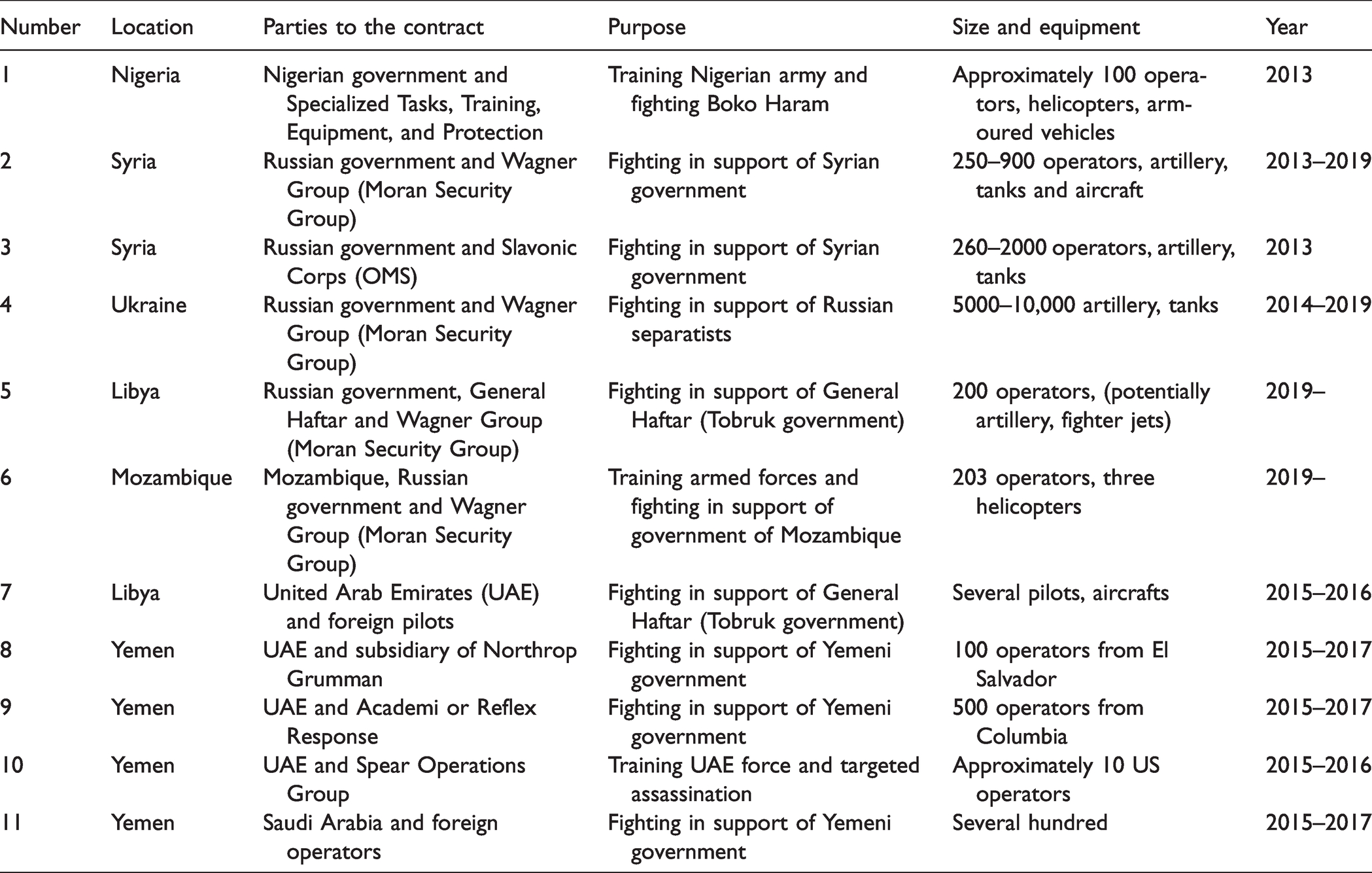
In 2013, the Nigerian government hired a company called Specialized Tasks, Training, Equipment, and Protection (STTEP) to support its combat operations against Boko Haram. Around 100 contractors were involved in direct combat, provided air support, and participated in night raids. 16 The second, third, and fourth contracts were cases where the Russian government hired different PMSCs, such as Moran Security and OMS, “to engage in the fighting in Syria and … Ukraine.” 17 The contracts were of substantial size, ranging from 200 to 900 operators, including heavy weapons operators. 18 The fifth contract was between the Wagner Group and either the Russian government or Moscow-backed Libyan General Haftar (Tobruk government) to provide military support to fight against the government in Tripoli. The Wagner Group deployed around 200 operators, including highly-skilled snipers. It has also been reported that Russian support included fighter jets and artillery, yet it is unclear whether this was through the Wagner contract. 19 The sixth contract refers to Wagner’s deployment in Mozambique. From 2019 on, the Wagner Group supported the armed forces of Mozambique against Islamist insurgents. The approximately 200 operators provided training to the host nation forces but also engaged in combat operations. 20 The seventh, eighth, ninth, and tenth contracts were United Arab Emirates (UAE) contracts. The UAE provided air support in 2015 and 2016—including aircrafts, pilots, and actual air strikes—to the Tobruk government in Libya. Several of the pilots flying combat sorties were foreigners. 21 Moreover, the UAE had two contracts in 2010, one with Northrop Grumman and one with Reflex Response (R2) to build an 800-member battalion of foreign troops to conduct “urban combat” and to destroy enemy equipment and personnel. 22 The unit was deployed in 2015 to participate in the fighting in Yemen. Finally, the UAE contracted with Spear Operations Group, a private military company based in the US which provided approximately 10 former special operations forces’ operators to train UAE armed forces in counter terrorism and to carry out targeted assassinations in Yemen. 23 There is only sparse information on the eleventh contract. In this case, Saudi Arabia hired several hundred foreign fighters to participate in the fight in Yemen.
Theoretical considerations
Crucial to this investigation is the fact that theories of normative change and emergence differ in the extent to which they emphasize intentional agency (i.e., whether an agent deliberately creates a specific outcome or whether the outcome is spontaneous and unintended). At one extreme of this spectrum, hegemonic theories consider the influence of agency to be very high on the final outcome. Powerful actors deliberately choose and authoritatively implement rules to maintain and exert their power. At the other extreme are evolutionary theories, which de-emphasize agency and intentionality. Norms may develop independent of a deliberative process through natural selection pressures, historical path dependency, or are shaped by psychological factors. 24 Two prominent and widely-applied theories are located in the middle ground in terms of intentionality and influence of agency on the outcome: the plural politics approach and the communicative action approach.
The plural politics approach is one of the most influential theoretical perspectives in explaining the emergence of norms. It argues that norm entrepreneurs, such as states, transnational, or international organizations, intentionally seek adjustment or institutionalization of a norm. In order to achieve their goals, they form coalitions to tip the balance in favour of their campaigns. Depending on the ability to form alliances, the balance will shift in favour of changing or establishing the norm. 25 However, in the cases at hand, neither has there been a campaign, nor has there been a coalition formed, tipping the balance in favour of combat services. Alternatively, the communicative action approach proposes that norms are developed through public discourse. 26 While the assumption of agency is still high, the intentionality of the outcome is more limited because the outcome is not under the control of any individual actor or group. It is the result of a collective process. Actors holding a variety of motivations, ideas, and arguments enter into discourse with each other. Their different positions are then pitted against each other, and multiple factors (e.g., resonance with normative structure, instrumental considerations, truthfulness, or the communicative power of actors) decide which actors are successful. In short, normative “change depends on the ensuing arguments.” 27 However, the approach runs into difficulty explaining the existence of the current combat market, as its explanatory leverage stems from the analysis of the dynamics of the discourse. First, in the case of the current combat market, no discourse changed the parameters under which force can be exchanged. None of the actors on the combat market made a deliberate attempt to trigger a discourse and seek to amend or change the norm. 28 Second, even though actors might not have wanted a discourse, choices routinely generate disputes over rules. If a rule collides with particular actions, a dispute should be triggered (i.e., compliant actors should demand an explanation or exert pressure). 29 However, in stark contrast to previous decades, there was no widespread outcry about the current practice.
Why is there a combat market despite the anti-mercenary norm?
The argument here is that the current combat market is not an intentional design but rather the consequence of strategic interactions. Game theory offers a powerful tool to explore strategic interaction and how such interactions—either intended or unintended—develop into a self-enforcing equilibrium. 30 The basic assumption of game theory is that actors are cost–benefit calculating. Hence, actors’ moves are constrained by rationality, and actors will always pick the option offering the best possible payoff. The outcome is not determined by unilateral action, however, but by interaction (i.e., the best reply to another actor’s actions). If both actors find a mutual best response from which they cannot improve unilaterally, and they decide to repeat this interaction, a self-enforcing (Nash) equilibrium emerges. They can formalize the rules, making the rules of the game explicit, or these rules can be informal and tacit. 31
Skeptics might have reservations about the approach’s ability to explain the existence of two contradictory equilibria (i.e., the combat market and the anti-mercenary norm). However, it may be more fruitful to ask not whether an institution or norm is self-enforcing in general but, rather, for whom it is self-enforcing. To be more specific, norms often have different payoffs for different actors within a given community. Payoffs can be distributed asymmetrically. 32 The underlying assumption is that international norms create an order yielding better payoffs for some than for others, and creating different groups within the international society. Satisfied states support the current order as it is constructed in a way that yields high payoffs and helps them to achieve their goals. However, that order also produces dissatisfied states. Dissatisfaction is derived from their disadvantageous positions under the current rules, yielding low benefits. 33 Accordingly, there are those whose best strategy is to comply with the anti-mercenary norm (H-doers) as this promises substantial payoffs; for others, the best strategy is to unilaterally defy the anti-mercenary norm (L-doers), as this promises better payoffs. 34 In terms of the stability of the order, some level of defection can be sustained as long as the group of L-doers is small and the group of H-doers remains large. The asymmetrical payoff structure has direct relevance for the argument about the emergence of the combat market. It is the unintentional outcome of the best strategies between the H-doer and L-doer groups that yields the combat market. To be more precise, it is the interaction of the two actors’ best strategies: H-doers moving in the compliance subgame; followed by L-doers moving in the compliance subgame; and, finally, H-doers moving in the enforcement subgame. 35
Norm compliance subgame
In the norm compliance subgame, members of the H-doer group move first. In theory, they have the option to comply or defect. However, compliance with the normative order yields a high payoff for H-doers. Hence, they are satisfied with it and seek to facilitate its stability. Compliance with the anti-mercenary norm is therefore a rational move. While hiring violent non-state actors has certain benefits—such as providing a maximum of freedom and a minimum of responsibility—this more adventurous foreign policy also has costly repercussions as it renders state relations less predictable and stable. 36 In the worst case, it could be difficult to determine who initiated and authorized forcible PMSC intervention. Overall, the lack of accountability and unpredictability may lead to diplomatic tensions, or worse, trigger war and increase overall violence. 37 In essence, as norms require a substantial amount of compliance to yield positive effects, the defection of H-doers would reduce the size of the group and end the anti-mercenary norm. The negative repercussions of instability and unpredictability for the H-group would be substantial as indicated by the payoff of Outcome B (Figure 1). Constrained by rationality, H-doers will therefore not opt for defection as it would be irrational. Hence, H-doers are expected to comply with the anti-mercenary norm.
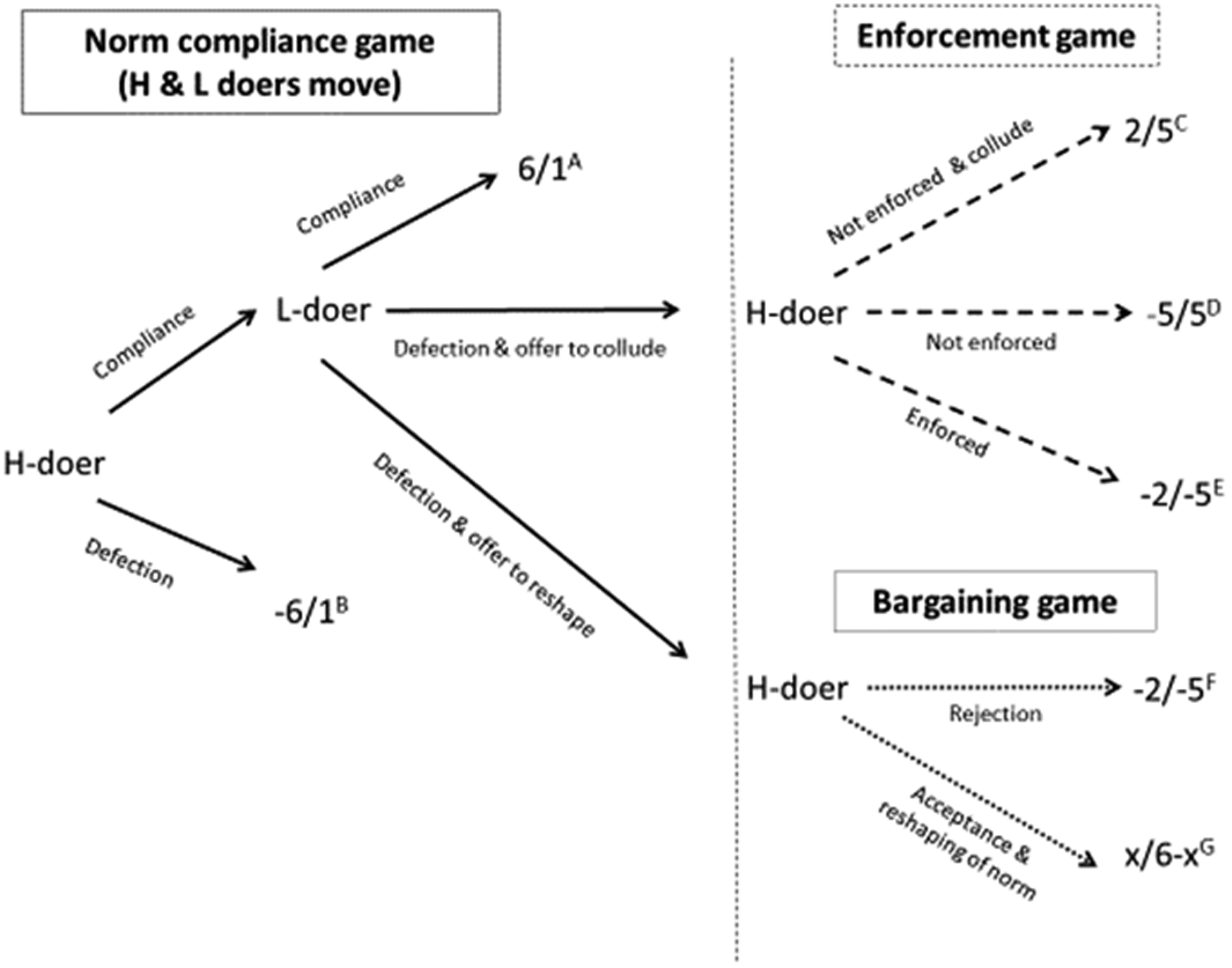
Payoff structure. Game theory depends on ordinal preference orders. The individual scores are for illustration purposes only.
Following this, L-doers are ready to move. L-doers have the option of compliance or non-compliance with the anti-mercenary norm. However, while compliance would contribute to the overall public good of stability and predictability, the benefits for the L-doers are small (Figure 1, Payoff A). The current order either disadvantages L-doers or makes the opportunity costs of compliance too high, rendering L-doers dissatisfied with the international order. The latter will mainly apply to states that face an internal military challenger and that are under threat for regime survival. Accordingly, L-doers are expected to respond with non-compliance. Theoretically, L-doers have two options to defect from the norm.
First, the L-doers’ dissatisfaction with the normative order may prompt an intentional norm challenge. In other words, the L-doer turns into a norm-entrepreneur. A norm challenge is indicated by the L-doer, making its violation public in order to trigger negotiations about the order and eventually re-shape the rules of the game. Accordingly, the violation is accompanied by a justification as to why the norm was violated and an offer to other actors to change the current order. Whether the offer is accepted depends on the offer made by L-doers. The offer (x) can range from 0 (L-doer receives all benefits) to 6 (payoff for H-doers if the status quo remains and actors comply with the anti-mercenary norm). It can be assumed that any offer less beneficial to H-doers than the status quo minus the enforcement costs will be rejected. 38 If the offer is above this threshold, H-doers may accept and both parties may benefit (Figure 1, Payoff G). If, in contrast, the offer does not resonate with H-doers, they will seek to maintain the status quo and take costly enforcement actions (Payoff F). While norm challenge is a theoretical possibility, there are currently no attempts by any actor to challenge or initiate negotiations.
Second, L-doers may violate the norm in order to gain higher payoffs from the violation. Instead of a negotiation game, this defection-move triggers a norm enforcement game. H-doers may then decide to punish L-doers by imposing costs, such as economic sanctions, or social sanctions, such as blaming and shaming. The goal is for the costs to significantly exceed the benefits from non-compliance, forcing L-doers into compliance (Figure 1, Payoff E). However, this is not a likely move as H-doers have a strong incentive to not pursue L-doers aggressively, as dealing out punishment is associated with substantial costs. The punisher accrues direct costs, first, from coordinating and adjustment (i.e., the formation and negotiation of a sanctioning alliance). For instance, in the case of the Syrian war, the European members of the UN Security Council sought to find a consensus for a resolution to condemn human rights violations and establish an arms embargo. However, despite substantial effort in drafting different versions of the resolution and intensive negotiation with other Security Council members, the initiative failed. 39 Further costs arise from implementing and monitoring sanctions. Lastly, imposing punishment may have repercussions on relations between sender and recipient, as the latter might adopt a more antagonistic stance in other issue areas. As a result, the preferred strategy for H-doers is to defect in the norm enforcement game. This leaves both groups of actors better off as opposed to norm enforcement (Payoff C). 40
However, whether non-enforcement or enforcement is the best strategy for H-doers depends on parameters external to the interaction. In other words, “the best” is always in reference to a set of stable parameters, and changes in such parameters may change what is considered the best strategy. For instance, power changes exogenous to the interaction may shift an actor’s best bargaining strategy. 41 In the game at hand, the external parameter influencing the choice of strategy is the level of attention by an external audience. An audience can influence an actor’s strategy by highlighting or publicizing non-compliance or non-enforcement. The publicity exploits the political vulnerability of actors committed to a norm. Actors are sensitive to their transgressions being made public, as that publicity will likely generate domestic and international reputational costs about the credibility of their commitments. 42 Accordingly, if public attention is high, H-doers are expected to enforce the norm as it is less costly than non-enforcement (Figure 1, Payoff E over D). However, the attention the audience pays to similar events varies. 43 Hence, one combat contract may receive attention while another does not. Accordingly, any defection by L-doers contains an offer to H-doers to collude in minimizing public attention and maintaining a compliance façade. Tacit cooperating to maintain a compliance façade is in the interest of H-doers as it promises a higher payoff.
Against this backdrop, the preference order of L-doers is C=D>A=B>E. The preference order of H-doer is A>C>E>D>B. 44 While there are theoretically five outcomes possible, the argument is that the outcome is either C or E, depending on the level of audience attention. If public attention is low, C is the preferred outcome by both parties. If public attention is high, E is the preferred outcome of the H-doer, who makes the last move. Accordingly, in order to create the circumstance under which H-doers are able to collude and outcome C is possible, L-doers engage in activities maintaining a compliance façade (Prediction 1). These actions include concealing activities, denial, or rhetorical moves to keep public attention low. While C is not the preferred outcome of H-doers (A is at the top of the preference order), it is preferable to E. Hence, H-doers will reciprocate by engaging in activities maintaining a compliance façade, such as denial or rhetorical action (Prediction 2). If H-group and L-group members collude in this manner, an unintended stable equilibrium forms: the market for force (Outcome C). 45 However, if the audience is attentive, the costs of non-enforcement increase. Under these circumstances, H-doers will not collude since non-enforcement would be punished by the audience and result in Outcome E. L-doers would be content with E as they would receive the benefits of defecting from the norm and not getting punished. However, H-doers prefer E over D, as the costs are lower in the former. Accordingly, the prediction is that H-doers will break the compliance façade and enforce the norm if public attention is high (Prediction 3).
Testing the prediction
A crucial assumption is that the current normative order yields an asymmetrical payoff structure, dividing actors into those who are satisfied and those who are dissatisfied. For the purpose of this investigation, it is important to identify the group of dissatisfied states—and, by extension, potential L-doers—independent of their norm defection. The assumption here is that dissatisfaction follows from lower payoffs received from the current order. Two indicators will be employed to determine dissatisfaction.
The literature has developed several indicators to measure dissatisfaction. 46 For the purpose of this investigation, dissatisfaction is first identified by proximity to the values upon which the system rests or the actual accrued costs associated with norm compliance. To be more specific, states follow their interest in forming international regimes and what treaties they enter into. 47 Dissatisfied states will therefore refrain from entering into any agreements or regulatory regimes not associated with positive payoffs. Accordingly, for the investigation at hand, membership in the Montreux Document will be taken as an indication of being satisfied with the current order. 48 Alternatively, the membership in the UN Convention Against Recruitment, Use, Financing and Training of Mercenaries could have been selected as an indicator for satisfaction with the order. However, although the treaty addresses the organization of the use of force by private actors, it does not reflect a widespread consensus. Although it was adopted almost twenty years prior to the Montreux Document, it has gathered fewer members. 49 Moreover, in contrast to the Montreux Document, none of the members of the UN convention are “crucial actors” (i.e., none of the members have a significant PMSC industry). Lastly, the convention seeks to criminalize any participation or attempted participation in hostilities by private actors. This deviates substantially from the current consensus, which only considers offensive participation problematic. 50
Dissatisfaction with the order may also result from the large opportunity costs generated from norm compliance. In the case of commercial combat providers, opportunity costs increase if there is a significant domestic threat and if the state is incapable of addressing that threat by deploying its own armed forces or drawing on resources of state allies.
According to Prediction 1, L-doers engage in activities to maintain a compliance façade. H-doers, in turn, tacitly collude with L-doers and engage in similar activities in maintaining the compliance façade (Prediction 2). In both cases, actors may undertake any of the following actions: concealment the activity, indicated by secrecy, retreat from the discourse, indicated by an absence of press statements mentioning the PMSC employment, and denial and rhetorical action, indicated by either contradicting the credibility of factual statements or framing the violation to be in accordance with the existing norm. 51 For the H-doer group, the focus here will be on the reactions of several important members of the Montreux Document, the US, South Africa, the UK, Germany, and the North Atlantic Treaty Organization (NATO).
As suggested by Predictions 2 and 3, the level of audience attention is decisive as to whether enforcement measures are implemented. However, different authors have conceptualized attention in different ways, suggesting that it is multidimensional. In order to capture this complexity, the investigation includes the three main dimensions of attention: elite attention; media attention; and public attention. 52 The level of elite attention is determined by the absence of reports by the UN Working Group on the Use of Mercenaries. Media attention is measured by the frequency of published newspaper articles on the specific subject, and public attention is captured by the frequency of Google search hits. In regards to the latter two indicators, high public attention is determined by comparing the hits in each case to an incident of exceptionally high public interest: the Nisour Square incident in 2007 in Iraq. In this incident, operators of the US PMSC Blackwater killed seventeen Iraqi civilians. Blackwater received unique and exceptional global attention, which needs to be taken into consideration. Accordingly, high interest is assumed if a case receives fifty percent (or more) of the Nisour Square interest, while anything below is considered low interest. 53 The following subsections test these predictions in several combat contracts.
Nigeria and STTEP
The Nigerian government has struggled with an insurgency on its own territory since 2004. Since 2009 the intensity of the fighting, territorial losses, indiscriminate violence, and the number of displaced increased, amounting to a significant threat to the government. With the Nigerian military ineffective as a result of years of decline and corruption, the opportunity costs of complying with the anti-mercenary norm and forgoing the hiring of combat PMSCs were high. Accordingly, in 2013, the Nigerian government tasked a PMSC called STTEP to train the Nigerian military and to engage in direct combat, provide air support, and execute night raids. 54 However, the Nigerian government had no interest in challenging the anti-mercenary norm and thus engaged in rhetorical action to keep a compliance façade, as Prediction 1 suggests. The government did not deny the existence of the contractual relationship nor the exchange of force-related services. However, when elaborating on those services, a representative of the company focused on the training task in order to maintain the impression of acting in accordance with normative requirements. 55 Likewise, Nigerian officials emphasized the legitimacy of the contract and placed the exchange within the boundaries of the security market for force. Mike Omeri, a government official, denied that foreigners provided military services to the Nigerian government. Nigerian President Goodluck Jonathan was more detailed and described the operators as “technicians” performing maintenance and instruction services, although they were actively participating in hostilities. Rear Admiral Gabriel Okoi, the chief of Nigerian defence intelligence, emphasized that the foreigners were not there to fight but to train the Nigerian army. 56
Because the Nigerian relationship with STTEP created minimal international attention, the offer to collude was accepted by the H-doers (Prediction 2). First, the UN Working Group did not mention Nigeria–STTEP in any of their reports. Neither did the group bring it to the attention of the General Assembly. Likewise, the media reporting was negligible. A Nexis search yielded only 17 reports. The low media interest is underscored by the results of a Google search, which yielded only 162 results and represents a low level of interest. Second, the international community’s response was mute. There was no official statement on the topic by the US, South African, or the UK governments, nor by NATO. While Nigeria and Boko Haram was brought up in a German government press conference, the spokesperson did not mention any mercenary activity. 57 However, a South African government official, the spokeswomen for the South African Defence Ministry, did comment on STTEP. When asked about the topic, she denied any knowledge about STTEP operating in Nigeria, thereby contributing to the maintenance of the façade. 58
The empirical results therefore support Predictions 1 and 2. L-doers defected and maintained a compliance façade. Likewise, because audience attention was low, H-doers also maintained the compliance façade and did not impose sanctions. The interaction of the two strategies yields Outcome C.
Russia in Ukraine and Syria
In Syria and Ukraine, Russian PMSCs engaged in combat operations on behalf of the Russian government. In Syria, the Slavonic Corps (a subsidiary of the Russian-based security company Moran Security) operated briefly in 2013. Currently, between 100 and 900 Russian private military personnel from the Russian company OMS (also known as the Wagner Group) are participating in the fight. The Wagner Group was also engaged in operations in Ukraine on behalf of the Russian government to support the separatists from 2013–2015. 59 In terms of payoffs, there were no significant opportunity costs by complying with the anti-mercenary norm. Russia has substantial military capabilities and did not face any significant domestic threat. However, Russia is often considered to be dissatisfied with the current international order in general. For instance, it displays a significant distance from the dominant liberal values of many H-doers 60 and, specific to this case, it is not a member of the Montreux Document.
As suggested by Prediction 1, Russia defected and engaged in rhetorical action while not drawing attention to its norm violation. Russia took extensive measures to keep the entire operation secret and out of public debate. For instance, the private soldiers of the Slavonic Corps were told not to bring any military-related articles to avoid attention and, upon their return to Russia, they had to surrender their SIM cards and electronic media to the Federal Security Service and sign a non-disclosure agreement. 61 Moreover, the Russian government refrained from providing any information about the involvement of Moran Security or OMS in Syria. It either refused to directly comment on any relationship to a Russian PMSC or denied having any information available on the Slavonic Corps. Likewise, representatives of Moran Security and the Slavonic Corps denied involvement. OMS has not engaged in any public discourse and has pre-empted any questions by keeping its contact details undisclosed. The Russian defence ministry refuses to respond to any inquiries about the relationship and involvement of the company, and the Russian military does not acknowledge the existence of the Wagner Group. Moreover, a Russian government spokesperson deflected news reports about the Wagner Group as untrustworthy. 62
In both cases international interest was high. A Nexis search yielded 180 articles mentioning the Syria–Russia contract and approximately 320 dealing with the Ukraine–Russia contract. The high interest is underscored by an analysis of the Google search results which produced around 500 hits. In addition, several in-depth journalistic pieces on Syria and the Russian practice of using private combat providers were published. 63 Even the UN Working Group took notice of the Russian practice. A delegation visited Ukraine and produced a report pointing out the participation of Russian operatives, their recruitment in Russia, and various human rights violations. 64 However, in contrast to Prediction 3, the high public attention triggered only scant criticism and did not lead to sanctions imposed on the norm violator. Indeed, in Ukraine, some H-doers broke the compliance façade by criticizing the deployment of PMSCs. The Foreign and Commonwealth Office criticized the presence of mercenaries in Ukraine, and Germany repeatedly called upon the Russian government to withdraw their mercenaries. 65 However, this was the exception rather than the norm. No other actor raised criticism, and in Syria H-doers even tried to diffuse attention by casting doubt on the link between Russia and the PMSCs. For instance, a US Department of Defense spokesperson stated that military officials had been in contact with their Russian counterparts, who assured them that no Russian paramilitaries were in the region. 66 US Secretary of Defense James Mattis insisted he did not know whom the US air strikes had hit and that he believed that Russia would have informed the US government if they had been involved. 67 In short, while there was some criticism, the main thrust of the efforts was aimed at diffusing public attention. Moreover, the sanctions imposed were not designed to enforce the norm but to rebut any allegations of non-enforcement. The measures targeted not the norm violator Russia, but the PMSCs. For example, Moran Security, which is registered in the British Virgin Islands, was sanctioned by the UK for its involvement in the Syrian conflict. Likewise, Wagner Group founder and leader Dmitry Utkin was added to the list of officials sanctioned for involvement in the Ukraine conflict by the US. 68 The absence of sanctions against Russia directly avoided the costs associated with coordination, monitoring, and (further) disrupting diplomatic relations.
In sum, the empirical results support Prediction 1 but not Prediction 3. As L-doers defected and maintained a compliance façade, some H-doers did criticize the use of combat providers, while most efforts sought to diffuse public attention. However, all H-doers avoided sanctioning the norm violator, Russia. Accordingly, outcome E—where H-doers pay enforcement costs and L-doers receive a hefty penalty for the norm violation—did not materialize. Instead, the interaction produced an outcome not yet accounted for by the game matrix. In terms of payoff, the unaccounted outcome is much closer to C than to E. The L-doer was able to keep the benefits of the norm violation, and H-doers simultaneously avoided the costs of non-sanctioning imposed by the audience and the costs of sanctioning the violator.
UAE in Libya and Yemen
In 2010, the UAE government hired R2 to establish an 800-member battalion of foreign troops to conduct “urban combat” and to destroy enemy equipment and personnel. 69 The unit was deployed in 2015 to participate in combat in Yemen within the military operation led by Saudi Arabia. Around the same time, the UAE was involved in the Libyan civil war, providing air support for the Tobruk government, including aircraft, pilots, and air strikes. One of the main contractors supporting UAE special operations in Libya was an American businessman named Erik Prince. Several of the pilots flying combat sorties were reportedly employed by him. 70 The UAE did not face any significant opportunity costs by forgoing combat providers as it was not confronted with any domestic challengers. However, the UAE is categorized as a state dissatisfied with the current organization of the use of force. The government does not align with the dominant liberal values and is not a member of the Montreux Document.
In both cases the communication strategy was as expected (Prediction 1): L-doers sought to maintain the compliance rhetoric. The New York Times reported the UAE’s plans and the involvement of R2 in setting up a special battalion in 2011. 71 In response, Faiza Patel, then-chairperson for the UN Working Group, sent a questionnaire to the UAE embassy regarding the laws regulating PMSC activities. The UAE embassy sought to conceal the true nature of the activities by explaining that “no military companies using mercenaries” were used and insisted PMSCs were “limited to preventive security protection.” 72 R2 did not engage in the discourse at all and did not issue any statements. Erik Prince, who reportedly helped to facilitate the contract, denied involvement. His spokesperson, Kathy Daneman, also denied involvement and explained that “[n]either Mr. Prince nor Blackwater are doing or have done security with the UAE … All reports to the contrary are in error.” 73 The Libya contract displayed the same pattern. When news of UAE involvement broke, Libya’s ambassador to the United Nations sought to diffuse the situation by claiming that outside support was involved in his country. Likewise, the foreign minister made it clear that his government did not want any foreign military intervention, and the Libyan prime minister called the allegations “false events.” Similarly, Erik Prince denied any involvement in the air operations. Finally, the UAE government did not provide any comments on specific matters, yet the UAE minister of foreign affairs said the claims about the attacks were a “diversion” from Libyans’ desire for stability. 74
Overall, the audience’s attention to both contracts was rather low. Although the UN Working Group took up the UAE–Yemen issue briefly, it was not followed up or referred to in any meetings of the UN Human Rights Council. Media reporting on the topic was low as well. A Nexis search yielded around 50 newspaper articles covering the R2 contract. Google generated 194 search results, which represents a low level of interest. Interest in the Libya case was also low. Nexis held only 12 reports, and a Google search yielded no results. This is a very low level of interest. As a consequence, the audience cost for not sanctioning the other actors was low. Accordingly, there was no official statement by the US, German, South African, or UK governments, or by NATO on the topic.
The empirical results support Predictions 1 and 2. As expected, L-doers defected and maintained a compliance façade. Likewise, as a result of low audience attention, members of the H-group maintained a compliance façade and did not impose sanctions. The interaction of the two strategies yields Outcome C.
Conclusion
Janice Thomson’s claim that “[t]oday real states do not buy mercenaries” needs to be revised. 75 Indeed, a large part of the international community has accepted a regulated and restrained security market for force and has vehemently rejected attempts to re-establish a combat market several times in the past decades. 76 Nevertheless, the combat market re-emerged.
Theoretically, this article argues that the combat market is the unintended outcome of strategic interaction between actors who are satisfied and dissatisfied with the order. Dissatisfied actors are disgruntled because they receive a lower payoff from compliance. Accordingly, for those actors it is more beneficial to defect. Satisfied actors, in contrast, are content with the order because they receive a higher payoff and their best strategy is to comply. Compliant actors may choose to enforce the norm, yet this is a costly undertaking and will be the best strategy only if the audience’s attention is high and non-enforcement accrues a penalty. If public attention is low, L-doers engage in activities to maintain a compliance façade (Prediction 1). H-doers will join L-doers in keeping that compliance façade (Prediction 2). If both actors collude in this way, the interaction yields a self-enforcing equilibrium, the combat market (Outcome C). However, if attention is high, the expectation is that H-doers will take enforcement measures (Prediction 3).
In sum, two theoretical predictions are congruent with the empirical evidence. As assumed, in all of the cases, the defecting actors were dissatisfied with the current order. Prediction 1 holds up to the empirical test. Any defection is accompanied by L-doers seeking to maintain a compliance façade. Similarly, Prediction 2 was corroborated. Whenever the audience’s attention was low, H-doers refrained from norm enforcement and maintained a compliance façade. However, in the case of the Russian contracts in Syria and Ukraine, high attention did not lead to the expected criticism or to sanctioning behaviour. While this contradicts Prediction 3, a closer look reveals that the result is still within the scope of the game theory model. H-doers sought to attain the best payoff by avoiding costly enforcement measures and costs from non-enforcement at the same time. The overall results support the argument of the combat market being an unintended consequence. It is the result of the interaction of both actors’ best strategies, either by the two colluding in maintaining a compliance façade, or by H-doers seeking to avoid costs of enforcement and of non-enforcement. In either case, the non-punishment by H-doers permits L-doers to continue to contract combat providers.
An objection to the validity of the results may be that, due to space constraints, only seven out of 11 combat contracts were investigated in detail. However, it seems unlikely that four additional cases would change the results: Saudi Arabia worked alongside UAE in Yemen and public attention was low. It is unlikely that Saudi Arabia received criticism for its actions while the UAE did not. The UAE–Spear Operations Group contract was one out of three contracts for the Yemen operation. It is unlikely that the UAE was not criticized for the first two contracts, yet was for the third contract. Lastly, to date, the Russian contracts in Libya and Mozambique have not received any international outcry or criticism. However, admittedly, knowledge about Russia’s involvement is still very recent, and the international response may change in the future. Nevertheless, since no substantial enforcement measures have been taken in previous Russian contracts, it is unlikely that the Libya and Mozambique cases will be different.
The result also has wider implications. If a norm is violated, the literature tends to discuss two stylized outcomes: either compliant actors uphold the norm through sanctions, forcing the violator to change behaviour; or the norm violator becomes a (illiberal) norm entrepreneur, engages in a discourse and persuades others to adjust the norm. 77 The findings here, however, suggest a third option. Tacit collusion may be the best strategy for both actors, saving sanctioning costs for the H-actors and the costs of norm adjustment for the L-actor. Nevertheless, according to conventional wisdom, repeated norm violations and a lack of enforcement measures weakens the salience of a norm. 78 Surprisingly though, the literature is divided about the repercussions of the current trend on the strength of PMSC regulation. Despite the presence of combat service exchange, Deborah Avant considers the current trajectory of regulation a positive development, increasing the “chances of effective governance.” 79 Elke Krahmann, in contrast, points out that much of the hope for regulatory effectiveness depends on market actors being able to punish deviation. Her conclusion is rather skeptical, suggesting that there are “significant obstacles” to enforcing standards. 80 However, the two assessments do not need to be contradictory if the different groups of actors are taken into consideration. Among H-doers, the salience of the anti-mercenary norm is high, and the norm is effectively governed, while the opposite is true for L-doers. In short, the norm’s salience varies across the two groups, yet there is no attempt to engage in a bargaining game and to find a new consensus. As a consequence, the market for force has become segmented. On the one hand, there is a legitimate segment governed by widely accepted rules; on the other hand, there is an illegitimate segment, where the exchange of combat services is a normality.
Tacit collusion between H-doers and L-doers may have wider implications and may not be limited to the anti-mercenary norm. 81 With the rise of revisionist states and dwindling influence of liberal states in the international system, increasing non-compliance on important international norms such as human rights, freedom of the press, military intervention, or climate change is already a reality. Faced with non-compliance and an increasing inability to enforce norms, H-doers may become more and more willing to tacitly collude with L-doers. This may be the path through which the normative foundation of the liberal international order becomes substantially weakened or even undone.
Supplemental Material
sj-pdf-1-ijx-10.1177_0020702021994519 - Supplemental material for The anti-mercenary norm and the market for combat force
Supplemental material, sj-pdf-1-ijx-10.1177_0020702021994519 for The anti-mercenary norm and the market for combat force by Ulrich Petersohn in International Journal
Footnotes
Declaration of Conflicting Interests
The author declared no potential conflicts of interest with respect to the research, authorship, and/or publication of this article.
Funding
The author disclosed receipt of the following financial support for the research, authorship, and/or publication of this article: This work was supported by the Gerda Henkel Foundation (Grant Number: AZ10/KF/17).
1
2
Janice Thomson, Mercenaries, Pirates, and Sovereigns (Princeton: Princeton University Press, 1994).
3
Sarah V. Percy, “Mercenaries: Strong norm, weak law,” International Organization, 61, no. 4 (2007): 367–397, 373–374.
4
UK Government, Foreign and Commonwealth Office, Private Military Companies: Options for Regulation (London: UK Government, 2002); UK Government, Foreign Affairs Committee, Memorandum from Armor Group Services Limited, Appendix 6 (London: UK Government, 2002); and US Government, Committee on Oversight and Government Reform, Hearing on Blackwater USA (2 October) (Washington, DC: US Government, 2007).
5
Peter Singer, Corporate Warriors (Ithaca: Cornell University Press, 2003); and Juan Zarate, “The emergence of a new dog of war: Private security companies, international law and the new world disorder,” Stanford Journal of International Law 34, no. 1 (1998): 75–165.
6
Sarah Percy, Mercenaries: The History of a Norm in International Relations (Oxford; New York: Oxford University Press, 2007), 242.
7
Ulrich Petersohn, “Reframing the anti-mercenary norm: Private military and security companies and mercenarism,” International Journal 69, no. 4 (2014): 475–493.
8
Percy, Mercenaries, 227.
9
Martha Finnemore and Kathryn Sikkink, “International norm dynamics and political change,” International Organization 52, no. 4 (1998): 887–917; and Elke Krahmann, “From ‘mercenaries’ to ‘private security contractors’: The (re)construction of armed security providers in international legal discourses,” Millennium– Journal of International Studies 40, no. 2 (2012): 343–363.
10
Austin Carson, “Facing off and saving face: Covert intervention and escalation management in the Korean War,” International Organization 70, no. 1 (2015): 103–131, 105.
11
Alexander George and Andrew Bennett, Case Studies and Theory Development in the Social Sciences (Cambridge, MA: MIT Press, 2005), 67–72, 181–204.
12
James D. Morrow, Order Within Anarchy: The Laws of War as an International Institution (Cambridge, MA: Cambridge University Press, 2014), 6.
13
William Jackson, “On the social structure of markets,” Cambridge Journal of Economics 31, no. 2 (2007): 235–253.
14
Peter Malanczuk, Akehurst’s Modern Introduction to International Law, 7th rev. ed., (London; New York: Routledge, 1997), 41.
15
Given that confidentiality is in the nature of the combat market, it is possible for a few cases to be missing. Libya was not included. There was too little corroboration of Gaddafi hiring foreigners to fight.
16
Jack Murphy, “Eeben Barlow speaks out (Pt. 1): PMC and Nigerian strike force devastates Boko Haram,” SOFREP, 23 May 2020, https://sofrep.com/news/eeben-barlow-south-african-pmc-devestates-boko-haram-pt1/ (accessed 23 May 2020); and Peter Fabricius, “Nigeria's decision to use ex-SADF soldiers to combat Boko Haram will further aggravate sour relations between the two countries,” Institute for Security Studies, 5 March 2015,  (accessed 5 November 2019).
17
Editor, “St. Petersburg sends contractors to Syria,” The Interpreter, 15 November 2013, https://www.interpretermag.com (accessed 5 November 2019); Thomas Grove, “Up to nine Russian contractors die in Syria, experts say,” The Wall Street Journal, 18 December 2015, https://www.wsj.com/articles/up-to-nine-russian-contractors-die-in-syria-experts-say-1450467757; and “The ride of the mercenaries: How ‘Wagner’ came to Syria,” The Economist, 2 November 2017, (accessed 5 November 2019).
18
John Sparks, “Russia’s Secret Soldiers Fighting in Syria,” Sky News, video, 9 August 2016, https://www.youtube.com/watch?v=HvW3OBJDVS8 (accessed 5 November 2019); and Pierre Vaux, “Fontanka investigates Russian mercenaries dying for Putin in Syria and Ukraine,” The Interpreter, 29 March 2016, (accessed 5 November 2019).
19
David Kirkpatrick, “Russian snipers, missiles and warplanes try to tilt the Libyan War,” The New York Times, 7 November 2019, https://www.nytimes.com/2019/11/05/world/middleeast/russia-libya-mercenaries.html (accessed 22 May 2020); and Sudarsan Raghavan, “Arrival of Russian mercenaries adds deadlier firepower, modern tactics to Libya’s civil war,” Washington Post, 6 November 2019, (accessed 22 May 2020).
20
21
22
Mark Mazzetti and Emily Hager, “Secret desert force set up by Blackwater’s founder,” The New York Times, 14 May 2011, 1; and Emily Hager and Mark Mazzetti, “Emirates secretly sends Colombian mercenaries to Yemen fight,” The New York Times, 25 November 2015, 1.
23
24
Ann Florini, “The evolution of international norms,” International Studies Quarterly 40, no. 3 (1996): 363–389; Douglass North, Understanding the Process of Economic Change (Princeton, NJ: Princeton University Press, 2005); and Jennifer M. Ramos, Changing Norms Through Action: The Evolution of Sovereignty (Oxford: Oxford University Press, 2013).
25
Finnemore and Sikkink, “International norm dynamics.”
26
Thomas Risse-Kappen, Stephen C. Ropp, and Kathryn Sikkink, The Power of Human Rights: International Norms and Domestic Change (New York: Cambridge University Press, 1999), 11; and Wayne Sandholtz and Kendall Stiles, International Norms and Cycles of Change (Oxford; New York: Oxford University Press, 2009), 14–15.
27
Thomas Risse, ”’Let’s argue!’: Communicative action in world politics,” International Organization 54, no. 1 (2000): 1–39.
28
There were two exceptions: Simon Mann suggested forming an “Arab Legion” to fight ISIS, and Erik Prince proposed a private multinational force. Both proposals failed.
29
Sandholtz and Stiles, International Norms and Cycles of Change, 6–10.
30
Edna Ullmann-Margalit, The Emergence of Norms (Oxford: Clarendon Press, 1977); and Avner Greif and David Laitin, “A theory of endogenous institutional change,” The American Political Science Review 98, no. 4 (2004): 633–652.
31
Douglass North, Institutions,Institutional Change, and Economic Performance (Cambridge; New York: Cambridge University Press, 1990), 3.
32
Toh-Kyeong Ahn, Myungsuk Lee, Lore Ruttan, and James Walker, “Asymmetric payoffs in simultaneous and sequential prisoner’s dilemma games,” Public Choice 132, no. 3 (2007): 353–366.
33
Susan G. Sample, “Power, wealth, and satisfaction: When do power transitions lead to conflict?” Journal of Conflict Resolution 62, no. 9 (2018): 1905–1931, 8, 23; and Ronald L. Tammen, “The Organski legacy: A fifty-year research program,” International Interactions 34, no. 4 (2008): 314–332, 317–318.
34
The acronyms were taken from Diego Gambetta and Gloria Origgi, “The LL game: The curious preference for low quality and its norms,” Politics, Philosophy and Economics 12, no. 1 (2012): 3–23. “H” indicates high compliance, and “L” indicates low compliance.
35
Players act rationally in every subgame (i.e., the game is subgame perfect). Kenneth Williams, Introduction to Game Theory: A Behavioral Approach (Oxford: Oxford University Press 2012), 144.
36
Deborah Avant, “The marketization of force: Adventurous defense, institutional malformation, and conflict,” in Jonathan Kirshner, ed., Globalization and National Security (New York: Routledge, 2006), 105–141, 116; and Steven Schooner, “Why contractor fatalities matter,” Parameters, Autumn (2008): 78–91.
37
Ulrich Petersohn, “Private military and security companies (PMSCs), military effectiveness, and conflict severity in weakstates, 1990–2007,” Journal of Conflict Resolution 61, no. 5 (2017): 1046–1072; and Ulrich Petersohn, “The impact of mercenaries and private military and security companies (PMSCs) on civil war severity between 1946 and 2002,” International Interaction 40, no. 2 (2014): 191–215.
38
Andrew Kydd, International Relations Theory: The Game Theoretic Approach (Cambridge: Cambridge University Press, 2015), 59; H-doers may accept offers which are >4 (6[status quo]-2[enforcement costs]).
39
40
Robert Axelrod, “An evolutionary approach to norms,” The American Political Science Review 80, no. 4 (1986): 1095–1111, 1098; and Daniel Drezner, The Sanctions Paradox: Economic Statecraft and International Relations (Cambridge: Cambridge University Press, 1999), 34, 41.
41
Avner Greif, Institutions and the Path to the Modern Economy: Lessons From Medieval Trade (Cambridge, MA: Cambridge University Press, 2006), 159, 164.
42
Martha Keck and Kathryn Sikkink, Activists Beyond Borders: Advocacy Networks in International Politics (Ithaca, NY: Cornell University Press, 1998), 24; and James Fearon, “Domestic political audiences and the escalation of international disputes,” The American Political Science Review 88, no. 3 (1994): 577–592, 580–581.
43
Nils Weidmann, “A closer look at reporting bias in conflict event data,” American Journal of Political Science 60, no. 1 (2016): 206–218, 211.
44
The pathway “defection and offer to reshape” has not been included in the analysis.
45
There are other possible equilibria.
46
Ronald L. Tammen, Jacek Kugler, and Douglas Lemke, “Foundations of power transition theory,” in Oxford Research Encyclopedias (Oxford: Oxford University Press, 2017); and Michael F. Altfeld and Bruce Bueno de Mesquita, “Choosing sides in wars,” International Studies Quarterly 23, no. 1 (1979): 87–112.
47
Abram Chayes and Aantonia Handler Chayes, “On compliance,” International Organization 47, no. 2 (1993): 175–205, 179.
48
Please see the Appendix.
49
The UN Convention was adopted in 1989 and it has thirty-six members (2020). On average, 1.2 states joined per year. The Montreux Document was signed in 2008 and has currently 56 members. On average, 5 states joined per year.
50
Lindsey Cameron, “Private military companies: Their status under international humanitarian law and its impact on their regulation,” International Review of the Red Cross 88, no. 863 (2006): 573–598.
51
Frank Schimmelfennig, “The community trap: Liberal norms, rhetorical action, and the Eastern enlargement of the European Union,” International Organization, 55, no. 1 (2001): 47–80; and Lee J.M. Seymour, “Let’s bullshit! Arguing, bargaining and dissembling over Darfur,” European Journal of International Relations 20, no. 3 (2014): 571–595.
52
W. Lance Bennett, “Towards a theory of press–state relations in the United States,” Journal of Communication 40, no. 2 (1990): 103–125; and James Fearon, “Domestic political audience and the escalation of international dispute,” The American Political Science Review 88, no. 3 (1994): 577–592.
53
A “Nexis” and Google search for reports on each case was conducted for the period 2013 to 2019. The search for the term “Blackwater” yielded 465 results on Nexis and 677 on Google.
54
Caroline Varin, “Turning the tides of war: The impact of private military and security companies on Nigeria’s counterinsurgency against Boko Haram,” African Security Review 27, no. 2 (2018): 1–14, 6.
55
Fabricius, “Nigeria’s decision to use ex-SADF soldiers to combat Boko Haram.”
56
Sani Tukur, “Nigeria denies hiring mercenaries to fight Boko Haram,” Premium Times, 16 March 2015, https://www.premiumtimesng.com/news/top-news/178529-nigeria-denies-hiring-mercenaries-to-fight-boko-haram.html (accessed 5 November 2019); and Chris Stein and Mike Eckel, “VOA exclusive: Nigeria brings S. African, foreign mercenaries into Boko Haram fight,” Voice of America, 12 March 2015, (accessed 5 November 2019).
57
Die Bundesregierung, Regierungspressekonferenze [Government Press Conferences, Volume 6 (Berlin: Die Bundesregierung, June 2016, 2014). [In German.]
58
59
“St. Petersburg sends contractors to Syria,” The Interpreter, 15 November 2013, https://www.interpretermag.com/st-petersburg-sends-contractors-to-syria/; and James Miller, “Putin's attack helicopters and mercenaries are winning the war for Assad,” Foreign Policy, 30 March 2016, (accessed 5 November 2019).
60
For example, the UK, Germany, or France.
61
62
63
64
United Nations, UN Working Group on Mercenaries, “Report of the Working Group on the Use of Mercenaries As a Means of Violating Human Rights and Impeding the Exercise of the Right of Peoples to Self-Determination on Its Mission to Ukraine,” A/HRC/36/47/Add.1, UN Human Rights Council, 12 September 2017.
65
UK Government, Foreign and Commonwealth Office, UK Remains Deeply Concerned by Situation in Ukraine (London: UK Government, 2014); Die Bundesregierung, Regierungserklaerung von Bundeskanzlerin Merkel (Berlin: Die Bundesregierung, 16 December 2015); and Die Bundesregierung, Hoffnungsschimmer fuer politische Loesung (Berlin: Die Bundesregierung, 15 October 2015).
66
67
Joshua Yaffa, “Putin’s shadow army suffers a setback in Syria,” The New Yorker, 16 February 2018, https://www.newyorker.com/news/news-desk/putins-shadow-army-suffers-a-setback-in-syria (accessed 5 November 2019); and Joseph Trevithick, “Russian mercenaries take the lead in attacks on US and allied forces in Syria,” The Drive, 15 February 2018, (accessed 5 November 2019).
68
69
Mazzetti and Hager, “Secret desert force.”
70
71
Mazzetti and Hager, “Secret desert force.”
72
73
Ibid.
74
“Egypt, UAE carried out Tripoli air strikes: US officals,” Reuters, 25 August 2014, https://www.reuters.com/article/us-libya-security-airstrikes-idUSKBN0GP1VJ20140825 (accessed 5 November 2019); Caline Malek, “Libya prime minister denies UAE military involvement in his country,” The National, 10 September 2014, https://www.thenationalnews.com (accessed 5 November 2019); and David Alexander and Andrea Shalal, “Egypt and UAE ‘behind air strikes on Libya’, claim US officials,” The Independent, 26 August 2014, (accessed 5 November 2019).
75
Thomson, Mercenaries, 96.
76
Percy, Mercenaries; and Petersohn, “Reframing the anti-mercenary norm.”
77
Carmen Wunderlich, Rogue States as Norm Entrepreneurs: Black Sheep or Sheep in Wolves’ Clothing? (Cham, CH: Springer, 2020); Alan Bloomfield, “Norm antipreneurs and theorising resistance to normative change,” Review of International Studies 42, no. 2 (2016): 310–333; and Keck and Sikkink, Activists Beyond Borders.
78
Ryder McKeown, “Norm regress: U.S. revision and the slow death of the torture norm,” International Relations 23, no. 1 (2009): 5–29; and Diana Panke and Ulrich Petersohn, “Why international norms disappear sometimes,” European Journal of International Relations 18, no. 4 (2012): 719–742.
79
Deborah D. Avant, “Pragmatic networks and transnational governance of private military and security services,” International Studies Quarterly 60, no. 2 (2016), 330–342, 340.
80
Elke Krahmann, “Choice, voice, and exit: Consumer power and the self-regulation of the private security industry,” European Journal of International Security 1, no. 1 (2016): 27–48, 47.
81
I am grateful to Reviewer 1 for this point.
Author Biography
Appendix
Supplementary Material
Please find the following supplemental material available below.
For Open Access articles published under a Creative Commons License, all supplemental material carries the same license as the article it is associated with.
For non-Open Access articles published, all supplemental material carries a non-exclusive license, and permission requests for re-use of supplemental material or any part of supplemental material shall be sent directly to the copyright owner as specified in the copyright notice associated with the article.
