



Abstract
While often overlooked, the Middle East has been a pivotal geographical and discursive space in Canadian foreign policy and national identity formation. The region was the birthplace of Canada’s liberal internationalist foreign policy identity, Pearsonianism, and the national myths associated with it. The Middle East also appears to be where Pearsonianism was later superseded by a more realist foreign policy approach, centred on key bilateral relationships with Western countries and a shared sense of Western civilisation. For reasons tied to identity formation and how Canadians perceive their place in the world, the Middle East is therefore a deeply contested space in the domestic arena and a site of deep divisions today. With the support of three contemporary case studies—Israel and Palestine, Saudi Arabia, and Iran—this paper explores how Canada’s ties to the Middle East have shaped and continue to shape Canada’s foreign policy, national identity, and place in the world.
The Middle East has, is, and will remain a region of vital geostrategic importance that Canada cannot ignore. From a shipping vessel stuck in the Suez blocking world trade to an airstrike on an Iranian general threatening to start a war, the Middle East offers constant reminders of its strategic imperative. A cradle of world civilisation and birthplace of Canada’s largest religious denominations, the region has suffered from devastating conflicts unleashed since the War on Terror in 2001 and Arab uprisings in 2011. So, despite being home to multiple energy superpowers that fuel world industrial and military might, the Middle East has also become home to numerous fractured states like Yemen, Libya, Iraq, and Syria, and resulting humanitarian crises. Though new alliances like the 2020 Abraham Accords represent détente among some regional governments, these seem set to reinforce ongoing violence by further entrenching the occupation and repression of the Palestinian and Sahrawi peoples. Meanwhile, the extension of China’s Belt and Road Initiative and strategic investment in Iran offer new points of contention in the brewing Sino–United States struggle for global hegemony.
Yet, the Middle East is more than a geopolitical arena that occasionally asserts itself into Canadian policy priorities and imaginations. It is a region which, through interaction and evolving Canadian attitudes toward it, has fundamentally shaped how Canadians perceive themselves, their nation, and their place in the world. The Middle East is where Canada really asserted itself in the 1950s as a sovereign power, independent from Britain, and forged its Pearsonian identity as a peacemaker and multilateralist state. This is an identity that still defines how many Canadians and non-Canadians perceive Canada and how it should act in foreign affairs. Likewise, the Middle East is where Canada’s liberal internationalist identity has been most contested, and has been, as this paper describes, superseded by a more realist approach that is centred on key bilateral relationships based on a sense of Western civilisation.
In fact, events tied to the Middle East have been so influential on Canada in recent years as to broadly affect Canadian governance, institutions, speech, and the composition of political parties. The impact of these occurrences on Canada may have as much to do with the pivotal role the Middle East has played in the story of Canadian identity formation—raising the stakes on every incident that takes place—as their own geostrategic logic and other factors like community ties. Meanwhile, Canada’s links to the region are mostly underappreciated and poorly understood, given a combination of limited scholarly analysis 1 and common assumptions about a topic that elicits incredible passion.
The purpose of this paper is two-fold. First, it describes critical ways that the Middle East has contributed to the development of Canada’s national identity. Second, it traces how events in the Middle East continue to shape Canada and its ongoing identity formation. The paper does this through five sections. Section one establishes how the Middle East has mattered historically in Canadian politics and how Canada has mattered in the region. Section two explores how Canada–Middle East engagement has shaped the development of Canadian identity. Sections three, four, and five each use a unique case study—Israel and Palestine, Saudi Arabia, and Iran—to offer contemporary examples of the Middle East’s importance to Canada, including how it continues to shape Canadian domestic politics, identity, and external policy. In the process, the paper highlights changes that are taking place in Canadian foreign policy and Canada’s national identity, which can be plotted out through the Middle East.
Canada and the Middle East
Since 1947, the Middle East has been an area of concern for Canada, and at times, Canada has been an important actor in the region. For instance, Canada played an intrinsic part in the 1948 partition of Palestine and creation of Israel. John Holmes, a diplomat during this period, pointed to the Canadian performance here “as the beginning of ‘Canada’s role as middle power.’” 2 Canada further built its reputation as a peacebuilder in the Middle East with its role formulating a peaceful resolution to the 1956 Suez Crisis. 3 There Canadian diplomats worked with United Nations (UN) officials to create the world’s first peacekeeping force (UN Emergency Force – UNEF I) to put an end to a crisis caused by the invasion of Egypt by Israel, France, and Britain. Through these actions, Canada garnered significance it had never before had on the world stage. This marked the high point of its “Golden Age” of Pearsonian foreign policy, and subsequently contributed to Canada’s image as a helpful fixer and “peacemonger” in global politics. 4 It also represents the foundation for what Will Kymlicka has labelled one of the most powerful and persistent aspects of Canadian identity: that of being “good global citizens.” 5 To this day Canadians consider peacekeeping synonymous with their national identity, whether government policy warrants this belief or not. 6
The Middle East has affected Canada in other ways, like threatening the stability of the Canadian economy and even governments. In 1973, a Saudi-led Arab OPEC oil embargo of Western powers deemed pro-Israeli included Canada, exposing vulnerable industrialised regions in eastern Canada to an economic downturn. 7 In 1979, a campaign pledge by Progressive Conservative leader Joe Clark to move Canada’s embassy in Israel from Tel Aviv to Jerusalem led to a diplomatic backlash from the Arab world that immediately put his new government into crisis. This led to the appointment of Robert Stanfield, Clark’s predecessor as leader of the Progressive Conservatives, as a special diplomatic representative to find ways to improve Canada’s standing in the Middle East and North Africa (MENA). Clark’s campaign pledge had also upset the United States by threatening its regional peacebuilding efforts. Ultimately, it contributed to his government’s early demise. 8
Further, Canada has had lengthy engagement with the region’s oldest refugee crisis, the large population of Palestinians expelled from their homes in what became Israel in 1948, and then from the West Bank and Gaza in 1967. 9 Between 1950 and 1969, Canada was the third largest donor to the UN Relief and Works Agency for Palestine Refugees in the Near East (UNRWA), while Palestinian refugees were part of a mid-1950s milestone experiment with non-European refugees, in a time of overtly racist immigration restrictions. 10
Canada’s long-standing engagement with Palestinian refugees eventually became intertwined with its later image as a peacemaker and refugee-friendly nation, in its next major peace role in the Middle East. From 1992 to 2000, Canada was “gavel holder,” or chair, of the politically sensitive Refugee Working Group (RWG), one of five multilateral groups established in 1992 to support the bilateral negotiations of the Middle East Peace Process (MEPP). The role in the RWG was one Canada accepted when asked by the United States, because it would allow Canada to play a constructive role for the Americans in the region, to contribute to a resolution of the Palestinian refugee crisis, and to gain new international prestige. Later, when the MEPP and RWG faced political challenges, Canada sponsored a Track II “Ottawa Process.” Lasting from 1997–2000, it encouraged academics and former officials to examine difficult policy issues intrinsic to finding peace, like the right of return and compensation of refugees. 11 This helped sustain peace talks through a difficult Benjamin Netanyahu Likud government (1996–1999) to the 2000 Camp David Summit.
Since the Suez Crisis, Canada has stationed peacekeepers across the Middle East (e.g., UNEF-I in Egypt 1956–1967 and UNEF-II in Egypt 1973–1979, UNFICYP in Cyprus since 1964, UNDOF in Syria since 1974, and UNIFIL in Lebanon 1978). From the 1990s, Canadian involvement in the region increasingly began to be oriented around hard power, such as its participation in the 1990–1991 Gulf War and the 2011 NATO-led mission in Libya, and its deployment of military personnel in Iraq and airstrikes against the Islamic State (ISIS) from 2014. Canada also became one of the largest regional arms dealers after a 2014 deal with Saudi Arabia. Significant Canadian resources have been marshalled in response to the crisis in Syria and Iraq, with C$3.5 billion committed between 2016 and 2021; while 44,620 Syrian refugees were admitted to Canada between November 2015 and October 2020.
12
Violence in the region even played a role in a 2015 Canadian election campaign tinged with Islamophobic rhetoric, when the Harper Conservative government promised to keep Canadians safe from Muslim terrorists, passed the Zero Tolerance for Barbaric Cultural Practices Act targeting Muslim Canadians and promised a “barbaric cultural practices hotline.” For their part, the Trudeau Liberals offered to make Canada welcoming to Syrian refugees, while they and the New Democratic Party (NDP) challenged some of the Conservatives’ most Islamophobic rhetoric (Figure 1). Author’s copy of 2015 Conservative Party campaign literature distributed for candidate Kevin Waugh in Saskatoon-Grasswood.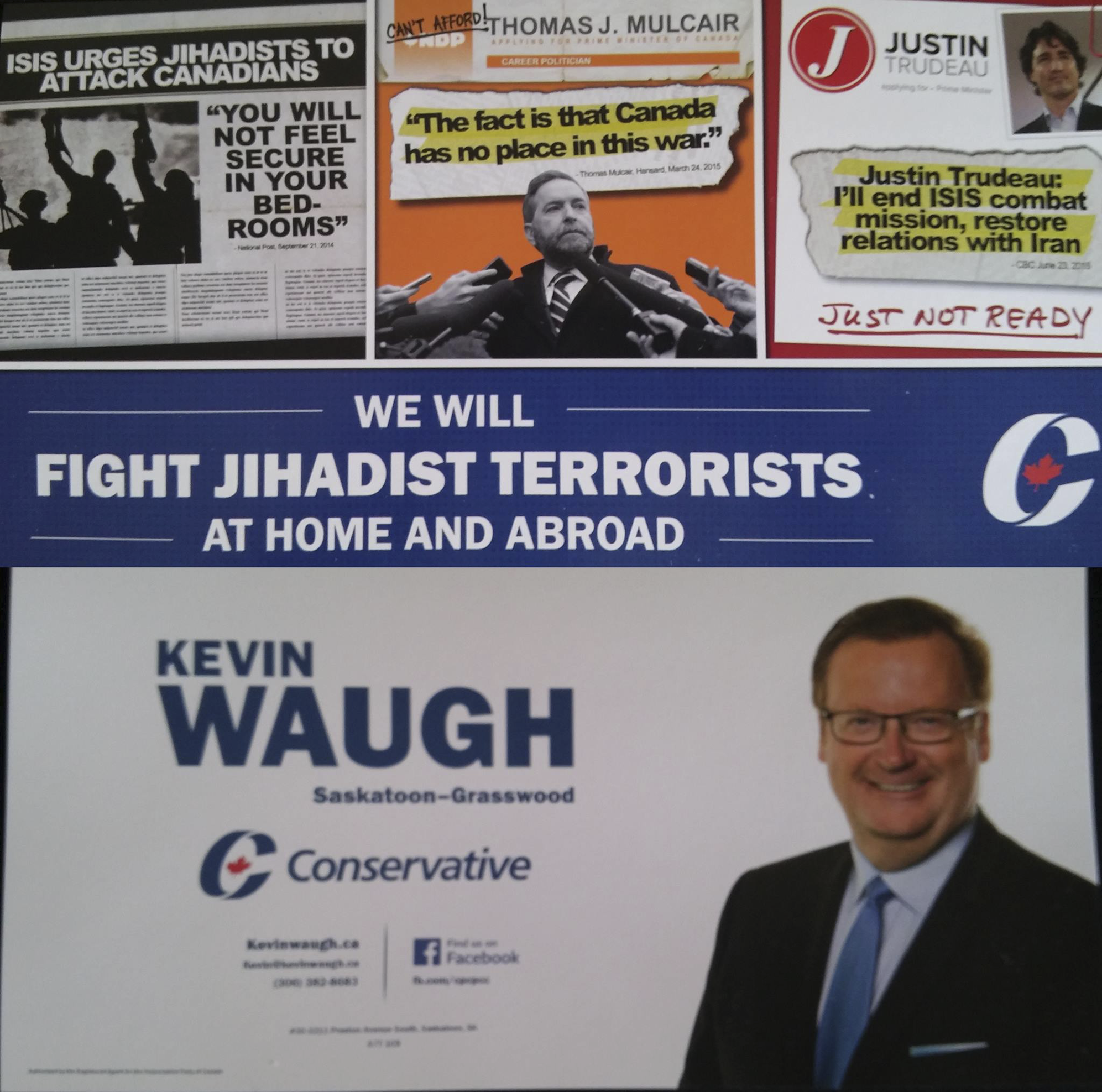
The Middle East and Canadian identity
Canadian engagement with the Middle East contributed significantly to the development of Canada’s identity and nation-building outside the British Empire. 13 Several decades after UNEF-I, Canadians had come largely to think of themselves as playing a useful and constructive role in world affairs, “as UN peacekeepers, as ‘honest-brokers’ in various international negotiations or conflict resolutions.” 14 They became accustomed to a perception that Canada supported virtually every important international accord, international law, and human rights initiative, even if the reality was different. 15 For many Canadians, this is what set them apart from other countries in the world and created a cognitive loophole that allowed them to attribute many of the world’s problems to the actions of other powers, and not themselves. This myth of Canadian exceptionalism was contrasted in particular with the United States, towards which Canada is always trying to assert an independent identity, portraying the Americans as isolationist, unilateralist, and unwilling to participate meaningfully in international institutions. 16
This progressive image of Canada was bolstered by its 1960s–1970s shift to a more liberal approach to immigration and multiculturalism. By adopting a more global immigration intake and one that was not solely from Europe, Canada abandoned its identity as an overwhelmingly white and European country. This has since been lauded, perhaps most vociferously by Canadians, for Canada’s accommodation and reconciliation of “substate” identities (i.e., not white and British), like Québécois, Indigenous, and immigrant; and is often portrayed as a uniquely Canadian trait. 17 During the 1990s, Canada further bolstered its liberal internationalist image when trying to distinguish itself as a champion of human security and later Responsibility to Protect (R2P), the idea that state sovereignty was conditional on countries fulfilling their responsibility to protect their citizens. Canada appeared to become a champion of the downtrodden and of a liberalism that was, in essence, oppositional to the violent legacies of colonialism and imperialism. By 2004, Michael Ignatieff argued, “human rights, tolerance, multiculturalism, [and] human security have all served as guiding values for Canadian foreign policy.” 18
In 2007, Marie-Joëlle Zahar asserted that peoples and governments in the Middle East largely had a positive opinion of Canada. However, Zahar also cautioned that Canada risked losing credibility by not following through with substantive action on its rhetorical commitments. 19 Hector MacKenzie warned of the negative impact which may result from any self-indulgent sense of exceptionalism caused by internalised notions of Canada’s unique goodness in the world. 20 Such idealised interpretations of Canadian state and society are after all selective, self-serving, and false. For instance, tolerance and accommodation of diversity are not distinctively Canadian, and may not even be deeply ensconced. 21 Underlining this point, contemporary polling suggests Canadians are both deeply Islamophobic and more unwelcoming of Islam than Americans. This has been expressed in very real terms by a spate of Islamophobic violence which includes the high-profile mass killings of Muslim Canadians in London, Ontario, in 2021 and Québec City in 2017. 22
While Canada has benefitted immensely from the progressive image it has cultivated in the international community, critics often argue that its image clashes with the foundational structure of a state whose rulers, for much of its history, considered it essentially a (white) British country, which was an outpost of British culture and civilisation where non-British groups, including French and immigrants were at best tolerated, but often excluded. 23 In the case of Indigenous Nations, Canada actively sought to make them disappear through cultural genocide, by dying out, intermarriage, and assimilation, perhaps most horrifically in the Residential School System. 24 This all took place while Canada was establishing its reputation as a peacemonger and champion of human rights on the world stage.
A non-idealised interpretation of Canada understands that it regularly tramples on the humanity of “substate” groups either internally or abroad, 25 and that Canada’s interventions in the Middle East have broadly been shaped by Orientalist and colonialist attitudes. 26 Some diplomatic historians even suggest that Canada only liberalised its foreign and immigration policy for cynical purposes, in the context of global decolonisation in a Manichaean Cold War that rendered the racially constructed hierarchies of European colonialism untenable. Asa McKercher argues that Canadian leadership proved particularly cognisant of fundamental changes taking place in a rapidly decolonising world after 1945, given that the United States was never comfortable with European empires and the Communist bloc was ideologically opposed to European imperialism. 27 So, Canada tried to fulfil a dual role of supporting its Western allies against Communism while helping hold the British Commonwealth, successor to the Empire, together.
This was on display during the Suez Crisis when Canada sought to support Britain and defend the latter's transatlantic alliance with the United States. The Americans had not been informed of the scheme to invade Egypt and take control of the canal, after the strategic transportation hub had been nationalised by a newly independent Egypt in search of revenue. This invasion ran contrary to global public opinion, offered a regional diplomatic opening for the Communists, and generally upset the United States over their not being consulted. Both the Soviet Union and United States threatened Britain. By innovating UNEF-I, Canada helped the invading countries save face and retreat, and helped to preserve the Anglo-American alliance. Canada thus played an exemplary role as a fixer resolving a major threat to world peace and the Western alliance, while also cultivating goodwill in the Global South and Middle East by helping block European recolonisation of Egypt and Israeli regional expansionism.
From this point, Canada clearly began to fulfil a “mediator or peacekeeper” function in the Western camp, allowing it to distinguish itself from the United States in a role the Americans could not, or did not, want. 28 Canada also fashioned itself as a Western interlocutor that appeared sympathetic to the aspirations of Global South peoples, (wrongly) arguing it was, like them, a fellow former colony without a history of colonisation, while championing the universality of human rights and voting at the UN with the Global South even on positions Canadians may have found unpalatable. 29 This would come to include voting on UN General Assembly (UNGA) resolutions sympathetic to the Palestinians, particularly during the Jean Chrétien Liberal government (1993–2003), when Canada regularly voted in favour of roughly sixteen annual resolutions that could be considered sympathetic to Palestinian rights and self-determination.
The Pearsonian liberal internationalist approach met its demise in the Middle East when a radical shift took place in Canadian foreign policy after the Harper Conservative government took power in 2006. This was most evident with Israel and Palestine. By the end of that government in 2015, Canada was voting with a handful of countries like Micronesia and the Marshall Islands against nearly all sixteen UNGA resolutions supporting the Palestinians. 30 Harper made his views on Pearsonianism known in a 2014 speech to Israel’s Knesset when he “accused Israel’s Western critics of moral relativism and said they single out Israel ‘to go along to get along.’” 31
The Harper Conservative government had a conviction that Canada should adopt policies based on moral clarity, allowing it to distinguish between good and evil in foreign affairs. 32 It portrayed liberal internationalism as morally flawed, and played down Canada the peacemaker, instead depicting Canada as a “valiant warrior” nation. 33 The government was partisan and vociferous in its support for Israel, characterising it as a beacon of light in a region of darkness. 34 This binary vision lacked nuance but lent itself well to another approach popular in scholarly, public, and security discourses during the War on Terror. There, Yasmeen Abu-Laban and Abigail B. Bakan describe how global relations were reduced to a Huntingtonian “clash of civilizations,” where race and culture were rendered synonymous, and then simultaneously obscured into racialised stereotypes. 35 This almost certainly contributed to Canada adopting an ardent and partisan Middle East foreign policy that clearly favoured what it considered like-minded and civilised Western allies, namely Israel and the United States. This identity-driven approach to international relations lends itself well to Justin Massie’s observation that Canada’s international security policy was driven, at least in part, by culturally bounded considerations. 36 The racialised element to this approach would not surprise critical scholars of race in Canada who often consider the liberal shift of the 1950s to 1970s to have been relatively cosmetic, concealing a truth that Canada is still very much affected by white nationalism and the erasure or trivialisation of Indigenous, Black, and other racialised populations. 37 With Harper’s vision of a world divided between good and evil, this led to a tendency to divide the world into friends and foes, centred on a racialised foundation, where the formerly colonised peoples of the Global South, like Arabs, were often essentialised with evil and categorised as the enemy.
Yet, the liberal internationalists’ view of Canadian identity had staying power in the national imagination. Even after a near-decade of Harper Conservative rule, Roland Paris argued their attempt to alter Canadians’ perception of their national identity did not work.
38
In fact, the Canadian public appeared to reject Harper’s approach when in 2015 the Justin Trudeau Liberals were given a strong majority on an electoral platform laced with what Norman Hillmer and Philippe Lagassé describe as progressive policy promises and not-so-subtle suggestions that they would dismantle Harper’s legacy.
39
Christopher Sands and David Carment described the Liberal platform as pledging to reinvigorate the liberal institutional order, while Richard Nimijean partially credits their victory to a clear articulation of a liberal internationalist approach.
40
Thus, when Trudeau announced “Canada is back,” the impression was given that Harper was an aberration, and optimism abounded that Canada would return to a more fair-minded approach to Middle East politics, starting with Israel and Palestine (Figure 2).
41
Mike from Vancouver. At the Liberal Party of Canada rally in North Vancouver during the last day of campaigning for the Canadian federal elections, 18 October 2015. (license CC BY-SA 2.0, original in colour) https://commons.wikimedia.org/wiki/File:Mr_Justin_Trudeau_(22117982150).jpg.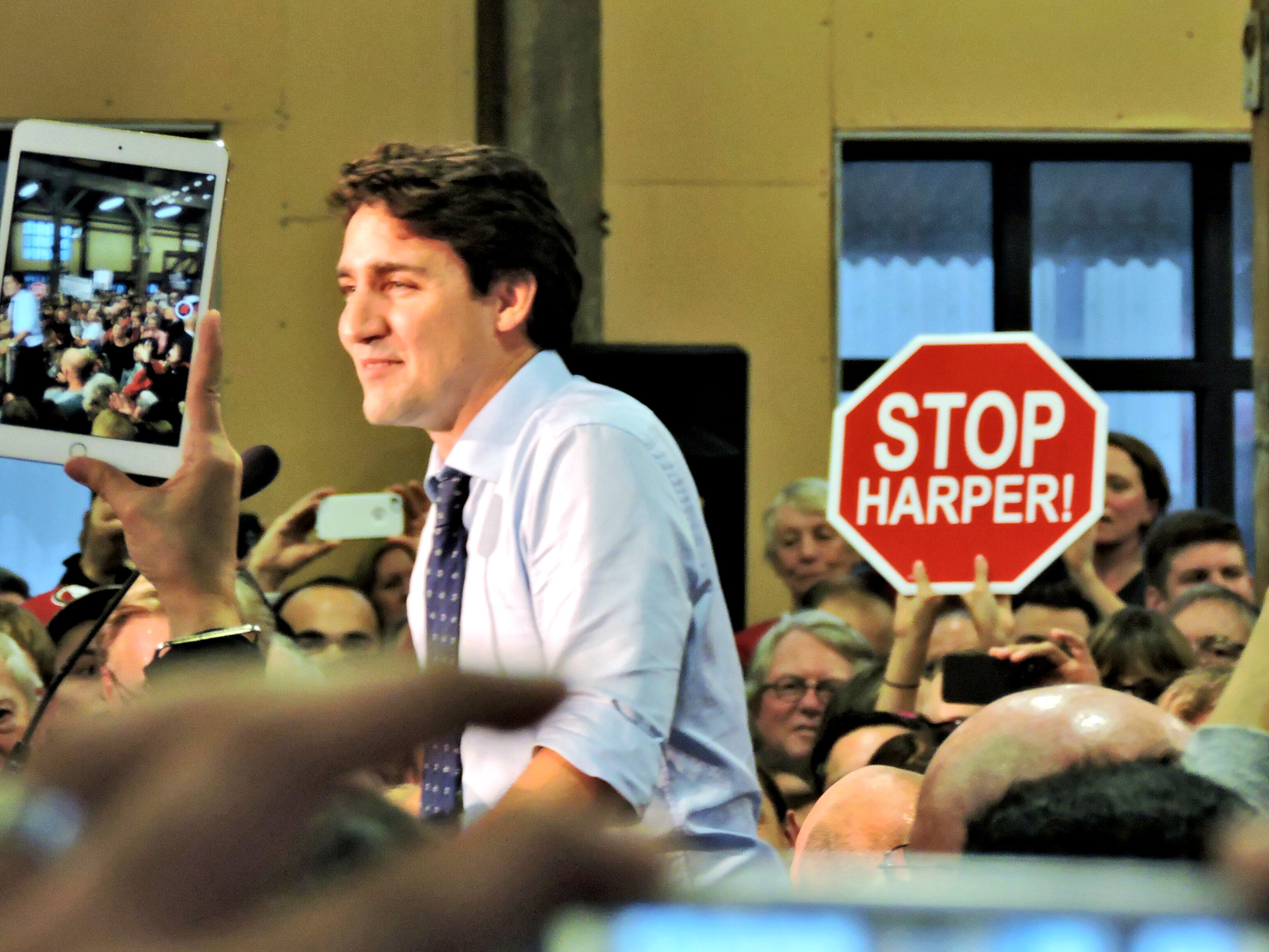
Israel and Palestine
No region in the Middle East affects Canada like Israel and Palestine, or the Occupied Palestinian Territory (OPT). 42 This was the first part of the Middle East to elicit Canadians’ official interest, 43 and to have some sort of scholarly tradition in Canada. 44 Some of the most notable events in Canadian foreign affairs history are tied to Israel and Palestine, as are many of the Middle East conflicts Canada has responded to. In addition to aforementioned events, significant occurrences that tested or are testing Canada’s governance, policy, and identity include the 2006 killing by Israel of a Canadian UN Truce Supervision Organization peacekeeper in Lebanon, scandals over how foreign aid is granted to the Palestinians and how charity law is applied to funds sent to Israel, 45 controversy over the recruitment in Canada of Canadian citizens to the Israeli military, 46 accusations levelled against Canadian charities of having an operational relationship with Palestinian terrorists, 47 allegations of anti-Semitism wielded against Canadians who criticise Israel, and the shuttering of Canada’s largest human rights agency over donations to an Israeli and two Palestinian human rights organisations. 48
Canadian charities send tens of millions of dollars in a year for activities in Israel, while Canada expended over C$1 billion on Palestinian foreign aid between the 1996/1997 and 2018/2019 fiscal years. 49 Since 2003, significant initiatives Canada funded in the OPT include a Track Two peacebuilding Jerusalem Old City Initiative (JOCI), justice training, courthouse building, and support for US training of Palestinian Authority (PA) security forces that provide security coordination to Israel. 50 In the fiscal years 2011/2012, 2013/2014, 2014/2015, and 2015/2016, the Harper government broke with tradition by not funding UNRWA, after blaming Palestinians for the 2008–2009 Gaza War. The Trudeau government began funding UNRWA again, a controversial move among Jewish community organisations. 51
Israel and Palestine are contested across Canadian institutions. Canadian media’s coverage of them is heavily scrutinized. 52 They are a contested topic in church and union politics, and the site for disputes over the meaning of human rights and genocide. 53 Nearly every university campus has Palestine and Israel advocacy groups that frequently clash with one another, while university administrations often clash with students advocating for Palestinian rights. 54 Accusations of interference against academic freedom to research Palestine abound, alongside well-understood threats to the careers of academics who dare engage. 55 In 2009, an academic conference was organised at York University to discuss possibilities for peace, entitled, “Israel/Palestine: Mapping models of statehood and prospects for peace.” Two weeks before the event, federal minister for science and technology Gary Goodyear allegedly contacted the Social Sciences and Humanities Research Council (SSHRC) president requesting they reconsider a peer-reviewed grant to it. 56 As of July 2021, the University of Toronto was under censure by the Canadian Association of University Teachers (CAUT) because a major donor intervened to reverse the 2020 hiring of a scholar, Valentina Azarova, who has a background in international law regarding Palestinians in the OPT. 57
Israel and Palestine comprise a rare part of the world that features prominently in the politics of every major federal political party, including electoral platforms, like the 1979 Progressive Conservative and 2019 Conservative pledges to relocate Canada’s embassy in Israel to Jerusalem. 58 Prime Minister Harper’s government carried out a crackdown on Canadian civil society groups working on Palestinian rights, while Trudeau has repeatedly denounced campaigns to sanction Israel. 59 Following a flare-up of protests and violence in Israel and Palestine in May 2021, support offered for Palestinians by the Green Party’s three sitting MPs ran into strident opposition by party leader Annamie Paul, resulting in a major rupture where one MP, Jenica Atwin, left the party and Paul faced a confidence vote. 60 Another Green MP, Paul Manly, was himself a political refugee from the NDP after being blocked from running in 2015 over his support for Palestinian rights. He is one of a number of potential NDP candidates who appeared to have been blocked for supporting Palestinians, as happened to potential Liberal candidates, too. 61
The parties’ interest seems partly due to the importance of the Israel-Palestine issue in spawning a multi-million-dollar public advocacy and government lobbying sector. This includes B’nai Brith Canada, the Centre for Israel and Jewish Affairs (CIJA), the Friends of Simon Wiesenthal Center for Holocaust Studies (FSWC), and the smaller Independent Jewish Voices (IJV) and Canadians for Justice and Peace in the Middle East (CJPME). Palestine has itself become the world’s highest-profile human rights cause. It has become allied with the influential Black Lives Matters movement and increasingly, in Canada, with Indigenous rights advocates. In response to May 2021’s violence, thousands of Palestine rights advocates began rallying across Canada on a weekly basis. This includes protests outside Canadian Broadcasting Corporation (CBC) offices challenging the state broadcaster’s poor coverage of the Palestinian perspective, which includes effectively banning the use of the word “Palestine” in important circumstances. 62 In fact, there is even now a tradition of major protests and counter-protests taking place over Palestine and Israel across Canada. Meanwhile, a controversial definition that equates criticism of Israel with anti-Semitism—the International Holocaust Remembrance Alliance (IHRA) definition of anti-Semitism—was quickly adopted by Global Affairs Canada (GAC) and is strongly supported by the Trudeau Liberals. In order to advance its adoption across Canada, they appointed long-time Israel advocate and former Liberal MP Irwin Cotler as a special envoy. Critics, including 150 Jewish Canadian academics, warn that the IHRA threatens to muzzle legitimate Palestinian human rights advocacy while not addressing important issues in anti-Semitism. 63
From the late 1980s until the late 2000s, there was a common practice in Canadian scholarship to analyse Canada’s involvement with Israel and Palestine, and the broader Middle East, through a liberal internationalist lens. In 1989, the same year Canada first voted at the UNGA in favour of Palestinian self-determination, Janice Stein said Canada’s Middle East foreign policy reflected a fairmindedness and “characteristically and uniquely Canadian” commitment to peacekeeping, mediation, and problem-solving. 64 Generally, Canada was portrayed in such analysis as fulfilling a traditional role as peacemaker in the region, a reflection of the peacekeeping identity beloved by many Canadians. 65
Today, Canada’s relationship with Israel and Palestine raises existential questions about Canadian identity. There is a robust Jewish Canadian community of nearly 400,000 people that identifies to a large extent with Israel, while Canada is home to a smaller but vibrant and growing Palestinian community of 44,820, which tends historically to have been supported by the broader Arab community of 947,820 (2016 census) and 1,053,945 Canadian Muslims (2011 census). 66 Political parties compete for their votes in key urban Ontario and Québec ridings. Beyond community and electoral politics, there appears to be a deep and long-running bond between Canada and Israel based on shared identities tied to race, religion, civilisation, and even settler colonialism, which may supersede the opinions of Arab and Muslim voters, or any commitment to liberal internationalism. 67
By the 2010s, it was apparent that the Harper Conservative government was striving to undo Canada’s Pearsonian tradition. They most clearly articulated this move in relation to Israel and Palestine, shifting Canada’s Middle East foreign policy overwhelmingly in favour of Israel. 68 Despite hopes by many Canadians for change in 2015, the Trudeau government has adamantly defended Israel both domestically and overseas. They oppose an International Criminal Court (ICC) investigation into Israeli war-crimes in the OPT and seek to expand the Canadian Israel Free Trade Agreement (CIFTA) to support Israeli settlements on Palestinian land. Yet, support for Israeli settlements contradicts both international law and longstanding Canadian policy. In 2020, the Trudeau government’s resistance to an Israeli plan to annex large swathes of the West Bank was so weak, it provoked an unprecedented rebuke by fifty-eight former cabinet ministers and diplomats. 69 Despite UNGA votes in favour of Palestinian self-determination in 2019 and 2020, the Trudeau government’s voting pattern on the sixteen annual Palestine resolutions remains overwhelmingly tilted in favour of Israel, even compared to Harper. 70
The Trudeau Liberal government’s flagship Feminist International Assistance Policy (FIAP), part of its early positioning as a global leader on gender equality, has been called into question in the OPT. Emma Swan’s assessment of the FIAP in Gaza found Canada’s apolitical approach at odds with a commitment to feminist-informed international assistance, which would require Canada to account for and address the political drivers of insecurity faced by Palestinian women: Israel’s occupation and blockade.
71
The Trudeau government does have a track record of offering bold public statements on gender equality while failing to incorporate a feminist epistemology into actual foreign policy. Stephen Brown observed that development projects announced since the Trudeau government came to power, including those specifically targeting women and girls, do not have particularly different underlying approaches from those funded by Harper.
72
Overall, Trudeau has differed little from Harper on Israel and Palestine, and there is a strong argument that this stasis contributed to Trudeau failing, like Harper in 2010, to secure a UN Security Council (UNSC) seat in 2020 (Figure 3).
73
Author’s Images. Pro-Palestine “Protest Nakba 73: Resistance Until Liberation” rally, Canadian Tribute to Human Rights monument, Ottawa, Canada, 15 May 2021. (cropped)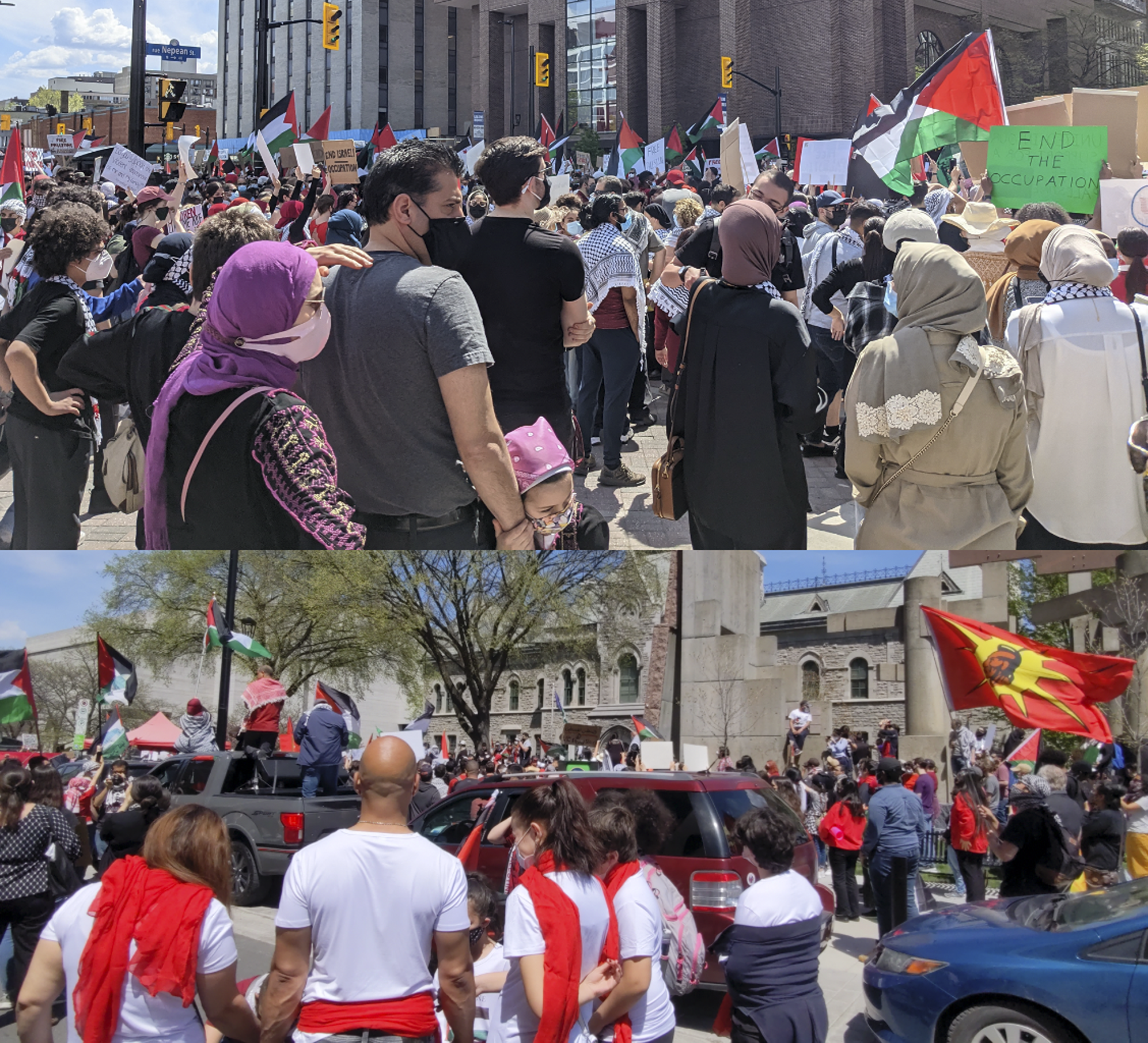
Saudi Arabia
Saudi Arabia is an energy superpower that plays an important role in global affairs, even periodically forcing Canada to rethink its foreign policy. Saudi Arabia is a Canadian regional partner within the United States–led alliance system and, though not yet a direct signatory, part of an opening-up with Israel by several Arab states that made the Abraham Accords possible. 74 Saudi Arabia has also long been the object of Canadian business interests, and successive Canadian governments have long wanted to penetrate its multi-billion-dollar weapons market. However, this presents a dilemma for Canada’s liberal internationalist and human rights identity, given Saudi Arabia’s poor human rights record and ties to the terrorism that precipitated the War on Terror. Moreover, Saudi Arabia’s persecution of “substate” groups is problematic for a country like Canada that has loudly embraced multiculturalism and once advocated for R2P. The execution of Saudi Shiite citizens has elicited concern and the 2018 extrajudicial murder of Saudi journalist Jamal Khashoggi put incredible strain on Canada-Saudi relations. 75 There are strong suspicions that Saudi security forces sought to do the same to Saudi exiles in Canada. 76
The Trudeau government’s positioning on women’s rights led to a major diplomatic row with Saudi Arabia in 2018. Following foreign affairs minister Chrystia Freeland’s criticism on Twitter of the Saudi government’s arrest of women’s rights activists, Saudi Arabia responded by suspending diplomatic ties, expelling the Canadian ambassador, recalling its envoy from Ottawa, halting future trade and investment deals, cancelling grain imports, saying it would shut down lucrative scholarships for Saudis to study in Canada, and selling off Canadian holdings by the Saudi central bank and state pension funds. 77 Unaffected was a $15 billion weapons deal negotiated by the Harper government in 2014, which the Trudeau government maintained by approving the necessary export permits.
A significant number of Canadians may have hoped the deal would get caught up in the spate of Saudi cancellations. Since the end of the Cold War, concerns in Western countries that arms sales contribute to human rights violations, instability, and warfare have prompted political leaders to script a more ethical foreign policy giving greater weight to protecting the rights and freedoms of extra-territorial citizens. 78 Often national mechanisms were set up to limit sales where abuses are suspected. Long considered among the world’s gravest human rights violators, Saudi Arabia has, since 2011, aggressively used imported weapons while hijacking or opposing reform movements across the Middle East. It has been cited for numerous violations of international humanitarian law in its fighting against rebel Houthis in Yemen. By 2019, the UN considered Yemen the gravest humanitarian crisis in the world. 79
Even the US Congress voted to block arms sales to their long-time strategic partner, which was only stopped by a rare Trump administration veto in 2019. Likewise, in the United Kingdom, a court of appeal in 2019 ordered a halt to weapons sales, citing concerns about a “historic pattern of breaches of international humanitarian law.” 80 Canadian-made weapons almost certainly end up in Yemen, despite Canada having legal restrictions intended to prevent the sale of weapons to countries that violate the human rights of their own or other countries’ citizens. 81 Canadian shipments of military goods to Saudi Arabia even hit record highs in 2019 despite a moratorium on approvals of new arms export permits. 82 Those ongoing sales are controversial to Canadians, and some have tried to physically block Canadian arms shipments to Saudi Arabia. 83
Such sales undermine Canada’s image as a liberal internationalist power. In 2019, concerns about the harm of an unregulated arms trade did drive Canada to become the 105th signatory to the 2013 Arms Trade Treaty (ATT). Yet, this may mean little for a country like Canada with a history of setting aside human rights for economic or other interests. In fact, Western arms sales have generally peaked in recent years, exposing an organised hypocrisy beneath many a liberal democracy’s ethical turn. 84 Some countries may even have been more ethical previously, while Anna Stavrianakis describes the ATT as part of a regulatory framework that facilitates and legitimises arms sales and Western militarism, by providing them with an ethical and humanitarian veneer. 85
In opposition, the Trudeau Liberals had been critical of the 2014 Saudi arms deal. David Carment and Teddy Samy in 2016 described the deal being under legitimate scrutiny because of Saudi Arabia’s record on civil liberties, political rights, gender inequality, and press freedom, and its intervention in Yemen. 86 Norman Hillmer and Philippe Lagassé describe the Liberals tying themselves in knots once in power, “with implausible assertions that the contract could not be cancelled, simultaneously declaring that their hearts bled for the victims of Saudi violence, some of whom were on the wrong end of weapons made in Canada.” 87 Jen Pedersen labels this “Liberal doublespeak regarding Saudi Arabia and human rights.” 88
There are justifications given for a Canadian ethical lapse. In 2016, Thomas Juneau argued that a realist-security interpretation prioritises the need to support allies and partners who, while not always ideal, are important bulwarks against dangerous foes like Iran or terrorist organisations like ISIS. 89 Dennis Horak, a senior Middle East diplomat and past ambassador to Saudi Arabia, has argued that the government’s core principle should be the advancement of Canadian interests and prosperity, including weapons sales. 90
From a liberal internationalist perspective, their positions may not appear to take into account the broader systemic impact of conflict and war on global society, and to assume Canada can shield itself from global issues behind the United States. Even the vaunted economic and developmental benefits of arms deals are questionable, along with the importance of a defence industrial base that is prone to corruption. 91 Meanwhile, Saudi Arabia faces an uncertain future, as its financial resources become depleted by war, COVID-19, and fluctuating oil prices, at a time when it needs to devote resources to internal development and reform for a burgeoning, youthful population. 92 Canada seems only to be reinforcing Saudi Arabia’s worst habits by selling it weapons and contributing to regional violence, rather than halting sales and challenging the Saudi positions, like a true feminist, internationalist, peacemaker would consider. 93 As with Israel and Palestine, the Trudeau Liberals essentially maintained the Harper-era foreign policy, at the expense of human rights and Canadian liberal internationalism.
Iran
Thomas Juneau and Dennis Horak made realist arguments for Canadian weapons sales to Saudi Arabia, irrespective of human rights and, in Juneau’s case, as a means to contain Iran. It is possible to assess Canada’s contemporary Middle East foreign policy through a realist lens. This can help describe the policy approach the Harper government adopted, which is centred on key bilateral relationships with Western countries, Israel and the United States. The realist interpretation aligns well with a popular approach of analysing Canada’s foreign policy through its close alliance and preoccupation with the United States, where even the liberal internationalist approach may be interpreted as Canada being a realist by fulfilling a multilateralist niche for the Americans. 94
Realism may define Canada’s relationship with Iran, a major Middle East and global energy power, with which Canada shares a bond via a large diaspora of at least 210,405 people (2016 census). 95 Iran has also been embroiled in a confrontation with Canada’s closest regional partners since 1979, which threatens the Middle East’s stability. This was highlighted after the United States’ 2020 assassination in Iraq of Iranian general Qasem Soleimani, and the subsequent downing of Ukrainian Airlines Flight PS752 by Iran, during the crisis. Of the 176 people on board, 138 were bound for Canada. 96
From 1980 to 1988, Canada shuttered its embassy in Iran, when relations deteriorated over Canadian officials helping six American diplomats escape the violent 1979 takeover of the US embassy in revolutionary Tehran. Since then, Canada has taken issue with Iran’s human rights record, nuclear weapons programme, support for Hezbollah in Lebanon, support for the Assad regime in Syria and the Houthis in Yemen, and opposition to the MEPP. Just as the Harper government aligned Canada more closely to Israel, it also moved Canada to a more oppositional foreign policy against Iran. Already between 1996 and 2011, Canada and Iran had poor diplomatic relations, where Ottawa maintained a “controlled engagement” strategy that limited the level of official contacts and topics for discussion. 97 In 2009, Prime Minster Harper said the Iranian government had “an ideology that is obviously evil,” 98 and by 2012 Canada had imposed a series of sanctions that froze trade, severed diplomatic ties, and listed Iran as a state sponsor of terrorism. The Harper government’s strategy included promoting Canadian values and human rights in Iran. Canada was even open about wanting regime change, and in 2012 delisted a terrorist organisation, a fringe group of militant Iranian exiles known as the Mujahedin-e-Khalq (MEK), committed to overthrowing Iran’s government. 99 The Conservative government’s Iran policies appeared related to Harper’s determination to be close to Israel and foreign minister John Baird’s sympathy toward Egypt, Jordan, and certain Gulf Arab states, which are hostile to Iran. 100 As a result of putting pressure on Iran, Baird received an “electric” response when in 2013 he addressed the American Israel Public Affairs Committee (AIPAC) in Washington, DC. 101
On campaign in 2015, Trudeau promised if elected to restore diplomatic relations with Iran. It appeared as though his government would fulfil this promise, as Liberal MP Majid Jowhari stated in 2016 that “[a]n absence of diplomatic representation hurts the people of both countries.” 102 At that time, the Obama administration sought détente with Iran through the Joint Comprehensive Plan of Action (JCPOA), which would see Iran roll back its nuclear programme in exchange for a gradual lifting of sanctions and opportunity to re-enter the international community. Canada had intended to be part of that process.
However, Canada was reluctant to delist Iran as a state sponsor of terror, especially given its support for Hezbollah and Hamas. By 2018, the Trudeau Liberals abandoned their pledge to improve relations with Iran, voting unanimously in Parliament for an opposition Conservative Party motion to not improve ties. Juneau noted several factors in the Liberal decision, including the lasting impact of hard-line Conservative policies such as the Justice for Victims of Terrorism Act and opposition within the Liberal Party. 103 Indeed, two leading Liberal MPs known to hold strong pro-Israel positions, Michael Levitt and Anthony Housefather, put up strong opposition to improving relations, and they had active support from influential former MP Irwin Cotler. Further, the Trump administration’s overt hostility to Iran disincentivised any rapprochement. In 2018, former prime minister Harper appeared at a “Free Iran” rally hosted by the MEK, alongside Donald Trump’s personal lawyer Rudy Giuliani and Trump advisor Newt Gingrich.
Within the context of Canadian electoral politics, in the Harper years the Conservatives calculated that they could siphon off anti–Islamic Republic voters in key urban ridings from the large Iranian diaspora community.
104
It was similar to a strategy they successfully employed with the Jewish community by adopting hard-line stances supporting Israel.
105
The tough stance on Iran would appeal to those same Jewish voters, while many Syrians in exile in Canada hold Iran responsible for reinforcing an Assad government they oppose. The Liberals are also competing for those same voters. So, despite early signals they would offer a different diplomatic approach from Harper, the Trudeau Liberals chose to stay the course with Harper’s Iran policies (Figure 4). Anonymous photographer. Iranian presidential election 2009 protests, Place Des Arts, Montreal, Canada, 15 June 2009. (License public domain, original in colour) https://commons.wikimedia.org/wiki/File:Iranian_presidential_election_2009_protests_Canada2.JPG.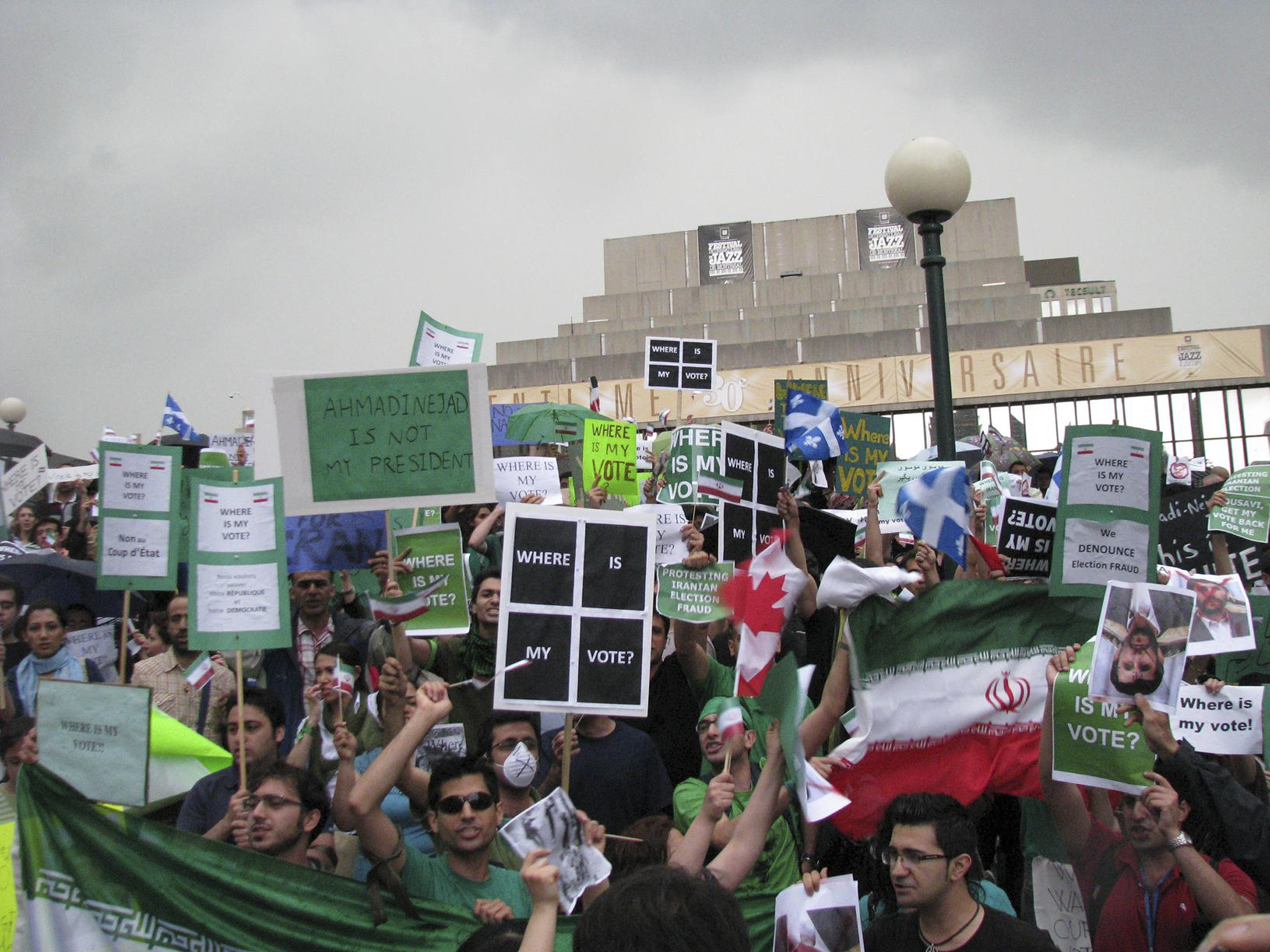
Conclusion
Canada has an important relationship with the Middle East. The deep intertwining of Canadian national identity with the Middle East situates the region as a unique barometer to assess Canada and its place in the world. This intertwining may help explain why events in the Middle East have such a strong impact on Canada. The foreign policy stakes may seem particularly high when existential questions about Canadians’ identity are on the line, and one can definitely identify the struggle playing out between Canada’s liberal internationalist and more realist foreign policy identities in its relations with the Middle East.
In 1985, Peyton Lyon described Canada’s Middle East foreign policy as a liberal internationalist by-product of its “strong commitment to the UN and its concern to preserve the cohesion of the Atlantic alliance and the Commonwealth,” while also expressing sympathy for Israel. 106 Though Canada was always loyal first to the Western camp when employing a Pearsonian approach, it would attempt to maintain balance by listening to and advocating for the views and aspirations of Global South nations. This approach reached its peak in the Middle East under the Chrétien Liberal government, when Canada considered Israel a close friend without precluding support for Palestinian rights and aspirations.
Canada’s mid-2000s Harperian foreign policy shift deliberately undermined Pearsonianism. Even though the Justin Trudeau government likes to present its foreign policy in the liberal internationalist mould, it has mostly been unable to differentiate itself from Harper’s government. This is apparent with regard to Israel and Palestine, Saudi Arabia, and Iran. There we are given the impression not of a country dedicated to peacebuilding or fairmindedness, but of one that contributes to regional instability, violence, poverty, and oppression, while picking sides in a racialised manner that raises questions about its commitment to multiculturalism. It is hard to describe such a state as “good global citizens” or playing a useful and constructive role in the Middle East.
Legitimate questions may be raised as to whether Canada’s current Middle East foreign policy is in Canadian interests. It does appear to be damaging the influence Canada once had in the region, while clashing with the identity that most Canadians associate with their country and inflaming domestic divisions, too. Meanwhile, Trudeau’s rhetoric-reality gap may have become so great as to tarnish Canada’s brand. 107 In external affairs, Canada has lost the influence it once wielded from support for human rights, peace-making, multilateralism, and multiculturalism. Once considered a soft-power behemoth that was synonymous with UN multilateralism, Canada is now unable to compete for a UNSC seat. It is possible this is part of a long-term shift that began in the mid-2000s in Canada’s national and foreign policy identities, even if the former has yet to catch up to the latter in Canadians’ imaginations. Like the emergence of Pearsonianism, this change is deeply intertwined with the Middle East, a region that has defined Canada’s international identity since the late 1940s.
Footnotes
Acknowledgements
This paper was presented in a draft form at the 2021 International Studies Association (ISA) conference panel entitled “Canada Navigates a Dangerous World: Domestic and International Dimensions” with David Carment, Richard Nimijean, Rebecca Tiessen, and Milana Nikolko. Thanks to the colleagues who offered feedback on parts of this article, Anthony Fenton and Andrew Robinson, or all of it, Asa McKercher, as well as the ISA co-panellists who offered feedback at the ISA.
Declaration of conflicting interests
The author(s) declared no potential conflicts of interest with respect to the research, authorship, and/or publication of this article.
Funding
The author(s) received no financial support for the research, authorship, and/or publication of this article.

.jpg)
