




Abstract
Both the volume of economic sanctions and the reasons for their imposition have increased tremendously around the globe. In this context, several countries, including the United States and Canada, have introduced Magnitsky acts to enable their governments to act unilaterally to impose sanctions against foreign actors for gross violations of human rights and significant acts of corruption. This paper evaluates the legislative changes made to Canada’s sanction regime in 2016–2017 and explores how the new authorities have been applied following implementation (2017–2019). We find that, despite granting the Canadian government new authorities to undertake autonomous sanctions, the country has continued to cooperate with other states as it had done prior to the changes. We conclude that lawmakers never intended for Canada to use the new autonomous capabilities to “go it alone.” Instead, the symbolism represented by Canada taking a strong stance against human rights abuses globally was the driving force behind the Magnitsky Law’s passage.
Originally applied as an alternative to the use of force, economic sanctions have been used for decades as a foreign policy tool to coerce, deter, and encourage behaviour change by foreign governments. Recently, both the volume of sanctions and rationale for imposing them have increased tremendously to address human rights violations and the subversion of democracy; fight terrorism by non-state actors; ameliorate internal conflict; and promote environmental protection. 1
This increased use of sanctions has prompted some experts to reconsider their effectiveness as a foreign policy tool more broadly. 2 Yet, part of the difficulty in evaluating efficacy is the variety of purposes for which states may impose sanctions. While, at one time, it was believed that sanctions were imposed by states in order to change behaviour in target states, it is now well recognized that sanctions are often imposed to deter further escalation, to “signal” to a domestic audience that their government is taking action, or simply to punish wrongdoers. Without understanding the purpose for imposing sanctions, it is difficult to measure whether they have been successful. 3
The increased use of sanctions also brings a growing awareness of the negative consequences of comprehensive sanctions, particularly for civilians and innocent populations. 4 While there is a solid literature on the relative efficacy of broad sanctions led by the United Nations (UN), less is known about the effectiveness of “smart sanctions,” 5 designed to be limited in scope and targeted at individual aggressors rather than entire populations. The most recent trend to emerge is the use of autonomous sanctions, whereby one or two states act to invoke sanctions against individuals in a target state, without the support of the UN or broader international community. Once solely the undertaking of global powers such as the United States, increasingly, middle powers, such as Canada, have undertaken policy changes that allow them to unilaterally impose sanctions against other countries or their citizens. 6 To complicate matters, the range of “offences” 7 that can trigger these new autonomous sanctions has also broadened. Whereas in the past, violent, societal level actions, such as South Africa’s Apartheid policy of racial segregation, led international coalitions to respond with comprehensive sanctions, new autonomous sanctions can stem from individual acts of corruption or gross human rights violations, and the resulting sanctions can be narrowly targeted on a handful of officials. 8
This article seeks to contribute to the literature on this new trend, by tracking the development and application of autonomous sanctions policy in Canada through its Sergei Magnitsky Law. To do so, we examine the legislative changes made to Canada’s sanction regime in 2016–2017 and explore the reasons its elected representatives passed those amendments. We argue that, despite giving itself the ability to act alone, Canada’s Magnitsky Law and associated amendments to the Special Economic Measures Act (SEMA) were passed primarily for symbolic reasons, and neither Canadian legislators nor the government really intended to pursue autonomous sanctions. We further demonstrate this by comparing Canada’s past behaviour with its use of sanctions for gross violations of human rights and corruption following the amendments (2017–2019). We find that, despite the new legislation’s broad, enabling capabilities, Canada has not yet used the new powers to act in a truly unilateral fashion. Instead, Canada has continued to impose sanctions together with allies per past practice. We conclude with a discussion of the additional policy risks presented by the legislative powers that now exist, even if it was never Canada’s intention to truly “go it alone.”
Canada’s Magnitsky Law
In 2016, Canada introduced a legislative bill to address human rights abuses and corruption in foreign countries. The bill commemorates Russian citizen and tax accountant Sergei Magnitsky, who was imprisoned, tortured, and killed in 2009 for investigating the alleged theft of US$230 million by Russian officials. 9 At the time, Magnitsky was employed by American investment banker Bill Browder, who was working in Russia before being forced to flee the country. 10 After Magnitsky’s death, Browder successfully lobbied American lawmakers to target Russian officials who were implicated in Magnitsky’s death via the Sergei Magnitsky Rule of Law Accountability Act of 2012. 11 Following this legislative victory in the United States, Browder then toured international capitals to lobby other countries to adopt sweeping legislation that would deny safe havens to corrupt officials of any country from operating with the same impunity as Magnitsky’s killers. 12
In 2017, Canada passed such legislation via the Justice for Victims of Corrupt Foreign Officials Act S.C. 2017, c.21 (“Sergei Magnitsky Law”), enabling the country to target foreign officials in any country who had committed gross human rights violations or serious acts of corruption. During the same period, the United States extended its own legislation under the Global Magnitsky Human Rights Accountability Act of 2016 (“Global Magnitsky Act”) to do the same. 13 The European Union (EU) is also considering its own Magnitsky law to supplement its sanctions regime. 14 These new instruments have been embraced by politicians and the broader media as important foreign policy tools in the countries where they have been adopted.
Yet, for Canada, these self-bestowed powers to act alone also represent a remarkable departure from its long tradition of multilateral cooperation. Canada has always worked with other countries to impose economic sanctions, even when it was leading efforts, as in the case of sanctions against South Africa. By passing legislation that enables it to impose sanctions outside of recognized international structures, Canada exposes itself to criticisms about motive and legitimacy. 15
Previous literature on the effectiveness of sanctions
As the use of economic sanctions has increased, so has interest in their efficacy, including the conditions under which they are most likely to yield positive results. 16 The research literature on the effectiveness of economic sanctions in foreign policy is mixed. This uneven record relates in part to measurement difficulties: defining success and measuring null outcomes (the absence of behaviour that led to sanctions or the threat of sanctions) are particularly challenging for researchers examining sanctions. 17
A study carried out by Hufbauer et al. in 1985 (updated once in 1990 and again in 2007) 18 outlined seven conditions associated with the successful application of sanctions, where behaviour change was the intention: when the goals were modest; when sanctions were imposed “quickly and decisively”; when they were targeted at states with which the sender had close ties and trade relations; if the target state was democratic; if there was no significant opposition to the sanctions by other states; when the sanctions were used in conjunction with other foreign policy tools, such as “covert measures”; and when the costs incurred by the domestic groups of the sender were lower than the expected benefits that could result from the sanctions. The study concluded that 34% of economic sanctions documented by the researchers were “at least partially successful.” 19 Other work by Drezner supports Hufbauer et al.’s 1985 conclusion, suggesting that sanctions were more likely to succeed when the target was considered democratic, costs were significant, and when an “international organization endorses the sanctions.” 20
While these factors have gained general acceptance, they are not universally embraced. For example, Pape’s 1997 paper challenged Hufbauer et al.’s 1985 findings and argued that the original study reflected an overly optimistic assessment of “success.” He agreed that only five of the forty cases evaluated as being successful in the 1985 study should have been classified as such. Furthermore, he found that the remaining thirty-five cases were influenced by factors other than economic sanctions, such as the use of force. Thus, Pape reports a success rate of less than 5% for sanctions instead of 34% reported in the 1985 study. 21
Despite disagreements over the efficacy of sanctions, it is generally agreed that sanctions are more likely to succeed at encouraging behaviour change when they impose high costs on the target state. Given this, many human rights organizations have raised concerns about the impact of state-to-state sanctions on civilian populations of target states, especially on public health. 22 Such comprehensive sanctions heavily impact the availability of basic necessities, such as food and medicine, and can have the unintended consequence of harming civilian populations more than the targeted government actors.
This awareness of the potential for unintended consequences on civilian populations has led to a move away from comprehensive sanctions towards targeted or “smart sanctions.” 23 However, since narrow sanctions are less likely to impose high costs on target states (a condition for success), the increasing use of “smart sanctions” has raised further questions about the effectiveness of economic sanctions overall. The literature, though limited, suggests that smart sanctions are even less successful than comprehensive ones. More recently, Bapat et al. have pointed to these inconclusive results to suggest, instead, that it is the threat of sanctions—rather than their imposition—that has the largest influence on a target state’s likelihood of behaviour change. 24
On the question of multilateral versus unilateral sanctions, the evidence is also mixed and the use of autonomous sanctions remains rare. In their 1985 study, Hufbauer and colleagues emphasized the use of unilateral sanctions unless cooperation with allies was necessary for reasons of legitimacy or circumvention, and multilateral sanctions only if that cooperation was genuine and concerted. 25 However, Drezner has found that smart sanctions undertaken unilaterally were likely to fair worse than multilateral action. 26 Similarly, a 2009 study by Bapat and Morgan found that multilateral sanctions had a higher likelihood of success than unilateral efforts, 27 and Doxey has argued that multilateral action conveys greater legitimacy for the decision to impose sanctions. 28 Overall, the finding that unilateral sanctions are less effective than multilateral action in encouraging behaviour change would be consistent with the related finding that smart sanctions are less effective than comprehensive ones. This is because the effect of autonomous sanctions—unless imposed by a globally influential economy such as the United States—can often be circumvented through economic ties to other countries, reducing their overall impact.
Despite the scholarly conclusion that sanctions (smart or otherwise) are generally unsuccessful at changing behaviour, Nossal pointed out thirty years ago that their use as a foreign policy tool has continued to expand. He argued that when the purpose of imposing sanctions is instead conceptualized as punishment, sanctions automatically became successful and help explain why policy-makers continued to use them. 29 More recent literature has come to similar conclusions. For example, Stalls argues that the utility of sanctions is political in nature and not dependent on behaviour change. 30 Similarly, Hufbauer and Oegg (2000) posit that, although targeted sanctions are rarely successful, they assuage the compulsion of a sending state to “do something.” 31 More recently, Whang has found support for this idea, concluding that American leaders impose sanctions for domestic political reasons in order to receive public support at home, irrespective of the outcome of sanctions on the target country. 32 Boulden and Charron also suggest that sanctions have become primarily symbolic, with little expectation of success when defined as a change in behaviour. 33
It is noteworthy that the parliamentary committee tasked with reviewing Canada’s sanctions regime summarized much of this evidence in its final report. The committee expressed a clear understanding of the incongruence when political actors champion the effectiveness of sanctions, focusing on the costs imposed on targets, without clear evidence of whether the desired policy outcome of changed behaviour has been achieved. Despite this challenge, the committee did not adopt a position on the purposes for which the Canadian government should impose sanctions moving forward, nor did it comment on whether Canada should begin using the new legislative amendments to act alone. 34
Revising Canadian conditions for imposing sanctions
Until 2017, Canada implemented sanctions almost exclusively as part of a multilateral effort.
35
This is in part because Canada’s strict legislative framework at that time enabled the government to impose economic sanctions for gross violations of human rights under only three conditions:
collectively with other states via the United Nations Act, R.S.C., 1985, c. U-2,
36
which is automatically triggered for Canada when the UN adopts a Security Council resolution to impose economic sanctions; together with other states via paragraph 4(1) of Special Economic Measures Act, S.C 1992, c.17 (“SEMA”), which allowed Canada to impose sanctions when acting as a member of an international organization of states (such as the Commonwealth)
37
that has called upon its members to do so; or autonomously, under paragraph 4(1) of SEMA if, “a grave breach of international peace and security has occurred that has resulted or is likely to result in a serious international crisis.”
38
Under that framework, the legal threshold for triggering Canadian unilateral action was high: only if a breach of international peace and security had occurred could Canada act alone to impose sanctions. Some have considered this threshold to be overly strict, preventing policy-makers from taking action. Others have pointed to gridlock at the UN Security Council and its inability to pass sanctions resolutions (condition one above) as the primary reason to expand Canada’s legislative powers to impose sanctions unilaterally. 39 This latter issue of UN paralysis was raised with parliamentarians as an argument in favour of enabling Canada to undertake autonomous sanctions. 40 Yet despite that criticism, Canada has found ways to work with allies to apply sanctions when the UN refused to act. For example, in 2014–2015, the Harper government acted in concert with the United States and EU to impose sanctions against Russia and pro-Russian forces over the crisis in Ukraine. In that case, however, the third legal condition for applying sanctions—a grave breach of international peace and security—had clearly been reached via Russia’s invasion of Ukraine.
Still, Canada’s perceived inability to use sanctions to respond to gross human rights abuses in the absence of a threat to international peace and security continued to be viewed as a gap in Canadian foreign policy.
41
Thus, a parliamentary review of Canada’s sanctions regime considered whether to lower the legal threshold for action, allowing Canada to respond unilaterally to gross human rights violations and acts of corruption in foreign states. During that process, several government and external experts offered advice regarding the bill’s enabling capabilities for autonomous action, presenting both the positive and negative implications.
42
The newly introduced Sergei Magnitsky Law addressed the perceived gap by adding two new conditions to paragraph 4(1.1) of SEMA for imposing sanctions:
gross and systemic human rights violations committed in a foreign state; and engagement in “acts of significant corruption” on behalf of a foreign state (SEMA s. 4(1.1)(c); SEMA s.4(1.1)(d))
As previously mentioned, the use of economic sanctions to address gross human rights violations is not a new concept and has long been recognized by the UN, United States, and the EU. 43 However, the key changes reflected in the SEMA amendments are significant: they enable Canada to act alone to respond to such violations, regardless of actions by allies or threats to international peace.
During subsequent parliamentary debates of the amendments, individual members of parliament (MPs) expressed mixed views regarding their own rationale for supporting the bills. With respect to the unilateral capabilities enabled by the amendments, few MPs commented, although those who did focused primarily on the continuing importance of multilateral cooperation. For example, MP Arif Virani of the Liberal Party stated, “We must implement legislation such as Bill S-226 in solidarity with other allies and members of the international community. It is only by acting in unison that we can hope to globally curb gross human rights violations and corruption.” 44
Regarding the purpose for imposing sanctions under the new act, some parliamentarians pointed to the importance of using sanctions for, “corrective action,” and for signalling to the broader community, but the majority pointed to the punitive function of imposing costs on those who behave with “impunity,” per the foreign affairs committee’s final report. Virtually every parliamentarian who spoke about the bill mentioned the circumstances of Magnitsky’s death specifically and the need to, “hold accountable,” the perpetrators of his death.
45
The views of MPs were summarized well by Robert Nault, who chaired the foreign affairs committee that reviewed the changes: Witnesses highlighted the practical use of these sanctions, for example, how imposing real costs on human rights violators could help to end the culture of impunity that too often prevailed in some countries. They also underlined the important symbolic value of sanctions, namely, how passing a Magnitsky act would demonstrate Canada’s resolve to stand up to human rights violators around the world and encourage other states to follow.
46
Overall, this examination of the foreign affairs committee’s review of the amendments, and parliamentarians’ stated intentions for supporting them, suggests that Canadian legislators sought to use the unanimous passage of the bill as a symbolic act itself. That is, by passing and implementing a Magnitsky Law, Canada could signal a strong, bipartisan position on global human rights abuses to both domestic and international audiences. This conclusion is only further supported by the lack of debate and discussion in the political calculus of the key policy change brought by the new legislation—Canada’s ability to act unilaterally. In short, the symbolism represented by passing legislation named in Magnitsky’s honour appeared to be more influential than the substantive policy changes reflected in the law.
Canada’s use of the Magnitsky Law, 2017–2019
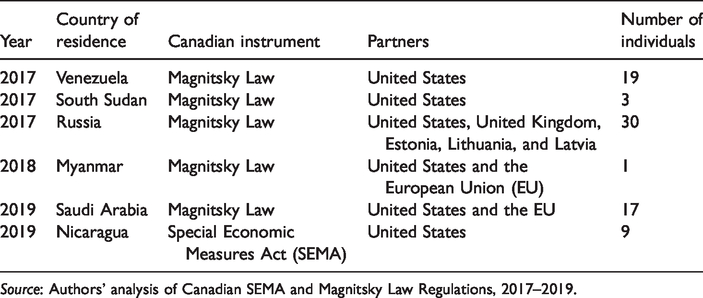
Next, we examine how, since the new legislation’s introduction, Canada has used it to address human rights violations and corruption by foreign governments and their officials. Table 1 summarizes the sanctions imposed by Canada for gross violations of human rights and/or corruption in the two-year period following the legislative amendments, from 2017 to 2019.
Canadian human rights/corruption sanctions, 2017–2019.
Source: Authors’ analysis of Canadian SEMA and Magnitsky Law Regulations, 2017–2019.
Table 1 demonstrates that, without exception, Canada acted in tandem with the US and, occasionally, also with European states (either via the EU or individual states). As mentioned previously, this behaviour matches Canadian action on Russia and Ukraine under the Harper government prior to the 2017 legislative changes. In those pre-2017 cases, Canada also acted in lockstep with, at the least, either the US or Europe. Thus, consistent with our argument, it appears that since the legislative amendments took effect, Canada has not acted more boldly, despite the government having greater authority to do so.
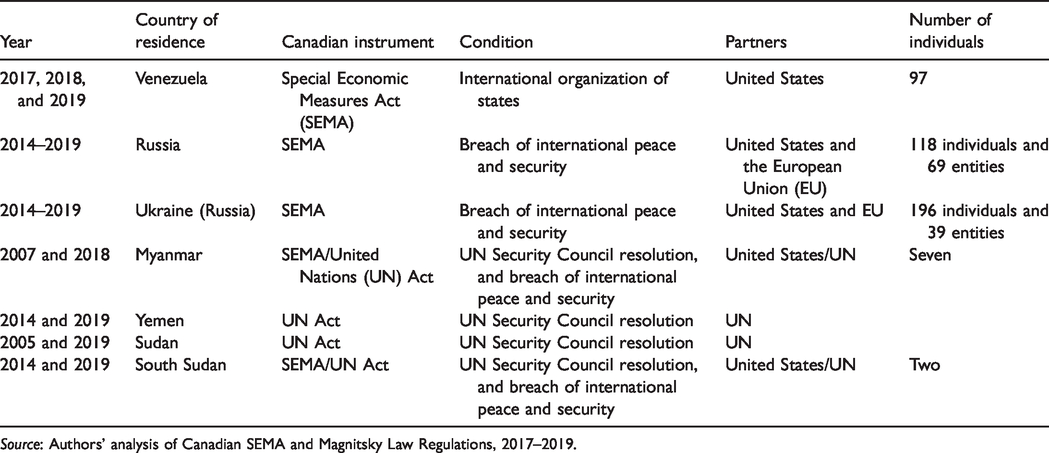
Because Canada has continued to cooperate with other states since amending its legislation, it is also worth examining whether the Magnitsky changes have enabled the country to undertake new sanctions for human rights abuses and corruption that would not have been legal under the previous legislative regime. Table 2 outlines all remaining Canadian sanctions introduced and implemented since 2017 that were not captured by Table 1, citing the legal condition for action. Table 2 demonstrates that, in every circumstance, Canada cited one of three conditions that pre-existed the 2017 legislative changes for taking action: (a) via the UN Act triggered by a UN Security Council resolution; (b) together with other states acting as an “international organization of states”; or (c) autonomously via SEMA due to a grave breach in international peace and security.
Remaining Canadian sanctions since 2017.
Source: Authors’ analysis of Canadian SEMA and Magnitsky Law Regulations, 2017–2019.
When trends from Tables 1 and 2 are combined, it appears that the unique human rights and corruption authorities amended in SEMA in 2017 have not been applied by Canada in a unilateral fashion in the initial years following implementation. Such was even the case for Venezuelan actions from 2017 to 2019, when Canada acted as a member of an “international organization of states” in which only Canada and the United States were members. Presumably, use of the international organization criteria was needed because the Venezuela case did not satisfy the SEMA threshold for a breach in international peace and security. Yet, curiously, Canada referenced its membership in “an international organization” consisting of only two members, rather than simply invoking Canada’s new legislative capacity to act autonomously. This reference may imply that Canadian officials remain deeply uncomfortable with the idea of acting alone.
Pandora’s box: implications of broadening Canada’s unilateral authority for action
Given that Canada has not yet applied the Sergei Magnitsky Law in a truly unilateral fashion, and that, since 2017, the country’s behaviour reflects previous trends, the evidence to date supports our contention that perhaps Canadian legislators never intended for the government to use the new powers to impose sanctions unilaterally. Despite this observation, now that the human rights and corruption amendments are law, Canada must acknowledge both some of the challenges that may arise from the new authorities, and potential risks for future policymaking. Furthermore, with no thresholds to anchor or restrict action, Canadian policy-makers may be forced to confront some difficult questions. For example, exactly what factors will influence Canadian autonomous sanctions under these new authorities in the future? In addition, is there a danger that the relative permissiveness of the SEMA amendments could be abused? The following subsections outline just a few of the potential issues that deserve closer attention.
Dramatic policy swings across ministers and governments
Provided that Canada’s foreign affairs minister is satisfied that gross violations of human rights or systematic acts of corruption have occurred anywhere on the planet, the minister can authorize sanctions, dramatically increasing the minister’s discretion and the potential for uneven policymaking. While SEMA’s previous, high thresholds for triggering sanctions frustrated those who wanted Canada to take bolder action to defend human rights and punish corruption, 49 those same thresholds also constrained a minister from taking rash, inconsistent, or unwarranted action. This issue was raised by Senator Woo during parliamentary debate, who expressed concerns that the legislation could open a “Pandora’s box” of policy inconsistency. 50
Conversely, ministers will also be increasingly pressured by some groups to take action under the new Magnitsky Law, regardless of the likelihood of success or negative consequences to Canada. Furthermore, Canadian governments will be required to explain and defend lack of action against countries with abysmal human rights records. 51 For example, the United States Congress has, via its own Global Magnitsky Act, passed the Uyghur Intervention and Global Humanitarian Unified Response Act of 2019, which imposes sanctions against China over the situation in Xinjiang. 52 Opposition parties in Canada’s parliament have asked the minister to extend the same sanctions in lockstep with the United States. 53 New calls have been made to impose sanctions against Chinese officials who may have suppressed information related to the COVID-19 pandemic, thereby facilitating global spread of the illness. 54 The flexibility created by the new legislation certainly enables Canada to act on either front, even if the sanctions are unlikely to sway China’s behaviour. Yet, Canadian interests might also be better served by working within an international coalition rather than by proceeding alone. Nevertheless, with the Magnitsky Law in place, the government may find it increasingly difficult to resist domestic political pressure in such cases.
Diaspora politics, signaling, and weakening Canada’s influence
As a nation of immigrants, Canada’s largest diaspora groups have significant political influence, including on Canadian foreign policy. 55 Under the SEMA changes, Canadian sanctions activity may be more susceptible to calls for action by diaspora groups in Canada. For example, during parliamentary debates of the bill, Canadian MPs emphasized the support of the Ukrainian Canadian Congress, the Polish Congress, and the Estonian Central Council in Canada. 56 Other groups specifically thanked by MPs included pro-democracy Russian, Vietnamese, Iranian, and Chinese communities in Canada for their “support, petitions, and advocacy” of the Magnitsky Law. 57
As Canadian citizens in a pluralistic society, diaspora groups should be engaged by their elected representatives on issues important to them, including on matters of foreign policy. 58 However, Carment and Landry have pointed out that Canadian foreign policy can seem confusing and inconsistent when specific policies are pursued mainly to address the interests of diaspora groups. 59 Not surprisingly, some Russian scholars and the Russian Congress of Canada have already accused Canada of using its sanctions policy merely to satisfy the Ukrainian diaspora in Canada for political gain. 60 If, as Whang has found in the United States, Canadian politicians are viewed as imposing sanctions primarily to gain domestic political support, 61 the overall influence of Canada’s sanction policy will be diminished internationally.
Use of sanctions to further Canadian self-interest
Finally, the new human rights and corruption elements of Canadian sanctions laws are most likely to be implemented against fragile and authoritarian states, many located in the Global South. To date, all individuals sanctioned by Canada for human rights violations and/or corruption reside in such countries, and Canada has poor diplomatic relations and weak economic ties with most. Drezner has demonstrated that sanctions are least likely to be effective in deterring or changing the behaviour of such states. 62
More problematic—at least in perception—is that Canada competes directly for commodity exports with several countries sanctioned under the new legislation. Saudi Arabia, Russia, and Venezuela are major oil exporters and competitors for Canadian oil sands products: all three have been sanctioned by Canada via the Magnitsky Law. Though this paper makes no suggestion that Canada is engaging in sanctions to erect unfair trade barriers against these countries, any perception that Canada could be advancing its own export interests via sanctions policy weakens its influence and legitimacy in these areas. 63
Conclusion
Despite the mixed evidence on the efficacy of autonomous sanctions, Canada proceeded to make legislative amendments to its sanctions legislation to enable unilateral action. This paper has demonstrated that, despite granting the government such authorities in 2017, Canada has yet to act alone on any of the sanctions imposed since. Instead, Canada has continued to find comfort in numbers, and has always acted together with at least one other country. In short, all of the sanctions imposed since 2017 could have proceeded under the previous legislative framework. Consequently, we conclude that the government passed the Magnitsky Law and its associated SEMA amendments primarily for symbolic reasons, without necessarily intending to use the autonomous powers they enabled. Yet, this act was not merely a symbolic. The amendments now in force also expose Canadian sanctions policy to greater pressures to take action, to politicize those actions for domestic political purposes, and to pursue uneven policy decisions that could result in dramatic policy swings over time.
Some will argue that Canada’s early adoption of a Magnitsky law is motivating other countries to pursue similar legislation, which will, in turn, enable more countries to cooperate on global efforts to impose sanctions for human rights violations. Indeed, that may well be the case. Nevertheless, as has been outlined, these benefits must be balanced against the risks of adopting authorities to act alone, especially if the current government never really intended to do so. Not addressed by this article is Canada’s capacity to weather retaliatory action by targeted states should a response to sanctions proceed in such a manner. Canadians have already experienced a taste of such retaliation from China over the arrest, on 1 December 2018, of Huawei executive Meng Wanzhou.
It is still early days, and, possibly, Canada will make use of its new authorities eventually. If the current administration President Donald Trump in the United States continues to be an unreliable ally, Canada may find itself alone and in need of greater authority to act unilaterally in this policy area. Yet, it seems unlikely. Many have long admired Canada’s commitment to multilateralism, and to the country’s rejection of aggressive unilateral action on the international stage. 64 It is doubtful that the country will voluntarily select the dangerous and aggressive geopolitical climate offered by the 2020s as the time to change course.
Footnotes
Declaration of Conflicting Interests
The authors declared no potential conflicts of interest with respect to the research, authorship, and/or publication of this article.
Funding
The authors disclosed receipt of the following financial support for the research, authorship, and/or publication of this article: The authors thank the Government of Canada (Social Sciences and Humanities Research Council of Canada) for financial support.

1
Margaret Doxey, “Reflections on the sanctions decade and beyond,” International Journal 64, no. 2 (2009): 541; Adam Smith, “A high price to pay: The costs of the US economic sanctions policy and the need for process oriented reform,” UCLA Journal of International Law and Foreign Affairs 4, no. 2 (1999): 325–376; Makio Miyagawa, Do Economic Sanctions Work? (Houndmills, UK: Palgrave Macmillan UK, 1992).
2
Doxey, “Reflections”; Bryan Early, Busted Sanctions Explaining Why Economic Sanctions Fail (Palo Alto, CA: Stanford University Press, 2015), 539–549; Robert A. Pape, “Why economic sanctions do not work,” International Security 22, no. 2 (1997): 90–136; Miyagawa, Do Economic Sanctions Work?
3
Doxey, “Reflections,” 541–542; Kim Richard Nossal, “International sanctions as international punishment,” International Organization 43, no. 2 (1989): 301--322.
4
Daniel Drezner, “Sanctions sometimes smart: Targeted sanctions in theory and practice,” International Studies Review 13, no. 1 (2011): 96–108; Susan Hannah Allen and David J. Lektzian, “Economic sanctions: A blunt instrument?” Journal of Peace Research 50 no. 1 (2013):121–135; Dursun Peksen, “Better or worse? The effect of economic sanctions on human rights,” Journal of Peace Research 46, no. 1 (2009): 59–77. Nossal, “International sanctions.”
5
Jane Boulden and Andrea Charron, “Evaluating UN sanctions,” International Journal 65, no.1 (2009), 1–11.
6
Idriss Jazairy, “Unilateral economic sanctions, international law, and human rights,” Ethics & International Affairs 33, no. 3 (2019): 291–302.
7
Nossal, “International sanctions.”
8
Justice for Victims of Corrupt Foreign Officials Act (Sergei Magnitsky Law), S.C. 2017, c. 21, https://laws-lois.justice.gc.ca/PDF/J-2.3.pdf; Justice for Victims of Corrupt Foreign Officials Act (Sergei Magnitsky Law), Bill C-267, 1st reading, 5 May 2016, 42nd Parliament, 1st sess. (2016), http://www.parl.gc.ca/HousePublications/Publication.aspx?Language=E&Mode=1&DocId=8236905 (accessed 1 October 2019).
9
10
11
Sergei Magnitsky Rule of Law Accountability Act of 2012, H.R. 4405 (2012).; “2019 year-end sanctions update,” Gibson, Dunn & Crutcher LLP (23 January 2020).
12
13
“2019 year-end sanctions update.”.
14
15
Nossal, “International sanctions. Miyagawa, Do Economics Sanctions Work? Jazairy, “Unilateral economic sanctions.”
16
Doxey, “Reflections,” 541.
17
Doxey, “Reflections,” 539–549.
18
G. C. Hufbauer, J.J Schott, K. A. Elliott, and B. Oegg, Economic Sanctions Reconsidered, 3rd ed. (Washington, DC: Peterson Institute for International Economics, 2007); G. C. Hufbauer, J.J Schott, and K. A. Elliot, Economic Sanctions Reconsidered, 2nd ed. (Washington, DC: Institute for International Economics, 1990); G. C. Hufbauer, J.J Schott, and K. A. Elliot, Economic Sanctions Reconsidered: History and Current Policy (Washington, DC: Institute for International Economics, 1985).
19
Hufbauer et al., Economic Sanctions Reconsidered, 158.
20
Drezner, “Sanctions sometimes smart,” 99.
21
Pape, “Why economic sanctions,” 99–106.
22
Allen and Lektzian, “Economic sanctions.”
23
Drezner, “Sanctions sometimes smart.” Idriss Jazairy, “Unilateral economic sanctions.”.
24
N. A. Bapat, T. Heinrich, Y. Kobayashi, and T. C. Morgan, “Determinants of sanctions effectiveness: Sensitivity analysis using new data,” International Interactions 39, no. 1 (2013): 79–98.
25
Hufbauer et al., Economic Sanctions Reconsidered, 175.
26
Drezner, “Sanctions sometimes smart,” 104.
27
N. Bapat and Clifton T. Morgan, “Multilateral versus unilateral sanctions reconsidered: A test using new data,” International Studies Quarterly 53, no. 4 (2009): 1075–1094.
28
Doxey, “Reflections”; Drezner, “Sanctions sometimes smart.”
29
Nossal, “International sanctions.”
30
31
Gary C. Hufbauer and Barbara Oegg, “Targeted sanctions: A policy alternative,” Law and Policy in International Business 32, no. 1 (2000): 18.
32
Taehe Whang, “Playing to the home crowd? Symbolic use of economic sanctions in the United States,” International Studies Quarterly 55, no. 3 (2011): 787–801.
33
Jane Boulden and Andrea Charron, “Evaluating UN sanctions,” International Journal 65, no. 1 (Winter 2009–2010): 3.
34
35
Michael Nesbitt, “Canada’s ‘unilateral’ sanctions regime under review: Extraterritoriality, human rights, due process, and enforcement in Canada’s Special Economic Measures Act,” Ottawa Law Review 48, no. 2 (Fall 2017): 509-576.
36
37
M. Rossignol, Sanctions: The Economic Weapon in the New World Order (Ottawa: Library of Parliament, 1996).
39
Nesbitt, “Canada’s ‘unilateral’ sanctions.”
40
Canada, House of Commons, Standing Committee on Foreign Affairs and International Development, A Coherent and Effective Approach.
41
Nesbitt, “Canada’s ‘unilateral’ sanctions.”
42
43
Hufbauer et al., Economic Sanctions Reconsidered.
44
45
Canada, House of Commons Debates, 42nd Parliament, 1st Sess., 148, No. 181, (19 May 2017).]
46
Ibid.
47
Liberal Member of Parliament (MP) Irwin Cotler sponsored a bill under Harper’s Conservatives, which was then sponsored by Conservative MP James Bezan under the Trudeau Liberals after Cotler left office.
48
49
Nesbitt, “Canada’s ‘unilateral’ sanctions.”
50
51
52
Uyghur Human Rights Policy Act of 2019, S. 178, 116th Cong. (2019).
53
54
55
“Tapping our potential: Diaspora communities and Canadian foreign policy,” The Mosaic Institute and Walter & Duncan Gordon Foundation, Annual Report, 2012. David Carment and Joseph Landry, “Diaspora and Canadian foreign policy: The world in Canada?” In: Adam Chapnik and Christopher J. Kukucha, eds., The Harper Era in Canadian Foreign Policy: Parliament, Politics, and Canada’s Global Posture (Vancouver: University of British Columbia Press, 2016), 210–227.
56
57
Ibid. d
58
“Tapping our potential: Diaspora communities and Canadian foreign policy,” The Mosaic Institute and Walter & Duncan Gordon Foundation, Annual Report, 2012.
59
Carment and Landry, “Diaspora and Canadian foreign policy.”
60
E. O. Balkylych, “What does Canada need sanctions for? Crucial factors of Canadian foreign policy towards Russia,” Izv. Saratov Univ. (N. S.), Ser. History, International Relations 19, no. 2 (2019): 204–207. [In Russian.] DOI: https://doi. org/10.18500/1819-4907-2019-19-2-204-207. Canada, House of Commons Debates, 42nd Parliament, 1st Sess., 148, No. 210, (2 October 2017). d
61
Whang, “Playing to the home crowd?”
62
Drezner, “Sanctions sometimes smart.”
63
Doxey, “Reflections.”
64
Author Biographies
Meredith Lilly is Associate Professor at the Norman Paterson School of International Affairs (NPSIA), Carleton University, where she holds the Simon Reisman Chair in International Affairs.
Delaram Arabi is completing her MA in International Affairs at NPSIA.