



Abstract
The rapid development of high-speed railways (HSR) worldwide has provided a fast, convenient, safe, and comfortable mode of transportation. It is also an important public transportation tool for green travel, contributing to the reduction of carbon emissions. HSR has a strong competitive advantage in long-distance passenger transportation, but it faces significant competition from the aviation industry. Airlines attract passengers with discounted fares and differentiated pricing strategies, apart from shorter travel times. Therefore, it is necessary for railway enterprises to enhance their competitiveness through differentiated pricing methods for HSR. In this study, we focus on optimizing a long-distance origin-destination (OD) pair and creating a competitive market environment by considering all operating trains and flights for the selected OD pair. We aim to improve the realism of the study by considering passengers’ fully rational travel choice behavior. To reduce the complexity of variables, passengers are grouped based on their expected departure time and income level. A mixed integer linear programing model is developed to address the problem, aiming to minimize overall travel costs for passengers while ensuring that the income of the railway enterprise does not fall below a specified value. By setting this specific value, the maximum revenue of HSR train tickets can be obtained.
Keywords
Introduction
Motivation
The HSR system has been instrumental in promoting fast and convenient passenger transportation since its inception. HSR has become an important choice for travelers, with the rapid development of HSR networks and systems in Europe and China, as well as people’s increasing attention to choosing low-carbon and environmentally friendly transportation modes.
The HSR network has been developed rapidly in China. China’s HSR currently has the most extensive operation network in the world, with a mileage of over 40,000 km, giving it a leading position. This extensive network has allowed China to accumulate and develop advanced operation and management experience and technology, making HSR a significant mode of travel for passengers within the country. In 2020, HSR passenger traffic in China reached 1557 million, accounting for 70.7% of the total passenger traffic of the railways. Consequently, optimizing passenger ticket pricing for HSR has become the focus of many scholars’ research. The goal of revenue management for passenger services on HSR is to maximize the number of train passengers and achieve the highest overall revenue. Achieving this objective involves implementing specific pricing strategies or restrictions on ticket purchases. The core of HSR ticket price optimization lies in passenger allocation or their HSR travel choice behavior (including the class of train, seats, departure time, travel time, etc.).
In the long-distance passenger transportation market, HSR faces fierce competition from airlines. Aviation has the advantage of time cost compared with HSR for travel distances of 1000 km and above. Additionally, special tickets with flexible price fluctuations often attract more passengers due to their economic advantages. Bian et al. 1 propose a market entry game model to analyze the competition between HSR and airlines in passenger transportation. Therefore, it is crucial for HSR to set flexible ticket prices in order to attract more passengers from airlines and ensure profitability in a completely competitive market environment.
The existing research on HSR ticket optimization has primarily focused on dynamic and static ticket pricing. Various methods, such as logit models and the principle of system equilibrium, have been employed in these studies. While some research has considered passenger travel choice behavior, many fail to fully account for self-interest and make choices based on limited rationality. This discrepancy with reality stems from the fact that passengers are inherently self-centered individuals who seek the most satisfactory travel options, including transportation modes and train schedules.
To address this gap, our study aims to investigate how HSR can effectively compete with the aviation industry in a fully competitive market environment. By incorporating fully rational passenger travel behavior, we seek to maximize HSR ticket revenue. This approach is more aligned with reality as it allows each passenger to choose their preferred train or flight when purchasing tickets. By optimizing HSR ticket prices, railway enterprises can effectively compete with airlines and attract a larger customer base. Ultimately, this research will contribute to the growth and success of the HSR sector, benefiting both passengers and railway enterprises alike.
Literature review
The optimization of HSR ticket prices is derived from the optimization of railway passenger ticket prices as a whole. Ciancimino et al. 2 conducted the initial study on optimizing passenger railway ticket prices. This study introduces a deterministic linear programing model and a probabilistic nonlinear programing model to address the problem of allocating tickets to different seat classes. You 3 extended the previous model by dividing each trip into full-price and discounted portions and created a nonlinear integer programing model to optimize railway revenue management and seat bookings. Hood 4 transformed passenger decision factors into a generalized cost in order to develop a choice model for improving timetabling and passenger ticket pricing decisions. Kraft et al. 5 discuss the benefits of using the bid price methodology in railway revenue management and the challenges associated with traditional airline-style, ESMR leg-based approaches in the context. Bharill and Rangaraj 6 examined the cross-price elasticity of demand for the three products offered by the Rajdhani Express. They utilized these values to create a mathematical model for assessing the consequences of fare adjustments and supplementary costs, like cancelation fees, on customer demand.
Static pricing and dynamic pricing are two different approaches to pricing strategies. Static ticket pricing is a pricing strategy employed by HSR for a specific duration. During this time, fixed prices are established by considering market demand, costs, and competition. No modifications to these prices are made throughout the designated period. Some scholars optimize ticket prices based on market demand to address supply and demand relationships and improve revenue. Lei et al. 7 conducted a bilevel programing model to optimize ticket prices of HSR, specifically focusing on maximizing enterprise benefits and minimizing passenger travel costs. The Beijing-Shanghai high-speed railway was used as a case study for empirical analysis. Robenek et al. 8 substituted the deterministic passenger satisfaction function with a probabilistic demand forecasting model to integrate the optimization of HSR schedules and ticket prices. Zhan et al. 9 building upon the work of Robenek et al., 8 considered the impact of ticket prices on fairness in order to improve the accessibility for low-income passengers. The timing of travel significantly affects the supply and demand relationship, with distinct differences in demand during peak and off-peak periods. Jing et al. 10 developed a dual-layer planning model to investigate the time-based pricing strategy for intercity railways, taking into account the volatility of passenger flow. This model aims to adjust the intercity railway ticket prices during different time periods, in order to regulate the supply and demand relationship between passengers and tickets. Zhao et al. 11 adopted a fully differentiated pricing strategy to optimize HSR ticket prices, taking into account the differences in running time and departure time for the same OD pair of trains.
Currently, seat reservations have also been included in the research on ticket price optimization. Luo et al. 12 proposed an interactive booking-limit control to improve the efficiency of partitioned booking-limit control for demand with high randomness. This approach aims to optimize train seat allocation and play a crucial role in boosting passenger ticket price revenue.
Ticket prices have varying levels of attractiveness to different customer segments. Qin et al. 13 categorized the passenger transport market based on factors influencing passenger choice behavior and developed a differentiated ticket pricing model to address elastic demand. Xia et al. 14 considered the heterogeneity of passenger price sensitivity and used passenger travel choice behavior and traffic distribution theory to construct a spatiotemporal network, transforming the fare optimization problem into a multi-commodity flow problem considering spatiotemporal resource constraints.
Dynamic ticket pricing refers to the real-time adjustment of ticket prices based on market demand and supply conditions. HSR employ various tactics, such as price discounts, promotions, and other methods, to attract passengers and enhance seat utilization and revenue. It is highly necessary to dynamically adjust fare prices over time, as there is a significant numerical difference in passenger demand between peak and off-peak periods. van Vuuren 15 explored the connection between optimal pricing economic theory and the estimation of railway demand price elasticity and marginal costs, offering theoretical support for optimizing ticket prices during peak and off-peak periods. Wang et al. 16 proposed a dynamic optimization model for single-line HSR with multiple ticket prices and time periods, aiming to achieve optimal revenue and seat allocation. Hu et al. 17 utilized a multi-stage discriminatory pricing strategy, aiming to attract a larger passenger base and ultimately boost overall revenue. They also devised a nonlinear programing model to jointly optimize pricing and seat allocation, enabling an analysis of the dynamic ticket price structure. Li et al. 18 analyze the passenger demand of parallel trains operating between the same OD but during different time periods. They develop a discrete-time dynamic planning joint pricing model to maximize the overall expected revenue of both trains.
Different groups of passengers or specific travel needs can also have a profound impact on HSR ticket purchase choices, making it essential to incorporate travel demands into HSR ticket pricing strategies. Zhang et al. 19 proposed an integrated revenue-maximization model that combines operation planning and pricing. This model utilizes dynamic ticket pricing, considers elasticity in passenger demand, and incorporates flexible dispatching. Qin et al. 20 developed a differentiated pricing model by segmenting the passenger market according to factors that impact passenger choice behavior, considering elastic demand. Wu et al. 21 incorporated seat allocation into a dynamic pricing problem for HSR and developed a co-optimization model. Jiang and Li 22 used the MNL model to describe the passenger’s ticket purchasing behavior and conducted a study on overall revenue maximization for parallel train services based on different passenger demands. Hetrakul and Cirillo 23 studied the random heterogeneity of passenger information with priority data and the choice behavior of passengers through a complex demand model. Chou et al. 24 conducted an optimization study on train ticket pricing by integrating operation, passenger perception, and time-space compression costs using an HSR floating ticket-pricing model. Xu et al. 25 considered the sensitivity of HSR ticket prices to demand and subsequently developed a non-concave non-linear mixed integer optimization model to address the issues of HSR ticket pricing and seat allocation.
Additionally, the HSR ticket pricing strategy factors in passengers’ travel behavior choices, which can be either limited or fully rational. The behavior of limited rationality resembles the theory of system equilibrium in traffic flow, where some individuals give up their own optimal choices for the sake of maximizing collective benefits.
The logit model is an important method for representing passenger choice behavior. Cheng et al. 26 analyzed passenger travel choice behavior by establishing a mixed logit model using real survey data. Nuzzolo et al. 27 developed a passenger railway travel choice model based on a nested-logit choice model to evaluate the effects of fare adjustments. Hetrakul and Cirillo 28 conducted a random heterogeneity study on passenger information regarding priority data using a complex demand model, aiming to investigate passengers’ choice behavior. Su et al. 29 analyzed the preferred characteristics of passenger departure time periods and used a multiple Logit model to simulate passenger travel choice behavior. They developed a coordinated integrated optimization model for differentiated pricing and ticket allocation among multiple trains on HSR.
Some scholars use system optimization theory to reflect the limited rational choice behavior of travelers. Lin et al. 30 influenced passengers’ choices by adjusting railway ticket prices to optimize the performance of the system.
Problem statement
Passenger grouping technology
When passengers make decisions about their mode of transportation, several factors come into play. These factors include travel time, ticket prices, departure time, and the convenience of reaching the transportation hub. Considering these aspects is crucial for passengers to choose a train or flight that aligns with their expectations. However, modeling each passenger individually during a study can be challenging due to the large scale of the model. To overcome this issue, this study employs passenger grouping technology for modeling purposes.
In this study, passengers are grouped based on two key factors: the expected departure time
Passengers within each group share the same expected departure time and income level. Moreover, their ability to perceive the utility of travel is also identical. Consequently, the travel cost of taking the same train is equal for every passenger within the same group. Therefore, this study assumes that each passenger group is indivisible, and only the travel choice behavior of the entire group is considered. This approach helps reduce the complexity of the problem and allows for a more manageable analysis.
Research problem
This paper discusses the fully rational travel behavior of passengers, where they prioritize choosing the HSR train or flight with the lowest travel cost. However, due to capacity constraints of the transportation vehicles, not all passengers can achieve the minimum cost travel option. Additionally, this article stipulates that the total ticket revenue of the HSR trains must exceed a certain requirement to meet the expectations of the railway enterprise, which can be reasonably determined by the decision-makers.
In summary, the research problem of this article can be described as follows: in a long-distance OD scenario, where multiple HSR trains and flights are operating to meet the transportation needs of passengers, how can the optimization of ticket prices for each train change the travel choices of passenger groups, and encourage more passengers to shift to HSR, thereby increasing the revenue from HSR train tickets? This problem is influenced by a series of factors, such as the capacity constraints of HSR trains and flights, the travel behavior of passenger groups, and the range of fluctuation in HSR train ticket prices.
Mathematical model formulation
Model assumptions
To facilitate the model formulation, the following assumptions are introduced.
Notations, parameters, and variables
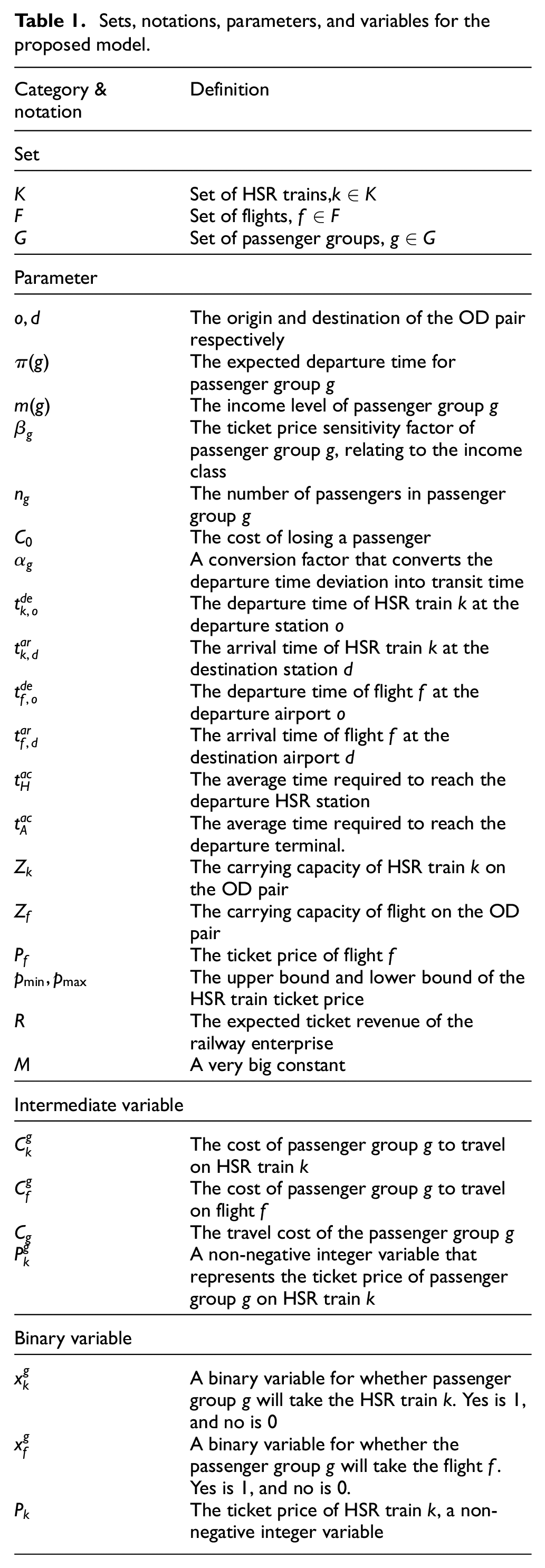
The sets, parameters, and variables of the proposed optimization model are listed in Table 1.
Sets, notations, parameters, and variables for the proposed model.
Optimization model
Objective function
The objective function aims at minimizing the total passenger cost including the passenger loss cost and travel cost. We have the objective function of ticket price optimization as follows:
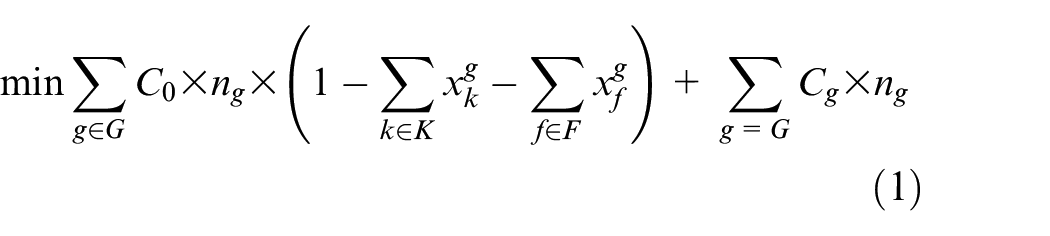
As shown in equation (1), the objective function consists of two terms. The constant term in the first term represents the total cost incurred by passenger group
Constraints
To generate the optimal ticket pricing strategy, the following constraints are proposed to specify the passenger’s choice of travel mode.
(1) Passenger travel choice constraints
This study considers a competing environment where passenger groups have the option to travel either by HSR trains or other transportation modes, based on different ticket prices. Thus, we establish the passenger travel choice constraint, as depicted in equation (2):

Equation (2) indicates that the passenger group will either choose an HSR train or a flight (when
(2) Travel cost constraints of passenger group


Equations (3) and (4) are used to determine the travel costs for passengers. When choosing between HSR train
(3) Travel cost calculation constraints
In this study, the total travel cost of HSR tarins and flights is consisted of several parts as shown below. and the total travel cost of HSR trains and flights are all influenced by these components.
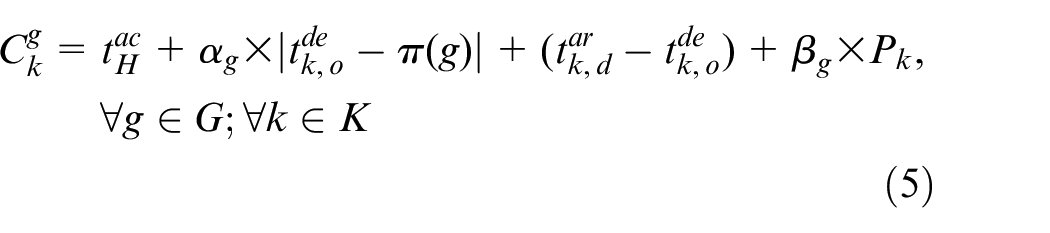
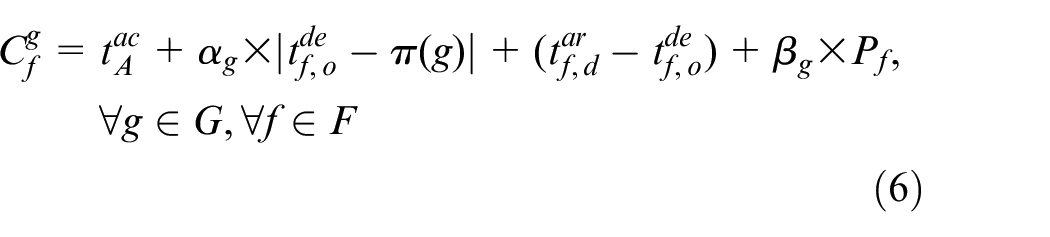
Equations (5) and (6) calculate the total travel costs for a specific passenger group
(4) Capacity constraints
Obviously, the number of passengers transported by an HSR train or a flight should not surpass the maximum capacity of the train or aircraft.


Equations (7) and (8) ensure that the number of passengers on HSR trains or flights does not exceed their own capacity. When the number of passengers in a passenger group exceeds the remaining capacity of the group’s expected HSR train or flight, this group of passengers will choose to cancel their travel, resulting in passenger loss.
(5) The fluctuation range constraint of HSR train ticket prices
In this study, we establish both upper and lower limits for ticket prices. The ticket price for each HSR train

According to equation (9), the ticket price for the HSR tarin
(6) HSR ticket price revenue constraints
In this study, we aim to maximize the ticket revenue of the railway enterprise. To achieve the goal of maximizing the HSR train ticket revenue, we introduce the expected ticket revenue of the railway enterprise and establish HSR ticket price revenue constraints. This constraints ensure that the total revenue from HSR tickets does not fall below the expected total revenue of the railway enterprise. By adjusting the expected ticket revenue of the railway enterprise, we are able to maximize the HSR ticket revenue.



Equation (10) ensures that the total ticket revenue of the HSR should not be less than the desired total passenger ticket revenue of the railway enterprise. Equations (11) and (12) determine the specific ticket price for passenger group
(7) Passenger fully rational travel choice constraint



Equations (13)–(15) reflect the fully rational travel choice behavior of passengers. These equations apply to passenger group g and involve a comparison among all HSR trains and flights. Each passenger group
The loss of passenger groups is jointly determined by the passengers’ fully rational travel choice behavior constraints and the capacity constraints of transportation modes. The passengers’ fully rational travel choice behavior constraints, represented by equations (13)–(15), dictate the specific travel choices preferred by each passenger group. These choices include the mode of transportation and the train/flight numbers. Consequently, the number of the corresponding passenger group is reduced based on the capacity of the specific choices. If the capacity of the most preferred mode is insufficient for a certain passenger group, the group of passengers will be lost.
(8) Variable constraints


Equations (16) and (17) outline the value range for the decision variables
In conclusion, the mathematical model established in this paper consists of an objective function (1) and a set of constraints (2)–(17). This model is a mixed integer linear programing model which can be solved using commercial solvers.
Case study
To demonstrate the effectiveness and efficiency of the proposed approach, numerical experiments are conducted in this section. The formulated model, which is a mixed-integer linear programing model, is encoded using the Python language. The CPLEX solver is then employed to generate the solutions. All experiments are performed on a computer equipped with an Intel Core i7-10510U CPU @ 1.80GHz and 16 GB of RAM.
Basic information and parameter values
HSR train and flight data
This study conducts empirical analysis and optimizes the ticket prices of all HSR trains at the OD of Beijing South Railway Station - Shanghai Hongqiao Station on January 28. The experimental object is the OD of the Beijing-Shanghai HSR. On that day, there are 30 HSR trains and 41 flights operating. The timetable of all trains and flights is shown in Figure 1, where the straight line represents the HSR train operation line, and the dotted line represents the flight operation line. It is important to note that this study focuses solely on the single OD and temporarily does not consider the stop information of all trains along the way. Thus, only the departure and arrival time of trains at the departure and destination stations are taken into account.
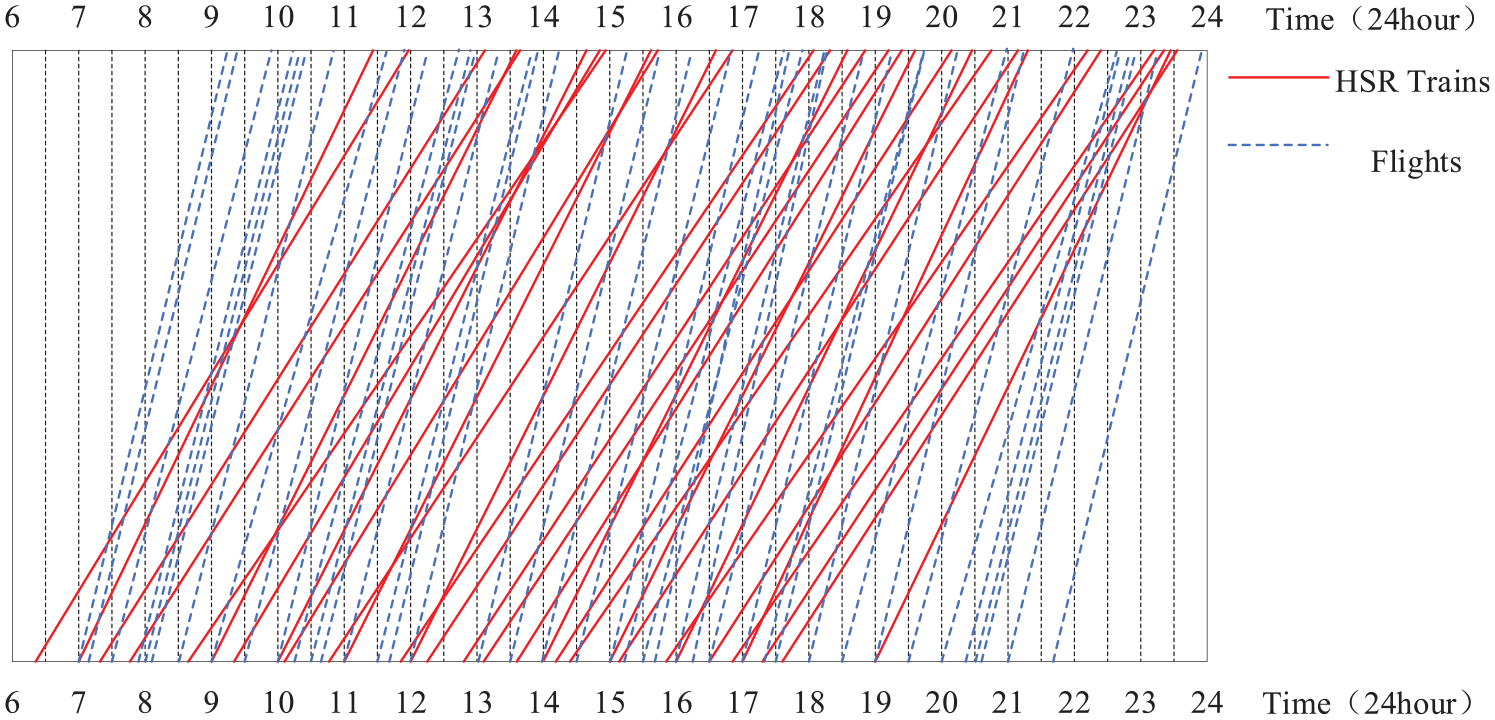
Schedule of trains and flights on January 28.
The HSR train system includes express trains that only stop at major stations and slow trains that stop at more stations. Based on historical ticket sales data, the passenger capacity for express trains on the OD route is set at 400 people, while for slow trains it is set at 100 people. The passenger capacity for all flights is set at 200 people.
Ticket price data
According to the official 12,306 ticketing website, the ticket prices for these 30 trains are divided into nine categories: 526 yuan, 553 yuan, 576 yuan, 598 yuan, 604 yuan, 626 yuan, 631 yuan, 662 yuan, and 667 yuan. The highest price of 667 yuan and the lowest price of 526 yuan can be considered as the upper and lower limits of the price fluctuation. For the prices of each flight, they can be found on Ctrip Travel website. Due to space limitations, they are not listed here.
Passenger flow data
This study generates passenger groups according to the following steps:
1) The expected travel time for passengers is set to be distributed between 6:00 to 21:00. The periods from 6:00 to 6:59, 11:00 to 12:59, and 16:00 to 21:00 are designated as off-peak hours, while the rest of the time falls under peak hours.
2) During off-peak hours, a passenger group of 60 individuals is generated every 10 min, which is further divided into subgroups of 20 individuals based on income levels.
3) During peak hours, a passenger group of 90 individuals is generated every 5 min, which is further divided into subgroups of 30 individuals based on income levels.
4) Finally, a total of 399 passenger groups are generated.
Relevant behavior data of passengers
The parameter settings related to the passengers’ travel choice behavior are as follows. Due to the private nature and difficulty of obtaining information about travelers’ purpose of travel and personal habits, this study sets the deviation time conversion coefficient
Experiment 1
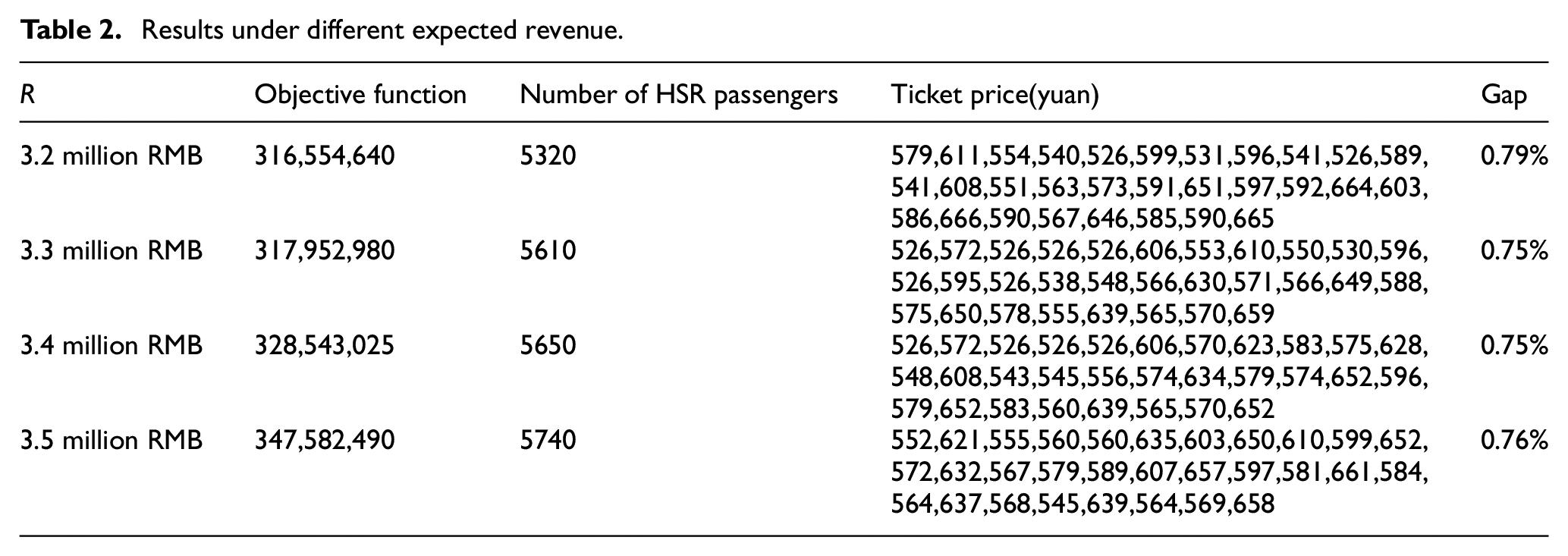
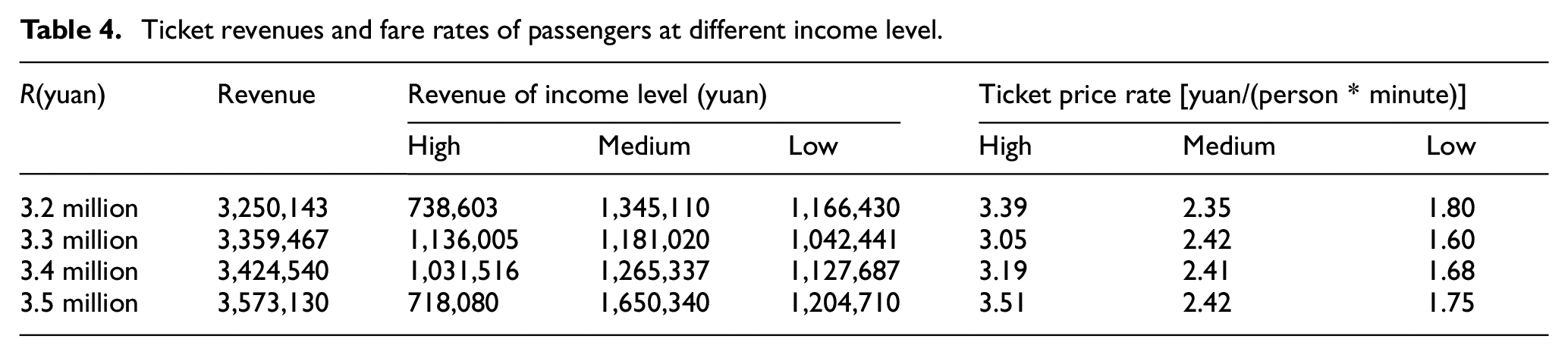
In this study, we conducted an analysis by incorporating different expected ticket revenue values (i.e. 3.2 million, 3.3 million, 3.4 million, and 3.5 million) into the model. In addition, considering the drop rate of the gap value and memory consumption, we determined a solution time of 7200 s. The calculation results of the actual high-speed rail passenger ticket revenue and the objective function are summarized comprehensively in Table 2. The preferred modes of transportation and their respective quantities for some selected passenger groups are presented in Table 3. The specific passenger ticket revenue results brought to the railway company by different income level passenger groups under different expected ticket prices are shown in Table 4.
Results under different expected revenue.
The amounts of part of the passenger groups’ minimum travel cost.
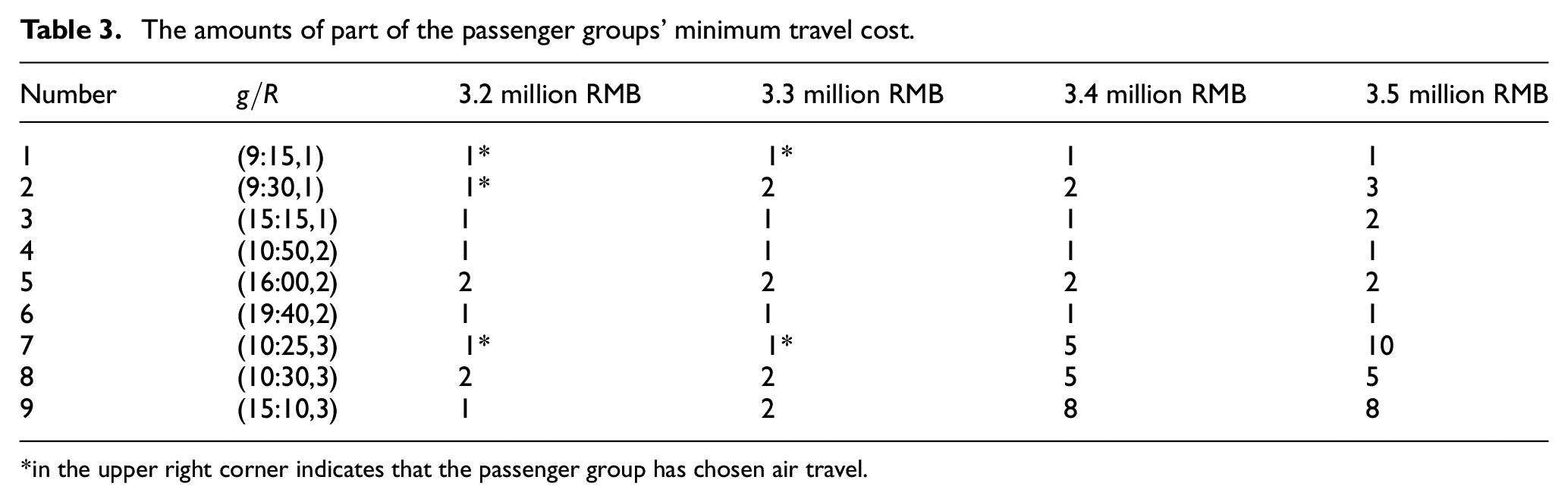
in the upper right corner indicates that the passenger group has chosen air travel.
Ticket revenues and fare rates of passengers at different income level.
According to the data presented in Table 2, the objective function value, which represents the total travel cost for passengers, increases as the demand for HSR ticket revenue rises. This reflects the intricate relationship between the interests of railway enterprises and passengers. The results of the experiments indicate that the travel cost of HSR trains can be influenced by adjusting the HSR ticket prices for different passenger groups. High-income level passengers exhibit a low sensitivity to HSR ticket prices, while medium-income level and low-income level passengers display a relatively high and very high sensitivity to HSR ticket prices, respectively. Therefore, when formulating HSR ticket pricing strategies, it is advisable to increase ticket prices for popular train services, thereby significantly raising the travel costs for middle-income level and low-income level passenger groups and dissuading them from choosing these trains as their preferred mode of transportation. At the same time, high-income groups are willing to pay more for these trains, ensuring high occupancy rates and generating increased ticket revenue from these passengers. Conversely, for less popular train services, reducing ticket prices can attract middle and low-income passenger groups who are price-sensitive. This approach not only prevents the loss of these passenger groups due to high-income individuals occupying the trains they intended to ride but also boosts the number of passengers on less popular trains, thereby improving overall ticket revenue. Consequently, the proposed HSR ticket differentiation pricing scheme outlined in this paper has the potential to attract more passengers to HSR trains and generate higher total ticket revenue. However, it is important to note that when the value of
To investigate the impact of a differential ticket pricing strategy on passengers’ preference for traveling by HSR trains, we present the preferred travel modes and the number of travel modes of some of the passenger groups in Experiment 1 with different expected revenues of the railway enterprise, i.e.,
Table 3 presents the number of travel plans and choice outcomes for selected passenger groups at different target income levels (i.e. these plans have the same and minimal travel cost). It can be observed that adjustments to ticket prices have attracted the first, second, and seventh groups of passengers to switch from air travel to high-speed rail. Additionally, based on the devised pricing plans, the optimal number of travel plans has increased for the second, seventh, eighth, and ninth passenger groups. This indicates that air travel is no longer the sole best option for these passengers, as high-speed rail offers comparable or even more favorable travel costs. As a result of these two scenarios, which are achieved through reasonable adjustments to ticket prices, the number of times high-speed rail is chosen by passengers has increased, leading to an increase in ticket revenue and an enhancement of high-speed rail’s competitiveness in the passenger transportation market.
Table 3 demonstrates the number of travel options and selection outcomes for different target incomes across various passenger groups. These options have identical and minimum travel costs. It is evident that adjusting ticket prices has attracted the first, second, and seventh passenger groups to switch from air travel to choosing HSR. This means that HSR trains, due to their advantages in ticket prices and departure times, have successfully reduced travel costs for specific passenger groups and managed to entice them to select HSR to travel. In addition, with the implementation of the ticket price scheme, there has been an increase in the number of optimal travel options for passenger groups 2, 7, 8, and 9. This means that the changes in ticket prices have resulted in a growing number of HSR trains providing these passenger groups with the same minimum travel costs. As a result, the travel costs of HSR trains are now on par with or even more favorable than air travel, which has attracted these passengers to choose HSR trains. Both scenarios above are the reasonable outcomes of adjusting ticket prices. By implementing differentiated pricing for HSR train tickets, the travel costs for the HSR trains are reduced, making them the preferred modes of transportation for a certain passenger group. As a result, the proposed method of differentiated pricing for HSR, mentioned in this paper, increases the frequency of passengers choosing HSR trains, leading to an increase in ticket revenue and an improvement in the competitiveness of HSR in the passenger transport market.
To assess the contribution of each income group to the railroads’ passenger ticket revenue, we calculated the specific revenue contribution of passenger groups with varying income levels under different expected revenues, i.e.,
Table 4 presents the ticket revenue from HSR for passengers of different income levels, based on various expected revenue requirements, as well as the corresponding ticket price rates for each income level passenger group. It is evident that high-income passengers, who are less price-sensitive but highly sensitive to travel time, tend to prefer flights that have shorter travel time. As a result, high-income passengers generate relatively less ticket revenue for HSR. Conversely, high-income passengers who choose to travel by HSR trains opt for the shortest travel time, leading to the highest ticket price rates for this group. On the other hand, middle and low-income passenger groups, who are more sensitive to price and less sensitive to travel time, prefer HSR for their travels. Consequently, these passenger groups contribute higher ticket revenue. However, due to the relatively longer travel time associated with their choice of the slower HSR trains, the ticket price rates for middle and low-income passengers are lower compared to those of high-income passengers.
Experiment 2
Experiment 2 compares the model proposed in this paper with the passenger flow allocation model under the fixed ticket price scheme. The ticket price in the model under the fixed ticket price scheme is no longer a variable but a fixed constant. This model is obtained by removing the constraints (9)–(12) based on the model in this paper.
Based on the fixed ticket price plan, the HSR generated an income of 3,109,390 yuan with 5040 passengers choosing to travel by HSR trains, resulting in an average occupancy rate of 77.30%. As for the results of Experiment 1, with an
We analyzed the passenger numbers of each train under both the fixed pricing scheme and the differentiated pricing scheme proposed in the paper. Then, we used this data to calculate the seat occupancy rate for each trip on the HSR trains under the two pricing schemes. Finally, we created a line graph comparing the seat occupancy rates, which is shown in Figure 2.
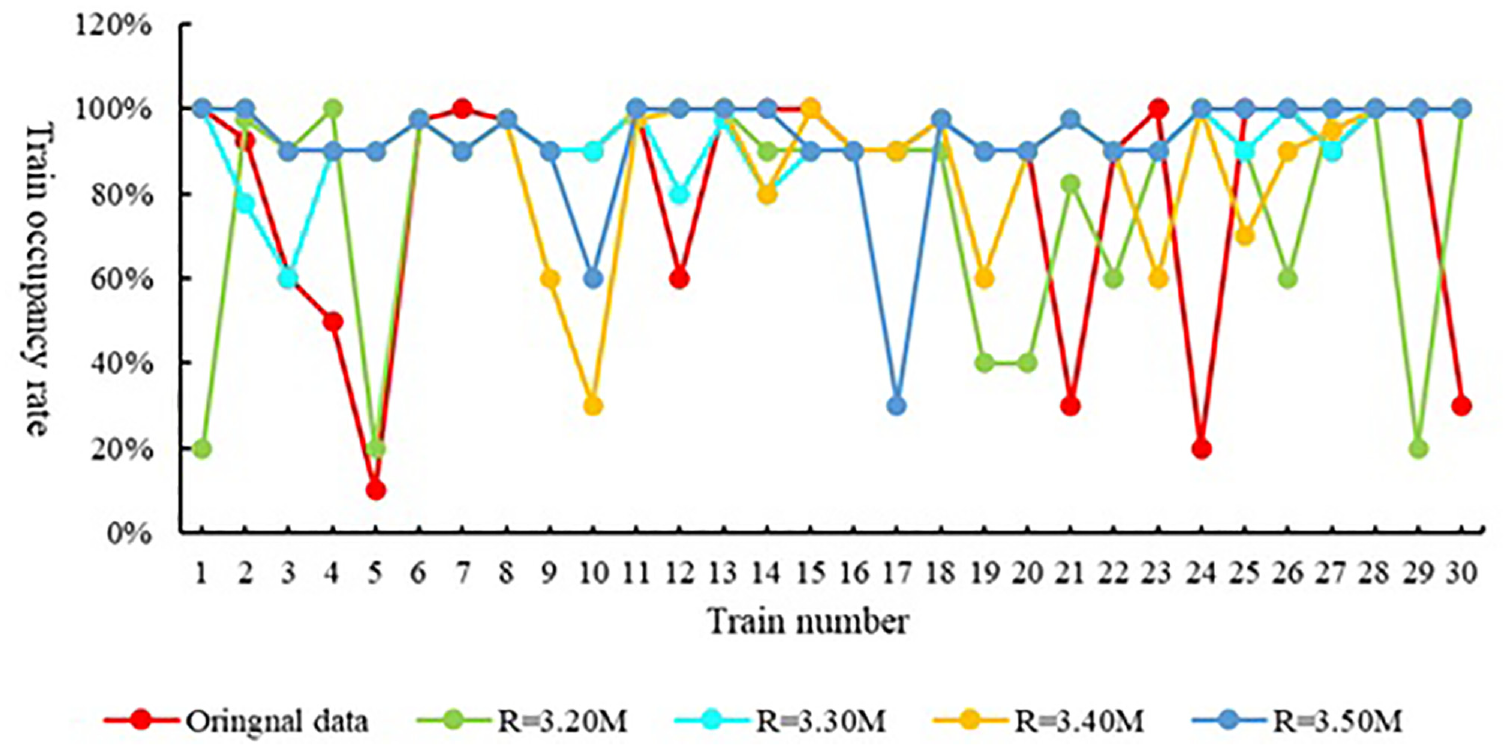
The comparison of train occupancy rate.
The occupancy rates of trains under different scenarios are shown in Figure 2. Based on the model presented in this study, the analysis of the obtained scenarios, combined with the conclusions from Table 3, reveals that the railway enterprise has attracted more passengers to choose HSR trains to travel and increased the occupancy rate of the trains by optimizing ticket prices. Particularly during off-peak periods, the discounted ticket prices reduced the cost of travel for passengers compared to the fixed ticket price scheme, which attracted more passengers to take the train. As a result, the occupancy rate of trains during off-peak periods increased and the difference in occupancy rates between peak and off-peak periods decreased. Furthermore, as
Table 3, resulting in an increase in the overall number of passengers riding the HSR trains. This leads to a smoother line representing the train occupancy rate, indicating a gradual reduction in differences in seat occupancy. This illustrates the effectiveness of the proposed approach in attracting more passengers to ride the HSR trains by setting reasonable ticket prices, thus achieving the desired effect of increasing passenger flow during off-peak periods and reducing the passenger flow disparity between peak and off-peak periods.
Conclusions and future research
This paper presents a HSR long-distance OD ticket pricing optimization model. The model takes into account various factors such as the full competitive market environment, passengers’ fully rational travel behavior, and the heterogeneity of ticket price sensitivity. The model is solved using CPLEX to minimize the total travel cost for passengers while maximizing the HSR ticket revenue for the railway enterprise by certain constraints. By considering these factors and utilizing advanced optimization techniques, the proposed model aims to provide a comprehensive and efficient approach to optimize ticket pricing in the context of HSR transportation. The results of this paper have the potential to contribute to the development of more effective ticket pricing strategies and revenue management practices in the HSR system.
Based on the actual case, this study analyzes the ticket price schemes, passenger fully rational choice behavior, changes in passenger ticket price rates, and the differences from the fixed ticket price scheme under different ticket revenue requirements. The conclusions are as follows: (1) Through the reasonable formulation of the HSR ticket price scheme, the actual HSR ticket price revenue can meet the railway enterprise’s demand for passenger ticket revenue. However, this revenue is capped at 3.6 million yuan. (2) High-income passengers are more inclined to choose air travel, with their ticket prices being approximately 1.4 and 1.8 times higher than medium-income and low-income passengers respectively, due to their low sensitivity to ticket prices and high sensitivity to travel time. Medium and low-income passengers contribute the most to HSR ticket revenue, accounting for approximately 70% of the total. (3) The ticket price schemes proposed in this study have certain advantages over the fixed ticket price scheme. HSR attracted an additional 700 passengers, resulting in an 18.34% increase in the average occupancy rate of trains. Furthermore, the ticket revenue saw a 14.9% increase.
The model formulated in this study can be regarded as a static ticket price optimization model of HSR within the single OD range. However, it is important to note that the flight ticket price changes dynamically throughout the ticket-selling period. This dynamic pricing results in passengers exhibiting specific characteristics of ticket-buying behavior, with most passengers being accustomed to purchasing tickets before departure. In order to address this dynamic pricing problem, the model proposed in this study can be utilized in conjunction with the framework of the rolling time domain algorithm. This involves dividing the ticketing period into several periods based on historical ticketing data. Consequently, for each period, the model is solved by acquiring passenger demand data, recording the flight price for that specific period, and updating the train and flight capacity in accordance with the solution results from the previous period. Ultimately, this approach enables the derivation of a dynamic pricing strategy for the entirety of the HSR ticket selling period.
In this study, HSR ticket pricing optimization was limited to second-class seats and single OD trips. However, future research can expand on this by considering a broader range of seats and cabin classes (such as first class, business class, and first class) as well as including additional passenger group characteristics, such as the specific time that passengers avoid departing at. Furthermore, it would be valuable to examine HSR ticket pricing optimization for multiple ODs, taking into account passenger flow and ticket prices between intermediate stations.
Footnotes
Authors’ note
The work presented in this paper remains the sole responsibility of the authors.
Declaration of conflicting interests
The author(s) declared no potential conflicts of interest with respect to the research, authorship, and/or publication of this article.
Funding
The author(s) disclosed receipt of the following financial support for the research, authorship, and/or publication of this article: This work is supported by the Technology Research and Development Plan of China State Railway Group [grant number: 2022F004].

Data availability statement
Data sharing not applicable to this article as no datasets were generated or analyzed during the current study.