




Abstract
To address the situation that the degraded system cannot be repaired as new and the degradation is accelerated after repair in engineering practice, an imperfect condition-based maintenance model is proposed based on the Gamma process by introducing the maintenance improvement factor and the accelerated degradation factor. The maintenance improvement factor describes the recovery degree of the degradation amount after imperfect maintenance, then gives a quantitative representation method of the system maintenance improvement effect and the determination method of the maximum number of imperfect maintenance. The accelerated degradation factor is combined with the geometric process to describe the accelerated degradation process of the system after imperfect maintenance. The Monte Carlo method is used to determine the optimal number of imperfect preventive maintenance decisions. Through the demonstration of calculation examples, the influence of accelerated degradation factor and maintenance improvement factor on the long-term operation maintenance rate and the optimal number of imperfect maintenance is analyzed. The results show that the model can more comprehensively describe the degradation and maintenance process of degraded systems, and it can effectively reduce maintenance cost ratio under long-term operation. It provides a certain theoretical support for formulating an economical and reasonable maintenance strategy that is more in line with the actual degradation and maintenance process in engineering practice.
Keywords
Introduction
Common mechanical equipment in daily life is a degraded system, and the degradation of the system will have a closely related impact on production and life. Maintenance is an important means to maintain the normal operation of equipment. 1 With the increasing complexity of mechanical equipment systems and the continuous improvement of safety and economic requirements, maintenance after failure can no longer meet the needs of production and life. The development of sensors and Internet of Things technology makes it possible to detect the status of equipment, and condition-based maintenance can arrange different maintenance plans and adopt different maintenance methods according to the operating status of equipment, so condition-based maintenance has attracted people’s attention. Therefore, studying the condition-based maintenance strategy of degraded systems is of great significance for improving the reliability and safety of equipment operation and reducing failure losses.
Condition-based maintenance can effectively improve the reliability of equipment so that different maintenance methods are adopted according to different conditions. But in early research on preventive maintenance, most studies used the minimum maintenance and perfect maintenance. However, in the actual maintenance process, the system is usually repaired to a certain state between “as new” and “as old,” which is imperfect maintenance.2,3 Imperfect maintenance can repair the degradation process of the system, thus increasing the system lifetime. In the imperfect maintenance model for the degradation process, the change of degradation level before and after maintenance is generally used to describe the imperfect maintenance. 4 The recovery degree of degradation after imperfect repair can be determined 5 or it could be random. 6 When the recovery degree of system degradation is determined, there are the service age reduction model and the degradation restoration model respectively. 7 The service age reduction model believes that the service age after the maintenance will return to a certain time before the maintenance to a certain extent, and this time is the corresponding virtual service age. Accordingly, the degradation level of the system is also restored to the virtual service age. The degradation restoration model considers that after the system undergoes the imperfect maintenance, the degradation can be repaired in a certain proportion. However, some scholars believe that the maintenance recovery factor is random, 8 so the effect of imperfect maintenance is random. When the recovery degree of the degradation level is uncertain, the Beta distribution can also be used to describe the random recovery degree of the degradation level.9,10 In fact, as the number of imperfect maintenance increases, the impact of such maintenance will gradually diminish. The improvement in degradation level will decrease if the system continues to undergo imperfect maintenance. Therefore, it is essential to limit the number of imperfect maintenance to ensure better improvement of the degradation level after preventive maintenance. 11
In fact, imperfect maintenance will have multiple impacts on the system. Chen et al. 12 believe that it will have both positive and negative impacts on the system. The degradation speed of the system before and after maintenance is also affected, not just the influence of imperfect maintenance on the degradation level. 13 In condition-based maintenance, which is based on the degradation process, it is commonly assumed that the rate of degradation of the system remains constant both before and after maintenance.14,15 However, in actual equipment operations, the structural strength of the system gradually decreases as its age increases or maintenance is performed. This results in the phenomenon of accelerated degradation. For instance, industrial welding of metal components can shorten the crack length and extend the use time, but it will also destroy the physical mechanism of the internal material, thus accelerating the degradation rate of metal components. As a result, the system after imperfect maintenance often experiences an acceleration in its degradation process. 16 Li et al. 17 takes hydraulic couplers as an example to verify the existence of system degradation acceleration. Despite this, most existing strategies for preventive maintenance in degraded systems rely on perfect maintenance, and many models for imperfect preventive maintenance only take into account the changes in system state after a single instance of maintenance. For example, Van and Bérenguer 18 only consider the change of degradation level after imperfect maintenance and does not consider the diminishing effect of restoration degree of degradation level after imperfect maintenance. Chen et al. 19 only considers the phenomenon that the degradation process of the system accelerates with the increase of maintenance times, but does not consider the change of the degradation level after maintenance. As a result, most current condition-based maintenance models do not fully consider the changes in the imperfect system before and after maintenance.
Therefore, this paper proposes a maintenance model based on accelerated degradation after imperfect maintenance, which comprehensively considers the influence of imperfect maintenance on the degradation level and speed of the system. It describes the recovery level of the system’s degradation after imperfect maintenance through the maintenance improvement factor and uses an accelerated degradation factor to describe the acceleration of the system’s degradation process after imperfect maintenance. The model provides a robust methodology to support the formulation of realistic and reasonable maintenance strategies for degraded systems.
System description and assumptions
General assumptions
The following assumptions are used to develop the model:
Degradation model
Degradation failure is one of the main failure modes of equipment components. In the process of operation, the system experiences an increasing degradation level over time until failure due to the influence of wear, fatigue, corrosion, and crack growth, erosion, consumption, creep, swell, degrading health index, etc. 20 Assumption 1 posits that the degradation of the system is strictly incremental. The Gamma process, characterized by independent non-negative increments, is suitable to model gradual damage monotonically accumulating over time in a sequence of tiny increments. Mercier and Castro 7 and Li et al. 17 are also modeled using the gamma process. Therefore, this paper adopts the Gamma process for modeling.
Considering β > 0 as a scale parameter and v > 0 as a shape parameter, the gamma density is defined as follows:

where
Furthermore, let v(t) be a non-decreasing, right-continuous, real-valued function for t ≥ 0, with v(0) = 0. The gamma process with shape function v(t) >0 and scale parameter β > 0 is a continuous-time stochastic process{X(t), t ≥ 0} with the following properties:
X(0) = 0,
In the case that the degradation process of the system is a stationary Gamma process, v(t) = αt. Then, at time t, the expectation and variance of performance degradation are respectively:

Maintenance strategy
Condition-based maintenance strategy
The condition-based maintenance strategy mainly includes two parts: detection strategy and maintenance strategy. According to assumption 2, the length of the detection interval is represented by ΔT. Then the k-th detection time of the system is:

As shown in Figure 1, the preventive maintenance threshold of the system is
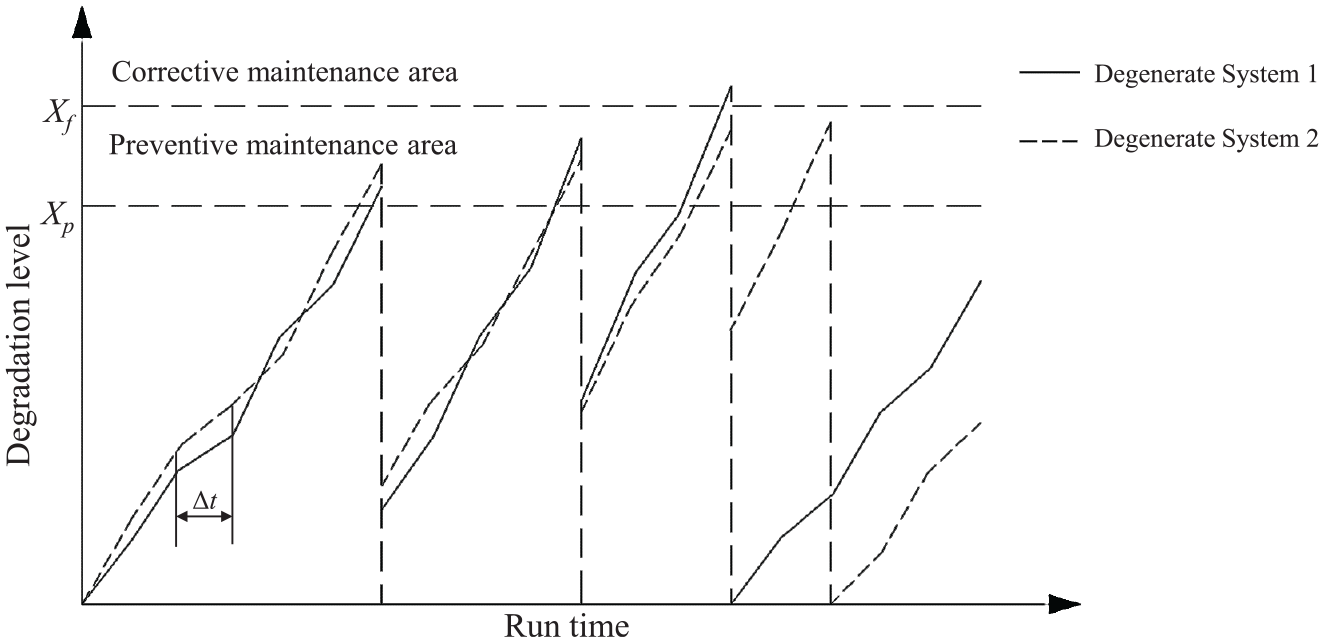
Schematic diagram of maintenance strategy.
According to the degree of degradation
(1) If the amount of degradation is less than the preventive maintenance threshold of the system,
(2) If the degradation amount of the system is between the preventive maintenance threshold and the failure threshold,
(3) If the amount of degradation exceeds the failure threshold of the system,
Effect of maintenance
Accelerated degradation
The degradation rate of the system is the amount of system state degradation per unit of time. According to observations, in the actual process, with the increase of service age and maintenance times, the degradation rate of the performance state of the system is not constant, but gradually accelerated. Aiming at this, this paper makes corresponding problem assumptions.
According to system assumption 5, as the system ages and undergoes more maintenance, its degradation speed accelerates, meaning the time required for its degradation level to reach X(t) from 0 decreases randomly. To model this accelerated degradation phenomenon, this paper introduces the accelerated degradation factor a and combines the geometric process with the Gamma process 17 to establish an accelerated degradation process model. Then the density function of the Gamma degradation process in the nth maintenance cycle after the system undergoes n−1 imperfect maintenance is
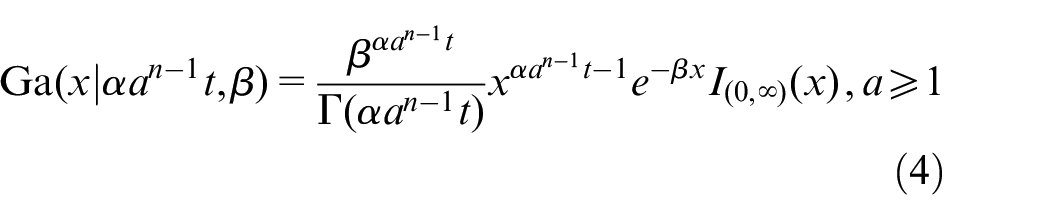
During this period, the average degradation increment of the accelerated degradation process is

where a is the accelerated degradation parameter. When a > 1, the mean of system degradation rate μn will increase with the increase of n, that is, with the increase of maintenance times, the average degradation rate of the system gradually increases, which can well describe the feature that the degradation rate of the system accelerates with the gradual increase of imperfect maintenance times. In particular, when a = 1, the accelerated degradation model is the standard Gamma degradation process model.
Maintenance improvement
The amount of equipment degradation is an observable index, such as the amount of wear of the equipment, the growth of cracks, etc. Imperfect repairs give the system some degree of recovery from its degraded state before repairs. However, as the number of imperfect preventive maintenance increases, the degradation recovery effect of the equipment after maintenance becomes worse and worse. When the imperfect maintenance is not enough to restore the system to the normal operating state, the perfect maintenance will be used to restore the system to the initial state.
First, a model is built to describe maintenance improvement of imperfect maintenance. In engineering practice, it is common for a system to be restored to a state between its original condition and the state before maintenance after undergoing imperfect maintenance. To describe the impact of this type of maintenance, this paper introduces the concept of the maintenance improvement factor b. 21 The degradation level of the system after imperfect maintenance is reduced to

where b is the maintenance improvement factor;
Then, an optimization model is used to describe the deterioration of the imperfect maintenance effect with the increase of repair times. Imperfect maintenance can bring the degradation level down to a certain extent, but repeated imperfect maintenance can decrease the efficiency of degradation improvement. In other words, while imperfect maintenance repairs the degradation level of the system, frequent maintenance leads to a reduction in its improvement efficiency. To better reflect this phenomenon, the maintenance improvement factor is transformed using the power law to describe the impact of maintenance frequency on the extent of degradation. Then the improvement model of imperfect maintenance degradation can be expressed as

where n is the number of imperfect maintenance, n = 1,2,3… Since the value range of b is
Continuous imperfect maintenance results in a gradual reduction in the effectiveness of maintenance and a decrease in the extent of degradation improvement. Consequently, it becomes essential to incorporate a strategy where the system undergoes perfect maintenance after a certain consecutive number N of imperfect preventive maintenance cycles, so that the system can be restored as new. According to the practice, the degradation of the system after imperfect maintenance should not exceed the preventive maintenance threshold Xp, so there is

The maximum value Nmax of the number of consecutive imperfect maintenance can be obtained from Equation 8 as follows

The maximum number of consecutive imperfect preventive maintenance, N, should not exceed Nmax, N≤Nmax. In particular, when N = 1, perfect preventive maintenance is required at the time of the first preventive maintenance.
Evaluation of maintenance policy
The long-term expected maintenance cost rate is used as the main criterion for evaluating the performance of the maintenance policy in this study.
According to the proposed maintenance strategy, the cumulative maintenance cost at time t is

where Ct is the total maintenance cost,
The expected rate of maintenance under long-term operation is:

Solution methodology
The Monte Carlo simulation method is employed in this paper to numerically solve the long-term maintenance cost rate in the maintenance model, due to its effectiveness in analyzing complex systems and solving mathematical problems through random numbers. 22 The specific steps of the algorithm are presented in Figure 2.
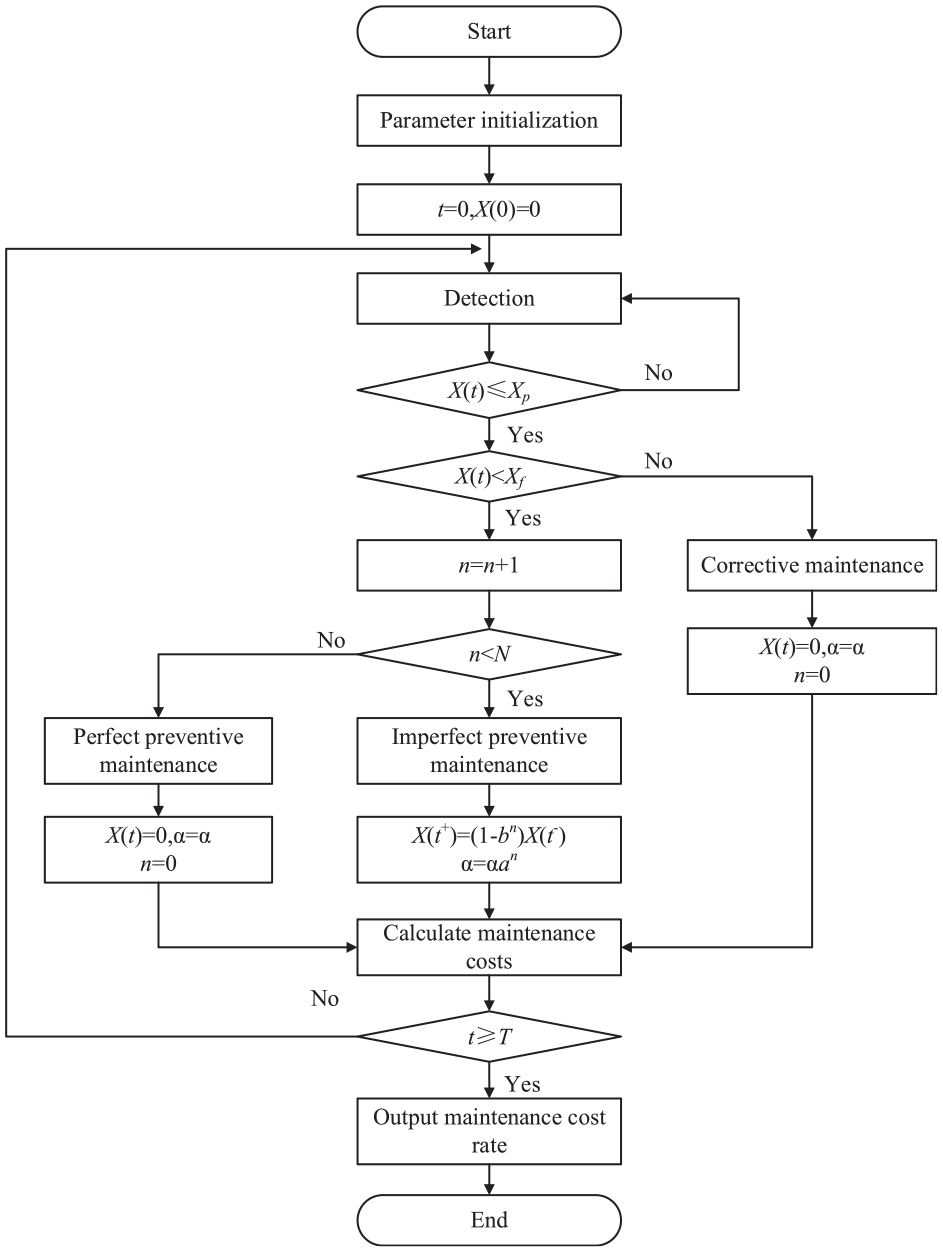
Monte Carlo simulation process.
Numerical example
The purpose of this section is to show how the proposed maintenance model can be used in the maintenance optimization of deteriorating systems through a simple example.
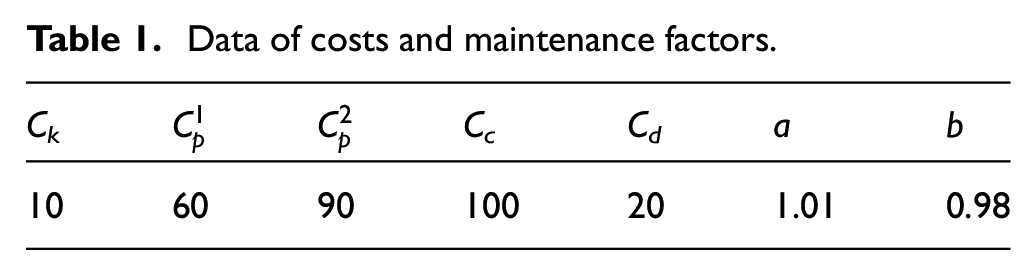
To analyze and verify the validity of the model without loss of generality, assume a single unit degenerate system whose degradation process follows a Gamma process with scale parameter α = 1 and shape parameter β = 1. The system periodically detects the system status with period δt = 1, the system fault threshold
Data of costs and maintenance factors.
To evaluate the mean maintenance cost per unit of time, a very large number of simulation realizations are done. Through Monte Carlo simulation, the simulation of continuous running 10,000 h. Run 1000 times respectively, and the results of 10 times are shown in Figure 3. It can be seen from Figure 3 that the expense rate of long-term operation cost has convergence. By calculating the average value of 1000 times of operation, the long-term operation rate converges to 20.07, indicating that this calculation method is feasible.
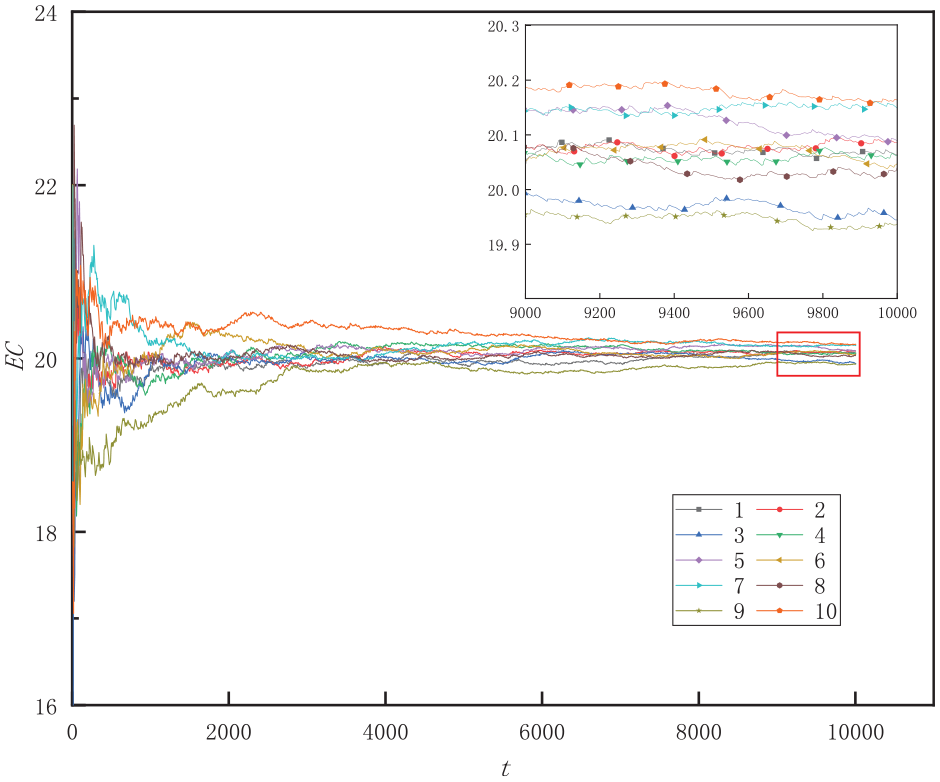
Convergence of simulation results.
After several consecutive imperfect preventive maintenance, the maintenance effect gradually deteriorates, which makes the imperfect preventive maintenance ineffective. Therefore, the convergence value of the long-term operation maintenance cost rate from 1 to Nmax is calculated respectively, as shown in Figure 4 shown. As can be seen from the figure, the maintenance cost rate decreases first and then increases with the increase of the number of imperfect maintenance decisions, and there is an optimal number of imperfect maintenance decisions. When N = 1, the system adopts perfect preventive maintenance. Under this maintenance strategy, the long-term operation maintenance cost rate is about 22.92, which is higher than most imperfect preventive maintenance strategies. With the increase of N, when N = 6, the long-term operation maintenance cost rate reaches the lowest, which is about 20.06. When N continues to increase, the maintenance cost rate begins to increase gradually. Therefore, when N = 6, the maintenance strategy under this condition is optimal, and the long-term operation maintenance expense rate is reduced by about 12.5% compared with perfect preventive maintenance.
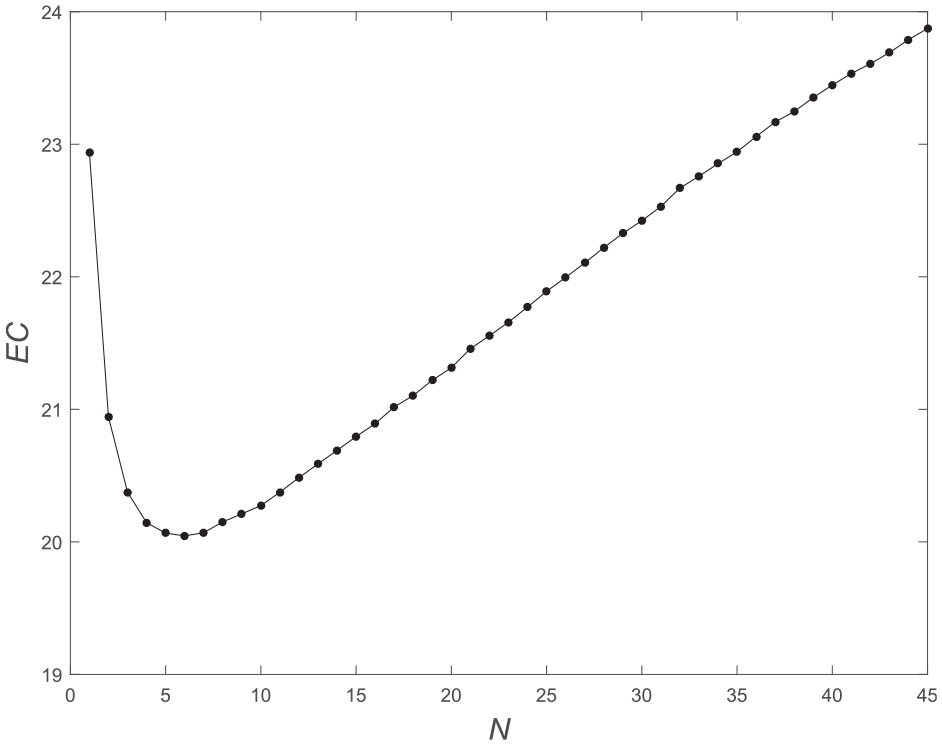
Changes in maintenance expense rate under different times of imperfect maintenance decisions.
Sensitivity analysis
Based on actual maintenance experience, the rate of accelerated degradation and the effectiveness of maintenance improvements can significantly affect the maintenance strategy. Thus, the following analysis focuses on the effect of the accelerated degradation factor and the maintenance improvement factor of imperfect maintenance on the long-term operating maintenance rate and the optimal number of imperfect maintenance. This will provide valuable insights into how these factors can influence the maintenance decision-making process.
The impact of the accelerated degradation factor and maintenance improvement factor on the long-term operation maintenance rate is analyzed in the first step. Figure 5 shows the change in maintenance cost rate under different parameters by varying the values of accelerated degradation factor and maintenance improvement factor when N = 5. The results indicate that, for the same number of imperfect maintenance, a higher accelerated degradation factor leads to a higher long-term maintenance cost ratio of imperfect maintenance when the maintenance improvement factor is constant. Conversely, when the accelerated degradation factor is constant, a larger maintenance improvement factor results in a lower long-term maintenance cost ratio.
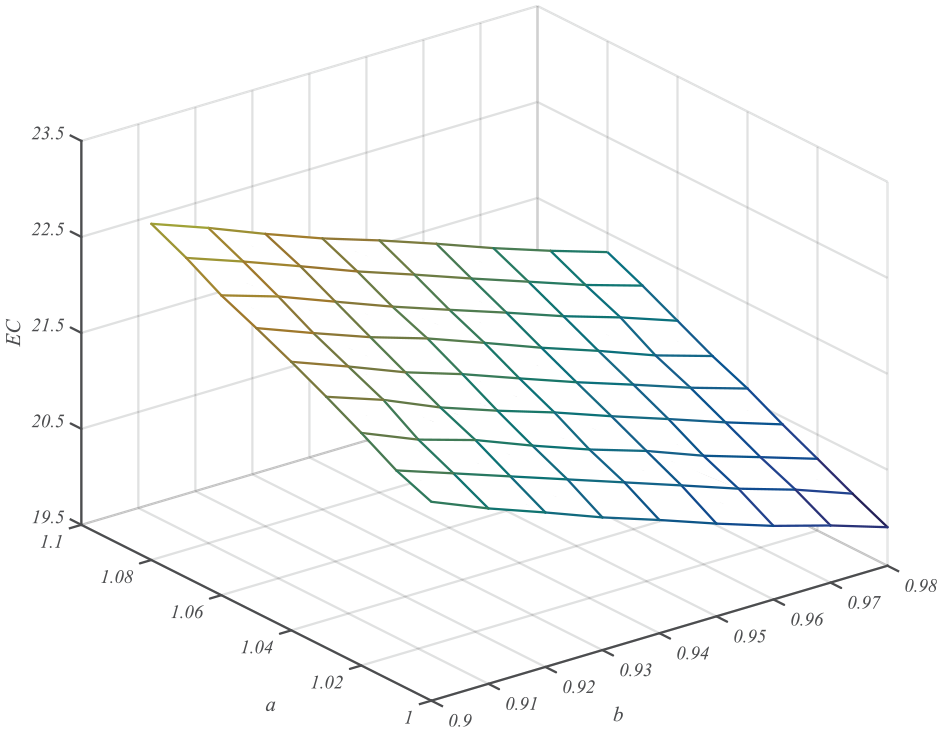
Influence of maintenance improvement factor and accelerated degradation factor on maintenance cost ratio.
Based on the analysis of the system’s degradation and maintenance processes, it can be observed that when the number of maintenance interventions is fixed and the maintenance improvement factor remains constant, an increase in the accelerated degradation factor results in a higher degradation rate of the repaired system, shorter normal operation time, and subsequently a higher maintenance cost rate. On the other hand, when the accelerated degradation factor is constant, after the same number of imperfect maintenance, the larger the maintenance improvement factor is, the more obvious the improvement effect of the repaired degradation level is, so that the repair can be restored to a better state and the normal operation time is longer, so the maintenance cost rate is lower.
When the maintenance improvement factor b and imperfect maintenance times N have different values, the change in long-term operation maintenance cost rate is shown in Figure 6. As shown in the figure, there is an optimal number of continuous imperfect maintenance decisions, and the maintenance cost initially decreases and then rises as the number of imperfect maintenance increases, while the maintenance improvement factor is held constant. At the optimal number of imperfect maintenance decisions, the long-term operation maintenance cost rate is the lowest. For example, when b = 0.96 and N = 3, the maintenance cost rate is 20.59, which is lower than the maintenance cost rate of the perfect preventive maintenance strategy when N = 1. Similarly, when N = 5, the maintenance cost rate is at its lowest, which is 20.47, lower than the rate when N = 1. However, when N = 7, the maintenance cost rate increases slightly to 20.68, but it is still lower than the maintenance cost rate of the perfect preventive maintenance strategy when N = 1. Therefore, the imperfect maintenance strategy can effectively reduce the maintenance cost ratio and is an effective preventive maintenance strategy. Moreover, it is observed that the optimal number of imperfect maintenance decisions tends to increase with the maintenance improvement factor. For instance, when b = 0.9, the optimal number of maintenance decisions N = 3; When b =0.96, N = 5.
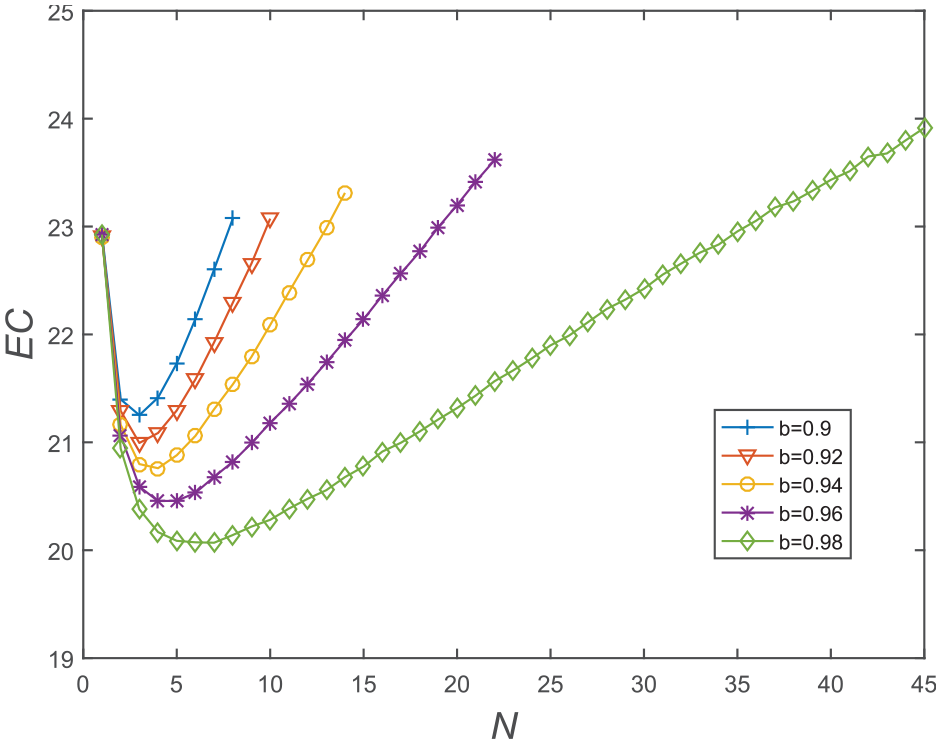
Influence of maintenance improvement factor on optimal decision times.
The degradation and maintenance analysis of the system shows that the initial imperfect maintenance decisions can restore the system to a better state, leading to longer normal operation times and lower costs compared to perfect maintenance. This results in a lower maintenance cost rate overall, indicating the effectiveness of the imperfect maintenance strategy. As the number of imperfect maintenance continues to increase, the maintenance effect of imperfect maintenance gradually decreases, so the actual degradation level repair degree of the system after imperfect maintenance gradually decreases, and the normal operation time of the system after maintenance shortens. Consequently, when N continues to increase, the maintenance cost rate begins to increase gradually. Therefore, the imperfect maintenance strategy has the optimal decision time. In addition, the larger the maintenance improvement factor is, the better the maintenance effect is. Appropriately increasing the maintenance times can still keep the system running for a longer time and reduce the maintenance cost rate. Therefore, the optimal number of imperfect maintenance shows an increasing trend. Furthermore, when the number of imperfect preventive maintenance is not limited, that is, N is infinite, with the unlimited increase of the actual number of imperfect maintenance, the maintenance cost rate gradually increases, so the maximum number of imperfect maintenance should be limited in the actual repair process. In the actual maintenance process, to ensure the normal operation of the system and reduce the maintenance cost rate, the maintenance improvement effect should be between (X f – X p )/X f and 1, and the greater the improvement effect, the better. At the same time, it is necessary to limit the number of imperfect maintenance and determine the optimal number of imperfect maintenance according to the actual maintenance improvement situation.
When the accelerated degradation factor a and the number of imperfect maintenance are of different values, the change in long-term operation maintenance cost rate is shown in Figure 7. As can be seen from the figure, when a = 1.00, there is no accelerated degradation of the system. When only imperfect maintenance is considered, the maintenance cost rate of the system for long-term operation is significantly lower than that under accelerated degradation. Therefore, the accelerated degradation process of the system leads to an increase in maintenance costs. With the increase of the accelerated degradation factor, the optimal number of imperfect maintenance has a trend of decreasing. For example, when a = 1.00, the optimal number of imperfect maintenance N = 7; When a = 1.04, the optimal number N = 4; When a = 1.08, the optimal number N = 3. Therefore, ignoring the accelerated degradation caused by imperfect maintenance will affect the formulation of optimal maintenance strategies.
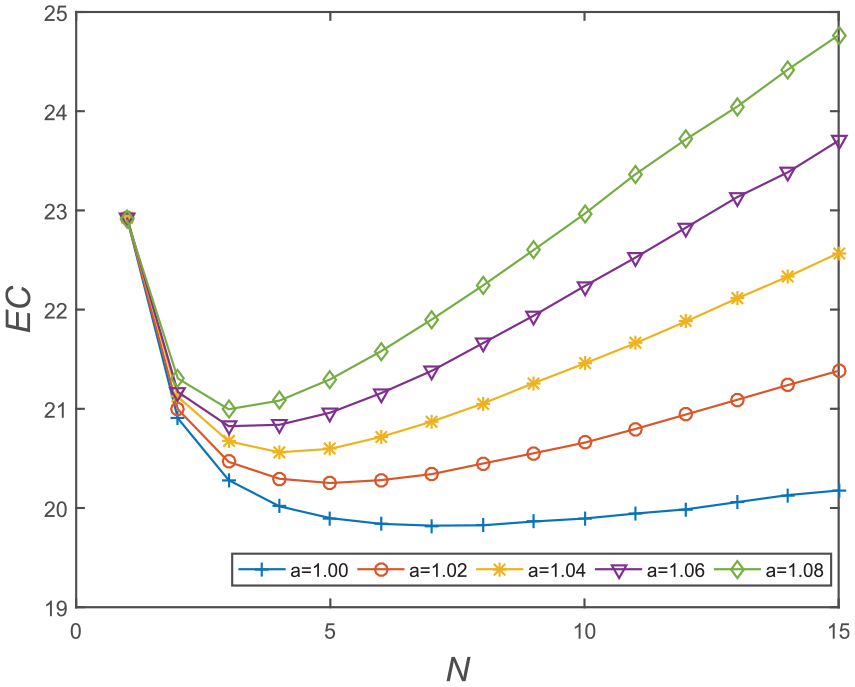
Influence of accelerated degradation factor on optimal decision times.
Through the analysis of the system degradation process, it is observed that when the accelerated degradation speed is constant, with the gradual increase of maintenance times, the improvement effect of the system gradually decreases and the actual degradation speed of the system significantly accelerates. As a result, the normal operation time after maintenance gradually shortens. Moreover, under the same conditions, the larger the accelerated degradation speed is, the higher the maintenance cost ratio is. To control the increase of the degradation speed and reduce the maintenance cost rate, the number of imperfect maintenance should be reduced. Therefore, the optimal number of maintenance shows a decreasing trend with the increase of the accelerated degradation factor. It is evident that the accelerated degradation process of the system significantly affects the maintenance cost rate of the system. If the accelerated degradation is not considered in the maintenance process, it will also affect the determination of the optimal number of imperfect maintenance. To formulate a reasonable maintenance strategy and reduce the maintenance cost rate, it is essential to pay attention to equipment maintenance during the use of the degraded system to reduce the accelerated degradation rate of the system. Furthermore, it is crucial to consider the influence of accelerated degradation when formulating the maintenance strategy to reasonably estimate the accelerated degradation rate of the system.
Conclusion
(1) In this paper, an imperfect condition-based maintenance model for the accelerated degradation system is proposed. The model considers both the improvement effect of system degradation after maintenance and the influence of degradation rate on maintenance decisions. It is a new condition-based maintenance decision-making model. This model can more comprehensively describe the degradation and maintenance process of degraded systems in engineering practice.
(2) The system degradation process is described based on the Gamma process, the calculation example is used for analysis and verification, and the solution method for the optimal number of imperfect preventive maintenance is given. Additionally, the optimal maintenance strategy is analyzed under different maintenance and degradation processes, offering a theoretical basis for formulating cost-effective and reasonable maintenance strategies for degraded systems.
Footnotes
Declaration of conflicting interests
The author(s) declared no potential conflicts of interest with respect to the research, authorship, and/or publication of this article.
Funding
The author(s) disclosed receipt of the following financial support for the research, authorship, and/or publication of this article: Project supported by the National Key Research and Development Program of China (No.2019YFB1707303).
