




Abstract
The surface reflection pressure sensor installation flatness will directly lead to the change of the explosion shock wave pressure propagation and distribution law, affecting the test results accuracy, and the test data cannot accurately evaluate the ammunition explosion damage power. In this study, the numerical simulation model of the explosion shock wave pressure propagation and distribution law was established by using the explosive mechanics simulation software, and the pressure distribution law was studied when the sensors installation angles were 0°, 4°, 8°, 12°, −4°, −8°, and −12° respectively. Combined with analysis of the pressure peak value and the pressure evolution nephogram at different measuring points, it is clarified that the positive tilt angle of the sensor installation has an enhancing effect on the pressure peak, while the negative tilt angle has a attenuation effect on the pressure peak. Based on the calculation function formula of the surface reflected pressure peak value in the national defense engineering design code, the surface reflected pressure peak value correction function formula is established by introducing the sensor installation angle correction effect. This study results provide a theoretical basis for the design of ammunition explosion shock wave pressure engineering test scheme and the test data validity verification.
Keywords
Introduction
Shock wave pressure is one of the main damage parameters produced by ammunition explosion.1–3 In the engineering test, the surface reflection pressure test needs to install the pressure sensor on a mounting plate with a certain structural size and quality, and then bury the sensor and the mounting plate underground at the same time to keep the sensor sensitive surface level with the surface. However, during the actual test, it was found that since the surface propagation medium at the explosion site was soil, the sensor installation plate could not be kept absolutely horizontal after being buried underground, some sensor installation plates would shift toward the explosion center, and some sensor installation plates would shift away from the explosion center, which would lead to inaccurate surface reflection pressure data obtained, and it was impossible to use the test results to evaluate and analyze the ammunition damage power. In view of the problem existing in the current testing process, it is necessary to carry out research on the sensor installation tilt angle influence on the explosion shock wave pressure propagation and distribution, clarify the influence of sensor installation plate positive and negative displacement on the shock wave pressure test results, and provide theoretical guidance for the surface reflection pressure test scheme design.
At present, relevant researchers in the field of damage testing have conducted some research and achieved certain research results. The inclination angle has a attenuation effect on the peak pressure. For example, Guo et al. 4 discussed the wall reflection pressure sensors deployment on the ground to test ammunition explosion shock wave pressure, analyzed the technical indicators, testing methods, and data processing methods, and proposed the performance indicators that the ground reflection pressure testing system needs to meet and the problems that should be noted in the testing process. Zhou et al. 5 established the TNT explosive explosion shock wave pressure distribution simulation model by using the finite element numerical simulation method, obtained the free field pressure and ground reflection pressure data, and compared them with the measured test results. The shock wave pressure distribution law is clarified, and the established finite element numerical simulation model accuracy is proved. Tong et al. 6 carried out relevant research on the sensor parasitic effect output caused by shock vibration and explosion temperature in the ground reflection pressure testing process, clarified the different kinds of influencing factors influence on the parasitic effect output of the surface reflection pressure sensor, and proposed corresponding suppression methods. Duan et al. 7 carried out the aluminized explosives explosion shock wave pressure test with different aluminum powder content and particle size, and quantitatively analyzed the transmission and attenuation characteristics of the aluminized explosives reflected shock wave pressure on the ground. The parameters of reflected shock wave pressure, polynomial form similarity relationship and power exponent form similarity relationship are calibrated by using the measured test data. The correction function of the influence of aluminum powder content and particle size on the explosion shock wave peak pressure was established. Liu et al. 8 developed a storage shock wave pressure measurement system suitable for the ground reflection pressure test requirements to obtain ground reflection pressure data during ammunition explosion. Based on the test data characteristics, the shock wave pressure data processing method is given, and according to the overpressure impulse criterion, the buildings damage grade and the personnel damage probability evaluation results are given. Chen et al. 9 to realize the explosion shock wave pressure rapid evaluation, integrated the shock wave signal processing function and characteristic parameter calculation module on the basis of the traditional storage and testing device, collected and analyzed the surface reflected pressure data, improved the shock wave damage power evaluation test efficiency, and realized the shock wave damage power rapid evaluation. Xu et al. 10 to study the terrain influence on the explosion shock wave propagation law, obtained the terrain slope angle influence on the explosion shock wave pressure distribution law by conducting explosion tests and numerical simulation on terrain with slope angles of 0°, 10°, 20°, 30°, and 40° respectively. Based on the surface reflected pressure data obtained, the engineering formulas for calculating the shock wave pressure peak value, impulse and ground roughness on different slopes in the experimental range are given. Hou 11 to accurately analyze the impact of complex terrain and landform on the warhead’s explosive power, summarized the existing theoretical formulas, and completed the theoretical research on the explosive killing bomb power field under the condition of flat terrain and landform (ideal state). Based on the characteristics of typical landforms and environments, numerical simulation analysis was carried out using ANSYS/LS-DYNA software, and the calculation model of the destructive power field of explosive bombs was improved. Xu et al. 12 to study the trench topography influence on the explosion shock wave propagation law, based on AUTODYN-3D simulation software, established finite element numerical simulation models of trench topography and flat ground ammunition touchdown explosion with different widths and depths. Quantitative analysis was conducted on the impact of changes in trench width and length on the peak pressure and specific impulse of explosion shock waves. The research results provide guidance for the output of explosive power and safety protection in trench terrain. It can be seen from the above analysis that in the process of the research on the ammunition explosion surface reflection pressure test, the research mainly focuses on the reflection pressure test methods and the parasitic effects suppression measures, ignoring the change of test results due to the sensors uneven installation angle in the actual test process, but this phenomenon is very common in engineering tests. Therefore, it is necessary to carry out finite element numerical simulation analysis on the sensor installation tilt angle to clarify the coupling mechanism and influence relationship between the sensor installation tilt angle and the explosion shock wave pressure.
In this study, the explosive explosion shock wave pressure finite element numerical simulation model was established by using the explosion display dynamics simulation software AUTODYN, and the shock wave pressure propagation distribution law was studied when the sensor installation tilt angle was 0°, 4°, 8°, 12°, −4°, −8°, and −12°. The shock wave pressure time history curve and pressure evolution cloud diagram under different measuring point positions and different sensor installation tilt angles were obtained, combined with the simulation data, the influence of the sensor mounting plate positive and negative tilt on the shock wave pressure is analyzed, and established the ground surface peak reflected pressure calculation function equation under the sensor installation tilt angle.
Explosion shock wave surface reflected pressure
When ammunition explodes in the air, due to the explosive products rapid expansion, the air is strongly compressed, thus forming an initial shock wave. 13 When the shock wave front is not interfered by obstacles in the propagation process, it propagates forward in the form of spherical wave. When the wavefront propagates to a certain distance and collides with the ground, due to the difference in wave impedance at the propagation medium interface, the incident shock wave will produce reflection and form a reflected shock wave. 14 The propagation speed and reflected shock wave pressure are much higher than the incident shock wave, so as the explosion time goes on, the reflected shock wave front will catch up with the incident shock wave front, and Mach wave will be formed at the junction of the two wave fronts. The incident shock wave, reflected shock wave and Mach wave will intersect at a point in space, which is called three wave point. 15 The shock wave pressure obtained from the area below the three wave points is the pressure of the Mach rod. The Mach rod is perpendicular to the ground and propagates forward. Therefore, the shock wave no longer emits in this area, and the pressure distribution is relatively stable. The shock wave pressure distribution evolution law during explosive explosion as shown in Figure 1. 16
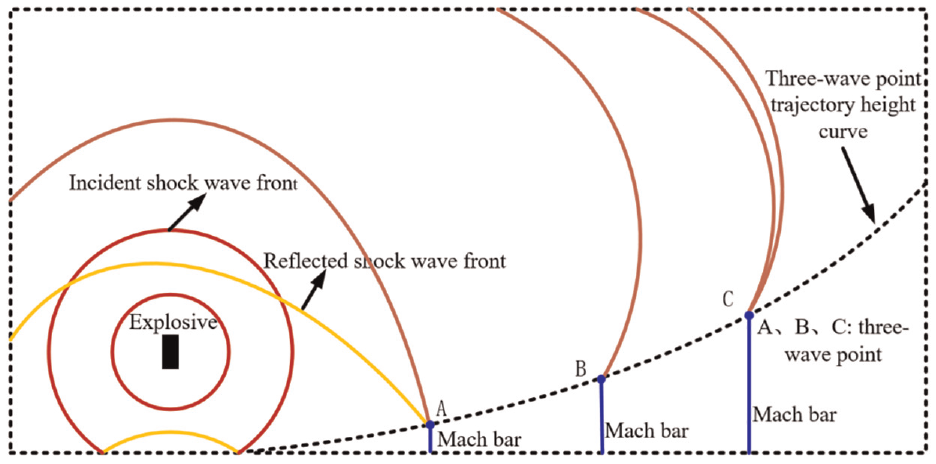
Explosion shock wave pressure distribution law.
When the impact between the incident shock wave and the ground is reflected, the reflection types can be divided into normal reflection, normal reflection, oblique reflection and Mach reflection according to the relationship between the incident angle
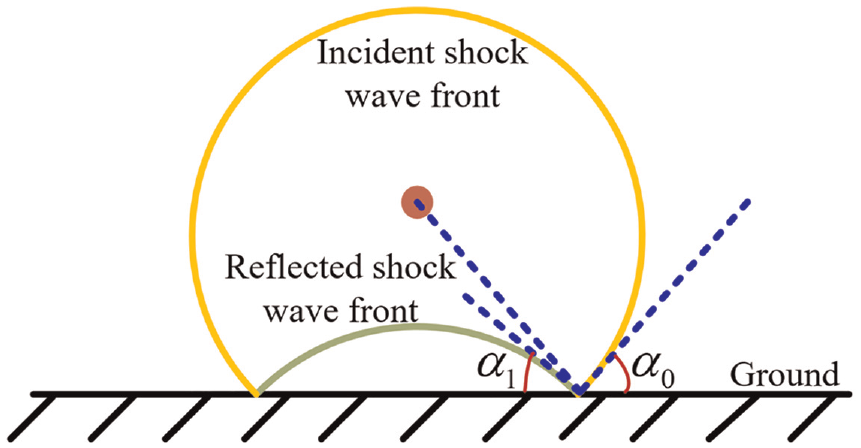
Shock wave pressure reflection structure schematic diagram.
The critical angle

where
When

When
Oblique reflection is a reflection stage in which the Mach reflection conditions have been met, and the incident shock wave intersection (three wave points), reflected shock wave and Mach reflection wave have been formed but cannot leave the ground. At this time, the reflected shock wave pressure meets the high strength reflected shock wave pulse generated by Mach reflection, but the duration is very short. The impact of this stage on the reflected shock wave pressure can be ignored in engineering.
When

where
According to the above analysis, in the actual test process, the ground reflection pressure measuring points layout should avoid the normal reflection area as much as possible, to ensure that the measuring points location is within the Mach reflection area, which requires that the measuring points should be a certain distance from the explosion center when conducting the ground reflection pressure test, and not directly below the explosion center.
Explosion shock wave pressure propagation and distribution law
Finite element numerical simulation
Based on the actual test environment, the ammunition explosion shock wave pressure distribution law finite element numerical simulation model is established by using the explosion mechanics simulation software ANSYS/AUTODYN. Taking typical TNT explosive as an example, TNT explosive has a mass of 5 kg, explosive density of 1630
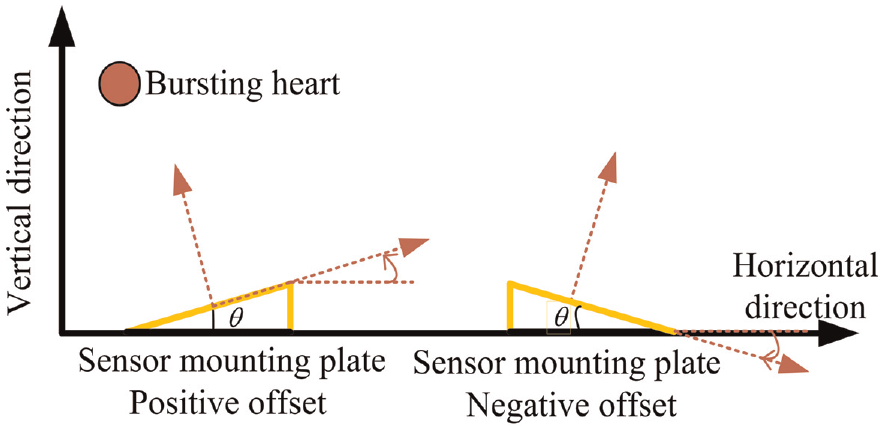
Sensor installation tilt angle structure schematic diagram.
To obtain the shock wave pressure data at different measuring point positions, a pressure monitoring point is set at the center point of the sensor mounting plate to obtain the shock wave pressure varying with time curve at different tilt angles. Due to the large number of models established, taking the sensor mounting plate tilt angle is 12° as an example, the established finite element numerical simulation model is shown in Figure 4
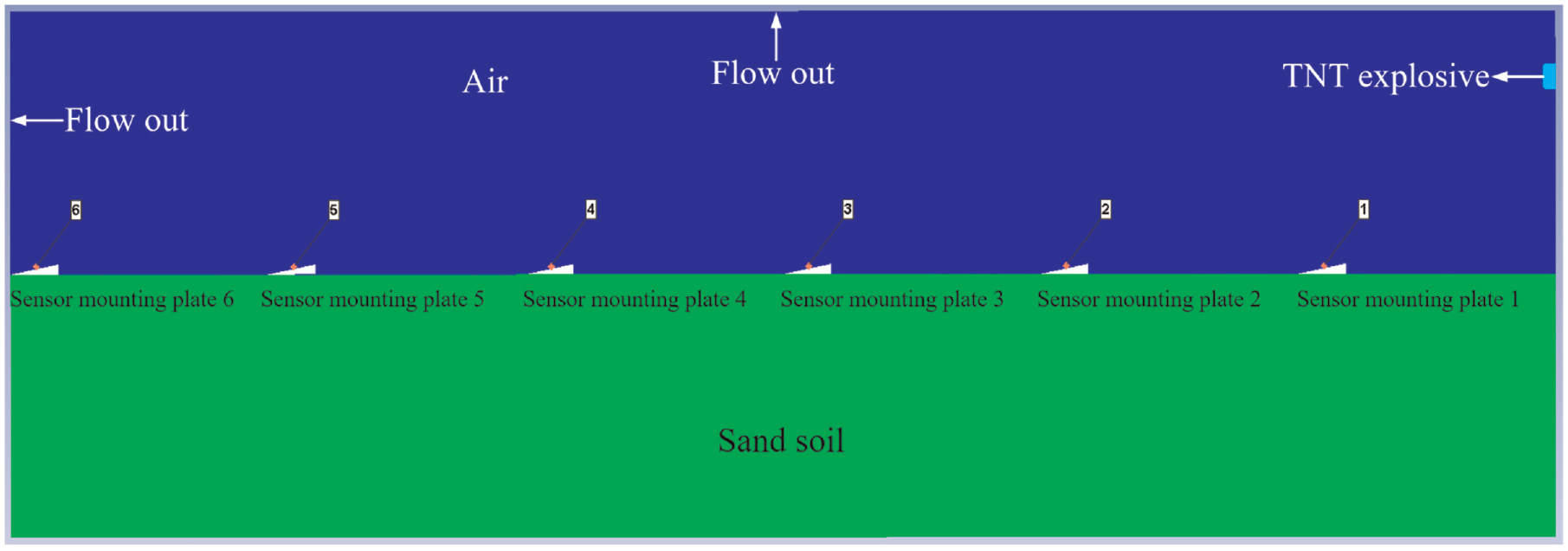
Finite element numerical simulation model.
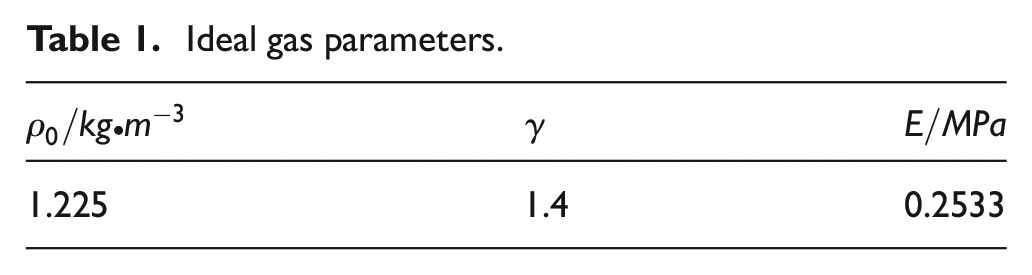
In the above model, air is an ideal gas, which is described by the ideal gas state equation, 21 as shown in equation (4).

where
Ideal gas parameters.
The TNT explosive explosion process is described by JWL state equation, which is shown in equation (5).23,24
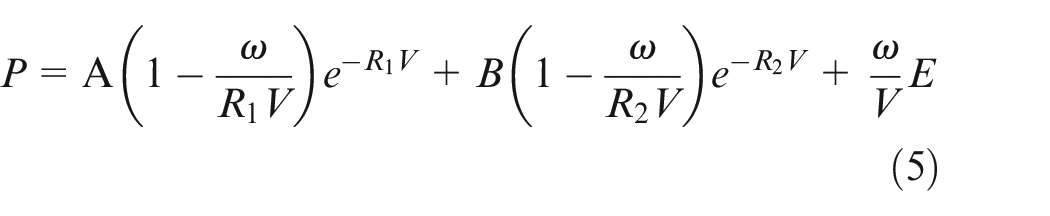
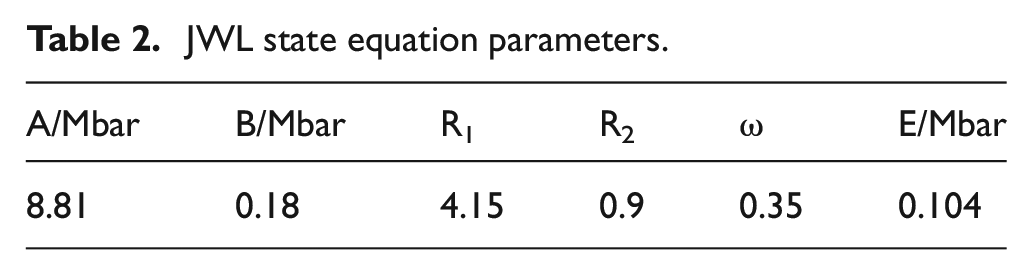
where
JWL state equation parameters.
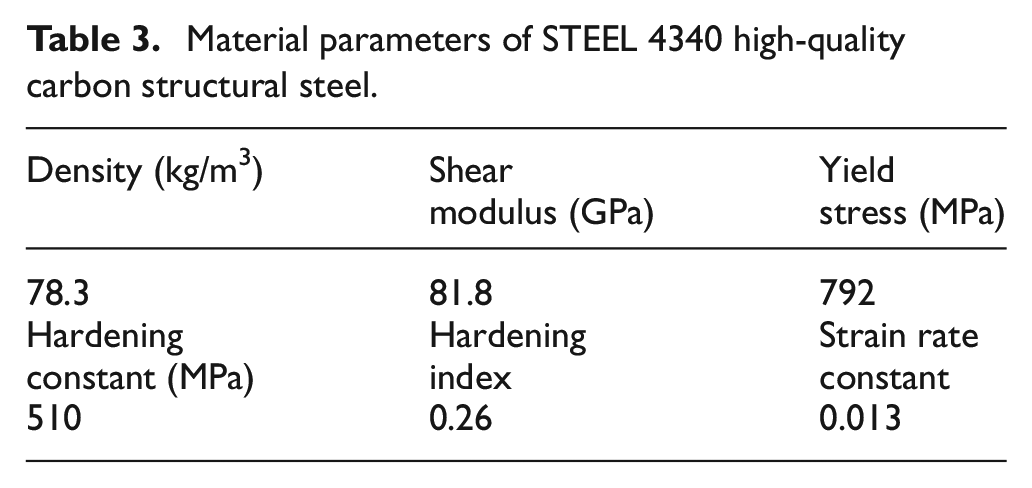
STEEL 4340 high-quality carbon structural steel uses Johnson-Cook constitutive equation to describe the strength limit and metal materials failure process under explosive load. The equation is shown in equation (6). 25

where C is the flow stress coefficient,
Material parameters of STEEL 4340 high-quality carbon structural steel.
Analysis of numerical simulation results
Using the aforementioned finite element numerical simulation model, time-history curves for shock wave pressure were obtained when the tilt angle of the sensor mounting plate was 0°, 4°, 8°, and 12°, as shown in Figures 5 to 8.
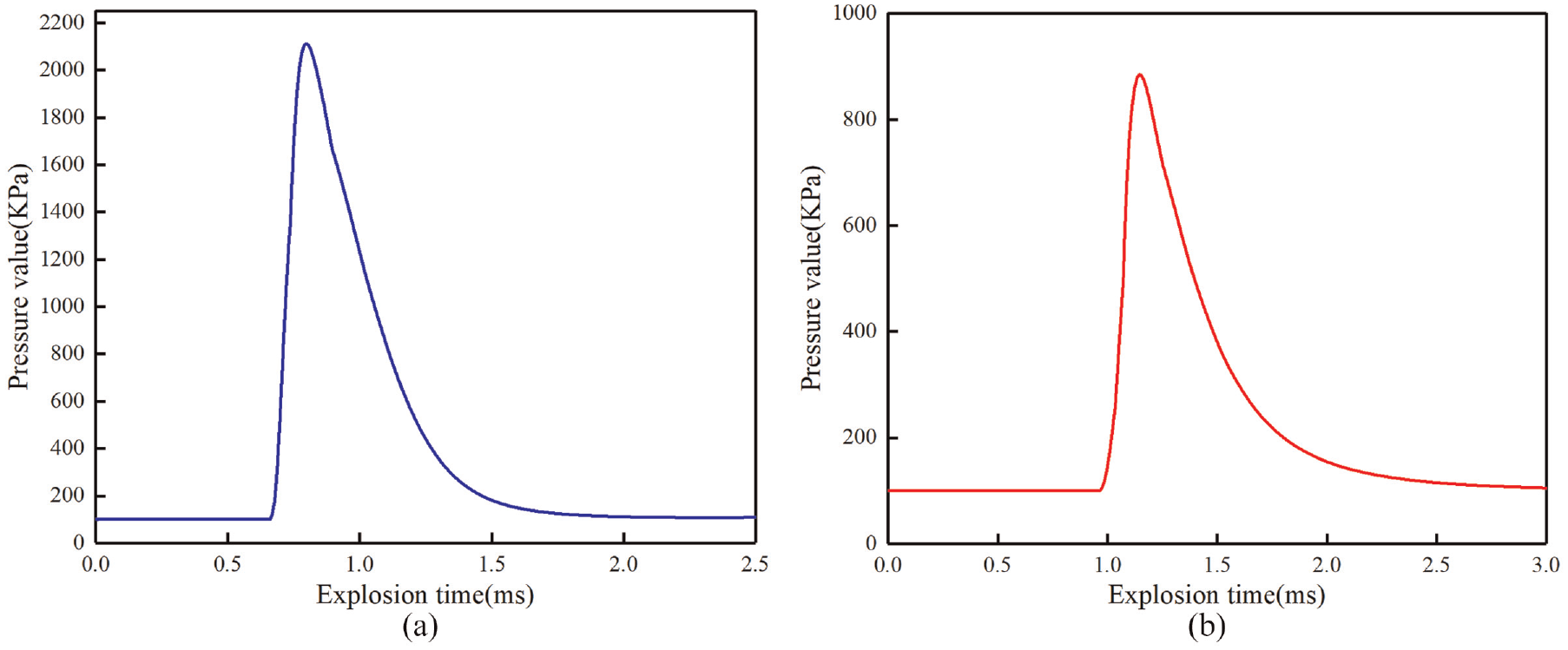
The sensor mounting plate tilt angle is 0°: (a) 1 m and (b) 2 m.
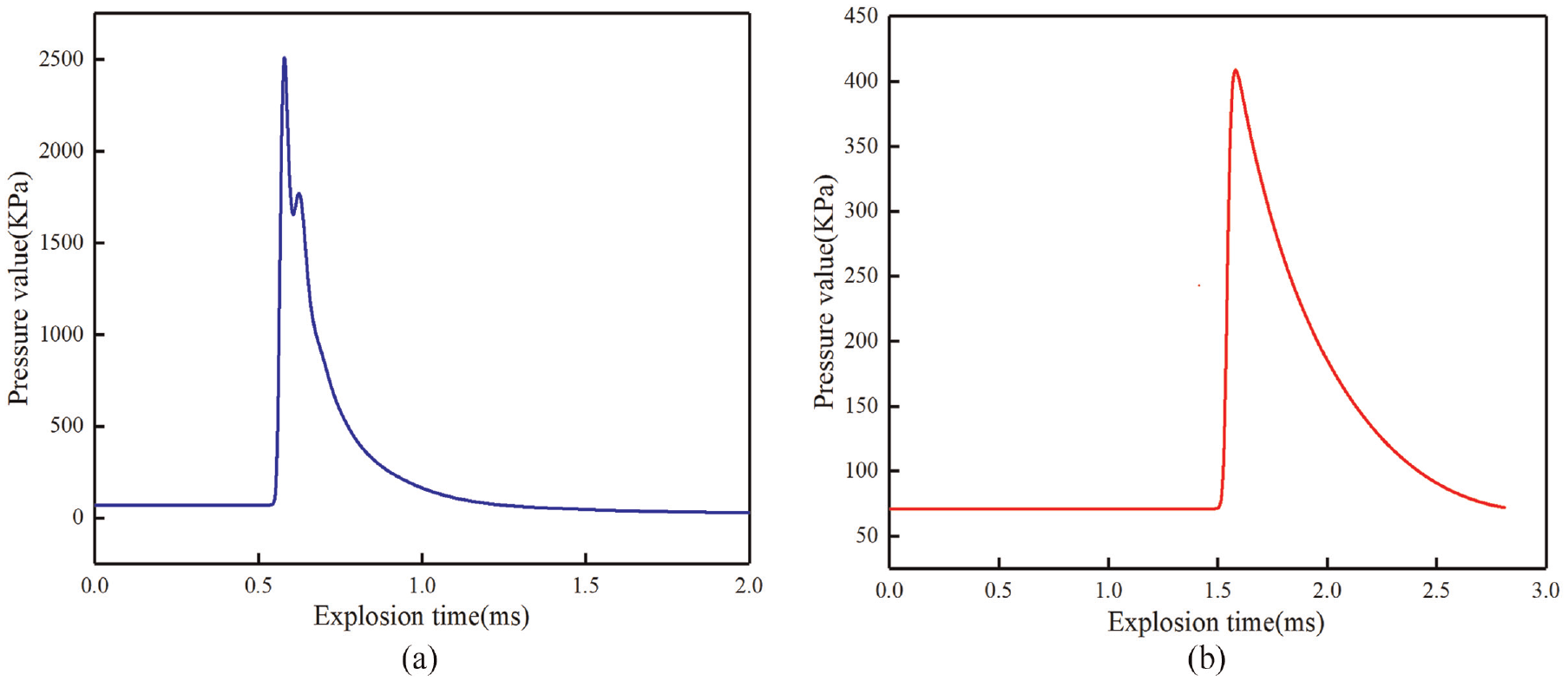
The sensor mounting plate tilt angle is 4°: (a) 1 m and (b) 2 m.
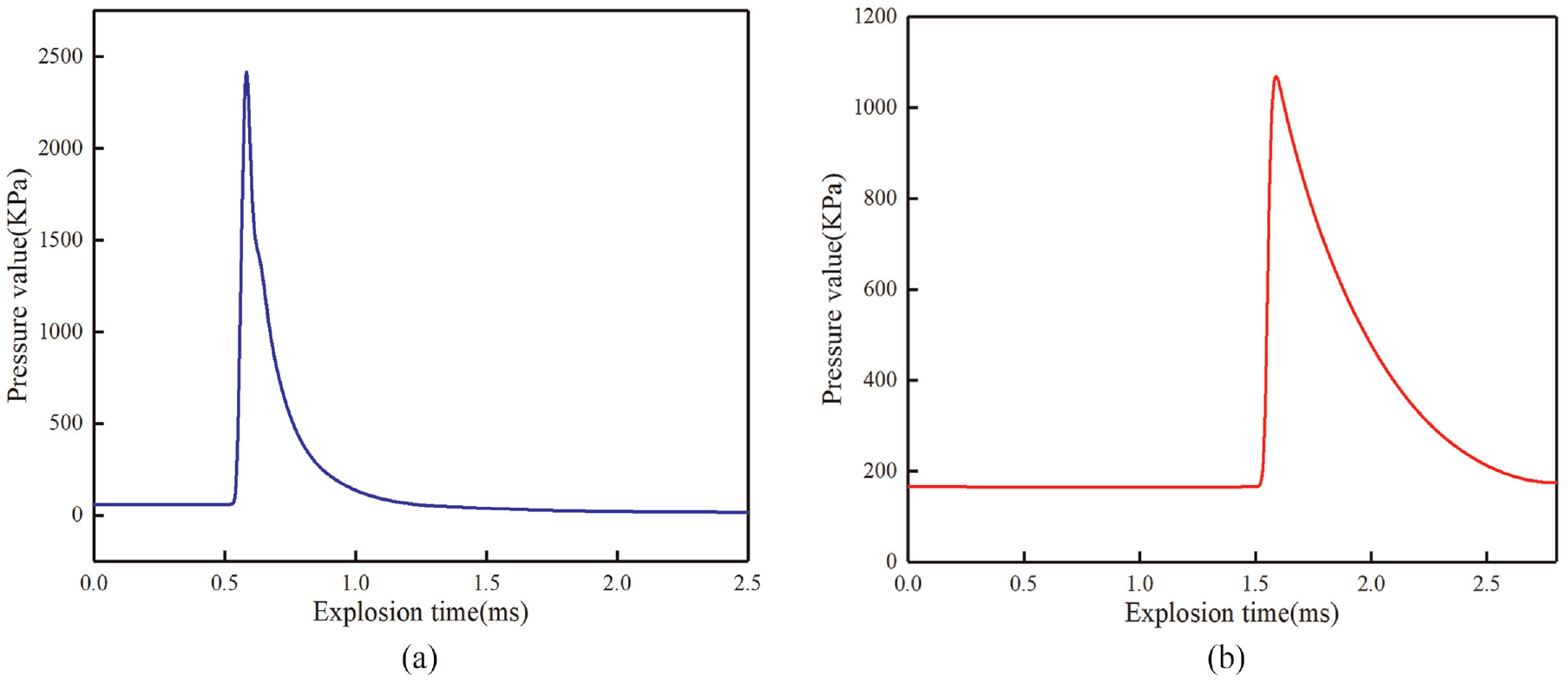
The tilt angle of the sensor mounting plate is 8°: (a) 1 m and (b) 2 m.
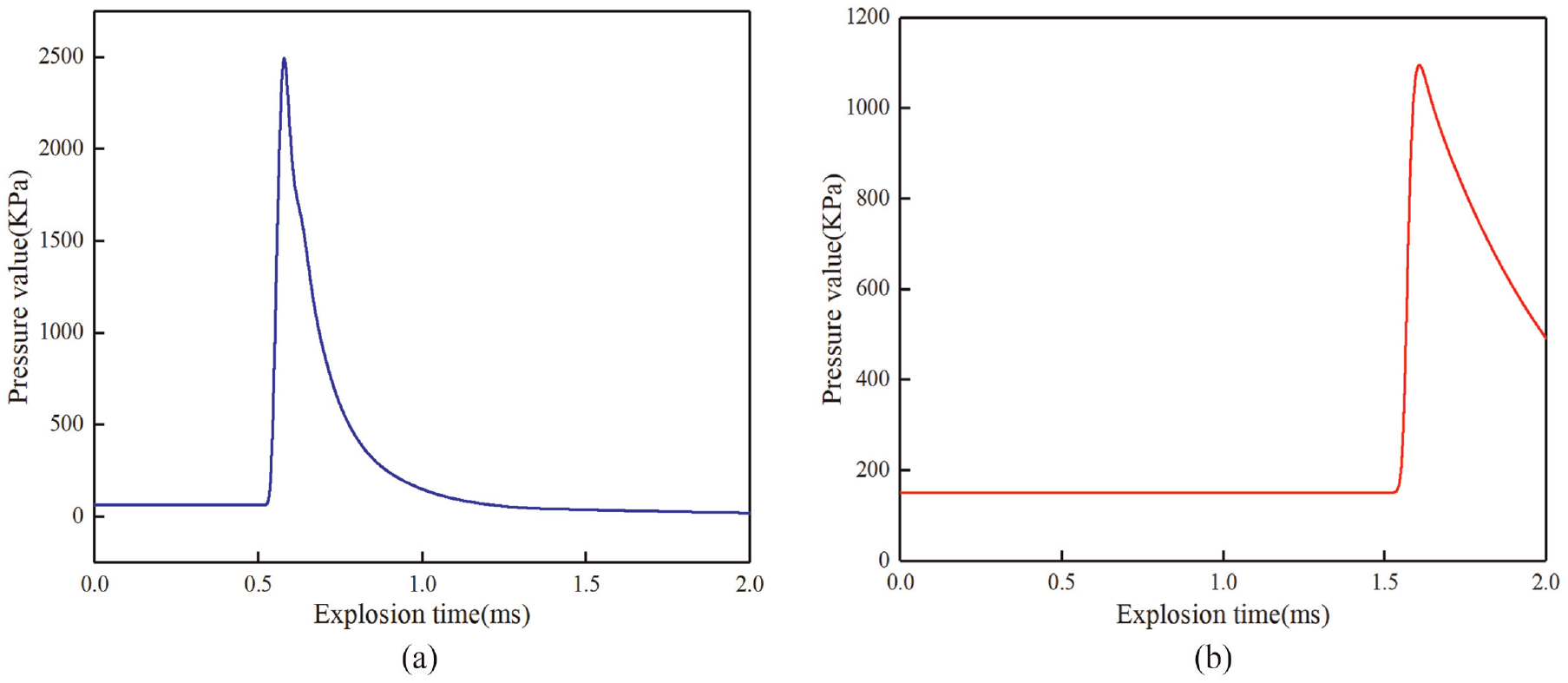
The sensor mounting plate tilt angle is 12°: (a) 1 m and (b) 2 m.
By analyzing the aforementioned shock wave pressure time-history curve, it was observed that the peak value of shock wave pressure gradually decreases with increasing distance between the measuring point and explosion center under the same positive inclination angle of the sensor mounting plate. This phenomenon conforms to the pressure propagation attenuation law of explosion shock waves in ammunition. At the same measuring point, the shock wave pressure peak value increases gradually with the increase of the sensor mounting plate positive inclination angle, indicating that the sensor mounting plate positive inclination angle is positively related to the shock wave pressure peak value. To quantify the relationship between the sensor mounting plate positive tilt angle and the shock wave pressure peak value, the peak value of the above shock wave pressure time history curve is extracted, and the extraction results are shown in Figure 9. Calculate the shock wave peak pressure relative growth rate, and obtain the shock wave peak pressure at different measuring points and the peak pressure relative growth rate curve, as shown in Figure 10. The formula for calculating the pressure peak relative growth rate is shown in equation (7).

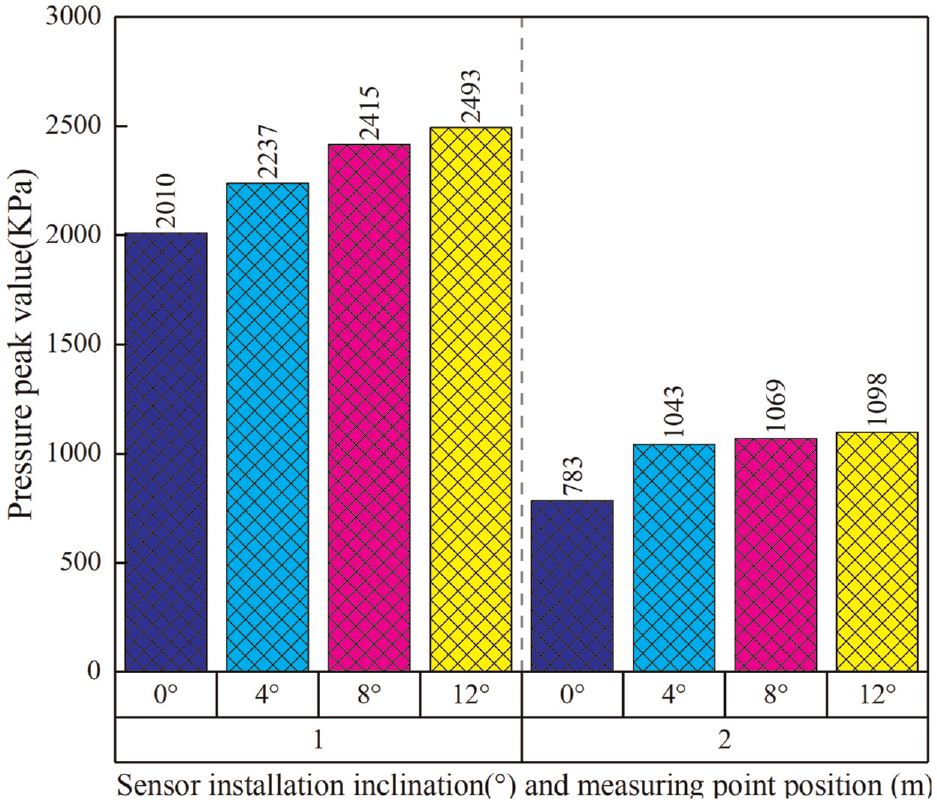
Installation angle positive tilt shock wave pressure peak histogram.
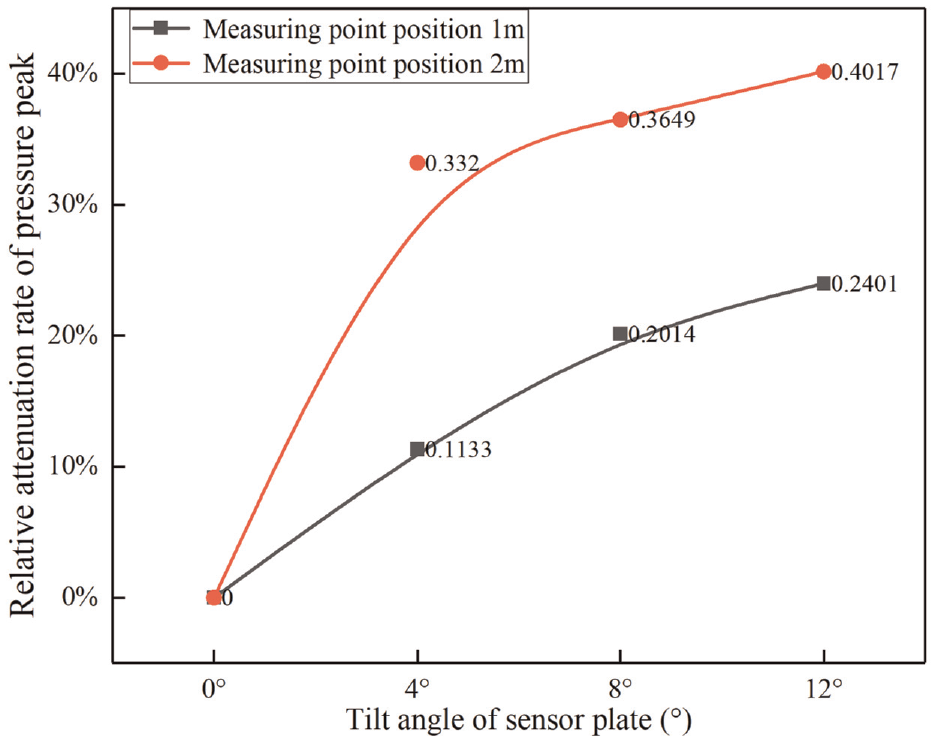
Peak pressure relative growth rate curve.
Based on the obtained shock wave pressure peak value from the sensor mounting plate inclination angle is 0°, when the sensor mounting plate inclination angle changes from 0° to 4°, 8°, and 12°, the shock wave pressure peak growth rate at 1 m measuring point are 56.78, 50.60, and 40.22 kPa/°, and the shock wave pressure peak growth rate at 2 m measuring point are 64.99, 35.71, and 26.21 kPa/°. It can be seen that the closer the measurement point is to the center of the explosion, the more significant the impact of the sensor mounting plate positive tilt angle on the growth rate of the shock wave peak pressure. The growth rate of peak pressure increases with an increase in the tilt angle of the mounting plate. With the increase of the distance between the sensor and the explosion center, the growth rate of the shock wave peak pressure decreases gradually, and the significance of the sensor mounting plate tilt angle effect on the peak pressure also decreases gradually. To analyze this phenomenon cause, the shock wave pressure evolution nephogram around the sensor mounting plate at different explosion times is obtained, and the obtained results are shown in Figure 11.
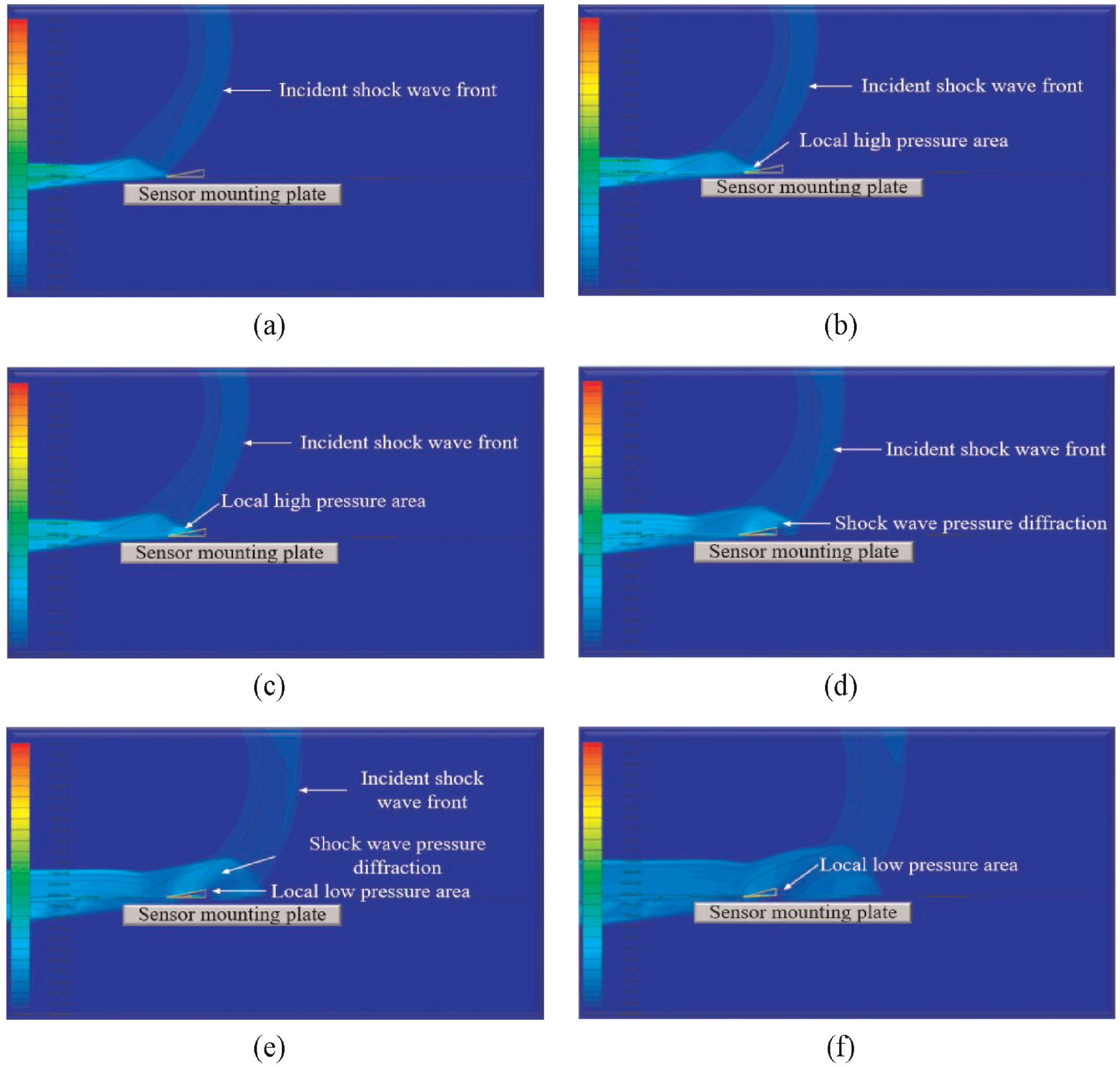
Shock wave pressure evolution at different explosion time cloud chart: (a) 0.30 ms, (b) 0.32 ms, (c) 0.34 ms, (d) 0.37 ms, (e) 0.42 ms, and (f) 0.47 ms.
When the explosion shock wave front propagates to the sensor mounting plate, because the left side of the sensor mounting plate is high and the right side is low, the shock wave pressure converges on the mounting plate upper surface, forming a local high pressure zone, as shown in Figure 11(b) and (c). As the explosion time goes on, the shock wave pressure continues to propagate along the sensor mounting plate surface, the high-pressure area gradually leaves the upper mounting plate surface, and diffraction occurs at the sensor mounting plate boundary, resulting in a decrease in the shock wave pressure peak value, as shown in Figure 11(d) and (e). Due to the shock wave pressure diffraction effect, a local low pressure area is generated on the sensor mounting plate rear wall, as shown in Figure 11(e) and (f). As the forward tilt angle of the sensor installation plate increases, the accumulation time of shock wave pressure on the surface of the installation plate increases, and the peak pressure gradually increases, resulting in an increase in the measurement results of the peak pressure of the ground reflection.
After conducting the aforementioned analysis, it is evident that the positive inclination angle of the sensor mounting plate has a significant impact on the peak pressure value of the explosion shock wave. In the actual test process, the sensor mounting plate has a negative tilt in addition to a positive tilt, so it is necessary to carry out the influence of the sensor mounting plate negative tilt angle on the shock wave pressure distribution. We extracted the shock wave pressure time history curve when the sensor mounting plate negative tilt angle are −4°, −8°, −12°, and the extraction results are shown in Figures 12 to 14.
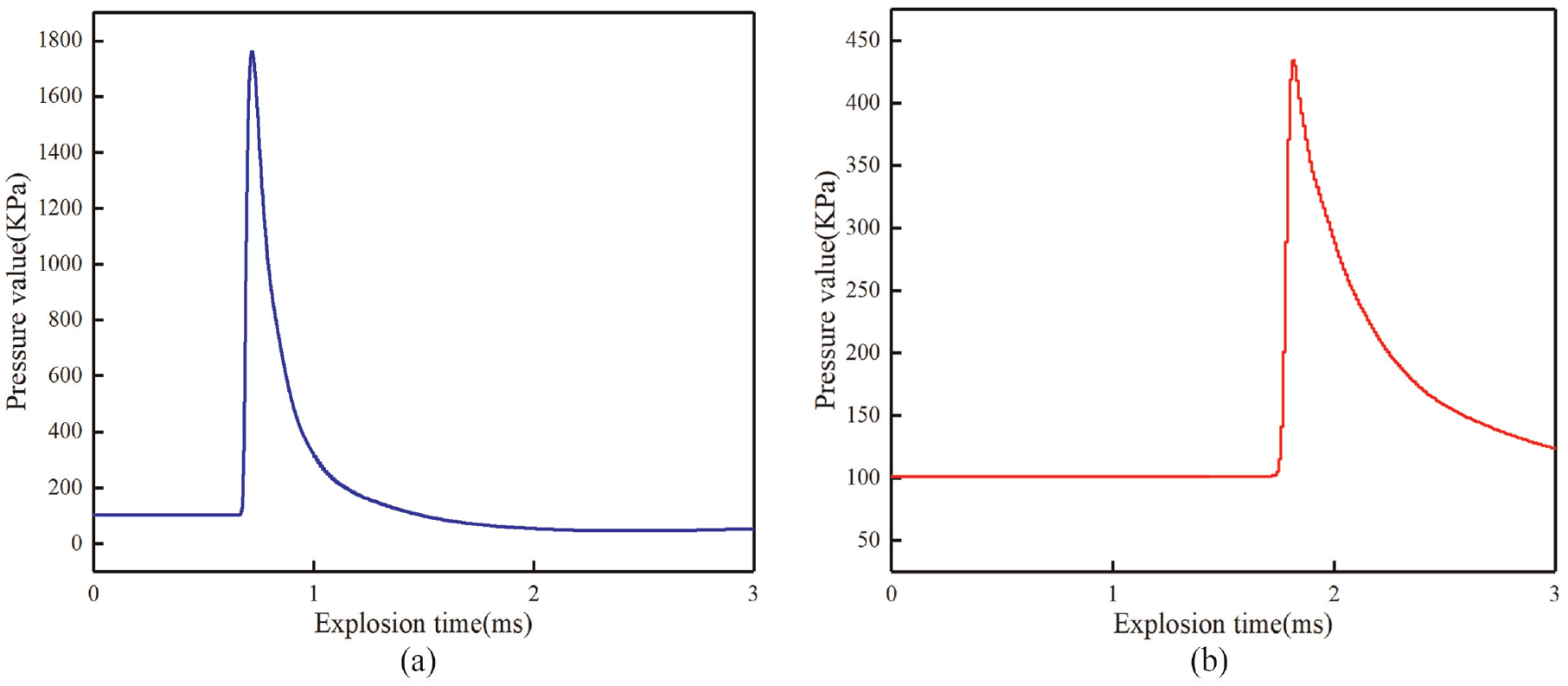
The sensor mounting plate tilt angle is −4°: (a) 1 m and (b) 2 m.
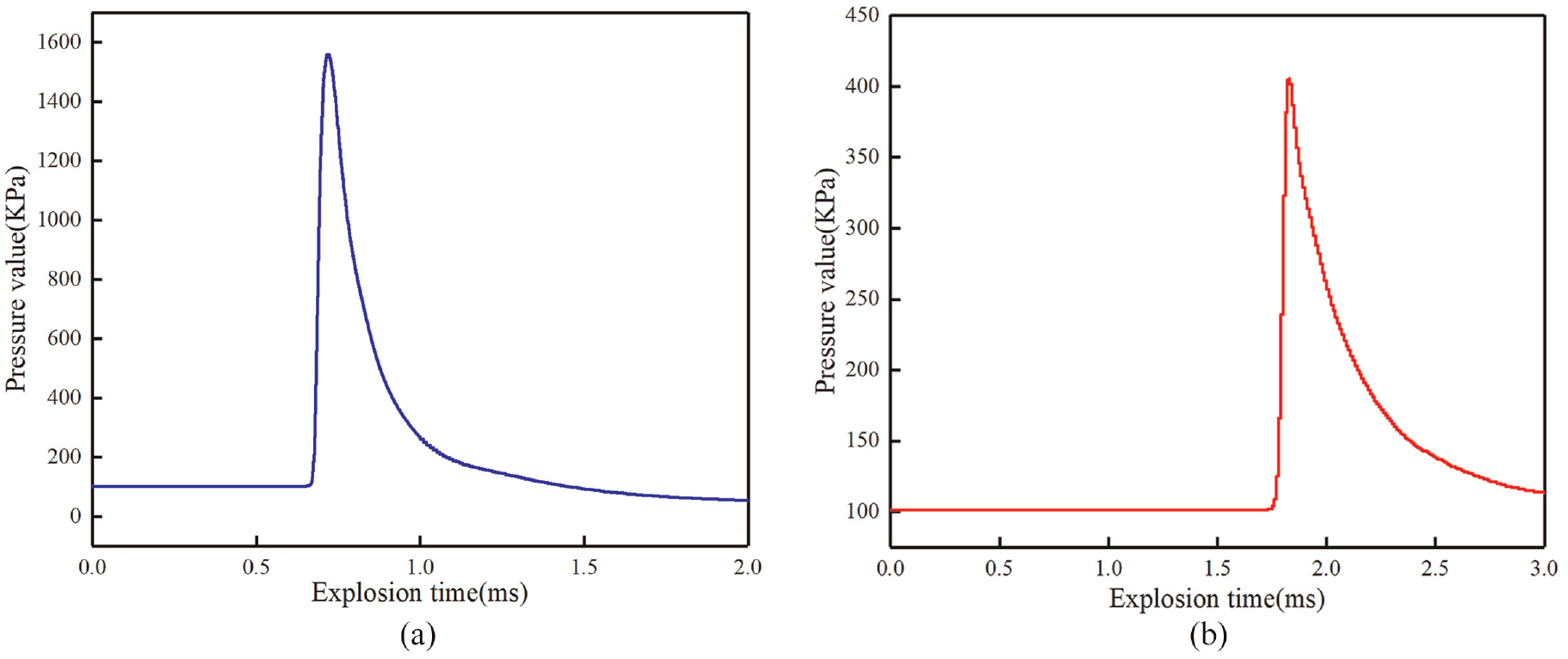
The sensor mounting plate tilt angle is −8°: (a) 1 m and (b) 2 m.
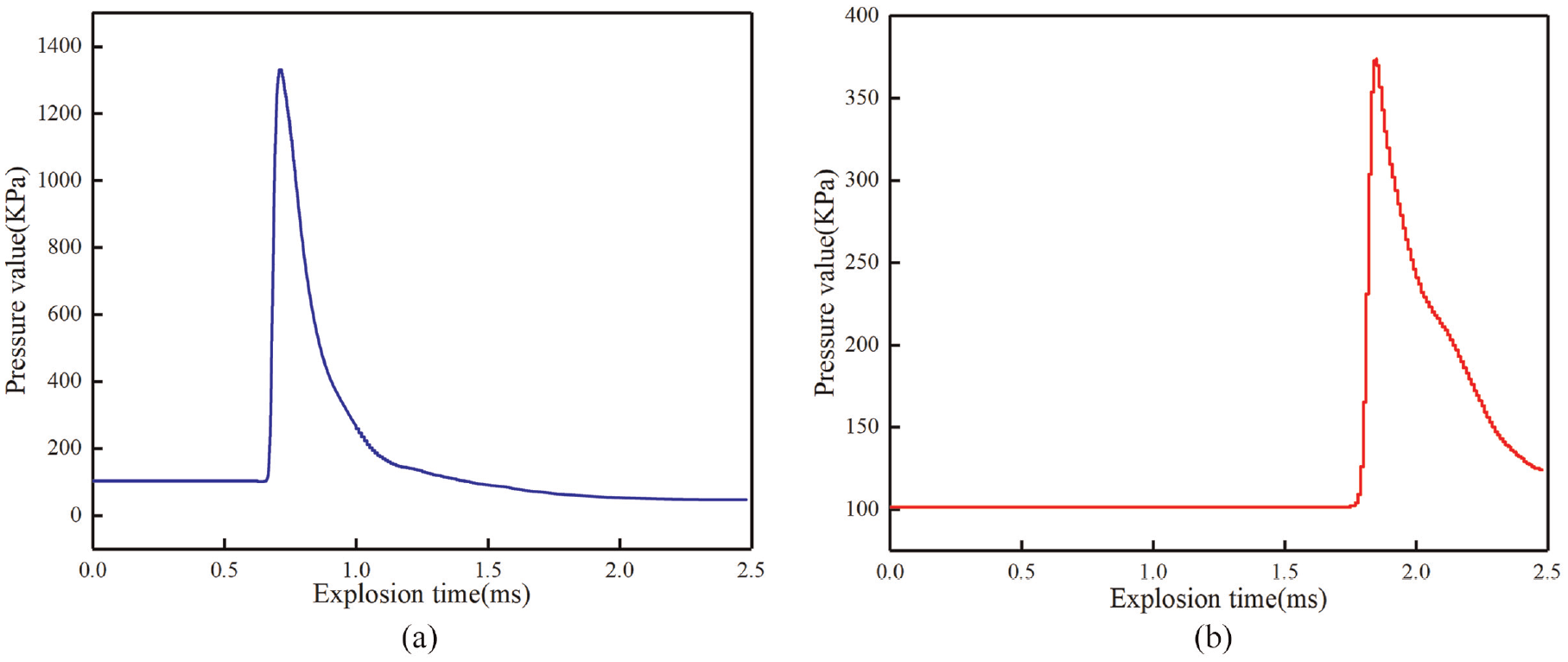
The sensor mounting plate tilt angle is −12°: (a) 1 m and (b) 2 m.
Through the analysis of the above shock wave pressure time history curve, it is found that at the same measuring point, the shock wave pressure peak value decreases gradually with the increase of the sensor mounting plate negative inclination angle, that is, the sensor mounting plate negative inclination angle is negatively related to the shock wave pressure peak value. To quantitatively analyze the influence of the sensor mounting plate negative inclination angle on the shock wave pressure peak value, the peak value of the above shock wave pressure time history curve is extracted, and the relative attenuation rate of the shock wave pressure peak value is calculated. The pressure peak value at different measuring points and the curve of the pressure peak value relative attenuation rate are shown in Figures 15 and 16. The equation for calculating the pressure peak relative attenuation rate is shown in equation (7).
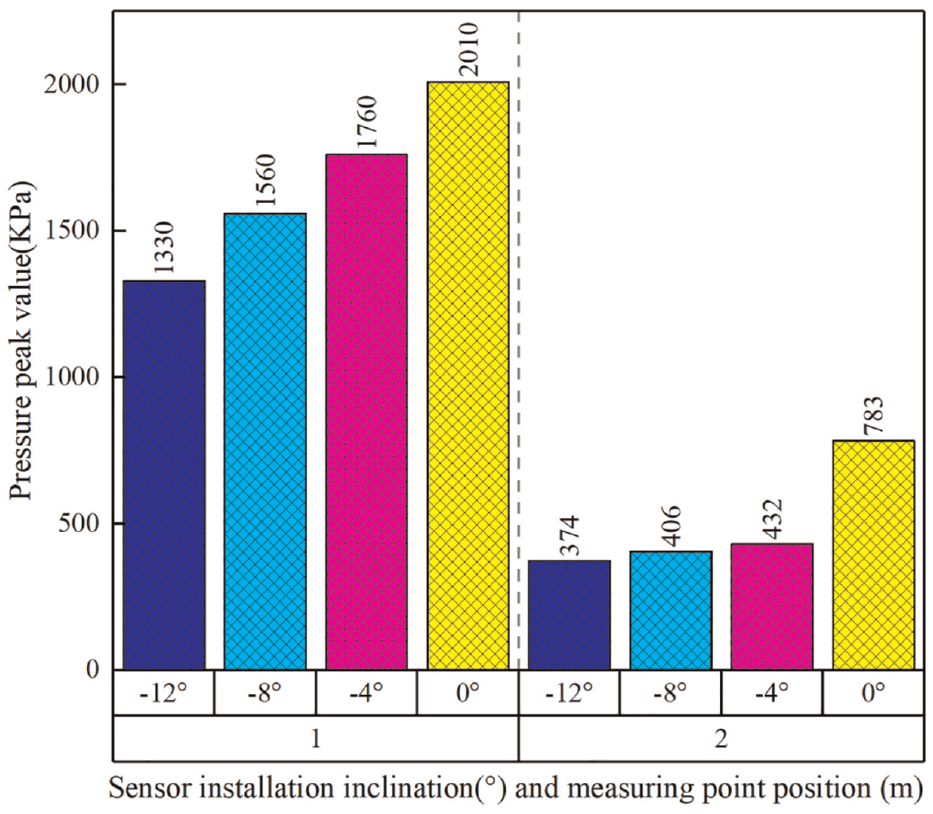
Installation angle negative inclined shock wave pressure peak histogram.
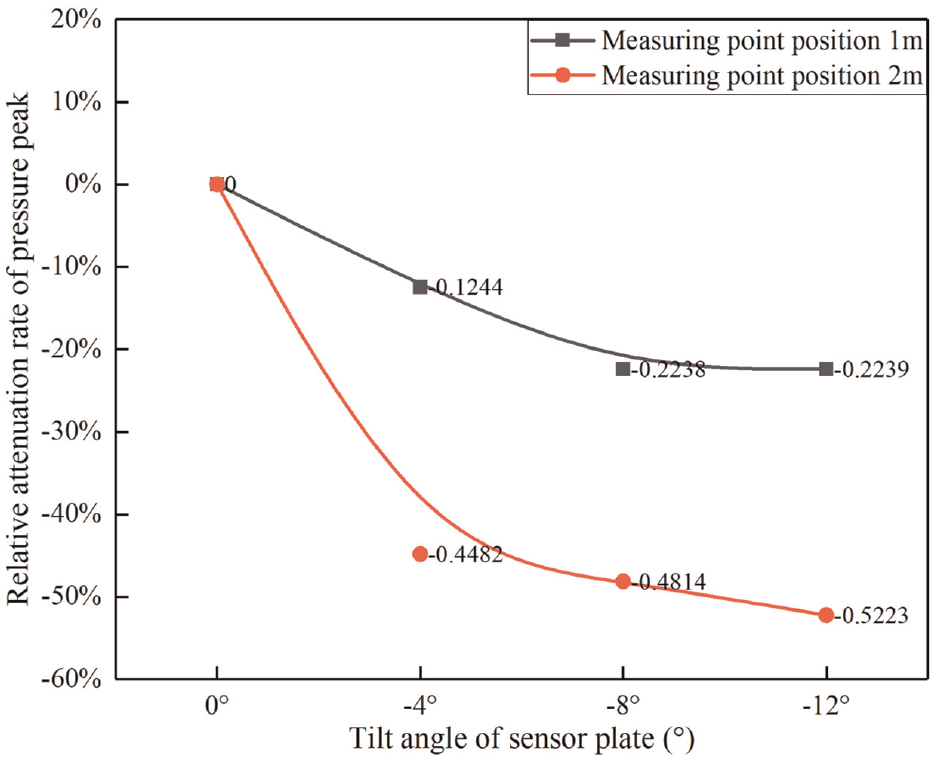
Pressure peak relative attenuation curve.
Based on the obtained shock wave pressure peak value when the sensor mounting plate tilt angle is 0°, when the sensor mounting plate negative tilt angle changes from 0° to −4°, −8°, and −12°, the shock wave pressure peak attenuation rate at 1 m measuring point is 62.5 , 56.25, and 56.7 kPa/°, and the shock wave pressure peak attenuation rate at 2 m measuring point is 43.86 , 47.38, and 34.08 kPa/°. It can be seen that the closer the measurement point is to the center of the explosion, the more significant the impact of the sensor mounting plate negative tilt angle on the shock wave pressure peak attenuation rate. The rate of pressure peak attenuation increases as the negative tilt angle of the sensor mounting plate becomes greater. As the distance between the measuring point and the explosion center increases, the rate of attenuation of the shock wave peak pressure gradually decreases. Additionally, the impact of the sensor mounting plate tilt angle on the peak pressure also gradually diminishes. To analyze this phenomenon cause, the pressure evolution nephogram of the shock wave pressure around the sensor mounting plate at different explosion times is obtained, and the obtained results are shown in Figure 17.
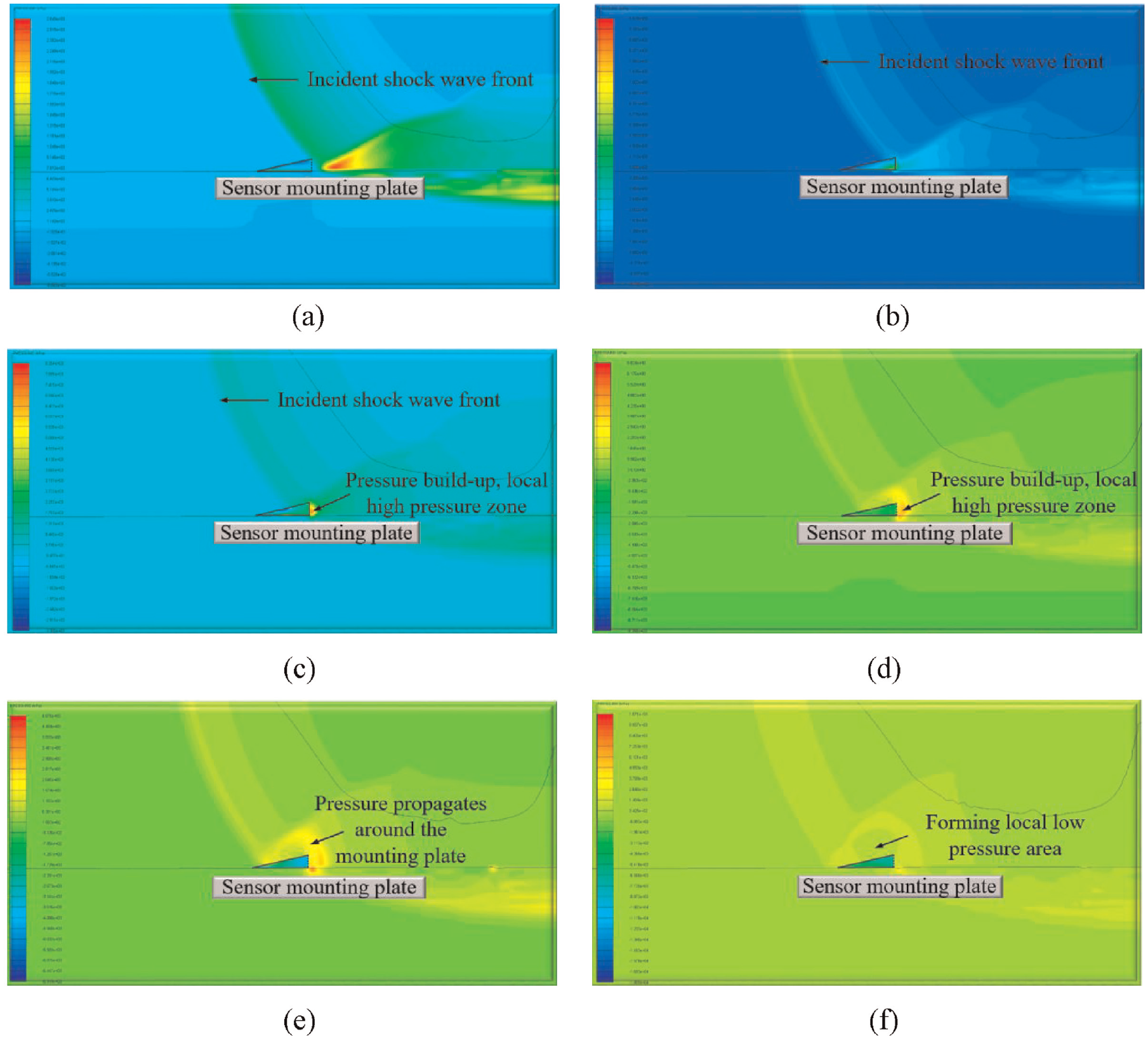
Shock wave pressure evolution at different explosion time cloud chart: (a) 0.61 ms, (b) 0.64 ms, (c) 0.67 ms, (d) 0.72 ms, (e) 0.76 ms, and (f) 0.82 ms.
Based on the analysis of the above shock wave pressure propagation distribution law evolution cloud diagram, when the explosion shock wave front does not contact the ground, the incident shock wave front propagates forward in the form of spherical wave. When the shock wave front propagates to the sensor mounting plate boundary, because the right side of the mounting plate boundary is high and the left side is low, the warped boundary prevents the shock wave front from continuing to propagate forward, causing the shock wave pressure to gather at the sensor mounting plate boundary, forming a local high pressure zone, as shown in Figure 17(c). When the pressure accumulates to a certain extent, the shock wave will bypass the plate boundary and continue to propagate forward, as shown in Figure 17(e). At this time, the shock wave pressure is affected by the installation plate boundary of the sensor, resulting in the propagation speed of the shock wave pressure in the vertical and horizontal directions at the installation plate boundary. The shock wave pressure jumps over the upper surface of the sensor installation plate in the form of an arc wave, forming a local low pressure zone on the surface of the sensor installation plate, as shown in Figure 17(f), which causes the measurement result of the ground reflection pressure to be biased toward smaller values. As the negative tilt angle of the sensor mounting plate increases, the amplitude of the shock wave pressure jump at the mounting plate boundary will gradually increase, leading to a gradual decrease in the peak value of the surface reflected pressure.
Surface reflection pressure peak correction function relationship
According to the above analysis, in the blast field surface reflected pressure test process, the installation plate of the reflected pressure sensor often tilted, resulting in inaccurate surface reflected pressure test results, and the existing surface reflected pressure calculation function equation does not take into account the influence of the sensor installation tilt angle. In view of this problem, it is necessary to carry out research on the surface reflected pressure correction model, introduce the influence of the sensor installation angle on the shock wave pressure test, and improve the calculation accuracy of the surface reflected pressure.
Currently, the commonly used formula for calculating surface reflected pressure is given in the defense engineering design specification, and is represented by equation (8).

where
By introducing the effect of the sensor installation tilt angle

To confirm the specific form of the function expression in equation (9), the surface reflected pressure data obtained by the finite element numerical simulation and the measured data are fitted to the function relationship in equation (9) using nonlinear adaptive fitting, and the fitting results are shown in Figure 18.
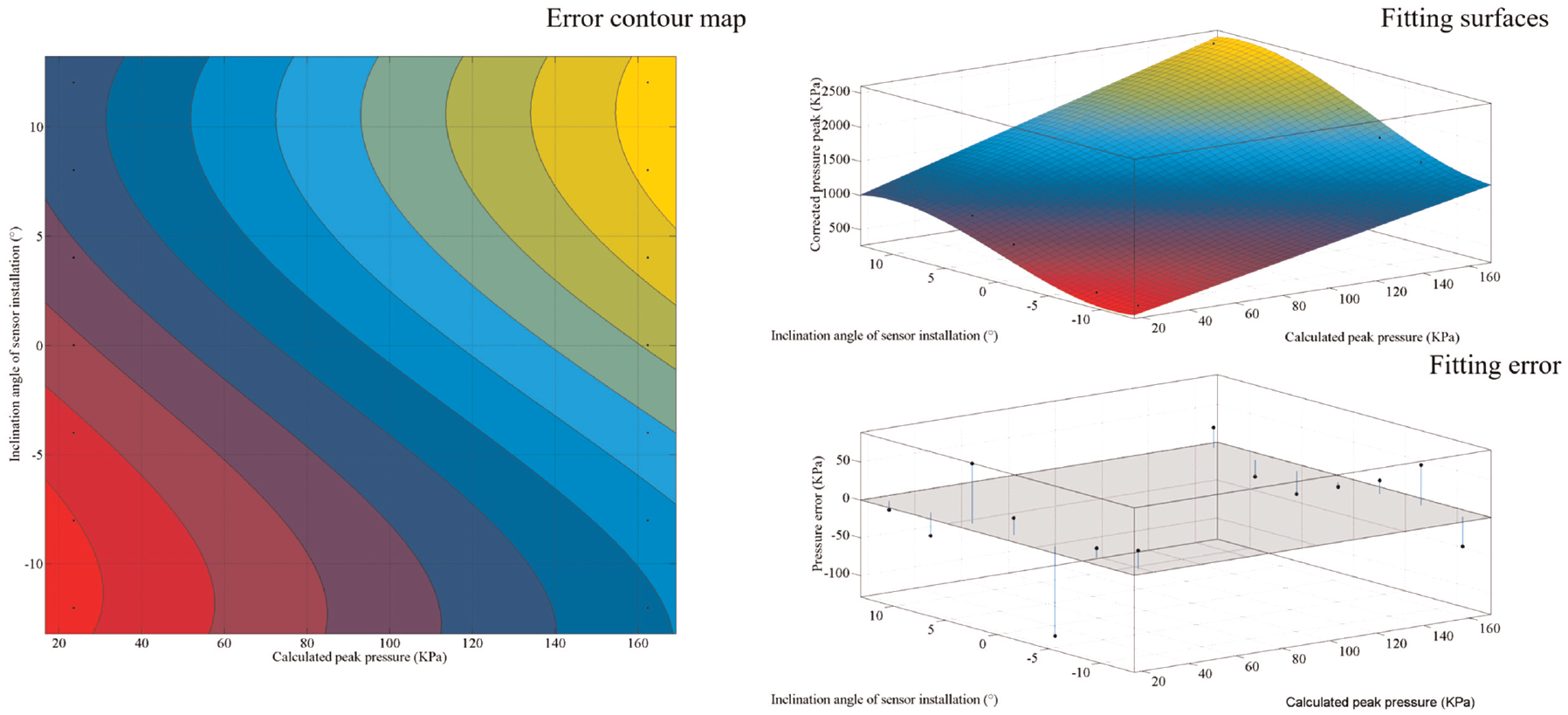
Nonlinear adaptive fitting effect graph.
From the fitting effect, this functional relationship expression is shown in equation (10). The sum of squared errors (sum of squared residuals) between the fitted data and the fitted function is 0.9875, indicating a high degree of agreement with the test data.

Analysis of the above fitting effect, although some of the fitted data do not fall exactly on the fitted curve, but are uniformly distributed on both sides of the fitted surface, and the sum of squared fitting errors is close to 1, so the above established functional relationship can be a good reflection of the sensor installation tilt angle and blast shock wave pressure peak between the changes in the relationship, the above functional relationship can be applied to the calculation of surface reflection pressure peak during ammunition explosion, thereby improving the calculation accuracy of surface reflection pressure peak.
Conclusion
This study focuses on the influence of the sensor mounting plate positive and negative tilt angle on the surface reflection pressure test. Using the display dynamics simulation software ANSYS/AUTODYN, the finite element numerical simulation was carried out for the shock wave pressure distribution when the sensor mounting plates tilt angles were 0°, 4°, 8°, 12°, −4°, −8°, and −12° respectively. Combined with the shock wave pressure peak value at different measuring points and the shock wave pressure evolution nephogram at different explosion times, the influence of the sensor mounting plate tilt angle on the measurement results of shock wave pressure is clarified.
(1) When the sensor mounting plate is tilted in the positive direction, the analysis combined with the evolution cloud diagram of the shock wave pressure distribution shows that the shock wave pressure will converge on the sensor mounting plate upper surface, forming a local high pressure zone. With the increase of the sensor mounting plate tilt angle, the time of the pressure convergence increases, and the pooled pressure peak value also gradually increases, leading to the increase of the obtained surface reflected pressure peak value. It can be concluded that the surface reflected pressure peak value is positively correlated with the sensor mounting plate positive inclination angle.
(2) When the sensor mounting plate is tilted in the negative direction, the analysis combined with the shock wave pressure evolution cloud diagram at the sensor mounting plate boundary shows that the shock wave pressure is affected by the sensor mounting plate warping the boundary, resulting in the pressure gathering at the boundary, resulting in a local high pressure zone. When the pressure converges to a certain extent, the shock wave pressure skips over the mounting plate and continues to propagate forward. At this time, a local low pressure zone is formed on the sensor mounting plate upper surface, resulting in the reduction of the surface reflected pressure peak value. As the sensor mounting plate negative inclination angle gradually increases, the pressure in the local low-pressure area gradually decreases. It can be concluded that the surface reflected pressure peak value is negatively related to the sensor mounting plate negative inclination angle.
(3) Based on the calculation function relationship of the surface reflected pressure in the national defense engineering design specification, the influence of the sensor installation tilt angle on the shock wave pressure is introduced, and the adaptive nonlinear fitting method is used to establish the relationship between the surface reflected pressure peak value and the sensor installation tilt angle. The fitting results show that the relationship between the shock wave pressure peak value and the sensor installation tilt angle can be well reflected. The surface reflection pressure calculation accuracy can be improved by using the function relation, which provides a theoretical basis for the validity inspection and correction of surface reflection pressure test data.
Based on the above analysis results, during the process of surface reflection pressure testing, the surface reflection pressure sensor installation should be horizontal to the surface, that is, it cannot tilt in the positive direction or negative direction. Any tilt will change the test results and reduce the test data reliability. The research results can provide theoretical guidance for the blast wave pressure damage test scheme design in the explosion field, and have strong engineering practical value. In subsequent research, a large number of measured experiments can be conducted on the installation tilt angle of the sensor, and the established shock wave pressure peak correction function relationship can be corrected through experimental data to improve the theoretical calculation accuracy of the shock wave pressure peak. Similarly, the above analysis method is also applicable to the study of the distribution law of free field shock wave pressure propagation.
Footnotes
Declaration of conflicting interests
This research work is supported by a key research and development project for basic strengthening, with project number: 2021-JCJQ-ZD-360-11.
Funding
The author(s) received no financial support for the research, authorship, and/or publication of this article.

Data availability statement
All data that support the findings of this study are included within the article (and any supplementary files).