




Abstract
Temperature variation is an important factor affecting the performance of Quartz flexible accelerometer (QFA). Performance deterioration of QFA degrades the navigation accuracy of inertial navigation system (INS). Normally dramatic change in temperature causes both thermal effect and severe creep effect on the performance of QFA. Previous papers have proved that part of errors caused by thermal effect can be restrained through simple temperature compensation. However, error caused by severe creep effect is seldom considered. In this paper, creep effect and thermal effect in QFA are detailed analyzed, respectively. Furthermore, based on the analysis of thermal effect and creep effect, the novel temperature model based on nonlinear auto-regressive with external input (NARX) improved by wavelet transform (WT) is proposed to address the retardation problem caused by thermal effect. Creep error causing the ruleless deformation of QFA’s structure is separated from overall errors, and only the thermal error whose effect has strong relationship with temperature is compensated by proposed model. Moreover, a 4-point dumpling experiment in temperature control oven is conducted to train and verify the proposed temperature model. The result of the comparative experiments shows that the performance of proposed method is the best among the comparative models. The compensation result based on proposed method improves stability of 1 g output from 776 to 14.6 µg. The proposed temperature compensation method improves the performance of QFA effectively and feasibly, which could be promoted to other applications of INS in temperature changing environment.
Keywords
Introduction
Inertial navigation system is an important navigation system which is widely used in missal, aircraft, ship, and submarine. QFA is the core component of INS, whose performance is important for inertial navigation especially at alignment period. The structure of QFA is shown in Figure 1. QFA consists of shell, terminal, magnet, coil, pendulous reed, and bellyband. Coil and pendulous reed are bonded by epoxy adhesive. The other components are fixed by bellyband.
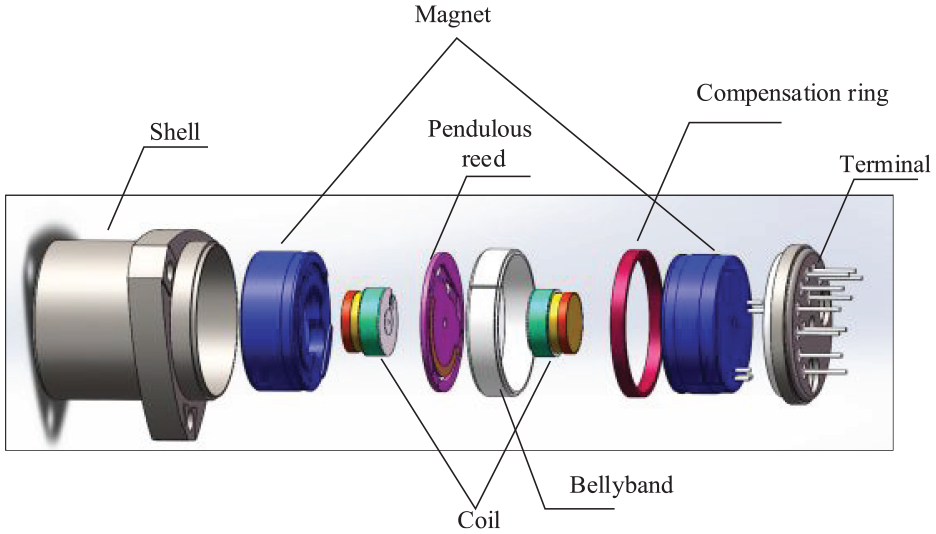
Structure of QFA.
Generally, varying temperature impacts the performance of magnet and epoxy adhesive greatly, which causes the drift of bias and scale factor.1–3 Previous works have optimized the temperature characteristic of QFA through hardware and software compensation under severe temperature conditions.
Magnetic induction shunting method is a typical hardware compensation scale factor. Magnetic induction in working gap is the main factor influencing scale factor of QFA, 4 so the stability of magnetic induction in working gap determines the stability of scale factor. This method adds a magnetic circuit to servo circuit in parallel to decrease the change of magnetic induction in working gap. However, the added magnetic circuit decreases the magnetic energy of permanent magnet, which degrades the measurement range of QFA.
Because the performance of hardware compensation is determined by the characteristics of material and manufacturing technique which are complex and expensive, hardware compensation is not economical to be widely applied. Therefore, software compensation methods which are based on rational temperature models are more suitable and reasonable. Normally, temperature is not the only factor in thermal issue, temperature gradient also influences the performance of QFA. A comprehensive temperature model of QFA which considers both stationary temperature impact and dynamic temperature impact is proposed to build the temperature model of QFA,5–7 the result indicates that the stability of scale factor improves obviously through proposed model. The temperature models of QFA proposed in previous researches are built through simple linear fitting method.8–10 High order model can describe relationship between temperature and characteristics of QFA precisely, but the results showed that the repeatability of temperature compensation using high order model is inferior.11,12 In contrast, low order model is effective in most circumstances, but the performance of temperature compensation using low order model cannot meet the demand in some severe circumstances.
QFA consists of quartz, aluminum, magnet, copper, and epoxy adhesive. The temperature characteristics of these different materials vary vastly. Normally, thermal expansion and creep are two main inner factors of deformation. Considering the different temperature model of each material, thermal effect and creep effect on each material are different, which leads the deformation consisting of thermal expansion and creep deformation. Thermal effect acts on most components in QFA, and creep effect only acts on epoxy adhesive obviously.13,14 Moreover, the deformation of other material caused by varying temperature is relatively slight comparing to it of epoxy adhesive. In this paper, the deformation of epoxy adhesive caused by varying temperature is mainly focused on. The deformation caused by thermal expansion is recoverable when temperature recover. Simple temperature compensation only suitable for thermal error. Error caused by creep effect whose influence is weak compared to thermal expansion is seldom considered. Error caused by creep effect is rarely separated from overall error, which causes the simple temperature model imprecise. In this paper, a new compensation method based on WT combined with NARX is proposed to establish a temperature model to realize high precise temperature compensation. The main contributions of this paper are summarized as below:
In QFA, creep effect mainly influences the performance of epoxy adhesive. The thermal effect on epoxy adhesive is also obvious. Therefore, a temperature experiment of epoxy adhesive is conducted to illustrate the creep effect and thermal effect on epoxy adhesive. The magnitude of unrecoverable deformation caused by creep effect is 1/6 to 1/10 of thermal deformation, which is the main inner factor degrading the repeatability of temperature compensation model.
The corresponding error of ruleless deformation of structure caused by creep effect so is hard compensated through a specific model.15,16 In order to build a temperature model which is tightly related with thermal expansion, creep error which changes in both time domain and frequency domain will be separated from overall errors by WT. The detail coefficient which corresponds to the high-frequency error caused by thermal expansion will be extracted as an input to proposed temperature model.
Because the deformation of structure is retardant when temperature changes, NARX which contains time-delay layers is applied to build the temperature model to address retardant problem.
In this paper, a novel temperature model of QFA is proposed to address the creep error and the retardant issue in temperature compensation. The paper will be organized as follows. In section II, overall temperature errors mainly divided into two parts: error caused by creep effect and error caused by thermal expansion. A temperature experiment of epoxy adhesive is conducted to illustrate the influences of creep effect and thermal effect on epoxy adhesive. Moreover, an analysis of thermal effect on other parts of components is carried out. In section III, in order to eliminate the influence of creep and to build a model tightly relating with thermal expansion, wavelet transformation is applied to separate the creep error from overall errors and to obtain the detailed coefficient as an input to NARX. Furthermore, NARX which contains delay-layers is used to address the retardant issue in temperature compensation. Detailed coefficient, bias, and scale factor are used to train the proposed temperature model of QFA. In section IV, a 4-point rotation temperature experiment of QFA is designed to collect raw data. Another two temperature models are set as comparative models to verify the efficient of the proposed compensation method. In section V, the summary of this paper is concluded.
Analysis of errors in tempearture variation
Error caused by creep effect
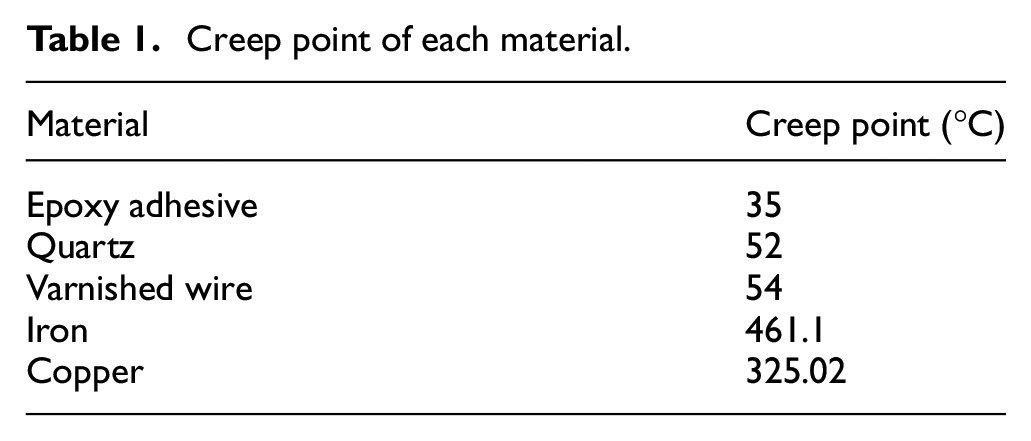
QFA consists of quartz, aluminum, magnet, copper, and epoxy adhesive. When temperature is higher than creep point, the creep effect will be severe. The relation between elongation and time can be described as follow:

Where
Creep point of each material.
A temperature experiment is conducted to illustrate the difference of creep effect and thermal expansion on epoxy adhesive. Two bars of epoxy adhesive whose weight, volume, and shape are same are placed in two deforming monitoring devices to measure the elongation of epoxy adhesive at different temperature. The test results are shown in Figures 2 and 3.
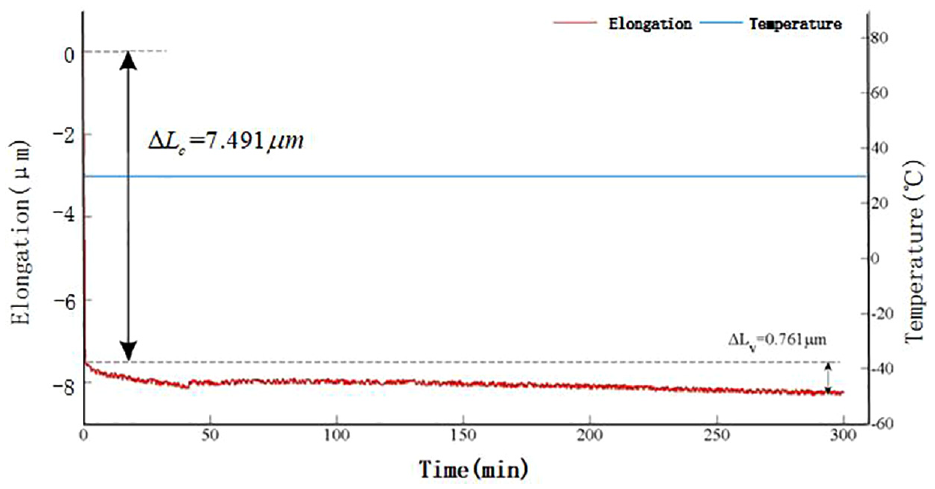
Elongation of epoxy adhesive at 35°C.
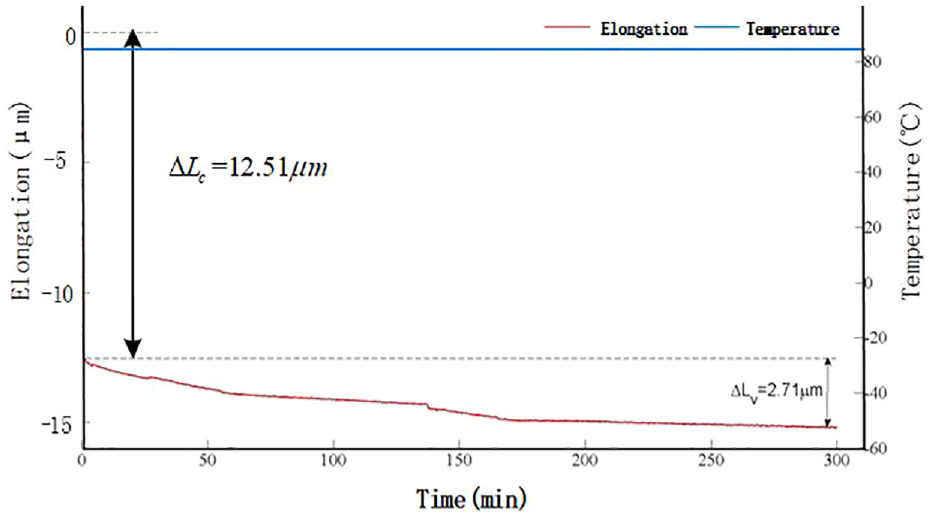
Elongation of epoxy adhesive at 85°C.
The result shows that when temperature is higher, elongation of epoxy adhesive caused by creep effect and thermal effect increases. However, compared with the rate of thermal expansion, creep rate is much slower. Therefore, error caused by creep corresponds to the low-frequency part error of overall error. Figures 1 and 2 indicate that the function describing temperature and elongation of epoxy adhesive is inexplicit. Creep error is main factor that degrades the reputability of temperature compensation model. Consequently, non-repeatable, low-frequent, and time-varying error caused by creep effect is eliminated from overall error to realize high-accurate compensation of thermal error.
Error caused by thermal expansion
The characteristic of each material is influenced by thermal effect, which not only causes deformation of structure, but also degrades the performance of magnet which is the main inner factor of scale factor.19,20 Moment coefficient is the key characteristic of scale factor. Under the impact of thermal effect, the moment coefficient of QFA is 20 :

Where
Equation (2) indicates that moment coefficient relates to variation of temperature, which means scale factor also responds to variation of temperature. Meanwhile, thermal effect also influences the performance of bias. The main reasons are: (1) As the temperature rise, the expanding varnished wire surrounds more magnetic induction lines, which enlarges the non-linear error of bias. (2) Pendulous reed contorts because of misalignment of installation and the equilibrium position of pendulous changes because of the unbalance of thermal effect. (3) The variation of temperature changes the viscosity of air inside the QFA, so that the air damping changes slightly.
WT NARX improved temperature model
WT NARX improved temperature model is proposed to address the creep effect and retardant issues. Overall error of QFA can be simplified as three parts, environment noise, creep error
Creep effect not only relates with time, but also is influenced by variation of temperature. Therefore, the characteristic of creep error is time-frequency related.21,22 Basing on the WT, output of QFA can be expressed as below.
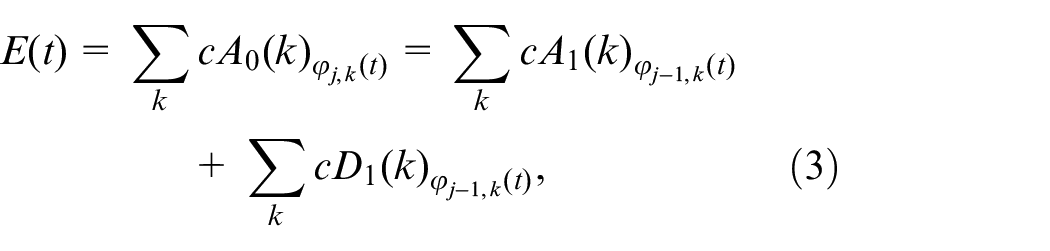
Where
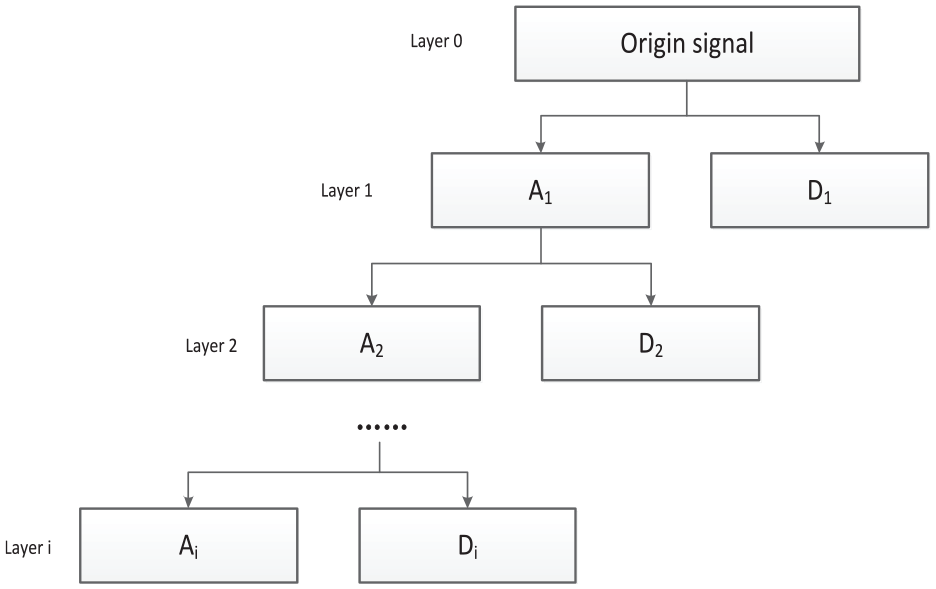
Framework of extracting the high-frequency characteristics.
The real-time deformation does not immediately reflect in the drift of performance. In fact, the accumulation of deformation affects the overall performance of QFA. Consequently, the drifts of scale factor and bias lag behind the real time deformation. In order to address dynamic problem caused by thermal expansion, NARX is a suitable scheme which contains a feedback circuit and a time-delay layer (TDL) in each layer.
NARX can be defined as below.

Where
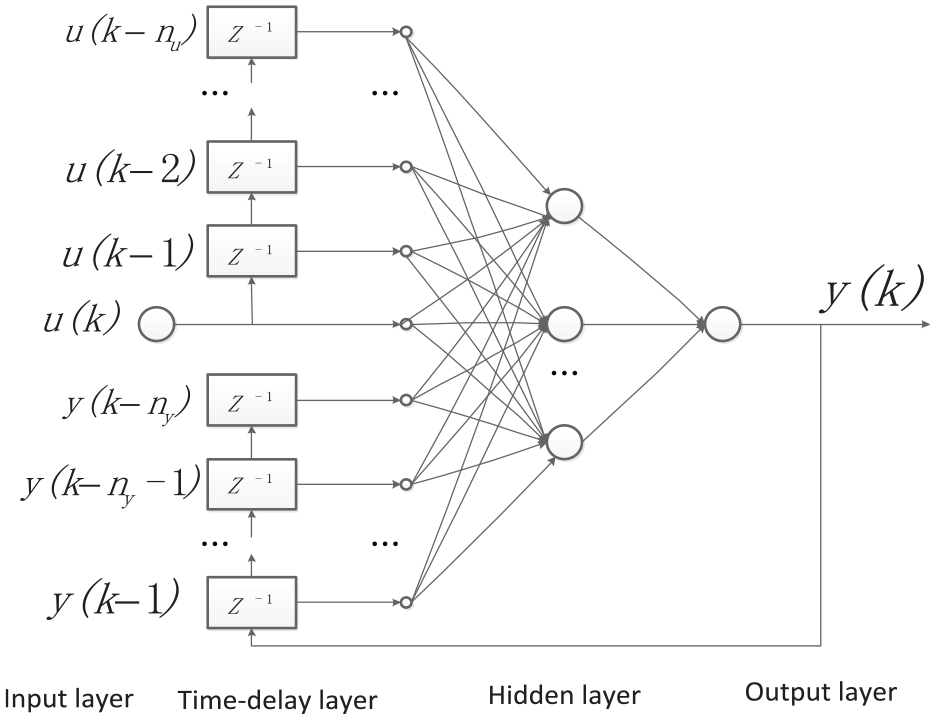
Framework of NARX.
At moment k, the output of ith hidden layer node
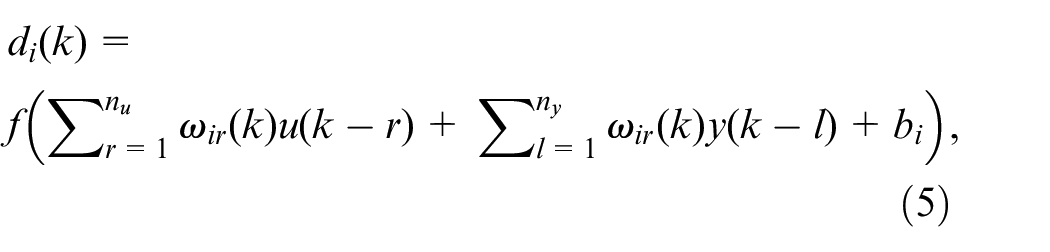
Where

Real-time recursive algorithm is an easy method to optimize the weights of the network. It is the extensive method of simple BP algorithm. The corrected weights

C,
The corrected weight is


Verification and analysis
QFA is calibrated through four position dumpling experiment, 24 it is installed in an index head and located in four position 0°, 90°, 180°, and 270° in turns. Bias and scale factor are calculated as below.

The tested QFA is JB-KT8 #1 and the instrument is put in a high-accurate temperature-controlled oven which can provide precise temperature ranging from −50°C to 120°C. In this paper, temperature range is set between −20°C and +60°C.The experiment equipment is shown in Figure 6.
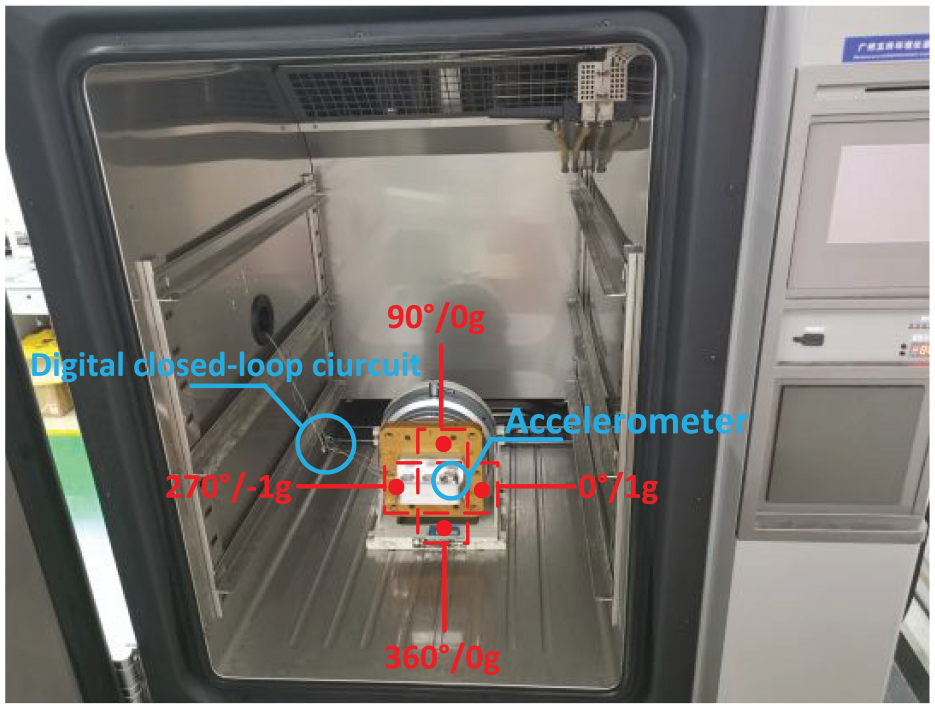
Experiment equipment.
The curve of output (1 g) versus temperature is shown in Figure 7.
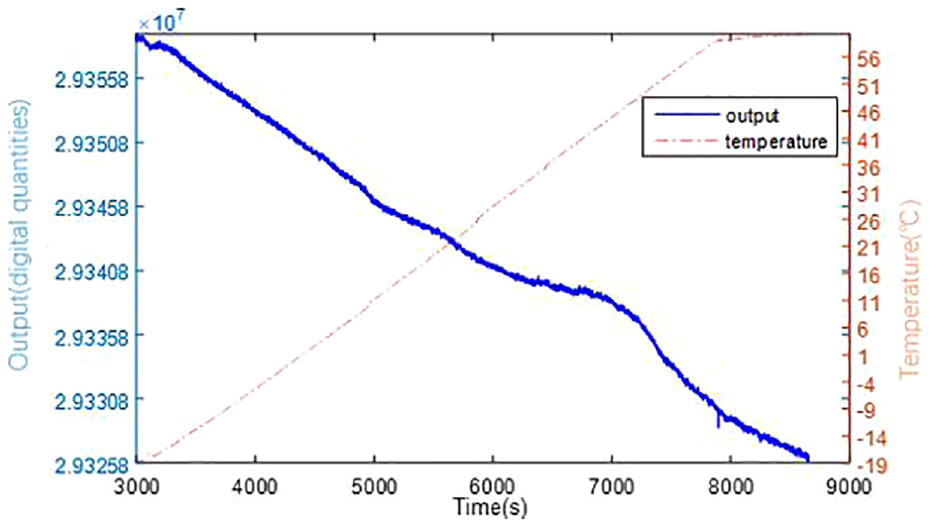
Output of 1 g at various temperature.
The linear relationship between output and temperature is relatively obvious. However, it is irrational to use simple linear regression to build the relationship between temperature and output to realize high-accurate compensation. In order to figure out how the temperature impacts bias and scale factor, WT NARX improved algorithm is employed to build the model and to realize the high accuracy of temperature compensation. “Coiflets” is chosen as wavelet basis which has good performances of regularity and symmetry. Regularity of “Coiflets” guarantee the smooth of wavelet, which can suppress the quantization error when rebuild the signal. The symmetry of “Coiflets” guarantee the wavelet is linear phase, which can avoid phase distortion when signal is decomposed. . The result of denoised signal is shown in Figure 8 and Table 2.
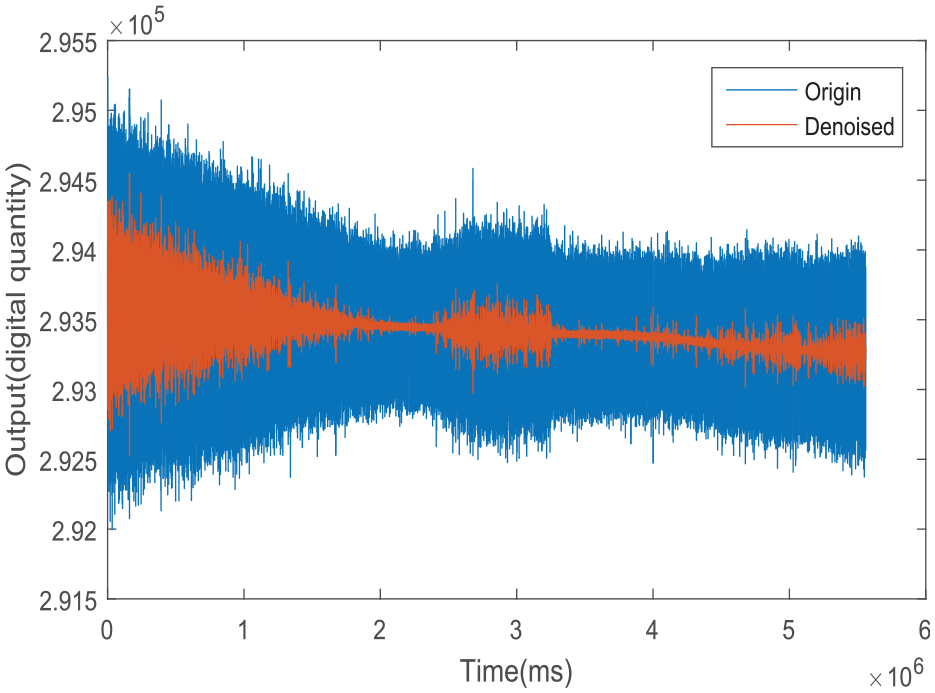
Original and denoised output.
Error model of two regression model.
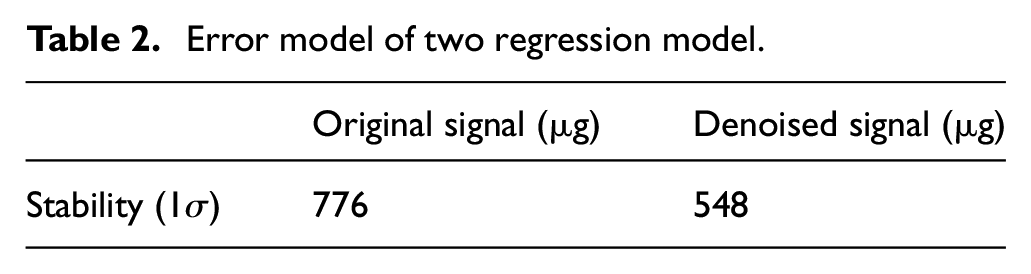
The stability of origin output is 776 µg and the stability of denoised output is 548 µg. The difference is the low-frequency errors, such as environment noise, parameter drift of electronic components, and creep effect on mechanical structure. Therefore, thermal effect is the only factor influencing the characteristic of QFA after denoised by WT.
According to (10), bias/scale factor versus temperature curve are shown in Figures 9 and 10.
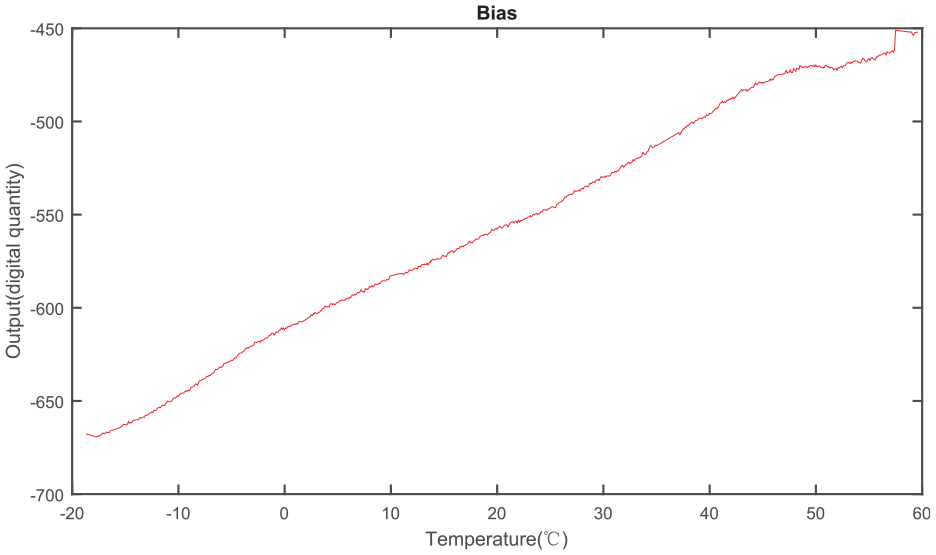
Bias versus temperature curve.
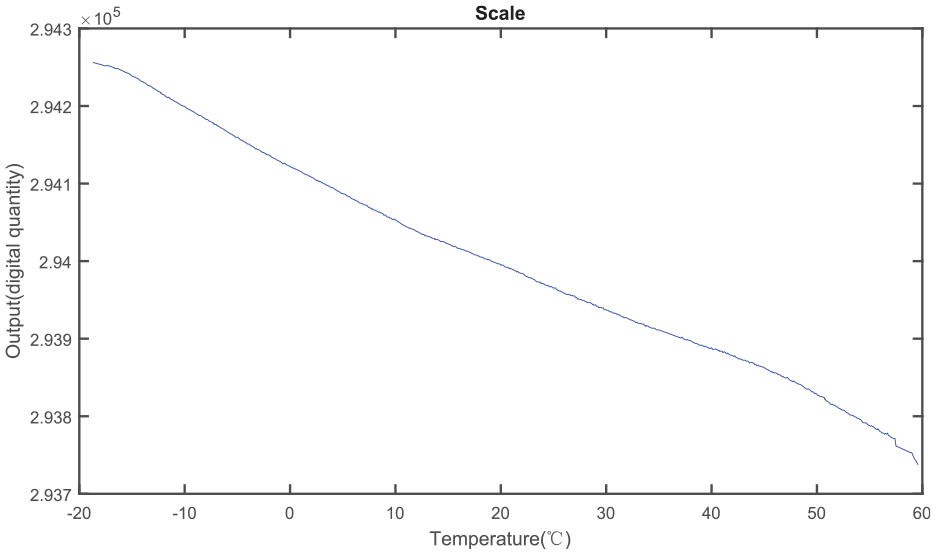
Scale factor versus temperature curve.
Because the relationship between temperature and time is linear,
NARX model synchronously predicts the training sample, validation sample, testing sample, and all samples while training by the regression process. “R” is regression coefficient whose value is closer to 1, the better prediction accuracy the model is. Figures 11 and 12 show the regression results of bias and scale factor.
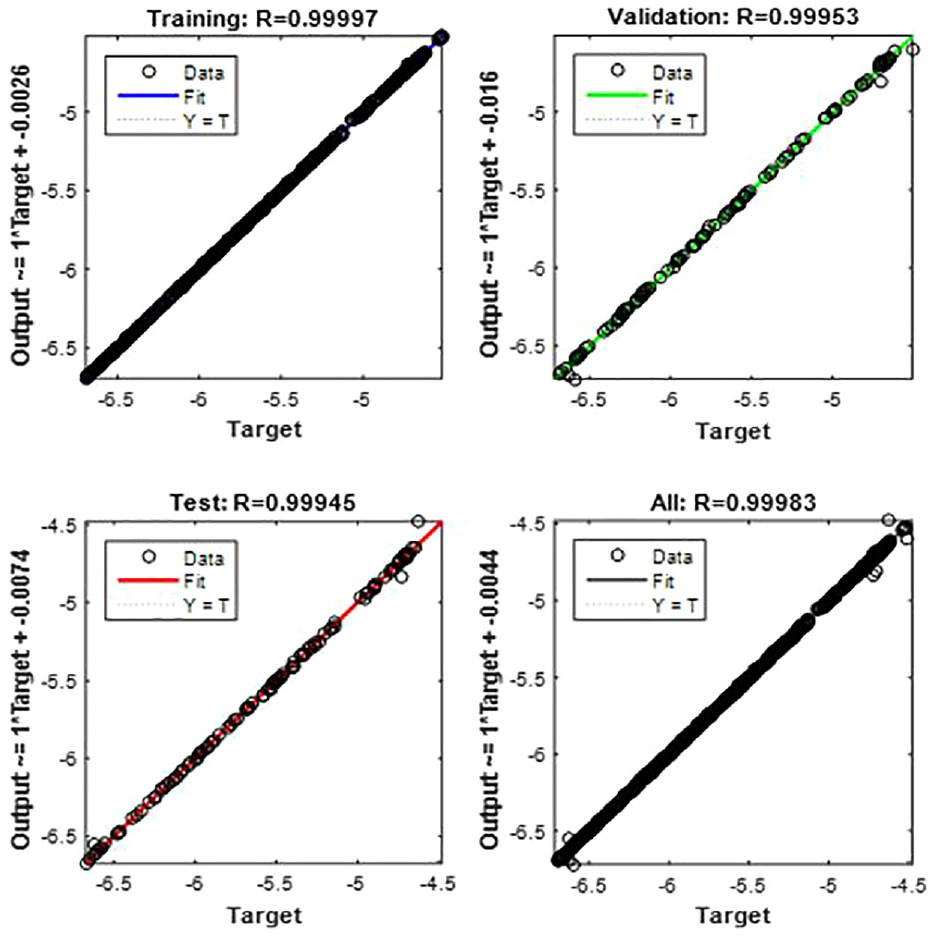
Regression curve of bias model.
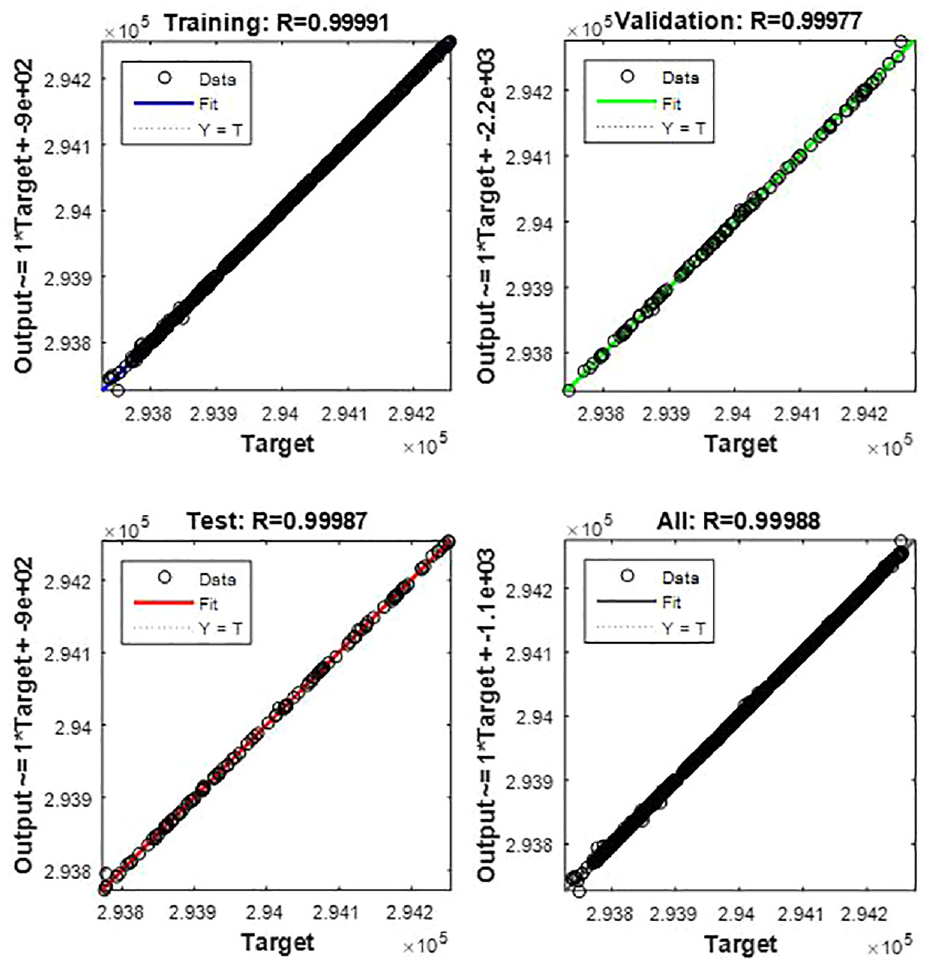
Regression curve of scale model.
Regression coefficients of scale factor /bias are both larger than 0.9994 which means the scale factor /bias models are precise.
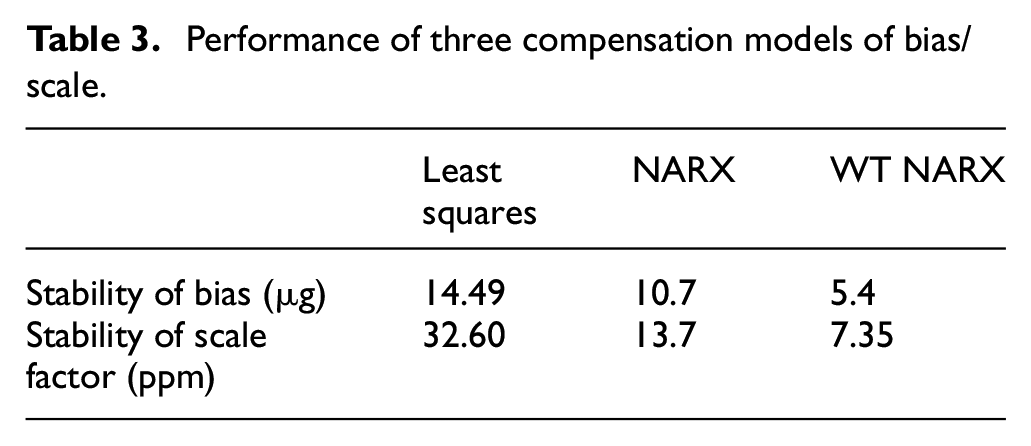
In table 3, the result shows that the performance of WT NARX model is better than ordinary regression algorithm like least squares model and NARX model in describing the relationship between scale factor/bias and temperature.
Performance of three compensation models of bias/scale.
The compensated bias and scale factor are applied to realize temperature compensation. The results of three temperature compensation methods for 1 g are shown in Figure 13.
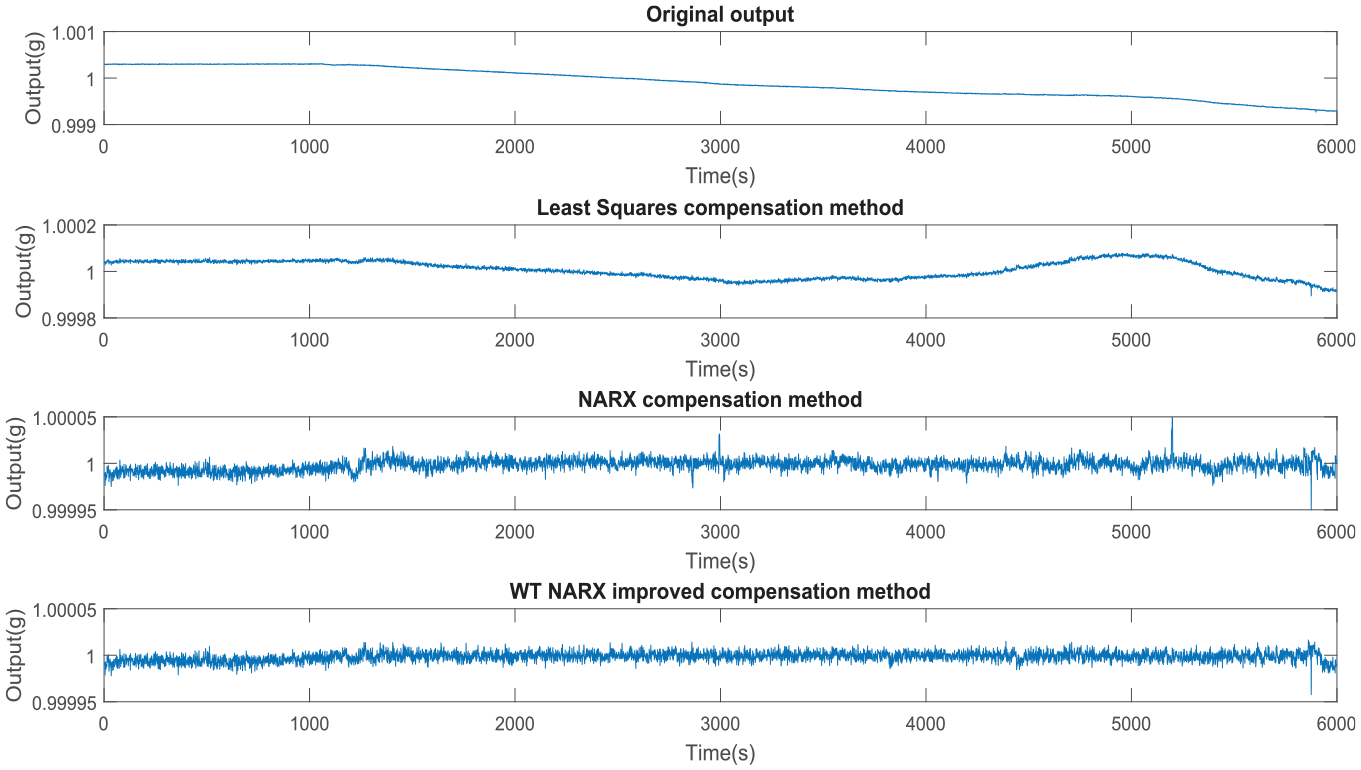
Compensation result of different methods.
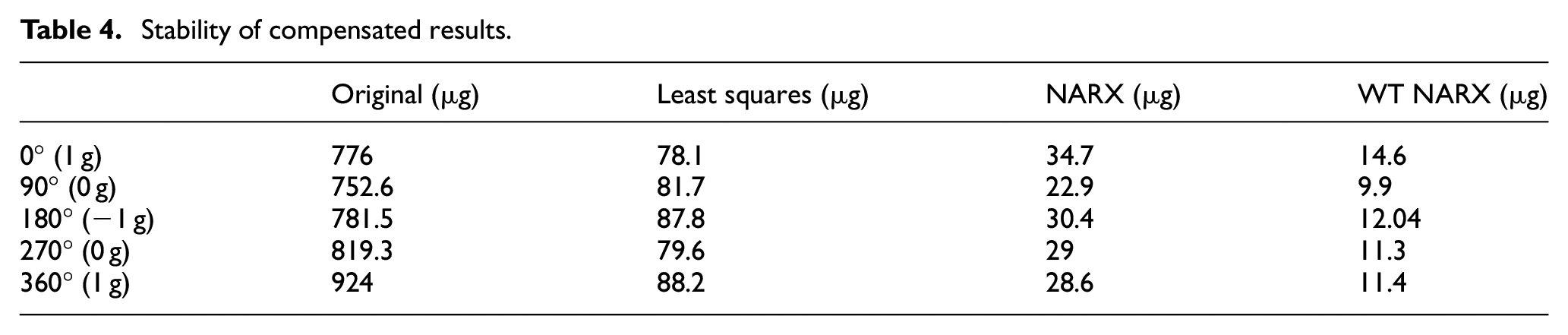
The compensated output of JB-KT8 #1 at 90° (0 g), 180° (−1 g), 270° (0 g), and 360°/0° (1 g) are shown in table 4. Temperature varies from −20°C to +60°C. The result indicates that ordinary compensation method, like least squares model, improves the performance of stability by about 90%, and the proposed model improves the stability by 98%.
Stability of compensated results.
Conclusion
According to the analysis above, temperature variation influences scale factor and bias greatly, which degrades the performance of QFA. Conventional temperature compensation methods whose performance is not acceptable in some severe temperature condition only focus on overall influence of temperature variation. Temperature variation causes severe creep effect and thermal expansion, which are two main inner factor influencing bias and scale factor. In this paper, in order to solve the problem of creep and retardant deformation caused by thermal expansion, WT NARX improved model is proposed. Based on WT NARX improved model, the stability of compensated bias improves from 14.49 to 5.4 μg and stability of compensated scale improves from 32.6 to 7.35 ppm when temperature varies from −20°C to +60°C.
The final compensated result shows that ordinary compensation method, like least squares model, normally improves the performance of stability by 90%. Compared to common compensation method, NARX compensation algorithm improves the stability of accelerometer by 95%. WT NARX compensation algorithm improves stability of accelerometer by 98%. This result shows that the performance of WT NARX improved compensation method is better than NARX model and least squares model. Nevertheless, temperature compensation is not the only way to improve temperature performance of QFA. Optimizing structure and material in economical and reliable methods is a more effective way to improve temperature performance of QFA. In addition, it should be taken into consideration that the parameters of QFA temperature model in INS may be different with that in single QFA, so precise temperature compensation in INS level need to be conducted.
Footnotes
Declaration of conflicting interests
The author(s) declared no potential conflicts of interest with respect to the research, authorship, and/or publication of this article.
Funding
The author(s) received no financial support for the research, authorship, and/or publication of this article.
