



Abstract
The transient startup and shutdown of centrifugal pumps is inevitable and its transient performance has thus attracted increasing attention in recent years. This study aims to reveal the transient characteristics of centrifugal pumps during the start-stop process by using the dimensionless analysis method and quasi-steady-state method. The research objects are three typical centrifugal pumps with an impeller structure. The startup process includes quick and slow startup, and the shutdown process includes low-speed and high-speed idle rotation. Results show that the similarity law of centrifugal pumps can be applied to transient hydraulic performance prediction under full flow conditions during slow startup and under small flow conditions during quick startup and idle shutdown. Quick or slow startup does not affect the evolution of the dimensionless power coefficients. The research result may be useful for the design of the new fluidmachinery equipment by utilizing transient hydraulic performance.
Introduction
Generally, pumps operate under stable conditions. However, in addition to steady-state operations, pumps operate under various transient conditions for short periods. For example, during a fighter jet’s short takeoff and landing, large-angle climb, and launch and disengagement of carrier rockets, the speed of the aviation fuel pumps changes drastically. Moreover, the pumps’ flow rate, pressure, and other parameters change dramatically. Extensive studies have shown that when pumps are operated under transient conditions, their transient characteristics, for example, pressure impact, power impact, and flowrate lag differ from those under steady-state conditions. If the power impact occurs during pump startup period, it causes the local low voltage, which maybe result in the damage of some small operating equipment. Maybe the dimensionless power coefficient would show different variation trends when impeller types are different. These characteristics exert a serious impact on the safety and reliability of the pumps and the entire system. Therefore, the characteristics of pumps under transient conditions need to be studied further.
The experimental research by Tsukamoto et al. showed that in the initial stage of startup, the dimensionless head is much larger than the calculated value based on quasi-steady-state theory 1,2. This study also revealed that the greater the acceleration speed is, the greater the difference between the transient result and the calculated value based on quasi-steady-state theory. 3 Lefebvre et al. found that the transient process exhibits a distinct difference from the steady-state process during startup. 4 Thanapandi et al. reported that the startup process is basically consistent with quasi-steady-state theory when the startup acceleration is extremely low.5,6 Dazin et al. found that the use of angular momentum equations and energy equation models can effectively predict the impeller torque, head, and power during transient operations. 7 Farhadi et al. established a mathematical model suitable for predicting the transient characteristics of the pump startup process. This model takes into account the turbulent kinetic energy within the entire system and achieves high prediction accuracy. 8 The experiment of Duplaa et al. indicated that under low flow conditions, the pressure at the outlet suddenly decreases at the end of the transient startup, and that under high flow conditions, cavitation damage during the startup process is severe. 9 The study by Wu et al. showed that the occurrence of cavitation during rapid pump startup causes a sharp drop in performance and a dramatic head fluctuation. 10 Li et al. 11 carried out a coupling numerical simulation of whole system comprising centrifugal pumps without imposing the boundary conditions of the pump inlet and outlet. Gao et al. 12 established a mathematical model of the hydraulic performance of a nuclear cooling pump during the inert rotation process and determined the variation law of the rotation speed and flow rate. Moreover, other transient behavior inside pumps is also studied and revealed.13–19
In the early phase of the current work, the transient hydraulic transmission performance of open impeller centrifugal pumps,20–22 compound impeller centrifugal pumps,23,24 and conventional impeller centrifugal pumps 25 during startup and shutdown was studied, and the results preliminarily revealed some transient characteristics of the pumps. In order to better and deeply reveal more transient characteristics of pumps during startup and stopping periods and on the basis of this experimental research, the dimensionless analysis method and quasi-steady-state method are employed in this paper to conduct further mathematical processing and analysis of the experimental results and thereby reveal the transient characteristics of centrifugal pumps with different impeller structures under different starting modes.
Theoretical analysis method
Dimensionless analysis
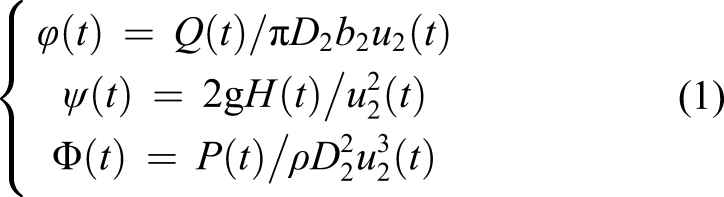
During the transient process of startup and shutdown, the rapid increase in rotational speed directly causes dramatic changes in various performance parameters, such as flowrate, head, and shaft power. In the analysis of the transient characteristics of the startup and shutdown process, the influence of speed change should be excluded. In the current work, the startup process is described by the dimensionless volume flowrate coefficient
Quasi-steady-state performance
According to the pump similarity law
26

Result analysis
Startup
(1) Quick startup
According to the previous literature,18,20,22 the open impeller centrifugal pump, compound impeller centrifugal pump, and conventional impeller centrifugal pump, respectively, require 0.20, 0.25, and 0.25 s to quickly rise from 0 to a stable speed (about 1450 r/min) during the startup process under different valve opening conditions. That is, the startup time is extremely short, and the acceleration speed is extremely large, these characteristics define a quick startup. Meanwhile, as we know, when the valve opening is different, the flow resistance is also different. In other words, the hydraulic loss is different. As such, the passing flowrate would be different. Different flowrate would result in different pump head, shaft power, etc.
A three-phase asynchronous alternating current (AC) motor with the rated power of 750W was used to drive the pump model, and the JC0 torque detector with the range of 0–5N.m was utilized to measure the instantaneous rotating speed and torque, the uncertainties of rotating speed and torque are both ±0.25%. The instantaneous flow rate is accurately measured by means of an OPTIFLUX2100 C electromagnetic flowmeter with a scale of 0–30 m3/h and the uncertainty of ±0.2%. Meanwhile, the unsteady static pressures at the inlet and outlet of the pump are recorded accurately using two WIKA S-10 pressure transducers, respectively, with measuring ranges of −1.0-1.0 MPa and 0.0–1.6 MPa. The uncertainties of the transducers are both ±0.1%. The output signals of the measured parameters are all current signals in 4–20 mA, and are acquired and processed by PCI8361BN card.
Dimensionless flowrate and dimensionless head have been analyzed in the previous literature.18, 20,22 Figure 1 shows the time evolution process of the dimensionless power coefficients of the three impeller centrifugal pumps during quick startup. The dimensionless power coefficients present similar evolution characteristics under eight valve opening conditions. The dimensionless power coefficients has a maximum value at the initial stage of quick startup, this value then decreases rapidly and gradually becomes stable. Dimensionless power during quick startup of pumps. (a) open impeller, (b) compound impeller, (c) conventional impeller.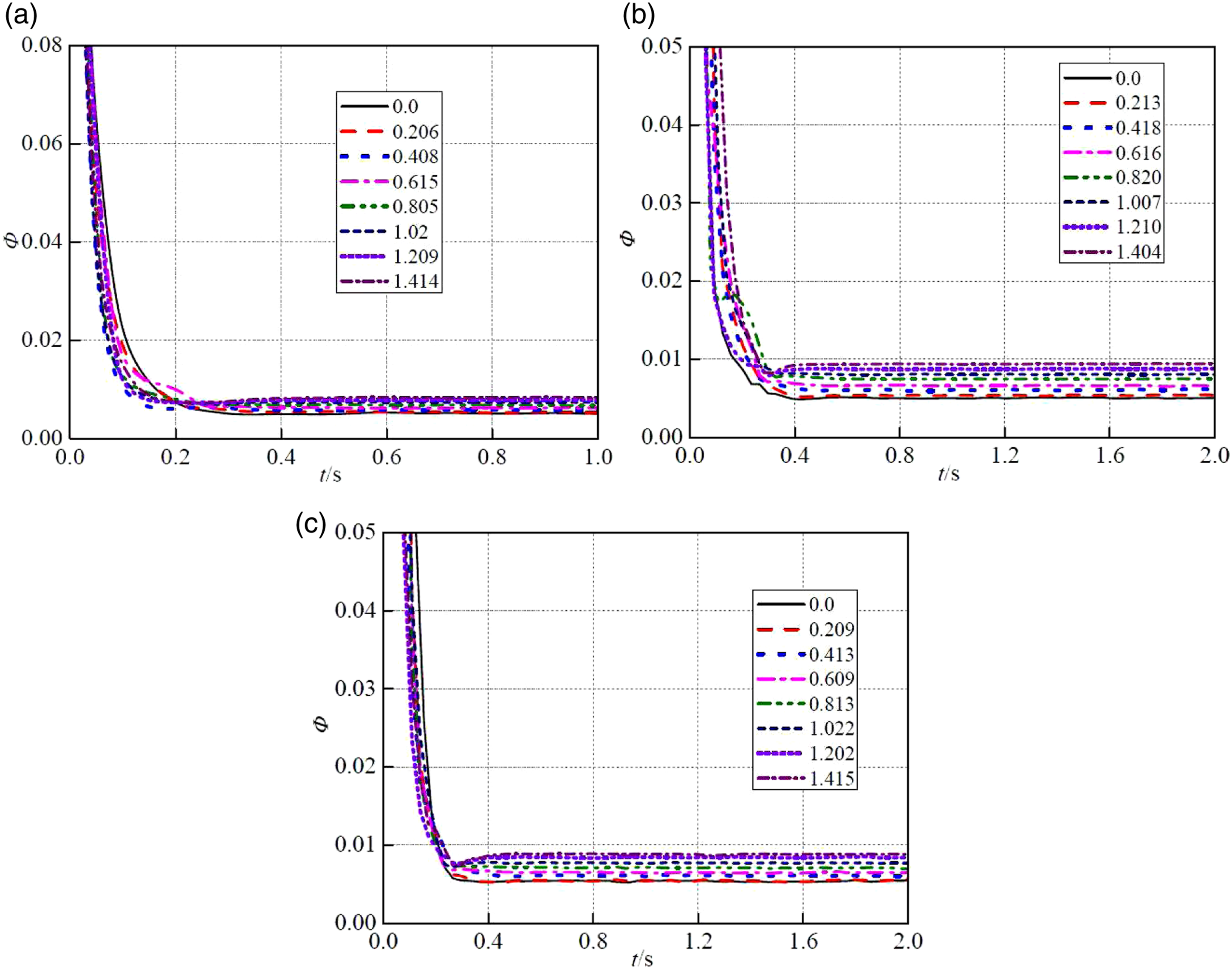
Figure 2 illustrates the comparison of the quasi-steady-state theoretical head-flow curve and the experimental head-flow curve in the startup process of the three centrifugal pumps calculated according to the pump similarity law. The experimental head-flow curve under stable working conditions is also given in accordance with the stable experimental value after startup. Pump head-flow curve during quick startup. (a) open impeller, (b) compound impeller, (c) conventional impeller.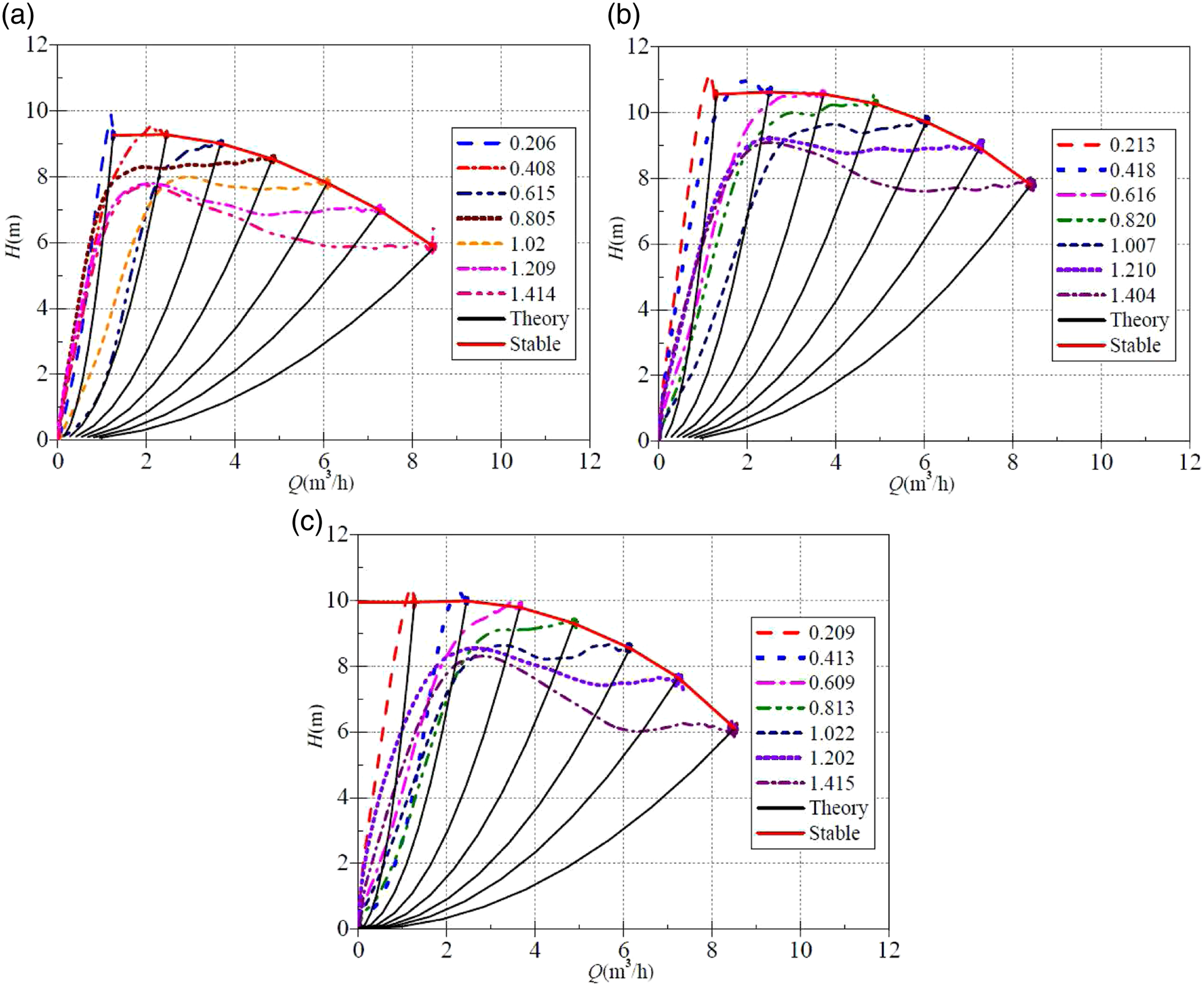
The three centrifugal pumps have small valve openings, that is, under the relatively stable flow rates Q/Qr = 0.206, 0.213, and 0.209, the quasi-steady-state theoretical head-flow curve is the closest to the experimental head-flow curve, and the difference is considerably small. Moreover, when three pumps have the maximum valve opening, that is, under the relatively stable flow rates Q/Qr = 1.414, 1.404, and 1.415, the difference between the quasi-steady-state theoretical head-flow curve and the experimental head-flow curve is the largest. As the opening of the outlet valve increases, the difference between the two curves shows an increasing trend. Therefore, during the quick startup process, the similarity law of pump is able to be considered to the prediction of transient hydraulic performance in the case of small valve opening.
As described in the literature, 17 the centrifugal pump with open impeller requires approximately 1.0 s for its speed to increase from zero to the final stable speed during the startup process under different valve opening conditions. Clearly, this duration is longer than that during quick startup (0.20 s), hence, the startup belong to slow one. In these experiments of slow startup, the test rig is similar to that in quick startup. The difference of test rigs between quick and slow startups lies in the motor and torque detector. The AC motor has been replaced by a variable frequency motor of 4.0 kW, while the detector is replaced by a new one with a scale of 0–50N.m, the uncertainties of rotating speed and torque are both ±0.25%. Other sensors are unchanged, and the sampling frequency and the uncertainty are also the same.
Figure 3 shows the time evolution process of the dimensionless coefficient of the centrifugal pump with open impeller during slow startup. Figure 3 (a) shows that under four valve openings, that is, four relatively stable flows, the dimensionless flowrate coefficient is extremely small at the initial stage of the slow startup, then it shows a gradual upward trend until reaching the final stable value. At the same time, the stable dimensionless flowrate coefficient after startup shows a gradually increasing trend as the stable flow rate after startup increases. Process of slow startup of centrifugal pump with open impeller. (a) dimensionless flowrate, (b) dimensionless head, (c) dimensionless power.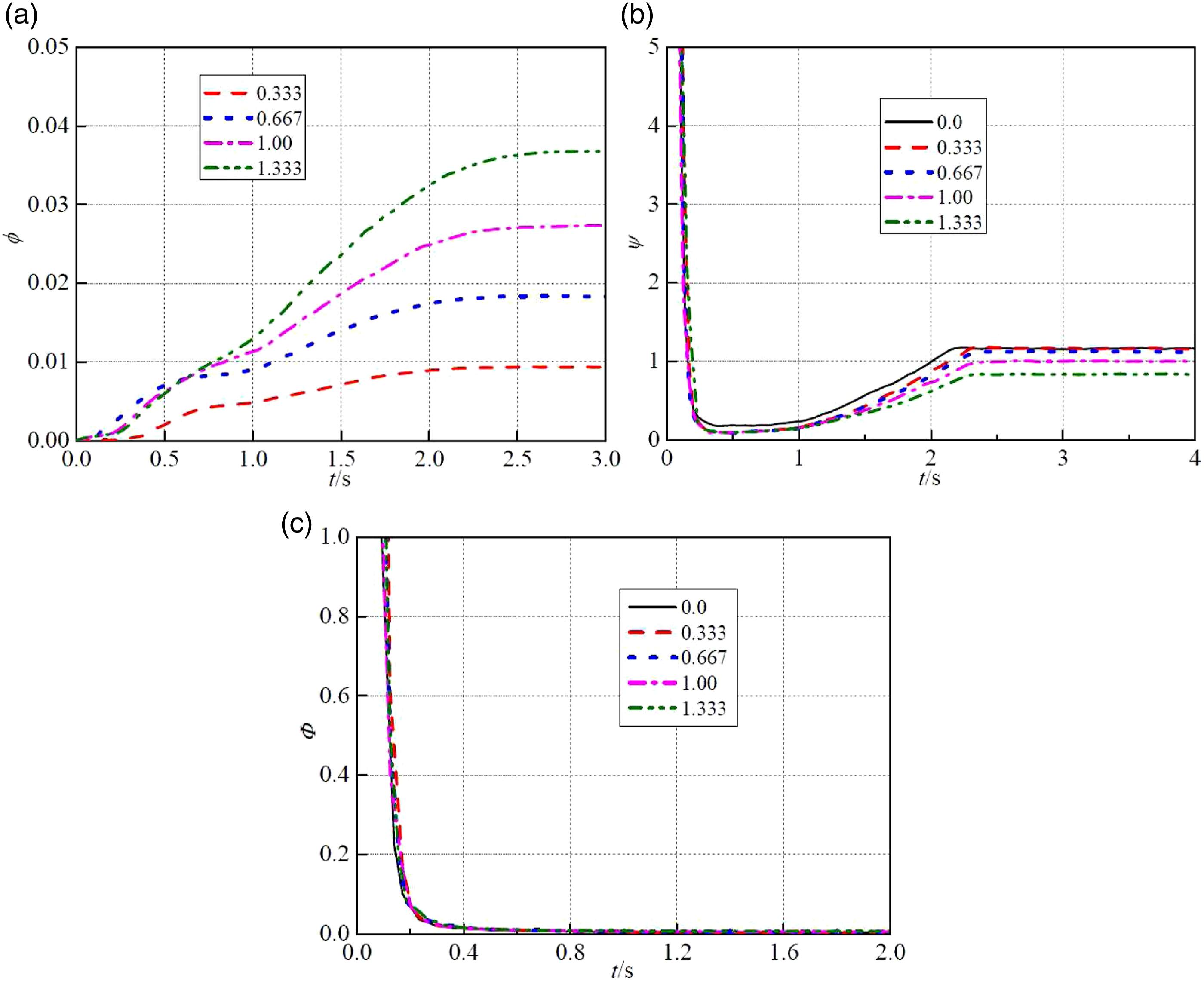
Figure 3 (b) shows that under five relatively stable flows, the dimensionless head coefficient has a maximum value at the initial stage of the slow startup, then, it rapidly drops to the minimum value and then gradually rises to the final stable value, as described in the literature.2,7 With the increase of the stable flow rate after startup, the stable head decreases, thus, the stable dimensionless head coefficient also drops. Figure 3 (c) shows that under five stable flows, the dimensionless power coefficient has a maximum value at the initial stage of the slow startup, then, it afterward drops to the minimum value rapidly.
Figure 4 presents the comparison between quasi-steady-state theoretical head-flow curve and the experimental head-flow curve of the centrifugal pump with open impeller during slow startup. Under the relatively stable flow rates Q/Qr = 0.333, 0.667, 1.000, and 1.333, the quasi-steady-state theoretical head-flow curve is close to the experimental head-flow curve, and their difference is small. This result is due to the fact that in slow startup, the startup time is relatively long, and the rotational acceleration and flow acceleration are small. As we know, the pump similarity law is usually used to describe the stable performance. Therefore, the pump similarity law can be applied to the prediction of the transient hydraulic performance of pumps during slow startup. Head-flow curve of centrifugal pump with open impeller during slow startup.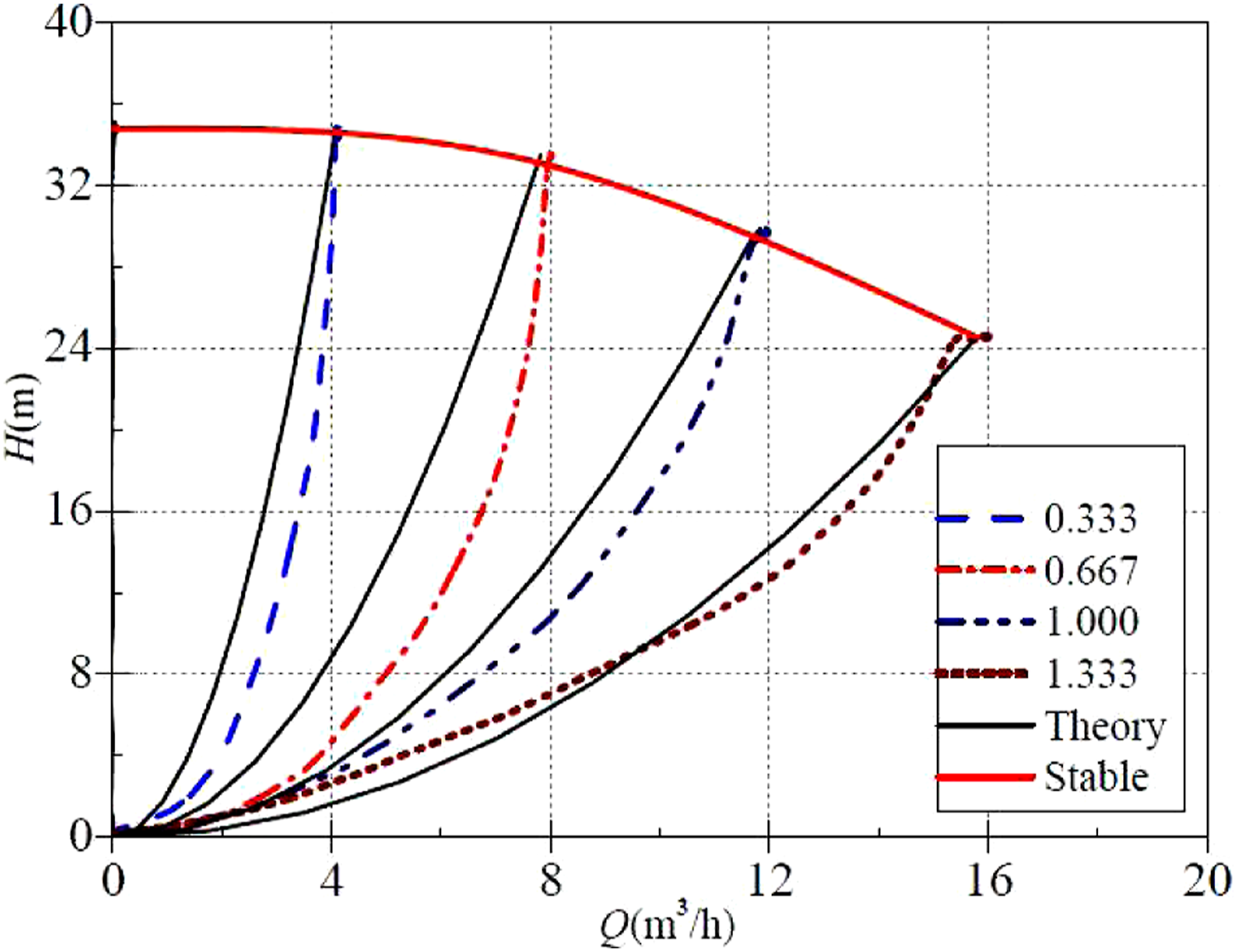
The comparison of the quick startup in Figure 2 and the slow startup in Figure 4 shows that the quick and slow startup methods exert a significant effect on the transient behavior of centrifugal pumps.
Shutdown
In this work, the three types of centrifugal pumps are powered off, and the pump impellers are stopped by means of rotor inertia of rotational rotor of pumps. The condition reflects idling shutdown.
As indicated in the literature,19,21 the speed of centrifugal pumps with open impeller, compound impeller, and conventional impeller before shutdown is approximately 1450 r/min, which indicates a low-speed running state. In these experiments of low-speed idling, the test rig is consistent with that in quick startup.
Figures 5–7 show the time evolution histories of the dimensionless coefficients of the external characteristics of three centrifugal pumps in the process of low-speed idling stop. The three dimensionless coefficients are extremely small in the initial stage of low-speed idling. With the decrease of the rotation speed, the three dimensionless coefficients show a slowly rising trend until they show a rapid rising evolution. Process of low-speed idling of centrifugal pump with open impeller. (a) dimensionless flowrate, (b) dimensionless head, (c) dimensionless power. Process of low-speed idling of centrifugal pump with compound impeller. (a) dimensionless flowrate, (b) dimensionless head, (c) dimensionless power. Process of low-speed idling of centrifugal pump with conventional impeller. (a) dimensionless flowrate, (b) dimensionless head, (c) dimensionless power.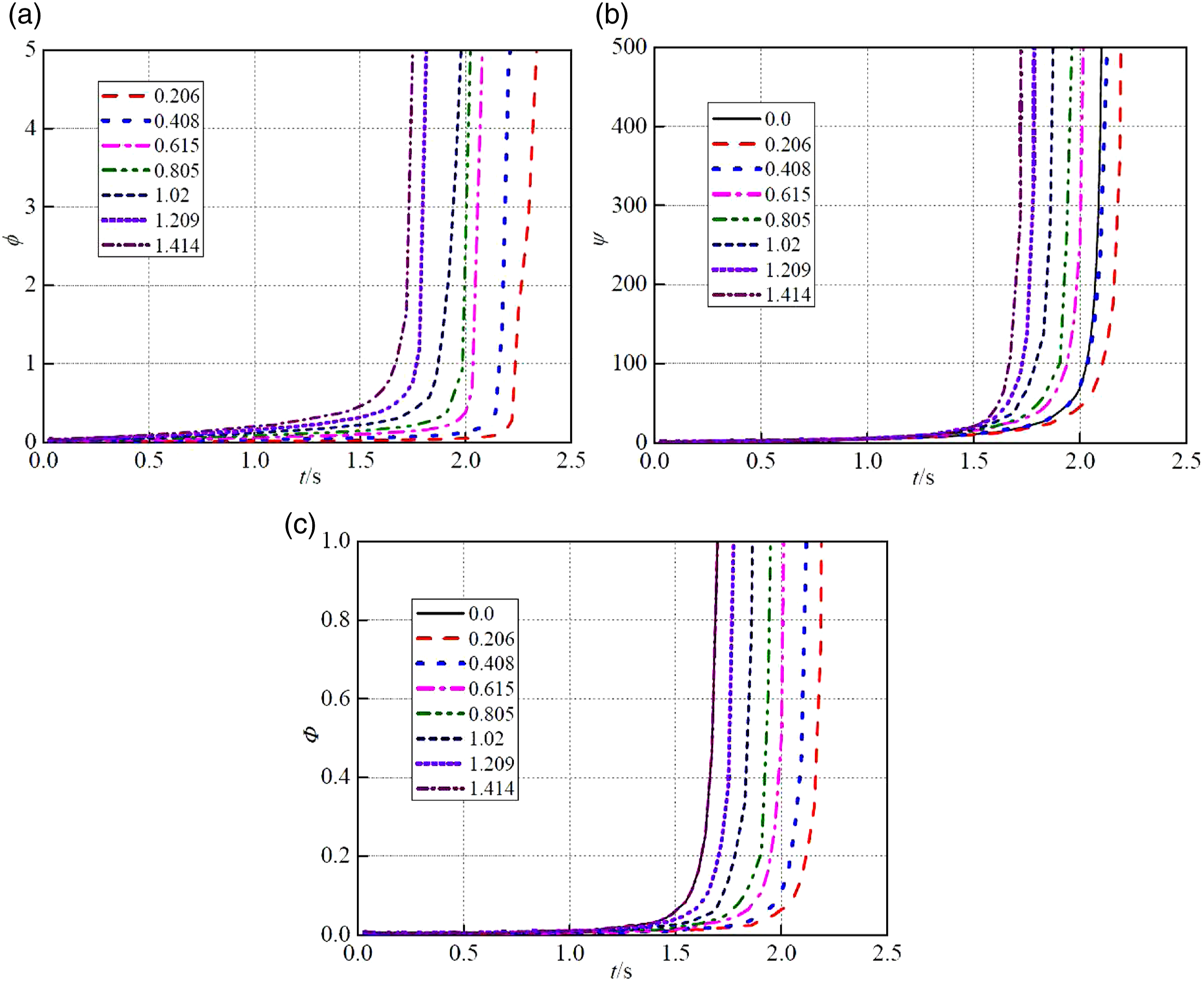
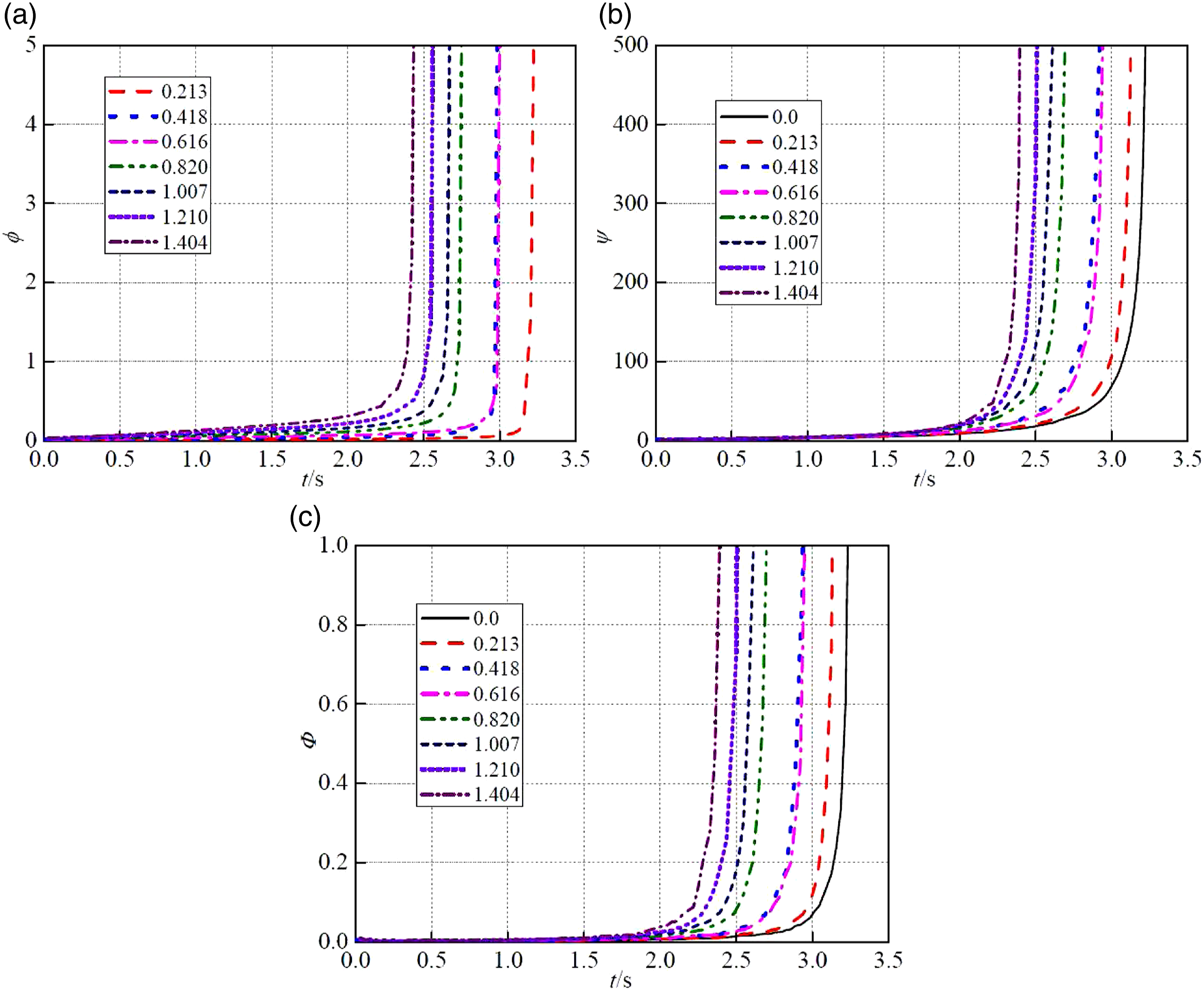
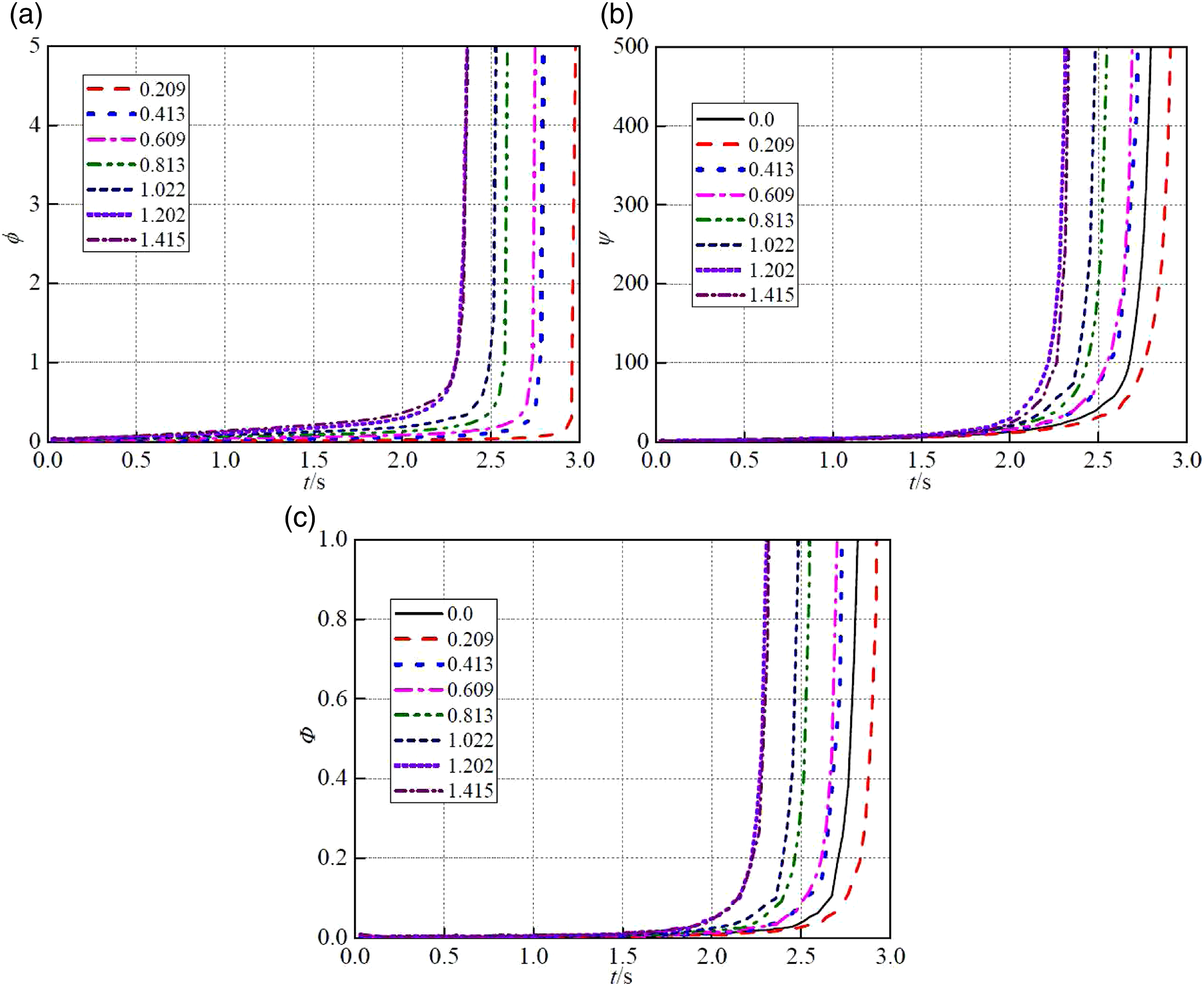
For centrifugal pumps with open impeller, compound impeller, and conventional impeller, their speed is extremely low and fluctuates after 2.5, 3.5, and 3.0 s, respectively. As for the three dimensionless coefficients, they are extremely large, and their fluctuation is intense. Figures 5–7 show the calculation results before 2.5, 3.5, and 3.0 s, respectively. With the increase of the opening of the outlet valve, that is, the increase of the stable flow rate after startup, the time required for the rapid rise of the dimensionless coefficient gradually decreases. For example, for a centrifugal pump with conventional impeller under seven relatively stable flows, the time periods for the dimensionless flowrate coefficient to rise rapidly are 2.95, 2.78, 2.73, 2.58, 2.50, 2.32, and 2.30 s. Under eight relatively stable flows, Q/Qr = 0.0, 0.209, 0.413, 0.609, 0.813, 1.022, 1.202, and 1.415, the time periods for the dimensionless head coefficient to rise rapidly are 2.80, 2.70, 2.65, 2.60, 2.50, 2.40, 2.25, and 2.20 s, respectively; those for the dimensionless power coefficient to rise rapidly are about 2.85, 2.70, 2.65, 2.60, 2.50, 2.40, 2.25, and 2.23 s, respectively. Therefore, under large flow conditions, the parameter changes during idling shutdown are particularly dramatic, thereby indicating that the transient effect becomes obvious.
Based on the pump similarity law, the comparison between the quasi-steady-state theoretical head-flow curves and experimental head-flow curves of the centrifugal pumps with open impeller, compound impeller, and conventional impeller during low-speed idling is shown in Figure 8. When the outlet valve opening is small, that is, the steady flowrate before shutdown is low and Q/Qr = 0.206, 0.213, and 0.209, the difference between the theoretical head-flow curve and the experimental head-flow curve is small. When the opening of the outlet valve is large, that is, the steady flowrate before shutdown is high and Q/Qr = 1.414, 1.404, and 1.415, the difference between the theoretical head-flow curve and the experimental head-flow curve is large. In sum, with the increase of steady flow before shutdown, the difference between the two curves becomes large. Hence, in the process of low-speed idling shutdown, pump similarity laws are applicable to the prediction of the transient hydraulic performance of pumps under small flow conditions. Pump head-flow curve during low-speed idling. (a) open impeller, (b) compound impeller, (c) conventional impeller.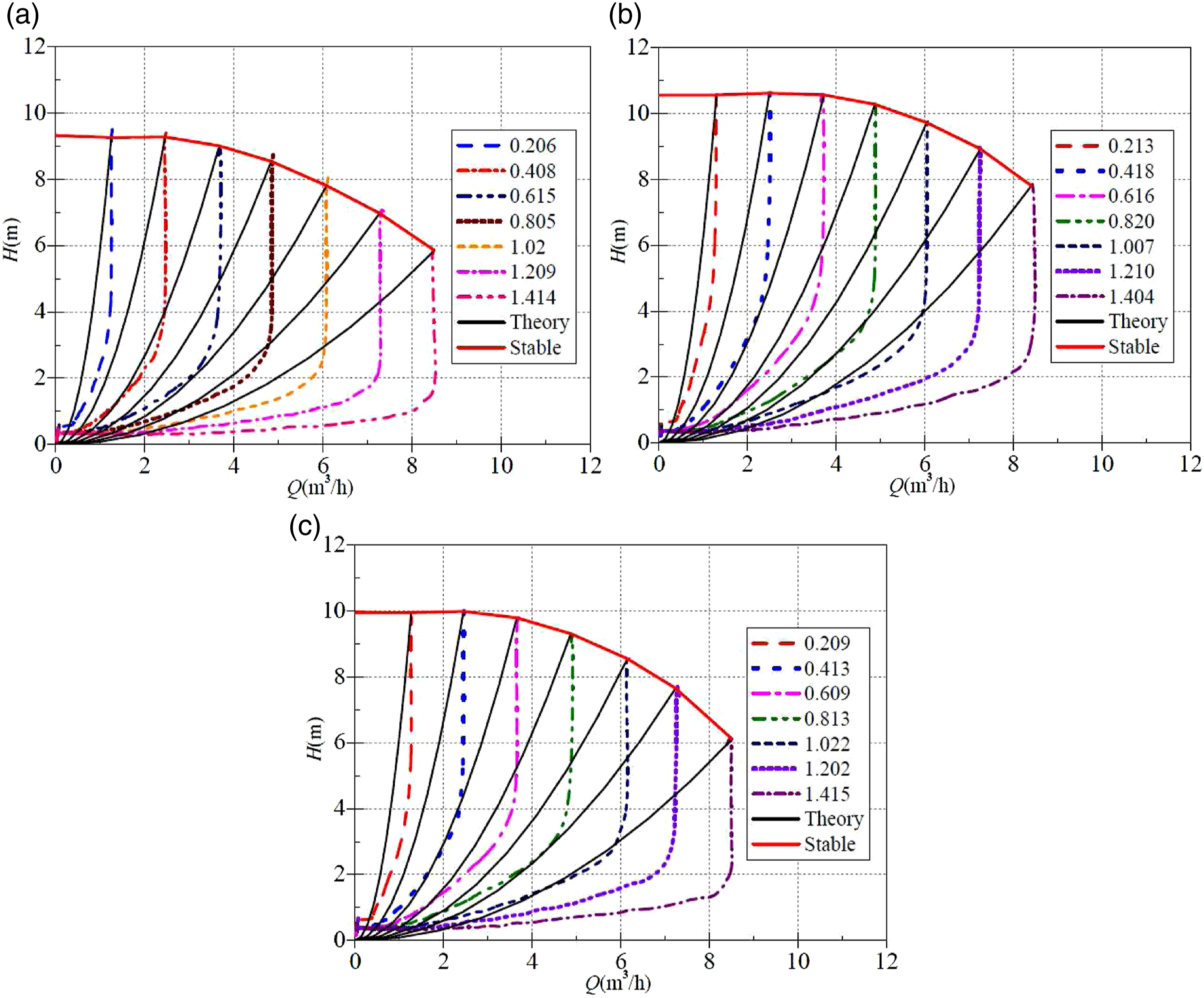
According to the literature, 17 the centrifugal pump with open impeller also performs power off and idling stop. The speed before shutdown is about 2900 r/min, which indicates a high-speed state. In these experiments of high-speed idling, the test rig is consistent with that in slow startup.
Figure 9 presents the time evolution process of the dimensionless coefficient of the centrifugal pump with open impeller during high-speed idling shutdown. The three dimensionless coefficients share similar evolution characteristics: they are extremely small in the initial period of idling, and then they show a slowly rising trend until rapid evolution. In the late stage of the shutdown process, the speed is low and jump, resulting in large dimensionless coefficients and extremely intense fluctuation. Figure 9 only shows the calculation results before 2.0 s. Process of high-speed idling of open impeller centrifugal pump. (a) dimensionless flowrate, (b) dimensionless head, (c) dimensionless power.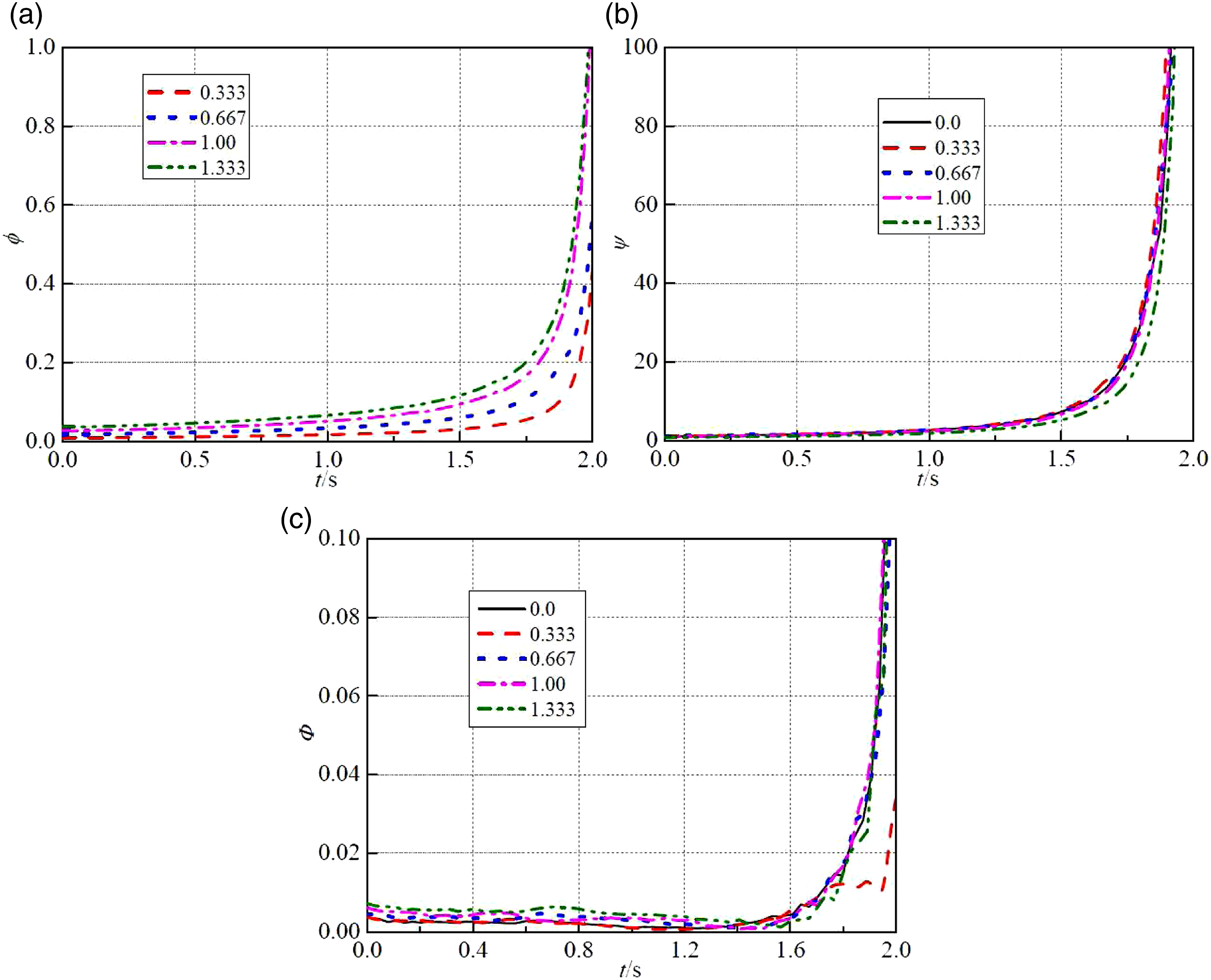
Based on the pump similarity law, the comparison between the quasi-steady-state theoretical head-flow curve and the experimental head-flow curve of the centrifugal pump during high-speed idling shutdown is shown in Figure 10. When the opening of the outlet valve is small, that is, the steady flow before shutdown is small and Q/Qr = 0.333, the difference between the theoretical and experimental head-flow curves is small. Conversely, when the opening of the outlet valve is large, that is, the steady flow before shutdown is large and Q/Qr = 1.333, the difference between the two curves is large. In summary, with the increase of the valve opening before shutdown, that is, the increase of steady flow, the difference between the theoretical and experimental curves becomes large. Hence, in the process of high-speed idling shutdown, the pump similarity laws are also applicable to the prediction of the transient hydraulic performance of pumps under small flow conditions. Head-flow curve of centrifugal pump with open impeller during high-speed idling.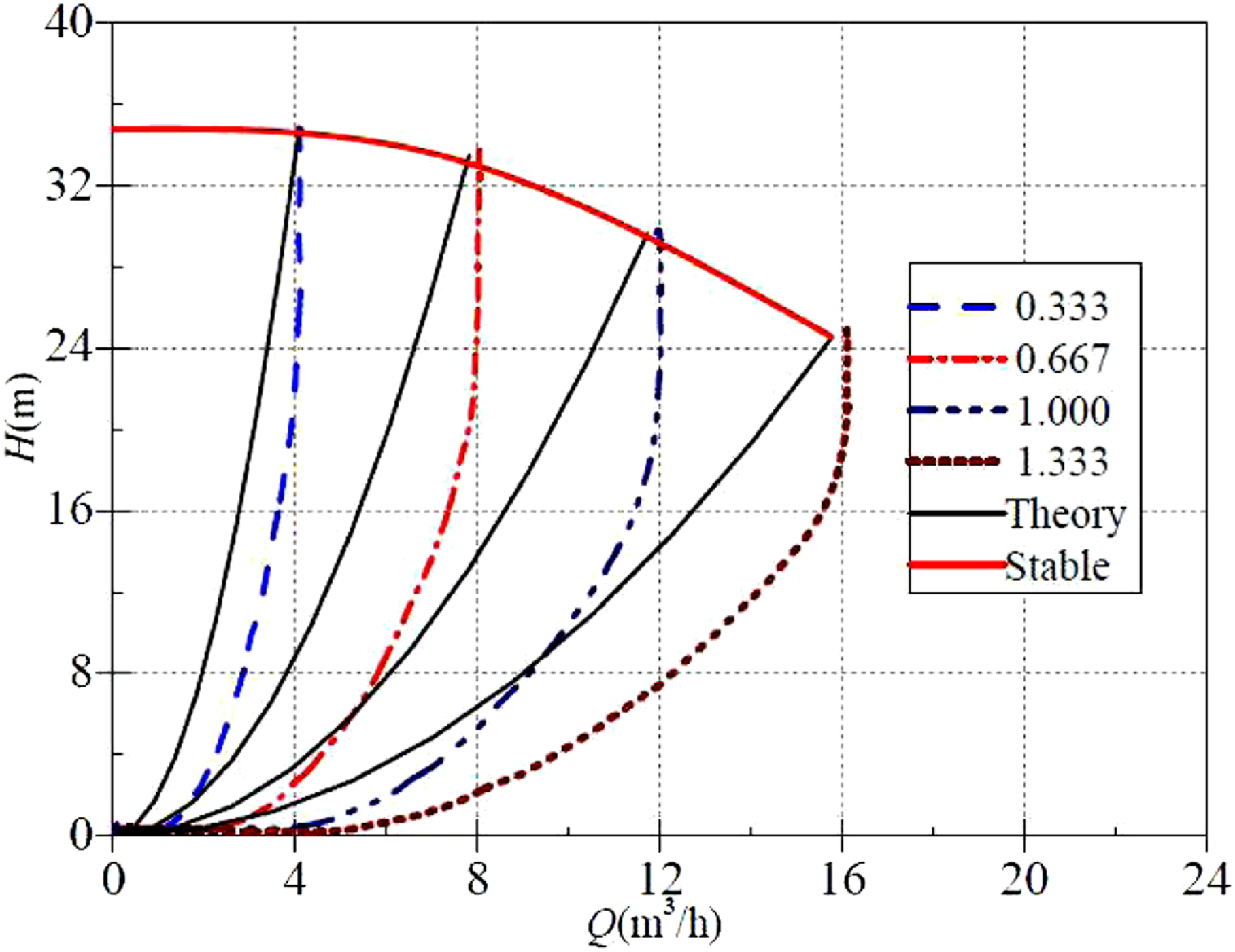
Conclusions
(1) The dimensionless power coefficients in quick and slow startup reach maximum values at the initial stage, decrease rapidly, and then reaches the final stable value gradually. This result suggests that quick or slow startup does not affect the evolution of dimensionless power coefficients. (2) The pump similarity laws can be applied to transient hydraulic performance prediction under full flow conditions during slow startup and under small flow conditions during quick startup and idle shutdown. (3) The three dimensionless coefficients herein are extremely small in the initial period of idling and then show a slowly rising trend until rapid evolution.
Data availability statement
The data used to support the findings of this study are available from the corresponding author upon reasonable request.
Footnotes
Declaration of conflicting interests
The author(s) declared no potential conflicts of interest with respect to the research, authorship, and/or publication of this article.
Funding
The author(s) disclosed receipt of the following financial support for the research, authorship, and/or publication of this article: The research was financially supported by the National Natural Science Foundation of China (Grant No. 51876103, No.51976202) and Zhejiang Provincial Natural Science Foundation of China (Grant No. LY18E090007).
