




Abstract
This study proposed a simple and effective response spectrum-compatible ground motions simulation method to mitigate the scarcity of ground motions on seismic hazard analysis base on wavelet-based multi-resolution analysis. The feasibility of the proposed method is illustrated with two recorded ground motions in El Mayor-Cucapah earthquake. The results show that the proposed method enriches the ground motions exponentially. The simulated ground motions agree well with the attenuation characteristics of seismic ground motion without modulating process. Moreover, the pseudo-acceleration response spectrum error between the recorded ground motion and the average of the simulated ground motions is 5.2%, which fulfills the requirement prescribed in Eurocode 8 for artificially simulated ground motions. Besides, the cumulative power spectra between the simulated and recorded ground motions agree well on both high- and low-frequency regions. Therefore, the proposed method offers a feasible alternative in enriching response spectrum-compatible ground motions, especially on the regions with insufficient ground motions.
Keywords
Introduction
The input of ground motion significantly affects the seismic hazards analysis 1 and risk assessment.2,3 Hence, most anti-seismic design Standards, such as Eurocode 8 4 and ASCE7-16, 5 have particular requirements for the artificial ground motions. For example, Eurocode 8 stipulates that no value of the mean 5% damping elastic spectrum should be less than 90% of the corresponding value of the 5% damping elastic response spectrum in the range of periods between 0.2T1 and 2T1 (T1 is the fundamental period of the structure in the direction where the accelerogram will be applied). Therefore, the response spectrum-compatible ground motions are significant for seismic hazard analysis. 6
Currently, two methods are commonly applied to obtain the response-spectrum matching ground motions in engineering fields, that is, simulating artificial ground motions7,8 and selecting ground motion from recorded databases.9,10 For the former methods, the ground motion simulation methods could be briefly divided into two categories, named physical-based method and stochastic method. The physical-based method generates ground motion from the perspective of seismology. 11 The advantages of this method are that the seismic source, path propagation and site topography characteristics are generally considered for generating ground motions. However, this method generally has complicated procedures and calculations.
In contrast with the physical-based method, the stochastic method treats the ground motion as a non-stationary stochastic process. Geodatis 7 elaborates a typical procedure for simulating spectrum-compatible stochastic ground motion based on Spectral Representative Method (SRM). Details are as following: (1) SRM generates a stationary Gaussian process; (2) a modulating process enables the stochastic process to meet the attenuation characteristics of seismic ground motion; (3) an iteration scheme based on the Power Spectral Density Function (PSDF) ensures that the pseudo-acceleration response of simulated ground motion is compatible with the target response spectrum. The stochastic process method is more efficient than the physical-based method. However, the convergence of response spectrum analysis is a challenging task.
Many investigations on response spectrum analysis have been carried out. These methods could be briefly divided into three categories, that is, frequency-domain method, time-domain method and wavelet-based method. The frequency-domain methods are widely applied in SRM-based ground motion simulation. Specifically, the PSDF modification is generally used in these methods. Shields 12 proposed a PSDF perturbation iteration procedure to generate spectrum-compatible ground motion. The time-domain methods enable the simulated ground motion to meet the spectral requirements by modifying the ground motion amplitude.13,14 Wavelet transform is utilized to make the simulated ground motion compatible with the target response spectrum due to its great resolution on both time and frequency domain.15–18 Additionally, the accuracy of simulated ground motions in low-frequency regions is relatively low using a stochastic process method.19,20
The selection methods obtain the spectrum-compatible ground motions from the recorded ground motion databases. This method is relatively convenient. However, the screening method is often restricted the seismic hazard analysis associated with Monte Carlo simulation21–23 due to the limited volume of recorded ground motions databases, especially on non-seismically active regions. Hence, this study aims to mitigate this issue by enriching the recorded ground motion databases.
Bearing the challenges of the stochastic process method and the lack of recorded ground motions in mind, we proposed a wavelet-based multi-resolution analysis method. This method can enrich the response-compatible recorded ground motions and effectively avoid the response spectrum compatibility analysis of the stochastic method. The fundamental theories of wavelet-based multi-resolution analysis and the proposed simulation procedure for ground motions are introduced in the Method section. The multi-resolution analysis is applied due to its invertible property and the great resolution on both time- and frequency-domain.24,25 Two high-resolution ground motion records in El Mayor-Cucapah earthquake from the Pacific Earthquake Engineering Research Center (PEER) are tested. The response spectrum error between the recorded ground motions and the average of simulated ground motions is tested to validate whether it meets the requirements of Standards. The cumulative power spectra of simulated and recorded ground motions are compared using the Discrete Fourier transform (DFT).26,27 The working principle and limitations of the proposed method are also discussed.
Method
Wavelet-based multi-resolution analysis
According to the wavelet-based multi-resolution analysis, 28 a signal can be expressed by equations (1)–(3).



where {j, n, k}∈Z; cj is the approximate coefficients (c0 is the input signal); dj is the detail coefficients; hn-2k is the low-pass filter; gn-2k is the high-pass filter; ψ is the wavelet function; φ is the scaling function; equations (1)–(3) are the essential formulations of the multi-resolution decomposition algorithm and multi-resolution reconstruction algorithm, respectively.
As shown in equations (1)–(3), the multi-resolution analysis is invertible; that is, a signal decomposed by the multi-resolution decomposition algorithm could be reconstructed ideally using the multi-resolution reconstruction algorithm. This property ensures the feasibility of the proposed method in simulating the ground motions.
Ground motion simulation scheme
The proposed method simulates new ground motions by reconstructing multi-resolution decomposition components from different recorded ground motions, as shown in Figure 1. According to the proposed method, (2j+1–2) new ground motions can be simulated using any two recorded ground motions with consistent data length (j is the decomposition level).
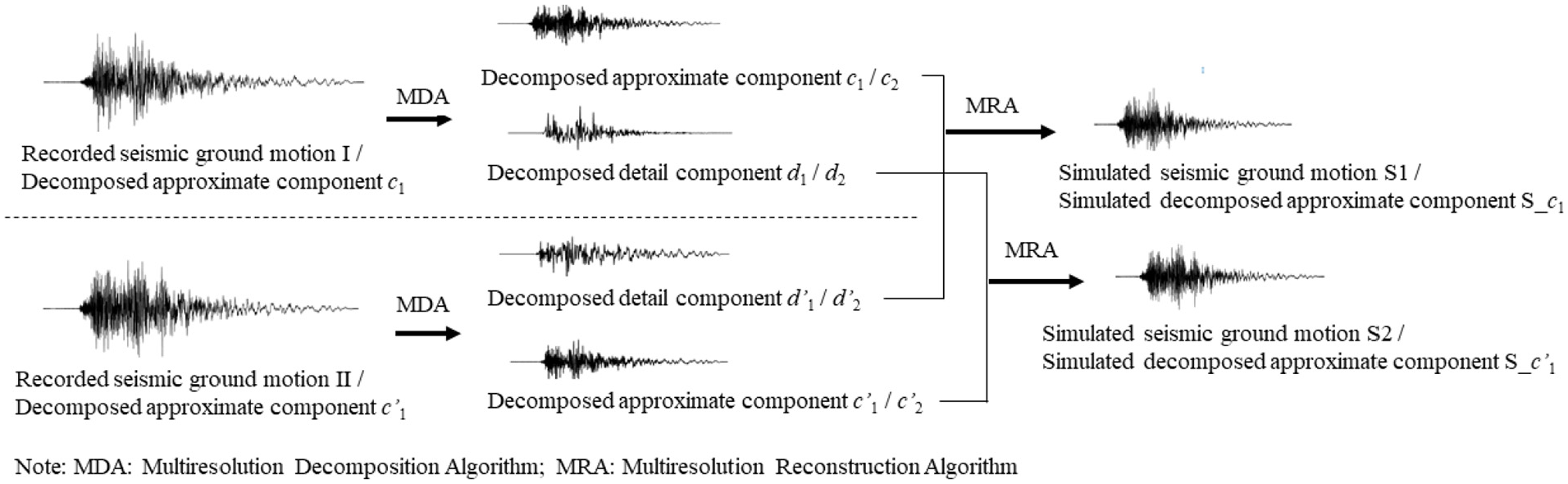
Illustration of the ground motion simulation method. As the decomposition level equals 1, two new ground motions (S1 and S2) are generated. As the decomposition level equals 2, two new approximate components (S_c1 and S_c′1) are generated. Then, four approximate components (c1, c′1, S_c1, and S_c′1) and two detail components (d1 and d′1) are obtained. Each approximate component can reconstruct two ground motions using the two detail components, thus generating eight ground motions in total. However, two of them are completely consistent with the recorded ground motions. Therefore, as the decomposition level equals j, (2j+1−2) new ground motions can be obtained.
Illustration
Multi-resolution analysis and ground motions simulation
The PEER filename of the two recorded high-resolution strong ground motions in El Mayor-Cucapah earthquake is RSN5823_SIERRA.MEX_CHI000.AT2 (CHI1000 in the text for short) and RSN5823_ SIERRA.MEX_CHI090.AT2 (CHI1090), respectively, and the ground motions are shown in Figure 2. The multi-resolution analysis parameters are set as follows. The ‘db8’ is selected as a wavelet basis. Ten decomposition levels are analyzed. The approximate and detail components are obtained after multi-resolution decomposition analysis, and the coefficients as the decomposition level are equal to 4 shown in Figure 3. Based on the proposed method, 2046 (i.e. 211–2) new ground motions are simulated, and three samples are shown in Figure 4.
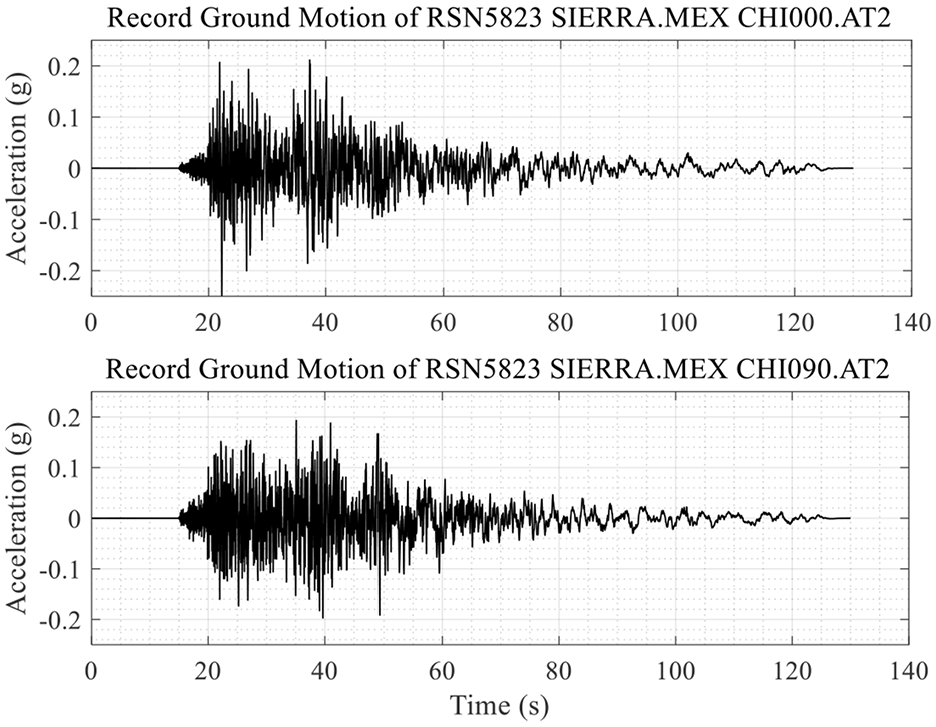
Two recorded ground motions in El Mayor-Cucapah earthquake from PEER.
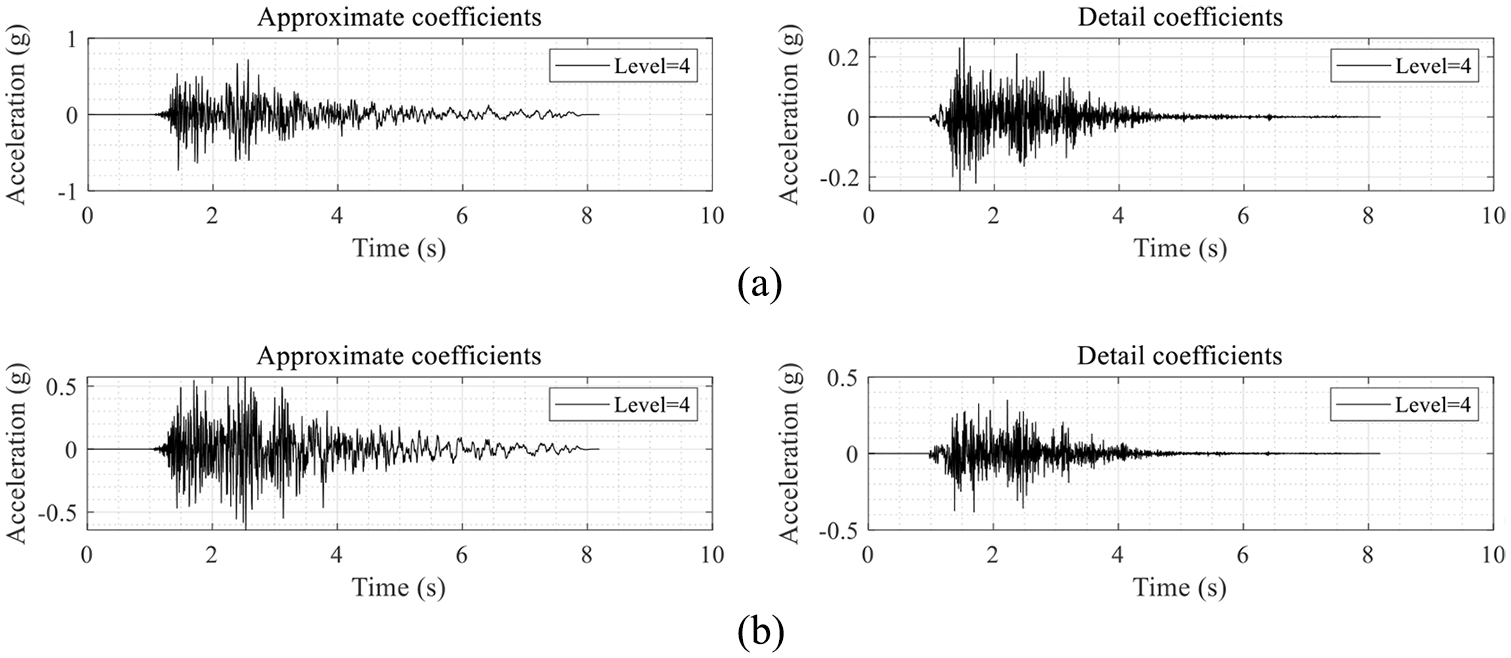
The multi-resolution decomposition components as decomposition level equals 4: (a) CHI000 and (b) CHI090.
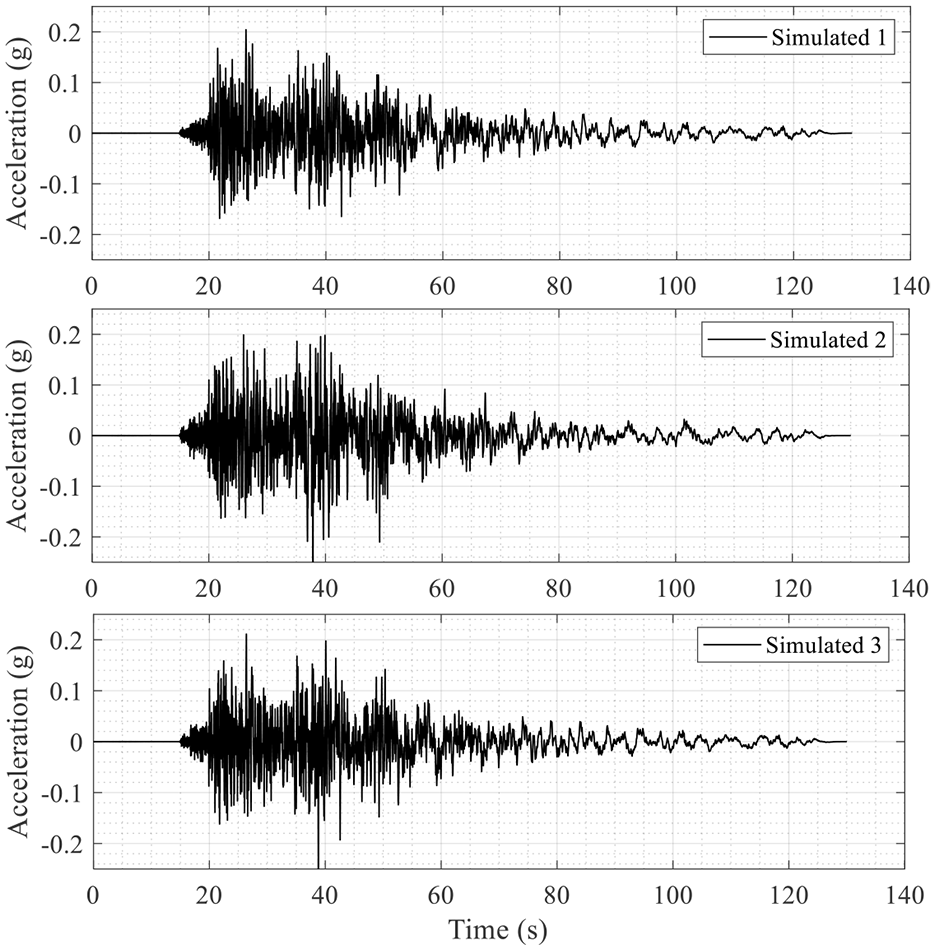
Three samples of the simulated ground motions. The simulated signal 1 is generated using the approximate coefficients at decomposition level 10 of recorded CHI000 and all detail coefficients of recorded CHI090. The simulated signal 2 is generated using the approximate coefficients at decomposition level 10 of recorded CHI090 and all detail coefficients of recorded CHI000. The simulated signal 3 is generated using the approximate coefficients at decomposition level 10 of recorded CHI090, the detail coefficients at decomposition level 1, 3, 5, 7 and 9 of recorded CHI000 together with the detail coefficients at decomposition level 2, 4, 6, 8 and 10 of recorded CHI090.
Pseudo-acceleration response spectra
The pseudo-acceleration response spectrum commonly serves as the evaluation indicator in simulating ground motions.12–18 The pseudo-acceleration response spectra of two recorded ground motions and the simulated ground motion are shown in Figure 5(a). The mean of recorded ground motion and that of 2046 simulated ground motion are also calculated to validate the spectrum-compatible ability of the proposed method, shown in Figure 5(b). Moreover, the overall response spectrum error between the recorded and simulated ground motion is quantified using the formulation suggested by Shields, 12 shown in equation (4). The overall error is 5.2%.

where ε is the overall error; R r and R s are the mean response spectrum of recorded and simulated ground motions, respectively; Tk is the period.
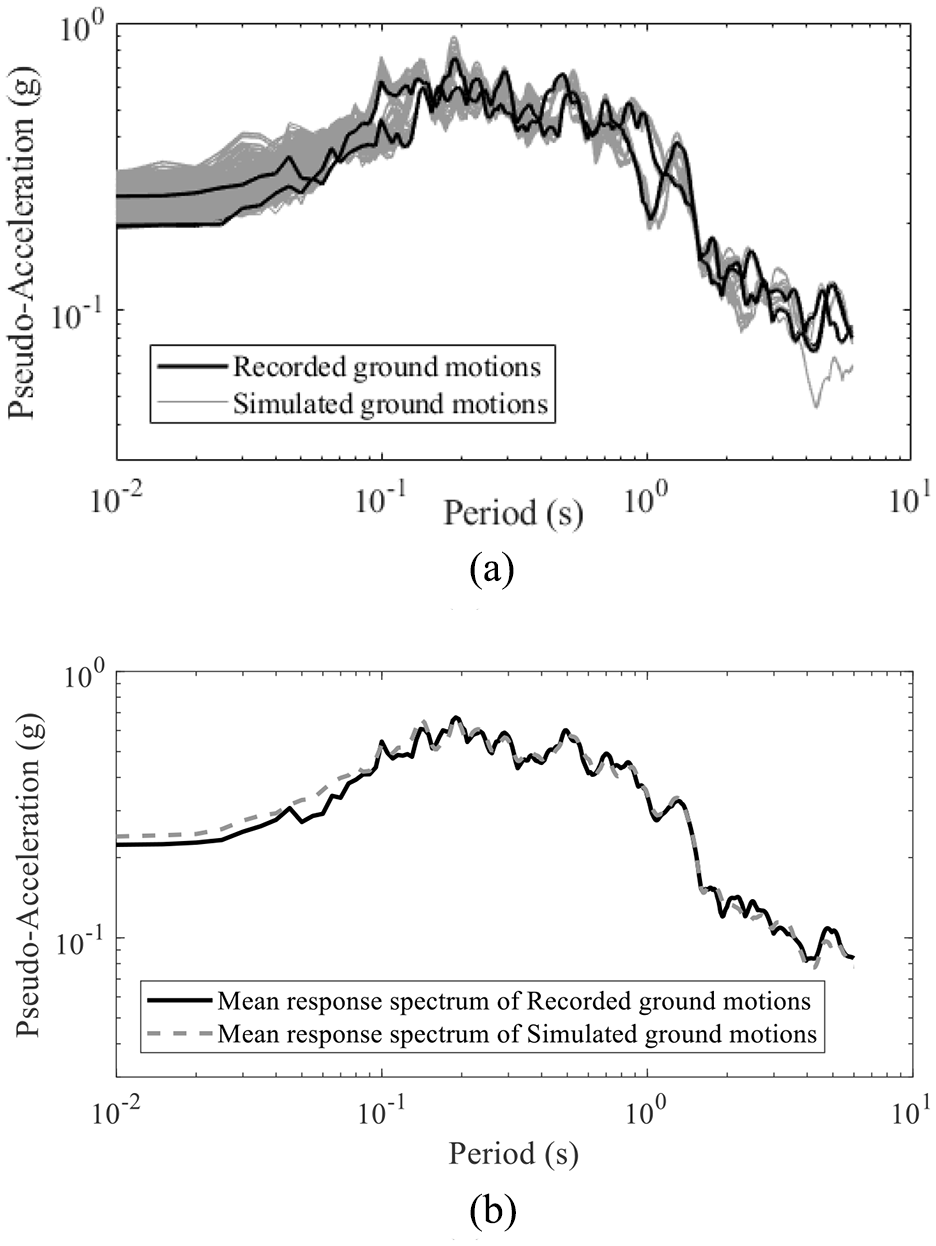
Pseudo-acceleration response spectra: (a) response spectra of 2046 simulated and two recorded ground motions (damping ratio = 5%) and (b) mean response spectra; error of mean response spectrum between simulated and recorded ground motions is 5.2%.
Frequency-domain energy distribution characteristics
The cumulative power spectra based on the Discrete Fourier Transform (DFT) are analyzed to verify the low-frequency characteristic of simulated ground motions. The DFT is utilized to explain the frequency-domain properties and represent the non-stationary properties of ground motions. 27 The formulations for calculating normalized cumulative power spectrum are expressed in equations (5)–(7). The sampling frequency of the recorded ground motions is 200 Hz. The Nyquist frequency is 100 Hz based on the sample theory.


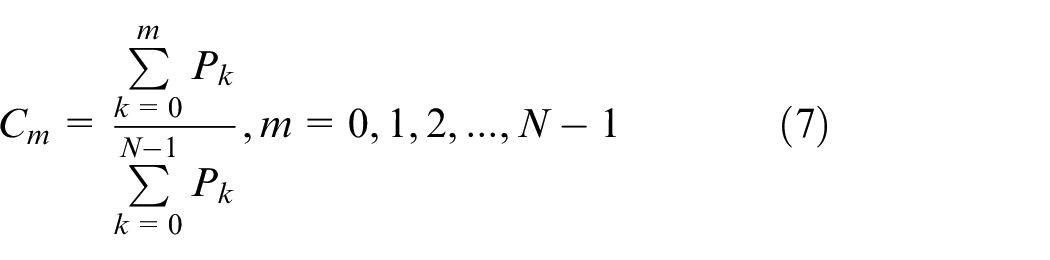
where fk in is the DFT coefficients; S (n) is the signal; Pk is the Fourier power spectrum;
The cumulative power spectra of simulated and recorded ground motions are plotted in Figure 6. It shows that the cumulative power spectra of simulated ground motions are distributed between the spectra of recorded ground motions. The energy of simulated ground motion at different frequency regions is basically consistent with that of the recorded ground motions. Two properties of the proposed method cause this phenomenon. (1) The simulated ground motion is reconstructed by the multi-resolution analysis components of recorded ground motion. (2) The multi-resolution analysis is non-redundant, ensuring multiresolution analysis components are not overlapped in the frequency domain. Hence, the frequency-domain energy of simulated ground motion inherently matches that of the recorded ground motion. These properties also enable the response spectrum of simulated ground motion to match the target response spectrum.
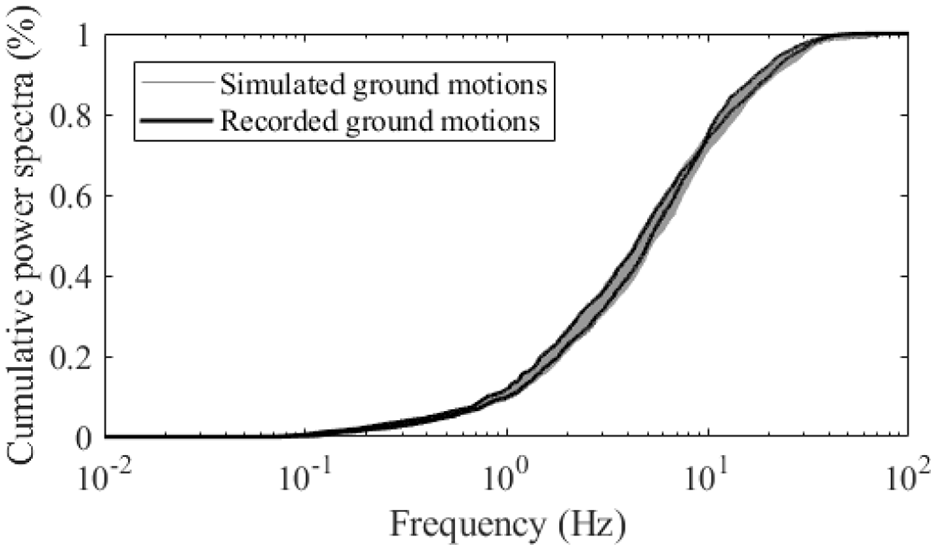
Frequency-domain cumulative power spectra of both 2046 simulated and 2 recorded ground motions.
Results and discussions
As shown in Figure 4, the simulated ground motions naturally meet the attenuation characteristics of seismic ground motion. The proposed method effectively avoids the modulation process required by the stochastic process method in ground motion simulation. The pseudo-acceleration response spectra of simulated ground motions distribute around that of the recorded seismograms, as shown in Figure 5. A response spectra iteration scheme, which usually utilizes in stochastic process methods, is also not required in the proposed method. According to Eurocode 8, 4 the response spectrum error between the artificial ground motions and the target spectrum should be less than 10% in damping ratio equaling 5%. The response spectral error between the recorded ground motion and the average of simulated ground motions is 5.2 %. Hence, the simulated ground motions meet the requirements for artificial ground motion in Standards. Additionally, the proposed method matches the target spectrum well on both high- and low-frequency regions. This property effectively mitigates the limitation of the low frequency-region match of stochastic process methods.
The proposed method can exponentially enrich the recorded ground motion databases. For the database with m recorded ground motions, the proposed method can enrich the database to
The working principle of multi-resolution analysis causes the advantages of the proposed method on attenuation characteristics, response spectra compatibility and frequency characteristics. Details are as following. (1) The multi-resolution analysis is non-redundant in the frequency domain. It ensures the components are not overlapped in the frequency domain during the decomposition and reconstruction. (2) The multi-resolution analysis has great resolutions in both time- and frequency-domain. The decomposed coefficients can retain both time- and frequency-domain information of the recorded ground motions. (3) The invertible property of multi-resolution analysis ensures that the components can be reconstructed effectively. The illustrated case merely adopts the multi-resolution decomposed components of the recorded seismograms. Hence, the simulated ground motions can inherently keep the characteristics of recorded seismograms on both the time and frequency domain. The errors in response-spectrum matching and frequency-domain energy analysis are associated with the frequency-domain resolution. The shape of simulated ground motions depends on the time-domain resolution. However, limited by the Heisenberg uncertainty principle, the time- and frequency-domain resolution is the opposite. For multi-resolution analysis, the frequency-domain resolution can be enhanced by increasing the decomposition level, and time-domain resolution reverses. Hence, selecting an appropriate decomposition level is critical in minimising the spectral analysis error and keeping the shape simultaneously.
The proposed method has some limitations. It requires at least two seismograms in simulating ground motions. Limited by the principle of multi-resolution analysis, the data length of decomposition coefficients will decrease with the decomposition level increase. The maximum decomposition level depends on the recorded ground motion data length; that is, the proposed method cannot simulate infinite amounts of ground motions like stochastic methods. Besides, this method is a pure math method. The seismological mechanism is not considered.
Conclusions
A response spectrum-compatible ground motion enrichment method based on wavelet-based multi-resolution analysis is proposed. The attenuation characteristics of simulated ground motions automatically agree with the seismic ground motion without performing the modulating process. The pseudo-acceleration response spectrum of simulated ground motions is naturally compatible with that of the recorded ground motion. Specifically, the overall response spectrum error between the recorded ground motion and the averaged of the simulated ground motions can fulfill the requirement in Eurocode 8 for artificially simulated ground motions. The cumulative power spectra of simulated ground motions are consistent with that of recorded ground motions in both high- and low-frequency regions. Hence, the proposed method provides a simple and effective alternative way to simulate response spectrum-compatible ground motions. However, the proposed method requires at least two recorded ground motions, and the data length of recorded seismograms limits the amounts of simulated ground motions.
Footnotes
Declaration of conflicting interests
The author(s) declared no potential conflicts of interest with respect to the research, authorship and/or publication of this article.
Funding
The author(s) disclosed receipt of the following financial support for the research, authorship and/or publication of this article: This research was funded by the National Science Foundation of China (51968019), and the International Postdoctoral Exchange Fellowship Program (No.40 Document of OCPC, 2019).
