




Abstract
Koch curve exciting coil of an eddy current probe can adjust the eddy current distributing in more directions at a small domain to enhance the sensitivity of eddy current probe for short defect detection. In this study, a relative entropy and a cross entropy of tangential intersection angle spectrum are proposed to evaluate the eddy current distributions in the different directions when the eddy current probe is positioned at different lift-off distances and excited by different exciting frequency alternative currents. The eddy current distributions induced by a circular and a fractal Koch curve exciting coils are analyzed by the two entropy indices. With the increasing of the lift-off distance or the decreasing of the exciting frequency, the eddy current distributions induced by the Koch curve exciting coil are close to those induced by the circular exciting coil.
Keywords
Introduction
Eddy current testing is a non-contact, rapid, and high efficient nondestructive testing method to evaluate the quality of the conductive materials and their parts. 1 Since about 1953, when the EC testing instrument was developed by Foerster, the EC testing is widely developed in many perspectives, such as its theory, probe, signal processing, and so on.
The principle of the EC testing is the fundamental knowledge for all aspects of the EC testing. In order to deeply recognize the mechanism of the EC testing, many models are created, such as equivalent circuit model, electromagnetic field model, 2 electromagnetic wave model, energy model, 3 EC disturbance model, 4 and so on. By the way, the principle of EC testing can be considered to be a communication model. An exciting coil and a pick-up element can be likened to a transmitting antenna and a receiving antenna, respectively. The primary magnetic field created by the exciting coils can be considered as a carrier wave, and the defect signal can be considered as a modulating signal. Thus, the output signal is an amplitude and phase modulating signal in which the defect signal is modulated the carry. All of the models mentioned above can be unified to Maxwell’s equations.
Based on those models, researchers developed and designed many types of EC probes in different perspectives for different applications, because the performance of the EC probe is directly affected the performance of its instrument. Firstly, the waveform of the exciting current is changed from simple single frequency current to complex waveform current, such as double frequency, multi-frequency, sweep, chirp, pulse, pulse modulation waveform, and so on.5–11 Secondly, the structure of the probe is changed from absolute type to differential type, from single element to array EC probe, form coil pick-up element to magneto sensitive pick-up element, and from 3-dimension to 2-dimension.
In the 2-dimensional EC probe, the flexible EC probe can reshape the surface to suit the detected part, such as crankshaft, turbine blade, and so on, and can detect the inaccessible areas of the complex parts.12–14 The coil structure is a key aspect of the flexible EC probe because the EC distribution is a direct determinant of the probe performance. Thus, researchers proposed many coil structures to improve the performance of the flexible EC probe, such as a circular spiral structure, meandering winding magnetometer structure, 15 and so on. These structures can be divided into two set by their EC distributions. The first set is the rotational field EC probe, which adjusts the eddy current in the time domain16,17; but the second set is mainly used in the circle, rectangle, spiral, and their combination, which can be named the space domain type EC probe.
For the spaced domain type of the flexible EC probe, the idea of the EC distribution adjustment is proposed by using the fractal geometry Koch curve exciting coil. 18 This idea is based that the shape of eddy current distribution in the specimen is similar to the shape of the exciting coils, so Koch coil may induce a Koch-like EC distribution, which may adjust the ECs distributing in more directions in the small space region to boost the performance of short defects detectable of the planar EC probe.
However, the number of turns of flexible EC probe is much fewer than those of 3-dimensional EC probe, so the structure of the coil and their EC distribution is very crucial. Thus, many indices were proposed to quantitatively evaluate the EC distribution, such as interaction efficiency, information entropy of angular spectrum, information entropy of intersection angle spectrum entropy, and a radial direction energy spectrum.19–21 The information theory was first used to evaluate the EC distribution, but there are many different indices in the information theory. Thus, in this study, the relative entropy and the cross entropy are considered as quantitative indices to evaluate the EC distribution, because the relative entropy measures the “distance” between the two EC distribution, and the cross entropy can prove the correctness of the relative entropy and the information entropy. Then, the EC distributions of the Koch curve and the circular exciting coils with different lift-off distances and exciting frequencies are analyzed.
Methodology
In order to analyze the eddy current adjustment by using Koch curve exciting coil of an EC probe, relative entropy, cross entropy and entropy are selected to evaluate the EC distribution in the perspective of tangential intersection angle spectrum (TIAS). In this study, the three entropies are calculated by TIAS which is proposed by the literature, 19 so the TIAS is introduced as follows. Then, the three entropies will be introduced in detail.
The definition of TIAS
Usually, entropy is a quantity that can measure the amount of information and can be calculated by a probability of a random variable. In this study, discrete random variable is selected to evaluate the EC distribution. However, there are many properties of an EC distribution, such as amplitude, position, direction, and so on. The selected property represents the perspective for evaluating the EC distribution.
When the Koch curve becomes an exciting coil of the EC probe instead of the circular coil, the idea of EC distribution adjustment in space domain is proposed. Koch curve exciting coil can adjust the ECs distributed in more directions in local domain than circular exciting coil. In order to evaluate the adjustment of ECs, the angle between the direction of ECs and the direction which is perpendicular to the position direction is a property to be observed as shown in Figure 1.
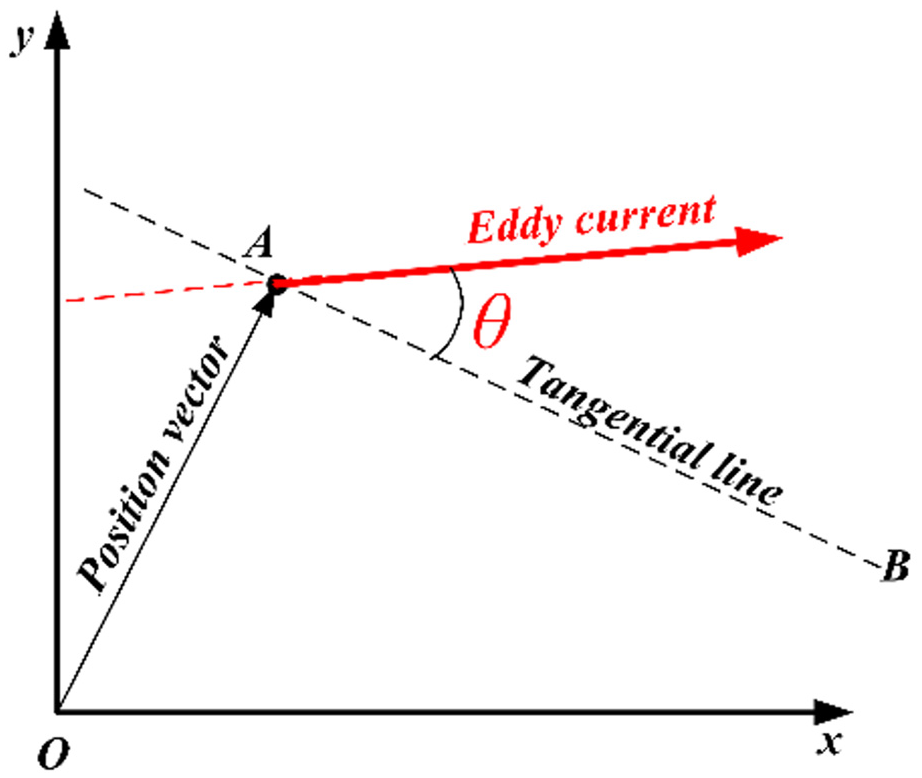
The definition of the tangential intersection angle.
In this study, the angle ranges from 0° to 90° and is split to 30 intervals. The size of each angle interval is 3°. The intervals are considered as a discrete random variable
Entropy
The entropy of the TIAS is calculated by the equation 22

Relative entropy
Relative entropy measures the distance between two distributions of random variables. If one discrete random variable

The index
Cross entropy
Cross entropy is another entropy between two probability distributions of the same discrete random variable. If

In this study, the distribution
Example of the entropies
In this paper, the eddy current distributions are extracting by FEMs calculated by commercial software COMSOL multi-physics and the entropies are calculated by the MATLAB which are same to that in the literature.
19
In order to fast get the information of the FEMs and the method, the parameter of specimen and the coil are rewrite here. All FEMs have three part: coil, specimen and air domain. The size of specimen and air domain are
To illustrate how to use the two entropies of TIAS, a simple example will present as follows. The EC distribution induced by a second Koch curve exciting coil with 0.1 mm lift-off distance and 1 kHz exciting frequency is extracted by the method in the literature. The

Results and discussion
Figures 2 and 3 show the information entropy and relative entropy of the EC distribution induced by the Koch and the circular exciting coils at different lift-off distances and fed with different exciting frequency alternative currents.
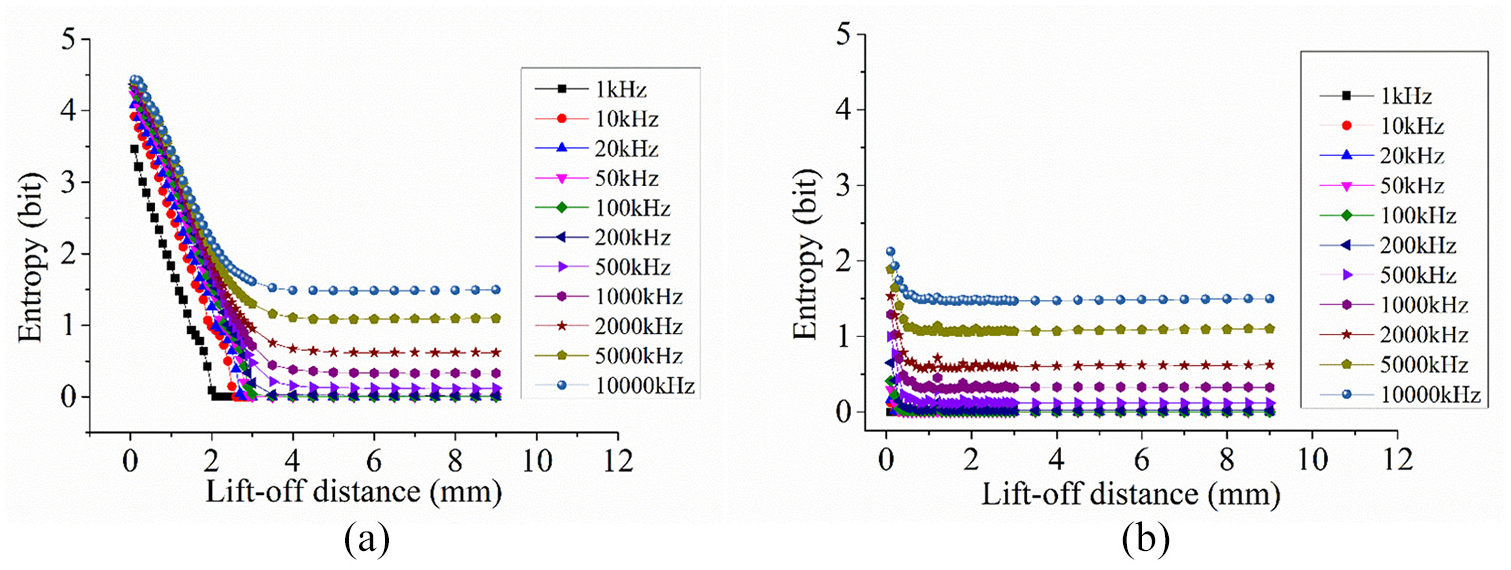
Information entropy: (a) Koch and (b) circle.
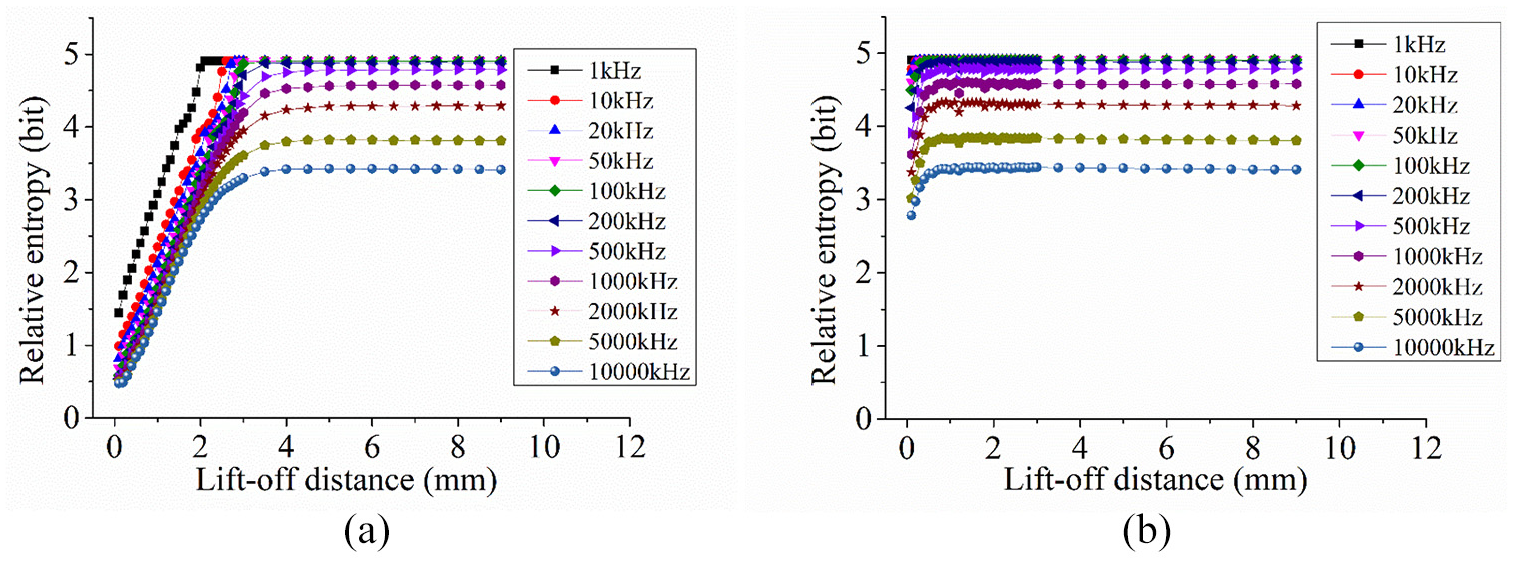
Relative entropy: (a) Koch and (b) circle.
For a certain frequency and a certain exciting coil, the curve of relative entropy changed with the increasing of the lift-off distance has two segments: a growth segment and a horizontal segment. However, the turning points between the two segments of the Koch exciting coil are lower than those of the circular coils. Lift-off distances of the turning points of the Koch exciting coils are roughly greater than 1 mm, but those of the circular coil are less than 0.5 mm. When the lift-off distance is 0.1 mm, the initial relative entropy of the Koch exciting coils for each frequency is less than that of the circular exciting coil.
For a certain exciting frequency, the values of the horizontal segment of the Koch exciting coil have little difference from that of the circular exciting coil. For example, when the lift-off distance is 9 mm, the relative differences of the relative entropy of the two exciting coils are calculated by the equation

According to equation (5), the maximum of the relative difference of different exciting frequencies is less than 0.16%. This result means that when the lift-off distance is 9 mm, the EC distributions induced by the two exciting coils are similar to each other.
The entropy of the TIAS of the two exciting coils is shown in Figure 3. The result of entropy of the TIAS is similar to the result in the literature, 19 the angle is split to 18 intervals by the step 5°, but 30 intervals by the step 3°in this work to refine the results.
The cross entropy of TIAS for each case is 4.907 bit. For each case, the cross entropy of the TIAS is the sum of the relative entropy of the TIAS and the information entropy of the TIAS. This phenomenon fits the equation (4) which describes the relationship among the entropy, the relative entropy and the cross entropy. Thus, the cross entropy can be used to validate correctness between the information entropy and the relative entropy.
In order to observe the relationship between the EC distributions and entropies, the change of the EC distribution with the change of the lift-off distance and the exciting frequency are shown in Figures 4 and 5.
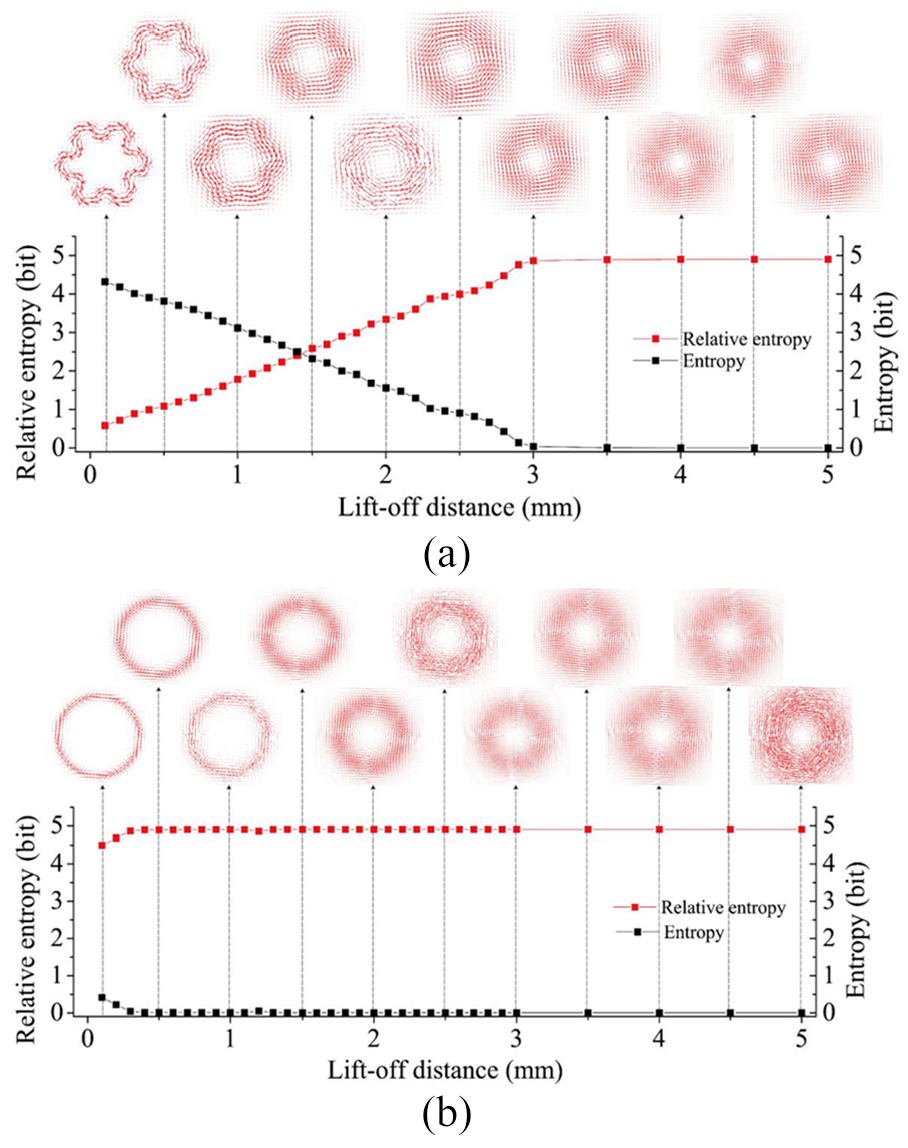
The change of EC distribution with the increasing of the lift-off distance when the exciting frequency is 100 kHz (not in scale): (a) Koch and (b) circle.
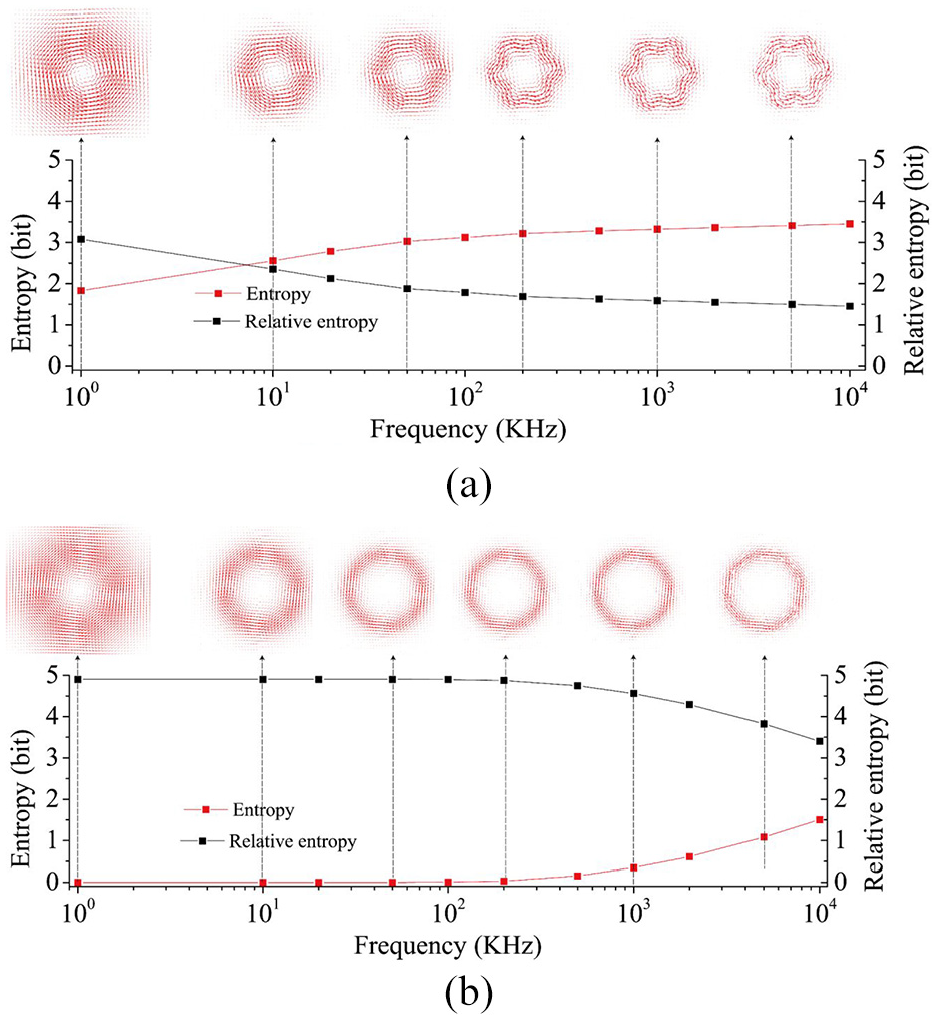
The change of EC distribution with the increasing of the exciting frequency when the lift-off distance is 0.1 mm (not in scale): (a) Koch and (b) circle.
Figure 4 illustrator the change of EC distribution of the Koch and circular coils with the increasing of the lift-off distance when the exciting frequency is 100 kHz. For the circular exciting coil shown in Figure 4(b), when the lift-off distance increases, the EC distribute in more space domain, that is, the concentricity of the EC distribution is attenuated. However, the EC of the circular coil are allocated in many concentric circles. Thus, the entropy and relative entropy of circular coil are close to those of the EC distributing in a small range of the tangential intersection angle.
Figure 4(a) shown the change of the EC distribution of the Koch coil with the increasing of the lift-off distance when the exciting frequency is 100 kHz. When the lift-off distance is 0.1 mm, the EC distribution is similar to the shape of the Koch coil; however, with the increasing of the lift-off distance, the EC distribution looks less and less like Koch coil but circular coils and the concentricity of the EC distribution reduces.
Figure 5 illustrator the change of the EC distribution with the increasing of the exciting frequency when the lift-off distance is 0.1 mm. With the increasing of the exciting frequency, the EC distribution of the two coils are more concentrated. For the Koch coil, the EC distribution looks more and more like the shape of the Koch coil with the increasing of the exciting frequency.
Conclusion
In this study, the relative entropy and the cross entropy are proposed to quantitatively evaluate the distribution of the EC distribution induced by the exciting coils of the EC probe. The TIAS of EC distributions of the Koch and the circular exciting coils are quantitatively evaluated.
For any exciting coils, when the exciting frequency is certain and the lift-off distance is increasing, the relative entropy of the TIAS includes a growth segment and a constant segment; when the lift-off distance is constant, the relative entropy of the TIAS is decreasing as the exciting frequency increasing. The turning points between the two segments of the EC distribution of the circular exciting coil are smaller than that of the Koch exciting coil. Then, in the constant segment, for the certain lift-off distance and the certain exiting frequency, the relative entropy of the two exciting coils is nearly equal to each other.
Thus, with the increase of the lift-off distance and decrease of the exciting frequency, the difference of the EC distribution of the two exciting coils is increasingly smaller. Combined the literature, 19 the “lift-off effect” of the EC testing can be summarized as follows:
magnitude. When the lift-off distance is increasing, the magnitude of EC will decrease because the primary magnetic field at the surface of the specimen decreases, and this phenomenon will cause the decrease of the secondary magnetic field and the lift-off noise will output from the EC probe.
concentration. The EC distribution will get loosen as the increase of the lift-off distance, which may cause a weaker defect signal.
information. The EC distribution of the Koch curve will close to that of the circular exciting coil when the lift-off distance is increasing. The adjustment of EC by Koch curve will be affected by the lift-off distance.
In the future work, the defect signals of the two probes will be acquired by experiment.
Footnotes
Declaration of conflicting interests
The author(s) declared no potential conflicts of interest with respect to the research, authorship, and/or publication of this article.
Funding
The author(s) disclosed receipt of the following financial support for the research, authorship, and/or publication of this article: This work was financially supported by the National Nature Science Foundation of China (Grant No. 51807086) and the Hongliu Youth Found of Lanzhou University of Technology.
