




Abstract
This paper presents a quantitative evaluation index efficiency of eddy current and defect interaction to evaluate the eddy current distribution induced by different planar eddy current probe. Efficiency’s definition and its calculation method are presented. Eddy current induced by three different exciting coils interacting with defects having different lengths and different orientation angles is analyzed by the proposed method. Finally, the paper highlights strengths and weaknesses of the studied current probe inducers and an improving method is proposed.
Keywords
Introduction
To ensure the integrity and reliability of key mechanical structures, regular non-destructive testing is required. 1 Because of its advantages such as non-contact, 2 rapidity, usability, and portability, 3 eddy current (EC) testing method is one of the most suitable methods for detecting surface and sub-surface defects in conductive components. 4 Moreover, EC method is widely used in composite materials detection.5,6
To inspect the components with complex surface, flexible planar EC probes have been proposed. Usually, these kinds of probes are integrated on a printed circuit board and micro-electromechanical systems. 7 Because the performances of EC probes strongly depend on the direction of defect, improving the EC distribution in space domain or in time domain are two effective ways to make probes more sensitive to defect in any direction. In space domain, many new shapes of the exciting coils such as meandering winding magnetometer (MWM),8,9 rosette-like, 10 rectangular, and fractal Koch curve 11 have been proposed. However, in time domain, only planar rotating field EC probes12–15 have been proposed.
All the aforementioned innovations aim to improve the EC distribution. However, except for the maximum and minimum, EC distribution can be only qualitatively analyzed. Guolong Chen and colleagues.16–18 proposed a novel method using information entropy to analyze quantitatively EC induced by different exciting coils, but this method could only quantitatively describe EC distribution in all directions by statistical analysis and not consider the sizes, positions, and directions of specific defects. To quantitatively analyze the EC distribution interaction with defects having a certain length and angle, because the EC is strongest disturbance by defect at the right angle of the EC and defect can only disturb the EC component which is perpendicular to the defect, interaction efficiency between EC distribution and virtual defect is proposed in this paper.
This work presents a quantitative index efficiency of the interaction between the EC and defect, and a method of how to calculate the index. Then, EC distribution induced by three different exciting coils is analyzed. The paper is organized as follows. Section “Introduction” gives a brief developing of planar EC probe and of the method of quantitative analysis of EC distribution. Section “Perturbation theory of defects detection by the EC method” describes the perturbation theory of defects detection by EC method. In section “EC transformation of coordinates,” EC transformation of coordinates is given and in section “Interaction efficiency between the EC and the defect,” the new method is introduced. In section “EC acquisition and calculation method of
Perturbation theory of defects detection by the EC method
EC method in non-destructive testing is based on electromagnetic induction. Usually, an EC probe consists of an exciting coil, which may take various shapes, such as circular, MWM, rosette, cruciform, and fractal Koch curve, and a pickup element made up of coils or magnetic sensors, such as anisotropic magnetoresistance (AMR), giant magnetoresistance (GMR), and tunnel magnetoresistance (TMR). During testing, the coil is excited with alternating electric current that produces an alternating magnetic field (i.e. primary field), oscillating at the same frequency as the current running the coil. Because of Faraday’s electromagnetic induction principle, an EC, which oscillate at the same frequency as the exciting current, is induced in conductive test specimen and generates a magnetic field (i.e. secondary field). The combination of primary and secondary field is net magnetic field. Then, the pickup element feels the net field and generates an output signal. Defects in specimen disturb the EC distribution, causing a variation in the secondary and the net magnetic field allowing the defect to be recognized.
However, the strength of EC disturbance is different in defects with the same size and position but different orientation. In detail, when the direction is parallel to defect’s direction, the disturbance is the highest and the EC probe is most sensitive to defects. When defect and EC are perpendicular to each other, the disturbance is the lowest and the probe is insensitive to defects; as the angle between the same size defects and the same EC varies from 0° to 90°, the strength of disturbance will become stronger and stronger. That explains the different sensitivity of EC probe to defects.
When the angle between the defect and the EC becomes larger, the EC probe becomes more sensitive because the EC component in the direction at the right angle of defect becomes large. In other words, disturbance occurs between the defect and the EC component perpendicular to the direction of the defect, rather than the parallel component. 12 It will be defined as vertical effective principle.
EC transformation of coordinates
As shown in Figure 1, an EC vector

where
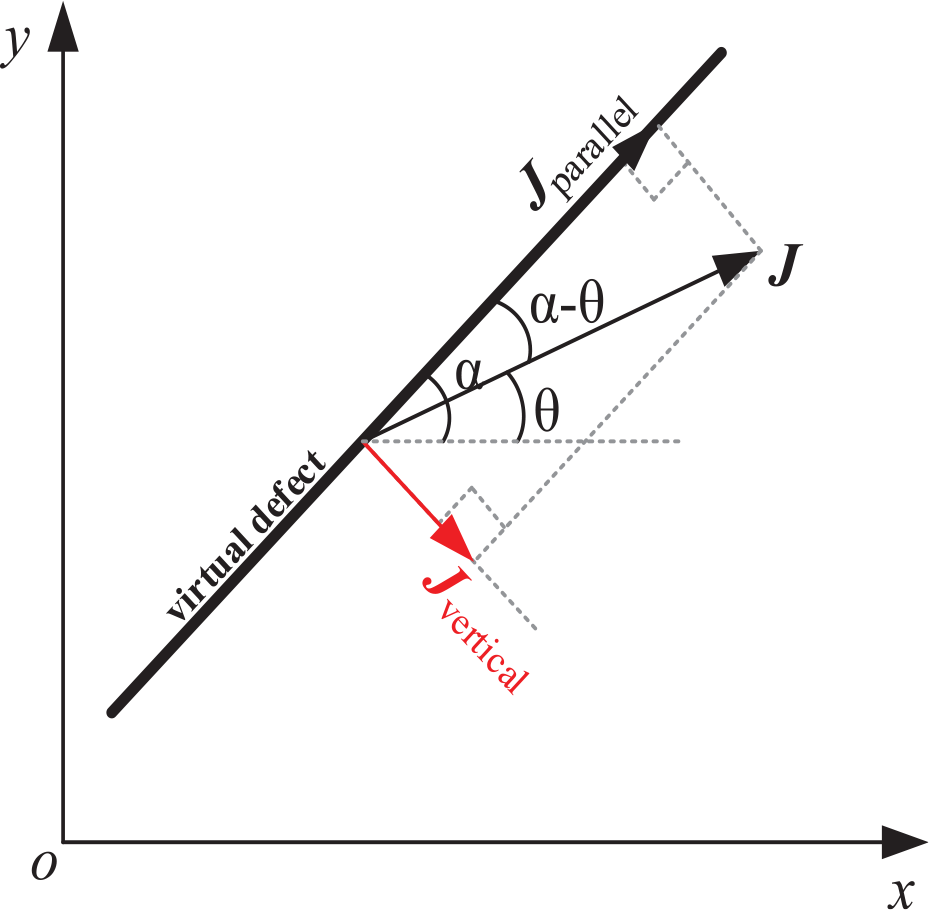
EC component at the right angle of the virtual defect.
The angle between the EC and the virtual defect is

or

where
Interaction efficiency between the EC and the defect
For the defect detection using EC method, the angle between of the EC and defect is a crucial factor to EC sensors. If the EC is perpendicular to defect, the EC can be easily disturbed by defect, and then the defect may be easily detected. Thus, in the detection procedure, the component of the EC vertical to the defect mainly affects the detectability of the EC method. To quantitatively calculate the useful component in the EC distribution, the proposed index imitated the efficiency in the classical physics. Specifically, the EC component vertical to defect and total EC were imitated to the useful work done and total work done, respectively. Efficiency is commonly defined as the ratio between the useful energy and the total energy, or the ratio of the useful power divided by the total power, in percent. The strict definition is as follows.
In practical application of EC testing, there is relative motion between the specimen and the probe. In this study, the probe is assumed to be stationary and the specimen moves along the x-axis; a virtual defect is tilted to x-axis with an angle of
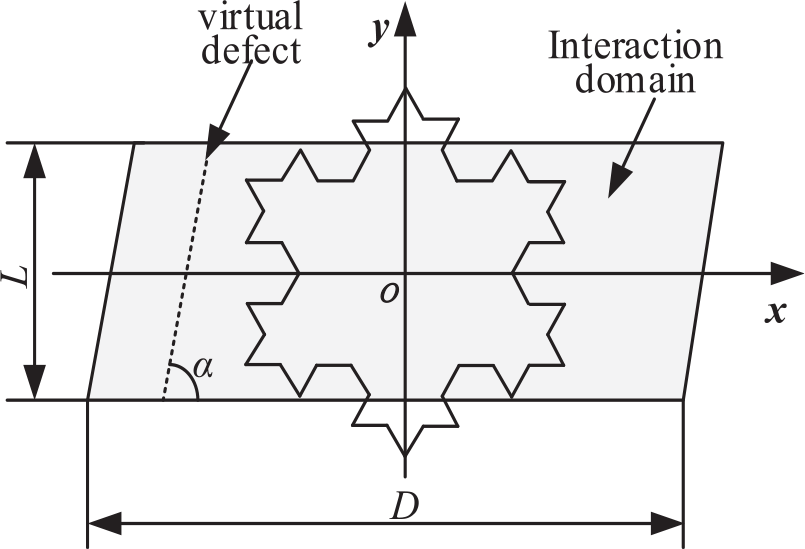
Interaction domain of EC and defect.
This definition was simulated, and EC-defect interaction efficiency was defined as the ratio between the useful energy of the EC component divided by the total energy of EC in the interaction domain.
First, the function of the efficiency along x-axis is given by

where

where

where
EC acquisition and calculation method of
and
EC distribution was acquired by three finite element models which are identical with the models in theliterature.
16
The studied exciting coils were a line, a circle, and a second-order Koch curve, respectively, the centers of which were located in the origin of coordinates and the line was along y-axis. In the length direction of defects, EC vector was acquired in 64 points equally arranged. In the scanning direction, vector was acquired in the range −26 mm to 26 mm with certain step length of 0.5 mm. Defects were 5-, 10-, 20-, 25-, and 40-mm long, and the orientation angle
In actual calculation, integral operator is replaced by a summation.
Results and discussion
Efficiency
Efficiency
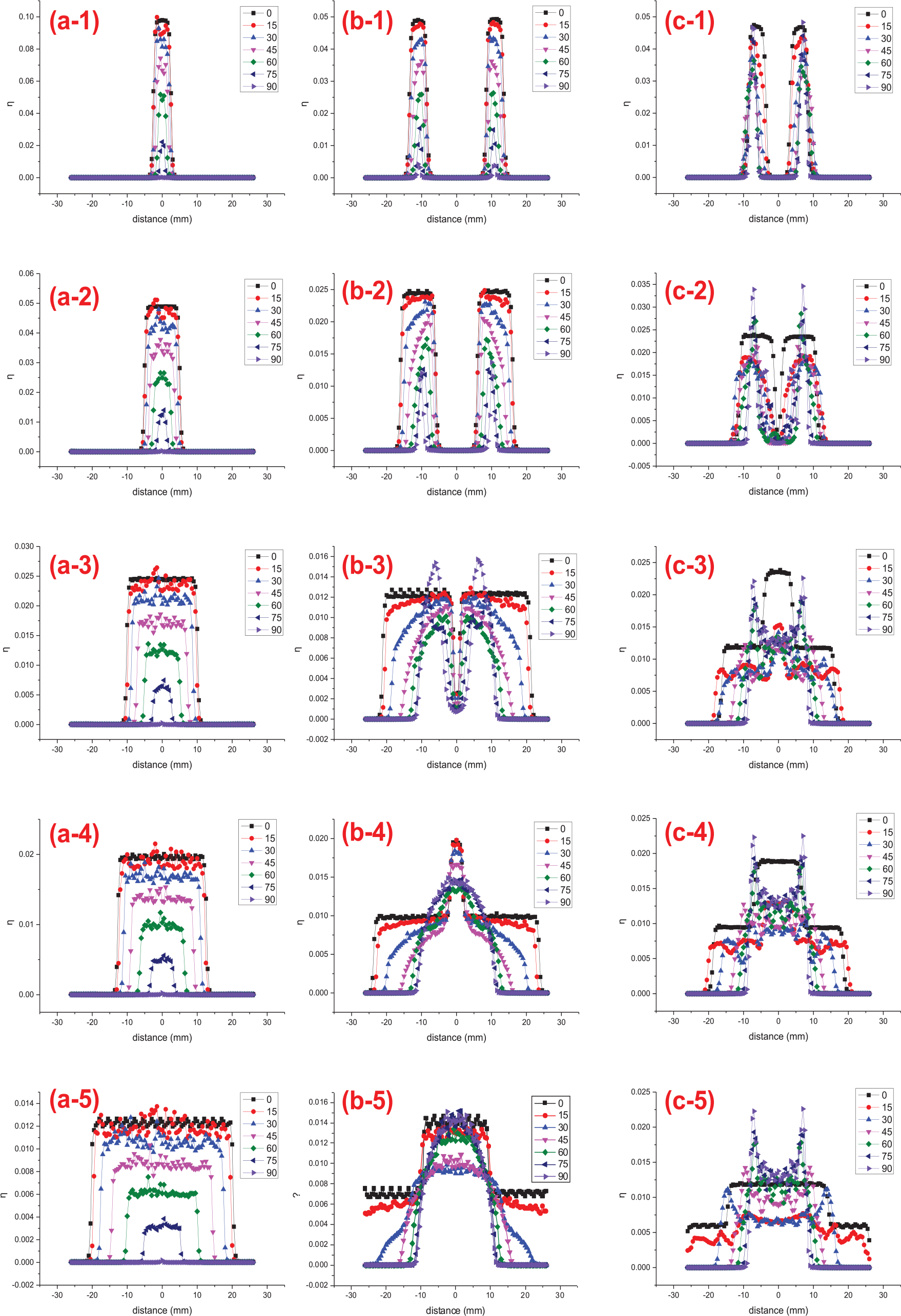
As detailed in Figure 3(a), the efficiency curves about linear inducer have one flat top, and the different lengths and orientations of a virtual defect result in different widths and heights of the flat top. In detail, width increases as the orientation angle
Figure 3(b) details
For the Koch curve exciting coils,
Total efficiency of the same exciting coil varying lengths and orientation angles of virtual defects
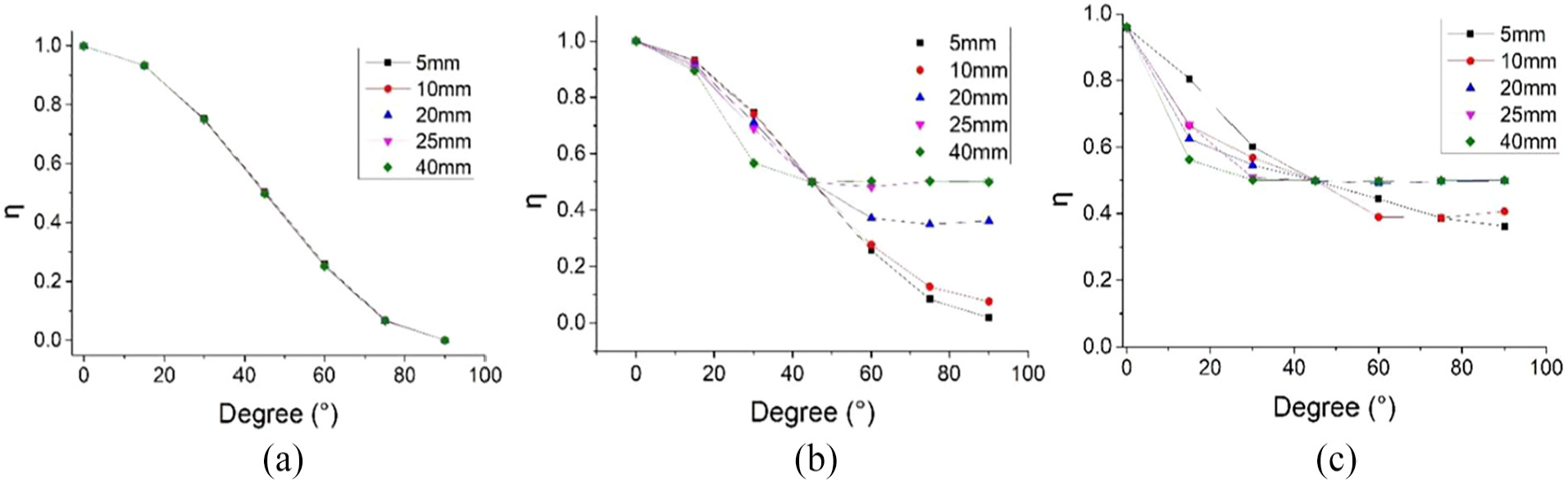
The total efficiency
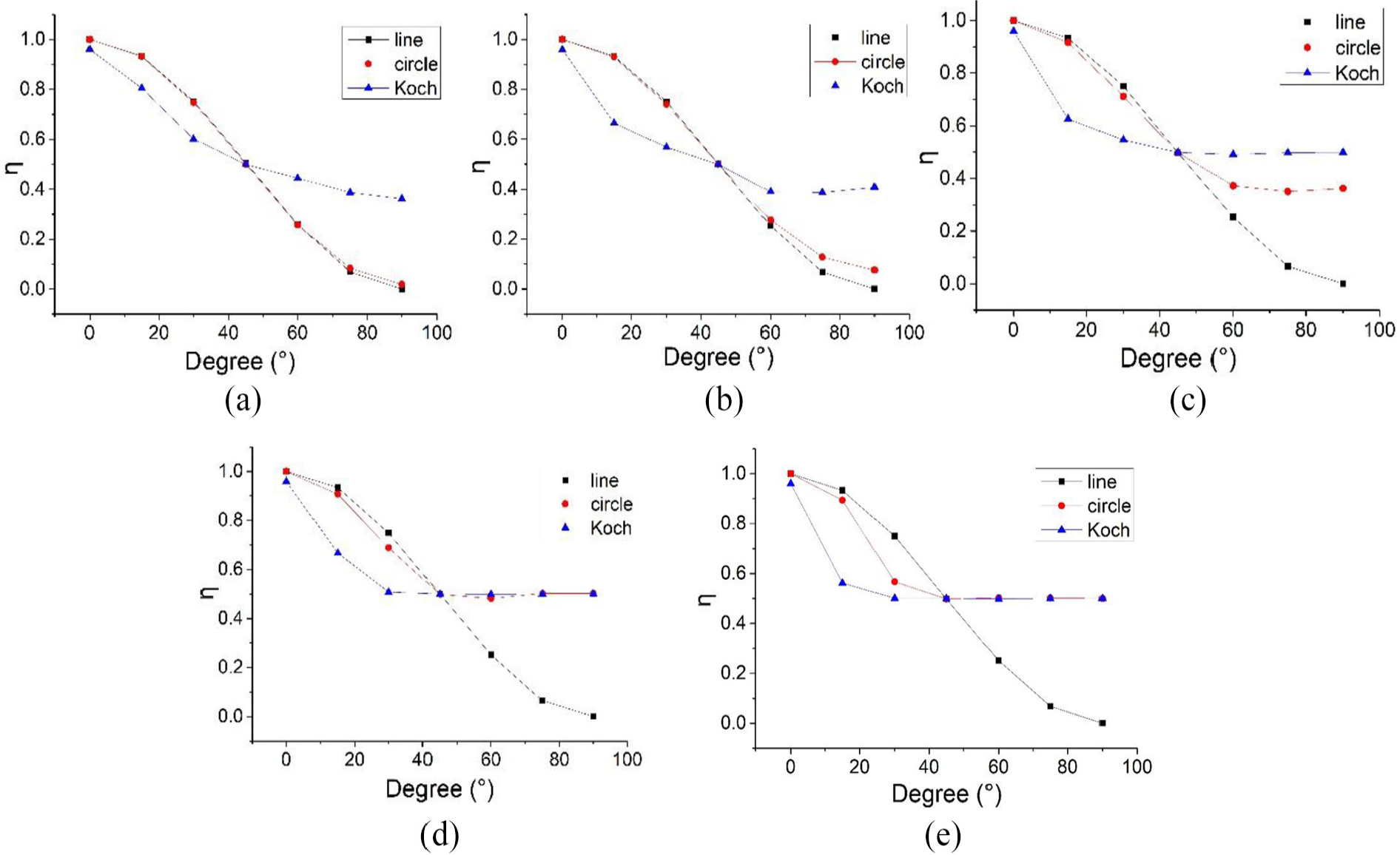
For circular exciting coils, when the orientation angle is less than
As Figure 4(c) shows, for the Koch exciting coils the orientation angle is less than 45°, and the total efficiency of whole interaction domain decrease as the angle increases. Unlike the circular exciter, the rate of change of
for defects with same length but different orientation angles and different exciting coils
Figure 5 compares the total efficiency of three different exciting coils. For all the lengths of virtual defect, when
Suggestions for EC probe testing
According to the foregoing discussion, the use of Koch curve exciting coils improves the interaction efficiency for short virtual defects. Koch curve can improve the EC distribution in space domain. However, in time domain, the method can be used as following:
Use the rotating field EC probe, which can induce a rotating EC flowing in the specimen. Thus, at the same time, the direction of EC can be perpendicular to the direction of defects.
It is similar to the rotating field EC probe, so the EC probe is rotating in mechanically.
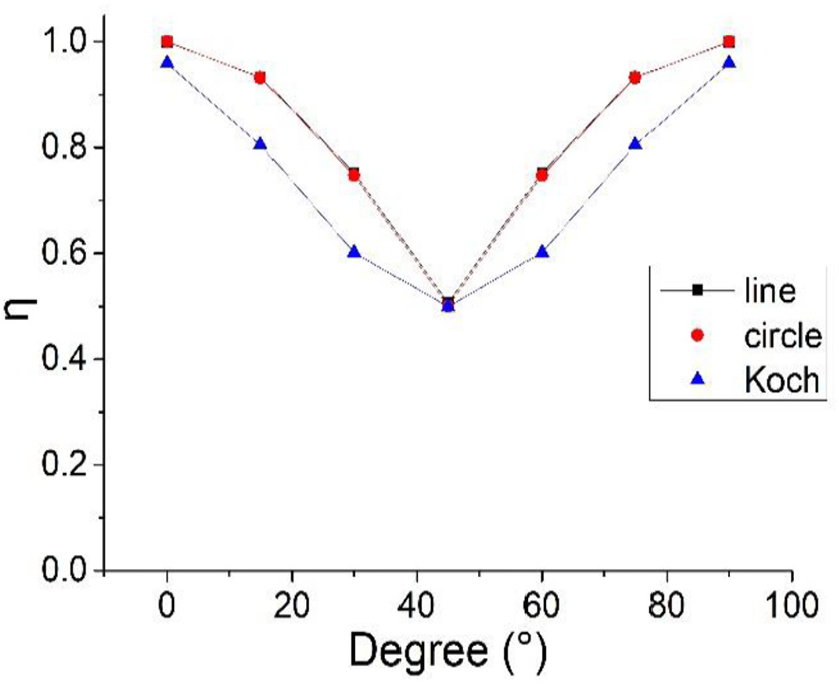
Testing process can be improved. Based on the conclusions drawn from the previous analysis, the total efficiency is bigger than 50% when the orientation angle is smaller than 45°. Thus, probe can scan in two directions, perpendicular to each other. In the first step, 0°–45° range is focused, but in the second step, 45°–90° range is focused. The total efficiency, which is greater than or equal to 50% for all orientation angles and all lengths of virtual defects, can be obtained, as shown in Figure 6.
Conclusion
This paper first proposes the interaction efficiency between the EC and the virtual defect to evaluate EC distribution, giving a measurement of interaction strength between EC and defect. The advantage of this EC distribution evaluation method takes account into specific sizes and direction of defect. By evaluating
Footnotes
Appendix 1
Declaration of conflicting interests
The author(s) declared no potential conflicts of interest with respect to the research, authorship, and/or publication of this article.
Funding
The author(s) disclosed receipt of the following financial support for the research, authorship, and/or publication of this article: This work was financially supported by the National Nature Science Foundation of China (Grant No. 51807086), the key research and development program of Gansu province, China (Grant No. 18YF1GA063), and the Hongliu First-class Disciplines Development Program of Lanzhou University of Technology.
