




Abstract
In this paper, the output feedback disturbance rejection control (OFDRC) problem is considered for buildings structures subject seismic excitations. First, based on a mild assumption and a linear transformation, the addressed problem of building structure system is translated into the output feedback disturbance rejection control problem large-scale system with disturbances. Then, by utilizing generalized-proportional-integral observer (GPIO) technique and output feedback domination approach, an output feedback decentralized disturbance rejection control law is derived via a systematic design manner. The multi-overlapping output feedback disturbance rejection controller is obtained according to the inverse transformation of a linear transformation. Strict theory analysis demonstrates that the states of the structure system will be stabilized to a small bounded region. Finally, an 8-story structure system is employed to evaluate the effectiveness of the proposed control strategy. Simulation results demonstrate that the proposed OFDRC exhibits better seismic loads attenuation ability and strong robustness against model uncertainties.
Keywords
Introduction
Nowadays, more and more tall buildings are mush-roomed in the city, which suffers from many natural hazards. Naturally, the protection of civil tall building structures and human occupants from natural excitations becomes one of the most imperative tasks. 1 To mitigate (or reduce) the undesirable effects of unknown natural excitations, the structural stability of the building structures could not be guaranteed only through improving the quality of architectural materials. 2 Therefore, the structural vibration control problem of tall building structures has been receiving more and more attentions from the field among civil, mechanical and control engineering.
Due to the significance of attenuating unknown natural excitations for building structure systems, much effort have been devoted to develop control schemes in the literature, such as linear quadratic regulator (LQR) theory,
3
PD/PID control,
4
It is well known that disturbances and uncertain-ties widely exist in practical engineering systems which bring adverse effects to control system. Many active disturbance rejection control (ADRC) techniques have been proposed, for example,9–11 and the references therein. The baseline of ADRC is that both the external disturbances and parameter uncertainties are summarized lumped disturbance during the design procedure. The ADRC controller is composed by two parts: nominal feedback control law and feedforward compensation part, where the nominal feedback control law is utilized for tracking/stabilization while the feedforward compensation part is used to improve the robust-ness against lumped disturbance. 12 And ADRC methods have been successfully implemented in PMSM system, 12 piezoelectric system, 13 air-fuel ration control systems, 14 wind energy conversion systems, 15 and dc-dc/ac converter system,16,17 flight control systems,18,19 and robotic systems, 20 etc. The ADRC idea has been reported in Ma and Yang 8 for the building structure systems. However, the result 8 is based on the full information of the whole systems are measurable. 21 proposed decentralized output feedback control method based on sliding mode control technique. Due to the appearance of signum function, the proposed controller is discontinuous which may bring adverse effects to the control systems. To the best of our knowledge, there are few results on the output feedback disturbance rejection control (OFDRC) problem of building structure systems in the literature.
In this paper, we will investigate the OFDRC problem for buildings structures subject seismic excitations. To this end, the building structure system subject seismic events is translated into a large-scale interconnected system with disturbances via a linear transformation. And the considered OFDRC problem of building structure systems is converted into the decentralized OFDRC problem of the large-scale interconnected systems. Then, by using high gain scaling transformation, the generalized-proportional-integral observer(GPIO) technique 11 and output feedback domination approach, 22 decentralized OFDRC laws are derived based on the output information of every subsystems. The decentralized OFDRC laws are composed by an output feedback control (OFC) and feedforward compensate term which is generated by GPIO. Strict theory analysis demonstrates that under the proposed decentralized OFDRC laws the states of the whole large-scale interconnected system will be stabilized to an arbitrarily small domain. Through the inverse transformation of the aforementioned linear transformation, the multi-overlap-ping output feedback disturbance rejection controllers are is obtained eventually. Compared to the aforementioned control strategies for building structure systems, the major contribution of this paper could be summarized as follows: (i) Only the displacement information is needed to during the design process; (ii) The seismic excitations is cancelled rather than attenuated, thus the current OFDRC could offer remarkable disturbance rejection ability; (iii) The current OFDRC has a simple linear structure which is beneficial to practical applications.
The paper is organized as follows. In the next Section, the mathematical model of building structure systems is introduced. The main result is given in Section 3. Simulation is carried out in Section 4 to illustrate the validity of the proposed control approach. Finally, some closing remarks are included in Section 5.
The mathematical model of building structure systems
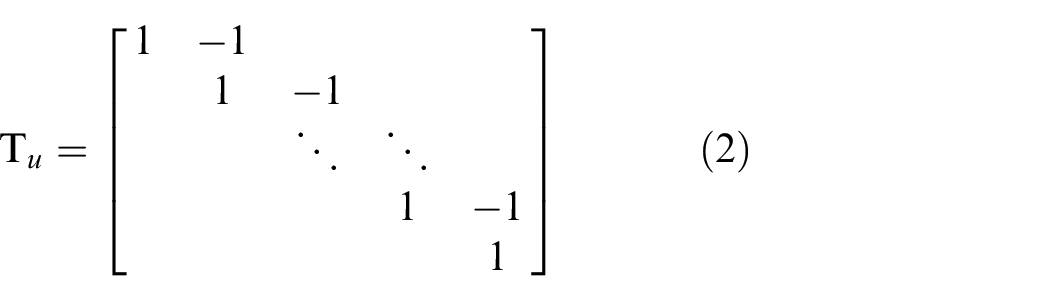
The n−degree-of-freedom building structure system with unknown external excitations1,6 could be de-scribed by the following model

where
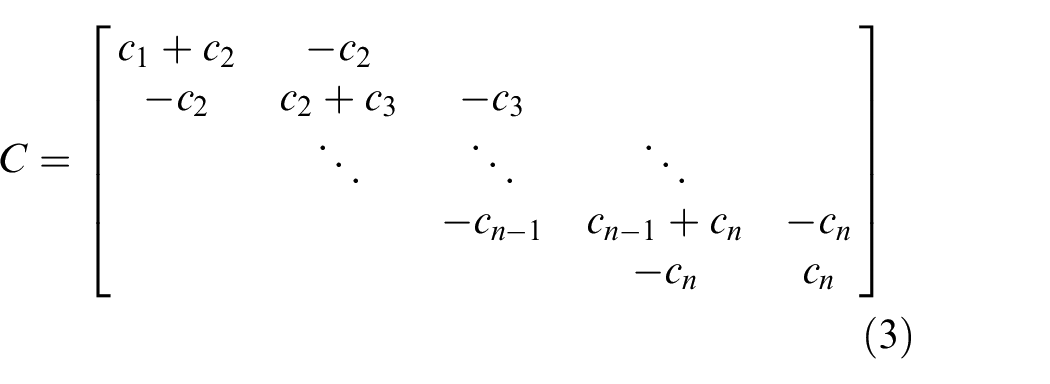
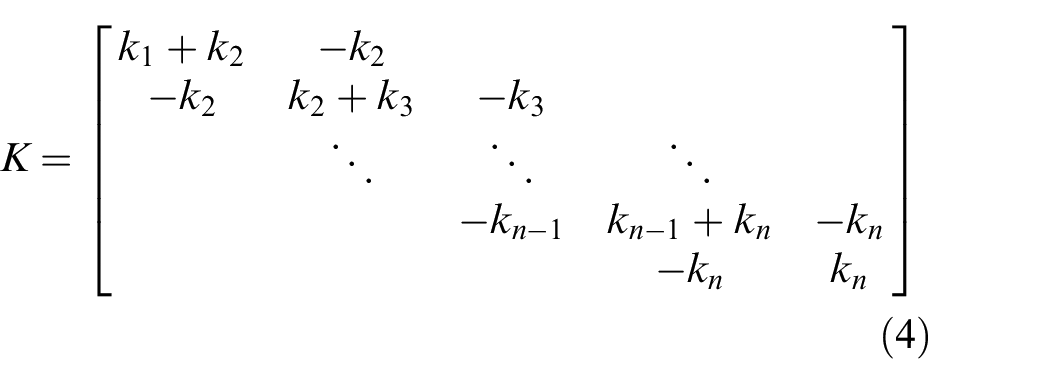
If ci that the values of the story damping coefficients are known, the damping matrix
Assume only
Consider the following linear transformation

Then system (1) is decomposed into n subsystems
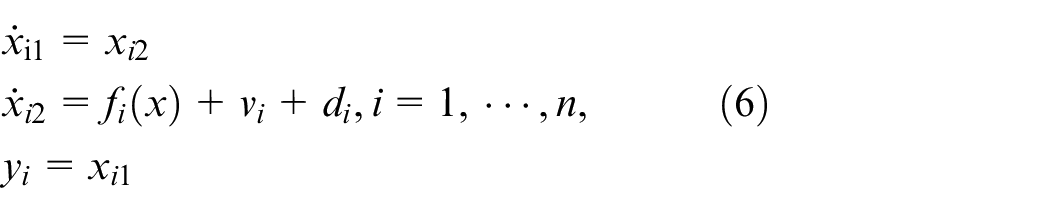
with

and
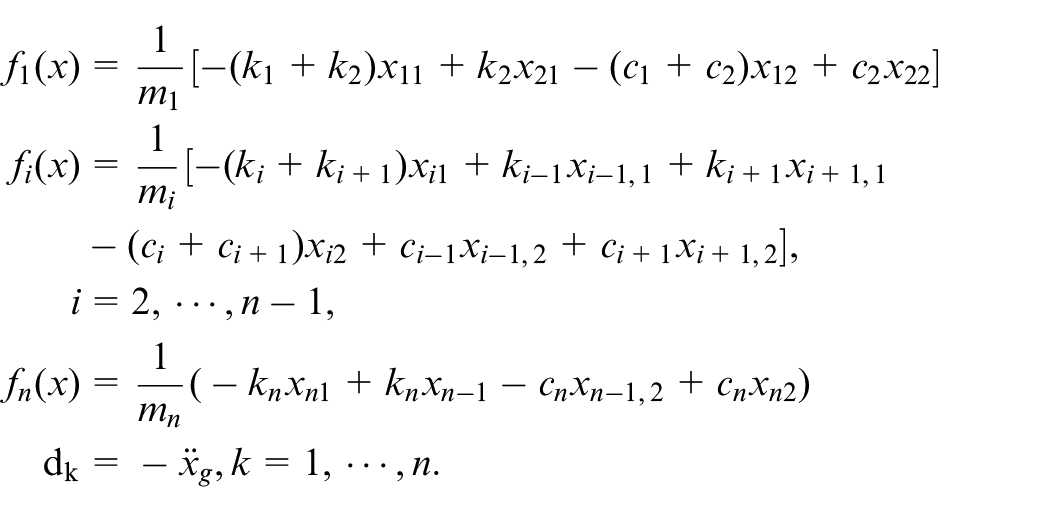
For practical building structure systems (1), the mass
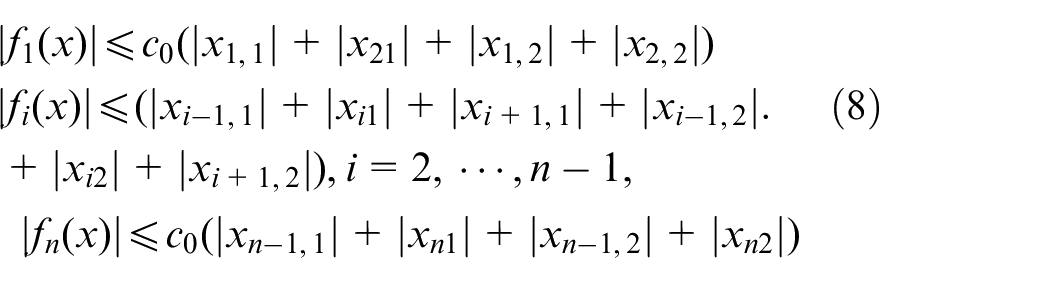
which will be used for the main result of the paper.
Thus far, the OFDRC problem for system (1) is translated into the decentralized OFDRC problem of large-scale interconnected system (6).
Main results
In this section, we will concentrate on the designing of the decentralized OFDRC problem of large-scale interconnected system (6), which mainly could be divided into steps.
GPIO observer design
For system (6), when only the output information (i.e. the position information
There exists a constant
Let
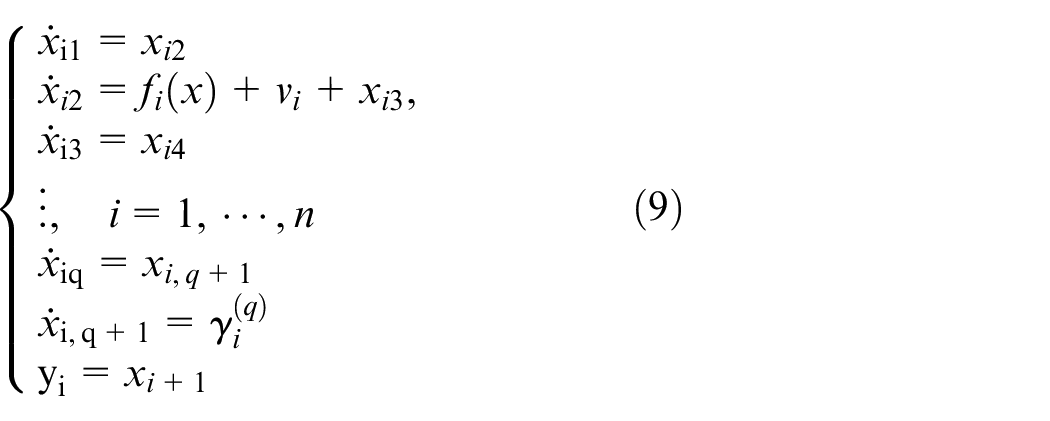
Thus far, the estimation problem of the unmeasured state
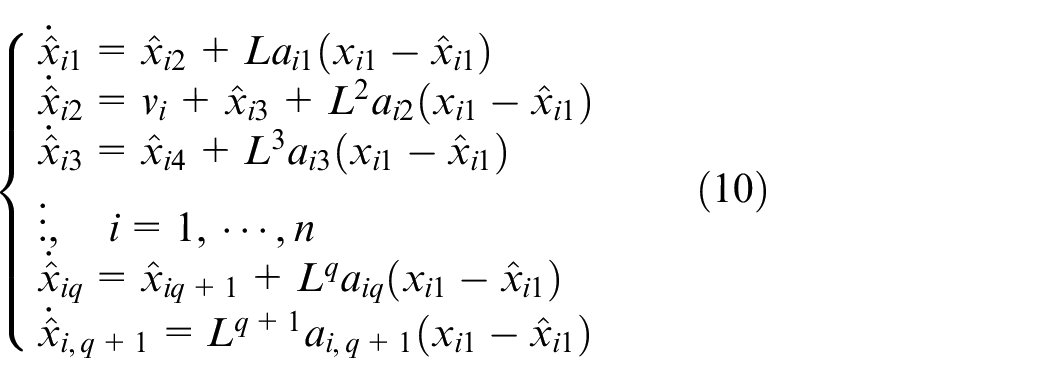
where
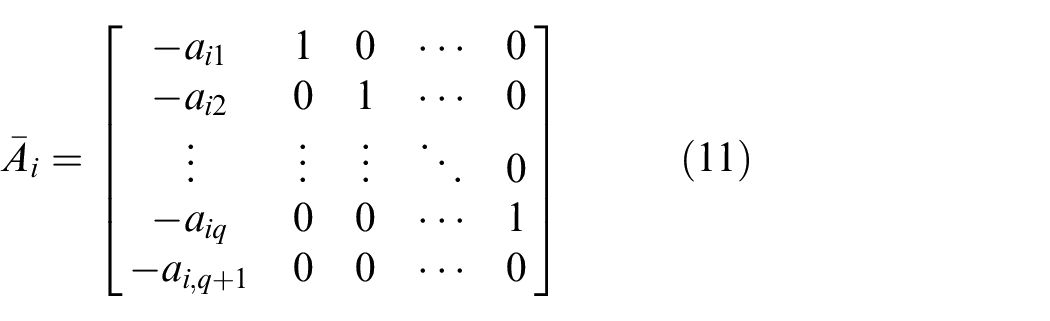
is a Hurwitz matrix.
Define the state error as

then combining (9) with (10), it is not difficult to obtain the observer error system

where

Decentralized output feedback disturbance rejection controller design
For system (9), if we introduce the following coordinate transformation

then according to the first two subsystem of system (9) we have

with

Under the GPIO (10) and the coordinate transformation (13), for system (6), we could design the following decentralized output feedback disturbance rejection controller

where

is Hurwitz.
Combine system (12), (14) and (15), the closed-loop system can be written as

where
and

According to the analysis above, we can obtain the following theorem.

where

Based on the equation (8), it can be shown that
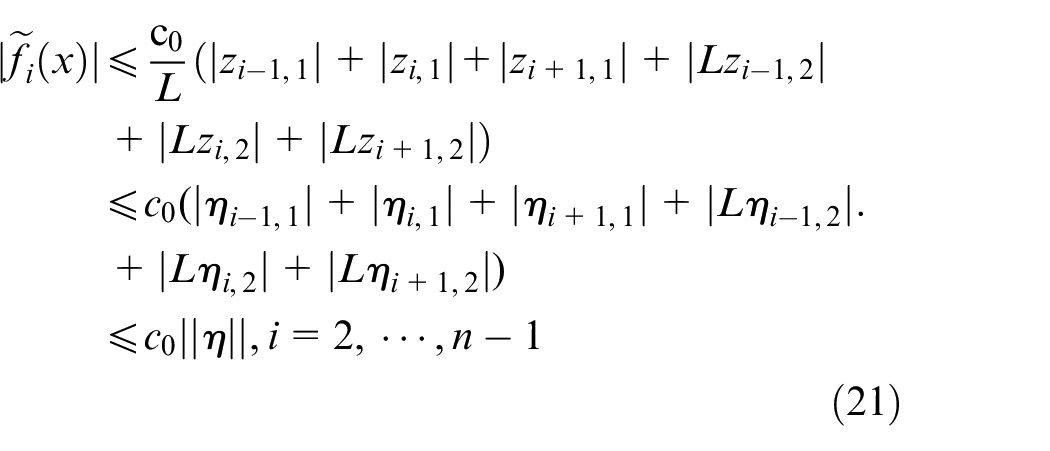
Where

By Assumption 3.1, it is not difficult to verify that

Based on the inequalities (21) and (23), for
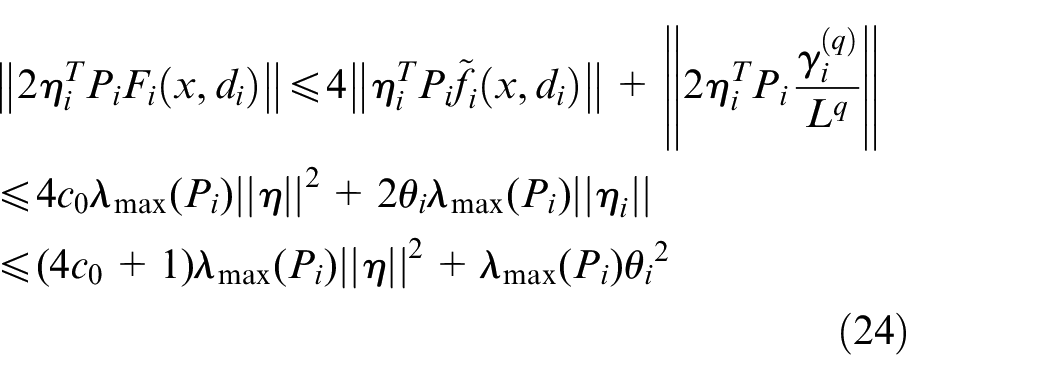
For the whole system (6), we choose Lyapunov function

By using inequalities (20)–(25), taking the derivative of
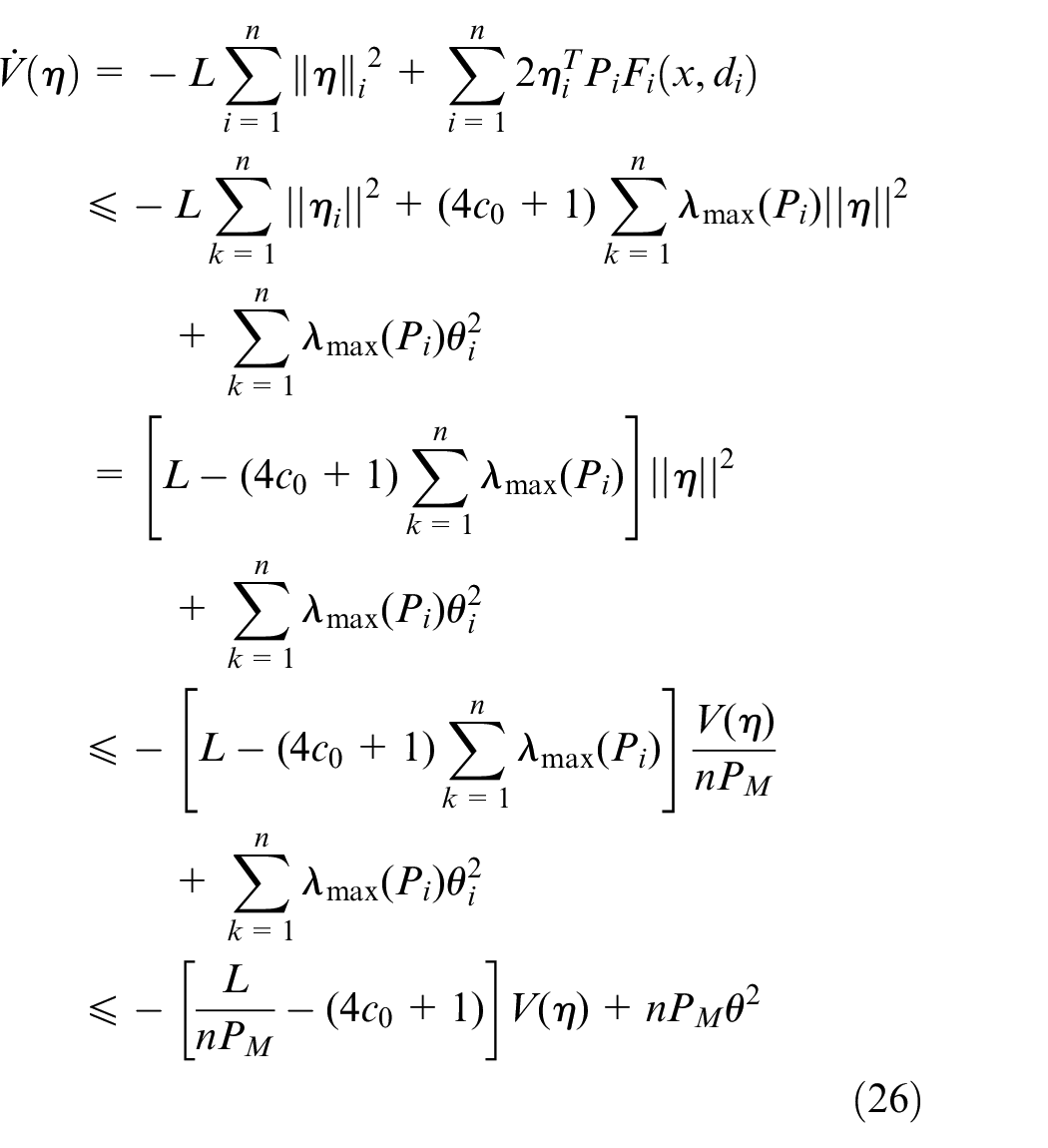
By choosing

it follows from (26) that
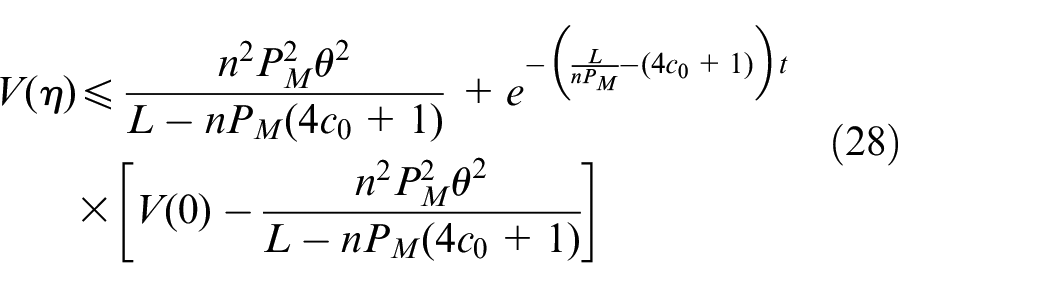
It can be concluded from (25) that all the states of the closed-loop system (6) will be globally stabilized to the bounded region
It is obviously from (24) that if

and the second part is

with the state observer

where
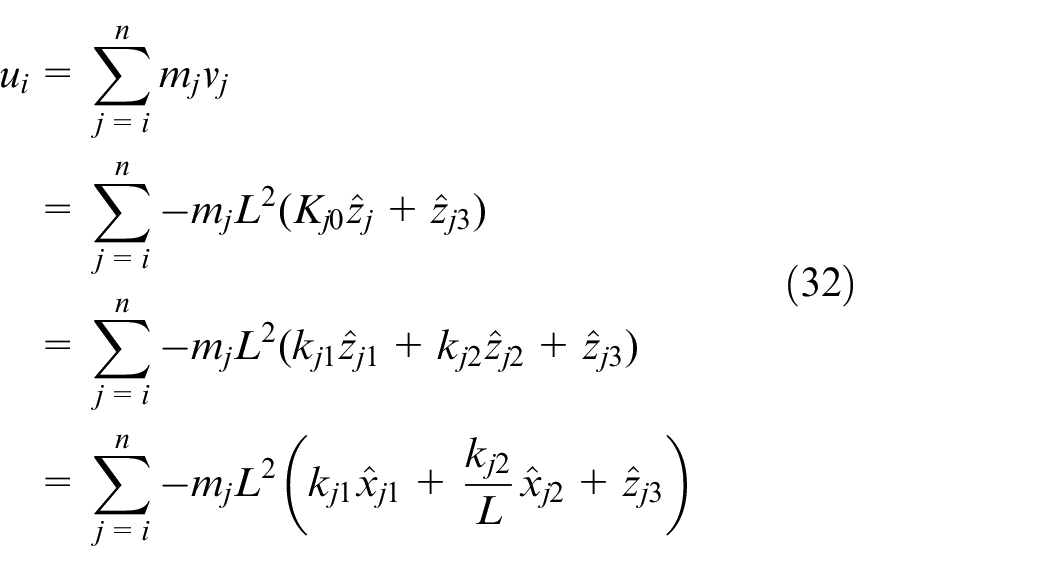
with
Simulation
To verify the effectiveness of the proposed output feedback disturbance rejection control approach. We will employ an 8-story sheer beam model proposed in Ma et al. 5 for the study.
The parameters for the building structure system are also borrowed from;
5

with
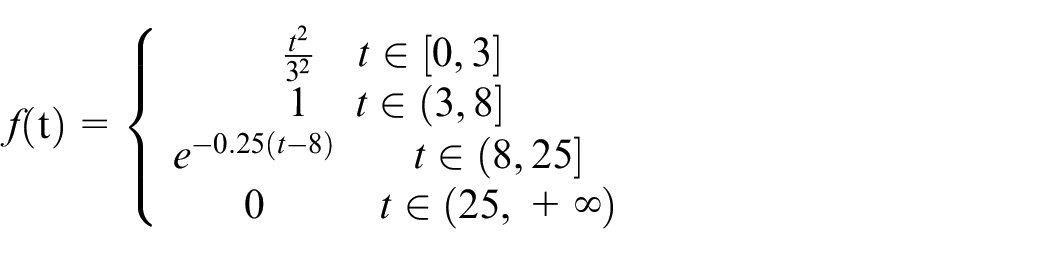
whose dynamic response characteristic is shown in Figure 3 (solid blue line).
The seismic excitation rejection ability
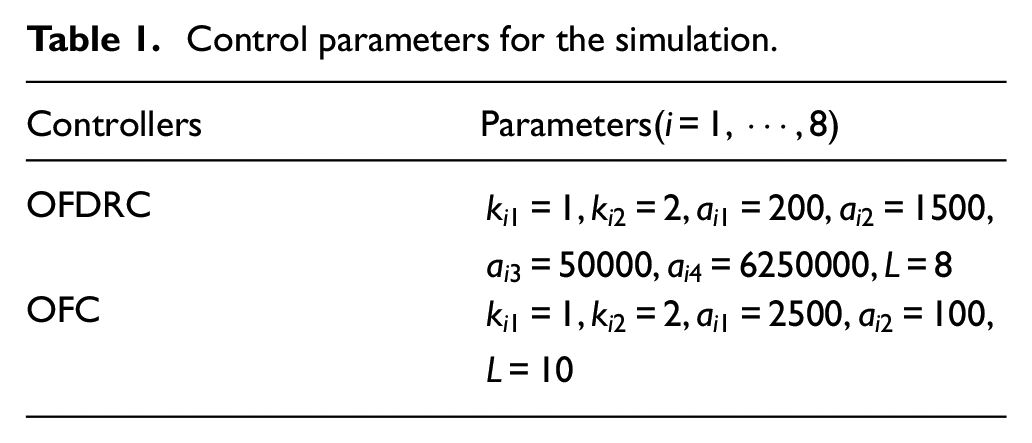
To evaluate the efficiency of the proposed (32), the OFC (30) and uncontrolled methods will be employed in the simulation for comparison. For fair comparison, both the OFDRC (32) and the OFC (30) use the same controller bandwidth and Observer bandwidth, but the OFC (30) has relative larger scaling gain
Control parameters for the simulation.
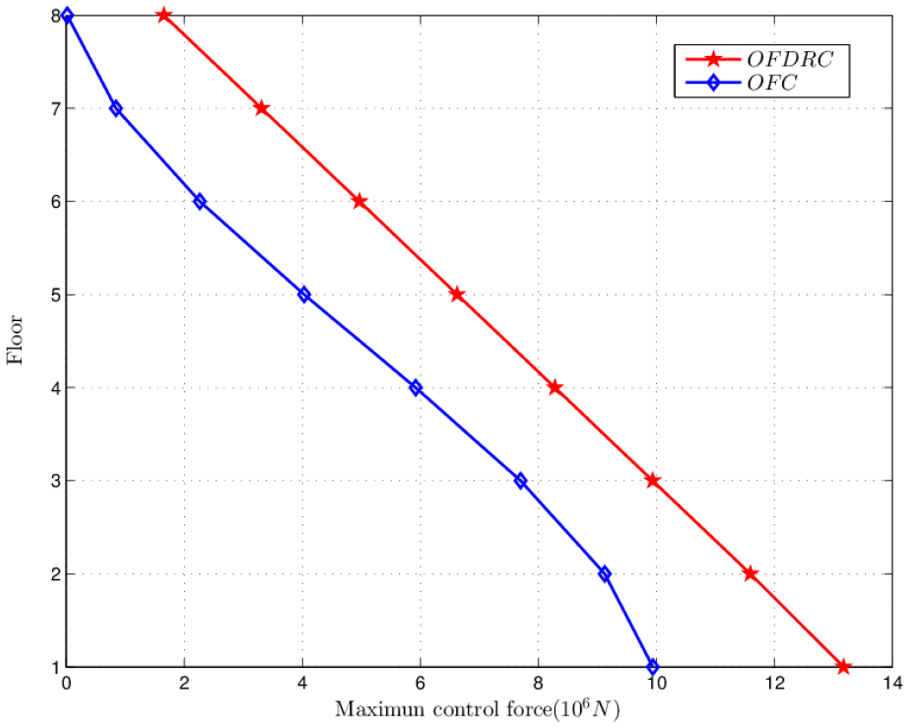
The time responses of the displacements and the absolute maximum interstory drift of each floor are provided in Figures 1 to 2. Clearly, compared with the OFC (30) and the uncontrolled scenario, under the proposed OFDRC (32) the responses of displacement and the absolute maximum interstory drift are significantly reduced. This is because that the influence of seismic excitation could be effectively estimated (Figure 3) and is cancelled by the OFDRC (32). While the maximum control forces of the OFDRC (32) and the OFC (30) are given in Figure 4, it is observed that the maximum control forces of the OFC (30) are smaller than that of OFDRC (32). Therefore, it could be concluded that the proposed OFDRC method exhibits good performance when the building structure system suffers such seismic events.
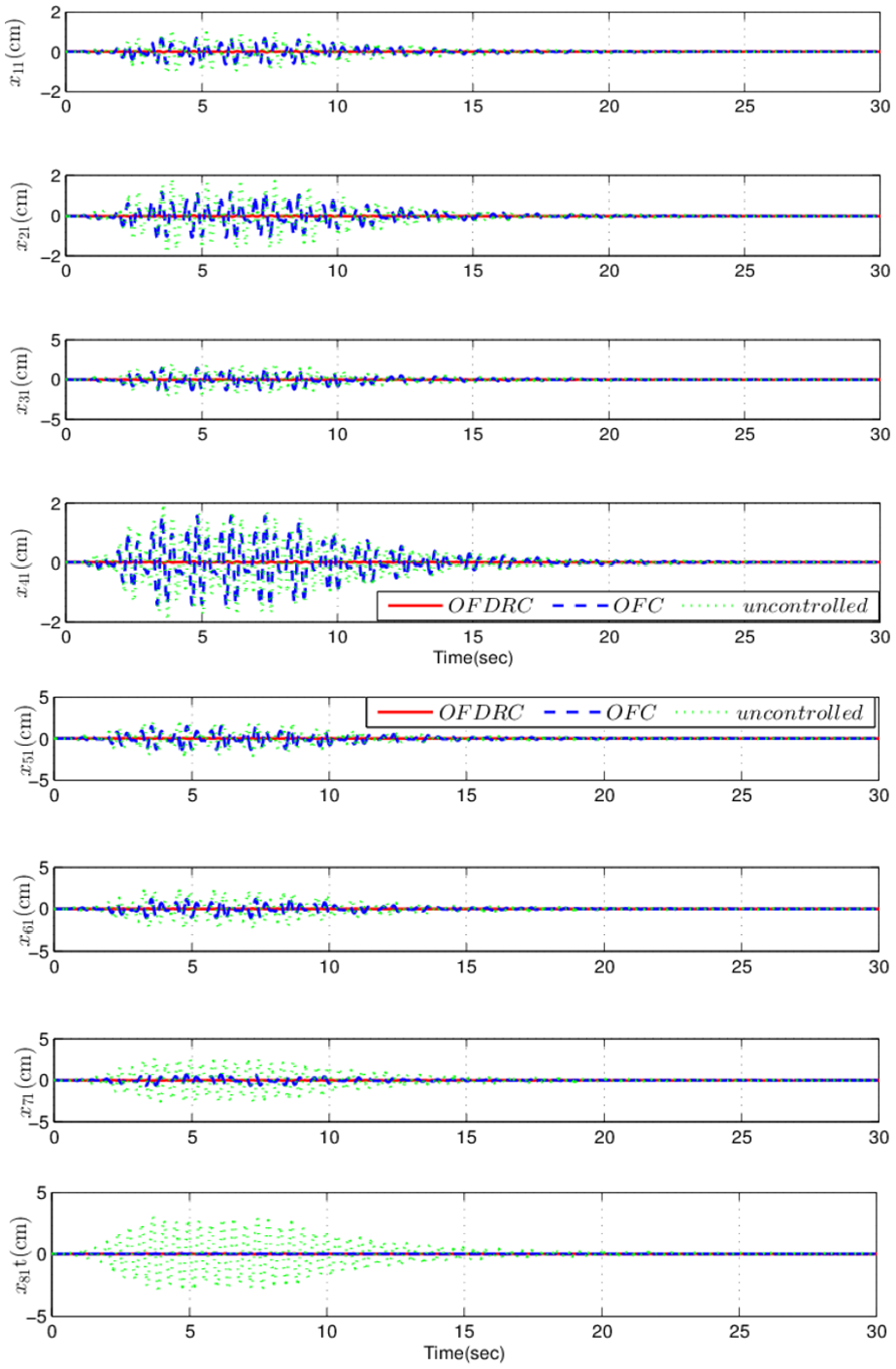
The displacements of the 8-story building model subject to the unknown seismic excitation under the two different controllers OFDRC (32) and the OFC (30).
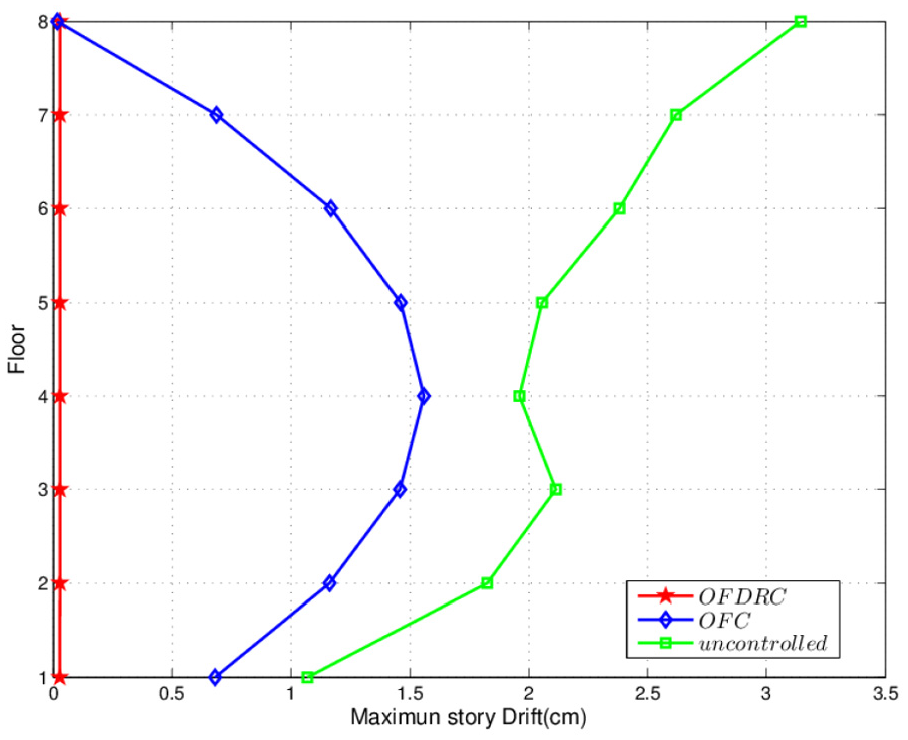
The maximum interstory drifts of the 8-story building model subject to the unknown seismic excitation under the two different controllers OFDRC (32) and the OFC (30).
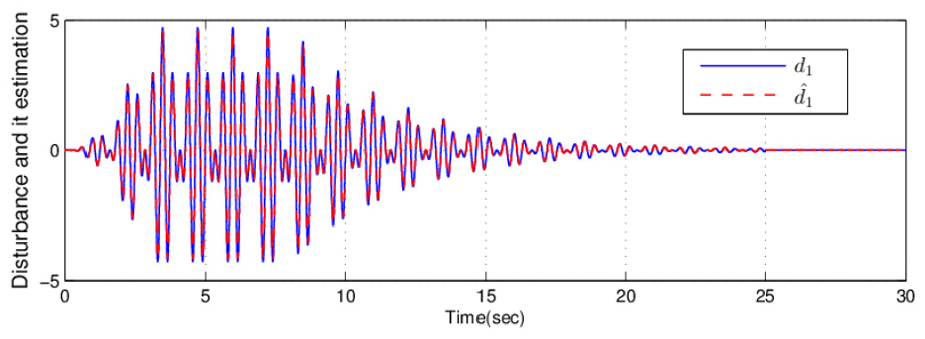
The disturbance and its estimation.
The displacements of the 8-story building model with uncertain parameters and unknown seismic excitation under the two different controllers OFDRC (32) and the OFC (30).
The robustness against parameter uncertainties
To assess the robustness of proposed method with regard to the uncertainties will be take into onsideration.
Assume the nominal values of the mass, damping and stiffness parameters are
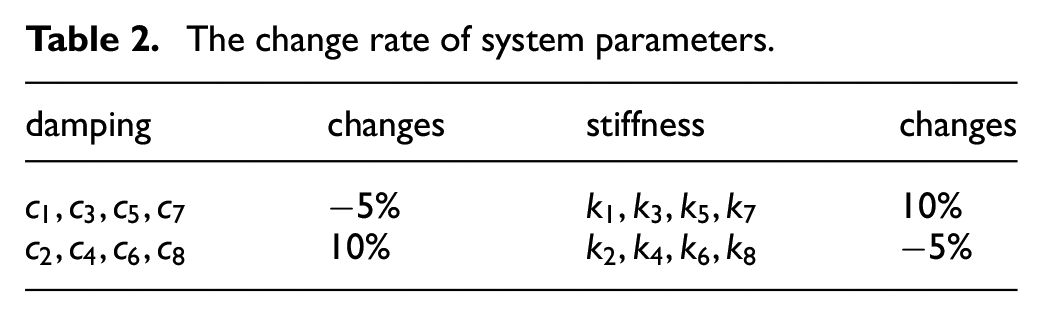
For simulation studies, the specific values of damping and stiffness uncertainties is shown in Table 2. We choose the same control parameters for OFDRC (32) as in Table 1. The simulation results are given through Figures 5 to 6.
The change rate of system parameters.
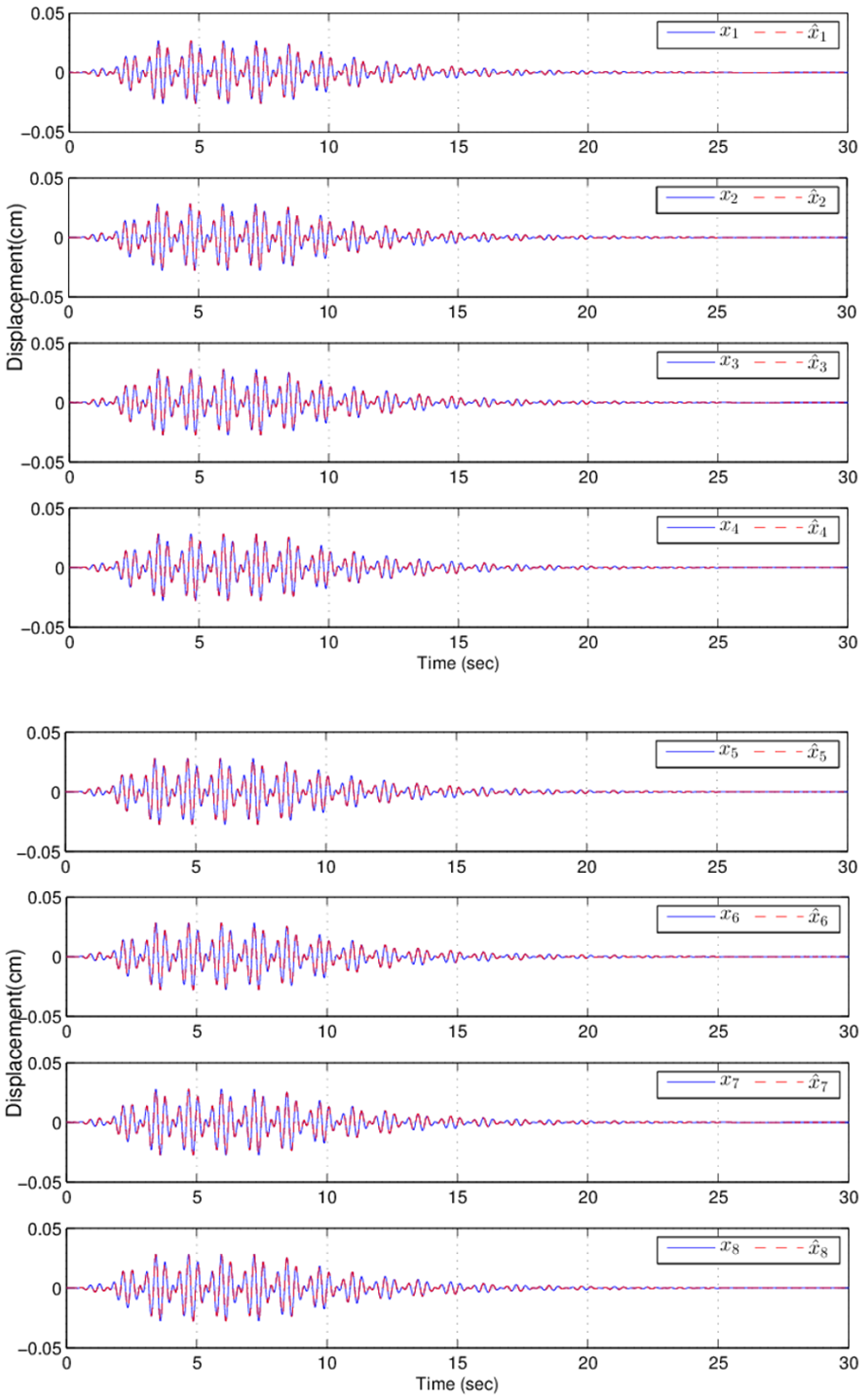
The displacements of the 8-story building model with uncertain parameters and unknown seismic excitation under the OFDRC (32).
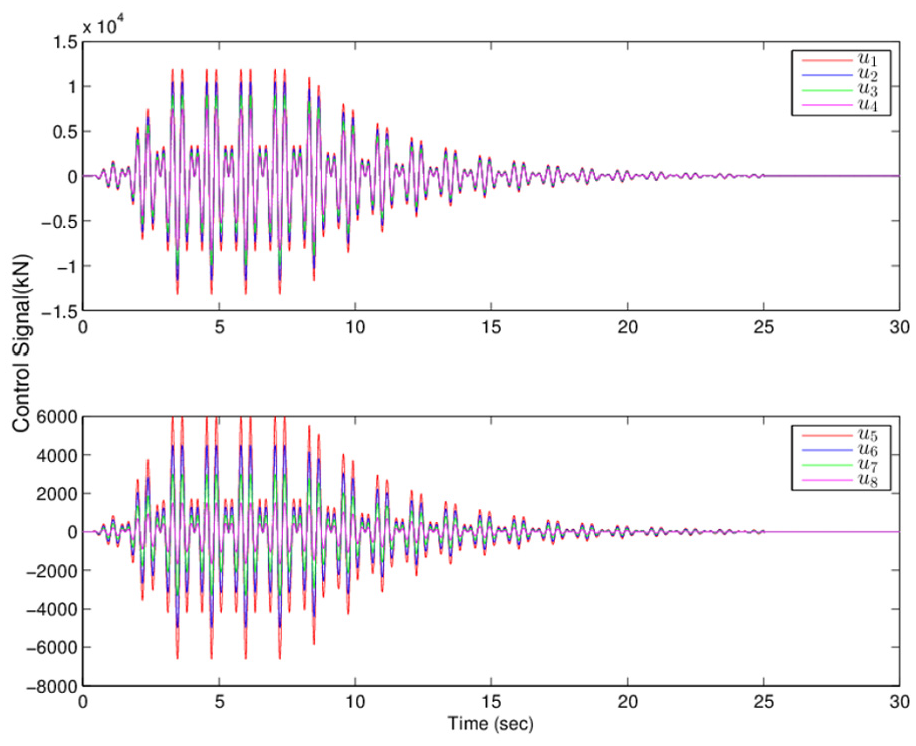
The response of control signals of the OFDRC (32).
It is observed from Figure 5 that the maximum story displacement drift (relative to the ground) of each story is no more than 0.03cm, which verifies that the proposed OFDRC method have not only disturbance rejection ability, but also good robustness to parameter uncertainties.
Conclusion
An OFDRC strategy has been proposed for building structure systems subject seismic excitations via GPIO and output feedback domination techniques. Under the proposed OFDRC approach, the seismic excitations (disturbances) is cancelled by estimations of GPIO, and the (uncertain) interconnected terms are dominated rather than attenuated.5,21 Compared to the decentralized sliding mode part OFC method, the proposed OFDRC has a simple linear structure which is beneficial to practical applications. The simulation results have illustrated that the proposed OFDRC has strong robustness against seismic excitations and uncertainties.
Footnotes
Declaration of conflicting interests
The author(s) declared no potential conflicts of interest with respect to the research, authorship, and/or publication of this article.
Funding
The author(s) disclosed receipt of the following financial support for the research, authorship, and/or publication of this article: This work is supported by the National Natural Science Foundation of China under Grant 61503122 and 12002120, the Key Research and Development and Promotion of Special Project of Henan Province under Grant 202102210142, and the Foundation of Henan Education Committee under Grant 18A120008.
