




Abstract
The effect of inclined volute tongue on the aerodynamic noise and performance of a centrifugal fan was investigated by experimental test in this article. The present work highlights that the effect of both the clearance and the radius of the volute tongue has an influence on the performance and noise. The experimental tests of various models aim to obtain the aerodynamic noise and performance characteristics of several fan models. First, the experimental results of centrifugal fan performance are tested by the standard test equipment of aerodynamic performance. The experimental results of centrifugal fan aerodynamic noise are measured by the standard test equipment of experimental noise. Our experimental results mainly show that the generation of aerodynamic noise is significantly correlated with the clearance and radius of the volute tongue. Certain geometries of the volute tongue could reduce the noise of the centrifugal fan without decreasing the performance. It is experimentally demonstrated that the high A-weighted sound pressure levels mainly concentrate on a range of from 700 to 7000 Hz frequency by observing the each 1/3 octave band frequency for four fan models. The comparison of aerodynamic noise results also demonstrates that the inclined volute tongue may not only produce a deceasing of about 1.58 dB compared to that of the baseline model. We further obtain that the properly inclined volute tongue not only has positive performance features compared with the baseline model but also effectively controls the broadband frequency noise of single-inlet centrifugal fan.
Introduction
The centrifugal fans are very important equipment widely applied in systems of ventilation and equipment of air conditioning. The centrifugal fans are mainly able to achieve high pressure rate, small size rate, and can change the direction of air flow compared with axial fans. Nowadays, people began to pursue a comfortable working environment which requires the decreasing centrifugal fans noise characteristics and improve the aerodynamic performance. In general, the aerodynamic noise dominates in centrifugal fans noise characteristics. Aerodynamic noise of centrifugal fan includes broadband noise caused by the separation of gas at the blade surface and the impeller outlet, and tonal noise due to the periodic impact of rotating blade on air flow. The effective reduction of the aerodynamic noise of the centrifugal fans not only make for the progress of the centrifugal fan industry but also can improve the comfort of people’s daily life. In recent several decades, the aerodynamic noise generation of centrifugal fans has caused increasingly widespread concern. Cai et al. 1 investigated that the aerodynamic noise was produced by the pressure fluctuations near the casing wall and the dipole noise also played the most dominant role in all fan noise source on the volute tongue surface. Rafael et al. 2 studied the unsteady flow of the impeller-volute configuration by numerical simulations and the unsteady forces acting on the fluid produced by the fan blades. Lee et al. 3 proposed the influence of a gap between inlet duct and impeller in a centrifugal fan, which indicates that the gap could enlarge flow separation and produce vorticity in the blade passage. Qi et al. 4 studied the aerodynamic performance and noise of a centrifugal fan with the forward-curved blades by performing several experimental tests of various geometric structures and obtained that a good geometric structure could decline the noise and enhance the performance of centrifugal fan. Khelladi et al. 5 studied the tonal noise of the centrifugal fan of high speed. The purpose was to reveal the insight of noise generated and to obtain that of dipole type with a monopole effected in the axial directions. Sandra et al. 6 studied the influence of the volute tongue shape on the aero-acoustic generated by experimental study, which obtained a significant relation of the shape of the volute tongue and the aerodynamic noise generation, even certain geometric structures of volute tongue could decrease the noise without declining the operating range of the fan.
As a matter of fact, experimental test is a very effective tool to capture the aerodynamic noise and the performance of the centrifugal fan. The reduction of aerodynamic noise of centrifugal fans was studied in a majority of works. Chen et al. 7 studied that dipole source on the impeller and volute surfaces, and obtained that the pressure on the volute tongue is the important dipole source. Canepa et al. 8 proposed that the spectral decomposition method that can get the propagation and generation functions, which shows that the two functions have better precision than scale index, and their values are generally consistent with expected values based on coherence and compactness of the sound sources. Xu and Mao 9 performed experimental studies of the centrifugal fan noise with the metal foam of open-cell, and obtained that total A-weighted sound pressure level reduces for about 5 dB and the total pressure declines for almost 200 Pa. Patil et al. 10 studied the effect of changing the clearance of volute tongue on the performance of the back centrifugal fan. Paramasivam et al. 11 described a method of predicting aerodynamic noise generation in centrifugal fans. Kim et al. 12 designed the blade array angles with the modulation method, and adopted a large blade curvature, which indicates that some design parameters of centrifugal fan could reduce the aerodynamic noise while declining fan efficiency losses. Jiang et al. 13 studied a method of random modulation for the blades to reduce the undesired tonal noise. They argued that an effective bade distribution could not only decline tonal noise, rather than reducing the performance and the whole aerodynamic noise. Paramasivam et al. 14 designed tapered guide vanes to decline the aerodynamic noise for the centrifugal fan in which the results indicate that the overall noise reduction of about 0.9 dB. Gong and Zhang 15 proposed an inclined leading edge vanned diffuser of the centrifugal fan to reduce the aerodynamic noise by experimental test, which results showed that pressure significantly decreases on the diffuser surface. Zhang et al. 16 performed numerical simulations of backward centrifugal fan to reveal the unsteady flow field to locate the noise sources and obtained the noise of volute higher than the noise of blade and good consistency with the experimental test. Magne et al. 17 studied the generative mechanisms of sub-harmonic noise for the ring fan. Upstream vortices, when impinging on the blades, create the main source of unstable flow, but due to the rotating speed of upstream vortices are lower than the rotor; therefore, the frequency of the interaction is smaller than the passing frequency of blade. Liu et al. 18 carried out numerical calculations to study the centrifugal fan noise generation. Sandra et al. 19 studied the acoustic spectrum and pressure fluctuations of the centrifugal fan by experimental test and also explained the rotation noise and tonal noise generation mechanism. Lee et al. 20 predicted the noise source using a hybrid technique, and obtained that the hybrid technique is agreement with the experiment. Darvish et al.21,22 studied the geometrical structures of volute tongue of centrifugal fan to reduce the areodynamc noise; the results demonstrate that the structures of the volute tongue play a critical role for the aerodynamic noise generation of the centrifugal fan.
The above reviews show that the interaction between the volute tongue of centrifugal fan and the rotating impeller plays a major role in aerodynamics noise generation. It is concluded that the shape and position of the volute tongue have an important impact on the generation of noise and increase performance for the fan.23–27 The volute tongue plays a significant function in the centrifugal fan, which mainly affects the aerodynamic noise and performance of the fan. Complex aerodynamic noise is also mainly produced by the Coriolis force of rotating and parochial blade passage and unsteady separated flow of forward centrifugal fan play a major role to affect aerodynamic noise of fan. Once this aerodynamic noise of centrifugal fan is described, the underlying aerodynamic noise characteristics are fully understood, and a new novel question will spring up in aerodynamic noise of fan. How do we retain performance to control aerodynamic noise of the centrifugal fan? By increasing aerodynamic load and reducing rotational speed could not considerably control the aerodynamic noise, whereas increasing the clearance and the volute tongue radius are significant, and the volute tongue with porosity show a better performance.
The main objective of this article is to not only improve the aerodynamic performance of a forward centrifugal fan, but also reduce the aerodynamic noise by controlling the air flow of interaction between the rotating impeller and the volute tongue. In this work, we mainly achieve the above purpose by inclined volute tongue from entrance of a centrifugal fan with single inlet to the rear disk of impellers. The origins and influences of inclined volute tongue on the aerodynamic performance and noise mechanisms and of a forward multiblade fan are regarded as reducing interaction between the rotating impeller and the volute tongue. Our work indicates that to properly improve the volute tongue radius, to improve the volute tongue clearance, and to properly improve the inclination angle from entrance of single-inlet centrifugal fan to the rear disk of impellers are to obtain significant physical mechanisms of improving the total pressure, the efficiency of total pressure, and reducing aerodynamic noise. It gives insight into understandings of the physical mechanisms of aerodynamic noise of a centrifugal fan with single inlet. In this work, an experimental study was focused on the influence of both the radius and clearance of the volute tongue of the centrifugal fan. The specific schemes are to reduce the noise by increasing the radius and clearance of the volute tongue and are to decrease the interaction.
The organization structure of the article is given in this section. Section “Parameters of centrifugal fans and schemes of inclined volute tongue” mainly introduces the parameters of single-inlet centrifugal fans. After that, the details of the experimental principle and method are discussed in section “Experimental setup.” In section “Experimental results and discussions,” the experimental results of aerodynamic noise and performance of various centrifugal fans with single inlet are compared and discussed. Some conclusions are presented in section “Conclusion.”
Parameters of centrifugal fans and schemes of inclined volute tongue
In this section, some important parameters of baseline centrifugal fan and the schemes of inclined volute tongue are presented.
Parameters of single-inlet reference centrifugal fan
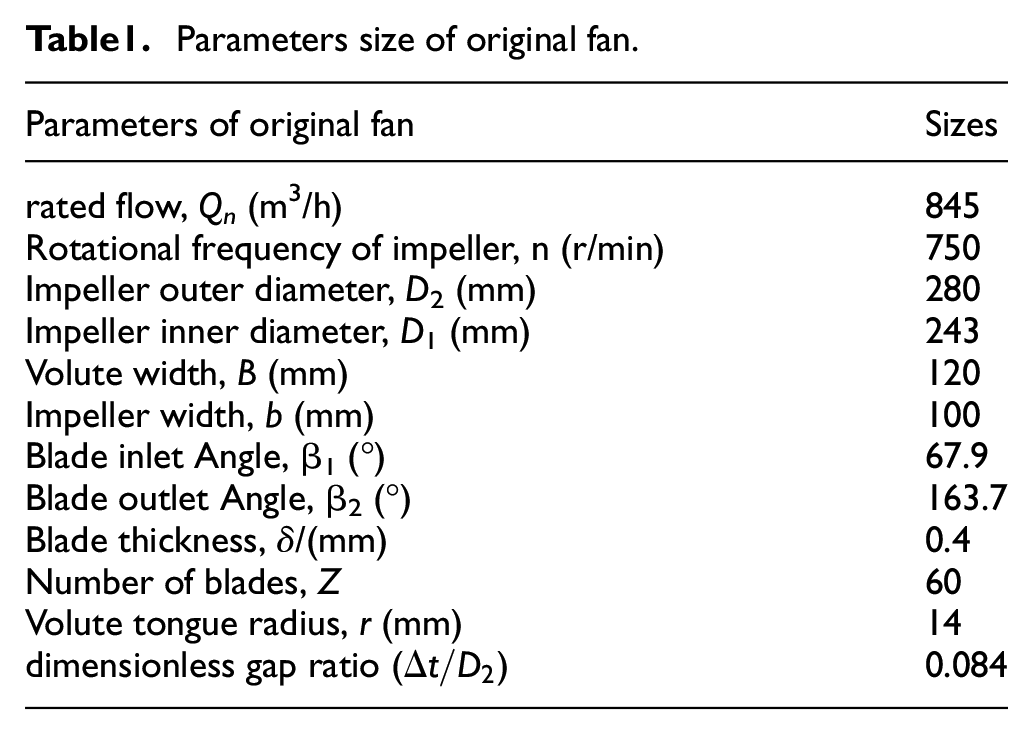
In this work, a single-inlet centrifugal fan is investigated and its key parameters will be introduced in the following subsection. Figure 1 shows the three-dimensional (3D) configuration of a single-inlet centrifugal fan, which includes an impeller with forward blades and a volute with a single inlet. Some specific parameters of the geometric model are described in Table 1. As shown in Table 1, it is obtained that the impeller blade number of the baseline centrifugal fan is 60, the width of its volute is 120 mm, the width B of the impeller are 100 mm, the diameter D2 of the impeller is 280 mm, the blade inlet Angle,
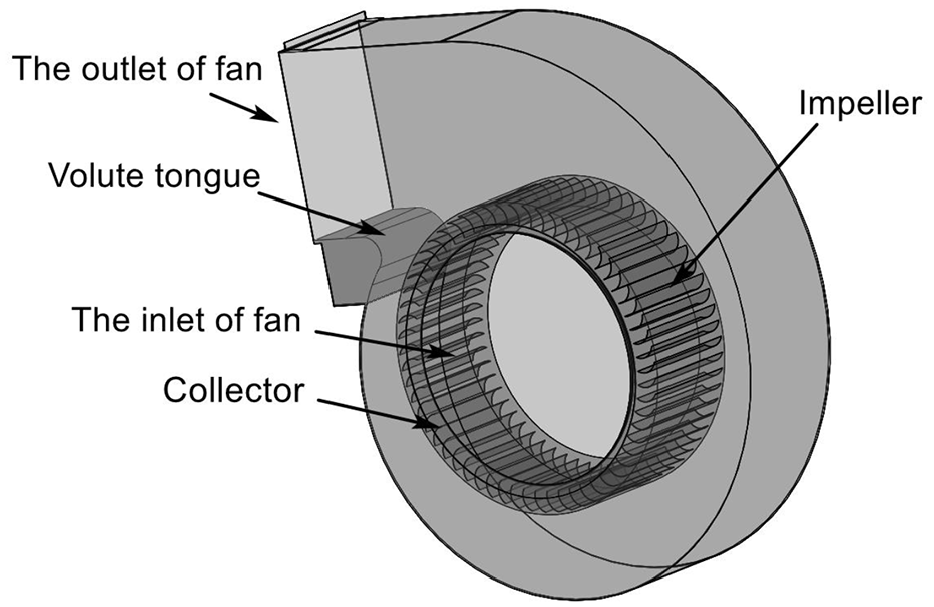
Single-inlet reference centrifugal fan.
Parameters size of original fan.
Schemes of inclined volute tongue
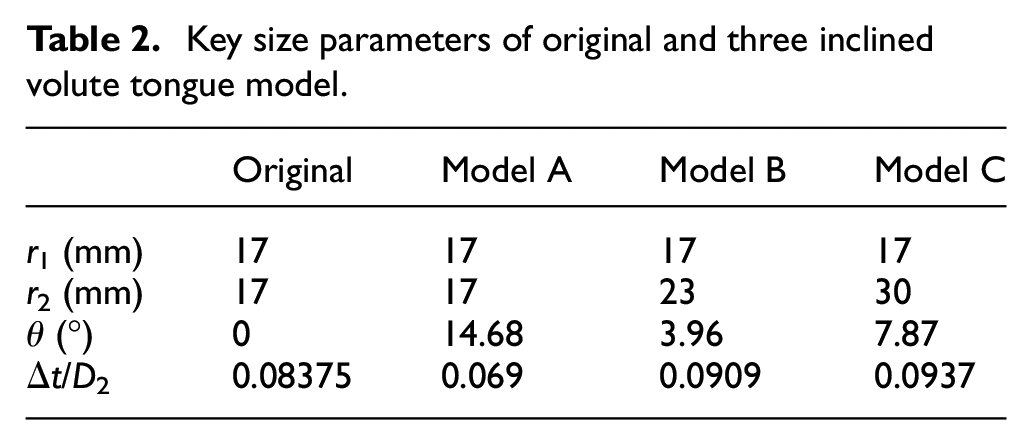
The schemes of inclined volute tongue are mainly focused on controlling three key parameters: the radius of volute tongue, the clearance of volute tongue, and the inclination angle. In this article, four experiments of different volute tongues are carried out to achieve the aerodynamic performance and aerodynamic noise characteristic of the centrifugal fan. Four models of testing are the baseline centrifugal fan, and three inclined volute tongues. In the following work, the detailed schemes of inclined volute tongue are introduced for four models of fan. Figure 2 demonstrates the definition of volute tongue parameters for the centrifugal fan. The inclination angle θ in Figure 2(b) is the angle between the line connecting the original geometry and the modified geometric center in Figure 2(a) and the projection line of the modified geometry on the original geometry; from Figure 2(c), it can be observed that the Δt is the minimum distance from the impeller outer diameter to the volute tongue; the specific position of r1 and r2 can be known from Figure 2(d), r1 is close to the inlet side of the volute, and r2 is close to the side of the volute back shroud. The radius and the clearance of volute tongue of the baseline model remain unchanged. The difference between Model A and Models B and C is that the volute tongue radius of Model A remains unchanged (r1 = r2), only the clearance of volute tongue is changed, while the volute tongue radius and volute tongue clearance of Models B and C are changed.
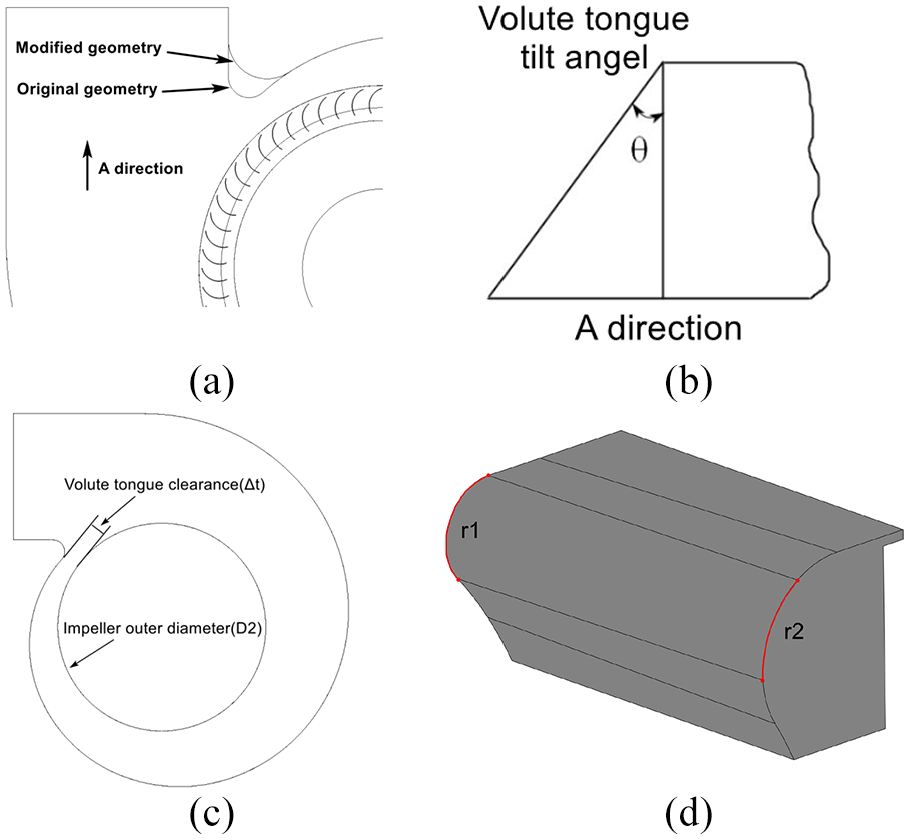
Key components of inclined volute tongue:(a) diagram of inclined volute tongue, (b) inclined angle of volute tongue, (c) two-dimensional diagram of volute, and (d) two radius of inclined volute tongue.
Table 2 shows the key parameters of the three types of volute tongues. As obtained in Table 2 and Figure 2, one can see that the original fan has the same volute radius (r1 = r2 = 17 mm), and the radius and clearance of volute tongue of three types of fan (A, B, and C) have different changes. The A-type radius of volute tongue keeps constant number (r1 = r2 = 17 mm), but the A-type clearance of volute tongue increases gradually from r1 to r2 shown in Figure 2(d), while that of the B and C-type volute tongue is variable both in radius and clearance, and that of the B-type volute tongue is from 17 to 23 mm, and that of the C-type volute tongue is from 17 to 30 mm. The tilt angles (θ) of the baseline model, models A, B, and C are 0°, 14.68°, 3.96°, and 7.87°, respectively. The dimensionless gap ratio
Key size parameters of original and three inclined volute tongue model.
Experimental setup
In general, experimental test and computational fluid dynamics are effective tools to study the fluid physics.28–35 In this article, we mainly investigate the effect of inclined volute tongue on the aerodynamic noise and performance of a centrifugal fan by experimental test. In this section, the experimental equipment and schemes of aerodynamic performance and aerodynamic noise characteristics of centrifugal fan are introduced, respectively.
Experimental test rig
This section mainly introduces the performance and noise test benches used to measure centrifugal fans. The test device for aerodynamic performance is selected from Guangzhou Xin-Na Electronic Equipment Co, Ltd. The product model is F-401-025A. The maximum air volume of this product is 25 m3/min, which meets the air volume test requirements of centrifugal fans. The noise experiment of centrifugal fan was completed in the acoustic laboratory of Zhejiang Martian kitchenware Co, Ltd and on 11 March 2019.
According to the requirements of GB/T1236-2000, the air performance test equipment as shown in Figure 3 is established. In order to describe the test system more intuitively, the sketch (a) of the test system is combined with the physical drawing (b). Illustrated in Figure 3, it can be clearly obtained that the outlet duct of the tested fan is connected to the air performance experimental device through the connector, and then connected to the cross-rectifier, the diffuser, the decompression cylinder to the atmosphere, and the computer connected to the data receiver. A decompression cylinder with adjustable orifice is connected at the end of the outlet of the fan performance test pipe, so as to adjust the flow rate by replacing the orifice plate with different opening diameters. There are four pressure taps on the wall of the decompression cylinder to measure the static pressure of the air flow on the wall of the decompression cylinder. The shaft power is obtained by the electrical test method specified in IEC34-2.
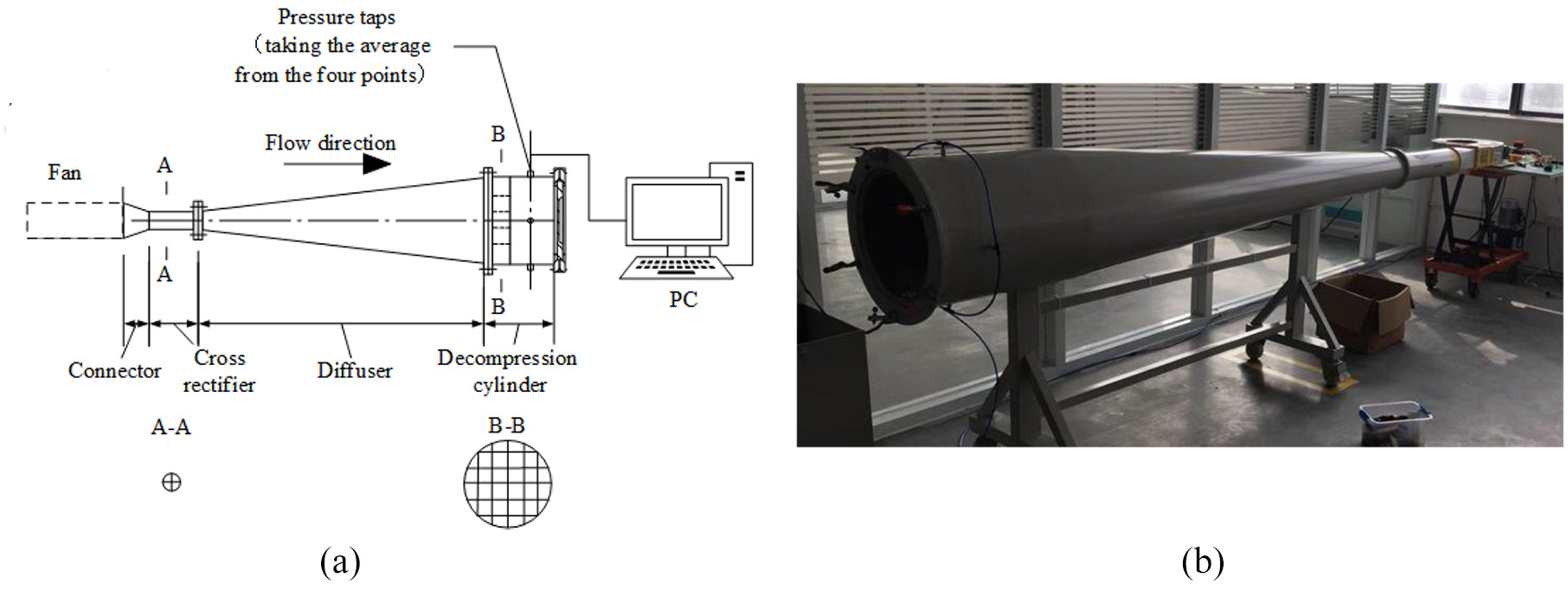
Centrifugal fan performance test installation: (a) Two dimensional diagram of fan performance test and (b) scene of fan performance test.
The air performance test process is generally divided into three parts. First, the test system is built and operated. After the instrument is checked and calibrated, the dynamic data of the tested fan is collected. Finally, the experimental data are processed, and the experimental report is generated. Dynamic data collection is performed by replacing orifice plates with different opening diameters because different orifice plate diameter corresponds to the dynamic data under different flow conditions. FantestVC software is installed on the computer to detect and record the data in real time. The results of air test data are deduced through internal calculation. Finally, the data are compiled into the test report.
Figure 4 shows the experimental equipment for noise measurement. In order to more intuitively describe the noise measurement principle of the semi-muffler (b), a brief description is given in combination with the sketch (a) of the semi-muffler. The size of the semi-anechoic is 6 m*6 m*4 m (L*w*h). The inner surface is all associated with wool wedges that are 40 cm high. The material has good sound absorption characteristics at frequencies above 100 Hz. So, there is no reflected sound inside, and external noise interference is also very small. The noise test standard for centrifugal fan is based on the CJ/T 386-2012 standard and the GB/T2888-2008 standard for acoustic testing in a chamber of semi-anechoic. As shown in Figure 4, it can be seen that the measured fan is placed in a chamber of semi-anechoic for noise measurement experiments, the sound pressure at the place 1 m away from the fan outlet and 45° inclined angle is measured with a 1/2-inch microphone. As shown in (c), after the signal from the microphone is received by the signal connector, the signal processing is performed by the four-channel signal processor (frequency range is 20 Hz to 20 kHz), and finally outlet by the computer terminal controller. The acoustic design of the semi-anechoic room meets GB50800-2012 standards. If the indoor background noise wants to reach the technical index, the difference between the background noise and the measured signal sound pressure level should be higher than 10 dB. When the difference is between 4 dB and 9 dB, the background noise should be corrected. In this article, the background noise of the semi-anechoic chamber is 22 dB, which can be measured directly without correction. Above the rigid ground is a uniform medium of the same sex, and the reflected sound can be ignored.
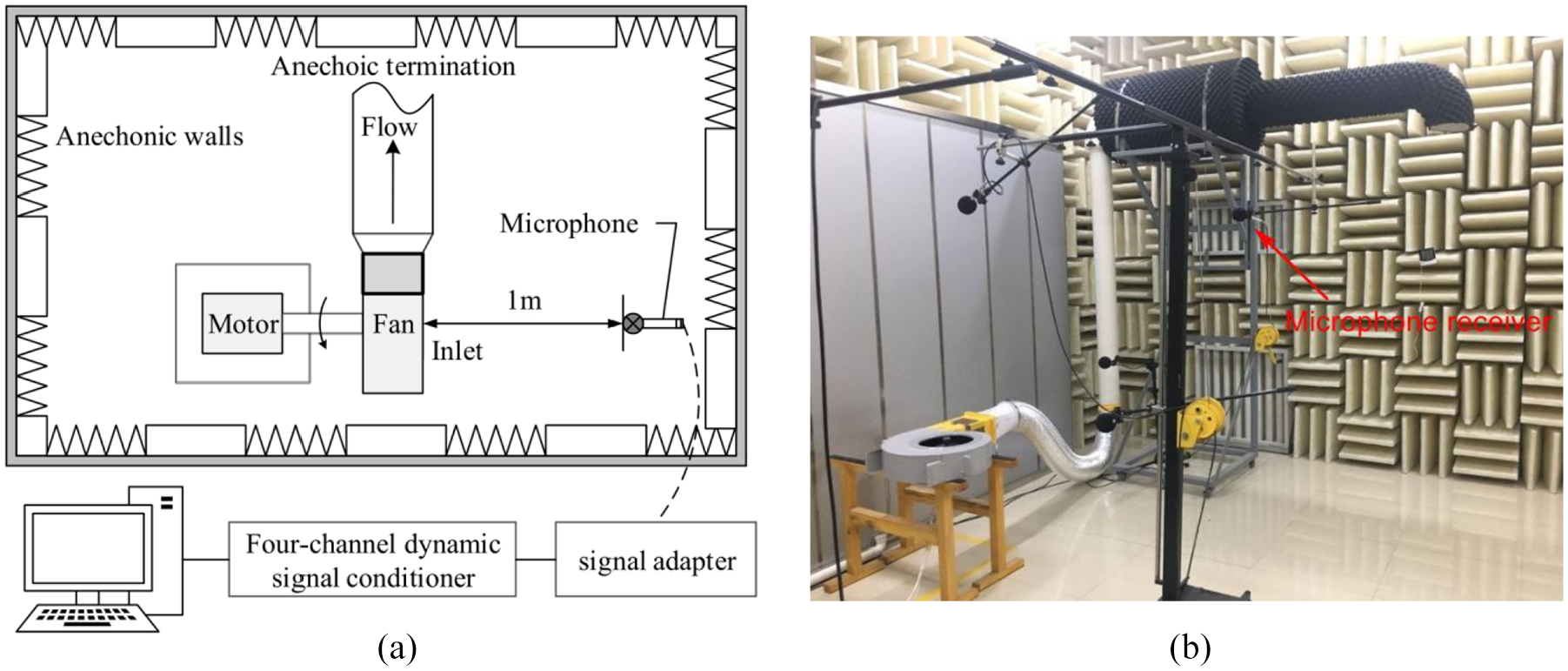
The centrifugal fan aerodynamic noise test installation: (a) two-dimensional diagram of noise test installation and (b) scene of noise test installation.
The values of maximum uncertainties in measuring size are followed as:
Static pressure is ±7 Pa.
Flow rate is ±16 m¹/h.
Shaft power is 2.5 W.
Speed is ±24 r/min.
Sound pressure level is ±0.2 dB a trustworthy level of 95%.
Figure 5 describes the specific improvement of the centrifugal fan at the volute. Plotted in Figure 5, it can be observed that the centrifugal fan used in the experiment has four different structures of volute tongues, and the modification method is to change the tongue portion of the volute into a detachable structure. The software of SolidWorks is implemented for the modified model to generate 3D files, and then 3D prints are carried out for the physical model. The key factor for using 3D printing is that it has higher dimensional accuracy. In order to describe more intuitively, Figure 5(a)–(d) is described by physical models and sketches, where Figure 5(a) is a physical assembly and a sketch assembly, it can be seen that the volute is composed of two parts, which can be tested by replacing different volute tongue structures to assemble new volutes. The model consists of three different models, Figures 5 (b)–(d), whose parameters have been introduced in the previous section. As shown in Figure 5, the assembly perfect is between fan volute and volute tongue of 3D printing, the volute tongue surface of 3D printing is very smooth. Thus, the test result is not influenced by the the volute tongue surface of 3D printing.
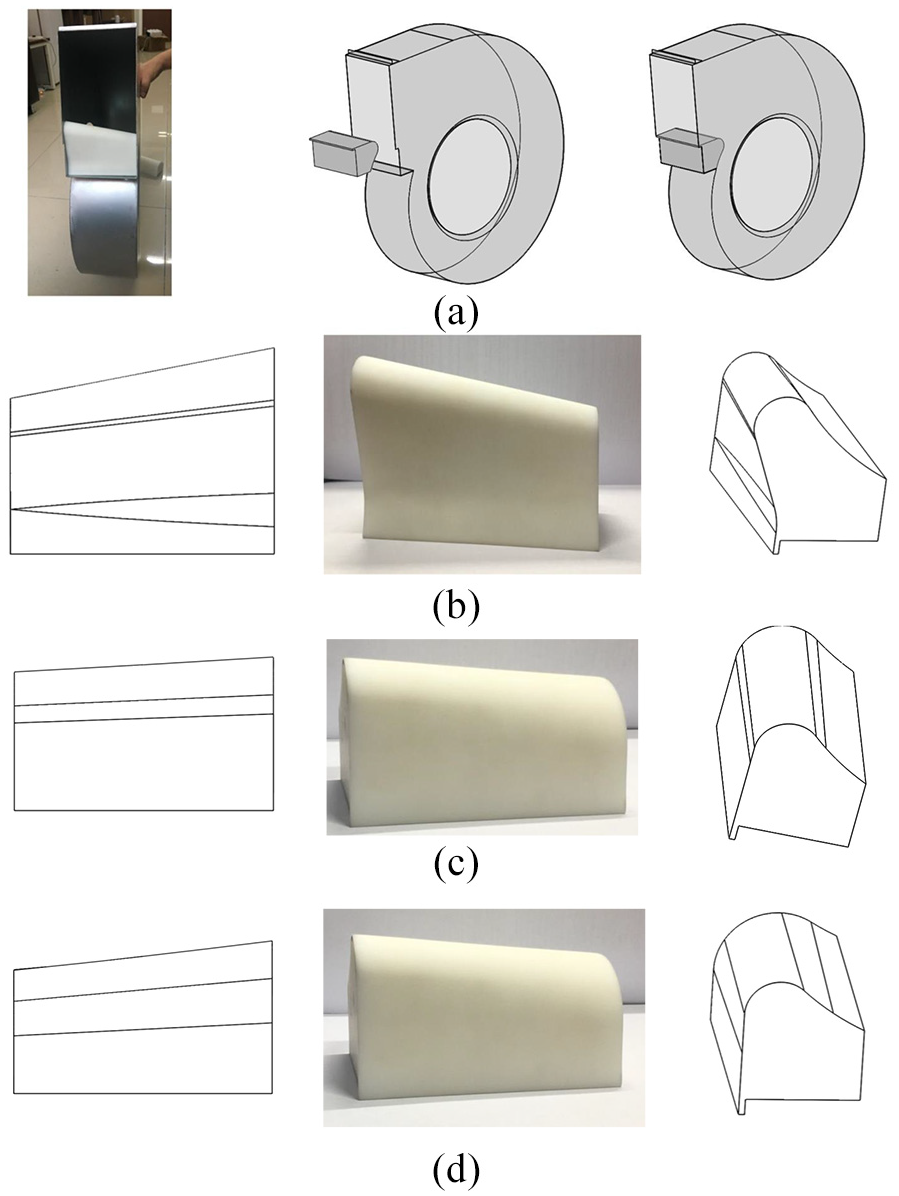
Definition of inclination volute tongue: (a) assembly between fan volute and volute tongue of 3D printing, (b) Model A volute tongue of 3D printing, (c) Model B volute tongue of 3D printing, and (d) Model C volute tongue of 3D printing.
The performance of centrifugal fan is usually expressed by total pressure P (Pa)-Volume flow rate Q (m3/h), and total pressure is the sum of static pressure and dynastic pressure. The total pressure of centrifugal fan is the difference between total pressure at outlet and total pressure at inlet, representing the total energy of 1 m3 gas.
The ability of a centrifugal fan to discharge air per unit time is called effective power or output power

where,
Usually, the shaft power of centrifugal fan is also called input power, which can be written as

where,
T is the torque, Nm;
n is the rotate speed, r/min.
Centrifugal fan efficiency (η) can be expressed as
Mathematics scheme and principle of A-weighted sound level
Sound intensity is divided into sound pressure level and hearing level, which are measured in different ways. Sound pressure level mainly represents the physical characteristics of sound, and the 0 dB sound pressure level is 2*e–5 Pa in each frequency. Hearing level describes the sound of feel for human ear.
In general, the human ear has different perception ability of noise in different frequency bands, it is most sensitive to the medium frequency of 3 kHz. A-weighted sound level measurement method is to design A-weighted network to moderately attenuate both low and high frequencies, so that the medium frequency is prominent. The weighted network is connected between the centrifugal fan and the measuring instrument, so that the influence of the medium frequency noise of the centrifugal fan will be “amplified” by the network. The calculation formula (Lp) for the average A sound level

where
N is the total number of measuring points;
Lp1 is the A sound level measured at point i, dB(A); (the reference value is 20 μPa);
KL1 is the background noise correction value at point I, dB(A);
K2 is the environmental correction value, dB(A);
K3 is the correction of ambient temperature and pressure, dB(A).
Experimental results and discussions
This section mainly discusses the experimental results, including aerodynamics performance and noise test. The performance test results include the total pressure (Pa)—volume flow rate (m3/h) curve, the total pressure efficiency (%)—volume flow rate (m3/h) curve, and the power (W)—volume flow rate (m3/h) curve for four different models. The experimental results of noise measurement include the sound pressure (dB)—time (s) curves of different experimental models and the noise values of different models which can reflect the subjective hearing of human ears through the A-weighted sound level method described above.
Aerodynamic performance feature of different centrifugal fan models
In general, total pressure of centrifugal fan describes the ability to overcome resistance of gas delivery. Figure 6 shows the variation of total pressure for various models by the experimental test. It is clearly observed that the total pressure of Models A and B is evidently greater than that of Model C and original model at medium and low flow rate, and the total pressure of Model C and original model is basically the same at whole operating range. The total pressure does not increase with enlargement of the radius and clearance of the volute tongue but has the best combination range. It is also noted that the total pressure value of Model A is about 371 Pa, the total pressure value of Model B is about 368 Pa, the total pressure value of Model C is about 365 Pa, and the total pressure value of the original model is about 364 Pa at design flow rate (856 m3/h). It is also obtained that at design flow rate, enhanced total pressure of Model A increases as much as 7 Pa. It is also obtained that Model A possesses excellent total pressure compared with that of other models for both low and design flow rates. Lun et al. 26 studied the effect of inclined volute tongue on the static pressure off at various flow rates by numerical simulations. They argued that for the double-inlet centrifugal fan, the properly inclined volute tongue can obtain an increase of the total pressure for both low and medium-flow rates, which further verifies the rational availability of inclined volute tongue.
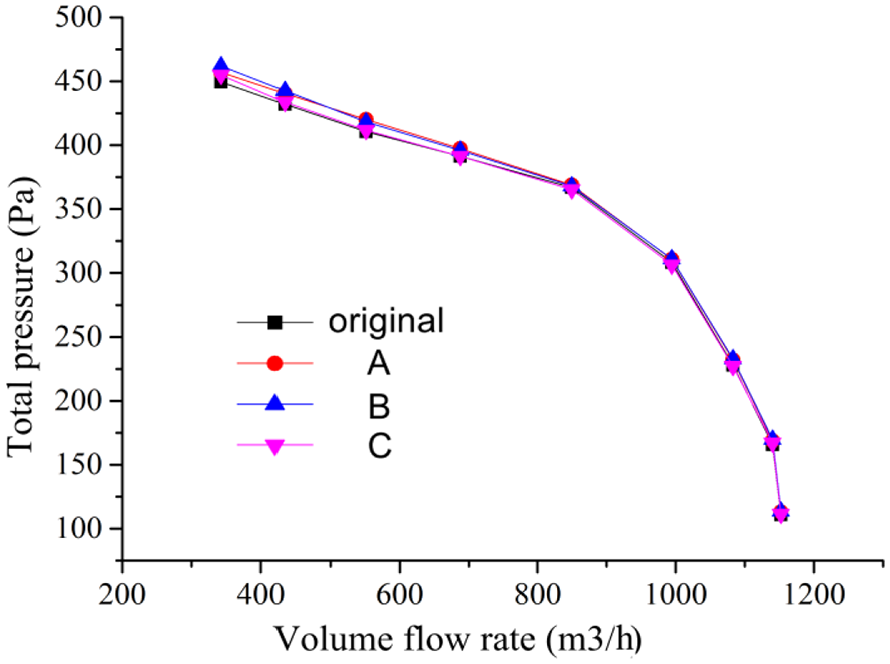
Total pressure curve of the fan.
In our experimental test, the total pressure efficiency includes the impeller efficiency, motor efficiency and mechanical loss efficiency. In other words, the motor efficiency and mechanical loss efficiency is not removed. Figure 7 shows the total pressure efficiency at various models by experimental test. As obtained in Figure 7, one can clearly see that the total pressure efficiency of Model A is apparently greater than that of the original model, the Models B and C near design flow rate. The total pressure efficiency of Model B is evidently lower than that of the original model near design flow rate. The total pressure efficiency does not increase with enlargement of the radius and clearance of the volute tongue but has the best combination range. It is gained that the total pressure efficiency value of Model A is about 35.2%, the total pressure efficiency value of Model C is about 34.4%, the total pressure efficiency value of the original model is about 33.8%, and the total pressure efficiency value of Model B is about 33% at design flow rate. It is also shown that at design flow rate, improved total pressure efficiency of Model A rises as much as 1.4%. It is further obtained that the total pressure efficiency value of Model A is evidently higher than that of other models at a range of flow rates from 500 to 1000 (m3/h). Thus, the above results also indicate that Model A possesses excellent performance compared with that of other models for both low and design flow rates shown in Figures 6 and 7.
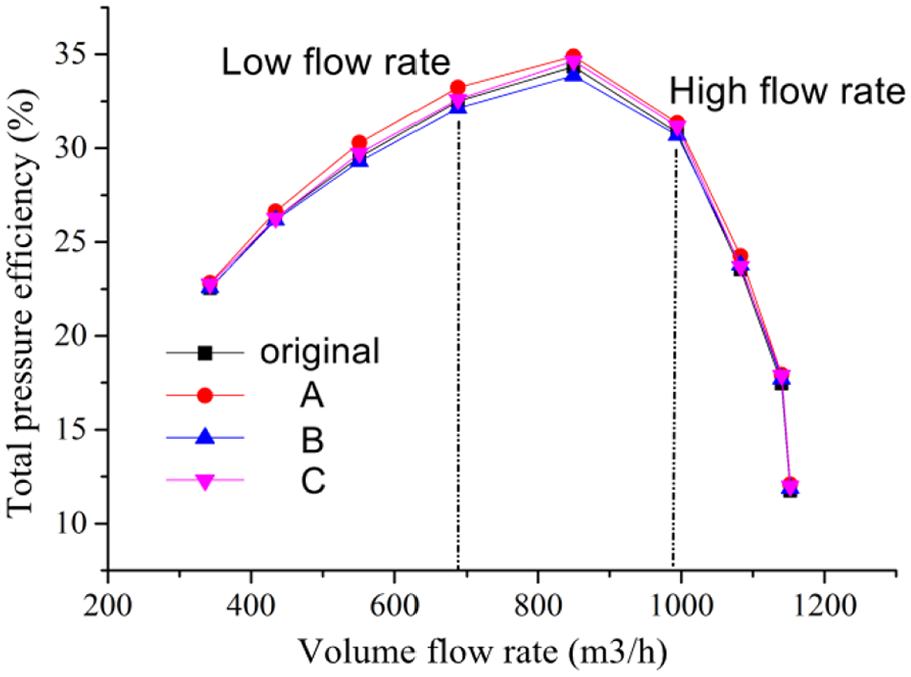
Total pressure efficiency curve of the fan.
The modification of the volute tongue about a baseline centrifugal fan also has an impact on the power consumption. As shown in Figure 8, at medium and low flow rate (<800 m3/h), the power of all the modified models is greater than that of original model; however, the values is slightly less than that of baseline model for high flow rates. Especially, it is further obtained that the power consumption is evidently lower than that of the original fan in the maximum efficiency zone, leads to the total efficiency higher values.
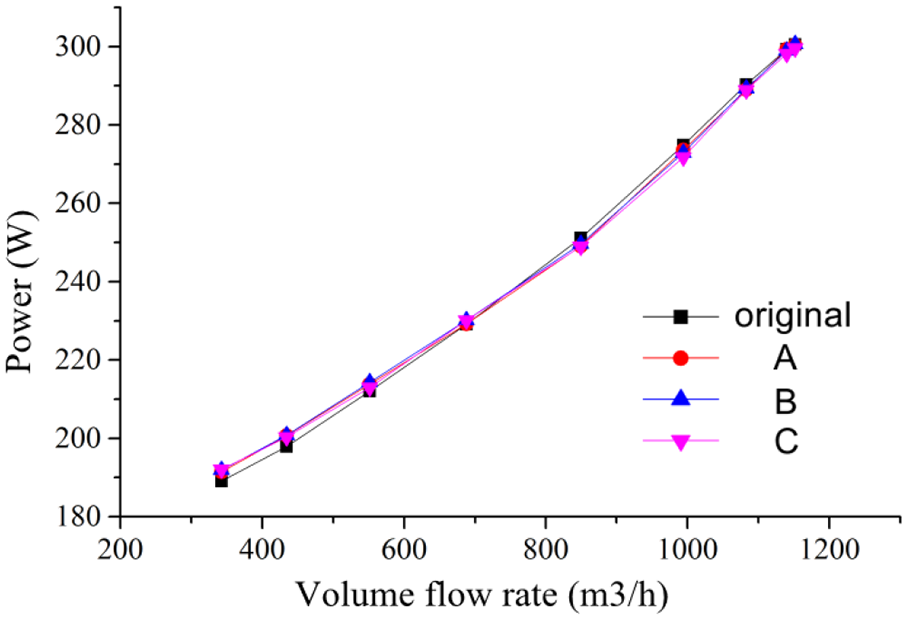
Power curve of the fan.
Aerodynamic noise characteristics of different centrifugal fan models
In this subsection, the time evolution fluctuations of sound pressure, the frequency-dependent variation of sound pressure, and A-weighted sound pressure are presented, respectively.
Figures 9 and 10 illustrate the time-dependent variation of sound pressure at low and high speeds of fan for various models. Plotted in Figures 9 and 10, it is seen that the statistical date is steady after 10 s. The sound pressure of model of inclined volute tongue is clearly lower than that of the original Model A for the whole time range. And the sound pressure of various models at low flow rate is significantly lower than that at high flow rate by the horizontal comparison. As illustrated in Figure 9, it is obviously observed that the average value of sound pressure of the original model is almost 56.5 dB, and the average value of sound pressure of the improved model is about 55.5 dB. As shown in Figure 10, we can obtain that the average value of sound pressure of the original model is about 59.5 dB, and the average value of sound pressure of the modified model is almost 57.5 dB. These values have been A-weighted for the accepted sound pressure signal by the four-way signal processor. And these sound pressure values can more realistically reflect the subjective sense of hearing. Lun et al. 26 studied the effects of inclined volute tongue on flow vortex structure near the volute tongue for the double-inlet centrifugal fan by numerical simulations. They argued that for the double-inlet centrifugal fan, the properly inclined volute tongue can control the flow loss and reduce air flow impact on the volute tongue, which further verifies the effect of inclined volute tongue on the sound pressure rational availability.
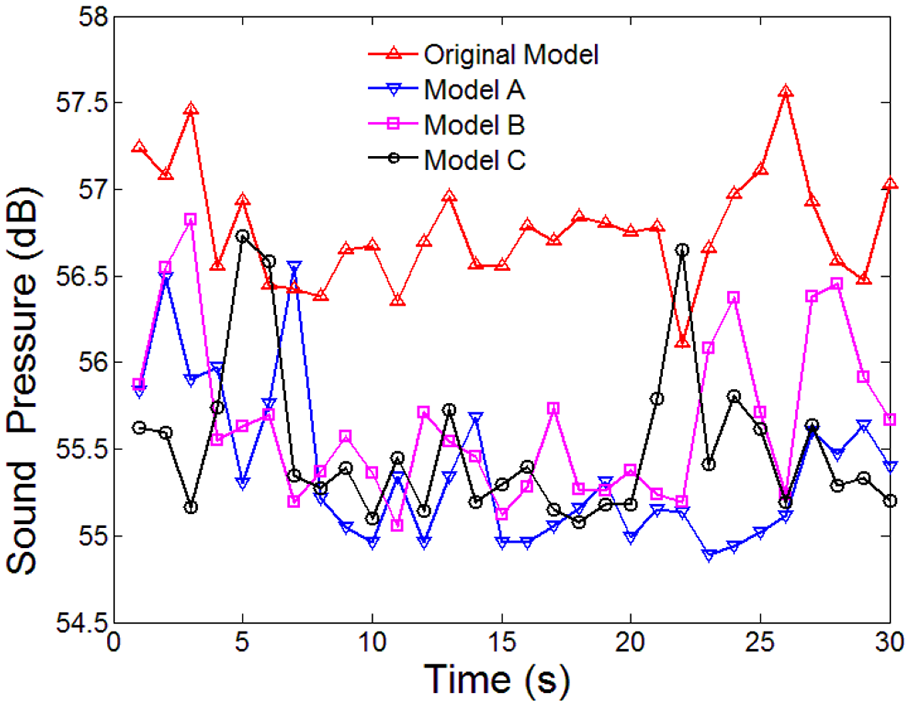
Sound pressure fluctuation at low speed of fan (800 r/min).
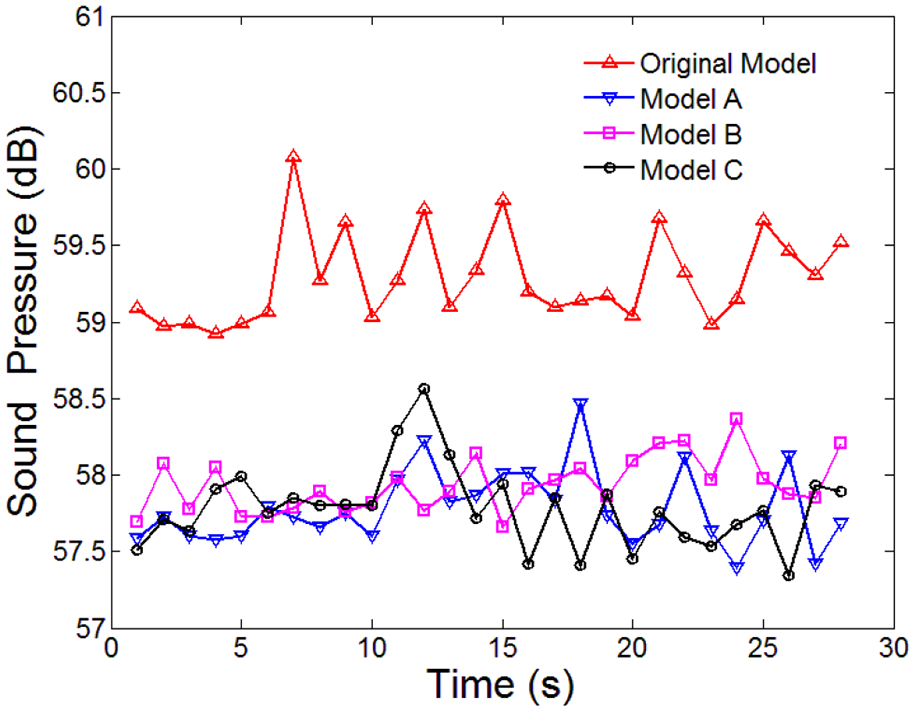
Sound pressure fluctuation at high speed of fan (1000 r/min).
In general, the noise at a range 50–20,000 Hz can be regarded as audible sound by people. The fan noise is classified as the low-frequency noise, the broadband noise and high-frequency noise. In the range 50–700 Hz, the noise is named the low-frequency noise, the broadband noise at a range 700–3000 Hz, and the high-frequency noise at a range 4000–20,000 Hz. The A-weighted sound pressure level is an effective tool to reveal the characteristic of fan noise compared to the linear sound pressure level.7,8 In this article, A-weighted sound pressure level and the each 1/3 octave band frequency are implemented to measure the noise characteristic of single-inlet centrifugal fan. It can be seen from Figures 11 and 12 that the sound pressure value of the original model is basically greater than the sound pressure values of the improved models A, B, and C in the range of broadband noise from 700 to 7000 Hz. For example, at high speeds, the sound pressure value of the original model at 1000 Hz is approximately 48 dB, while the sound pressure value of Model A is 43 dB. At low speeds, the sound pressure value of the original model at 1000 Hz is approximately 46 dB, while the sound pressure value of Model A is 40 dB.
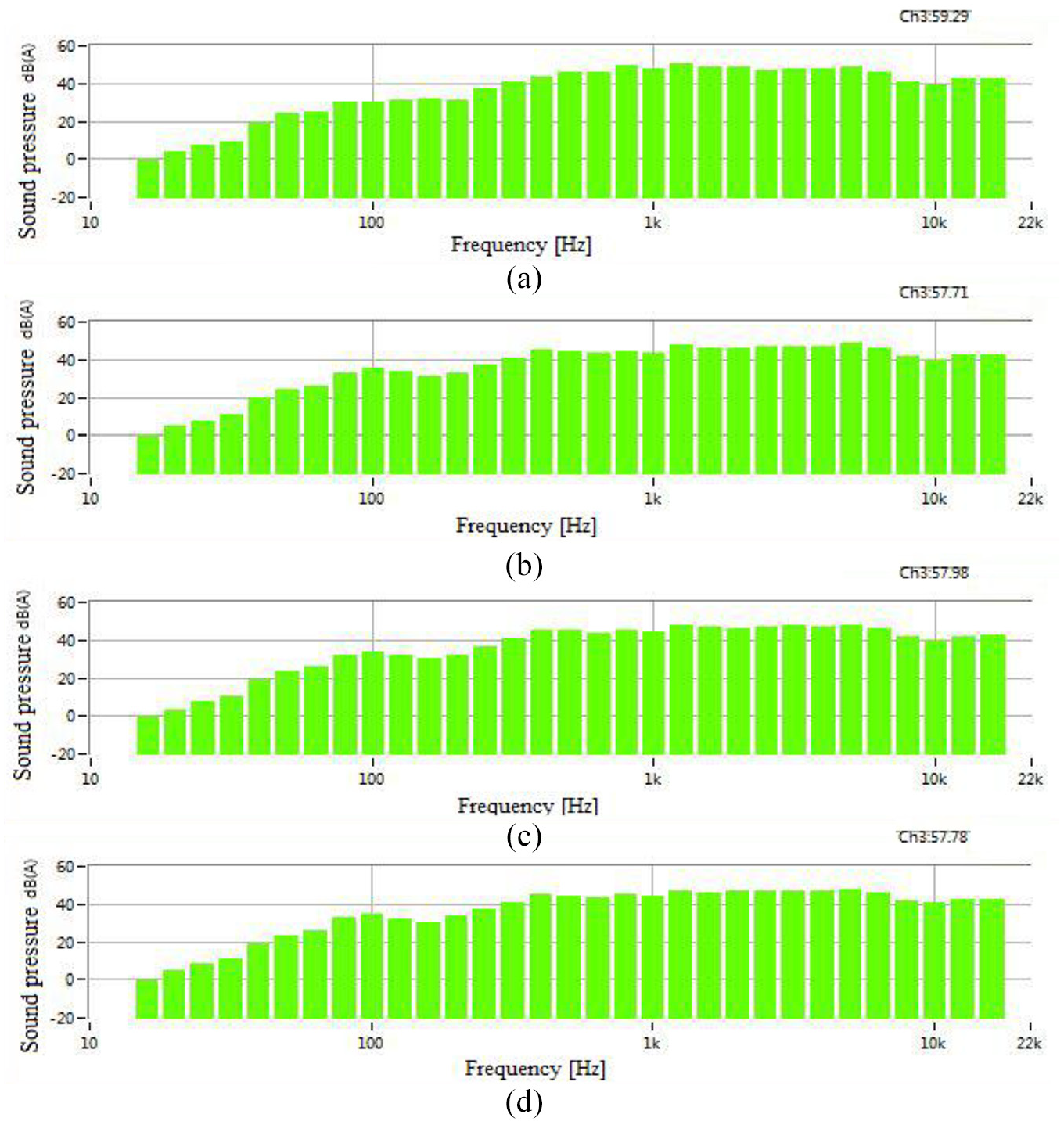
Frequency-dependent variation of sound pressure at high speed of fan (1000 r/min) for different models: (a) sound pressure of original fan, (b) sound pressure of Model A fan, (c) sound pressure of Model B fan, and (d) sound pressure of Model C fan.
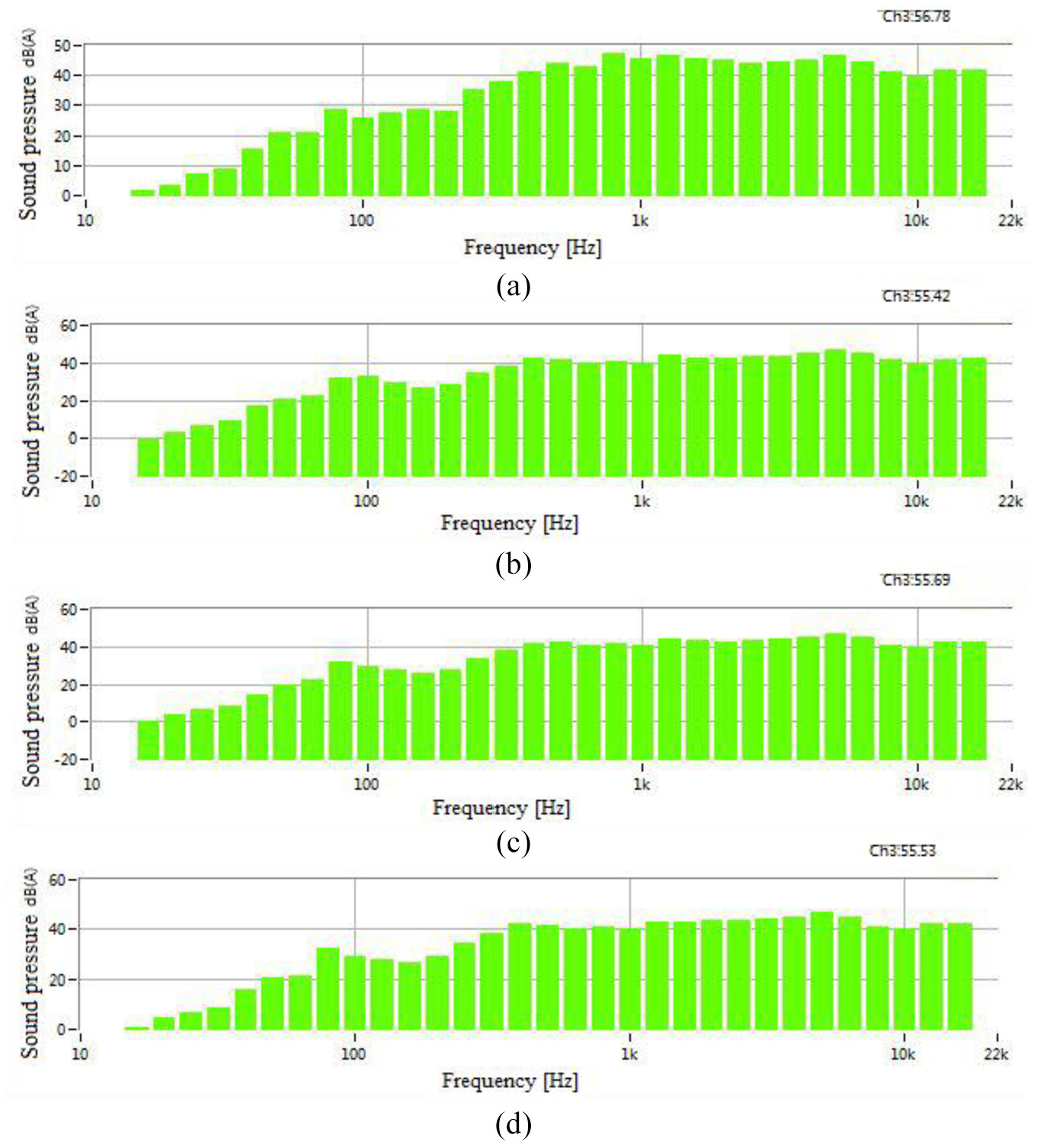
Frequency-dependent variation of sound pressure at low speed of fan (800 r/min) rate for different model: (a) sound pressure of original fan, (b) sound pressure of Model A fan, (c) sound pressure of Model B fan, and (d) sound pressure of Model C fan.
The generation of broadband noise is mainly caused by the flow separation between the blade surface and the impeller outlet. The function of volute tongue is to prevent partial gas circulation in the volute. The advantage of inclined volute tongue is from the front cover plate near the fan inlet to the back cover plate, and the volute tongue gap becomes larger and larger. This leads to the reduction of the obstruction of the volute tongue to the air flow at the outlet of the impeller, and the increase of the circulation of the air flow. However, due to the vortex reduction caused by the air flow separation, the broadband noise is reduced.
To obtain the noise characteristics of different centrifugal fan models, the frequency-dependent variation of sound pressure at high and low speed of fan will be introduced, respectively. Figure 11 describes the frequency-dependent variation of sound pressure at high speed of fan (1000 r/min) for different fans by experimental test of aerodynamic noise. One can see that the high A-weighted sound pressure levels mainly concentrate on a range of 700–7000 Hz frequency by observing the each 1/3 octave band frequency for four fan models. This also indicates that the broadband noise plays a major role for the noise characteristic of centrifugal fan with single inlet, which is also well consistent with the noise experimental test of fan by Canepa et al. 8 He argued that the broadband noise is mainly due to the vortex street generated by the narrow blade channel of the fan. A-weighted sound pressure levels of each 1/3 octave band frequency are almost greater than 40 dB at a range of 700–7000 Hz frequency. Furthermore, it is clearly observed that A-weighted sound pressure levels of the original model is greater than that of Models A, B, and C in this frequency scope.
In order to further demonstrate the above viewpoint, the sound pressures at low speed of fan (800 r/min) for different models are measured. It is also demonstrated that the high A-weighted sound pressure levels mainly concentrate on a range of 700–7000 Hz frequency by observing the each 1/3 octave band frequency for four fan models, which indicates that the vortex street generated by the narrow blade channel of the fan still plays an important role for the fan noise. A-weighted sound pressure levels of the original model is greater than that of Models A, B, and C in this frequency scope. At low speed of fan (800 r/min), A-weighted sound pressure levels at a range of 700–7000 Hz frequency slightly reduce as much as a range of 1–3 dB compared to that of high speed of fan. However, at 100 Hz frequency, A-weighted sound pressure levels greatly reduces as much as a range of 5–7 dB compared to that of high speed of fan, which indicates that the noise of the motor obviously decrease due to the speed decrease of fan.
Figure 13 shows the value of A-weighted sound pressure at high and low speeds of fan with various models by experimental test. As shown in Figure 13, it is observed that the sound pressure of the original model is evidently larger than that of modified models at two different conditions. And the sound pressure of Model A is evidently lower than of models B and C at high and low speeds of fan. Table 3 shows the specific sound pressure values of each model in Figure 13. As shown in Table 3, it is also obtained that the sound pressure of the original model is 56.78 dB and the sound pressure of Model A is 55.42 dB at low flow rate. We can gain that at low speed of fan, improved sound pressure of Model A decreases as much as 1.36 dB at low speed of fan. It is further found that the sound pressure of the original model is 59.29 dB and the sound pressure of Model A is 57.71 dB, improved sound pressure of Model A declines as much as 1.58 dB at high speed of fan. This is demonstrated that the inclined volute tongue is a very effective approach to restrain tonal noise for single-inlet centrifugal fan.
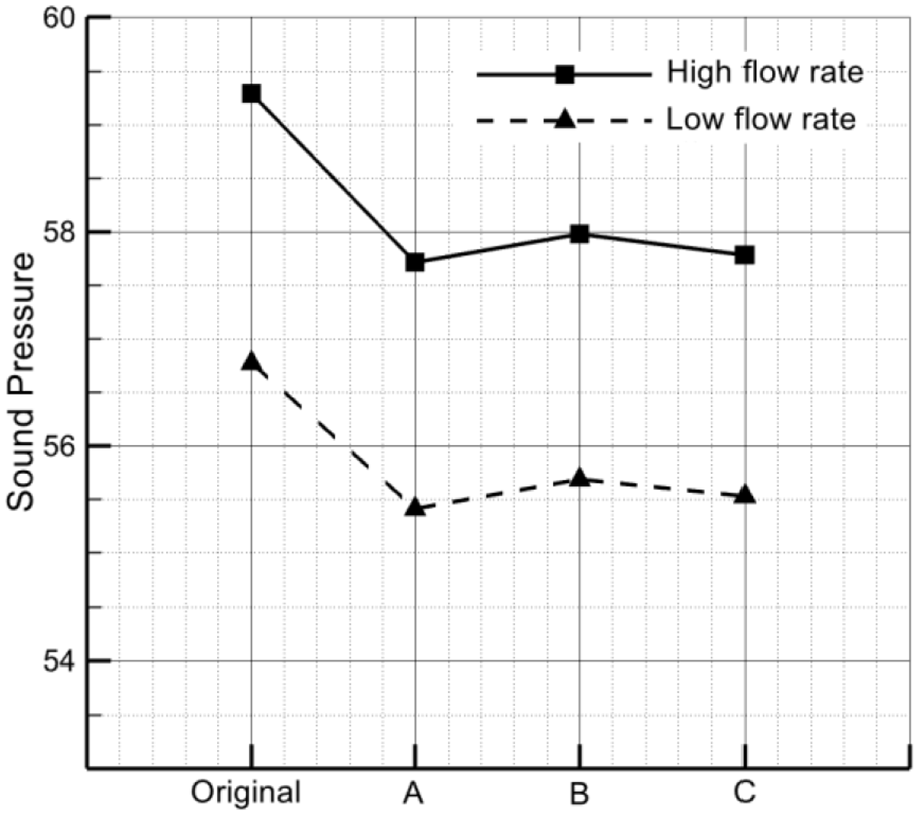
The value of A-weighted sound pressure at high and low speeds of fan with various models.
The specific value of A-weighted sound pressure at high and low speeds of fan with various.

Conclusion
Effects of inclined tongue volutes on aerodynamic noise and performance characteristics of a centrifugal fan with single inlet and forward blades are investigated by experimental test by changing the clearance and the volute tongue radius. The aim of this article is to cut down the aerodynamic noise generated without decreasing the performance of the centrifugal fan. The main conclusions are as follows:
It is evidently observed that at the design flow rate, the total pressure of Model A increases as much as 7 Pa, improved total pressure of Model B increases about 4 Pa, improved total pressure efficiency of Model A increases as much as 1.4%, and improved total pressure efficiency of Model B increases about 0.6% compared to the original model. However, the total pressure of Model C at whole operating range is almost consistent with that of the baseline model, and the total pressure of Model C is obviously lower than that of the baseline model.
All the configurations tested can control the centrifugal fan aerodynamic noise generation with respect to the baseline model due to the reasonable clearance and the volute tongue radius can enhance the air flow near the volute, reduce the circulation of partial air flow, and further increase the performance of the centrifugal fan.
The high A-weighted sound pressure levels mainly concentrate on a range of from 700 to 7000 Hz frequency by observing the each 1/3 octave band frequency for four fan models, which indicates that the vortex street generated by the narrow blade channel of the fan still plays an important role for the fan noise. It is obtained that the influence of inclined volute tongue on the broadband frequency noise of centrifugal fan with single inlet is very effective. It is experimentally demonstrated that the A-weighted sound pressure value of Model A reduces as much as 1.36 dB, improved A-weighted sound pressure of Model C reduces about 1.25 dB, improved A-weighted sound pressure of Model B reduces as much as 1.09 dB at low flow rate compared to the original model. Meanwhile, it is also obtained that the A-weighted sound pressure of the three modified models is significantly lower than that of the original model at high flow rate.
Finally, it can be stated that the clearance and radius of the volute tongue can reduce the aerodynamic noise of the centrifugal fan and increase the total pressure and total pressure efficiency. It is demonstrated that increasing the clearance of the volute tongue without increasing the radius of the volute tongue (Model A) is a more effective method to decrease the centrifugal fan noise generation without declining the performance of the centrifugal fan.
Footnotes
Declaration of conflicting interests
The author(s) declared no potential conflicts of interest with respect to the research, authorship, and/or publication of this article.
Funding
The author(s) disclosed receipt of the following financial support for the research, authorship, and/or publication of this article: This above work was mainly supported by the National Natural Science Foundation of China (grant nos. 11872337 and 11902291), the Fundamental Research Funds of Zhejiang Sci-Tech University (grant no. 2019Y004), and he Key Research and Development Program of Zhejiang Province (grant no. 2020C04011), and the Public Projects of Zhejiang Province (grant no. LGG20E060001).
