




Abstract
Regional logistics has become an important direction of logistics development. The rationality of regional logistics network layout will affect the regional development. And the measurement and calculation of node gravity is an important aspect affecting the layout of logistics network. Nowadays, the traditional gravity model cannot measure the condition of a network properly. This paper focuses on the nodal gravity measurement in the logistics network and constructs an improved gravity model considering the role of policy. Quantifying the policy factors makes the measurement more realistic. We test our model on a famous regional logistics network in China. Result shows that cities are greatly influenced by policies, which change the node gravity obviously and even change the gravity level of logistics. This paper shows that the traditional gravity model ignores the impact of policy quantification on logistics gravity, and the improved gravity model that proposed in this paper has more practical significance.
Introduction
Regional logistics has become the key direction of logistics planning. At present, logistics is not only limited to the development of a single node, but also emphasizes the regionality of the logistics development process, as well as the driving force of each node to the development of peripheral nodes’ logistics. Regional logistics refers to the economic strength and scale of the central city. Considering the scope of logistics radiation to the surrounding cities, regional logistics carries out economic, political and natural logistics activities in the radiated area. Modern communication technology, transportation mode, transportation speed and logistics infrastructure construction make the development of regional logistics more rapid. 1 The rapid development of regional logistics can better realize the scale of regional economy, strengthen the exchange and interaction between urban agglomerations, and better promote the development of urban agglomerations.
Regional economy and urban agglomeration have become the focus of China’s development. In recent years, China has vigorously developed urban agglomerations and strengthened comprehensive service functions in Beijing-Tianjin-Hebei region, Yangtze River Delta region, Pearl River Delta region and other regions. As a third-party industry, logistics service capability has an important impact on the whole regional service function. Under the influence of the development of urban agglomeration, in order to make the development of regional logistics better and faster, the state has introduced relevant policies and plans. The country hopes to point out the direction for the development of regional logistics through policy control and guidance. There is no doubt that these policies will directly affect the development direction of regional logistics. At present, there is no research to prove the impact of quantitative policies on the study of regional logistics using the gravity model.
Constructing a reasonable logistics network is the key to the development of regional logistics. The selection of regional logistics network hub nodes and the determination of the coverage of nodes are the key steps of logistics network layout. In this paper, the nodal gravity measurement, which is an important content in the study of node coverage, is taken as the research content. Through the improved gravity model, the nodal gravity change is analyzed. Before introducing the problem, the current research status of gravity model is described.
The gravity model originated from Newton’s gravitation and developed from it. It has been gradually applied in many fields. Relevant studies have emerged since 1948. Stewart 2 first put forward the concept of gravity model, and Jan Tinbergen first put forward the trade gravity model. 3 In the subsequent expansion, in addition to the proof of gravitational model theory itself, it has been applied to many disciplines. Among them, trade, urban spatial linkages and logistics related research are the most extensive.
First, in the field of trade research, Gallo et al. 4 studied the parametric and non-parametric trade gravity model, and tested the trade situation between Italy and the World Economic Zone as an example. Zhao and Lin 5 studied the situation of agricultural trade between China and 10 ASEAN countries. Rajesh 6 used the gravitational model to study the impact of the Great Recession on India’s economy. In the field of urban space research, Fotheringham 7 used gravity model to study the competition and agglomeration of cities. Peng, 8 Liu et al., 9 Pang and Cao 10 took Guangdong-Hong Kong-Marco Greater Bay Area and surrounding cities, Nanjing metropolitan area and Chengdu-Chongqing economic circle as examples, respectively, to study the urban spatial linkage and urban spatial network problems in the region through gravity model.
In the field of logistics research, Corradetti and Cavaceppi 11 used the gravity model to study the problem of regional logistics coordination, which provides a new research method for the evaluation of regional logistics cooperation. Duanmu et al. 12 combined gravity model and genetic algorithm to study freight distribution. In the construction or analysis of logistics network, Puertas et al. 13 used gravity model to estimate logistics performance index to evaluate the impact of logistics on European export competitiveness. Kong et al. 14 took Jinan as an example and studied the design of green space network by using gravity model. Zhu and Fan 15 used gravity model to study the logistics connection intensity of inland regional logistics, and determined the logistics center city and logistics connection direction of Jinquli area in Zhejiang Province. Li and Xue 16 used gravity model to construct the logistics network structure of Beijing-Tianjin-Hebei Region with four hubs and nine spokes under the background of Beijing-Tianjin-Hebei regional logistics. The distinct characteristics of logistics network research are based on gravity model to construct and analyze regional logistics network from different perspectives and regions. These studies show that gravity model can be used to measure regional logistics gravity.
In the aspect of improved gravity model, Wang et al. 17 used the improved gravity model to study the disordered image diffusion when studying the image encryption problem. According to the actual situation of container liners, Wang and Liang 18 rewrites the “distance” in the gravity model to make the gravity model more suitable for predicting the expected cargo flow of liner routes. In many studies, based on gravity model, regional logistics network is constructed and analyzed from different perspectives and regions. Fang et al. 19 and Xie and Wang 20 both deduced the gravitational model with micro-theoretical basis through general equilibrium model, and then used it to measure trade costs. Zeng et al. 21 evaluated the rationality of public rental housing spatial layout by rewriting the “quality” of gravity model. It can be seen that in the improvement of the gravity model, researchers have changed the “quality” or “distance” in the gravitational model to make the gravitational model more in line with the actual situation of the problem studied.
From the above, we can see that the related research of gravity model is extensive and in-depth, from theoretical research to practical application, from the field of physics to the field of economics, and then to the field of logistics. No matter which fields have done in-depth research on gravity model, and the theory is detailed, the case is representative. The application of traditional gravity model is very extensive. In the improvement of traditional gravity model, no matter for “quality” or “distance,” there is a certain degree of improvement. However, the shortcomings of previous studies are that when it comes to background-related factors, most of them adopt the method of adding background analysis to the final conclusion analysis or countermeasures. For example, in the study of gravity model related to regional logistics, policy background, future planning and even political and natural background are often added to the paper as countermeasures and suggestions. However, this approach cannot accurately measure the specific impact of policy and other background factors.
In this paper, from the perspective of regional logistics, by improving the gravity model, policy factors are added into the gravity model as coefficients to make policy as a quantitative index to influence the attraction of node logistics, and then the effectiveness of the improved model is verified by an example. In the next section, the reasons for improving the gravity model and the benefits of introducing policy factors are analyzed. The next introduces and improves the model, and then makes an empirical analysis with an example. Finally, the paper analyses the impact of policy factors on regional logistics nodes after changing the attraction of logistics, and gives reasonable application suggestions for the improved model.
Problem description
Under the current development background, the state strongly advocates the development of urban agglomeration to promote the development of more cities and surrounding areas, and has launched a large number of policies to promote and accelerate the development of urban agglomeration. Thus, we can know that in this case, the current and future development of regional logistics will be affected by policies. In previous studies, most people analyzed the policy as a qualitative factor, but the problem lies in the inability to judge the specific impact of the policy on regional logistics nodes. For example, the node h in Figure 1 is only a node, but under the influence of policy, it may become the same hub node as m and K. Then the logistics attraction between the nodes adjacent to h will change and new nodes may be attracted to form a new logistics circle, as shown in Figure 2. This change is hard to come to by qualitative analysis.
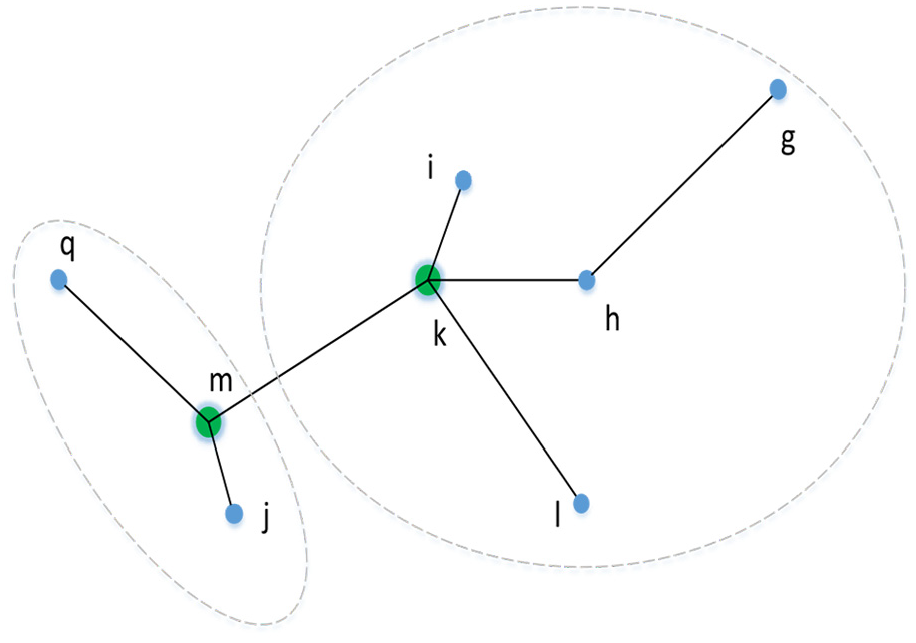
Simple regional logistics network layout.
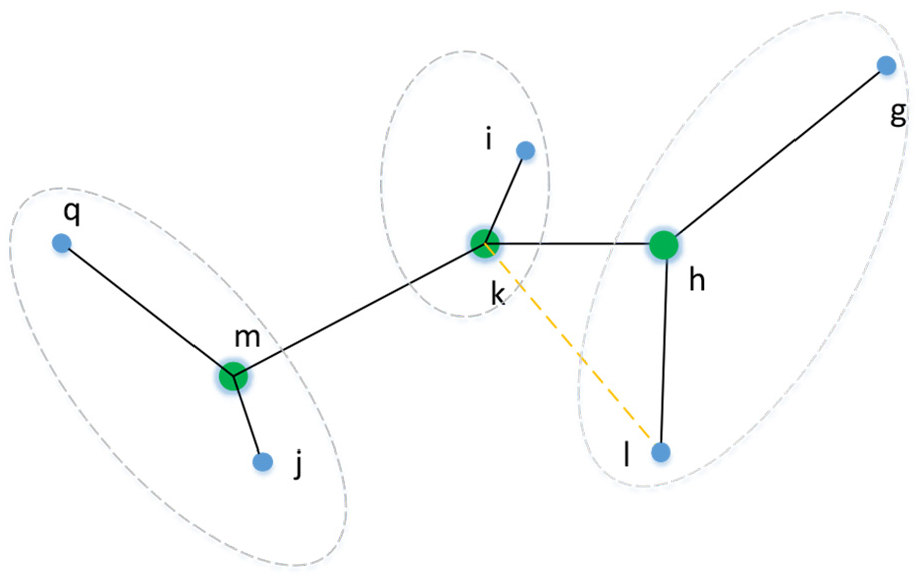
Simple regional logistics network layout under the impact of policy.
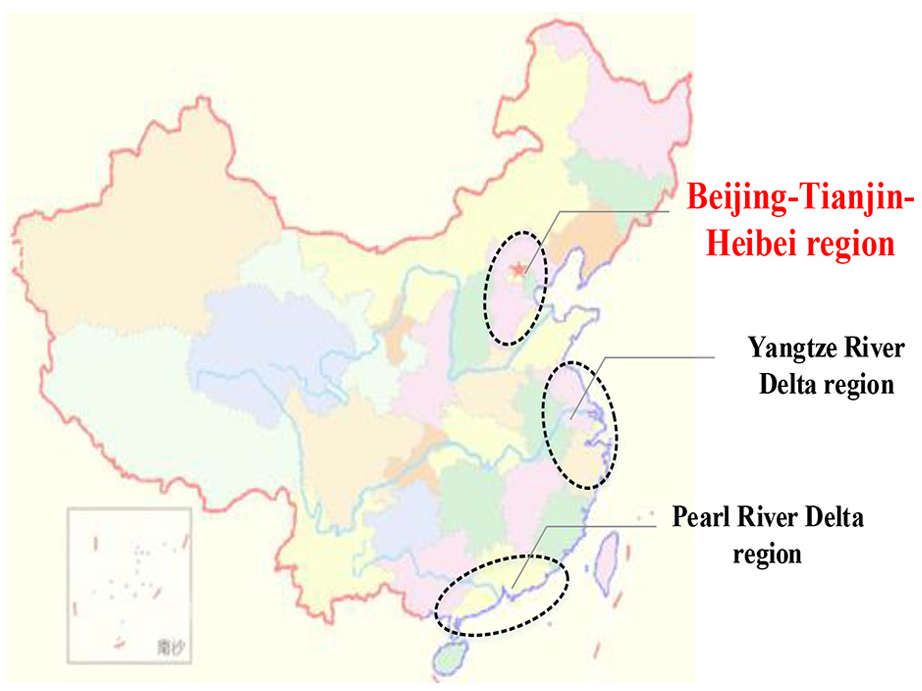
Distribution of important urban agglomerations in China.
In previous studies, the improvement of gravity model is mainly based on two aspects: one is to change the “quality,” the other is to change the “distance.” Policy as an influencing factor is difficult to be introduced into “quality” or “distance.” Therefore, the solution of scholars in the past is to make qualitative analysis of policy factors, not quantitative analysis. This approach does not accurately determine the extent of policy impact.
Considering the above problems, this paper adds policy factors as coefficients to gravity model to judge the development of regional logistics in the period of main policy influence, which not only use the past data to infer, but also quantify policies to accurately judge the impact of policies. We can even infer the future direction of regional logistics development in the medium or even long term.
Problem formulation
Gravity model
Gravity model is a spatial interaction model based on Newton’s classical gravitation formula. It is widely used to predict the spatial interaction ability. 22 In regional logistics, hub logistics city will exert a gravitational effect on node logistics city, and in the process of development, hub logistics city will constantly attract related industries to gather around the city, produce some radiation force and have a certain radiation impact on the surrounding node logistics city. Formula (1) is the basic form of gravitational model

where
The research content of this paper is regional logistics. Therefore, the basic assumptions and concretization of the model are based on regional logistics.
Hypothesis 1: Assume that the location of all node cities is known. 23
Hypothesis 2: Based on the gravity model, the gravitational attraction between cities can be determined by city size and spatial distance. In order to study the intercity logistics gravity, this paper defines the endogenous variable

According to Formula 2, the logistics gravity between two cities of regional logistics can be calculated by obtaining relevant data. Before judging the approximate radiation range of the central city, other methods are used to determine the city grade of regional logistics, such as principal component analysis, factor analysis, TOPSIS, and so on. After determining the central city, the logistics scope of other cities should be ascertained. Furthermore, we can know the general network structure of regional logistics.
Improved gravity model
Based on the problems mentioned in the problem description, with the increasing influence of national policies on regional logistics, when measuring the gravity of regional logistics nodes, only considering the data related to logistics development will make the real gravity measurement results not suit the actual development of regional logistics. First, the Hypothesis 3 is put forward for the policy environment.
The development of regional logistics depends on the development of city cluster. The development of cities in city cluster has many influences. Considering the development of the future period and the relationship between cities is not simply physical distance, Hypothesis 4 is put forward.
Hypothesis 3: The development of regional logistics has a great relationship with policy, and the response of each city to policy is not time-lag, that is, when the policy is issued, the cities involved can respond at the same time.
Hypothesis 4: In a certain region, cities with comparable economic development level have less hindrance to the connection between the two places because of the frequent flow of people and materials. 24
The improved gravity model is as follows



The indicators are explained as follows:
Case study
There are several important urban agglomerations in China, including the Beijing-Tianjin-Hebei region, the Yangtze River Delta region and the Pearl River Delta region. Beijing-Tianjin-Hebei region is an important political and cultural center of China, and also an important core of the economy of northern China. Beijing-Tianjin-Hebei region includes Beijing, the capital of China, Tianjin, one of the four municipalities directly under the Central Government, and 11 major cities in Hebei Province. It has superior geographical location and resource advantages, and its development potential is huge.
In the past 2 years, the integration of Beijing, Tianjin and Hebei has had an important impact on the region. The state has vigorously developed the Beijing-Tianjin-Hebei region and has issued many policies to speed up its construction and development. In order to better realize the integration of Beijing-Tianjin-Hebei region, the construction of transportation integration is also proceeding step by step. The integrated transportation system will gradually break the regional and administrative barriers. In addition, China has also implemented a series of policies to promote the development of Beijing-Tianjin-Hebei City Group, especially transportation and logistics development planning. Then, the policy may have a more important impact on the development of regional logistics in Beijing, Tianjin and Hebei. The impact of the implementation of Beijing-Tianjin-Hebei regional policy on regional logistics needs to be analyzed. Combining with the content of this paper, Beijing-Tianjin-Hebei regional logistics can be used as a typical example to verify the improved gravity model.
First, by constructing the evaluation index system of logistics competitiveness of cities in Beijing-Tianjin-Hebei Region, we can determine the logistics competitiveness of node cities in Beijing-Tianjin-Hebei regional logistics. Using the principal component analysis method, combined with the statistical data of 2017, the grade of node cities in Beijing-Tianjin-Hebei regional logistics is obtained as shown in Table 1.
Logistics competitiveness level of cities in Beijing-Tianjin-Hebei region.

According to the actual development of logistics in Beijing-Tianjin-Hebei region, the transportation of logistics is mainly completed by road, that is, the spatial distance between node cities only considers highway transportation. The magnitude of logistics attraction is directly proportional to the logistics competitiveness between two urban nodes and inversely proportional to the distance between cities. By consulting CHINA Highway Information Network, this paper obtains the distance between logistics nodes and cities, calculates the distance by formula (2), and obtains the result of logistics attraction between cities. Each city is divided into four levels: very strong gravity, strong gravity, general gravity, weak gravity and very weak gravity. See Table 2 for details.
Classification of logistics attraction in cities of Beijing-Tiajin-Hebei region.
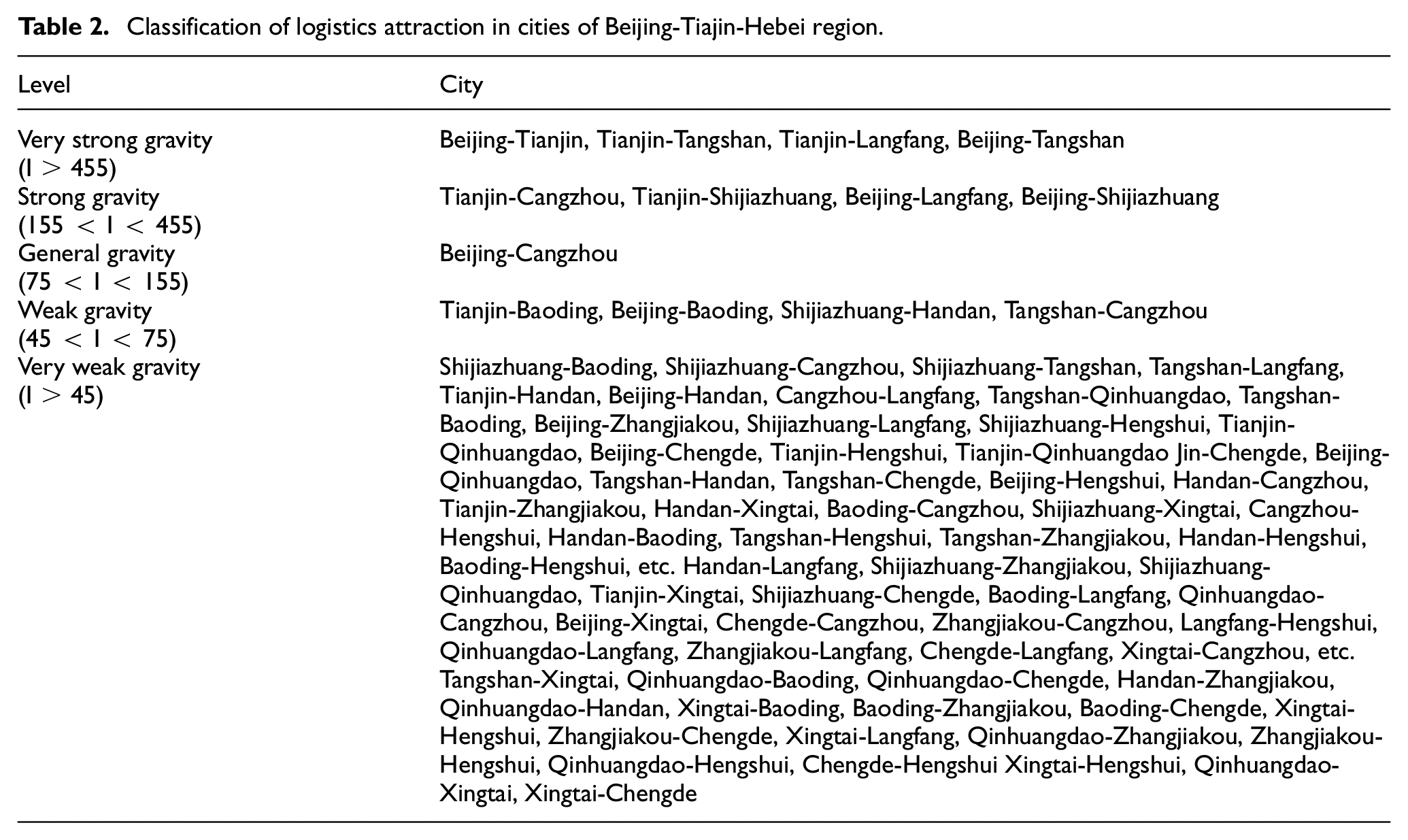
The above table is the result of traditional gravity model. The following table will calculate the intercity logistics gravity under the effect on policy factors. In recent years, the government has issued many policies on logistics development planning, such as commercial logistics development, hub construction, transportation structure adjustment, urban agglomeration development, and so on. In order to verify the significance of the improved gravity model, this paper chooses the traffic and logistics planning policies which have a direct impact on logistics according to the research contents. Considering the development of regional logistics in Beijing-Tianjin-Hebei Region, combined with the reality, three main policies related to transportation and logistics are selected as policy coefficients. These three policies are:
The impact of these three policies on regional logistics in Beijing-Tianjin-Hebei region is direct and clear. No policy only related to the overall planning and construction of regional logistics in Beijing, Tianjin and Hebei has been selected. In each policy, there are positioning and planning for different cities in Beijing-Tianjin-Hebei region. This can better quantify the impact of each policy on the cities in Beijing-Tianjin-Hebei region, making the results closer to reality.
According to Delphi method, the related policies are scored first, and the weights of each policy are determined. The total weights are 100.

Second, the node cities involved in each policy are scored, and the impact of this policy on each node city is analyzed. The scoring range of each node city is 0–100.
According to the results of Delphi method,
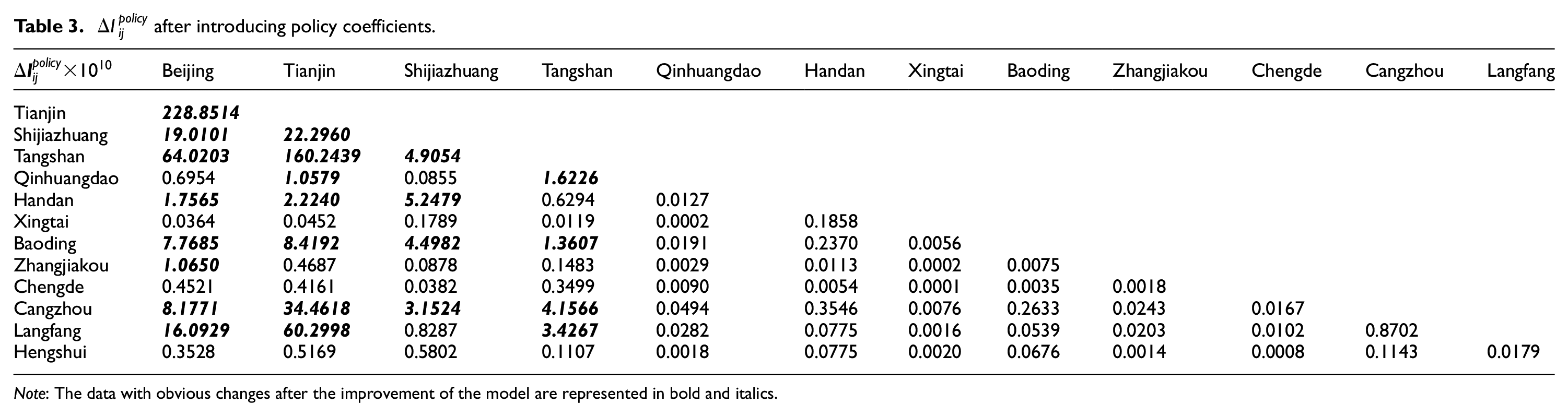
Note: The data with obvious changes after the improvement of the model are represented in bold and italics.
Classification of new logistics attraction in cities of Beijing-Tiajin-Hebei region.
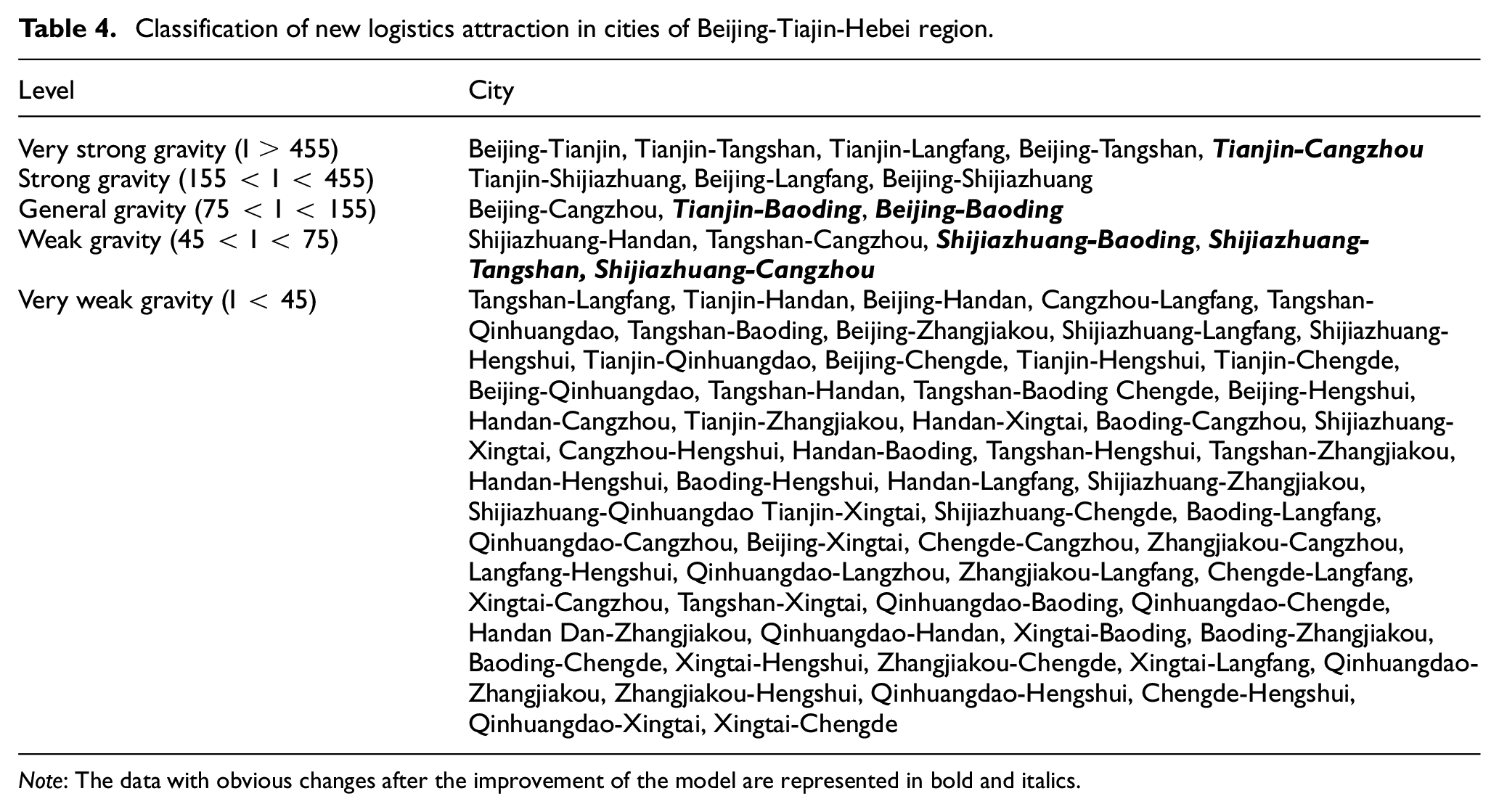
Note: The data with obvious changes after the improvement of the model are represented in bold and italics.
After introducing the policy coefficients, the cities of
According to the case, the reasons are as follows:
The introduction of policy coefficients will undoubtedly change the attraction of logistics between some cities. The influence of different cities can be divided into three aspects. First, the node itself has the advantage of resources and the policies applied have a significant impact on it. These cities include Beijing, Tianjin, Shijiazhuang and Tangshan. Because of its relatively large resource advantages, the policy makes these resource advantages more obvious, and the attraction of the four cities increases obviously,
The introduction of policy coefficients will significantly change the level of node gravity in regional logistics, which is a clear conclusion that qualitative analysis is difficult to give. In the classification of logistics gravity among nodes in Beijing-Tianjin-Hebei region, such as Tianjin-Cangzhou, Tianjin-Baoding, Beijing-Baoding, Shijiazhuang-Baoding, Shijiazhuang-Tangshan and Shijiazhuang-Cangzhou, there are upgrading grades, respectively, as shown bold in Table 4.
The policy coefficients in the case only consider the beneficial aspects to the development of regional logistics cities, that is
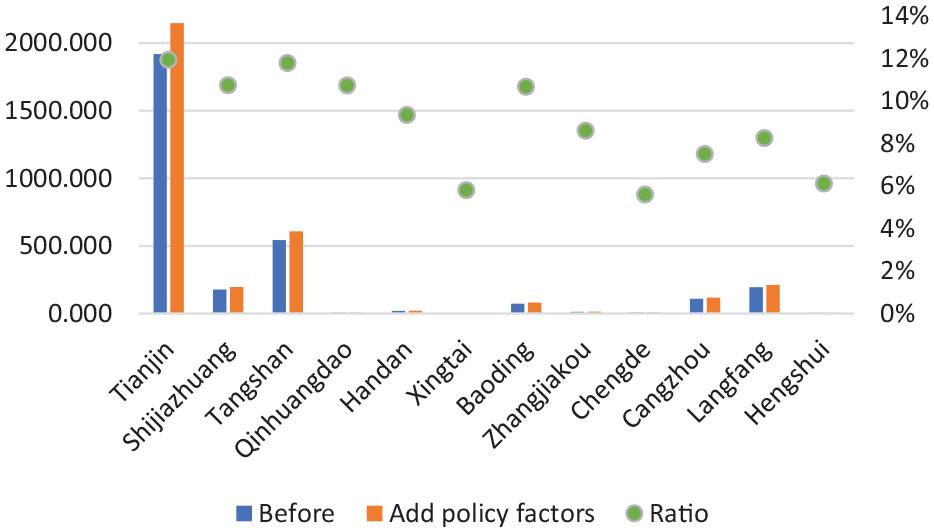
Gravity changes between cities and Beijing after introducing policy coefficients (Tianjin, Shijiazhuang and Tangshan are similar).
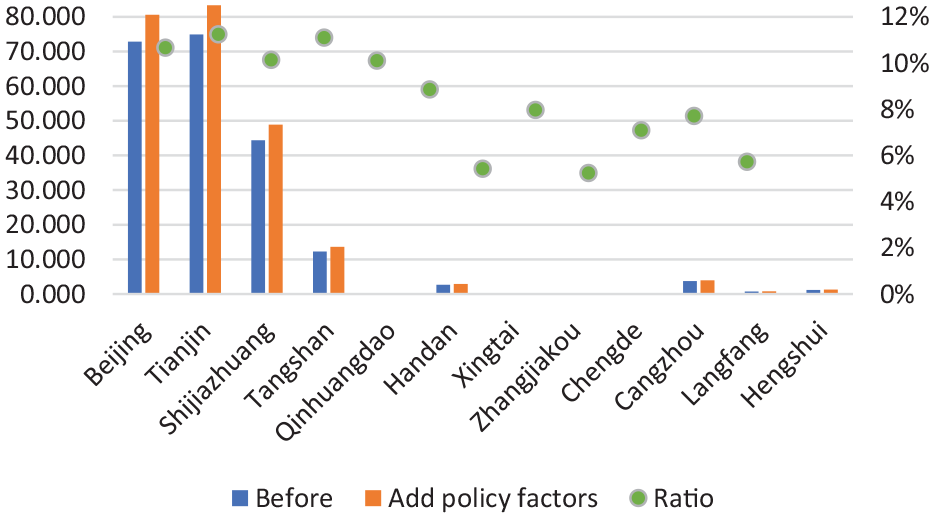
Gravity changes between cities and Baoding after introducing policy coefficients (Handan, Qinhuangdao, Cangzhou and Langfang are similar).
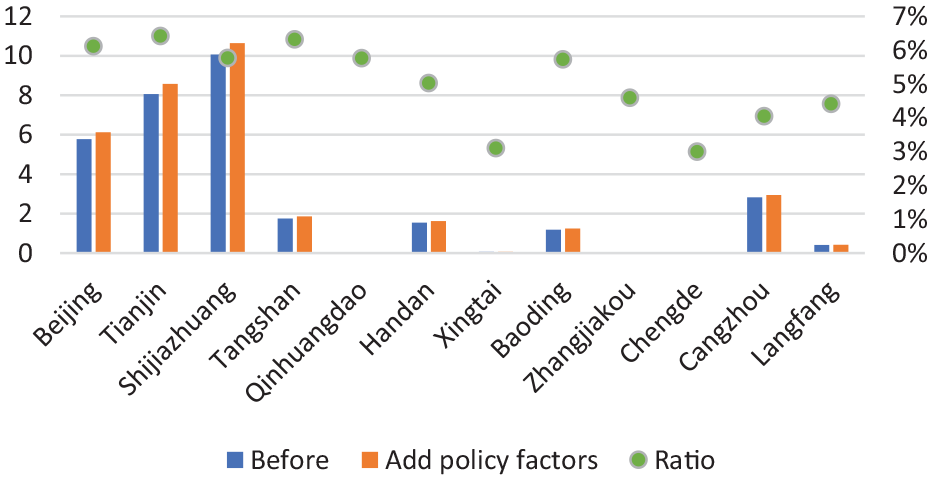
Gravity changes between cities and Hengshui after introducing policy coefficients (Zhangjiakou, Xingtai and Chengde are similar).
Conclusion and future direction
This paper mainly studies the improved gravity model. By introducing policy coefficients to improve the gravity model, it changes the traditional rewriting of “quality” or “distance,” and provides a new way to improve the gravity model. Through the specific analysis of regional logistics in Beijing-Tianjin-Hebei region, it is proved that the policy will obviously affect the change of logistics center of regional logistics nodes. It may change the node’s own logistics gravity, even the grade of the node. The degree of its influence should be calculated according to the degree of policy influence. This also shows that for some problems, policy indicators cannot be simply qualitative analysis. The role of policy in regional logistics is to balance the resources of regional logistics nodes, so that some cities with less resource advantages can obtain more resources and increase the attraction of nodes. Previous studies have neglected this detail, as well as the specific impact on node logistics gravity, which makes the results lack authenticity. This is proved in this paper.
Throughout all aspects of China’s development, the role of policy has led to considerable development in one area. For example, in the early years, the establishment of Shenzhen Special Economic Zone, with the strong support of the state, made Shenzhen change from a small village to a city with technological and technological innovation leading the whole country. In recent years, the state has vigorously developed the construction of high-speed railway, making China’s high-speed railway technology become the forefront of the world. 25 All these show that the policy is very important to guide a city and an industry. Therefore, in the study of regional logistics, we should not neglect the impact of policy. In this paper, policy is introduced into gravity model as a coefficient, and the impact of policy is better analyzed in a quantitative way.
In the future research, we can focus on several aspects. First, the policy choice is more comprehensive, considering the indirect impact of political, economic and natural planning policies on regional logistics. Second, the policy should consider the negative impact of adding, that is, the policy weakens the attraction of some nodes in regional logistics. Third, in addition to node gravity calculation, the improved gravity model can also be applied to pre-planning and prediction. In the process of government planning, if we want to improve the logistics attraction between two or more cities in order to improve the competitiveness of a part of the logistics circle, we can properly increase the policy impact to improve its logistics attraction. By calculating the impact of policy, some cities can have clearer plans. Fourth, we can change the research area and take the Yangtze River Delta regional logistics or cross-border logistics as an example for analysis and verification.
Footnotes
Declaration of conflicting interests
The author(s) declared no potential conflicts of interest with respect to the research, authorship, and/or publication of this article.
Funding
The author(s) disclosed receipt of the following financial support for the research, authorship, and/or publication of this article: This work was supported by the National Natural Science Foundation of China (grant number 61772062).
