




Abstract
The main purpose of the paper is to propose a new method to achieve separating periodic impulse signal among multi-component mixture signal and its application to the fault detection of rolling bearing. In general, as local defects occur in a rotating machinery, the vibration signal always consists of periodic impulse components along with other components such as harmonic component and noise; impulse component reflects the condition of rolling bearing. However, different components of multi-component mixture signal may approximately have same center frequency and bandwidth coincides with each other that is difficult to disentangle by linear frequency-based filtering. In order to solve this problem, the author introduces a proposed method based on resonance-based sparse signal decomposition integrated with empirical mode decomposition and demodulation that can separate the impulse component from the signal, according to the different Q-factors of impulse component and harmonic component. Simulation and application examples have proved the effectiveness of the method to achieve fault detection of rolling bearing and signal preprocessing.
Keywords
Introduction
In general, when local defects occur in a rotating machinery, the corresponding vibration signal will comprise periodic impulse component along with other components such as rotating harmonic component and noise. The periodic impulse component usually presents condition of rolling bearing and the fault information is usually contained in the envelope part. Therefore, how to effectively extract the impact component and apply a proper envelope analysis on it is a fatal issue for fault detection. Considering the complexity of multi-component vibration signal and impulse component is weaker than the interfering component and bandwidth overlap with each other, the traditional signal separation method based on filter will reduce the amplitude of weaken impact component and introduce much noise consequently.
It has been noted that resonance-based sparse signal decomposition (RSSD) acts as a new nonlinear signal analysis approach concentrating on signal resonance attribute instead of scale or frequency, as provided by the wavelet transform and Fourier transform.1–4 This method decomposes multi-component signal into sustained oscillations and non-oscillatory transients; they are corresponding to high-resonance component and low-resonance component, respectively. Considering the particularity of rotating machinery, especially the research object of this paper is rolling bearing, the high-resonance component corresponds to rotating harmonic component and noise, and low-resonance component corresponds to rolling bearing fault component consequently. As a result, the RSSD can be used to extract the weaken periodic impact component.
It is apparent that the low-resonance component representing weaken periodic impact feature also contains noise, adopting effective measure to improve the signal-to-noise ratio (SNR) of low-resonance component is essential for enhancing the fault characteristic frequency resolution ratio of envelope spectrum. Several investigators have claimed5–7 that empirical mode decomposition (EMD) is an self-adaptive signal processing. According to the non-stationary vibration signal characteristics of rotating machinery, EMD method has been successfully introduced into rotating machinery fault detection.8–14 Using EMD method, it can decompose the low-resonance component into a number of intrinsic mode functions (IMFs), then determining principal IMFs that involve fault characteristic for demodulation analysis.
Compared with Hilbert demodulating method, Teager energy operator has a faster and higher precision demodulation advantage.15,16 Besides, energy operator can also be capable of increasing SNR of envelope spectrum and sharpening the spectral peaks which reveal the presence of fault feature.17,18 On account of above advantages, in this paper, the principal IMFs of low-resonance component are analyzed by energy operator demodulating, and each one’s instantaneous amplitude and instantaneous frequency can be calculated. Finally, according to the spectra of envelope spectrum, faults of bearing rolling can be detected.
In all, the author proposed a novel hybrid intelligent fault detection that is based on RSSD combination with EMD and energy operator demodulating. By synthesizing and utilizing multiple advanced signal processing algorithm, this method not only overcomes the shortcomings of traditional signal separation method but also inherits the advantages of EMD and Teager energy operator. Finally, the framework of this method can be seen in the following.
As local defects occurred in rolling bearing, RSSD can separate the impulse component from the vibration signal. Furthermore, considering the fault information exists in modulated amplitude, EMD method can be used as a pretreatment to decompose the impulse component into a number of IMF. Finally, using energy operator to analyze IMF component to get spectrum of instantaneous amplitude and rolling bearing fault can be detected consequently.
As shown in Figure 1, the major section of proposed method is RSSD; the effect of decomposition is inseparably dependent on parameter value, such as Q-factor, redundancy parameter r, maximum decomposition level L. Value of these parameters can use optimization algorithm or manual setting.
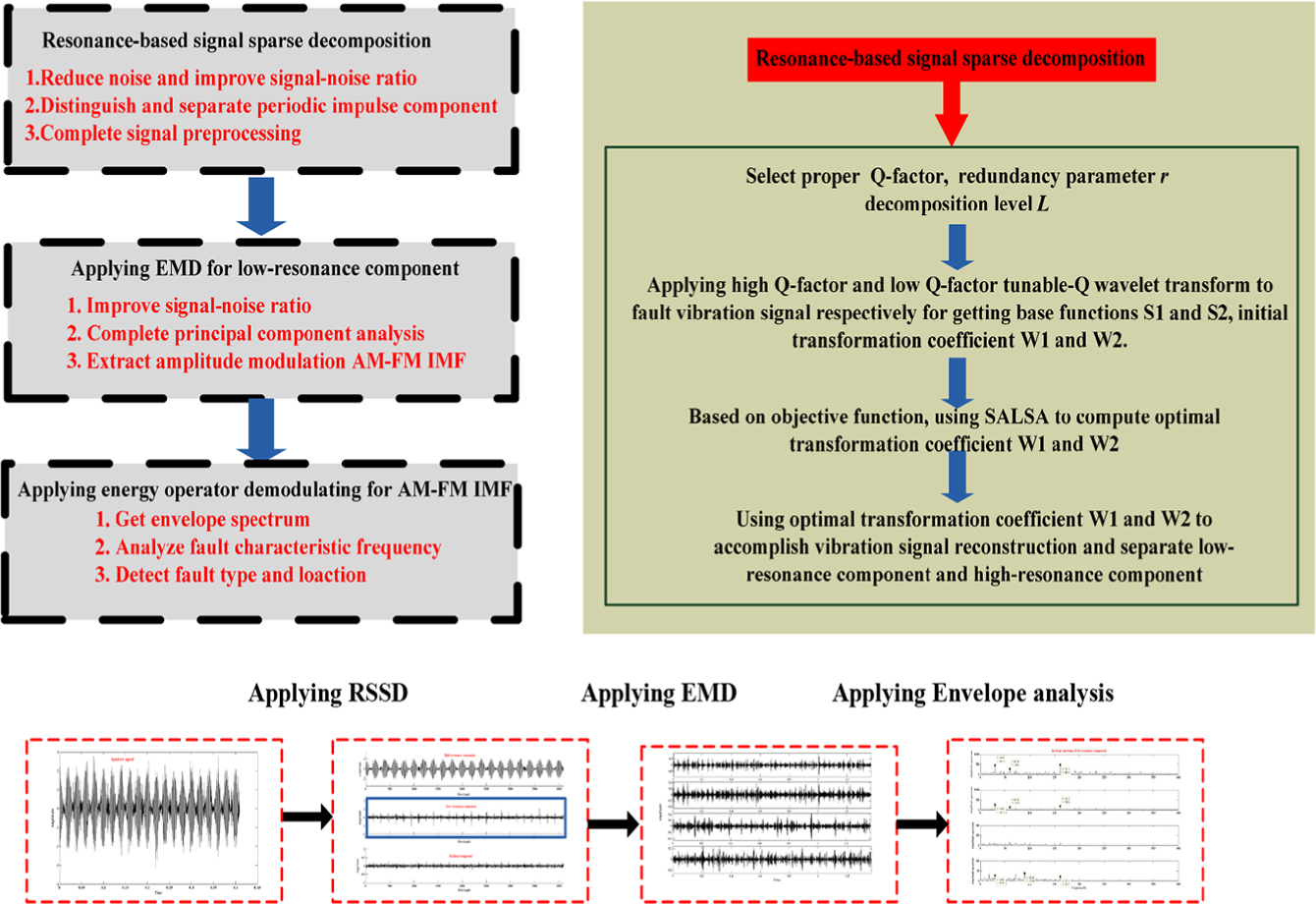
Framework of proposed method in this paper.
Resonance-based signal sparse decomposition
Signal resonance
Generally, the resonance property of generic signal can be quantified by its quality factor, or Q-factor
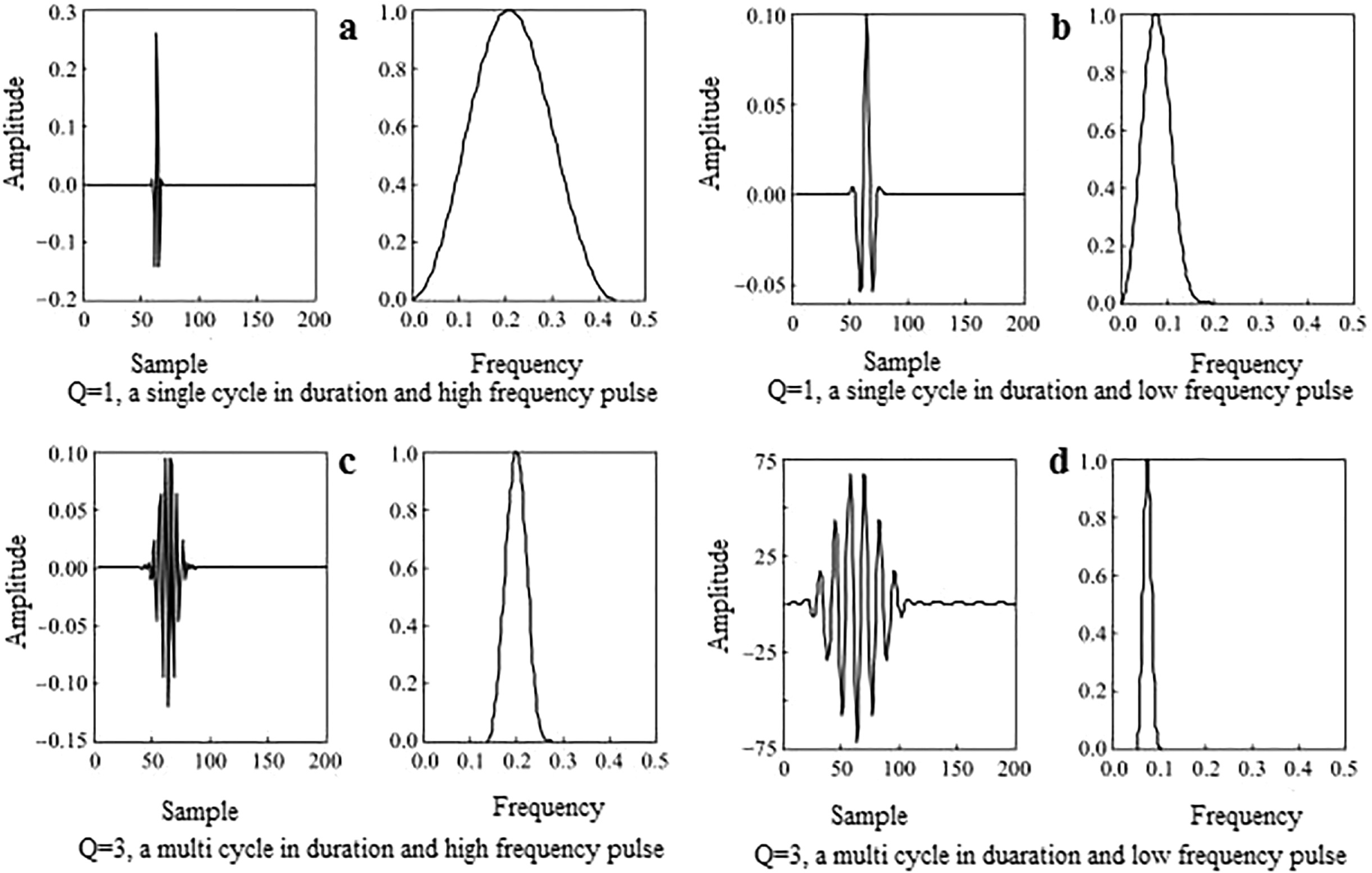
Waveform and spectra with different Q-factor.
Tunable Q-factor wavelet transform
RSSD utilizes tunable Q-factor wavelet transform (TQWT)19–21 which achieves high Q-factor constant-Q (wavelet) transforms for the sparse representation of high-resonance component and low Q-factor constant-Q (wavelet) transforms for the sparse representation of low-resonance component with the aid of high Q-factor analysis and low Q-factor analysis, respectively. On the other hand, tunable Q-factor wavelet transformation which is developed in terms of iterated two-channel filter banks and can be implemented efficiently with fast Fourier transform (FFT) has a series of advantages, such as it is fully discrete has the perfect reconstruction property and can be modestly overcomplete. Two-channel filter banks for the TQWT that contain analysis and synthesis filter banks are shown in the following: symbol α represents low-pass scaling parameter, symbol β represents high-pass scaling parameter,

Analysis and synthesis filter bank for tunable Q-factor wavelet transform.
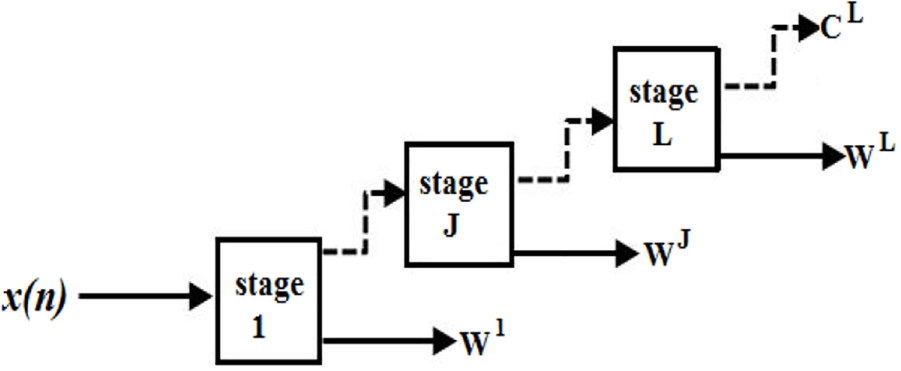
Wavelet transform with tunable Q-factor.
Decomposition
RSSD uses morphological component analysis (MCA)
22
to achieve nonlinear separation of vibration signal based on oscillatory property and establish the efficiency (sparsity) of high-resonance component representation and low-resonance component representation. Assuming an observed signal

With respect to
Due to the non-differentiability and large number of variables in the objective function (equation (1)), RSSD uses split augmented Lagrangian shrinkage algorithm (SALSA) in combination with iteration to renew value of
Teager energy operator
In general, a fault vibration signal contains multi-component amplitude modulation–frequency modulation (AM-FM) that is shown in following

As for each single-component

Using equations (4) and (5), the instantaneous amplitude and frequency of AM-FM component can be approximately computed


Obviously, periodic impulse component reflects essential fault information; as a result, it is indispensable to compute instantaneous amplitude
Theoretical simulation
In order to theoretically verify the effectiveness and superiority of proposed method, the author sets the following synthetic signal

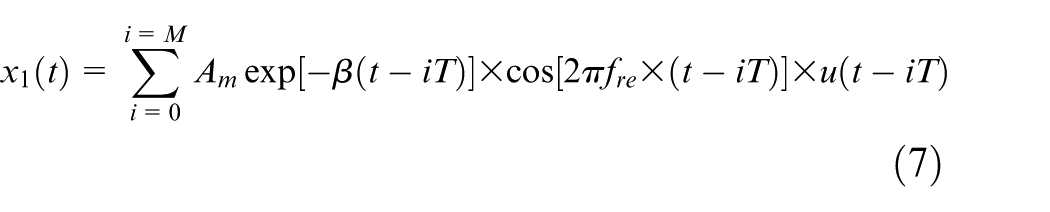

In the above equations, symbol M represents impulse numbers in the periodic impulse component, Am symbolizes impulse amplitude, β represents attenuation coefficient, T symbolizes impulse interval which infers that fault characteristic frequency
Parameter value of synthetic signal.
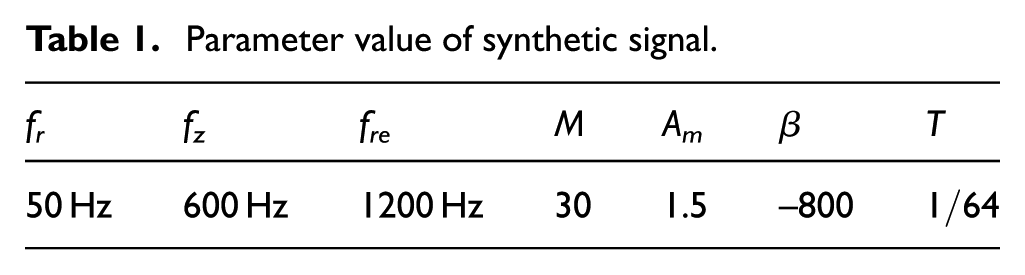
In this paper, setting sampling frequency of 1000 Hz and number of sampling points is 4000. Time domain waveform of synthetic signal and decomposition signal are shown in Figures 5 and 6, respectively; compared with harmonic interference and stochastic noise component, the amplitude of periodic impulse component is significantly weaker from the waveform.
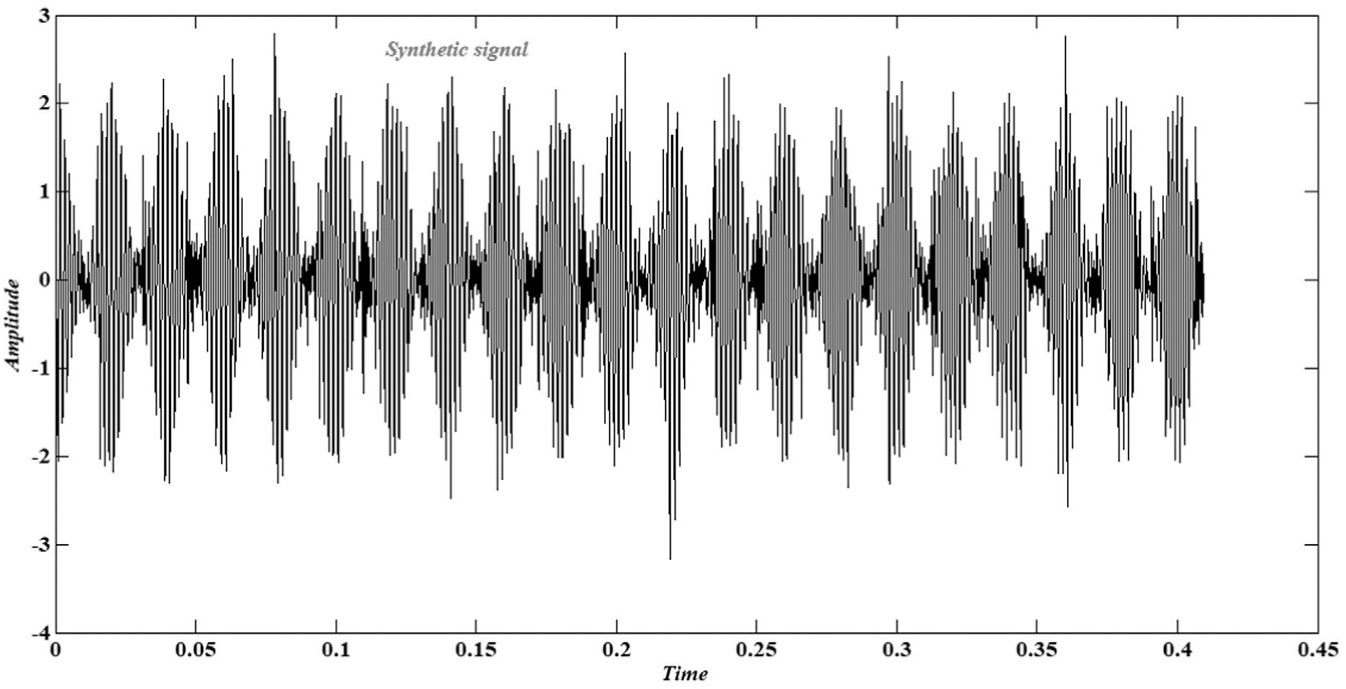
Simulated signal.
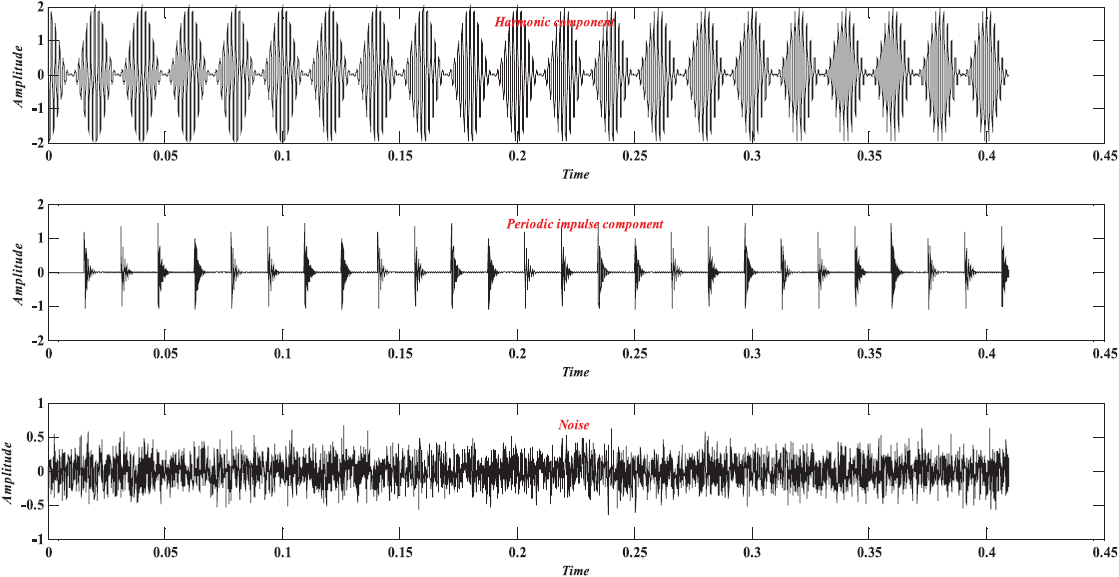
Decomposition result of simulating signal.
Figure 7 presents the power spectrum magnitude of multi-component signal; it can be seen that the power spectrum of harmonic component and periodic impulse component coincided with each other that are difficult to disentangle by linear frequency-based filtering. Considering the amplitude of periodic impulse component is weaker compared with interfering component, the demodulation effect by directly using energy operator demodulating is poor. Using the proposed method to decompose synthetic signal, according to the signal characteristics and practical experience, 1 decomposition parameter setting is as follows: high-resonance component Q1 = 3, redundancy r1 = 3, maximum decomposition level L1 = 30, low-resonance component Q2 = 1, redundancy r2 = 3, maximum decomposition level L2 = 10. Finally, the synthetic signal is decomposed into high-resonance component H(n), low-resonance component L(n) and residual component R(n), as shown in Figure 8.
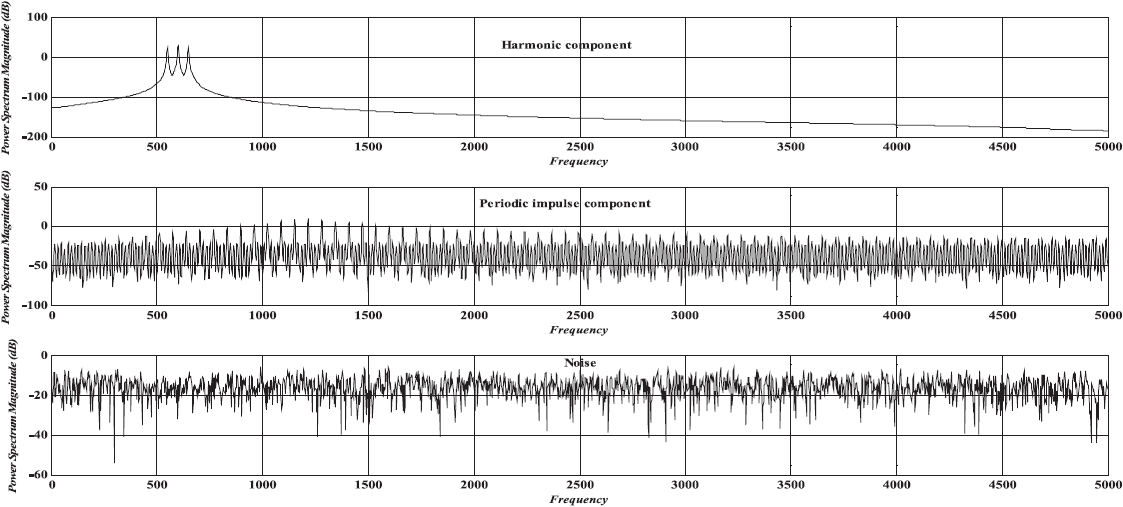
Power spectrum magnitude of multi-component simulating signal.
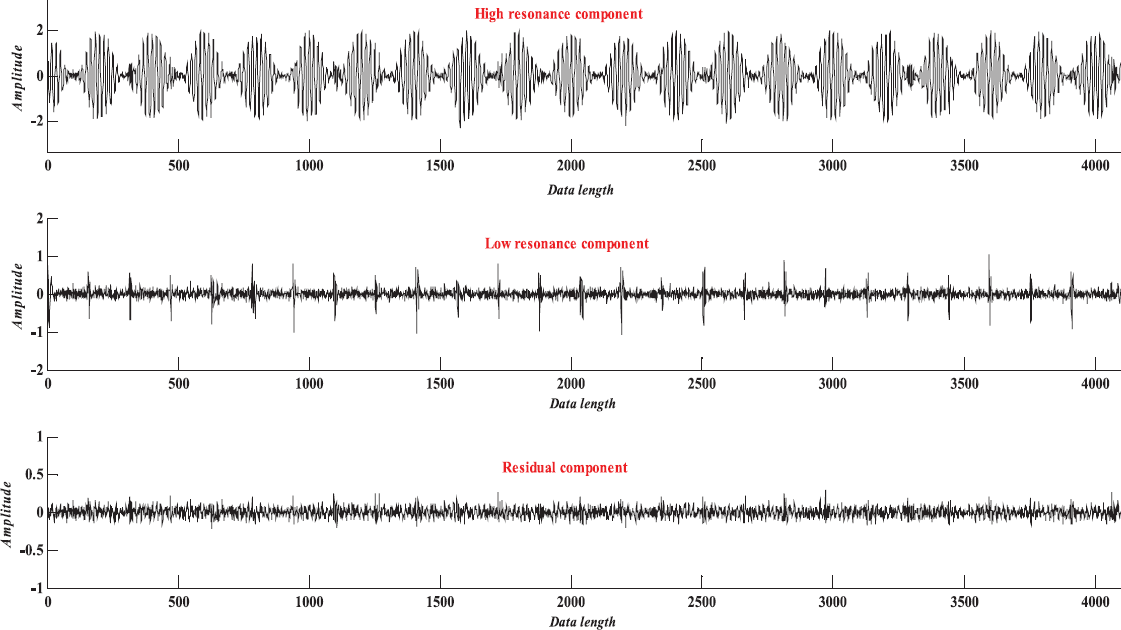
Signal decomposition based on resonance-based sparse signal decomposition.
It is significant that the high-resonance component mainly reflects harmonic property and low-resonance component mainly reflects periodic impact property; as for residual component R(n), it has low energy which implies that the proposed method has a good signal reconstruction function. Yet, it is noticeable that the low-resonance component compared with the original periodic impulse component has weaker amplitude. This phenomenon occurs due to the fact that the relative values of parameters
On the other hand, the envelope spectrum of low-resonance component is shown in Figure 9; it is obvious that the envelope spectrum can significantly detect the fault characteristic frequency
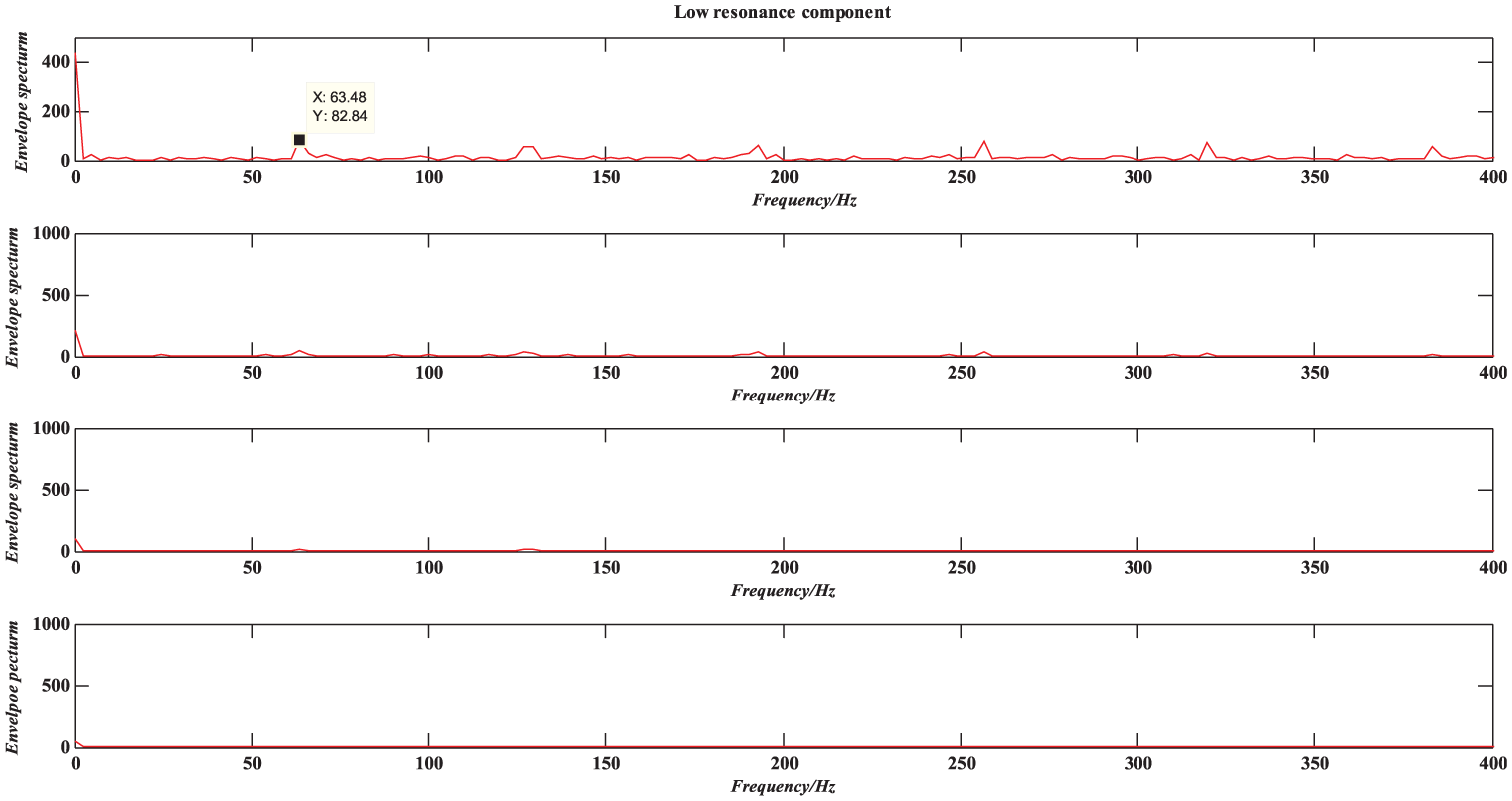
Envelope spectrum of low-resonance component.
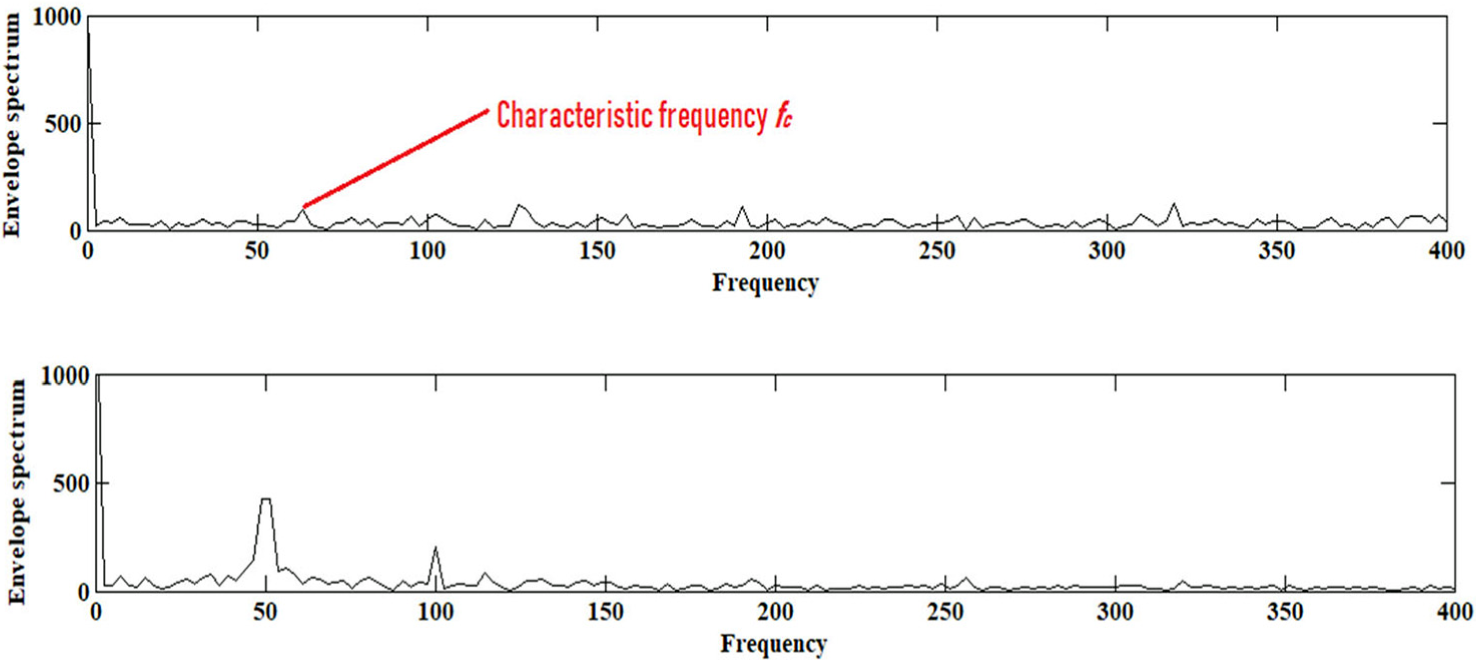
In order to analyze the superiority of the proposed method, the EMD integrated Teager energy operator is also applied to the simulating signal for comparison, and the envelope spectrum is shown in the following.
The envelope demodulation spectrum is presented in Figure 10; it is prominent that the fault characteristic frequency is weaker and the spectrum presents noise component, and it infers that the proposed method has a better performance.
Envelope spectrum of simulating signal for comparison.
Analysis of anti-noise
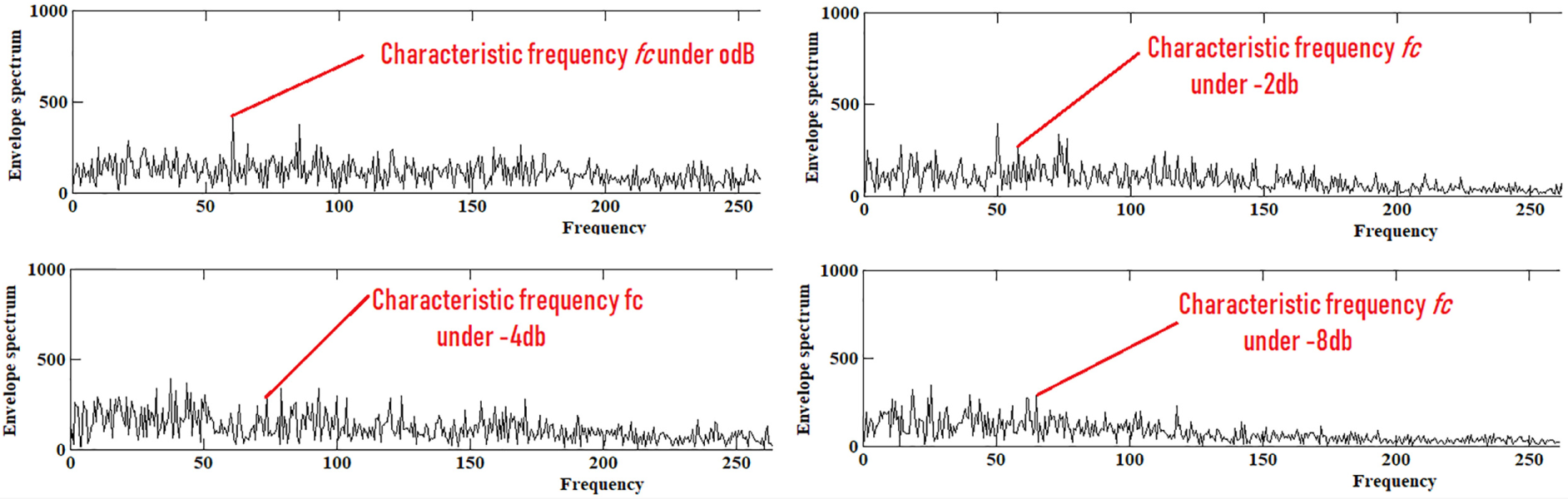
Generally, an efficiently signal decomposition algorithm must have a good anti-noise performance. For performing anti-noise characteristic, adding stochastic noise with SNR of 0, −2, −4 and −8 dB, and the envelope spectrum of simulating signal with different SNRs is presented by proposed method as shown in Figure 11.
Anti-noise analysis of simulating signal.
As shown above, it is prominent that the fault characteristic frequency can be detected; however, when the SNR is low, the spectrum peak of fault characteristic frequency becomes weaker consequently. This phenomenon infers that it is necessary to adopt optimal algorithm for fault feature enhancement
Experimental validation
In order to further validate the effectiveness of this proposed method, experiments are conducted with SKF 6205-type rolling bearings, the parameters of test rolling bearings are shown in Table 2. The experimental rig is shown in Figure 12; the shaft can be driven using a motor which can be running at variable speed. Two SKF bearings are mounted for supporting the shaft, the one on the right side is healthy and the another one on the left side is seeded with inner raceway and outer raceway fault using electro-discharge machining. An accelerometer is installed on the top of faulty bearing to collect vibration signals. Finally, the fault signal is collected by DAQ card with LabVIEW; the signal processing algorithm uses MATLAB.
Parameter of bearings used for fault test.

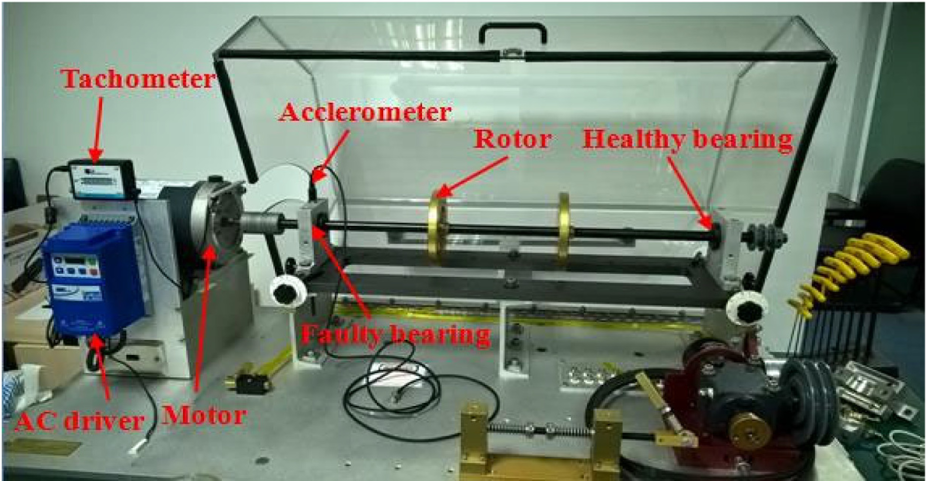
Test rig.
The experiment is first conducted on a SKF 6205-type bearing with an inner raceway fault, the fault diameter is 6.4 mm and fault depth is 3.4 mm, the experimental rotating frequency is 29.95 Hz, the sample frequency is 12,000 Hz; according to equation (9), the fault characteristic frequency of bearing for inner raceway fault is calculated to be 162.36 Hz. On the other hand, as for outer raceway fault, the fault diameter is 4.3 mm and fault depth is 3.6 mm, the experimental rotating frequency is 28.83 Hz, the sample frequency is 12,000 Hz; according to equation (10), the fault characteristic frequency of bearing for outer raceway fault is calculated to be 103.18 Hz


Inner raceway fault experiment
The signal of inner raceway fault is shown in Figure 13; it is significant that the experimental signal consists of impact component combination with much noise.
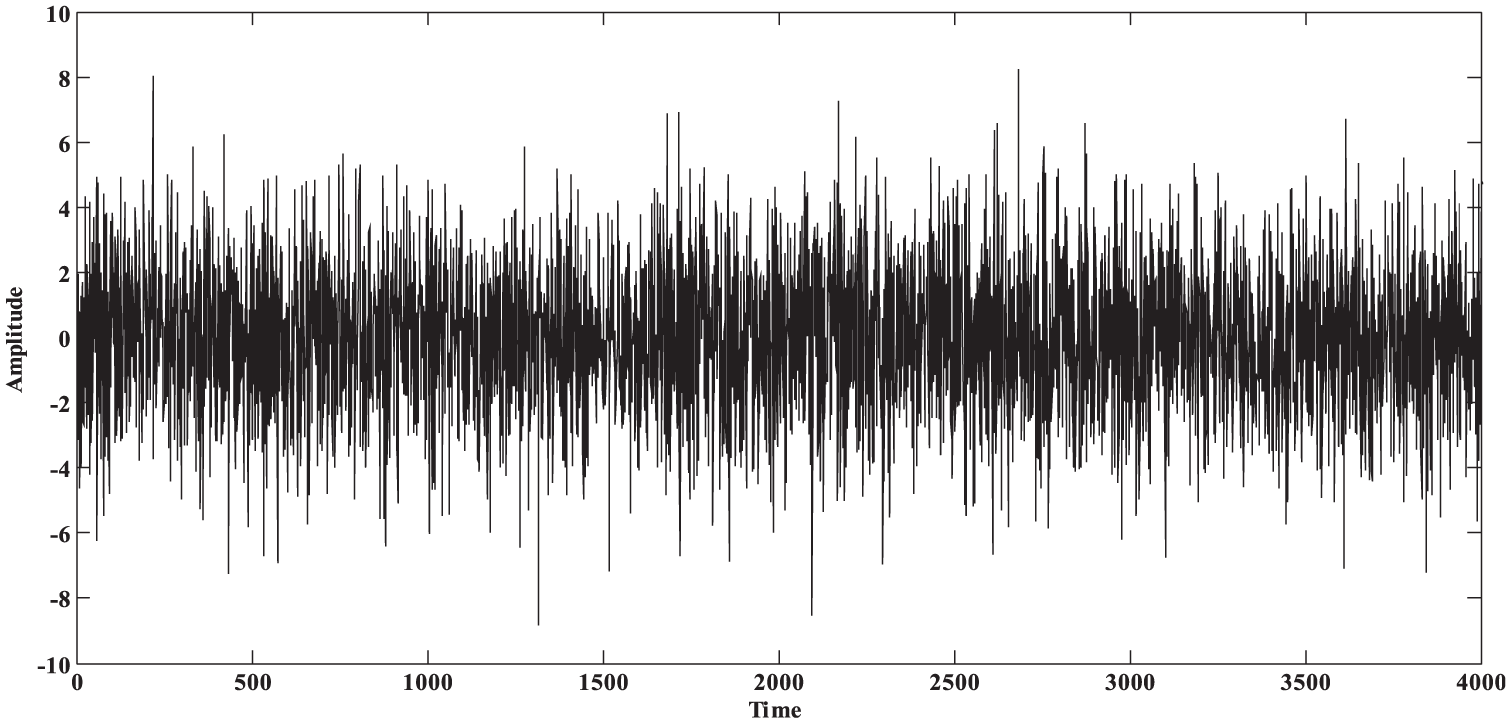
Inner raceway fault signal.
Taking into consideration that the study object is rolling bearing in this paper, by the way of repeating test, the high Q-factor Q1 and low Q-factor Q2 are preliminarily sorted in four and two. As for the parameter r, its value has little effect on the decomposition result; in this paper, the corresponding high-resonance redundancy parameter r1 and low-resonance redundancy parameter r2 are the same value three. Finally, as for the decomposition level L1 and L2, the author takes into account the resolution of decomposition result and time consumption, the values are 30 and 12, and the signal decomposition is shown in Figure 14.
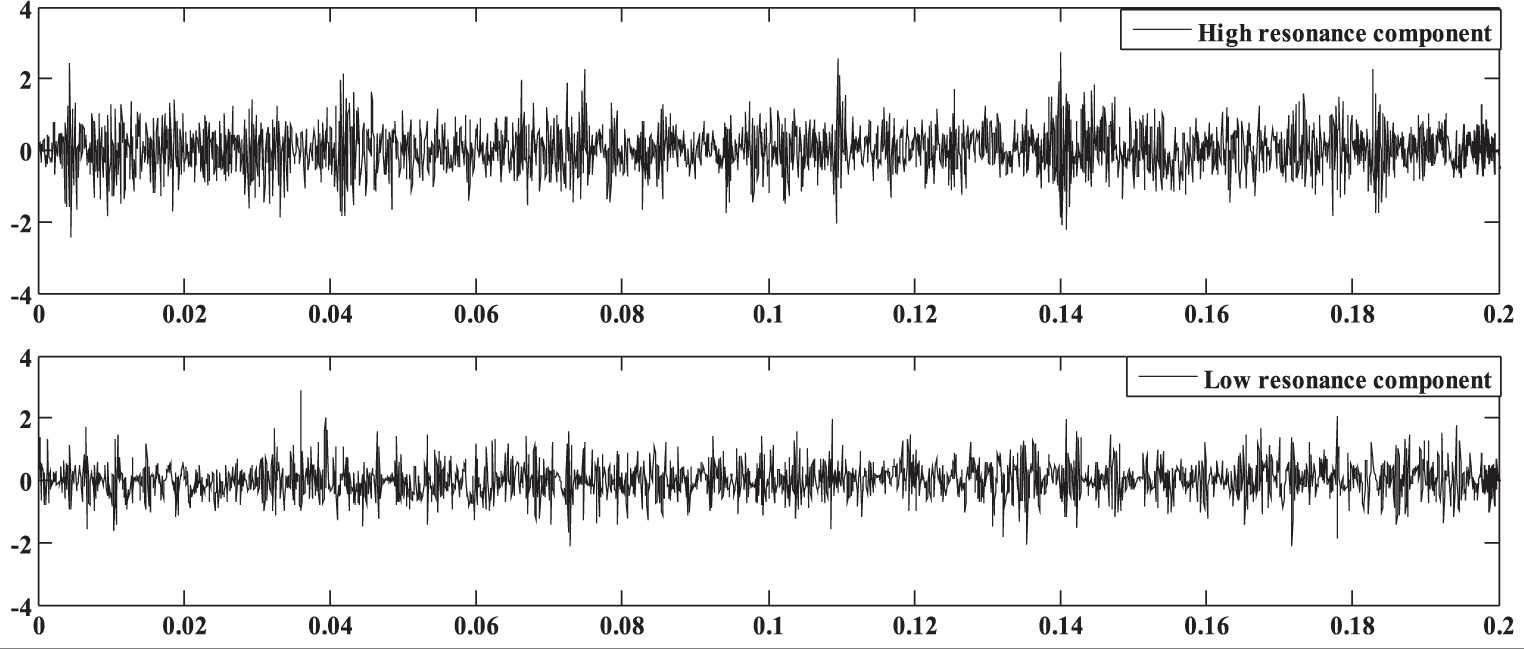
Decomposition result of inner raceway fault signal.
As shown in Figure 14, the high-resonance component mainly reflects harmonic feature and noise and the low-resonance component presents impact characteristic. Finally, the envelope spectrum of first IMF component is presented, as shown in Figure 15. It can be seen from the figure that the fault characteristic frequency and rotational frequency exist in the spectrum; besides, the second harmonic frequency of fault component also exists in the spectrum. This phenomenon infers that the proposed method can effectively be used to detect fault.
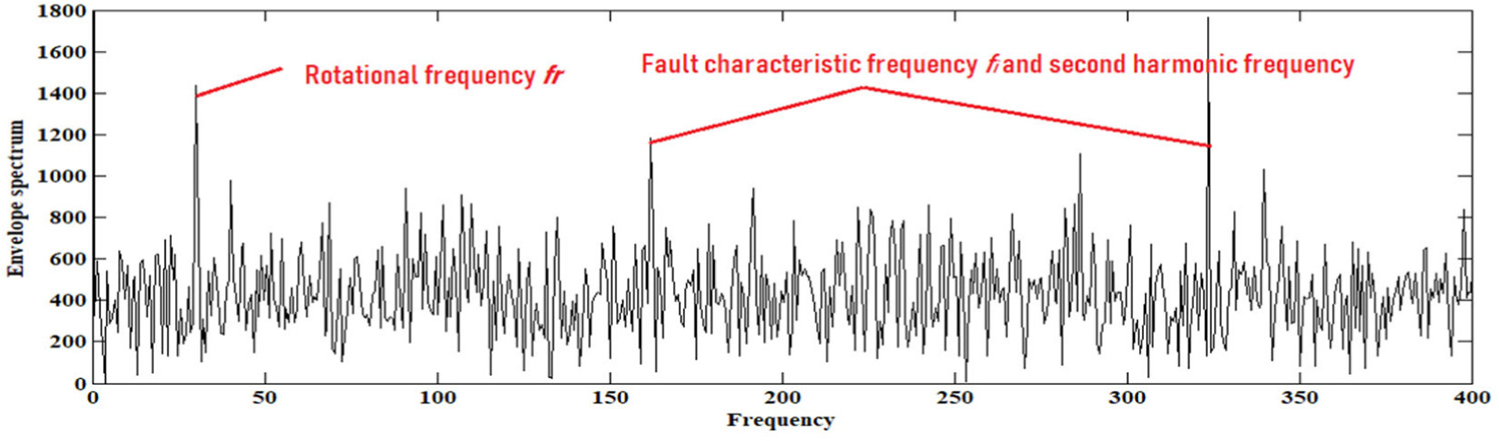
Demodulation spectrum of low-resonance component for inner raceway fault.
For comparison, the EMD integrated Teager energy operator is also used for analyzing the signal; the envelope demodulation spectrum is presented in Figure 16. The rotational frequency and fault characteristic frequency are shown in Figure 16. However, compared with the proposed method, the second fault characteristic frequency does not exist and the spectrum peaks is weaker.
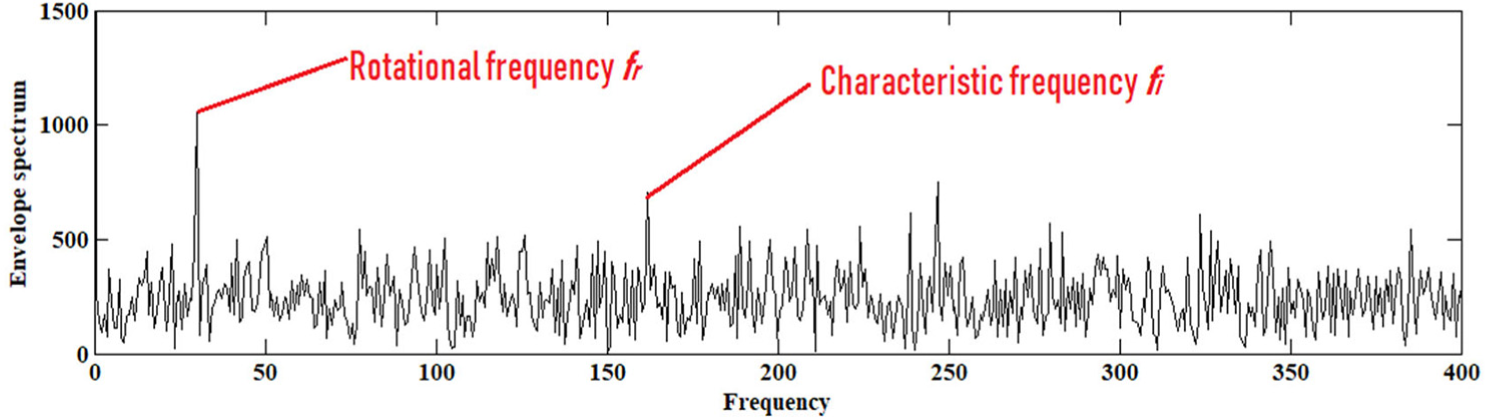
Demodulation spectrum for inner raceway fault under EMD integrated energy operator.
Outer raceway fault experiment
As for the signal of outer raceway fault, the waveform is presented as shown in Figure 17. Compared with the waveform of inner raceway fault signal, the impact feature is more evident.
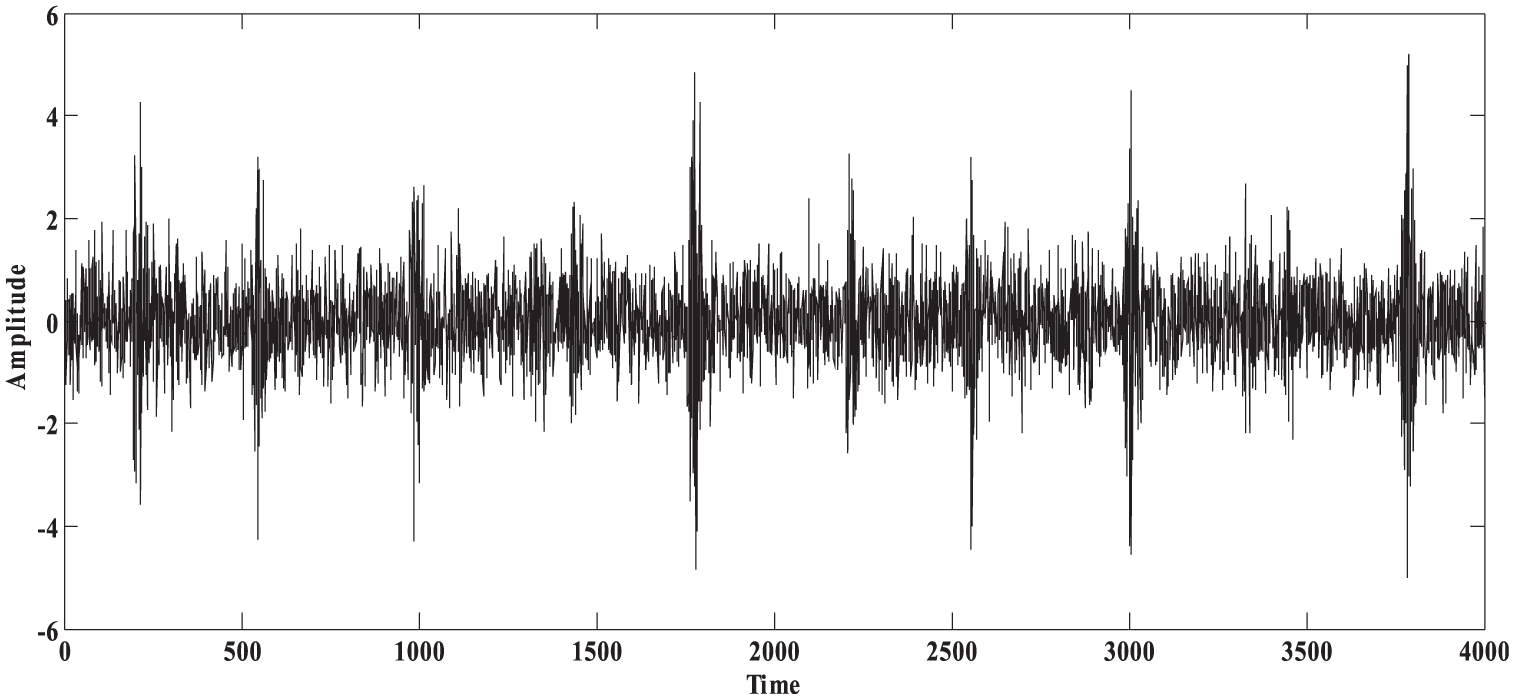
Outer raceway fault signal.
Using the proposed method and the same decomposition parameters, the decomposition result is shown in Figure 18.
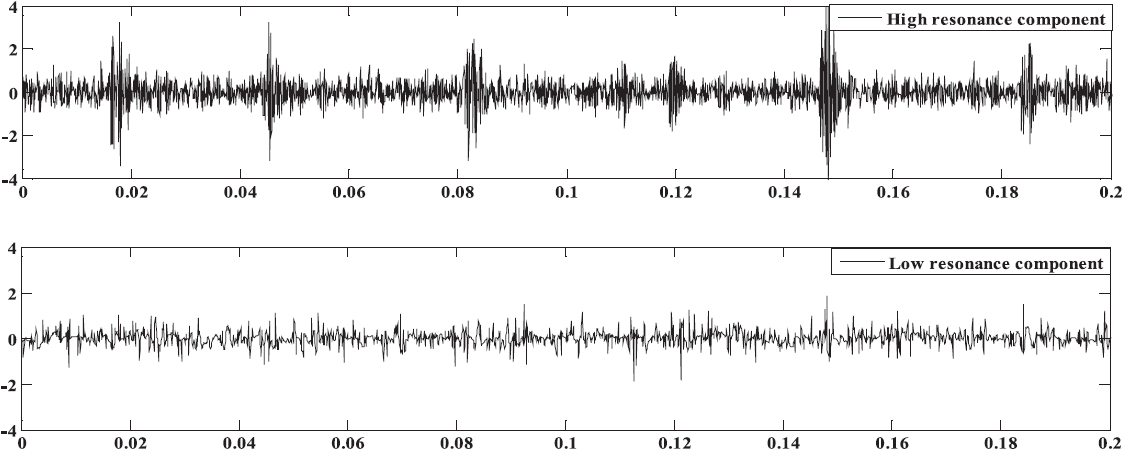
Decomposition result of outer raceway fault signal.
As shown above, the high-resonance component reflects harmonic characteristic and noise, and the low-resonance component reflects impact feature that contains fault information (Figure 19).
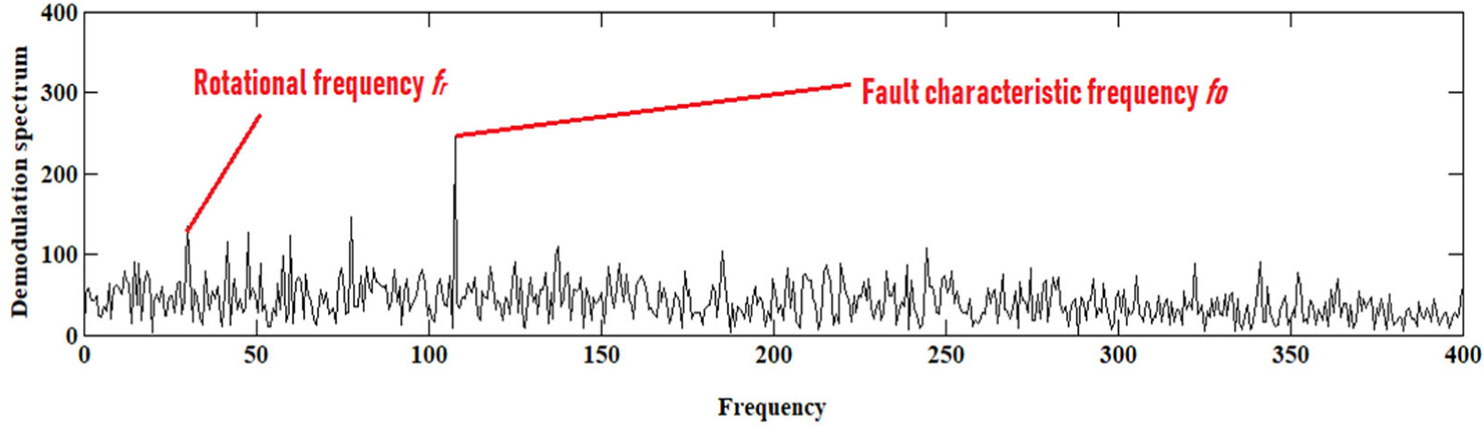
Demodulation spectrum of low-resonance component for outer raceway fault.
For comparison, the EMD-integrated Teager energy operator used is same for analyzing outer raceway fault signal; the envelope demodulation spectrum is presented in Figure 20.
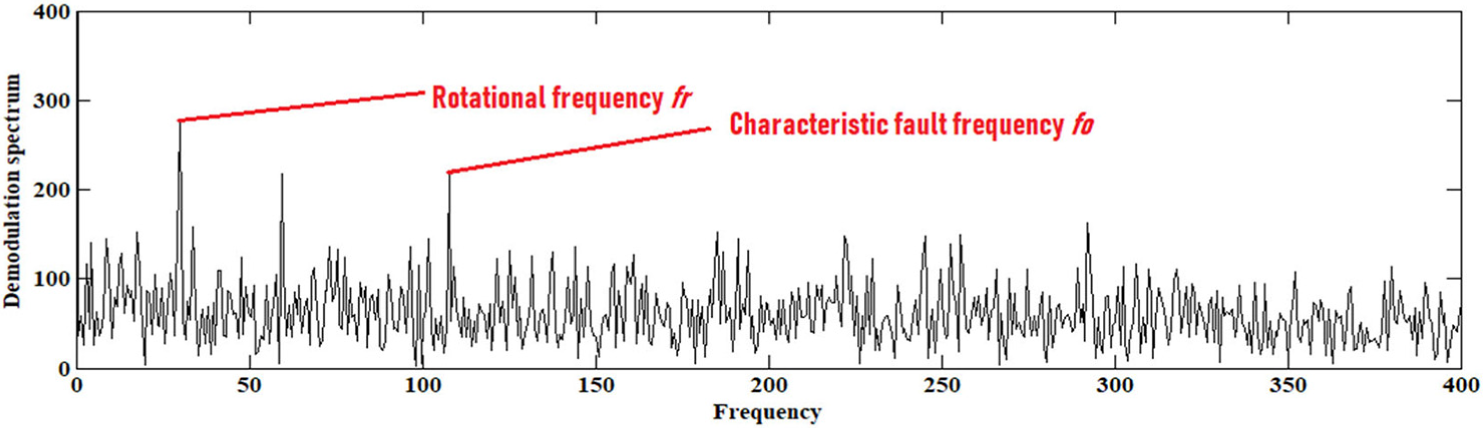
Demodulation spectrum for outer raceway fault under EMD integrated energy operator.
Compared with the proposed method, in spite of the fact that the above decomposition result can detect fault feature frequency fo and rotational frequency fr, the spectrum peak of fault characteristic frequency is weaker. It implies that the proposed method can improve the effectiveness of fault detection.
Finally, the author considers that the reason why the proposed method can have better performance is that the RSSD can accurately extract the impulse component in vibration signal, and it is an essential signal preprocessing. This process can improve signal decomposition and fault detection.
Conclusion
In this paper, the author proposes a new method to separate the periodic impulse component among multi-component signal and uses it to achieve rolling bearing fault detection. The following conclusions can be inferred from this paper:
RSSD can effectively separate impulse signal and harmonic signal based on Q-factor that can make up the disadvantages of linear frequency-based filtering; furthermore, compared with EMD and envelope analysis, the proposed method can be used for rolling bearing fault detection.
The proposed method in this paper can be appropriate to act as a signal preprocessing, the high-resonance component corresponds to harmonic characteristic and the low-resonance component can reflect the impact feature. Consequently, this process can identify fault characteristic more clearly.
The author discovers some parameters such as Q-factor has an evident effect on fault detection; in order to get better performance, the author must repeatedly modify the parameters. In the next step, the author considers that we can establish an optimization function for getting the optimal decomposition parameters. In this paper, the research object is impulse signal; therefore, it infers that kurtosis value of impulse signal can achieve this goal.
Footnotes
Declaration of conflicting interests
The author(s) declared no potential conflicts of interest with respect to the research, authorship and/or publication of this article.
Funding
The author(s) disclosed receipt of the following financial support for the research, authorship and/or publication of this article: This study was financially supported by the National Natural Science Foundation of China (61703399) and the Open Project Program of Shang hai Key Lab of Advanced Manufacturing Environment(KT20190602).
