



Abstract
The European Social Dialogue (ESD) has served as the platform for European social partners to negotiate parental leave policies at the European Union (EU) level since 1995. The partners’ efforts to revise the regulations in 2015, in response to the European Commission’s broader approach toward European work–life balance policies, failed, however, and the reasons for and implications of this failure remain insufficiently explored. Drawing on existing ESD literature and leveraging the regulator-intermediary-target (RIT) model, the authors develop a typology of policymaking outcomes based on the analysis of three parental leave directives from 1996 to 2019. The findings demonstrate that divergent preferences among European social partners, particularly when juxtaposed against the Commission’s policy objectives and interests, reduced the probability of a successful ESD through which European social partners could generate a framework agreement. Instead of being rule-makers, these conditions relegated European social partners to the role of rule-takers. If this trend continues, it poses a significant challenge to the role and influence of European social partners in EU policymaking.
Keywords
When President Jean-Claude Juncker took office in the European Commission (hereafter, the Commission) in 2014, he declared the aim of bringing back the European Union’s (EU) social dimension (Peterson 2017). To achieve this goal, the Commission pushed ahead with its social agenda in response to its diagnosis that social cohesion was fraying in Europe after the austerity years (Copeland 2022). This agenda led to flagship declarations such as the European Pillar of Social Rights (EPSR), which included the Work-Life Balance Directive (WLBD). When European social partners (employers and trade unions) failed to agree on the WLBD despite having policymaking competence and influence through the European Social Dialogue (ESD) (Keller and Sörries 1999), the Commission took over their role and competences. Although scholars have acknowledged the Commission’s changing behavior in the ESD (Mailand 2021; Vesan and Pansardi 2021), the consequences of this behavior on European social partners are less researched. Specifically, scholars have argued that the ESD has weakened over time (e.g., Marginson 2014; Tricart 2020), but the various ways by which the Commission contributed to this weakening remain understudied (see Sørensen, Würtzenfeld, and Hansen 2022: 3).
Therefore, this study addresses this research gap and asks, How do the European social partners and the Commission shape various ESD outcomes? While the Commission has the legal right to propose legislation (Article 17, Treaty on European Union [TEU]), it must consult the European social partners in matters related to the social domain as they have the right, and thus possibility, to negotiate their own agreement through the ESD. ESD involves discussions, consultations, negotiations, and joint actions by European employer organizations and trade unions (Marginson and Sisson 2004). One of the EU’s overall aims—as specified in the legal treaty (Article 152, Treaty on the Functioning of the European Union [TFEU])—is to respect social partners’ autonomy and their decisions and to transmit social partners’ agreements (i.e., ESD framework agreements) to the Council of the EU (hereafter, the Council) and the European Parliament for their adoption (Carré and Steiert 2022).
ESD came under increased pressure in the aftermath of the 2008 economic crisis, with a decline in bargaining coverage and state intervention in wage policy (Marginson 2014). Whereas some scholars argue that the Juncker Commission’s renewed focus on Social Europe reopened opportunities for European social partners to influence policy through the ESD (Bekker 2014; Zeitlin and Vanhercke 2018), others stress that the new social policies launched by the Juncker Commission undermine their influence (Erne 2015).
In this study, we develop a model that outlines the divergent interests and preferences of ESD actors to explain potential ESD outcomes. Our analytical model allows us to categorize the scope of policymaking roles available to (or to be subjected to by) European social partners: They range from rule-makers (usually empowered through ESD) to rule-takers, who have to accept the Commission’s proposed legislation (see also Abbott, Levi-Faur, and Snidal 2017). Our empirical case is European parental leave policies from 1996 to 2019 (Falkner 1998; de la Porte, Larsen, and Szelewa 2020). The case includes the 1996 Parental Leave Directive, the 2010 Revised Parental Leave Directive, and the 2019 Work-Life Balance Directive. Parental leave directives are illustrative because of the long-standing interests of both the European social partners and the Commission in developing such policies since the 1980s. They are also useful to explore potential outcomes because the 1996 and 2010 directives were products of ESD whereas the 2019 directive was not. In short, this case provides a longue durée perspective to compare various ESD outcomes in one policy area, and thus sheds light on the evolving scope of policymaking roles afforded to the European social partners and the Commission. Thus, we also contribute to previous literature on parental leave policies that is limited to snapshots or short-time trends, which therefore neglects more extensive longitudinal trends (Falkner 1998; Falkner, Treib, Hartlapp, and Leiber 2005; Fusulier 2009; de la Porte et al. 2020, 2023). Moreover, although some previous research has examined ESD outcomes across various policy fields (e.g., Keune and Marginson 2013; Tricart 2020), these policies have their own respective idiosyncrasies that complicate comparisons (see Locke and Thelen 1995).
Our findings demonstrate that under certain conditions—namely when strongly divergent interests and preferences among European social partners concerning costs and subsidiarity on an issue are present and when the Commission has strong ambitions for and interest in the issue—the Commission is likely to act as a decision-maker, which increasingly limits the rulemaking influence of European social partners. Our findings also support studies that illustrate the general weakening of the ESD over time (see Marginson 2014; Tricart 2020), but also underscore the instrumental role of the Commission in contributing to this outcome. We conclude that our findings are illustrative of the trajectory of Social Europe itself, in which the role of European social partners has become more uncertain.
Brief Review of the European Social Dialogue
The European Social Dialogue (ESD) encompasses two forms of dialogue. First are tripartite dialogues, which involve interactions between European political institutions, European social partners, and public authorities. These dialogues shape the direction and content of EU social policy (Keller and Sörries 1999). Second are bipartite dialogues between European employers and trade unions, through which European social partners can independently initiate and/or conclude policy initiatives proposed by the Commission (Keller and Sörries 1999). At the EU level, these bipartite dialogues take three distinct forms.
First is the cross-industry dialogue between the main European confederations represented by the European Trade Union Congress (ETUC), the European Centre of Employers and Enterprises providing Public Services (previously known as CEEP and now known as SGI Europe), BusinessEurope (previously known as UNICE), and the European Association of Craft, Small, and Medium-sized Enterprises (previously known as UEAPME and now known as SMEunited) (Marginson and Sisson 2004; Larsen and Andersen 2007). These organizations have their own voting rules for their constituent members, which influence the determination of their bargaining mandates. BusinessEurope requires unanimity, whereas ETUC and SGI Europe (formerly CEEP) require a qualified majority vote to adopt policy proposals (Keller and Sörries 1999; Interview ETUC 2022; Interview SGI Europe [formerly CEEP] 2008). The second type of bipartite dialogue is the European sectoral dialogue, through which social partners representing specific branches engage in discussions to develop new policy documents at the EU level (Keller and Weber 2011; Prosser 2011). The third type is the cross-border company dialogue, which refers to collaboration between individual companies. It occurs within European Works Councils (Pulignano 2007; Haipeter, Hertwig, and Rosenbohm 2022). In this study, we focus on the first type of ESD, the bipartite cross-industry dialogue between European social partners when adopting legally binding decisions since their joint framework agreements cover all workers and companies on the European labor markets, whereas the other types of ESD cover only specific subsectors or individual companies. Thus, the policy outcomes from the cross-industry dialogue have much broader implications for European labor markets (Marginson and Sisson 2004).
ESD has served as a platform for European social partners to negotiate bipartite hard law (framework agreements elevated to EU directives) and soft law (autonomous agreements) (Falkner 1998; Larsen and Andersen 2007; Tricart 2020). Framework agreements elevated to EU directives are legally binding, whereas autonomous agreements are not. The second and third Delors Commissions (1989–1994) 1 witnessed much momentum to produce a series of social partner agreements, such as the Parental Leave Framework Agreement, which were elevated into hard law (Keller and Sörries 1999; Falkner et al. 2005).
The importance of ESD shrank during the first and second Barroso Commissions (2004–2014), 2 however, especially during its second term, which saw fewer binding framework agreements and more non-binding autonomous agreements. Because the latter agreements were non-binding, their growing prevalence relative to the former spurred unequal adoption across member states (Larsen and Andersen 2007; Weber 2010; Prosser 2011; Tricart 2020). Despite this context, the European social partners managed to renegotiate and revise the 1996 Parental Leave Directive, which culminated in the 2010 revised social partner directive on parental leave (Clauwaert 2010). Although the Juncker Commission (2014–2019) promised a rejuvenation of ESD, the number of successful social partner–led directives remained low. Instead, the Commission took an active role in policymaking in the social domain.
Conceptualizing ESD Outcomes and Their Requisite Factors
Scholars have extensively studied the factors that explain the outcomes of individual ESD cases (e.g., Falkner 1998; Elomäki and Kantola 2020; Sørensen et al. 2022). They have also documented distinct periods of European industrial relations based on the prevailing ESD outcomes during those periods (e.g., Pochet 2005; Keune and Marginson 2013; Tricart 2020). Therefore, we have rich knowledge on why individual cases result in specific ESD outcomes (Marginson and Sisson 2004; Falkner et al. 2005; Larsen and Andersen 2007; Tricart 2020). These studies have limitations, however. On the one hand, studies that seek to explain the outcome of an individual ESD case in a specific policy field rarely include the time dimension and thus are unable to consider how changing policymaking contexts, such as the Commission’s approach to the ESD, and previous ESD outcomes in the same policy field shape the outcome they seek to explore (e.g., Falkner 1998; Sørensen et al. 2022). On the other hand, studies that seek to generalize about the state of ESD outcomes in a certain time period are often based on assessments of ESD outcomes across multiple policy fields (Keune and Marginson 2013; Tricart 2020), which complicates generalizations (Locke and Thelen 1995). Furthermore, attempts to conceptualize various types of ESD outcomes beyond the metric of producing a framework agreement as well as their requisite determinants tend to be fairly fragmentary, with few exceptions (see Falkner 1998; Sørensen et al. 2022). To address this literature gap, we first posit a more nuanced approach for classifying ESD outcomes. Next, we propose several conditions we consider to be key in explaining these outcomes. We then apply this typology to analyze a single policy field observed over two decades.
To begin, our typology builds and extends upon the regulator-intermediary-target (RIT) model proposed by Abbott et al. (2017). The authors distinguished between three types of roles: rule-makers, intermediaries, and targets. For our purposes, we are primarily concerned with the roles of rule-makers and rule-takers to typologize ESD outcomes. Abbott et al. (2017) defined rule-makers as actors with authority and capability to regulate the target, whereas rule-takers can be understood as the target for the regulations proposed by the rule-maker. European social partners can be considered as intermediaries—non-state actors with delegated rule-maker capacities—that are granted the authority and capability to potentially regulate (Abbott et al. 2017: 14–15).
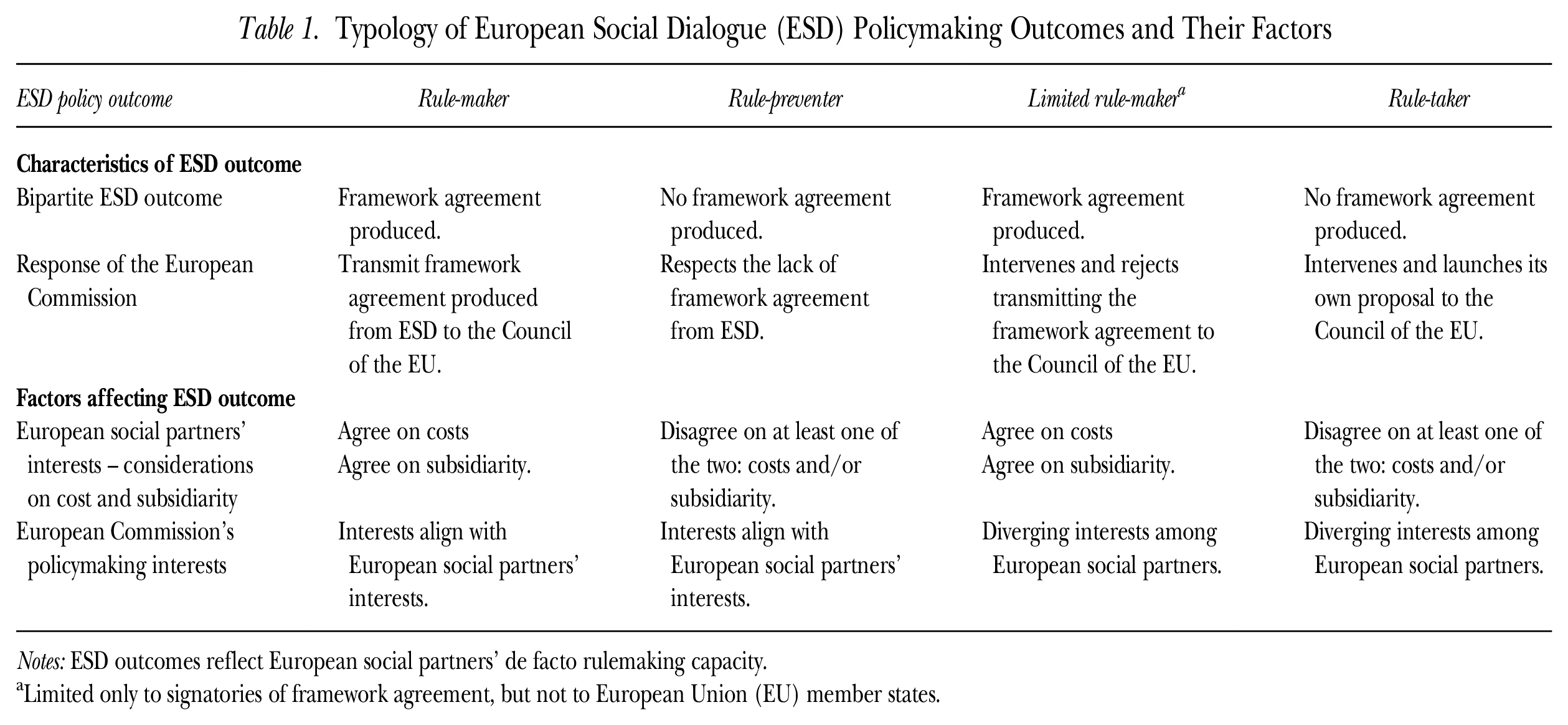
Therefore, the difference between rule-makers and rule-takers is their rulemaking capacity. In other words, this metric of rulemaking capacity allows us to distinguish if and to what extent European social partners as intermediaries are de facto successful in the exercise of their rulemaking authority and capacity to be rule-makers in the domain of social and labor policies, which they have been granted through the EU’s founding treaties. To do so, we extend Abbott et al.’s (2017) framework and introduce two new rule-maker typologies: rule-preventer, which means that European social partners utilize their rulemaking capacities to prevent regulation by failing to produce a joint framework agreement, and limited rule-maker, which means that European social partners produce joint regulation within the ESD framework but fail to elevate their framework agreement to EU legislation. Based on our metric, we propose four typological outcomes (Table 1).
Typology of European Social Dialogue (ESD) Policymaking Outcomes and Their Factors
Notes: ESD outcomes reflect European social partners’ de facto rulemaking capacity.
Limited only to signatories of framework agreement, but not to European Union (EU) member states.
First, when European social partners agree on a framework agreement and when the Commission transmits this framework agreement to legislators for adoption, the partners become rule-makers. This outcome is typically considered to be a successful ESD outcome (Tricart 2020; Ilsøe and Söderqvist 2022).
Second, the Commission may refuse to transmit the framework agreement to legislators. While uncommon, it occurred in the cases of the Hairdressers Agreement and the European Public Service Union (EPSU) Agreement (Dorssemont, Lörcher, and Schmitt 2019; Carré and Steiert 2022). In both cases, the European social partners managed to produce a framework agreement through ESD, but the Commission refused to transmit the framework agreements to the legislators for adoption. Crucially, the Court of Justice of the European Union (CJEU) stated that the Commission was not obliged to propose a framework agreement negotiated by European social partners as an EU legal act under Article 155(2) of the TFEU (Carré and Steiert 2022). This landmark ruling erased the norm that the Commission follows through on European social partners’ successful bipartite framework agreements (Keller and Sörries 1999). When the Commission chooses not to transmit the framework agreement, the agreement is applied only to the signatories and not to non-signatories (Larsen and Andersen 2007; Keller and Weber 2011). In this outcome, European social partners can be considered limited rule-makers, whereby their authority and capability to regulate is limited to signatories only.
The next two typological outcomes are based on the event that European social partners fail to agree on a framework. Although this event is typically considered to be an unsuccessful ESD outcome (Keune and Marginson 2013), we provide nuance by typologically differentiating it based on the response of the Commission. When the Commission decides to respect the lack of agreement among European social partners and refrains from intervention, this outcome represents the maintenance of the status quo. If European social partners intended to maintain the status quo, which is often preferred by European employers (Keller and Sörries 1999; Nowak 2018), this supposed “failed” ESD outcome in fact represents an exercise of European social partners’ rulemaking capacity to prevent unwanted new rules. We label this outcome rule-preventer, which is an innovation of the RIT model by Abbott et al. (2017).
Last, we can distinguish another outcome when the Commission intervenes. Specifically, the Commission proposes its own legislative proposal after European social partners fail to agree on a framework agreement through ESD, such as in the cases of the European Works Council Directive (1996), the Posted Workers Directive (1994), and the Information and Consultation Directive (2002) (Falkner 1998). In this fourth outcome, the Commission effectively overrides the European social partners’ decision and takes over their authority and capability to regulate in a specific policy field (see Keller and Sörries 1999). Hence, we consider this outcome rule-taker, whereby European social partners are forced to accept the regulations imposed by the Commission.
Overall, our typology leans toward an actor-centered approach of analyzing successful and unsuccessful ESD outcomes based on the presence or absence of European social partner agreements (e.g., Sørensen et al. 2022). Therefore, we extend the RIT model (Abbott et al. 2017) to the domain of ESD. We leverage the RIT model to typologize ESD outcomes and their consequences for European social partners’ rulemaking capacity. 3
Factors Influencing ESD Outcomes
Next, we identify requisite factors we expect to influence each of these outcomes. We suggest two sets of requisite factors. The first set of factors are considerations about economic costs and subsidiarity. While we acknowledge that other factors also influence the policymaking process, considerations of economic cost and subsidiarity are often highlighted within the ESD literature. 4 Based on the ESD literature, both factors reflect European social partners’ interests and preferences (Keller and Sörries 1999; Larsen and Andersen 2007; Sørensen et al. 2022). For considerations of economic costs, we refer to both the adaptational costs associated with implementing provisions and the permanent costs incurred by extending social rights (Falkner et al. 2005; Levi-Faur 2014; Benish, Eliahou, and Haber 2017), which may be shouldered by member states, employers and/or individual employees (e.g., in collective agreements), social insurance schemes or individual private insurances, or individual workers’ own expense (Falkner and Leiber 2004; Obinger, Leibfried, and Castles 2005; de la Porte et al. 2020, 2023). Although the overall estimates on costs are outlined by the Commission in its impact assessments that accompany each legislative proposal, we argue that the European social partners may have distinct priorities and perspectives on these costs. Hence, the costs that may affect ESD outcomes are costs that are perceived by the partners. If both European employers and trade unions consider the costs from any potential framework agreement to outweigh its benefits, they are less likely to produce it. As a caveat, we acknowledge diverging interests between European and national social partners on costs. Although both sides (employer and employee) need to consider costs, trade unions are usually in favor of additional costs when expanding social rights since they are often not burdened by these costs. In other words, trade unions often prioritize expanding social rights, especially if they do not bear the costs associated with them. By contrast, employers traditionally oppose additional costs arising from expanded social rights since they are typically expected to carry them (see Touwen 2023).
For considerations about subsidiarity, we note that the term “subsidiarity” itself has been used in at least two distinct ways. First, it refers to whether policy decisions should be taken at the EU or the national level (de la Porte et al. 2020, 2023). Second, it refers to whether regulation should be made by European social partners (Larsen and Andersen 2007). For our purposes, we leverage the second reference in which subsidiarity refers to considerations by European social partners about whether to abide by their competence to regulate. This decision to abide (or not) by subsidiarity in policy domains, where European social partners have de jure competence, depends on their deliberations about the benefits and losses when they cede their rulemaking capacity to other actors such as the Commission. If they abide by subsidiarity, one possible gain is autonomy. Conversely, one possible loss is European social partners failing to achieve more of their intended policy goals through the Commission’s initiative than through negotiations with other EU social partners. If they perceive the loss to outweigh gains of autonomy, they are less likely to produce a framework or autonomous agreement (see Sørensen et al. 2022). Additionally, European social partners’ perceptions about the importance of gaining autonomy (thus its magnitude vis-à-vis the possible losses when abiding by subsidiarity) may depend on how critical they perceive autonomy to be to adopt firm-, sectoral-, or national-level policies (Keller and Sörries 1999; Tricart 2020). Thus, subsidiarity refers to European social partners’ consideration about their benefits and losses derived from EU’s regulation in a policy field in which European social partners have competence.
Yet, European social partners may sometimes struggle to articulate their preferences and interests since they are composed of national-level social partners from various EU member states, which operate in distinct industrial relations system across the EU (Marginson and Sisson 2004; Visser 2009; Nordin 2022). Notably, the EU’s expansion over time has led to heterogeneity between European social partners. If an individual European social partner’s positions diverge internally, they may struggle to adopt a position to negotiate with their opposing EU social partner. Even if they do adopt, they may encounter resistance among national-level social partners that disagree with the position. Hence, the extent to which European social partners can produce a framework agreement through ESD depends on whether they can find common ground among their own national-level members (Falkner 1998; Nordin 2022).
A second set of factors influencing ESD outcomes is the Commission’s policymaking priorities in the domain of social rights. If the Commission considers the positions of European social partners to be irreconcilable with its own aims or position, it may overturn the decision. For instance, Tricart (2020) argued that the former Barroso Commission (2004–2014) emphasized macroeconomic considerations and economic competitiveness more than improving social rights and labor regulations. Relatedly, Vesan and Pansardi (2021) underscored that the Juncker Commission prioritized expanding social rights and considered it pressing and necessary. One of its manifestations is the adoption of the EPSR, which the Commission considered to be an antidote to rising political dissatisfaction within the EU (see also Mailand 2021; Copeland 2022). Therefore, the Commission may pursue its own proposals on a policy issue, even if European social partners cannot produce a framework agreement through ESD.
Table 1 summarizes how these conditions are linked to the four ESD outcomes. When European social partners have convergent interests regarding the benefits and costs associated with producing a framework agreement, and these interests align with the Commission’s priorities, a framework agreement produced by European social partners is likely to be transformed into EU legislation (rule-maker). When they have convergent interests regarding the benefits and costs of producing a framework agreement, but these interests do not align with the Commission’s priorities, the framework agreement is unlikely to be transformed into legislation (limited rule-maker). When social partners have divergent interests regarding the benefits and costs of producing a framework agreement and the issue is not a pressing priority for the Commission, chances are high that a framework agreement will not be produced and the Commission will refrain from pursuing its own proposals (rule-preventer). By contrast, when European social partners have diverging interests regarding the benefits and costs of producing a framework agreement, but this issue is a pressing priority for the Commission, chances are high that they will fail to produce a framework agreement, but the Commission will act as a decision-maker (rule-taker).
Research Design and Methods
To explore the reasons for the various ESD outcomes, we employ the embedded case study method, which investigates a contemporary problem—here the ESD outcomes—within its real-life context (Scholz and Tietje 2002: 9–14). Thus, we are interested in the decisive factors, contexts, and processes of a phenomenon (Scholz and Tietje 2002) that yield different ESD outcomes in parental leave policies. We focus on the parental leave directives from 1996, 2010, and 2019. Both the European social partners and the Commission aimed to develop parental leave policies since the early years of the ESD, but their interests and ambitions regarding these policies diverged over successive directives. Notably, whereas the 1996 and 2010 directives were milestones for the European social partners as they were outputs of successful ESD respected by the Commission, we observe a very different outcome in the case of the 2019 directive. In 2019, ESD failed and the Commission legislated its own directive on parental leave policies. Hence, the three EU parental leave directives serve as exemplary and contiguous cases within the same policy field (Locke and Thelen 1995) to apply our analytic framework to explore variations in ESD outcomes and their determinants.
In our analysis, we include data from multiple sources from which we triangulate (Scholz and Tietje 2002). Our data include official documents from various European social partners, their written positions, European social partners’ and the Commission’s views on the proposed directives, outcomes from consultation processes, press releases, cost and impact analyses, and actors’ policy priorities. We obtained this material manually from the organizations’ websites between January 2022 and October 2022, except for BusinessEurope’s own cost and impact analysis of the 2019 WLBD. The latter was provided by BusinessEurope itself. In total, we collected and examined 30 documents (see Appendix Table A.1, which serves as a reference list for these sources cited throughout the text).
We supplemented these data with expert interviews conducted in 2008 and 2022 with key European stakeholders involved in EU policymaking in the domain of social rights and labor regulations. Specifically, we first examined the interests and preferences of three European social partners and the Commission through publicly accessible information on their views on the proposed changes to parental leave, and then triangulated these data with our interviews. We conducted a total of 10 interviews with the European social partners and the Commission in 2008 (as part of our past studies on ESD) (Larsen and Andersen 2007; Larsen, Navrbjerg, and Søndergaard 2009) and in 2022 (see Appendix Table A.2). The interviews lasted on average 60 minutes and were fully transcribed and anonymized. We analyzed our data qualitatively based on our analytical framework, whereby we first examined the European social partners’ preferences and interests on cost and subsidiarity, and then examined to what extent these preferences and interests shaped their negotiations and the eventual ESD outcome. We also paid particular attention to the context in which these preferences and interests operated by elucidating the role of various actors and the extent to which they have changed over time.
Our analysis is presented in the following order. We first introduce the political context under which the individual parental leave directives were discussed and describe the motivations of the Commission. Next, we elaborate on the interests and preferences of European social partners regarding costs and subsidiarity. Then, we evaluate how the motivations of the Commission interacted with the European social partners’ preferences and interests leading to specific ESD outcomes. In the final section, we study the evolution of ESD outcomes—and thus changes in European social partners’ role over the long period—by juxtaposing the cases of all parental leave policies. Therefore, the presentation order reflects our analytical approach that is underpinned by theory-guided process tracing through which we describe and trace sequences of events in relation to our analytical framework (George and Bennett 2005; Falleti 2006).
ESD Outcomes in EU’s Parental Leave Policies (1996–2018)
Although regulation of earmarked and paid parental leave has been on the EU’s agenda since 1983 (Falkner et al. 2005), a stalemate impeded the Council during the 1980s and early 1990s, notably because of British opposition. To overcome this political impasse, the Commission used the new procedures of qualified majority voting under the Single European Act in the fields of health and safety to pass its Pregnant Workers Directive in 1992, and subsequently encouraged European social partners in the mid-1990s to enter negotiations with the aim of regulating parental leave through ESD (Welz 2008; Fusulier 2009). The European social partners succeeded with a joint framework agreement that was subsequently elevated to an EU directive and later revised their framework agreement in 2010. In this revision, they agreed to one month of earmarked, but unpaid, parental leave and flexible working arrangements (Clauwaert 2010). When the Commission proposed to revise the 2010 directive in 2015, European social partners had another opportunity to revise their 2010 framework agreement and take on the role of rule-makers. The outcome turned out somewhat differently, however, as illustrated by our case studies.
1996 Parental Leave Directive: A Flagship for European Social Partners
The 1996 Parental Leave Directive is considered a milestone for European social partners’ involvement in shaping EU social policy (Falkner 1998), and the period leading up to the 1996 directive was notable for at least two reasons. First, as described above, the Commission intended to develop and legislate on parental leave policies since 1983 (Falkner et al. 2005). Yet, its attempt was stymied by political opposition, notably from the United Kingdom. Thus, the Commission sought alternative means to overcome this impasse and pursue its ambitions with parental leave policies. The ambitions of the Commission were reflected in its 1994 white paper, which stated: “The Commission will also examine the possibility for a framework directive covering the issues of reconciling professional and family life, including career breaks such as parental leave. . . . The Commission will press for the adoption of the proposed Directive on parental leave and/or other legislation on leave arrangements” (European Commission 1994: 22, 34). Notably, the Commission also proposed regulations for other leave arrangements such as paternity leave, family leave, and educational and holiday leave (European Commission 1994; Falkner et al. 2005; Fusulier 2009).
Second, this directive is the first that resulted from the ESD, which was enabled through the new procedures introduced with the 1992 Maastricht Treaty. The European social partners successfully utilized these new opportunities to act as rule-makers rather than rule-takers by negotiating a joint framework agreement on parental leave (Falkner 1998). Past attempts by the European social partners to act as rule-makers had been unsuccessful (e.g., the proposed directive on European Works Council), leading the Commission to proceed with the ordinary legislative procedure (Falkner 1998; Keller and Sörries 1999: 116). Therefore, European social partners were under increased pressure to produce and present results as rule-makers since they had pushed for these competences in the negotiations of the Maastricht Treaty (Campbell 1996: 59; Falkner 1998: 115).
Interests and Preferences of European Social Partners
The European social partners—namely ETUC, CEEP, and BusinessEurope—decided to enter negotiations with the aim of regulating parental leave. Concerning subsidiarity, BusinessEurope and CEEP initially opposed a European framework agreement on parental leave by arguing that lower levels of governance such as national legislation or a collective agreement would be preferable. Implicitly, they referred to the principle of subsidiarity (Campbell 1996; Fusulier 2009). By contrast, ETUC welcomed the Commission’s initiative to regulate parental leave at the EU level.
Concerning costs, BusinessEurope and CEEP opposed the idea of paid parental leave and lowering the ceiling (children’s age) for parents to take parental leave. They argued that additional costs would emerge for businesses and also requested small- and medium-sized enterprises (SMEs) be exempt (Lapeyre 1996: 123; Falkner 1998: 118). By contrast, ETUC did not prioritize the issue of cost and was keen to improve social rights, such as introducing carers’ leave and paid parental leave and allowing parental leave to be taken up until children reach the age of 8 years old, and opposed any exemptions for SMEs (Lapeyre 1996: 123; Falkner 1998: 118).
Outcome
Despite these differences, BusinessEurope agreed to enter negotiations on parental leave when all other issues contained in the initial proposal were set aside (Campbell 1996). After five months of negotiations, they reached an agreement in December 1995. ETUC succeeded in preventing exemptions for SMEs, securing parental leave as an individual right, obtaining force majeure entitlement for urgent family matters, and increasing parents’ rights to take leave until their children are age 8. The final framework agreement also involved other concessions made by ETUC (Lapeyre 1996: 123; Falkner 1998). For example no reference to minimum paid leave entitlements appears in the agreement. The same applies to the right for carers’ leave. Both omissions were considered by commentators to be a victory for European employers, which had fiercely opposed such regulations (Lapeyre 1996: 124; Falkner 1998). Furthermore, the employers had successfully pushed for a fairly flexible parental leave agreement that respects the principle of subsidiarity and thus left room for national interpretation. This flexibility was criticized by some member states in the Council and by some national trade unions (Council of Europe 2004).
Despite these criticisms, the proposed directive was eventually passed and adopted without changes to the original framework agreement, indicating that the Commission respected European social partners’ rulemaking capacity (European Commission 1996; Falkner 1998). This respect is exemplified by the following recommendation by the Commission: “The Commission also considers that the actual text of the agreement cannot be amended by the Council. It should not therefore be part of the decision but annexed thereto” (Commissioner for Directorate-General (DG) Employment quoted in ETUC bulletin 1996). Outside of the Commission, some noteworthy voices criticized the policymaking process behind this directive, but not its content. For example, the European Parliament stated that it had only a minimal role in the process (European Commission 1996). A similar criticism was voiced by the SMEs’ employer organization (SMEunited), which was not involved in negotiations but was nevertheless mandated to adhere to the new regulations (European Commission 1996).
Last, despite concessions made by both sides of industry, commentators observed that the standards outlined in the final framework agreement did not significantly deviate from the original proposed directive of 1983 and the Commission’s consultation documents (European Commission 1983; Falkner 1998). Noteworthy differences on carers’ leave and paid parental leave were present, however. The original proposed directive suggested three months of parental leave that is earmarked and paid. However, earmarking and pay were not explicitly mentioned within the framework agreement, but left for lower levels of government to decide in line with the principle of subsidiarity (European Commission 1983; Falkner 1998). Likewise, the original Commission proposal contained carers’ leave. Instead, the final framework agreement granted rights to time off in case of family emergency (European Commission 1983; Council of Europe 1996). Therefore, although ETUC failed with its requests for carers’ leave and paid parental leave, the employers had to change their positions and agreed to regulate within a field of limited EU legislation. Overall, they also did not overly water down the Commission’s initial proposal.
Hence, the 1996 Parental Leave Directive has been considered a policy success for the European social partners, but especially for the Commission as it had attempted to regulate parental leave since 1983 but could not do so because of a stalemate in the Council (Falkner et al. 2005). The 1992 Maastricht Treaty opened a window of opportunity for the Commission to overcome political stalemate by urging European social partners to enter negotiations with the aim of regulating parental leave through ESD to prevent the United Kingdom, especially, from potentially blocking any progress (Welz 2008). The United Kingdom had decided to opt out from the new legislative procedures that gave European social partners novel rights to become rule-makers and was thus unable to block the passage of the directive.
2010 Revision of the Parental Leave Directive: A Landmark for European Social Partners
In September 2008, the European social partners agreed to revise their 1996 framework agreement. Although the number of participating social partner organizations had expanded with the 2004 enlargement of Eastern Europe (in which 10 new member states joined the EU), following six months of negotiations, the European social partners reached a compromise and signed the revised framework agreement in June 2009. The agreement was subsequently adopted into a directive (Business Europe, UAEPME, CEEP, and ETUC 2009; Council of Europe 2010). This development marked a shift in the European social partners’ rule-maker approach (de Boer, Benedictus, and van der Meer 2005: 64). Until then, European employers had opposed anything more binding, but the European social partners’ joint wish to gain increased autonomy from the Commission and illustrate their rulemaking capabilities was an important reason for pursuing autonomous framework agreements, as implementation is left to the national affiliates of the signatories rather than member states (Larsen and Andersen 2007).
Several contextual aspects may explain this turn of events. As illustrated in various Commission-led consultation documents, the increased pressure from the Commission seemingly pushed the social partners to use their rule-maker capacities and revise the 1996 social partner–led directive. In 2003, the Commission assessed the implementation of the 1996 Parental Leave Directive, despite the responsibility for this evaluation originally lying with the European social partners as stated in the directive. The social partners had not fulfilled this obligation until then, however (European Commission 2003, 2008). The Commission further consulted the European social partners in 2006 and 2007 as part of its broader consultation on “Reconciliation of Professional, Private, and Family Life,” urging them to evaluate the 1996 Parental Leave Directive and consider revising their framework agreement. The position and ambitions of the Commission are exemplified in a speech by Vladimir Sidpla, then EU Commissioner for Employment, Social Affairs and Equal Opportunities, who stated, “Companies with experience in parental leave report very few men availing of leave. This shows too many men and women in the EU still have to make difficult choices between family life and a successful career. I believe we need to create the right conditions for people to do both and we cannot achieve this without the full support of the social partners” (European Commission 2007a). At the time, the Commission had proposed to not only revise the 1992 Parental Leave Directive but also introduce new leave rights for the self-employed, paid paternity leave, paid parental leave, paid carers’ leave, and possibilities of flexible work (European Commission 2006, 2007a, 2007b, 2008).
Interests and Preferences of European Social Partners
The initial reactions by the European social partners were mixed. ETUC expressed its willingness to revise the 1996 Parental Leave Directive and welcomed the other issues raised by the Commission, arguing that “there is an urgent need for further action on reconciliation between professional, private and family life” to ease men and women’s work-life balance and achieve gender equality (ETUC 2006: 4; ETUC 2007). In its position paper, ETUC also called for raising the ceiling of children’s age to allow parents to take parental leave for children older than 8 years, and for paid parental, paternity, carers’, and adoption leave. Educational leave and strengthening maternity leave protection, notably remuneration and flexible working, were also part of their requests (ETUC 2006, 2007).
The European employers, notably BusinessEurope and UEAPME, were critical. For example, BusinessEurope stated, “UNICE (BusinessEurope) does not believe it necessary to revise existing EU legal provisions on maternity and parental leave. In any case, a modification of the EU framework agreement on parental leave can only be done by the signatory parties themselves” (BusinessEurope 2006: 3; European Commission 2007a, 2007b). BusinessEurope also opposed EU regulations on flexible working and introducing carers’ leave (BusinessEurope 2006, 2007; European Commission 2007a, 2007b). They believed that these issues should be addressed at lower levels of governance, and thus respect the principle of subsidiarity. By contrast, public employers showed more openness to revising the 1996 directive, including considering paid parental leave, but remained critical of other aspects of the Commission’s proposals (Interviewee 9; Interviewee 10; see Appendix Table A.2 for a list of organizations interviewed). In short, the ETUC, BusinessEurope, and UEAPME expressed different positions on subsidiarity. ETUC was less concerned about the loss in subsidiarity from further revisions to the 1996 directive than were BusinessEurope and UEAPME.
Their interests also diverged regarding costs, especially those arising from carers’ leave, earmarking, and paid parental leave. ETUC welcomed the expansion of social rights, if these new policies were introduced (ETUC 2011). By contrast, both public and private employers strongly opposed them, especially carers’ leave because of the perceived high costs. BusinessEurope maintained that such policies would impose costs on businesses. The public employers, however, eventually showed willingness to discuss the concept of paid leave. The division around costs is summarized by commentators who observed that the bargaining process took longer than expected largely because the revisions concerned legally binding provisions and covered controversial grounds that could potentially inflict increased costs on businesses (Fusulier 2009; Clauwaert 2010).
Outcome
Despite these differences in interests and thus an initial reluctance, the European social partners decided to negotiate. The European employers and ETUC agreed in July 2007 to jointly evaluate the implementation of the 1996 Parental Leave Directive and to consider other leave arrangements. Concurrent with the publication of their joint evaluation report, the European social partners informed the Commission of their wish to revise the 1996 framework agreement and started negotiations in September 2008 (Clauwaert 2010). One reason, as offered by a representative of public employers, is that uncertainty about the position of EU institutions reportedly pushed ESD negotiations. The representative stated, In the employers’ group we had no clarity about whether the Council would take this forward in 2010. We always operate in the context of the negotiation in the shadow of the law. At the time, there were strong concerns on the side of the employer that there could be legislation that would touch upon pay, and pay came strongly into the discussion. That would be a sufficient margin to motivate basic negotiations on the side of employers and reasonable expectations that a directive could come strongly from the European institutions. That would be the only factor being able to motivate sufficient[ly] the employers for negotiating[,] basically (Interviewee 10).
Concessions were made by both sides during negotiations, as reflected in the final framework agreement. Parental leave was extended to four months with one month earmarked for each parent. Unlike the 1996 directive, the revised agreement recognized paid leave but left remuneration decisions to member states. The agreement introduced new rights for flexible work, enhanced leave rights for non-standard workers, safeguarded against discrimination for parents taking leave, and recognized diverse family structures. Concessions by businesses were reflected in the extended leave rights and earmarking provisions. ETUC had to compromise on their initial requests, however, and the final agreement focused solely on parental leave and excluded other forms of leave (ETUC 2007, 2011; European Commission 2007a, 2007b; Clauwaert 2010). The inability of European social partners to deal with other forms of leave was criticized by the European Parliament’s Committee on Women’s Right and Gender Equality. This committee produced a resolution welcoming the new leave rights, but simultaneously regretted that the European social partners had failed to address other forms of leave and introduced only limited earmarking (one out of four months) (European Parliament 2009; Clauwaert 2010: 434). Despite the critical remarks, the Commission put forward the revised framework agreement as a proposed directive, and the Council adopted it without any major changes to its content. This outcome indicates that both the Commission and the Council respected the rulemaking capacity of European social partners and their ownership of their own joint framework agreement, although the final text deviated from the initial intentions of the Commission.
2019 Work-Life Balance Directive: The Commission’s Directive
In contrast to the 1996 and 2010 directives, the 2019 Work-Life Balance Directive (WLBD) did not involve the European social partners through ESD. Instead, it was formulated as a legislative measure by the Commission after the European social partners’ failure to revise the 2010 directive. Several factors set the context for this failure. First, the WLBD was developed under the Juncker Commission, which had other ambitions and interests. In contrast to the former Barroso Commission, it was known for its focus on promoting social equality and expanding social rights in response to the heightened political discontent in the EU after the economic crisis of 2008 (Tricart 2020; Copeland 2022). This turn toward increased social rights is best exemplified by the launch of the EPSR, which the Commission subsequently used to justify its pursuit of expanding social rights in the member states.
Second, the Juncker Commission was set on proposing a parental leave directive to replace the stranded revisions of the 1992 Pregnant Workers Directive in the form of the proposed Maternity Leave Directive (European Commission 2015: 2). Our interviewees from the Commission stressed that the Commission intended to propose a more expansive directive than the provisions covered by the proposed Maternity Leave Directive if the latter directive was not passed (and which indeed did not pass) (Interviewee 7; Interviewee 8). One interviewee highlighted that the Commission saw the provisions in the stranded Maternity Leave Directive proposal as being too narrow and focused on women rather than on men and was thus unable to facilitate higher uptake rates among men to improve gender equality (Interviewee 8).
Consider two additional crucial contextual aspects. First, the Juncker Commission issued public statements acknowledging the weakening of ESD during the previous two Barroso Commissions. In response, the Juncker Commission announced its intention to revitalize ESD. Second, research indicates declining trust between European social partners and the Commission (Tricart 2020; Sørensen et al. 2022), partly because of personnel changes and limited shared understanding of ESD’s value, which was echoed in the interviews with European social partners (Interviewee 2; Interviewee 10). While the Juncker Commission prioritized expanding social rights, particularly for parents through ESD, it remained prepared to pursue its social agenda independently if ESD failed.
Interests and Preferences of European Social Partners
The Commission formally consulted European social partners on its proposed WLBD on November 11, 2015, which was approximately the same time it conducted its public consultations. 5 However, European social partners had diverging interests and preferences regarding parental leave rights (BusinessEurope 2015; ETUC 2015, 2016; CEEP 2016). The employers’ associations perceived the principle of subsidiarity as pivotal. Official documents from the CEEP illustrated that it viewed “current European legislative framework on gender equality [to be] robust and provides protection [and] there is no need, therefore, to amend the current European legislation or introduce new instruments” (CEEP 2016: 1). The reservations of BusinessEurope and SMEunited were even stronger. BusinessEurope held “strong reservations about re-opening the discussion on parental leave . . . the Commission should respect the autonomy of the social partners in this area and not reopen the Directive” (European Commission 2016a: 3). The official position papers from UEAPME (2016: 1) stated that it did not “see the need for adding or revisiting the already robust EU legislation such as maternity or parental leave.” In fact, the interviewee from BusinessEurope stressed that the private employers wanted to carry out fact-finding seminars on the topic of work–life balance first and also to consult with national members, governments, and key stakeholders before engaging in ESD (Interviewee 2; see also ETUC et al. 2015; EPSU 2016 in Table A.1). 6 Before then, both BusinessEurope and SMEunited were stridently opposed to revising the 2010 Parental Leave Directive, through either ESD or the traditional legislative route.
By contrast, the trade unions were more favorable toward revision. Official position papers from the ETUC stated that “in case these discussions and negotiations [from ESD] would not lead to any concrete outcome in these areas, the ETUC would urge the Commission to provide the necessary initiative and come up with legislative proposals” (ETUC 2015: 1; ETUC 2016). Likewise, the official position of the European Confederation of Independent Trade Unions (CESI) was that the 2010 directive “should be revised and [they] do not object to the Commission proposing to do so, declaring that, should discussions and negotiations between social partners not lead to any concrete outcome to improve work-life balance, the Commission should provide the necessary initiative and come up with legislative proposals” (European Commission 2016a: 3; see also CESI 2016: 7).
Regarding costs, the employers’ associations (primarily BusinessEurope and UEAPME) considered any expansion of parental leave rights to be additional and high costs that would burden firms (European Commission 2016a: 3). The position paper of BusinessEurope (2017a, 2017b) specifically considered the remuneration of parental leave to be financially burdensome. Additionally, the employers’ associations generally opposed paid carers’ leave. The interviewee from BusinessEurope emphasized that BusinessEurope’s own impact assessment diverged significantly from the Commission’s assessment (Interviewee 2; see European Commission 2016b for the Commission’s assessment). The interviewee stressed that the Commission overlooked substantial costs, including administrative and financial expenses that would be incurred by businesses of all sizes when new standards and regulations were to be implemented. By contrast, the trade unions regarded remunerated parental and carers’ leave as a solution for the unequal take-up of leave between fathers and mothers (ETUC 2016). The interviewee from ETUC stated that ETUC welcomed the WLBD’s provisions on paternity leave, parental leave, carers’ leave, and flexible work arrangements (Interviewee 4).
Outcome
Because of differing preferences and interests related to subsidiarity and costs, the European social partners opted not to renegotiate their 2010 agreement through ESD. The employers’ associations saw further EU legislation as a threat to their autonomy in deciding local-level policies, while trade unions did not consider it to undermine their autonomy. Concerning costs, employers considered remunerated parental leave as an additional burden on businesses, whereas trade unions did not share the same perspective.
Despite European social partners’ inability to reach a framework agreement, the Commission proceeded with its own proposal. According to the interviewee from the Commission (Interviewee 8), the EPSR highlighted the policy priorities and ambitions of the Juncker Commission, and it withdrew the stranded maternity leave directive to pursue a more ambitious WLBD. The Commission had anticipated that social partners would not agree to a substantial revision of the 2010 Parental Leave Directive (Interviewee 8). The introduction of one month of earmarked unpaid parental leave in 2010 was criticized by the interviewee as insignificant compared to the Commission’s aspirations for the WLBD. The commitment and urgency given to an ambitious WLBD to represent a visible product of the EPSR was evident in the parallel public and social partner consultations conducted by the Commission on the proposed WLBD. The simultaneous public consultation with relevant stakeholders, such as interest groups, suggested an effort to garner support for its proposal outside ESD (Copeland 2022).
The BusinessEurope interviewee expressed surprise and disappointment about the Commission’s decision because they had requested more time to conduct fact-finding seminars and expected the Commission to respect ESD (Interviewee 2). BusinessEurope considered the revision of their own agreement to be a matter of European social partners’ autonomy. They had communicated their step-by-step approach through their work program and were not prepared for re-negotiations (Interviewee 2). BusinessEurope perceived the Commission’s decision to press ahead as disregarding its interests, contradicting the Juncker Commission’s declaration of renewing ESD (Interviewee 2). An SGI Europe interviewee referred to this contradiction as a “double discourse,” in which the Commission presented a new start for ESD, but concurrently proposed detailed ideas for EU social legislation development on its own (Interviewee 10). This point was crystalized in the same interviewee’s sentiments acknowledging the realization that the “European social partners’ voice was not as strong as we believed when there is clear [Commission] institutional ambition [to pursue its policymaking agenda]” (Interviewee 10).
By contrast, the Juncker Commission’s discourse and ambitions on social legislation were welcomed by the European trade unions. The interviewee from the ETUC stated that the Juncker Commission was unlike the Barroso Commission, which had “absolutely zero social initiative” (Interviewee 4). Thus, the interviewee welcomed the European Commission-led WLBD (see also ETUC 2018), although it was watered down in some respects during the negotiations among member states in the Council. Crucially, it appears that the ETUC recognized that the Juncker Commission’s ambitions and initiative were unlike the Barroso Commission’s and was aware that the Juncker Commission’s ambitions and initiative could complement their own. The case of the WLBD illustrates that the European employers’ associations sought to be rule-preventers (unsuccessfully) but became resentful rule-takers, whereas the European trade unions were willing rule-takers.
Comparing the Parental Leave Directives: From Rule-Makers to Rule-Takers
Research on EU parental leave directives tends to focus on individual snapshots (Falkner 1998; Falkner et al. 2005; Fusulier 2009; de la Porte et al. 2020, 2023), which therefore neglects longitudinal trends. When research has studied trends, it often examines ESD outcomes from multiple policy fields that have their own respective idiosyncrasies that complicate comparisons (see Locke and Thelen 1995). This study addresses this gap by examining three contiguous directives and the decision-making processes within ESD in the same policy field over 23 years (1996–2019). Our analysis reveals that ESD outcomes were shaped by the broader political context and the Commission’s and European social partners’ positions and engagement.
The European social partners’ involvement in EU policymaking through ESD has alternated over the past three decades, and various political constellations and political winds have characterized the Commission, Council, and European Parliament, as well as their inter-institutional dynamics. All of this occurred alongside an expansion of EU member states. These shifting political contexts have—to varying degrees—shaped the willingness of European social partners to engage in regulating Social Europe, as illustrated in this study through the three distinct parental leave directives. Our findings further indicate that political pressure from the Commission was often the impetus that brought European social partners to the bargaining table to facilitate them to be rule-makers (see also Falkner 1998; Larsen and Andersen 2007; Sørensen et al. 2022).
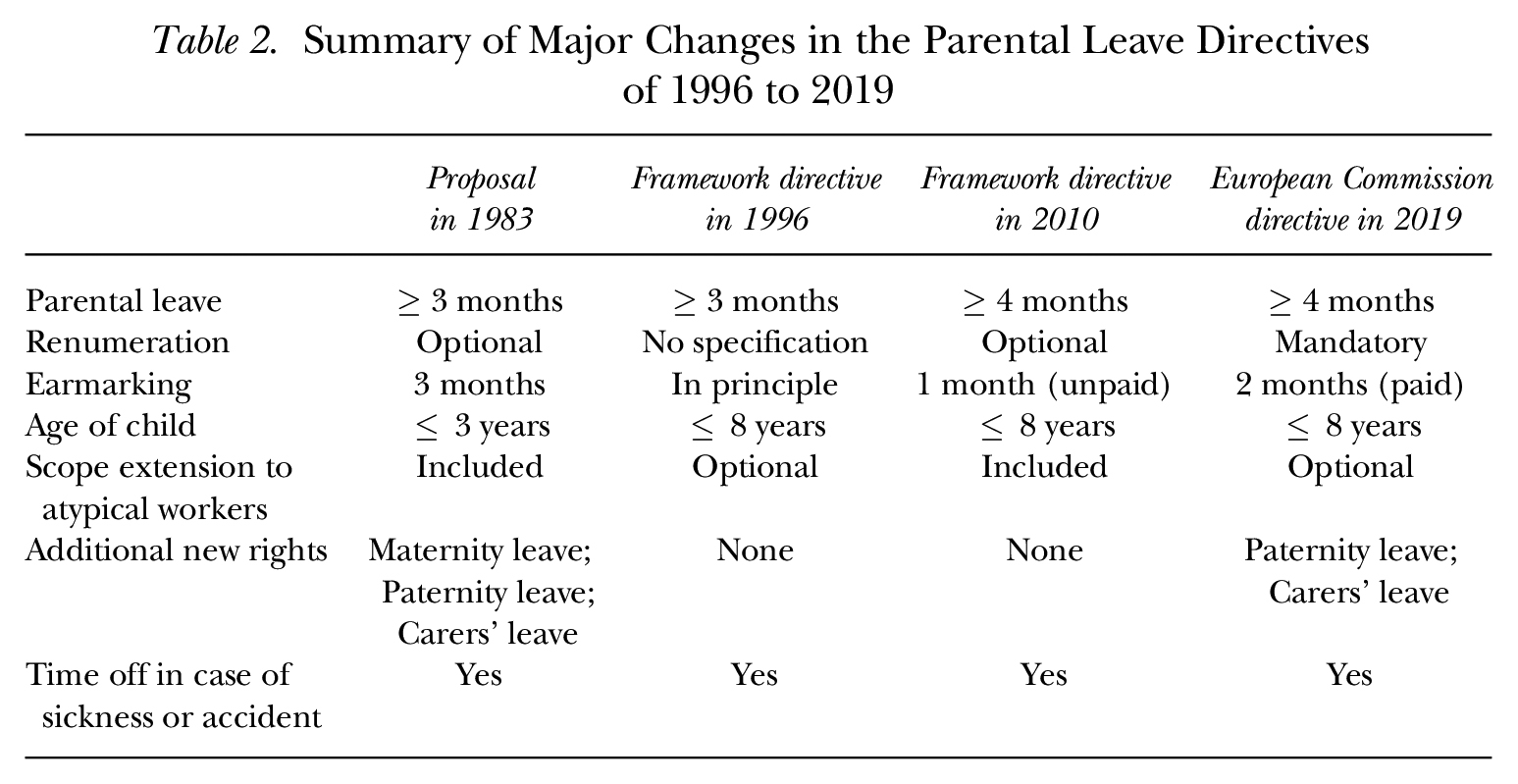
The 1996 and 2010 ESD negotiations both resulted in agreements. In both cases, the European social partners served as rule-makers, and the ESD was successful in the sense that both sides of industry agreed on EU legislation without interference from the Commission. When negotiations between European social partners on parental leave directives began, they started with a low baseline on aspects related to parental and other care leave policies (e.g., earmarking, length of leave, renumeration). Thus, the stakes for European social partners on costs and subsidiarity were lower, which facilitated the alignment of European social partners’ interests on the lowest common denominator on costs and subsidiarity related to parental and other care leave policies. Table 2 shows that European social partners in 1996 agreed on only a fraction of what was originally proposed in 1983. European employers’ associations utilized their rulemaking capacities to limit the scope of negotiations, while trade unions pushed, with limited success, to expand the scope of the directive. Likewise, in 2010 European social partners agreed to only limited, but not insignificant, changes from the 1996 directive: three to four months of parental leave, of which one month is earmarked, and remuneration designated as optional. Similar to the situation in 1996, concerns about costs and the level of governance (thus subsidiarity) especially among private employers influenced the bargaining results.
Summary of Major Changes in the Parental Leave Directives of 1996 to 2019
Crucially, the Commission’s interests were consistent with those of the social partners in 1996. The Commission was satisfied with implementing a directive on parental leave in 1996 when it was previously stymied by British opposition in particular. In 2010, the Commission respected the autonomy of European social partners in this policy field and thus the outcome of ESD, despite the Commission having greater ambitions on parental leave policies than the ones agreed to by the European social partners. Hence, European social partners acted as rule-makers in both 1996 and 2010.
By contrast, the political context and starting point for negotiations between European social partners for the 2019 WLBD differed from the political contexts and the starting points for European social partners’ negotiations that led to the 1996 and 2010 directives. The two sides of industry disagreed substantially on cost and subsidiarity. With limited scope for low baseline improvements after two important, but limited (policy-wise) framework agreements, finding the lowest common denominator to facilitate a framework agreement was much more difficult than in negotiations that led up to the 1996 and 2010 directives. This difficulty was especially evident when the employers appeared willing to use European social partners’ rulemaking powers to act as rule-preventers. The Juncker Commission, however, had much greater ambitions regarding EU’s parental leave policies, and they were more aligned with the ambitions of ETUC. When considering the cases of EPSU and the Hairdressers Agreement, which provided precedence of the Commission overruling the European social partners’ agreements in pursuit of its own ambitions (and thereby relegated them to limited rule-makers), the Commission always had the option to push ahead with its own proposal regardless of the ESD outcome, especially when the Commission considered it to be a visible product of its flagship EPSR (see Copeland 2022). If this was the view of the trade unions, they would have less incentive to find a compromise with the employers. On the side of employers, they may have expected that the Commission would respect a failed ESD outcome and not intervene as in the proposed revision of the 1993 Working Time Directive. They may also have expected that the Juncker Commission’s promise to relaunch and strengthen the role of ESD would yield a policy window, with limited (if any) repercussions on European social partners should they use their rulemaking powers to act as rule-preventers. If this was the view of employers, they may have had little incentive to find a compromise with the trade unions.
Overall, an examination of successive parental leave proposals and directives illustrates the changes in the Commission’s actions and ambitions, and their subsequent impact on European social partners’ rulemaking capacity. Notably, our typology underscores that the Commission’s actions and ambitions affect the scope of rulemaking capacity for European social partners, both when they agree and disagree on a framework agreement. When the Commission facilitates ESD and respects the autonomy of European social partners, as stated in the Lisbon Treaty (Article 152, TFEU), European social partners are more likely to be either limited rule-makers or rule-preventers. When the Commission intervenes through implicit political pressures, European social partners are more likely to be either rule-makers or rule-takers. In short, the political (Commission) context within which ESD operates restricts the types of ESD outcomes that will manifest. If the political context evolves over time, it implies that any analysis of the rulemaking capacity of European social partners (especially on a policy field that stretches over time) ought to be conducted longitudinally to unfurl the impact of changes in this context.
Conclusion
How do European social partners and the European Commission shape ESD outcomes? To address this question, we leveraged and extended upon the RIT model (Abbott et al. 2017) and conceptualized four potential outcomes for European social partners’ rulemaking capacity. We then elaborated how each outcome is contingent on the interests of European social partners and the Commission’s actions and ambitions. By focusing on rulemaking capacity, which is at the core of Abbott et al.’s (2017) model, we contribute to the ESD literature by going beyond its typical focus on successful and unsuccessful ESD outcomes based on the presence or absence, respectively, of a social partner agreement. We applied this conceptual framework to a longitudinal study of EU parental leave directives and policies from 1996 to 2019 and revealed the following findings.
First, European social partners currently face challenges regarding their rulemaking capacity as supranational actors. Their rulemaking capacity may be undermined by the Commission’s increasing focus on social policies and its aim to enhance its role in these domains, especially if this focus and aim imply a willingness to override ESD outcomes that are at odds with the Commission’s own ambitions.
Second, our analysis of successive parental leave proposals and directives suggests that European social partners have become rule-takers in a policy field, whereas they were previously rule-makers or rule-preventers of hard law through ESD. In other words, the longue durée perspective is relevant to illuminate changes in European social partners’ rulemaking capacity in the same policy field over time. While we focused only on parental leave policies, future studies may study this development in other policy fields critical for a Social Europe.
Third, when European social partners failed to agree on a framework agreement in 2019 because of deep differences in views on economic costs and the principle of subsidiarity, it opened a window of opportunity for the Commission to pursue its own policies. In the case of the WLBD, the Commission’s policy ambitions aligned with those of European trade unions, and employers’ interests were largely sidelined. In other cases, the tables may be turned for the trade unions. Regardless of the specific outcome of each case, the pronounced role of the Commission as a policy entrepreneur for new legislation in social policy (Mailand 2021; Vesan and Pansardi 2021; Copeland 2022) seemingly undermines the power and role of European social partners. We caution that the strong role of the Commission in social policy coupled with the loss of power of the European social partners may undermine support for Commission-driven social policies among actors and citizens who consider social policymaking as a domain for social partners. In our study, we mainly focused on the Commission and its changed roles, but future studies could consider the impact of other EU institutions on European social partners’ rulemaking capacity.
Finally, it remains to be seen whether this trend of the Commission focusing on pursuing its social policy ambitions, even at the risk of sidelining European social partners, will continue. For instance, European social partners have recently sought to craft a new social partner–led directive on the right to disconnect from digital devices when off work. If successful, it would be the first social partner–led directive since 1999. From a long-term perspective and in the light of the failures of ESD in producing the WLBD and the Hairdressers Agreement, it could also mark the point that European social partners seek to reclaim their rulemaking role after more than a decade of largely being rule-takers or limited rule-makers at best. On the flip side, some national social partners may welcome the Commission’s involvement in certain policy fields, if they have leverage on national policymaking. In short, the impact of intra-European social partner heterogeneity should not be discounted, especially in the years after the EU enlargement. Additionally, the dynamics for sectoral dialogues such as EPSU may differ from those for cross-industry dialogues. If so, the probability of sectoral dialogues leading to some of these ESD outcomes may differ from that of cross-industry dialogues. Overall, these points suggest that ESD outcomes are likely to vary by policy field, which is something future studies ought to consider.
Footnotes
Appendix
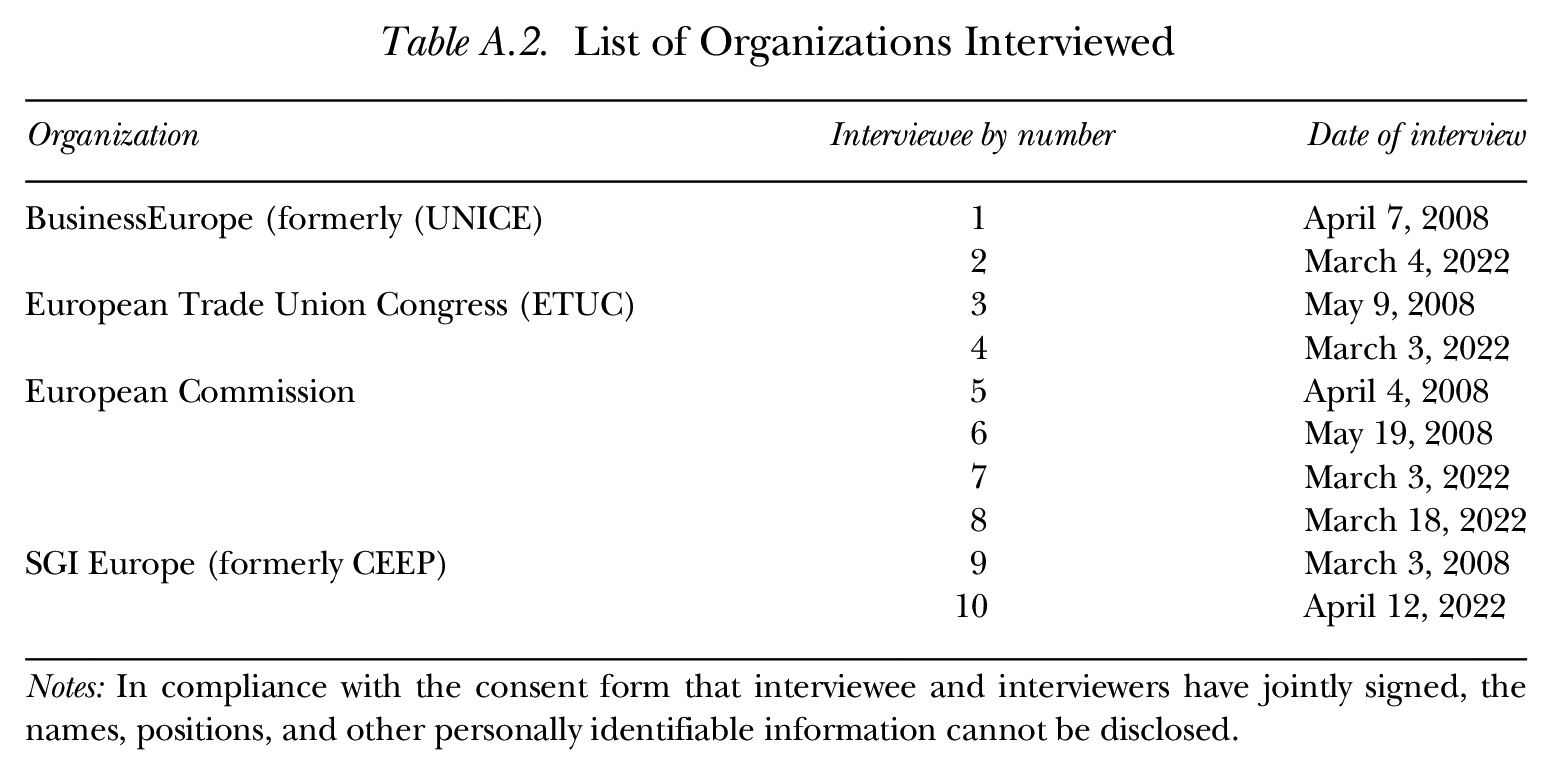
List of Organizations Interviewed
| Organization | Interviewee by number | Date of interview |
|---|---|---|
| BusinessEurope (formerly (UNICE) | 1 | April 7, 2008 |
| 2 | March 4, 2022 | |
| European Trade Union Congress (ETUC) | 3 | May 9, 2008 |
| 4 | March 3, 2022 | |
| European Commission | 5 | April 4, 2008 |
| 6 | May 19, 2008 | |
| 7 | March 3, 2022 | |
| 8 | March 18, 2022 | |
| SGI Europe (formerly CEEP) | 9 | March 3, 2008 |
| 10 | April 12, 2022 |
Notes: In compliance with the consent form that interviewee and interviewers have jointly signed, the names, positions, and other personally identifiable information cannot be disclosed.
Acknowledgements
We thank Marco Hauptmeier, Roland Erne, Jörg Nowak, Valeria Pulignano, Karol Muszyński, Maite Tapia, Holm-Detlev Köhler, Carolina Dantas Madureira, Sergio González Begega, and other participants of the ILR Review workshop on Transnational Employment Relations in the European Union held on April 20 and 21, 2022, in Leuven, Belgium, for their helpful comments and feedback. We also thank Caroline de la Porte, Gianna Maria Eick, Elke Heins, Janine Leschke, Mikkel Mailand, and other participants of the panel Obstacles and Opportunities in the Multilevel Governance of a European Social Union at the 29th International Conference of Europeanists held on June 28, 2022, in Reykjavik, Iceland. We extend our gratitude to Georg Fischer for his comments.
This article is part of an ILR Review Special Issue on Transnational Employment Relations in the European Union.
This study acknowledges funding support from the EU Horizon 2020 financed-project, EuSocialCit (Grant agreement number – 870978) and from the Danish Trade Union Confederation (2022).
For general questions as well as for information regarding the data and/or computer programs used for this study, please contact corresponding author Zhen Jie Im at
1
Jacques Delors from France served as president of the European Commission from 1985 to 1994. His first term spanned from 1985 to 1988, the second from 1989 to 1992, and the third from 1993 to 1994.
2
José Manuel Barroso from Portugal served as president of the European Commission for two terms, from 2004 to 2014.
4
Sørensen et al. (2022) showed that other factors, such as issue complexity and reputational risks, may also influence whether European social partners produce framework agreements. The key overriding divides between European social partners, however, often pertain first and foremost to costs and subsidiarity. In the case of the Work-Life Balance Directive of 2019, cost and subsidiarity also featured heavily in debates in the Council and were featured extensively in the impact assessment report prior to the release of the proposed directive by the Commission. See  .
.
5
The European Commission conducted public consultations from November 18, 2015, to February 17, 2016, with stakeholders that included member states, social partner organizations, civil society organizations, equality bodies, and other organizations and individuals. In total, it received 786 contributions of which 229 were from organizations and the rest from individuals. See https://ec.europa.eu/social/BlobServlet?docId=17603&langId=en.
6
In “The 2015-2017 Work Programme of the Europe Union Social Partners” (ETUC et al. 2015), ETUC, BusinessEurope, UEAPME, and CEEP agreed to “organise a fact-finding seminar to identify and promote leave, working arrangements and care facilities that benefit both employers and workers” (p. 6). Despite this agreement, only BusinessEurope and UEAPME stressed the need to complete this seminar prior to any EU-level decision on work–life balance during the Commission’s consultations with European social partners.