




Abstract
Many labor scholars and practitioners see the regulation of informal work as necessary to protect the world’s most vulnerable workers from market predation. This article advances an alternative perspective: State regulation is a versatile tool that can be wielded either by workers or by elites, often toward contradictory ends. Accordingly, the key question for those seeking to promote decent work is not whether to formalize informal jobs, but rather, formalization by and for whom? The author uses this approach to analyze differential outcomes between efforts to formalize the work of waste pickers in São Paulo, Brazil, and Bogotá, Colombia. Drawing on 24 months of field research, the author documents how São Paulo’s formalization policies benefited few street waste pickers, whereas those of Bogotá elevated the incomes, conditions, and voices of thousands of comparable workers. The analysis suggests that formalization is likely to yield pro-worker outcomes only when workers possess sufficient power over policy design and implementation.
An estimated two billion workers—some 61% of the global workforce—toil in informal jobs, without access to basic labor protections and social insurance (ILO 2018). It is little wonder, then, that many scholars and practitioners in labor and development circles see formalizing informal work as an urgent moral imperative. Indeed, the ethical charge to vanquish “informality” is woven into the term’s very etymology, which like many concepts used to describe the working poor define them in terms of what they lack relative to an implicit middle-class ideal. The prefix “in” means without and often connotes deficiency (e.g., inadequate, incompetent, inept). “Informal” thus suggests the absence of form or structure, evoking a trope of the poor—especially poor Black and Brown people in the Global South—as an amorphous, disorderly mass (Rosaldo 2021). Early definitions of informality centered on economic enterprises that lacked bureaucratic sophistication, whereas later ones focus on jobs that lack state regulation. Formalization policies, conversely, refer to efforts to align economic practices and the laws that govern them through processes such as registration, taxation, decriminalization, and the extension of social protections (Tucker and Anantharaman 2020). Such legal shifts are often accompanied by financial, spatial, and technological reorganizations of worksites and industries.
Proponents of formalization seek to protect vulnerable workers from predation by the unfettered market by bringing the rule of law to informal worksites. Thus, in 2015, the International Labour Organization (ILO) passed a recommendation on the Transition from the Informal to the Formal Economy, which it argued “is essential to achieve inclusive development and to realize decent work for all” (ILO 2015: 1). The recommendation passed in a near unanimous vote among representatives of government, employers, and labor from more than 100 countries. That same year, the United Nations made reducing the portion of workers in informal employment an official indicator for its Agenda 2030 Sustainable Development Goals, as a means to promote inclusive growth and decent work. More recently, the World Bank (Ohnsorge and Yu 2022), Organisation for Economic Co-operation and Development (2020), and the Inter-American Development Bank (Busso, Camacho, Messina, and Montenegro 2021) issued reports calling on governments to invest in formalization policies to ensure a sustainable and just recovery from the COVID-19 pandemic.
The prevailing impression in these proclamations is that state officials possess the will, know-how, resources, and persistence to deliver decent work to their most marginalized constituents. Such assumptions, however, do not always align with the experiences of informal workers, many of whom were pushed into informal jobs as a result of state inefficacy, negligence, or persecution. Moreover, a growing body of research challenges the orthodoxy that formalization policies naturally and automatically lead to improved outcomes for workers (e.g., Chen 2009; Millar 2018; Tucker and Anantharaman 2020; Kanbur 2021; O’Hare 2022). To be sure, in many instances, such policies have facilitated workers’ access to labor protections, secure worksites, public infrastructure, enforceable commercial contracts, and social insurance. But in other cases, they have intensified workers’ exploitation or deprived them of work altogether. And although formal jobs on average provide superior incomes and conditions than do informal ones, this is far from universally true—especially when considering the options available to workers at the bottom of the global economic pyramid.
To deepen our understanding of the circumstances under which formalization policies are likely to lead to pro-worker outcomes, this article compares efforts to formalize the work of waste pickers in São Paulo, Brazil, and Bogotá, Colombia. Informal waste pickers in these cities eke out a living by salvaging and selling recyclable and reusable materials from household and industrial waste left on streets or in buildings. Waste picking is a reasonable entry point for this line of inquiry as it has been said to “epitomize the informal sector: it constitutes a labor-intensive, low-technology, low-paid, unrecorded, and unregulated activity” (Medina 2007: 64). Waste pickers face many barriers to collective organizing: social stigma, mobile and dispersed worksites, economic instability, legal liminality, and lack of recognized employers. Nonetheless, over the past three decades, organized waste pickers in hundreds of cities across Latin America, Asia, and Africa have pressured governments to begin implementing “inclusive recycling policies,” which expand formal recycling services and contract previously informal waste pickers to provide them.
São Paulo and Bogotá are hailed as global leaders in waste picker rights policy and organizing. For example, an Economist Intelligence Unit (2017) report ranked São Paulo and Bogotá in the top three among 17 large cities in Latin America and the Caribbean on inclusive recycling policy and waste picker organizing. Yet their policy outcomes diverge dramatically. São Paulo’s formalization policies benefited less than 1% of the city’s estimated 20,000 street waste pickers, whereas Bogotá’s policies appear to have benefited the majority of the city’s estimated 18,000 waste pickers. This outcome is unexpected given that São Paulo’s waste picker movement matured under supportive leftist national governments, whereas that of Bogotá came of age under right-wing national regimes that violently repressed labor movements and attempted to criminalize waste picking.
Why did formalization policies in Bogotá succeed in elevating the incomes, conditions, and voices of thousands of street waste pickers, whereas parallel efforts in the seemingly more favorable political context of São Paulo benefited very few? And what does this reveal about the conditions under which formalization is likely to promote workers’ rights and urban sustainability? The first part of this article problematizes the assumption that formalization necessarily leads to pro-worker outcomes and proposes an alternative framework that distinguishes between bottom-up formalization and top-down formalization. The subsequent sections use this framework to analyze differential outcomes between waste picker formalization efforts in São Paulo and Bogotá. The article concludes by arguing that formalization is likely to yield pro-worker outcomes only when workers possess sufficient power over policy design and implementation.
Fetishization of Formalization
In previous work, I have termed the a priori framing of informality as problem and formality as solution, the “fetishization of formalization” (see Rosaldo 2021). Scholars and policymakers have long presumed informality to be a “problem,” yet diagnoses of its cause have been fiercely debated. For dualist economists of the 1970s, the problem was rapid population growth in Third World cities, which outstripped industrial job creation, pushing rural-to-urban migrants to turn to marginal informal jobs (e.g, Sethuraman 1976). Neoliberal economists of the 1980s and 1990s, by contrast, argued that the problem was excessive and burdensome government regulation, which forced informal entrepreneurs to work in the shadow of the law, stifling their capacity to grow and innovate (e.g., De Soto 1989). And structuralist sociologists, who achieved prominence in the 1990s, argued that the source of informal workers’ economic woes was unregulated exploitation by capital (e.g., Portes and Schauffler 1993). Such debates reached an apex in the mid-1990s, after which a loose consensus arose within labor and development circles around a structuralist-inspired perspective that sought to mitigate informality through state regulation.
Recent publications on formalization by the ILO, the most influential voice in global policy and scholarly debates, draw on structuralist analysis (e.g., ILO 2015, 2018, 2020, 2021; Weller 2022). I depict this perspective in Figure 1. The ILO argues that informal workers’ lack of state protections increases their vulnerability to “decent work deficits” characterized by low incomes, unhealthy and unsafe conditions, and a lack of social dialogue. Formalization, conversely, leads to improved labor standards by facilitating workers’ access to labor rights, social insurance, and state services and infrastructure. However, formalization is not a simple, one-time fix. Businesses may evade regulation through strategies of “informalization” (ILO 2015) such as outsourcing, subcontracting, offshoring, misclassification, and—more recently—gigification. These approaches result in the creation of precarious “semi-formal” jobs, located between fully formal and informal jobs on the “spectrum of informality” (Cobb, King, and Rodriguez 2009). Thus, the ILO (2015) proposed a three-pronged strategy that seeks to 1) transition jobs from the informal to the formal economy, 2) create new jobs in the formal economy, and 3) combat the informalization of existing formal jobs. The ILO emphasizes the importance of workers’ collective representation in all of these strategies.
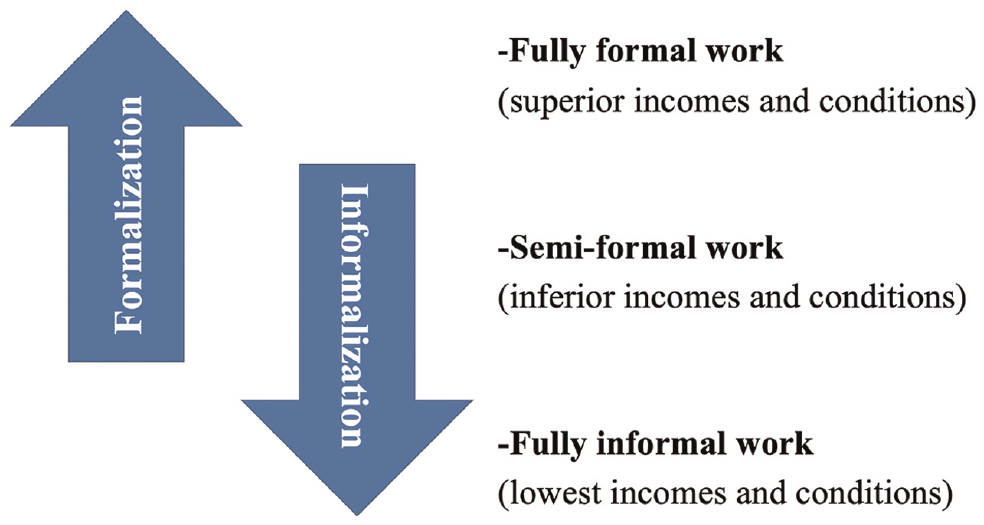
ILO Perspective on Informality
The ILO perspective gets many things right, including highlighting the state’s role as an arbitrator of class conflict, promoting worker organizing and voice, and treating in/formality as a dynamic process rather than as a static binary. Yet it upholds the dubious assumption that state regulation universally favors workers, a premise that holds true only in the context of a highly benevolent, inclusive, and effective state (Plagerson, Alfers, and Chen 2022: 5). But globally and historically, the state has served as a more reliable ally to capital than to labor. Consequently, not all state policy favors workers (Kamal 2023). Indeed, the instances in which the state has implemented transformative workers’ rights policies are the exception, not the rule, and have typically come in response to pressure from powerful worker movements (Evans 2010).
Reconceptualizing Formalization
In Figure 2, I propose an approach to formalization that treats the state as an inherent ally of neither workers nor elites, but rather—in a Gramscian sense—as an uneven terrain of struggle between and among them. This struggle is structured by and structuring of complex webs of laws, policies, and norms governing business and labor relations. When opportunities arise, both workers and elites are likely to create and enforce (i.e., formalize) state rules perceived as aligned with their interests. Conversely, all actors have an interest in evading or eroding (i.e., informalizing) state rules perceived as disadvantageous or unjust. This framework thus underscores both the formal and informal dimensions of worker struggles for what Fischer-Daly (2023) termed “dignity”—that is, the capacity to participate in creating, implementing, and adapting rules that govern work. Note that the four categories presented in Figure 2 represent interactive, co-constitutive forms of strategic action, not mutually exclusive ideal types, although one category may come to predominate in a given worksite.
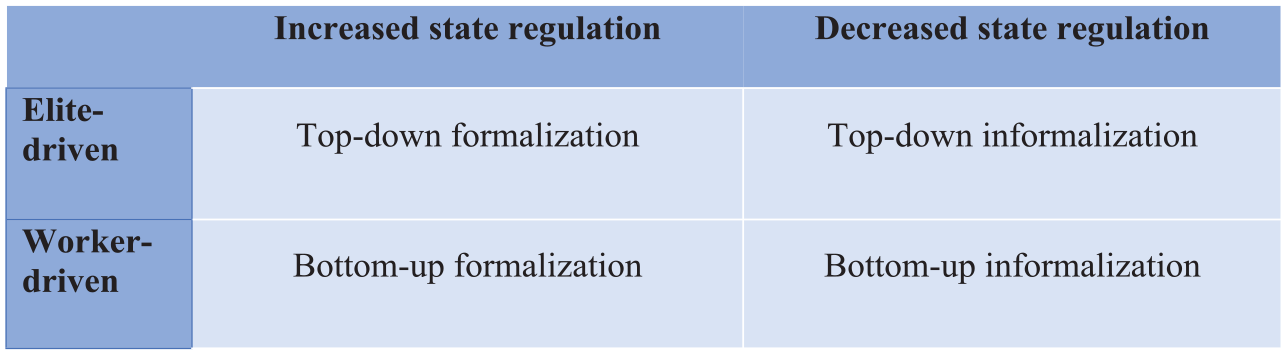
Locating Formalization in a Field of Power
By “workers” I refer to people who derive their livelihoods primarily through their own labor rather than through asset ownership or the labor of others. By “elites” I refer to individuals who occupy dominant positions in institutions that exercise authority over workers’ lives such as business and government. This framework calls attention to the power differentials between workers and elites but does not deny the diverse and conflicting interests that exist within each group. To paint in broad strokes, employers generally seek to formalize property rights (license to run their businesses free of state and union interference) and informalize both workers’ rights (e.g., minimum standards, freedom of association) and social rights (state-mandated, employer-funded social services). Employees, by contrast, generally push to informalize property rights and to formalize workers’ rights and social rights. Self-employed workers often pursue creative combinations of all three types of rights. Politicians’ stances on these issues, meanwhile, hinge on a range of factors including electoral self-interest, political program, and state capacity. In what follows, I discuss the central dynamics of each category from Figure 2 and their implications for waste pickers’ struggle for improved workplace voice and conditions.
Top-Down Informalization
This concept describes how elites evade state rules in order to reduce costs and increase power, underscoring the coercive and exploitative dimensions of informal work. In many cases, state officials abet top-down informalization by turning a blind eye to workers’ rights violations—a form of “organized abandonment” (Gilmore 2008, quoting Harvey 1989: 303), that is, the systemic withholding of state investment and legal rights from marginalized communities in ways that intensify their exploitation. This line of analysis was first advanced by structuralist sociologists to expose formal capital’s hidden exploitation of informal workers. Portes and Schauffler (1993: 49) contended that informal workers provide “a vast subsidy” to big businesses through two mechanisms. First, formal firms directly profit from informal labor either by hiring workers off the books or by sourcing informal inputs. Second, informal workers provide cheap goods and services to formal workers, thereby enabling employers to pay lower wages.
Waste pickers face both types of exploitation. They sell their goods to intermediary buyers for as little as 5% of the rate the industry eventually pays for them (Medina 2007: 5). They are not recognized as employees, however, which deprives them of rights to collective representation, social insurance, and minimum standards at work. Also, they provide a vital public service, saving the municipal government millions of dollars in waste transportation and disposal costs annually, while extending the lifespan of landfills, reducing pollution, and mitigating climate change. Unlike other waste management workers, however, waste pickers have not historically received state remuneration for their services, forcing them to eke out a living from the scrap prices of recyclables alone.
Bottom-Up Informalization
This concept describes workers’ evasion of state rules in order to increase their incomes and control over the labor process, calling attention to the oft-overlooked agentic and empowering dimensions of informal work. Self-employed informal workers’ daily noncompliance with state regulations can be understood as “weapons of the weak” (Scott 1985)—that is, poor people’s covert, small-scale acts of resistance. These quotidian transgressions must be understood not only in their negative sense as the defiance of state institutions but also in their positive sense as the creation of alternative institutions (Tripp 1997). Every day, hundreds of millions of informal workers defy state regulations regarding the registration, operation, and taxation of microenterprises. Such transgressions generate incomes, goods, and services that enable billions of people on the bottom rungs of the global economy to survive and sometimes thrive in the face of state neglect and persecution. State officials commonly tolerate such unlawful behavior as a means to redistribute resources, create jobs, win electoral support of the poor, and avoid protests (Holland 2017; Dewey 2020).
Through this lens, waste picking can be understood as an act of resilience, resistance, and resourcefulness. For example, anthropologist Kathleen Millar (2018) studied dumpsite waste pickers in Rio de Janeiro, Brazil, who face rapacious exploitation, hazardous conditions, and social stigma. Nonetheless, many waste pickers choose their profession over other available jobs, some of which offer regular salaries and state benefits. The key advantage of work on the dump is “relational autonomy,” that is, insulation from the despotism of waged employment, which is facilitated by and facilitating of community relations. Similarly, anthropologist Patrick O’Hare (2022) found that “waste commons” provide waste pickers in Montevideo, Uruguay, with greater incomes and dignity than does available waged employment. Parallel findings in Bogotá led economist Luisa Fernanda Tovar (2018) to jettison the deficit-based concept of “informality” in favor of the asset-based concept of “popular economy”—a Latin American term that emphasizes the collective resiliency and ingenuity of marginalized communities.
Bottom-Up Formalization
I refer to workers’ promotion of laws and policies designed to elevate their incomes, conditions, and power as bottom-up formalization. Whereas workers use “weapons of the weak” to informalize rules, bottom-up formalization typically requires “weapons of the organized”—that is, sustained collective action with explicit political ideologies (Kabeer, Sudarshan, and Milward 2013). Indeed, until the emergence of the modern labor movement in the late 19th century, all workers were technically “informal” (Gallin 2011). During the first half of the 20th century, waves of militancy by industrial labor unions and leftist political parties begot the first major laws and institutions regulating collective organizing and labor standards in many countries. Such efforts, however, often excluded the most marginalized and powerless segments of the working class, who would come to be labeled as “informal.”
Long dismissed by labor scholars and unionists as too weak and fragmented to collectively organize, millions of informal workers also have begun mobilizing for labor rights since the 1980s. This upsurge of organizing among “the world’s most vulnerable workers” (Agarwala 2013: 5) was accelerated by support from nongovernmental organizations (NGOs), foundations, and universities—civil society institutions that typically uphold elite power but also can be used to contest it. Rather than making productionist demands (jobs, conditions, and wages) to employers, informal workers typically make consumptionist demands (welfare and social programs) and political demands (human rights–based) to the state (Palmer-Rubin and Collier 2022). In this way, ironically, informal workers often push the state to play a more direct role in ensuring their livelihoods than it does for formal private-sector workers (Agarwala 2013: 199). And when the state responds to informal worker protest by offering consumptionist benefits, this may trigger further demands and protests (Garay 2007).
The long-term success of worker-driven formalization hinges not only on workers’ capacity to contest state power, however, but to collaborate with it. Recent literature highlights how informal worker organizations and state agencies partner to co-produce public services such as education, transportation, home care work, construction, and waste management (Meagher 2013; Rosaldo 2022). Well-designed co-production processes may generate socially beneficial synergies by lowering the cost, expanding the breadth, and improving the design of public services—especially for underserved communities. A parallel vein of literature highlights the benefits of partnerships between worker organizations and sympathetic state officials in the “co-enforcement” of labor regulations, which facilitate information sharing and mutual trust (Amengual and Fine 2017). Meanwhile, Hummel (2021) demonstrated how state officials with low-enforcement capacity create incentives for informal workers to build organizations, which negotiate and enforce state regulations.
Top-Down Formalization
This concept entails legal reforms that advance elite interests at the expense of those of workers. In many countries, workers’ rights gains of the mid-20th century were countered in the neoliberal age with policies that expanded corporations’ political power and made it easier to legally evade employer responsibilities. Indeed, according to the Center for Global Workers Rights’Labor Rights Database, the 185 ILO member states today have an average of nearly 10 laws on the books that violate the ILO’s own standards regarding workers’ rights to form unions, bargain, and strike (Kucera and Sari 2019). For self-employed informal workers in the Global South, however, top-down formalization poses an additional threat: dispossession. As industries and worksites are formalized, informal workers may be expelled and forcefully cut off from their means of livelihood—a phenomenon that Tucker and Anantharaman (2020: 294) called “dispossession by formalization.”
In the recycling industry, top-down formalization typically involves the implementation of “modern” collection routes and treatment facilities without adequate waste picker inclusion. City officials commonly introduce technologies such as containers, sanitary landfills, or incinerators that are exclusionary by design (O’Hare 2022), leading waste pickers in many countries to embrace the rallying cry, “Recycling without waste pickers is garbage!” The push to modernize recycling services is driven by a combination of elite interests and misconceptions. Private developers may seek to evict informal workers in order to beautify the city and pave the way for private development. Meanwhile, waste management corporations may promote the formalization and privatization of recycling services as a means to usurp control of the increasingly lucrative recycling industry. State officials often justify such policies based on spurious assumptions that modern recycling routes are the only way to create decent work and efficient service. Empirical research, however, finds that informal recycling systems outperform formal recycling routes on many metrics (Vergara, Damgaard, and Gomez 2016).
Determinants of Formalization Outcomes
I now return to the article’s central question: Under what circumstances is waste picker formalization likely to improve waste pickers’ incomes and conditions, and when might it intensify inequality? Recent ILO publications give the impression that formalization broadly benefits workers, and that any sub-optimal outcomes can be attributed to technical error. I hypothesize, by contrast, that outcomes hinge on waste pickers’ levels of power over processes of policy design and implementation. When waste pickers build sufficient power to shape policy proposals and hold state officials accountable for their implementation, they are likely to advance policies that are well attuned to their needs, capacities, and realities. But when waste pickers lack power, even well-intentioned state officials and business leaders are likely to advance top-down, exclusionary approaches to formalization.
Drawing on a relational understanding of poverty (Mosse 2010), I conceive of power not as an endogenous trait of waste pickers, but as a dynamic interaction between waste pickers and other influential actors (e.g., municipal administrations, waste management companies, NGOs). The key indicator of waste pickers’ power is their collective capacity to design and implement policy proposals, especially in the face of political resistance. Waste pickers typically have low levels of financial, technical, and political capital, and lack capacity to extract concessions through labor’s traditional tactic of the strike. As a result, building power requires not only self-organization but the mobilization of external resources and political leverage.
Research Methods
This study is a political ethnography (Tilly 2007) on waste picker formalization policy and politics in São Paulo and Bogotá. My empirical observations focus on the municipal level, where waste management policy is implemented and pivotal battles over waste picker rights unfold. My analysis also, however, encompasses the role of national-level politics in shaping local outcomes. Between 2011 and 2017, I conducted 24 months of field research, focusing on relations between street waste pickers, the cooperatives designed to benefit them, and other relevant policy protagonists, including state officials, NGO staff, and waste management corporations. I use pseudonyms for interviewees who are not public figures. The protocols follow guidelines from the University of California’s Institutional Review Board.
From 2014 to 2017, I conducted 12 months of research in São Paulo. To study the internal dynamics of recycling sorter cooperatives, I visited all 21 of São Paulo’s formalized cooperatives and conducted a 75-question survey with their leaders. I also spent five days working in the cooperatives. I spent six days working alongside members of São Paulo’s two remaining street waste picker organizations and interviewed 10 members. To deepen my understanding of the perspectives of non-organized street waste pickers, I conducted a brief survey with a convenience sample of 40 waste pickers working in the city center. I attended eight internal meetings, six conferences, and five protests of Brazil’s National Waste Picker Movement (MNCR). Additionally, I conducted 15 interviews with São Paulo-based MNCR leaders, 12 interviews with staff members of allied NGOs, and eight interviews with relevant government officials.
From 2011 to 2016, I conducted 12 months of research in Bogotá, interviewing 20 waste picker leaders, 15 rank-and-file organization members, and 15 non-organized waste pickers. To better understand waste pickers’ practices and perspectives, I spent 12 days collecting and sorting materials alongside organized and non-organized waste pickers and six nights staying with waste picker families. I attended 19 meetings between waste pickers and the municipal public service agency, the Special Administrative Unit for Public Services (UAESP), and four internal UAESP meetings. I interviewed four former UAESP directors and 10 staff members. I also interviewed government officials from eight national ministries and two national regulatory agencies, four members of Colombia’s Constitutional Court, two managers of waste management corporations, and 10 NGO workers from six NGOs that worked with waste picker organizations.
Drifting from Bottom-Up toward Top-Down Formalization in São Paulo
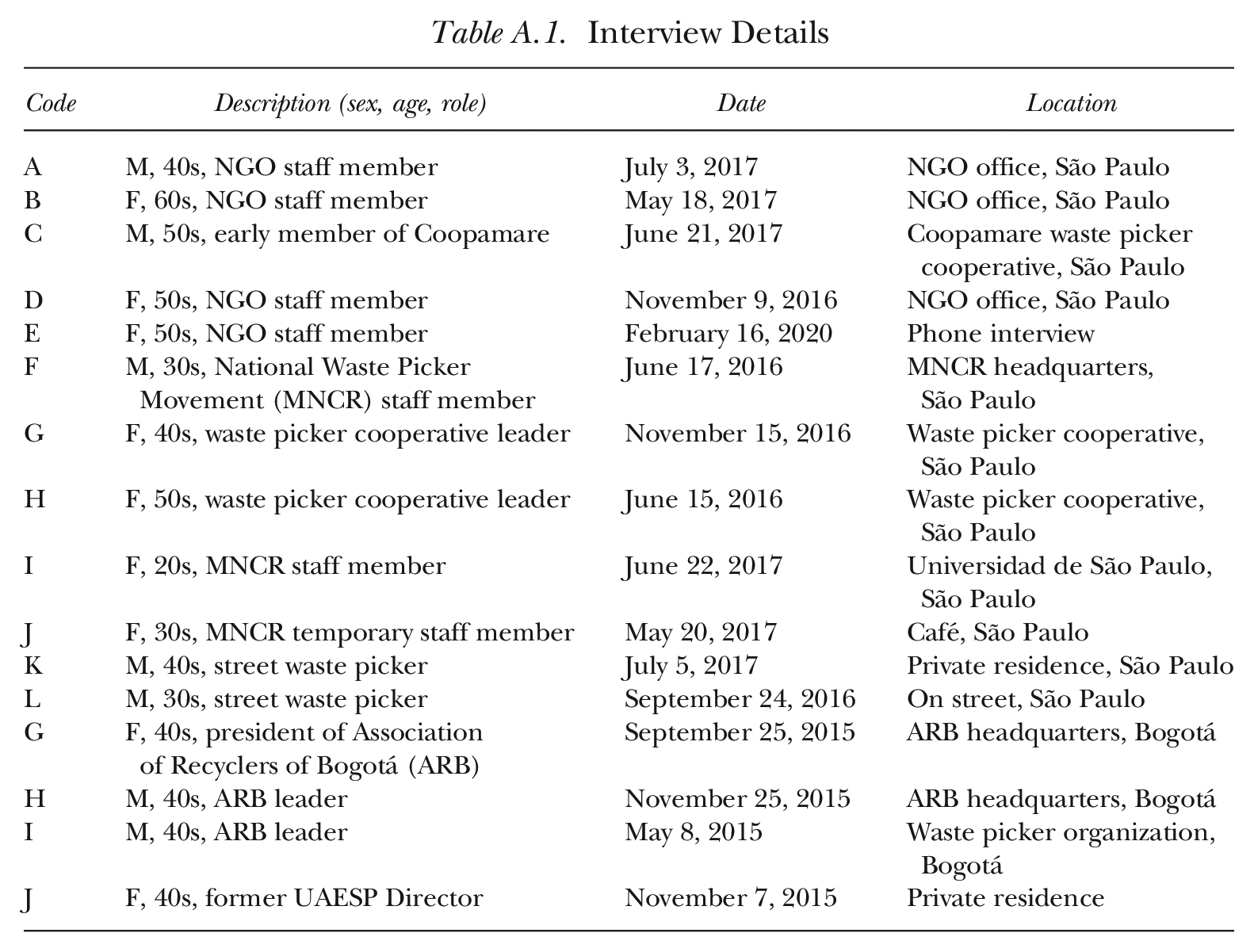
The way I think about how we should treat waste pickers has changed since I started working with them, fifteen or twenty years ago. We thought that it was simple. We thought that we could just tell them, “We have a warehouse for you. Come on, let’s build a cooperative inside. We’ll train you and equip you.”. . . But we didn’t understand how to serve that population. . . . We thought, naturally, inside of the warehouses, they are going to earn more and be in a more secure place. But then we saw that the waste pickers would leave the sorter cooperatives, or they wouldn’t even enter. —NGO staff member who worked as a consultant in the creation of sorter cooperatives during the administration of Marta Suplicy (Interview A; see Appendix Table A.1 for complete list of interviews)
From 2001 to 2004, a paradigm for waste picker formalization was developed in São Paulo that city officials would come to refer to as “inclusive recycling,” as it sought to create a formal recycling system into which to include previously informal waste pickers. City officials saw waste picking as a degraded and degrading form of work and an anarchic and unsightly way to provide recycling services. They thus designed a formal recycling route, modeled on those of the Global North, and contracted waste management corporations to take over waste pickers’ traditional role of collecting and transporting recyclables. New jobs were created for waste pickers in “sorter cooperatives,” where members worked along assembly lines inside of industrial warehouses, sorting and baling recyclables that had been collected by the official route.
These formalization policies have won international accolades for improving both waste picker livelihoods and recycling services. For example, in an assessment of inclusive recycling regulatory frameworks in 17 large cities in Latin America and the Caribbean, The Economist Intelligence Unit (2017: 64) gave its number one ranking to São Paulo, where it claimed “the interaction between users, recyclers [waste pickers], and privately owned waste management companies have been perfected due to [15] years of implementing selective collection routes with the participation of cooperatives.”
Such fanfare belies a more complex reality that is rarely publicly discussed by scholars or practitioners. By 2017, less than 1% of São Paulo’s street waste pickers had been integrated into formal waste management. Two issues accounted for the low inclusion rate. First was the quantity of jobs produced. Approximately 1,500 jobs were created in the sorter cooperatives—not nearly enough to absorb the city’s estimated 20,000 waste pickers. 1 Second, and more vexing still, was the quality of the jobs, which clashed with street waste pickers’ needs, capacities, and logics. Contrary to the expectations of NGO staff and state officials, street waste pickers overwhelmingly rejected invitations to work in the cooperatives, and most of those who joined quit within weeks. In their place, cooperatives hired other precarious workers who had never previously worked in the sector but were officially classified as “waste pickers.”
According to my survey of São Paulo’s 21 official waste picker cooperatives, 93% of members had never worked previously as informal waste pickers and most did not identify as such. To be sure, creating jobs for these workers—the plurality of whom were Black, women, and heads of households—was an immensely worthy project. Meanwhile, however, thousands of waste pickers continued to work on the streets, where they collected several times more materials than did the official route, but they received no state recognition or remuneration. Perversely, some claimed that their incomes had decreased because of competition with the very recycling route that was created for their benefit.
Why did São Paulo’s waste picker formalization policies largely fail the population they were designed to benefit? This conundrum becomes even more puzzling when one considers that these policies were initiated under seemingly favorable conditions: during the administration of a mayor from the leftist Workers’ Party (PT), in the midst of an economic boom that enabled the Brazilian state to invest hundreds of millions of dollars into inclusive recycling initiatives, and through participatory processes designed to include waste pickers and their civil society allies. I find, however, that because of street waste pickers’ lack of power relative to elites during the early 2000s, formalization policies drifted from a bottom-up toward a top-down orientation.
Process of Political Empowerment: Democratic Participation
São Paulo’s waste picker movement was born amid a turbulent transition from dictatorship to democracy, a time of ascent for leftist political parties, trade unions, and social movements. The PT was founded in 1980 by three currents of the resistance to Brazil’s military dictatorship: independent trade unions, Catholic clergy, and New Left activists (Keck 1992). After democracy was reinstituted in 1988, PT candidates began winning elections, first on the municipal and state levels, and then held the presidency from 2002 to 2016. During this time, waste picker cooperatives became a centerpiece of the PT’s agenda for a “solidarity economy”—that is, one based not on profit maximization, but on camaraderie with and within oppressed groups (Singer 2006).
Against this backdrop, the waste picker movement advanced its policy goals through what I term the “democratic participation” path. This refers to efforts to influence elected officials—especially those in the PT—by building coalitions of actors from civil society, the private sector, and the state to develop policy proposals and advocate for their implementation. I choose the phrase “democratic participation” in distinction to its inverse, “participatory democracy,” a more radical democratic practice that involves the direct devolution of decision-making power from state officials to their constituents—as in the case of Brazil’s vaunted participatory budgeting projects.
The origins of the democratic participation path in São Paulo can be traced to two leftist milestones in 1989. The first was the founding of Brazil’s first waste picker cooperative, the Cooperative of Autonomous Paper, Scrap and Recyclables Collectors (Coopamare). Through a decade-long process of trial and error, the waste pickers and their NGO allies developed an organizing model known as the “cart-pusher cooperative,” which blended the individualistic logics of waste picking with the collective logics of cooperatives (Interview B). Members collected materials individually on the streets, but participated—to varying levels—in collective decision-making, entrepreneurial projects, trainings, and political activism (Interview C).
The second was the inauguration of founding PT-member and longtime grassroots activist Luiza Erundina as São Paulo’s mayor. Erundina’s administration provided workspace, equipment, technical support, and service contracts to Coopamare, despite NIMBYist backlash from middle-class residents. Additionally, she passed a decree recognizing waste picking as a legitimate profession and outlining terms for state partnerships with waste picker cooperatives (Grimberg 1994).
This collaboration between waste pickers, NGO staff, and state officials embodied the ideals of bottom-up formalization: a worker-driven effort that sought to defend and gradually improve waste pickers’ traditional form of work rather than to erase and replace it. Accounts from scholars, NGO workers, and waste picker leaders suggest that these policies were resoundingly successful, helping hundreds of waste pickers elevate their incomes, conditions, and social status (Grimberg 1994). The Coopamare experience helped inspire the creation of 70 more waste picker organizations across São Paulo by the decade’s end (Grimberg 2007: 14). But thousands more unorganized waste pickers continued to work on the streets. Could the waste picker formalization initiative be rolled out on a larger scale without losing its bottom-up character? And could it succeed without the support of a leftist mayor with deep ties to popular movements?
Lack of Waste Picker Voice in Policy Proposal Design (2000)
At the turn of the century, new political possibilities for the waste picker movement were opened by the PT’s ascent and growing public environmental consciousness. A watershed moment came in 2000, with the launch of São Paulo’s Waste and Citizenship Forum (henceforth, “the Forum”), part of a national network that advocated for inclusive recycling policies. Meetings were held with representatives from more than 85 organizations, including state agencies, businesses, NGOs, universities, and waste picker organizations (Grimberg 2007: 186).
The Forum proposed creating “a system of recyclables collection, sorting, and sales that integrated the estimated 20,000 waste pickers who worked on the city’s streets” through a two-tier organizing model (Grimberg 2007: 36). On the first tier, formalized waste picker cooperatives would help waste management corporations collect recyclables along an official route and deliver them to industrial warehouses, where cooperative members would sort, bale, and sell them. Forum leaders anticipated, however, that street waste pickers might have difficulty adjusting to fixed schedules, rigid rules, professional norms, collective work, and democratic decision-making. Thus, they called for a second tier, an intermediary organizational form called a “nucleus”—that is, an informal group of about three to ten street waste pickers. The city would offer the nuclei trainings, equipment, spaces to sort recyclables, and opportunities for members to work in cooperatives. In exchange, the nuclei would recruit waste pickers off the street, train them, and direct them to work in the cooperatives. This approach was referred to as the “picker-to-picker” strategy (Interview D).
Forum leaders correctly anticipated that waste pickers’ transition from the streets to the cooperatives would be challenging. But they underestimated the logistical magnitude of this challenge and overestimated street waste pickers’ desire to work in industrial cooperatives. Why were such misconceptions not clarified through dialogue? In interviews, NGO workers explained that though the Forum was intended to elevate the voices of waste pickers, it wound up privileging the technical expertise of NGO staff, consultants, and state officials—who assumed they knew what was best for the waste pickers. As an NGO staff member who helped organize the meetings recalled, “Environmental organizations, academic institutions—that was the universe of the Waste and Citizenship Forum. . . . There was only a small contingent of waste pickers” (Interview A).
Beth Grimberg, an NGO director who helped lead the Forum, agreed that waste pickers had difficulty participating in such “formal political spaces.” Because of their absence, she admitted, “we overestimated their readiness to leave the streets and work in sorter cooperatives.” But Grimberg noted that this oversight was also a consequence of the structural constraints within which the Forum operated. By the late 1990s, city officials were already discussing plans to formalize recycling, which was seen as a best environmental practice and a marker of “world-class city” status. Grimberg and her colleagues sought to ensure that waste pickers were included in this process. Yet they did not have the internal capacity to identify, consult with, and organize thousands of street waste pickers, so they called for state support—which never materialized (Interview E).
Policy Formation: Prioritizing Waste Management Corporations over Waste Pickers (2001–2004)
The timing of the Forum’s launch appeared fortuitous, when six months later, in October 2000, the mayoral election was won by Martha Suplicy, a candidate from the leftist Workers' Party (PT). Yet Suplicy, who hailed from one of Brazil’s wealthiest families, embodied the party’s emerging business-friendly, centrist face. As a candidate, Suplicy had pledged to uphold the Forum’s platform and principles. But in October 2002, Suplicy blindsided Forum activists by announcing a secretly developed law that threatened to hand over the recycling industry to waste management corporations with only a marginal role for waste pickers (Interview F). The municipal administration then held a tender for waste and recyclables collection and awarded 20-year concessions to two waste management corporations.
The corporations collected recyclable materials along designated routes and delivered them to sorter cooperatives to be sorted and baled. Suplicy’s administration planned to build 31 such cooperatives but wound up constructing only 15, in which approximately 814 members worked (Jacobi and Besen 2011). The municipal government paid rent and utilities for the cooperatives’ warehouses and provided equipment, technical support, trainings, and regular deliveries of materials. The city did not remunerate cooperative members for their environmental service, however, forcing them to eke out a living from recyclables sales alone (Grimberg 2007).
In sum, the biggest winners from Suplicy’s inclusive recycling policies were waste management corporations, which won 20-year contracts and control of the lucrative recycling market. For members of the sorter cooperatives, this period was a mixed bag. Suplicy’s administration constructed the city’s first 15 sorter cooperatives and provided infrastructure and technical assistance. But it rejected the Forum’s demands that cooperatives be granted long-term contracts, a role in the recycling route, and remuneration for environmental services. This arrangement trapped the cooperatives in a permanent state of insecurity and dependency, relying on deliveries from waste management corporations and the goodwill of mayors for survival. And the biggest losers were organized street waste pickers, who became increasingly politically marginalized as São Paulo drifted from a bottom-up toward a top-down formalization model.
Progressive Neglect and Persecution of Street Waste Picker Organizations (2004–2017)
At the onset of the inclusive recycling policies in 2003, the city worked with 30 informal groups of street waste pickers known as “nuclei,” representing nearly 1,000 street waste pickers. But in 2004, once the initial 15 sorter cooperatives were installed, the city cut ties with the nuclei altogether. Street waste pickers were outraged at this perceived betrayal but lacked power to stop Suplicy from withdrawing promised support to their organizations (Grimberg 2007: 89). As a result, most of the nuclei disbanded, further weakening street waste pickers’ voice.
Suplicy was succeeded by two conservative mayors, who continued to support and gradually expand the sorter cooperative model, while also overseeing police crackdowns against street waste pickers and the eviction of waste picker organizations from their headquarters (Interview E). Such evictions were typically justified on the grounds that cart-pusher organizations were unsanitary and posed fire hazards. Members of these organizations, however, argued that the true motive for the simultaneous promotion of sorter cooperatives and persecution of cart pusher organizations was higienizacão, that is, the social cleansing of unwanted populations from public space. Not coincidentally, the conservative mayors also mounted “a full-blown, well-planned, administratively airtight offensive” against street vendors (Cuvi 2016: 396), cracked down on graffiti artists, and evicted homeless encampments.
During this period, most street waste picker organizations were forced to close down or shift to a sorter cooperative model. For example, in 2005, Coopamare worked with approximately 300 street waste pickers, who were either regular members or sold materials there. But that year, the city pressured the cooperative to stop buying materials from street waste pickers and shift to a sorter model, under threat of eviction (Interviews C and D). By 2017, only 23 members remained at Coopamare, most of whom had never worked as street waste pickers. At that time, only two cart pusher organizations remained in São Paulo, both of which were fighting against eviction processes.
Functional Exclusion of Street Waste Pickers from Sorter Cooperatives
In 2003 and 2004, Suplicy’s administration oversaw the construction of 15 sorter cooperatives with 814 members, the vast majority of whom were street waste pickers recruited from nuclei (Grimberg 2007). But according to accounts of cooperative leaders, most street waste pickers quit within weeks of being recruited (Interviews G and H). A small group of street waste pickers stayed on, often occupying leadership positions. But their efforts to recruit more street waste pickers failed. Instead, they hired other precarious workers who were officially classified as waste pickers, despite never having worked previously in the sector.
In the year’s after Suplicy’s mandate, only one more large-scale effort to recruit street waste pickers into sorter cooperatives was undertaken. From 2012 to 2014, Brazil’s MNCR ran a federally funded program called “CataRua” (Pick the Street), in which a team of three MNCR leaders—all former street waste pickers—and three técnicos (hired professional staff), combed the streets of São Paulo looking for waste pickers. They created a registry of 815 street waste pickers and invited them to join cooperatives. Only six accepted the invitation, however, and no follow-up was conducted to see how long they stayed in the cooperatives (Interviews I and J).
In 2016 and 2017, my survey of the leaders of São Paulo’s 21 formalized waste picker cooperatives found that only 7% of members previously worked as street waste pickers and most did not identify as “waste pickers.” Most cooperative leaders had given up on recruiting street waste pickers altogether. They now saw the social mission of their cooperatives as creating jobs for unemployed people, rather than improving the livelihoods of street waste pickers. Of the leaders, 17 said that they made no special effort to recruit street waste pickers. The other four claimed that, on an ad hoc basis, they invited street waste pickers to join, but the invitations were nearly always rejected.
Why did street waste pickers reject opportunities to work in the formal cooperatives time and time again? A street waste picker from São Paulo’s Eastern Zone, Marco Bastos (Interview K), explained: The dude who says you have to get rid of waste pickers is a damn idiot who doesn’t know what it means to push a cart through the street, to experience the freedom of working without having to kiss your boss’s butt, without having someone talking down to you all the time . . . busting your balls [enchando o saco] to follow a schedule, surveilling your every step. That’s why street waste pickers become street waste pickers—they are free. A real waste picker doesn’t accept being ordered, not just because he wants to do things the way he thinks they should be done, but because he really knows how to work, you understand? And his income is a lot more than the person who works in a sorter cooperative—that’s for sure!
Bastos highlighted two benefits of work on the streets over that in cooperatives, which were echoed by many street waste pickers in interviews. First, although many street waste pickers had a more critical view of their trade than did Bastos, most agreed that it offered a distinct advantage over other available jobs: a measure of control over when, where, and how they worked. Such “relational autonomy” (Millar 2018) helped waste pickers adjust to life’s daily urgencies and pursue their own ideals of “the good life” based on values of independence, resilience, and enjoyment of the present.
Second, as Bastos suggested, street waste pickers earned moderately higher average incomes than did members of sorter cooperatives. According to my survey, nearly half of the 21 cooperatives paid equal or less than the federal minimum wage (US$220 per month) at some point during 2016, and some did not pay members for months on end in response to budget deficits. Most cooperatives offered social security and health insurance. Street waste pickers did not receive such benefits, but many reported earning between 1.5 and 2 times the minimum wage from recyclables sales, which they supplemented by working odd jobs on the street and salvaging discarded items for reuse or resale. Key causes for the low incomes in the cooperatives were the unreliable quantity and poor quality of materials delivered by the official recycling route, most of which had to be thrown away. Street waste pickers, by contrast, collected only valuable materials. As one street waste picker explained, “The government is suffocating the cooperatives, forcing them to beg for more materials. Us street waste pickers earn more because we don’t depend on the government” (Interview L).
Outcomes: Political Marginalization of Street Waste Pickers
According to an ILO report (Weller 2022), labor formalization policies should be evaluated based on two questions: Do they increase levels of formality? And does formalization improve workers’ incomes and conditions? Measured against these criteria, São Paulo’s policies were hardly successful. By 2017, after 15 years of inclusive recycling policies, less than 1% of street waste pickers had been included in formal waste management, and many independent pickers reported experiencing greater dignity, freedom, and incomes on the streets. The new policies, however, did achieve other important goals: producing approximately 1,500 cooperative jobs for low-income workers, educating millions of residents about recycling, and moderately raising recycling rates. But an estimated 20,000 waste pickers continued to work on the street, where they collected the lion’s share of the city’s recyclables, with no state recognition, remuneration, or representation.
What went wrong? The progressive exclusion of street waste pickers from the policies designed to benefit them was the consequence of street waste pickers’ lack of voice and power at two moments. First, during the policy design phase in 2000 and 2001, NGOs convened multi-stakeholder forums for creating policy proposals. These forums were intended to elevate waste pickers’ voices but wound up favoring the technical expertise of NGO staff, consultants, and state officials. Second, during the policy implementation phase, Mayor Suplicy prioritized the interests of waste corporations and private developers, whereas conservative mayors directly attacked street waste pickers and their organizations.
Advancing Bottom-Up Formalization in Bogotá
In 2012, when Bogotá’s mayor proposed an “inclusive recycling” plan with many similarities to that which had been implemented in São Paulo a decade earlier, organized waste pickers revolted. Nohra Padilla, the president of the Association of Recyclers of Bogotá (ARB), argued that rather than creating a formal recycling system into which to include informal waste pickers, the state should recognize and build upon the existing informal system. As Padilla put it, “If we start with inclusion, it’s as if we were starting from zero. But, as it turns out, we’re not at zero. Twenty-thousand waste pickers already collect fourteen-hundred tons of material daily, a quarter of the waste that the city produces, without any help from the state. That’s nothing to sneeze at” (Interview G).
Through a combination of human rights lawsuits, strategic advocacy, and contentious protest, Bogotá’s waste pickers pressured city officials to shift course and adopt a series of policies that Padilla termed “waste picker recognition.” These policies treated waste picking not as a source of precarity, but of resilience and resistance. Whereas São Paulo’s formalization policies were designed to transition waste pickers away from the streets, Bogotá’s policies sought to defend and gradually improve their work on the streets by legally, socially, and economically recognizing their contributions. From 2012 to 2015, Bogotá’s municipal administration created a registry of 18,000 waste pickers through an elaborate census and verification process. The city then distributed 18,000 government uniforms to registered waste pickers and issued 3,000 pickup trucks to waste pickers who had previously worked by horse-and-buggy. And, most groundbreaking of all, the city began making bimonthly payments to 13,000 waste pickers in recognition of their public service based on the quantity of materials they collected (Tovar 2018).
Critics contended that these policies did not go far enough to improve the quality of waste pickers’ conditions nor of municipal recycling services, and that the unwieldy remuneration scheme led to irregularities and fraud. Nonetheless, in just three years, Bogotá’s policies moderately improved the incomes, conditions, and political voice of thousands of street waste pickers. Why did Bogotá’s formalization policies benefit so many more waste pickers than did those of São Paulo? I argue that Bogotá’s waste pickers achieved relatively higher levels of power, which enabled them to resist attempts at top-down formalization and push for policies that were better aligned with their needs, capacities, and realities.
Political Empowerment: Human Rights Path
Bogotá’s waste picker movement came of age under right-wing national regimes that violently repressed social movements, labor unions, and leftist parties. During the 1980s, municipal officials evicted waste pickers from streets and dumps, and sometimes conspired with “social cleansing” death squads who murdered thousands of waste pickers, sex workers, and beggars. In response, waste pickers in small and large cities across Colombia began collectively organizing into cooperatives during the 1980s, many of which united into regional networks. The most politically influential network is the ARB, which formed in 1990 when four Bogotá-based cooperatives came together to fight the closure of a landfill. Two years later, the National Association of Recyclers (ANR) was founded, which shares a headquarters and overlapping leadership with the ARB (Rosaldo 2016).
In the hostile Colombian context, waste pickers found few allies in elected office, hamstringing their capacity to advance their interests through the democratic participation strategies used by their Brazilian counterparts. Movement leaders learned this lesson the hard way during the 1990s, when they spent seven years lobbying congress for comprehensive waste picker rights legislation, to little avail. Finally, in 1999, congress passed a largely symbolic law that declared March 1 “Waste Pickers’ Day” and encouraged state agencies to provide education, housing, and health care to waste pickers. Such benefits never materialized, however, and the law soon became letra muerta (dead law). Worse yet, over the next two years, national and municipal officials passed a series of decrees that threatened to ban the act of informal waste picking on sanitary grounds and hand over rights to recycling collection to waste management corporations (Parra 2016).
The otherwise hostile Colombian political terrain, however, offered the waste pickers one distinct opportunity: Colombia is home to some of the world’s strongest human rights laws, which were enshrined in the Constitution of 1991. The new constitution, catalyzed by a student movement called “We Can Still Save Colombia,” definitively adopted the principles of the Universal Declaration of Human Rights and created new enforcement mechanisms. Colombia so frequently falls short of these ideals that it has earned the ignominious reputation of having the hemisphere’s worst human rights record. Nonetheless, the Constitutional Court, which is charged with defending the integrity and supremacy of the constitution, has served as a strategic leverage point for many progressive social movements (Rosaldo 2016). This disposition stands in sharp contrast to the Brazilian judiciary, which is widely viewed as a conservative political force.
Facing the threat of permanently losing their livelihoods, in 2001 ARB leaders recruited pro-bono lawyers to sue the government for prejudicial policies. The first judge to hear their case dismissed the waste pickers’ demands for inclusion in formal waste management as “absurd.” But from 2002 to 2011, the ARB and ANR won six landmark cases in the Constitutional Court. These rulings defined waste pickers as a protected population, akin to indigenous people facing dispossession from their traditional livelihoods and terrain (Parra 2016). The rulings provided the Colombian waste pickers with important forms of discursive and political leverage that did not exist in Brazil. First, they overturned laws and policies that threatened to cut off waste pickers’ access to work and to hand their role over to waste management corporations. Second, the Court’s rulings specified the obligation of mayors to comprehensively and exclusively identify and formalize informal waste pickers, the subjects of special protection. Third, the Court inflicted serious penalties against mayors who did not comply with its rulings, nullifying a billion-dollar waste management bidding process in Bogotá in 2011 on the grounds that it did not adequately include street waste pickers.
Waste Pickers Reject Top-Down Approach to Formalization in Bogotá
Gustavo Petro, a former member of the Marxist M-19 urban guerrilla group, was elected to Congress five times before becoming Bogotá’s mayor in 2012—a shocking feat in what was known as one of Latin America’s most politically conservative countries. The Constitutional Court had ordered Petro to formalize the waste pickers’ work, but Petro used this as a justification to embark on an even more radical project: He sought to bring waste management under direct city control, replace waste burial with recycling and (eventually) composting, and replace waste management corporations with waste picker cooperatives. Three months into the new administration, Bogotá’s UAESP released a 110-page Court-mandated document called the “Plan for Waste Picker Inclusion.” The UAESP’s plan centered on the creation of a formal recycling route, which would collect recyclables and deliver them to state warehouses to be sorted and baled by waste picker cooperatives. In this sense, it resembled the inclusive recycling policies introduced in São Paulo a decade earlier.
The UAESP’s plan, however, contained additional provisions aimed at fulfilling the Court’s order to comprehensively formalize waste pickers’ work. First, jobs in the cooperatives would be exclusively reserved for people who had previously worked as street waste pickers, as identified through a census and verification process. Second, the UAESP planned to create many more cooperative jobs than had been created in São Paulo, including jobs staffing recycling routes, 60 public warehouses for sorting recyclables, and six large recycling parks for value-added processes. Third, Petro sought to return waste collection and disposal, which had been privatized in the mid-1990s, to direct city control. Petro argued this was needed to facilitate the complex logistics of the new system and would help avoid resistance by waste management corporations as the “zero waste” plan gradually drove them into extinction (Rosaldo 2019).
Despite such reassurances, leaders of the ARB and allied organizations saw the Plan for Waste Picker Inclusion as a top-down directive that would lead to their exclusion and dispossession. Specifically, ARB leaders expressed three concerns. The first regarded the quantity of jobs. According to ARB estimates, recycling sustained more than 20,000 of the city’s most vulnerable residents and served as a safety net in times of crisis for many more. They believed that the new system would create only a fraction of this number of jobs. As ARB co-founder Silvio Ruiz-Grisales argued, “We can’t support this model because we can’t allow a minority to exclude a majority. . . . It is more dignified for many people to be able to eat a little bit, than for a few people to eat a lot” (Interview H).
The second concern regarded the quality of jobs. ARB leaders argued that many waste pickers lacked the capacity and desire to follow rigid rules and schedules and would therefore be effectively excluded from the new system. The UAESP’s utopian discourse of worker democracy notwithstanding, ARB leaders argued that in the new system waste pickers would essentially become state employees. In other words, they would be forced to follow fixed schedules and rules in exchange for a salary (Interview H).
The third concern related to control over jobs. In the informal system, anyone who wished could collect recyclables and sell them at any one of the city’s estimated 1,500 scrap shops. But under the new system, the city would control the means of production, forcing waste pickers into a relationship of dependency. ARB leaders were skeptical that Petro’s administration had the will and capacity to create formal jobs for all of the city’s 20,000 waste pickers. But even if it did, they saw no guarantee that future administrations would not expel the waste pickers and sell the lucrative recycling industry to private companies.
Implementing Bottom-Up Formalization in Bogotá
In early 2013, the ARB and allied waste picker organizations pushed Petro’s administration to radically shift course. New policies aimed to provide waste pickers with state remuneration and equipment immediately, even as they continued to work in the informal recycling market. Five policies characterized the new paradigm of waste picker recognition. First, a team of 25 social workers began verifying and updating a waste picker census from 2012. They regularly combed the streets of all 20 city boroughs, eventually creating a registry of 18,000 active waste pickers. Second, the UAESP temporarily set aside plans to make waste pickers work in cooperatives with fixed routes and schedules, and instead began paying waste pickers even as they continued to work autonomously. Beginning in 2013, the city would send a text message every two months to registered waste pickers with a code redeemable for cash at ATMs based on the quantity of materials they had sold to approved scrap shops, representing an estimated 50% pay raise. Within two years, the city would use this innovative pay scheme to remunerate 13,500 waste pickers on a bimonthly basis (UAESP 2015: 41). Third, the city banned the use of horse carts on city streets but provided nearly 3,000 pickup trucks to waste pickers who had previously worked with horse carts, finally making good on a Constitutional Court ruling from a decade earlier. Fourth, at the suggestion of ARB leaders, the district handed out 11,000 kits with safety equipment (boots, goggles, masks, gloves) and official city uniforms to all registered waste pickers (UAESP 2015: 49). Fifth, UAESP agents provided technical support to waste picker organizations as they prepared to become official public service providers (Tovar 2018).
Why did the UAESP veer from its original agenda of “inclusion” to one of “recognition” in early 2013? UAESP officials claimed that the primary motivation was logistical. The individualized pay scheme was a temporary, stop-gap measure that would enable the city to begin remunerating waste pickers without further delay, while new recycling infrastructure was constructed (Interview J). Some UAESP personnel highlighted another motivation, however: Petro could no longer afford to antagonize the ARB because of his growing political vulnerability. After the UAESP released the Plan for Waste Picker Inclusion, waste pickers launched protests and aggressively challenged city officials in the media and at public forums. Then, from December 14 to 17, 2012, trash piled up for three days on Bogotá’s sidewalks as the city transitioned to public waste collection. Though many pundits blamed Petro for the mess, evidence suggests that waste management corporations bore much of the responsibility, as they stopped collecting waste several days before their contracts expired and refused to return public trucks to the city (Rosaldo 2019).
Petro and his supporters alleged that waste management corporations deliberately sabotaged the transition to force him to rehire them and to pave the way for his impeachment. Indeed, Petro’s approval rating fell below 30%, and a citizen movement to recall him gained steam (Freeman 2014). Meanwhile, national supervisory agencies began investigating Petro for his alleged bungling of waste management. Given that Petro justified the re-municipalization of waste management based on the shaky legal argument that it was necessary to comply with the Constitutional Court’s waste pickers' rights rulings, he needed the most powerful waste picker organizations in his corner. As a former UAESP director put it, “The Inspector General, the Commercial Supervisory Agency, the whole national government was trying to take us out. We couldn’t risk a war with the waste pickers too. Politically, it would have been impossible” (Interview J).
The policies Petro inaugurated in 2013 helped win waste pickers’ support during his moment of greatest need. On December 10, 2013, Colombia’s right-wing Inspector General impeached Petro and banned him from holding political office for 15 years on the grounds that the re-municipalization of waste management had provoked a sanitary crisis and violated the free market rights of waste management corporations. Many of Petro’s supporters saw this as a “soft coup”—a right-wing plot to destroy his ascendent political career before he arrived to the presidency. ARB leaders, thrilled with the policies Petro had implemented over the previous year, helped organize international petitions, a building occupation, and massive protests in his defense. Four months later, following an injunction by the Inter-American Commission on Human Rights, the Superior Court of Bogotá reinstated Petro (Rosaldo 2019). During the final two years of Petro’s administration, the UAESP attempted to recover its original plans for inclusive recycling. The ARB and allied organizations, however, used contentious protest and legal advocacy to pressure the administration to continue to expand the waste picker recognition policies instead (Interview I).
Outcomes of Bottom-Up Formalization in Bogotá
The outcomes of policies implemented during Gustavo Petro’s polemic mayoral term (2012–2015) demonstrated both the potentials and challenges of bottom-up formalization. During this period, Bogotá’s waste picker organizations achieved unprecedented levels of political power, which they skillfully used to pressure the municipal administration to abandon its original proposals and to begin implementing policies better aligned with waste pickers’ needs, capacities, and realities. Over the next three years, the municipal government provided thousands of waste pickers with remuneration, trucks, safety equipment, uniforms, and trainings in recognition of their public service even as they continued to work autonomously. This accomplishment was especially impressive compared to the relatively low rates of street waste picker inclusion in São Paulo (see Table 1). Moreover, recycling rates increased significantly during this period according to government data, helping reverse a decades-long trend of increased materials arriving to the overtaxed city landfill (Quevedo Fique 2020).
Outcomes of Formalization Programs: São Paulo Compared to Bogotá
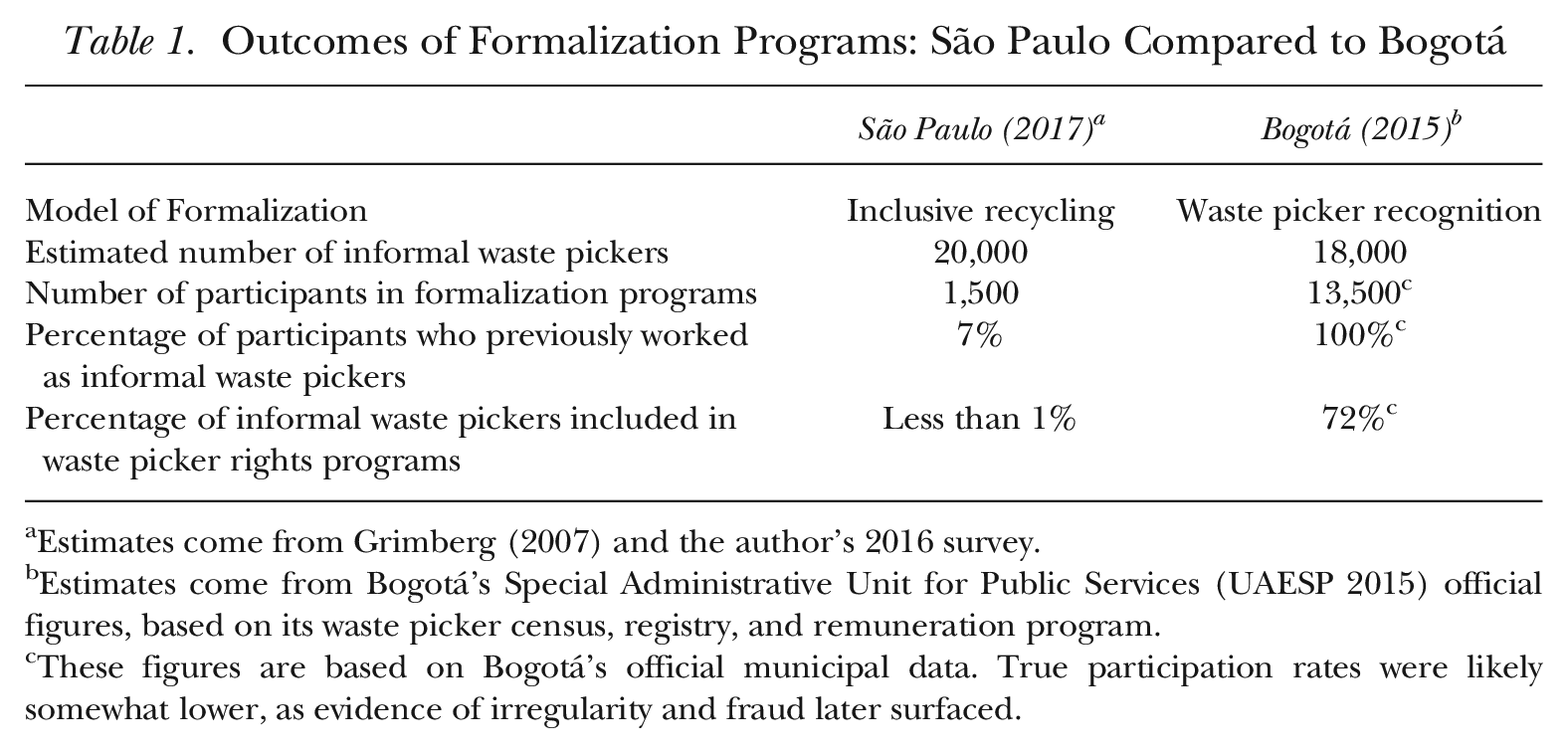
Estimates come from Grimberg (2007) and the author’s 2016 survey.
Estimates come from Bogotá’s Special Administrative Unit for Public Services (UAESP 2015) official figures, based on its waste picker census, registry, and remuneration program.
These figures are based on Bogotá’s official municipal data. True participation rates were likely somewhat lower, as evidence of irregularity and fraud later surfaced.
Such accomplishments notwithstanding, technical challenges persisted. To start, maintaining an accurate registry of waste pickers was an uphill battle due to the dispersed, unregistered, reclusive, and transient nature of the workforce. Also, the unwieldy remuneration scheme proved difficult to administer and supervise, leading to delays, irregularities, and alleged fraud. Perhaps the biggest challenge, however, was organizing a professional, comprehensive recycling collection service with an autonomous, freewheeling workforce. UAESP officials’ efforts to incrementally impose fixed schedules, regular routes, and professional conduct rules upon waste pickers were often met with resistance.
Although this article focuses on the political dimensions of bottom-up formalization, the case of Bogotá also demonstrates the importance of the technical dimensions—especially in the provision of a vital sanitary and environmental service. Ultimately, the policy’s logistical shortcomings threatened its sustainability. National regulatory agencies sanctioned Petro and top UAESP officials on the grounds that their bungling caused irregularities and fraud. Right-wing national administrators began preparing their own waste picker formalization policies, which would wrestle away control from mayors such as Petro and put waste pickers into direct competition with waste management corporations.
In the years since Petro’s mayoral term ended in 2015, the municipal and national administrations have turned over twice—including Petro’s historic election as Colombia’s first leftist president in March 2022. Although many of the specifics of Bogota’s formalization policies have changed, two important legacies endure. First, the waste picker recognition policies of 2013 to 2015 created a precedent for large-scale waste picker formalization, which generated a ripple effect, pushing many Colombian mayors and the national administration to create their own waste picker formalization policies. Second, Bogotá’s waste pickers won substantial concessions without sacrificing their political or economic autonomy. In this manner, they avoided a key pitfall of successful bottom-up formalization: becoming self-satisfied, co-opted, or demobilized. Rather, the waste picker movement used its political victories to recruit and activate new members, thereby strengthening its capacity to push for further concessions.
Conclusion
According to prevailing wisdom in labor and development circles, regulating informal worksites is necessary to protect vulnerable workers from predation by the unfettered market. This article advances an alternative perspective: State regulation is a versatile tool that can be wielded either by workers or elites, often toward contradictory ends. Accordingly, the key question for those seeking to promote decent work and equitable development in the world today is not whether to formalize informal jobs, but rather, formalization by and for whom? I have proposed a distinction between top-down and bottom-up formalization, which I used to explain differential outcomes between two ambitious attempts at waste picker rights policy. São Paulo’s formalization policies created approximately 1,500 jobs for low-income workers, but functionally excluded the very population of street waste pickers they were designed to serve. Bogotá’s policies, by contrast, elevated the incomes, conditions, and political voices of thousands of waste pickers. The higher inclusion rates in Bogotá reflected waste pickers’ superior levels of political power, which stemmed from both their internal organization and external sources of leverage such as human rights rulings. The analysis thus supports my central hypothesis: Formalization is likely to yield pro-worker outcomes only when workers possess sufficient power to shape processes of policy design and implementation. In what follows, I extend this insight by discussing three mechanisms through which worker power generated favorable policy outcomes.
First, waste pickers used power over processes of policy design to advance proposals that were aligned with their needs, capacities, and realities. In São Paulo, inclusive recycling policy proposals were designed through multi-stakeholder forums that were intended to include the voices of waste pickers but wound up favoring the technical expertise of NGO staff, academics, and state officials—all of whom overestimated waste pickers’ desire and capacity to work in industrial cooperatives. In Bogotá, by contrast, when city officials sought to implement policies with many parallels to those of São Paulo, the waste picker movement used contentious protest, lawsuits, and media campaigns to force a new course of action. Movement leaders argued that waste picking was best understood not as a source of vulnerability, but rather as a resource that people created in order to survive poverty and sometimes salvage a measure of dignity. They therefore pushed for policies that sought to recognize and gradually improve waste pickers’ work on the streets, rather than to erase and replace it.
Second, waste pickers used power over processes of policy implementation to hold state officials accountable for implementing their policy proposals. As a mayoral candidate in São Paulo, Marta Suplicy pledged to support the waste picker movement’s policy proposals. But after assuming office in 2001, she reneged on many of her promises, withdrawing support for street waste picker organizations and selling off their traditional role of collecting and transporting recyclables to waste management firms. Street waste pickers denounced this betrayal but lacked the power to stop it. Subsequent right-wing mayors oversaw police crackdowns against street waste pickers and evictions of their organizations. In Bogotá, by contrast, the waste picker movement used human rights lawsuits to overturn policies that threatened to criminalize their profession and hand their industry over to private companies. Constitutional Court rulings required mayors to comprehensively identify informal waste pickers, remunerate them for their services, and include them in formal waste management. Critically, the Court inflicted severe sanctions against mayors who did not comply with its rulings, nullifying a billion-dollar waste management bidding process in Bogotá on the grounds that it did not adequately include street waste pickers.
Third, worker-driven processes of formalization enabled waste pickers to increase their organizing capacity, begetting further power. From 2000 to 2015, the number of street waste picker organizations operating in São Paulo plummeted from 70 to 2 as a result of government neglect and persecution. As street waste pickers’ organizational strength decreased, so too did their ability to protest their increasing political exclusion. By 2017, when the Economist Intelligence Unit awarded São Paulo its top ranking for inclusive recycling policies, few organized street waste pickers were left to provide an alternative account. In Bogotá, the trend was the opposite: As waste picker leaders gained the capacity to create and implement policies that affected their work and lives, they developed collective confidence and aptitude to assert more demands. And as the city rolled out policies that benefited thousands of street waste pickers, more waste pickers began joining organizations in order to gain knowledge of, access to, and power over the new policies.
What would it take for São Paulo to recover its original goal of improving the conditions of the city’s 20,000 street waste pickers and integrating them into formal waste management? A first step would be a more candid discussion of the shortcomings of the city’s current inclusive recycling policies. In academic literature, popular media, and NGO publications, the prevailing impression is that many street waste pickers successfully transition to sorter cooperatives, where they experience superior conditions and incomes. Such claims should be tested through rigorous empirical research. A second step would be to question assumptions that undergird the current model of waste picker inclusion. Many state officials continue to see street waste picking as a survival activity of last resort and a premodern and inefficient way to provide recycling services. Yet many street waste pickers report experiencing greater incomes and dignity on the streets than in available formal jobs. Moreover, São Paulo’s informal recycling system continues to dramatically outperform the formal one in terms of quantity of materials recycled, greenhouse gases reduced, and jobs produced—despite receiving virtually no state support. The final and most important task is for state agencies, NGOs, universities, and the waste picker movement itself to increase support for grassroots street waste picker organizing—as occurred during the 1980s and 1990s. Such backing could bolster street waste pickers’ capacity to collectively develop political analysis, organizing models, and policy proposals that prioritize their own lived experiences and practical knowledge.
Footnotes
Appendix
Interview Details
| Code | Description (sex, age, role) | Date | Location |
|---|---|---|---|
| A | M, 40s, NGO staff member | July 3, 2017 | NGO office, São Paulo |
| B | F, 60s, NGO staff member | May 18, 2017 | NGO office, São Paulo |
| C | M, 50s, early member of Coopamare | June 21, 2017 | Coopamare waste picker cooperative, São Paulo |
| D | F, 50s, NGO staff member | November 9, 2016 | NGO office, São Paulo |
| E | F, 50s, NGO staff member | February 16, 2020 | Phone interview |
| F | M, 30s, National Waste Picker Movement (MNCR) staff member | June 17, 2016 | MNCR headquarters, São Paulo |
| G | F, 40s, waste picker cooperative leader | November 15, 2016 | Waste picker cooperative, São Paulo |
| H | F, 50s, waste picker cooperative leader | June 15, 2016 | Waste picker cooperative, São Paulo |
| I | F, 20s, MNCR staff member | June 22, 2017 | Universidad de São Paulo, São Paulo |
| J | F, 30s, MNCR temporary staff member | May 20, 2017 | Café, São Paulo |
| K | M, 40s, street waste picker | July 5, 2017 | Private residence, São Paulo |
| L | M, 30s, street waste picker | September 24, 2016 | On street, São Paulo |
| G | F, 40s, president of Association of Recyclers of Bogotá (ARB) | September 25, 2015 | ARB headquarters, Bogotá |
| H | M, 40s, ARB leader | November 25, 2015 | ARB headquarters, Bogotá |
| I | M, 40s, ARB leader | May 8, 2015 | Waste picker organization, Bogotá |
| J | F, 40s, former UAESP Director | November 7, 2015 | Private residence |
Funding for this work was provided by a Fulbright Hays Doctoral Dissertation Research Abroad Fellowship, an Inter-American Foundation Grassroots Development Fellowship, a Simpson Fellowship in International and Comparative Studies, and a Social Science Research Council International Dissertation Research Fellowship.

For information regarding the data and/or computer programs used for this study, please address correspondence to