




Abstract
This article explores how gig workers interact with more conventional employees. Drawing on original qualitative and quantitative data from Instacart shoppers and grocery store staff, this article shows how Instacart’s algorithmic management system pushes shoppers to mistreat in-store staff. Yet for shoppers who frequently interact with staff, the author finds they develop cooperative, cross-organization co-worker relationships. These relationships grant shoppers access to resources typically reserved for staff, allowing them to navigate the algorithmic constraints that Instacart places on them. Findings show that platform companies’ use of algorithmic management tools can spill over to negatively affect the working conditions of conventional workers; but also, that gig workers can improve their own conditions by building relationships with their conventional peers.
Since the earliest days of the online gig economy, scholars and policymakers have asked how gig work will influence more conventional forms of employment. Primarily, this conversation revolves around the threat of replacement, whereby organizations substitute gig workers for full-time employees to avoid paying employment benefits and to eliminate workers’ rights to form or join a union. Yet the institutionalization and growth of gig work has elevated the importance of another aspect of the gig worker–conventional employee dynamic: These two groups of workers frequently come into contact with one another, especially in the service sector (Kuhn, Meijerink, and Keegan 2021). For example, millions of times each day, DoorDash and Uber Eats workers interface with restaurant workers (Dean 2021). Similarly, Instacart and Shipt shoppers routinely work alongside grocery store staff, and gig fitness instructors spend much of their day sharing a workspace with gym employees. Despite extensive research on the nature of gig work, researchers know very little about how gig workers relate to or shape the working experiences of more conventional service workers.
Existing academic research and anecdotal evidence on this topic suggest contradictory outcomes. On the one hand, gig workers may act as service workers’ app-based nemeses. Whereas customers harass or bully service workers in order to receive greater attention or personalized service, gig workers have an even stronger incentive to do so: Their job may depend on it. Platform companies deploy strict performance management systems that require gig workers to quickly complete their tasks while also catering to each customer desire. Accordingly, to meet these performance requirements, gig workers may bully or harass service workers into providing them with rapid, attentive service. Media reports support this “nemesis” theory, finding that some service workers resent gig workers and often treat them poorly (Ongweso and Gurley 2020). On the other hand, workers who frequently interact with one another can form bonds and engage in mutually beneficial behaviors, similar to traditional co-workers. Indeed, researchers have noted that service workers give some gig workers discounts and preferential treatment at their stores (Kuhn et al. 2021).
This article makes two contributions to our understanding of how gig workers interface with more conventional service workers. First, I offer a conceptual model to show how the intersection of these two forms of work creates a distinct labor model, which I call intersecting triangles. Second, using original qualitative data from 37 Instacart shoppers and 11 in-store grocery staff and quantitative data from 171 Instacart shoppers, I empirically investigate the adversarial and cooperative dynamics that occur within the intersecting triangles model. Using these data, I explain why some gig workers mistreat more conventional service workers while others form cooperative bonds with them, which I refer to as cross-organization co-worker relationships. This article concludes by exploring how poor labor conditions in the gig economy create new burdens on more conventional employees.
The Gig Economy and New Worker Relationships
Empirical Question and Theoretical Gap
How gig workers interact with (traditional) service workers is an important yet overlooked facet of the gig economy (Meijerink and Keegan 2019). These interactions are common, with some gig workers frequenting restaurants or shops several times a day (Ongweso and Gurley 2020; Kuhn et al. 2021). Conceptually, the service worker–gig worker interaction requires scholars to modify how they model the nature of gig work. Whereas researchers typically cast gig work as a subset of the service triangle (Tomassetti 2018; Ostrom et al. 2021; Maffie 2022; Schneider, Subramanian, Suquet, and Ughetto 2022), I model the interaction of gig and service workers as a set of intersecting triangles in which a gig worker is inserted between a service worker and the final customer, such as DoorDash drivers receiving customers’ food from restaurant staff. (See Figures 1A, 1B, and 2.)
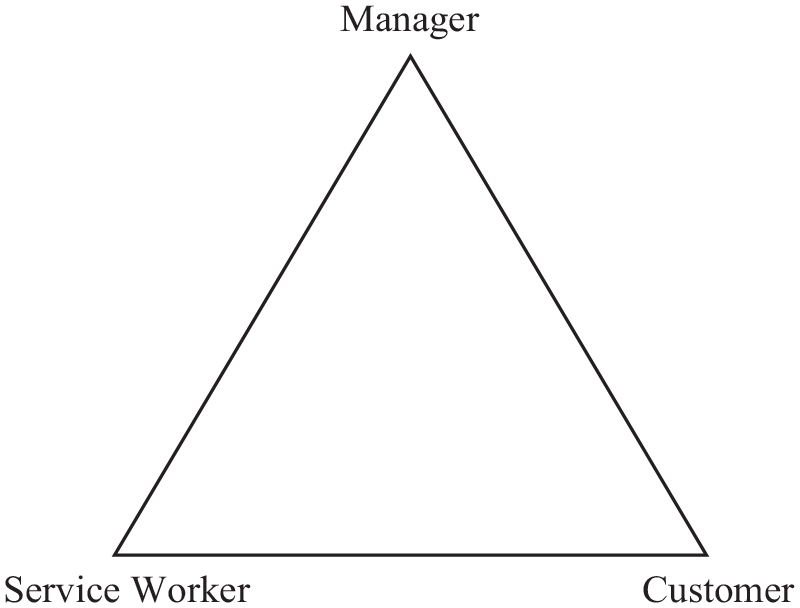
Service Triangle
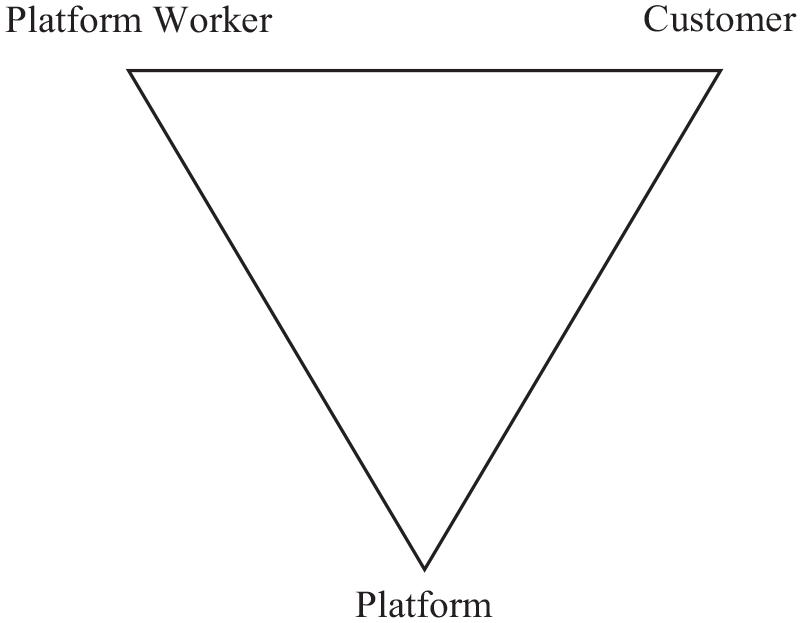
Gig Triangle
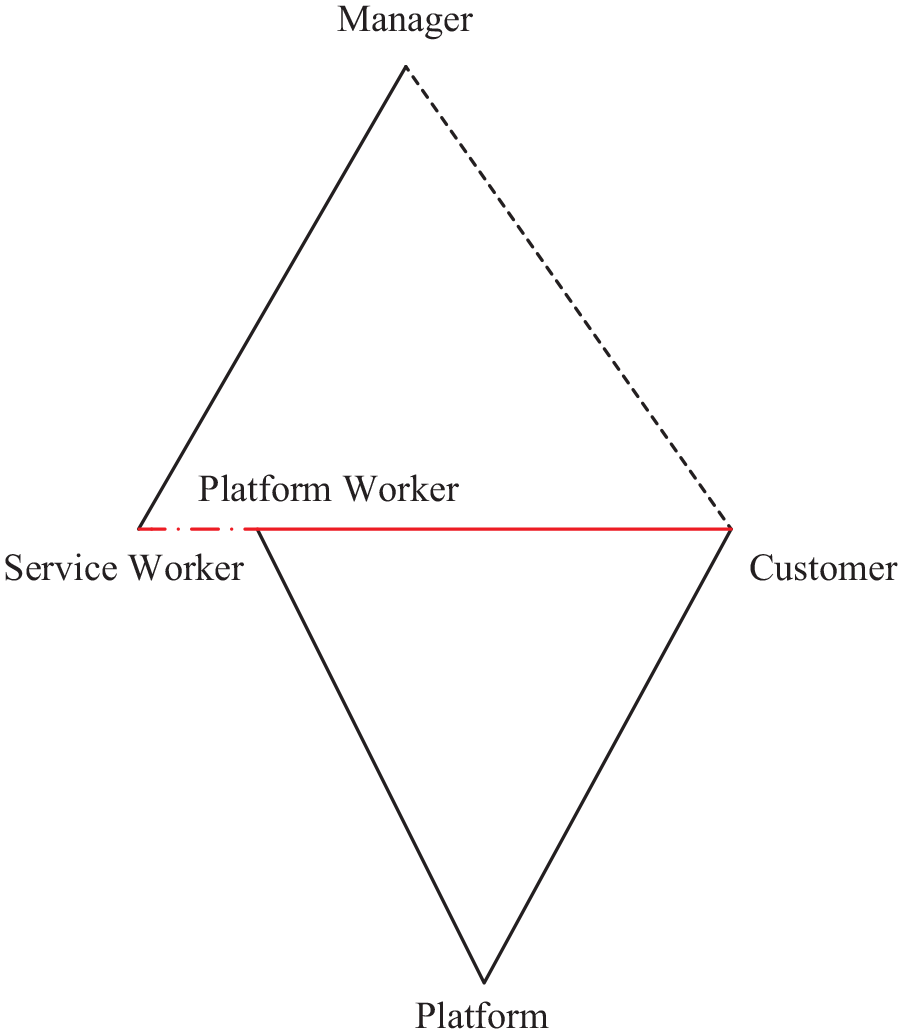
Intersection of the Service and Gig Triangles
Scholars have explored many of the relationships in Figure 2 from both the service worker perspective (for an overview of this literature, see Schneider et al. 2022) and the gig worker perspective (for an overview of this literature, see Vallas and Schor 2020). The intersecting triangles arrangement is unusual in that it creates a previously undocumented worker-to-worker interaction, depicted by the red dashed line. Extrapolating this relationship from existing theory is indeterminate but suggests that gig and service workers will form adversarial relationships, in which they are pitted against each other, or cooperative ones, in which workers engage in mutually beneficial acts of support.
Adversarial Relationships
Theory suggests two reasons gig workers may form adversarial relationships with more conventional workers. First, customers often mistreat service workers, most commonly because they desire prompt or personalized service (Lopez 2010; Van Jaarsveld, Walker, and Skarlicki 2010). The literature assumes that customers mistreat workers because they personally benefit from prompt or personalized service, but gig workers face a stronger incentive: Their future income may depend on it (Rahman and Valentine 2021). Research finds that platform companies build unforgiving, opaque, and strict performance management algorithms into their work systems (Griesbach, Reich, Elliott-Negri, and Milkman 2019; Kellogg, Valentine, and Christin 2019; Cameron 2021; Rahman 2021). Such systems often demand that gig workers complete their tasks quickly while simultaneously providing perfect service to customers. Indeed, these algorithmic pressures can be so coercive that gig workers engage in illegal or dangerous activities to appease both platform companies and customers (Maffie 2022). Whereas customers normally mistreat service workers out of a desire for a better service experience, platform companies’ performance management systems may push gig workers to do so.
Second, “blended” workplaces, in which organizations combine both standard and non-standard employees, can be rife with conflict (Davis-Blake, Broschak, and George 2003). For example, blended workplaces often develop hidden hierarchies to denigrate non-standard workers (Smith 1994), such as employees labeling non-standard workers “just a temp” (Feldman, Doerpinghaus, and Turnley 1994). Reminiscent of these hidden hierarchies, popular media reports suggest that service workers treat gig workers as “second class” customers (Gurley 2020). Furthermore, blended workplaces can increase standard employees’ job burdens, creating tension between them and their non-standard counterparts (Vough, Broschak, and Northcraft 2005). For example, standard employees can be tasked with overseeing, correcting, and training non-standard employees (Geary 1992), leading them to resent non-standard workers (Kochan, Smith, Wells, and Rebitzer 1994; Smith 1994). Should gig workers create additional burdens on standard workers, a similar dynamic could emerge.
Cooperative Relationships
By contrast, theory suggests two reasons gig workers may develop cooperative relationships with conventional employees. First, instead of an abusive dynamic, the worker-to-worker nature of the gig worker–service worker interaction could buffer customer demands. Research finds that in “backstage” spaces—that is, places workers interact with each other away from the customers—service workers build worker-to-worker bonds (Boyle 2011; DiBenigno 2022). These spaces facilitate camaraderie because they allow workers to genuinely interact and discuss the nature of their work, perhaps venting or joking about customers (Cohen 2010; Billingsley 2016). Because gig workers are not consuming the service product, their presence may create a “backstage moment” away from “real” customers, relieving service workers from needing to stay “in character” during their interactions (Wharton 2009) and enabling bonds to emerge between the two (Wang and Brewster 2020).
Second, frequent interactions between individuals can give rise to cooperative relationships (Chiaburu and Harrison 2009). These relationships are especially common in service work, where the interdependent nature of their tasks requires service workers to coordinate their work in order to provide a customer with service (Hochschild 1983; Larsson and Bowen 1989; Leidner 1993). For example, in food service, a host must evenly distribute customers across servers, servers must work collaboratively with line cooks to ensure that orders do not become cold, and bussers must clear tables in a logical fashion to ensure the next wave of customers can be seated (Subramanian and Suquet 2018). Framed this way, service work is not a single interaction, but consists of a combination of tasks on which groups of workers cooperate to create an overall service experience (Korczynski 2002). Although cooperative ties among service workers have been documented only among those who work for the same organization (Subramanian and Suquet 2018), these bonds can form between non-standard employees, such as contractors, and more conventional employees (Connelly, Gallagher, and Gilley 2007). As many gig workers frequently interact with service workers (Meijerink and Keegan 2019), similar ties could emerge between the two.
Are gig workers an app-based nemesis or potential friend to more conventional workers? Anecdotal evidence suggests both outcomes occur. At one extreme, media reports find that restaurant workers often treat gig workers as “subhuman” (Ongweso and Gurley 2020), even denying them access to store restrooms. At the same time, however, researchers note that some service workers bond with gig workers, even giving them small gifts or discounts on store products (Meijerink, Keegan, and Bondarouk 2021). Resolving these competing anecdotal and theoretical claims requires empirical investigation. Inductive, qualitative research is well suited for exploring such issues (Eisenhardt, Graebner, and Sonenshein 2016). Thus, I chose these methods to study the following research questions (RQs):
RQ1: Why do some gig workers develop adversarial relationships with service workers while others develop cooperative ones?
RQ2: What are the consequences of these relationships for gig workers and more conventional employees?
Study One: Investigating the Gig Worker–Service Worker Interaction
To explore these research questions, I interviewed 37 Instacart shoppers and 11 grocery store employees. During these interviews, I probed to understand the nature of these workers’ relationships. Next, I examined the consequences of these relationships from both a shopper and an in-store staff perspective.
Research Setting and Data
I situated this study in the grocery delivery industry because Instacart shoppers have frequent opportunities to interact with in-store staff. Following past qualitative research on platform workers (Griesbach et al. 2019; Cameron 2021), I recruited shoppers from an online community. Adhering to best practices, I initiated contact with the group’s administrator and interviewed him for the project. After this semi-structured interview, he introduced me to the group, and I posted a call for participants. I recruited 20 participants from this group and, following up with snowball sampling from these interviews, I was able to recruit a total of 33 participants. Semi-structured interviews lasted between 20 and 100 minutes and included a range of experiences, from shoppers who had just started working in the industry to those with more than three years of experience. During a follow-up project on Instacart shoppers, four participants provided useful information for this study, bringing the total number of shoppers to 37.
My interview questions were designed to probe workers’ experiences on the platform and examined a number of areas, such as: why workers began shopping, which platforms they worked on, their interactions with shopper support, and if they knew any of the in-store staff at the stores they shop. As appropriate, I asked follow-up questions to examine how other elements of their work, such as workers’ experience with the COVID-19 pandemic, influenced their answers. All interviews were conducted via phone, audio recorded, transcribed, coded, and anonymized. After each interview, I kept track of findings, statements, and relationships I found of interest in a field notebook.
To gain data on both sides of the shopper–staff interaction, I complemented these data with 11 interviews with in-store staff. These participants were also recruited from online communities. Interviews lasted between 30 and 90 minutes and, similar to the Instacart worker interviews, were recorded, transcribed, coded, and anonymized. Again, interview questions began broadly, asking about workers’ experience in stores, their responsibilities, how the COVID-19 pandemic had affected their work, their interaction with Instacart shoppers, and if/how these shoppers had altered their work.
In addition to these interviews, I embedded myself in three digital communities for three months. These groups ranged in size from 28 to more than 2,000 members. Within these groups, I observed how shoppers engaged with one another and gained a clear sense of the shoppers’ main topics of concern, such as declining batch pay, customer support, and changes to the Instacart app. These data were helpful in grounding the data from my qualitative interviews.
Method
I analyzed these data using an inductive approach, iterating between data and theory in order to understand the constructs in my data (Strauss and Corbin 2008). In my initial round of coding, I coded interviews for the number of platforms a worker used, gender, experience on Instacart, reasons for working a gig, if they have formed relationships with other workers online, if they have another full-time job, if they have a positive or negative view of Instacart and gig work, and if they prefer one platform over another. Table 1 presents an overview of respondent data. In my second round of coding, I examined the relationships gig workers formed with in-store staff. For example, when workers described themselves as friends or co-workers with staff, I coded these as cooperative relationships.
Gig Worker Inventory
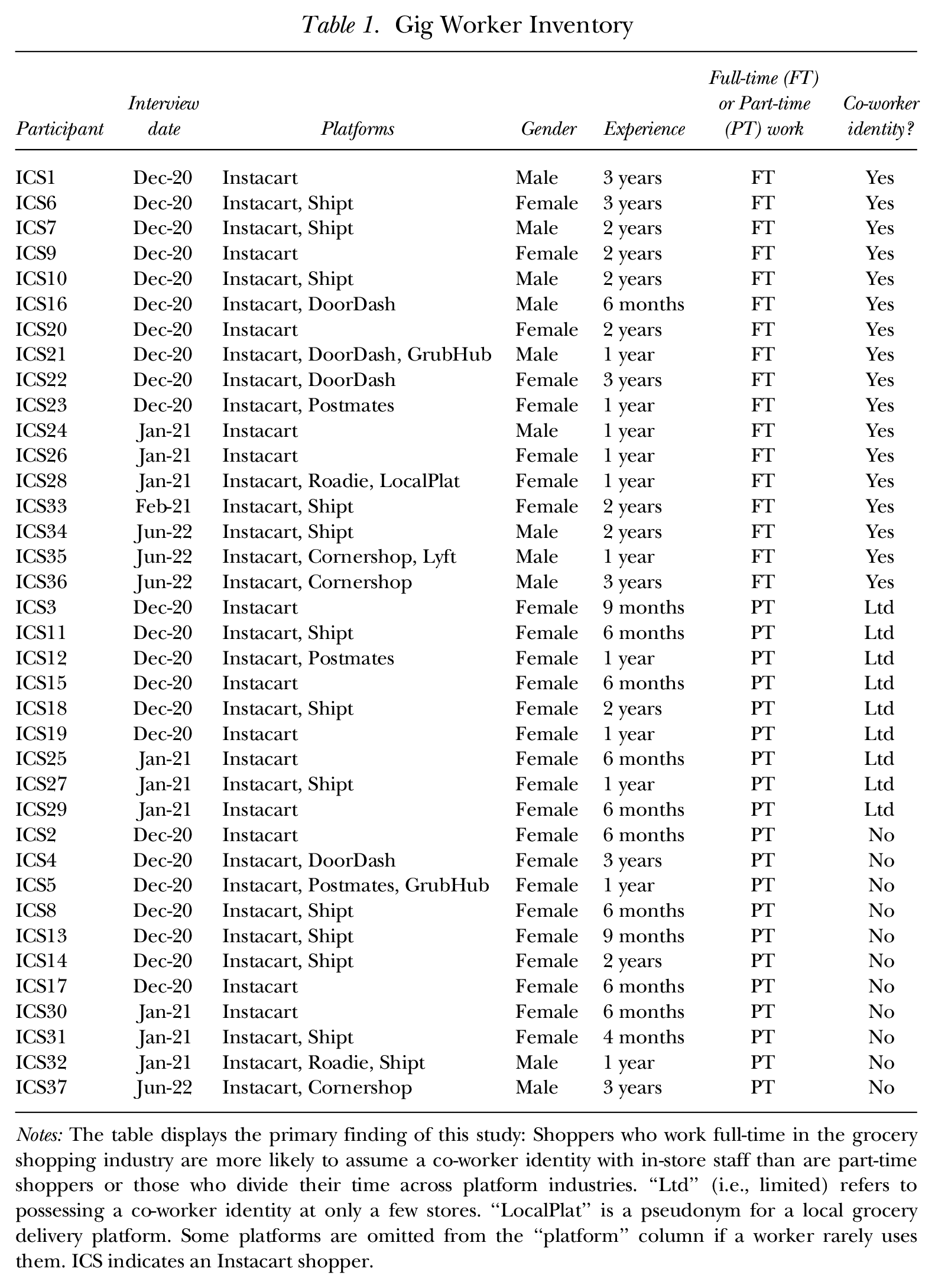
Notes: The table displays the primary finding of this study: Shoppers who work full-time in the grocery shopping industry are more likely to assume a co-worker identity with in-store staff than are part-time shoppers or those who divide their time across platform industries. “Ltd” (i.e., limited) refers to possessing a co-worker identity at only a few stores. “LocalPlat” is a pseudonym for a local grocery delivery platform. Some platforms are omitted from the “platform” column if a worker rarely uses them. ICS indicates an Instacart shopper.
In the next round of coding, I examined how cooperative relationships with in-store staff influenced shoppers’ work and identified two dimensions. First, shoppers described how they formed important social relationships with in-store staff, similar to those between more traditional co-workers. For example, shoppers learned the names of in-store staff and talked with them about personal matters, including, for instance, how their family was faring during the pandemic [Instacart Shopper (ICS)-25] (see Table 1 for participant information). I coded these interactions as social support. Second, shoppers described how ties with in-store staff helped improve their performance: They helped shoppers find unusual products, provided suggestions for substitute items, told shoppers if the store had extra items that had yet to be shelved, and helped shoppers get through the checkout line quickly. I coded these actions economic support.
After identifying these dimensions of cooperative relationships, I began coding in-store staff data. These data provided an important corrective to my initial findings; whereas well more than half of the shoppers in my sample reported forming cooperative relationships with staff, staff reported relatively few bonds with shoppers. Instead, in-store staff saw most Instacart shoppers as a burden because of their constant demands for assistance. Further analysis revealed that these concerns emerged from two pieces of Instacart’s algorithmic management system. First, Instacart uses a “speed timer” to push workers into completing their work as rapidly as possible. Second, Instacart reserves the highest-paying work for those with near-perfect customer ratings, requiring that workers provide perfect service in order to maintain their income. Faced with these competing demands, shoppers badger in-store staff for assistance, sometimes asking staff for help finding four or five items during each job. I coded these interactions as transfer of algorithmic pressure.
Finally, following Charmaz (2006: 63), I “weave[d] the fractured story back together” by combining data from in-store staff, shoppers, and my observations from online communities, focusing on gaps between existing theory and my data. This process inverted my understanding of shopper–staff bonds: By starting with shopper data, I had come to assume shoppers and staff normally form cooperative relationships. After analyzing data on both sides of the interaction, however, I saw that the more common relationship between shoppers and staff is an adversarial one, in which shoppers pester staff for help. Shoppers could modify this relationship by investing time and effort into building bonds with staff, shifting their relationship into a cooperative one. I describe each of these relationships below, starting with how Instacart’s performance management system pushes workers into developing an adversarial relationship with staff before turning to how some gig workers can overcome these pressures by building cooperative ties with staff.
Findings
Adversarial Shopper–Staff Relationships
The general relationship between Instacart shoppers and in-store staff is an adversarial one; staff view shoppers as a burden and a nuisance. This relationship emerges from a gap in the way platform companies intersect with more conventional organizations. On the one hand, Instacart pushes shoppers to work as quickly as possible while also providing customers with perfect service. On the other hand, Instacart does not always have access to critical logistical information about stores’ products, such as the location of items in a store or if an item is out of stock. As a result, shoppers are often searching for items—unsure if they have been moved to a new location, are out of stock, or simply waiting to be shelved. To resolve this dilemma, shoppers turn to the most available resource to help them meet their performance goals: in-store staff, often badgering them for help finding items in order to meet Instacart’s aggressive performance requirements: Oh,
Absent logistical support from Instacart, shoppers require additional support from staff because shoppers often do not know the location of various brands and products: When a regular customer comes in the door,
Because searching for items will harm their speed score, many shoppers immediately turn to staff for help: “ Sometimes I wish they [shoppers] would just give me the list and I could shop for them really fast.
Yet because Instacart shoppers were not “real customers,” in-store staff felt less pressure to appease them and would ignore their demands for specialized treatment. One staff member, who had previously been an Instacart shopper, put it bluntly by stating shoppers were “not customers” and that staff will “treat a customer a lot better than they’ll treat a shopper . . . like if a customer is being rude to them, they’ll just suck it up and deal with it, maybe go get a manager, do anything to appease them. Not for a shopper” [ISS-11]. Instead of deferring to Instacart workers as “customers,” some in-store staff would even treat Instacart shoppers poorly. “The cashiers, honestly, some of them are
Building Cross-Organization Co-worker Relationships
Although many Instacart shoppers experience adversarial relationships with in-store staff, repeat interactions between shoppers and in-store staff do allow gig workers to form a cooperative relationship with staff, which I refer to as cross-organization co-worker relationships. Similar to relationships that form organically within a more traditional workplace, these relationships are a function of time and effort, whereby gig workers who spend more time in the same stores have greater opportunities to build these relationships with the staff who work there. These relationships commonly emerged through socializing with in-store staff, such as one shopper who would stop by the meat counter even if the customer did not order meat because “the ladies at the meat counter love me” [ICS-07]. Others cultivated these relationships through exchanging personal stories with staff, or gift-giving, such as providing masks to in-store staff to help protect them against COVID-19 [ICS-11]. The repeated nature of these interactions allowed shared routines to emerge, as it was with one shopper who was greeted like the character “Norm” from the television show Cheers when she entered the store [ICS-29]. Much like servers who bond through shared professional experiences in “backstage spaces,” Instacart shoppers and staff bonded over shared experiences interacting with customers: The people who feel like co-workers are those who work in the grocery business, those who work in the stores. . . . You see the same faces every day. You are dealing with the same sort of clients and people. . . . You build this bond with people you see every day. [ICS-35]
Cross-organization co-worker relationships were so meaningful that one worker refused to work as an Instacart shopper when their in-store “co-workers” went on strike: “There was an instance when they [the staff] went on strike. While they were on strike, I didn’t do any Instacart—I was like,
Staff confirmed these bonds with gig shoppers; although Instacart shoppers are ostensibly customers, shoppers and staff were working toward the same goal, which was to provide customers with groceries: You form a bond with them [Instacart shoppers]. You’re definitely willing to help them out and stuff like that. . . .
This cooperation, however, was reserved for the shoppers the staff member (i.e., ISS-6) had bonded with. While she thought part-time shoppers should “figure it out . . . it’s your choice,” she was happy to help the shoppers she had bonded with: There are a few [shoppers] I’ve gotten to know over the last year. . . . You say, “hey, how’s it going?”
Because these bonds are a function of time and effort, infrequent shoppers struggle to develop a cooperative relationship with in-store staff. For example, some shoppers did not form bonds with staff at all: “I recognize them [in-store staff], and they might recognize me, but I haven’t had personal conversations with them” [ICS-30]. Other part-time shoppers develop a limited set of bonds with staff by accepting jobs at only a small number of stores: I’ve gotten to know some of the employees at some stores, like the Shop ’n Save by my house because I’m there enough. They’re very helpful if I come across something [that I can’t find]. The manager knows me; I was there this morning and he’s like, “back at it again?” [ICS-3]
While this strategy allows part-time workers to develop bonds in smaller stores, they struggle to do the same at larger ones: I shop at Trader Joe’s about three times a week, maybe four times a week. . . .
Maintaining these relationships is also challenging for infrequent shoppers; while full-time shoppers have ongoing contact with staff, infrequent shoppers’ bonds can atrophy, as was the case with one shopper who felt her relationships with in-store staff frayed after she reduced her hours on the platform: “Right now, I only work occasionally, but a few months ago, I was working every day and they [the in-store staff] definitely knew me at that point. They would say, ‘oh hey, you’re back again today’ and we were always friendly. If I go back to the stores that I went to a lot during that time frame, they’ll still recognize me, but if it’s a random store, then no” [ICS-19].
Benefits of Cross-Organization Co-worker Relationships
Social Support
Similar to more traditional co-workers (Chiaburu and Harrison 2009), cross-organization co-workers provide gig workers with social support, reducing their isolation and providing personal and emotional support at work. For my informants, social support took many forms, such as checking in on how sick family members were faring during the pandemic: “I know some of the cashiers, one woman who greets people at the door. The other day she said to me, ‘oh, where’s your nephew?’” [ICS-25]. Another shopper with an autoimmune disease described how having these relationships—having others “appreciat[e] you”—made the work more uplifting: They notice if I’m not there [at the store shopping] for a while, and I’ll be like, “I was sick.” They know I have lupus. You just get talking to them when you’re in there five times a day. . . . To know that they’re nice—it’s more a social thing for me—
These personal connections were important because of the lack of support workers felt from Instacart. When asked how shoppers thought Instacart saw them, the most commonly used term was “disposable” [ICS-11, ICS-15, ICS-09]; others used phrases or terms such as “a cog in a machine” [ICS-18] or simply “meat” [ICS-32]. By contrast, gig workers felt grocery store companies valued them because their labor allowed stores to provide customers with products during the pandemic, “It's the companies I work with [grocery stores] that actually value me. Instacart could [sic] care less, honestly” [ICS-10]. While platform work felt isolating, relationships with in-store staff “ma[de] the job a lot more tolerable” [ICS-07].
Economic Support
Whereas shoppers who formed adversarial relationships with staff try to demand staff’s help so that they can meet Instacart’s performance management goals, in-store staff were happy to provide their cross-organization co-workers with economic support when working. Conceptually, economic support is derived from staff’s knowledge about and resources in a store. First, shoppers often draw on in-store staff’s knowledge of the store layout: At our local ALDI . . . I know them [in-store staff] all by name. . . . If we're looking for something . . . they'll ask us if we're looking for an item and help us out as much as they can. . . . If you know you can go to somebody for help, it definitely makes it easier. [ICS-20]
In-store staff’s product knowledge is especially useful when shoppers are searching for unusual items or products they rarely purchase, “Without their help, Jesus, I suck at finding wine, and all they do is grab one and [say] ‘here it is’” [ICS-34].
Second, in-store staff have access to exclusive resources that can help shoppers complete their work. For example, one shopper had a “crazy order” for a customer who was conducting a cooking class, requiring her to purchase 480 items [ICS-11]. Because of this shoppers’ relationship with the store manager, the manager dispatched two in-store staff members to help her shop and take the bags to her car. In-store staff, however, can also help shoppers quickly move through checkout lines, including opening lines for shoppers so that they can skip lengthy waits: “One time an employee at Aldi’s opened a line and let me skip everybody because she knew that I needed to get out of there” [ICS-22].
Third, and perhaps the most important way that in-store staff help shoppers, is by letting shoppers know if items that appear as “out of stock” are just waiting to be shelved. This insight was especially important during the first few weeks of the COVID-19 pandemic when stores could not keep certain items shelved, such as dairy goods. Yet for shoppers with strong relationships with staff, they would “drop whatever they were doing” to help shoppers, and “nine out of ten times, it [the item] will be in the back [of the store]” [ICS-29]. These relationships gave shoppers access to items that other shoppers could not find, increasing the chances they could deliver a full order and “keep the majority of their tips”: I tried to familiarize myself with them [the in-store staff] so that if I come across an out-of-stock item, I'll go and ask Susie, who works behind whatever counter [and ask], “hey, do you have any of this in the back?” I'm more likely to have a positive response rather than them just thinking that I'm trying to irritate them or getting away with something. [ICS-09]
Cross-organization co-workers received other forms of economic support as well, such as gaining access to items that had been held back from the general public [ICS-07] or more generally receiving help in the event something went wrong during their work: It [relationships with store staff] really helps you tremendously. . . .
Finally, once shoppers become seen as cross-organization co-workers, cashiers pay greater attention to items during checkout, ensuring that they are properly bagged and separated to make it easy for shoppers to drop off each order: The relationships that I built with the workers [the in-store staff] have been
Shoppers who form bonds with staff feel that staff’s economic support is “crucial” to their success. Similar to Amazon Mechanical Turk (Martin, Hanrahan, O’Neill, and Gupta 2014), Instacart offers the most lucrative work to those who have a perfect (or near-perfect, approximately 4.98+ out of 5) performance score. Should shoppers obtain a low customer evaluation score, they are required to work 100 batches before the sub-5.0 score is removed from their performance rating. Additionally, customers could adjust their tips for up to 24 hours after delivery, directly tying high-quality service to workers’ immediate earnings: Anything under a four-point-nine-eight, you just have to take whatever you can get. . . . It takes one hundred orders to make the bad rating go away, so I had to take whatever, you know, nine dollars to do a forty-unit shop that takes me an hour [to complete]. And if you don’t take those, your [poor] rating will never push away. . . .
These findings indicate that the pressures platform companies place on gig workers, combined with a general lack of support, leads gig workers to develop adversarial relationships with more conventional employees. Yet repeated interactions between gig and service workers can shift this relationship onto cooperative terms, allowing gig workers to become a cross-organization co-worker and providing them with access to social and economic support. The benefits of a cooperative approach appear to go beyond what other shoppers try to demand of in-store staff (i.e., item location), and include other types of support, such as opening new checkout lanes or holding back items from the public, giving these workers a cooperative solution to the dilemma they face when working.
Study Two: Convergent Validation of Cross-Organization Co-worker Relationships
In this study, I use a convergent triangulation approach to examine the cross-organization co-worker relationships found in Study One. Convergent triangulation is the “complex process of playing each method off against the other so as to maximize the validity of field efforts” (Denzin 1978: 304) and helps address “threats to internal and external validity” (Denzin 1978: 308). Such an approach seeks to provide “further empirical evidence using another research method” (Kelle and Erzberger 2003: 467). Furthermore, triangulating qualitative data with quantitative data is especially useful because it can help test if “a pattern or idiosyncrasy they [researchers] thought was there is not” (Sandelowski, Voils, and Knafl 2009).
Accordingly, I developed an original survey instrument to “play one method off against the other” and address three limitations to the qualitative study. First, while the qualitative study was based in one city, in this study I recruit participants from across the United States to test the transferability of these findings to the wider population of interest (Morgan 1998). Second, many of the participants in my qualitative study began working in the first few months of the COVID-19 pandemic, raising the possibility that their relationships with staff emerged in response to the general increase in social isolation at this time (Bu, Steptoe, and Fancourt 2020). Collecting quantitative data one year after Study One enables me to test if these relationships were driven by workers’ temporary desire for greater social contact in the early period of the pandemic. Finally, gig workers who form bonds with in-store staff may be inclined to believe that these relationships naturally yield economic benefits. Comparing the performance of workers with these bonds to those without provides more direct evidence for the relationship between shopper–staff bonds and workers’ ability to meet their performance goals.
Participant Recruitment
Recruiting platform workers is challenging because these workers lack a central gathering place, such as a workplace (Parrott and Reich 2020), and platform companies filter partnership requests to ensure that research will reflect favorably on the company (Horan 2019). Previous research has addressed these methodological barriers in two ways. First, researchers use online communities, such as Facebook, as central gathering hubs for workers (Griesbach et al. 2019; Maffie 2020). Second, researchers recruit from multiple types of gathering spots—such as labor unions, worker associations, and social media influencers (Maffie 2022; 2023a). Following these best practices, this study gathered participants from two online communities, each with roughly 2,000 members, and a social media influencer, the “Gig Tetris Dude.” Across these recruitment channels, a total of 269 participants signed up to participate in the study.
Research Design
In this study, I distributed three surveys to participants, each spaced two weeks apart. To help address concerns around a common method bias (Podsakoff, MacKenzi, Lee, and Podsakoff 2003), the first survey gathered data on the independent variables of interest, and the dependent variables appeared in the third wave. Of the 269 shoppers who began the study, 171 provided usable data on the final survey, reflecting a 64% retention rate.
Variables of Interest
Independent Variable: Shopper–Staff Bonds
From my qualitative interviews, I developed an original 5-item scale to measure shoppers’ relationship with in-store staff: 1) I feel comfortable asking store staff if there are out-of-stock items in the back at [store], 2)[Store] employees have asked me for help in the past, 3) I feel like I am on a team with the [store] employees, 4) I value and respect [store]’s employees, 5) I could not do my job as well without the relationships I have with the staff at [store]. Workers could answer these questions on a 1 to 5 Likert scale (strongly disagree (1) – strongly agree (5)). Workers completed this scale for the three stores in which they most commonly shop. Across all stores, the resulting scale returned a 0.77 Cronbach’s alpha.
Because this study examines if shoppers’ bonds with staff shape their access to resources and support, I calculated workers’ average support across their three stores. For example, if a worker had the following scores on the store-staff bond scale (Store 1: 4.5, Store 2: 4, Store 3: 2), their average score would be 3.5.
Dependent Variable: Shopper Performance
My qualitative study found that shoppers who develop cooperative relationships are better able to find items in a store and also achieve higher customer satisfaction than those without these bonds. I operationalize these outcomes using the following variables:
Speed Rating
I use workers’ Instacart “speed rating” as a way to measure how long it takes workers to complete a job. I selected this measure because it is easy for shoppers to check in their shopper app, reducing the chance of a perception bias. The Instacart app calculates this rating based on two components: the average number of seconds it takes workers to find an item and the number of seconds in the checkout line. Lower speed times indicate that workers are spending less total time shopping an order. The median (81) and mean (90) speeds indicate that it takes the average shopper in this study between one and two minutes per item, when accounting for checkout times.
Customer Tips
At the time of this study, customers were allowed to adjust workers’ tips in the app for up to 24 hours after a shopper drops off an order. In this study, I asked shoppers the number of customers who increased their tips in the previous week. Because workers who take more batches will have more opportunities for customers to increase their tips, I divided this number by the number of total orders a shopper worked the previous week. I focus on tips as a measure of performance because it was the most commonly cited reason why store-staff bonds were economically important for shoppers. Customers increasing a shopper’s tips is a rather common occurrence, with more than 44% of participants in this study indicating they had at least one customer increase a tip during the previous week. Furthermore, the mean suggests that approximately 10% of customers increase a shopper’s tip post-delivery.
Control Variables
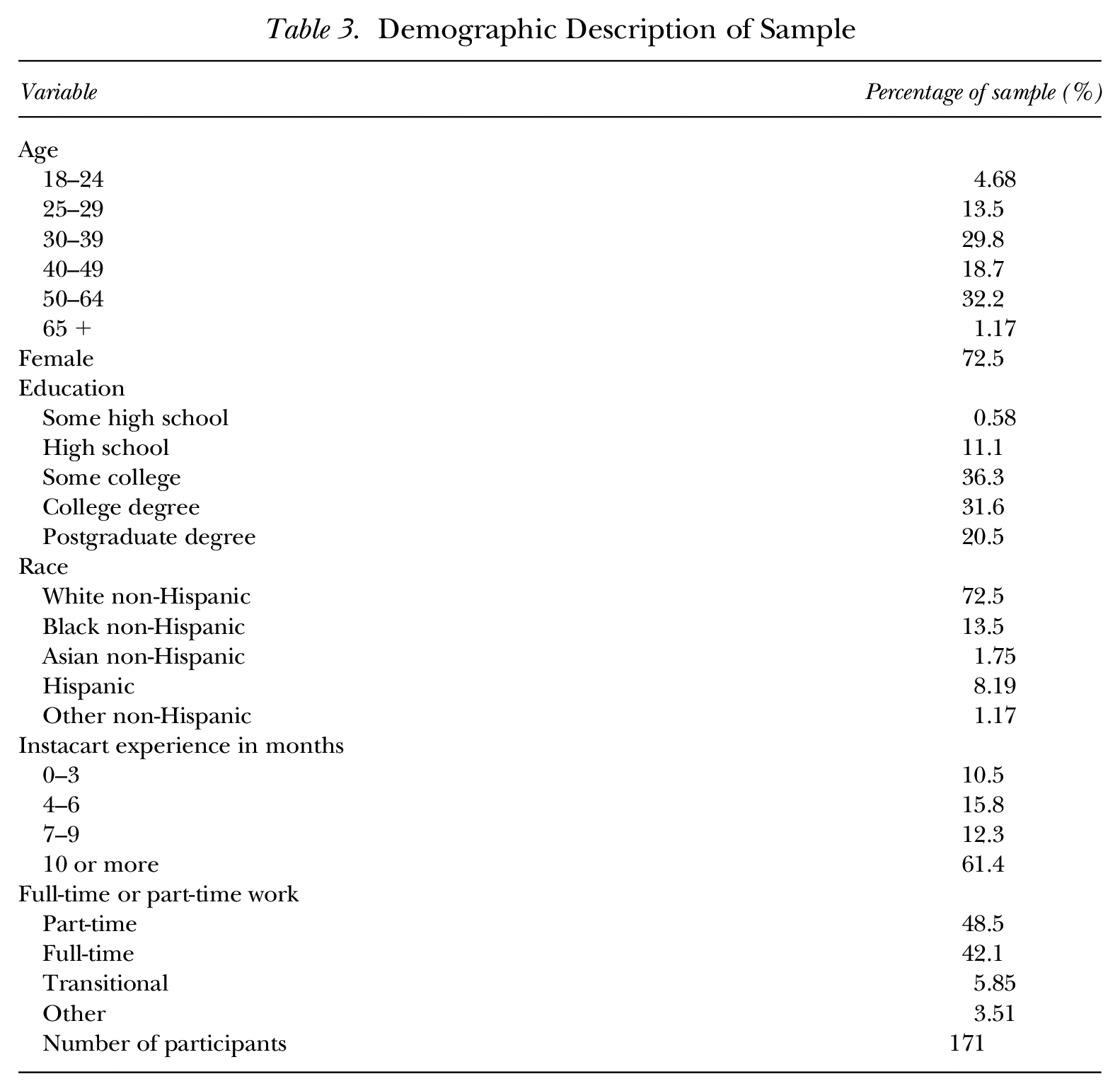
Several factors must be accounted for when estimating the relationship between shoppers’ bonds with staff and their overall performance. First, both experience (Cook, Diamond, and Hall 2018) and shoppers’ frequency of work will correlate with their opportunities to form relationships with staff (i.e., the independent variable [IV] of interest) and their overall performance (i.e., the dependent variable [DV] of interest). Accordingly, I collected data on how long participants had been shopping for Instacart and if they are full-time, part-time, are working Instacart between jobs, or work for other reasons. Second, I control for four demographic variables (age, race, education, and gender) that could shape both shoppers’ opportunity for forming bonds with staff and customers’ evaluation of shoppers’ performance. Summary statistics for the variables in this study are presented in Tables 2 and 3.
Descriptive Statistics of Key Independent and Dependent Variables
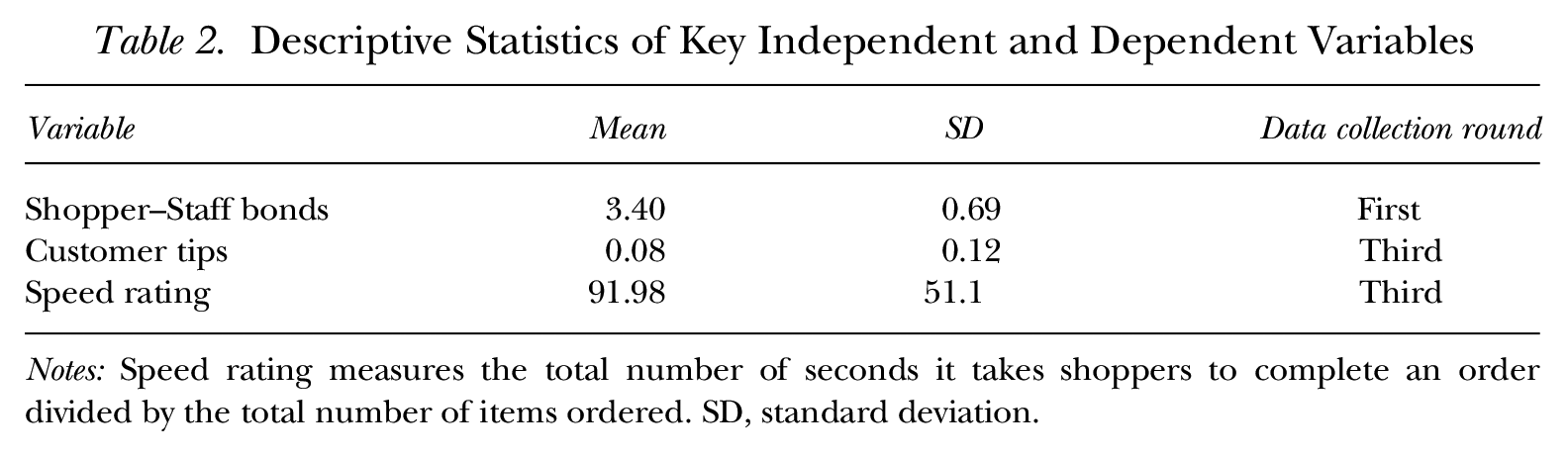
Notes: Speed rating measures the total number of seconds it takes shoppers to complete an order divided by the total number of items ordered. SD, standard deviation.
Demographic Description of Sample
Results
I modeled these data two ways. First, I use a Tobit model to estimate the relationship between customer tips and shoppers’ ties with in-store staff because the response variable is censored at zero and one. Furthermore, 55% of these data are censored at zero. Tobit models decompose estimates into the probability of observing an outcome above the truncated point and the linear change in an observation above the truncation point (Batt, Colvin, and Keefe 2002). The latter estimate can be interpreted similar to an ordinary least squares (OLS) coefficient after appropriate adjustments. Decomposing the estimates in this fashion enables Tobit models to use all observations when estimating the regression line (Haines, Jalette, and Larose 2010). Estimates that appear in Table 4 can be interpreted similarly to an OLS estimate. That said, modeling these data using an OLS model returns substantially similar results. Second, I use an OLS model to estimate the relationship between shoppers’ speed rating and their relationships with in-store staff. While these data are also theoretically censored at zero (it is impossible for someone to take negative time to complete a job), zero observations fall at the censor point. Accordingly, OLS is an appropriate model for these data.
Effect of Shopper–Staff Bonds on Shopper Performance
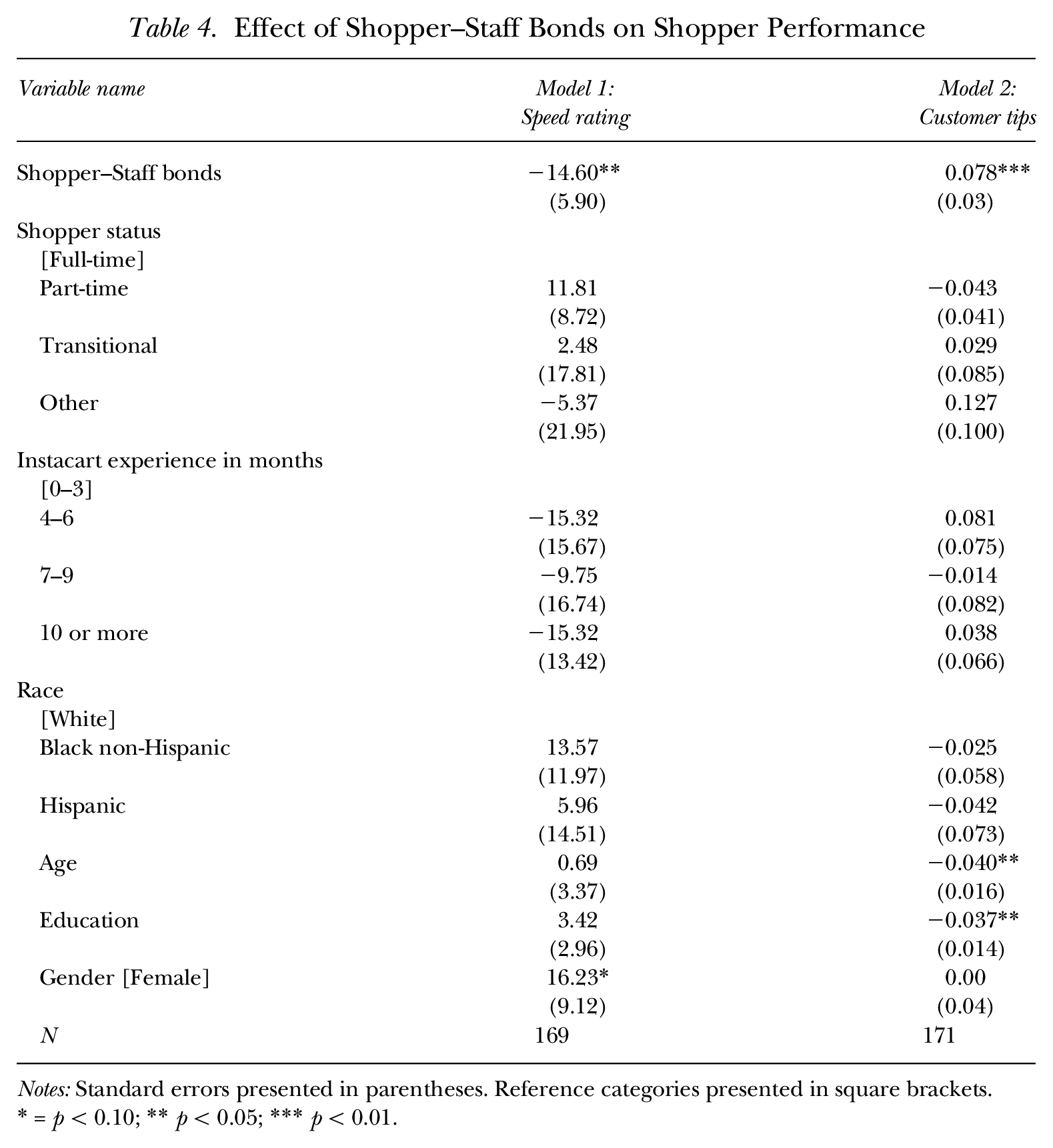
Notes: Standard errors presented in parentheses. Reference categories presented in square brackets.
= p < 0.10; ** p < 0.05; *** p < 0.01.
Table 4 displays the results of this study. In Model 1, I examine if, all else equal, a worker’s bonds with in-store staff predict their speed ratings. In this model, I find a significant (p < 0.05) negative (–14.60) relationship between shoppers’ bonds with staff and shoppers’ speed rating. This finding suggests that a one-point increase in shoppers’ bonds with in-store staff is associated with about a 15-second reduction in combined shopping and checkout time per item. Model 2 tests if stronger bonds with in-store staff are associated with a greater percentage of customers increasing shoppers’ tips. Here, I find a significant (p < 0.01) positive (0.078) relationship between shoppers’ ties with in-store staff and the percentage of customers who increased their tips. For scale, a two-point increase in the in-store staff bond scale would increase the number of customers who increase shoppers’ tips by roughly one standard deviation (0.12). These results validate my qualitative finding that gig workers who develop cooperative relationships with staff are able to translate these relationships into higher performance.
Discussion
By exploring the gig worker–service worker interaction, this article shows how the challenges of the gig economy are spilling over to negatively affect those workers in more conventional forms of employment. Specifically, I find that the pressures platform companies place on gig workers can transform gig workers into service workers’ app-based nemeses by their badgering of service workers for aid and attention. Yet a subset of gig workers overcome these pressures by creating a novel type of relationship—the cross-organization co-worker—with conventional workers, thus giving gig workers access to more conventional employees’ social and economic support. These findings provide new insight into how the gig economy is transforming workplace dynamics in more conventional settings.
Algorithmic Management and App-Based Nemeses
Since the beginning of platform scholarship, the toxic triangular interplay of customers, platforms, and workers has been clear (Rosenblat and Stark 2016): Platform companies, in an attempt to force workers to cater to customers’ every need, design their performance management systems in a fashion that requires workers to provide prompt, attentive service. This dynamic has been studied in the “gig triangle” (Maffie 2022), but scholars have yet to widen their scope of inquiry to examine how platform companies’ performance management systems may affect actors outside of this immediate triadic exchange. In this study, I include a new actor—conventional service workers—and examine how they interact with gig workers and platform companies. I find that when platform companies send workers into another organization, such as a grocery store, platform companies’ lack of support and algorithmic pressures result in many gig workers using and abusing the resources of conventional organizations. Specifically, I find that gig workers mistreat more conventional service workers, pestering these workers in an attempt to gain their assistance. This finding provides new insight into both the customer incivility and platform literatures.
With respect to the customer incivility literature, this study finds that platform companies contribute to the burdens of workers in the wider service economy. While past scholarship finds that platform companies contribute to the mistreatment of their workers by designing opaque and unforgiving performance management algorithms (Rosenblat and Stark 2016), this study finds that algorithmic pressures push gig workers into badgering more conventional employees. This finding illustrates the shortcoming of depicting gig work as an isolated triangle: When gig and service workers interact in these “intersecting triangles,” algorithmic pressures flow through gig workers onto service workers. Gig workers do so because they, similar to more traditional service workers, are pinned between “two bosses”—the algorithm and the customer—and lack the necessary support to appease both.
Yet traditional service workers were not powerless in these adversarial interactions because the interactions feature power relationships that differ from those found in the traditional service triangle. Whereas service workers are typically subordinated to customers (Leidner 1993; Lopez 2010), I find that Instacart shoppers could not avail themselves of the full power of a traditional customer because they were not shopping for themselves. Consistent with media reports that gig workers are given “second class” treatment by service workers (Gurley 2020), staff were less tolerant of these workers’ behaviors, while some even acted mean or “nasty” toward gig workers. These findings show how gig work creates new stresses for service workers but also shifts the power dynamics within conventional organizations in such a way that service workers can express greater frustration or annoyance when interacting with gig workers.
More broadly, however, these adversarial dynamics suggest that platform companies use and abuse the resources of conventional organizations. In most triangular employment relationships, host organizations control non-standard workers’ behavior, such as temporary contract workers who are managed by the hiring firm (Cappelli and Keller 2013). Yet in “intersecting triangles” situations, platform companies do not have a formal relationship with the firm to which they send their workers. Absent these relationships, when platform companies prioritize their own interests—customer satisfaction—they can neglect or outright damage more conventional firms. Although past research has found that platform companies mistreat public spaces in an effort to attract and retain customers, such as ride-hail companies increasing traffic congestion in large cities (Szymkowski 2021), no study has extended this work to private employers. Future research can further build on this line of inquiry by examining if platform companies encourage gig workers to mistreat more conventional employers’ physical space as well. For example, do gig fitness instructors leave training facilities in worse conditions than do typical clients? Or are DoorDash delivery drivers more likely to take additional resources (e.g., napkins, sauces, cutlery, and so on) from fast food restaurants compared to regular customers? Findings could demonstrate whether platform companies’ desire to attract and retain customers not only contributes to poor labor conditions on their services (e.g., Vallas 2018) but pushes workers to mistreat more conventional organizations as well.
Promise of Cross-Organization Co-worker Relationships
More intriguing than these adversarial dynamics, however, is that for a set of gig workers, a cooperative strategy exists that leaves both gig and service workers better off. I find that, in contrast to gig workers who interact with staff only rarely, repeated interactions among (primarily) full-time gig workers and service workers gives rise to cross-organization co-worker relationships. Similar to other cooperative relationships (Axelrod 1985), cross-organization co-worker relationships require the parties to have frequent repeat interactions. Once gig workers become seen as co-workers, they gain access to what other gig workers try to demand: conventional employees’ knowledge and support. I find that these bonds not only give gig workers access to new resources, such as items that have yet to be shelved, but emotional support as well, making gig work less isolated and lonely. Gig workers reciprocate in-store staff’s support through task-related help, such as returning carts to the store from the parking lot. Using new survey data from 171 shoppers, I find evidence that a cooperative strategy is superior to an adversarial one, whereby shoppers who develop cross-organization co-worker relationships with in-store staff are able to achieve higher performance compared to those who do not form these bonds. This finding expands how scholars think about several literatures.
Within the gig work literature, the cross-organization co-worker relationship provides new insight into how gig workers improve their performance over time. Existing research on gig worker performance focuses on these workers’ strategic behavior, such as work-arounds, (Möhlmann and Zalmanson 2017; Chen, Yuan, Ma, and Hanrahan 2019; Kellogg et al. 2019), screening customers (Cameron and Rahman 2021), or building software (Irani and Silberman 2013). By expanding the scope of inquiry to include other workers, this article brings the “human element” into an otherwise mechanically focused literature. Specifically, repeat interactions between gig and service workers creates a cooperative strategy, through which gig workers build bonds with those who have access to resources they need. These relationships provide a new dimension by which to analyze gig worker performance and could explain why past research finds unexpectedly high returns to gig workers’ experience (Dai, Swaminathan, and Xu 2022). Future research can further refine these findings by validating the scales used in this study and examining how they compare to other similar constructs.
For the service work literature, cross-organization co-worker relationships show how the gig economy creates a novel interest alliance across organizational boundaries. Whereas scholars know that frontline service workers can form bonds with repeat clients (Morais, Kerstetter, and Yarnal 2006), such as home health care aids and patients (Wicks 1998), I find that these workers’ mutual shared interest—satisfying a distant customer—creates an interest alliance between the two. This finding indicates that workers not only navigate alliances within the workplace, such as those with managers (Rosenthal 2004), but that workers can form interest alliances across organizational divides. Such an outcome raises the prospect that workers could use cross-organizational alliances to achieve other goals, such as resisting managerial control. Future research along these lines would be a fruitful addition to the gig and service work literatures.
More generally, cross-organization co-worker relationships show how gig work can enrich more conventional organizations. While research shows that traditional co-workers provide task and emotional support to one another (Chiaburu and Harrison 2009; Subramanian and Suquet 2018), I extend these findings by showing that gig workers support more conventional employees several ways, such as bringing carts back into a store or helping traditional customers find items. Although gig workers performed these actions because of the bonds they forged with more conventional employees, these acts could also be seen as organizational citizenship behaviors that aid an employer. This finding opens several future research directions that explore how gig workers can engage in organizational citizenship behaviors that support more conventional firms. For example, do gig fitness instructors who form cross-organization co-worker relationships with gym staff help clean equipment or teach classes? Or do gig workers who restock grocery store shelves support their cross-organization co-workers by returning misplaced items? These findings would show that, in contrast to damaging more conventional organizations, gig workers can enrich traditional firms and that employers should foster ties between gig workers and their employees.
Conclusion
By examining the gig worker–service worker interaction, this article documents how platform companies push their workers to mistreat conventional employees. Gig workers do so because they are subject to demanding performance standards, requiring these workers to complete their jobs quickly and without sufficient support from platform companies. As a result, gig workers pester more conventional workers for aid, shifting the algorithmic pressure they feel onto service workers. Yet for a set of mostly full-time gig workers, a cooperative solution to the pressures they face emerges: They can develop cross-organization co-worker relationships with more conventional employees. Once staff begin to see gig workers as “co-workers,” these workers gain what other gig workers attempt to demand: attention and support from in-store staff. Drawing on new survey data, I find evidence that a cooperative solution is superior to the more common adversarial one, whereby gig workers are able to achieve higher performance metrics through cooperation with staff. Crucially, these dynamics illustrate that the labor problems of the gig economy are not confined to the gig economy. Instead, platform companies’ inferior support and intense pressures are spilling over to affect those in other occupations, demonstrating how poor labor standards in the gig economy create new burdens for more traditional workers.
As with any theory-building article, it is important to acknowledge unknown boundary conditions and the ways future scholars could build on this work. First, while this article is the first to document the nature of gig worker–service worker bonds, our understanding of this phenomenon could be refined by exploring how the personal characteristics of these workers shape the nature of their bonds. For example, do extroverts or those who have high trust in others form these bonds more frequently? Furthermore, the participants in this study may not be representative of the entire population of gig or service workers. Although triangulating two distinct data types helps offset some of these limitations, future researchers who have access to a random sample of gig workers could develop a paired study to create more precise point estimates of the phenomenon of interest. That said, researchers have found that gig workers are generally reliable in self-reported data (Maffie 2023b). Finally, it is important to acknowledge that both of my studies were conducted during the COVID-19 pandemic, which could have influenced individuals’ desire for social contact. This work partially accounts for this issue by spanning more than a year of the pandemic, including time post-vaccine, thereby reducing the chance that the pandemic contaminated the results presented in this article.
