



Abstract
The COVID-19 pandemic led to an unprecedented expansion of working from home. To capture the individual well-being implications of this profound social change, the authors examine how workers’ affective well-being changed from pre-pandemic to the pandemic era and how such change varied at the intersections of work location, parental status, and occupational teleworkability. Data came from the American Time Use Survey (2003–2021), the American Community Survey, the Current Population Survey, and the Oxford COVID-19 Government Response Tracker. Ordinary Least Squares models show that the pandemic exacerbated negative affect the most for remote-working parents in less-teleworkable occupations. This pandemic impact was most pronounced during school closures, suggesting that rising challenges in balancing work–family demands heightened negative affect among remote-working parents with less-teleworkable occupations. Overall, this study reveals the heterogeneous well-being impacts of working from home and highlights the adverse implications of weak care infrastructures and inadequate workplace support for parental well-being.
The COVID-19 pandemic led to an unprecedented expansion of working from home (Dey, Frazis, Loewenstein, and Sun 2020; Fan and Moen 2022; Barrero, Bloom, and Davis 2023). As millions of workers abruptly transitioned to working from home, what happened to their affective well-being, and was it experienced evenly across social groups? Pre-pandemic research offers mixed evidence on the well-being implications of working from home (e.g., Bailey and Kurland 2002; Allen, Golden, and Shockley 2015; Song and Gao 2020; Yang, Kelly, Kubzansky, and Berkman 2023). Moreover, applying pre-pandemic findings to the pandemic era is challenging, considering the selective nature of remote work prior to COVID-19 (Mas and Pallais 2020; Kelly and Moen 2021) and the largely “enforced” nature of remote work during the pandemic, at least in its early stages (Anderson and Kelliher 2020; Gueguen and Senik 2023).
An emerging body of research has been conducted since the pandemic onset to understand the link between working from home and subjective well-being (e.g., Fan and Moen 2023; Gueguen and Senik 2023; Restrepo and Zeballos 2023; Wels et al. 2023; Yucel, Latshaw, and Kim 2024). With few exceptions (Yucel et al. 2024), this line of research has primarily focused on the pandemic period, not treating COVID-19 as a watershed moment to directly assess whether remote work may have led to different well-being outcomes across distinct historical moments. Additionally, there has been less investigation on whether the combination of occupational and family contexts might have made the well-being effects of remote work especially salient among certain workers.
This study leverages the COVID-19 pandemic in two ways to advance the existing research. First, we use the pandemic as a structural break that may have shifted the well-being implications of remote work. Second, given the parenting challenges brought to the forefront during the pandemic (Yavorsky, Qian, and Sargent 2021), we use the pandemic to assess the role of family caregiving obligations—along with occupational attributes—in potentially complicating the relationship between remote work and affective well-being.
Accordingly, we integrate four data sets—the 2003–2021 American Time Use Survey (ATUS), the 2021 American Community Survey (ACS), the 2021 Current Population Survey (CPS), and the Oxford COVID-19 Government Response Tracker (OxCGRT)—to address the following questions. First, did the association between working from home (versus working away from home) and affective well-being change from before to during the pandemic? We focus on affective well-being, a distinct component of subjective well-being that captures individuals’ instantaneous emotional experiences, such as feeling stressed, sad, and happy, throughout the day when they engage in various activities (Krueger and Stone 2014; Giménez-Nadal, Molina, and Velilla 2023; Qu and Robichau 2024).
Second, to the extent that the relationship between work location and affective well-being differed between pre-pandemic and pandemic periods, whose well-being was most affected by the pandemic? We focus on family and occupational circumstances, given that parents encountered more work–family challenges during the pandemic than did non-parents and that some jobs are more adaptable to a home working environment than others (Calarco, Meanwell, Anderson, and Knopf 2020; Dingel and Neiman 2020; Albanesi and Kim 2021; Yavorsky et al. 2021; Fan and Moen 2022). As such, we evaluate the pandemic as a structural break in the well-being implications of work location for parents and non-parents separately and assess how these relationships are further moderated by an occupation’s capability to be performed from home, which we term occupational teleworkability.
We contribute to ongoing debates and scholarship on the future of work—in particular, how new work arrangements, such as nontraditional work locations, shape worker well-being and may produce social inequalities (Berkman, Kawachi, and Theorell 2014; Kalleberg 2018; Kelly and Moen 2021). We demonstrate that working from home is associated with different levels of affective well-being depending on family caregiving obligations and occupational teleworkability. These findings have implications for organizations because affective well-being is linked to not only better health and longevity but also positive work outcomes such as higher productivity and performance ratings, lower turnover and absenteeism, and a greater propensity to exhibit exemplary organizational citizenship (for reviews, see Harter, Schmidt, and Keyes 2003; Lyubomirsky, King, and Diener 2005; Krueger et al. 2009). Our findings offer valuable insights into how organizational support and policies can be tailored to address the unique challenges faced by diverse groups of employees, thereby enhancing their affective well-being. These insights will benefit workers, organizations, and businesses beyond the pandemic era, as working from home has become a permanent fixture in many organizations around the globe (Aksoy et al. 2022; Barrero et al. 2023).
The Shifting Meaning of Remote Work from before to during the Pandemic
Pre-pandemic studies on remote work painted an inconsistent picture of its impact on subjective well-being. By offering employees flexibility, reducing commute time, and allowing for a more favorable balance between work and home life, remote work can potentially decrease stress and improve well-being (Golden, Veiga, and Simsek 2006; Gajendran and Harrison 2007; Giménez-Nadal, Molina, and Velilla 2020; Kelly and Moen 2021). Conversely, given that remote work is often pivoted to prioritizing business needs over those of employees, it can lead to the blurring of work and personal spaces and erase the previously clear distinction between professional and private life (Hill, Ferris, and Märtinson 2003; Schieman and Glavin 2008; Chesley 2014; Kaduk, Genadek, Kelly, and Moen 2019; Kim, Henly, Golden, and Lambert 2020; Chung 2022). This erosion of boundaries has intensified in recent decades when communication technologies have not only enabled but heightened the expectation for employees’ constant connectivity to work (Chesley 2014; Ollier-Malaterre, Jacobs, and Rothbard 2019). The greater difficulty in disconnecting from work likely diminishes worker well-being (Büchler, ter Hoeven, and van Zoonen 2020; Yang et al. 2023). Indeed, several studies have found that whereas working at home as part of one’s job has well-being benefits, working at home in addition to a day at the office to catch up on workloads is detrimental to the well-being of workers, especially that of women (Kim et al. 2020; Song and Gao 2020; Yang et al. 2023).
Pre-pandemic experimental evidence pointed to the significance of voluntary remote work for worker well-being. A randomized field trial conducted among IT professionals at a US Fortune 500 company showed that the combination of working remotely and having control over work location enhanced emotional well-being, whereas involuntary remote work did not predict well-being (Kaduk et al. 2019). Another field experiment randomized Chinese call center workers who opted to work from home into a home or office working arrangement and found higher job satisfaction, lower emotional exhaustion, and a more positive outlook among remote workers than office workers (Bloom, Liang, Roberts, and Ying 2015). Note that while both studies revealed the well-being benefits of voluntary remote work, working from home was largely mandated during the pandemic, especially at the beginning (Anderson and Kelliher 2020).
Since the pandemic onset, a burgeoning body of US research has been conducted to examine the association between remote work and well-being. Findings from these pandemic studies have largely supported the beneficial effects of remote work. Using a nationally representative panel survey conducted in October 2020 and April 2021, Fan and Moen (2023) showed that remote workers returning to the office experienced reduced well-being in the form of more stress and lower satisfaction, compared to those continuing to work remotely, indicating that remote work likely promoted well-being. Similar findings were reported elsewhere, including a field experiment conducted in a large Chinese travel technology firm that demonstrated improved job satisfaction when employees worked in a hybrid arrangement as opposed to an in-person setup (Bloom, Han, and Liang 2024). A study drawing on the Pew Research Center’s American Trends Panel survey, however, found that workers who transitioned to remote work during the pandemic were more distressed than both workers consistently working from home and those consistently working on-site (Yucel et al. 2024), suggesting that it was the change (as opposed to stability) in work location that diminished mental well-being.
Despite the growing research on remote work before and during the pandemic, these two bodies of literature have not yet been integrated to address a key question: Did the relationship between remote work and well-being shift from before to during the pandemic? We expect any potential benefits of remote work to decline from before to during the pandemic. Because working from home during pandemic lockdowns was enforced (Anderson and Kelliher 2020; Gueguen and Senik 2023), remote workers may not perceive greater autonomy in choosing where to work. Such autonomy is, however, a key mechanism linking remote work and subjective well-being (Gajendran and Harrison 2007; Kaduk et al. 2019; Kelly and Moen 2021). In line with this reasoning, we hypothesize that:
Family Caregiving Contexts
To the extent that remote work became more challenging during the pandemic compared to pre-pandemic, we expect that these challenges and their well-being implications were concentrated among parents. Before the pandemic, remote work was depicted as a way to address the conflicting demands between paid work and unpaid care work (Bailey and Kurland 2002; Allen et al. 2015). However, the added childcare demands due to the closure of childcare facilities and the transition to online schooling during the pandemic may have complicated the ways in which parents’ well-being was affected by remote work. Indeed, research has shown that parents experienced heightened childcare demands during the pandemic (Calarco et al. 2020; Collins, Ruppanner, Landivar, and Scarborough 2021; Yavorsky et al. 2021). For example, parents working from home in 2020 increased their supervisory parenting, whereas parents working on-site during the pandemic experienced smaller changes in time use (Lyttelton, Zang, and Musick 2023).
One line of research indicates that the added childcare burdens were largely shouldered by mothers. A nationally representative survey conducted in 2020 revealed that among mothers who worked from home (but whose spouse did not), 69% reported spending more time on their children’s home learning—much higher than similarly situated fathers (29%) (Dunatchik et al. 2021). Remote-working mothers were also more likely than remote-working fathers to alter their work schedules to fit family needs (Lyttelton et al. 2023). In-depth interviews conducted in southern Indiana during April–May of 2020 showed that, because of disruptions in childcare arrangements, mothers of young children who worked from home spent more time with their children and experienced increased stress (Calarco et al. 2020). A recent US study found that, compared with mothers working on-site, remote-working mothers were less likely to experience work–life stress in the absence of mandated school closures, but they reported greater stress when schools were required to close (Fan and Moen 2024), suggesting that the added childcare obligations attributable to pandemic school closures likely made remote work more stressful for mothers.
Another line of evidence suggests that fathers working from home during COVID-19 may have also experienced increased domestic obligations (Lyttelton et al. 2023). Panel data collected in March–November of 2020 revealed that among US partnered parents, the division of housework and childcare became more gender egalitarian when fathers worked from home (Carlson and Petts 2022), indicating that fathers may have pitched in when working remotely. Given the mixed gender findings, we treat gender differences as an empirical question and expect that, regardless of gender, parents may experience fewer well-being benefits from remote work during the pandemic than pre-pandemic. As a reference, we also conduct corresponding tests for non-parents, though we expect that shifts in the well-being implications of remote work from before to during the pandemic most likely occurred among parents.
Occupational Teleworkability
Another dimension we examine is occupational teleworkability, namely, the degree to which a job is suitable for remote work. Early pandemic studies used the frequency of remote work before the pandemic to estimate how many jobs can be performed from home and to identify occupations that were most at risk of unemployment due to lockdowns (Dingel and Neiman 2020; Sostero et al. 2020; Albanesi and Kim 2021). Given that virtually all jobs with the potential to be carried out remotely moved online during the pandemic (Dey et al. 2020), there was sufficient variation in the teleworkability of the jobs held by pandemic-era remote workers, ranging from IT jobs that were often conducted remotely even before COVID-19 to teaching, which was largely done in person prior to the pandemic.
In view of the challenges of transitioning to an online working environment, which vary by occupation, we anticipate that parents in positions less suited for remote work would experience the greatest burden during the pandemic, leading to lower affective well-being. Specifically, for workers in jobs less suited to telework, the fact that remote work was rare in their jobs before the pandemic suggests that many of them likely had little to no experience working from home previously; consequently, the learning curve in transitioning to remote work might be especially steep. Moreover, the strain of balancing childcare responsibilities with tasks that are difficult to perform remotely can exacerbate stress and diminish emotional well-being. Taken together, we expect occupational teleworkability to intersect with parenthood, amplifying the pandemic as a structural break in the well-being implications of remote work.
Data
We use data from the American Time Use Survey (ATUS) covering the pre-pandemic to pandemic periods over 19 years (2003–2021). First fielded in 2003, the ATUS is a federally administered, cross-sectional survey that collects nationally representative data on how Americans spend their time (Bureau of Labor Statistics 2023). ATUS respondents completed time diaries in which they reported the activities they did from 4 a.m. the previous day to 4 a.m. on the interview day and supplied key information on each activity, such as its duration and location (Bureau of Labor Statistics and Census Bureau 2023). Given our focus on affective well-being, we harmonize the well-being module data, available only in the 2010, 2012, 2013, and 2021 waves of the ATUS, to examine negative affect across work locations, parental statuses, and occupations before and during the pandemic. A key feature of the ATUS well-being module is that it assesses how people feel when they perform various types of daily activities (Krueger and Stone 2014). It also measures different dimensions of affective well-being, such as sadness and happiness, which we integrate to construct a measure that captures respondents’ negative affect (Dolan, Kudrna, and Stone 2017; Augustine, Prickett, and Negraia 2018; Qian and Fan 2019; Hoang and Knabe 2021). In addition to the 2010–2021 well-being module, we draw on the 2003–2019 ATUS data to construct an occupation-level variable that gauges occupational teleworkability, that is, the extent to which an occupation has the potential to be performed from home (details below).
We also use the 2021 American Community Survey (ACS) and the 2021 Current Population Survey (CPS) to construct several occupation-level control variables that we describe in the Variables section. The ATUS, ACS, and CPS data were all obtained from the Integrated Public Use Microdata Series (https://www.ipums.org/). Lastly, we employ data on state-level school closure policies from the Oxford COVID-19 Government Response Tracker (OxCGRT) (Hale et al. 2021), which are available through OxCGRT’s GitHub site (https://github.com/OxCGRT/covid-policy-tracker).
Sample
The ATUS well-being module includes 41,468 respondents across waves. We first limit our sample to 25,131 working-age respondents who were 18–55 years of age when surveyed (Collins et al. 2021). We then restrict our sample to 11,132 individuals who reported at least one episode of paid work on the diary day, which allows us to determine respondents’ work location (from home or away from home). Next, we remove 1,139 self-employed workers given the distinct nature of self-employment that may affect workers’ experiences with remote work (Giménez-Nadal et al. 2020). To simplify our analysis, we follow previous research to drop 1,005 respondents who reported both episodes of working from home and episodes of working away from home on the diary day (Lyttelton et al. 2023; Restrepo and Zeballos 2023). These respondents with mixed work locations account for only about 10% of the sample both before and during the pandemic. After dropping 43 respondents with missing data on the variables used in our analysis, we obtain a final sample of 8,945 respondents.
Variables
Our dependent variable is the average level of negative affect that respondents experienced during the diary day. Following the data dictionary of the ATUS well-being module (Bureau of Labor Statistics 2022), negative affect is constructed as the weighted average of four affective dimensions: happy (reverse-coded), sad, tired, and stressed. Respondents were asked to rate each affect item on a 7-point scale: “From 0–6, where a 0 means you were not [happy/sad/tired/stressed] at all and a 6 means you were very [happy/sad/tired/stressed], how [happy/sad/tired/stressed] did you feel during this time?” Factor analysis confirms that these four affective dimensions load onto one underlying construct (Eigenvalue = 1.88). Negative affect ranges from 0 to 6, with higher values indicating lower affective well-being.
We have four main independent variables. First, we compare two time periods: before (2010, 2012, 2013) and during the pandemic (2021). Second, based on the location of work-activity episodes, we differentiate between respondents working from home and those working away from home on the diary day (Lyttelton et al. 2023; Restrepo and Zeballos 2023). Third, we distinguish parents from non-parents. Parents refer to respondents with at least one child below the age of 18 in the household, whereas non-parents are those without any children younger than 18 living at home (Gupta, Sayer, and Pearlman 2021; Holmes et al. 2021).
Fourth, we pool the 2003–2019 ATUS data to construct a measure of occupational teleworkability. We first harmonize occupation codes across years to ensure comparability over time. For each occupation, we then calculate the weighted proportion of workers who reported at least one episode of working from home on the diary day; this analysis is restricted to wage and salaried workers who reported at least one work-activity episode on the diary day. To ensure the robustness of our estimates, we keep only occupations with 10 or more occupants (Yavorsky, Cohen, and Qian 2016). This measure of occupational teleworkability ranges from 0 to 0.6, with higher values indicating that the occupation is more suited to telework. In Online Appendix Table A.1, we present the occupational teleworkability score for each of the 372 occupations in our analytic sample. (Hereafter, numbering for Online Appendix material is prefaced with an “A.,” such as Table A.1.) As an illustration, occupations with a teleworkability value of 0 include jobs such as parking lot attendants, extraction workers, and motor vehicle operators, whereas examples of occupations with a teleworkability value of 50% or above include public relations managers, sales engineers, and postsecondary teachers.
Our analysis adjusts for a wide array of individual-level control variables that may confound the relationship between work location and affective well-being (Dunatchik et al. 2021; Barrero et al. 2023; Fan and Moen 2023; Restrepo and Zeballos 2023). Basic sociodemographic variables include respondents’ age, gender (women = 1, men = 0), race-ethnicity (non-Hispanic white, non-Hispanic Black, Hispanic, other), education (bachelor’s degree or above = 1, otherwise = 0), and census region (Northeast, Midwest, South, West). We also control for work-related variables, which include hours usually worked per week (< 35 hours, 35–49 hours, 50+ hours, variable hours), logged weekly earnings, and industry. 1 Health-related characteristics include self-rated health ranging from 1 (poor) to 5 (excellent) and whether respondents took pain medication yesterday (yes = 1, no = 0). Family characteristics include information on the respondent’s children in the household, spouse/partner, and involvement in domestic labor. Specifically, we account for whether children younger than 6, children aged 6–12, and children aged 13–17 were present in the household (yes = 1, no = 0 for all three variables). We include a categorical variable to indicate the presence and employment status of the respondent’s spouse or partner: 1) no spouse/partner living in the household, 2) spouse/partner who was non-employed, 3) spouse/partner working part-time (1–34 hours), 4) spouse/partner working full-time (35–49 hours), 5) spouse/partner working long hours (50+ hours), and 6) spouse/partner working variable hours. As for respondents’ involvement in domestic labor, we include two continuous variables to separately measure the duration of time they spent on care work and housework on the diary day (Pepin, Sayer, and Casper 2018).
We also control for a series of occupation-level measures that might confound how occupational teleworkability intersects with work location to shape affective well-being (Qian and Fan 2019; Dey et al. 2020; Sostero et al. 2020). Using the 2021 CPS, we calculate the log of average weekly earnings for each occupation. Based on the 2021 ACS, we derive, for each occupation, the share of unemployed individuals, 2 the share of women workers, the share of white workers, the share of college-educated workers, and the share of part-time workers.
In exploring why the pandemic may have exacerbated the negative affect of remote-working parents, we consider the role of pandemic school closure policies. Based on each respondent’s state of residence and interview date, we merge the ATUS data with daily data on state-level school closure policies from the OxCGRT to create a three-category variable: 1) pre-pandemic; 2) pandemic, school open (either no measure or recommends closing); and 3) pandemic, school closure (requires closing for either some or all levels).
Analytic Strategies
Following previous research on affective well-being (e.g., Dolan et al. 2017; Augustine et al. 2018; Qian and Fan 2019; Giménez-Nadal et al. 2023), we use ordinary least squares (OLS) regression models to estimate negative affect, which is a continuous variable. All our analyses are weighted using the ATUS well-being module person-level weights (Bureau of Labor Statistics 2022). We cluster standard errors by occupations in all our models to account for within-occupation correlation. We do not use multilevel models (with individuals nested within occupations) for two reasons. First, the intraclass correlations for two-level models were extremely small (0.005 to 0.030), suggesting that most of the variance in negative affect is at the individual level rather than the occupational level. Second, the design effect—an indicator of how much the standard errors are underestimated due to using single-level rather than multilevel models—ranged from 1.06 to 1.44 for our models. These values were below the recommended threshold of 2, indicating that a single-level model would suffice (Maas and Hox 2004).
While we present coefficients for the main variables of interest in regression tables, our discussion focuses on the figures derived from the regression results for easier interpretation. The figures below present the predicted values of negative affect based on the independent variables and their combinations—time period, work location, parental status, and occupational teleworkability. All models include control variables, which are set at their observed values when predicting negative affect.
Descriptive Results
The weighted descriptive statistics for all the variables used in our analysis are presented in Table 1. Of the 8,945 respondents in our sample, the negative affect on average scored 1.65 on a scale of 0 to 6, with a standard deviation of 1.01. Approximately 77% of the respondents came from the pre-pandemic 2010, 2012, or 2013 ATUS well-being module, and 23% came from the 2021 module fielded during the pandemic, including 8% who were subject to pandemic school closure policies and 15% who were not exposed to such policies when surveyed. Approximately 13% of the respondents were working from home on the diary day, including 29% during the pandemic and 9% before the pandemic (not shown in the table). Occupational teleworkability ranged from 0 to 0.60, with a mean of 0.17 and a standard deviation of 0.14.
Descriptive Statistics
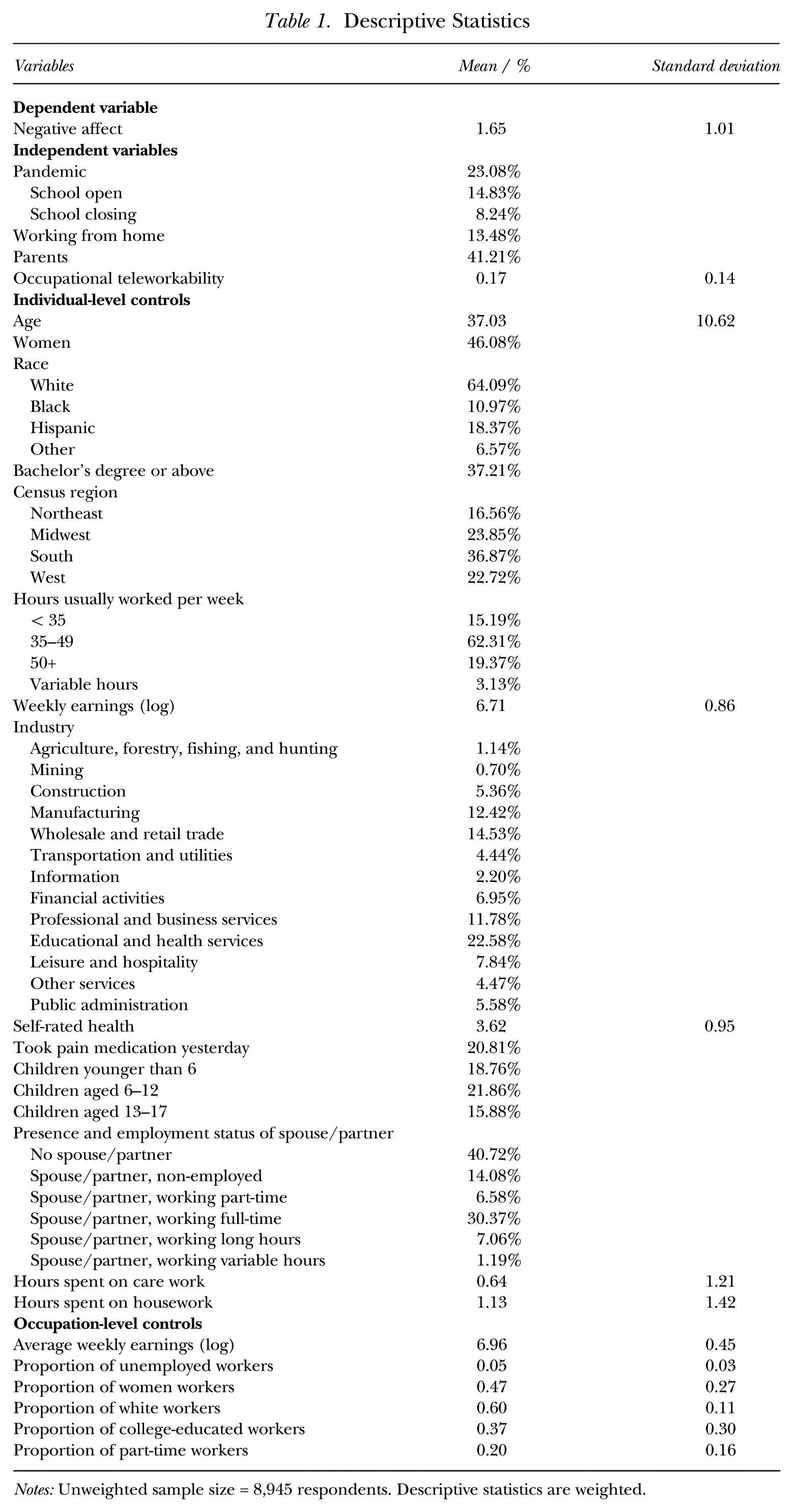
Notes: Unweighted sample size = 8,945 respondents. Descriptive statistics are weighted.
Respondents’ basic sociodemographic characteristics were as follows. Respondents were on average 37 years old, 41% were parents, 46% were women, and 37% had a bachelor’s degree or above. Non-Hispanic whites, non-Hispanic Blacks, Hispanics, and those from other racial-ethnic groups comprised 64%, 11%, 18%, and 7% of the sample, respectively.
Results of OLS Regression Models
We first examine how the relationship between work location and negative affect changed from pre-pandemic to the pandemic era. As shown in Table 2, model (1), holding individual-level and occupation-level control variables constant, working from home was associated with lower negative affect before the pandemic (bWorking from home = −0.155, p < 0.01), but this association attenuated during the pandemic (bWorking from home × Pandemic = 0.148, p < 0.10). We present the results in Figure 1. Before the pandemic, working from home was associated with significantly lower levels of negative affect (indicating better affective well-being), relative to working away from home (1.51 vs. 1.66, p = 0.005). During the pandemic, however, work location no longer predicted affective well-being (1.67 vs. 1.68, p = 0.919). The results provide supportive evidence for Hypothesis 1 that the well-being benefits of remote work were attenuated during the pandemic compared with before the pandemic.
Ordinary Least Squares Regression Models Predicting Negative Affect, Using Work Location, Period, Occupational Teleworkability, and Their Interactions as Independent Variables
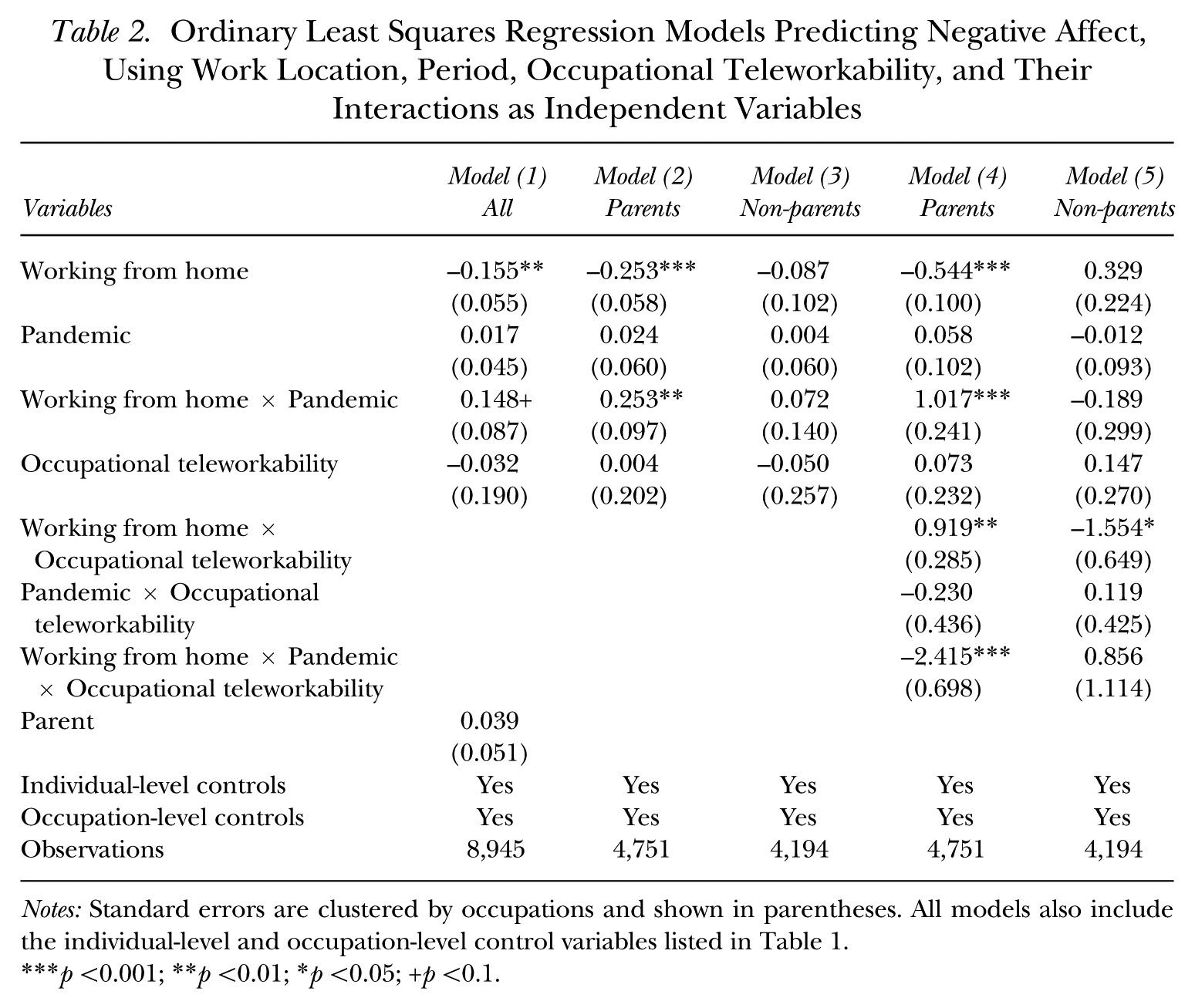
Notes: Standard errors are clustered by occupations and shown in parentheses. All models also include the individual-level and occupation-level control variables listed in Table 1.
p <0.001; **p <0.01; *p <0.05; +p <0.1.
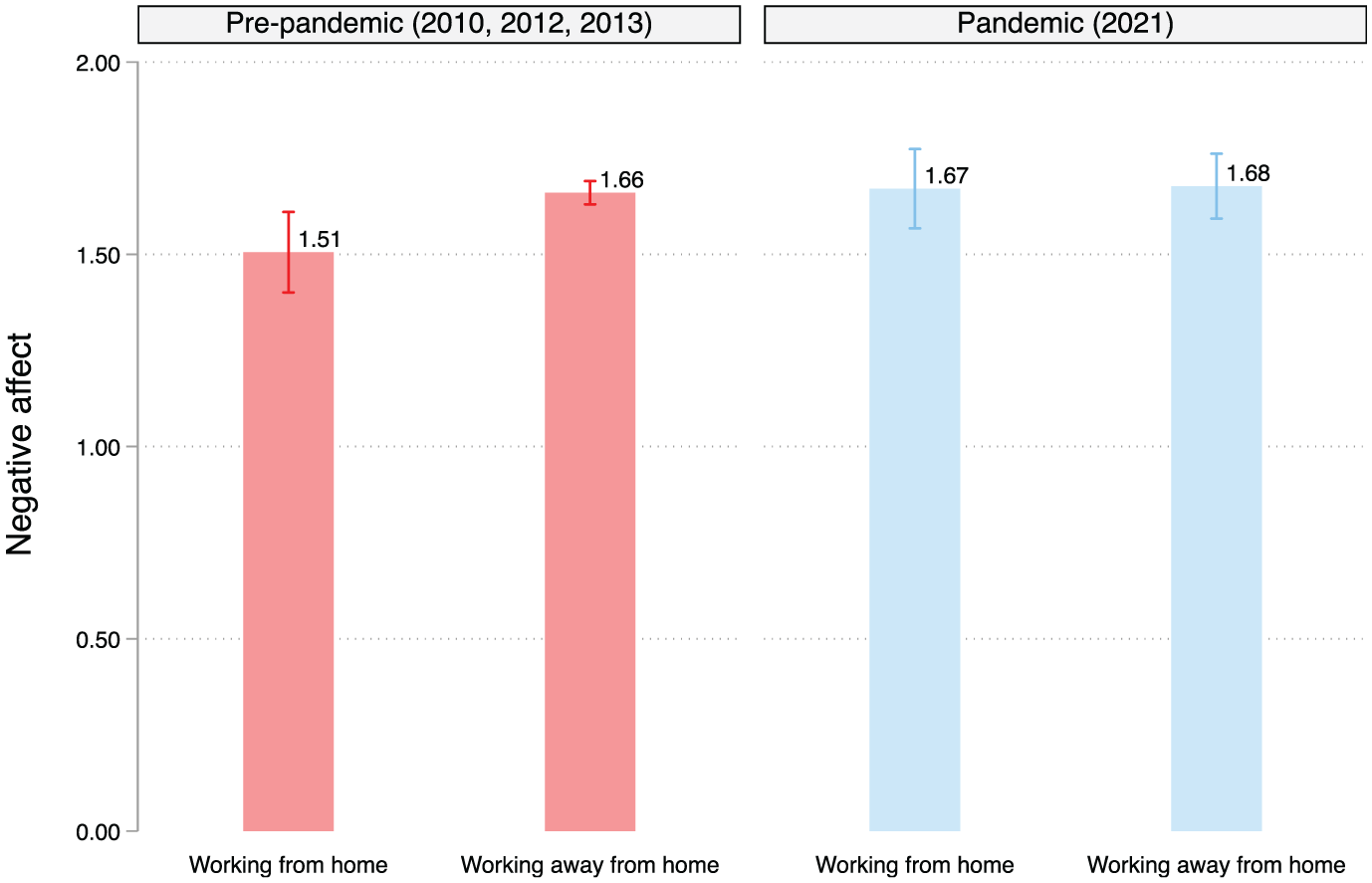
Predicted Negative Affect by Work Location and Period
Next, we examine the negative affect before and during the pandemic among four groups of workers based on their work location and parental status, while controlling for individual-level and occupation-level controls. As shown in models (2) and (3) of Table 2, the relationship between working from home and negative affect changed significantly from before to during the pandemic among parents (bWorking from home × Pandemic = 0.253, p < 0.01), but not among non-parents (bWorking from home × Pandemic = 0.072, p = 0.605). The predicted negative affect based on these models is shown in Figure 2. Despite the various challenges faced by non-parents during COVID-19, their negative affect remained unchanged from pre-pandemic to the pandemic period, regardless of whether they worked from home (1.58 vs. 1.65, p = 0.518) or away from home (1.66 vs. 1.67, p = 0.948). The stability in negative affect was also observed for parents who worked away from home (1.66 vs. 1.68, p = 0.687). By comparison, remote-working parents saw a significant change in negative affect from before to during the pandemic: Their negative affect scored 1.68 during the pandemic, significantly higher than the pre-pandemic score of 1.41 (p = 0.003). Recall that Figure 1 shows a diminished role of remote work in promoting well-being during the pandemic. Figure 2 further shows that the lower affective well-being during (compared to before) the pandemic was concentrated among remote-working parents, which provides supportive evidence for Hypothesis 2. We additionally conducted two sets of robustness checks. First, we included occupation fixed effects in models (1)–(3) of Table 2 to help address potential unobserved occupation-level confounding. The results remained consistent (Table A.2 and Figures A.1–A.2). Second, in light of prior research showing the challenges faced by mothers working from home during the pandemic (for a review, see Yavorsky et al. 2021), we disaggregated parents by gender and found no gender differences (Figure A.3).
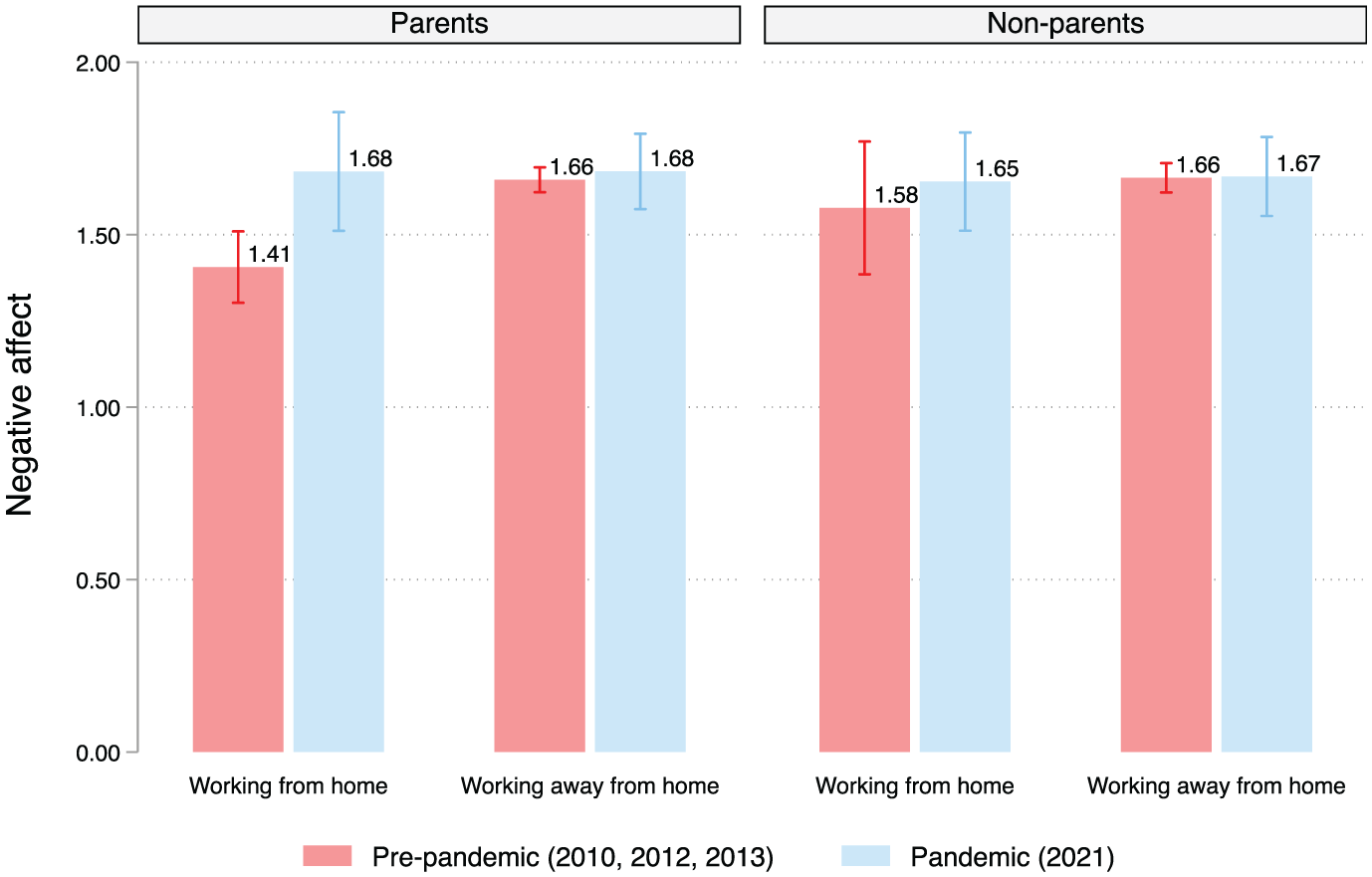
Predicted Negative Affect by Parental Status, Work Location, and Period
Figure 2 suggests that working from home posed a unique challenge for parents during the pandemic, but does this pattern hold for all parents across occupations with varying degrees of telework suitability? To address this question, we disaggregate Figure 2 by introducing another dimension—occupational teleworkability. In models (4) and (5) of Table 2, the three-way interaction term between working from home, the pandemic indicator, and occupational teleworkability is statistically significant among parents (b = −2.415, p < 0.001) but not among non-parents (b = 0.856, p = 0.443). Figure 3 presents the predicted negative affect based on these models. The overlapping confidence bands in the lower panels of Figure 3 show that, for non-parents, the pandemic did not change their affective well-being regardless of where they worked or how teleworkable their occupations were. This nonsignificant finding was also evident among parents working away from home, as shown in the upper-right panel of Figure 3.
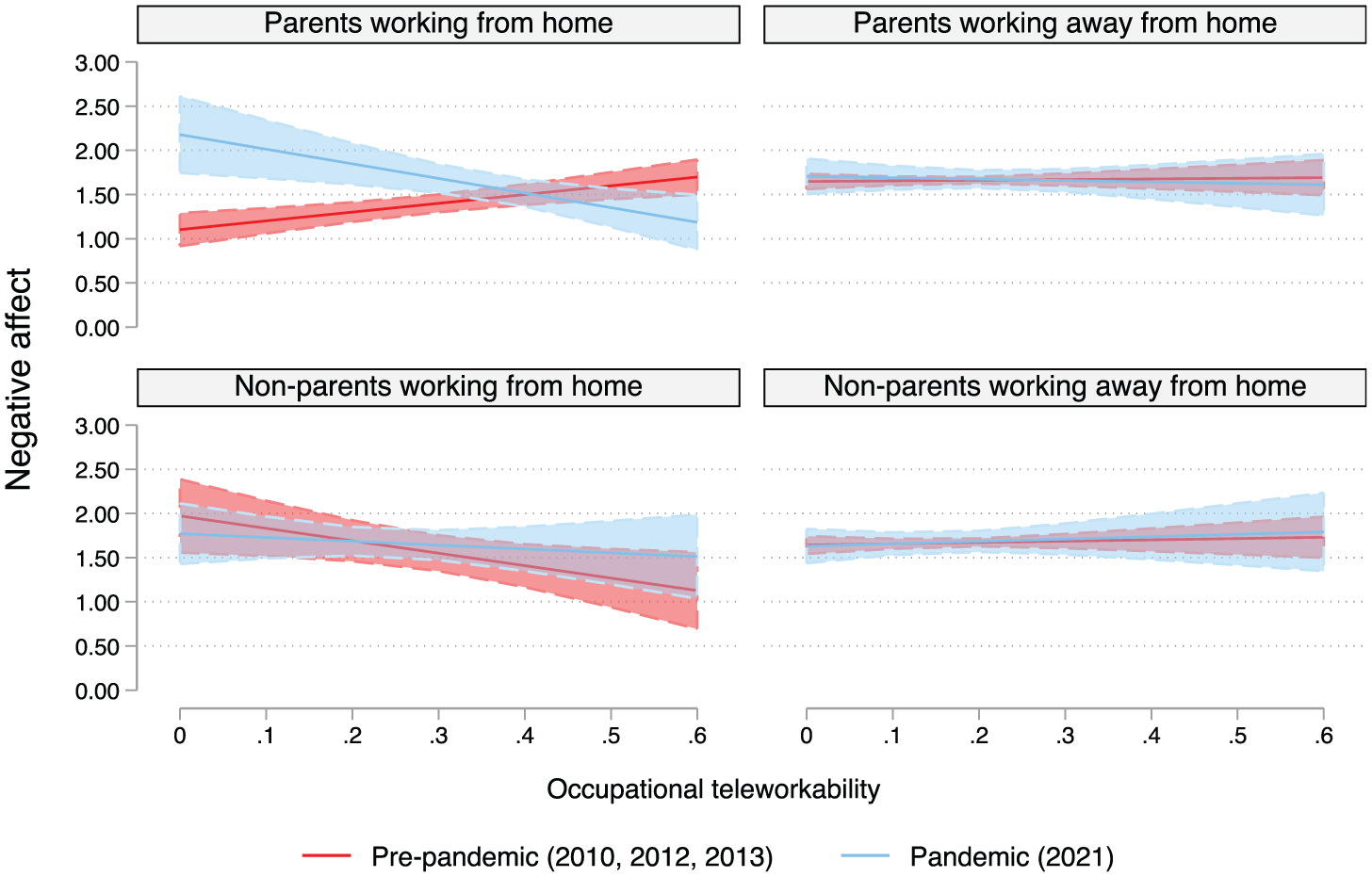
Predicted Negative Affect by Parental Status, Work Location, Period, and Occupational Teleworkability
Parents working from home, however, exhibit a different pattern. As shown in the upper-left panel of Figure 3, working from home was generally associated with more negative affect during the pandemic than before, as evidenced by the significantly higher confidence band of the pandemic line (blue) relative to that of the pre-pandemic line (red). This pattern is particularly pronounced among those working in occupations with lower teleworkability scores, that is, occupations in which fewer workers worked from home before COVID-19. To put it into perspective, among remote-working parents who held an occupation with a low teleworkability score of 0.1, the predicted negative affect moved from 1.20 before the pandemic to 2.01 during the pandemic (pdifference < 0.001 based on a post-estimation test). By comparison, among remote-working parents who held an occupation with a relatively high teleworkability score of 0.4, the predicted negative affect barely shifted over time (1.50 vs. 1.52, p = 0.802). Overall, in line with Hypothesis 3, Figure 3 highlights the affective well-being challenges faced by remote-working parents in less-teleworkable occupations during the pandemic. In supplementary analysis, we examined whether the result differed by gender and found no evidence of gender differences (Figure A.4).
Why did the pandemic exacerbate negative affect for remote-working parents in less-teleworkable occupations? One explanation could be the increased challenge of balancing work and family obligations during the pandemic for these parents. If this is the case, the gap in negative affect between the pandemic and pre-pandemic periods would be particularly pronounced during times of stringent school closure policies. Figure 4 provides supportive evidence for this speculation (the corresponding models are shown in Table 3). As shown in the upper-left panel of Figure 4, among parents in less-teleworkable occupations, negative affect was lowest before the pandemic (red line) and highest when school closure policies were in place (blue-purple line). For example, when occupational teleworkability is at a low level of 0.1, the predicted negative affect for remote-working parents was 1.20 before the pandemic, which increased significantly to 1.86 during the school-open pandemic period and grew further to 2.37 during the school-closure pandemic period (1.20 vs. 1.86 and 1.20 vs. 2.37, p < 0.001 for both). Overall, Figure 4 provides evidence for our proposed explanation that the increased difficulty in juggling work and family demands during the pandemic, especially when school closure policies were stringent, likely posed challenges for remote-working parents in less-teleworkable occupations, which in turn undermined their affective well-being.
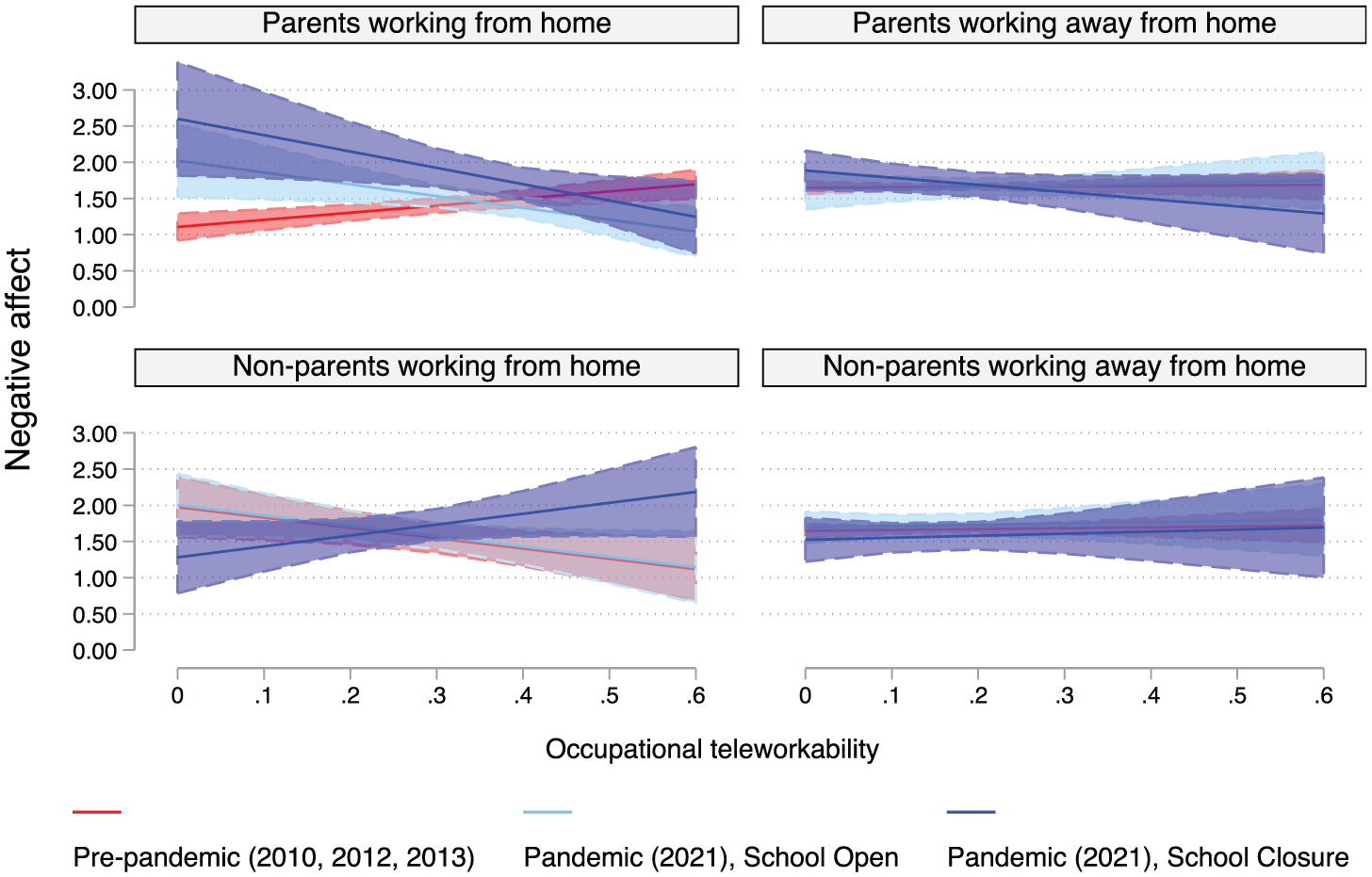
Predicted Negative Affect by Parental Status, Work Location, School Closure Policies, and Occupational Teleworkability
Ordinary Least Squares Regression Models Predicting Negative Affect, Using Work Location, School Closure Policies, Occupational Teleworkability, and Their Interactions as Independent Variables
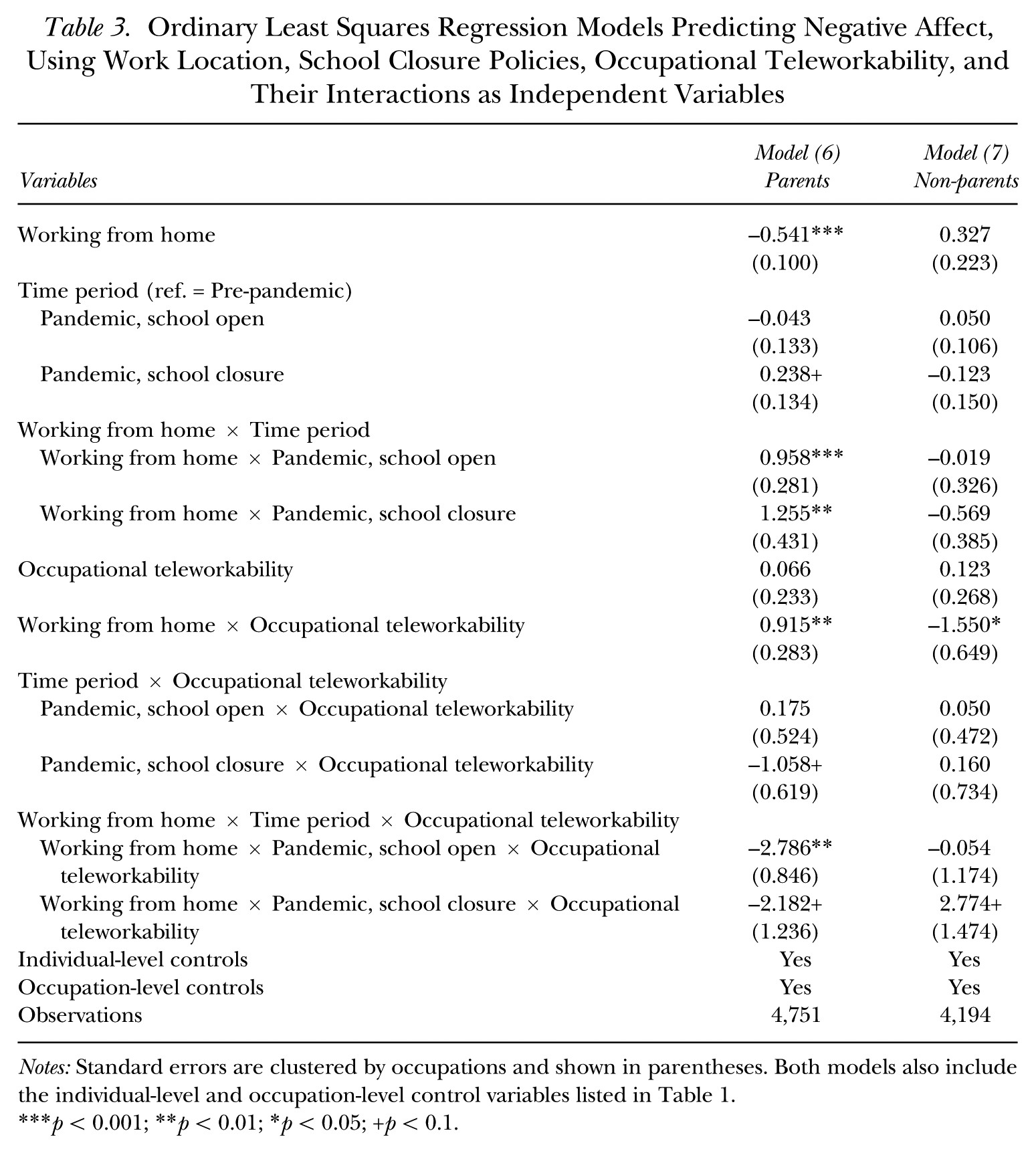
Notes: Standard errors are clustered by occupations and shown in parentheses. Both models also include the individual-level and occupation-level control variables listed in Table 1.
p < 0.001; **p < 0.01; *p < 0.05; +p < 0.1.
Before turning to the discussion, we note an intriguing pattern in Figures 3 and 4: Before the pandemic, remote-working parents in more-teleworkable occupations had higher negative affect than those in less-teleworkable occupations. Pre-pandemic, remote work was often used by parents to manage the competing demands of paid work and unpaid caregiving (Bailey and Kurland 2002; Allen et al. 2015). We suspect that for parents in less-teleworkable occupations, the rarity of remote work may have made such arrangements feel like valued accommodations, potentially lowering negative affect. By contrast, parents in more-teleworkable occupations may have taken working from home for granted and experienced those days as periods of heightened strain, juggling childcare and work responsibilities. Unfortunately, the ATUS data do not include the necessary workplace or psychosocial measures to empirically test this speculation.
Conclusion
The COVID-19 pandemic precipitated a sudden shift to remote work. Changes in the circumstances surrounding remote work during the pandemic may have significantly altered the remote work experience and the well-being benefits workers derived from it. To date, however, there has been limited research exploring COVID-19 as a watershed moment to explicitly examine whether and in what way the relationship between remote work and well-being shifted from before to during the pandemic. In this study, we integrate four national data sets to reveal the heterogeneous impacts of working from home on affective well-being across social contexts.
Our major contribution is to demonstrate that the relationship between remote work and affective well-being is not fixed but contingent on the larger social contexts within which it occurs. Specifically, while working from home was associated with better well-being before the pandemic, this benefit was attenuated and became nonsignificant during the pandemic. Further analyses indicate that the diminished affective well-being during the pandemic, compared to pre-pandemic levels, was concentrated among remote-working parents in less-teleworkable occupations and this pattern was most severe during pandemic school closures. These parents likely faced considerable challenges given the double jeopardy of a sudden shift to working from home—despite their jobs being poorly suited for it—and the abrupt closures of schools and childcare facilities.
These findings align with previous research highlighting the challenges parents faced while working from home during the pandemic (e.g., Calarco et al. 2020; Yavorsky et al. 2021; Lyttelton et al. 2023). The value-added of our study lies in deepening the understanding of pandemic-era experiences while keeping pre-pandemic patterns as a reference point. Furthermore, we show that occupational contexts play a crucial role in shaping the well-being implications of remote work. Examining remote work through a comparative lens—across historical periods, family caregiving responsibilities, and occupational contexts—allows us to identify the conditions under which remote work benefits workers. Not all jobs are equally suited for remote work, and when social crises such as widespread school closures occur, mandatory shift to remote work—without adequate support, training, or worker autonomy—can intensify stress and undermine well-being, particularly for those juggling multiple responsibilities. Combined, our research contributes to theories on worker well-being (Berkman et al. 2014; Kalleberg 2018; Kelly and Moen 2021) by highlighting the role of contextual factors in shaping the daily affective experiences of workers in alternative workplace arrangements.
While several studies have shown the benefits of remote work compared to on-site work during the pandemic (Fan and Moen 2023; Bloom et al. 2024), our findings indicate no significant difference in well-being between remote and on-site workers during this period. This discrepancy may be attributable, at least in part, to selection effects. Fan and Moen (2023), for example, used panel data to examine within-person changes in well-being as remote workers either returned to the office or continued working remotely, whereas our study relies on between-person comparisons of remote and on-site workers. Given the sudden shift to remote work, the composition of remote workers likely changed over time. Our supplementary analysis (Table A.3) shows that remote workers before and during the pandemic did not differ in terms of college attainment and earnings. However, while remote workers tended to have better self-rated health before the pandemic, this advantage disappeared during the pandemic. The negative health-based selection into remote work during the pandemic—an expected pattern given the health crisis—may have limited our ability to fully identify the well-being benefits of remote work during this period.
Remote work is likely to persist beyond the pandemic (Barrero et al. 2023), and as such, our findings have implications for post-pandemic governmental and organizational policies. As life moves past the pandemic, remote work is likely to once again benefit workers’ affective well-being, similar to pre-pandemic patterns. To make remote work more effective, increased policy attention is needed to address the dependent care challenges many US parents face, as our finding underscores the negative implications of weak care infrastructures and inadequate workplace support for parental well-being. With adequate support, parents could more fully benefit from the flexibility offered by remote work without the added burden of childcare struggles. Stronger policies are also needed at the federal and state levels to establish a robust childcare infrastructure, such as affordable childcare and paid family leave. Furthermore, advancements in new technologies and AI tools will help enable the transformation of previously less-teleworkable jobs into teleworkable ones. Organizations can adapt by investing in equipment and technology, enhancing communication tools, providing resources for effective remote collaboration, subsidizing employees’ childcare costs, and providing targeted training on managing remote work while caring for children, among others.
This study has several limitations. First, because the ATUS is a cross-sectional data set, we can identify only associations, not causality. Although our regression models have controlled for a wide array of individual-level and occupation-level covariates to adjust for potential confounders, further research is needed to systematically account for selection effects, for example, by analyzing longitudinal data to examine within-person change in work location and its impact on well-being. Second, while the time diary data from the ATUS are regarded as the gold standard for measuring time use, they are subject to limitations such as recall errors, underreporting of short-duration activities, and restriction to a 24-hour window (which limits the ability to reveal individuals’ activities and affect over longer periods) (te Braak, van Tienoven, Minnen, and Glorieux 2023). Third, given the sample size, we are unable to assess whether the findings hold for workers of all racial-ethnic or social class backgrounds. Fourth, our analysis offers suggestive evidence that increased work–family challenges may have contributed to the negative affect experienced by remote-working parents. Future research may draw on more direct measures (e.g., work–family conflicts) or mixed-methods data to further illuminate the nuances surrounding remote work, caregiving, and well-being.
Despite its limitations, our research underscores the importance of considering the broader social context in which remote work occurs to gain a fuller understanding of its benefits and drawbacks. Changing contexts alter the nature, meaning, and experiences associated with certain work arrangements. Our study demonstrates that work location, family circumstances, and occupations are key factors that contextualize workers’ daily affective experiences and well-being. As the prevalence of remote work extends into the post-pandemic era (Barrero et al. 2023), the varied impacts of remote work on well-being necessitate a tailored—rather than a one-size-fits-all—approach to designing and implementing workplace initiatives.
Supplemental Material
sj-pdf-1-ilr-10.1177_00197939251390748 – Supplemental material for Did the COVID-19 Pandemic Make It Worse? Working from Home and Affective Well-Being at the Intersections of Parental Status and Occupation
Supplemental material, sj-pdf-1-ilr-10.1177_00197939251390748 for Did the COVID-19 Pandemic Make It Worse? Working from Home and Affective Well-Being at the Intersections of Parental Status and Occupation by Yue Qian and Wen Fan in ILR Review
Footnotes
This article is part of an ongoing ILR Review Special Series on Work, Labor, and Employment Relations in the COVID-19 Era.
For general questions as well as for information regarding the data and/or computer programs, please contact the corresponding author at
1
Industry is coded into 13 categories based on a classification outlined by the US Census Bureau ( ): 1) agriculture, forestry, fishing, and hunting; 2) mining; 3) construction; 4) manufacturing; 5) wholesale and retail trade; 6) transportation and utilities; 7) information; 8) financial activities; 9) professional and business services; 10) educational and health services; 11) leisure and hospitality; 12) other services; and 13) public administration.
2
For unemployed respondents, the ACS collects data on their most recent occupation. Therefore, we are able to calculate unemployment rate for each occupation by dividing the number of unemployed respondents by the sum of employed and unemployed respondents.
References
Supplementary Material
Please find the following supplemental material available below.
For Open Access articles published under a Creative Commons License, all supplemental material carries the same license as the article it is associated with.
For non-Open Access articles published, all supplemental material carries a non-exclusive license, and permission requests for re-use of supplemental material or any part of supplemental material shall be sent directly to the copyright owner as specified in the copyright notice associated with the article.
