




Abstract
The increasing variety of contingent work raises the question of how employers choose between various types of contractual arrangements. The authors review relevant Employment Relations and Strategic HRM literature and distinguish four types of contingent contracts along the dimensions of costs and control. They argue that employers are making choices based on cost and control constraints but are able to reshape these constraints through “institutional toying.” Their case study of a German manufacturing plant and R&D center illustrates the mechanisms of institutional toying, which are consistent with the literature on institutional loopholes and exit options. The article develops propositions that explain the diversity of contingent work arrangements and show how toying strategies enlarge the range of options available to employers.
Keywords
The growth of contingent work across developed and emerging economies has generated a body of literature on the factors contributing to this trend, and its implications for workers, unions, organizations, and wider society (Kalleberg 2012; Cappelli and Keller 2013; Stone and Arthurs 2013; Doellgast, Lillie, and Pulignano 2018). Contingent work entails “any work arrangement that does not contain an explicit or implicit commitment between worker and employer for long-term employment” (Polivka and Nardone 1989: 11). It involves diverse contractual arrangements, spanning from zero-hours contracts and staff leasing to self-employment (Cappelli and Keller 2013). Traditional frameworks, such as the dual labor market model (Doeringer and Piore 1971) and the flexible firm model (Atkinson 1987), appear inadequate to explain the variety of contingent work arrangements (CWAs), as they focus on employers’ decisions on whether to use contingent work and bundle disparate types together.
This article contributes to understanding the diversity of CWAs. Studying this diversity is both theoretically and empirically important, because the differences among contingent contracts have implications for organizations and workers. Differences among contingent workers are reflected in their psychological contracts (Davis-Blake, Broschak, and George 2003) and affect their relationships with permanent coworkers (Broschak and Davis-Blake 2006). Furthermore, access to benefits and coverage of legal or negotiated standards of wages and working conditions vary across CWAs, with implications for workers’ welfare and well-being (Houseman and Ōsawa 2003). Therefore, there is a need for researchers to better understand “how organizations decide which [contingent] arrangements to use and in which combinations” (Cappelli and Keller 2013: 593; see also, Cobb 2016: 341).
Responding to this call for further research, we explore how employers choose between four types of contingent contracts based on cost and control constraints. In addition, we argue that employers manipulate these constraints so that they are able to choose the most convenient contract. Our analysis makes two contributions to the literature. First, we provide an integrative framework of employers’ decision-making between CWAs according to the regulatory constraints associated with various contracts. To this end, we combine insights from two strands of literature that have so far developed rather independently: employment relations (ER) research on the role of regulation in constraining employer choice (Shire, Schönauer, Valverde, and Mottweiler 2009), and strategic human resource management (SHRM) research on the fit between contingent arrangements and the organization of work (Davis-Blake et al. 2003).
Second, we develop the concept of “institutional toying” and integrate it into our framework. We build on empirically rich ER studies suggesting that employers deviate from behavior prescribed by regulations by exploiting institutional loopholes, ambiguities, and poor enforcement (Doellgast, Batt, and Sørensen 2009; Jaehrling and Méhaut 2013; Grimshaw, Cartwright, Keizer, and Rubery 2019). Thus, employers use what they consider to be the most convenient contingent contracts, even if they do not fully or strictly comply with all regulatory requirements. Finally, synthesizing the above insights, we develop propositions that highlight how regulation constrains employers’ choice and how institutional toying allows employers to reshape these opportunities and constraints.
Costs and Control in the Contingent Employment Relationship
Dual labor market theory (Doeringer and Piore 1971; Osterman 1975) frames employers’ segmentation strategies as the choice between hiring either permanent skilled employees in core positions as part of internal labor markets (ILMs), or unskilled contingent workers in peripheral positions drawn from external labor markets. This framework has become increasingly inadequate to account for recent transformations of work, however. The standard employment relationship in ILMs has been progressively downgraded: Flexible work arrangements have proliferated, career perspectives and job tenure have declined, and wages have become more exposed to market competition (Cappelli 1999; Bosch 2004). In parallel, contingent contracts have spread beyond peripheral positions. They are now used across skill levels and for diverse purposes that include enhancing numerical flexibility to respond to demand fluctuations, contributing to product and service innovation, and reducing head counts and labor costs (Nesheim 2003; Kalleberg and Marsden 2005; Appelbaum and Batt 2014).
This development has prompted scholars to analyze the nature of the contingent employment relationship, and its implications for workers and organizations, from SHRM and ER perspectives. We organize our discussion of the literature along the dimensions of costs and control, which are typically considered the central elements of the employment relationship. On the one hand, managers need to control the work process to such an extent that their workers unleash their full productivity; on the other hand, they need to secure adequate effort and commitment by providing job security and a certain level of wages and working conditions, which implies sustaining certain costs (Edwards, Bélanger, and Wright 2006: 129).
ER scholars have claimed that contingent work offers great advantages for employers in terms of control and costs, as they typically see these workers as more dependent on their employer because of a fundamental power inequality in the employment relationship (Hyman 1994). Employment regulation, both joint and statutory, partly rebalances the employment relationship by limiting employers’ discretion (Baccaro and Howell 2011). Contingent workers are more exposed to the market’s price mechanism in determining the value of their work, however, than are workers on permanent contracts in (what is left of) ILMs (Bidwell, Briscoe, Fernandez-Mateo, and Sterling 2013; Greer and Doellgast 2017). Thus, for ER scholars the market’s prevalence over regulation uniquely disadvantages contingent workers. Employers acquire greater control over workers because they have more freedom to rescind the employment relationship (Bosch 2004) and can use competition to discipline them (Flecker, Haidinger, and Schönauer 2013). They also save labor costs by avoiding, for example, redundancy payments, minimum standards for wages and working conditions, and social insurance (Houseman and Ōsawa 2003; Stone and Arthurs 2013).
SHRM scholars, by contrast, have analyzed the employer’s choice between permanent contracts and CWAs as a tradeoff between 1) the advantages highlighted by the ER literature, and 2) the potential costs for the organization attributable to the employer’s lack of full control over the transient employment relationship. Using CWAs implies higher transaction costs for the company (Baron and Kreps 1999), and the short-term orientation in the employment relationship increases turnover, leading to work process disruption and the loss of knowledge and training investment (Kesavan, Staats, and Gilland 2014; De Stefano, Bonet, and Camuffo 2019). These issues are particularly salient for strategically critical, core tasks. Indeed, the SHRM literature has found that contingent work is often used in low-skilled, routine positions (Lepak and Snell 2002). Contingent workers are also employed to conduct high-skilled tasks when the human capital is too costly to develop in-house (Matusik and Hill 1998), however, or when providers of specialized services prefer being hired ad hoc from the external market (Abraham and Taylor 1996). To minimize costs for the organization in such cases, employers tend to use high-skilled contingent workers for tasks that are less complex and less interdependent with core tasks (Baron and Kreps 1999) and that do not require specific knowledge of the company’s core business (Lautsch 2002; Håkansson and Isidorsson 2012).
Thus, the SHRM literature has mainly focused on employers’ decisions between hiring broadly defined contingent workers and relying on the ILM—with a few exceptions. A theoretical article by Gallagher and McLean Parks (2001) suggested a relationship between varying commitment foci (e.g., organizational, job, employment) and types of contingent contracts. The empirical articles by Davis-Blake et al. (2003) and Broschak and Davis-Blake (2006) found that the use of contingent contracts leads to declining commitment and satisfaction among both contingent workers and permanent workers. The use of fixed-term workers, especially if these workers are integrated in teams of permanent workers, is associated with increased turnover intentions and lower loyalty of the latter, and with deteriorated work relationships compared to the use of part-time workers and subcontractors. Although the use of specific CWAs might affect organizational performance in the medium and long term, the extant literature suggests that costs of the so-called blended workforce are borne by workers and little considered by employers (George and Chattopadhyay 2015). Thus, even this research stream, while sensitive to differences between CWAs, has not explained the rationale underlying employers’ choice between those arrangements.
The SHRM and ER literatures have examined, from distinct perspectives, both the benefits and challenges of using CWAs; however, explicit discussion of how employers choose between the various contingent contracts available has been limited. In focusing primarily on the implications for workers and their unions, ER scholars have paid little attention to employers’ strategic decision-making, particularly regarding the various contingent arrangements. Conversely, by neglecting the context outside the organization, SHRM scholars have bypassed the role of regulation in defining employers’ responsibilities and constraints with respect to various CWAs. As Cappelli and Keller (2013) illustrated, however, the legal differences regarding terms and conditions of employment and employers’ responsibilities have important implications for how workers under specific contingent arrangements can be controlled and for the corresponding costs borne by employers. Therefore, we expect these differences to influence employers’ strategic decisions.
Based on work by Cappelli and Keller (2013), we focus on four types of CWAs: fixed-term contracts, agency work, subcontracting (on the premises), and self-employment. These arrangements are characterized by specific types of contractual relationship, as defined by regulation, depending on whether they are mediated by a third party and thus cross organizational boundaries. These differences have implications for the dimensions of costs and control (see Table 1) and therefore matter for managerial decisions. Fixed-term workers are in a direct employment relationship, whereas agency workers are in a co-employment arrangement in which they are employed by the staffing agency but seconded to the client organization. Workers on subcontractor or freelance contracts sit outside the (core) employer’s organizational boundaries; the subcontractor mediates the employment relationship between workers and the client organization, whereas the contractual relationship for freelancers is direct.
Characteristics of Contingent Work Arrangements (CWAs)
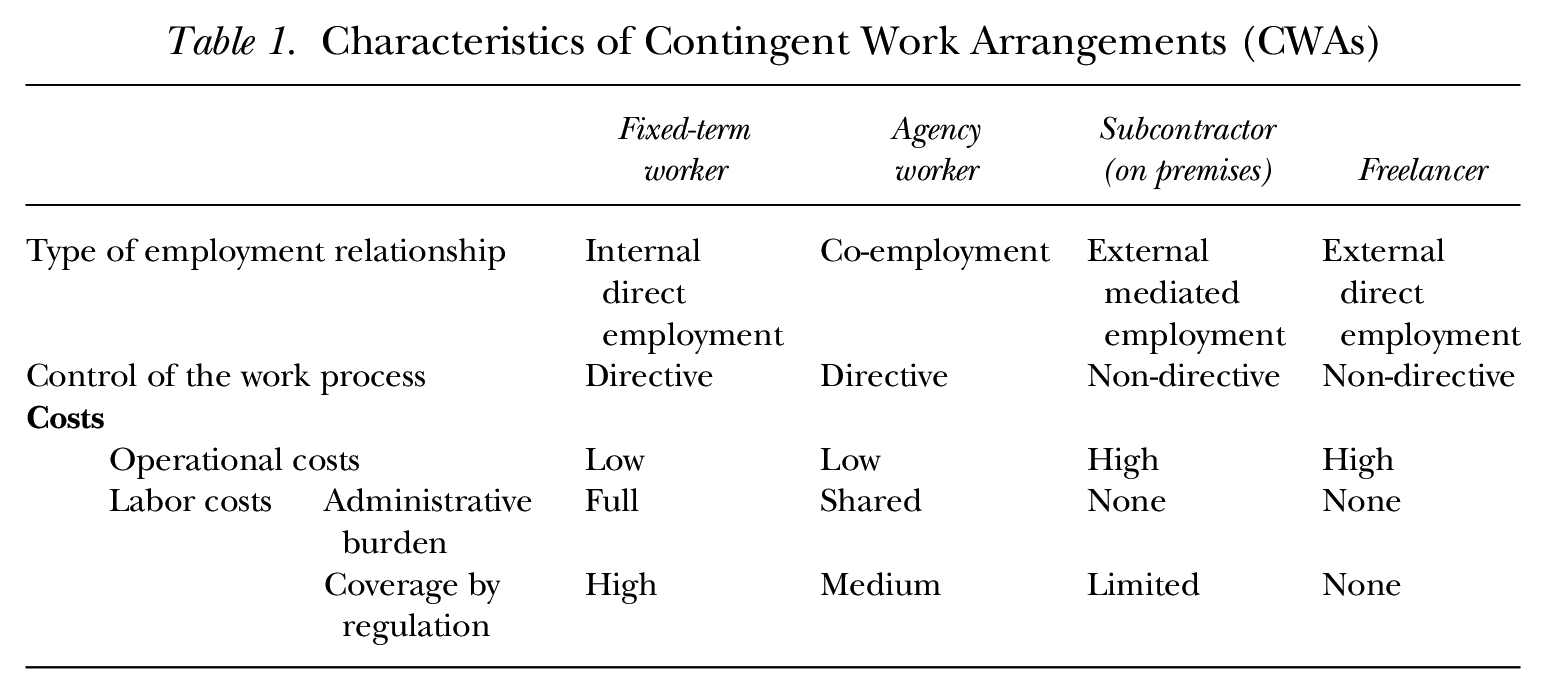
The type of relationship affects managers’ control over workers, from which operational costs derive; it also affects the distribution of the administrative burden and the coverage of work arrangements by regulations. The dimension of directive control concerns the extent to which legislation allows employers to directly instruct workers on how to perform their tasks (see Cappelli and Keller 2013). For fixed-term workers and agency workers, who are respectively in direct and co-employment arrangements, the organization has directive control over their work process (e.g., working time, work methods). Conversely, for subcontractors and freelancers, the management has only non-directive control over the work process: Managers set standards and clearly measurable targets for services provided via procurement but cannot directly control how these are delivered. Thus, the operational costs of fixed-term workers and agency workers are lower than for subcontractors and freelancers, as the former can be integrated in existing teams while the latter, who are managed outside the core employer’s organizational boundaries, entail higher transaction and coordination costs (Baron and Kreps 1999). Furthermore, hiring subcontractors and freelancers entails higher costs if it requires restructuring of work organization (Ang and Slaughter 2001) or investing in new technology (Whyte and Lobo 2010) to ensure that their tasks are clearly separate from the existing work process.
The employment relationship’s configuration also determines the distribution of the administrative burden. We conceptualize this burden as legal obligations and regulatory requirements, “such as payroll and employment taxes, in addition to managing the screening, hiring, wage setting, and termination of employment” (Cappelli and Keller 2013: 587). It also involves the costs of investment in training and safety equipment, together with uncertainty over future costs such as extended sick leave. Legal scholars in the United States and Europe have suggested that, for fixed-term contracts, these costs are borne entirely by the lead employer; for agency workers, they are usually shared between the lead employer and the staffing agency; and for subcontracted workers and freelancers, they are shifted to the subcontractor and to individual workers, respectively (e.g., Stone 2006; Howes 2011).
The extent of coverage by regulations depends on both the type of employment relationship and the country-, sector-, and company-specific regulatory context. ER research has shown that the strength and scope of regulation affect the gaps in wages, working conditions, and employment security between distinct types of CWAs and between CWAs and permanent employment (Doellgast, Sarmiento-Mirwaldt, and Benassi 2016). Although it is difficult to generalize, fixed-term workers—given their dependent employment status—are usually covered by statutory regulations and often by sectoral or company collective agreements (joint regulations). Agency workers are also dependent workers, but primarily of the agency; they are protected by statutory regulations, but not necessarily by the same joint regulations or ILM rules as permanent or even fixed-term workers. For instance, the European Union’s equal pay directive for agency workers (2008/104/EC) has been strictly implemented in some countries through laws and collective agreements (e.g., in Italy), although pay discrimination between permanent and agency workers is allowed for a restricted period (e.g., in Germany). Subcontractors are dependent workers, so they are covered by employment legislation but rarely by the same standards of wages and working conditions as in the client organization (see Doellgast et al. 2016). This observation is especially applicable in our case study given that we consider subcontractors working on premises only (as per Cappelli and Keller 2013), and these are often small service companies not covered by unions and collective agreements. Finally, freelancers face the highest exposure to market-based wage-setting mechanisms given their self-employment status. Table 1 summarizes the ways in which the various types of employment bundle multiple characteristics.
Employers’ strategic choice between these types of CWAs thus entails setting the right balance between labor costs and operational costs, which derive from the degree of control. Employers can be expected to match contracts with specific tasks, depending on whether control over the outcome rather than the process is appropriate given the legal requirements about directive control. Employers’ decisions on labor costs will instead be influenced by the opportunity to shift (part of) the administrative burden to a third-party organization or individuals, and by the balance of convenience between the standards set by regulations and external market rates. These considerations would be sufficient to explain employers’ choice of CWAs in a world in which employers fully comply with regulations; instead, recent empirical research has suggested that employers do not always comply with the rules and can manipulate the regulatory context of CWAs to better serve their needs. The next section theorizes this behavior through the concept of institutional toying, which we argue takes place through three main mechanisms.
Mechanisms of Institutional Toying
The concept of institutional toying relies on recent literature that suggests that employers—and (powerful) social actors more generally—have broad room for maneuvering within their institutional context (Streeck and Thelen 2005). This perspective necessitates considering the institutional rules separately from their enactment, as actors can defect from institutions, especially when these rules are poorly enforced (Doellgast et al. 2009; Jaehrling and Méhaut 2013). Furthermore, actors can reinterpret institutions to better serve their interests (Holst 2014) and can even change the purpose of institutions while maintaining their form when the balance of power shifts (Kornelakis 2014). These theoretical considerations imply that actors can strategically deviate from what is institutionally mandated.
Scholars have generally agreed that using contingent work is, per se, a strategy for avoiding some of the legal obligations that typically apply to permanent direct employment (Baron and Kreps 1999: 458–60). Our argument goes beyond this point, suggesting that although toying is not exclusive to contingent labor markets, their characteristics enable employers to implement clearly identifiable strategies of institutional toying. The legislation on contingent work is often ambiguous, for instance regarding the legal definition of contracted work in both common law systems, such as the United Kingdom (Behling and Harvey 2015), and civil law systems, such as Italy (Roccella 2009). It also contains loopholes and exit options: In Germany, for example, works councils lack bargaining rights over subcontracting, and equal-treatment provisions for agency workers can be amended via collective agreement (Doellgast et al. 2009; Jaehrling and Méhaut 2013). Because of the precarious nature of contingent contracts, unions are either absent or weak (Gumbrell-McCormick 2011) and labor inspections are too rare or simply impossible, such as in cases in which work is performed at home (Weil 2014). Some workers tend to be more vulnerable (e.g., migrant workers) and might not be informed about their rights (Wagner 2015). Supply-side conditions also influence employers’ ability to toy with institutions. High unemployment rates and the large supply of certain skills affect workers’ exit options and, therefore, their individual ability to enforce contracts, as Güell and Petrongolo (2007) found in their research on the transition from fixed-term to permanent contracts in Spain. The culture of informality also contributes to the perception that institutional toying is an acceptable and non-risky behavior. For instance, Prosser (2016) found that widespread noncompliance with labor law, and mistrust toward the state, have contributed to the growth of contingent and informal work in Central and Eastern European and Mediterranean countries.
These factors affect the costs employers expect to incur if they are “caught” toying with institutions. These costs are highly uncertain because such toying does not necessarily entail noncompliance: Most often, institutional toying falls in the gray area of the spectrum, where loopholes and vagueness provide room for opportunistic behavior. Employers operate within blurred legal boundaries and act according to the letter of the law, rather than its spirit; if their cases reach court, they might get away with their actions (Cherry 2016). Through in-depth insights into workplace dynamics, ER research on contingent work has accumulated substantial evidence of this behavior; we discuss this below, highlighting three main strategies of institutional toying.
First, employers manipulate costs in terms of benefits, wages, and working conditions that stem from the regulation of contingent work. Regulations can be vague, difficult to enforce, or contain loopholes that employers can exploit. A good example is the legislation on equal treatment of agency and fixed-term workers: Scholars have found “a gap between the legal requirements and the day-to-day practices of employers, especially in the low-wage sector” (Bosch, Mayhew, and Gautié 2010: 117). Research on low-wage work in advanced economies has found several examples of contingent workers being paid below the collectively agreed wage for permanent workers, or even the minimum wage. In France, agency workers in budget hotels were found to be paid piece-rate in 2005, making as little as €1.90 per hour despite equal treatment legislation and a minimum wage of €8.27 per hour (Vanselow, Warhurst, Bernhardt, and Dresser 2010). Research in the meat industry has found that on-site subcontracting is associated with malpractices concerning benefits and salaries (Wagner 2015; Dorigatti and Mori 2016). In Italy, subcontracted workers working on-site are sometimes paid according to the logistics sectoral agreement, which sets lower wages and working conditions compared to agreements for the food industry, or even through reimbursement of expenses rather than normal salaries, as the former do not require employer contributions (Dorigatti and Mori 2016). Along similar lines, employers might not respect the legal restrictions on consecutive renewals of fixed-term or agency contracts, which require transition to permanent employment in many countries. In the Greek banking sector, where Law 2956/2001 requires employers to hire leased workers on a permanent contract after 18 months of continuous employment, employers have been found to avoid that obligation by firing the workers and rehiring them one week later in the same post through another leasing firm (Nikolaou 2011).
Second, employers can misclassify the workers’ status as self-employed or subcontracted. In a study of Austrian call centers, Shire et al. (2009) found that call center agents were subject to directive control despite being hired as freelancers, which enabled their employers to avoid bargaining agreements, the establishment of works councils, and payment of health and social security contributions. Similarly, a study of the Austrian parcel delivery sector suggested that companies had begun subcontracting services to self-employed people while still issuing direct instructions to them. This form of bogus self-employment allowed employers to avoid working time regulations, with drivers working 10 to 15 hours and bearing the burdens and risks associated with vehicle maintenance and administration (Flecker et al. 2013: 14–15). Such practices take advantage of the legal fuzziness around what constitutes project-based or self-employment work, particularly regarding the definition of regular work as a project. Indeed, from a survey of 1,082 German establishments, Hertwig, Kirsch, and Wirth (2015) found that subcontracting practices are often used in place of more expensive agency work, even though the assigned tasks should be performed by directly employed workers. More famously, Uber made headlines in the United States in response to legal disputes over its drivers’ self-employed status: Drivers were argued to be subject to directive control from their “employer,” meaning they should be classified as “workers” or “employees.” Although US courts have not provided definitive resolutions, this shift would confer rights to the minimum wage and minimum standards of working conditions, and have implications for employers in terms of liabilities and taxation (Cherry 2016).
Third, employers can twist work organization to such an extent that the mismatch between tasks and contractual arrangements, as required by legislative provisions on control, can be difficult to prove. In their study on call center work in Europe, Doellgast et al. (2016) found that Italian employers used freelance contracts for inbound call center agents, contravening the legislative provision passed in 2006 that explicitly limited use of freelance contracts to outbound call center activities. The legislation recognizes that inbound call center activities are characterized by fixed shifts, and so require a direct employment relationship. In response, employers assigned to call center agents a mix of inbound and outbound calls, making it more difficult for labor inspectors and union representatives to collect evidence of law infringement. Investigating subcontracting in various sectors in Germany, Klebe (2014) found that some employers traced a blue line on the ground to separate permanent workers and subcontractors, or even built separate changing rooms and offices; behind these pretenses, workers were, in reality, performing similar tasks, side by side. We next illustrate the three mechanisms of institutional toying through a case study based on new empirical evidence. The study shows that employers can simultaneously use all three institutional toying strategies to take advantage of specific CWAs.
Case Study
The fieldwork for our case study was undertaken between 2016 and 2017 in a German special-vehicle plant with a research and development (R&D) center. It involved semi-structured interviews with HR managers, union representatives, and works councilors, as well as three site visits. All interviews were conducted in German, transcribed verbatim, and analyzed, together with fieldwork notes, using NVivo software. The timeframe of the case study covers the period between 2012 and 2017.
Regulatory Context in Germany
German law stipulates that subcontracted workers and independent contractors are not subject to directive control by the hiring company, which has only limited responsibilities (e.g., health and safety). By contrast, the legislation allows employers to exercise directive control over agency workers and fixed-term workers and sets a maximum tenure for those contracts of 36 months; 1 for fixed-term workers, it also sets the right to equal pay and equal treatment. For agency workers, these rights were initially amended by way of collective agreement for an indefinite period, as the existing collective agreements covering the agency sector set salary rates lower than those in most other sectors. In 2017, however, the law was changed to give agency workers equal pay and equal treatment rights after nine consecutive months of employment.
The law also defines the information, consultation, and codetermination rights of works councils (the elected workers’ representative bodies in German workplaces) on fixed-term and agency work and on subcontracting. Works councils can theoretically prevent the hiring of fixed-term and agency workers when this undermines the standards of wages and working conditions or employment of permanent workers; however, such actions are difficult to prove. Furthermore, works councils in the contracting company have the right to information on only the subcontracting costs and the tasks covered. Hence, their ability to limit use of CWAs mainly depends on power relations in the workplace.
Sectoral agreements integrate statutory regulations. In the metal industry the union bargained a collective agreement for agency workers in 2012, which required agency workers to be permanently hired after 24 months (extended to 48 months after the fieldwork ended). It also introduced a system of salary bonuses that increase with assignment duration, with the aim of gradually closing the gap between agency workers and direct employees, but extending the period in which equal pay does not apply from 9 months (as set by law) to 15 months. 2 Collective agreements covering subcontractors set lower standards than those in the metal sector. Most subcontractors are not even covered by collective agreements and are entitled only to the minimum wage (introduced in 2015). Consequently, the wage gap between workers in core firms and subcontractors is large, incentivizing employers to use subcontractors.
Use of Contingent Work at Plant Level
The plant includes a production line facility and an R&D center, employing approximately 1,600 workers. It has high union density (approximately 70%) among high-skilled, white-collar workers and strong workplace representation through the works council. It is covered by both the metal agreement and the company-level agreement, which has implemented the system of salary bonuses described above to gradually start closing the pay gap from the first day of employment. The company-level agreement does not set special provisions for subcontractors, who are not covered by any collective wage agreement; hence, the minimum wage applies.
The management uses various types of contingent contracts. In production, typically at the assembly line, agency contracts are used primarily as a flexibility buffer and extended trial period. Since the 1990s, the company has subcontracted low-end services such as security, cleaning, and facility maintenance to external companies, so as to compress labor costs and reduce head count by focusing on the core business. More recently, subcontractors were also used for small production tasks such as vehicle pasting. In 2016, works councilors estimated the average hourly (pre-tax) wages as follows: €25.00 per hour for permanent production workers in the plant, €16.50 per hour for agency workers on the assembly line, and €8.70 per hour (minimum wage) for subcontracted workers in industrial services.
In the R&D center, the company mainly used agency workers until 2013; these workers were ideally assigned to time-limited projects. In response to pressure from the firm’s headquarters to reduce the head count, however, the company started replacing agency workers with subcontractors and independent contractors. Whereas individual contractors and subcontractors are not included in the head count, agency workers are still counted, albeit separately from the permanent workforce. Without providing specific rates, the HR manager of the R&D center stated that the contractors’ salary rates are higher than those of agency workers but contractors bring advantages in terms of head count reporting and lower administrative costs and taxation.
The use of CWAs partly reflects the employer’s considerations discussed in the previous section. Fixed-term workers and agency workers are integrated among office clerks and blue-collar workers in production, while management uses subcontracting for self-contained tasks that need to be performed on-site, such as cleaning, catering, and security services. On-site subcontracting in low-end industrial services has enabled greater reductions in labor costs than would have been achieved through agency and fixed-term contracts, while also responding to head count reduction pressure. Such pressure also explains the shift among engineers from agency work to freelance contracts and subcontracting starting in 2013. Our fieldwork revealed that employer’s strategic choices regarding CWAs do not solely reflect these considerations, however, but also pertain to their ability to engage in institutional toying.
Institutional Toying
Even though the law and collective agreements regulate the wages and working conditions of fixed-term and agency workers, thus limiting employers’ discretion, management in the case firm found ways to advantageously work around these constraints. First, the firm manipulated the costs in terms of benefits and wages. Especially in production, management sometimes extended the period of temporary employment by switching from an agency to a fixed-term contract. Furthermore, because of the vagueness of the equal-pay provision, agency workers were often paid according to a lower salary level than their position and qualification merited. Theoretically, they should receive salary bonuses calculated on the basis of the rates of permanent workers performing the same job and, after nine months, should earn the same hourly wage as permanent workers. In practice, the collective agreement generically requires agency workers to be paid according to the metal collective agreement, without specifying the salary level or providing company-level productivity bonuses.
Second, the firm was found to misclassify the employment status of contingent workers by using subcontractors or freelancers instead of fixed-term and agency contracts. They employed a few workers as independent contractors in the marketing unit and in production; however, use of these contracts was such an obvious case of “fraud” (Works councilor-1, September 7, 2016) that management was ultimately forced to transform them into fixed-term contracts. In addition, management employed independent contractors and subcontractors to replace agency workers in the R&D center beginning in 2013. When the company was employing agency workers, the co-employment arrangement allowed frequent interactions between permanent staff and agency staff. This strategy contributed to greater flexibility, lower labor costs, and head count reduction, without disrupting the existing work organization. By contrast, the shift to subcontracting arrangements (theoretically) implies the creation of boundaries in terms of tasks and physical space so as to prevent subcontracted workers acquiring the right to be hired directly. The Head of HR in the plant explained the matter as follows: I cannot give them any instructions; I cannot give them an office where I can write their name on the door. Actually, they should not even have a phone number and be in our phone list. I have to, when it comes to the email address, I have to pay attention. It is actually formally very difficult—even though necessary—to actually integrate them in the process. It is a tightrope walk . . . the law is so strict. (Management-1, September 5, 2017)
Consequently, the work process was partly restructured but these changes mainly consisted of twisting the work organization, our third institutional toying mechanism, because the tasks of engineering subcontractors and freelance engineers were not truly separated from those of dependent workers. Management had introduced a new procedure for information exchange and collaboration between the two teams, encouraging online communication via email and/or a platform. It also formally discouraged face-to-face information exchange between the team of directly employed engineers and the team of subcontracted engineers. Notably, engineers in the former team were prohibited from giving direct instructions to the latter; only the managers of the respective teams were allowed to communicate directly with each other. The workers, however, preferred direct communication to online communication and considered the online arrangement as rather impractical given the need to communicate quickly and frequently when working on related projects. A works councilor explained the situation as follows: Theoretically, as I am the Head of Production, I could not talk to the external worker on a subcontracting arrangement. I should tell my boss about the issue, and my boss should make an appointment with his boss. His boss makes an appointment with his colleague, who actually sits at a desk next to mine, more or less, and tells him that. He solves the issue, communicates, and we are all four weeks older. (Works councilor-2, September 6, 2016)
However, though the law is strict on paper and forbids the integration of subcontractors into the work process on-site, it is also loose enough, especially in its enforcement, to be interpreted creatively by management. Indeed, the same manager who defined the law as strict suggested that: The ways to communicate, the ways of giving instructions and collaborating are, I would say, fluid between the formal requirements and the reality. (Management-1, September 5, 2017)
In particular, the subcontracted team was not moved off the premises; instead, an additional office was built in the R&D center to mark the separation between the two teams. Yet the presence of subcontracted teams in the building allowed the use of informal communication channels—such as face-to-face chats in the shared kitchen—that were used to exchange information and instructions.
Overall, this case study shows how employers were able to work around legal constraints to their advantage, thereby enlarging their strategic room to maneuver through the three institutional toying mechanisms suggested above. The employer was found to misapply the terms and conditions for agency workers and to extend the length of their contingent employment by switching from agency to fixed-term contracts. Management toyed with the classification of workers as “self-employed” and “subcontractors,” and avoided the costs of substantially restructuring the work organization by simply twisting it. In this way, they benefited from head count reduction while somewhat maintaining directive control.
Developing the Propositions
As shown in Table 1, we conceptualize employers’ decisions between four types of contingent contracts as a trade-off between types of costs, as set by regulations. On the one hand, employers consider operational costs, which are higher for subcontractors and freelancers because these workers are subject to non-directive control. On the other hand, employers consider labor costs (the administrative burden and level of wages and benefits), which tend to be highest for fixed-term workers but higher also for agency workers compared to subcontractors and freelancers. In this section, we develop propositions on these trade-offs and on how the three mechanisms of institutional toying allow employers to enlarge their decisional space. Before developing our propositions, however, we discuss the role of supply-side constraints.
Role of Supply-Side Constraints
When national, local, and/or occupational labor markets are characterized by workforce oversupply, employers are clearly better able to hire workers on contingent contracts of their choice, because “having any job is generally regarded as better than not having any job at all” (Kalleberg 2012: 431). Under other conditions, however, employers must also consider workforce preferences, particularly regarding the choice between dependent/co-employment versus subcontracting and self-employment. Some workers might prefer autonomy in their work and so be happy to enjoy professional freedom in exchange for accepting greater administrative responsibility and uncertainty. This preference may vary at an individual level, but also across occupations, which might have a tradition of self-employment (e.g., freelancing in the creative industries; Schwartz 2018), and across countries, depending on the cultural acceptance of uncertainty and risk (Hofstede 1980). Most important, workers’ preferences might be influenced by the cost advantages of dependent employment versus self-employment. High taxation on wages and systems of health and social insurance that cover individuals outside dependent employment make self-employment more desirable (Hipp, Bernhardt, and Allmendinger 2015). If wages in the external labor market are higher than those set by regulations for workers within organizational boundaries, workers are likely to prefer external work arrangements (subcontracting or freelancing) in order to use the market rates to their advantage (Abraham and Taylor 1996).
The supply of workers willing to undertake jobs on certain contingent contracts clearly shapes employers’ final decision on which contract to offer, especially when seeking highly specialized skills and expert knowledge. Though conscious of this limitation, we develop our propositions on the assumption that the chosen CWAs are sufficiently acceptable to the available labor supply suitable for the required position. Thus, similar to most studies on the use of contingent work versus permanent contracts (e.g., Davis-Blake and Uzzi 1993), we analyze employers’ strategies while keeping the labor supply constant so as to better examine 1) employers’ decisions between certain arrangements given regulations, and 2) the effects of toying, which are this article’s core focus. We do discuss in some detail the effect of supply-side conditions in relation to our third proposition, however, which explicitly concerns the role of external labor market conditions.
Control Constraints and Operational Costs
As discussed above, employers have directive control over fixed-term and agency workers but can only control the work outcomes of subcontractors and freelancers. These limitations should influence employers’ decisions on how to match CWAs with the types of tasks, as this decision also affects employers’ operational costs. Such costs are higher for subcontractors and freelancers because they are in an indirect contractual relationship with the company, and their hiring might require a restructuring of work organization to comply with the legal requirements of non-directive control.
Empirical evidence has suggested that agency and fixed-term contracts are most often found in positions that require collaboration with permanent workers and integration into their teams; they are frequently used for numerical flexibility—for instance, as a buffer, to replace permanent employees on leave, or as an extended trial period (Berton, Devicienti, and Pacelli 2011; Hopp, Minten, and Toporova 2016). By contrast, freelancers and subcontractors are assigned tasks that can be delivered without cooperating with permanent staff. Indeed, freelancers are often used for services performed by individuals in specific professional occupations (Cappelli and Keller 2013), such as software development, journalism, and design (Schwartz 2018). Besides specialized tasks, on-site subcontractors are used for tasks that require coordination between two or more workers. Examples at the low end of the skill spectrum include janitorial and cleaning services, but subcontracting can also cover mid-level positions, such as HR payroll and network technicians, and the high end of the spectrum, such as health care professionals or R&D engineers (Kunda, Barley, and Evans 2002; Weil 2014).
Furthermore, employers have been found to sustain substantial costs for restructuring work organization in order to hire subcontractors and freelancers. Studies in the IT sector have found that employers standardize work processes to facilitate the interaction between teams of direct employees and of subcontracted workers (Flecker and Meil 2010), and redesign contractors’ jobs to be self-contained and narrower so as to increase these workers’ efficiency (Ang and Slaughter 2001). Employers in the R&D and engineering sectors have been found to invest in digital infrastructure to lower the costs of hiring contractors through greater coordination capabilities (Whyte and Lobo 2010; Dhont-Peltrault and Pfister 2011). These changes can also provoke resistance or hostility from employees who either fear change or believe it will be detrimental, adding further costs (Bryson, Barth, and Dale-Olsen 2013: 990).
The above discussion suggests that two key characteristics—which distinguish arrangements allowing for directive control versus arrangements associated with non-directive control—reflect the extent to which tasks are self-contained, and the fact that core employers can incur substantial costs for restructuring the work process into self-contained tasks. For self-contained tasks, employers define the outcome of a predetermined segment of the labor process and supervise it upon completion, giving workers greater autonomy with respect to planning and carrying out their work (Galbraith 1974; MacDuffie 2007). Thanks to the modularization of the work process, contingent workers and permanent workers can work autonomously on their tasks, as the outcomes of their work will be synchronized at the end (Sako 2003; MacDuffie 2007). Thus, self-contained tasks, or tasks that can easily become self-contained, are likely to be associated with lower operational costs for subcontractors and freelancers. When these operational costs do not outweigh the advantages of lower labor costs (see Table 1), we expect employers to hire freelancers and subcontractors. On the assumption of sufficient labor supply for all CWAs, we develop the following proposition:
However, employers can twist the work organization to such an extent that their noncompliance with legal constraints regarding directive control is concealed. In this way, they reduce the transaction costs associated with managing subcontractors and freelancers and the potential costs of restructuring the work organization. Thus, this institutional toying mechanism contributes to favoring the hiring of subcontractors and freelancers because it lowers operational costs regardless of task characteristics. Thus, we develop the following proposition:
Labor Costs: Administrative Burden and Standards of Wages and Benefits
The employer bears the full administrative burden for fixed-term workers, but can share it with the staffing agency for agency workers or shift these costs to a third party when subcontracting or hiring freelancers. Companies that want to consolidate their core competencies are particularly inclined to externalize work to avoid administrative responsibilities and HR-related costs (e.g., recruitment) for workers considered peripheral to the core business (Baron and Kreps 1999; Lepak and Snell 2002). Furthermore, the worker status distinction has important implications for head count reporting, although it is likely to vary between countries, companies, and even departments within the same company, depending on how or for what reason data on head count are collected (Atwater and Jorgensen 2008). Generally, however, in the case of work externalization through agency workers, who are usually counted as employees of the staffing agency but not of the hiring firm (Clauwaert 2000), subcontracting or freelancing is seen as a strategic response to shareholder pressures to lower the head count, which increasingly drive personnel strategies (Appelbaum and Batt 2014). Depending on their strategic priorities, employers might decide to hire agency workers instead of fixed-term workers because the former entail similar operational costs but lower labor costs associated with the administrative burden. Alternatively, the advantages of avoiding the administrative burden through freelancers and subcontractors might outweigh the higher operational costs. Hence, on the assumption of sufficient labor supply for all CWAs, we develop the following proposition:
In addition, ER research has suggested that institutional toying amplifies employers’ ability to use freelancers and subcontractors. By misclassifying workers’ employment status—from direct employment and co-employment arrangements to subcontracting and freelancing—employers benefit from lower labor costs, including head count reduction, no administrative burden, and possibly lower wages (see discussion below), while also reducing operational costs. Hence, we develop the following proposition:
The second constitutive element of labor costs comprises wages and working conditions, which are determined by regulations and by the market. Although it is difficult to generalize because of cross-contextual differences, in Table 1 we differentiated CWAs depending on the coverage of regulations. Taking as an implicit benchmark the regulation covering permanent workers in the ILM of the hiring firm, we conceptualize regulatory coverage as a continuum from fixed-term work to agency work, subcontracting, and freelancing. ER researchers have provided broad evidence that employers use CWAs to avoid regulation (Doellgast et al. 2009; Stone and Arthurs 2013); however, in the cases considered by these researchers, employers were able to take advantage of market competition, as wage levels and working condition standards in ILMs were higher than in the external market. The assumption that employers benefit from market-based wages does not apply though when workers hold monopoly power over employers through the restricted supply or the specificity of their skills (Christenko, Martinaitis, and Gaušas 2020). In such cases, employers hire on the basis of external work arrangements that meet workers’ preferences and the costs of wages and benefits as set by regulation play a minor role. As the wages for such specialized professionals with monopoly power are already higher than those set by regulations, we would not expect Propositions 3a and 3b (below) to apply to those cases.
Recognizing these limitations, we expect employers to choose the CWA associated with lower labor costs at parity of operational costs. Hence, they might prefer agency work to fixed-term work, depending on the regulation. They face a clearer trade-off when it comes to deciding between CWAs associated with low versus high operational costs. We would expect employers to hire subcontractors and freelancers if their standards of wages and working conditions as set by regulations are lower than those of agency workers and fixed-term workers to the extent that their higher operational costs are outweighed by lower labor costs. Hence, we develop the following proposition:
But ER research has shown that employers can misapply the wage levels and working condition standards supposedly assured for contingent workers by regulations to bring the costs of those contracts closer to market standards. As a consequence of the narrowing gap in labor costs, employers might prefer direct or co-employment arrangements, which provide the advantage of asserting directive control over workers, and therefore lower operational costs. Hence, we develop the following proposition:
Discussion and Conclusion
Although earlier literature focused on the dichotomy between permanent and contingent contracts (e.g., Doeringer and Piore 1971; Kalleberg and Marsden 2005), this article explores how employers choose between four types of CWAs. Drawing on concepts and findings in the fields of ER and SHRM, which have not been discussed from the angle of CWA selection, we provide a synthesis of employers’ choices regarding regulation, which reflects the distinctive characteristics of CWAs. Our article builds on previous conceptualizations of the (contingent) employment relationship (Edwards et al. 2006; Cappelli and Keller 2013) and illustrates the differences between four types of contingent work (fixed-term, agency, subcontracting, and freelancing) along the dimensions of costs and control. Apart from the regulation on costs and control that affects employers’ choice of CWAs, our analysis proposes that employers’ choice is also influenced by what we dub institutional toying. We illustrate this concept through an integrative review of the rich empirical accounts of ER research, which identifies the three strategies of institutional toying: misclassification of employment status; misapplication of wage levels and working condition standards; and twisting work organization.
Our case study of a German manufacturing plant and R&D center further details how employers use these three strategies in the workplace, even simultaneously. To some extent, the choice of contingent work in the case firm was in accordance with the cost and control constraints set by regulations. The case suggests, however, that substantial toying with regulations was also a driver of the hiring choices. The managers misapplied the standards of wages and working conditions as they paid agency workers according to lower salary levels and hired them on fixed-term contracts to extend their maximum permitted tenure. In response to pressures to reduce head count, they misclassified the employment status of directly employed workers as freelancers and subcontractors. Finally, managers twisted the work organization in the R&D center by making only minimal changes, so that subcontracted engineers remained largely under their directive control.
In the final section, the propositions bring these insights together. They specify employers’ decisions regarding labor costs and operational costs derived from the control options attached to contingent contracts, as defined by regulation. They rely on existing insights from SHRM literature on how employers can fit contingent work into their work organization (Lepak and Snell 2002), linking these strategies to the regulatory constraints on control and their associated operational costs. The propositions also rely on insights from ER research highlighting how regulations affect employers’ calculations, especially regarding costs (Bosch et al. 2010; Doellgast et al. 2016). Finally, the propositions suggest how institutional toying allows employers to reshape the structure of opportunities and constraints.
In sum, our contribution is twofold. First, our integrative synthesis of employers’ decision-making regarding CWAs informs research on contingent work in SHRM, which has so far downplayed the differences between CWAs, as defined by regulations, and in ER, which has dedicated much more attention to unions’ strategies than to those of employers. Second, we suggest that employers’ decision space within the regulatory framework on contingent work is richer and more complex than previously assumed (Baron and Kreps 1999; Lepak and Snell 2002; Cappelli and Keller 2013). This claim adds to broader calls to researchers focused on work and organizations to take seriously the “indeterminacy” and “fluidity” of employment regulation, as well as actors’ strategies of rule contestation and reinterpretation in the workplace (McCann et al. 2014; Inversi, Buckley, and Dundon 2017: 295).
Our integrative framework has implications for further research. Our article suggests that using external work arrangements for tasks under the employers’ directive control is more likely where fixed-term and agency work arrangements are more regulated. Future research could investigate the extent of the phenomenon and its implications for society (e.g., fiscal contributions), organizations, and workers (e.g., the psychological contract and occupational identity). Additionally, our framework could be used as a heuristic device in cross-country comparative studies or in longitudinal studies on how differences in regulation affect employers’ choice of arrangement, or how enforcement regimes affect their ability to toy with institutions. Finally, supply-side factors might influence employers’ selection of one arrangement over another, so future research could examine how the characteristics of workforce supply interact with employers’ decision-making and the regulatory context.
Footnotes
Acknowledgements
We thank Matthew Bidwell, Arnaldo Camuffo, Nele Dittmar, Virginia Doellgast, Niccolo Durazzi, Marco Hauptmeier, Markus Helfen, Sarosh Kuruvilla, Glenn Morgan, Andreas Pekarek, and Susanne Pernicka for their comments. We also thank the participants of the workshops in which we presented this paper: the Toward New Theories in Employment Relations workshop at MIT in May 2018; the Employment Relations seminar at the LSE in March 2019; the Interuniversity Research Centre on Globalization and Work (CRIMT) seminar in October 2019; and the Amsterdam Institute for Advanced labour Studies (AIAS) seminar in November 2019. Chiara Benassi is also thankful to the Hans Boeckler Foundation and the Economic and Social Research Council (ES/N01605X/1) for financial support. Finally, we thank our research assistants, who, from one year to another, were moved from hourly paid contracts to freelance contracts because of new HR guidelines.
For information regarding the data and/or computer programs used for this study, please address correspondence to

1
In 2018 (after the fieldwork), the maximum contract tenure was revised to 18 consecutive months of employment.
2
Following the constitutional principle of free collective bargaining (Tarifautonomie), collective agreements can be allowed to derogate national legislation in Germany.