



Abstract
A paradigm shift in the governance process is being observed because the Central and state governments have started working on Citizen’s Charters to deliver services within a time-frame. Information Communication Technology is playing a great role in fulfilling the service-delivery timelines according to the provisions of Right to Services Act, 2014. The Haryana government has come up with an innovative thesis for the SARAL platform (Simple All-inclusive Real-time Action-oriented and Long-lasting), which intends to simplify and transform public-service delivery system. The objective of this article is to provide a platform for academic discourse by comparing the different public service delivery arrangements as citizens’ rights with the e-service delivery model of Haryana. The author analyses the e-services delivery process, grievances-redressal mechanisms, operational arrangements, working procedure of e-service delivery platform, e-seva scheme for Common Service Centres as prescribed in the Right to Services Act and e-service delivery model of Haryana.
Keywords
Introduction
Public service delivery is the primary function of a democratic state and a pivot of citizen-centric governance. Technological innovations are essential for responsive and accountable public governance. Accountable governance is not only answerable to the public regarding decisions taken by the government but also responsible for safeguarding appropriate use of revenue raised from taxpayers. With the advancement of Information and Communication Technology (ICT), electronic government (e-government) has emerged as an effective means of delivering governmental services to its citizens. While e-government has already established itself as the primary enabler for transforming the way public services are offered to citizens, e-Governance is a process and/or an applied field of e-government. Common Service Centres (CSCs) are the products of National e-Governance Policy as the front-end service delivery outlets enabling smooth and transparent governance to citizens. These are considered as the one-stop shop for delivering multiple public services by various departments. CSCs are considered as change agents for public service delivery reforms as well as promotion towards rural entrepreneurship (PwC, 2015, p. 25). The Government of Haryana envisioned a paperless, cashless, and faceless service-delivery mechanism for its citizens to give them a smooth, effortless, and transparent experience (Government of Haryana, 2019, p. 10) through Common Services Centres. These Centres provide public e-services to the citizens by using e-technologies at locations other than government offices. Village Level Entrepreneurs have been selected by district-level officers to operate the CSCs on commission basis for each service provided by them (Government of Haryana, 2017, p. 35). Most of these services are also in the ambit of The Haryana Right to Service Act, 2014.
Contribution of Research in Expanding the Subject Matter
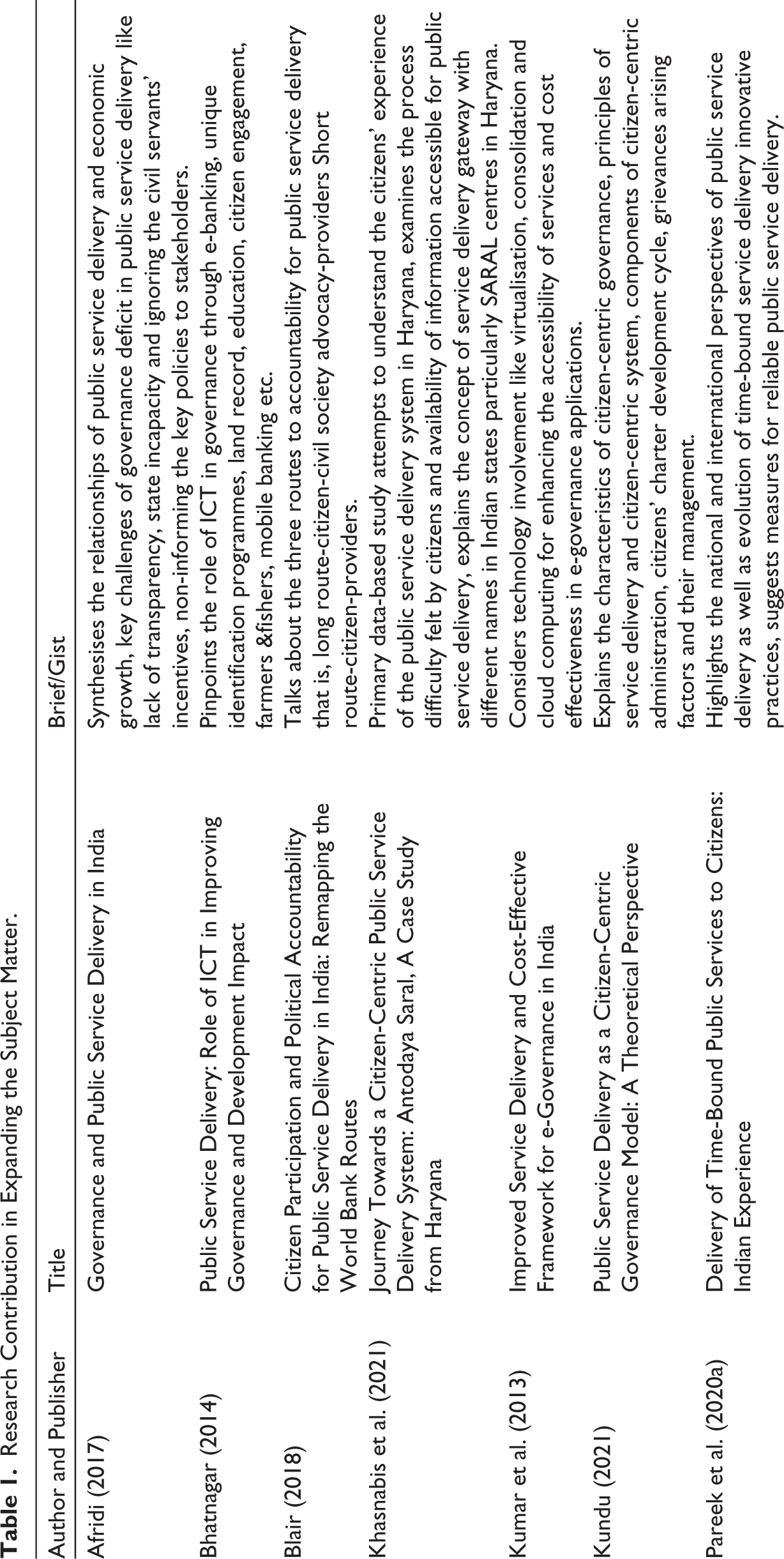
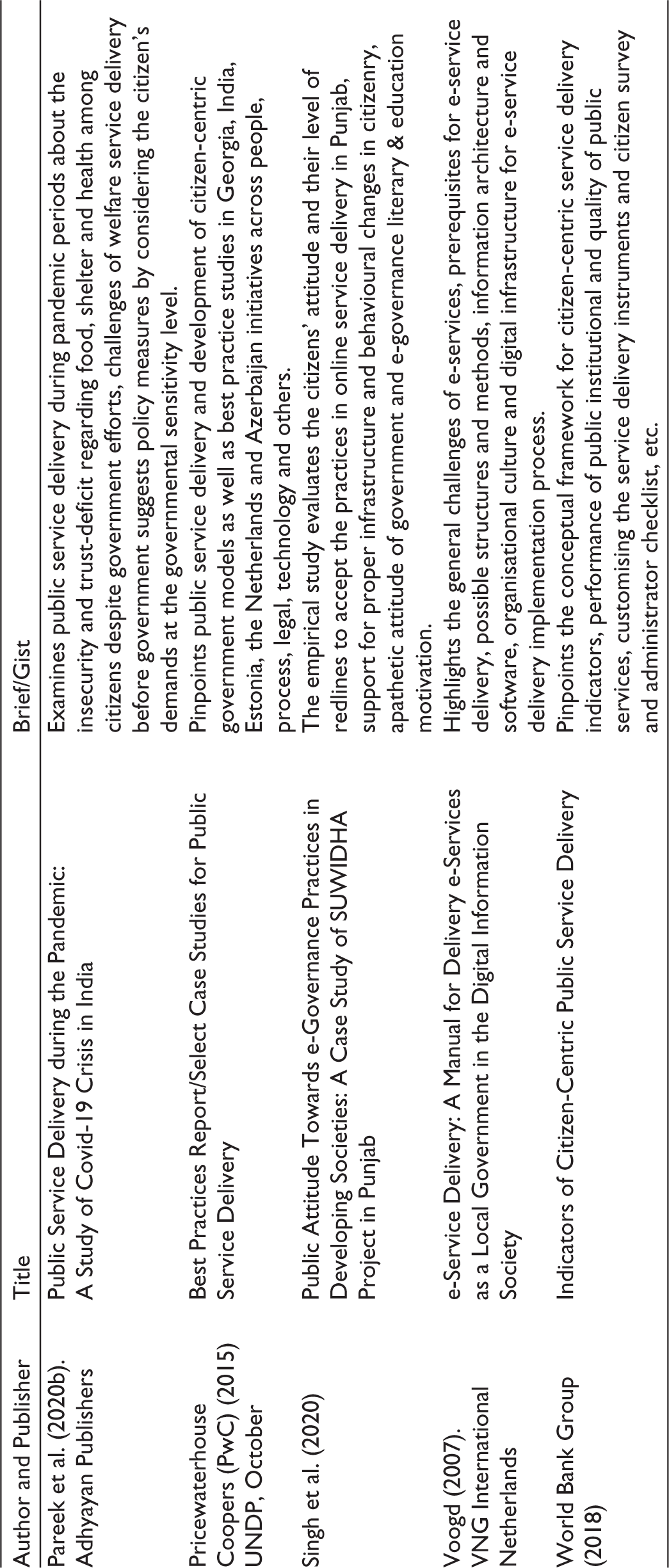
The subject matter of any discipline is dependent on the research efforts for exploring the different dimensions of literature analysis. It is important to clarify the ideas, establish the theoretical roots of the study and help in developing the research methodology (Kumar, 2014, p. 48). A representation of expanding the subject matter through reviewing the specific relevant literature is highlighted in Table 1.
Research Contribution in Expanding the Subject Matter.
Methodology
In this article, an archival research method is used to trace the history of e-service delivery in Haryana and Right to Public Service Delivery Legislation in India as well as in Haryana. Content analysis is a technique for analysing a body of text and enabling an investigator/researcher to draw meaningful interpretations and make inferences about the patterns in the content of the overall body. This article analyses the contents of networking the New Public Management (NPM), New Public Services (NPS) and New Public Governance (NPG) concepts as the theoretical perspective of e-service delivery as well as the review of relevant essential literature. It examines the present status of right-based and time-bound public-service delivery in Haryana as a part of e-governance policy/process.
Theoretical Perspective of e-Service Delivery
The bureaucratic theory establishes a channel between citizens and government regarding their role and relationship. This theory also plays a significant role about the operational issues of private entities in a welfare state like India. e-Government allows the bureaucracy to manage their affairs of governance in an effective, efficient and economic manner as per the objectives of good governance. Public service delivery is the sole function of local bureaucracy and e-governance is the supportive and operative jurisdiction of administrative procedures to improve the organisational outcomes. e-Governance is a means of efficiency and effectiveness in day-to-day performance of bureaucracies.
The NPM perspective is a necessary product of bureaucratic inefficiency, ineffectiveness, and unresponsiveness towards the service delivery domain. NPM is not only propagating just implementation of new technologies in the public-service delivery process but also incorporates a new set of values derived from the private sector. This propagation of private sector values in public service delivery emphasises on the adoption of entrepreneurial approach in its domain. Denhardt and Denhardt (2000) supported the NPM approach under the mirror of NPS. The NPS offers an important and viable alternative to both the traditional and managerial models. It is an alternative that has been built on the basis of theoretical explorations and practical innovations (Denhardt & Denhardt 2000, p. 557). The NPG is being considered as a conceptual tool with the potential to assist our understanding of the complexity of public policy implementation and public services delivery challenges as well as a reflection of the reality of the working lives of public managers today (Osborne, 2010, p. 6). e-Public service delivery is the blended mode of NPS and NPG concepts and right to services legislation strengthens both these concepts.
Right to Public Services Delivery Legislations and Delivered Services in Indian States
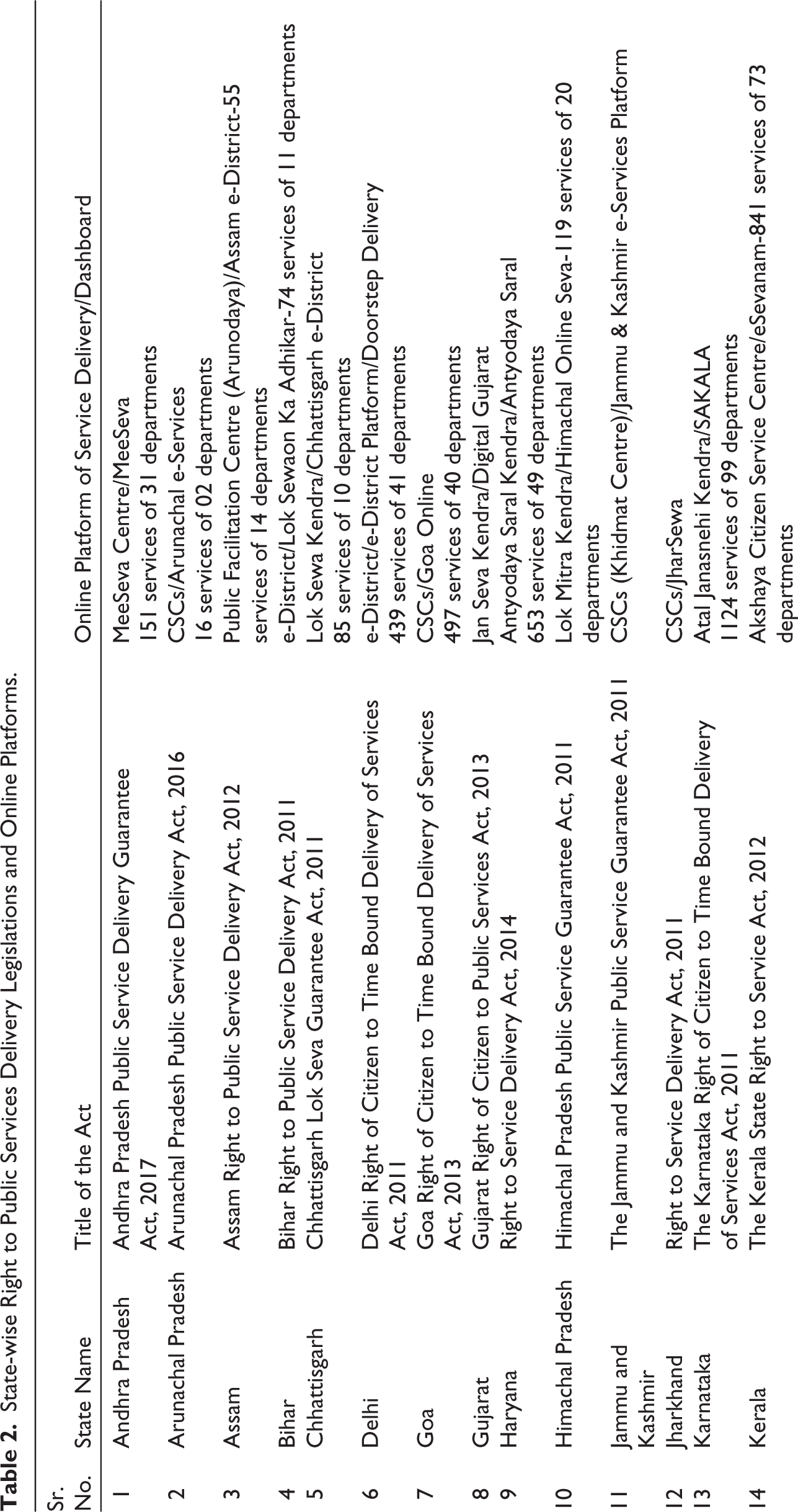
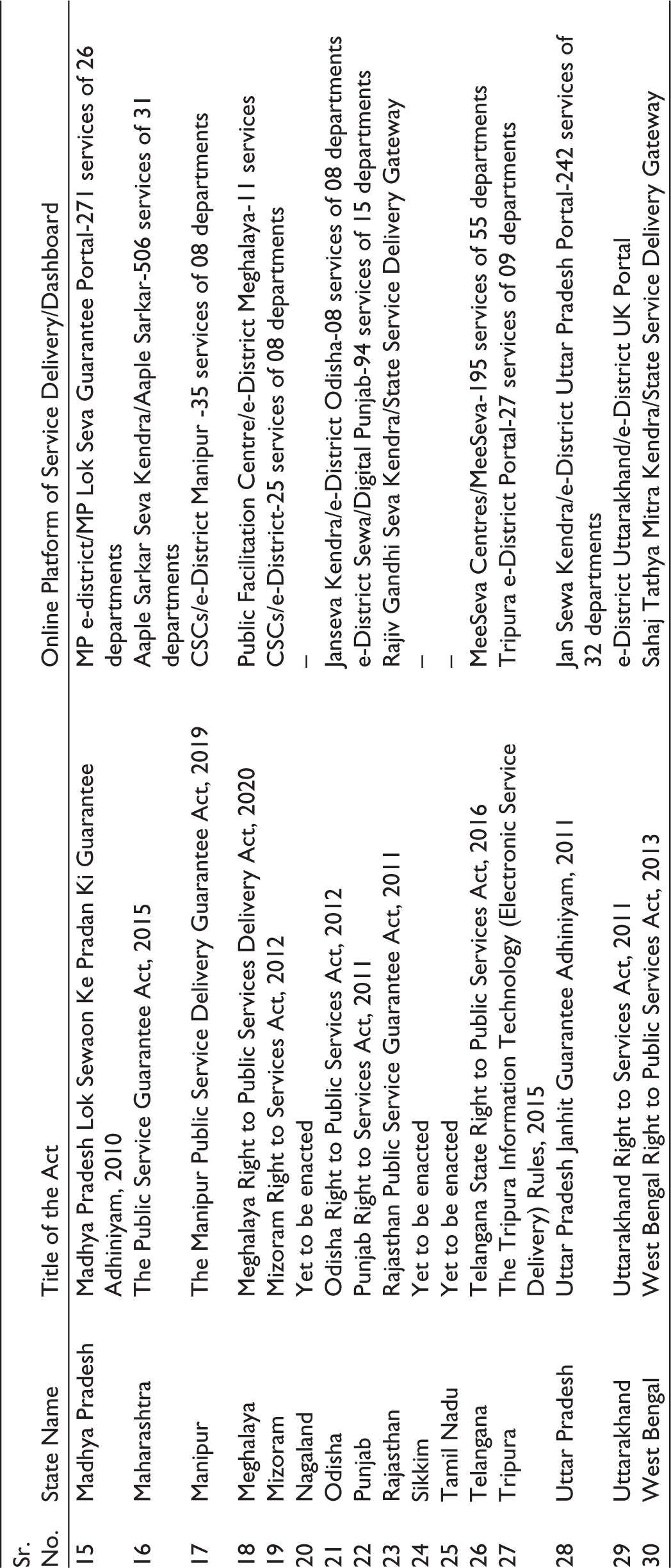
The Right to Public Services represents the commitment of the respective state governments in India towards standard, quality and timeframe of service, grievance-redressal mechanism for ensuring transparency, and accountability. This enables the citizen to avail the services of the government departments with minimum inconvenience and maximum speed (PwC, 2015, p. 26). Almost all the Indian states, except three (Nagaland, Sikkim and Tamil Nādu), have enacted their respective public services delivery legislations as a right to their citizens. Madhya Pradesh is the first state which enacted its Right to Public Services Act in 2010 followed by eleven states in 2011, four states in 2012, three states in 2013, Haryana in 2014, two states in 2015, two states in 2016, Andhra Pradesh in 2017, Manipur in 2019 and Meghalaya in 2020.
e-Service delivery is a paradigm shift from manual delivery to electronic delivery of services. In the case of Karnataka, it is the first state of India to provide 1124 services in 99 departments. The amendments in the Karnataka Sakala Services Act, 2011 and (Amendment) Act, 2014 describe as follows: ‘As a part of e-governance, the Government shall endeavour and encourage the public authorities, to deliver their citizen-related services electronically or through post in a phased manner and in such other manner as may be prescribed’ (
State-wise Right to Public Services Delivery Legislations and Online Platforms.
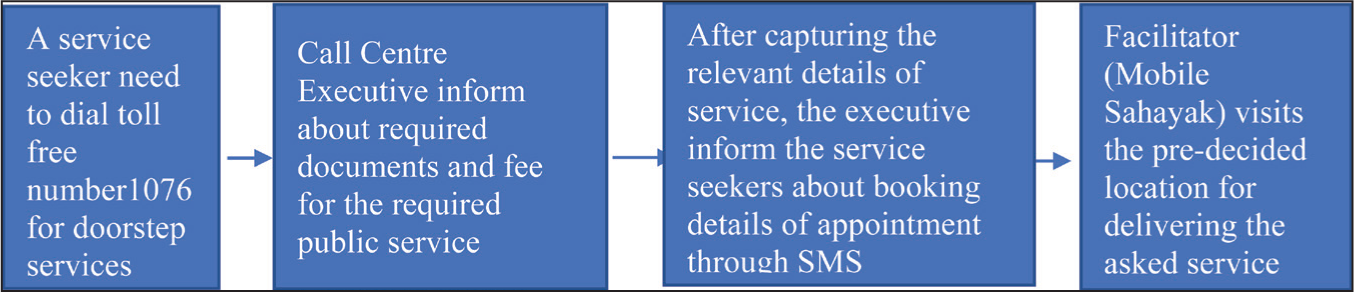
Delhi Government made a value addition in the process of e-service delivery by launching the doorstep delivery scheme in 2018. Initially, this scheme was started with 40 services across eight departments and expanded to 100 services of 14 departments in 2021. On 9 February 2022, Government of Delhi announced an increase in the doorstep service delivery from 100 to 300 services. This doorstep delivery scheme is supporting those citizens who are not familiar with computer technology and the e-governance process. As the mode of operations for doorstep delivery scheme (as depicted in Figure 1), a helpline number 1076 is provided to book a service, in response of it a Mobile Sahayak visits to the doorstep of the service seeker to collect necessary documents on nominal charges of ₹50 only for providing doorstep services (Chakrabarty & Kandpal, 2020, p. 358).
Delhi Doorstep Service Delivery Model Process.
Haryana Right to Services Legislation: An Overview
Haryana Right to Service Ordinance, 2013, was promulgated on 16th December 2013 by the Governor of Haryana and the same was notified by Legislative Department of Haryana on 19th December 2013 to deliver public services to its eligible citizens within the notified time-limits (Government of Haryana, 2013, p. 91). This Ordinance was repealed by legislating ‘The Haryana Right to Service Act, 2014’ (Government of Haryana, 2014b, Clause-23). The Administrative Reforms Department of Haryana notified ‘The Haryana Right to Service Rules, 2014’ on 1 July 2014 (Government of Haryana, 2014d, p. 7/11/2014-3AR). These Rules provide for making an application for delivery of service through registered post duly addressed to the aforesaid designated officer or through e-Delivery of Integrated Services of Haryana e-DISHA Kendra.
According to the Haryana Right to Service Act, 2014, the State government is required to notify the services and time limit for their delivery. For proper delivery of services, the first and second designated officers as grievance redressal authority has to be notified by the government. The designated officer is responsible for providing the required services, rejecting the application of services, maintaining the record of supplied services and stating the time-limit of services (Government of Haryana, 2014b, Clause-5). If a service seeker is not satisfied with the delivered service or rejection of his/her application, then there is a provision of filing appeal to the first grievance redressal authority within 30 days from the date of rejection or expiry of the notified time-limit. When the authority is satisfied with the genuineness of the appeal, then he/she can request the designated officer to deliver the service within seven working days by explaining the reasons of default. The first grievance redressal authority must dispose of the appeal within 30 days of its receipt by providing the opportunity of hearing both the parties (Government of Haryana, 2014b, Clause-6). If the appeal for service is rejected or not provided within specified time by the first grievance redressal authority then the service-seeker may move to the second grievance redressal authority within 60 days of rejection or other decision. This authority has the power to reject the appeal or issue direction to designated officer for providing service within seven working days by passing a reasoned order in writing. The above said decision is to be taken within 60 days of receiving the appeal by second grievance redressal authority (Government of Haryana, 2014b, Clause-7). Both the grievance redressal authorities have similar powers equivalent to a civil court regarding production and inspection of documents as well as issuing summons’ for hearing to the designated officer and appellant (Government of Haryana, 2014b, Clause-8).
In case of failure or undue delay in service delivery without sufficient and reasonable cause, the second grievance redressal authority has the power to impose a lump sum penalty on the designated officer or responsible official in the range of ₹250 to ₹5,000/-. The authority can order compensation of an amount of ₹1,000 to the appellant to be paid by the designated officer or responsible official concerned. The authority can recommend disciplinary action against the defaulter as per the service rules applicable (Government of Haryana, 2014b, Clause-9). The aggrieved person can file a revision request within a period of 90 days from the date of order of second grievance redressal authority before Haryana Right to Service Commission (Government of Haryana, 2014b, Clause-10). The Information Management Department Secretary has the responsibility to display disposal of cases locally and on a website (Government of Haryana, 2014b, Clause-11). The Haryana Rights to Service Commission comprises a Chief Commissioner and four Commissioners appointed by the Governor of Haryana on the recommendation of a committee consisting of the Chief Minister as Chairperson and the Leader of Opposition and one Cabinet Minister nominated by the Chief Minister. The Chief Commissioner is appointed from the group of the retired officers equivalent to the rank and status of the Chief Secretary of Haryana or Secretary to the Government of India. The two Commissioners are appointed from the retired officers of Government of Haryana in the rank and status of administrative secretary and two from the eminent public life persons having at least 20 years’ experience in management, law, administration and corporate governance (Government of Haryana, 2014b, Clauses-12 and -13).
Chief Commissioner and Commissioners are not entitled to re-appointment as well as hold the office for 5 years or till the age of 65 years, whichever is earlier. The salary, allowances and other terms and conditions of service of Chief Commissioner and Commissioners are the same as Chief Information Commissioner and Commissioners appointed under the Right to Information Act, 2005. The office of the Commission includes a Secretary from Haryana Civil Services (HCS) cadre, a Secretary General, and other such officers essential for the proper functioning of the Commission (Government of Haryana, 2014b, Clause-15). The Chief Commissioner and Commissioners can be removed from the office by an order of the Governor on grounds of proven misconduct, misbehaviour and incapacity found in an enquiry of Punjab and Haryana High Court. The Governor can remove them when adjudged as insolvent, convicted for moral turpitude, engagement in any paid employment during the term, unfit by reason of infirmity of mind or body and being involved in acquiring such financial or other interests that prejudice the function of the Commission (Government of Haryana, 2014b, Clause-16).
The Commission is responsible for suggesting better ways of service delivery, carrying out inspections of public service delivery offices as well as grievance redressal authority offices, recommending departmental action against any officer or employee who has failed in discharging due functions. The Commission can recommend procedural change for delivery of services with consultation of the concerned administrative secretary in-charge of the department and additional services to be notified. The Commission has the power to impose penalties on designated officers or any official for default of any notified service up to ₹20,000/- and allow compensation up to ₹5,000/- to be paid to the eligible person. The Commission is empowered to review its own decision, direction, and order. The Commission can initiate suo motu inquiry in reasonable ground cases. It can frame its regulations for conduct of business after the approval of the State government (Government of Haryana, 2014b, Clause-17). The State government must act on the recommendation of the Commission within 30 days or such longer time fixed with consultation of the Commission. If the Government decides not to implement the recommendation of the Commission, then it needs to communicate the reason for non-implementation. The Commission needs to prepare an annual report of recommendations made by it and the government must lay it on the table of the Haryana Legislative Assembly (Government of Haryana, 2014b, Clause-18).
The work done in good faith or intended to be done in pursuance of rules and regulations is exempted from suit, prosecution, or any other legal proceeding (Government of Haryana, 2014b, Clause-19). The State Government is empowered to provide the format of maintaining records of services, procedure for disposing of services, salary, allowances, and conditions of services of the officers and other employees of the Commission (Government of Haryana, 2014b, Clause-21).
e-Service Delivery Model of Haryana
e-Governance offers vast opportunities for transforming governance and improving capacities of government operations. In one sense, it is a gateway of good governance. Good governance encapsulates values such as public enhanced participation, transparency, accountability, and public access to information that helps to combat corruption and secure both basic human rights and the rule of law (Reddy, 2019, p. 12). Sustainable Development Goals agenda includes the element of service delivery as a part of a good governance index framework. By following the objectives of Information Technology Act, 2000, Government of Haryana adopted the means of e-service delivery to achieve the expectations of good governance objectives. In this direction by implementing the mission mode e-governance projects identified under the National e-Governance Plan, Haryana started e-Delivery of Integrated Services of Haryana (e-DISHA) project in 2006. Kaithal district was the first district where e-DISHA Centre was operationalised with the help of District Red Cross Society. This help includes ICT infrastructure, hardware, software, human resources and running expenses (Reddy, 2019, p. 15). After the successful results of this pilot project about citizen-centric service delivery, it was extended to twenty districts of Haryana (Rastogi et al., 2006, p. 249). For this purpose, the Department of Information and Technology created the infrastructure for proper operation of the E-DISHA centres at District level. Primarily, the main objective of these centres was to provide transparent and citizen–centric public service delivery. To support this objective the online based citizen–centric interaction, reduction in cost and duplicity of efforts, efficient, reliable, and integrated computer-based citizen services at a single window have been considered as the sub-objectives for achieving the goals of good governance. As per instructions of National-e-Governance Plan, Haryana State-wide Area Network was inaugurated on 6 February 2008, for connecting the State Headquarters, that is, Chandigarh, to District Headquarters (Dharmvir & Bansal, 2008, p. 86).
e-Service Delivery Procedure through SARAL Centres
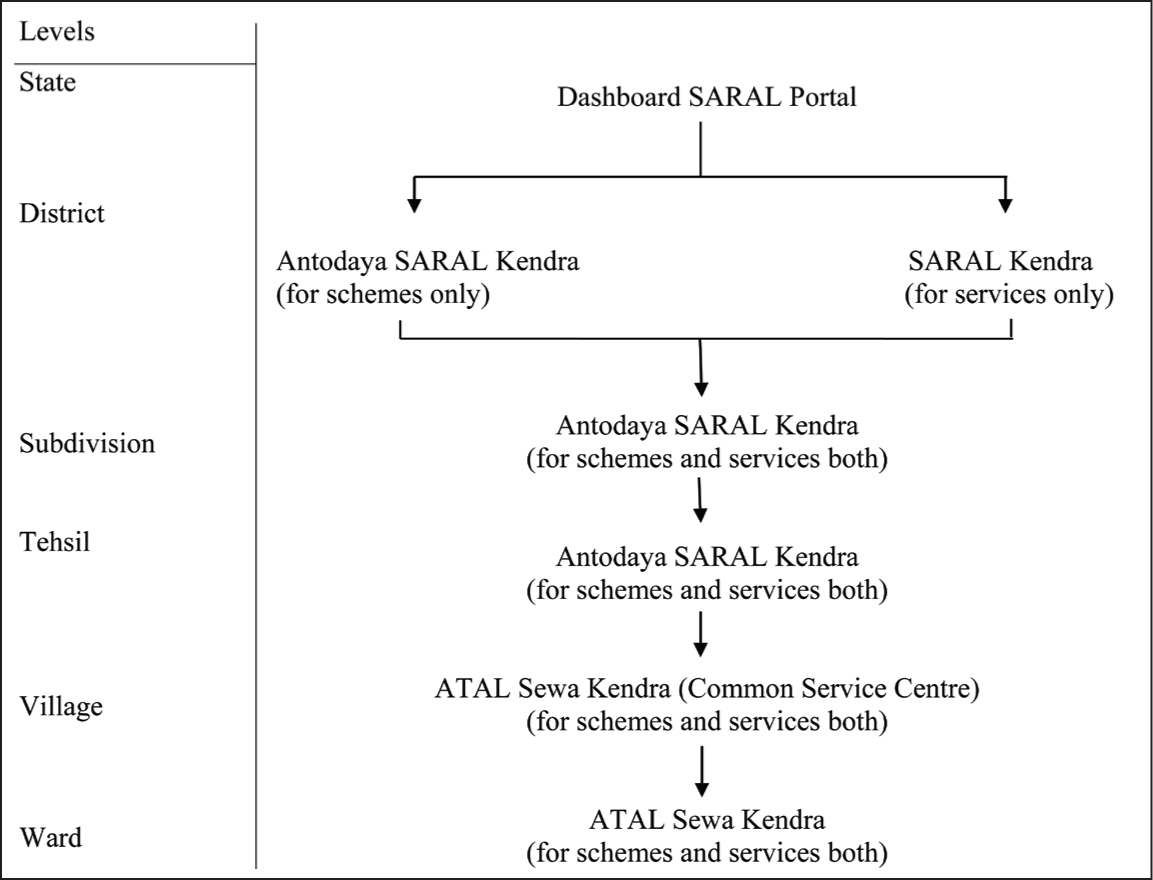
E-DISHA, now renamed as Simple All-inclusive Real-time Action-oriented Long-lasting (SARAL) portal, is working as a common electronic service delivery point (ESDP) for all identified service delivery departments and it is equipped with requisite ICT infrastructure. According to the guidelines of Haryana government regarding SARAL operations, the officials operating the ESDP shall assist the public and provide helpdesk facilities for service delivery. The officials at common ESDP must receive the application from the citizens along with associated fee and other prescribed documents. The official is responsible to check the application file for its completeness, and if he/she feels any discrepancy related to documents and fee then returns the file to the applicant along with a list of discrepancies for completion of the same. Once the complete file in the first instance is received, the ESDP operator has to enter the requisite (minimum) information in the Management Information System (MIS). After entering the information, the operator will generate a unique computerised receipt with the date by which the service will be delivered. He/she has to print two copies of the receipt; one will be handed over to the citizen and the second needs to be attached to the received application file. The officials of the concerned service delivery department are required to collect all applications on a daily basis from ESDP at the-DISHA Centre and get the status of previous applications updated through ESDP. The service delivery departments must ensure to get all the received applications (applications received by them directly, by hand, by post, etc.) are entered at ESDP of e-DISHA Centre, so that all the service requests are included in MIS for monitoring. The concerned department is responsible for the processing of the applications for final delivery of the required service. Citizens can also get all assistance for the service delivery process from ESDP of e-DISHA Centre. A file number is provided to the citizen in print form along with required documents from the e-form software. Using this file number, data are directly imported into the MIS application, without re-entering it. MIS application imports the desired data from online e-form application. Citizens are also facilitated to track the status of their applications, through a website, using the unique computerised receipt number. Citizen’s-awareness campaigns through media and workshops are required to educate the citizens about their rights and time-bound delivery commitment of the government.
Haryana e-Seva Scheme for Common Services Centres
The Government of Haryana started the Seva Scheme for CSCs in January 2014 (Government of Haryana, 2014a, p. 1076). The objective of this scheme is to meet the requirements of citizen’s expectations, efficiency, timeliness, and transparency in the delivery of public services from various departments and agencies of the government. It is a Private Entrepreneurship Business Model which involves village and urban level entrepreneurs for delivering public services as a CSC operator. This scheme is based on a convergence model which envisages that the CSC is authorised to transact business and deliver a rich basket of relevant services to the citizens from multiple government departments/enterprises/agencies except the private and financial sectors. This model follows the Government-to-Citizens (G2C) and Business-to-Citizens (B2C) method of service delivery through CSCs.
Organisational Flowchart of SARAL and Antodaya SARAL.
District Information Technology Society (DITS)
District Information Technology Societies (DITS) are the basic controlling and supervisory agency regarding management of SARAL centres/CSCs at the district headquarters level covering entire Haryana districts having individual DITS. Deputy Commissioner acts as the Chairperson of the DITS and Additional Deputy Commissioner as Vice-Chairperson. District Information Officer (National Informatics Centre) is the Member Secretary of DITS assisted by Assistant District Informatics Officer. The Account Officer of the district acts as Treasurer/Accountant for DITS. Most of the District Heads of different departments (13 to 15 in number) perform the duties of members of DITS in their districts (Government of Haryana, 2014a, 299/1SIT/1076).
A model service bylaws draft of DITS was prepared for recruitment of the computer professionals regarding smooth functioning of DITS. This draft provides for posts/positions of Programmer, Network Engineer, Instructor, Junior Programmer/Joint Data Analyst Networking Assistant/web Designer, Desktop Publisher (DTP) Operator and Data Entry Operator under the model service byelaws (Government of Haryana, 2019, p. 9651).
Concluding Remarks/Recommendations
Use of digital technologies for interconnecting, interacting and integrating the information/data is an indicator of present-day governance reforms. e-Service delivery is the operational part of digital technologies as per the decisions of government. The online and time-bound service delivery modality supports the concept of NPG. Haryana state is doing well in e-governance as well as e-service delivery. SARAL platform provides the ability to avail the enlisted services in a time-bound manner, online access, application tracking, transparency in services charges, redressal of grievances and district & department-wise performance dashboard as an accountability element.
e-Governance concept may be successful when the users can take advantage of e-service delivery from their homes. The SARAL platforms are the medium of semi-service delivery and a service-seeker has to be present physically for the required service. The e-service delivery model will be successful when service-seekers are in touch with technology only as the medium of service delivery. For this purpose, the government of Haryana needs to develop a mobile-based SARAL App to minimise the service seeker and middleman interaction.
To generate proper awareness, the government needs to develop specific awareness modules in the form of print, digital, and short videos for citizens. Department-wise service delivery timelines, fees, and required documents as per RTS provisions should be displayed on the departmental websites. Mobile campaigning teams should be prepared to organise seminars and hands-on training programmes for rural and urban citizens. An awareness generation employee can be deputed at SARAL platforms to distribute service user’s manuals, pamphlets and other booklets of the e-service delivery process and Right to Service Act provisions. A reception counter employee may take this responsibility at the initial stage.
Soft skill training for SARAL service providers is needed for behaviour management in a respectful and friendly manner. A technology-friendly and familiar help desk should be established at every SARAL platform for providing hands-on training to the citizens/service-seekers and they should be motivated to apply for services from their home. A list of contacts and e-mail addresses of Designated Officers should be displayed in the waiting area of SARAL platform of the district as well as the departmental webpage. A public service delivery policy should be formulated for uniform pattern of service delivery procedure.
Ultimately, e-public service delivery is leading towards an innovative paradigm shift in the Indian governance system because of technology insertion with the right-based approach as well as the willingness of governance ecosystem.
Footnotes
Declaration of Conflicting Interests
The author declared no potential conflicts of interest with respect to the research, authorship and/or publication of this article.
Funding
The author received no financial support for the research, authorship and/or publication of this article.
Acknowledgements
This article is an outcome of minor research project financially supported by Dr. Radhakrishnan Foundation Fund, Maharshi Dayanand University, Rohtak (Haryana).