




Abstract
Marx’s model of capital and labour, dynamised by contradictions and the compulsion to accumulate, leaves deviations from the polar classes of capital and labour ignored, regarded as precapitalist outliers, or as headed for extinction. But the two considered here, petty commodity production (and trade and services) and merchant’s or commercial capital, persist widely. Here in tribute to the major contributions to political economy of Utsa Patnaik and Prabhat Patnaik, their structure and dynamics are discussed in general and in the contemporary Indian case. They are argued to be awkward both analytically and politically. Petty production overlaps with both wage labour and small capitalist firms; it reproduces and expands by multiplication, not accumulation; it does not mobilise in a politically coherent way. Commercial capital is in turn suffused with productive activity; it encompasses petty trade and accumulating enterprises which pursue a reactive opportunistic politics which preserves their independence. Further awkwardness results from the disjuncture between analytically useful categories and the policy concepts used by the state.
Introduction
To this day, Marx’s model of capitalism, based on his analysis of nineteenth century British capitalist production relations, dominates critical materialist political economy. Focused on industrial production, including the industrialisation of agriculture and the transition from pre-capitalist, peasant, feudal, artisanal or primitive communist production relations, Marx’s model is driven by the class-differentiating contradictions between the forces and relations of production to which Utsa Patnaik has contributed germinal analyses (Patnaik, 1976, 1987). On one side is the disciplining of capitalist wage-labour (and the convulsive mass displacement of people necessary for this). On the other are the compulsive driving forces of accumulation through private property, the control of technology and the quest for profit (Marx, 1887, Chapter 24). 2 In the on-going disputes over the transition to, and subsequent transformations of, capitalist relations, social classes which deviate from Marx’s model have tended to be ignored, regarded as outliers, or treated teleologically as headed for extinction (Aslany, 2021; Bernstein, 2001). 3
Here we examine two such ‘awkward’ classes that are peripheral to the orthodox understanding of Marx’s model but which persist and are expanding globally, play a vital role in social relations and politics, and are moreover now fully integrated with industrial and financial capital. 4
The first is the class of petty commodity producers—also known as ‘peasants’, ‘simple commodity producers’ and ‘the self-employed’—although these labels distinguish different aspects of the class, have different theoretical lineages and assign petty commodity production (PCP) different roles in development. 5 For India, Prabhat Patnaik has theorised PCP as the outcome of a ‘perverse transformation’ in which a truncated process of primitive accumulation of capital dispossesses labour outright through land seizure or intensifies its distress through progressively reducing rural incomes, yet is unable to absorb the free or semi-free labour it creates. So PCP remains as a residue, effectively part of the reserve army of labour (Patnaik, 2012). The second awkward class is the class presiding over circulation—‘merchant’s capital’, also known as ‘commercial capital’ (CC) and/or the ‘produce traders’ (Banaji, 2016a; 2020; 2021 6 ; Jan, 2017).
As classes, they are certainly awkward. The concept of awkwardness in a class is owed to Teodor Shanin, who argued controversially that in Russia a century ago the differentiation of these classes into proletarians or capitalists faced a series of social and political, centrifugal and centripetal processes which countered the force of differentiation and led Shanin to suggest that peasants could not have a distinct political interest or become part of the long-term political vanguard (Shanin, 1972). 7 Shanin’s concept of awkwardness was therefore both analytical and political. Other scholars have developed the concept of awkwardness. For Bush (1992) the disjuncture between analytical categories and political activity, between a class which can be identified ‘in itself’, defined by conditions different from those of other classes yet which cannot organise politically ‘for itself’, is awkward. 8 He criticises Marx for never having established links between class in and for itself (Bush, 1992). The concept of awkwardness has also been expanded to include the discursive mismatches, first between state classifications and theoretical concepts, and second between the latter and those enshrined in regulative law (Sankaran, 2008). And if we take seriously the dynamism, multifariousness and the social and spatial unevenness of actually occurring capitalist transformations (Adnan, 2015; Braudel, 1982; Dörre, 2010) the polar classes of capitalists and workers themselves are not un-awkward too.
In this volume, celebrating the signal contributions of Utsa and Prabhat Patnaik to Marxist scholarship and politics, we argue in this essay that the true awkwardness of petty commodity activity lies in its dynamics, structure and politics: in its persistence and capacity to reproduce without accumulation; in the internal contradictions of an apparently simple form which combines capital and labour and yet which also manages labour organised inside the family; and in its inability to act in a politically coherent way. We argue that the awkwardness of merchant’s capital is different, lying in the tension between its structural and dynamic complexity and its political coherence. Although the theoretical concept is clear—capital for buying and selling in the sphere of circulation—in its concrete form it is permeated by productive activity. Further, actually existing commercial capital includes both large and sometimes oligopolistic firms, which accumulate through the concentration and centralisation of capital, and very small or petty (‘petit’) firms which are prevented from accumulating but which persist and expand by multiplication into yet further small-scale operations. Oligopolistic commercial capital has a coherent politics in which, moreover, subordination, either to the state or to industrial capital, is successfully resisted. To overlook these two awkward classes is not just a matter of incompleteness, it is rather to misunderstand the dynamics of contemporary capitalist development.
The argument is developed for each awkward class as follows. First, concepts are introduced and critically discussed, since they have been developed at a relatively high level of abstraction and for general application. They are then applied to the case of contemporary India. India is not only a highly socially heterogeneous, unequal, regionally and politically complex, ecologically differentiated society, comprising nearly a tenth of the world’s economy, a fifth of its people and a third of its poor (World Bank, 2016); it has also long been a major focus of debates and of empirical research on the two awkward classes discussed here. In view of the enormity of the literature we focus mostly on rural and ‘rurban’ society and politics.
Petty Commodity Production and Circulation in the Development of Capitalism
Petty commodity production (PCP) is economic activity in which the household is the unit of production and consumption, a contradictory class position combining capital and labour in gendered roles. Unable to reproduce itself without engagement in the commodity economy, the PCP household may be found in production and in circulation, with flexible and diverse portfolios of activity complicated by wage–work: in agriculture, industry, trade, finance and services, in productive activity, in activity that is unproductive but necessary; and in activity which for some commentators is neither productive nor necessary but represents the reserve army of surplus labour, a sector of refuge, the non-capitalist economy or alternatively the socially excluded (Altvater, 1993; Bhattacharya, 2007; Sanyal, 2007).
PCP in Agrarian Transformation
Combining the ownership of small holdings of land with family participation in the labour process, rural productive activity raises crops and animals primarily for subsistence, with sporadic or small surpluses being sold on markets. When markets are incompletely developed and producers are subordinated to other classes and the state, this definition also fits the standard conception of the peasant (Ellis, 1993). While for many Marxist scholars the two terms are interchangeable, here, in order to clarify what is awkward about PCP, they need to be distinguished.
In his ‘notorious epigrams’ (Duggett, 1975) Marx compared the French peasantry to potatoes in a sack (undifferentiated), representing ‘rural idiocy’ (social isolation) and ‘barbarism within civilisation’ (political powerlessness). 9 In the European transition to capitalism, peasants were expected to disappear. Capitalism would grow on the peasantry’s tomb, wrote Marx (1887, Chapter 33). Engels wrote equally famously that ‘their position is absolutely hopeless as long as capitalism holds sway … capitalist large-scale production is absolutely sure to run over their impotent antiquated system of small production as a train runs over a pushcart’ (1892/2000, p. 15/23). Later, both Lenin and Kautsky argued that peasants would be differentiated into the polar classes of capital and labour, though while Lenin argued from the Zemstvo statistics that the peasantry would be destroyed through struggles between contradictory interests that forced most of them into the proletariat (Lenin, 1899/1964, Chapter 2, p. 179 et seq), Kautsky thought that through their ‘superhuman industriousness’ (Kautsky, 1988, p. 116) peasants would make possible the social reproduction of a distinctive reserve army of pauperised agricultural workers by producing at prices below those of capitalist production. In addition, the seizure of peasants’ assets in ‘primary’, ‘original’ or ‘primitive’ accumulation, 10 later understood as not only an era of history but as an on-going process in logical and historical terms (Adnan, 2015; Dörre, 2010; Perelman, 2001) was another violent force in addition to differentiation that would threaten the peasantry.
While Hobsbawm famously nailed the late twentieth century as witnessing the ‘death of the peasantry’ worldwide, among scholars the terminal illness of this economic class is interminable, contentious (Bernstein, 2001) and unresolved. In Utsa Patnaik’s foundational analysis of peasant class differentiation, the peasantry is alive, forms the nutrient base for capital while subject to the concentration of the means of production, land, which compels owners to exploit wage labour (Patnaik, 1976). 11 For some, while the term has fundamental historical significance, it has been liquidated as a concept relevant to contemporary agrarian conditions (Friedmann, 2013); yet for others it has contemporary relevance as a cultural and political term (Edelman, 2005; McMichael, 2006).
While for Prabhat Patnaik PCP is a non-capitalist form, a form outside the capitalist sector whose persistence attests to the perverse transformation unable to absorb labour virtually dispossessed by capital (Patnaik 2008; 2012), in other readings, the contradictory class position of the family farm has been transformed and incorporated by the penetration of markets into all aspects of production—except for the way in which family labour is deployed and the family budget is allocated internally among its labour.
12
Indeed, Bernstein and Byres, in their compendious retrospective review of research in agrarian studies, conclude that ‘peasant production’ is:
constituted within generalized commodity production, conceived as the imperative of integration in commodity relations to social reproduction… Among the implications of this approach are (i) its provision of an adequate theoretical specification of the tendency to class differentiation, postulated as the contradictory combination of the class places of capital and labour in peasant production in conditions of generalized commodity production; (ii) the uneven allocation of those class places within PCP enterprises (‘households’), for example, by gendered divisions of property, labour and income; (iii) what determines whether, how, and how much, the tendency to class differentiation is realized in actual trends of class formation (including the effects of counter-tendencies) and (iv) that one possible outcome of differentiation, according to specific circumstances, may be the consolidation of middle peasant strata and/or ‘capitalized family farms’ (Bernstein & Byres, 2001, pp. 26–27).
So PCP may be consolidated as one of the ‘infinitely diverse combinations of this or that type of capitalist evolution’ that are possible (Lenin, 1899/1964, Preface, pp. 25–28). And regardless of further debates over self-sufficiency, PCP is not a system of peasant or pre- or non-capitalist enterprise for three reasons. First, it is dependent on commodity relations in the circuits of production and reproduction. It cannot reproduce outside capitalist relations: they are its existence conditions. Second, while the units of PCP are households, petty commodity producers can develop ‘micro-conglomerate’ portfolios of gendered activity, varying seasonally, straddling economic sectors, displaced across territory, bridging rural and urban, fusing (migrant) wage-work and its remittances with PCP, able to be destroyed yet easily resurrected (Chattopadhyay, 1965; Harriss-White 2008; Jan 2017). While it may include a stream capable of differentiating into capital and wage labour, most PCP households reproduce themselves as PCP while spaces are created into which PCP can expand. Third, Bernstein and Byres introduced Friedmann’s distinction between the peasant form and the (American) ‘capitalized family farm’, and, with this, the idea that there are ‘other ways of theorising PCP/SCP’. 13 Here, peasant farms have become firms producing commodities, no longer meeting subsistence needs but agriculturalised, food-crops in particular becoming cash-crops, and spinning, weaving or brewing becoming specialist occupations rather than part of a complex way of life. And not only in agriculture: a clearer distinction between peasant production and PCP lies in the development of PCP as a form of independent activity for the market in the spheres of manufacturing, trade and services. As early as 1978, Moser, to take an influential instance, having critically reviewed all the ILO case material for informal economic activity in Latin America, Africa and South Asia, argued for the superiority of PCP as an analytical category, stressing the diversity and dynamism of its substantive urban forms and relations. Providing the bulk of urban livelihoods, it is to be considered a permanent feature of capitalism in developing countries, she concluded (Moser, 1978, pp. 1056–1060).
Actually Existing Petty Commodity Production in India
India’s capitalist transition and ongoing transformations have created a complex, uneven and heterogeneous social formation (Mohanty, 2016). Rampant differentiation has occurred and advanced forms of corporate capital have been created with family dynasties, often grafted onto former colonial managing agencies, and now wielding global power (Mukherjee-Reed, 2004)—and a substantial wage-working class (Hensman, 2010). Yet the most common form of production is still PCP. In the 2013–2014 Economic Census, 71.7% of firms were own-account enterprises (Government of India, 2015). In terms of livelihoods, PCP is the robust backbone of the agrarian, manufacturing, service and commercial sectors, even though—due to the low purchasing power associated with PCP (Patnaik, 2008)—it is a constraint on the development of India’s national market. It is not a transient or transitional form: if it is really only a stage in the differentiation of the peasantry into capital and labour, it looks likely to be an indefinitely long one (D’Costa, 2014; Patnaik 2006; 2012).
Under liberalisation, an explosion of activity officially classified as self-employment is now driving an expansion of the workforce and is a significant component of India’s economic growth (Sinha, 2007): own-account firms doubled in number between 1990 and 2011. Moreover, the average wage labour force per firm in India dropped from three workers to just two, while 95% of firms in India employ fewer than five people. 14
In India PCP is unevenly distributed, rarely dominating or even populating a whole state territory (refer Mishra, 2015 for the exception of Arunachal; Map 1: Harriss-White, 2017).
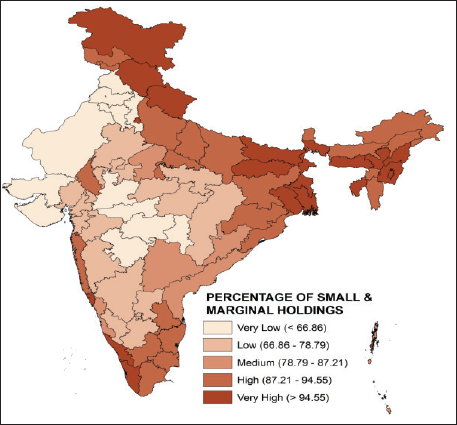
It co-exists with other forms of production, for some of which it may be functionally necessary for accumulation, while elsewhere it occupies niches in ways that are not directly exploited. Three types of co-existence can be distinguished. The first is ‘process-sequential’, in which PCP and wage work are deployed at different stages in a system of commodity production (as in the smelting and crafting of metal (Ruthven, 2008)); the second is ‘process-segregated’ in which certain sectors of the informal economy are populated by PCP and others by firms with wage workers (e.g. local informal retail versus wholesale trade (Aga, 2018)); and the third is ‘process-integrated’ in which PCP and factory production using wage labour are mixed at all stages of a commodity supply chain (e.g. garments) (Kaur et al., 2007)
Under PCP, it is not that differentiation is impossible. Some households are able to invest in assets and expand by employing wage labour, while others slither into ever-greater dependence on wages. But its remarkable and theoretically awkward characteristic is how comparatively rare this is, and how much more common is its tendency to expand through multiplication rather than the concentration and centralisation of capital. PCP exists and expands alongside other forms of capitalist production relations. Why does it persist, and how?
The Economics and Internal and External Logics of PCP
The research literature has generated no consensus about the forces driving the persistence of PCP or its expansion through multiplication. Since capital and labour are fused in PCP, it is not dynamised by contradiction—or at most through ‘tensions’ (Banaji, 2016a). 15 These are specific to particular historical contexts. Although the term PCP is not found in Marx’s own writings, three problematics related to PCP are found scattered there. Jan and Harriss-White (2019) have identified these themes as dissolution, conservation and the exploitation-autonomy dialectic. Distinguishing them may enrich theoretical–historical explanations for the persistence of PCP. In the first, PCP is transient; the English transition is used to show how the peasantry is transformed into a landless proletariat. In the second, labour is incompletely separated from the means of production and PCP persists formally subsumed to capital as disguised wage labour (DWL). The third is less well established in Marxist scholarship. Here, Marx used nineteenth century America to lay out ideas about ‘independent producers’. He distinguished what he earlier called the ‘twaddle’ of conceiving individuals as capable of action in isolation from their societies 16 from the concept of ‘the producer’ who is ‘owner of his own conditions of labour’ but without command over wage workers. This producer is ‘awkward’ because of being capable of resisting capitalist regimes, even when backed by their states. Marx held that to the extent that this kind of producer possesses the means of production and can accumulate for themself, capitalist accumulation and its mode of production are not possible. Marx called these ‘dramatically opposed economic systems’ and thought that under ‘independent production’ wealth tends to be dispersed rather than accumulated (Marx, 1887, Chapter 33). So, capital and labour unified in PCP persists with some independence and may even reproduce at the expense of capital (Marx, 1887).
In India’s complex and historically uneven process of the subsumption of labour to capital, small scale agriculture, subcontracting, out-sourcing, in-sourcing, home-working and such like are said not to be independent, and to be structurally no different from wage work, merely one of the ‘classes of labour’ differentiated by precarity, dependence and the scale of assets (Lerche, 2010), or ‘disguised unemployment’ (Basu, 2018, p. 5) or the ‘reserve army’ (Patnaik, 2012). Here petty production is being generalised as representing the formal subsumption of labour to capital—it is DWL—historically prior to wage work itself, which is the real subsumption, in turn delayed in India (Gupta, 1980). In the transition to the polar classes of capital, the process of differentiation thus takes place after all, albeit extremely slowly. Distinguishing PCP as a class is said to mistake form for essence, to delegitimise labour politics and distract both scholarly and political attention from the struggle between capital and labour (Bhattacharya, 2014).
However, while the phenomenon of DWL cannot be denied, several decades earlier Adnan (1985) had already counter-argued that where an owner of assets takes decisions about production, 17 and is accountable for the outcome, the activity cannot be reduced to wage labour nor even to DWL but must be recognised as PCP. 18 Its persistence and expansion makes Adnan’s position hard to resist and enhances the contemporary significance of Marx’s third theme of an exploitation-autonomy dialectic.
Since PCP exists in all three forms, what halts differentiation? The persistence of independent production is due to their owning or controlling a restricted and specific means of production, on which the value of work–time, measured by the realised product, can be less than that of wage work. The capacity to self-exploit (and not to pay family labour), and the greater labour time invested in production at less than the prevailing wage, does not just undercut capitalist production relations and labour-displacing technical change, it is also a mechanism for transferring resources/value from PCP to those consuming the product. Some rural economists interpret this capacity as efficiency (e.g. Lipton, 1968)—and it can indeed result in the more physically efficient use of capital and scale-neutral production technologies than capitalist production (Hazell et al., 2010). Others see the partition and miniaturisation of assets that underlies expansion by multiplication as ‘involution’ (Geertz, 1963). But they are both forms of self-exploitation.
Another explanation proposed for the persistence of PCP involves the concept of simple reproduction in which surplus is invested only to the extent that production and consumption are constant. PCP depends on market exchange for day-to-day culturally defined subsistence, both food and non-food. Non-market forms of exchange, co-operation and sharing may be practised. ‘Enrichment as such was not its direct purpose’, observes Marx (1863, XXI, p. 1305) of handicraft production. Inflation of the prices of consumption goods and inputs may provoke a ‘simple reproduction squeeze’ Bernstein (1977), responses to which may include lowering food consumption and intensifying labour effort including—if necessary withdrawing children from school to work in production (Pal et al., 2016; Patnaik, 2003).
Further, the need for consumption expenditure (including for housing and education), and spending on protection against risk (including health) constrain investment to expand activity and accumulate. So does the state’s fiscal activity, which is in aggregate socially retrogressive, even if income tax itself is not (OECD, 2017). Yet despite this tendency to produce adverse domestic balances, small social surpluses are accumulated and play a key part in the multiplication of small firms through the transfer of assets between and within families at marriages and through inheritance. 19
The form of PCP cannot be analytically extricated in any pure and simple way from the social and cultural practices in which it is embedded, which generate further complexity. Marx called these ‘patriarchal, political or even religious admixtures’ (1863). Accumulation is persistently constrained by micro-political relations of gender (in which women are normatively—and even forcibly—prevented from saving (Guerin et al., 2013; Kapadia & Anandhi, 2017)); and by caste and ethnicity: occupational choices are still mostly restricted for Dalits and Adivasis, the hours of toil are set customarily, and the returns to effort can and do differ on ethnic- or caste-discriminating lines (Harriss-White & Rodrigo, 2016). Further constraints on class differentiation are also found in the exchange relations in non-labour markets in which PCP is embedded. The persistence of tied contracts in several of the markets in which exchange takes place in both agriculture and non-agriculture (above all in the ‘labour-intensive’ textiles and garments sectors) has generated a large literature (reviewed in Mohan, 2015). The social terms and conditions of tied labour reduce returns below the levels they might otherwise be expected to reach (Gill, 2007). Less well acknowledged is the common addition to operating costs that happens when payments for what petty producers sell are delayed, while payments for what they need to buy are not (Harriss-White, 2013). These asymmetrical payment periodicities combine to reduce the investible surplus.
Given the range of different logics and social relations at play in PCP and given the absence of contradiction between capital and labour in this form, it is not that PCP has no politics. Its politics are dynamic, incoherent and effectively neutralised in such a way as to avoid labour-capital confrontations of the classical kind.
The Awkward Politics of PCP in India
Insofar as PC producers are owners of capital, farmers’ movements and business associations admit them to join mobilisations (such as for price support) (Lutringer, 2010). But while these forms of collective action are often termed ‘populist’ they rarely allow for the political aspirations and interests of PCP to be represented if they differ from those of local capitalist elites. 20
Considered as labour, the politics of PCP is just as disadvantaged as it is when seen as capital. Labour politics focuses on struggles to improve the terms of exploitation in labour markets. But if PCP is labour then it requires an expansion of the concept of exploitation to markets other than labour: rental markets for premises, land and machines, money markets, the supply of raw materials and of manufactured goods. To date, the politics of such markets is not recognised as labour politics by unions or labour policy makers—or by scholars of labour.
As for the mobilisation of PCP for itself, the Self-employed Women’s Association which spread from Gujarat to cover 2% of India’s workforce is regarded as a political model for fighting for work security, income security, food security and social security (
PCP has never generated a political party.
The awkward political question for PCP is whether to try to remove the constraints to accumulation and to try to destroy PCP and DWL and accelerate the creation of a formal proletariat, or to try to transcend such forms by collectivised, cooperative and/or socialised forms of production. For lack of a clear analysis, state policy towards PCP has been incoherent and often self-defeating.
When the state engages in city beautification, when it invokes the law of eminent domain to seize land for public infrastructure or for corporate capital, it actively destroys PCP without compensation (Lieven, 2018). PCP is also disenfranchised under Indian Labour law, because for cases to be brought to court an individual employer must be identified. The Labour laws not only disenfranchise, they also de-class petty capital, PCP and labour alike, because employers of up to 5 wage workers (recall, this is 95% of all Indian firms) are themselves legally classified as ‘labour’ on grounds of their relatively small size and lack of access to social security (Sankaran, 2008). Yet, when the state seeks to develop small-farmer agricultural technology and extension services, implement land reforms, build micro-industrial estates and expand micro finance, it deliberately promotes PCP. From 2005 to 2009, for example, the National Commission for Enterprises in the Unorganised Sector (NCEUS), despite its lack of consensus over self-employment, which it saw in ‘good proportion’ as being DWL, it treated PCP as a form of entrepreneurial capital, advocating credit, skills-training and secure sites as elements of ‘pro-poor development’ (NCEUS, 2007). And when the state establishes safety nets of social protection it protects PCP along with wage labour. When it establishes municipal marketplaces and parking stands for carts and tempos, the state tolerates PCP. PCP is also both sustained and disadvantaged through unintended outcomes—as when the rural employment guarantee scheme incentivises PCP by raising the formal wage floor under which PCP competes, or disadvantages it by expanding and formalising credit for which PCP has no acceptable collateral (Harriss-White, 2012). But it is for reasons other than the incoherence of state intervention that Prabhat Patnaik (2006) argued that PCP needs protection and promotion through collective and co-operative organisation of the means of production. For Patnaik, the social costs of the alternative—mass unemployment—exceed the combination of the costs of state support for PCP (let alone the costs of its incoherence) and the threats to wages to labour and returns to self-exploitation of a ballooning reserve army of workers if PCP were to be eviscerated.
Threats to, and the Resilience of, PCP
Since threats to PCP would have wide ramifications, scholars of agrarian development have seen PCP’s conditions of existence as being unprecedentedly threatened by the expansion of export agriculture, by contract production for supermarkets and corporate capital, by stricter phytosanitary regulation, by rising hedonic standards, and by the speculation in food markets by finance capital. The commodification of applied life sciences also displaces agriculture from land to factories through the reconstitution of nutrients in bio-fortification, aquaculture, genetically modified seeds and the bonding of food processing with pharmaceuticals (Friedmann, 2013; Patnaik, 2003; 2008). These are indeed all serious threats.
In the Indian economy, however, such is its armoury of resistance that there is little evidence for anything but a continuing proliferation of PCP as a constitutive form of Indian capitalism. While PCP may undergo further transformations through capitalisation, it seems all but proof against differentiation. It is not only the practical outcomes of state intervention which constrain differentiation. Over a span of several decades, characterisations such as ‘blocked transition’ (Harriss, 1982) and ‘blocked differentiation’ (Jan, 2017) have drawn attention to the roles of agro-commercial capital in preventing accumulation by PCP and in maintaining small-scale (often fragmented) production. This brings us to the role of the second awkward class: merchant’s capital.
Merchant’s capital (MC) was peripheral to Marx’s model of industrial capitalism and belonged to an historical epoch predating capitalism proper. For Marx, MC or ‘circulation capital’ was the oldest form of capital. It was money used in the sphere of circulation in which commodities are bought and sold. It was distinct from capital deployed in production. In Capital, Marx argued that there are no activities on the part of MC in the sphere of circulation which could increase the use value of the commodities which it buys and sells, because the act of buying and selling on markets does not change the physical nature of the commodity. MC is therefore unproductive—even though it is clearly necessary to the process of social reproduction. Its social value resides in the fact that ‘a smaller part of society’s labour power and labour time is tied up in this unproductive function’ than would be the case were there to be no such mechanism for facilitating the turnover of capital (Marx, 1887, Chapter 4). Without MC, the mass of surplus value produced by agricultural and industrial capital would be less efficiently produced. Marx has been criticised for having an inadequate theory of the transition to capitalism. 21 However he can be read as seeing MC both as a transitional form of capital, and as an integral element of capitalism, subordinate to industrial capital in its mature stage. Marx introduces the idea that MC itself embodies contradictory relationships with respect to production.
For Marx, the role of MC is essentially ambivalent and has both progressive aspects—being conducive to the establishment of (industrial) capital—and regressive aspects—blocking this process. On the one hand ‘(t)he development of commerce and merchant capital gives rise everywhere to a tendency towards the production of exchange values, increases its volume, multiplies it, makes it cosmopolitan and develops money into world money. Commerce therefore has a more or less dissolving influence on the producing organisation which it finds at hand, and whose different forms are mainly carried on with a view to use value’ (Marx, 1894, Chapter 20). Marx also recognised that MC, like primary accumulation, enables the concentration of capital which can then be invested in production. This is a process which is logically prior to the development of capitalist production because production takes place over time and investment capital is necessary for plant, raw material and wages before production can start.
On the other hand, MC could not avoid also having a regressive role because it was unable to avoid being dependent on (then) pre-capitalist labour processes to generate the products it buys and sells and thus prevented these processes from being superseded by capitalist production relations. Here Prabhat Patnaik makes two further points: first that merchants capital, while itself integrating regions, can isolate PCP production regionally, introduce impersonality, quash relations of clientelage and cause reproduction crises; second (in an engagement with Irfan Habib) imperialist MC, aligned against national MC can rip, plunder and accelerate primitive/primary accumulation (Patnaik, 2015). Furthermore, MC re-invests resources obtained by buying cheap and selling dear into markets and speculation, not in the expansion of production. ‘The independent development of MC is inversely proportional to the degree of development of capitalist production’ (Marx, 1894, Chapter 20). It is even ‘synonymous with the non-subjection of production to capital’ (cited in Banaji, 2016b). Thus merchants’ capital ‘is an obstacle to the real capitalist mode of production’ (Marx, 1894, Chapter 20).
The way Marx argues about the balance of contradictory effects is to privilege production relations:
(t)o what extent it (commerce) brings about the dissolution of the old mode of production depends upon its solidity and internal structure, and whither this process of dissolution will lead, in other words what new mode of production will replace the old, does not depend on commerce, but on the character of the old mode itself (Marx, 1894, Chapter 20).
Productive industrial capital is also privileged in Marx’s prediction that the development of capitalism would force MC to be progressively subordinated to the role of a passive ‘wing of industrial capital’ (Marx, 1894).
Despite the historical specificity of the MC to which Marx refers, this conception of MC has been influential in India. In part this is because, as the quotations show, he tended to elide the abstract concept of merchants’ capital with the concrete one of commerce.
Commercial Capital
Over the decades since Independence, a few scholars of India have examined the concrete form of MC—Marx’s ‘commerce’—initially understood as money used for buying and selling in combination with money advances for production to secure post-production supplies of commodities. They have particularly asked whether the indirect control of petty production by merchant-moneylenders does or does not proletarianise producers who are dependent on loans for their reproduction (Banaji, 1977; Harriss, 1982). In a debate that brings together the two awkward classes of this essay, both sides also engage with the prevailing expectation in the Marxist tradition that commerce will eventually eradicate petty production before being itself subordinated to industrial capital. Yet in India, neither of these things has happened.
Marx’s formulation of MC as having an unavoidably ambivalent developmental role, and of circulation as an analytically distinct and independent sphere, mixes the impurities of history with the pure concept of MC in a way that obscures the explanation of how the awkward class of MC persists. The actually existing counterpart to MC—commercial capital (CC)—needs reformulating, not as an autonomous independent entity floating above production relations and about to be subordinated to industrial capital, but as deeply rooted in productive activity.
As Marx acknowledged in Capital Volume II, trade cannot take place without the processing of the traded goods (‘an interruption of the process of circulation for productive purposes’) (Marx, 1885, Chapter 6) and transport (‘the use value of things is materialised in their consumption and their consumption may require a change of location’) (Marx, 1885) and storage (productively preventing deterioration in the way allowed by Marx for the repair of factory machinery) (Marx, 1885, Chapter 17). When CC does not undertake such activities directly, it advances money or loans-in-kind for purposes of production (or consumption), through a stratum of intermediaries which manage such loans. CC oligopolists seek the state’s protection, including support for their roles as net contributors to the cascades of credit, and net recipients of the stream of commodities in repayment from debtors (Krishnamurthy, 2015). As both Bernstein (1977) and Banaji (1977) argued 40 years ago, such investment by MC/CC is an accumulation strategy capable of averting the subordination of MC to industrial capital expected by Marx. Commercial capital can also constrain the independence of PCP by subsuming it (Banaji, 2016a, p. 417). The formal subsumption of labour through DWL is essential to this argument though, in deference to both the staggering variety and the blurring of forms in ground reality, both Banaji and Bernstein hedge their bets with vocabulary—sometimes substituting for DWL the concepts of ‘artisanal production’ or ‘household commodity production’ rather than outright PCP (Banaji, 2016a, p. 424).
How does CC invest productively and remain independent of industrial capital? The mechanisms invoked by theorists of capital are remarkably imprecise. Commercial capital presses household production ‘into the service of capitalist production’ (Marx, 1887, Chapter 25). Citing many historians who use the concept of commercial capital, Banaji invokes ‘domination’ and ‘price domination’ (forthcoming, p. 13/22). Chayanov is cited as calling the process ‘economic dictatorship’ (in Banaji, 2016a, p. 412). What are the criteria that count here?
Critical attributes are the difference in scale and reach of assets between MC/CC and those of household producers/PCP, the flexibility and fluidity of forms (Banaji, 2016b) and the size and diversity of commercial portfolios (Jan, 2017). It is the capacity of traders to buy at prices lower than average, store between seasons and sell above average; and their masterful skill in avoiding both tax and regulation (Basile & Harriss-White, 2003). Banaji invokes their ability to extract ‘the major share of the profit’, of surplus value or of organisation or the management of production (2016a, p. 426). And in a convincing, virtuosic sweep through the history of MC/CC throughout the Islamic and colonial worlds, Banaji goes much further and argues for the existence not only of a mercantile-dominated form of industrial capitalism but also for the existence of a merchant capitalism (2016b; 2017).
In order to compensate for the ‘missing Marxist history’ of this form of capitalism Banaji proposes a new typology of ‘the ways in which commercial and industrial capitals penetrate, control and/or reshape the countryside and its relations’, which in his view explains this distinctive form. 22 ‘This was [and is] a capitalism that invested widely in a range of economic sectors beyond commerce in its narrower definition’ …. ‘It was commerce that gave birth to industry’ (Banaji, 2016b, quoting Verlinden), becoming bound to it but not subordinated to it (Banaji, 2016a). And as Banaji’s wide-ranging examples show, MC/CC is as necessary to the non-agricultural capitalist economy as it is to agriculture.
However, one can accept Banaji’s historical evidence while also suggesting another approach to the questions at stake—using a mass of primary fieldwork on ‘real markets’ in Indian rural-urban regions over the last five decades. This approach, less concerned with historical stages, breaks with both orthodox and unorthodox typologies of merchant’s or commercial capital.
Actually Existing Commercial Capital in Non-metropolitan India
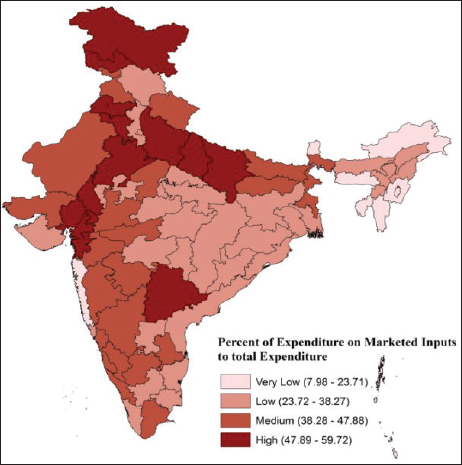
While historians have addressed CC in the export sectors, very large amounts of capital remain locked up in small-scale commerce for domestic circulation—in forms of market exchange that are specifically not addressed by Banaji’s histories of large-scale, vertically co-ordinated CC. In India it is possible that the total capital controlled by family firms still outweighs that of corporate capital (Reserve Bank of India, 2017). As with PCP, CC is unevenly distributed. Map 2 shows the regional heterogeneity of commercial inputs to agriculture—similar to the spatiality of the marketed surplus but different from that of PCP displayed in Map 1 (Harriss-White, 2017).
Field evidence from districts in Southeast India over 45 years and Northeast India over 25 years, confirmed by recent studies in Northwest India (Aga, 2018; Jan, 2017; Sinha, 2017) and Central India (Krishnamurthy, 2011; 2015), shows that the structure of commercial assets is independent of land-based agrarian power. These commercial structures vary regionally and can even be specific to given towns and to crops/commodities; yet almost everywhere local oligopolies co-exist with petty trade. Commodities are exchanged in combinations of wholesale, retail, processing, transport and storage that tend towards such diversity and complexity that they cannot be easily compared and the compulsion to compete is compromised (Harriss-White, 1995; 2008). Commercial portfolios, built out of components controlled by individual family members, link apparently specialised trade with a range of productive activities. They are built up from rent, interest and profit from self-exploitation, together with surplus extracted from relatively small and rarely permanent wage labour forces. Returns from these permutations, including trade, exceed those from productive sectors alone.
Within a given structure of fluctuating prices, while some family firms accumulate, others persist without accumulating, yet without necessarily depending on larger scale capitals (Aga, 2018; Cohen, 2013). Some petty trade may even lack sufficient collateral to be creditworthy and financially dependent on moneylenders. Yet corporate capital subordinates smaller scales of trade when it can—in Aga’s case-study of agricultural inputs, by off-loading risk and reducing dealers’ rates of return in the non-corporate sector—in Jan’s cases, by manipulating quality assessments, prices and modes of payment. Elsewhere, mechanisms which limit domination and dependence include credit being rolled over at low or no interest, symmetries in payment periodicities, remote or mobile sites of operation, control over cheap second-hand technologies and spares and autonomy in the deployment of working capital (Guerin et al., 2013; Harriss-White, 2008). From his extensive comparative fieldwork Jan (2017) argues that while this kind of capital in trade, finance, processing and production is socially, technologically and functionally fragmented, it is sufficiently distinct from rural labour to be unified under the term ‘rural commercial capitalism’.
The co-existence of varied forces of production, technologies and forms of organisation of commercial activity—and multiple modes of exploitation—endows the system with resilience against risk and shocks. And this is in turn possible only due to the similarly awkward persistence of different kinds of social segmentation through forms of economic authority grounded in religion, biradari, caste, ethnicity, clan and gender. These too were expected to disappear altogether with the development of capitalism, or to become confined to the private sphere. 23
The Politics of India’s Commercial Capital
This structure of diversity is also reflected in the idiosyncratic politics of CC. Organised through local business associations (where possible federated in order to gain national influence) and Chambers of Commerce 24 ; through factions and clientage; through lobbying, participation in and manipulation of state regulative agencies; through power over civic property (sometimes through management of the land of temples and mosques); and through a risk-minimising participation in a range of political parties: throughout India MC/CC confronts other classes and the state as ‘masters of the countryside’. 25
The many ways in which production and circulation are intertwined are not confined to rural commerce and class formation and the persistence of PCP in agriculture. Their variety is fundamental to India’s capitalist economy. Their general implications for production have already been considered in the discussion of PCP. Their implications for commerce are of two broad kinds. First CC which is large enough to be capable of accumulating secures average rates of profit which exceed those of purely productive activity. In complex portfolios, it is trade and commerce which yield the highest rates of return, and speculative activity which dominates the stream of profit. Second, in the numerically preponderant petty commercial capitalism, the margins between the prices of purchases and sales set by the mercantile activity of local oligopolies, together with their webs of credit, enable petty capital to enter, to generate small livelihoods, to multiply and be perpetuated in varying degrees of dependence—though less frequently to accumulate through the concentration and centralisation of capital (Harriss-White, 2008; 2016). The significant outcome is that far larger numbers of livelihoods are created than would be the case under generalised accumulation involving competition, labour displacement and scale economies, along classical Marxist trajectories.
While merchants’ capital is a necessary theoretical concept, Marx did not theorise the composite forms of capital that have proved to be so persistent in India’s economy, as elsewhere. Of CC, Banaji observes:
(I)t is logically absurd to imagine a history of capital using a notion of commerce that was developed by Marx for the kind of capitalist economy that evolved only in the 19th century. In practice that is largely what has happened…. There is a methodological impasse at work here, a staggering confusion of history and of logic’ (Banaji, 2007).
When euphemised as markets, the economy, growth or business, capitalism is de-institutionalised and de-politicised. Marx’s analytical tools, privileging forces and relations of production and circulation, remain essential to the analysis of the myriad forms of social and political relations and institutions that exist alongside the development of the polar classes of (corporate) capital and labour. They occupy large spaces in-between these and have the capacity to persist in the contemporary era of neoliberal globalisation.
Neither of the two explored here, PCP nor CC, is archaic, a backward form belonging only to history. While both stretch from the Middle Ages to contemporary times, they are as modern as is the corporation. 26 Although others differ, we conclude that PCP, in which capital and labour are fused and profit comes from self-exploitation, is neither a reserve army nor a pre-capitalist outlier. Though it may be being differentiated or surviving as DWL, a significant proportion of its vast numbers persists in a dialectic of exploitation and autonomy. Meanwhile actually existing CC is not confined to buying-and-selling, nor is it subordinated passively to industrial capital. Both involve complex bridging activities; both are rooted in the family and embedded in non-class social authority relations; both embody great internal variety and a wide range of exchange relations. This variety needs to be considered as normal.
To conclude, we summarise our findings about the concepts of class and of awkwardness, ending with some questions that they pose for politics.
Class
Are PCP and CC classes, what Marx called distinct social groups and Shanin defined through shared economic interests and united political action?
Yes and no.
While PCP is identified in relation to the means of production through the fusion of micro-capital and labour, CC is less distinctly identified since it is so heterogeneous in function and scale that accumulation is possible through productive activity niched within the sphere of circulation.
While not in open contradiction with polar classes, both PCP and CC create tensions with them. While it serves a functional role for corporate capital, PCP undercuts wage labour. While the management of corporate capital is skilled wage-work, that of CC results directly in a residual claim (profit). While corporate capital seeks to minimise wages, both CC and PCP self-exploit and exploit ‘unpaid’ 27 family labour.
PCP does not act as a class for itself. By contrast, the oligopolistic apex firms of CC have a distinctive politics involving the promiscuous and opportunistic alignment of business associations with political parties. Through the manipulation of the way regulative policy is implemented CC acts to resist subordination to industrial capital and to maintain its independence. CC is thus a class that plays an active role in class formation. It can also prevent PCP from differentiating to become disguised and then real wage labour or to accumulate. In both cases the politics of identity is meshed with that of class—often reinforcing but sometimes acting at cross purposes with it.
Awkwardness for Political Economy
Both PCP and CC are awkward in the sense of having defied predictions about their transience. They are also awkward due to requiring detailed empirical evidence to interpret their overlaps with other categories. Found throughout the economy, reproducing despite or because of other forces, PCP overlaps with (disguised) wage labour and with accumulating capital. 28 Meanwhile MC/CC is not confined to circulation, meshes productive with unproductive but necessary activity, combines accumulating and non-accumulating firms, co-exists with and may exploit PCP and trade. CC may also exploit and be exploited through markets other than labour markets. Relations between PCP and CC cannot be assumed: CC constantly reworks the relations that enable both to persist. Straddling the rural and the urban, the agricultural and the non-agricultural, understanding CC requires an expanded concept of the agrarian so that its ambivalent progressive-expansionary and retrogressive-exploitative roles can be integrated into political economy.
The balance between these roles is also awkward for state interventions, because the ‘parametric’ regulation of efficient private markets and the displacement of inefficient, exploitive markets (or the replacement of missing ones) by state-administered distribution of goods, which these classes call for, embody contradictions of principle (White, 2016).
PCP is also awkward for labour politics because it undercuts wages, and because it is not possible to incorporate PCP into labour movements, or mobilise it through access to labour law. The political question of whether PCP is an ally of the working class and hostile to capital is one only asked by Maoists (and answered positively (CPI Maoist, 2004)). Meanwhile the India state’s NCEUS while recognising PCP as DWL, regarded PCP for policy purposes as ‘enterprise’ requiring skills, sites and microfinance (NCEUS, 2007).
Both PCP and CC are also discursively awkward for state policy because classifications and vocabulary differ. 29 CC is bundled up in official files called ‘wholesale, retail trade and repair work, hotel and restaurant’ and ‘transport, storage and communications’. 30 And the question whether self-employment or small and marginal enterprise is to be encouraged or destroyed, and if so how, in a neoliberal era, given that ‘markets’ enable and force its persistence, has only ever been framed in this way by Patnaik (2006) whose case for promotion requires collective/co-operative organisation for PCP to reap economics of scale and enable technological upgrading.
Even if officially overlooked, the numerical importance to livelihoods of PCP and CC cannot be denied. India’s corporate capitalist economy has failed to create jobs at the rate at which people reach the officially defined working age. Over three-quarters of India’s agricultural sector consists of very small family farms, and nearly three-quarters of non-agricultural firms are operated by individuals. Excluding agricultural commodities and local distribution, interstate non-agricultural trade accounts for over half of GDP. In the structure of the macro-economy, the share of trade and services swells, while ‘productive’ manufacturing and agriculture are relatively stunted (Dasgupta & Kar, 2018). Until the twenty-first century, the mutual embedding of production and exchange and the state’s accommodation of CC have imposed strong constraints on challenges to this mass of livelihoods from any other class or class fraction. In the era of India’s BJP government, the threat to CC is from above, from corporate capital with strong state support, rather than from below (Patnaik, 2017; 2020). As demonstrated by the year-long cross-class agrarian resistance to the attempt through thunderbolt politics to impose farm-market reforms favouring corporate capital, the impact upon livelihoods of a successful challenge from corporate capital would be nothing short of catastrophic to India’s contemporary political economy.
Footnotes
Acknowledgements
I am grateful to Shapan Adnan, Henry Bernstein, Ali Jan and colleagues and students at JNU’s Centre for the Informal Sector and Labour Studies for discussions about contemporary petty production, and to Jairus Banaji for his historical work on merchant’s and commercial capital. Errors are mine.
Declaration of Conflicting Interests
The author declared no potential conflicts of interest with respect to the research, authorship and/or publication of this article.
Funding
The author received no financial support for the research, authorship and/or publication of this article.