




Abstract
This article reviews three veins of contributions on contemporary petty commodity production in Marxian political economy, with reference to India. Through a comparative analysis of the works of Henry Bernstein, Kalyan Sanyal, and Barbara Harriss-White, the article maps areas of commonality and contestation between the three theoretical constructions and makes a case for the merits of Harriss-White’s framework over others.
1. Introduction
The explosion of informality is a central characteristic of the economies of the global south. While some types of informalization represent a retreat from Fordist capital-labor relations, there is a significant section that requires theoretical elaboration (Sanyal and Bhattacharyya 2009). As far back as 1978, Caroline Moser has attempted to theorize informality through social relations of production with the proposition that informality or the informal sector is nothing but petty commodity production (PCP): the production of commodities by producers who engage in productive labor and who exert control over the means of production (Bernstein 1988).
Within Marxian political economy, there exist multiple theorizations of contemporary PCP, intersecting with and contradicting each other. This article compares three veins of contributions on PCP by Henry Bernstein, Kalyan Sanyal, and Barbara Harriss-White, with reference to the Indian context. By reviewing key articles and books by the above-mentioned scholars, I attempt to highlight their core arguments and chart areas of agreement and disagreement.
2. Locating Petty Commodity Production within Informality
According to the National Commission for Enterprises in the Unorganized Sector (NCEUS), 93 percent of employment in the Indian economy as of 2009 is unorganized or informal. Informality entails self-employment, employment in informal or unorganized enterprises (fewer than ten workers or entirely family-labor based, not registered with the government, do not pay taxes, not required to obey labor laws), or informal employment by organized sector enterprises (irregular or casual work, may not be governed by a contract, no benefits) (Basole and Basu 2011: 63).
Nearly 70 percent of employment in non-agriculture and 99 percent of employment in agriculture is in the unorganized sector (Mehrotra et al. 2012: 12–13). The organized sector accounted for 16 percent of total employment in 2009–10, but nearly half of the employment generated by the organized sector is informal (Mehrotra et al. 2012: 19). Informalization in the organized sector entails short-term contracts for wage workers as well as subcontracting and putting-out arrangements with unorganized enterprises and home-workers, either directly or through contractors. Such arrangements help firms reduce production costs such as costs of compliance with labor and environmental laws (Basole and Basu 2011).
The third type of informality is the surge in self-employment. Self-employment is, according to Harriss-White (2012), the condition of the common man in India. Self-employed workers were 56 percent of the total workforce by 2007—64 percent in agriculture and 46 percent in the non-agricultural sectors (Sanyal and Bhattacharyya 2009: 39). Own-account enterprises, that is, which are exclusively run with the unpaid labor of the proprietor and family members, account for 87 percent of the non-agricultural unorganized sector (Sanyal and Bhattacharyya 2009: 39).
Own-account enterprises are concentrated in agriculture, manufacturing, and repair and trade; only 11 percent are engaged in subcontracting or putting-out relations with capitalist firms (Sanyal and Bhattacharyya 2009: 40). Own-account enterprises and nondirectory manufacturing enterprises (which hire between one and five workers) sell the majority of their product to consumers or households directly and not to contractors or firms (Basole and Basu 2011: 68). For own-account firms, the sites of production and of reproduction often overlap—81.1 percent of own-account manufacturing is located within the household premises of the owner-producer (Sanyal and Bhattacharyya 2009: 67). Own-account firms are also more likely to be run by women: Bhattacharya and Kesar (2018: 718) show that 45 percent of own-account manufacturing is headed by women, as opposed to only 5 percent of establishments.
Therefore, the really interesting empirical category that demands theoretical engagement is the self-employed worker or family engaged in PCP, independently, with no overt relations to capital and without hiring any labor. In the next section, I summarize and compare the theoretical contributions of Henry Bernstein, Kalyan Sanyal, and Barbara Harriss-White on this category. 1
3. What Is Petty Commodity Production?
3.1 Henry Bernstein
Bernstein (1986, 1988) first developed his conception of PCP, drawing on Gibbon and Neocosmos (1985), in relation to the question of social relations of production in agriculture. His treatment of PCP can be understood by the single paraphrase “real-world relentless micro-capitalism.” PCP is “constituted as a contradictory combination of the class places of capital and labor, both of which have their own circuits (and disciplines) of reproduction” (Bernstein 2006: 457).
As capital, PCP must reproduce at its existing scale and possibly grow, that is, accumulate. As labor, producers must maintain socially necessary standards of consumption and living. PCP is shaped by the contradictions between these compulsions. It is regulated by the same immanent laws that govern all commodity-producing enterprises under capitalism (Bernstein 1988: 262).
Capitalism, in turn, is “generalized commodity production founded upon the contradictory relation between capital and wage laborers” (Gibbon and Neocosmos 1985 quoted in Bernstein 1988: 260). Bernstein entreats us to separate the phenomenal form of production relations from their essence, arguing that every individual economic constituent in a capitalist economy does not necessarily display the polar separation of capital and doubly-free labor (Bernstein 1988: 260–61). Those engaged in PCP “are unable to exist and reproduce themselves outside the circuits of commodity economy and divisions of labor generated by the capital/wage-labor relation and its contradictions” (Bernstein 1988: 261).
Bernstein emphasizes that PCP, even when treated as nontransitory, bears within it the possibility of differentiation—either up into capitalist production proper, or down into doubly-free labor (Bernstein 1988: 264). He is careful to note that this is only a tendency and may not in fact manifest, but that this is important to recognize in order to make sense of the emergence of capitalist relations when they do. The generalized tendency is differentiation; the absence of it is to be explained through the examination of concrete conditions in different contexts.
There is no essential logic to PCP that is distinct from capitalist production. There is also no difference between family labor-run enterprises in the global north and in the global south, except their position in the global imperialist division of labor (Bernstein 2001: 27). Bernstein is careful to avoid functional constructions of PCP, or an explanation based on articulation or subsumption (Bernstein 1988: 259–60). There are no stages to capitalism, only its world historical.
The preponderance of PCP is a consequence of the inability of contemporary capitalism to provide a generalizable living wage (Bernstein 2006: 457). The lower rungs of PCP, engaged in survival activity, are understood by Bernstein (2004, 2006) to be part of spatially and economically fragmented “classes of labor.” But when rooted in land ownership, PCP is imbued with the tendency to accumulate (Bernstein 2006: 457). As such, PCP is petty bourgeois and not an exploited class (Bernstein 1988: 264–65). Bernstein (2006: 266–67, 2001: 30) highlights the gendered and generational (class) relations of exploitation within the PCP household instead of treating PCP as a homogenous self-exploiting whole.
3.2 Kalyan Sanyal
Kalyan Sanyal’s influential Rethinking Capitalist Development (2007) is a powerful counterposition. At the core of Sanyal’s contribution is his motivation to make sense of the economic structures of the postcolonial world without recourse to transition.
Postcolonial capital, Sanyal argues, is limited—capital extracts resources from precapitalist sectors but is unable to generate commensurate employment to absorb surplus populations because of the increasing capital intensity of production techniques (Sanyal and Bhattacharyya 2009: 36). As a result, postcolonial nations have large surplus populations (“wasteland”) that exist outside of the capitalist economy proper, who have been dispossessed of their means of labor through processes of primitive accumulation (such as land grabs, slum clearing), but are not a reserve army because they have never had the opportunity to be hired and fired by capital (Sanyal 2007: 54–55).
This wasteland constitutes a non-capitalist “need economy,” a “Chayanovian space outside the circuit of capital” consisting of economic units that operate based on the logic of survival, which is fundamentally different from the logic of the circuit of capital, that is, accumulation (Sanyal 2007: 69; Sanyal and Bhattacharyya 2009: 36).
Producers in the need economy purchase means of production from the market, combine them with unpaid family labor, and produce commodities that are then sold on the market. The circuit of the need economy is:
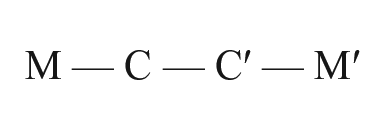
where M′ − M, the surplus generated, is oriented toward household consumption requirements, so that the next cycle of production begins with M, not M′ (Sanyal 2007: 212). Even when surplus is re-invested into production, the aim is to achieve better standards of consumption and living in the future (Sanyal 2007: 213). In Chayanovian fashion, surplus is distributed not through impersonal market exchange but along kinship and communal lines, so that producers share the average product (Sanyal and Bhattacharyya 2009: 38–39).
Much of productive activity in the need economy takes place within households, and household assets become the assets of the enterprise. Production and reproduction processes and expenses cannot always be disentangled (Sanyal and Bhattacharyya 2009: 40–41). The interlinked nature of productive and reproductive activities in the need economy can also explain why a large number of own-account enterprises are headed by women. Homestead-based self-employment allows women greater flexibility (spatially and in terms of time-use) to supplement social reproduction with income-generating work.
The need economy is not conceived as being economically necessary for capital; it is distinct from that part of the informal economy that is tied to capital (the accumulation economy) through outsourcing or flexible hiring (Sanyal 2007: 59; Sanyal and Bhattacharyya 2009: 36). The relation between the need and accumulation spaces is not one of exploitation but of extraction—capital encroaches on the need economy to extract resources (Sanyal and Bhattacharyya 2009: 36–37). At the same time, since the need economy serves as a refuge for those who cannot find a place in the accumulation economy, it fulfils an important political and ideological need of capital (Sanyal 2007: 35). The function of the need economy is political, not economic; this is why capital transfers resources via the state or nonstate actors to the need economy, in a reversal of primitive accumulation, to help sustain it (Sanyal 2007: 60–61, 80–85).
Sanyal posits producers in the need economy as being expropriated by capital and also refurbished by it. Capital and non-capital are engaged in a structural, though hierarchical, unity within the complex of global commodity markets and private property, that is, global capitalism (Sanyal 2007: 15). He eschews the concept of PCP because of its underlying implications of transition (Sanyal 2007: 211–12). While Sanyal allows for the possibility of individual producers within the need economy accumulating enough to transform into capitalist producers, he argues that this cannot happen on a large scale—need spaces are continuously destroyed and re-created.
3.3 Barbara Harriss-White
Harriss-White’s conception of PCP sits somewhere in between. PCP is conceived as economic activity in which “the household is the unit of production and consumption, a unit combining capital and labor in gendered roles” (Harriss-White 2018: 357). Embedded in commodity production, PCP is marked by the “dialectic of accumulation and exploitation” (Jan and Harriss-White 2019).
What differentiates Harriss-White’s position from Bernstein’s is that Harriss-White seeks to restore the “essential reality” of PCP. PCP persists by virtue of self-exploitation, that is, through the deployment of underpaid and unpaid family labor (Harriss-White 2012: 121). Within the household-enterprise, remuneration may be dependent on patriarchal social norms rather than the market per se (Harriss-White 2014: 984). Social identities and institutions such as age, gender, caste, ethnicity, religion, and spatial locations serve as “regulative forces” that shape processes of production, exert control and domination, and “disguise” class formation in PCP (Harriss-White 2010: 156, 166).
Because the household is both the unit of production and reproduction, it is not possible to strictly separate reinvestment of surplus into production and deployment of surplus toward consumption, since the latter contributes to the maintenance of labor in its productive state (Harriss-White 2012: 130). Harriss-White (2018: 360–62) shifts focus away from the theoretical possibility of differentiation to the empirical reality that PCP tends to expand through multiplication, often through resource transfers within households.
PCP is not reducible to disguised wage work because producers are accountable for, and have control over, the means of labor, the production process and, by extension, their own time (Harriss-White 2018: 361). Surplus extraction in PCP takes forms different from capitalist production—surplus is extracted through rents, interest payments, and through markets for commodity exchange (Harriss-White 2010: 154). PCP is therefore “a mechanism for transferring resources/value. . . to those consuming the product” (Harriss-White 2018: 361).
Harriss-White also takes into account the ways in which PCP is functionally useful for capital. She differentiates between three types of integration or coexistence with capitalist production—process-sequential, in which PCP and wage labor operate at different stages of production; process-segregated, in which certain sectors are dominated by PCP and others by wage labor-hiring firms; and process-integrated, in which PCP and factory production are combined at all stages of production (Jan and Harriss-White 2019: 357). Contracting or putting-out arrangements with PCP allow for the “offloading” of various production costs, and afford greater flexibility in the production process (Harriss-White 2010: 154). PCP also absorbs the costs of social reproduction of the industrial workforce (Harriss-White 2010: 154).
Because the primary form of value extraction is via absolute surplus value and not relative surplus value, PCP is understood as the formal subsumption of labor under capital (Harriss-White 2012: 120). However, this does not imply that formal subsumption will necessarily give way to real subsumption—PCP may be a “stage in the differentiation of individual capitals, but is being constantly replenished and reproduced” (Harriss-White 2012: 117).
4. Mapping Theorizations
All three theorizations map commodity-producing units that rely primarily on unpaid family labor. The core difference between Bernstein and Harriss-White on the one hand and Sanyal on the other is that Sanyal identifies capitalist production exclusively with the polar separation between doubly-free wage labor and capitalists who own means of production. 2 On this count, he has been critiqued for obfuscating phenomenal form and essence (Jan 2012). Bernstein and Harriss-White on the other hand recognize the capital-labor relation to be an abstraction that is not necessarily descriptive of concrete production relations in capitalism (see table 1).
Mapping Theorizations.
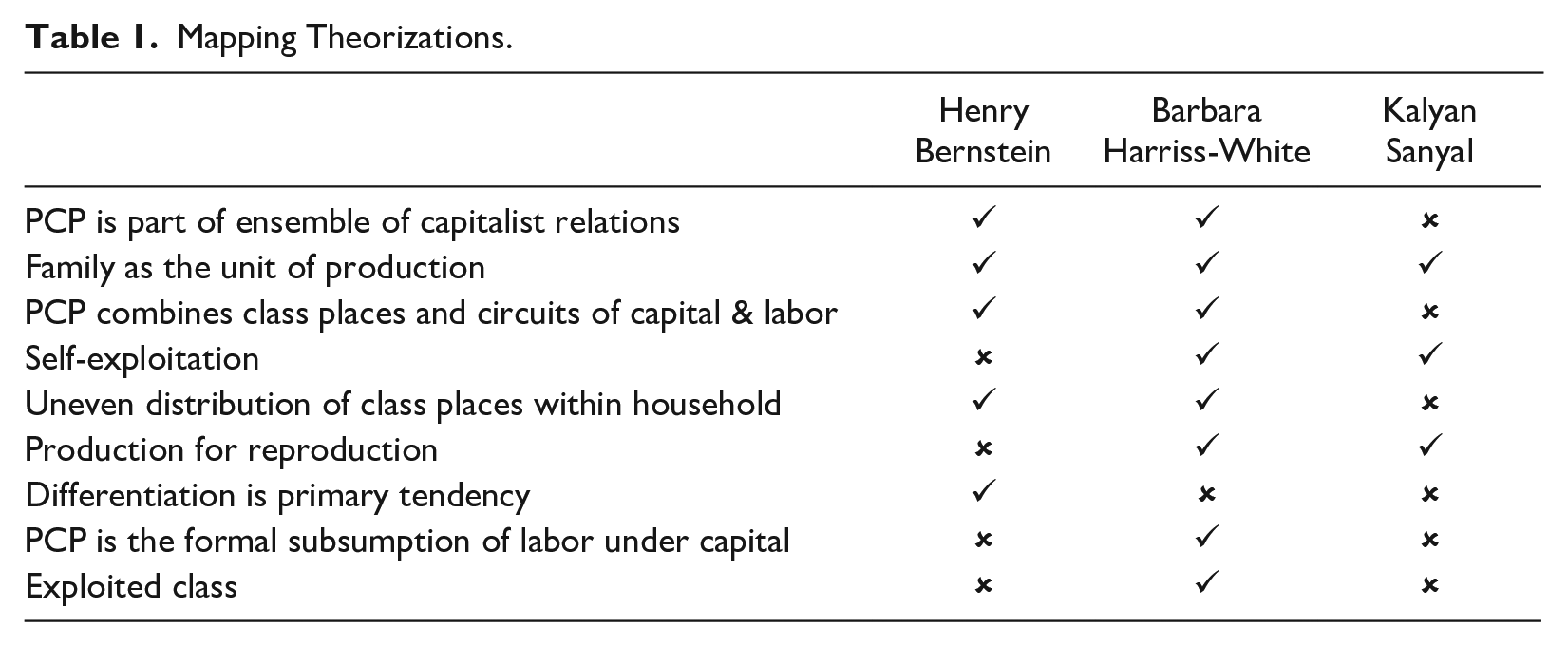
Bernstein’s conception of PCP, though an important reminder not to confuse form and essence, or levels of abstraction in Marx’s analysis, lacks sufficient descriptive power. How do the twin circuits of labor and capital intersect with or impede each other? Does PCP operate differently from capitalist firms, particularly over time? If PCP is subject to the same market forces as capitalist firms, how does it compete and persist? Such questions are not posed in Bernstein’s analysis; PCP does not require a distinct logic or theoretical toolkit. By retaining the core contradiction between capital and labor, Bernstein (2021) also retains the relevance of Marx’s model of capitalist political economy—its central axioms, abstractions, and dynamics.
Instead of putting the theoretical cart before the horse, Harriss-White and Sanyal identify the dynamics of PCP (multiplication, production for reproduction) based on concrete observations. In many ways, Harriss-White builds on Bernstein’s distinction between form and essence by identifying PCP as part of the complex of capitalist relations. She retains Marx’s emphasis on forces and relations of production and circulation, but unlike Bernstein, she is interested in unpacking what it means for a capitalist social formation to be dominated (numerically) by awkward classes that do not appear like the polar separation between capital and wage labor (Harriss-White 2018). To this end, she emphasizes the essential reality of PCP—its core of self-exploitation and overlapping spheres of production and reproduction in the household enterprise. 3
In this regard, Harriss-White’s analysis treads closer to that of Sanyal. Both privilege the centrality of reproduction (and the overlap of spheres of production and reproduction) in the dynamics of PCP/need economy. Both highlight the role of social and kinship relations (as opposed to impersonal market relations) in structuring production and distribution within the PCP/need economy household. But where Sanyal imbues the need space with a general tendency of income sharing between its members, Harriss-White, like Bernstein, explores the disguised forms of class within the household-enterprise.
Harriss-White (2018: 358) highlights the possibility of combinations of self-employment and wage work within the household-enterprise, shaped by gendered divisions of labor that span seasons, sectors, and are spatially dispersed. Though she outlines different types of co-existence of PCP with apex capital, Harriss-White does not fall into the trap of defining PCP through the economic need of capital, which, as Sanyal notes, may be transitory. While she pays attention to the various ways in which PCP subsidizes capital and undercuts labor, the essence of PCP is not bound to apex capital. But Harriss-White’s analysis, evolving as it is, does not provide a theoretical explanation for growth by multiplication, which is treated as an empirical stylized fact rather than a theoretical tendency that stems directly from the contradictory combination of capital and labor that constitutes PCP.
Sanyal instead locates the essence of non-capital clearly in the logic of survival or need, though as described in section 3, he allows for a multiplicity of individual motives in the need space. Sanyal clarifies that the logic of need is an emergent property that arises from the interaction between the need and accumulation spaces (Sanyal and Bhattacharyya 2009: 39). This has rightly been critiqued as effectively undoing the distinction between the two spaces in Sanyal’s analysis, and considerably weakens his analysis (Gidwani and Wainwright 2014: 44–45).
Sanyal does not address the question of how entities in the need space compete with capitalist firms in the market economy. Despite the use of some of Chayanov’s concepts, Sanyal does not explicitly identify self-exploitation as a means of retaining competitiveness (Gidwani and Wainwright 2014). Instead, he overstates the role of reversals of primitive accumulation and welfare governmentality in the survival of the need space (Gidwani and Wainwright 2014).
Sanyal’s theorization is riddled with serious concerns (see also Bardhan 2018) but is commendable nevertheless for attempting to identify an essential logic for self-employment. By conceptualizing PCP as part of the complex of capitalist relations and by highlighting self-exploitation, Harriss-White evades some of these theoretical issues. And though she seeks to restore its “essential reality,” the question of why PCP grows by multiplication has not yet been addressed: is it the result of competitive barriers posed by apex capital, or does it have to do with the centrality of reproduction, in which case, how does it differ from the logic of need or survival? In the opinion of this author, closing this theoretical gap is critical for what is otherwise the most holistic Marxian theorization of contemporary PCP.
Harriss-White also offers insightful preliminary comments on the potential relationship between the size of capitalist production and the size of the informal sector (and PCP in particular) through the introduction of effective demand: “as long as apex capital can expand without requiring high levels of domestic mass consumption, the relations sustaining PCP will persist” (Harriss-White 2014: 991).
The implication is that PCP households tend to have lower purchasing powers given the “super-self-exploitation” that characterizes their economic realities. As a result, they (as well as workers with informal contracts) are more or less confined to the informal sector for the purchase of consumer goods. The primary marketing channel for self-employed producers also happens to be consumers themselves, instead of contractors or firms (Basu and Basole 2011). Apex capital on the other hand tends to produce for capital and for workers with formal contracts who have greater purchasing power.
Harriss-White’s argument is powerful when inverted as well—domestically-oriented capitalist production is limited by the size of the informal sector (and consequently limited demand for consumer goods). Capital creates informality through its inability to provide a generalizable living wage, through primitive accumulation, and through its attempts to extract absolute surplus value. But profits can only be realized if commodities produced are, in fact, sold. Increasing informalization serves as a constraint on capital’s ability to sell.
If the informal sector continues to grow, it will alter the composition of capitalist production. The rigors of effective demand will orient capitalist production increasingly toward the production of investment goods for other apex capital, and toward luxury consumption for a small section of the well-to-do workers and capitalists (as well as rentiers, merchant and commercial capitalists, and moneylenders). The informal sector will increasingly be responsible for itself, for its own reproduction, even as it is enmeshed in extractive relationships with apex capital.
5. Conclusion
Harriss-White’s conception of PCP, though evolving, allows for a multiplicity of capitals that exist and compete in a hierarchy of global divisions of labor and value chains, extract surplus through an ensemble of forms of exploitation, have different modalities of distribution, and have varying dynamic trajectories. PCP households, marked by an empirical tendency to multiply, survive through intense self-exploitation, gendered and generational divisions of labor within the household, and by combining the spheres of production and reproduction. Apex capital and informality are co-created and co-constrained, enabling and limiting each other’s existence.
This conception takes the core of Bernstein’s argument and develops it such that it loses its theoretical sharpness but gains in descriptive richness. In this process, it can express several of Sanyal’s core axioms relating to the circuit of non-capital without having to distinguish it as such. A clearer theorization of the predominance of multiplication can contribute strongly to its explanatory power.
Footnotes
Acknowledgements
I am grateful to the two anonymous reviewers of the journal for their insightful and constructive feedback, and to Avraham Banares and Timothy Hazen for their helpful comments on this article at the Radical Political Economy of Development panel at ASSA 2022. All errors are my own.
1
For reasons of space, I restrict myself to a review of the theoretical construction of PCP and not its political implications.
2
Moreover, Sanyal’s wasteland is a product of the extractive machinations of capitalist development—it consists of producers who have lost their means of labor through processes of primitive accumulation and must procure them through the market; this is why the need economy does not include agricultural self-employment. Bernstein’s and Harriss-White’s conceptions of PCP do not necessitate such a separation between labor and the means of labor, though for Bernstein this is the core theoretical tendency.
3
This has political implications as well. Bernstein (1988) reduces the relevance of the politics of PCP to whether it allies with that of labor or of capital;  is willing to evaluate it on its own terms given its importance as a source of livelihood and employment for large sections of the population in the absence of formal employment.
Declaration of Conflicting Interests
The author declared no potential conflicts of interest with respect to the research, authorship, and/or publication of this article.
Funding
The author received no financial support for the research and authorship of this article. Open access publication is enabled by the Canadian Research Knowledge Network (CRKN).