




Abstract
The study discusses Krishna Bharadwaj’s elaboration of the Sraffian critique of the currently dominating supply-and-demand equilibrium theories that are based on the marginalist approach by making use of documents from the Sraffa archive. Starting from Krishna Bharadwaj’s astute observation that the law of diminishing returns ‘was the thin end of the wedge by which the marginal analysis was introduced and generalised’ the study is concerned with Sraffa’s critique of the marginalist treatment of intensive diminishing returns and his return to a pre-marginalist and non-mechanical analysis of the intensification of land use. In the opening part of the article, the development of the friendship and collaboration between Piero Sraffa and Krishna Bharadwaj is briefly recalled, based on information provided in the correspondence files and diary entries in Sraffa’s papers.
Introduction
Krishna Bharadwaj’s main contributions have been in the field of the analytical history of economic theory. With her elaboration of the Sraffian critique of economic theory, in which she clarified the differences in the theoretical approaches and methodological frameworks of the two main streams of economic theory, the classical surplus approach and the marginalist approach that underlies the supply-and-demand equilibrium theories, she has contributed significantly to a better understanding of Piero Sraffa’s work. This study is concerned with one particular aspect of this large field only, namely with Sraffa’s return to a pre-marginalist, non-mechanical analysis of intensive diminishing returns. That this rather narrow topic may perhaps be of much wider interest derives from the fact that the analysis of intensive diminishing returns of the classical economists ‘was the thin end of the wedge by which the marginalist approach to the study of economic phenomena has been introduced and generalised’ (Bharadwaj, [1978] 1986, p. 41n). The analysis of ‘extensive’ and ‘intensive’ diminishing returns, which in the writings of the classical economists was confined to renewable and exhaustible natural resources such as land and mineral deposits, was subtly transformed, by authors such as Jevons, Wicksteed, Clark and Marshall, into a marginalist analysis of decreasing ‘factor’ returns of universal applicability. As Krishna Bharadwaj has pointed out, the general notion of the law of decreasing returns appears to have been derived in two steps:
First, was the near-elimination of the distinction between the ‘extensive’ and the ‘intensive’ case and the eventual dominance of the latter as a generalized principle. … Secondly, this subtle shift towards intensive margins implied an important change in the method of analysis—a shift from ‘observable’ to ‘potential’ or ‘hypothetical’ changes. This facilitated the illegitimate generalization and construction of symmetry between land and other factors, and an analysis in terms of potential changes and variable proportions of factors. The generalization proceeding from the case of land as a fixed factor led to the general assumption of given factor endowments, thus extinguishing a distinction, crucial to the classical writers, between non-reproducible and reproducible factors. (Bharadwaj [1985] 1989, p. 226)
Sraffa’s return to a non-marginalist formulation of the theory of intensive rent in chapter XI of Production of Commodities (1960) must therefore be regarded as constituting an important element in his wider research programme, which consisted in reconstructing, and eventually rehabilitating, the classical approach to economic theory and in elaborating the associated critique of the supply-and-demand based theories. In the chapter on ‘Land’ of Production of Commodities Sraffa explained briefly how his time-less or ‘geometric’ treatment of rent relates to the traditional, dynamic conceptualisation of ‘extensive’ and ‘intensive’ diminishing returns:
While the case of lands of different qualities will be readily recognised as the outcome of a process of ‘extensive’ diminishing returns, it may be less obvious that a similar connection exists between the employment of two methods of producing corn on land of a single quality and a process of ‘intensive’ diminishing returns. From this standpoint the existence side by side of two methods can be regarded as a phase in the course of a progressive increase of production on the land. (Sraffa, 1960, p. 76)
Based on the documents in the Sraffa archive, this article makes an attempt at identifying the main steps in the path followed by Sraffa in his elaboration of a non-marginalist analysis of intensive rent. It is organised as follows. In Section II, the development of the friendship and collaboration between Krishna Bharadwaj and Piero Sraffa is briefly recalled, based on information provided in the correspondence files and diary entries in Sraffa’s papers. In Section III, Sraffa’s manuscript notes on the analysis of intensive rent from the early period of his constructive work on Production of Commodities, which extended roughly from the autumn of 1927 to the end of 1931, are discussed. Section IV turns to his manuscript notes on rent of the mid-1940s and shows that he reached a ‘turning point’ with regard to the treatment of intensive rent by focusing attention on the coexistence of two methods following discontinuous method switches. Section V is concerned with notes and manuscripts from the period 1955–1958, in which the final version of the chapter on ‘Land’ was elaborated. Section VI concludes by briefly discussing Krishna Bharadwaj’s perceptive observations on the significance and wider meaning of Sraffa’s non-marginalist treatment of intensive rent.
Piero Sraffa and Krishna Bharadwaj: History of a Friendship (in Three Phases)
Phase 1
On 5 September 1963, during one of his solitary hiking excursions in the Austrian alps, Sraffa received a letter from a young Indian economist, together with a copy of her review article of his 1960 book (D3/12/111: 41 and 48–50,
1
and E 35).
2
Sraffa did not wait for his return to Cambridge, but wrote to her from Salzburg on 8 September 1963 (E 35):
3
I am delighted with your excellent article, which will be of great help to many who have been puzzled by my book. I have no doubt that you have correctly grasped the main lines of the argument and also guessed some of the directions in which the criticism of marginalism should be developed. (D3/12/111: 42)
Soon afterwards he received a further letter from the young author, the 28-year-old Krishna Bharadwaj, thanking him for his ‘kind and very generous letter’, and noting that it had ‘greatly encouraged me to proceed further along similar lines’. She added: ‘This, of course, would mean that you have brought upon yourself the burden of guiding a pupil in absentia and staying thousands of miles away!’ (D3/12/111, : 43). That Sraffa was prepared to provide guidance to his new Indian pupil is shown by his answer to some queries on the basics/non-basics distinction that he sent in response to a letter from Krishna Bharadwaj in 1964 (D3/12/111: 44, 46–47). When she informed him in 1965 about plans for a research stay in Cambridge and sent her academic CV (D3/12/111: 51–52), Sraffa unhesitatingly supported her grant application. The grant was approved, but because her funders did not allow her to take along her daughter, Sudha (b. 1961), Dr Bharadwaj’s research stay had to be postponed to the academic year 1967/1968 (C 21: 12 recto). Shortly before her departure, in a letter of 5 August 1967, Bharadwaj wrote to Sraffa: ‘I am looking forward to a very fruitful year, and hope to clean up, in discussions with you, many of the confusions and doubts—“elementary” but nevertheless, I find, “basic” to any understanding of the subject. I forewarn you, however, that you would have to bear with my ignorance, especially in the classical literature’ (C 21: 14 recto).
Phase 2
According to Sraffa’s diary, he and ‘Mrs Bharadwaj’ first met on 30 October 1967 in the Marshall library (E 40). Three weeks later, and notwithstanding her frank acknowledgement of her ‘ignorance, especially in the classical literature’, Sraffa appears to have contemplated involving Krishna Bharadwaj in the work on the General Index for his edition of David Ricardo’s Works and Correspondence. This is suggested by a diary entry for 21 November 1967: ‘M. L. Mrs Bharadwaj (parla dell’indice Ricardo?) {(speak about Ricardo index?)}’ (E 40). 4 In the same week, on Saturday, 25 November, ‘Mrs Bharadwaj and child’ were invited to visit Trinity College (E 40). Sraffa’s diary entries over the following months record numerous meetings, mostly in the Marshall library, and also reveal how their relationship turned, rather quickly, into a genuine friendship and close scientific collaboration: In the winter of 1967/1968 Sraffa’s appointment notices change, within a few weeks, from ‘Mrs Bharadwaj’ to ‘Mrs Krishna Bharadwaj’, then to ‘Krishna Bharadwaj’, and finally to ‘Krishna’ (E 40). 5 Related to this, Sraffa’s Cambridge Pocket Diary also reports on a present for Krishna’s daughter, Sudha, of whom Sraffa appears to have been very fond. 6 There are also numerous appointment notices, apart from those for their regular meetings in the Marshall Library, for various social events, such as an invitation to a dinner party, on 27 August 1968, together with ‘Brahmananda, Garegnani, Pasinetti, Joan, e tre indiani’ at ‘casa di Krishna’ (E 40). 7
In June 1968, Dr Bharadwaj’s stay was prolonged for the lent term, when Joan Robinson secured a further ‘grant’ for her by making use of those ‘secret funds’ which had been used earlier also for Kalecki. 8 In a letter of 3 July, Krishna Bharadwaj wrote to Sraffa: ‘The idea of staying longer has a great appeal to me—even though I have not produced any impressive, concrete results, my complacency about economic theory has been much shaken. I have learned from discussions with you to approach the theory with reasonable doubt’ (C 21: 7 verso). On 27 November 1968, a further grant from the ‘secret fund’ was allowed by Joan Robinson for January to March 1969 (‘Joan d’accordo per altro grant a K dal “fondo segreto”’ (E 41)), and on 3 March 1969 Sraffa simply entered into his diary: ‘Joan agreed to continue “fellowship” K.’ (E 41).
During her Cambridge years, Krishna Bharadwaj managed to write several important papers, with Sraffa providing guidance, advice and criticism. As Sraffa’s diary entries show, she discussed her work with him on a regular, and in some periods almost on a daily basis, and also obtained advice and support for choosing suitable publication outlets. 9 In 1968, Sraffa proposed to Krishna to work on Marshall’s MS notes on Pigou’s Wealth and Welfare, and made those MS notes available to her (E 41). 10 Recorded in Sraffa’s diary are also numerous discussions about her ‘Maximum number of switches’ paper; on 7 October 1968 Sraffa entered into his diary: ‘troppa matematica! {too much mathematics!}’ (E 41). 11 And two years later, on 8 October 1970, he reported an important find: ‘Krishna ha scoperto MS! teoria del valore di Marshall Guillebau scrive “lost”’ {Krishna has found MS! theory of value of Marshall Guillebau writes “lost”’} (E 43). 12 In the end, Bharadwaj’s research fellowship in Cambridge extended from September 1967 to June 1971, when she went back to India. Further research stays in Cambridge of shorter duration were arranged in 1973, 1974 and 1975 (E 45, E 46 and E 47), with the help of John Eatwell. 13 The picture that emerges from Sraffa’s diary entries (confirmed also by observations from contemporary witnesses) 14 is that of Krishna Bharadwaj and Piero Sraffa working ‘consistently side by side’ in the Marshall Library, discussing patiently and intensively problems of economic theory and its history. When Dr Bharadwaj finally had to leave Cambridge in 1971 in order to return to India, Sraffa noted in his diary on 11 June: ‘Krishna Party 61/2-8’ and ‘10-12 visita di Krishna, congeda {10-12 visit by Krishna, farewell}’ (E 43).
Phase 3
After 1975, Sraffa’s diaries record no further meetings with his Indian friend, apart from two short meetings, one on 20 May 1976 (‘lunch Krishna (con Rob. Neild) riparte subito {lunch Krishna (with Rob.{ert} Neild) departs immediately} (E 48) and another one on the occasion of a gathering of some Anglo-Italian ‘Sraffians’ on 27 September 1977, when Sraffa noted explicitly in his diary: ‘visto Krishna Bharadwaj {seen Krishna Bharadwaj}’ (E 49). The last document relating to Krishna Bharadwaj in the Sraffa Papers is a draft version, dated ‘1978’, of her article on ‘Marshall’s early writing on value’ (G 19). In her last letter, of 15 October 1975, she thanked Sraffa for books on economic theory which he had gifted to her and informed him about her plans for a book ‘on classical theories of value and distribution and the shift to the supply and demand approach’ (I 38). The book project mentioned in Krishna Bharadwaj’s letter was to take shape as Classical Political Economy and Rise to Dominance of Supply and Demand Theories ([1978] 1986).
The Analysis of Rent in the Early Period of Sraffa’s Constructive Work on Production of Commodities
When in the summer and autumn of 1927 Sraffa began to work on what was eventually to become his masterpiece, Production of Commodities by Means of Commodities (1960), he had already shown, in his article ‘Sulle relazioni fra costo e quantità prodotta’ [On the Relations between Cost and Quantity Produced] ([1925] 1998),
15
that diminishing agricultural returns, in both the ‘extensive’ and the ‘intensive’ form, arise from the choices of cost-minimising producers and not from some ‘botanical’ or ‘physical’ law, as authors such as John Stuart Mill, Jevons, Marshall, Edgeworth and Wicksteed had maintained. Sraffa’s demonstration proceeded from an analysis of the choice of the technique problem of an individual agricultural producer,
16
operating in competitive conditions, who decides to spend a certain sum of money by choosing from a given set of methods, designated as A, B, C, D, etc., which are indicated to him by agricultural technology ([1925] 1998, pp. 333–334). The following features of Sraffa’s analysis should be noted. First, Sraffa followed Ricardo’s practice of expressing the ‘portions of capital’ in monetary units, rather than in James Mill’s and Alfred Marshall’s ‘pseudo-physical’ units of ‘doses of capital and labour’. The returns are measured in ‘quantities of products’—but Sraffa stressed that such physical measurement becomes impossible as soon as one admits for heterogeneous agricultural products. Second, Sraffa related Ricardo’s application of successive ‘portions of capital’ to discrete production methods which are applied to the land in succession:
Let us suppose that the choice is made to spend the {first} 1,000 lire {the Italian currency} on method B. If subsequently it is decided to spend another 1,000 lire the choice will be restricted. There will no longer be either method B, or those methods among the others that are incompatible with B, that is, that can no longer be used when B is used. This will leave the choice, let us say, between methods A, C, D ..., each of which in the preceding conditions (when the 1,000 lire had not yet been spent on B), would have given a product less than, or, at best, equal to that of B.’ (Sraffa [1925] 1998, p. 334)
According to Sraffa, three cases can now be distinguished, depending on whether the productivity of the remaining uses is increased, diminished or unaffected by the use of method B. If the productivity of these methods is unaffected, as is typically the case when different plots of land are cultivated (i.e., in the case of ‘extensive’ rent), ‘it is clear that the second 1,000 lire will give a product less than the first 1,000 lire, since the producer has chosen and has acted in precisely such a way as to make this happen’ (Sraffa [1925] 1998, p. 334; emphasis added). Sraffa then turned to the case, typical for the application of another ‘portion’ to the same type of land, in which the productivity of the remaining methods is not independent of the use of method B, distinguishing between two subcases: that in which the productivity of the remaining uses is diminished and that in which it is increased when method B has been used. Sraffa regarded the first subcase—erroneously—as the only one in which the ‘law of diminishing returns’ could be considered a ‘physical law’:
If the returns from the remaining uses, in the new conditions, were diminished, we would have a case of a ‘physical law of diminishing returns’ and the result would take place a fortiori through the economic law coinciding with the physical law. (Sraffa [1925] 1998, p. 334)
With regard to the second subcase of interdependencies among the available methods, that is, the case in which the productivity of the remaining uses is increased when method B has been used, Sraffa pointed out that this
cannot happen unless the cultivator has made a mistake in his calculations. If this case occurred, instead of spending the preceding 1,000 lire on method B, he should have spent it on a mixed method M (which agricultural technology would certainly have indicated), comprising, let us say y lire used on method B and (1,000—y) lire on method D, applying method M to half his land.
17
This case comes back to that considered above,
18
..., for which, when a second ploughing increases the product more than the first, it is better to plough half of the land twice, rather than plough the whole of the land once. (Sraffa [1925] 1998, p. 334, emphases added)
We can now go back to the case of decreasing productivity, and note—with the benefit of hindsight—that in analogy with the case of increasing productivity also in this case there must exist a ‘mixed method’ M (with the meaning ‘ploughing the land twice’): when a ‘second ploughing’ increases the product less than the ‘first ploughing’, then a given industry output that exceeds the amount that can be produced by applying only method B to all the land is produced by combining methods B and D on part of the land, so that a part of the land is ploughed once and the remaining part twice. Thus, while in the argument by which he disposed of increasing returns Sraffa recognised the possibility of applying a method to only part of the land in the absence of indivisibilities, he failed to perceive that a similar argument also applies to the case of decreasing returns: for a given level of output produced by the industry, the more intensive, land-saving method of cultivation, the ‘mixed method’ M, is similarly applied to a part of the available amount of land only, so that two methods, B and M, are used consistently ‘side by side’ on the same type of land. Sraffa at this time, and by analysing the problem of intensive rent from the standpoint of an individual producer, supposed instead that method D would have to be applied to all the land—in analogy with the marginalist treatment, where the additional ‘dose’ of a ‘factor’ is likewise supposed to be so applied. Nevertheless, one of the main results of Sraffa’s analysis of diminishing returns in 1925 was that given the existence of a variety of methods from which producers can choose,
diminishing returns must of necessity occur because it will be the producer himself who, for his own benefit, will arrange the doses of the factors and the methods of use in a descending order, going from the most favourable ones to the most ineffective, and he will start production with the best combinations, resorting little by little, as these are exhausted, to the worst ones (Sraffa [1925] 1998, p. 332).
In the summer and autumn of 1927, when Sraffa embarked on his (re-)constructive work on the classical approach to the theory of value and distribution (and formulated, in November 1927, his ‘first equations’), his understanding of the laws of variable returns changed significantly. As Garegnani (2005) has shown, it was in the so-called ‘Pre-Lectures’, that is, the notes he wrote in the summer and autumn of 1927 in preparing his ‘Lectures on Advanced Theory of Value’, that Sraffa abandoned his earlier ‘Marshallian’ interpretation, according to which the classical economists had based their ‘cost of production’ theories of value on the assumption of constant returns, and that he also recognised that the idea of a functional relationship between costs and quantities produced is not to be found in the classical authors, but had been introduced only later. However, in the ‘Lectures on Advanced Theory of Value’ (LATV; D2/4) Sraffa’s statements on the ‘Ricardian’ theory of rent and on the law of diminishing returns and its relation to Marshall’s notion of ‘increasing cost industries’ still followed closely his argument in the 1925 article. The only notable additional element is perhaps the greater emphasis he put on Ricardo’s exclusion of rent from ‘cost of production’ in his theory of value and distribution (D2/4: 3.f.9 recto), and on the necessity of its inclusion in Marshall’s notion of ‘supply price’. 19
Before we can turn to Sraffa’s notes on intensive rent in the folders relating to Production of Commodities, we must briefly discuss some further material from the earlier period and its possible relevance. First, there are several (undated) manuscript notes (in Italian) on ‘Miglioramenti Ricardiani {Ricardian improvements}’, which appear to have been prompted by Edwin Cannan’s contention that Ricardo’s analysis of agricultural improvements was fundamentally flawed. 20 A point discussed at some length in these notes, which might turn out to be important in the present context, concerns the fact that Ricardo, unlike Malthus, always kept constant the quantities demanded when discussing the impact of agricultural improvements on rents. 21 This fact can perhaps be seen as an additional element for having suggested to Sraffa the idea of ‘given quantities’. Second, it must be noted that in the earlier period Sraffa had also studied, apart from the major classical and marginalist economic writings on the theory of rent and diminishing returns, several contemporary works on agricultural experiments relating to the ‘law of diminishing returns’, such as Spillman and Lang (1924), Gorski (1924, 1925), Patton (1926) and Byé (1928), which probably convinced him that an expansion of agricultural output was typically brought about by discontinuous method switches rather than by the addition of incremental ‘doses’ of a factor. Third, it is clear, from Sraffa’s annotations in his copy of the Histoire des doctrines économiques (SL 3699) and from a working index and annotations in his copy of the French edition of vol. III of Capital (SL 3367), that Sraffa had also studied carefully Marx’s writings on rent. It is difficult, however, to ascertain their influence on the development of his ideas, because almost no traces of these readings are to be found in Sraffa’s manuscripts. As is well known, Marx had pointed out, in his ‘Notes on the history of the discovery of the so-called Ricardian law’ in Theories of Surplus Value ([1861–1863] 1989, pp. 344–376), that the theory of differential rent had been first expounded by Anderson (1777a, 1777b, 1801), who however had not related it to a ‘law of diminishing returns’. According to Marx, this association had rather been introduced only later, and in particular by the ‘plagiarist’ Malthus in his corn law pamphlets, from where it had then entered into Ricardo’s Essay on Profits. 22 Marx therefore had tried to restore Anderson’s original position and to show that successive capital applications on the land need not necessarily be associated with diminishing returns. 23 A point to be noted here, which emerges from Sraffa’s remarks on the flyleaf of his copy of vol. III of Le Capital (SL 3367), is that in his discussion of intensive rent Marx had always supposed the price of the agricultural product to be determined, not on the land on which the cultivation is intensified, but rather on another, rent-free land type, thus precluding intensive rent from being price-determining.
It is necessary also to refer to some general aspects of Sraffa’s overall project that appear to be relevant also for the development of his treatment of intensive rent. The first such element of a more general nature concerns Sraffa’s ‘objectivism’. On this we can refer to Kurz and Salvadori (2005), who have shown that from his extensive studies of recent contributions on the developments in modern physics and other natural sciences, reflected in several notes and manuscripts as well as annotations in the books he consulted, ‘Sraffa was convinced that it was especially the idea of continuity that had been undermined by recent developments {in quantum theory}. This idea had also made its way into economics, in particular in terms of the assumption of the contiguity of any pair of ‘adjacent’ methods of production in the production function of a commodity’ (Kurz & Salvadori, 2005, p. 85). Second, it must be noted that Sraffa’s criticism of the marginalist treatment of intensive rent formed part and parcel of his more general critique of ‘marginism’—an issue that has been discussed more extensively by Marcuzzo and Rosselli (2011), Marcuzzo (2014), and, more recently, also by Rosselli and Trabucchi (2019)—who however have not tried to reconstruct the path by which Sraffa arrived at his non-marginalist formulation of the classical theory of ‘intensive’ rent. This is what will be attempted in the following.
Let us turn, then, to Sraffa’s manuscripts relating to rent. With regard to the treatment of extensive and intensive diminishing returns from land, he observed in a document of ‘November 1927’:
24
Differential land. The fatal mistake of Economics is that it is not true to its statical assumptions. They believe that, by introducing complicated dynamic assumptions, they get nearer to the true reality; in fact they get further removed for two reasons: a) that the system is much more statical than we believe, and its ‘short periods’ are very long, b) that the assumptions being too complicated it becomes impossible for the mind to grasp and dominate them—and thus it fails to realise the absurdity of the conclusions. Dim.{inishing} ret.{urns} is a dynamic assumption and therefore must be ignored (depends upon incr.{easing} pop.{ulation}, etc.). We must consider only the different fertility of different plots of land: but not in the dynamic sense, of the order in which they are brought under cultivation. It is simply the fact that lands of different fertility are simultaneously cultivated by independent producers … and that at the same time the market price for wheat must be one and the same, whatever the land each bushel comes from. (D3/12/11: 33)
Sraffa thus argued that only extensive rent can find a place in a theory of prices and distribution based on ‘statical assumptions’, while the intensive form of diminishing returns must be ignored. The decisive difference between the two types of rent, Sraffa argued in a document kept in a folder marked ‘After 1927’, 25 relates to the fact that the existence of the former is based on facts that are directly observable ‘at one instant’ of time, whereas the latter has no such foundation:
The fundamental difference is that the extensive (different qualities of land) is truly a purely timeless, or geometrical representation: all the different lands exist simultaneously, at one instant, they and their products can be ascertained, distinguished and measured at one instant, without changing anything in the present arrangements.
On the contrary, the intensive (successive doses of c.{apital} and l.{abour} on a piece of land) dim.{inishing} ret.{urns} do not exist at any one instant: the ‘doses’ are (supposed to be) all identical, and since there is not a location in space of each of them (each is applied on all the surface of land) we have no knowledge of (and there is no meaning in the expression) the product of a separate dose: we know only the product of all together, and if we like we may deduce an average. We can only find these dim.{inishing} ret.{urns} by change, or movement: that is to say, we require time. (D3/12/13: 23(1), 1 bis and 2; emphases added)
Note that Sraffa’s argument against the possibility of accommodating the intensive form of rent in a ‘timeless’ or ‘geometrical’ representation is based on the premise that all the (supposedly identical) ‘doses’ are applied ‘on all the surface of land’, so that with each addition of a further ‘dose’ the previously used method is replaced on all the land by another one. In a further document from the same period, Sraffa provided a more detailed explanation of why ‘intensive’ diminishing returns cannot possibly find a place in the classical, objective theory of long-period prices and distribution that he intended to formulate:
The quantities involved in economic theory can be classed in three groups: Those which cannot possibly be measured … e.g. marg{inal} utility … Such quantities must be excluded altogether. … {Q}uantities which can be, and in fact are, statistically measured. These quantities have an objective, independent existence at every or some instant of the natural … process of production and distribution; they can therefore be measured physically, with the ordinary instruments for measuring number, weight, time etc. … These are the only quantities which must enter as constants in economic theory, that is, which can be assumed to be ‘known’ or ‘given’ (The ‘extensive’ theory of rent and the labour theory of value only assume this kind of knowledge.). Finally, there is the class of quantities which form the basis of Marshall’s theory …, such as demand and supply curves, marginal productivities, etc. …The several quantities represented by these curves do not exist at any one moment, nor during any period of the recurrent steady process of production or consumption. … they cannot be found by merely observing the process or state of things, and measuring the quantities seen. They can only be found by means of experiments—and these quantities in effect are always defined in terms of such experiments (successive doses applied to land; alternatives offered to the consumer, etc.) These experiments cannot be carried out (and never have been, as a matter of fact) for various reasons: 1) the practical difficulties; 2) the lack of definition of the conditions to be required, which are always summed up in the absurd ‘other things being equal’. But even apart from these difficulties, which might conceivably be overcome, there remains something about these experiments which is very curious: they are generally regarded as acceptable, as if they were calculated to reproduce under controlled conditions, so as to be able to measure them, facts which actually happen ‘in nature’ all the time but cannot directly be primed down for observation. But the experiments have an entirely different significance: they actually produce facts which would otherwise not happen at all; if the experimenter did not step in first to produce them, and then to ascertain them, they would remain in the state of ‘unknown possibilities’, which amounts to the deepest inexistence. (D3/12/13: 2, 3, 5)
On a small sheet of paper, inserted between pages 3 and 5 of this manuscript, he added:
The mistake is to assume direct knowledge of these (inexistent) consequences. Changes (possible) must only be predicted from (actual) differences. Extensive & intensive. (D3/12/13: 4)
The basic conception for the treatment of extensive rent that Sraffa was later to adopt in Chapter XI of Production of Commodities was fully sketched out already in a document written in the period ‘after 1927’, under the title ‘Rent in equations with surplus’ (D3/12/7: 131–132). The problem of intensive rent Sraffa addressed in a long manuscript note written in ‘Summer 1929’, characteristically entitled ‘Puzzles on The Theory of Rent’ (D3/12/13, 23f.1). In this study, Sraffa discussed inter alia the following problem:
Another point that has puzzled me often is this: There may very well be two methods of cultivating a given piece of land, which yield the same rent and have the same marginal product (qui è il busillis {here is the difficulty}: how measured? …) but employing different amounts of other factors. The point is not so much to find how the choice is determined. The real difficulty is the apparent contradiction of the above, which is certainly possible, with the ordinary presentation of the theory of rent, by means of a ‘marginal product (or cost)’ diagram. This necessarily assumes that, as more doses of other factors are employed, the marginal product falls (or—as more is produced the marg. cost rises) and the rent falls {sic}. The three variations must thus be strictly connected; to an increase of the first, a fall in the second and a rise in the third must always follow. But from the above it appears that a higher rent may correspond to a smaller amount of other factors employed (or of gross product). How can these two things be reconciled? (D3/12/13: 23f.3.recto)
To answer this question, Sraffa developed an argument in terms of linear marginal cost curves for two different methods of cultivation in a particular land-using industry. He illustrated his argument by means of a diagram, with ‘x = quantity of product’ depicted on the horizontal axis and ‘marginal or av.{erage} cost = y’ on the vertical axis (see Figure 1). In this diagram, the upward-sloping straight line of method I cuts that of method II from below, at the output level 0N. At the output level 0C (with 0C > 0N) and marginal cost AC, a horizontal line connecting the two upward-sloping straight lines is drawn, such that the area between the lines depicting the two methods to the left of the intersection point (0LM) is exactly equal to the area on the right (MPQ). Then, the areas ABP = BQV are added, so that at the output levels 0C for method I and 0V for method II both methods incur the same marginal costs and give the same rent (0GA = LGV).
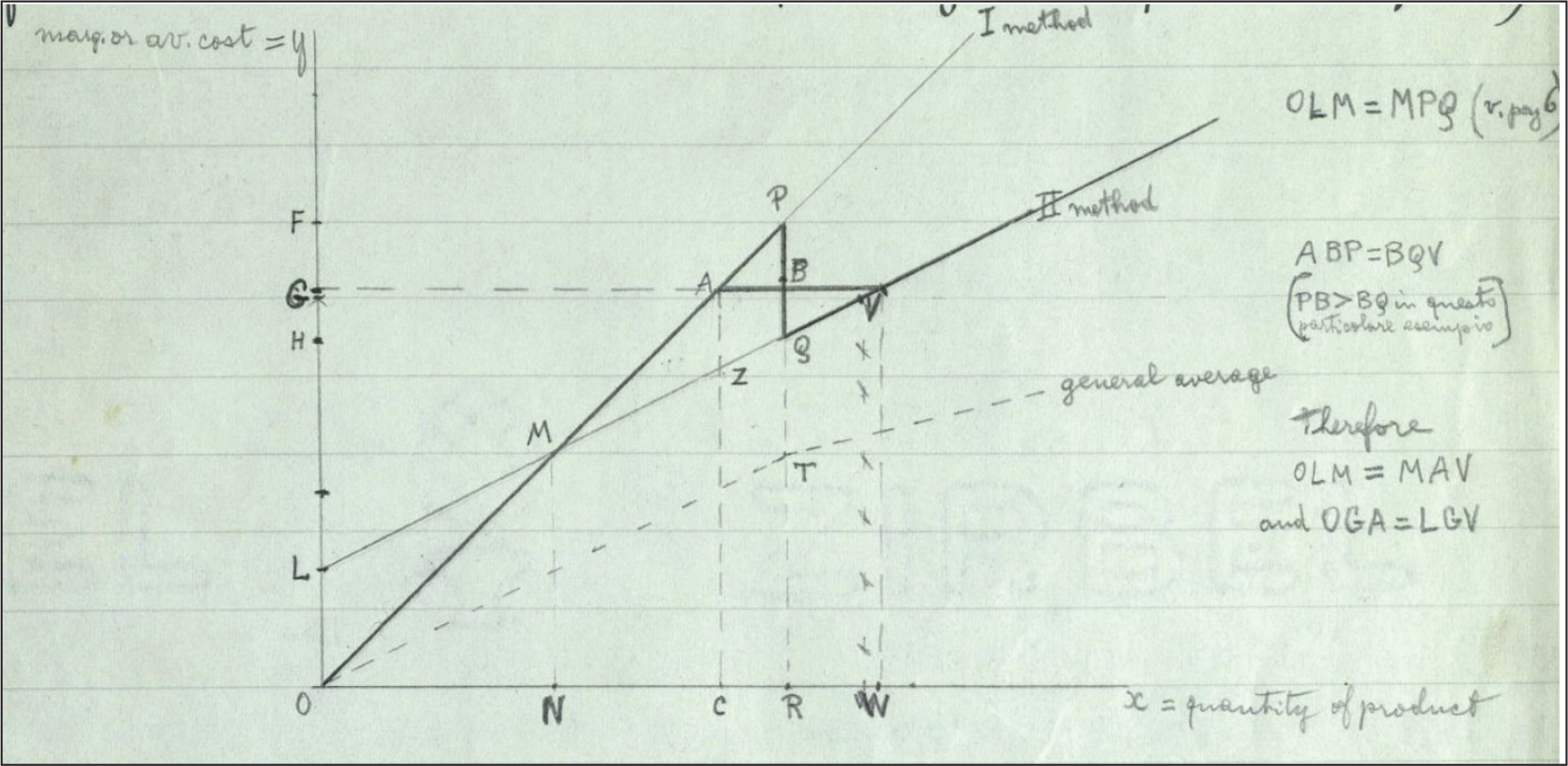
On the basis of this diagram, Sraffa then discussed the problem of the farmer’s choice of technique for a given level of rent. He realised that the illustration of intensive diminishing returns by means of a successive application of two related methods (such as ‘first ploughing’ and ‘second ploughing’, etc.) may be rather misleading, because it conceals the fact that the intensification of land cultivation can involve the switch to a ‘radically different’ method:
The confusion arises from the customary way of expounding diminishing returns by imagining the application of successive ‘doses’ of c.{apital} and l.{abour}. This is correct, provided it is clearly understood that ‘adding one dose to the 100 doses already employed’ means ‘employing 101 doses where 100 were employed before’. But it is altogether false if, as unconsciously one often does, it is understood as meaning ‘employing the same 100 doses plus a new one’. … To avoid this misunderstanding we must keep in mind that the marginal adjustment refers only to the quantity of factors: but, as for methods, the addition of a dose may involve a radical change in the way in which all the preceding doses are used. (D3/12/13: 23 f.6. recto; final emphasis added)
Sraffa then showed that in order to increase the output level beyond 0C a cost-minimising producer in competitive conditions must switch from method I to method II, and that at output levels 0C (for method I) and 0W (for method II) the two methods can be applied side by side on the same quality of land, giving the same rent and incurring the same costs per unit of output. However, Sraffa reminded himself to set out clearly the assumptions underlying his argument:
What we are doing is this: we assume that rent and other shares in distribution (= prices of factors) are determined in industry as a whole, and that our industry is so small that its separate contribution to that determination is negligible. We then proceed actually to neglect it: and we assume that rent etc. are determined, not by all industries, …, but by all the other industries, excluding our tiny one. (D3/12/13: 23 f.10. recto)
He also reminded himself that his argument referred indeed not to the individual producer, but to the industry as a whole:
Note that the standpoint here adopted is that, not of an individual farmer, but of all the farmers in our industry: this is implied by taking rent as given (determined by all industries), but price as unknown (determined by the whole of that industry, but not by a single farmer: for the latter it is ‘given’). (D3/12/13: 23 f.11. recto)
Sraffa thus had got hold of the concept of two equi-profitable methods of cultivation on a single type of land which give the same rent, although the argument was still based on special assumptions. However, at this stage he was apparently not clear about the fact that this would allow him to incorporate intensive rent into his system of equations. Only later, upon re-reading this manuscript, he marked the following statement with double lines at the margin:
The critical point is when they produce 0C at the marg.{inal} cost CA. This point (or rather, this rent) has the singularity (unique ‘in general’, salvo eccezioni, and of course for straight lines) that at it (?) the two methods have both the same rent and the same marginal cost. (D3/12/13: 23 (12))
A further point that Sraffa recognised in this manuscript was that the switch to another, perhaps ‘radically different’ method need not necessarily involve that the previously used method is replaced by the incoming method on the entire area of land. He noted this in discussing the problem of how the two methods are shown in a single diagram, depicting the ‘usual’ productivity curve:
The productivity curve between A and V is a straight line parallel to the abscissa …: and this is because the farmer in applying successive doses above 0C will adopt method II on an increasing part of his land (number of ‘atoms of land’), while going on with method I on the rest—until when he applies 0W he will have extended method II to all his land …. Thus, between A and V there are constant returns. The solution is identical with that adopted in ‘Annali’
26
for the case of ‘initial increasing returns’: they have been substituted by constant returns, i.e. extending ‘optimum’ proportion to all parts of land, leaving some of it uncultivated in the meantime. (D3/12/13: 23f.15)
Sraffa thus noticed that the use of the two methods side by side, and the gradual extension of method II at the expense of method I, is associated with changes in input proportions that allow for a continuous output expansion. However, Sraffa at this time apparently still thought that the treatment of intensive rent cannot be conducted with reference to the co-existence of two methods in a given system of production, but requires an analysis of the choice of technique problem with changing levels of output, that is, that it requires ‘time’ and ‘change’ to enter into the analysis.
In Spring 1943,
27
Sraffa studied some contributions by von Bortkiewicz (in German) on Böhm-Bawerk’s theory of capital interest, in which he encountered some statements which he excerpted and to which he then referred in some of his subsequent manuscript notes as ‘Bortkiewicz’s dictum’ or ‘dogma’.
28
After he had put forward his criticism of Böhm-Bawerk’s theory of the determination of interest by the greater productivity of ‘roundabout methods of production’ and the resulting lengthening of the ‘average period of production’, Bortkiewicz had defined the aim of the theory of interest as follows:
In any case, I believe that this can be regarded as the touchstone of such a theory: whether it is able to show the general cause of interest also for the case in which not only no technical progress, of whichever type, takes place, but also the length of the period of production appears to be technically predetermined, so that no choice is possible between different methods. (Bortkiewicz, 1906, pp. 970–971)
Sraffa fully agreed with Bortkiewicz’s statement that the ‘touchstone’ of the theory of interest was to show the ‘general cause of interest’ for a given system of production in which ‘no choice is possible between different methods’. This specification, which Sraffa had met in terms of his ‘equations with a surplus’, flew in the face of the marginalist explanation of interest in terms of an incremental output change associated with a change in the proportion of ‘factors’ of production and thus a change in technique. Sraffa then also excerpted the following statement from Bortkiewicz’s article:
Now my opinion is that in general the value of goods can only depend upon such technical knowledge as is applied in practice. But the value of goods remains unaffected by knowledge which, on whatever grounds, is not utilised. The result thus obtained can be summed up in the following brief formula: for the determination of the value of goods there come into consideration only actual methods of production, and not merely potential ones. (D1/91: 7)
29
As we shall see below, Sraffa considered this statement very important and variously referred to it in his papers as ‘Bortkiewicz’s dictum’ (or ‘Bortkiewicz’s dogma’). He fully agreed with it and had actually stated the same maxim, independently of Bortkiewicz, in a document of October 1929:
Clearly, we must reduce all the data to things that actually happen, excluding inexistent possibilities. Only such things are measurable, and can enter the theory as ‘knowns’, or ‘constants’; and, in reality, only really happening things can be real causes and determine effects. (D3/12/13: 1.f.1. recto)
One of Sraffa’s major concerns in his papers from late 1942 and early 1943 was a critique of marginal productivity theory in its different variants. More specifically, he wanted to find out how his own approach compared with marginal theory especially as regards the formulation of the problem of the choice of technique. In December 1942, he wrote a manuscript note on ‘Marginal Productivity and our Scheme’ (D3/12/29: 18–24), in which he attempted to ‘translate’ the marginal productivity theory into his own scheme. On 27 December 1942, he composed a working note on ‘Marginal Productivity Theory’ (D3/12/29: 25–26) in which he provided a sketchy discussion of ‘Three schools: J–B–W {Jevons–Böhm-Bawerk–Wicksell}, Clark, and “Others”’, and on 29 December 1942, he started to write a long manuscript note on ‘Quantity of capital’, in which he discussed J. B. Clark’s theory of capital (see D3/12/29: 27 et seq.). At the same time, Sraffa also struggled with the proper way of formulating the choice-of-technique problem within his own scheme.
As we saw in Section III, in Sraffa’s view not only the marginalist explanation of interest but also that of rent in terms of intensive diminishing returns violated ‘Bortkiewicz’s dictum’. Did this necessarily imply that intensive rent could not find a place in his ‘scheme’? The treatment of intensive rent that Sraffa was to adopt in his book was fully worked out only in the period from 1955 to 1958. However, a ‘turning point’ was reached, and also clearly marked as such by Sraffa, already in a manuscript note on ‘Differential Rent in Equations (extensive & intensive)’ that carries the date: ‘11 January 1955’—which however replaces the earlier dating ‘12 December 1944’ (D3/12/18: 9). It is difficult to ascertain exactly which parts were written when, but the first two paragraphs at least must have been written already in December 1944:
A Extensive form. On each additional quality {of} land a different method of production is used for the same product, e.g. corn: not necessarily technically different, but such as to be represented by a different equation, to which corresponds an unknown for the rent of that quality of land. The original equation corresponds to the no-rent land (an extra equation to say that one rent is = 0; thus B The usual intensive form of Dim.{inishing} Ret{urn}s and Rent cannot be fitted into the equations. Whether this is because there cannot exist a ‘continuous’ transition from one method to another—will have to be considered under the general problem of passing from one method to another; or (? and) perhaps it is an aspect of Bortkiewicz’s dictum that inexistent methods of production can have no effects. (D3/12/18: 9 recto)
In the third paragraph, Sraffa then sketched out how the intensive form of rent—although not the ‘usual’ (i.e., the marginalist) one—can be ‘fitted into the equations’ without bringing in ‘inexistent methods of production’. The analysis was conducted in a similar way to the one he had explored already in the Summer of 1929, but Sraffa now sought to provide a more general analysis by allowing for non-linear average cost curves:
It is necessary to introduce the discontinuous change of method in, e.g. dairy farming (from extensive to intensive, if these terms …) from method A to method B,
30
which is a transition effected on successive acres of the uniform quality of land, when the cost is at the switch level. The two equations (for A and for B methods) require (and determine) the rent to make equal the costs per unit of product. The unknown R {rent per acre} enters therefore both equations. [It is only because the two methods pay the same rent per acre that their costs per ton of product are equal.]. (D3/12/18: 9 recto)
Sraffa summed up his finding in another, rather sketchy, note, entitled ‘Draft (Rent: intensive)’, which merely consists of a single sheet of paper (with upper part in pencil, lower part in ink and dated 15 February 1946):
Title: ‘Intensive’ Rent on single quality of Land by two methods of production. Similarity with Joint Products. Suppose there is only one quality of land. So long as there is more of it than is needed there will be one method of production that is more profitable than the others for each commodity, at {From here on in ink and dated:} 15.2.46 Land (or rather its price) is an additional variable: therefore we can have an additional equation. Thus we have two equations for producing the same product. (D3/12/18: 8 recto)
The final paragraph is noteworthy for its recognition of the possibility of a treatment of intensive rent on the basis of Sraffa’s system of equations: intensive rent is determined, without violating ‘Bortkiewicz’s dictum’, for a given system of production, where ‘only actual methods, and not merely potential ones’ are taken into account. 31
Sraffa’s Manuscript Notes from the Period 1955 to 1958
Sraffa continued the manuscript note on ‘Differential Rent in Equations (extensive and intensive)’ with the remark: ‘See whether this can be generalised to all Dim.{inishing} Ret{urn}s’ (D3/12/18: 9 recto). He tackled the task he had set himself in January 1955, and came up with the following answer:
If all Dim.{inishing} Ret{urn}s were of this kind the whole curve would have a ladder shape with only singular points where only one method is used (? clear up).
32
At normal points, 2 methods would be in use on the same quality of land for the same product, and there would be no true marginal product: although an appearance of it would arise from the possibility, at any moment, to increase the capital (by employing a dose of capital and labour and switching an acre from the less to the more productive method) without addition to rent—this might look like the marginal no-rent unit. The two methods considered on the previous page would not, of course, be represented by curves. They would be represented by a horizontal straight line in their present common zone, and two other straight lines, one higher and one lower, would represent the common zone of each with its next door neighbouring method. Each however would involve using so much capital and labour per acre, and no more or less, a change would only take the form of a discrete step onto another (however close) method of production. (D3/12/18: 9 verso)
Sraffa then commented on the relationship between this ‘ladder-shaped’ curve and the usual neoclassical production function with continuously decreasing marginal returns:
If the methods were numerous and close to one another the two curves would be very similar; and if sufficiently numerous and close, undistinguishable. But … The marginal theory however works only if the two methods employ all the same things in same quantities, except that one employs one thing in addition: and this is divisible so that any number of intermediate methods can be conceived. But discrete methods are not generally ‘near’ to one another, and the interval is not divisible: only a faith in continuity (natura …) can persuade one that they are so. (D3/12/18: 9 verso)
Sraffa’s manuscript note continues (under the heading ‘Rent (intensive) cont’ and dated ’11.1.55 cont’):
It is held in this work that, while around each method of production there may be a fringe of minor continuous changes, these are generally of a trivial and trifling nature, and can serve only to conceal the essential discontinuity of the important transitions. It’s focusing attention on these aspects is what causes one to regard marginalism as the economics of the penny-wise and the pound-foolish. (D3/12/18: 10 recto)
33
Sraffa then pointed out that the idea of a continuous ‘dosing’ of land with capital was undermined by the fact that the ‘quantity of capital’ used by each method cannot be measured in physical terms, but only as a value magnitude:
Note also that the ‘dosing’ of capitals would not be possible as alternately one or the other of two methods would have the capital of greater value, depending on r, and prices. (D3/12/18: 10 recto)
About a week later, in a document of 19 January 1955, Sraffa then provided an answer to two further questions he had raised in this manuscript, namely whether this analysis was capable of giving rise to a continuously rising supply curve with regard to individual agricultural products, and whether it implied that the level of rent was determined by the technical conditions of production:
The ‘two methods’ in agriculture are exactly parallel to the ‘two methods switch’ in industry. Thus: 1) Only one of the products (i.e. land-using ‘industries’) can use two methods at any one time; 2) they are no more determining rent than they are determined by it—as with rate of profit in the other case.
34
3) There is no chance of drawing a ‘ladder’ curve for a product (e.g. ‘meat’ as here); the next switch may take place in corn, or elsewhere—but the rent will rise equally for all. (Increased output for a product would be obtained by transferring land to its production. ‘A curve’ would be for rent, or for the use of land—and then it would involve all products in successive points). (D3/12/18: 10 recto)
‘Margins and Margins’ and ‘Rent: Filling Last Gap’
In January 1958, Sraffa was concerned with filling last gaps in his book manuscript, which included also the drafting of the ‘Preface’ and parts of the chapter on ‘Land’. While he had clarified already in 1946 that intensive rent can indeed be ‘fitted into the equations’, its analysis still had to be fully elaborated and the proper place for its discussion to be decided. It was during this period that Sraffa wrote inter alia also the following note, titled ‘Margins and Margins’, 35 which apparently he contemplated for inclusion in the ‘Preface’ or, alternatively, as a ‘final paragraph’ at the end of the chapter on ‘Land’, or, indeed, at the end of his book (see D3/12/66: 1):
Every beginner in economics must be struck (at any rate, I was struck) by the incongruity of the two types of Diminishing Returns from land, and the corresponding two types of rent—one arising from the necessity of cultivating lands of different degrees of fertility, the other from the diminishing returns obtained by successive doses of capital and labour applied to the same piece of land.
The names usually given to the two types, ‘extensive’ and ‘intensive’, conceal rather than describe the essence of the distinction. This is that the first is based on the difference between situations which are mutually compatible and can coexist at the same time, since they involve the payment of different rents on different qualities of land; while the second is based on changes in the situation on a single quality of land which represent a transition from one to another state, the two states being incompatible and mutually exclusive, since they determine two different rents on the same quality of land. The former compares two or more ‘returns’ existing side by side within a given set of circumstances: the latter compares successive returns obtained in different circumstances—it implies a comparison between the actual return and a potential alternative return.
The true test of the nature of the difference is that a man who was in a position to observe the methods of production of a stationary society (but not to make experiments), would be able by observation to discover all about the returns from lands of different fertility, but could never find out by observation alone the ‘marginal product’ on one and the same land: this is not a visible object, for the reason that it has no existence. The ‘experiment’ of the successive doses, described in the textbooks, does not merely ascertain or measure the marginal product, it brings it into existence. (D3/12/46: 50–51)
It needs to be stressed that Sraffa’s argument in the preceding paragraph regarding the non-observability refers to the notion of the marginal product, and not to that of the average product:
If the usual diagram representing the ‘intensive’ form of Diminishing Returns is reduced to its simplest terms, rent is determined by the difference between the ordinates of two points, one representing the average, the other the marginal return. But while the former is obtained by observation, the marginal return can only be discovered through the knowledge of two successive and distinct (even if infinitely close) average returns—each of which is not part of the situation in which the other can be observed. (D3/12/46: 50–51)
After it was pointed out that ‘Wicksteed, the most consistent of marginalists, rejects the case of different lands as not belonging to the marginal system at all’,
36
the manuscript note continues:
I give here two references which have always seemed to have a bearing on the above. The same Wicksteed, writing at a much earlier period, before the marginal approach had become a second nature for economists, felt the need for reassuring his readers about the actual existence of a ‘marginal supply curve’ (in this case of labour): ‘But even if he cannot tell what amount of work he would be willing to do under the varying circumstances, obviously there is a given amount which, as a matter of fact, he would be willing to do under any given circumstances. Thus the curve really exists, whether he is able to trace it or not’.
37
… This is nothing less than a declaration of faith in universal determinism, for nothing less can support the belief in the actual existence of a prescribed path which must inevitably be followed, whether by the consumer or by the producer, such as is described by the demand-and supply-curves: for no observation, however minute, of the existing situation (in our case, of the existing methods of production) can bring out the path in which they must move in any given circumstances. (D3/12/46: 52 recto)
Sraffa’s second reference is to the statement by Bortkiewicz he had excerpted in 1943 and then variously referred to as Bortkiewicz’s dictum (D3/12/46: 52–53). Clearly, Sraffa eventually decided against the inclusion of this note, or parts of it, in the Preface to Production of Commodities. But in April 1958, he briefly tinkered with the idea of inserting the manuscript note on ‘Margins and Margins’ towards the end of his book. This is suggested by a rather sketchy note of 14 April 1958:
Piano per l’ultimo paragrafo (dopo ‘Switch’) {Plan for the final paragraph (after ‘Switch’)} Every beginner … The difference is … Wicksteed repudiates … As a number of cases discussed in the course of the present work may give the impression of being instances of marg.{inal} prod.{ucts}, it is necessary to emphasise that, on the contrary, they all belong to the opposite case. We may begin with the main case, that of the switch of method in the preceding para.{graph}. (D3/12/66: 1)
This plan, however, was also rejected and the note on ‘Margins and margins’ thus did not enter into Production of Commodities. Its typescript version is from the same time period in which Sraffa also drafted the chapter XI on ‘Land’. An envelope with the inscription ‘30 Jan. 1958. Rent, and some retyped pages (filling last gap). Copy used by typist’ contains a hand-written draft of Chapter XI of Production of Commodities; 38 the paragraphs dealing with intensive rent were drafted in the period from 24 to 29 January 1958 and are almost identical with the final version, except for some stylistic changes (see D3/12/96: 5–18).
Concluding Remarks
Careful readers of Krishna Bharadwaj’s writings will have noticed that she had used some of the concepts, ideas and arguments that were quoted in this article from archive documents (and are not found explicitly in Sraffa’s publications) in some of her argument, long before she had access to the Sraffa papers. This is certainly due to the fact that she was strongly influenced in all her work by the many conversations she had with Sraffa, as she always acknowledged.
39
However, Krishna Bharadwaj’s contributions go much beyond what is to be found explicitly in Sraffa’s manuscripts, since her main concern was with clarifying the wider implications of Sraffa’s work with regard to the theoretical and methodological differences between the two main streams in economic theory. In ‘Sraffa’s Return to Classical Theory’ ([1985] 1989, p. 226), Krishna Bharadwaj thus made it clear that Sraffa’s criticism concerned the ‘marginal method’, and not only the theory which is based on that method.
40
Referring to the grounding of the marginalist approach in mechanics she also pointed out, no doubt inspired by her discussions with Sraffa, that the difference between propositions in geometry and those in mechanics consists in the fact that ‘the former are statements concerning given positions in space, {whereas} the latter postulate movement, whether actual or potential’ (Bharadwaj [1978] 1986, p. 39), and she also made it clear that ‘hypothetical’ or ‘potential’ change is an indispensable requisite of the supply-and-demand theories. Related to the methodological differences are also differences in the analytical structure of the theories, which implied that the classical theory, as opposed to the supply-and-demand equilibrium theory,
did not or, indeed, did not require to, postulate any restrictively specific functional relations between outputs and costs. No doubt in the case of agriculture, a relation between output and increasing cost came to be inferred. But the context was that of explaining rents and although it was realized that its operation could affect the cost of ‘corn’, increasing costs was not emphasized as a cause of variation in the relative prices of individual commodities. … In general, when the output of a commodity increases, it was not necessary for the theory to presume that per unit cost would or should vary in any particular direction. Also, with such output variations, methods of production may or may not change—neither was it necessary to be presumed. It is in this sense that propositions were advanced irrespective of whether constant or variable returns prevailed. ([1978] 1986, p. 60)
And finally, Bharadwaj has also pointed out that
Sraffa (1960) in his chapter on land shows how the classical view of rents could be divorced from the traditional ‘law of diminishing returns’, and thence from the ‘supply schedule’ based thereupon. We have seen how powerful the rent theory was in the original construction of marginalism. In fact, Sraffa shows, correcting the classicals, that differential rents as well as the ‘no-rent land’ depend on the rate of profits. (Bharadwaj [1985] 1989, pp. 246–247)
In view of the great importance which the generalised law of diminishing returns has assumed in the supply-and-demand theories it is not surprising that several attempts have been made, by authors such as Jevons, Böhm-Bawerk, Wicksell and others, to demonstrate its validity by means of ‘logico-mathematical’ proofs. It seems not to have been widely recognised, however, that a thorough critique of such ‘proofs’ of the law of diminishing returns was provided by K. Menger ([1936] 1954), 41 and that in its wake some mathematical economists have then set out to provide rigorous mathematical proofs. Thus, Ronald W. Shepard (1970) demonstrated that the law of diminishing returns can be proved when the production function is assumed to be homogeneous of degree one and input sets are supposed to be strictly convex for positive output. Interestingly, he stressed the tautological character of his exercise by introducing his paper with the remark that ‘the traditional forms of the law cannot be obtained without assumptions on the fine structure of a technology which are contrived to obtain the result’ (Shepard, 1970, p. 9). In this regard, it seems apposite also to recall Krishna Bharadwaj’s reference to a statement by Tjalling Koopmans, who stressed the purely ‘axiomatic’ character of the usual convexity assumption, and noted that it ‘can lay no general claim to realism’, but rather derives its significance from the fact that it ‘enables us to state minimum assumptions for the validity of important parts of existing economic theory’ (1957, p. 25). As Bharadwaj aptly noted, this means that ‘the basis of the usual “convexity assumption” has not been sought in empirical experience’—it is introduced, rather, ‘in the … spirit of validating existing theory’ ([1978] 1986, p. 53).
Footnotes
Acknowledgement
The author is grateful to Tony Aspromourgos, Saverio Fratini, Antonella Palumbo, Wilfried Parys, Heinz D. Kurz, Annalisa Rosselli and Neri Salvadori for useful comments on an earlier version.
Declaration of Conflicting Interests
Funding
The author received no financial support for the research, authorship and/or publication of this article.