




Abstract
After the publication of Production of Commodities by Means of Commodities (Sraffa, 1960), a lot of attention was devoted to ‘reswitching’, that is to the fact that a technique is cost-minimising at two disconnected ranges of the rate of profits and not so in between these ranges. We owe Krishna Bharadwaj (1970, Schweizerische Zeitschrift für Volkswirtschaft und Statistik, 106, 409–429) an important contribution to the debate by stating and proving a general result concerning the maximum number of switches between two techniques that have at least one switch point on the wage-frontier. She proved that the maximum number of switches coincides with the number of distinct commodities, without double counting, that enter directly or indirectly into at least one of the alternative methods of production. This means that if the alternative methods produce a commodity that is basic in both techniques, then non-basics in both techniques play no role in this, whereas if the alternative methods produce a non-basic commodity in at least one technique, then a role is played also by those non-basics that enter directly or indirectly into the production of at least one of the alternative methods of production.
Introduction
After the publication of Production of Commodities by Means of Commodities (Sraffa, 1960), a lot of attention was devoted to ‘reswitching’, that is to the fact that a technique is cost-minimising at two disconnected ranges of the rate of profits and not so in between these ranges. We owe Krishna Bharadwaj (1970) an important contribution to the debate by stating and proving a general result concerning the maximum number of switches between two techniques that have at least one switch point on the wage-frontier. 1 She proved that the maximum number of switches coincides with the number of distinct commodities, without double counting, that enter directly or indirectly into at least one of the alternative methods of production. This means that if the alternative methods produce a commodity that is basic in both techniques, then non-basics in both techniques play no role in this, whereas if the alternative methods produce a non-basic commodity in at least one technique, then a role is played also by those non-basics that enter directly or indirectly into the production of at least one of the alternative methods of production.
Studying her paper more closely shows, however, that her main concern was not with establishing this important result, but with clarifying the role of the distinction between basic and non-basic commodities. The paper starts with a clear reference to this distinction:
In his ‘Production of Commodities by Means of Commodities’ Piero Sraffa introduces a classification of commodities into ‘basics’ and ‘non-basics’: A commodity is called ‘basic’ to the system of production if it enters, directly or indirectly, into every other commodity in the system; a commodity which does not do so is called ‘nonbasic’. Opinions have diverged as to the role and significance of this distinction.
And only at the beginning of the second paragraph the question of switching, which gives the paper its title, is mentioned. Moreover, the third part of the paper, that is the part in which Krishna discusses the relevance of her results, is almost totally concerned with the distinction between basics and non-basics. Finally, the exchange of letters between Sraffa and Peter Newman published as an appendix to the paper concerns precisely the role of such a distinction.
In this paper, we have a closer look at Sraffa’s distinction by reconstructing the path he followed in his unpublished papers in the three periods of the work that finally led to the publication of Sraffa (1960), which extended roughly from 1927 to 1931, from 1942 to 1945 and from 1955 to 1958. Sraffa was convinced that ‘In economic theory the conclusions are sometimes less interesting than the route by which they are reached’ (C 26). 2 However, in the present case, both the conclusions and the route taken are interesting. This is so not least because whereas in the first period mentioned Marx’s analytical contribution played hardly any role in Sraffa’s constructive work, in the second and partly also in the third period it became a major touchstone of his own construction. He in fact elaborated his own argument in terms of a close scrutiny of Marx’s labour-value based theory of the rate of profits and prices of production and was keen to see how far it got one and why in the end it could not be sustained. He followed a strategy, not uncommon in mathematics, to assume that the theory was correct and then, by following all the ramifications of the underlying argument, to show that it necessarily led one into contradictions. The upshot of his critical examination of the theory, which to Sraffa proved most valuable in elaborating his own analysis, consisted in demonstrating that the theory was logically inconsistent. This amounted to what Sraffa in one place called ‘disastro del modello’ (disaster of the model).
The story behind the partitioning of Sraffa’s work in periods where the former period is separated from the latter by roughly a decade each is the following. As is well known, Sraffa had to interrupt his constructive work because in 1930 the Royal Economic Society had entrusted him with editing the works and correspondence of David Ricardo. The editorial project soon turned out to be too demanding to allow him to continue his constructive work. 3 He therefore for a decade or so focused all his energy on the Ricardo edition. However, two further events changed again the course of his intellectual path in important ways.
First, in 1940 Winston Churchill had ordered the imprisonment of all so-called ‘alien enemies’, that is in particular German and Italian citizens living in the United Kingdom, on the Isle of Man, because they were suspected of potentially conspiring with the Nazis or Fascists. 4 During his stay in the ‘Metropole Internment Camp’ in September 1940, Sraffa read the English edition of volume I of Capital that had recently been reprinted (see Marx, 1938). Back in Cambridge he then read also volumes II and III and apparently was taken aback to see Marx grappling with very similar problems than him, Sraffa, and putting forward ideas that were worth trying out. Sraffa was clearly fascinated by Marx’s work and achievements and benefitted from them in various ways. In these circumstances, he was keen to bring to fruition the results of his critical confrontation with Marx’ analysis. This he did in the early 1940s, especially in 1942 and 1943, and then also in the mid-1950s.
Yet another event forced him to interrupt his constructive work for a second time. The unexpected discovery in July 1943 of Ricardo’s letters to James Mill and a number of new writings of Ricardo that also had belonged to Mill requested a fundamental re-organisation of the Ricardo edition (see Sraffa, 1951, pp. ix–x). The need to return to the edition was reinforced by the munitions industry, in which lead was an important input. Printing houses including Cambridge University Press were repeatedly urged to hand over to the munitions industry some of the lead they possessed for lead type in printing. This prompted the Press inter alia to ask Sraffa to speed up and complete his editorial work. We therefore see Sraffa shortly after the discovery of Ricardo’s letters to slow down his constructive work and eventually abandon it entirely for another decade. He was able to resume it only in the mid-1950s, after he had managed to revise the plan of the Ricardo edition and incorporate the new material in it. From 1955 to 1958, he went back to his old papers and notes and prepared the manuscript of his book for the printer.
In the following sections, we focus on what we consider to be the most important steps he takes with regard to the elaboration of the distinction between basic and non-basic commodities in the case of single production and how their presence affects the properties of the economic system. Many of the fascinating details of the intellectual process by means of which Sraffa arrived at his results can only be mentioned in passing, if at all. Since in all three periods Sraffa typically dealt with several problems at around the same time, the main task consists in separating as best as possible his work on the problem we are concerned with. The question of the distinction between basic and non-basic commodities in the case of joint production was considered by Sraffa as one of the gaps to be filled among those ‘which had become apparent in the process’ (Sraffa, 1960, p. vi) of putting together Production of Commodities ‘out of a mass of old notes’ (ibid), ‘such as the adapting of the distinction between “basics” and “non-basics” to the case of joint production’ (ibid). A detailed reconstruction of how this gap was filled and the role played by his ‘mathematical friend’ A. S. Besicovitch in this is given by Kurz and Salvadori (2004, Section V).
The composition of the paper is the following. Sections 2–6 deal basically with Sraffa’s work in the first two periods of his work. Section II is devoted to the first period and summarises Sraffa’s investigation of economic systems without and with a surplus product in his ‘First’ and ‘Second Equations’. It is only in systems with a surplus that more than one type of products can possibly play a role, because in the no-surplus economy all products are needed directly or indirectly in the production of all products, that is, are basics as Sraffa later called them. This is the case of what Sraffa dubs the ‘natural’ economy, and the costs of production are ‘natural costs’, employing a terminology used by the classical economists. In the with-surplus economy, some products may, on the contrary, be non-basics. Interestingly, Sraffa at first approached the problem not from the point of view of production, but from that of consumption-cum-distribution. Interest (or rather profits), he assumed, is a ‘social’ cost as opposed to a natural one, borne by the rest of society, whose purpose is to prevent capitalists from ‘withdrawing’ their (circulating) capital goods from production. 5 By means of the interest they receive, capitalists can buy luxuries that appease them and make them allow the process of production to continue unhampered. Sraffa translated this idea into a hypothetical industry that transforms the surplus product into luxuries, which are conceived as pure consumption goods, employed nowhere in production—that is, a type of non-basic that is the opposite extreme to basics. 6 Section III turns to what Sraffa called his ‘Hypothesis’, which played a most important role in his attempt to master the intricacies in the theory of value and distribution. The Hypothesis refers to the special case in which, given the system of production in use, although the prices of single commodities typically change with changes in income distribution, the aggregates of material inputs as a whole, on the one hand, and of the gross outputs, on the other, do not. If this invariance condition with regard to the capital-output ratio happens to apply, the rate of interest (profits) can easily be determined for any given level of wages, and the inverse relationship between the two distributive variables established. After long and occasionally painstaking investigations, Sraffa eventually convinced himself that in no real economy can the condition be expected to be met. This made him reflect upon a hypothetical system that meets the condition, which eventually led him to the construction of the ‘Standard system’. Section IV has a closer look at Sraffa’s concept of ‘All-commodities’, that is, an aggregate representation of the economic system, which exhibits a close family resemblance with Marx’s concept of ‘average commodity’. The concept allows one to fix the maximum rate of profits compatible with the system of production in use. This rate is positive and finite, because in a circular flow framework, as in François Quesnay’s Tableau économique, but especially in Marx’s theory of reproduction, there is always a constant capital element that constrains the profit rate from above. Section V turns to the concept of the reduction to dated quantities of inputs, especially labour, which had been suggested by authors such as Adam Smith, David Ricardo and others. Sraffa employs it in order to analyse the time phasing of production and the role of compound interest in ascertaining prices and to discriminate between basic products and various types of non-basics. When discussing these matters, Sraffa also identified for the first time a problem associated with self-reproducing non-basics. Section VI finally turns to the third period of Sraffa’s constructive work, in which he took stock of his previous manuscripts and notes and finally distilled from them the manuscript of his book. We focus attention especially on Sraffa’s work in 1955, in which all the themes and concepts discussed at an earlier time recurred and were brought by him to a level of maturity so that the respective parts of his 1960 book could then easily be prepared for the printer. Section VII comments briefly on some discussions that took place after the publication of Sraffa’s book dealing with the distinction between basic and non-basic commodities. We focus, first, on the exchange of letters between Peter Newman and Sraffa, which were reprinted in Krishna’s paper on the maximum number of switches, and, secondly, on some discussions that took place in Indian journals and periodicals and involved Krishna and other eminent Indian scholars. Section VIII contains some concluding observations.
Systems with a Surplus: ‘Natural’ Plus ‘Social’ Costs of Production
In November 1927, Sraffa began to discuss the mathematical properties of systems of production without a surplus in what he called his ‘First Equations’. If there is no surplus, whatever is produced is needed in order to make good what has been used up, or ‘destroyed’, as means of production or means of subsistence, in the course of production. In a ‘self-replacing’ state of the economy, each and every product is needed directly or indirectly in the production of each and every product. Sraffa dubbed such an economy a ‘natural’ economy and the costs borne in the production of the various products ‘natural’ costs. In this case, all products are ‘basic’ products, to use the term Sraffa later introduced (1960, pp. 7–8). Indeed, if some non-basic commodities were produced, it would be enough to eliminate such production to obtain a surplus. The exchange ratios or relative prices that would ensure the undisturbed repetition of the entire process of production are given by the solution of the corresponding homogeneous system of equations. In Sraffa (ibid, p. 3), we will later read that ‘such values spring directly from the methods of production’. This result Sraffa established in 1928. He asked: ‘in a community that produces just what is sufficient to keep it going would there not be only one combination which satisfies the above condition? it would be “the cheapest”’ (D3/12/3, p. 44). However, it is possible that there are two techniques that are both cost-minimising, as can be shown by means of simple examples.
Immediately after his ‘First Equations’, Sraffa began to elaborate what he called his ‘Second Equations’. These reflect a system of production that produces a surplus above and beyond what is absolutely indispensable in order to reproduce the means of production and the necessary means of subsistence that are ‘productively consumed’ in the course of production. In this case, Sraffa observed that the system becomes ‘self-contradictory’, an observation he repeated in his book (1960, p. 6): summing up all the production equations gives a RHS (aggregate outputs) that with regard to some or even all products exceed the LHS (aggregate inputs). Not all prices of products can therefore be just identically equal to costs of production, as in the no surplus case, but at least one or in the extreme all of them have to be larger. Which set of exchange ratios or relative prices obtains depends on how the given surplus product is distributed amongst the different claimants in society, workers and capitalists. In the case of a uniform rate of interest (the term Sraffa employed at the time), on which he after some deliberation focused attention, the ratio of the total value of the aggregate output of a commodity to its total cost of production is the same across all processes of production.
Sraffa asked himself the following question: If the natural economy reflects the realm of necessities, in which each cost is unavoidable in order to bring forth the various products, what is the equivalent to this in the with-surplus economy. Put differently: Why is interest paid? He then for a while and with explicit reference to Adam Smith ([1776] 1976), Anonymous (1821) and some other authors (including Pareto) considered the payment of interest as reflecting a social instead of a natural necessity: it is taken to prevent the proprietors of capital goods from ‘withdrawing’ these from production in analogy to the payment of wages, which enable workers via the consumption of ‘necessaries’ to reproduce their labour-power. 7 In the period under consideration Sraffa explicitly assumed what he called a ‘natural science point of view’, according to which for every effect there must be sufficient cause. Adopting this perspective implied that interest (profits) had to be seen in a way analogous to wages: it allowed capitalists to consume ‘luxuries’, which, by assumption, prevented them from thwarting the smooth continuation of production. 8
The analytical strategy Sraffa followed in the late 1920s was to extend the realm of necessity to the with-surplus case, in which natural necessities were complemented by social necessities. The natural necessity ‘would exhibit the true absolute costs’ (D3/12/6, p. 11) of the different commodities and, employing a term Ricardo used, show their corresponding ‘absolute values’. Interestingly, Sraffa also employed the term ‘physical value’ of products and insisted that it ‘is equal to what has been consumed’ in production (D3/12/1, p. 5; see also D3/12/10, p. 54). He showed that the sought-after ratios, or (relative) values, are uniquely determined by the socio-technical conditions of production and can be ascertained by solving a set of linear homogeneous production equations.
Carrying the natural science point of view over to the with-surplus case implied that ‘We shall have to adopt that definition which makes the scale of absolute values identical with what it was when there was no surplus’ (D3/12/6, p. 14, emphasis added). This required reducing the surplus, or interest, that is, an ‘effect’ for which there had to be ‘sufficient cause’ to some ‘cost’ or other. Interest, he insisted, reflects some objective necessity, rooted in some objective ‘social’ obstacles that have to be overcome. Sraffa related his respective point of view explicitly to Adam Smith’s discussion of the ‘dispute’ over the distribution of income between ‘workmen’ and ‘masters’ in Chapter VIII of book I of The Wealth of Nations (WN I: viii). There, Smith had stated: ‘In the long-run the workman may be as necessary to his master as the master to him, but the necessity is not so immediate’ (WN I: viii.12). Similarly, Ricardo had maintained: ‘The farmer and manufacturer can no more live without profit, than the labourer without wages’ (Works I, p. 122).
How much must each party receive in order not to withdraw its productive resource, or, in modern terms, what is the reservation price of each resource? Workers have to be paid, Smith stressed, a real wage that allows their ‘race’ to reproduce itself. In a comparable vein, interest has to be paid, Sraffa argued, in order to prevent capitalists from withdrawing their circulating capital (including the wear and tear of fixed capital), thus thwarting the ‘self-replacement’ of the economy. 9 Correspondingly, Sraffa at the time conceived of the surplus product as the physical input into an artificial industry producing ‘luxuries’ or ‘gioielli e altre cose “improduttive” (jewels or other “unproductive” things)’ for capitalists (see D3/12/8, p. 29). These artificial goods are ‘unproductive’ in the sense that, while produced, they are not themselves employed in production. They serve only a single purpose: they are the incentive needed to make capitalists leave their circulating capital in production.
As Sraffa observed in a document of August 1931, in this way the surplus was made to ‘disappear’ or ‘melt away’ (D3/12/7, p. 161 (3)). And in a document from winter 1927–1928 he concluded with respect to the new equations he had elaborated, taking the production of commodity A as a case in point: ‘These absolute values with surplus are no more what is necessary to enable to produce A, but what is necessary to induce to produce A’ (D3/12/6, p. 10). By conceptualising the surplus product as being employed in the production of an artificial (composite) commodity, Sraffa assimilated the with-surplus to the no-surplus case. By tucking away the surplus, the resulting equations would be rendered non-contradictory again and could be ascertained by solving a system of homogeneous simultaneous equations.
Non-basics, we may conclude, made an appearance in the first period of Sraffa’s constructive work, but they did so in a peculiar and rather contrived way, with the focus not being on the structure of production, but on the requirements to be fulfilled in order to preserve the continuation of the process of production.
These arguments put in sharp relief the view that not only a minimum level of wages has to be taken into account, but also a minimum rate of profits. This leads directly to the question: If the minimum rate of profits happens to be smaller than the rate of surplus of the system, then there is room for a ‘dispute’ over its distribution, as Smith put it. This led, in turn, to a question that had bothered Ricardo quite a bit, namely: How does a change in the wage rate affect the general rate of profits and ‘natural’ (relative) prices. 10 This question, however, had as a prerequisite a decision about whether to treat wages as paid out of capital or out of the product, which is tantamount to deciding whether to treat wage goods as basics or as non-basics. We know that while in both cases the rate of profits would inversely vary with the wage rate and prices would generally vary with income distribution, the assumption about the payment of wages would somewhat affect the result in any given case. But the proof of the inverse relationship between the wage rate and the rate of profits was obtained by Sraffa only at the end of 1944. The whole story and the role Besicovitch played in establishing this proof was reconstructed by Kurz and Salvadori (2008).
A few numerical examples that Sraffa constructed convinced him that
È chiaro come il sole che se cambiano i salari cambiano anche i valori: per persuadersene basta suporre che le due industrie impieghino uguali quantità di lavoro diretto, (e cioè di salari) e diverse quantità di macchine. L'industria che produce macchine avrà sempre lo stesso eccedente di macchine da dar via, qualunque sia il livello dei salari: se i valori restassero invariati con il variare dei salari, essa riceverebbe sempre in cambio la stessa quantità di ‘merci consumabili’: e quindi il totale ‘salari più profitti’ che essa avrebbe da distribuire sarebbe costante: e cioè l’aumento dei salari in quell’industria sarebbe uguale, in quantità assoluta, alla diminuzione dei profitti: ma ciò sarebbe possibile solo se nelle due industrie il rapporto fra salari e profitti fosse uguale, ciò che in generale non è. (D3/12/7, p. 95)
11
These considerations are interesting for the following reasons. First, they dispel the idea that, flukes apart, values in the Second Equations can be made to conform to values in the First Equations. Secondly, Ricardo’s contemplation of the possibility of workers participating in the sharing out of the surplus product points in the direction of taking at least a part of wages as being paid out of the product. If total wages were to be paid out from it, then wage goods would be non-basics and the system decomposable.
In the above, we have referred to Ricardo’s argument that there is a minimum level of the rate of profits below which it does not pay the risk and trouble to accumulate capital. In much of his argument, he implicitly assumed that the actual rate of profits exceeds the minimum and therefore capital accumulates and the economy grows. He considered also the case in which the actual wage rate is larger than the minimum rate, at which the population would be stationary. Hence, he assumed that also the population grows, and if the actual wage exceeds the minimum for long enough, then a kind of ratchet effect could make itself felt with the minimum wage rate picking up to the level of the actual rate. Sraffa did not consider the dynamics of the quantity side in any depth, but focused attention on prices and income distribution in given circumstances.
Sraffa’s ‘Hypothesis’
In parallel, Sraffa in the first period investigated the mathematical properties of his ‘Second Equations’ in which the surplus was distributed at a uniform rate of interest across the various industries of the economy. Normalising the system by taking the gross output of each industry as defining its production unit, we get
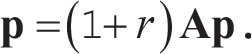
Here
Sraffa shortly afterwards turned to the problem Ricardo had begun to study, namely, how a hypothetical increase of wages affected the interest rate and relative prices. In other words, Sraffa started to investigate the properties of the system of production actually in use and represented by the production equations, which we may write for simplicity in the following way:

Here, w refers to the surplus wage per unit of labour employed in terms of some given consumption bundle and
However, Sraffa felt that it was extremely cumbersome to have to solve the system of production equations time and again for each and every level of w in order to find the corresponding level of the rate of interest r and the set of prices

where λ is independent of r and
In this case, the change in r associated with a change in w (and vice versa), given the system of production in use, could easily be ascertained. The values of the two distributive variables could then be plugged in the production equations to solve them for the prices of commodities in terms of some standard of value (or numéraire).
Finding out the precise conditions under which aggregate output and aggregate capital employed in the economy do not change at all in response to changes in income distribution was a major concern of Sraffa’s in the early 1940s. We therefore see him in the spring of 1943 beginning to investigate the issue and discuss in particular the impact of the following phenomena on the respective properties of the system:
the presence of fixed in addition to circulating capital, on which Sraffa had focused attention in the first period of his constructive work; the presence of a variety of means of production and means of consumption and differences in the proportions of labour and means of production in their production and different rotation periods of the durable items of production; and different consumption patterns of workers and capitalists.
A discussion of these items is beyond the scope of this essay. It suffices to say that Sraffa soon found out that in all three respects the Hypothesis could not be strictly sustained with regard to any real economic system. Apparently, it applied only in hypothetical or artificial conditions, the identification of whose properties eventually made him elaborate the concept of the ‘Standard system’.
Sraffa was convinced that the Hypothesis, which, as we have seen, amounts to postulating an invariance condition, would greatly help in coming to grips with a fairly complex system of simultaneous equation. But was there any good economic reason for entertaining such a condition, or did it impose an arbitrary constraint upon the system that lacked any legitimacy? According to Sraffa, it would indeed be an impossible imposition in the case of the Austrian concept of production, entertained by Eugen von Böhm-Bawerk and Knut Wicksell, but also Ricardo in some of his analysis in order to avoid getting lost in a ‘labyrinth of difficulties’ (Ricardo, Works VI, p. 214). They assumed a linear or unidirectional process of production, which started from ‘unassisted labour’ (Ricardo) and after a finite series of further quantities of labour employed (and possibly the services of natural resources) resulted in a means of consumption. Sraffa as early as in the late 1920s and then again in the 1940s criticised this perspective, because in modern times there was no production that started without any means of production. The circular flow contemplated by François Quesnay and the physiocrats, Robert Torrens and also Marx was the right one and throughout his work Sraffa clung to it. In this case, things are different. As Sraffa opined towards the end of the first period in February 1931: ‘it may be said that the value of total capital in terms of total goods produced cannot vary [consequent upon a change in the interest rate], since the goods are composed exactly in the same proportions as the capitals which have produced them’. He added that this proposition was of course ‘false, but may contain an element of truth’ (D3/12/7, p. 157(3)). Twelve years later, in November 1943, he stressed that his proposition may be seen to get some support from the ‘statistical compensation of large numbers’ (D3/12/35, p. 28). Looking at the system as a whole and taking a ‘social point of view’, it becomes clear that ‘means of production as a whole are built by means of production as a whole’ (D3/12/32, p. 2) or, as the title of his 1960 book suggests, commodities are produced by means of commodities. Hence, while the prices of single commodities may vary with a variation of the interest rate (and a contrary variation of the wage rate), with some prices going up and others going down, the prices of the two aggregates of commodities mentioned in the above, social capital and social product, may perhaps be assumed not to vary at all or to a much smaller extent. As has already been mentioned, analysing the precise conditions in which they do not change at all was one of Sraffa’s major concerns in the early 1940s.
Two additional observations are appropriate at this point. First, Sraffa credited Marx with having insisted on the circular character of production in terms of his concept of constant capital, which was required in each and every line of production. When Sraffa turned to the reduction of prices to dated quantities of labour, he stated: ‘Thus the infinite series is essential for us to grasp the nature of Constant Capital and of R’ (D3/12/133, p. 14), where R is the maximum rate of profits. Indeed, because of constant capital the rate of interest (profits) does not tend to infinity in the hypothetical case in which wages vanish, as the Austrian economists had assumed. The rate of profits is rather bounded from above. To zero wages corresponds a maximum rate of profits, R, that is finite and in Marx’s labour-value based reasoning equal to the inverse of the organic composition of capital for the system as a whole, L/K, with L as the living labour performed during a year and K as the value of the constant capital employed. Sraffa’s praise for Marx in this regard is expressed in his 1960 book in Appendix D, ‘References to the Literature’ (1960, p. 94).
Secondly, when we say that the price of a commodity or an aggregate of commodities does not change as income distribution changes, we have to clarify in terms of what, of which measure, this is supposed to hold true. Sraffa had seen that this problem has been of great concern to Ricardo in his search for an ‘invariable measure of value’. Sraffa took up that part of Ricardo’s problem, which defined the conditions under which the measure was not affected by changes in distribution: a rise (fall) in wages was accompanied by a fall (rise) in the rate of profits and changes in the prices of commodities that exactly compensated each other. (Sraffa was not concerned with the other part of Ricardo’s search, which consisted in finding a commodity that was always produced by the same amount of direct and indirect labour. It had become clear to Ricardo that no such commodity could possibly be found.) The solution to the problem consisted in the ‘Standard commodity’ (see Kurz & Salvadori, 1993), which Sraffa succeeded in elaborating in the second period. Here we deal with Sraffa’s construction only insofar as it is intimately connected with the distinction between basics and non-basics.
The Hypothesis concerned a property Sraffa surmised to apply with regard to the economic system as a whole. It was therefore close at hand to represent the system in aggregate terms. This Sraffa did in terms of the concept of ‘All-commodities’. This concept shows a close family resemblance with Marx’s concept of ‘Average Commodity’ expressed in labour value terms. Sraffa in fact took the Average Commodity as the ‘standard of prices’ in his respective analysis, as he stressed in a document composed on 7 October 1942 (D3/12/24, p. 25). In the case in which wages are paid out of capital, that is, ante-factum, Sraffa wrote the All-commodities equation in the following way:

with C as the value of total outputs, Ct as the value of total material inputs (means of production and means of subsistence of workers), Lt as total employment and w as the average surplus wage rate (see D3/12/30, p. 16).
12
The magnitudes of C and Ct are assumed not to be sensitive to changes in the distribution of income, that is w and r. Therefore, fixing w (or r) fixes at the same time r (or w) in a simple and straightforward manner. That is, the All-commodities equation involves the following r–w relationship

This allows one to plug any w and the corresponding r in the production equations above and determine prices.
Readers of Sraffa’s manuscripts written in the early 1940s will not escape the fact that Sraffa vacillated between taking wages paid out of the capital advanced and wages paid out of the product generated. This is understandable, because on the one hand wages cover the necessary subsistence of the workers and thus enter the system ‘on the same footing as the fuel for the engines or the feed for the cattle’, as Sraffa was to write in his book (1960, p. 9), which supports the treatment of wages by the classical authors and Marx. On the other hand, they may include a share of the surplus product, which had already prompted Ricardo to replace the assumption of given real wage rates by the assumption of given ‘proportional wages’, that is, the share of wages in the social product.
13
As we know, Sraffa eventually abandoned the ‘traditional wage concept’ and followed ‘the usual practice of treating the whole of the wage as variable’ (ibid, p. 10). This turn is foreshadowed in the papers under consideration. If wages are taken to be paid out of the product, then the expression of the rate of profits in the all All-commodities case becomes
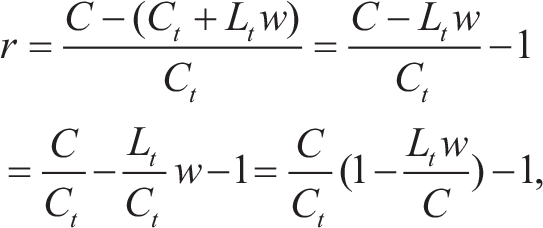
where Ct now contains only means of production and no longer means of subsistence of the workers, w now stands for the whole wage rate paid to workers, and C/Ct equals 1 + the maximum rate of profits, R, which obtains in the hypothetical case in which wages are nil. Interestingly, in a note Sraffa drafted on 5 May 1943, he wrote the above expression in the following way:

where w is now the share of wages in national income, 0 ≤ w ≤ 1 (see D3/12/33, p. 12). The same expression recurs in Sraffa’s book (1960, p. 22), giving the w–r relationship for the Standard system and also for the real system, ‘provided only the wage is expressed in terms of the Standard product’ (ibid, p. 23). With post-factum payment of wages the w–r relationship is linear.
It is clear that passing from ante-factum to post-factum payment of wages implies that wage goods change the status from clearly necessary inputs, or basic commodities, to consumption goods and eventually non-basics. 14
This consideration raises the question whether the rate of profits is determined by all industries composing the economy, as the All-commodities equation suggests, or only by a subset of industries. If this is so, which subset is it? This brings us to Sraffa’s method of the Reduction to dated quantities of labour—here at first with regard to the aggregate product or All-commodities in early October and November 1942. Sraffa saw quickly ‘that however far we push the operation of reduction, the quantity of commodity contained in the first term …, although it becomes much smaller, never becomes negligible’ (D3/12/ 24, p. 4): there will always be a residue left. 15 However, he also swiftly understood that the properties of the All-commodities case depend on the properties of the reduction of single commodities. On 6 November 1942, he jotted down: ‘Reduction of Single Commodities effect on Reduction of All Commodities’. This will be seen in the next section.
In a note written on 6 October 1942, Sraffa contemplated the following case: ‘suppose that the constant capital of each commodity consists entirely of that commodity itself’. He was clear that such a system decomposes into as many systems as there are commodities and is typically incompatible with a uniform rate of profits that would reflect the connectedness of the various industries. He commented on the case that ‘this is not a fruitful line’ (D3/12/24, p. 22). This remark can be interpreted as foreshadowing the assumption entertained in his book that ‘any system contains at least one basic product’ (1960, p. 8).
Reduction to Dated Quantities of Labour
If the aggregate representation of the system did perhaps not offer a solid basis to ascertain the rate of profits associated with a given level of wages, were there other options to see clearly and correctly the salient features of the economic system studied? Already in the first period of his constructive work, Sraffa had been in search of alternative analytical methods that allowed one to look at the economic system from different perspectives that revealed its various properties. 16
As we have seen, Sraffa deplored the difficulty of having to solve the system of production equations in order to determine the rate of interest, given the wage rate, and was on the lookout for other options to accomplish the task. One such option was the Reduction of the prices of commodities to dated quantities of labour, appropriately discounting forward the wage payments becoming due at different times in the course of the production of the various commodities. The purpose of the Reduction, Sraffa pointed out in a document composed in November and early December 1942 with reference to William Jevons and Eugen von Böhm-Bawerk, but using Marxian terminology, consisted in making ‘constant capital’ (i.e. fixed and circulating capital) gradually disappear and leaving only ‘variable capital’ (i.e. wages) (D3/12/26, p. 9). The reduction series, he insisted, was infinite in a circular flow framework of the analysis (as it was to be found, for example, in Quesnay and Marx) and not finite, as Jevons and Böhm-Bawerk had maintained: there remained always a ‘commodity residue’ that could not be eliminated however far the reduction was carried. A few weeks earlier, in October 1942, Sraffa was not yet clear whether commodities entering in their own production could be reduced at all. He commented: ‘A difficulty in Reduction: is “self entering” ever reduced at all?’ (D3/12/27, p. 40).
And in November, he distinguished between ‘persistent’ and ‘vanishing’ commodities, with the former referring to types of products that would never be totally eliminated from the commodity residue, whereas the latter after some rounds would. He called the former ‘general’ and the latter ‘special’ (see D3/12/24, p. 1). The distinction corresponds to the distinction between basics and non-basics that are used in their own production or that anyway enter directly or indirectly in their own production, on the one hand, and non-basics that are never used in production or that anyway do not enter either directly or indirectly in their own production, on the other. This problem points in the direction of what Sraffa in his book would then discuss in Appendix B in a ‘Note on Self-Reproducing Non-Basics’ (1960, pp. 90–91), where it recurs as the beans example. If the product under consideration is a basic, no problem arises, because the maximum rate of profits would have to be less than the minimum rate of self-reproduction amongst all basic products. However, if the product is a non-basic, as in Sraffa’s example (wheat), which has a rate of self-reproduction of 5% that is lower than the corresponding rate of the basic (10%), then a problem arises.
It should not come as a surprise that the distinction between basic and non-basic commodities began to loom large, when Sraffa in late 1942 and then in 1943 was groping towards the concepts of the ‘Standard commodity’ and Standard System’. These were designed to allow him to look at the system of production from a particular point of view that replicated in analytical terms the basic idea underlying his Hypothesis, namely the independence of the ratio of the product to the aggregate of its own means of production of the rate of profits. 17 He became clear that the ‘average commodity’ had to give way to what he then called an ‘imaginary commodity’ and a particular ‘standardisation’ of the system of production (see the discussion in D3/12/24, p. 17). He was also clear then that an assumption he had entertained for a while following in the footsteps of Marx that prices of production are a linear function of the rate of profits cannot be sustained (ibid).
Taking Stock: Preparing the Edition of Sraffa’s Book
We now turn to the third period of Sraffa’s constructive work, which he was able to take up again in 1955 after having reorganised the Ricardo edition project. The attention will focus on a selection of documents pertinent to our theme and especially those in which Sraffa took stock of the findings in his earlier work and began to assemble those he found useful for his 1960 book.
In March 1955, Sraffa spent two weeks in reclusion in a hotel in Majorca to start writing his book. The result was the so-called ‘Majorca Draft’ (D3/12/52, pp. 1–30). As we shall see, the issues discussed in previous periods and analysed by us in the above reappear in the Majorca Draft and notes and papers he wrote thereafter. They reflect both continuity and change in Sraffa’s respective studies. We focus attention on his work in 1955 and deal with the issues under consideration one after the other.
Before going into details, it is worth mentioning that according to Sraffa the problem of value and distribution can be approached from a physical real cost perspective ‘without need of [the different commodities] being first reduced to some uniform substance’ (D3/12/52, p. 2; emphasis added), as suggested by the classical economists’ search for an ‘ultimate measure of value’ or Marx’s concept of abstract labour. He also emphasised that the distinction between basics and non-basics is alien to a world without a surplus and presupposes one with a surplus.
Wage goods: basic or non-basic? Sraffa was clear that the assumption regarding the payment of wages—ante- or post-factum—was crucial since it decided whether the commodities consumed by workers had to be considered as basics or not. He took up the problem several times, and when he finally decided to assume post-factum payment in the main parts of his book, he stressed that this must not be taken to deny the indisputable, ever-present subsistence element of wages. 18 He was keen (1) to retain a remainder of this fact in terms of the assumption of a lower boundary below which wages cannot fall and (2) to provide compelling reasons why apart from the strict subsistence case it was advisable to assume wages paid out of the product and not out of capital.
As regards task (1), Sraffa emphasised that assuming wages paid out of the product ‘implies transferring wage-goods from the class of “basic” to that of “non-basic” products’. The ‘tribute paid to [modern] tradition’ by reckoning wages as a part and parcel of net national income, he opined, ‘is a costly one’ (D3/12/50, p. 23). He stressed that the distinction between basics and non-basics ‘is not purely one of nomenclature’ (ibid) or a ‘play with words’ (ibid, pp. 18–20) and added that ‘however we describe them, necessaries will influence prices and the rate of profit’ (ibid). Yet ‘if they are prevented from doing so under the category of basic goods, they will (reappear) reassert similar effect through setting a limit below which, in fact the wage cannot fall.’ He concluded: ‘The result is that the products which were at first included in a single class of basic products will now be somewhat arbitrarily distributed under two different labels’ (ibid, p. 23). 19
In a note composed half a year later on 4 September 1955, Sraffa took the problem up once again and emphasised: ‘My own inclination would be to take surplus wages’ and he ‘confessed’ that he had taken the decision ‘somewhat reluctantly’ (D3/12/50, pp. 10–12). But, he observed, this would involve ‘considerable difficulties of demarcation in distinguishing the two sorts/parts of wages, all the greater in so far as we do it in actual commodities, which would confront us with the impossible task/insoluble problem of splitting single commodities into ideal parts as basic qualities and surplus qualities’ (ibid). He exemplified his idea with regard to a commodity ‘which in one way is part of necessaries/subsistence’, but is ‘consumed in a better quality than is strictly necessary’. Then this part, he added, becomes ‘to that extent part of surplus’, which, however, ‘confronts us with the insoluble problem of splitting it [the commodity] into these two notional parts’ (ibid). 20 Sraffa concluded that ‘the consideration of not complicating unnecessarily the exposition by introducing more unfamiliar conceptions than is necessary must prevail’ (ibid).
As regards task (2), Sraffa provided further reasons in addition to the one just given in favour of treating wages as a whole as paid out of the product, some of which are intimately intertwined with it. (a) In modern societies, the surplus might be ‘distributed in various ways between capital and labour instead exclusively to capital’ (D3/12/50, p. 18). Hence, wages may exceed subsistence not just marginally. (b) While the division of the wage in two parts—one consisting of necessaries (ante-factum), the other of the workers’ participation in the surplus (post-factum)—‘would correspond to Adam Smith and Ricardo’s idea’ (ibid, p. 19), there is no presumption that workers consume the same kinds and amounts of necessaries independently of the overall magnitude of their wage. (c) ‘The idea of a wage “advanced” is characteristic of an agricultural society with its annual cycle. In an industrial society characterised by continuous production, the idea vanishes altogether: the advance is irregular, does not involve the carrying of large stocks and in any case its period is short’ (ibid). But already shortly afterwards Sraffa decided to retain the assumption of a common (actually an annual) period of production, but abandon that of ante-factum payment wages. 21
Labour Entering Explicitly the Production Equations
With wages at the subsistence level, the quantities of labour employed in the different industries did not explicitly appear in Sraffa’s ‘First’ and ‘Second Equations’, but were represented by the amounts of wage goods advanced to workers. With wages paid out of the product, the quantities of labour had to be represented explicitly in the production equations. Since the labour performed is typically heterogeneous, Sraffa followed the classical economists in assuming that labour is uniform in quality or rather that different kinds of labour have been reduced to uniformity by means of given relative wage rates. With the unit of labour set equal to the annual social labour actually employed in the economy, the fraction of the national income that goes to wages reflects Ricardo’s ‘proportionate wage’ (ibid, p. 6), that is, the share of wages in net income.
Sraffa was clear that the relationship between wages and the rate of profits implicit in a given system of production depends on ‘the question of what is included and what not in wages’, since ‘w and r are determined exclusively by basic commodities: so that if an improvement takes place in the production of basics R is affected, but if in not basics, not. Clearly, “essential subsistence” wages must be included in basics for this purpose’ (ibid, 7 retro).
The Reduction to Dated Quantities of Labour
Sraffa insisted ‘that “basic” commodities have a role greater than luxuries in the context under consideration; and surely, according as we include wheat etc. among basics, or not, must have a far-reaching influence on the mathematical properties of the system’ (ibid, p. 7). This can be seen inter alia with reference to the Reduction to dated quantities of labour. With basic commodities involved, the reduction series is infinite, but convergent. ‘The prices which we obtain for r = 0 have the peculiar property that they are exactly proportional to the quantity of labour which, directly and indirectly, has entered into the production of a commodity’ (ibid, p. 8). In the case of production as envisaged by the ‘Austrian’ economists Eugen von Böhm-Bawerk, Knut Wicksell and Erik Lindahl, the series is finite, because there are no basic products involved. Sraffa in this context drew the attention to his comments on papers by Ladislaus von Bortkiewicz (1906, 1906–1907) (ibid, p. 10), who in the second paper mentioned (1906–1907) adopted a unidirectional Austrian approach to production and thus missed the role of constant capital, whereas in the first paper adopted Marx’s circular view. 22
The Hypothesis and the w–r Relationship
Sraffa took up again the problem of the relationship between the share of wages and the rate of profits in the case in which wages are paid post-factum. The fact that prices change with a change in income distribution is said to complicate the matter considerably and to cloud the properties of the w–r relationship in uncertainty. At one point, he even asked whether one could be sure that the rate of profits and the share of wages vary inversely with one another, given the system of (single) production in use (see ibid, p. 12). He expressed sympathy ‘with Ricardo in his search for an invariable measure of value’ and explained: ‘In a universe where everything moves we need a rock to which to cling to, a horizon to reassure us when we see a brick falling that it is not we who are going up—nor that we are falling when we see a balloon rising’ (ibid, p. 15). What was badly needed was a solid observation point from which one could see clearly why some commodities rose in price and others fell or did not change. A few months later, on 1 September 1955, Sraffa wrote: ‘However (and here we part company with Ricardo who rejects the mass of commodities) what is not found in one commodity may be found in a crowd’ (D3/12/53, p. 4; see also D3/12/52, p. 17).
23
A closer scrutiny of the problem shows that ‘one prerequisite’ of the sought measure is that ‘it must be a stable relation in price between the product and its own means of production’ (ibid). This leads us back to Sraffa’s concept of ‘All-commodities’ and his ‘Hypothesis’. In fact, he wrote:
Now, if we look at the great mass of commodities that compose the means of production of society on the left hand side of the equations, and the still greater mass which compose the social product on the right hand side, we notice that they are selected according to their fitness as instruments of production or objects of consumption, both of which will depend upon their natural technical properties, and are not likely to be connected with those aspects of their make-up which determine their price fluctuation. And if from this point of view they are random, their large number and variety (insures) that they (neither r[ight] nor l[eft]) will not be biased one way or another, and will tend to average out at a rough equality on both sides. (D3/12/53, p. 5)
He continued, now bringing in the artificial construction of the Standard system:
But we can go a step further. Even if the actual National Product were to some extent biased; if, e.g., profits tended to be spent on high class hand-made goods; or human consumption generally were more concentrated on agricultural products than was the case with other means of production; there is no reason that we should not take it as it is; there is nothing to prevent us ‘improving’ its composition, so as to eliminate biases, and ‘bridges’ or ‘rientranze’ [indentations] in the ratio of left and right which may be noticeable at some value of r: adding to or reducing such commodities as help to restore uniformity. (D3/12/53, pp. 5–6; emphasis added)
24
The underlying idea, Sraffa emphasised, is taken from Ricardo’s reference to the ‘two extremes’ in production structures and the medium between them (ibid, p. 8). 25 However, since Ricardo assumed linear or unidirectional production, the proper point of reference would be the ‘organic composition of capital’. The result of seeing the system through the lens of its standardisation is a linear w–r relationship (see Section IV above).
The construction of the desired ‘synthetic’ system requires the elimination of all non-basic commodities which requests eliminating their production equations, as Sraffa observed on 18 March 1955:
We eliminate first of all the equations of industries that produce luxury goods, which do not enter among the means of production; then we eliminate such means of production as enter only in the production of themselves directly (e.g. orchids) or indirectly (such as canary birds and canary eggs); and finally we eliminate such other means of production as enter only, directly or indirectly, in the production of such luxury goods. The remaining equations are those of goods all of which, directly or indirectly, enter into the production of one another. (D3/12/52, p. 17)
These issues Sraffa analysed in documents dated 1947 (D3/12/44, pp. 5, 6) with notes added in 1955 (D3/12/44, p. 5). In 1955, another ‘mathematical friend’ of Sraffa’s, Alister Watson, was involved in the elaboration of these concepts. The whole story is told by Kurz and Salvadori (2000, Section VI).
The Collapse of the Concept of the ‘Pool of Profits’
For some time, Sraffa scrutinised whether in the case of the Hypothesis or in the corresponding ‘newly acquired toy’ (ibid, p. 23), the synthetic construction of the Standard System, the concept of a ‘pool of profits’ applied. The meaning of it was that there is a given and constant pool of profits from which profits can be transferred to wages in the case of a rise of w, if that rise requests an increase in the prices of some commodities which could not be financed, so to speak, from the fall in profits consequent upon the corresponding fall in the general rate of profits. Conversely, in the case of those commodities that would fall in price: they would transfer the supernumerary amounts of profit to the pool. A (possibly composite) commodity was considered ‘stable’ if it neither needed to draw upon nor transfer to the pool of profits: it just used the profits set free by a fall in the general rate of profits to wages requested by the corresponding increase in w. The idea behind this can be traced back to Marx, who had advocated the idea of a conservation of mass with regard to the net value added by the living labour performed during a year and distributed in terms of variable capital (wages) and surplus value (profits). However, Sraffa eventually, after careful scrutiny and attempts to rescue the concept, established the fact that it could not be sustained and abandoned it. A detailed account of the path along which he arrived at this result is beyond the scope of this paper.
Self-reproducing Non-basics
The case of self-reproducing non-basics Sraffa took up again on 23 February 1955 in a note entitled ‘Commodity used to produce itself (seed etc.) – (directly and indirectly)’. The note reads:
There is in these papers some inaccurate talk on this; it has been assumed that the quantities of ‘itself’ used directly and indirectly in its own production can be added together to find the ‘own’ R of that commodity. This is wrong, since different powers of (1 + r) apply to indirect items, and thus understates the importance of this case. An example (which requires a little goodwill on the reader’s part) shows that it is not negligible: Suppose a sapling weighing 5 kg has to be planted to obtain in 75 years an oak-tree weighing 20 tons: this makes impossible/sets a limit of (even if all labour and other materials are free/gratis) a rate of profits higher than 10%, since 5(1 + 0.10)75 = about 20.000. (D3/12/ 51, p. 4)
In terms of substance, this passage comes even closer than the one pointed out above to the treatment of the problem in Sraffa’s book. But apparently Sraffa was not pleased with the illustration of the case under consideration and on 6 November 1955 provided yet another exemplification of it in terms of a different renewable resource. He wrote:
For example, if the fertility of white elephants were so low that to produce 110 of them a year (including replacements) 100 had to be used, the price of white elephants would tend to ∞ as r approached 10%, pass to – ∞ and be negative for values of r between 10% and 20%. (D3/12/55, p. 61)
26
In Sraffa’s book (1960, pp. 90–91), the charming example of white elephants is replaced by ‘beans’ and the dependence of the price of beans on the rate of profits which is hypothetically changed from zero to its maximum (now 15% instead of the 20% in the above) is illustrated in terms of a diagram.
Discussions on the Meaning and Usefulness of the Distinction Between Basics and Non-basics
After the publication of Sraffa’s book, the distinction between basics and non-basics drew some criticism, several of which turned out to reflect elementary misunderstandings. Here, we focus attention only on the exchange between Peter Newman and Sraffa in their correspondence, which is reprinted as an appendix to Krishna’s paper of 1970, and discussions amongst Indian economists that included Krishna.
The Peter Newman and Piero Sraffa Correspondence
The exchange of letters between Newman and Sraffa was known since 1970 when it was published, with the permissions of the authors, as an appendix to the paper by Krishna Bharadwaj (1970). In a mathematical exposition of the first part of Sraffa’s book, Newman (1962) clarified that the price of some non-basic commodity may be negative and suggested to assume that all commodities are basic also because ‘whether a good is non-basic is partially a matter of the degree of aggregation in the system’. Newman sent a copy of his paper to Sraffa, who, in his first letter, thanked him for the interest in his book, but recalled that the price of some non-basic commodity becoming negative was explicitly mentioned and analysed in Appendix B of his book. This appendix is very interesting since it clarifies that if we consider the price of the non-basic expressed in terms of the Standard commodity as a function of r from 0 to the maximum rate of profits R, it can happen that such a price becomes negative, but is not going through 0, but through the infinite: that is, the function is not continuous in R and tends on the left to + infinity, and on the right to – infinity. Sraffa uses a simple example, but the result is general. This fact is relevant since it opens the door to a solution to the problem based on the choice of technique. Indeed, a non-basic is not indispensable and is produced only if it is either consumed or enters directly or indirectly into the production of another non-basic commodity that is consumed. Hence in the cost-minimising technique the prices of some non-basics may be fixed in such a way that they are not consumed (see Kurz & Salvadori 1995, pp. 146–147). Going back to Sraffa’s first letter to Newman, Sraffa disagrees in two respects. First, from an empirical point of view the problem might arise in just a few cases, but this does not appear to be so in an example with just one basic and one non-basic, as in the paper by Newman. However, the existence of many basics makes it clear that it is highly probable that the maximum rate of profits R is larger than the rate of reproduction of a non-basic or a (small) group on non-basics. Secondly, the distinction between basics and non-basics is a theoretical fact that cannot be eliminated by an act of the observer (who decides the degree of aggregation). It is interesting to see that Sraffa uses an empirical fact to maintain that the problem has a low probability, but he is adamant in avoiding the use of an empirical fact to brush aside a piece of theory. In his answer, Newman tries to find an economic interpretation of what he calls Gantmacher’s conditions, but he is sceptical that the case can be considered rare and suggests that ‘more empirical considerations would have to be brought in’. Moreover, despite the fact that if he had had at his disposal the mentioned interpretation, he ‘would not have brought in the point about aggregation’, he remarks that ‘All we ever have is what we observe, or more strictly, what we classify’. This introduces some additional elements concerning Sraffa’s methodology we cannot analyse here (but see Salvadori & Signorino 2021). In his answer, Sraffa dissects the economic interpretation proposed by Newman and argues again on the difficulty of finding examples of cases in which the price of the non-basic would become negative. It is interesting that neither Newman nor Sraffa mention the cost-minimising technique or the possibility that the non-basics with such a problem are simply not produced because they are not demanded. If it is so, it comes as no surprise that the case is rare, since the commodity in question is produced only if there are some special reasons, religious or other, to continue to produce it, like the example of white elephants mentioned above.
The Debate Amongst Indian Scholars
Sraffa’s book was received with some excitement by Indian scholars, but met also with stiff opposition and in some cases severe misunderstandings. In a postcard Krishna sent to Sraffa on 7 January 1964, 27 she wrote that while the distinction between basics and non-basics has been welcomed as a ‘useful analytical device’, there is ‘prevalent a strong propensity to associate basics with “consumption necessaries” … and, in certain cases, with “food” alone. Some have contended that consumption necessaries alone are basic’. She drew Sraffa’s attention to a debate she had had with Gautam Mathur in TheEconomic Weekly of late spring 1963 (see Bahardwaj, 1963a; Mathur, 1963). She added that she was not really clear about what Mathur and others sharing similar views had in mind and opined that ‘in a vision of economic universe based on the circular flow of commodities, the notion of a hierarchical structure of commodities is essentially absent.’ In her view, ‘the distinction between “consumption” and “investment” goods is not only analytically irrelevant in such a situation, but logically ill-defined’ (ibid). It would fit the marginalist perspective with its concept of a one-way avenue from ‘factors of production’ to ‘consumption goods you had explicitly discarded’ (ibid). Krishna’s remarks show that she was not fully clear what was wrong with Mathur’s argument. So it does not come as a surprise that she would ask Sraffa: ‘Could you enlighten us on this point’.
Sraffa answered on 21 February 1964, after having looked up the articles in The Economic Weekly. 28 In it, he summarised and then explained why Mathur’s claims could not be sustained (see D3/12/111, pp. 46–47). First, Mathur (1963, p. 1039) ‘fathers on me “a production function of the generalized Sraffa type” …—a monster with which I will have nothing to do.’ Sraffa added: ‘Besides, he makes it a function of “capital intensity”—a conception which I regard as untenable’. Secondly, Mathur (ibid, 1040) maintains that everything in a single Sraffa system is ‘valued in terms of basic goods’ and that a ‘series of Sraffa systems’ is represented by a ‘production function’. Mathur goes on contending that since there are ‘no other than the consumption necessaries, and these are assumed to be consumed by all in rigid proportion, we get thus a numeraire for measuring the value of non-basic goods’. Sraffa comments on this strange concoction of attributions to his construction that none of them is correct: (a) There is no need to use basics as numeraire—‘any goods, whether basic or non, simple or composite, can be used as numeraire and are equally satisfactory—with the one exception, that if the aggregate of basic goods, taken in the proportion in which they enter the Standard system, is used as the measure of wages, certain peculiar results follow’. He adds: ‘This, however, holds only within the one system of which those properties form the Standard’ (ibid). (b) Whether only consumption necessaries are basic in all systems is a questio facti, which Mathur does not even attempt to answer and probably ‘would not find it easy to do so’ (ibid). (c) Mathur’s conclusion requires much more than he thinks it does; in fact, it ‘requires that consumption necessaries should be the only basics in each individual system … and that all basic goods should be used in the same proportion in all systems’ (ibid). Is it conceivable that any real economy is characterised by a sequence of production systems that satisfy this condition?
There is no doubt that in Sraffa’s view Mathur’s interpretation is fundamentally mistaken and based on a serious misunderstanding of the nature of basic commodities and the role of the Standard system as offering a perspective on the economic system that brings out salient features of it, without in the least affecting its properties.
Unfortunately, Sraffa did not publish his critical comments on Mathur, which is a pity, because they could have ‘enlightened’ in addition to his young Indian lady admirer other economists, who had difficulties to understand the crucial distinction between basics and non-basics. Several Indian scholars commented on the distinction in the 1960s and 1970s, including Palahalli Ramaya Brahmananda (1963, 1974), Arun Bose (1965), Ranganath Bharadwaj (1972) and L. Sinha (1974), some very favourable to Sraffa (especially Brahmananda), some very critical and dismissive (R. Bharadwaj). However, none of the criticisms put forward stand up to close scrutiny (see Kurz 1976). Krishna had the privilege of being able to fully absorb Sraffa’s clarifying remarks in his letter to her and from 1967 onwards was able to discuss with him matters of common interest during her stay in Cambridge. Her fine 1970 paper bears testimony to her mature understanding of the distinction between basics and non-basics and her remarkable ability to move the frontiers of classical political economy in the tradition of Sraffa outwards. 29
Concluding Observations
In this paper, we have traced Sraffa’s elaboration of the distinction between basic and non-basic commodities throughout the three periods of his work on his book and his intellectual discourse with Krishna Bharadwaj around this distinction. The latter emerged within the wider frame of Sraffa’s mental scheme of systems of production in modern economies characterised by a sophisticated division of labour. It therefore was developed in parallel with other important concepts of Sraffa’s analysis, such as the Reduction to dated quantities of labour, Sub-systems, the Standard system and Standard commodity and the w–r relationship. Krishna was a most acute student of Sraffa’s work, who however managed to reach a level of excellence that allowed her to go beyond the theory where Sraffa had left it and establish an important property of it, that is, the maximum number of switches between two production systems, which revolves around the said distinction. There is no doubt that Sraffa was deeply impressed by Krishna’s readiness of mind, quick analytical thinking, meticulosity, seriousness, honesty and modesty. She was very much a person to his liking, perhaps because she shared to no small extent his attitude towards academic work and need for intellectual achievement, critical socio-political orientation and personal integrity. She was, for sure, one of his followers he appreciated most and liked best.
Footnotes
Acknowledgement
The authors are grateful to Christian Gehrke for his valuable comments and suggestions on the first draft of this paper.
Declaration of Conflicting Interests
Funding
The authors received no financial support for the research, authorship and/or publication of this article.
