



Abstract
The pandemic has resulted in severe dislocations in the lives of many women workers especially the poor and the neglected, exacerbating the ‘chronic crisis’ in the everyday existence of the workers to unprecedented proportions. Evidences from the ground signal desperate times with women workers facing severe unemployment, reduced incomes and adverse conditions of work. The article argues that the crisis of women’s work caused by COVID-19 is not a sudden tragic consequence of the pandemic, but an outcome of pre-existing structural and systemic ruptures. For long, women have confronted, exclusion and precarious employment opportunities resulting from anti-women attitude at workplaces with lack of acknowledgement and attempts to address the deep-rooted structural fault lines leading to systemic failures. After giving the larger background that are important in the understanding of women’s employment in the context of the pandemic, the article gives an overview of women’s employment during the pandemic taking up two specific sectors that are particularly marked—paid domestic work and frontline community workers (ASHA and Anganwadi workers) are examined in detail. The article suggests that the COVID-19 pandemic has further exacerbated and personalised the endemic context of crisis for women calling for state intervention at the time to correct systemic issues that have positioned women unequally in employment.
Keywords
The negative implications of COVID-19 on the economies across the world and the increased vulnerability of poor and marginalised in particular are by now acknowledged. However, given variations in the levels of economic growth and structural factors, the outcomes have been different. As the pandemic swept through the world in the past many months, with various countries adopting their own measures of social distancing and temporary national lockdowns to curtail spread of infection, its impact on existing social inequalities in terms of caste, class, race and gender became increasingly evident. The gendered impact of the pandemic has been extensively covered in media reports and academic papers. The health and economic crisis has led to a decline in women’s overall economic and social status, with women disproportionately losing employment in large numbers. There are also reports of increased incidence of domestic violence and loss of access to sexual and reproductive health services for women, increased burden of unpaid social reproductive tasks on women, as access to public resources and market services declined.
An important dimension that has been of critical importance and matter of concern has been the employment dimension. Certain sections of the population had to bear a disproportionate burden of this global crisis, both in terms of a threat to life as well as to livelihoods. As all evidences show, be it secondary and field level studies, a large number of workers have lost jobs and others are facing wage cuts. In India, COVID-19 has brought to the forefront the fault lines of our economy, with informal sector workers and women at large having to bear the brunt of the employment challenges. The crisis of women’s work caused by COVID-19 is not a sudden tragic consequence of the pandemic, but an outcome of pre-existing structural and systemic ruptures, a product of various social and economic policies that the country has adopted over the years. Marginalisation of women’s issues, including that of employment, in various policies cemented the patriarchal understanding of women as dependents, and thus secondary. With the opening up of the economy, pre-existing gender inequalities saw a furthering with markets using it to its advantage through exclusion and segmentation of workers. This is reflected in the unequal social status of women and their disproportionate share in the lower rungs of the unorganised/informal sector and its sustenance over time.
The article, through macro data and existing studies traces the crisis in women’s employment in the context of the pandemic and locates it within the larger context of women’s employment over time. The article is divided into four sections. An overview of women’s employment in the pre-globalisation period is outlined in the first section, which is important to the understanding of women’s economic role in the later periods. The opening up of the economy which formalised the restructuring of production organisations resulting in the expansion of the informal sector is a critical change as far employment is concerned. Section II highlights important changes in women’s employment in this period. Having laid the larger background that are important in the understanding of women’s employment in the context of the pandemic, Section III, based on existing literature, gives an overview of women’s employment during the pandemic. Two specific sectors that are particularly marked in this period—paid domestic work and frontline community workers (ASHA and Anganwadi volunteers) are examined in detail highlighting the apathy of the state in recognising the primary status of women as workers. Finally, Section IV wraps up the article calling for state intervention at the time, when contributions of women workers are specially marked, to correct systemic issues that have positioned women unequally in employment.
I. Fallen Through the Crack: Women’s Employment in the Planned Economy
The employment question of women which is the key to women’s economic equality seems to have fallen out of the radar or received minimal attention from social scientists and scholars during the beginning of India’s planned development. This neglect is argued to have perpetuated many ambiguities, misconceptions and understatement of the intensity of the issue. After independence, women’s question including women’s economic equality was taken as addressed since the principle of equality in the constitution guaranteed rights to education, entry into public services and other fields of work (Mazumdar, 1985). The lack of engagement with women’s inequality, including that of women’s employment, is apparent from the absence of research on women in this period. The decline in female work participation rates (WPR) evident from census data, Mazumdar argues, did not attract the attention of social scientists or of policymakers (Mazumdar, 1985). This was largely because of the understanding of this decline as an outcome of the larger transition of the economy, from subsistence to a modernised economy with large scale industrialisation. It was also assumed that the decline would be automatically corrected through a trickle down process ensured by the promising progresses in education and incomes. Limited interest in women and their critical role was recognised outside employment due to some specific compulsions of that time such as the population crisis, where women were targets of intervention. Further, the increasing poverty and ways to address it were concerns that received attention from the late 1960s where women’s role was highlighted critical (Desai & Krishnaraj, 1987).
The report of the Committee on the Status of Women in India (GOI, 1974) was a landmark one which highlighted the ongoing marginalisation of women in the economy and society. The committee (CSWI) analysing the policies that were followed in the 1950s and 1960s highlighted that women were the greatest victims of the process of economic transformation resulting in a permanent shift of women to the periphery of the economy. The promotion of large industries and the technological changes that accompanied the shift not only reduced the demand for women but also rendered them unskilled. Further, the competition from these industries was noted to have adversely affected household and small-scale industries were women were traditionally concentrated, resulting in a general stagnation and declines in work force participation rates. The report highlighted the ruination of female oriented, labour intensive domestic industries from the colonial period onwards leading to the decline in non-agricultural occupations of women. On the other hand, it was pointed out that the externally induced process of modernisation excluded women resulting in their near absence from the modern sector (GOI, 1974). Thus, not only was work participation of women a matter of concern, but their absence in the organised sector was pointed out as more worrying. It was noted that the number of women in the organised sector constitutes for a very small fraction of the total women in the work force, with 94% of the women workers engaged in the unorganised sector and agriculture accounting for about 81.4% of women workers. Following the report of the Committee on the Status of Women in India which highlighted the long-term overall decline in women’s WPR, reduced share of women in total labour force and their segregation, the adverse impact of the ongoing development on women was marked.
The report coincided with International Women’s Year in 1975 leading to many discussions and debates on women’s economic role, all positioned within the discourses around women and development. There were not many policy interventions to address the structural challenges 1 as unearthed by the report, though the concern about the economic marginalisation of women attracted much academic attention. With women’s development issues gaining international attention, there have been many studies that have explored women’s neglect and the possibilities of women’s incorporation into development models (Desai & Krishnaraj, 1987; Mazumdar, 2012). However, research during this period was mostly centred around the issue of invisibility and undercounting of women’s work with parallel research findings coming from other developing countries as well.
On the development model front, as a response to addressing the issues of integration of women into the larger development of the country, few interventions were initiated but within the larger model of women as welfare beneficiaries and possible secondary earners. Drawing from the assumptions and experiences of poverty programmes, where women were targets of many programmes as beneficiaries starting from the Fifth Five Year Plan 1974–1979, the need to train women for taking up income generating activities was stressed. The assumption that households will tide over poverty if women are given required training and infrastructural support underlined many programmes/schemes, without any systematic planning (Desai & Krishnaraj, 1987). The schemes were largely targeted and sporadic, with the rhetoric of integration of women into development models continuing plan after plan. Support programmes for working women such as hostels for working women and crèches for children were part of the larger understanding of integrating women into development, highly limited in terms of numbers and coverage. The lack of acknowledgment of rural specificities and patchiness in programmes and schemes without enough understanding of the changed social and economic reality meant that none of these programmes could address the looming issue of women’s exclusion and marginalisation from economic activities. Many years of this poor acknowledgment of women’s employment question resulted not only in the perpetuation of women’s economic marginalisation but also in the deepening of a crisis in women’s overall status, much evident from the increased incidence of violence against women and declining sex ratios by the late 1980s.
Given this context, the new economic order of global integration was seen as an opportunity for women with its possibilities to usher in a process of feminisation of workforce facilitated through informalisation of production. Though feminisation was primarily focused on wage employment, self-employment was also at the heart of the thesis, linking entrepreneurial skills of women with wider markets (Neetha, 2020a). Though employment in manufacturing, especially export oriented production was clearly an important sector in these discussions, service sector and its possibilities for women was particularly the point of discussion in the Indian context. The high rate of unemployment among educated women and the skill set required for the service sector, defined as feminine, furthered by the notion of the sector being female friendly led to it being the prime sector of focus for women’s employment.
II. The New Crisis in Women’s Work
The decade since late 1980s marks a new phase with the discourse on women’s employment marked by an understanding of feminisation of workforce, driven by the experiences of East Asian countries. After the initial period of optimism, the furthering of women’s employment questions became evident with a long-term decline in women’s WPR and a marked segregation of occupations. Except for 2004–2005, which is now accepted as a year of aberration, there has been no upward trend in women’s WPR (Figure 1) which has exposed the larger claims of globalisation and its employment opportunities for women. Thus, not only is the issue of low participation unaddressed in this phase but also faced with the challenge of its decline.
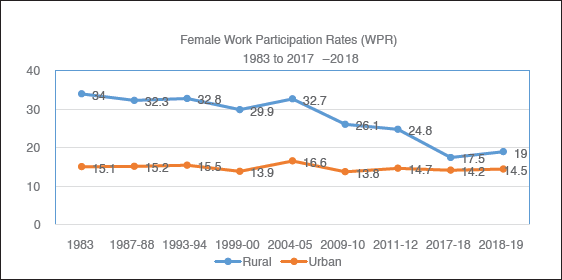
The downward trend in participation rates was stark since 2011–2012 with an absolute fall in the number of women workers to the tune of 21 million women workers (Kannan & Raveendran, 2019). It needs to be noted that the period also coincided with high economic growth, urbanisation and expansion of services. Further, there has been a marked increase in the share of women in higher education, which was to address the supply side issue based on the U-shaped understanding of the relationship between education and employment for women. By 2019–2020, the share of women in higher education was 47%, roughly the proportion of women in the total population.
It was only with a decline in absolute number of women in employment getting international attention that the issue has got some acknowledgement at policy levels. Policy responses to this fall in women workers was to deny the decline as an outcome of women’s economic marginalisation. Increases in education and household income came to the rescue with income theory dominating the discourse, suggesting women’s withdrawal from employment as part of the increase in household income. The disaggregate analysis of the secondary data proved the absence of any such trend with the decline largely restricted to poor women and those in the age group of 24+ who are unlikely to be in education in large number (Raveendran & Kannan, 2012). Further, it was noted that the decline in WPR is specifically marked among marginalised communities—Muslim, SC and ST (Neetha, 2014).
Invisibility of women in the definition of work followed by data sources and the possibility of undercounting by national surveys was highlighted and once again it became a subject of interest. The conceptual and methodological issues of women’s work and the debate around unpaid economic work have a long history, since 1970s. The definitions of work though still is a matter of concern, there has not been any changes in the definition in the last many rounds of macro data which questions this explanation. Unpaid housework and care work, which had acquired much attention since the beginning of this century also got heightened attention in terms of women’s absence from wage employment, segregation and issues of economic marginalisation. The burden of housework/care work combined with invisibility issues have been in the forefront of considerable discussion since 2015, largely attributable to unpaid care work finding mention in the SDG goals. It may be true that in the context of an overall crisis in employment, engagement of women in unpaid economic work may have increased (Action Aid, 2017) but this to as an explanation for the decline in women’s employment, especially of the poor and the marginalised appears inadequate and misleading.
With declining WPR, signs of marginalisation and segregation of women in employment was further pronounced (Neetha, 2015). Within manufacturing, women workers are found concentrated in food processing, textile & garment production and beedi making with a high share of home-based workers. Even within factory-based manufacturing, women are concentrated and segregated in labour intensive, monotonous and repetitive processes (Ghosh, 2009). This is true of all sectors, be it construction industry or other services. In the service sector, women have been disproportionately engaged in jobs that are paid less, considered less skilled and are an extension of care functions in the productive sphere of the economy (as nurses, teachers, domestic workers and schemes workers). The upsurge in paid domestic work and its feminisation has been of particular significance in this period. 2 The processes of migration that have intensified as a result of increased rural crisis have also been highlighted by various scholars to explain the burgeoning number of female domestic workers from marginalised communities in urban cities (Moghe, 2013). With growing class differentiations, intersecting identities of caste and gender have pushed poor women to the realm of paid domestic work. Only few women from privileged positions in social hierarchies of class or caste, through their social and economic capital could overcome some of the challenges to women’s entry into workspaces that are exclusionary. Not only did they have the means to access education and training as well as to avail better jobs through existing social networks, they also had the economic means to outsource domestic tasks of their household to a hired worker in order to free up more time and energy to engage in the labour market.
The sectoral concentrations of women in this period are reflective of an ongoing crisis of women’s employment, whereby extremely cheap labour was made available to undertake all low paid manual work including that of maintenance and care functions (Ghosh, 2009). The ‘double burden of work’, which meant that poor women who performed wage work also simultaneously performed unpaid domestic work had the inevitable consequence of hindering women’s employment prospective. This seems to have enabled the economy to overcome its paradox of social reproduction without fundamentally challenging the sexual division of labour (Neetha, 2013a). Thus, structural inequality engendered in patriarchy saw a worsening in this period (Neetha, 2020a).
The disaster unleashed by the pandemic needs to be seen in this larger background of an ongoing crisis of women’s employment. Though the pandemic did affect women’s employment adversely, the fact remains that the upheaval was not new for women, rather it is an extension or deepening of an ongoing situation. The crisis did deepen the existing ruptures in the system whereby pre-existing inequalities were reinforced or exacerbated with women more vulnerable to loss of jobs or cut in wages or salaries. Lack of contract or any social security for women workers in the informal sector made it easy for employers to retrench the workers or altering the terms of employment. PLFS data for 2018–2019 shows that in the non-agricultural sector about 66.5% of regular/salaried women workers do not have any contract; 50.6% are not eligible for leave and 54.4% are not eligible for any social security benefit. With the lockdown and the continuing pandemic, it is this group who are suffering a decline in living standards which are clear from the stories of retrenchment, unemployment and worsening of employment conditions. A considerable proportion of these workers are migrants, though women’s labour migration did not figure much in the discussion on the unprecedented exodus of migrants during the pandemic to their villages 3 .
III. The Pandemic and Women’s Work
The question as to whether the pandemic has affected women’s employment has been a subject of much academic discussion. The initial response to the outbreak of the pandemic was to control the health effects of the crisis which resulted in a complete lockdown for a period of almost two months. The lockdown and the later unlock period were marked by restrictions which resulted in large scale disruptions to economic and social life resulting in the worsening of the crisis in female employment and a further gendering of social reproduction.
There has been no reliable macro data to analyse the impact of the pandemic on women’s employment or work. Despande’s analysis using CMIE data based on a sample of over 37,000 households undertaken in April 2020, comparing it with the data in November–December 2019 (pre-COVID) is useful for an aggregate picture (Deshpande, 2020). This estimation reveals that men in general are more likely to be employed after the lockdown though the drop in male employment is greater. Women who were employed in the pre-COVID phase were found 23.5% less likely to be employed in the post-COVID phase compared to men who were employed in the earlier phase 4 . The data gives insight only into the lockdown period and hence cannot help in the understanding of later periods with the economy registering negative economic growth. The slowdown in economic growth and decline in incomes across many classes of households, which defines the present situation, have affected aggregate demand. This has led to further retrenchment and job loss where women have higher likelihood of termination from employment 5 . There are now increasing evidences from micro level studies and media reports suggesting loss of female employment (Bhandare, 2020; Bora, 2021; ISST, 2020). Not only has the level of employment declined, there also been a deterioration in wages/salaries/incomes and working conditions of those who could manage to be in employment.
For the post lockdown period, CMIE data, the only large data that is available, shows female labour force participation rate at its lowest—11%; while for men it is 71% in November 2020. Unemployment rates for women also increased between November 2019 and 2020 by 17% compared to 6% for men (Rajagopalan, 2020). In this period, women’s overall labour force participation rate declined by 13% and the decline has been mostly in urban areas (27%); with women in the younger age groups showing the highest fall. There are many reports available now on different sectors, category of workers, such as migrants, in different locations. Though these insights are based on small surveys and have local specificities they are useful in the understanding the impact of the pandemic. At the overall level all the studies have pointed out large scale loss of employment due to retrenchment or lack of availability of work (Bhandare, 2020). Those who managed to save their jobs had to sacrifice some of the terms of their employment, with many being turned into part-time workers. Wage/salary cuts have been reported extensively often with increased work pressure. For the self-employed, the economic shock meant abrupt closure of their economic engagement forcing many workers to situations of acute economic distress. Women wage workers who are over-represented in the lower segment of the ‘informal employment’ pyramid as discussed earlier—as temporary or part-time workers, contract workers, unregistered workers and home based supply chain workers—are the easy targets of all shocks.
The mass exodus of migrant workers to rural areas has increased the demand for work under the MGNREGA, where women had an advantage in many states with male members opting out of the programme. With competition and entry of male migrant returnees women’s shares in the programme in some states have been declining (Deccan Herald, 2020). Women have lost jobs, like men, in manufacturing (one of the worst hit) and construction in large numbers (APU, 2020; Chakraborty, 2020). Trade, hotel and restaurants, as per ILO, is one of the worst hit sector (ILO, 2020a). Though the share of women in this sector is not promising, the sector accounts for about 25% of all women service sector workers in urban areas and thus would have affected women’s employment adversely (APU, 2020).
The reorganisation of work particularly the shifting of productive work back to homes, closure of schools and other institutions of care has also amplified the reproductive work burden to families and households (Swaminathan & Lahoti, 2020). The social and cultural understanding of women responsible for housework and care work and to be available full time for such work is an accepted notion (Palriwala & Neetha, 2011). Thus, the reorganisation of work into homes during the pandemic has surely redefined and intensified women’s work burden. This has been especially so for those who faced difficulty in combining productive and reproductive work.
Given the larger picture of an enhanced employment crisis with the pandemic, in the subsequent section two important sectors of women’s employment, namely paid domestic work and frontline community workers are taken up for detailed discussion and analysis.
Visibilised by the Pandemic: Paid Domestic Work and Scheme Workers
The specific sectors that have got national and international attention in the context of the pandemic is the category of care workers—paid domestic work and frontline community workers. As discussed earlier, one of the sectors that has shown an upsurge since 1990s, even when at the overall level WPR of women declined, was that of paid domestic workers. The sector has been home to many migrants who are either illiterate or have poor educational backgrounds and are mostly from marginalised communities (Neetha & Palriwala, 2011). The ease of entry into paid domestic work and its increased demand among middle class households have contributed to the growth of the sector. Though many states have extended the coverage of Minimum Wages Act to the sector, most workers are paid much below the legal wages, though legal wages for domestic work in general, is noted to be much below that of other sectors (Neetha, 2013b). The dependence on domestic workers by middle class households had become so marked that domestic workers were considered indispensable to these households with the number of domestic workers showing a steady increase over time. With the most common system of part-time 6 live out workers, many households were dependent on an array of workers for diverse tasks on a single day (Neetha, 2013b). This was assumed to continue given the steady supply of cheap labour and the increasing demand for such workers. The indispensability and prospects of paid domestic work was shaken with the onslaught of the pandemic (Joy, 2020; Mitra, 2020). Even after several months of the easing of restrictions, many domestic workers have not been able to return to work.
Anganwadi 7 and ASHA 8 (an Accredited Social Health Activist) volunteers who are both part of ‘COVID warriors’ constitute for the largest chunk of community workers who are part of state programmes. The main responsibility of Anganwadi volunteers is to deliver nutrition and immunisation to pregnant and small children and that of ASHA is to ensure healthcare to disadvantaged groups, especially women. These workers have always been placed at a precarious position as they are not counted as workers by the state though they are categorised as workers by the statistical agencies of the state (Palriwala & Neetha, 2010). Government of India by refusing to recognise this ‘all women workforce’ classifies them as ‘honorary volunteers’ denying minimum wages, leave and other conditions of work. There are about 1 million ASHA workers, 1.3 million Anganwadi workers and another 1.2 million Anganwadi helpers, and all are women. As ‘volunteers’ Anganwadi workers receive an ‘honorarium’ and there has been a marginal increase in the honorarium from ₹3,000 to ₹4,500 in 2018 (Pratichi Research Team, 2020). ASHA workers are attached to local government-run dispensaries, with every worker catering to 40–400 households. These volunteers are paid performance-based remuneration with incentives for health activities such as immunisation, taking pregnant women to hospitals and routine check-ups of beneficiaries.
Community workers and paid domestic workers represent contrasting evidences of how women’ employment have been affected by the pandemic. Domestic workers are facing issues of unemployment and job insecurity, whereas community workers are in the lime light with the sudden realisation of their contributions, with extended demands on them. The case of both domestic workers and frontline community volunteers elucidates the diverse realities of women’s work and the differential impact of the pandemic.
Domestic Workers: Always on the Periphery
The COVID-19 pandemic, with its accompanying uncertainty and precautionary restrictions, has had devastating consequences for domestic workers, who are mostly women. The anxiety due to the possibility of transmission of the virus in closed spaces like homes became an issue even before the official lockdown in the country. The media reports during this period gives anecdotal accounts of the economic hardships inflicted upon domestic workers as their employers asked them to go on an indefinite unpaid leave once the nation-wide lockdown was announced in March 2020. Many part-time live out domestic workers who constitutes for more than 90% of all domestic workers were directed by the employers to stop reporting for work and thus the part-time system of domestic work came to a halt completely (Joseph, 2020) 9 . Of the domestic workers who were not able to work during two months of lockdown period, many were not paid though employers were urged to pay. As per the study conducted by ISST about 68.3% of the domestic workers were not able to get their wages in March 2020 because of restrictions of mobility and fear of coronavirus leading to severe economic distress (ISST, 2020). The study by RMKU and IIHS gives indication of the reduced income of domestic workers with lockdown, with average income dropped by 35% in March 2020 and by 93% in April. As per an 8 state random sample survey conducted by the Domestic Workers Sector Skill Council this has huge implications for these worker household as women were the regular earners contributing to about 50% of the household income (RMKU & IIHS, 2020). In total, 85% domestic workers did not get paid in the month of April 2020 (Pandit, 2020).
In the absence of any social protection, these workers were left with little choice but to migrate back to the village if possible. As per an estimate based on a large survey about 18% of workers who migrated back to the villages are women (Acharya et al., 2020), of which a considerable proportion would surely be domestic workers. The near impossibility of returning back to the villages with small children until public transport was made available forced many workers to stay back. The loss of income and absence of savings has caused severe hardships to domestic workers in terms of arranging for food and paying rent on their accommodations compelling them to stay in starvation or poorly fed and increased the debt burden of workers (Kamble, 2020; Mohan et al., 2020) 10 . Studies of domestic workers during this period do reflect many of these struggles. Expenses on food and rent were met from their meagre savings while 14% borrowed from their relatives/neighbours (ISST, 2020). Many workers also shared their hesitation, shame and embarrassment in asking employers as they were sure that employers will turn down their request. The ISST study also recorded anxiety and stress that the workers were going through because of uncertainty in employment and wages.
In the initial phase of ‘unlockdown’ though workers who stayed back in their places of stay tried to contact their employers to return to work, many were turned down. All anecdotal evidences reveal that many domestic workers have been dismissed without any notice, have been asked to work with wage cuts and have been facing harassment by guards, employers and landlords with threats of eviction from rented homes as they are unable to pay rents (Viswanath, 2020). Resident’s welfare associations were used by employers to prevent workers from entering their homes, leading to loss of jobs for many workers.
With the onset of the ‘unlockdown’ phases, many residential complexes had to open up and part-time domestic workers are returning to work, though the number of workers hired by employers has considerably reduced. Added to this is the social stigmatisation that domestic workers are subjected to even when they are able to get back to work in a much-reduced number of houses. This is because domestic workers are perceived as carriers of the virus owing to their class and caste positions which hamper their ability to follow social distancing norms in cramped residential spaces and public transportation (Choudhury, 2020). Fear of many outsiders entering homes combined with anxieties about hygienic standards of domestic workers was noted by studies (Verbruggen, 2020). The fear of transmission though was the initial concern, loss of jobs and declining household incomes of employers seems to have added to the reduced demand for domestic workers.
For those workers who were reemployed are undertaking many more tasks as they are replacing other part time workers leading to additional workloads. These workers also have to bear the burden of increased work due to heightened expectations of cleanliness and an increase in other housework chores with members of the employer’s households confined to homes. Additional work demands from the employers has also increased pushing up working hours, but this is often without any increase or sometimes with marginal increases in wages with reduced bargaining power (The Hindu, 2020). In the case of live-in domestic workers, who are now restricted to the employers’ residence, the lockdown has meant practically a 24-hour workday as they are expected to be on call throughout the day. The requirement to wear clean masks and use of sanitisers are all additional conditions for part-time workers. Coupled with additional work burden, hygiene demands and reduced wages, workers face threats of infection as they step out of their houses every day to work, in often multiple houses.
Even though the demand for live in domestic workers was understood to be increasing in this period, antidotal evidences from placement agencies do not suggest any such trend. On the other hand, before any placement, the condition of undergoing coronavirus test at the workers expense and required period of quarantine are creating huge burden on workers and placement agencies. The following quote from an interview with Vinod Yadav, founder and CEO, Hire Help in India, cited in Hindustan Times clearly states the issue:
I had to start Zoom interviews as prospective employers do not want to meet household help in person. First, they want an interview over the phone, and if satisfied they ask for a Zoom interview. Out of the 100 Zoom interviews I organised in the past few months, only 20 got hired. Ironically, while those wanting to hire a maid asked me to get the maid tested for coronavirus disease, which I do, but they do not want to undergo the test themselves as if only the maid is susceptible to the virus, and they are not. (Sharma, 2020)
Even salaries of workers who are recruited as live-in workers have come down drastically (Mitra, 2020).
However, despite all these vulnerabilities that afflict the lives of domestic workers during this pandemic, there is little by way of state support, as always, that has been granted to these workers (Khullar, 2020; The Hindu, 2020). The realm of paid domestic work has been suffering from a severe lack of recognition and regulation, leading to oppression and exploitation of domestic workers (Neetha & Palriwala, 2012). The denial to accept private homes as workplace combined with social locations of the workers—intersections of caste, class, ethnicity and gender—have resulted in stripping them of any effective choice or voice against injustice. Added to their workplace issues, domestic workers are also facing increased burden of own housework with reduced income as they have to manage everyday living with limited resources (Rajagopalan, 2020). With family members falling sick with the spread of the virus to the communities, the care burden of these women surely would also have multiplied.
Patronising for the Immediate: Unrecognised as Workers
Community workers/volunteers are highly underpaid and unpaid and are kept outside of any workplace rights. There have been many studies that have documented the contribution of community workers and have urged the state to extend the definition of workers to this category of women ‘volunteers’ (Palriwala & Neetha, 2010). The parliamentary standing committee on labour also recommended the formalisation of the work of ASHA and anganwadi workers with defined conditions of work like other employees of the state (Venugopal, 2020). These workers have also been a subject of discussion in the Indian Labour Conferences, 11 leading to the recommendation for their recognition as contractual workers or government employees and regularised.
The position of the state not to regularise community workers relates to two positions—the part-time nature of work (4–5 hours) and the increased fiscal burden that comes with formalisation. However, available evidences suggests that these volunteers work for more than eight hours as they have to keep detailed records of the target families, done mostly after their official working hours. For ASHA workers as their payment is performance based there is an added demand of keeping proper record of their own work. Further, they are also drawn into almost all welfare programmes of the state due to their contacts with the community. These workers are supposed to travel to the entire work area and given the diffused locations of beneficiary households with no travel support, they end up walking long hours adding up to the working time. The most disturbing aspect is the imposition of forced volunteerism by the state as a way to extract free labour from women based on the social understanding of women as secondary earners.
During the pandemic ASHA and anganwadi workers along with other frontline workers were in the highlight for their immeasurable contribution. As discussed earlier, almost all community workers are women of 25–45 age groups who are recruited from local communities and have contacts with local population. All state governments at varied degrees relied on these workers during the pandemic for community level tracking, monitoring and awareness creation.
Even before the reported cases of virus in the country, ASHA workers were mobilised by the state as part of the grass root level component of the Micro Plan for Containing Local Transmission of Coronavirus Disease (COVID-19) largely to
search clinically suspect cases; identify contacts of confirmed and suspect cases, maintain line list of suspect/confirmed cases and contacts, monitor contacts daily, inform Supervisory Medical Officer about suspect cases and their contacts and create awareness among community about disease prevention, home quarantine, common signs and symptoms and need for reporting suspect cases by distributing fliers, pamphlets and also by interpersonal communication. (GOI, 2020)
ASHA workers, thus, were in all states part of the frontline workers for screening and contact tracing. Field insights suggest ASHA workers visiting the quarantined houses every day to ensure the members of the house were not violating their quarantine, in addition to providing them health assistance as required, which makes them prone to infection. Though the responsibility was largely on ASHA workers, Anganwadi workers were also given these responsibilities, especially that of creating awareness. With an increasing number of migrants returning to the rural areas in many states, anganwadi workers (AWW) were also given the responsibility of recording incoming migrants, tracking their travel history and if required ensuring their quarantine for 14 days and noting symptoms if any (KPMG Josh, 2020), which was apart from other responsibilities. Though Anganwadi centres were closed since 13 March 2020, many workers did door to door delivery of food to children and pregnant women, providing old age pension, and educating people (Jigeesh, 2020).
Such community level work by these volunteers was undertaken without much training and safety equipment (Agarwal, 2020). Further, many had to fight their own fears and fear of their families and resistance from the community (Awasthi, 2020). The fear, hostility and hatred of the community was also an issue as many households as community workers were seen as carriers of the virus given their contacts with infected patients. Many ASHA workers have also succumbed to the virus as they were not provided basic precautionary equipment such as masks and gloves. There are reports of these workers stitching their own masks or using their dupattas or handkerchiefs to double up as masks (Agarwal, 2020).
The responses to the pandemic had to be localised and thus the services of community workers who were invisibilised and ignored had to be drawn in as no one else had contacts and information of the community like these workers. These frontline workers, as elaborated have a huge role in containing the virus and limiting its spread within the community. Despite their immeasurable contribution, they remain highly underpaid without required facilities and any health insurance coverage. (Josephine, 2020; Pandit, 2020). Recognising, resent by the underpaid and overworked workers at the community level, in April 2020 the government announced monthly payment
IV. Conclusion
To conclude, the pandemic has resulted in severe dislocations in the lives of many women workers especially the poor and the neglected, exacerbating the ‘chronic crisis’ in the everyday existence of these workers to unprecedented proportions. Evidences from the ground signal desperate times with women workers facing severe unemployment, reduced incomes and adverse conditions of work. While the pandemic is undoubtedly creating an unprecedented livelihood dislocation for many, women in India have been confronting economic and social crisis for decades. COVID-19 has brought to the forefront the fault lines of our economy, with informal sector workers and women at large having to bear the brunt of pandemic which worsened structural issues. As all evidences—both secondary and field level studies—have shown, a large number of workers have lost jobs; or facing wage cuts. For long, women have confronted, exclusion and precarious employment opportunities resulting from anti-women attitudes. Lack of policies to address the deep-rooted structural factors have deepened the fault lines leading to systemic failures as is evident from the crisis in women’s employment during the pre-pandemic period. The COVID-19 pandemic has further exacerbated and personalised this endemic context of crisis for women as evident from studies on women workers in paid domestic work and ‘voluntary’ community workers.
Though the two sectors seem to suggest contrary developments, one of declining opportunities and the other of increased visibility, the underlining thread is that of lack of any recognition as workers. Paid domestic work and community workers are important segments of women’s work and the state’s approach to these workers reflect the devalued social and political understanding of women’s economic contributions. It is high time that the state should recognise their contribution and accept them as workers extending the protection of all relevant labour laws. Recognition of these workers could shake the social understanding of women’s work as secondary earners and could help a long way in resolving the larger question of devaluation of women’s work, especially care work. This would help in addressing some of the structural issues and failures to a greater extent altering the balance in favour of women’s employment.
In the context of existing research on women it is clear that re-entering the workforce for women who have lost employment is always difficult given exclusionary tendencies in the labour market combined with social and family expectations. The burden of reproductive work has also risen in the lives of many women, and recognition of care work in the public sphere could help in shaking the unequal division of house work and care burden. Given declining state interventions and increased privatisation of social reproduction this is bound to impact women’s status adversely. Evidences from the field suggest that the pandemic has intensified the shift of the burden of social reproduction to the homes, which has detrimental effect on women’s social and economic status. Thus, women are going to be left behind even when the economy recovers which is a matter of huge concern. In the absence of interventions that could address some structural issues, women’s employment is to move from one crisis to another, be the context of pandemic or otherwise. Learnings from public employment programmes such as MGNREGA in containing crisis in employment and addressing gender disparity in the labour market including wage gaps are critical. Expansion of MGNREGA and designing similar programmes for urban women are important to address the decline in female employment in the immediate.
