



Abstract
Do platform workers inadvertently strengthen the algorithmic management (AM) systems they seek to resist? Drawing on 37 interviews with digital labor platform managers, this paper provides an organizational perspective on workers’ “algoactivism” in food and grocery delivery. We reveal that platforms are not passive targets and their reactions to algoactivist acts unfold through a dynamic cycle of sensemaking across three stages: noticing, framing, and acting. We identify key determinants at each stage, explaining why platforms react differently to worker acts. Unlike traditional organizations with formal conflict management procedures, we suggest that platforms operate as adaptive socio-technical systems, continually recalibrating managerial mechanisms through experimentation. We find that workers exploit gaps that platforms subsequently close, rendering them unwitting contributors to their own control. Explaining workers’ algoactivism and its role in shaping AM practices, we situate sensemaking within the duality of AM, highlighting how its interpretive flexibility creates tensions between intended design and actual use. We refine this conceptualization, asserting that the recursivity of AM is not open-ended, as interpretive flexibility may shrink with platforms continually adapting to algoactivist acts. While mutual shaping persists, recursive dynamics may compress worker agency, exposing the limits of algoactivism and challenging assumptions about its emancipatory potential.
Keywords
Introduction
Operating akin to an invisible hand, algorithms shape the foundation of platform work. Digital labor platforms (DLPs) leverage algorithms to automate several functions and processes that were traditionally the preserve of middle and line managers (Rosenblat and Stark, 2016). A core feature of these work arrangements is the use of algorithmic management (AM), which can be broadly defined as algorithmic systems that are delegated managerial responsibilities of orchestrating the end-to-end labor process, thereby optimizing the organization of work. This has permitted DLPs to distance themselves from conventional employment liabilities and operate as a technological intermediary that connects customers with service-providing, “independent contractors” (Duggan et al., 2020). While the use of algorithms offers significant leverage for this business model to increase its operational scale, there has been much criticism by academics, legal professionals, and regulatory authorities. This is premised on their opaque mechanisms of control and for being exploitative towards workers (Pulignano et al., 2024), restricting workers’ agency, specifically their capacity to influence the circumstances under which they work.
Prominent DLPs (e.g., Uber, Deliveroo, Amazon Mechanical Turk) and their use of AM have been examined primarily based on worker experiences and anecdotes (Anwar and Graham, 2020; Newlands, 2021; Panteli et al., 2020; Rosenblat and Stark, 2016), propagating technologically deterministic narratives. In part, this has been due to the layered opacity of algorithmic systems, manifesting as (a) intentional and institutional (rooted in corporate secrecy and platform governance) and (b) technical and emergent (arising from machine learning complexity) (Burrell, 2016). This underscores the dual challenges of both access (Maffie, 2023) and comprehension (Burrell, 2016)—the “black box” problem in AM (Heiland, 2025). In the former, opacity is structurally embedded, arising from design choices such as proprietary algorithms and inscrutable coding logics, which are largely non-negotiable and reinforce a fixed asymmetry of power between workers and DLPs (Ananny and Crawford, 2018; Burrell, 2016). By contrast, the latter manifests itself as practical or performative, reflecting how workers experience limits in understanding and/or navigating algorithmic systems (Ananny and Crawford, 2018). Even though this form of opacity continues to limit transparency, there is evidence that it can be interpreted, adapted to, and resisted by workers, albeit partially and unevenly (Curchod et al., 2019; Heiland, 2025), via various actions they claim to undertake to outsmart the DLPs’ AM (Heiland, 2021; Moore and Joyce, 2020; Vasudevan and Chan, 2022).
Drawing parallels to worker resistance and activism in traditional employment and organizational settings (Burrell and Fourcade, 2021), the extant literature documents a broad portfolio of covert, individual-level worker acts around data obfuscation, and collusion with various marketplace actors (e.g., customers and restaurants), along with overt, collective actions such as undertaking strikes in the form of mass “logoffs” and “ride-outs” (cf. Cameron and Rahman, 2022; Cini et al., 2022; Joyce et al., 2023; Vasudevan and Chan, 2022; Woodcock and Cant, 2022; Yu et al., 2022). Typically dispersed, these actions, termed “algoactivism” by Kellogg et al. (2020: 368), are devised by workers to address grievances arising from algorithmically controlled aspects of their work by making sense of their “experiences with an algorithmic manager” (Mayberry et al., 2025: 124). Therefore, this paper frames algoactivism as an expression of worker agency in response to organizational constraints imposed by DLPs’ AM. This agency is restricted, as it is shaped by technical characteristics and governance logics embedded in the platforms’ AM, which simultaneously enable and restrain action through codified and opaque scripts and metrics (Curchod et al., 2019; Doherty et al., 2006; Kellogg et al., 2020; Meijerink and Bondarouk, 2023).
While workers’ algoactivism has been suggested as a critical catalyst for change in the evolution of AM practices (Meijerink and Bondarouk, 2023), existing scholarship offers limited insight into how these algoactivist acts influence DLPs’ AM. In light of this and contrasting the technologically deterministic perspectives, there has been a growing recognition of AM practices as being socially constructed (Kellogg et al., 2020), that is, not only are they deeply influenced by human decisions, organizational strategy, choices, and culture, but are also shaped by meanings and functionality attributed by users (Heiland, 2025). The dichotomy between the technologically deterministic and socially constructed views suggests they are mutually exclusive, when they are not (Orlikowski, 1992). A mutual constitution is the central premise of Orlikowski’s (1992) “duality of technology,” which Meijerink and Bondarouk (2023) have drawn upon to propose the “duality of algorithmic management.” They suggest that AM evolves recursively and possesses both enabling and restraining features, implying that AM practices are “shaped and influenced by, as much as it is shaping and influencing, the autonomy and value to workers” on these platforms (Meijerink and Bondarouk, 2023: 3). Jarrahi et al. (2021) call for more research to explore this phenomenon of the “mutual shaping” of work algorithms.
We contend that while the prevailing dominance of worker perspectives offers a useful starting point, it may equally warrant research from an organizational perspective that examines how DLPs perceive workers’ algoactivism, which is enacted as part of their interactions through the worker–app interface. This would involve considering how organizational managers discern and interpret variable and changing algoactivist acts, particularly given that previous research has conceptualized “platform management methods as a composite of technological and organizational forms that managers can deploy, in various combinations” (Joyce and Stuart, 2021: 166). Understanding this dynamic is important for assessing how algoactivist acts interact with, and influence AM, as well as ascertaining their limits. Furthermore, considering research that suggests that these interactions may manifest as a feedback loop that reshapes AM (Jarrahi et al., 2021; Meijerink and Bondarouk, 2023), there is little knowledge of the consequences of these recursive dynamics and the influence of contextual factors. Addressing this lacuna and associated calls for empirical evidence from the DLP perspective (see Cameron and Rahman, 2022; Dasgupta et al., 2025a; Oyetunde et al., 2026), we ask: how do digital labor platforms react to workers’ algoactivism?
To establish the organizational perspective, we draw on 37 in-depth interviews with 17 platform managers who have worked for 10 different DLPs in the food/grocery delivery sector. We utilize the sensemaking lens (Weick, 1995), which prior research has used to examine how workers’ interpretations of AM may shape certain algoactivist acts (Heiland, 2025; Vasudevan and Chan, 2022). We extend this lens to platform managers to examine how they reciprocally make sense of and respond to workers’ algoactivism. This builds on research showing that line managers in traditional organizations also engage in sensemaking to identify and address potential workplace conflicts (Currie et al., 2017). As part of our working theory guiding our research question, we posit that the duality of AM conceptualization (Meijerink and Bondarouk, 2023) implicitly rests on sensemaking processes, through which differing and potentially divergent interpretations by workers and platform managers co-constitute the recursive shaping of AM and its associated outcomes.
The paper’s contributions are twofold. First, this study features the underrepresented DLP perspective on workers’ algoactivism in platform work. Adding to the embryonic literature that captures this view (see Franke and Pulignano, 2023; Meijerink et al., 2021; Parth and Bathini, 2021), we argue that DLPs are not passive actors, and their reactions to algoactivism unfold through a dynamic cycle of sensemaking. This is centered around three temporally sequential response stages—noticing, framing, and acting. By situating sensemaking processes within the duality of AM conceptualization and articulating a range of determinants at each stage, we provide a more comprehensive understanding of the variability in DLP reactions that arise from managerial decisions to alter AM practices. We elucidate that these decisions are embedded in broader organizational and contextual dynamics, rather than made in isolation. There is an associated empirical value achieved by unpacking how “human managers/software designers . . . (re)design HRM algorithms” (Meijerink and Bondarouk, 2023: 2); a crucial stage identified in the recursive development of AM.
Second, drawing on literature on workplace conflict management (Currie et al., 2017; Lewin, 2001), we note how DLP reactions contrast traditional organizational responses to worker resistance and activism that have formalized over time and adhere to established employment and labor law frameworks (Greer and Labig, 1987; Griffin et al., 1986; Vardi and Weitz, 2003; Wheeler, 1976). This led us to frame DLPs as adaptive socio-technical systems (Muldoon and Raekstad, 2023; Pulignano et al., 2024) that are capable of ongoing recalibration of managerial mechanisms through algorithmic experimentation, thereby enacting a distinctive form of “governance” that diverges from conventional organizational models (Vallas and Schor, 2020). Reflecting on this unique form of governance, we offer insights into how workers may inadvertently contribute to the creation of their own algorithmic control structures. In so doing, we add to existing analyses of algorithmic control (Duggan et al., 2023; Kellogg et al., 2020) and refine Meijerink and Bondarouk’s (2023) duality of AM conceptualization by attributing this consequence to the mutual shaping of work algorithms and AM (Jarrahi et al., 2021). We contend that such recursive dynamics may shrink interpretive flexibility of AM and compress worker agency over time (Doherty et al., 2006), exposing the limits of workers’ algoactivism.
The paper is structured as follows. We begin by positioning our study through a review of literature comparing DLP responses to algoactivism with those of traditional organizations, highlighting worker resistance and agency in navigating opaque, highly controlled AM systems. We then present our conceptual framework, integrating sensemaking into the duality of AM to better capture DLP reactions as unfolding, recursive processes. This is followed by an overview of our research methods and analytical approach, the presentation of our study findings, and a discussion of the theoretical and practical contributions of our work.
Algoactivism in food/grocery delivery: Continuities and departures in worker resistance and conflict management approaches
Traditional approaches to identifying workplace conflict and resistance initially relied on immediately apparent, adversarial acts characteristic of the Industrial Relations (IR) era. Over time, these approaches evolved to incorporate management-initiated diagnostic tools (e.g., employee surveys and observation of turnover/absenteeism) as the Human Resource Management (HRM) perspective gained prominence, seeking to proactively detect conflict before it escalated into a dispute (Currie et al., 2017; Lewin, 2001). This evolution reflects a shift from the IR view of conflict as enduring and rooted in fundamental employer–employee power imbalances, which require institutional interventions (e.g., disciplinary procedures, unions, collective bargaining, labor law frameworks and regulations) (Greer and Labig, 1987; Vardi and Weitz, 2003). Under the HRM view, conflict is instead seen as stemming from poor management and can be addressed through managerial improvements and cooperation (Currie et al., 2017; Lewin, 2001).
Alternative dispute resolution (ADR) mechanisms such as open-door and “speak-up” policies, mediation, ombudsmen, and arbitration emerged alongside traditional grievance and disciplinary procedures or litigation, particularly for individual employment rights disputes. Interest-based bargaining and assisted bargaining emerged to handle disputes involving groups or collective issues in both non-union and union firms, albeit with different rationales and regional variations (Currie et al., 2017). The former typically embraced ADR as a “union substitution” strategy, with the latter centered on fostering a more cooperative employment relations climate (Currie et al., 2017: 498). The adoption of such mechanisms was ad hoc and reactive when organizations were challenged, and incorporated incremental amendments to conventional procedures, which were appropriately socialized. Beyond ADR, the role of line managers within HRM’s business partner model also expanded to promoting coaching and mentoring approaches for conflict prevention and/or engaging in informal problem-solving (Currie et al., 2017). Employee involvement and participation practices to encourage organizational citizenship behaviors and employee engagement also became commonplace. All things considered, the move has been toward more consensual processes that promoted the amicable settling of differences.
A caveat of both IR and HRM approaches was their selective application to core, full-time employees, who were considered “assets” or “capital” justifying the organizations’ investment in conflict reduction mechanisms. Part-time, temporary, and contract workers were often viewed as an “expense” resulting in their exclusion from such structures (Lewin, 2001: 477). DLPs appear to align with this view, given that platform workers, in most jurisdictions, are classified as “self-employed” or “independent” “contractors” or freelancers rather than having a formal employment relationship (Duggan et al., 2020: 121). This framing, when compounded with DLPs’ use of AM to displace accountability and further depersonalize the relationship, has had a minimal effect on reducing conflicting interests or power imbalances (Dasgupta et al., 2025b; Joyce et al., 2023; Kellogg et al., 2020; Mayberry et al., 2025).
Understanding workers’ algoactivism in platform work settings requires awareness of the operating context. DLPs can be broadly categorized as online web-based platforms, where tasks are performed remotely and include human-intelligence digital/data work such as transcription, translation, app/website development; and location-based, where tasks are geographically bound, fulfilled locally such as food delivery and ride-hailing (ILO, 2021: 40). AM is universally leveraged by DLPs to match clients/customers with independent contractors for on-demand, short-term tasks (Kuhn and Maleki, 2017). While all DLPs employ AM, there are notable differences in the priorities of their respective algorithmic systems, driven by variations in the services they offer (McDonnell et al., 2021). For example, food/grocery delivery platforms rely heavily on algorithms for dispatching/assigning orders to workers, monitoring task progress, and calculating fees; tasks deemed central for efficiency and scalability (Heiland, 2025). The restaurant/grocery (supplier) represents another additional stakeholder, alongside the customer and worker (Duggan et al., 2020). Consequently, AM focuses on organizing and coordinating the work process between three stakeholders, relying on real-time optimization of tasks through automated pricing, ranking mechanisms, and real-time route decisions (Gandini, 2019).
The delivery workflow entails order assignment, where algorithms automatically allocate customer orders to nearby couriers (workers) based on factors such as proximity, estimated delivery time, food preparation time, and other organizationally determined parameters. This leaves little room for input from the couriers themselves, who can choose to either accept/reject the task offer within a brief time window (Duggan et al., 2023). While couriers typically have the flexibility to log in at their discretion, this may be tempered by restrictions that confine them to working in designated geographic delivery zones (cf. Heiland, 2021), which DLPs can adjust in real time based on supply–demand factors. Furthermore, DLPs continuously monitor task progress, using GPS tracking and metrics such as delivery time and acceptance rates by couriers to forecast demand and supply within specific zones. Based on predictive data, they may even incentivize the base fee over a specific timeframe to ensure an adequate supply of couriers in areas where increased demand is anticipated (Heiland, 2025).
Payment structures are typically determined by a mix of base pay, travel distance, and customer tips, with some DLPs incorporating automated surge pricing during peak times. Consequently, worker earnings vary widely across DLPs and are based on their respective algorithmic logic and calculations. When couriers are carrying out tasks, communication with the DLP is largely managed through the app, which provides updates, instructions, and customer details. Human support is available in highly restricted forms for dealing with on-the-job challenges, with couriers mostly relying on automated systems/contact forms for guidance and addressing grievances when they are not actively working (Kougiannou and Mendonça, 2021). Essentially, the entire organization of work on food/grocery delivery DLPs is algorithmically managed and controlled, with AM playing the central decision-making role (Heiland, 2021, 2025). These subordinated working conditions are exacerbated by opaque and shifting standards of performance, pay, and outcomes, which undermine couriers’ capacity to make informed work decisions (Muldoon and Raekstad, 2023).
Research suggests that couriers start to speculate and develop theories, essentially “mental models” (Heiland, 2025; Sherman et al., 2025), about the algorithms’ mode of operation, guided by their own experiences on the platform or through participation in online networks/forums which provide opportunities for collective sensemaking (Mayberry et al., 2025). Heiland (2025) identifies the use of different “cognitive frames” by couriers, where some see the algorithm as a flawed but neutral system, while others see it as a tool of control and therefore mistrust the DLPs’ intentions. These frames are not necessarily mutually exclusive and can coexist, shaping how couriers interpret AM and devise algoactivist acts in interfacing with the app, thereby navigating its controlling dynamics. Mayberry et al. (2025) classify these algoactivist acts into (a) uninvolved, (b) aligned, and (c) coordinated practices, indicating variation in workers’ reactivity (Rahman, 2021) and willingness to engage. In “uninvolved practices,” workers express frustration with the algorithmic system but refrain from engaging in algoactivism, often due to fear of potential sanctions stemming from income/platform dependence (Rahman, 2021). “Aligned practices” involve workers experimenting with strategies to improve earnings or exploit loopholes in the algorithmic system through trial and error. For example, there is evidence of couriers swapping devices or accounts through which they access work (Newlands, 2021), thus interfering with algorithmic surveillance and obfuscating performance data. Heiland (2021, 2022) observed couriers using fake GPS devices to manipulate their location, thereby evading continuous algorithmic monitoring and associated sanctions for working outside of their designated delivery zones.
In “coordinated practices,” workers act collectively, demonstrating solidarity by sharing knowledge to demystify the algorithm and develop deliberate strategies to influence the system. These manifest as ad hoc acts of labor withdrawal that disrupt the “circuit of production” and create bottlenecks in the platform’s labor process (Newlands, 2021: 13). This may involve couriers refusing to complete deliveries after collecting food from the restaurant or logging off from the platform mid-task (Briziarelli, 2019). When undertaken collectively, these practices can take the form of a protest or strike action, via “coordinated log-offs” or “critical mass ride-outs” (Joyce et al., 2023: 11). Together, these acts exemplify how traditional forms of individual resistance, commonly comprising work avoidance, pilferage, foot-dragging, and work-to-rule strategies have been reimagined, and also how elements of shopfloor organizing and collective action have emerged, despite the material conditions of platform work precluding it (Burrell and Fourcade, 2021; Kellogg et al., 2020).
The variable nature of algoactivism makes it difficult to reduce it to opportunistic behaviors or isolated acts of defiance. Algoactivism, therefore, encompasses a continuum of worker actions, ranging from tactical or survival-driven adaptations to more deliberate and organized forms of resistance. These actions are agentic, reflecting intentionality, choice, and direction in how workers attempt to negotiate visibility, value, and autonomy under conditions of algorithmic subordination (Curchod et al., 2019; Rahman, 2021). They demonstrate how workers challenge decisions and the constraints embedded into these algorithms (Kellogg et al., 2020; Moore and Joyce, 2020; Newlands, 2021; Vasudevan and Chan, 2022), by potentially influencing AM in unintended or unforeseen ways (Meijerink and Bondarouk, 2023).
Consequently, DLPs may encounter distinct challenges in identifying algoactivism while potentially adopting different approaches for managing it; a marked contrast with traditional organizations. Due to the limited research available from the platforms’ standpoint, we postulate that the transactional nature of the platform work relationship may lead DLPs to identify algoactivism through continuous data tracking (algorithmic monitoring/surveillance), and to interpret it as non-compliance with terms of service or as a failure to meet algorithmically defined performance standards (Rosenblat and Stark, 2016; Wood, 2021), thereby minimizing meaningful efforts to understand its underlying causes. As a result, deviations from expected performance could be immediately flagged as requiring disciplinary intervention or sanctions. Scholarship on algorithmic control has identified “replacement” as one such disciplinary mechanism whereby the DLPs’ AM system automatically removes (deactivates) workers engaging in such activities or otherwise enforces punitive consequences for failing to meet performance or compliance thresholds (Kellogg et al., 2020). Research shows that couriers were penalized for late deliveries or frequent order rejections 1 through reduced access to tasks or lower priority in work allocation, which negatively affected their future earning opportunities. For example, Deliveroo and Foodora workers who were ranked poorly found their access to the best shifts curtailed (Ivanova et al., 2018). Studies have also noted couriers reporting fee penalties for not following an “efficient route” recommended by the app (Rosenblat and Stark, 2016).
While we can deduce possible DLP responses to workers’ algoactivist acts and the corresponding repercussions for workers from the algorithmic control discourse, we urge caution in conflating any inferences drawn, as the platform perspective is largely absent. We also note that certain responses, while DLP specific, stand in sharp contrast to the IR and HRM views on organizational conflict/dispute management. For instance, workers may not be provided with an opportunity to contest algorithmic decisions or present their own perspective (Rosenblat and Stark, 2016), all of which highlight the need to incorporate the organizational perspective.
The duality of AM
AM in platform work has been shaped by several competing views and perspectives, and these debates are unfolding much like they have with emergent technologies in organizations. Early studies assumed technology to be an objective, independent force, with a deterministic influence, often leaving little room for human intervention (Orlikowski, 1992). Subsequent studies argued that technology is not an external entity but shaped by continuous human actions, shared interpretations, and interventions (Klein and Kleinman, 2002; Pinch and Bijker, 1993). Within an organizational context, technology can be adapted, that is, shaped by the strategic goals and decisions made by key stakeholders (Heiland, 2025; Kellogg et al., 2020). The shared interpretations and meanings around technology may direct future development and interactions with that technology (Pinch and Bijker, 1993). The limitation, however, lies in the selective application of human agency, where managers and/or technology designers are seen as having sole power to shape technology.
The perceived shortcoming of this view was addressed by recognizing workers’ ability to influence and alter how technology is interpreted, appropriated, and used through their actions, bringing into focus the socially constructed nature of technology development (Burawoy, 1979; Heiland, 2025; Meijerink and Bondarouk, 2023). Another perspective, characterized by soft determinism, portrays technology as assuming objective forms and functions that are gradually moderated through social shaping by users and their contexts (Barley, 1986). In this vein, Orlikowski (1992) used Giddens’ (1979, 1984) theory of structuration to propose the “structurational model of technology,” capturing the dynamic and recursive relationship between technology and organizations.
The structurational model of technology asserts that “technology is created and changed by human action, yet it is also used by humans to accomplish some action” (Orlikowski, 1992: 405). This highlights the most fundamental properties of technology, that is, its recursive lifecycle and interpretive flexibility. The explanation for the former is rooted in the concept of “the duality of technology,” which arose in response to the need to go beyond deterministic perspectives. Instead, Orlikowski (1992) contends that technology is socially constructed by human actors based on different meanings they ascribe to it, and the various features they emphasize and use. To illustrate with an example from Orlikowski’s (1992) study of a large multi-national software consulting firm (“Beta Corporation”) and its use of Computer-aided Software Engineering (CASE) tools, senior managers (management) intended to introduce these tools to increase productivity and reduce consulting time. The CASE tools were designed and built by technical consultants (developers) based on a set of assumptions and procedures intended to standardize the work. However, the way the tools were interpreted and used by the functional consultants (users) varied. These consultants often found certain features inappropriate, inadequate, or unduly restrictive. Consequently, they engaged with the tool’s interpretive flexibility to create workarounds or circumvent certain constraints, thereby offsetting the intended centralization of control by asserting agency. While the consultants succeeded in bringing the tools’ problems into focus, which subsequently led to modifications, the victory was “partial,” as the modified tools eventually became “reified” and “institutionalized,” continuing to condition the work of newer consultants, while reinforcing the firm’s overall system of control (Orlikowski, 1992: 419).
Based on this illustration, we suggest that Weick’s (1995) seminal work on sensemaking is highly relevant. While Orlikowski (1992) does not explicitly articulate or use the “sensemaking” terminology, the example highlights the existence of competing sensemaking processes among different actors (management, developers, and users), who may bring different interpretations and meanings to the technology, and adapt it to pursue divergent objectives based on needs and interests. It shows that control may not be inherent in the technology itself but is enacted through ongoing interpretive practices. Furthermore, once technology becomes “reified” and “institutionalized,” it may begin to appear as though it possesses the objective, structural properties of the organization, seemingly detached from the human actors who originally constructed or imbued it with meaning (Orlikowski, 1992). While this reification reinforces the “black box” perception of technology by obscuring its underlying logic, it is more significant in highlighting that human actions (agency) and structure are interconnected and influence each other. This mutual influence suggests that technology is not a static tool, but a product of contestation and negotiation, thus continually being shaped by how humans design and use it, afforded by its interpretive flexibility. This eventually manifests as a cyclical or recursive ongoing process of shaping and reshaping (Orlikowski, 1992).
This fundamental idea serves as the foundation of Meijerink and Bondarouk’s (2023) “duality of algorithmic management” conceptualization, which we leverage to situate our understanding of AM in platform work. Meijerink and Bondarouk (2023) propose the dualistic perspective as facilitating research that unpacks the complexity of AM and, hence, reduces deterministic assumptions. Their core assertion is that algorithms, like other workplace technologies, should neither be understood as an external force, dictating human actions, nor as solely a product of social construction (Meijerink and Bondarouk, 2023). For instance, when designing AM, software developers tend to incorporate their knowledge, experiences, and perspectives, embedding various organization-specific imperatives (e.g., norms, assumptions), which imbue algorithms with specific meanings and affordances that typically enable and/or restrain the actions of those using and interacting with them (Curchod et al., 2019; Heiland, 2025). However, through these continuous interactions, AM tends to become a target of influence by users, thus making them subject to evolution (Meijerink and Bondarouk, 2023). This can be attributed to interpretive flexibility, which enables sensemaking whereby users discern the meanings and norms embedded in AM by observing how outputs respond to different inputs and strategically leverage this understanding to act within the system’s confines to achieve desired effects.
In the platform work context, studies intimate that workers rely on sensemaking to engage with AM’s interpretive flexibility (Möhlmann et al., 2023). This underpins their algoactivism (Heiland, 2025; Vasudevan and Chan, 2022), empowering them to influence the algorithm’s enabling and restraining properties by creatively modifying various inputs, that is, making certain actions more visible to the algorithm while hiding others (Meijerink and Bondarouk, 2023). Enabling and restraining properties of algorithmic systems define the scope of possible actions for workers, whereby, for example, AM enables workers to earn flexibly and complete tasks efficiently, but restrains autonomy by enforcing opaque task allocation, acceptance rate thresholds, constant monitoring, and performance pressure to conform to DLP-defined standards. To rebalance these properties in their favor, workers leverage their interpretive agency (Heiland, 2025) to devise and engage in various algoactivist acts such as manipulating their availability (e.g., by staging coordinated logoffs) or location (e.g., using fake GPS) which can determine how tasks are distributed or what fees they get offered for the task, thus effectively reshaping (a) the system’s outputs, without altering the underlying algorithmic code and (b) how enabling and restraining properties are experienced in practice.
However, these actions may prompt DLPs to change and/or maintain the rules and norms embedded within their AM practices as part of their response repertoire to tackle algoactivism (Meijerink and Bondarouk, 2023). This interplay points to AM’s socio-technical nature (Jarrahi et al., 2021; Pulignano et al., 2024), where the materiality of the technical subsystem (algorithms, digital interfaces, data infrastructures) is not merely that of a calculative object (Curchod et al., 2019); it actively prompts actions and reactions from actors within the social subsystem (workers, customers, managers, and other stakeholders) (Parent-Rocheleau and Parker, 2022), and is thus entangled in producing organizational realities. The duality of AM captures the entanglement of the social and technical subsystems whose effects are both evolving and mutually constitutive (Jarrahi et al., 2021). This entanglement may afford DLPs a distinct adaptive capacity, whereby rules and norms remain fluid, contested, and subject to ongoing reconfiguration in response to workers’ actions and organizational strategies (Meijerink and Bondarouk, 2023). This contrasts with the more standardized and institutionalized approaches by which traditional organizations address worker resistance and activism (Currie et al., 2017; Greer and Labig, 1987; Lewin, 2001; Vardi and Weitz, 2003).
We propose that in such data-driven, algorithmically depersonalized work settings, this dynamism hinges on the visibility and interpretability of workers’ algoactivist acts. DLP reactions to workers’ algoactivism are therefore contingent on sensemaking processes (Wu and Liu, 2024). This reinforces the analytical value of sensemaking within the duality of the AM perspective. In this view, sensemaking enables a processual understanding of the potential malleability of DLP reactions to workers’ algoactivism through three interrelated stages: (a) noticing activism cues (e.g., algorithmic deviations) from the stakeholder environment, (b) framing activism implications, that is, retrospectively interpreting these deviations (e.g., based on data capture and availability), and (c) acting in response to activism by taking appropriate actions (e.g., introducing algorithmic adjustments) to address the challenges posed (Maitlis and Christianson, 2014; Wu and Liu, 2024).
These processes are “triggered” (Meijerink and Bondarouk, 2023) when workers act in unexpected ways that disrupt the expectations of the algorithmic system, much as workers themselves rely on individual and collective sensemaking to navigate AM (Heiland, 2025; Mayberry et al., 2025; Möhlmann et al., 2023; Vasudevan and Chan, 2022). Furthermore, unlike traditional organizational settings where managerial sensemaking relies primarily on interpersonal cues and direct observation (Currie et al., 2017), we suggest that platform managers’ sensemaking is distinctively based on algorithmic outputs, which possibly render certain algoactivist acts that do not produce algorithmic deviations invisible. Sensemaking, thus, becomes a central mechanism through which AM operates, produces organizational realities, and recursively evolves in platform-contingent ways, shaped by specific data infrastructures, governance logics, and managerial practices.
This integrative perspective enables us to grasp how AM evolves, influenced by organizational choices, context, and social relations within which it is introduced (Guest et al., 2022; Pulignano et al., 2024), thereby extending understanding beyond its functionality in the organization of platform work. For instance, Lee et al. (2015: 1) describe AM as “software algorithms that assume managerial functions” such as the allocation, optimization, and evaluation of work. Kellogg et al. (2020) extend this understanding by outlining six main mechanisms, which they call the “6 Rs”: organizations use algorithms to direct workers through “restricting” and “recommending,” evaluate workers by “recording” and “rating,” and discipline them by “replacing” and “rewarding.” Duggan et al. (2020: 119) refer to AM as a “system of control where self-learning algorithms are given the responsibility for making and executing decisions affecting labor, thereby limiting human involvement and oversight of the labor process.” While valuable in providing a foundational understanding, these conceptual works overlook the broader organizational and social dynamics and competing sensemaking processes involved in the development and implementation of AM. Specifically, there is a need to look beyond the technical aspects of AM, shifting focus toward organizational factors and social interactions, shaping work algorithms and DLP-specific AM practices (Franke and Pulignano, 2023; Wood, 2024). This study provides a key contribution by examining algoactivism from the platform perspective, hence advancing understanding of the duality of AM while revealing the limits of worker influence within these socio-technical systems.
Methods
Research context
DLPs have undergone significant growth in the last decade, with the number of location-based platforms offering ride-hailing and delivery services increasing from 142 in 2010 to over 777 in 2020 (ILO, 2021). Food delivery DLPs gained further popularity during the COVID-19 pandemic as increased demand for their services solidified their role as a staple in consumer life (Poon and Tung, 2024). Given the low barriers to entry and the sector’s expansion into grocery, these DLPs are among the most prevalent and recognizable forms of location-based platform work, with couriers representing a large portion of the global platform workforce.
In this qualitative study, we examine the platform perspective on workers’ algoactivism, focusing on location-based food/grocery delivery DLPs. This perspective is a strength of the study, given that DLPs rarely engage with external researchers or provide access to their data unless the research is commissioned by them (Maffie, 2023). Providing insights from platform organizations on how they perceive and respond to these worker acts (see Cameron and Rahman, 2022) enables us to better balance the dominant worker narrative in existing scholarship about why and how workers engage in algoactivism (Dasgupta et al., 2025a; Mayberry et al., 2025). In total, we conducted 37 in-depth interviews with 17 platform managers, who have combined experience of working for 10 different DLPs in the food/grocery delivery sector.
Data collection
The project received ethical approval from the host university’s social research ethics committee. Participants were recruited using a combination of purposeful, key informant, and snowball sampling strategies (Patton, 2015). DLPs identify as technological intermediaries, so it was necessary to gather insights from participants across technical roles and functional positions to understand how they organizationally react to workers’ algoactivist acts. Accordingly, the first step involved visiting company websites to become acquainted with the naming conventions of typical roles. This also encompassed identifying participants through the website in addition to LinkedIn. For the latter, names of prominent DLPs operating in the sector, in combination with the identified functional roles, were searched. We also included former employees under the assumption that they may be more inclined to reflect on and share their experiences openly than those currently employed by the organization, and that participation may be limited for them. We considered potential drawbacks of this approach; the main one being recall bias, as they may not remember certain details or experiences accurately (Patton, 2015). We ensured that no more than 2 years had passed since these participants had been employed by the DLPs to reduce such limitations.
A total of 89 individuals, consisting of both current and former employees, were identified, and a LinkedIn invitation was sent by the first author. Of the 73 individuals who accepted the invitation, 9 agreed to participate in an interview; 2 additional participants who were identified through LinkedIn were recruited by leveraging mutual personal contacts. A further six participants were recruited using snowball techniques (Patton, 2015). In total, 17 participants (12 current employees, 5 former employees) were recruited and participated in this research (Table 1). They held middle and senior-level technical roles (e.g., data scientists, machine learning engineers) and key functional positions (e.g., operations, product managers, strategy, public affairs). The participants were based across several countries, reflecting the DLPs’ headquarters and operational locations.
Participant details.

DLP: digital labor platform.
The purpose of the first interview was to introduce the research, understand the participant’s background, and establish trust. Participants were asked to share their views on the platform’s business model, their understanding of how AM practices are designed, and the key factors considered during its development. In addition, they were invited to discuss the expectations that DLPs have from different marketplace stakeholders—workers, suppliers, and customers—and the challenges they face in managing these relationships both within and outside of the workflow.
The purpose of the second interview was to delve deeper into more contentious issues with regard to how the DLP perceives and reacts to workers’ algoactivism. For example, participants were specifically asked to reflect on challenges they encountered while managing relations with their workforce in a marketplace model, which led them to discuss operational issues that stemmed from certain worker actions. They were probed to share the organizational view and strategy for dealing with these, and the impact they had on the DLP’s AM practices. Follow-up calls were conducted with two participants to clarify and elaborate on new insights that emerged during data collection and preliminary analysis. Subsequently, it was determined that data saturation had been attained—when new “categories” stopped emerging. The interviews lasted between 35 and 93 minutes and were conducted virtually using Microsoft Teams between July 2023 and April 2024.
In-depth semi-structured interviews were used for several reasons. First, because of the absence of publicly available, standardized protocols on how DLPs respond or have responded to workers’ algoactivism. Second, although DLPs have developed internal procedures over time, which we gathered from these interviews, documentation of these procedures remains proprietary, and managers were only willing to discuss and share their views orally under this study’s confidentiality agreements. Interviews allowed nuanced exploration into the DLPs’ worldviews and interpretive processes. This included their implicit assumptions and context-specific reasoning through which they understand and respond to workers’ algoactivism while offering platform managers a space to articulate how organizations made sense of algoactivism.
Analytical approach
All interviews, with permission, were audio recorded. The first author transcribed and anonymized the interviews, and unique identifiers were assigned (e.g., Resp 01 refers to interviewee #1). This was followed by a preliminary analysis, which mainly involved reading the transcripts, summarizing, and note-taking. NVivo 14 (Lumivero) was used for data analysis. While the analytical process was conducted by the first author, the coding process was jointly discussed and reviewed among all co-authors. This helped resolve ambiguous codes and arrive at a consensus regarding the final categories.
The analytical process involved the four stages of data reduction, display, categorization, and contextualization (Miles and Huberman, 1994). Data reduction involved selecting and summarizing the data in light of our research question to ensure a focused approach. Data display involved organizing the data in a way that made it easier to make sense of. This included creating a table, listing the main interview questions against how the participants responded, which helped identify broad themes. This was followed by data categorization, which encompassed line-by-line coding of the interview transcripts. Finally, data contextualization was informed by the annotations made by the first author throughout the coding process.
We followed an abductive approach to coding for generating, refining, and stabilizing categories (Vila-Henninger et al., 2024). To generate categories, we drew on the outcomes of the preliminary data analysis (open coding). Taking an in vivo approach, we inductively identified first-order categories, directly from participants’ language, capturing phrases or terms they used to describe specific worker actions on the platform and their views on it, which we inferred from the literature as references to workers’ algoactivism. This ensured that the categories reflected their authentic experiences and insights (Patton, 2015). During this process, initial similarities and differences among participants’ views were noted.
The next step involved refining and arriving at second-order categories, which involved merging, splitting, and dropping categories to ensure “internal homogeneity” (Grodal et al., 2021). At this stage, literature was referred to make better sense of an emerging cyclical process of action and reaction between the DLP and worker arising from divergent interpretations of AM (Meijerink and Bondarouk, 2023; Orlikowski, 1992), and further attempt to rationalize why DLPs’ reactions to algoactivism varied (Pulignano et al., 2024). The final step involved revisiting these categories to explore how these could be related and sequenced, leading to stabilized, aggregate categories. However, this entailed recognizing the interpretive processes linked to how DLPs respond to workers’ algoactivism. For this purpose, we revisited additional literature, which led us to Weick’s (1995) work on sensemaking and Wu and Liu’s (2024) three-step analytical model—noticing, framing, and acting—a valuable framework for breaking down corporate responses to activism challenges. The latter critiques existing studies for offering an overly simplistic view of the activism-response relationship, where the sensemaking processes in organizational and managerial decision-making are often undermined or overlooked (Wu and Liu, 2024).
Aligning with this, we organized our findings by distinguishing three stages: noticing, framing, and acting, noting dynamism (Meijerink and Bondarouk, 2023; Wu and Liu, 2024) in how DLPs react to workers’ algoactivism (Table 2). We identify determinants linked to each stage that reflect implicit and interpretive assumptions, including context-specific reasoning that helped us understand the variability in DLP reactions. Engaging in theory elaboration (Fisher and Aguinis, 2017), we explicitly recognized sensemaking within the duality of AM conceptualization. We also extended and shed light on how DLPs represent a new type of governance mechanism (Vallas and Schor, 2020), whereby variability in responses signals the socio-technical process through which DLPs’ AM practices evolve in response to algoactivism within a complex, multi-actor work environment. The limits of algoactivism became apparent in our findings, which empowered us to suggest that while the mutual shaping of AM remains valid (Jarrahi et al., 2021), recursive dynamics theorized in the duality of AM conceptualization (Meijerink and Bondarouk, 2023) is not open-ended and may shrink interpretive flexibility of AM and associated worker agency over time (Doherty et al., 2006).
Overview of the coding process.
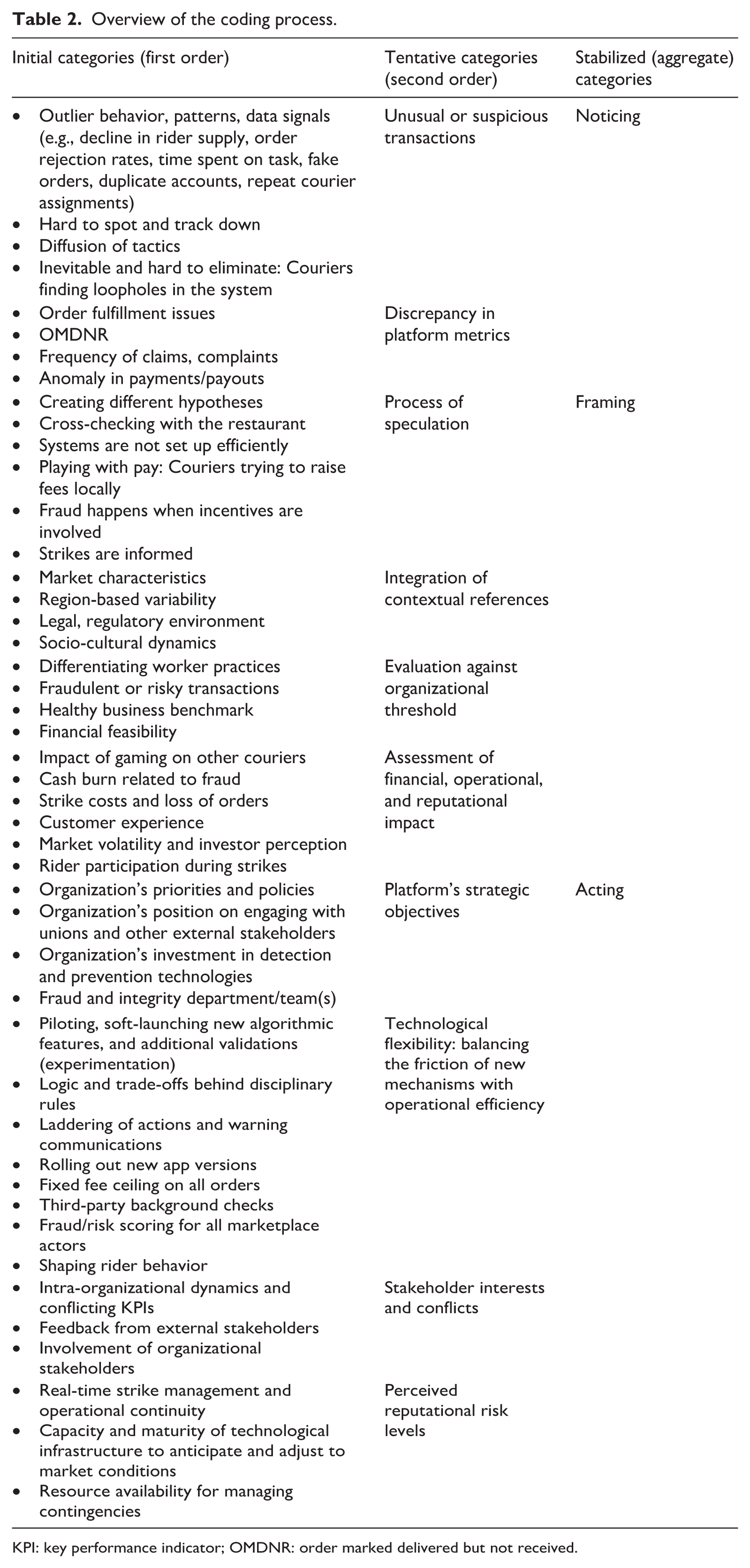
KPI: key performance indicator; OMDNR: order marked delivered but not received.
Findings
Noticing
Noticing refers to becoming aware of workers’ algoactivism. Our findings highlight that due to the sheer scale of operations, platform managers face significant challenges in isolating non-compliant or unusual transactions involving workers (or couriers, terms used interchangeably). Identifying and pinpointing irregular worker activities become a complex task, as they are easily obscured by the high transaction flow, and the subtlety with which some workers may undertake these variable acts. All platform managers expressed this concern and shared that the discovery of algoactivist acts often happens “by chance” (Resp 14), or “luck” (Resp 17), as “it is really difficult to see . . . the issue in one or two weeks” (Resp 13), suggesting a temporal lag in identification. Furthermore, as workers interact with the platform using the app’s algorithmic interface, managers rely heavily on data signals to identify anomalies in worker activity, such as a courier completing an unusually high number of orders within a short time frame. While repeated instances of such transactions may subsequently raise suspicion, as one platform manager describes, “there’s this really weird . . . thing happening in the data” (Resp 14); it also reflects that they often struggle to discern the precise methods employed by the couriers, which could have led to an atypical outcome.
Other cues shared by managers relate to anomalies in payments made by the DLP to a courier, which they are unable to justify or explain based on the courier’s transactions on the platform, or even from repeated claims raised by different customers against a particular courier. Sometimes, managers have discovered specific acts when the entire courier network within a particular market began to employ the same tactic at scale, where such collective adoption produced broader network trends that showed up in the DLPs’ performance metrics.
Challenges related to noticing algoactivism were often intensified when managers had to deal with the diversity and the constantly evolving nature of worker acts, which also made it hard to contain them. As one manager shared, “I think it’s constantly changing because as soon as . . . we identify and stop one thing . . . another door will open up . . . they just get more creative” (Resp 10). For instance, couriers might leverage their experiential understanding of how the DLP’s algorithm dynamically calculates fees, leading to a practice where they reject task offers in the hope that the system will automatically amend and provide a higher fee. Other times, they may collude with a restaurant to create fake orders on the platform—a practice since cracked down on by the DLP: Back then . . . if a restaurant . . . had already prepared the food and if the customer cancelled the order, then [the platform] was legally bound to pay these merchants . . . because the food had been prepared . . . Delivery partners [pretending to be a customer] used to place an order through the restaurant and then after they collected the order, the customer would cancel the order . . . From the restaurant side, it was like I had already given the food, so then from the amount that the restaurant used to get, they used to pay something to the delivery partners . . . (Resp 16)
Platform managers identified practices when tasks were being assigned to a handful of couriers repeatedly, which was later attributed to couriers using “duplicate accounts” (Resp 17) to increase earning opportunities, as well as examples where couriers resorted to “spoofing GPS and started getting paid because of that” (Resp 01), or even reverse engineering the app, which as one manager noted, led to a “chicken and an egg problem . . . we patch it or fix it, they hack it ” (Resp 05). Capturing this heterogeneity, we found these practices most prominently stemmed from couriers figuring out “a loophole in the system or rule” (Resp 14). Findings also show other worker acts such as falsely marking an order as delivered, without making the delivery, or even withdrawing their service from the app collectively.
Framing
Framing refers to interpreting and distinguishing the acts of algoactivism. This entailed speculation by platform managers, which began with managers inspecting whether their algorithmic systems were set up efficiently or not. This was followed by developing hypotheses based on initial observations and/or triangulating using various data patterns or signals. For instance, upon encountering an act where workers repeatedly rejected task offers for a revised and increased fee, one manager explained, “there are systems which are not set up efficiently, and people are misutilizing it . . . like not accepting . . . let’s say you reject 100 orders” (Resp 01). Managers noted that frequently, certain algoactivist acts arose when couriers discovered a “bug” in the system by chance, and they exploited this vulnerability.
When encountering worker transactions that could not be explained or attributed to a systemic deficiency, platform managers adopted a more open-ended approach. One manager described their initial thoughts upon encountering a case of fake orders, “maybe it’s a scam restaurant . . . so all three parties are colluding in some way or form to run this . . . which is leading to something fancy [implying the ingenuity behind these acts]” (Resp 04). Rather than taking a definitive stance, the managers’ thought process involved contemplating how different actors within the DLP ecosystem might be interacting in ways that undermine the system’s integrity. They further reflected that instances of collusion typically increased whenever the company introduced incentive schemes or offers to target a specific marketplace actor, “maybe that incentive scheme is someway beneficial to them, which we have not thought about” (Resp 04). Therefore, establishing these connections through speculations was a crucial determinant for framing. Similarly, to ascertain more layered practices around GPS spoofing, where couriers may fix their locations to get allocated, but not necessarily carry out the task in reality, one manager drew upon different data signals to establish the courier’s physical presence at the location. Another manager mentioned that, in a similar case, they would verify with the restaurant whether the courier had personally collected the order for delivery: When the rider accepted [the order], was that rider on Wi-Fi or on normal cellular tower?
2
And looking at the tower strength, looking at the places where he is . . . trying to triangulate that . . . trying to make sure . . . if the rider was still there or not. (Resp 06)
We found that the organizational threshold for these practices and the contextual references to where these DLPs operated played a significant role in managers’ framing of workers’ algoactivism. This was most evident in how managers distinguished between these algoactivist acts as “gaming” (Resp 14), “fraud” (Resp 08), or “industrial relations protest” (Resp 11). For example, one manager acknowledged that some level of gaming is inevitable in any technological system, referring to the organization’s threshold for these acts. Managers recognize how such acts add no value and possibly lead to inefficiencies that detract from the system’s overarching purpose: There’s always gonna be some degree of gaming that is possible . . . but I think you want to design a system that doesn’t reward people for . . . doing things that are not necessarily very efficient . . . you want to have a system . . . where people are taking actions that make sense, that help us and then we reward them with money . . . not necessarily . . . having them run in circles to . . . get extra money or whatever kind of tricks they figure out that they could do. (Resp 14)
When classifying certain acts as fraudulent, one of the managers rationalized, “I mean on average . . . a healthy business would have less than 1% of fraud” (Resp 03), while another manager noted, “fraud happens everywhere, but it happens in different ways across all markets” (Resp 12). While the former statement denotes some degree of organizational tolerance, the latter reflects a key distinction driven by market-based characteristics or regional factors that influence how fraud manifests. For example, in contexts that are cash-intensive or favor cash transactions, one manager recollected experiences around cash-related frauds—“certain amount of cash is collected and then its lost or not given back . . . so cash management and cash related conversations are also a big, big problem” (Resp 04). Ultimately, any deviation from normal transaction behaviors, that is, “any anomaly in payment” (Resp 01), could be construed as acts of fraud. Given the serious implications of the term, one manager also shared their reservations around its usage for classifying these acts, “we’re really careful in our own wordings as well, and we say, ‘potentially fraudulent’” (Resp 13). Another manager emphasized the importance of considering socio-cultural dynamics when referring to these acts as fraud: You need to navigate . . . in which area you’re operating . . . What cultural references are there? . . . How [do] people perceive it? Try and understand that more . . . because it may lead to unnecessary confrontation even when you’re right. (Resp 06)
A clear distinction existed between acts that were seen as gaming or fraud, and those considered worker strikes or protests. The latter, as described by a platform manager, involved “a spontaneous withdrawal of service” (Resp 11). In this regard, managers appeared to share a common understanding that pay was the primary driver of strikes, “people always want more money . . . At end of the day and one of the best ways to get that is to strike” (Resp 10). One manager noted, “strikes are generally planned” (Resp 12) and may not be viewed as “legitimate” within such a dynamic work arrangement if they occur without prior notice, as this could lead the company to assume, “probably the competitor is paying a lot of money; everybody went there” (Resp 01). The likelihood of strikes occurring was also gauged in relation to the legal and regulatory environment in different regions: Largely in the UK, but there are portions here and there, like for example, it will never happen in the Middle East because of the regulations. It’ll never happen in Singapore . . . It’ll never happen in Hong Kong because the regulations are strict, so it can only happen in Europe. (Resp 01)
Finally, when framing algoactivism, managers considered how widespread these acts were and their impact on the company or on other actors. For example, when couriers engage in gaming by “spoofing” location using fake GPS devices, one manager noted how it “creates a bad atmosphere for other riders” (Resp 06), and leads to an uneven playing field, allowing some to bypass the system’s checks and unfairly benefit at the expense of others. Another manager shared, “we take it very seriously when there’s somebody attempting to game the system . . . because we view it that somebody else is losing out on that basis” (Resp 11). This highlights the broader consequences of individual acts on the courier network, and not just the DLP. Conversely, acts that were deemed fraudulent were more directly linked to having a financial impact on the company. For example, “this rider seems to regularly not deliver a product but mark[s] it as delivered. That’s . . . kind of our worst negative outcome basically, because we end up having to refund the customer for the whole order” (Resp 10).
By contrast, worker strikes were noted as having a greater negative impact on customer experience than on the company’s financial performance, since from an operational point, the DLPs’ “ability to fulfil orders goes down” (Resp 15) due to a drastic drop in courier supply. However, one manager shared, “We’ve not really seen in our biggest markets like real massive strike action that’s actually affected significant parts of the volume on the platform” (Resp 10), suggesting how such impact can be contingent on the market size held. Therefore, the impact of strike costs on the company was low: Financially, like I can give you a rough estimate . . . there was a strike before Valentine’s Day. We lost like 13k . . . which is like peanuts . . .from the business point of view. (Resp 01)
Another manager noted that “most of the time, the strikes are organized by smaller groups of riders” (Resp 07), suggesting varying interest and participation levels. While these excerpts highlight experiences of minimal financial and operational disruption during worker strikes, one manager emphasized how strikes could potentially threaten and jeopardize future investments or financial support from investors. This perspective is captured in the following statement from a manager, which reflects concerns around the reputational impact and the potential damage to the organization’s public image caused by worker strikes: Other than reputational risk . . . there’s no effect at all. Mostly, it is directed towards investment, like if I was a rider, I would want to hit a company like [DLP 1] where it hurts the most, right? It is a for-profit business. (Resp 01)
Acting
Acting entails specific initiatives DLPs take aligned with their strategic goals to tackle workers’ algoactivism. Managers consistently referred to their respective organizations’ long-term objectives, operational priorities, and resources. For instance, one manager noted, “if the policy is lenient . . . and if you want to just grow, then you just don’t do anything with this . . . So, it’s not . . . really breaking anything for these companies” (Resp 03). Another shared, Initially in 2015, 2016 . . . we knew a lot of fraud was happening . . . nobody cared about it because we were growing business . . . But after that people became more cognizant about fraud and trying to handle fraud. (Resp 01)
Managers revealed that over the years, their organizations set up a fraud and integrity team, “we’ve got like an entire tech team dedicated to, you know, researching . . . finding identifying, and eliminating fraud because . . . there’s a lot of vectors for attack in the marketplace . . . when you’ve got as many parties involved as we have” (Resp 10). One manager stated, “it’s always cat and mouse, right? [chuckles] . . . It’s always [the workers who] come up with new strategies. You block the strategies; you build machine learning algorithms to block the strategies or rules to plot the strategies . . . they come up with new strategies” (Resp 05). This highlights the demanding and perpetual nature of professed managerial struggles to respond to workers’ algoactivism, which was echoed elsewhere, “only in the last 4 to 5 years probably have these systems . . . become more robust to handle these kind of tactics” (DLP Resp 08).
Managers discussed a range of scalable features, additional rules, and validations that DLPs progressively and iteratively integrated into their systems to manage different acts. For instance, DLP one implemented a fixed fee ceiling 3 on orders to prevent couriers from gaming their algorithmic pricing system through fee increases; “You can’t get offered more than £45.00 . . . there’s a time limit to it as well; if it gets rejected for more than 15 minutes, we tell the customer that . . . there are no riders . . . so it’s a configuration [our organization] set up. It could be different in different cities” (Resp 01). The same DLP introduced a “2-digit code” (Resp 10) as a verification system to confirm the successful handover of deliveries and to constrain couriers from marking food as delivered without fulfilling the task. As a result, there was a significant reduction in such incidents; “Previously, we had like a 2% rate of this . . . and we’ve dropped that down to a tenth of what it was by increasing the number of times the handover code is used” (Resp 10). Other examples include the implementation of facial recognition at regular intervals to verify that couriers were still in charge of their accounts (Resp 10). To address GPS spoofing, updated and “new versions” of the courier app were introduced (Resp 01), with plans to implement a system that required couriers to “scan a QR code” upon arrival to confirm their physical presence at the restaurant location (Resp 11). These examples cumulatively illustrate how DLPs introduce new mechanisms to constrain workers’ algoactivism.
Beyond these constraints, managers also highlighted mechanisms to actively discipline and discourage such acts. These mechanisms typically followed an escalation protocol, as one manager shared, There are various levels—first, you tell [the courier]; “we are informing you that this has happened” [that their action has been noted]; then we give them a warning; after the warning . . . if the corrected behavior is not addressed, then we block them for some time; if the problem persists, then we block them completely. So, there is a laddering that happens. (Resp 04)
Another manager echoed this, stating that “the overall process needs to be vetted by our legal team” (Resp 15). Another example of a disciplinary mechanism is highlighted in the following extract: We created this rule that the moment we get this signal [each time the system detects anomalous worker transactions] . . . let’s say . . . you did something which hampers the growth of the platform or creates a bad experience for a genuine user . . . we’ll block you off for couple of hours . . . [the courier] got that soft warning . . . “you did this and because of that you were not able to get rides for the next couple of hours.” So ultimately, the idea was . . . how do we make the ROI [return on investment] to create fraud negative for them? (Resp 06)
The manager further shared that by integrating this rule with the incentive system for couriers, the DLP witnessed a remarkable reduction in gaming and fraudulent acts, and “it changed the [worker] behavior in the sense that they realized that . . . either they can lose all their incentive by doing a couple of mistakes or, if they stick to it [working as they should], they’ll still get the incentive” (Resp 06). Managers also mentioned implementation of vetting processes, and background measures such as fraud and risk scoring for all actors—couriers, customers, and restaurants/grocers (Resp 10; Resp 06). This helped in assessing and managing the risk levels associated with all participating marketplace actors.
However, introducing every new mechanism, for instance, the implementation of the “2-digit code” involved weighing trade-offs regarding the DLP’s overall network effects, as couriers had to spend additional time obtaining and entering the code into the app. When developing and implementing certain disciplinary mechanisms, managers noted the involvement of external (ex-policemen, special service agents) and internal (organizational) stakeholders: The cross-functional teams sit down to look at . . . how do we tackle that issue. People in that conversation are . . . involved in privacy law . . . involved in employment law. It’s not just the developers. It’s not just the data scientists or the technical side. It’s . . . the policy and public affairs too. Actually . . . the legal [team] is able to say . . . “this is where the guard rail is of what’s allowed.” But we [policy and public affairs] also have a role in saying, “well, this is the guard rail of what we think will be allowed.” So, let’s develop for the future. (Resp 11)
One manager also emphasized the influence of intra-organizational dynamics in the introduction of new mechanisms—“then there’s always this battle with the country heads where . . . if you are working in the fraud side . . . your OKR [objectives and key results] or KPIs [key performance indicators] are actually against their OKR and KPIs because they want growth, and we want the correct . . . the right growth, so there’s always that friction” (Resp 06). Collectively, these findings closely capture key organizational considerations, as well as stakeholder interests that influence algorithmic adjustments or “tweaks” (Resp 13) that DLPs introduce in response to algoactivism.
With regards to strikes, which carry consequences for the DLPs’ reputation and operational continuity, one manager noted, “we have to understand what’s happening because the algorithm can’t fix that . . . no automated system can fix it. Like the riders have decided collectively, or at least some of them, to remove their service for some particular reason” (Resp 11), focusing on the organization’s stance on negotiating with courier representatives, unions, and local city governments. Commenting on the DLP’s position, the manager stated, “Where unions are constructively looking to work with [the platform] to improve the situation for riders . . . we’re open to discussions with them,” and further added, “we’ve matured quite a lot as a company in that regard in the last couple of years” (Resp 11). Another manager highlighted how their company focused on preventing strikes: So, we have a special team for whenever couriers protest. When . . . they’re not okay with the kind of fare that you’re [the platform] providing . . . we take the request . . . and [in] most cases they work as a union, right? And they have a common goal in mind . . . we [the platform] work with them to sort of understand . . . what their needs are and try to find a common ground. (Resp 15)
However, in the event of a strike, and based on the perceived reputational risk, the focus remains on mitigating the strike’s immediate impact. This involves addressing operational disruptions in real-time, ensuring service continuity, thereby safeguarding the DLPs’ reputation and relationships with restaurants and customers. In this regard, a manager shared that their firm’s (DLP 1) technological capabilities had evolved, making them better equipped to handle such disruptions: The algorithms are built for scale. They are built for a scenario where if your order volume goes up significantly . . . you’re able to handle it. If your rider network goes down, you’re able to handle it . . . If more and more people start ordering from McDonald’s, there is a system in place which says, “okay, then move McDonald’s from the platform” because we will not be able to serve those orders. So, there is a fallback mechanism . . . called the circuit breaker. (Resp 12)
Therefore, DLPs also rely on automated configurations like “restaurant selection reduction” (Resp 17) that detect rider supply issues during a strike and dynamically reduce the number of restaurants available to customers. This minimizes the likelihood of a negative customer experience due to delayed or unfulfilled deliveries.
To ensure operational stability, certain DLPs (e.g., DLP 1) enforced a “code freeze,” that is, prohibited technical maintenance or engineering work, such as implementing new code releases or updates during the duration of the strike. These actions carry a risk of causing technical disruptions and service breakdowns, which could be erroneously linked to the strike, or perceived as an outcome of the strike, impacting the brand’s reputation: We [the company] didn’t do any code releases . . . let’s say you do a code release, and something breaks and [the platform] goes down . . . nobody could place their orders . . . The next day, the [news] headline would be like, “riders could like completely destabilize [the platform]” . . . which is not amazing. (Resp 01)
Another manager added that “some algorithms are put on different kind of modes” (Resp 14), suggesting that their company’s reaction to worker strikes tends to be proactive, involving planned adjustments to their algorithmic systems to manage any potential disruptions efficiently and effectively.
Discussion
Workers engage in algoactivist acts to challenge DLPs’ mechanisms of control. In turn, these acts prompt DLPs to reassess and modify their management practices, reflecting the socio-technical foundations of AM, which is both shaped by and shaping workers’ participation (Meijerink and Bondarouk, 2023). Algoactivism is attributed to workers socially constructing AM through sensemaking, which guides their interactions with the algorithm—a perspective well established in the literature (Heiland, 2025; Vasudevan and Chan, 2022). Our study is one of the first that captures the DLPs’ perspective by unpacking their role in this social construction and analyzing how they react to workers’ algoactivist acts.
Our first contribution is to reveal that DLPs, like workers, rely on sensemaking given the often uncertain and equivocal nature of algoactivism (Weick, 1995). We frame that DLP reactions unfold across three stages—noticing, framing, and acting—thereby illuminating how workers’ algoactivist acts trigger organizational sensemaking and its central role in the (re)design of AM practices (Meijerink and Bondarouk, 2023). We explicitly situate sensemaking (Weick, 1995) within the duality of AM conceptualization (Meijerink and Bondarouk, 2023), suggesting that the process of sensemaking by both workers and organizational (DLP) managers alike, facilitates engagement with AM’s interpretive flexibility and drives its recursive development. Within this, we identify critical determinants associated with each stage, enabling a deeper understanding of the variability in DLP reactions toward these algoactivist acts (see Table 3). Notably, we found temporal interdependence across stages, characterized by delays in identification, speculation processes, organizations’ growth path, and the gradual roll-out of adaptation mechanisms, revealing that DLPs’ reactions are rarely instantaneous.
Platform reactions to algoactivism: A sensemaking process.


OMDNR: order marked delivered but not received.
Beginning with the noticing stage, we found that managers encountered significant difficulties in detecting workers’ algoactivist acts, given the involvement of multiple actors in the food/grocery delivery workflow and the volume of data generated from transactions. They typically relied on deviations in DLPs’ performance metrics or outlier patterns in the captured data for identifying and isolating atypical courier activity. The framing stage entailed managers speculating and arriving at probabilistic interpretations of how these workers’ acts interfered with and impacted the DLPs’ AM. This also involved DLPs classifying acts as either gaming, fraud, or industrial action, based on their accumulated experiences and thresholds for such acts, the operating multi-actor environment, as well as contextual references rooted in the local and institutional setting (Meijerink et al., 2021). Finally, the acting stage revealed that the DLPs’ strategies, priorities, and resources fundamentally influenced how they chose to address worker acts, leading to some algoactivist acts being prioritized for intervention, with others overlooked. We gathered that DLPs have, over time, equipped themselves with specialized teams to assess and manage algoactivism. They have invested in advancing their technological capabilities, which involved building sophisticated self-preservation mechanisms to maintain operational continuity and safeguard against potential disruptions arising from different algoactivist acts.
Focusing on the different mechanisms (i.e., additional validations, rules, and measures) that DLPs dynamically introduced to address or mitigate the impact of worker acts, offered insight into organizational logics and trade-offs. These were shaped by managerial interpretations of organizational policies and directives but also customer and supplier needs and constraints within the multi-actor platform environment (Meijerink et al., 2021). Managers referred to physical touchpoints shared by workers and other marketplace actors as key sites for collusion, which made it more difficult to attribute and contain certain acts. Consequently, certain mechanisms were devised with a dual purpose of limiting undesirable or non-compliant worker actions and equally regulating workers’ interactions with customers and suppliers. This suggested that managers, like workers, engaged similarly with AM’s interpretive flexibility when making sense of algorithmic outputs arising from workers’ actions, considering plausible causes and explanations, and deciding whether to enable or constrain such uses.
These interpretations manifested in the design of new and/or the recalibration of existing algorithmic mechanisms (Orlikowski, 1992), where managers alluded to a constant cycle of adaptation and counteradaptation. As DLPs implemented measures to tackle problematic algoactivist acts, workers responded by devising new acts of circumvention, creating a “cat and mouse” dynamic. This highlights the tension between control and agency, where the DLP attempts to shape worker behavior through AM, while workers find newer ways to circumvent, manipulate, or resist (Meijerink and Bondarouk, 2023). More importantly, this dynamic underscores the recursivity of AM (Meijerink and Bondarouk, 2023), whereby competing interpretations from sensemaking processes generate an enduring friction between intended design and actual use (Orlikowski, 1992), causing AM practices to continuously evolve in response to the actions and reactions of both the DLP and workers.
Our second contribution is to identify how DLPs’ reactions differ from traditional organizational responses to worker resistance and activism. While variability exists, worker resistance and activism in traditional employment are now relatively well understood and tend to follow recognizable patterns. Organizational responses have therefore not only formalized over time, alongside evolving conflict management philosophies and detection approaches (Currie et al., 2017; Lewin, 2001), but are also compliant with established employment frameworks. They may be most commonly tied to direct managerial intervention, grievance processes involving optional mediation, disciplinary procedures (e.g., written warnings, suspensions, discharges) involving arbitration if sanctions are challenged, HR interventions in line with organizational directives (e.g., open-door and “speak-up” policies), and bargaining processes for collective concerns (Currie et al., 2017; Greer and Labig, 1987; Griffin et al., 1986; Vardi and Weitz, 2003; Wheeler, 1976). In comparison, we posit that DLPs operate as adaptive socio-technical systems (Pulignano et al., 2024) with the capacity to continuously recalibrate managerial mechanisms, often by algorithmically adjusting organizational constraints.
This embodies a distinctive form of “governance” (Vallas and Schor, 2020) where the rationale, consistency, and timing (cause and effect) (Greer and Labig, 1987) of changes in these organizational constraints are blurred by the DLPs’ experimentation logics, which emerge from ongoing organizational sensemaking. This implies that workers’ algoactivism is not met with one-off organizational responses but with ongoing algorithmic modifications that continually reshape working conditions. These recursive dynamics are not reflected in existing analyses of algorithmic control (Duggan et al., 2023; Kellogg et al., 2020), whereby power asymmetries are perpetually reinforced, with workers often, and inadvertently, becoming producers of their own algorithmic control structures. For example, when couriers collectively rejected orders to trigger surges (fee increases), DLPs responded by implementing fee ceilings that constrained earning potential for all workers. Similarly, GPS spoofing led to more invasive location monitoring even for compliant workers. This demonstrates how certain acts may trigger system-wide constraints. In this sense, the recursive development of AM could reduce interpretive flexibility and compress worker agency over time (Doherty et al., 2006) (see Figure 1).

Mutual shaping of AM.
Recursive dynamics, therefore, expose the limits of algoactivism, an aspect that has received limited attention in the literature. Research has largely focused on workers’ accounts of success and their ingenuity in devising algoactivist acts (Anwar and Graham, 2020), including the emancipatory benefits and opportunities for self-care these acts may offer (McDaid et al., 2023). Seldom questioned is whether such acts enable workers to exert influence that leads to lasting improvements in working conditions, rather than temporary concessions. This study offers two noteworthy observations on this matter by demonstrating how platform governance (cf. Vallas and Schor, 2020) can absorb and has the potential to adapt to workers’ algoactivism by leveraging these acts as a recursive input for the systems’ evolution rather than treating them as a breakdown of labor-management dynamics.
First, echoing Joyce and Stuart (2021: 177) who suggest that “platform management is not overthrown, but neither does it run without frictions caused by workers’ deliberate actions,” we note that workers’ algoactivism linked to experimental stress-testing of AM may generate “hidden” value for DLPs. This arises because the gaps workers exploit are also those that are subsequently identified and closed by the DLPs by refining their AM practices. In this regard, analyses of platform work that privilege algorithmic control alone fail to account for the co-constitutive dynamics of control and agency, which shape the continuous evolution of AM (Joyce and Stuart, 2021). While the resultant recursive dynamics mean that algoactivism, rather than being emancipatory (McDaid et al., 2023), often functions as an unwitting form of free labor for DLPs, where workers effectively test and debug the AM systems that govern them. Arguably, this marks a fundamental shift in how worker resistance and activism are organizationally perceived and processed in platform work settings, particularly in how algoactivism reflects workers’ informal involvement in shaping AM practices and their contribution to organizational innovation (Courpasson et al., 2012).
Second, we contemplate that outcomes for workers are conditional, alluding to the effectiveness of workers’ algoactivism. It may result in genuine improvements for workers or, alternatively, trigger tighter controls, depending on DLPs’ approach, responsiveness, and the visibility of worker actions. For instance, when workers make a public declaration of strike action, DLPs—although not bound by employment relations frameworks or laws (yet)—may sometimes choose to engage in dialogue or selectively concede to worker demands to safeguard longer-term objectives (Joyce and Stuart, 2021). Whereas any attempts by workers to “game” the system, or their engagement in acts that are deemed “fraudulent” and potentially disrupt the DLPs’ performance or ability to fulfill orders, might be more than often met with countermeasures that affect all. These likely asymmetric outcomes for workers enable us to further refine and enrich Meijerink and Bondarouk’s (2023) conceptualization of the duality of AM through a more nuanced understanding of “mutual shaping” of work algorithms and AM (Jarrahi et al., 2021).
Practical implications
Algoactivism by platform workers reveals their capacity to affect work conditions in the short term, demonstrating notable agency, but within the constraints imposed by the DLPs’ AM. However, given how these acts are unevenly executed and often speculative, they can inadvertently and temporarily introduce new or reinforce existing inequalities, disadvantaging workers who might not be engaging in such acts—an outcome also highlighted in manager accounts. Therefore, workers may benefit from recognizing the unintended consequences of certain algoactivist acts, while considering how they could impact their collective power to influence long-term structural conditions. Workers may need to weigh whether covert, individual acts better serve their long-term interests, as these can evade detection for longer but offer limited collective benefit. Alternatively, they may consider collective action, such as strikes, consequences of which, while financially negligible for DLPs, may be more effective in securing dialogue and concessions as our study shows, than individual acts which tend to trigger system-wide constraints affecting all workers.
We also note that DLPs’ capacity to absorb and recalibrate their AM in response to workers’ algoactivism in a variable manner carries significant legal and regulatory implications. Given the evolutionary character of AM, a need for appropriate oversight emerges from our findings. While regional bodies such as the European Union have been experimenting with regulatory instruments by setting guidelines (Council of the European Union, 2024), these efforts might need to be extended given the transnational presence of some DLPs. This could mean developing a set of internationally harmonized “auditable” standards that establish the baselines for transparency, accountability, and fairness, which mandate DLPs to undergo regular audits to ensure compliance (Susskind and Susskind, 2022). This may also require suitably qualified and resourced audit firms/bodies with the technical, legal, and ethical capacity to evaluate complex algorithmic systems.
This study equally carries important implications for management practices in the digital landscape of work. Foremost, DLPs need to recognize the role of workers’ algoactivism in driving organizational innovation. Such awareness could encourage DLPs to voluntarily employ a more participatory governance approach when it comes to optimizing their AM systems. We highlight organizational benefits in terms of cost savings and resources that DLPs allocate to manage algoactivism and infer that there is significant potential for these platforms to deepen their engagement with worker voices and constructively leverage worker experiences to evolve their algorithmic practices in a way that fosters sustainable and inclusive organizational growth and mutually beneficial outcomes.
Limitations and future research
We conclude by discussing the limitations of this study and noting future research directions that could advance our work. This paper is among the very few empirical studies to investigate the DLP perspective. Given the challenge of accessing this underrepresented stakeholder due to the proprietary nature of their work, we were pragmatic in our approach and used a convenience-based, purposeful sampling strategy (Patton, 2015). Although we acknowledge the potential limitations of this sampling method, including the risk of response bias from relying solely on interviews as our data source, we observed notable convergences in DLP experiences and approaches that offer credibility to our study findings, while also capturing diverse perspectives from multiple platforms on an organizationally sensitive topic.
Future research could build on our study, adopting a longitudinal case study approach, using different data sources (e.g., company policies and reports, where access is granted) to gain a thorough understanding of “organizational choice” (Pulignano et al., 2024), and how individual DLPs adapt their AM systems and processes in reaction to workers’ algoactivist acts over time. This could provide greater insights into the temporal dynamics of how DLPs notice, frame, and act toward algoactivism. Such an approach would also allow for a more in-depth examination of the recursive nature of AM and its associated outcomes, revealing how DLPs adjust their policies and practices. By examining repeated cycles, we could gain insights into how AM evolves in tandem with organizational strategies, priorities, and resources.
In addition, we recognize that diverse regulatory environments, cultural norms, and market conditions influence how platform managers respond to workers’ algoactivist acts. Future research could design a multi-context case study, providing insights into how DLPs’ AM practices vary across institutional contexts (Meijerink et al., 2021). We recommend the inclusion of worker perspectives for triangulation and comparative designs, which could offer valuable insights by exploring different types of platform work in more depth, identifying common patterns and divergences in how DLPs operate and adapt their AM practices in reaction to workers’ algoactivism across different contexts and sectors.
More broadly, as AM systems mediate managerial sensemaking, organizational scholars could examine how data, metrics, and algorithmic signals shape organizational know-how and decision-making. This calls for greater attention to the socio-technical processes through which algorithms and AM produce organizational realities and redistribute and reconfigure control and accountability. Addressing these dynamics may require engagement with theoretical perspectives and methodological approaches that are capable of capturing these evolving forms of managerial judgment.
Footnotes
Acknowledgements
The authors would like to express their gratitude to the Associate Editor, Yasin Rofcanin, and the three anonymous reviewers for their careful reading of the paper and their constructive critique of the manuscript throughout the peer-review process. Early versions of this work were presented at the Academy of Management Annual Meeting (2025), the Society for the Advancement of Socio-Economics (SASE) Conference (2024), and the Irish Academy of Management Conference (2024 and 2025). We are grateful for the feedback received from these presentations. Open access funding provided by IReL.
Funding
The authors received no financial support for the research, authorship, and/or publication of this article.
AI usage declaration
The authors acknowledge that they have followed Human Relations’ AI policy. No AI was used for preparing the manuscript.
