



Abstract
What might we learn about care and agency by attuning to the sensory dynamics of human-canine care collaborations? While most research on care focuses on humans, this paper extends the relational care work debate by engaging with interspecies care, foregrounding the nuanced relational care agency that entails nonhuman animal–human interdependency. Drawing on relational and interspecies care literature affording agency to nonhuman animals, we studied 13 assistance dog teams to explore how care is co-created between disabled humans and educated, yet vulnerable, animal workers. The empirical material includes ethnographic observations, interviews with human clients, and photographs. Our findings illustrate often invisible, nonverbal aspects of interspecies care, grounded in mutual trust and the aesthetic “reading” of one another, thereby contributing to a more granular understanding of relational care agency. Second, by showing how dogs, long understood through limited human conceptions, “shift” from care receivers to embodying agential care professionals who disrupt power dynamics and human-centered care norms, we nuance the carer–cared-for relationship in OS. Third, we offer novel insights into interspecies care, encompassing a broader range of animal-driven care practices than previous literature recognized. Finally, our study aims to foster more ethical relationships for working animals and humans alike.
Keywords
Introduction
After my 20 years of experience of training assistance dogs as a sighted person, I had grown accustomed to the certainty that when I issued a command, the dog would follow me. However, when I received a guide dog after losing my sight, it was a holistically stopping experience in my life. I realized I had to relinquish control and trust the dog, who would now be responsible for guiding me and caring for me in our everyday encounters. (Guide dog handler, March 18, 2024)
Care is a practice that always involves more than meets the eye (Mumford et al., 2022) and requires training to learn how to perform it well (Tronto, 1993). In the opening vignette, the human (Homo sapiens) reflects on his relationship with his guide dog (Canis familiaris), expressing deep trust in the dog’s care and professionalism due to his visual impairment. Extensive formal education, mutual interdependence, and the ability to perform a wide range of assistive tasks position the guide dog as an active care provider rather than merely a care recipient, taking on significant responsibilities (Warda, 2025, 2026). While care in Organization Studies (OS) is largely understood as a human-driven, relational, and reciprocal practice (Fisher and Tronto, 1990; Tronto, 1993) centered on attending to and caring for the “needs of the particular other we take responsibility” for (Antoni et al., 2023: 645), the interspecies dynamics of such work remain largely underexplored (for exceptions, Coulter, 2016a, 2016b; Cudworth, 2022, 2023; Satama and Huopalainen, 2019; Warda, 2026). These dynamics involve nonhuman animals (hereafter “animals”) who act as both agential care providers and care receivers, yet in ways that diverge from and disrupt human norms of professional care.
As illustrated above, co-dependency and mutual care are evident, with trust needing to be established across the species-boundary, an added challenge for the canine-human care collaboration to function. 1 More broadly, interspecies care often relies on subtle, embodied, and haptic communication, in which language may become secondary, simultaneously revealing distinct positionalities between animals and humans (Donovan, 2016). Beyond this, interspecies care brings to light details and dimensions less visible in human-to-human care, including the finely tuned “reading” of a radically different other, and inherent power asymmetries, which are foregrounded in these relationships (Taylor, 2017). We argue that these dimensions not only encourage greater appreciation of the often-marginalized care work provided by animal workers but also shed important new light on human-to-human care practices in OS. They do so by nuancing the care relationship and foregrounding the significance of aesthetics, understood here as knowledge created through the senses (Huopalainen et al., 2026), and the negotiation of relational, embodied agency (Noland, 2009) within it.
In interspecies care work, such as that performed by assistance dogs, animals engage in mandated tasks 2 assigned by humans to mitigate one or more of a human’s disabilities, requiring extensive education and behavioral assessment (Warda, 2025, 2026). Additionally, animals may engage in voluntary care work, such as providing companionship, proximity, emotional support, and bonding in multispecies homes (Coulter, 2016a, 2016b; Cudworth, 2023), which involves varying degrees of agency and enjoyment. Yet in anthropocentric societies and OS theories, care is typically assumed to rest on human-centric ontological grounds (Tronto, 1993), or to emerge exclusively from human-to-human action (Antoni et al., 2023; Mumford et al., 2022). This overlooks how care arises through aesthetic, material, and interspecies dynamics, where animals can provide care in ways that disrupt human conventions or that human-to-human care cannot replicate. Moreover, while Antoni et al. (2023) have recently shown how human care workers juggle and “trick” time, struggling with the need to be available for care, the comprehensive, around-the-clock care work performed by animals in assistance roles, who are constantly available, is largely overlooked. This perhaps reflects a broader dominant tendency in OS to disregard animals as agential care workers and an unwillingness to acknowledge their vital contributions as “work” (compare Blattner et al., 2020; Coulter, 2016a, 2016b).
While the relational care literature aptly demonstrates that care practices are ambiguous, complicated, and situated (Antoni et al., 2023; Caduff, 2019; Molterer et al., 2019; Mumford et al., 2022) and governed by their own ethics and logics (Mol, 2008),the hierarchy often assumed in human-to-human care, between the dichotomy of caregivers and care receivers (Herring, 2020), warrants deeper theoretical and empirical understanding. Interspecies care, we argue, can further nuance this relationship. Recent studies have highlighted the darker sides of interpersonal care, complicating the two-way relationship between the “carer” and the “cared for,” emphasizing its often oppressive (Taylor, 2017) and infantilizing consequences (e.g., Bojovic et al., 2025; Buchter, 2022; Mik-Meyer, 2016). Assistance dogs, as caregivers, act through their own perceptive and relational capacities. Although shaped by meticulous training, they do not act according to human norms or judge vulnerable humans; in so doing, they further challenge and nuance this power-laden dualism. Specifically, dogs’ continuous care and distinct ways of acting shed new light on the more subtle negotiations of agency and autonomy (Tronto, 1993, 2013) that are often overlooked in human-to-human care practices. In so doing, they make visible a more granular understanding of how these dynamics play out in practice and enrich our understanding of relational care work, including its nuanced and veiled practices (Mumford et al., 2022).
To explore how agency and care emerge across species within shifting power-laden 3 relationships, and how dogs care for and communicate with humans in aesthetic, embodied ways (Donovan, 2006; Holland, 2022), we focus on situated canine-human collaborations. Specifically, we examine how care, understood as attentiveness and responsiveness to the “other” (Antoni and Beer, 2024), is co-created within these unequal “humanimal” 4 (work) relationships. Our study is positioned within recent discussions on relational care in OS (Antoni et al., 2023; Mumford et al., 2022; Suquet and Collard, 2024) and the debate on interspecies care (Coulter, 2016a, 2016b; Cudworth, 2022, 2023; Schuurman, 2021). In these reciprocal relationships, both dogs and humans give and receive care, with roles that shift depending on context, as agency is relationally shaped and constrained through embodied gestures and kinesthetic responsiveness (Noland, 2009). Our research question is as follows: how is care and agency negotiated in canine-human work relationships, and what can this teach us about human-to-human care?
To address this question, we empirically studied 13 dogs in assistance roles and their human handlers in the Finnish context. These dogs are educated animal care workers, aesthetically attuned, with significant olfactory abilities, independent decision-making, and responsibilities expected across a wide range of environments (Mouret, 2017; Warda, 2026). Our human study participants all self-identify as disabled and face multiple challenges in their daily lives that require care and dedicated attention to manage. The empirical material, including semi-structured interviews, ethnographic observations, and photographs, analyzed through a species-inclusive aesthetic lens (Huopalainen et al., 2026), provides rich insight into our research problem.
We contribute to the relational care literature in OS in two key ways. First, while existing literature largely centers on discursive understandings of human-to-human care relationships (Antoni et al., 2023; Leontowitsch, 2024; Mumford et al., 2022; Suquet and Collard, 2024), we emphasize the subtle, non-verbal “reading” of the other, theorizing the fine-grained, aesthetic dimensions of relational care. Attending to aesthetics reveals how subtle gestures, touch, and proximity mediate care and agency in situated care relationships. We introduce the notion of relational care agency, which theorizes how humans and animals both care for and are cared for simultaneously.
Second, we extend the relational care discussion by theorizing care performed by animals, centering their agency and recognizing their individual needs. Humans are rarely accustomed to receiving care- or health-related guidance from animals, as it is typically performed by human healthcare professionals. By illustrating animals as intelligent, agential care workers (see also Coulter, 2016a, 2016b), we challenge the anthropocentrism of existing literature, which seldom grants them such agency. Theorizing how dogs move from mere care receivers to professional caregivers nuances the two-way dynamic between “carer” and the “cared for” (Mumford et al., 2022), revealing the surprising ways dogs provide care and challenge human care conventions. While previous research examines agency and power in human-to-human care (Tronto, 1993, 2013), we reveal the more complex dynamics that arise when dogs exercise agency, offering new insights into the negotiation of care and autonomy (Tronto, 2013). We deepen our understanding of relational care agency, crucial for fostering ethically grounded relationships that support both vulnerable animals and humans. Third, we advance the interspecies care debate (Coulter, 2016a, 2016b; Cudworth, 2022, 2023). While Cudworth (2022, 2023) frames dogs’ care work as largely passive waiting, greeting, or “being there” for humans, we show it also includes a broader range of active, dog-driven tasks.
Theoretical location
Relational care work
Care is a multifaceted and ambiguous practice always shaped by power dynamics (Mumford et al., 2022), and the negotiation of agency and autonomy within these relationships (Tronto, 1993). Building on Antoni et al. (2023: 648), we conceptualize care work as a relational, dynamic process that calls “for different and often conflicting temporal orientations on the part of carers and organizers of care.” Our theoretical focus is on relational care, drawing on care ethics (often referred to as relational ethics), which views ethical behavior as enacted through complex caring practices and shared responsibility (Antoni et al., 2023; Caduff, 2019; Mumford et al., 2022; Suquet and Collard, 2024). Rooted in Gilligan’s (1982) feminist ethics of care, this approach holds that we are morally and epistemologically interdependent beings (Held, 2006). Care is linked to intersubjectivity, defined as the “subjectivity that arises from the relationship between one’s own body and the bodies of others” (Pullen and Vachhani 2021: 2), directing our attention to caring for and with others.
The growing discussion on relational care in OS (see, e.g., Antoni et al., 2023; Fotaki et al., 2020; Mumford et al., 2022; Rynes et al., 2012) emphasizes interdependency and interconnection in contextual practices. In line with Mumford et al. (2022: 579), we understand the subject positions of caregiver and care-receiver in care relations as overlapping, changing, and fluid, rather than fixed. Relational care is understood as the complex, necessary, and intimate “labor required to sustain those who are dependent, but also the action needed to sustain the lives of vulnerable others more distant in time, space, and identity” (Adams, 2020: 695). It can also be seen as the process of forming relationships attentive to needs, interests, and the ways we interact with one another (Fotaki et al., 2020). Suquet and Collard (2024) argue for an expanded view of care as a collective, ongoing achievement that emerges not only between caregivers and care recipients but also across diverse actors within social and organizational networks. By foregrounding care as an emergent, negotiated, and sometimes contested process, these scholars together deepen our understanding of care as an ethico-political practice, one fundamentally shaped by time, power dynamics, and the subtleties of human, and non-human, relations.
Similarly, Gherardi and Rodeschini (2016) position care as a co-constituted sociomaterial accomplishment, enacted by and one unfolding through entanglements of humans, non-human materialities, discourses, and technologies through daily tasks (see also Wickström et al., 2025). Bell’s (2025) article on craft entrepreneurship destabilizes humanist ontological privilege by making human bodies more receptive to the unexpected presence of nonhuman others and engaging in caring relationships with them. In other words, care emerges from context-specific everyday material practices, including daily actions, proximity, human and non-human agents, touch, emotional attachment, empathy, nurturance, and labor (see also Coulter 2016a).
Ethicists of care have long underscored the tensions between care as a situated, relational, and processual practice (see, e.g., Lawrence and Maitlis, 2012; Molterer et al., 2019), and the organization of care work within the rigid confines of standardized time structures. Antoni et al. (2023) illustrate this dynamic in their participant study of a French child protection agency, where care workers creatively “trick” time, creating care-specific temporalities that resist linear clock-based time in favor of a continuous, present-oriented mode of engagement. This paradox echoes Tronto’s (1993) claim that the quality of care lies not solely in the actions taken by the caregiver, but in how care is ultimately received.
As Caduff (2019: 787) further notes, “care has always been there, yet somehow it has remained invisible.” While care often unfolds beneath the surface of formal recognition, it is never merely a private or benevolent act. Caduff (2019) highlights how relations of care simultaneously align with and resist dominant conventions. Building on this, Mumford et al. (2022) develop the concept of “veiled care” to emphasize the subtle, power-laden aspects of caregiving that shape how care is experienced and understood. Veiled care reveals the ambiguities and tensions in caregiving, particularly in situations where care meets resistance from care-recipients or where the focus shifts to “non-maleficence”—minimizing harm rather than performing conspicuous or celebrated acts of care. Power relations underpin these dynamics and guide our exploration of how agency is negotiated in interspecies care, revealing its complexity when a non-human agent with significant otherness “troubles” the usual power hierarchy (Clegg, 1989, 1994).
A key challenge in studying interpersonal (human-to-human) care relationships in OS is the oversimplified, often intuitive view of care that is reproduced (Caduff, 2019). Despite its complexity and difficulty, care is often perceived as surprisingly straightforward, intentional, or unambiguously altruistic (Mumford et al., 2022) by scholars who have not fully explored its nuances (Caduff, 2019). While Tronto (1993) and Fisher and Tronto (1990) frame care as an embodied and relational practice rooted in human connectedness, we extend this by exploring the largely overlooked aesthetic nuances and micro-gestures of care in interspecies relationships, focusing on the achievement of relational care agency and how working dogs engage in affective, embodied care work. This shifts the focus toward understanding how subtle bodily interactions and gestures mediate agency and power, and how care relationships are co-constructed in “messy” everyday practices. By exploring the complexities of care in everyday interactions, we engage with Tronto’s (2013) autonomy-agency debate, which critiques autonomy as an individualistic ideal, emphasizes interdependence over independence, and examines the tension between respecting care recipients’ autonomy and recognizing the relational dynamics that shape the practices of care work. Next, we review literature on interspecies care work to theorize its non-verbal and aesthetic dimensions. This helps uncover subtler negotiations of agency, also shedding new light on (human-to-human) care relationships (Tronto, 1993).
Conceptualizing interspecies care work
Given that verbal language is secondary in interspecies relationships, they provide an ideal entry point to “zoom in” on how care relationships are co-created through non-verbal cues, showing how care work unfolds across species boundaries and highlighting mutual dependencies, vulnerabilities, and the complex negotiation of agency in human-canine dynamics. Yet, from a human-centric perspective, animals are often stereotypically viewed as instinct-driven and incapable of independent decision-making or reciprocal care like humans (Noddings, 2013). Consequently, some argue that care ethics should remain focused on human relationships, fearing that including animals might shift attention from human vulnerability and dependency. Given the dominant anthropocentrism in OS care literatures, we build on emerging post-anthropocentric care literature (Cudworth, 2023; Donovan, 2006, 2016; Satama and Huopalainen, 2019; Sayers et al., 2022). Following a feminist ethic of care toward animals (Donovan, 2006; Donovan and Adams, 2007), we consider how animals are often subject to human-led control and exploitation, prompting deeper discussion of interdependent care relations with, for, and by animals. This literature nuances care discussions by emphasizing animals’ agency and (care) work (Cudworth, 2022, 2023), challenging anthropocentric views.
Cudworth (2022) teases out the care work performed by dogs as involving emotional management work, in which dogs manage boredom and anxiety while alone at home, wait and greet, and at times more actively play and jump to mediate relations. Warda (2025, 2026) focuses on working dogs managing their emotions to align with professional expectations. Relational agency, as we view it, is negotiated through embodied interactions and affective attunements between species, at both home and work, acknowledging mutual dependence, vulnerability, and a shared drive for life with individuals of other species (Taylor, 2017).
To gain a deeper understanding of care as an ongoing accomplishment between canines and humans, we problematize human-animal relationality, 5 acknowledge species hierarchies, and scrutinize the often-contradictory ways humans relate to other animals (Charles et al., 2022, Charles and Wolkowitz, 2019). Following Schuurman et al. 2023 (see also Adams, 2020; Schuurman, 2021), we position care in humanimal (work) relationships as “a complex process of relational encounters and communications, interpretations and tacit knowledge of what an animal is at any given moment in any specific space and, finally, an ever-evolving continuum of situational practices.” 6 This entails closely attuning to, listening to, and learning from individual animals within contextual care relations (Donovan, 2006; Donovan and Adams, 2007) by centering their lifeworld, recognizing them as agential, and carefully asking “what are they telling us?.” Meanwhile, focusing on (relatively) privileged animals in assistance roles, though fully dependent on human care, may overlook the most vulnerable aspects of interspecies care. However, much like violence, domination or control, care can be found in all kinds of human-animal relations, including some of the more “unexpected” ones, such as beekeeping (Davies and Sayers, 2023).
Following Taylor (2017: 223), we approach interspecies care work as a practice where “two vulnerable, interdependent beings of different species” learn, awkwardly and imperfectly, to understand each other’s needs and care for each other. As unequal power relations and species hierarchies structure care relations (Sayers et al., 2019), animals become part of the family through acts of care. Assistance dogs are meticulously educated to care for humans both because of their designated working roles and their “natural” inclinations, such as in scent work. As Eason (2020: 135) aptly reminds us in her study on diabetes dogs, “It cannot be said that the medical alert dogs have a choice in being there for those in need”. However, they are there, and they “act autonomously to assist those in need” (Eason, 2020: 135). This suggests that a degree of agency and enjoyment can also be involved in humane, trusting interspecies care work when the individuals, regardless of species, are interested in and suitable for the role (Warda, 2025, 2026).
Finally, in interspecies relations, care enables meaningful coexistence (Schuurman, 2021), and emerges through shifting, mutually attuned roles. Bolman’s (2019) article on traumatized parrots and former soldiers highlights the therapeutic potential of shared care, where both humans and parrots engage in mutual healing or “becoming-well-together.” Although animals can be, and often are, active care providers, the literature rarely explores spaces where they, or vulnerable humans, express agency or negotiate power relations. The perspective we build sensitizes us to the subtle negotiations of relational care agency and the aesthetics of interspecies care, opening an analytical lens that allows us to further theorize the nuances of care as a relational practice shaped by interspecies negotiations, mutual responsiveness, agency, and shifting power dynamics—an area in which this study provides novel theoretical insights.
Methodological considerations
To address our research question, we conducted an exploratory multispecies micro-ethnography including observations of 3 assistance dog teams, 13 semi-structured interviews, and field photographs. Using an aesthetic lens (Huopalainen et al., 2026), we attended to the sensory and non-verbal dimensions of care practices and participant interactions.
Research context
Our study was conducted in Finland, a Nordic welfare state. Focusing on assistance dogs, we briefly describe their training, roles, and mandated and voluntary care work, including that performed by guide dogs (Warda, 2025, 2026) and medical alert assistance dogs (Eason, 2019, 2020). Guide dogs are recognized assistance dogs, “extensively educated to assist a vision-impaired human partner to improve mobility and diminish reliance on human assistance” (Warda, 2026: 15), guiding visually impaired humans “to mitigate the effects of an individual’s disability,” 7 and providing vulnerable humans with a sense of agency, control, and inclusion in society (Jammaers, 2023b). Guide dogs perform what Johnston (2014: 1) refers to as “the most demanding work the human being asks of any animal.” Other assistance dogs, then, work for individuals with disabilities other than blindness or deafness (ADI, 2025). In our study, these dogs are medical alert assistance dogs trained to retrieve objects, alert to medical crises, and provide assistance during such events.
The first group in this study consists of guide dogs. A guide dog in Finland is considered an assistive aid for medical rehabilitation, and vision-impaired individuals most often apply for one through the vision rehabilitation services of their local central public hospital (The Guide Dog School, 2024). Guide dogs are generally bred, raised, and educated by a guide dog school (Warda, 2026: 17), offering “skills and physical abilities to ‘become-with’ their human partner.” Guide dogs are taught a wide range of tasks (Warda, 2025), educated in both basic skills and specific abilities to meet the future client’s needs in a mutually beneficial partnership. In Finland, guide dog training follows a 20-week program (The Guide Dog School, 2024), educating dogs to keep humans safe in stressful environments, follow directional cues (e.g., left, right, turn), stop at crosswalks, find doors, benches, and stairs, and avoid obstacles. Guide dog mobility instructors consider the differences between dogs and clients to match them carefully, ensuring a successful pairing. For example, an active person may be paired with a more energetic dog, while a less active individual may need a calmer, slower-paced dog (Mouret, 2019; Warda, 2026). The guide dog is easily identifiable by their harness, and knows they are working when wearing it (see Supplemental Picture 1). In this way, other people recognize that the working dog should not be disturbed.
The second group consists of medical alert dogs whose main task is to alert to oncoming medical episodes, helping chronically ill humans live safer and mobile (Eason, 2019). These dogs engage in “nose work” for human benefits, utilizing their olfactory abilities to detect and signal oncoming diabetic or seizure episodes for a wide range of disabilities. This is care work that humans are incapable of performing. Medical alert dogs can, for instance, alert to a medical crisis or detect when a person is under- or over-alert (Eason 2019, 2020). As our study participants explained, the dogs are trained to detect physiological changes in a person’s body that may signal an impending medical crisis, such as a seizure, or other emergencies, such as fluctuations in vigilance. The dogs provide individuals with time to react, often 20–30 minutes before onset, before sudden total exhaustion occurs. However, these working dogs are also vulnerable agents on multiple layers, often positioned as animate instruments (Eason, 2019) assisting vulnerable human lives. The complex status of the dogs in our study, as care workers, companions, family members, and, in society, “medical devices” (Eason, 2019), defies neat categorization (Knight and Sang, 2020). For clients, the dogs are both beloved family members and around-the-clock care workers.
Conducting multispecies “micro-ethnography” among assistance dogs in Finland
Dogs and humans provide each other with a “significant otherness” (Skoglund and Redmalm, 2017: 243), which poses methodological challenges in our research. We are reflexive about dogs as care workers dependent on, and often subordinate to, humans in multispecies families. This includes the overall methodological challenge, or impossibility, of grasping the standpoint or lifeworld of the dog, as well as the complexities involved in recognizing this “otherness” in care (Antoni and Beer, 2024) as well as work relations (Coulter, 2016a, 2016b). Thus, our aim is not to claim that we speak from the position of the dog (our empirical material largely consists of interviews with humans) but rather to sensitize OS researchers to the agency of dogs, the aesthetics of the interspecies care relationship, and to develop care work theorizing as an interspecies matter, which our methodological choices fully support.
Multispecies ethnography (Hamilton and Taylor, 2012, 2017; Holland, 2022), which we draw upon, provides a more integrated approach to studying cross-species interactions and analyzing the relationality and co-becoming of animals. Multispecies ethnography “is attuned to life’s emergence within a shifting assemblage of agentive beings” (Ogden et al., 2013: 6), in other words, to how humans co-become with individuals of species through shifting relationships and negotiations of power (Hamilton and Taylor, 2013). Multispecies ethnographers face challenges when attempting to attune to animals and position them as ethnographic subjects; however, this approach also seeks to carefully attune to the animals and grant them agency and voice in research (Hamilton and Taylor, 2012).
We term our methodological approach a “micro”-ethnography (e.g., Alvehus and Crevani, 2022) because it involved shorter, intensive field periods focused on understanding the complexities of care and listening attentively, rather than years-long field immersion (Van Maanen, 2011). This was only possible due to the participants’ vulnerability.
Empirical material of the study
To address our research question, we also conducted 13 semi-structured interviews, carefully considering our roles as interviewers and aiming to make the situations as comfortable as possible for our research participants. As others have noted in vulnerable contexts (Mandalaki, 2025), we sought to avoid any instrumentalization through our behavior, refused the role of a “knowledgeable” researcher, and carefully considered the atmosphere and power dimensions inherent. We acknowledge that interviews are a human-centered method, attuned to teasing out human lived experiences, but they do not help us understand the animal perspective (Table 1).
Empirical material of the study.
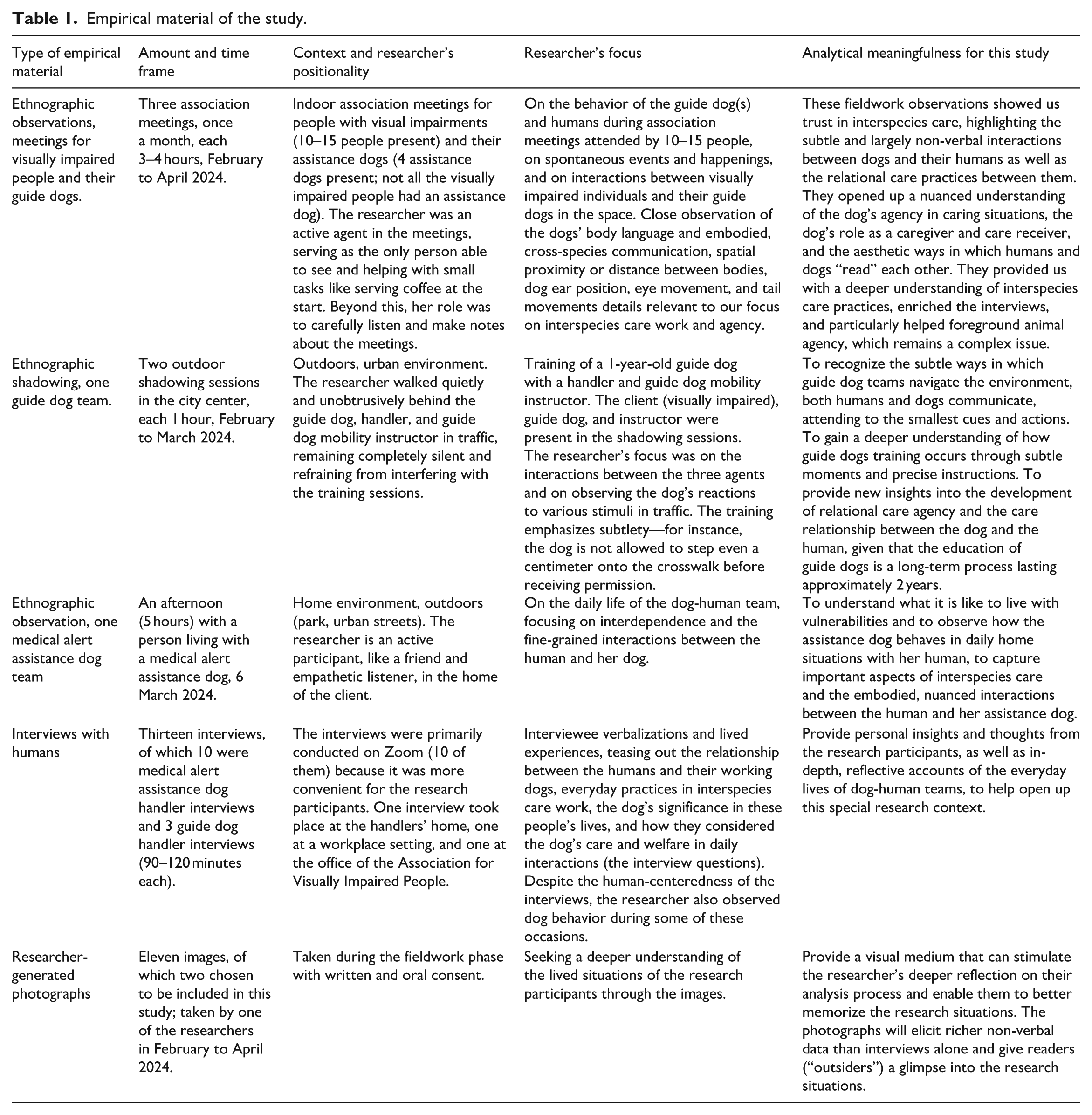
The empirical material includes approximately 20 hours of detailed ethnographic observations of the interactions between three assistance dogs and their human clients in both public and private spaces, as well as observations of one guide dog team in settings such as homes and association meetings where guide dog teams were present. Here, the aesthetic approach (Huopalainen et al., 2026) guided our attunement to the non-verbal, sensory connections between the dogs and their humans. We interpreted the achievement of dog agency through aesthetic and non-verbal cues, acknowledging the challenge of “aesthetic muteness” (Warren, 2008) in the field.
Additionally, the empirical material includes 11 field photographs of social interactions evoking sensations, attunement to the guide dogs’ body postures and behaviors during meetings, as well as the everyday moments of the 3 canine-human teams. All photographs were taken by us with participants’ consent during fieldwork, and two were selected to illustrate the empirical episodes. Photographs helped us gain a more nuanced understanding of the subtle aspects of care work between dogs and humans, yet visual methods cannot do justice to the fullness of lived experience (Shortt and Parsley, 2025; Vannini et al. 2012). Reducing experience to images can serve as a technique of power that risks objectifying the world (Kavanagh, 2014). While aiming to explore the dog’s positionality, we acknowledge that human-taken photographs inevitably fall short of providing an understanding of the animal’s rich lifeworld. However, analyzing this visual material, following methodological guidance provided by Warren (2008) and Shortt and Parsley (2025), allowed us to reflect on the subtle cues like posture, embodied expressions, and reactions to surroundings that reveal deeper layers of the dog’s agency in spatial and material care work. Moreover, the visual material helped us analyze how the working dogs interacted with their environment, including their movements, and relationships (proximity/distance) with humans, other animals, and material elements.
Our aesthetic analysis process
The analysis of the empirical material was conducted in four main stages. In analyzing the empirical material, we adopted an aesthetic-epistemological approach (Strati, 1992) to highlight experiential ways of sensing and attuning to the aesthetics, fine-grained care practices, and relationalities in canine–human companionships. This approach was suitable, as interspecies relationality relies heavily on sensory communication, where aesthetics enables attunement to and interpretation of “the other” (Donovan, 2006, 2016). The first stage involved a “fuller” rewriting of our fieldnotes, either while still in the field or directly after leaving, to produce detailed accounts of the interspecies care practices studied. We also took notes during the interviews and transcribed the interview materials right afterward to enable focused analytical attention to these materials. Regarding observation notes, we attended to aesthetics to tune in, notice with care, and attune to the “whole” of contextual canine-human relations, focusing on gestures, detailed engagements, and on how the affective and sensory manifested in these interdependences. In interspecies relationships, knowledge and care are interconnected: understanding another being fosters care, while care deepens knowledge. Our aim was to closely attune to these interdependences aesthetically, meaning relying on sensory perception and an openness to embodied experience.
Second, we continued with a close, in-depth reading of the transcribed interview materials and the field notes. These field notes emphasized moments in the working dog’s everyday lives and interactions with their humans, highlighting instances that were meaningful from the perspective of interspecies care work. They effectively drew our attention to the interdependencies of care, shifting care roles, and the nuanced capacities of dogs while reading them, suggesting that they provided valuable insights into the subtleties of care work, consistent with our theoretical perspective and commitment to a multispecies ethnographic approach. Third, drawing from the interviews and detailed fieldnotes, we identified recurring themes, such as trusting the other, “reading” the other, care in liminal spaces, giving and receiving care, aesthetic details and embodied gestures in care, comprehensiveness of care, and agency, that felt meaningful and relevant to us after closely reading the empirical material. These themes allowed us to describe key characteristics of interspecies care work while reflecting on them also in relation to agency and autonomy in human-to-human care. After highlighting the most compelling themes through interview quotes and empirical descriptions informed by our analytical lens, shared interpretation, and thematic grouping, we combined these descriptions and interpretations to identify the key perspectives on interspecies care work that emerged from the research. This formed the initial “sketch” of three main findings relating to negotiations of agency and power: trust-building, the liminal spaces in the lives of dog-human pairs and care collaborations, and the balance between caring and being cared for. These dimensions surfaced in various ways in the empirical material, revealing how agency and power are not fixed attributes but relationally and bodily negotiated within dog–human partnerships.
The final three analytical dimensions, including trust as the foundation, “reading” the other, and the comprehensiveness of care, and dog agency in interspecies care work, detailed in the “Findings: Achieving relational care agency in interspecies care work” section, emerged through the fourth analytical stage. This involved another deep, iterative re-engagement with our empirical material and theory, staying close to our empirical material while deepening analysis. At this stage, we continuously went “back and forth” between our empirical material and state-of-the-art literature on relational care work and interspecies care in OS. Additionally, the reviewers’ comments played a crucial role in refining, deepening, and expanding our analysis, ultimately contributing to the development of these three dimensions and the theoretical contributions we teased out based on them. Taken together, throughout the research process, we prioritized listening to and respecting all our research subjects’ voices in a dialogical manner, with knowledge generated as relational and always incomplete, shaped by ongoing encounters with the unique life stories and agencies of both working dogs and their humans.
Research ethics
Our empirical material is part of a larger study on human-canine collaboration in care, health, and wellbeing, approved by two University Research Ethics Committees for animal and human research. We acknowledge the continuous ethical considerations involved in our study, as both animal and human participants require researcher sensitivity, attunement and empathy, and reflexivity to avoid benevolent discrimination (Mandalaki, 2025). The relational nature of care compelled us to be responsive to participants’ needs and collaborate with them (Haraway, 2008). For humans, obtaining informed consent involved careful communication about the study. Gaining consent from animals is more complex, as they cannot verbally agree to participate. Researchers must appeal to them, prioritize their welfare, and carefully monitor the smallest signs of stress or discomfort to prevent harm or mistreatment. We approached not only humans but also dogs as subjects to whom we carefully attuned: “We must recognize ‘that the ‘other’ has a ‘nature’ of her own that needs to be respected and with which one must enter into conversation” (Rosemary Radford Ruether, 1975, in Donovan, 2016: 324). We draw on Donovan’s (2016) care ethics to ethically listen to individuals of other species, emphasizing receptivity grounded in genuine respect and engagement with others. Research, for us, is not about fully understanding the other but about attuning to and being affected by their presence and difference, thereby allowing their agencies and stories to shape our understanding.
Finally, we recognize our able-bodied privilege in the field. In the fragile research setting, care enabled partners to respond and attune to one another ethically. As Rhodes and Carlsen (2018: 1295) note, “self-reflexivity becomes rendered subservient to other-vulnerability in embodied research encounters that are open and generous.” At the research site, fragility and vulnerability were sensed through interactions among dog, human, and researcher, as trust needed to be established. With these reflections in mind, we present the findings based on our analysis of three interrelated aspects of the empirical material.
Findings: Achieving relational care agency in interspecies care work
Our findings reveal three interrelated aspects of interspecies care work that contribute to the achievement of agency for both working dogs and vulnerable humans. First, we outline the nuanced characteristics of interspecies care work, with mutual trust as its foundation, foregrounding the interdependent relational care agency of both parties. Second, we examine how this care unfolds beyond verbal language, through the continuous and careful aesthetic “reading” of each other, subtle gestures, and relational sensitivity between dog and human. This also reflects the comprehensive nature of interspecies care occurring around the clock and rooted in dogs’ and humans’ shared capacity to care for one another through delicate gestures and expressions. Third, we describe how dog agency emerges in interspecies care and shed light on moments when dogs can even “trick” humans and disrupt power dynamics, troubling the traditional one-way care relationship.
Trust as the foundation for interspecies care work
Many of our study participants described how difficult it was, at first, to learn to trust the dog as a distinct persona capable of providing them with care and support. This was difficult for multiple reasons, and being in a vulnerable position, on the “receiving” side of care to begin with, most likely highlighted this experience. First, some had never had a companion animal before their disability. Lacking prior experience of such companionship, playing with a dog, and learning to aesthetically “read” a dog could be challenging, let alone adapting to the idea that the dog, a living being, not a device, performs the role of caregiver in their daily life, as one participant reflected: Because, if you think about it, when a person becomes visually impaired and at some point, gets a guide dog, a guide dog really isn’t an obvious assistive device. Many of those people have never had any pet in their lives. And then they are given a living creature as an assistive device. Just imagine the amount of questions and all sorts of things that person has about it . . .
The transition from a halted, vulnerable experience to gradually working and living in a partnership with a guide dog raises countless questions and uncertainties about trusting and living well in partnership with a sentient being of a different species, rather than receiving support from conventional assistive devices. Here, visual impairment initially entails a loss of autonomy and an increased need for assistance. However, by learning to trust a guide dog in a team and by granting the dog agency and the autonomy to make decisions, a person can regain autonomy through partnership and interdependence with the dog, including the ability to navigate society together (Warda, 2026). Yet the assistance dog is not a “pet” or a “device,” although legally framed in the latter term, which risks rendering animals passive and solely human-controlled. Complexity arises when a human is matched with, and becomes dependent on, a guide dog for care and assistance, also introducing an ethical tension: someone vulnerable, immobile, and potentially inexperienced with dogs becomes responsible for the animal worker’s care and well-being. This relates to Warda’s (2025) observation that a guide dog must indeed be the right choice for a vulnerable human, who, despite their disability, must be able not only to care for themselves but also for the animal worker.
Study participants described their involvement in educating their guide dog, which is a common practice, as a gradual learning process in which mutual trust is built over time, largely through non-verbal but also verbal interactions, and mutual embodied interpretation. This process required both time and patience, as it involves two different personalities of different species, creating an additional level of complexity, learning to understand, get to know, and trust each other. Such subtle, gradual development of trust was seen as essential for effective and safe collaboration, allowing the dog to develop into a trusted caregiver, even a mentor, as one participant expressed. While mutuality and precise movement exemplify “a well-orchestrated interspecies partnership” (Warda, 2026: 1), the human might still retain greater power and control, as reflected below in the saying that dogs must “accept” the handler as their new “mistress” or “master”: It is that this trust then gradually builds. The more we go on those walks together, the more any challenges or mistakes can be corrected. And then, each time, you can trust the dog more and more, knowing that it (sic) won’t lead me off in a completely different direction. I reached this point feeling that, okay, now I could just as well walk with the dog with my eyes closed and not be afraid of crossing the street without stopping or stepping into traffic. And of course, from the dog’s side, it also takes time for them to somehow accept the handler as their new mistress or master of the house. (Guide dog handler, May 23, 2024)
As depicted above, trust is crucial in training guide dogs to lead their humans safely in society and, in the case of medical alert assistance dogs, to provide accurate cues and care before health changes are noticed. Here, trust connects to how power dynamics are both built and deconstructed in this extract. At first, the human appears to hold all the power, being the “master” or “mistress of the house” (terms we use here with some caution). Through growing trust, the human gradually grants more agency and power to the dog, challenging the anthropocentric, power-laden, and stereotypical “master-servant” relationship. In these moments, the human gradually learns to trust and accept the dog as a knowledgeable agent, sometimes more aware than the human of their own health and becomes willing to submit to this reciprocal relationship. Yet a key challenge for humans was learning to trust the dog to perform care work “correctly,” trusting the dog as the primary caregiver, for example, capable of alerting to a medical issue well before it came to human notice: And a certain relinquishing or relaxing of control. I have to trust the dog. She knows. In the beginning, when I was training her, I often wondered if that’s it, if she was alerting to my agony correctly. It took me a long time to trust her to the point where she starts to indicate the discomfort hours before I can feel any symptoms of it. (Medical alert assistance dog team, human partner, March 6, 2024) It’s not that simple because I can get too involved in analyzing what’s going on. If you think of a dog sport, such as agility, you are always analyzing and improving your performance with your dog. Now I go on the dog’s terms, lean on her, and listen to her. I need to give leeway to my dog. That’s something I had to learn. (Medical alert assistance dog team, human partner, March 6, 2024)
Above, the human describes how training and living with a medical alert dog require relinquishing human-led control and trusting the dog’s sensory expertise as a caregiver, giving leeway, and aesthetically attuning to the dog’s needs, and vice versa. Having begun to “go on the dog’s terms” indicates deep trust and care for the dog’s perspective and wellbeing within this team. The dog manages the human’s wellbeing, while the human must learn to respond to the dog’s smallest cues and take responsibility of the dog’s care. This shift illustrates how interspecies care becomes a dynamic form of human-mandated work, where the dog is recognized as a trusted, serious care worker, even a kind of health “professional” (Eason, 2019), whose abilities the human must rely on. Another participant with a medical alert assistance dog reflected on this care relationship, where she learned to trust the dog to carefully monitor her well-being: In the first few days at home, I started leaving Charlie at home if I was going to do something I knew would make my body hurt. But then I realized, okay, now I’m actually going home, and the dog goes into alert mode, like an alarm—how do I handle this? So I’ve spent a lot of time thinking that, okay, I need to start listening to my body more, because of the dog. It’s kind of easier for me that way. I mean, normally you can push yourself to your limits more easily. But now that I’m also responsible for my coworker, it somehow makes me more compassionate toward myself.
The imperative to “trust the dog” as a coworker embodies a relational approach that encourages humans to adopt the dog’s perspective during episodes of illness and to adjust fluidly to shared signals. Trust underpins interspecies care, as the human relies on the dog’s sensory expertise to monitor her health, and in turn adapts her own behavior and listens to her body in response to the dog’s alerts. Another participant described how, when the dog signals and stares intently, they must again trust the dog and immediately take a rest. If ignored, as sometimes happened despite the dog’s efforts, the dog “would become confused for the rest of the day,” the human explained. In this care relationship, the human genuinely learns to trust, listen to, and even “obey” the caregiving dog, who takes control of managing their health. This highlights the relational nature of care agency between dogs and humans, where trust functions as a reciprocal form of interspecies care: trusting the dog is itself a form of caring for the dog. If the human ignores the dog’s signals, the dog’s confusion reveals that the relational care agency has been disrupted. Thus, interspecies care work emerges as a co-created and negotiated practice, rooted in attentiveness, responsiveness, and mutual trust. Finally, a human describes the process of getting a dog as a learning journey, where the dog’s ability to learn to trust humans was pivotal for their (work) relationship to function: I got a call saying, “Hey, we have a dog here that has passed the assistance dog test, would you like to have him?” I said yes. We went to the place to look at him. The dog was completely subdued; the previous owner had treated him badly. It took six months for me and my wife to completely dismantle the training and then to rebuild the things we wanted to do with him. The most important thing in those six months was that he just learned to trust us. (Medical alert assistance dog team, human partner, January 26, 2024)
The quote above exemplifies the cruelty of humans exploiting animals for their benefit, violating the dog’s trust, and showing how easily a dog can become a commodity to be exchanged, as also seen in the casual question, “would you like to have him?.” The dog was initially given to someone who failed to care for him but was later rehomed and trained by new people, making care a reciprocal process. The dog’s trust in humans had to be rebuilt before he could care for them, showing that interspecies trust requires both human reliance on the dog’s abilities and, importantly, the dog’s sense of safety and trust sufficient to invest in the mutual relationship. At the same time, tensions can emerge between emotional attachment, care, and using the dog for personal needs. The human rescued and cared for the dog while also training him to meet specific requirements. Even when the human acknowledges the dog’s agency and expertise, the dog’s perspective, whether they truly want to perform this work, whether the task interests and suits them (Warda, 2025), or whether they can manage the temporal demands of care (Antoni et al., 2023), may receive limited attention. This raises ethical questions about the dog’s agency and interpreting the dog’s interest and willingness in care, medical alert, or assistance roles.
Reading each other: Aesthetic nuances and comprehensiveness of interspecies care
As Caduff (2019) notes, care can act as the “preferred painkiller” of precarity, flowing through “the sparest of signs and gestures.” This section focuses on the aesthetic nuances and the comprehensive nature of interspecies care that disrupts clock time (Antoni et al., 2023), grounded in dogs’ and humans’ mutual capacity to read each other through aesthetic cues—smallest gestures, expressions, and subtle bodily signs. During the interview, Nora notices the dog settled at the human’s feet, seemingly following the conversation. The human explains that the dog has learned a wide verbal vocabulary and constantly interprets her gestures and facial expressions in caring for her: I think she has very developed gesture reading and a very large vocabulary. It’s an important part of our everyday life. I feel that there is a constant subtle communication between us. And I’ve had to reflect during this dog training on how much my own certain expressions and gestures affect me when I’m in intense discomfort. So that they don’t act as triggers for the dog. The whole thing is based on smell, so I have to be careful about that. (Medical alert assistance dog team, human partner, March 6, 2024)
The life of a human with chronic illness or disability is extreme in the sense that discomfort never subsides and remains a profound affective presence in their daily life. Above, care is described to rely on the dog’s highly developed capacity to “read” the human through aesthetic cues. Interestingly, the human needs to monitor her illness and constantly read her dog in a way that doesn’t require the dog to be overly attentive to her condition, so that the dog doesn’t have to be in a constant alert mode, burdened by continuous caregiving. Assistance dogs constantly “read” their human partners, interpreting subtle bodily cues, anticipating needs, and responding accordingly, demonstrating the aesthetic nuances and physical proximity of interspecies care, as described below: I always have those wool socks at home. When I came home yesterday, I wandered around the house wondering where I had put my socks again. Then I sat on the sofa, and he [the dog] came to sit next to me. He dropped the socks in my hand and said, “Here they are; this is what you were looking for just now.” Even though I didn’t even mention the wool socks, he still thought, “Hey, here are your socks; you’ll be looking for these soon.” (Guide dog handler, March 18, 2024) She wants us to already have some kind of physical contact. And she also has this kind of “weighted blanket” function. She likes to climb right on top of me so that she puts her front paws right up here (demonstrates with her hands on the chest) and then leans her head against my chest. It’s usually this kind of symbiosis, where ideally it has to be that way, that we are a duo, and it’s hard to say where the human begins and the dog ends. (Guide dog handler, May 23, 2024) When my feet are really sore, she comes and warms them up. Just stroking her soft fur will take my mind off the discomfort and makes me feel better. (Medical alert assistance dog team, human partner, March 6, 2024)
Above, the dog’s aesthetic and agential ability to aesthetically “read” humans are exemplified, where the dog’s care can even appear momentarily free of coercion or learned habits, where the dog spontaneously exhibits warm care behaviors that benefit and comfort the human. Above, we also see how the material embodiment of the dog disrupts human forms of professional care or distance in the care relationship, for example, by climbing on top of the human, resulting in an intertwined co-becoming of “humanimal” in a posthuman sense.
In the dog-human teams described in this study, dogs seemed attuned to the immediacy and fluidity of care-time rather than fixed routines (compare Antoni et al., 2023), making their care comprehensive and, in some instances, occurring around the clock. This dynamic reveals the tension between the able-bodied dog and the disabled human in navigating their 24/7, two-way care relationship. Another episode illustrating this comprehensiveness and fluidity of care (time) shows the dog trained to wake the human during a medical episode, even at night. Here, the line between voluntary and mandated care work is blurred, as the dog appears to perform the role willingly despite being officially trained and assigned to it: He’s a very resilient dog. Even if I’m completely asleep and try to push him away, he won’t stop alerting until he sees that I’ve taken my medication. (Medical alert assistance dog team, human partner, February 16, 2024)
Another human describes feeling “not enough” as a disabled person, while the dog by her side is constantly caring and working for her. The dog’s comprehensive care and persistent work ethic in contrast with the human’s feeling of inadequacy and vulnerability, are unable to provide the dog with all the experiences they desire due to their disability. The human describes: He gives me everything all the time. I feel bad that I can’t even throw him the ball. (Medical alert assistance dog team, human partner, February 13, 2024)
Care circulates unevenly yet reciprocally, challenging normative ideas of dependence and ability. The dog’s active role in providing support reconfigures traditional hierarchies of care, illustrating how agency and vulnerability coexist within the interspecies companionship: If I go upstairs, he’ll follow me up in a moment. When I go downstairs, he follows me then as well. When I take a nap, both of our dogs sleep on top of me or by my side. Atlas has become so attached to me . . . and he constantly watches to see how I am doing. We brought in the other dog mainly to help relieve his stress. (Medical alert assistance dog team, human partner, February 13, 2024)
Above, we get another glimpse of the dog’s physical and comprehensive care, following the human up and down stairs, staying close during naps, and monitoring her well-being. The human interprets this as a sign of strong attachment. This constant presence demonstrates the dog’s comprehensive engagement in care, which can create stress for the dog, necessitating the introduction of a second dog to provide stress relief. We cannot be certain whether the dog follows the human out of genuine inclination or if his behavior is merely a result of consistent training. However, the dog has been conditioned and educated over the years for demanding work, requiring him to remain closely attuned to monitor and aesthetically “read” human health, regardless of his own desires. This highlights the often-overlooked reality of a medical detection dog’s perpetual care work, an aspect that even the dog’s closest human may not always recognize or reflect upon. Given that there is no way of knowing when an episode will require an alert, the detection dog is always on duty, providing unwavering care and support, while vulnerable humans may struggle with a sense of inadequacy, unable to offer the same level of comprehensive care—24 hours a day, 7 days a week.
Dogs help vulnerable humans create a peaceful space amid everyday life, with care that is continuous, multifaceted, and integrated into the human’s daily routines. Calming down can be a challenge, yet slowing the pace of “clock time” becomes a relational act of care (Antoni et al., 2023) and a way of exercising agency for the dog through the dual caring relationship: She has taught me to take breaks and pace my days. For example, if I come from somewhere carrying a few bags in my hands, she has taught me that I can leave them in the hallway for a while and unpack them later. If I don’t believe or listen to her, she gets restless at the end of the day. (Medical detection dog team, her human partner, March 6, 2024)
The care-receiver may sometimes actually resist the provided care, as noted above. This dynamic is apparent in the subtle negotiations between the dog and her human, where the dog must sometimes adapt to ensure her alert is heeded, while the human must respect her knowing and agency by listening to her. In doing so, the dog is able to carve out a moment in which her human feels at ease—allowing her, the medical detection dog, to also experience a sense of comfort, peace, and agency.
Dogs achieving agency and “tricking” humans in interspecies care work
In the final section, we show how dogs exercise agency to create moments of freedom for themselves as caregivers, including deciding when and how to care for and be cared for by a human at the same time, as well as doing so reciprocally and even “tricking” humans by intentionally guiding their actions to achieve their own goals within interspecies care work. Agency, understood as the capacity to act intentionally, allows working dogs to regain autonomy, make choices, and engage with their sensory environment. “Time off” care work, such as walks with an able-bodied human, provides relative freedom, balancing work with rest and allowing the dogs to temporarily step outside their caregiver role to receive care themselves. These moments let dogs experience the world more on their terms, even though on-leash walks keep them under human control. The clients also described longer off-leash walks in the woods, where the dogs could run freely, follow intriguing smells of the forest, and express their agency. The following episode highlights playful dog agency during a walk, when the dog “tricks” the human to get what she wants, a stick, demonstrating how dogs influence human behavior and enact their own intentions: Something funny happened last week. It was incredible how clearly she (the dog) showed me what she wanted. We were out on a walk, almost at the edge of the park, and I thought we’d cross one more field so she could run around for a while. Suddenly she started staring at me meaningfully. I wondered, “hmm, does this mean we should head home, was this her way of saying that?” There was something unusual in her look. It wasn’t entirely clear, but she clearly had something to tell me. I puzzled over it for a moment, trying to figure out what it meant. Then she began backing up. I mean literally backing straight toward me. At that point I realized: “aha, she wants to go back.” I thought maybe she was in pain or something was wrong, so we turned around. But as soon as we did, she suddenly veered off in a different direction than I expected. It turned out she had left a stick behind along the way and wanted to fetch it. She ran to the stick, brought it back happily, clearly pleased that I had understood her message. So it wasn’t about pain or worry at all—she just wanted to retrieve the stick she had left behind. (Medical detection dog team, human partner, March 6, 2024)
In the following empirical episode, we highlight how the guide dog achieves agency during a workday, possibly seeking a moment of independent sensory exploration, as he senses from the harness resting on his back that he is not actively working. In this instance, the dog reclaims autonomy and actively creates leeway for agency by crawling away from the spot where the visually impaired human instructed him to stay and rest during the meeting: I am sitting in a meeting of the regional association for the visually impaired people with 15 people around the big table. Today, we are going to discuss aids for individuals with visual impairments. A woman enters the room with her guide dog and settles him in a small, dimly lit corner. The space is narrow and cramped, but she spreads a familiar-scented blanket beneath him for comfort. The dog lies down and appears relaxed at first. Gradually, he starts moving towards something, possibly drawn to an interesting smell. It seems to me that the guide dog is doing this discreetly, knowing he shouldn’t. The handler, who is blind, is unaware of her dog’s actions. The leader of the association, who is almost completely blind but can recognize shapes and movement, is seated next to me and directs the dog back to his place. Slightly frustrated, the leader tells me that the owner has been lax in training the dog. This is when it becomes clear that the dog occasionally acts independently on his own decisions. (Nora’s diary note, March 20, 2024)
The guide dog, possibly having smelled something intriguing in a moment of dropping concentration and possible increasing boredom, quietly starts crawling away from the designated spot (see Supplemental Picture 2), demonstrating his autonomy and revealing the interplay between trust and the possibility of playful, innocuous subversion. Probably, he knows this is a good time to act—after all, he is not technically “on duty” or performing tasks. The handler relies on the dog to remain by her side, but drawn by enticing smells or crumbs, he secretly follows them instead. For a moment, the dog indulges in self-created freedom, moving between mandated care work and playful “doggy” identities, seemingly enjoying the achievement of agency before resuming his official tasks as a guide dog.
The dog’s behavior illustrates how non-human agency can momentarily reconfigure relational dynamics and reveal ambiguities in caregiving. The dog’s independent decision to crawl illustrates how care and autonomy are co-produced, and sometimes contested, through embodied interspecies interactions. The leader’s frustration reveals how norms around “proper” training and the “place” of the dog infuse these relationships with subtle power dynamics. The handler’s perceived lack of control becomes a site where power, care, and responsibility are negotiated not just between human and dog but also among the whole group present in the meeting room. The situation continues: The leader quickly jumps up from her chair to command the dog as soon as she senses him moving from his place. The handler, who also notices the movement and the confusion in the meeting room, asks me, as a sighted person, if the dog was moving. I answer yes—he is already crawling toward the others, and I feel strangely happy for the dog. Meanwhile, the human remains still, seemingly indifferent to the situation. (Nora’s diary note, March 20, 2024)
What surprises us about the occasion is why humans feel such a strong urge to redirect the dog back to “his” designated spot and why he wasn’t allowed to move more freely, even though he was on a break. Taken together, even in interspecies care relationships, there are moments, however fleeting, where the animal worker’s agency and independent decision-making can surface in playful ways.
Discussion: Relational care agency and “reading” the other in interspecies care work
Our study explored how care and agency are negotiated in canine-human care collaborations. As a shifting and relational practice (Fisher and Tronto, 1990; Held, 2006; Rynes et al., 2012; Tronto, 1993), care is shaped by and provided in response to the often unpredictable and evolving needs of others. We studied 13 assistance dogs and their human clients, examining the power-laden dynamics between disabled humans and dogs, who are able-bodied yet controlled and, in their own way, vulnerable workers. As our analysis situated within debates on relational care (Antoni et al., 2023; Mumford et al., 2022; Suquet and Collard, 2024) illustrates, interspecies care differs from human-to-human care due to differences in life worlds (we have, after all, studied individuals of different species), power dynamics and positionalities, sensory abilities (dogs’ highly developed capacity to smell), and possibilities for agency.
Although animal-provided care is often overlooked in OS, our findings demonstrate its broader relevance to OS and human-to-human care, highlighting aspects often neglected, such as sensory attunement, the ethics of “boundaryless” care, and the fine-grained reading of the “other.” We identified three interrelated dimensions of interspecies care that foster relational care agency for both working dogs and vulnerable humans, highlighting the profound relational shifts required in care and contributing to debates about agency and autonomy (Tronto, 2013) in both interspecies and human-to-human contexts. First, we illustrated mutual trust as foundational, showing how trust must be established across species boundaries for agents to learn to live well together, for care collaboration to function, and for safe navigation of urban spaces. Our findings suggest that building gradual interspecies trust involves “respect and reciprocity” (Coulter, 2016b: 209) in the two-way care relationship. Working animals must first learn to trust humans to provide care, highlighting an overlooked ethical dimension (Donovan, 2006). Vulnerable humans are equally reliant on the dogs’ care, needing to learn to trust that the dog performs care “correctly.” Over time, dogs gradually become care professionals (compare Warda, 2025), challenging the typical assumption that caregivers are human and that healthcare is a medicalized practice solely operating according to human norms and conventions (Suquet and Collard, 2024).
Second, we illustrated how care unfolds beyond verbal language, through the continuous aesthetic “reading” of one another, as dogs and humans attune to each other’s gestures, facial expressions, and bodily cues to provide care and navigate challenging circumstances together. This “reading” relies on the subtlest of gestures and relational sensitivity, aptly illustrating some of the non-verbal and typically “hidden work of enacting care”. We illustrated how dogs made informed interpretations and acted on them, drawing on their training, experience, and aesthetic knowing in care situations, and how, as caregivers, they provided care outside human conventions of scheduled work. This comprehensiveness of care, continuous for some of the detection dogs, as it occurred 24/7, disrupts conventional notions of “clock time” (Antoni et al., 2023). In this way, the dogs also responded to the immediacy and fluidity of care-time (Antoni et al., 2023), inviting further ethical reflection on how some assistance dogs do, and all should, have boundaries.
Third, we illustrated how dog agency surfaced in interspecies care, sometimes unexpectedly. Dogs’ agency could momentarily reconfigure relational care dynamics and reveal ambiguities in caregiving, disrupting human norms of professional care, for example, the usual expectation of a degree of distance between professional care providers and care recipients (e.g., Gabriel, 2015). These insights challenge the typical one-way care relationship often assumed, where the caregiver exerts power “over” a vulnerable “other” and agency is rarely attributed to an animal. Moments when dogs could even “trick” humans further troubled this relationship, highlighting a nuanced understanding of agency and autonomy in care work beyond anthropocentrism (Tronto, 1993). In our study, the dogs sometimes made their own decisions, formed relationships, communicated their will in nuanced ways, and resisted certain forms of care. For example, the guide dog’s decision to crawl illustrated how care and autonomy are co-produced and sometimes contested, and how norms and expectations around “proper” work and training of working dogs infuse these relationships with subtle power dynamics present (Mumford et al., 2022).
Dogs actively co-create reciprocal care relationships. They enacted care for vulnerable humans, who often had to “obey” the dog acting as a care professional or mentor, far beyond functioning as a mere “device.” When humans ignored the dog’s cues or voice, the dog became confused. While it may not be surprising that intelligent animals achieve agency in care relationships where roles are constantly negotiated, what is more striking is that they act as responsible caregivers, even as care professionals (Warda, 2026), to whom humans must carefully listen, even “obey.” Taken together, our findings complicate the human-centered caregiver–care receiver binary (see Gilligan, 1982; Molterer et al., 2019) in OS and reveal how agency is negotiated and achieved through subtle acts and aesthetics, deepening understanding of care as an interdependent, embodied, and “more-than-human” practice. The emergence of agency through giving leeway across species boundaries offers valuable insights to human-to-human care. We contribute to the literature on relational care work within OS (Antoni et al., 2023; Caduff, 2019; Mumford et al., 2022) in two key ways: first, we offer a more granular understanding of the negotiation of agency in relational care through the aesthetic “reading” of the other. Second, we provide a more nuanced understanding of the carer–cared-for relationship in OS through theorizing animal agency, which nuances the agency-autonomy debate (Tronto, 2013) in human-to-human care work. Third, we contribute to the literature on interspecies care (Cudworth, 2022, 2023) by nuancing the “passive” role of dogs in the current debate. We discuss these three main contributions below.
Developing aesthetic “reading” in relational care work through interspecies care
While interpersonal, human-to-human care often relies on discourse and spoken language (Antoni et al., 2023; Leontowitsch, 2024; Mumford et al., 2022), we extend this discursive focus by shedding novel light on the largely non-verbal, aesthetic, and continuous “reading” of the “other” that is central to relational care. Arguably, care work has to date focused mainly on human-performed emotional labor and nurturance (Molterer et al., 2019; Suquet and Collard, 2024), which “obscures the particular characteristics of the corporeal interactions involved in working with and on the bodies of others” (Maher et al., 2019: 880). Our findings draw attention to the subtlest characteristics of these sensory interspecies interactions, which required humans and dogs to carefully attune to each other’s species-specific communication and individuality in providing and receiving care.
Relational care is thus grounded in fine-grained, non-verbal interdependence built on mutual trust and ongoing aesthetic “reading” of the other, as illustrated in our analysis. While care theorists (Donovan, 2006; Gruen, 2015) acknowledge the role of attentiveness in non-verbal caring relations, we develop these insights further by highlighting the fine-tuned “reading” as foundational for relational care to emerge. In this way, we provide deeper theoretical insight on how care “operates” in the aesthetic and intimate encounters between bodies, where the smallest gestures matter, when speech is absent or limited, emphasizing subtle sensory “reading,” aesthetic attentiveness, and mutual bodily attunement. Even in human-to-human contexts, such as caring for individuals who are non-verbal due to illness, disability, or age, similar challenges arise in interpreting non-verbal cues, which is why recognizing the importance of this aesthetic attunement and “reading” becomes so crucial.
Rethinking human-to-human care work through relational care agency
Second, we offer new theoretical insights into human-to-human care relationships (Antoni et al., 2020, 2023; Molterer et al., 2019) by examining the achievement of relational care agency in power-laden interspecies care relationships. We theoretically develop the notion of relational care agency, which we define as attending aesthetically to both animals and humans within care work dynamics, allowing us to understand the nuanced interplay through which both care and are cared for. Relational care agency highlights the co-becoming of humans and animals in sensory, negotiated care relationships, where both give and receive care simultaneously. This is important because it expands our ethical and moral circle of concern and reveals mutual interdependencies that cross species-boundaries. While previous research has highlighted power imbalances in human-to-human care relationships (Tronto, 1993, 2013), relational care agency reveals the more complex, more-than-human nature of these dynamics. Moreover, we bring an interspecies perspective to notion of veiled care, which highlights the moral ambiguities in care relationships, where the care-receiver may actually resist the provided care. We highlight both the power imbalances inherent in care relationships (Tronto, 1993) and the necessity of “letting go” of oneself to reach out to the cared-for, showing that this also concerns animals as co-workers, not only humans.
We theorize care performed by animals and challenge the persistent prejudice that animals “cannot be one-caring in relation to human beings” (Noddings, 2013: 139), a belief rooted in the long-standing tendency to disregard animal sensibilities, capabilities, and abilities. We bring animal agency from the margins to the fore, attuning their agency and addressing their individual needs in care relationships, which other studies in OS have not done to this extent. Dogs care for vulnerable humans in multiple ways while also receiving care, acting independently and co-dependently within mutually bonded partnerships. By theorizing how dogs shift from mere care receivers to caregivers, we nuance and challenge the two-way relationship between the “carer” and the “cared for” (Maher et al., 2019; Suquet and Collard, 2024), shedding new light on the autonomy-agency debate (Tronto, 1993). While dogs are in some contexts seen as inferior to humans, in others as family members, their role as caregivers momentarily shifts this power imbalance, granting a surprising degree of agency and power to the dog. As illustrated in the third part of our analysis, dogs can also exercise agency by “tricking” humans to achieve their goals. Such actions challenge the traditional understanding of care as a one-way act performed by a caregiver (Taylor, 2017). Furthermore, our study shows that to become an “effective” caregiver, the dog must transcend certain species-typical behaviors through training, forgoing socializing and playing with other dogs to maintain focus on their human partner. In doing so, assistance dogs perform emotional labor (e.g., Warda, 2025, 2026), actively managing their emotions to redirect their attention away from their own interests or natural inclinations to meet the needs of the cared-for human. This parallels the way human caregivers, whether parents, healthcare workers, or others, often navigate the balance between their own autonomy and the relational obligations of care work (Antoni et al., 2023; Molterer et al., 2019).
Tronto’s (2013) concept of the “freedom paradigm” is relevant for our study. In bureaucratized systems, autonomy is often framed as freedom from care or emotional entanglement, whereas in more intimate or affective care contexts—such as parenting or interspecies caregiving—the carer’s autonomy may be redefined through the act of caring. In human-to-human care, for example children, as a vulnerable group, are often seen primarily as dependents in need of care. In Finland, a recent legislative initiative emphasizes that children also require legal agency and recognition of their rights in contexts where traditional care relationships may become harmful (see Verdelehti, 2024). The initiative highlights the delicate balance between vulnerability and agency in care relationships, echoing the complexities our study explores. Just as children’s (legal) agency is recognized alongside their vulnerability, animals are vulnerable living beings whose agency emerges in a complex interplay with relational care and human agency (Tronto, 2013). As shown in our study, recognizing animal agency means understanding animals as active participants and workers in our society, which carries important ethical implications.
Advancing interspecies care theory
We advance the emerging discussion on interspecies care in OS (Coulter, 2016a, 2016b; Cudworth, 2022, 2023). While Cudworth (2022, 2023) frames dogs’ care work as passive waiting, greeting, or “being there” for humans, we add nuance by highlighting the more active, physical tasks performed by animal care workers for humans, ranging from mandated tasks (guidance or medical detection) to voluntary acts of care (bringing socks or providing comfort and physical proximity). In this way, we extend the debate by highlighting active, dog-led care work that shows how dogs make informed interpretations during care work and act on them. Meanwhile, interspecies care underscores our ethical responsibility to seriously consider care work from the animals’ perspectives (Coulter, 2016a) by asking, “What’s in it for them and how can mutual advantage be achieved?” While care is recognized as essential for human survival and flourishing (Elley-Brown and Pringle, 2021; Noddings, 2013), our findings show it is equally vital for animal wellbeing and flourishing.
Conclusion
Animals’ agency, intelligence, and voice deserve our in-depth scholarly attention, also in OS. We go beyond discussing mere “canine presence in organizations” (Cunha et al., 2019: 793) or dogs as “secondary actors”, instead emphasizing them as subjects and key organizing agents. Animals have the right and desire to live well (Coulter, 2016a) and receive care that wholeheartedly benefits their well-being. Power, as we see it, involves the capacity to fulfill these ethical desires (Harding and Ford, 2025), including making care for and with animals an organizational reality. We advocate a holistic, species-inclusive approach to care work, emphasizing mutual well-being and cross-species solidarity in policy and practice. Rather than focusing solely on HR, we need to explore multispecies (work) relations built on relational care agency, aiming to ensure humane conditions for all workers (Coulter, 2016a, 2016b), and create ethical guidelines that prioritize animals’ rest, recovery, and wellbeing, fostering mutual trust and environments where both animals and humans can thrive.
As Haraway (2008: 73) reminds us, animals work, but “not under conditions of their own design,” engaging in complex forms of work (Coulter, 2016b), communication, decision-making, and emotional labor (e.g., Warda, 2026). Interspecies work settings, by their comprehensive nature, can expose animals to ill-being, abuse, stress, and exploitation or allow them to thrive and enjoy themselves, depending on human choices affecting their well-being. Even when interspecies work is motivated by compassion (see Coulter, 2016a, 2016b; Eason, 2019, 2020), elements of potential domination and coercion remain, as animals cannot consent to or decide where, when, how or with whom they work. A key question, as we see it, is this: How can we better practice “a power-to-care, that is, a desire for a relational, embodied ethics of care” (Harding and Ford, 2025: 22)?
Care ethics highlights the unequal power distribution in care relationships (Tomkins and Bristow, 2023) while fostering more responsive, empathic, and responsive relationships between researchers and subjects. Looking ahead, our study can inform ethical practices between humans and individuals of other species, as well as among humans in various organizational contexts. Future research could prioritize the emotional labor animals perform in professional environments and examine such work (e.g., Warda, 2026), from the animals’ perspectives. Since the quality of the provision of care is defined by its reception and not merely by actions taken (Tronto, 1993), future research could usefully build on our theorization of how care workers trick clock time to provide care in order to evaluate the extent to which such care is actually received in different cases. Robotcare provides another intriguing posthuman area of future research, as it may, in some cases, be more ethical to use robots rather than living beings. Finally, when animals serve as care workers, their health and well-being must be at the forefront in all human-animal interactions and workplaces involving animals.
Supplemental Material
sj-jpg-2-hum-10.1177_00187267261428980 – Supplemental material for “He gives me everything all the time, and I feel bad that I can’t even throw him the ball”: Relational care agency in interspecies care work
Supplemental material, sj-jpg-2-hum-10.1177_00187267261428980 for “He gives me everything all the time, and I feel bad that I can’t even throw him the ball”: Relational care agency in interspecies care work by Astrid Huopalainen and Suvi Satama in Human Relations
Supplemental Material
sj-jpg-3-hum-10.1177_00187267261428980 – Supplemental material for “He gives me everything all the time, and I feel bad that I can’t even throw him the ball”: Relational care agency in interspecies care work
Supplemental material, sj-jpg-3-hum-10.1177_00187267261428980 for “He gives me everything all the time, and I feel bad that I can’t even throw him the ball”: Relational care agency in interspecies care work by Astrid Huopalainen and Suvi Satama in Human Relations
Supplemental Material
sj-pdf-1-hum-10.1177_00187267261428980 – Supplemental material for “He gives me everything all the time, and I feel bad that I can’t even throw him the ball”: Relational care agency in interspecies care work
Supplemental material, sj-pdf-1-hum-10.1177_00187267261428980 for “He gives me everything all the time, and I feel bad that I can’t even throw him the ball”: Relational care agency in interspecies care work by Astrid Huopalainen and Suvi Satama in Human Relations
Footnotes
Acknowledgements
We are deeply grateful to all our research participants, both human and animal. We also warmly thank our anonymous reviewers, as well as Professor Johanna Moisander, Senior Lecturer Saija Katila, and Postdoctoral Researcher Tiamat Warda, for their thoughtful feedback.
Funding
The authors disclosed receipt of the following financial support for the research, authorship, and/or publication of this article: This research was funded by the Research Council of Finland for project PAWWS—People and Animal Wellbeing at Work and in Society (funding decision #355434).
AI usage declaration
The authors acknowledge that they have followed Human Relations’ AI policy. Accordingly, AI was used only for copy editing or proofing the manuscript.

Supplemental material
Supplemental material for this article is available online.
Notes
References
Supplementary Material
Please find the following supplemental material available below.
For Open Access articles published under a Creative Commons License, all supplemental material carries the same license as the article it is associated with.
For non-Open Access articles published, all supplemental material carries a non-exclusive license, and permission requests for re-use of supplemental material or any part of supplemental material shall be sent directly to the copyright owner as specified in the copyright notice associated with the article.


