



Abstract
How do proverbs play a role in the evolution of corporate-community communication about social responsibility? We show that these everyday sayings can act as powerful, other-than-human actants in corporate social responsibility (CSR) dialogues. Drawing on 32 interviews with CSR managers in Vietnam, supported by ethnographic notes and observations from 8 corporate–community presentation sessions, we trace how proverbs enter conversations and redirect the flow of interaction. Using a ventriloquial lens, we identify three mechanisms—authoring, re-authoring, and counter-authoring—through which proverbs speak on behalf of participants, challenge corporate narratives, and reopen space for community voice. Our findings reveal how proverbs become resources through which community members reclaim authority, rework the meaning of CSR, and negotiate more equal communicative ground with corporations. By foregrounding how these cultural resources participate in interaction, our study encourages communication constitutes organization scholarship to take seriously the organizing role of material and other-than-human actants. We argue that attending to proverbs not only enriches our understanding of communication in the Global South but also unsettles dominant assumptions about who, and what, gets to participate in organizational life.
Keywords
Introduction
You know, what we would like to do here is to make sure that ‘Đất lành chim đậu’ (Birds are perch in safe land), so the more we cultivate the land carefully, the more it attracts life and prosperity’, the atmosphere shifted, suddenly, the community looked up [Extracted from Quoc’s CSR communication session]
Recent corporate social responsibility (CSR) communication research grounded in the “communication constitutes organization” (CCO, also called communicative constitution of organization) perspective highlights the deliberative and transformative potential of CSR communication (or CSR talk), underscoring how discursive strategies and narratives can foster organizational responsibility and sustainability (Christensen, 2022; Schoeneborn et al., 2020a). Scholars from this perspective have placed an increasing attention to “other-than-human” 1 actants (e.g., documents, organizational values, standards, logos, slogans, stakeholder beliefs, ideals, and stances) as active participants in communicative dynamics where the meaning and expectations of CSR are (re)negotiated and (re)shaped (Cooren, 2020; Poroli and Cooren, 2024; Slager et al., 2024). Some empirical studies have illuminated how other-than-human actants participate in organizational communication through bolstering (authoring) or weakening (counter-authoring) speakers’ positions and arguments (Cooren, 2020; Poroli and Cooren, 2024).
While CCO research often highlights the situationally embedded and culturally contingent nature of other-than-human actants in communicative dynamics (Koschmann, 2013; Poroli and Cooren, 2024; Schultz et al., 2013; Slager et al., 2024), how culturally specific artifacts 2 play constitutive roles in organizational communication remains underdeveloped (Bencherki et al., 2016; Dong et al., 2024). A relational view on authority (Porter et al., 2018) highlights that the agency of other-than-human actants is entangled with broader social, historical, and cultural structures that determine which forms of expression are recognized as legitimate. Applied to CSR communication, this insight reveals a critical blind spot: the cultural resources actors draw upon fundamentally inform how CSR meanings, and whose CSR meanings, gain, or lose legitimacy. Yet, CCO-informed CSR studies have largely examined authoring dynamics without sufficiently considering how culturally specific actants—such as local narratives, traditions, or community-rooted discursive resources—enter into the negotiation of who can author, and with what authority (Dong et al., 2024). Consequently, existing studies often privilege organizationally dominant voices in processes of authoring or counter-authoring (e.g., managerial discourse, corporate symbols, and expert terminologies) while under-examining how less-powerful stakeholders participate in the ongoing making of CSR communication. Attending to cultural sensitivity is therefore not only an analytical refinement but also a theoretical necessity.
Such oversight reinforces the need for a culturally attuned CCO approach, one that can more fully account for the plurality of voices, resources, and forms of authority that inform CSR dialogues. In this study, we refer to culture as the shared symbolic resources through which people make sense of their world (Swidler, 1986), expressed through community-based language practices and behavioral norms. Proverbs are central to these practices: they function as locally grounded rhetorical resources and iconic cultural markers that embody collective values, emotional orientations, and behavioral expectations rooted in communal life (Esimaje et al., 2014; Ngo and Nguyen, 2019). As culturally shared wisdom passed down through generations, proverbs operate as cultural-linguistic artifacts (Norrick, 2014) that invoke embedded moral frameworks and locally resonant worldviews. Building on this, we adopt a culturally attuned perspective that takes proverbs seriously as communicative resources through which speakers author, negotiate, and legitimize CSR meanings in corporate–community interactions. In doing so, proverbs do not merely reproduce cultural logics but are actively enacted through organizational practices and, more importantly, bridge global management concepts and practices with local lived realities (Outila et al., 2021). Therefore, in this study, we investigate: How does the use of proverbs author CSR communication?
The study empirically examines the role of proverbs in the evolution of CSR dialogue between CSR managers and beneficiary communities in Vietnam. It draws on interviews with 32 CSR project managers, complemented by ethnographic notes and observations from 8 corporate presentations to community members, sessions in which managers introduced CSR initiatives, engaged villagers in discussion, and frequently relied on local intermediaries to translate and contextualize messages for the community. Vietnam was chosen for two main reasons. First, CSR in Vietnamese Small and Medium Enterprises (SMEs) is both symbolic and pragmatic (Nguyen et al., 2018) yet strongly shaped by informal institutions. Given widespread skepticism toward corporate CSR, CSR managers often struggle to secure community support (Vu and Shin, 2025), requiring communication strategies that align corporate goals with local cultural values. Second, folk ideology is integral to Vietnamese culture and identity (bản sắc văn hóa dân tộc). As proverbs and metaphors serve as the soft power of folk philosophy (Jiménez-Tovar and Lavička, 2020), Vietnamese proverbs are widely regarded as a handbook of life, condensing generations of lived experience and expressing locally shared ways of relating to nature, family, neighbors, and the wider community (Ngo and Nguyen, 2019). Grounded in this context, Vietnamese proverbs serve as community-based language practices and behavioral norms.
The study makes three main contributions to the literature on CCO and management and organization studies (MOS). First, we extend CCO research by demonstrating how proverbs, as culturally resonant other-than-human actants, operate with their own performative agency, and play a key role in the evolution of CSR communication. It extends CCO analysis beyond organizational boundaries (Schoeneborn et al., 2022; Smith, 2024) by bringing community voices into focus, voices often overlooked in CSR communication (Christensen, 2022; Schoeneborn et al., 2020b). Second, a culturally attuned CCO approach advances a relational view of authority (Porter et al., 2018) by demonstrating that authority is not fixed but relational, emergent, and culturally mediated, taking shape within a broad sociocultural structure. Finally, by focusing on proverbs, the study broadens our understanding of organizational life beyond human-centered intentions and actions (Gherardi et al., 2024), highlighting the agency of discursive, cultural, and material resources in shaping organizing processes. It also emphasizes the importance of pluriversal and culturally situated interpretations (De la Cadena and Blaser, 2018; Wickert et al., 2024), deepening insight into how organizations are constituted through diverse ways of knowing and doing.
Other-than-human in CSR communication and the need for cultural attunement
Recent scholarship increasingly employs the CCO perspective to understand CSR (Letiche et al., 2023; Poroli and Cooren, 2024; Schoeneborn et al., 2020a, 2020b; Slager et al., 2024). Rather than viewing communication as the transmission of information, CCO conceptualize communication as the site where organizational realities—including CSR practices—are continuously constituted, negotiated, and transformed (Christensen et al., 2021; Cooren, 2020; Poroli and Cooren, 2024; Schoeneborn et al., 2020a, 2022). CSR communication therefore can be understood as a dynamic, polyphonic process that unfolds through ongoing interactions between firms and their stakeholders (Castelló et al., 2013; Cooren and Sandler, 2014; Poroli and Cooren, 2024; Trittin and Schoeneborn, 2017).
Central to the CCO perspective is the concept of polyphony: CSR emerges as the negotiated process of diverse and sometimes conflicting voices, values, and interests (Castelló et al., 2013; Cooren and Sandler, 2014; Poroli and Cooren, 2024; Trittin and Schoeneborn, 2017). This perspective extends agency to other-than-human actants through ventriloquial analysis (Cooren, 2020; Poroli and Cooren, 2024; Slager et al., 2024). Focusing on various voices that come to matter in organizing (Poroli and Cooren, 2024), this view underscores that communication is not understood as solely a human activity, but as a process in which a variety of “beings”—each with distinct ontologies—play a constitutive role in shaping organizational reality and CSR practices (Cooren, 2020; Poroli and Cooren, 2024). For instance, tangible and intangible objects (e.g., shopping bags, logos, names, and slogans) can be mobilized to legitimize speakers’ claims, bolster their authority, or advance particular viewpoints (authoring), while also destabilizing or questioning the very speakers’ position (counter-authoring; Cooren, 2020; Poroli and Cooren, 2024). This dynamic illustrates how individuals are simultaneously “actors and passers” in interaction, shifting between ventriloquists and dummies. Such interplay highlights the inherently complex and contestable nature of organizational communication, especially in the context of CSR (Cooren, 2020; Poroli and Cooren, 2024).
While CCO research has opened space for considering a wide range of elements as acting participants (Cooren, 2020), it has paid less attention to the cultural specificity of the actants that play a role in CSR conversations (Dong et al., 2024). CCO scholars highlight that ventriloquism is always mediated by culturally patterned resources that inform what can be invoked persuasively and which voices become socially legitimized (Cooren, 2020; Poroli and Cooren, 2024; Schultz et al., 2013; Slager et al., 2024). Yet, most empirical work draws on Western discursive practices and tends to privilege corporate actors as the primary authors of CSR communication (Girschik, 2020; Slager et al., 2024). However, as Porter et al. (2018) argue, authority is relational accomplishment. It emerges through processes of authoring, co-authoring, and contestation. Authority is never possessed, it is negotiated. Thus, the force of an actant—and the legitimacy of those who invoke it—can depend on culturally situated norms that govern what is intelligible, credible, and appropriate in a given context. From this relational-authority perspective (Porter et al., 2018), treating actants as universal risks obscuring how cultural norms figure in the authorization of who can meaningfully participate in CSR dialogue.
Bencherki et al. (2016) specifically demonstrate how organizational communication unfolds through tongues-in-use—heterogeneous linguistic, cultural, and ontological repertoires that coexist and compete within conversational interactions. Their analysis shows that communication cannot be fully understood without recognizing how different cultural and linguistic “worlds” inform what counts as meaningful action. However, such insights remain underdeveloped in CCO research, especially in CSR communication (Dong et al., 2024), where cultural resources profoundly influence how responsibility is interpreted and enacted (Vu et al., 2024).
This limited engagement with culturally grounded communicative resources creates a blind spot in CSR communication research: marginalized or less institutionally powerful stakeholders often mobilize locally embedded cultural actants, such as collective wisdom, historical memory, ancestral knowledge, ritualized norms, and indexical expressions like proverbs, to articulate CSR expectations and participation in meaning negotiation (Vu et al., 2024). When CCO analyses privilege Western artifacts and communication styles (e.g., corporate symbols or managerial narratives) without attending to how legitimacy and authority are locally produced and recognized through shared traditions, norms, and symbolic forms, they risk flattening polyphony and foregrounding institutionally powerful voices (e.g., CSR managers, corporate representatives, or corporate logos), while overlooking communities as active contributors to CSR communication (Cooren, 2020; Morsing and Schultz, 2006). This omission sidelines the culturally grounded actants through which CSR meanings and practices are negotiated beyond corporate boundaries. To capture the interactive and co-constructed nature of CSR communication (Cooren, 2020; Trittin and Schoeneborn, 2017), CCO scholarship needs to attend more closely to local artifacts, communities, and publics as culturally situated participants in the negotiation and authorization of CSR meanings and practices. Examining culturally embedded actants—proverbs in particular—can illuminate how CSR meanings are negotiated and enacted in practice through dialogues between corporate actors and communities.
Toward a cultural perspective on CSR communication: Proverbs
To develop a culturally attuned account of how contextually embedded other-than-human actants participants in CSR communication, we examine proverbs as indexical markers of culture (Esimaje et al., 2014) and a form of cultural language that encodes and transmits collective values, emotional orientations, and behavioral expectations rooted in communal life (Ngo and Nguyen, 2019). Encoding the belief systems of a speech community (Smitherman, 1983), proverbs make connections between concepts and meanings more comprehensible (Palmer and Dunford, 1996). For instance, natural objects, animals, and their behaviors frequently appear in proverbs as they allow people to easily visualize and remember the situations being described (Malinowski, 1926). Proverbs typically share recognizable traits: they are pithy (often using rhyme or rhythm), vivid and relatable, convey abstract messages, use humor to fit situations, and serve rhetorical functions such as teaching, persuading, or warning (Milner, 1969). With these characteristics, proverbs play a significant performative role in social interactions by shaping norms (Gumperz and Hymes, 1986), revealing the logical propositions underlying cultural communication, and conveying layered meaning about everyday practices and values (Fraser, 1980).
Through metaphor and cultural resonance, they can frame arguments, rationalize actions, or even challenge behaviors (Bascom, 1965; Mieder, 1993) by asserting authority, discouraging dissent, or guiding behavior, while also invoking shared cultural wisdom to deflect responsibility for offense (Cram, 1983; Dairo, 2010). For instance, in many nonliterate African communities, proverbs function extrinsically in public discourse, where they are used to resolve disputes, reinforce social norms, and guide moral reflection among younger members (Finnegan, 1970). Therefore, proverbs are not only pedagogical and rhetorical devices (Bascom, 1965) but also a form of discourse that can serve as a form of social leverage or “weaponry” in everyday interaction (Yankha, 1982). On the other hand, as culturally attuned entities, proverbs can reinforce stereotypical roles in communication shaping meaning in complex ways. While some portray women positively, emphasizing traits like motherhood or virtue (God cannot be everywhere, that’s why he created mothers/grandmothers—Dutch proverb), many encode negative gender stereotypes (Kochman-Haładyj, 2020), depicting women as vain, cunning, or untrustworthy (Many children, many debts; many wives, much malicious gossip—Vietnamese proverb), and men as intelligent, tough, and action-oriented (Words are female, deeds are macho—Portuguese/Brazilian proverb). This complexity highlights how culturally attuned artifacts, such as proverbs, can both enable and constrain meaning-making, influencing the reproduction and contestation of cultural norms. Examining these dynamics offers a pathway for more contextually grounded analyses of how organizational discourse interacts with broader social values, biases, and power relations.
In organization studies, proverbs have been examined as managerial heuristics for navigating uncertainty and aligning decision-making (Atanasiu, 2021), as tools reinforcing normative approach to nonprofit financial management (Mitchell and Calabrese, 2019), or as culturally grounded resources for management and labor relations in diverse contexts. For instance, Yoruba proverbs in African cultures emphasize delegation and employee empowerment (Bernard and Fernandez, 2012), Malay and Chinese proverbs reflect values related to work ethic (Richardson et al., 2017), or Māori whakatauākī (proverb) highlights interconnectedness, linking CSR to Indigenous ecological values and to collaborative forms of organizing (Parsons, 2023). Yet, most organizational research reduces proverbs to rhetorical devices strategically deployed by speakers (e.g., Ezzamel and Willmott, 2008), overlooking their agency as culturally attuned actants that participate in the articulation of meaning and collective life beyond individual intention. Proverbs transmit shared values and norms through cultural “knowledge codes” that are embodied and experiential, enacted in ritual, performance, and interaction (Malinowski, 1926). This aligns with calls within MOS to advance pluriversal approaches to understanding phenomena (de Vaujany et al., 2024; Ergene and Calás, 2023).
In CCO research, authoritative texts (Kuhn, 2008) are understood as performative artifacts that mobilize and (re)distribute authority in interaction by embodying cultural norms (Koschmann, 2013; Smith, 2024). Existing CCO studies have focused primarily on formal organizational texts—such as CSR reports or strategy documents (Penttilä, 2020)—emphasizing relatively stable text–conversation dynamics within organizational boundaries (Christensen et al., 2021; Smith, 2024). Proverbs extend this conception of authoritative texts. As culturally grounded linguistic resources, they condense shared wisdom, moral imperatives, and collective worldviews (Norrick, 2014) into portable forms that travel across organizational and community contexts. As other-than-human actants, proverbs enter into the articulation of meaning, negotiation of authority, and the orientation of action within fluid interactions that exceed formal CSR communication from corporations (Acuti et al., 2024; Smith, 2024). Accordingly, this study adopts a culturally attuned approach to CCO perspective to examine how the use of proverbs can author CSR communication.
Methods
We adopted an exploratory case study approach to examine CSR communication as it requires detailed, context-specific analyses (Letiche et al., 2023). To address the question, How does the use of proverbs author CSR communication?, we examined how proverbs function as authoritative, other-than-human actants within the ongoing (re)articulation of CSR dialogue between CSR managers and local communities. In doing so, we captured how proverbs actively contributed to the co-constitution of organizational and community understandings of social responsibility.
Empirical setting
Vietnam is a suitable context for examining CSR communication due to weak regulatory enforcement, strong informal norms (Vu and Tran, 2021), and increasing exposure to global sustainability expectations. While CSR has gained prominence since the early 2000s, it remains highly context-dependent and often symbolic (Bilowol and Doan, 2015) with selectively adapting CSR to local belief systems (McLeod and Nguyen, 2001), which led to persistent public skepticism. These conditions have prompted growing calls for locally grounded, community-centered CSR approaches (Vu and Shin, 2025), particularly as CSR managers navigate growing tension between globally standardized sustainability discourse and highly localized community settings.
Following Vietnam’s integration of the UN Sustainable Development Goals (SDGs) into its National Action Plan in 2017 (Voluntary National Review, 2018), alongside a national green growth strategy (Decision No. 1393) and the expansion of green finance by major banks (e.g., State Bank of Vietnam, HDBank, Vietcombank), SMEs initially welcomed these initiatives but faced two key communication challenges. First, access to green finance increasingly required the use of globally standardized sustainability language (United Nations Vietnam, 2017), shifting CSR communication toward global yet abstract rhetoric for local communities, such as SDGs, net zero, or climate resilience (United Nations Industrial Development Organization, 2018). Several CSR managers in our study described those global terms hindered meaningful community engagement: “When we say SDG, or sustainability, it’s like the foreign language to the community, and [they] just nod politely but don’t really listen. . .but without having those words in our campaign, the banks are reluctant to give us funding. . .” (Phuoc).
Second, despite the introduction of green incentives such as a preferential 10% tax rate for renewable and clean energy projects (Decision No. 693/QD-TTg), the complex approval process created uncertainty and hindered businesses from committing to sustainability initiatives: “To get the incentives and claim tax back for our wind power project was just impossible. Too many paperwork, endless meetings and waiting time. . .” (Anh). While CSR managers initially designed broad sustainability strategies on global frameworks (e.g., the SDGs or ISO 26000), these often developed into performative, compliance-led communication. Consequently, messaging shifted toward satisfying funding criteria rather than fostering community engagement: “we had to emphasize on phrases like net zero or climate resilience, just to be seen as eligible. . ., these words didn’t make sense to the community at all. . ., and the project went nowhere” (Khanh). CSR managers often recognized that such compliance-led sustainability discourse did not generate meaningful engagement or resonance: “It makes no sense if the community is not responding or not engaging.. . .they don’t even understand what sustainability is in the way that we are promoting . . .we had to change the way we communicate and engage with the community” (Tam).
This disjunction between “global words” and “local worlds” provides a crucial entry point into understanding why CSR managers turned to culturally attuned communicative resources like proverbs to reconnect with community values and regain communicative traction. Vietnam’s rich folk ideology, rooted in ancestral values and its 4000-year-old wet rice agricultural civilization, continues to shape moral expectations and everyday behavior. Proverbs articulate the daily experiences, hardships, and relational norms of Vietnamese life (Borton, 2000). Proverb expressions remain widely used across generations and regions, making them powerful cultural resources through which CSR communication can be localized, negotiated, and made meaningful.
Data collection
Within the above setting, between 2016 and 2019, we conducted a multiphase study on CSR implementation, engagement, and dissemination in Vietnam’s transitional context. Across these phases, a recurring theme emerged: several participants directly involved in CSR communication consistently emphasized the role of proverbs. Building on this insight, we focused on interviews with these participants and selected field observations where proverb use was evident. They were interviewed twice (initially and again in 2019), enabling them to reflect on how their use of proverbs evolved over time. We combined interview data with ethnographic notes to capture both participant perspectives and the contextual dynamics of proverb use. Table 1 outlines participant characteristics and details of our observations and recordings.
Details of participants’ profiles, ethnographic notes, and recordings.
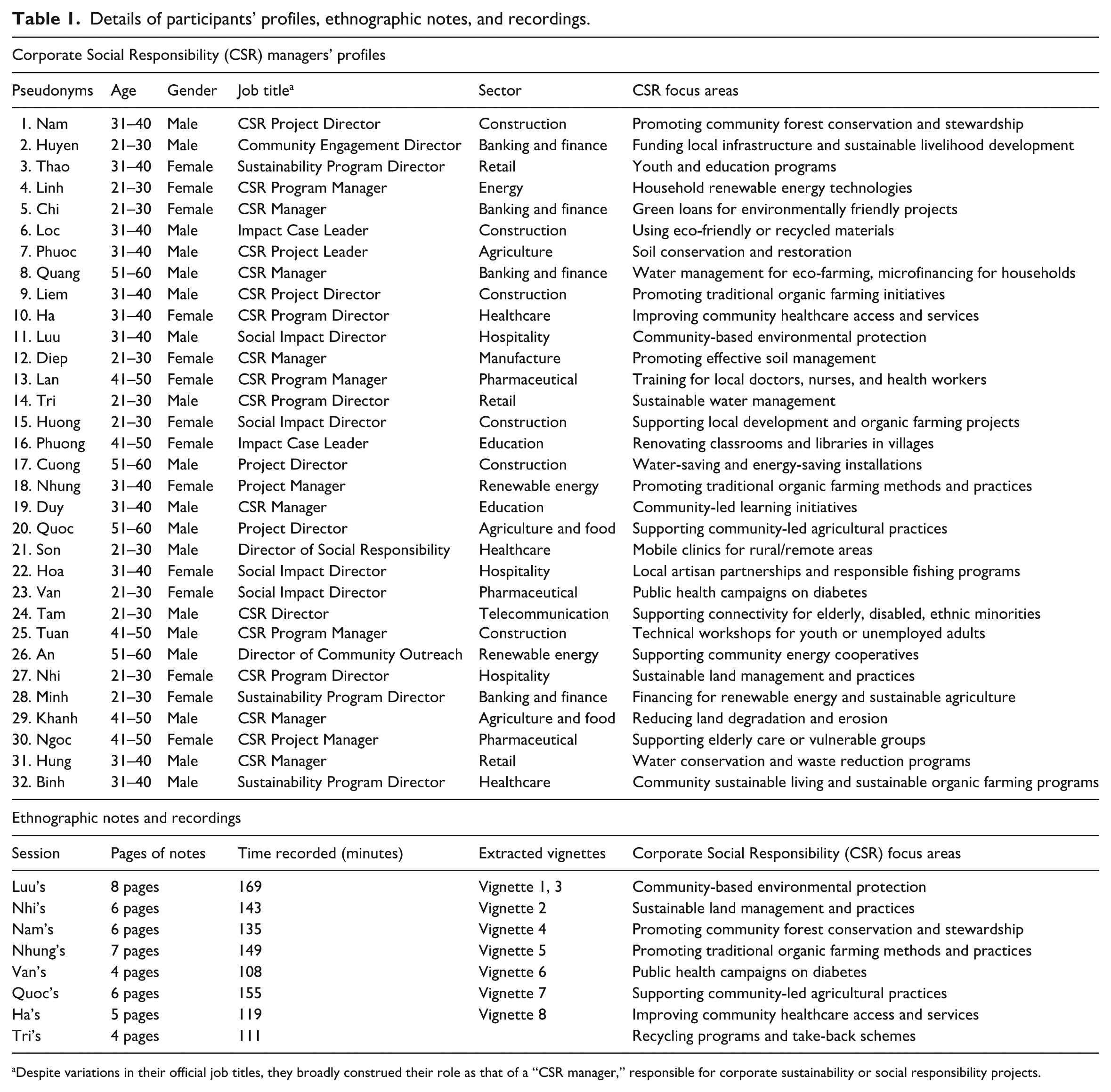
Despite variations in their official job titles, they broadly construed their role as that of a “CSR manager,” responsible for corporate sustainability or social responsibility projects.
Interviews
We selectively chose 32 participants who were CSR project managers from this cohort for their strong emphasis on the use of proverbs in communication. This was particularly evident in how they incorporated proverbs into presentations to introduce the relevance of their initiatives to the community’s cultural values and traditions. Exploring the CSR managers’ intended use of proverbs enables us to unpack how they disseminated and reflected upon their experiences with using proverbs in their CSR communication and their roles as CSR managers along the process. Consequently, the interviews enabled us to explore how they expressed themselves, their experiences, and the shifting critical discursive events that contributed to the enactment of these proverbs.
Observations
One author attended eight corporate presentation sessions for community members as a third-party observer, recording and taking notes on the presentations and the interactions between corporate agents and community members as part of a larger study. From this project, we drew on 46 pages of ethnographic field notes and approximately 18 hours (1089 minutes) of audio recordings documenting how 32 CSR managers communicated CSR projects in village community halls and local meeting spaces. During these sessions—the question-and-answer—community members frequently reflected on the use of proverbs, sharing opinions, emotions, memories, and personal or collective histories associated with these sayings. These exchanges revealed how proverbs fostered cultural familiarity and strengthened community members’ engagement with the CSR initiatives. The combination of detailed field notes and full audio recordings captured both formal presentations and informal interactions, enabling a nuanced analysis of CSR discourse and the strategic use of proverbs. However, due to logistical challenges, including travel limitations and corporate confidentiality policies, the field notes did not cover all presentation sessions, which may have affected the comprehensiveness of our data. In addition, although sessions were audio- and video-recorded, only audio data were retained for this study due to confidentiality policies; nonetheless, the data provided a rich account of the communicative dynamics at play.
Data analysis
We adopted a ventriloquial perspective on communication (Cooren, 2012; 2020; Poroli and Cooren, 2024). This approach, widely used in CCO research, examines how actors attribute voice, agency, and authority to entities beyond themselves, sometimes speaking “on behalf of” or “through” artifacts, texts, or systems (Cooren, 2012; 2020; Poroli and Cooren, 2024; Slager et al., 2024). We adopt this approach in two main ways: (1) to examine how proverbs, as strategic tools in CSR communication, enable practitioners to assert locally grounded knowledge and embed it within organizational discourse; and (2) to investigate how agency shifts toward proverbs and how meanings and practices emerge, circulate, and are negotiated throughout the communication process.
Our data analysis consisted of three main parts. We first familiarized ourselves with all the data to develop an overall understanding of the communication processes taking place between CSR managers and community members. This initial step allowed us to grasp the broader picture of interaction and to identify recurring communicative patterns that warranted closer analysis. Following Nathues et al.’s (2025) ventriloquial framework, we systematically identified vents, figures, and matters of concern within the interviews and observational materials. We defined vents as the sources that animate an utterance or action (e.g., values, emotions, norms, or principles that motivate speakers); figures as the entities invoked or given voice in interaction (e.g., proverbs, cultural values, community members); and matters of concern as the issues or tensions that become communicatively relevant and inform how vents and figures enter interaction. In our context, these included human actors (CSR managers, community members) and other-than-human actants (proverbs; Cooren et al., 2013). Within this stage, we specifically traced how proverbs 3 surfaced in interaction, as figures (voiced directly or indirectly) and as vents (animating speakers’ stances or intentions), by examining how they were quoted, paraphrased, or embedded in storytelling; where they appeared (e.g., in community meetings or field visits); and why they were mobilized (e.g., because their content referenced forests, crops, farming techniques, or invoked culturally grounded values such as interdependence, humility, or respect for land). To do so, we examined the narratives of CSR managers, particularly how earlier forms of communication (e.g., the use of global terms such as the SDGs or technical sustainability language) were perceived as inaccessible or disconnected from local realities. We then examined how managers’ intended communicative purposes (e.g., encouraging community participation) were animated through the use of proverbs (see Table 2). Proverbial figures invoked ancestral worldviews and moral ties to land (e.g., framing forests as home), allowing managers to embed local knowledge and enabling communities to reinterpret CSR as a shared, culturally meaningful practice.
Additional exemplar proverbs used in (Corporate Social Responsibility (CSR) communication by CSR managers.
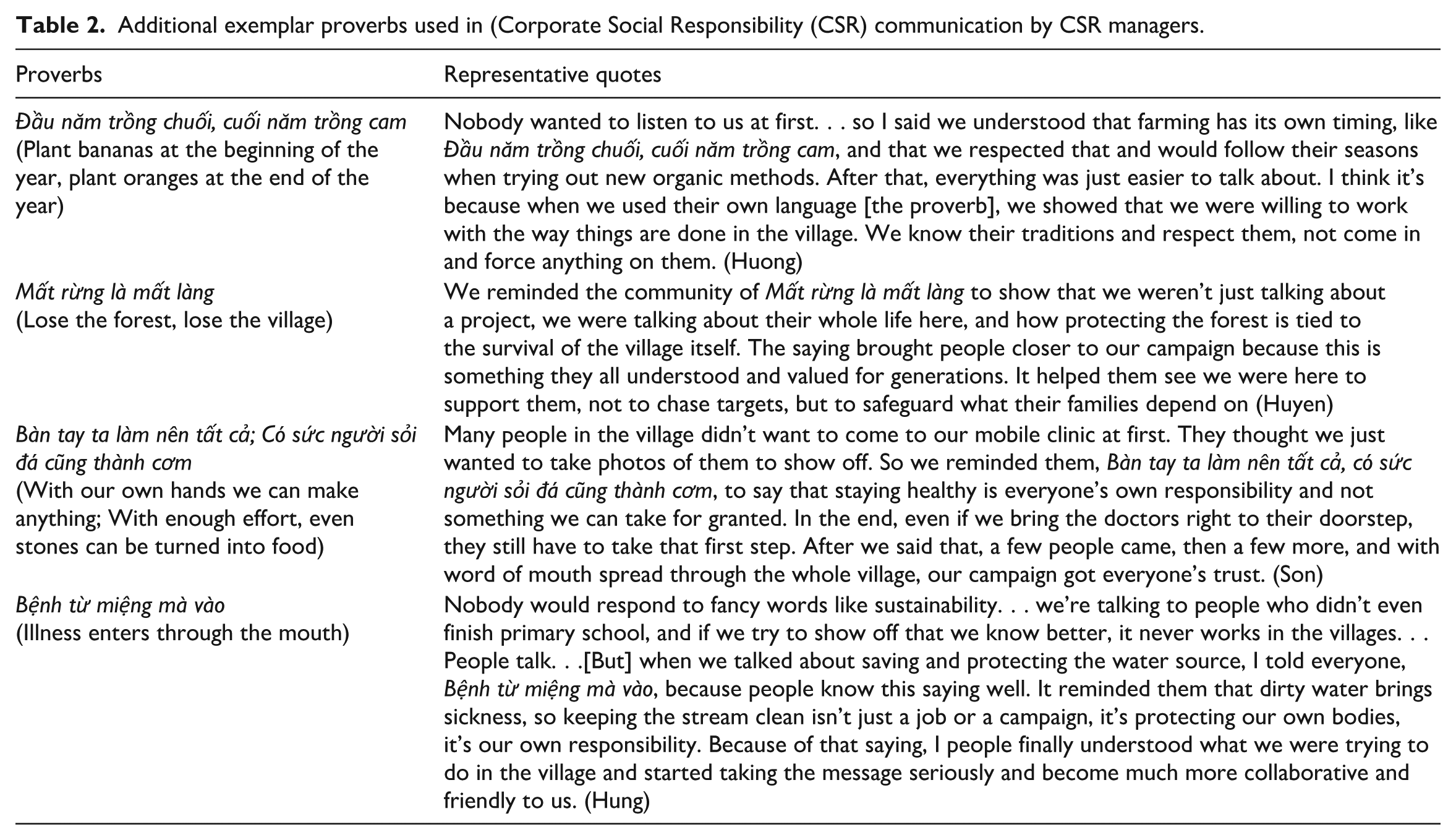
In this second part of our analysis, we traced the ventriloquial mechanisms of proverbs across three phases. By (ventriloquial) mechanisms, we refer to patterned communicative arrangements through which proverbs animate voices and orient interaction, rendering particular meanings, obligations, and courses of action recognizable, legitimate, and actionable in corporate-community dialogues. In phase A, when mobilized by CSR managers, proverbs operated as authoring ventriloquial mechanism, supplying culturally resonant moral authority that aligning CSR messages with local values and norms. By invoking shared cultural references, managers framed CSR initiatives as locally meaningful, fostering community engagement where global sustainability terminology did not work. Proverbs surfaced matters of concern (Bencherki et al., 2021) by activating shared memories, ancestral wisdom, and collective pride, while also exerting implicit moral pressure. In this phase, the ambivalent nature of proverbs as authoring devices became particularly saliently, reinforcing moral obligations while helping navigate tensions between universal CSR standards and local sensibilities. In phases B and C, authoring progressively shifted into re-authoring and counter-authoring. Phase B marked a shift from practitioner-led communication to community-initiated dialogue, characterized by a move from talking to communities to talking within communities, and a reframing of corporate social responsibility (CorpSR) as community social responsibility (ComSR), where community values and priorities became central reference points in CSR narratives and practices. In this phase, proverbs rearticulated narratives of social responsibility and constrained or redirected sustainability initiatives in practice. In phase C, proverbs operated as counter-authoring forces that unsettled CSR managers’ assumptions and communicative positioning, promoting self-reflection and challenging alignment with corporate agendas. In this phase, they were repositioned from external representatives of organizational agendas to internal advocates for community-driven CSR. Table 3 summarizes the evolution across the three phases.
Ventriloquial mechanisms of proverbs across Corporate Social Responsibility (CSR) communication phases.
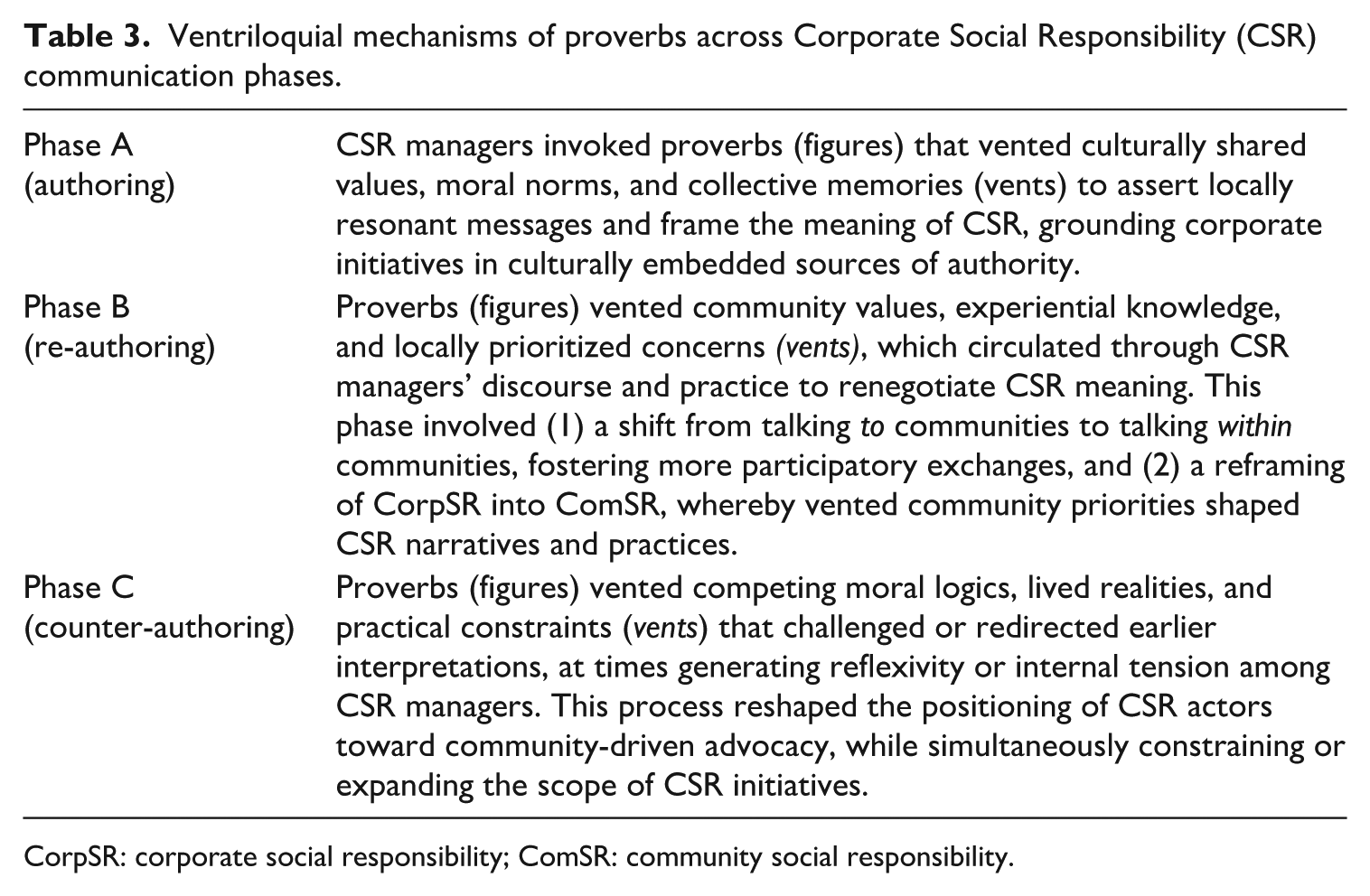
CorpSR: corporate social responsibility; ComSR: community social responsibility.
In the third part of our data analysis, we developed vignettes from field observations and audio-recorded community discussions. These vignettes capture how community members discussed and reacted to CSR initiatives, allowing us to trace how meanings were articulated, and illustrating how vents and figures, especially proverbs as other-than-human actants, were mobilized across CSR communicative dynamics (see Table 3). We selected vignettes that made visible the density and interplay of ventriloquial mechanisms (Cooren et al., 2013; Nathues et al., 2025), showing how proverbs animated dialogue, invoked cultural voices, and participated in authoring, re-authoring, and counter-authoring by capturing voices interwoven with collective actions (Cooren, 2012). We selected Vignettes 1 and 2 to illustrate how proverbs as authoring mechanisms enabled engagement beyond encouragement (Cooren et al., 2013), subtly guiding actions in line with culturally attuned norms. Vignette 3 highlights how proverbs facilitated community engagement, participated in CSR discourse, and navigated tensions between global standards and local values, while also risking the reinforcement of moral obligations. Vignettes 4 and 5 capture internal community dialogues sparked by the proverbs, revealing how re-authoring reclaimed agency and enabled communities to reaffirm ancestral sustainability practices. Vignette 6 and reflections from CSR managers further illuminate how these interactions contributed to the transition from CorpSR to ComSR. Finally, the counter-authoring mechanism of proverbs was reflected in CSR managers’ accounts of how the proverbs challenged their assumptions, generated self-reflection, and shifted their positioning toward community-driven advocacy (Table 4 illustrates additional vignettes and representative data). Triangulating interviews and vignettes made it possible to trace the unfolding agency of proverbs, revealing how authority was continuously enacted, contested, and reclaimed by both CSR actors and community members.
Multiple voices in the evolution of Corporate Social Responsibility (CSR) communicative dynamics.
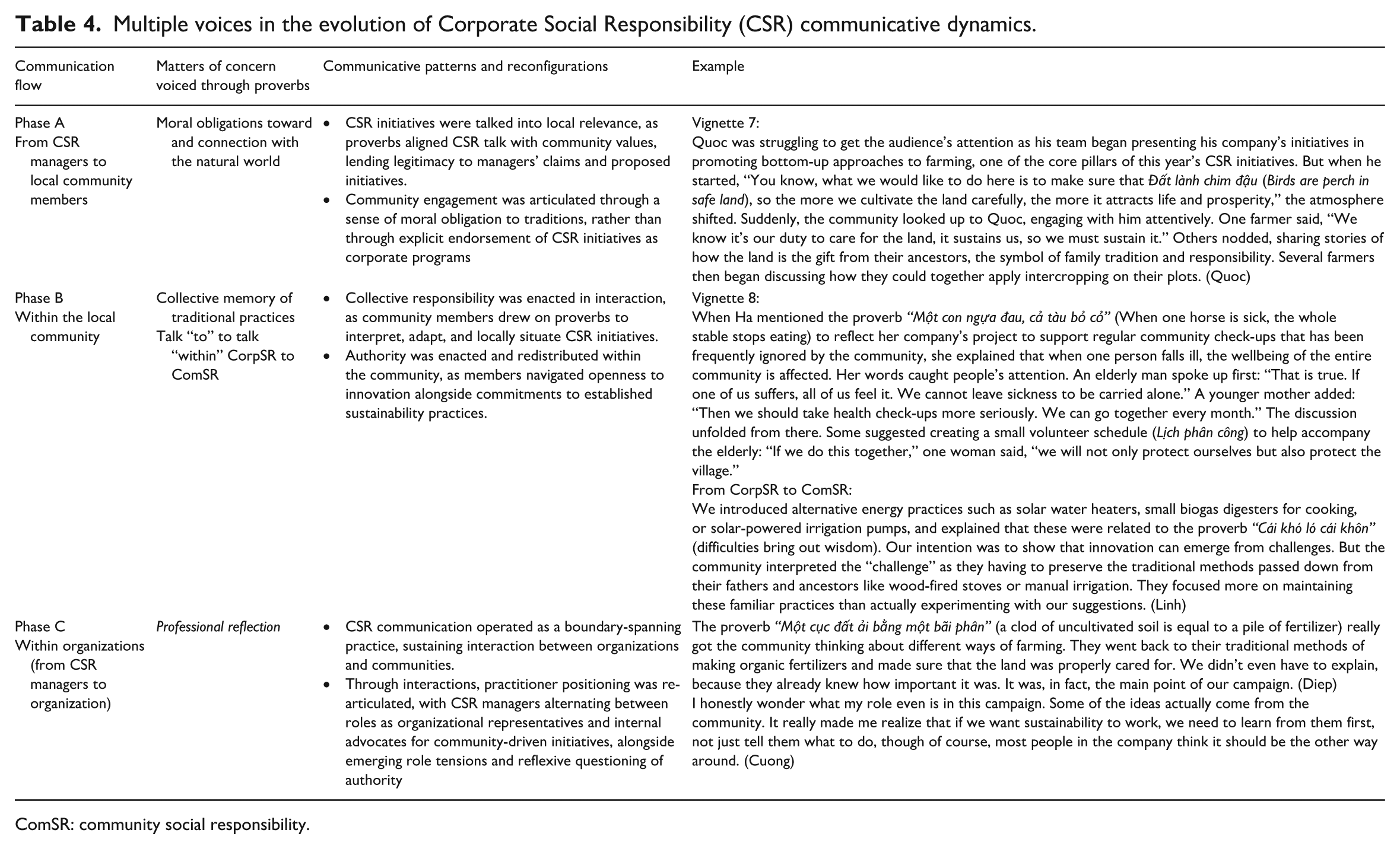
ComSR: community social responsibility.
Proverbs as emerging other-than-human actants in CSR communication
CSR managers in our study strategically used local proverbs to facilitate more resonant forms of community dialogue through familiar moral vocabularies. For instance, Luu used proverbs as an alternative way to discuss the impact of deforestation and engage with the communities after having struggled for 3 years to persuade local communities to engage in the company’s CSR on community-based environmental protection programs, which was originally associated with a wide promotion of global sustainability certificates like the Forest Stewardship Council or ISO 8347. He noticed a significant shift when he used the proverb Phá rừng như thể phá nhà—Đốt rừng như thể đốt da thịt mình (burning forests is like scorching your own flesh) to talk about sustainability to the community. As he expressed: “This approach resonated much more deeply with their personal feelings than conversations about sustainable development goals or word like sustainability. . .it reminded them that forests are like their homes and destroying them feels like a personal harm.” The metaphor of forests as both a “home” and an extension of the body reflected cultural memories as for generations, forests symbolized a sense of survival, resilience, and played a critical role as shelters, food sources, and strategic cover during the wartime. Luu explained: “We won the war because our ancestors knew and understood the forest, they knew how to use the hidden paths and dense cover to outsmart the enemy. . .it was the forest that was our shelter, provided food and being a strategic alley” (Luu).
The proverb Luu used evoked in the community a sense of duty to protect their “home.” Luu animated the forest as a figure, a morally charged cultural voice that guided how responsibility was understood and enacted, reframing environmental protection into a matter of collective survival, belonging, and duty. Community members began participating in discussions, offering suggestions, and showing genuine interest in the project: “For them, our campaign suddenly became something real, something they needed to live by to protect their future and community” (Luu). The Figure 1 below shows the attention and engagement from the community following Luu’s introduction of the company’s initiatives through proverbs.

Community attention and engagement.
Similarly, Thao, another CSR manager who ran community-based education programs, described how her community-based CSR programs initially failed to gain traction when framed in global developmental language (e.g., “SDG-aligned youth programs”), which rural parents perceived as abstract and disconnected from everyday realities: “Parents felt we were talking big city ideas that made no sense to them and to their children, especially when there was work to be done at home” (Thao). When Thao used the proverb Tre già măng mọc (when the old bamboo dies, new shoots rise) to reframe the programs, they gained acceptance by resonating with shared understandings of intergenerational continuity and the value of investing in children’s growth. Here, the proverb functioned simultaneously as a vent (animating Thao’s message with moral purpose) and a figure (voicing the community’s values around lineage and continuity). It reframed the program not as an external intervention but as part of parental responsibility: “parents started bringing their children voluntarily. They even reminded each other in the village to send their kids” (Thao).
Culturally grounded CSR talk: Proverbs as authoring, re-authoring, and counter-authoring mechanisms
In this section, we demonstrate how proverbs as culturally attuned authoritative other-than-human actants are authored, re-authored, and even counter-authored, which shifted the focus from corporate social responsibility (CorpSR) to ComSR. The use of proverbs also reveals the internal conflicts and limitations faced by managers themselves. Below, we’ll delve into this.
Proverb as authoring mechanism for CSR
By strategically incorporating local proverbs into his community-based environmental protection campaign, Luu mobilized culturally resonant voices that allowed ancestral memory and shared understandings of the forest to speak through his CSR communication (see Vignette 1). This ventriloquial authoring mechanism repositioned the campaign as something rooted in the community’s sense of home rather than a corporate initiative, lending the interaction emotional weight and enabling engagement and trust to emerge.
Vignette 1:
When Luu began introducing his company’s CSR to the community gathered in the village central hall, no one seemed to listen. The room was loud, chaotic, people were chatting about their families, children, and daily concerns rather than paying attention to the presentation. But then, as Luu mentioned the proverb, the noise faded into a sudden hush. An elderly man, known in the village as the Big Uncle, who sat in the front row, spoke up: That’s what our ancestors used to say when warning us not to take more than we need. A middle-aged woman added, Trời ơi (oh gosh), I haven’t heard that saying in years, but it’s so true. The forest fed my parents and me during the war. The atmosphere suddenly shifted from passive observation to a moment of collective shared memory. People began engaging actively: someone called out, So what do you suggest we do? Another followed: What will you do then? One man expressed: At least now we’re talking the same language, I honestly had no idea what this thing was about until now. The crowd, once disengaged, now expressed a deep, almost ancestral connection to the forest. The campaign was reframed through the proverb as something more personal, more embodied. It became something worth defending, something that belonged to them, not imposed upon them. Through a few familiar words, the forest was home.
Similarly, Nhi, tasked with encouraging more sustainable land use that is part of her company’s CSR focus on sustainable land management and practices, often faced skepticism from local communities. As she put it: “They think I’m just a girl who knows nothing about farming, talking nonsense and trying to sell the campaign to get paid more.” With pressure mounting to show progress and retain her company’s green funding, Nhi reconnected with the community’s sense of reverence and cultural memory by using a local proverb that directly linked to their use of land.
Vignette 2:
As Nhi stood in front of the small community room discussing sustainable land use to reduce soil depletion, comments surfaced, cutting through her presentation: It’s too much work. It won’t make a difference. We’ve heard this before. Sensing the tension, Nhi paused and spoke I know some of you feel this whole sustainability idea doesn’t make sense. But remember the old saying: Thấy cây mà chẳng thấy rừng (seeing the tree but not the forest). There was a moment of silence. Then she continued: If we only look at the short-term effort, we would be disrespectful to our ancestral land. This land raised your parents, and theirs before them. It gave you food, shelter, and life. Letting it be exhausted would be like turning our backs on all they worked for. An older man near the back raised his voice: It’s not just a land, it’s where we bury our dead. It’s sacred. Gradually, the energy in the room shifted. Questions emerged: What can we grow that keeps the soil rich? Can we compost together like before? The session had turned into a space of rediscovery, a sense of shared purpose rooted in reverence, duty, and cultural pride.
The proverb that Nhi used evoked the value of land and traditional practices rooted in the concept of Đất tổ (Ancestral Land), which helped re-anchor the community’s attention to the project, something that previous initiatives had failed to achieve. The community came to realize that ideas of sustainability had long been embedded in Vietnamese traditional practices. Nhi’s use of proverb reframed sustainability as an act of cultural continuity and reverence. The proverb did not merely explain sustainability, it summoned the land as kin, the soil as inheritance, and sustainable action as a form of ancestral duty. As such, through the authority conferred by the proverbs to Nhi, the community internalized sustainability as a moral and intergenerational responsibility grounded in their core values.
The proverb functioned as an authoring mechanism, lending authority to CSR discourse by defining what “doing good” entails, who should act, how, and why. It guided community members toward engagement aligned with the moral logic encoded in the proverb, persuading participation while embedding culturally grounded legitimacy. Proverbs did more than supporting CSR talk—they authored it, shaping community engagement in ways consistent with corporate interests. Proverbs reframed sustainability efforts not as voluntary, but as moral imperatives rooted in collective values, enabling a form of responsibilization where community obligations were subtly regulated through proverbially framed moral norms.
While proverbs served as a source of inspiration for community members, strengthening the authority of both CSR talk and CSR initiatives and practices of organizations (CorpSR), they also carried an implicit sense of imposition for them. Proverbs simultaneously generated unintended dynamics, such as placing an emotional and moral obligation on local community members. As Luu reflected: “[it] felt like it was ‘calling’ them, so they felt a sense of responsibility to join the campaign. . .some said their ancestors would be proud of them” (Luu). In Vignette 3, after Luu’s presentation, such dynamics within how the community was subject to obligation was evident.
Vignette 3:
After the presentation session, a middle-aged man who had been quietly observing from the row above leaned over to the person next to him. It feels like no one wants to fail our ancestors, he said, So it’s already a done deal, right? The woman beside him nodded: This is a village of history, she replied, it’s the forest calling. One elderly man at the end of the row added: I don’t care about the company. We’re doing this because this is our home, the forest is our blood. If we don’t protect it, who will? It’s not for them; it’s for our grandchildren. That’s what matters. As these conversations were going on, younger villagers who had previously voiced concerns about the CSR project suddenly fell silent. One whispered to his partner: But what about what we planned for our field? His partner replied: We’ll manage, you heard the elders. The conversations were no longer about what the company’s initiatives were, it has now become fulfilling moral inheritance invoked by the proverbs, reshaping the moral landscape of engagement within the community. Any refusal would now be interpreted as betrayal of lineage and land rather than a critique of CSR practices.
The moments in Vignette 3 highlights how proverbs functioned both as a source of inspiration by evoking shared memory, ancestral wisdom, and pride, and as a form of subtle moral coercion. Luu’s case demonstrates the proverb spoke with the authority of ancestors and communal history, animating culturally grounded moral obligations that exceeded individual preference or deliberation. Rather than persuading through argument, the proverb authorized participation by invoking an inherited moral order rooted in intergenerational responsibility. Through its authoring mechanism, the proverb legitimized Luu’s company’s CSR initiative and informed both how the initiative was presented and how participation was normatively expected to unfold. By grounding the initiative in a moral order tied to tradition and cultural heritage, the proverb rendered nonparticipation feel morally questionable. As the proverb circulated as an authoritative cultural reference, legitimacy and obligation were articulated together in community talk, with some members describing an intensified, and at times overwhelming, sense of duty grounded in inherited cultural norms rather than personal or practical considerations.
Proverb as re-authoring mechanism
The use of proverbs as described in the previous section granted authority to CSR managers’ accounts and, by extension, legitimized the CSR initiatives their organizations sought to introduce. This approach transformed one-way corporate messaging into a catalyst for inspirational dialogue within the community. Rather than merely talking to the community, it initiated conversations within the community. These internal dialogues shifted the locus of authority from external imposition to internal negotiation through the communities’ narratives crafting, lived experiences, and moral understandings. In other words, one form of “talk” gave rise to another, marking a transition in authority from externally driven persuasion, which initially reinforced the legitimacy of CSR talk and projects, to a co-created, community-led discourse where authority was redefined and re-situated. This process emboldened the community to push back against corporate-led CSR projects and talk, advocating instead for initiatives that reflected their own values and priorities.
From ‘CSR To’ to ‘CSR Within’
During the company’s CSR introduction session in the village, Nam delivered his corporate messages about deforestation and sustainability using proverbs, as part of his company’s aim to promote community forest conservation and stewardship. However, this mode of communication was reinterpreted by the local community, shifting the focus from corporate directives to locally grounded meanings articulated through community values and cultural understandings. The dialogic nature of CSR communication, how one talk can inspire another, became evident in the following vignette.
Vignette 4:
Nam introduced the proverb Khủng bố đại ngàn là hủy diệt hạ lưu (Terrorizing the forest means destroying the downstream) to illustrate the long-term environmental consequences of deforestation at the village communal house. He then used Cha chung không ai khóc (When it’s everyone’s business, it’s no one’s business) to urge the villagers to take collective responsibility for protecting their surrounding forests. Following his presentation, Nam invited the villagers to participate in breakout discussions. Over the following 30 minutes, the communal house got loud. Seated in circles on mats, people began to discuss about Nam’s talk and the proverb. One elder stood and said: The forest is like our lungs; we are breathing together. This isn’t the company’s project. It’s ours because we are part of it. It’s our survival. Nearby, a group of women discussed the importance of planting cây dổi (michelia tonkinensis) and mắc khén (zanthoxylum rhetsa), not only for soil regeneration but also for traditional cooking and trade: My grandmother used to plant them on the edges of the forest where the soil is deeper. Another group talked proposed dividing planting duties, with each family taking responsibility for specific forest sections near their ancestral plots: You know just like how we used to do with water sources. If we plant there first, it will show we’re serious, and maybe the ancestors will bless the new growth. Others emphasized protecting young saplings using bamboo fencing woven by hand and using natural compost made from rice husks and buffalo dung, which had long been used to enrich mountain soils. A man added: Don’t let outsiders think we don’t care [referring to Nam’s proverb about collective responsibility] we show them we protect our land, the way we always have.
The session evolved into a more active process within the community, with community members proposing and selecting tree species of spiritual or ecological significance, assigning tasks for seedling care and land preparation, and forming small committees to oversee the long-term maintenance and growth of the trees. What had begun as a corporate presentation became a co-created talk within the community, illustrating how the use of proverbs invoked a new form of inspirational talk within the community. This process mobilized internal resources (e.g., a shared sense of custodianship over the forest, traditional ecological knowledge), enabling community members to participate in CSR talk by crafting their own narratives on their own terms. Consequently, a sense of ownership and agency emerged, marking a critical shift in authority from externally imposed CSR talk directed to the community toward a dialogical, internally negotiated talk within the community itself, empowering the community to actively participate in defining, narrating, and enacting sustainability efforts.
Like Nam, Nhung observed a significant shift from her initial CSR discussions on traditional organic farming methods and practices that were met with skepticism due to community concerns about land ownership to the ongoing conversations that unfolded within the community. These interactions did more than inform Nhung about locally specific organic practices; they made visible how authority over farming knowledge was being re-authored through collective recall and affirmation of ancestral methods. Organic farming was articulated not as a technical intervention introduced through CSR, but as a way of life embedded in cultural and historical continuity. Practices that had been fading from everyday use were recalled, validated, and revitalized through Nhung’s deliberate invocation of proverbs, as illustrated in the following vignette:
Vignette 5:
At the village gathering at the village cultural house (Nhà văn hóa thôn), Nhung used the proverb Nhất canh trì, nhị canh viên, tam canh điền (First comes the pond, second the garden, and third the field) to emphasize the natural order of farming and ecosystem balance and to make her project more locally grounded. What followed was unexpected. Her presentation evolved into a spontaneous community dialogue. Villagers began exchanging ideas, interrupting one another with memories, experiences, and suggestions. One elder stood up and said: We let the ponds feed the gardens, and the gardens feed the fields. That’s what keeps the land healthy. Another woman added: We used to raise cá rô (mud carp) and cá trê (catfish) in the ponds, use the pond silt and fish waste to fertilize our rau muống (morning glory) and cải xanh (mustard greens). The community began to reclaim and embrace their traditional ecological knowledge, reaffirming their role as stewards of the land. One elder farmer remarked: We’ll join you in developing organic farming, but this isn’t new to us. We’ve been doing it for generations. We don’t need others to teach us how to farm, we know how to do it ourselves. A younger farmer added: We can do this on our own; We already know how. We’ll show you what organic farming really means from our own soil and stories.
Through interactions, Nhung’s CSR talk became a site of collective re-authoring rather than one-way transmission. The proverb functioned as a ventriloquial figure that animated ancestral voices and legitimized community knowledge, enabling villagers to reclaim authority over how organic farming was understood and enacted. Community members moved beyond responding to CSR initiatives to articulating their own practices (e.g., fertilization with nutrient-rich pond sediment and intercropping techniques) as legitimate sustainable farming practices. Vignette 5 illustrates how re-authoring unfolded through a shift from CSR talk to the community toward dialogue within the community: authority was no longer anchored in corporate expertise of organic farming but circulated through culturally grounded knowledge mobilized by the proverb. Nhung’s CSR initiative was articulated as an internally cultivated practice by the community rather than an externally introduced intervention.
From CorpSR to ComSR
These internally driven conversations also empowered the community to (re)define what social responsibility meant (to them). Within ongoing interactions, CSR was increasingly articulated in terms of ComSR rather than CorpSR. Instead of passively accepting externally imposed CSR models, community members drew on traditional knowledge as culturally grounded alternatives, contesting homogenized frameworks and positioning these approaches as equally, if not more, legitimate. For instance, while Van’s pharmaceutical company supported a community campaign on diabetes prevention, her use of a local proverb redirected the interaction from corporate CSR discourse toward culturally embedded understandings of health and responsibility, thereby reasserting community-based knowledge as a legitimate alternative. This dynamic was evident during Van’s campaign session at the village hall:
Vignette 6:
When Van introduced the proverb Ăn có chừng, dùng có mực (Eat with limits, use with measure), community members immediately began sharing advice on eating from ancestral teachings. An elderly man sitting at the front turned to those behind him and said: It’s all about how and what you eat. If you follow what our ancestors (cha ông) taught, nobody would have these problems. I’ve got Lá ổi (guava leaves), Lá xoài (mango leaves), and Mướp đắng (bitter melon) in my garden, boil them and eat them once a week, and it clears out all the toxins from food. Another man next to him added: I’ll write out my daily meals for a week for all of you, follow that, and none of you would have diabetes. Another elder nearby added: I still have my grandfather’s notes about what to eat in each season. . .I’ll print them out for everyone. Suddenly, the session turned into a lively exchange of recipes, routines, and household remedies.
Vignette 6 illustrates a shift from Van’s campaign framing to a community-led exchange of everyday health practices, articulated as locally valid ways of preventing diabetes and sustaining well-being. Through the proverb’s circulation, community members reclaimed authority over what counted as responsible health practice and how it should be enacted. Furthermore, some CSR managers observed that when communities felt their traditional practices were recognized and reinforced by CSR programs, their authority in how they crafted their own ComSR narratives sometimes hindered the adoption of new ideas. For instance, Nhung recognized the challenge of aligning new initiatives with the deeply rooted cultural narratives reinforced by the proverbs and embraced by the community: “. . .the locals felt more comfortable with their traditional methods. . . [but] they made it harder for us to introduce other modern techniques that could have improved their practices.” In Nhung’s case, the use of proverbs helped align organizational practices more closely with traditional organic farming methods. However, it re-authored the agency to the community that evoked their reliance on familiar traditional practices, such as crop rotation framed within local ecological knowledge. Thus, this created resistance to the introduction of alternative farming methods. Tri, another CSR manager, also explained that after using the proverb Phân tro không bằng no nước (Fertilizer is not as good as sufficient water) to his company’s campaign on promoting sustainable water management, his organization supported the community in implementing their traditional irrigation system of digging small channels to irrigate fields. As a rice-farming country, Vietnam has always prioritized water management due to its reliance on irrigation systems and seasonal rains. However, when the company proposed further support to introduce a modern drip irrigation system, the community resisted adopting the new method, preferring to stick with their familiar practices: “I think it’s because we adjusted our program to follow their irrigation practice, they felt like their method was already good enough, so why bother changing it?” (Tri). Some other participants also expressed some similar concerns: “The villagers took our support as confirmation that what they were already doing was just fine. . .at that point, it was very tough to ask them to try anything different. . .” (Ngoc) “We embraced their traditional farming practices to build trust and honor the village’s way of life. But when we introduced intercropping to help diversify the ecosystem, they did not like it. They said, ‘you already said we did well. . .” (Liem)
These scenarios show that proverbs operate as sites of re-authoring, extending beyond the mere lending of cultural authority to CSR talk. Proverbs provided a discursive space in which communities articulated their own epistemic and ecological knowledge, with CSR talk becoming a site for reinterpretation, resistance, and the reworking of externally driven change. This created both a space for and a process of re-authoring, where the legitimacy of CorpSR expertise was challenged and gradually displaced by community-led interpretations of what sustainable development should look like. In this process, CSR was articulated on community terms, foregrounding local authority over the meaning and direction of sustainability beyond CorpSR.
However, according to some CSR managers, this re-authoring mechanism can at times overly romanticize tradition and impose a moral imperative that unintentionally constrains useful CorpSR efforts. Nhi shared an example where some villagers, inspired by the moral resonance of proverbs, converted a portion of their farmland into a conservation area for native plants. While this act was seen as a noble response to a perceived ancestorial “calling,” it came at the cost of reducing land available for income-generating crops: “some even gave up the crops they relied on for income because they felt it was their cultural duty to respect the ancestors’ land, but honestly, I know that income was really important to them. . .” (Nhi). Such acts can create significant challenges for CSR managers by limiting their ability to carry out or innovate initiatives as originally planned. This dynamic reflects a broader tension where community assertions of cultural authority disrupt the progress of CorpSR agendas, thereby requiring practitioners to navigate a complex terrain of negotiation and adaptation.
Proverb as counter-authoring mechanism
The use of proverbs in CSR communication and the accompanying shift in authority, compelled CSR managers to critically reflect on their own responsibilities and positionalities in relation to the communities they served. In this reflexive process, proverbs functioned as a counter-authoring mechanism through which CSR managers navigated ongoing doubts, self-contradictions, and internal tensions. These struggles prompted them to question the assumptions underlying their firm’s CSR approach and to reflect on their own roles as CSR managers, particularly as they forged deeper connections with local actors and witnessed the shifting authority from corporate narratives to community-driven ones. In some cases, this reflexivity led them to advocate for changes within their own organizations, seeking to align CSR practices more closely with culturally grounded understandings and local needs: “When I framed the project as Đói ăn rau, đau uống thuốc (When hungry, eat vegetables; when in pain, take medicine), the locals came up with even better initiatives their traditional organic farming practices than what we initially planned to promote. Honestly, I don’t even see my role as necessary anymore. . .I suggested to my department head that we should let the community take the lead in this campaign. . . grassroot approaches for doing CSR.” (Binh)
When Binh used the proverb to promote simple and contextually appropriate solutions for his company’s sustainable living and farming projects, it triggered a shift in how both he and the community engaged with the project. As he collaborated more closely with the community, their knowledge of traditional organic farming practices, such as intercropping, composting with natural materials, and pest control using herbal mixtures, proved to be more effective in tailoring sustainable practices to the local climate and soil conditions than what Binh’s company initially suggested. This reality prompted Binh to reframe his role, shifting from a directive guide to a responsive facilitator of locally driven initiatives. His communication counter-authored his original talk, prompting him to advocate within his organization for a more participatory, bottom-up approach to CSR. Through this counter-authoring mechanism, the proverb animated challenges to top-down assumptions, becoming a matter of concern through which Binh engaged in the ongoing reworking of CSR narratives from within. Hoa, a CSR manager who was working with fishing communities in ocean conservation, was also surprised in how the local community had many practical and useful ideas: “Using the saying Nước lên thuyền lên , nước xuống thuyền xuống (When the water rises, the boat rises; when the water recedes, the boat lowers) had a big impact on the community. . .they understood their interconnectedness with the health of the ocean and used practices to minimize bycatch, like implementing rotational fishing systems to allow fish stocks to recover naturally. . .. I suggested to reframe our future CSR project as a grassroot one to promote local communities’ involvement and innovation. . .” (Hoa)
Hoa’s use of proverbs not only activated dialogue with community members but also, conversely, casted doubt on her original position as a corporate CSR communication agent who was supposed to convince community members to adopt CorpSR initiatives. Through this counter-authoring mechanism of proverbs, Hoa became attuned to the community’s lived realities and ecological knowledge, thereby reinterpreting her organization’s CSR goals considering community values. She shifted from a CorpSR agent to a broker between the organization and community members. This reflexive process revealed that the organization’s initial top-down CSR approach was insufficient, highlighting the need for a participatory, culturally grounded approach.
In the counter-authoring ventriloquial mechanism, proverbs became sites where CSR managers’ positioning shifted toward facilitation between corporate and community perspectives. These interactions surfaced internal tensions, as CSR initiatives articulated through culturally rooted community values unsettled managerial authority and invited closer alignment with community-led interpretations of responsibility: “It would have been much more effective to adopt or upgrade traditional methods used by locals, such as rice paddy irrigation with bamboo and weirs to control water levels and distribute it evenly across the fields, instead of imposing on the electronic irrigation system. . .it was unnecessary because the locals have already known for generations how to treasure water. . .[that’s why] we incorporated the saying Nhất nước, nhì phân, tam cần, tứ giống (First water, second fertilizer, third care, fourth seeds) when we talked about the importance or water management for farming. . .” (Quang)
As Quang communicated with the local community to promote his company’s water management projects, he was able to understand locals’ traditional methods more and even supported their values, criticizing his firm’s sustainability approach: “I said that our approach wasn’t working and that we should’ve just used effective local approaches and low-cost materials that could be sourced locally. . .” (Quang). He started repositioning his role, not as an implementer of corporate policy but as a mediator between corporate practices and community values, or even often as a community communication agent. Despite their desire to advocate for local voices and initiate change within their organizations, however, many CSR managers struggled to position themselves between the local communities and corporate practices. For example, Binh often encountered the company’s rigid stance on control and ownership, particularly when he tried to promote ComSR practices: “[the department head] disagreed, arguing it would mean we couldn’t take credit for the success. . .I feel stuck with my role, I had to say ‘sorry’ so many times to the community. . .but also keep saying: keep doing what you are doing,. . .” Binh’s frustration at being unable to persuade management to adopt more locally meaningful approaches or support genuine community ownership illustrates the tensions inherent in CSR, as well as the counter-authoring role of proverbs in disrupting linear corporate messaging.
Here, counter-authority emerged not as overt opposition but as subtle, culturally grounded resistance that reoriented how CSR managers perceived their work. This form of counter-authoring recurred in the narratives of other CSR managers: “. . .they [board of directors] did not agree, they said it would not benefit the reputation of our campaign. . .it’s hard to be in the middle and I sometimes just wonder if I’m even in the right place to make a difference. . .” (Hoa) “. . .the management team didn’t seem to get it; they insisted on using the partner’s [their suppliers and vendor partners] materials so they could promote them as being sustainable. . . I think that it [the local’s request] was fair, and I personally failed to deliver. . .I told them it makes me feel disappointed.” (Quang)
When Hoa’s company rejected her proposal to support marginalized local artists in favor of reputation-driven CSR aligned with sustainability reporting, she questioned her capacity to contribute to meaningful change for both the organization and the community. This disjuncture exposed the tensions of counter-authoring, as she struggled to reconcile bottom-up community values with corporate goals that constrained her influence. Similarly, Quang expressed frustration with the company’s failure to address community needs, underscoring the widening gap between corporate control and community priorities. Across cases such as those of Hoa and Quang, proverbs recurrently functioned as sites of counter-authoring, where authority was simultaneously asserted and contested. These interactions reveal the limits of top-down CSR approaches and led CSR managers to reflexively reassess their roles, reaffirming proverbs as influential nonhuman actants shaping the negotiation of and meaning in CSR.
Discussion
In this section, we integrate our findings into a culturally attuned framework for understanding CSR communication dynamics, highlighting how authoritative other-than-human actants—proverb—participate in CSR communication and the CSR managers-local community interactions through three ventriloquial mechanisms. Proverbs frame situations, legitimize actions, and shift CSR’s meaning and practices (Penttilä, 2020; Poroli and Cooren, 2024) by anchoring discourse in shared cultural authority. Authoring occurs when proverbs confer authority on CSR managers, legitimizing both their messages and proposed initiatives through shared cultural values. Re-authoring takes place when community members mobilize proverbs to reinterpret or rearticulate CSR agendas, asserting their own priorities and local practices, and influencing both how CSR is discussed and how it is implemented as a community-driven practice (ComSR) away from a corporate design (CorpSR). Counter-authoring arises when culturally attuned proverbs provoke internal tensions or contradictions that challenge the initially developed corporate narratives and practices. This pushed CSR managers to reconsider both the messages they communicated and the implementation strategies they promoted internally, highlighting how cultural actants can redirect CSR communication as well as practice. Our findings demonstrate that CSR is continuously (re)negotiated and transformed in an iterative and polyphonic manner among various participants in CSR communication (Cooren, 2020; Poroli and Cooren, 2024; Trittin and Schoeneborn, 2017).
Contributions to CCO research
The study contributes to CCO research in the context of CSR in two interrelated ways. We show that culturally attuned other-than-human actants are not merely persuasive devices but central ventriloquial mechanisms through which CSR authority, meaning, and practice are co-constructed. By demonstrating how culturally grounded CSR talk directed to communities stimulates action with and within communities, and simultaneously prompts reflexive reorientation within firms, our study positions CSR communication as a performative, dialogic and relational process rather than a one-directional corporate performance (Christensen, 2022; Schaltegger et al., 2024). In doing so, we advance CCO scholarship by showing how CSR realities emerge through culturally grounded, polyphonic exchanges that redistribute both voice and authority across organizational and community boundaries. We further elaborate on these contributions below.
First, this study extends CCO research by demonstrating how culturally and situationally embedded authoritative texts (Koschmann, 2013; Kuhn, 2008)—in our case, proverbs—function as other-than-human actants that actively participate in CSR communication. While prior studies acknowledge that artifacts participate in organizing, they often overlook vernacular, community-rooted texts (Castelló et al., 2013; Cooren and Sandler, 2014; Poroli and Cooren, 2024). Our analysis shows how proverbs, through mechanisms of authoring, authoring, re-authoring, and counter-authoring, shift CSR from corporate-led (CorpSR) to community-driven (ComSR). These ventriloqual mechanisms reveal that CSR meanings and practices are not simply negotiated about or for communities but are co-constructed with them through culturally resonant communicative resources. In doing so, we move beyond organizational boundaries (Christensen, 2022; Christensen et al., 2021; Schoeneborn et al., 2022; Smith, 2024), revealing community engagement as a constitutive, and often overlooked force in CSR communication (Christensen, 2022; Schoeneborn et al., 2020b). Proverbs enable marginalized stakeholders, particularly local communities typically treated as passive recipients (Acuti et al., 2024; Morsing and Schultz, 2006), to re-author and even challenge the priorities and practices of CorpSR. Ultimately, a culturally attuned CCO approach enriches the understanding of CSR as a polyphonic (Castelló et al., 2013; Poroli and Cooren, 2024), boundary crossing communicative process (Schoeneborn et al., 2022; Smith, 2024), in which community interests are actively animated rather than merely represented.
Second, we contribute to the CCO literature by conceptualizing authority in CSR communication as a relational, emergent, and culturally mediated accomplishment. The three ventriloquial mechanisms illuminate how authority is both exercised and redistributed: CSR managers initially mobilized proverbs to author CSR discourse and encourage participation, reinforcing their organizational authority. Yet these same proverbs activated cultural values that enabled communities to re-author and counter-author CSR meanings and practices, allowing them to take ownership of CSR dialogue, rather than merely accepting or rejecting corporate messages and practices. Through this process, proverbs became authoritative actants that (re)negotiate and (re)distribute authority among CSR managers, local community members, and the proverbs themselves (Koschmann, 2013; Kuhn, 2008; Smith, 2024). While CCO research has shown that other-than-human actants can legitimate claims or stabilize discourse (Cooren, 2020), we extend this work by demonstrating that authority itself is unstable, contested, and continuously renegotiated through culturally situated communicative ventriloquial practices. Proverbs enabled community members to articulate collective concerns, foreground local sustainability practices, and challenge corporate framings misaligned with community values. This dynamic reveals the dual capacity of culturally attuned actants to catalyze action while also constraining speakers’ intentions (Poroli and Cooren, 2024) through both intended and unintended implications (Christensen, 2022; Smith, 2024). This echoes the relational view on authority as produced through ongoing struggles over authoring and ownership (Porter et al., 2018). Advancing this view, we show that what counts as authoritative text (Kuhn, 2008) in CSR is not simply a matter of discursive competence, but of culturally mediated interactions among speakers (e.g., corporate actors), their audiences (e.g., local communities), and the actants they mobilize (e.g., proverbs; Bencherki et al., 2016). Proverbs derive authority not from organizational status or expertise but from their grounding in shared moral orders, collective memory, and communal life. Authority, therefore, is not only negotiated among actors but also through culturally resonant actants that preexist and exceed organizational control.
Contributions to the study of proverbs in MOS
While a few studies have identified proverbs as discursive resources that negotiate competing discourses and reflect both imported and local ideals of good management (Outila et al., 2021), the processes through which proverbs (re)negotiate meanings, relationships, and practices—both within organizations and in interactions beyond organizational boundaries—remain largely unexplored. Our study extends this line of inquiry by showing that proverbs do not simply reflect cultural logics; they actively (re)distribute communicative authority, enabling marginalized stakeholders, such as local communities, to co-author CSR meanings, priorities, and practices. This capacity of proverbs to amplify the voices of less-powerful actors has been largely overlooked in organizational research despite longstanding critiques of how marginalized voices are muted or constrained (Fleming and Spicer, 2014). In our case, proverbs afford communities a culturally grounded means to articulate concerns, reinterpret CSR expectations, and contest externally imposed priorities. In doing so, they add a valuable and rarely examined perspective to research on stakeholder voice, community agency, and participatory CSR (Morsing and Schultz, 2006), showing how culturally embedded discursive resources enable those with limited institutional power to meaningfully participate in CSR dialogue.
Within the context of organizational communication, we extend the understanding that the role of proverb in organizing communication is not the exclusive domain of human beings; other-than-human beings can also communicate (Cooren, 2015), and exercise agency independently, without necessarily being channeled through human actors, through ventriloquial mechanisms such as authoring, re-authoring, or counter-authoring. Within these processes, the authoritative aspect of proverbs in our study demonstrates that humans should not be regarded as the absolute starting point for understanding organizational life and what unfolds in a given situation (Cooren, 2010). Proverbs themselves assert authority and generate discursive shifts that reconfigure organizational practices through speech community (Smitherman, 1983) and collective social thinking (Yankah, 1982). This is exemplified by the transition from CorpSR to ComSR, which, simultaneously rationalizing and, at times, challenging organizational communication practices (Bascom, 1965; Mieder, 1993). Hence, we highlight proverbs as boundary-crossing communicative resources that redistribute authority and meaning across organizational and community contexts.
By applying a ventriloquial analysis (Cooren, 2012; 2020; Poroli and Cooren, 2024), we capture both the immediate dynamics and the sustained agency of proverbs as other-than-human actants in navigating and organizing organizational practices. This approach advances MOS by extending analysis beyond human-centered perspectives, highlighting how discursive, cultural, and material resources actively participate in organizing (Cooren, 2010). Importantly, proverbs offer pluriversal and culturally situated interpretations (Finnegan, 1970; Mieder, 1993), extending theoretical and practical orientations beyond Western contexts (Wickert et al., 2024), and recognizing that organizational reality is fundamentally about becoming and relationality (Gherardi et al, 2024). For instance, proverbs (re)interpret, legitimize, and enact CSR communication in locally specific ways, demonstrating how organizational realities are co-constituted through diverse epistemologies and culturally attuned meaning-making. This underscores the proverb’s role as an agent of negotiation and adaptation, transforming organizing from a standardized model into a contextually responsive practice rooted in community values.
Practical implications
By incorporating cultural context into CCO analysis, our study avoids assuming universal communicative processes or imposing culturally specific notions of dialogue, critique, or consensus (Acuti et al., 2024). We argue that a culturally attuned CCO approach can reveal how CSR is communicatively constituted in diverse contexts, especially in non-Western and Global South settings, where CSR may not align with idealized public understandings prevalent in the West (Girschik, 2020; Trittin-Ulbrich, 2023). This perspective offers a more nuanced appreciation of how meaning is negotiated, tensions are navigated, and realities emerge through interactions of human and other-than-human beings across varying cultural landscapes. Such an approach responds to the need to advance non-Western perspectives (Wickert et al., 2024), facilitating the emergence of a pluriverse (De la Cadena and Blaser, 2018) that has long been overlooked in mainstream discourses.
Culturally attuned CSR communication affords practitioners enhanced opportunities to position themselves as boundary spanners, enabling them to develop alternative ideas and forge alliances across organizational and community contexts (Girschik et al., 2022). However, our study delineates a more complex situation where CSR managers are required to navigate the often-conflicting demands of advocacy and implementation. For instance, while CSR managers employed culturally resonant narratives to build trust with local communities and adapt these narratives to align with corporate goals, they concurrently grappled with internal struggles and tensions between external community values and internal corporate imperatives. These findings highlight the critical need for enhanced training programs that equip CSR managers to navigate and balance the dual imperatives of external advocacy and internal implementation (de Roo et al., 2024; Girschik et al., 2022).
Limitation and avenues for future research
While context-specific, this study points to several directions for future research. Limited access to all CSR communication events and the cross-sectional nature of our design constrained our ability to capture the full range and evolution of interactions, underscoring the value of longitudinal and ethnographic approaches. Moreover, our focus on proverbs foregrounds one key cultural ventriloquial mechanisms but may overlook other culturally attuned resources, such as rituals, symbols, and narratives, that also participate in the constitution of CSR meanings and practices. Future studies could extend this lens across cultures and industries to examine how institutional and cultural variation influences processes of authoring, re-authoring, and counter-authoring in CSR communication. We hope this discussion encourages further attention to other-than-human elements in CSR communication.
Footnotes
Acknowledgements
We would like to express our sincere gratitude to all the participants in this research, as well as to the community members and village leaders who so generously supported the study. Their openness, local knowledge, and patient explanations were invaluable, and this work would not have been possible without their trust and generosity. We are also deeply grateful to the Associate Editor, Professor Dennis Schoeneborn, and the three anonymous reviewers for their careful reading of the manuscript and their insightful, constructive, and supportive feedback throughout the review process. The authors take full responsibility for the content of the article and for any remaining errors or omissions. Finally, both authors contributed equally to the conceptual development of the article. Data collection, curation, and ownership are attributed to the first author.
Funding
The authors received no financial support for the research, authorship, and/or publication of this article.
AI usage declaration
The authors acknowledge that they have followed Human Relations’ AI policy. Accordingly, AI was used only for copy editing or proofing the manuscript.
