



Abstract
Although scholarly interest in minority employees has grown in recent years, Indigenous Peoples’ experiences of work still largely appear on the margins of management and organizational scholarship. For Indigenous employees, the interplay of colonialism and features of Indigenous cultures and communities can lead to distinct work experiences. We thus explore the question of how being Indigenous shapes life at work by reviewing findings from 127 empirical studies, spanning multiple Indigenous groups and scholarly disciplines. We canvas four factors that existing literature suggests are especially relevant for understanding Indigenous work experiences: colonialism and Indigenous employment; the work-culture interface; relationships; and perceptions. We highlight how different constellations of these factors can lead Indigenous workers to experience the relationship between their Indigenous identity and their work as broadly synergistic, strained, or ambivalent. To conclude, we present a constructive critique of the literature on Indigenous employees, and in doing so, propose three key priorities for future research: engaging with the complexities of Indigenous identities, exploring the varied contexts in which Indigenous employees experience work, and developing solutions to common challenges Indigenous employees face at work.
Keywords
Scholars have become increasingly vocal about a lack of racial and cultural diversity across various facets of management and organizational scholarship (e.g., Dar et al., 2020; Nkomo, 2021). One of the groups who continue to be marginalized in our field are Indigenous Peoples (Bastien et al., 2023; Peredo, 2023). The inequities and social problems they face around the world are well-documented (United Nations, 2019), and in work contexts specifically, research has shown that Indigenous employees often experience a range of challenges, including racism and discrimination (Haar, 2023; Lahn, 2018) and cultural misfit (Jewell et al., 2020; Staniland et al., 2021). More positively, some research has showcased the power of workplaces to improve Indigenous lives and rectify (rather than reinforce) broader inequities (e.g., Clark, 2002; Eva et al., 2024).
Alongside this emerging research, there is growing interest amongst (and incentives for) governmental and commercial organizations to address issues related to Indigenous employment. Such efforts are facilitated by international and national mechanisms, including the United Nations Declaration on the Rights of Indigenous Peoples, the Canadian Truth and Reconciliation Commission report, and other social policy recommendations (Alang et al., 2022; Day et al., 2004; Hunter and Gray, 2013). In addition, business case arguments that recognize the potential of a growing and youthful Indigenous workforce continue to be raised (Hunter and Gray, 2013; Proulx et al., 2020). While the general business case for diversity typically emphasizes the organizational benefits of inclusion (e.g., more diverse perspectives, enhanced worker productivity), the business case for engaging with Indigenous employees is distinct, as it is often intertwined with constitutional or legal considerations that require organizations to engage with Indigenous communities (e.g., Caron and Asselin, 2020; Guimond and Desmeules, 2018; McNicholas and Humphries, 2005; Proulx et al., 2020).
Despite all these developments, research focused on Indigenous employees’ experiences of work still largely appears on the margins of management and organizational scholarship. Indeed, at the outset of this review, we searched seven management journals 1 that are widely regarded as premier outlets in the field for articles with “Indigenous” in either the title or abstract (published at any time since each journal’s inception). Acknowledging the bluntness of this approach, we found just four articles on average per journal, with three or fewer published in all but Human Relations (6) and Organization Studies (10). Overall, these 7 journals published just 29 such articles across a combined 404 annual volumes.
Our central aim in this article is to facilitate deeper understanding of the role of work in both enabling and disabling Indigenous employees and communities, and in doing so, rectify Indigenous Peoples’ marginalization in mainstream management and organizational scholarship. Developing this understanding is also a step toward addressing the complex inequities that continue to afflict Indigenous Peoples around the world (United Nations, 2019), and progressing efforts toward Indigenous self-determination (Julien et al., 2017; Staniland et al., 2024). Thus, in this article, we critically review research on Indigenous employees from a range of disciplines, with the following question as our guide: how does being Indigenous shape life at work? In addressing this question, we also respond to broader calls for research on the workplace realities of minority employees (e.g., Nkomo, 2021; Prasad, 2023a), while also addressing the more specific issue of Indigenous perspectives and experiences being overlooked within the workplace diversity literature (Staniland et al., 2024).
Further, through integrating research on Indigenous employees across both geographic and disciplinary boundaries, this review facilitates critical reflection on the current state of research on Indigenous employees as a global collective. Existing research on Indigenous employees tends to be quite localized, with individual studies typically focusing on the workplace experiences of a single Indigenous group (e.g., Māori in New Zealand, Aboriginal and Torres Strait Islanders in Australia). Existing research is also largely siloed within scholarly disciplines (e.g., psychology (Steel and Heritage, 2020); labor economics (Hunter and Gray, 2013); health (Farquhar et al., 2008; Lucas et al., 2014)). While this deep focus on specific Indigenous groups within disciplines is valuable, it can also limit the exchange of insights across both Indigenous groups and disciplinary boundaries.
In reflecting on this point, we were reminded of a Māori whakatauki (proverb): “mā taku rourou, mā tō rourou, ka ora ai te iwi” (“with your food basket and my food basket, the people will thrive”). In this spirit of exchange, our review aims to facilitate both an interdisciplinary and global conversation about research on Indigenous employees, which in-turn allows for reflection on where this research currently stands, and where it could go from here. To this end, we conclude with a “constructive critique” of the literature and propose three priorities for future research, namely: engaging with the complexities of Indigenous identities, exploring the varied contexts in which Indigenous employees experience work, and developing solutions to common challenges Indigenous employees face at work. Ultimately, we hope this review helps to inform efforts to enhance Indigenous work lives, and Indigenous livelihoods more broadly.
Review design
Here we discuss how we conducted our review, with a focus on: (1) how we define Indigenous employees; (2) positioning ourselves as researchers; (3) outlining our process for collecting relevant articles; and (4) presenting an overview of the literature we collected.
Defining Indigenous employees
Indigenous employees are the focal population of this review. The second aspect of this parameter (“employees”) is reasonably straightforward and is defined in this review as any individual who contributes labor to an organization for compensation. 2 The first aspect (“Indigenous”), however, can be a complex and sometimes even contentious concept (Weaver, 2001). It is important, then, that researchers are transparent about how they understand Indigenous Peoples in their studies. For this project, we were guided by Peredo et al.’s (2004: 5) definition of Indigenous Peoples as those who: (1) descend “from populations inhabiting a region prior to later inhabitants”; (2) have experienced “geographical, political, and/or economic domination by later inhabitants or immigrants”; and (3) maintain “some distinctive social-cultural norms and institutions.” We adopted this definition because we thought it aligned with everyday understandings of Indigenous Peoples, and also emphasizes the impacts of colonization, including ongoing institutional impositions that reflect the majority, rather than Indigenous Peoples. Note that in deciding how to refer to specific Indigenous groups (e.g., Aboriginal and Torres Strait Islanders, Native Americans), we deferred to the most common name for each group across the studies we collected.
Positioning the researchers
Given the troubling history of research on Indigenous Peoples being conducted by those with questionable or even harmful intent (Smith, 1999), it is critical that researchers of Indigenous Peoples be transparent about their own identities and research goals. To this end, we clarify that five of the six authors of this article (including the lead author) are Māori researchers living in Aotearoa New Zealand and working/studying in mainstream universities. We are diverse in our whakapapa (genealogy), iwi (tribal affiliations), gender identities, career stages, and journeys of cultural reclamation. But along with the sixth member of our author team, who is Pākehā (New Zealand European), we are united by a commitment to advancing Indigenous causes and communities through our research.
Article collection
Systematic and other forms of structured reviews have become popular in recent times. As mentioned, however, research on Indigenous employees is scattered across disciplines and diverse in epistemology and methodology. Given this fragmentation and diversity, a highly structured approach would likely have been restrictive and led to us overlooking studies relevant to our research question. For this reason, we opted for a more fluid and interpretive approach to collect relevant articles, which began with an iterative scoping phase, followed by a more structured focused phase.
In the scoping phase, we used a range of search platforms and strategies to collect an initial set of peer-reviewed journal articles, which reported empirical studies that purposefully (not incidentally) focused on Indigenous employees. In terms of search platforms, we used academic databases, such as Web of Science, ProQuest, and Business Source Complete, and also conducted many searches using Google Scholar. In terms of search strategies, we used numerous keywords and search strings to locate relevant articles in each of these databases, such as: “Indigenous employee experiences”; “Indigenous employment experiences”; “Māori employee experiences”; “Aboriginal employee experiences”; “First Nations employee experiences”; and “Native American employee experience.” As we collected articles through these standard approaches, we also noted any authors or journals that had a record of publishing research on Indigenous employees, and subsequently searched authors’ university or Google Scholar profiles, as well as journal archives. Additionally, for any articles that had 40 or more citations (on Google Scholar), we inspected the titles and abstracts of the citing articles. At the conclusion of this scoping phase, we had an initial set of 59 empirical studies.
Following our scoping phase, we wrote summaries of key findings from each of the articles we collected, and coded/organized these finding summaries into emergent categories and sub-categories. Through organizing these findings, we observed a substantial body of evidence on certain categories/sub-categories (e.g., cultural misalignment at work, issues with organizational and managerial support, and stereotyping and discrimination), but relatively little on others (e.g., Indigenous pay gaps). We also found that many of the studies focused on certain Indigenous groups (especially Māori (New Zealand), Aboriginal and Torres Strait Islanders (Australia), and First Nations (Canada)), while other groups were relatively underrepresented (Mapuche (Chile), Indigenous Peoples of Mexico, Taiwan, and Vietnam).
We used these insights to inform our focused phase of article collection, which aimed to fill the gaps in our existing article set. In this phase, we prioritized finding literature that either yielded insights into categories/sub-categories we had relatively less evidence for, and/or focused on an Indigenous group that was under-represented in our article set. To do so, we used many of the same approaches as in our initial phase, but in a more incisive way. We also inspected reference lists of relevant articles we had already collected, regarding issues or Indigenous groups that were under-represented in our emerging dataset. As a final check for relevant articles, we uploaded our reference list to two A.I. literature search platforms (Litmaps and Research Rabbit) to identify articles with similar titles/abstracts, or a similar network of citing/cited articles. Throughout the focused phase, we continued to write findings summaries for each article, and organize these summaries into categories/sub-categories.
Overview of the articles
At the conclusion of both phases of article collection, we had collected and summarized findings from 127 journal articles. In terms of focal Indigenous groups across these articles, the most common were Aboriginal and Torres Strait Islanders in Australia (46 studies), Māori in New Zealand (36 studies), and First Nations Peoples in Canada (22 studies). Other Indigenous groups represented in our article set include Native Americans (9 studies), Mapuche in Chile (2 studies), and the Indigenous Peoples of Mexico (2 studies), Peru (2 studies), Taiwan (2 studies), and Vietnam (2 studies). In terms of method, 71 studies were qualitative, 45 were quantitative, and 8 used a mixed-methods approach. Finally, in terms of publication year, we found just 4 studies published prior to 2000, 19 published in the 2000s, 65 published in the 2010s, and a further 39 published between 2020 and 2024.
We now turn to exploring the substantive findings of these studies across four sections, each of which represents a key factor that existing literature is relevant for understanding how being Indigenous shapes life at work: colonialism and Indigenous employment; the work-culture interface; relationships; and perceptions. Our focus on these factors is not necessarily a signal of their importance for understanding Indigenous employees’ work experiences, but rather their prevalence across the studies reviewed.
Colonialism and Indigenous employment
The experience of colonization is a key element of our guiding definition of Indigenous Peoples. We therefore begin by reviewing research that illuminates how the enduring effects of colonization have created distinct barriers to securing quality employment, as well as employment-related inequities (e.g., Indigenous pay gaps) for Indigenous employees. This is a critical point to highlight at the beginning of our review, because the research we review in the subsequent sections focuses entirely on the experiences of Indigenous employees—that is, those already in employment arrangements. As we show here, however, securing and maintaining quality employment can be disproportionately challenging for Indigenous Peoples, owing to the enduring effects of colonialism.
Drawing on Wolfe (2007), Tuck and Yang (2012) emphasize that colonialism is not an event but a structure. Contemporary capitalist economies were built upon and enabled through colonial exploitation, justified through assumptions of superiority and civilizing motives. The acquisition and privatization of land, expropriated from Indigenous Peoples, enabled the intergenerational accumulation of wealth and power amongst settlers, and the dispossession of Indigenous Peoples from their lands, their languages, traditions, and culture (Tuck and Yang, 2012). While the details of how this process unfolded vary across Indigenous groups, “the overall contours . . . of colonialism (dispossession), state policies (assimilation), and trauma (violence) appear similar across borders” (Sangster, 2017: 36). As a result, Indigenous Peoples today often have varying connections to culture (Sangster, 2017), disrupted community structures and social systems (Mikaere, 2017), and are overrepresented at the adverse ends of various socioeconomic spectrums, including household wealth and income, education level, and health (Lamb and Verma, 2021; Lashley and Olfert, 2013). Critically, colonization has also created a perverse social reality for Indigenous Peoples, whereby they are now minorities in—and thus often lack control over—their own lands (Tuck and Yang, 2012). As illustrated by the following quote from Dong et al.’s (2022: 1233) qualitative study of Orang Asli (the Indigenous people of Peninsular Malaysia), such dispossession creates both practical and existential challenges: We rely on the land so much, we grow food from it. However, the land is not our land anymore, we Orang Asli have no rights to our land. I am worried that, if this situation will continue, what [are] we going to do with our future generation?
All of these outcomes of colonization can act as major constraints on Indigenous Peoples’ efforts to both secure and maintain meaningful employment (Al-Asfour et al., 2021; Caron et al., 2020; Haar and Ghafoor, 2021). For example, the comparatively lower rates of Indigenous People with formal qualifications can systematically exclude them from jobs that deem such qualifications a baseline requirement (Hunter and Gray, 2006). Similarly, physical and mental health issues can adversely affect Indigenous Peoples’ ability to gain or maintain employment, especially when organizations provide little flexibility or support (Beaudoin et al., 2022; Christiansen et al., 2019; Ewing et al., 2017; Haar and Ghafoor, 2021; Hunter and Gray, 2002; Jewell et al., 2020). Some research also demonstrates how lower socioeconomic status can lock Indigenous people into a cyclical struggle with unemployment, because it limits one’s capacity to cover the financial costs of being employed, such as transportation to/from work (Al-Asfour et al., 2021; Beaudoin et al., 2022; Jewell et al., 2020) and childcare (Christiansen et al., 2019). The ultimate effects of all these constraints on Indigenous Peoples’ ability to gain (or sustain) employment are starkly evident in unemployment rates: Haar and Ghafoor (2021) report that, relative to the majority ethnic group of their respective countries, unemployment is 249% higher for Indigenous people in New Zealand, 190% higher in Australia, and 184% higher in Canada.
In addition to these inequities in gaining employment, studies show that Indigenous Peoples also face inequities in the quality of their employment. For example, there is some evidence that Indigenous workers are more likely to be employed in precarious arrangements such as casual, fixed-term, or seasonal contracts (Hunter and Gray, 2013). In certain organizations and sectors, there can also be a reflex of recruiting Indigenous employees into jobs that give them few (if any) options for developing viable careers (and thus facilitate social mobility) via skill development, knowledge acquisition, and promotions (e.g., Guimond and Desmeules, 2018; Parmenter and Drummond, 2022). Perhaps the most compelling evidence of inequities in job quality comes from research on Indigenous pay gaps—where Indigenous employees are paid less on average than the majority ethnic group in their country (Haar and Ghafoor, 2021). Indigenous pay gaps have been documented in studies using large-scale datasets from Australia (Birch and Marshall, 2018), Mexico (Canedo, 2019), Canada, New Zealand, the USA (Haar and Ghafoor, 2021), and Peru (Kolev and Suárez Robles, 2015). To a large extent, the Indigenous pay gap can be understood as the product of the socioeconomic inequities discussed above. For example, Canedo’s (2019: 17) quantitative study of the Indigenous pay gap in Mexico found that: . . . inequalities in indigenous peoples’ years of education and the size of the labor market largely explain wage disparities between both groups; if indigenous peoples had the same levels of schooling as the non-indigenous population, their wage gap would be reduced by 11 percent.
Finally, an additional critical implication of colonialism for Indigenous Peoples is the destruction of Indigenous lifeways and the subsequent normalization of foreign ways of organizing and working (Scobie and Sturman, 2024), which continue to dominate employment relationships and institutional structures today. Although broadly Western modes of organizing tend to be rooted in values of individualism, impersonality, and immediacy, Indigenous approaches often prioritize the exact opposite (e.g., collectivism, relationality, long-term outlooks; Salmon et al., 2022). For example, in reflecting on Māori businesses, Spiller et al. (2015: 3) note that “success is succession,” such that the priorities are often: . . . handing to the next generation land that is in better shape than when we received it, fisheries that are thriving, enterprises and organisations that are sustainable, where people are valued and community wellbeing is the priority over the “economy,” amongst a host of other concerns.
Unsurprisingly, then, Indigenous employees often detect and can struggle with misfit between their Indigenous culture and the norms and values of their work contexts—an issue we explore in-depth in the next section.
The work-culture interface
The tension between colonial ways of working and Indigenous culture lies at the heart of a second large body of the Indigenous employees’ literature, which focuses on the interface of employees’ Indigenous culture on the one hand, and their work, occupation, or organization on the other. Further analysis of this literature led us to identify two major sub-categories—work-culture alignment and cultural double-shifting. Before elaborating these sub-categories, we note the distinction between Indigenous culture and Indigenous identity. We use culture to refer to those values, beliefs, and practices that are shared amongst members of an Indigenous community. Further, and following definitions of identity as a broader concept (Caprar and Walker, 2024), we use Indigenous identity to refer to one’s knowledge of their Indigeneity, as well as the subjective meanings they associate with this self-knowledge, which are shaped by relationships and broader sociocultural influences. The distinction between culture and identity is perhaps clearest in the case of people who identify as Indigenous, but who have had limited exposure to Indigenous culture and communities: while such individuals still identify as Indigenous, the meanings they personally associate with this identity are less likely to incorporate Indigenous cultural elements.
Work-culture alignment
We introduce the term work-culture alignment to refer to the extent to which an Indigenous employee perceives and experiences fit between their Indigenous culture and the culture of one or more of their work contexts (e.g., organization, industry, profession). The extent of work-culture alignment experienced by Indigenous employees can have major implications for their work lives. Indeed, in their survey of 349 Māori employees, Brougham and Haar (2013) found that perceived cultural inclusion at work explained over half (57%) of the variance in employees’ perceptions of organizational support. In another survey study of 174 Māori employees, the same authors found that “cultural satisfaction at work directly predicted loyalty and organisational citizenship behaviours” (Haar and Brougham, 2011: 461).
Consistent with these findings, much research has documented the adverse effects of Indigenous employees experiencing low levels of work-culture alignment, or even direct conflict between their work and their Indigenous culture—especially when working in broadly mainstream contexts (Alang et al., 2020; Bennett and Zubrzycki, 2003; Burgess and Dyer, 2009; Gould, 1999; Jewell et al., 2020; Lahn, 2018; Lucas et al., 2014; McNicholas and Humphries, 2005; Staniland et al., 2020, 2021; Wilson and Baker, 2012). For example, Indigenous employees often struggle with the “ideal worker image” perpetuated in many mainstream organizations, which tends to revolve around total devotion to one’s work, to the point that it is prioritized ahead of other parts of life (Davies and Frink, 2014).
Living up to these ideals can be problematic for any worker, but Indigenous employees can find this especially challenging given the high centrality of family and community relationships in Indigenous cultures (e.g., Briggs, 2006; Julien et al., 2017; Lucas et al., 2014). In addition, many studies have documented how Indigenous employees can be confronted by the hierarchy, impersonality, and rigidity of the bureaucratic ways of organizing that are common in mainstream organizations (Burgess and Dyer, 2009; Gould, 1999; Guimond and Desmeules, 2018; McNicholas and Humphries, 2005; Proulx et al., 2020). Culturally-incompatible organizational goals can also be a major challenge (Staniland et al., 2020; Walters et al., 2019), as reflected in the following quote from Caron et al.’s (2020: 5) study of Indigenous employees in the Canadian mining sector: I remember my friends also working at [the mine] with me telling me “Hey, it’s really different working in a mine, it isn’t the Cree way of life.” It’s as if I’m involved in the destruction of our land.
Experiences of work-culture misalignment within mainstream contexts are largely the product of the historically ingrained purpose, values, and consequent mode(s) of organizing that characterize a given work context (Guimond and Desmeules, 2018). As discussed earlier, colonization sparked an enduring process of both normalizing foreign (for Indigenous Peoples) ways of working and organizing, as well as stigmatizing and suppressing Indigenous alternatives (Bastien et al., 2023; Peredo, 2023).
However, when such alternatives are established, as is the case with Indigenous organizations (e.g., Clark, 2002; Kuntz et al., 2014; Proulx et al., 2020), research has documented the positive outcomes of high levels of work-culture alignment for Indigenous employees. In Eva et al.’s (2024) qualitative study of owners, managers, and employees of Indigenous-owned businesses in Australia, several factors are highlighted as contributing to Indigenous employees experiencing high work-culture alignment (and positive work and personal outcomes more generally) in such contexts. These factors include collaborative (rather than hierarchical) approaches to leadership and governance, automatic (rather than requested) flexibility regarding cultural and family obligations, and as illustrated by the following quote—an organic (rather than manufactured) climate of cultural understanding: “Our competency is not a one-off session. It’s ongoing. We celebrate it not at NAIDOC [National Aboriginal and Islanders Day Observance Committee], not at special events. Every day” (Eva et al., 2024: 41). Additional manifestations of high work-culture alignment in Indigenous organizations in other studies include a strong accord between cultural and organizational values (Kuntz et al., 2014), and incorporation of Indigenous rituals, practices, and languages into everyday work routines (Holmes et al., 2008).
Consistent with these logics, existing research suggests several factors that might promote work-culture alignment for Indigenous employees in mainstream contexts, including boosting cultural competence amongst non-Indigenous workers via education (Alang et al., 2022; Fleming et al., 2013; Parmenter and Barnes, 2020), offering culturally-tailored support and flexibility to Indigenous employees (Burke, 2018; Julien et al., 2017), giving Indigenous employees the autonomy to incorporate their cultural knowledge and practices into their work (Wilson and Baker, 2012), and as we discuss later (see “Relationships” section), facilitating connections amongst Indigenous employees (Jewell et al., 2020; Parmenter and Barnes, 2020).
Cultural double-shifting
In contrast to the climate of cultural suppression that characterized life for Indigenous Peoples through much of the 20th century, in many countries today, Indigenous cultures are increasingly accepted as valuable and significant by mainstream society (Haar et al., 2019; Peredo, 2023). As a result, and whether driven by genuine or more instrumental motives, many mainstream organizations are looking to become more responsive to Indigenous cultures and communities. On the surface, such developments seem positive for Indigenous Peoples. Yet several of the studies we collected highlight that much of the groundwork involved in engaging with Indigenous culture and communities often falls to an organization’s Indigenous employees (Day et al., 2004; Haar and Martin, 2022; Lahn, 2018; Lucas et al., 2014; Oates and Malthouse, 2021; Staniland et al., 2020; Steel and Heritage, 2020).
Following Haar and Martin (2022), we refer to this phenomenon as cultural double-shifting, and define it as additional work (i.e., beyond one’s core role) that Indigenous employees undertake, which primarily draws on their Indigenous cultural knowledge, skills, or networks. Common examples of cultural double-shifting in the literature include Indigenous employees being asked (or implicitly expected) to build, maintain, or repair relationships with Indigenous stakeholders (Cherney and Chui, 2010; Haar and Martin, 2022; Lahn, 2018; McNicholas and Humphries, 2005; Mercier et al., 2011; Steel and Heritage, 2020; Wilson and Baker, 2012), perform traditional cultural practices (Mercier et al., 2011) or language translation/interpreting at work (Meades et al., 2019), and being asked to educate colleagues about Indigenous histories, issues, or perspectives (Burke, 2018; Day et al., 2004; Staniland et al., 2020). All of these manifestations of cultural double-shifting are typically depicted in their respective studies as a source of strain for Indigenous employees. In Haar and Martin’s (2022) study of Māori scientists, for example, those who reported higher levels of cultural double-shifting also tended to report poorer well-being and detrimental career consequences, including stronger intentions to leave their jobs.
Several mechanisms explain why cultural double-shifting so often strains Indigenous employees. First, cultural double-shifting is by definition an additional demand on employees’ resources (Haar and Martin, 2022; Staniland et al., 2020), and the nature of the work involved in cultural double-shifting—such as building enduring relationships with Indigenous communities—can also be especially taxing (Day et al., 2004; Haar and Martin, 2022). In addition to the demands of the actual work itself, because Indigenous employees are often inherently motivated to advance Indigenous causes through their work, repeated requests for cultural labor create an additional mental and emotional workload for Indigenous employees, in the form of a chronic sense of responsibility for “all things Indigenous” at work (Burke, 2018; Day et al., 2004; Haar and Martin, 2022; Lucas et al., 2014; McNicholas and Humphries, 2005; Mercier et al., 2011; Staniland et al., 2021).
Compounding the substantive and mental workload of cultural double-shifting is the fact that, at least in mainstream organizations, Indigenous employees are often just a small proportion of the workforce, meaning that a high volume of cultural labor is sought from a small number of Indigenous employees, as illustrated by the following quote from Staniland et al.’s (2021: 3536) study of Māori scholars: I also think there’s other pressures on Māori academic staff, ‘cos there’s so few of you, and as soon as you’re identified as being a Māori academic in the Business School—you suddenly become the font of all knowledge.
Third, as Haar and Martin (2022) note in their study of Māori scientists, cultural double shifting is often not accounted for in Indigenous employees’ formal job descriptions and employment agreements, meaning there is no corresponding organizational mechanism (e.g., promotion, pay rises) to acknowledge Indigenous employees’ (often extensive) cultural labor. Indeed, Haar and Martin’s (2022) study noted that while the vast majority of participants engaged with Indigenous communities as part of their work, only 42% noted this kind of work was explicitly accounted for in their employment agreement. That cultural double-shifting is often invisible (and thus goes unacknowledged) can breed feelings of exploitation and tokenism amongst Indigenous employees (Burke, 2018; Lahn, 2018; Mercier et al., 2011).
Despite the many challenges arising from cultural double-shifting, however, the reverse extreme—where one’s cultural competency is completely ignored or even undermined at work—can also be alienating for Indigenous employees (e.g., Bennett and Zubrzycki, 2003; Walters et al., 2019), as illustrated by the following quote from Lahn’s (2018: 7) study of Indigenous workers in the Australian public service: People don’t feel valued here for their experience and their knowledge. Here you feel like you’re dictated to when we’re actually the experts on Indigenous programmes, but we’re not having any input into anything.
The specific details of how exactly cultural double-shifting occurs and is managed in any given organization, and for any given individual, are likely crucial in determining its ultimate impact on Indigenous employees. Although engagement with these details in existing studies is rare and represents a valuable priority for future research, factors that likely make cultural double-shifting a more-or-less affirming experience for Indigenous employees include whether it is: (1) Bluntly expected of “just any” Indigenous employee (Burke, 2018; Lucas et al., 2014; Wilson and Baker, 2012) versus carefully channeled to those with relevant cultural skills and knowledge (Staniland et al., 2021); (2) Seen by Indigenous employees as motivated by a genuine desire (on behalf of colleagues, managers, and the organization) to engage deeply with Indigenous culture and communities (Lahn, 2018), and; (3) Formally accounted for (e.g., in employment agreements and workload allocations) and rewarded (e.g., via performance appraisals) (Haar and Martin, 2022).
Relationships
Scholars studying Indigenous employees often describe Indigenous cultures as highly relational (Bastien et al., 2023; Haar and Staniland, 2016). Consistent with this view, existing research has identified three specific relationships as critical influences on Indigenous employees’ experiences of work, these being relationships with managers, Indigenous co-workers, and family and community. We explore each of these in the following sub-sections.
Manager relationships
In our review, Indigenous employees’ relationships with managers consistently emerged as a critical influence on work experiences. While the same is true for virtually all employees (Boxall, 2013), two (related) questions are particularly helpful for organizing research findings regarding Indigenous employees’ relationships with managers: first, what kinds of managerial supports are especially valued by Indigenous employees, and second, is having an Indigenous manager necessary for employees to receive this kind of support? We consider each of these questions in turn.
Supporting Indigenous employees
Autonomy and flexibility are especially prominent themes in research on relationships between Indigenous employees and their managers. Several studies suggest that for Indigenous employees, managers can operate as powerful “autonomy brokers,” with their decisions about how to enact formal policies and procedures playing a critical role in facilitating autonomy and flexibility, which can support Indigenous employees to feel valued “as a whole person, not just as a worker” (Clark, 2002: 95). While existing research supports both autonomy and flexibility as universally positive work design practices (Parker et al., 2017), both motives for and expression of these practices may look different for Indigenous employees. Autonomy refers to the extent of control and discretion over one’s work tasks and methods and is a significant contributor to meaningful and rewarding work (Parker et al., 2017). For Indigenous employees, this relates to their ability to meaningfully contribute to organizations, and practice their work in ways that align with their identity, worldviews, and culture (Alang et al., 2020; Clark, 2002; Mercier et al., 2011), which can contribute to a sense of commitment and belonging in the workplace (Alang et al., 2020; Burke, 2018; Clark, 2002; Lahn, 2018; Mercier et al., 2011). Burke’s (2018) study with First Nations and Métis social workers, for example, highlighted the significance of autonomy over practice decisions to support Indigenous clients, and the need for strong leadership backing when those decisions contradict organizational policy. Like autonomy, flexible working arrangements can enable Indigenous employees to balance work and non-work responsibilities (Clark, 2002), including family and cultural obligations (Brougham and Haar, 2013), which are often highly central to Indigenous lives.
We note, though, that both autonomy and flexibility tend to be privileges afforded to more senior employees and those working in professional occupations (Magson et al., 2022), and both may be less prevalent for Indigenous workers. In Clark’s (2002) study of two Native American organizations, for example, Native American employees were found to have marginally less work flexibility than non-Native Americans. In another study, Magson et al. (2022) found a lower sense of autonomy among Indigenous employees, and suggest this could be due to either heightened managerial control of Indigenous employees, or heightened sensitivity amongst this group due to prior experiences of marginalization.
Beyond autonomy and flexibility, managers who show they understand Indigenous perspectives, or share similar values to Indigenous Peoples, can facilitate work-culture alignment and thus more positive work experiences for Indigenous employees (Julien et al., 2017). However, research suggests that managers in mainstream workplaces often lack familiarity with Indigenous worldviews, cultures, and histories, which can limit their ability to meet the needs of Indigenous employees (Alang et al., 2020; Bennett and Zubrzycki, 2003; Burke, 2018; Lahn, 2018; Mercier et al., 2011; Staniland et al., 2021). This well-documented observation raises a critical question: is it only Indigenous managers who can provide the kinds of supports Indigenous employees want or need?
Implications of (not) having an Indigenous manager
Consistent with wider evidence (Pogrebna et al., 2024), several studies highlight the relevance of managers’ own identities as (non-)Indigenous for understanding Indigenous employees’ experience of work. Unsurprisingly, given the barriers Indigenous employees face in advancing to leadership roles (e.g., devaluing of their cultural knowledge, adverse stereotypes and discrimination; Alang et al., 2022; Lahn, 2018; Staniland et al., 2020), non-Indigenous managers were prevalent across the studies we reviewed (Alang et al., 2022; Fleming et al., 2013; Lahn, 2018; Mercier et al., 2011). For example, Alang et al. (2020: 565) found that “non-Indigenous people still dominated managerial positions,” while one of Mercier et al.’s (2011: 85) participants stated that “decision-makers are ‘still white males over 50’.” Beyond the negative symbolism and demoralizing effects of a lack of Indigenous representation at managerial levels (Alang et al., 2022; Fleming et al., 2013; Lahn, 2018), Indigenous employees can also find it challenging to relate to non-Indigenous managers. This disconnect likely stems (at least in part) from the fact that non-Indigenous managers may have been insulated from racial and/or gendered stressors by virtue of their identities (DiAngelo, 2018), causing them to lack the skills and experience necessary to relate more personally and deeply with Indigenous employees.
Conversely, several studies suggest that Indigenous employees can respond more positively to having a manager who shares an Indigenous identity, and thus an understanding of Indigenous values, lived experiences, and priorities (Alang et al., 2022; Burke, 2018; Julien et al., 2017). Indeed, Indigenous leaders can (e.g., through role modeling or creating structural change) improve the experiences of Indigenous employees (Mercier et al., 2011). More broadly, research with women and minorities has suggested that greater managerial representation of similar others can support better opportunities and career progression through in-group preferences and advocacy for in-groups, as well as signaling an inclusive organizational culture (Pogrebna et al., 2024).
Importantly, though, having an Indigenous manager is neither a guarantee of, nor a requirement for, Indigenous employees to feel supported. Indeed, broader research suggests that positive outcomes do not always ensue from shared manager-employee identities (e.g., studies have indicated the heightened potential for same-sex conflict between female managers and female employees (Sheppard and Aquino, 2017)). Similarly, for Indigenous employees with Indigenous mentors or managers, colonial workplace logics (e.g., that emphasize competition, individualism, and patriarchy) can sometimes override shared in-group values, leading to relational distance and a sense of not being supported (e.g., McNicholas and Humphries, 2005). By contrast, the following quote from a participant in Julien et al.’s (2017: 12) study illustrates the value of inclusive, values-aligned management for Indigenous workers, irrespective of the cultural identity of the manager enacting it: I don’t know where I’d be without (this company), the company is very supportive . . . they are compassionate, they are real, (this company) isn’t your life, it’s part of your life, they (i.e. the organization) recognize that there are other responsibilities, (they have the) same core values as me.
In this vein, a key recommendation arising from many studies is for non-Indigenous managers to be trained in Indigenous ways of knowing and being (Alang et al., 2020; Bennett and Zubrzycki, 2003; Burke, 2018; Julien et al., 2017; Mercier et al., 2011), as well as in “a range of policy and practices including equal employment opportunity, affirmative action and anti-sexual harassment procedures” (Alang et al., 2020: 560). While managers sometimes report apprehension about offering this kind of tailored support to Indigenous employees, often due to fear of backlash from non-Indigenous staff (Proulx et al., 2020), evidence indicates that such fears may be overstated, and that non-Indigenous staff can react positively to seeing their Indigenous colleagues being well-supported (Haar et al., 2024; Julien et al., 2017).
Relationships with Indigenous co-workers
Co-worker relationships shape everyone’s experience of work, and Indigenous employees are no exception. While the challenges that can arise from working with non-Indigenous colleagues are well documented (e.g., our earlier discussion of work-culture misalignment, our later discussion of negative workplace stereotypes), relationships with other Indigenous co-workers are also a critical consideration. Due to the underlying social inequities discussed earlier, it is not uncommon for Indigenous employees to literally be “one of a kind” in their organizations. An absence of other Indigenous co-workers with whom to build relationships can have a range of negative outcomes for Indigenous employees, including feelings of loneliness (McNicholas and Humphries, 2005), tokenism (Burke, 2018; Fleming et al., 2013; Lahn, 2018), and an overwhelming sense of responsibility for Indigenous matters (Lucas et al., 2014; Oates and Malthouse, 2021).
With all this in mind, simply not being the only Indigenous employee can enhance one’s experience of work (McNicholas and Humphries, 2005), as illustrated by the following quote from one participant in Parmenter and Drummond’s (2022: 7–8) study of Indigenous women working in the Australian mining sector: When I first started, they said “you’re a woman, you go into an admin role.” I lasted 6 months . . . Thankfully I ended up with the Day Crew team . . . and there was an Aboriginal woman there . . . and there was another old girl there and I thought well, I’ll have a go too, and they inspired me to go into the operations side of things.
Other research shows that these positive relational effects “scale up,” such that as an organization grows its Indigenous workforce, the resulting network of relationships between Indigenous employees can positively influence not only their experience of work (Burgess and Dyer, 2009; Burke, 2018; Clark, 2002; Fleming et al., 2013) but also their overall mental health (Clark, 2002; Haar and Roche, 2010).
The benefits of having a network of work colleagues who share one (or more) demographic identities have also been documented in studies of other groups who are minorities at work (e.g., women in industries dominated by men; Meister et al., 2017). But for Indigenous employees, these in-group relationships can have distinct benefits. First, in addition to the burdens associated with minority status generally, Indigenous employees must navigate the added psychological and spiritual challenge of being minorities in their own homeland—a challenge that can be easier if navigated collectively (Mercier et al., 2011). Second, given the aforementioned demand for Indigenous cultural labor in many mainstream workplaces (Haar and Martin, 2022), more Indigenous co-workers create more scope for a collective response to this pressure, enabling Indigenous employees to better manage and indeed resist unwanted levels or varieties of cultural double-shifting (Caron et al., 2020). Finally, a greater critical mass of Indigenous co-workers in mainstream organizations creates more potential for (though is no guarantee of) decolonization, of unmooring an organization’s values, norms, and practices from colonial defaults (e.g., Mercier et al., 2011).
In addition to the positive effects arising from the informal relationships between Indigenous co-workers, some research has also explored the effects of more formal, organizationally sanctioned efforts to cultivate connections amongst Indigenous employees, such as staff networks and mentoring programs. Generally, these studies suggest that these kinds of formal initiatives have positive outcomes, albeit to varying degrees (Burgess and Dyer, 2009; Lucas et al., 2014; Mangan and Trendle, 2019; McPhee et al., 2017; Mercier et al., 2011). However, more research is needed to pinpoint when such formal relationship-building efforts are most likely to benefit Indigenous employees. Two questions stand out in this regard. The first concerns the issue of responsibility and workload: ensuring that relationship-building efforts are championed by Indigenous employees is likely to benefit their viability, but at what point does this become cultural double-shifting and entail negative outcomes for Indigenous employees tasked with leading these efforts? The assumption embedded in this first question also raises a second: must relationship-building efforts be led by Indigenous employees to be effective? For example, do those who mentor Indigenous employees also need to be Indigenous for such mentoring to beneficial? While some studies highlight the benefits of Indigenous-to-Indigenous mentoring (e.g., in terms of mentors being able to advise on Indigenous-specific challenges, such as workplace racism; Burgess and Dyer, 2009), others suggest that non-Indigenous mentors can ease the already-high demands on Indigenous employees (Lucas et al., 2014).
Family and community relationships
Through a Western lens, one might deem an employee’s relationships with family and community to be “non-work” relationships. But for Indigenous employees, this label overlooks the fact that they often seek careers in Indigenous-focused occupations and organizations, where family and community relationships are woven into work lives (Burgess and Dyer, 2009; Walters et al., 2019). To account for this point, we introduce the concept of work-community integration, and define it as the extent to which, as part of their job, an Indigenous employee works with or within Indigenous communities—be it their home community or another.
Our earlier discussion of work-culture alignment alludes to the fact that high levels of work-community integration can make work more meaningful and rewarding for Indigenous employees (Fleming et al., 2013; Haar and Roche, 2010; Oates and Malthouse, 2021; Wilson and Baker, 2012), and also strengthen one’s Indigenous identity, as illustrated by the following anecdote from Stewart et al.’s (2017: 555) study of Native American business leaders: Paul told a story about how his eyes were opened to his Native identity through his work at the holding company of another tribe . . . He was invited to be on the economic development board for his tribe . . . through his leadership role in a tribally owned organization, he reconnected to a dormant identity that has since become salient.
Acknowledging these positives, we also encountered several studies documenting the challenges of high levels of work-community integration for Indigenous employees. For example, a major finding in Burke’s (2018) study with First Nations and Métis social workers in Canada concerned the overlap between workers’ personal and professional lives, including the trauma of constant exposure to the difficulties facing their communities. On top of this emotional toll, some research has documented how high levels of work-community integration can heighten the personal responsibility Indigenous employees feel to fix community problems through their work (Oates and Malthouse, 2021; Staniland et al., 2021; Steel and Heritage, 2020), as well as the blurred boundary that high levels of work-community integration create between professional and personal life (Bennett and Zubrzycki, 2003; Nicholson et al., 2025; Roche et al., 2013). Consider the following quote from Oates and Malthouse’s (2021: 10) study of Indigenous child protection practitioners in Australia: I have to live out there. I have to go out and remove children from families that probably have relationships with the extended family that I know . . . I go to openings. I go to funerals . . . . There’s no acknowledgement how difficult that is when you’ve just gone and snatched their children.
Although similar challenges have been documented in studies of non-Indigenous workers in community-focused jobs (Carvalho et al., 2023), the quote above illustrates that for Indigenous employees in such roles, the often large overlap between family and community can exacerbate these challenges. A major reason for this overlap is the broader way “family” tends to be understood in Indigenous cultures. Whereas Western cultures typically emphasize the “immediate” nuclear family as having social primacy over the “extended” family, Indigenous cultures place less emphasis on this dichotomy (e.g., Mckenzie and Carter, 2010), with family instead representing a single, more encompassing collective. Thus, for Indigenous employees, a job with high levels of work-community integration is often equally one with high levels of work-family integration (e.g., Haar and Roche, 2010)—an equivalence that further heightens the social and psychological stakes of such work, as illustrated by the following quote from Jongen et al.’s (2019: 8) study of Indigenous healthcare workers in Australia: “It’s not just about being paid . . . it’s about these people. The rest of our mob out there. We have close family members that we need to help.”
Clearly, high levels of work-community integration can create a range of distinct challenges for Indigenous employees, and more research is needed to better understand how Indigenous employees can be supported to navigate these challenges. We also note, though, that we encountered very little research focused on Indigenous employees in jobs with minimal work-community integration. This might be because studies tend to cast a wide net in terms of the meaning of working “with” or “for” one’s Indigenous community (e.g., working in a public sector job that aims to enhance Indigenous outcomes, even if the job itself involves little engagement with Indigenous stakeholders beyond the organization). Nevertheless, we encourage future research to explore how Indigenous employees experience an (intentional or incidental) absence of ties to Indigenous communities in their work.
Perceptions
A final set of factors relevant for understanding Indigenous employees’ work experiences are others’ perceptions of their identities, most often in the form of stereotypes—a cognitive framework or mental representation that individuals use to categorize and understand members of social groups (Rosette et al., 2018). In reviewing studies of Indigenous employees’ encounters with stereotypes, we identified two varieties: Indigenous stereotypes held by coworkers (including managers)—what we term workplace stereotypes—and stereotypes about an Indigenous employee’s work, organization, or occupation among members of one’s family and/or community—what we term work-related stereotypes.
Workplace stereotypes
Across the literature, we observed three workplace stereotypes that Indigenous employees commonly report encountering: the “lazy worker”; the “authentic” Indigenous person; and the troublemaker. We emphasize, though, that these stereotypes are not endemic to workplaces, and often reflect broader racist or simplistic attitudes in society at large (Burgess and Dyer, 2009; Day et al., 2004).
The most common workplace stereotype evidenced in our review was that of Indigenous Peoples as “lazy workers” (i.e., incompetent and/or unprofessional; Al-Asfour et al., 2021; Hewett, 2008; Jewell et al., 2020; Lahn, 2018; Parmenter and Drummond, 2022). For example, in Julien et al.’s (2017: 172) study of Indigenous workers in the Canadian public sector, a participant remembered being called a “lazy Indian” by a previous supervisor, while in Steel and Heritage’s (2020: 252) study of Indigenous workers in mainstream Australian organizations, a participant reported: “It’s always us just being judged, we are always wrong, we’re negative, we’re not workers, we’re lazy.” Assumptions of incompetence can also extend to entire Indigenous organizations, with a participant in Lahn’s (2018: 7) study of Indigenous workers in the Australian public sector highlighting how “people make open statements about ‘Aboriginal organisations being so hopeless.’” Proulx et al.’s (2020) study of (primarily) non-Indigenous managers in the Canadian forestry sector also gives insight into how the lazy worker stereotype can manifest in managerial discourse, sometimes through explicit comments (e.g., “[Hiring Indigenous workers] never worked . . . the [Indigenous] employees did not show up; it created conflicts,” p. 415), but also more implicitly in talk of the need to instill a “culture of North American work” (p. 417) in Indigenous employees. While stereotypes relating to incompetence are also a challenge for other employee groups (e.g., African Americans; and women generally, Rosette et al., 2018), for Indigenous employees, the “lazy worker” stereotype has unique historic origins, rooted in decades of discriminatory social policy underpinned by early colonial perceptions of the “primitive” and unsophisticated division of labor of Indigenous Peoples, as well as them being “untrainable,” “unwilling-to-work,” or otherwise “undeserving” (Taylor-Neu et al., 2018).
The “lazy worker” stereotype has harmful effects on Indigenous Peoples both within and beyond the workplace. Within workplaces, in addition to positioning Indigenous employees as generally unfit or unsuited for employment (Al-Asfour et al., 2021), the “lazy worker” stereotype attributes any unfavorable circumstances that Indigenous employees bring to light to an innate lack of effort and initiative, and thus, their own problem to “fix.” As a result, efforts focused on Indigenous inclusion come to be seen as unfair special consideration (Guimond and Desmeules, 2018; Proulx et al., 2020), resulting in backlash (Fleming et al., 2013), and creating “issues” that managers must navigate (Alang et al., 2022). All such outcomes of the “lazy worker” stereotype reinforce the perception of Indigenous employees as burdensome for organizations. These workplace ramifications of the “lazy worker” stereotype can have unique consequences for Indigenous communities beyond work as well. Most notably, continuously portraying Indigenous Peoples as incapable of maintaining employment (or meeting employer expectations), let alone managing their own affairs and resources, likely reduces public support for Indigenous causes, and thus undermines broader efforts toward Indigenous self-determination and cultural reclamation.
A second common workplace stereotype documented in the literature is that of the “authentic” Indigenous person, which refers to co-workers assuming simplicity, homogeneity, and strength when it comes to Indigenous employees’ cultural identification and embeddedness. Indigenous identity is political and contested and the notion of an authentic Indigenous identity is rooted in colonialism (McKay, 2021; Sissons, 2005). McKay (2021) argues that notions of Indigenous “authenticity,” measured through markers such as blood quantum, phenotype, and federal registration practices, represent another form of colonial violence for Indigenous Peoples, which are underpinned by an intention to further divide and conquer Indigenous communities. Indeed, the reification of “authenticity” in defining Indigenous identity has been used by colonial regimes to undermine claims to Indigeneity, restrict access to resources, and delegitimize difference or status (Tuck and Yang, 2012).
Studies in our review demonstrate how these perceptions manifest in the workplace through expectations regarding appearance (e.g., skin color, attire), as well as cultural knowledge, beliefs, practices, and networks (Al-Asfour et al., 2021; Cherney and Chui, 2010; Day et al., 2004). Further, unlike the lazy worker stereotype, which has obviously derogatory content, this second stereotype can be rationalized as positive given its assumptions of competence, but only as it pertains to Indigenous cultural knowledge or activities in the workplace (Alang et al., 2020; Cherney and Chui, 2010; Lucas et al., 2014; McNicholas and Humphries, 2005; Staniland et al., 2021; see also our earlier discussion of “Cultural Double-Shifting”). Some positive outcomes can include hiring advantages when managers assume greater loyalty from Indigenous candidates for roles requiring work with Indigenous communities (Alang et al., 2020). However, for Indigenous employees, repeat encounters with these reified Indigenous stereotypes can also be experienced as an identity threat, and breed or deepen existing insecurities about one’s Indigenous identity or cultural capability (Staniland et al., 2021; Walters et al., 2019). Further, such “positive” stereotype content can conceal more insidious effects, in particular, hierarchical beliefs that portray Indigenous peoples as antiquated or less “developed,” and thus inferior. In the workplace, this can lead to tokenism (Fleming et al., 2013), pigeonholing (Asmar and Page, 2017), or “ghettoizing” (Cherney and Chui, 2010) of Indigenous employees, leading to career stagnation, and limiting the contributions Indigenous employees can make in their organizations.
Finally, we also found evidence of Indigenous employees being stereotyped as troublemakers. One manifestation of this stereotype is the assumption that Indigenous Peoples tend to be (political or ideological) radicals who are out to revolutionize their workplace, as illustrated in the following quote from McNicholas and Humphries’s (2005: 34) study of Māori accountants: “[There appears to be a fear in the firm that] I might be a Māori activist and that I’m going to put everyone offside, and I won’t be the right sort of person to be sending out to clients.” Another manifestation of the troublemaker stereotype is the assumption of a pervasive “victim mentality” amongst Indigenous Peoples, which frames Indigenous employees as actively seeking out (or even fabricating) workplace grievances—especially regarding racism and discrimination (Lahn, 2018). A third is the view of Indigenous employees as deviants who are prone to behaving unethically at work (e.g., Conway et al., 2017). For Indigenous employees, their awareness of the troublemaker stereotype often breeds stereotype threat (Seibt and Forster, 2004), where paradoxically, fear of confirming this stereotype renders employees passive, and reluctant to “cause trouble” by reporting negative workplace interactions—even in the most unequivocal situations (e.g., Al-Asfour et al., 2021; Julien et al., 2017; Lahn, 2018; Steel and Heritage, 2020). Indeed Fleming et al.’s (2013) survey of Indigenous women in the Queensland Police Service (Australia) found that only around 52% of the participants who experienced harassment or racism during training formally reported or complained about these instances. Framing Indigenous employees as “problematic” can hinder their employment or advancement. It may also reinforce out-group perceptions, especially if Indigenous workers’ commitment to community or environment is seen as conflicting with organizational priorities (Baruah and Biskupski-Mujanovic, 2023).
Work-related stereotypes
Stereotypes about a person’s occupation are certainly not new, but for Indigenous employees, a particular challenge can be managing these stereotypes when they find them in their own families and communities—what we term work-related stereotypes. Most studies documenting this issue focus on negative work-related stereotypes, rooted in historically fraught associations between an occupation and Indigenous communities (see also Steel and Heritage, 2020), such as social work (Bennett and Zubrzycki, 2003; Oates and Malthouse, 2021), policing (Cherney and Chui, 2010; Gould, 1999), and other government-affiliated organizations (Day et al., 2004; Lahn, 2018). The following excerpt, from Park and Richards’s (2007: 1333) study of Mapuche public sector workers in Chile, helps to illustrate the kinds of negative work-related stereotypes Indigenous workers can encounter: Mapuche workers are often accused of being “yanaconas” (“traitors” in Mapudungun). Others allege that the workers are not “real” Mapuche—that they have “el puro apellido no mas” (just the last name) or are “champurria” (only half Mapuche), or worse yet, “awinkado”—having become like the “winka” (used in reference to Chileans, the word means “thief” or “invader” in Mapudungun).
Beyond the obviously negative content of certain work-related stereotypes, sometimes their simplicity is the bigger challenge for Indigenous employees—most often when work-related stereotypes create unrealistic expectations of Indigenous employees amongst family and community members. For example, in Oates and Malthouse’s (2021) study of Indigenous child protection practitioners in Australia, some participants reported being expected by their family to pass on confidential information about certain cases (see also Burke, 2018), and facing backlash or ostracism when they did not. As mentioned earlier (see “Family and Community Relationships” section), some studies also document an expectation that one is (or should be) constantly available to help their community in a professional capacity, including beyond regular work hours (Cherney and Chui, 2010; Conway et al., 2017; Day et al., 2004).
Encounters with work-related stereotypes can raise difficult questions for Indigenous employees about the compatibility of their work and Indigenous identities, and thus breed identity conflict, as illustrated by this reflection from Cherney and Chui’s (2010: 291) study of Australian Police Liaison Officers: “It makes you feel disappointed . . . You go home and you question yourself. You wonder did you do the right thing where your people are concerned.”
Promisingly, though, some studies reveal potentially helpful ways Indigenous employees navigate these work-related stereotypes, most of which revolve around the notion of transforming these stereotypes into more nuanced understandings, including through proactively (but sensitively) educating family and community members about the realities of one’s work (Cherney and Chui, 2010; Oates and Malthouse, 2021). More substantively, however, changing such stereotypes also requires organizations and occupations that have a historically fraught relationship with Indigenous communities to do better by these groups. We encourage future research to elaborate on these initial insights, and examine what kind of organizational efforts can help Indigenous employees to navigate the work-related stereotypes they might encounter amongst family and community members.
Discussion
How does being Indigenous shape life at work? Having explored research relevant to this question, in this concluding section, we distill the broader implications of our review. We begin by synthesizing the review findings in light of our research question. Specifically, we discuss how different constellations of the factors reviewed to this point can, for any given Indigenous employee, lead to different experiences of the relationship between their Indigenous identity and their work. We then discuss the scholarly contributions of our work in this article. Finally, we outline what we see as broader priorities for future research on Indigenous employees arising from our review.
Indigeneity-work relationships: Synergistic, strained, and ambivalent
Our review indicates at least four factors as relevant for understanding how being Indigenous shapes life at work. First, much research has emphasized that, for many Indigenous Peoples, the enduring effects of colonialism create distinct barriers to accessing quality employment. Once employment is secured, studies also clearly highlight the relevance of the work-culture interface for Indigenous employees, and draw attention to the challenges that can arise when Indigenous employees: (a) work in contexts unaligned with Indigenous values and worldviews, and/or (b) are, in the form of cultural double-shifting, expected to use their Indigenous cultural knowledge, skills, and networks for organizational ends. Research also evidences the relevance of Indigenous employees’ relationships—with managers, Indigenous co-workers, and family and community—for understanding their work experiences. Finally, scholars have noted others’ perceptions—specifically in the form of workplace and work-related stereotypes—as a critical influence on Indigenous employees’ experiences of work, as well as their broader well-being.
An implicit but crucial message across all this research is that there is much diversity in the ways Indigenous employees perceive and experience the interaction of their Indigenous identity and their work life—a conceptual heuristic we term the Indigeneity-work relationship. Across the studies reviewed, three varieties of Indigeneity-work relationships are especially evident—synergistic, strained, and ambivalent—which we elaborate below. As visually depicted in Figure 1, each Indigeneity-work relationship is the result of different constellations of the factors reviewed earlier. Taken together, this framework provides an evidence-based understanding of how being Indigenous shapes life at work.
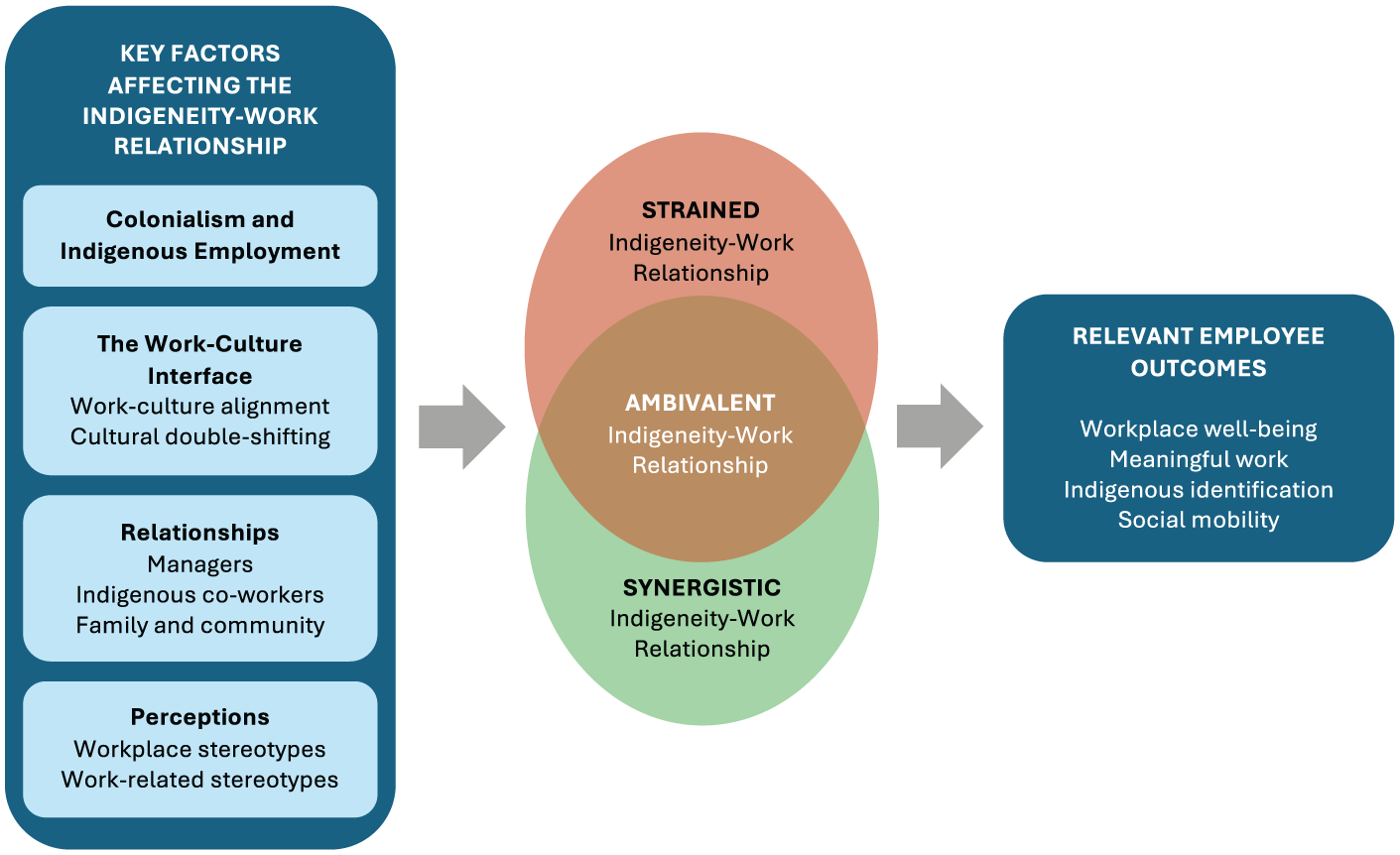
A map of Indigeneity-work relationships.
First, and most positively, some of the research depicts Indigenous employees’ work and Indigenous identity as existing in a synergistic relationship, such that the two infuse meaning and/or facilitate evolution in one another. As outlined in our discussion of work-culture alignment, and family and community relationships, Indigenous employees often seek careers that facilitate them working toward positive outcomes for Indigenous groups or communities (Fleming et al., 2013; Lahn, 2018; Lucas et al., 2014; Oates and Malthouse, 2021; Staniland et al., 2021; Wilson and Baker, 2012). These kinds of careers can promote a synergistic relationship between Indigeneity and work, where one’s Indigenous identity renders their work highly meaningful (Conway et al., 2017), positively influencing motivation, belonging, and well-being. Conversely, progressing Indigenous causes and communities through one’s work can also facilitate a reinforcing feedback loop that further validates and strengthens one’s Indigenous identity (Mercier et al., 2011; Morven and Cunningham, 2019; Stewart et al., 2017). However, as noted by studies of meaningful work more generally (Cardador and Caza, 2012), a synergistic relationship between one’s work and Indigenous identity is not without challenges. Indeed as we observed in our coverage of family and community relationships, as well as work-related stereotypes, a synergistic Indigeneity-work relationships can make it difficult for Indigenous employees to maintain work-life balance, because strong identification with both can blur the boundaries between “work” and “life” (e.g., Gould, 1999; Oates and Malthouse, 2021).
A second kind of Indigeneity-work relationship evident in the literature depicts Indigenous identity and work in tension with one another, resulting in a strained relationship. As canvassed in the first two sections of this review, the enduring effects of colonialism can lead Indigenous employees to feel that their work leaves little room for them to express (or even actively suppresses) their Indigenous cultural values, beliefs, and practices (Burke, 2018; Gould, 1999; Staniland et al., 2020, 2021; Wilson and Baker, 2012). At the other extreme, excess (or poorly considered) requests for cultural labor can also be a source of strain for Indigenous employees (Haar and Martin, 2022), as can the broader issue of co-workers engaging with one’s Indigeneity in instrumental or inauthentic ways (Lahn, 2018; Mercier et al., 2011; Morven and Cunningham, 2019). Finally, adverse workplace stereotypes can also contribute to a strained Indigeneity-work relationship by making workers feel pressure to constantly prove their competence, and/or disprove their deviance (Day et al., 2004; Fleming et al., 2013; Haar, 2023; Morven and Cunningham, 2019).
We emphasize, though, that for many—perhaps even most—Indigenous employees, the relationship between work and Indigenous identity is not uniformly synergistic nor strained, but a mix of both—and thus ambivalent. Much of this ambivalence stems from the fact that both work and identity are multifaceted, meaning that one can perceive different aspects of their Indigenous identity as more-or-less aligned with different aspects of their work (e.g., Caron et al., 2020; Cherney and Chui, 2010; Oates and Malthouse, 2021). Indeed, in Mercier et al.’s (2011) study of Māori academics, while many lamented their universities as inhospitable organizational environments for Māori, many also spoke of the deeply rewarding experience of supporting and educating Māori students. Similarly, Day et al. (2004) highlight the positive impact of Aboriginal and Torres Strait Islander staff representation across criminal justice agencies in Australia, but also the continued challenges for such staff in the form of high demands from Indigenous clients and families, as well as instances of personal and systemic discrimination. Such accounts help to illustrate that the relationship between Indigenous identity and work is rarely a singular narrative of harmony or hardship, and more often a complex story of lived ambivalence.
Contributions to knowledge
In the not-too-distant past, a review of scholarly research on Indigenous employees would have been impossible, simply because studies focusing on this global collective were so rare. That we have been able to explore the preceding issues in depth attests to the efforts of all the researchers who have worked to build this body of knowledge into what it is today. The relative youth of the literature also means that the primary contribution of our review does not take the form of highly delineated contributions to longstanding theories that one would typically highlight at this point in an article (Prasad, 2023b), simply because specific theories regarding Indigenous employees are yet to emerge. Indeed, research on Indigenous employees to date has mostly tended toward thick description of lived experiences, which seems entirely appropriate given the longstanding invisibility of such experiences across the social sciences. Given these considerations, we see the primary contribution of our work as synthesizing (based on a range of existing evidence) certain conceptual “building blocks” for developing dedicated theories about Indigenous experiences of work in future research. We hope the concepts canvassed and introduced in this article (e.g., Indigeneity-work relationships, work-culture alignment, work-community integration), all of which are grounded in empirical evidence, provide a conceptual language for beginning to theorize the distinct experiences, patterns, and processes that characterize Indigenous work lives. In setting this theoretical foundation, our review also helps answer broader calls to make management and organizational scholarship more reflective of the diverse workforces of modern organizations (Dar et al., 2020; Nkomo, 2021).
Constructive critiques and future research
We now turn to identifying priorities for future research on Indigenous employees across two steps. First, we revisit our research question (how does being Indigenous shape life at work?) from a more critical standpoint, and explain how future research could seek to “constructively complicate” two key notions embedded within it—“being Indigenous” and “at work.” Second, we highlight a need for future research to balance the goal of deeply understanding Indigenous work experiences on the one hand, with the need for more solution-focused studies of how to enhance Indigenous work experiences on the other.
Constructively complicating Indigeneity
The studies we reviewed showcase the pluralism in how Indigenous employees experience the intersection of their work and Indigenous identities. Yet across the studies, we noticed much less engagement with the pluralism of Indigenous identities themselves. Indeed, we sensed an implicit assumption in the research that Indigenous identities tend to be highly central to Indigenous employees’ overall sense of self, and therefore a primary lens they use to make sense of their work lives. Further, while studies regularly acknowledge the severing effects of colonization on Indigenous Peoples’ connection to land, culture, and communities, there is relatively less engagement with how these effects shapes employees’ own Indigenous identities, and with what consequences for their work lives. For example, we encountered few studies that deliberately focused on Indigenous employees who identify less strongly with, or attach alternative meanings and values to their Indigeneity, as well as those who—whether by choice or circumstance—have limited connection with Indigenous culture or communities.
Considering these observations, we encourage future research to explore the pluralism that exists in how Indigenous employees relate to their Indigeneity, and the consequences of this pluralism for work lives. Stewart et al.’s (2017: 556) qualitative study of Native American business leaders provides helpful inspiration in this regard as they carefully explore the different ways leaders understand their Native American identity (e.g., one participant remarked: “I’ll be honest, I have almost zero traditional knowledge. I have more of a heart for the people than I would have in practicing traditional Native-type things”). Further, and though not focused specifically on employees, Houkamau and Sibley’s (2015) Multidimensional Model of Māori Identity and Cultural Engagement (MMM-ICE), and associated psychometric scale, demonstrates one way of capturing the various nuances of Indigenous identities, even in quantitative studies.
In addition to canvassing a more diverse range of Indigenous identities, we also noticed that studies rarely consider how Indigeneity interacts with other identities to shape one’s experience of work. Intersectional frameworks have exposed the ways in which multiple identities and social positions intersect to produce qualitatively different experiences of both privilege and oppression (Dy et al., 2017), yet there is still limited understanding of how Indigenous identities intersect with identities related to gender, class and sexuality, as well as physical, mental, emotional, and spiritual capacities. As one example, our review demonstrates a growing but still comparatively small body of literature on the employment experiences of Indigenous women (e.g., Clark et al., 2022; LaBelle, 2015; Mills and McCreary, 2006). Like Indigenous employees generally, Indigenous women are overrepresented in low quality jobs, but they must also navigate both colonial and patriarchal structures that shape their workplaces and influence their communities (Baruah and Biskupski-Mujanovic, 2023; Clark et al., 2021), as well as distinct pressures from within their communities (e.g., Indigenous women taking on wage earning responsibilities to support their families may sometimes be viewed as a threat to community interests; Baruah and Biskupski-Mujanovic, 2023; Parmenter and Drummond, 2022). How do Indigenous women navigate these challenges, and with what consequences for both their personal and professional outcomes?
Finally, we also advocate for researchers to explore how Indigenous employees’ additional racial and/or cultural identities shape their work lives. In reviewing the literature, we noticed that researchers commonly depict Indigenous and non-Indigenous as mutually exclusive identity categories, a heuristic that simplifies research, but does not grapple with the fact that many—sometimes even the majority—of an Indigenous population also have non-Indigenous identities. There is a longstanding literature on multiculturalism (Vora et al., 2019), and we encourage more research to leverage insights from this literature to explore how multiracial and multicultural Indigenous employees’ experience their work. For example, future studies could explore how work is implicated in interactions or conflicts between one’s Indigenous and other cultural/racial identities, as well the work implications of having a less obvious or “visible” Indigenous identity (e.g., Al-Asfour et al., 2021).
Constructively complicating work contexts
In addition to complicating our understanding of Indigeneity, we also encourage future research to better account for the complex landscape of organizational contexts in which Indigenous employees work. Through our review, we noticed that existing studies overwhelmingly focus on Indigenous employees working in broadly mainstream contexts, with public sector organizations (e.g., Alang et al., 2022; Brougham and Haar, 2013; Lahn, 2018) and companies that profit from Indigenous-controlled land or resources (e.g., mining companies; Caron and Asselin, 2020; Caron et al., 2020; Parmenter and Barnes, 2020) being especially common. A focus on mainstream work contexts is understandable given how many Indigenous people find work in them, and might also explain why accounts of strained Indigeneity-work relationships are so common in the literature.
Few studies, however, have substantively explored the experiences of Indigenous employees in Indigenous work contexts (Eva et al., 2024; Kuntz et al., 2014). Our review findings highlight at least three explanatory mechanisms as to why Indigenous work contexts can enhance Indigenous employees’ experience of work: (1) a majority Indigenous workforce (Hunter, 2015; Proulx et al., 2020); (2) a high degree of work-culture alignment (Kuntz et al., 2014); and (3) a high level of integration with Indigenous communities (Eva et al., 2024). However, these mechanisms are yet to be tested empirically and represent a valuable direction for future research (e.g., via carefully designed studies of Indigenous employees working in mainstream vs. Indigenous contexts). Conversely, some studies hint at the potential strains of working in Indigenous organizations (e.g., the emotional toll of intensive engagement with one’s own communities, the blurred boundary between work and personal life). We thus caution against the notion that working in Indigenous contexts is any kind of guarantee of a synergistic Indigeneity-work relationship—or inoculation against a strained one—and encourage future studies to engage with this more critical perspective.
The need for solution-focused studies
Our impression is that the literature on Indigenous employees to date has mostly focused on exposing the difficulties this group encounters in and around work. Yet our review shows that certain common challenges that Indigenous employees encounter (e.g., work-culture misalignment, cultural double-shifting, adverse workplace and work-related stereotypes) have now been repeatedly documented by multiple studies, spanning a range of Indigenous groups.
Looking ahead, then, we encourage scholars to undertake research focused on identifying and testing effective solutions to these common challenges. Although the cross-sectional (quantitative and qualitative) research designs that are currently dominant in the literature can also help with this goal, such designs are somewhat limited when the focus is on capturing the precise extent of the impact of certain interventions on relevant employee outcomes (e.g., well-being, Indigenous identification, social mobility). To this end, we encourage researchers to consider research designs that better facilitate such conclusions, including longitudinal studies, action research, comparative studies of workers in different work contexts, and intervention-based studies (e.g., field experiments). As part of these efforts, and to account for the fact that what constitutes “best practice” is context- and even person-dependent, we suggest that researchers carefully consider relevant moderators and boundary conditions.
We also see a need to deepen understanding of how to implement best practices in organizations. For example, the literature clearly highlights a need to reduce Indigenous employees’ encounters with harmful stereotypes (e.g., Al-Asfour et al., 2021; Lahn, 2018). But what are the best ways to make this happen? Some studies point to implicit bias and cultural awareness training for non-Indigenous employees as a potential solution (Fleming et al., 2013), but given the variable efficacy of and complexities involved in actually implementing such training (Parmenter and Trigger, 2018), are there certain critical attributes that such training must include to boost its likelihood of success? As another example of an implementation dilemma, several of the studies we collected highlighted the harm Indigenous employees can endure due to backlash from non-Indigenous staff when an organization implements Indigenous-focused initiatives (Fleming et al., 2013, though see Haar et al., 2024). What, then, is the best way of mitigating this backlash risk, whilst still ensuring the initiative delivers its intended value for Indigenous employees?
All such efforts should proceed from the understanding that—as highlighted at the outset of this review—many of the challenges Indigenous employees encounter at work are symptoms of deeper structural issues facing Indigenous Peoples. Thus, while we certainly see a need for more solution-focused research, research that documents the workplace manifestations of the deeper structural issues facing Indigenous Peoples remain valuable, given their potential to influence broader policy and legislative decision-making, and ultimately facilitate Indigenous thriving and self-determination.
Conclusion
Our review highlights the range of ways that Indigenous employees’ work lives are shaped by the enduring impacts of colonialism, (mis)alignment between work and Indigenous cultures, relationships within and beyond the workplace, and others’ perceptions of both their Indigeneity and their work. From a practical standpoint, enhancing Indigenous work experiences requires action across all of these domains, namely: better jobs (e.g., equitable, secure, and meaningful roles), better management (e.g., culturally competent and policy-aware managers), better work environments (e.g., organizing systems that value relationality as well as results), and better personal strategies (e.g., equipping Indigenous workers with tools for navigating requests for cultural labor). Progressing these goals is not only likely to improve outcomes for Indigenous employees, but also further expose the limits of received ways of organizing, and thus, heighten our ability to reimagine work in ways that uplift and empower all.
Footnotes
Acknowledgements
We are deeply grateful to associate editor Ajnesh Prasad and the two peer reviewers for helping us to realize this manuscript’s full potential.
Funding
The authors disclosed receipt of the following financial support for the research, authorship, and/or publication of this article: Wellington School of Business & Government, Victoria University of Wellington, Early Career Researcher Support Grant; Royal Society of New Zealand, Marsden Grant (MFP-MAU2404, He kaupapa whakapakari kaimahi hou: Equipping young Māori workers to navigate cultural double-shifting).
AI usage declaration
The authors acknowledge that they have followed Human Relations’ AI policy. Accordingly, AI was used only for copy editing or proofing the manuscript, and for assistance with literature collection (see the “Article Collection” section for further details).
