



Abstract
How do we further enrich our understanding of multilevel dynamics, particularly in strategic human resource management (HRM) research? Organizational policies and practices, such as strategic HRM practices, are subject to influence from internal organizational factors and external factors, affecting organizational outcomes at various levels, including individual, team, organizational, and societal levels of analysis. Therefore, the field of strategic HRM is inherently multilevel. However, how HRM systems are conceptualized in multilevel studies, and how such studies attempt to theoretically connect HRM systems to their antecedents and outcomes at different levels of analysis, is still unclear. The present paper poses the question: to what extent do multilevel HRM system studies provide a coherent theoretical justification for the HRM system conceptualization, and are the proposed HRM system multilevel linkages coherently explained with theoretical reasoning? This question is answered through a systematic review of 112 studies. The results reveal strong theoretical diversity in explaining the HRM system construct, primarily at the organizational level, and its predominantly multilevel situational mechanisms. Moreover, the analysis indicates great potential for enhancing the quality of multilevel theorizing in strategic HRM. This paper advances strategic HRM research by systematically mapping and advancing theoretical discourses on the multilevel nature of HRM systems.
Keywords
Introduction
Over the years, the management literature has highlighted the importance of conducting research that connects the macro and micro domains (Paruchuri et al., 2018). Scholars argue that addressing complex management challenges requires cross-boundary efforts that integrate multiple levels (Kozlowski and Klein, 2000). Multilevel research, incorporating both macro and micro perspectives, can elevate the relevance of management studies by generating insights into unique organizational phenomena that are central to our understanding of organizations and individuals (Paruchuri et al., 2018). Advances in the availability and accessibility of multilevel analytical techniques, such as multilevel structural equation modeling, hierarchical linear modeling, and their variants, have encouraged many management scholars to engage in multilevel projects (Cowen et al., 2022; George et al., 2016). This type of research not only involves conducting more complex analyses but also necessitates the development of theories that span different levels (Cowen et al., 2022). However, researchers often tend to draw from the logic of theories from single-level studies, without adequately explaining their logic across different levels. This is problematic, as it could result in missed opportunities to gain a deeper theoretical understanding of complex organizational phenomena. Even worse, it could amount to reductionism or lead to inappropriate assumptions about the nature of the issue, its cause, and solutions (Cowen et al., 2022; Paruchuri et al., 2018).
Strategic human resource management (HRM) scholarship is a prime example of a field where multilevel theorizing is essential but is often conflated with multilevel modeling, meaning the analysis is used to justify the proposed hypotheses instead of the theory (Ployhart and Hendricks, 2019). Strategic HRM scholarship is defined as “. . .the study of HRM systems (and/or subsystems) and their interrelationships with other elements comprising an organizational system, including the organization’s external and internal environments, the multiple players who enact HRM systems, and the multiple stakeholders who evaluate the organization’s effectiveness and determine its long-term survival” (Jackson et al., 2014, p. 2). Key in this definition, and those of other seminal research (e.g., Delery and Shaw, 2001; Wright and McMahan, 1992), is that HRM systems reflect different stakeholders interests and experiences of a set of interrelated HR practices, and evolve in interaction with external environments (e.g., labor market conditions, trade unions), in which the impact of any given practice is influenced by the others in the system (Delery, 1998; Gerhart, 2007; Jiang et al., 2012). In turn, HRM systems are interrelated with other internal and external elements of organizations, including organizational performance and effectiveness, and social conditions beyond the organization itself (Combs et al., 2006; Jackson et al., 2014). Strategic HRM is therefore shaped by both internal organizational factors and external environmental interdependencies, spanning individual, team, organizational, and societal levels. This makes the field of strategic HRM inherently multilevel in nature (Ackoff, 1981; Kozlowski and Klein, 2000; Ostroff and Bowen, 2000; Renkema et al., 2017). This multilevel nature of HRM is evident in the growing body of research exploring the plethora of factors that shape HRM practice adoption in organizations (Paauwe and Farndale, 2017) and the enactment of HRM practices and their impact on performance across these different levels of analysis (Jiang and Messersmith, 2018; Peccei and Van de Voorde, 2019). Investigating such cross-level effects between micro and macro domains with respect to HRM practice emergence and their effects is therefore crucial for capturing the complexity of strategic HRM.
While multilevel research has gained momentum over the past decade in HRM research (e.g., Marescaux et al., 2021; Peccei and Van De Voorde, 2019; Shen, 2016; Shen et al., 2018), several theoretical challenges remain. A first major challenge is that, despite the adoption of multilevel approaches, many strategic HRM studies have only partially integrated theoretical multilevel principles (Paruchuri et al., 2018; Renkema et al., 2016, 2017). Studies often justify the use of multilevel analysis, using their analytical framework as a starting point while incorporating no or very limited multilevel theorizing to underpin their conceptualization of HRM and their related proposed linkages (Cowen et al., 2022; Renkema et al., 2017). This is problematic, as without adequate theoretical integration across levels, our understanding of the antecedents of HRM systems, as well as the interrelations between HRM systems, pertinent outcomes, and contingency factors, remains constrained (Boon et al., 2019; Guest, 2025; Hitt et al., 2007; Jiang and Messersmith, 2018; Peccei and Van De Voorde, 2019; Renkema et al., 2017). This could amount to an inability to comprehend different empirical results across studies in their totality or a lack of clear guidance on where theory refinement or generalization is necessary, depending on the level of analysis studied (Chen et al., 2005). For example, some multilevel studies have found that HRM systems negatively impact employee satisfaction (Akdere, 2009), whereas single-level research has identified a positive relationship between the two (Boon et al., 2011). Understanding such differences in similarly proposed relationships and the theoretical reasons for such differences is therefore essential. We aim to address this challenge by examining the current state of play in multilevel HRM studies, specifically regarding the articulation and theoretical justification of the level at which the HRM system is conceptualized and its proposed linkages.
Second, researchers in strategic HRM historically used macro-level theories as frameworks to explain the influence of HRM systems on organizational performance, inspired by industrial relations and strategic management perspectives (Budd, 2020; Kaufman, 2020). Macro research often overlooks the role of individual experiences and reactions to the implemented HR practices in contributing to higher-level outcomes, thereby running the risk of “superficiality and triviality inherent in anthropomorphizing: organizations do not behave; people do” (Kozlowski and Klein, 2000, p. 5). More recently, strategic HRM scholars have shifted their attention more to psychological explanations for how HRM systems influence employee experiences, attitudes, and behaviors (i.e., employee-centered HRM). However, it has been posited that this stream of HRM research is too dominated by psychological perspectives and thereby “reduce explanation of macro-level HRM outcomes to within-person psychological/behavioral constructs, processes and states and their cross-person differences” (Kaufman, 2020 p. 50). The risk here is that, in multilevel HRM research, either macro-level theories (e.g., resource-based view) or individual-level psychological theories (e.g., the job demands-resources (JD-R) model, social cognitive theory) are dominant, which hinders a more comprehensive understanding of the organizational outside and inside multilevel dynamics in strategic HRM (Cowen et al., 2022; Paruchuri et al., 2018). We zoom in on this issue by examining the current state of play in multilevel HRM studies with respect to the theorizing of multilevel HRM system linkages. In particular, our review will decipher to what extent a “purely” macro or micro theory focus of HRM is apparent in multilevel theorizing and offer solutions about how the macro and micro levels can be better integrated theoretically.
In acknowledgment of these challenges, and in particular what we know with respect to the macro versus micro level, there have been calls for a more multidisciplinary, multilevel, and multistakeholder approach in strategic HRM research that emphasizes the need for better integration of multilevel theorizing (Jiang and Messersmith, 2018; Shen et al., 2018; Troth and Guest, 2020). In response to these calls, the specific research question that the present study seeks to answer by way of a review is as follows: To what extent do current multilevel HRM system studies provide a coherent theoretical justification for the HRM system conceptualization, and are the proposed HRM system multilevel linkages coherently explained with theoretical reasoning?
Our review contributes to the (strategic human resource) management literature in the following ways. First, we apply specific criteria derived from the literature on multilevel theorizing (Paruchuri et al., 2018) to systematically assess the extent to which empirical studies on HRM systems, analytically connecting at least two levels, coherently connect these different levels of analysis theoretically. Hereby, we first assess the extent to which the level at which the HRM system is conceptualized is clearly articulated and coherently theorized. Subsequently, we map the current field of multilevel HRM systems studies in terms of the theories used to underpin the cross-level linkages. We not only focus on the outcomes of HRM systems and employee-related mechanisms, as prior overview work has done (Peccei and Van De Voorde, 2019), but also incorporate the antecedents of HRM systems and the role of HRM systems as contingency factors. Specifically, based on Coleman’s boat (Coleman, 1990), an established model that explains how micro-level social phenomena both influence and are influenced by macro-level phenomena, we group theories that are used to explain situational mechanisms (i.e., how macro-level phenomena influence micro-level phenomena) and transformational mechanisms (i.e., how micro-level phenomena influence macro-level phenomena). Building on the work of Renkema et al. (2016, 2017), which provides directions for multilevel theorizing and advanced crucial ideas related to multilevel thinking in HRM research, we especially zoom in on the adoption of multilevel theorizing, which has been argued to be crucial in realizing the value of integrating macro and micro approaches (Cowen et al., 2022; Jiang and Messersmith, 2018; Shen et al., 2018). While Renkema et al. (2016) provided an inventory of theories used to connect different levels in research studying HRM systems, the present study departs from this work by executing a critical review to ascertain the coherence of the specific theories adopted to explain the relevant multilevel link. Such a “thought-provoking synthesis” (Ogbonnaya and Brown, 2023, p. 368) is necessary to strengthen theorizing across different levels of analysis and is thereby critical in terms of advancing research on strategic HRM (Peccei and Van De Voorde, 2019), and by extension, the broader multilevel management literature.
Second, we develop a novel framework to advance multilevel theorizing in strategic HRM research, with theories used in extant literature to underpin the different multilevel relationships. This framework builds on our evaluation and serves as an initial point of departure for theoretical integration across levels in future research. Our study recommends key best practices to ensure that future studies investigating a multilevel approach to HRM systems, and more broadly, organizational phenomena, can contribute to a more substantive understanding of them. This will enable future strategic HRM research to more coherently theorize on the relevant levels and embark on multilevel investigations that yield advances in our knowledge and contribute to improvements in the field of strategic HRM (Donnelly and Hughes, 2023).
Background
The multilevel nature of HRM systems
HRM systems encompass a set of HR practices often involving intensive recruitment and selection, training and development, job security, involvement in decision-making, teamwork, and rewards linked to performance (Pfeffer, 1995; Subramony, 2009). Such practices are seen as part of a strategic approach to the management of employees. That is, they are designed to attract, motivate, and retain them, thereby offering the organization a competitive advantage over rivals (Barney, 1991; Gerhart and Feng, 2021). There are two primary ways of understanding the role of HRM practices in terms of their impact (c.f. Ogbonnaya and Aryee, 2021). The first approach is the isolationist or “practice-based approach” whereby it is argued that HR practices should be considered separately as they do not have a reinforcing effect. The second and more predominant “mainstream” approach is the “systems approach.” Conversely, this approach highlights that HR practices should be considered as a coherent bundle or system of practices that work together synergistically to impact various employee and organizational outcomes (Gerhart, 2007). In line with this view, it is the whole system, rather than the sum of its parts, which is required to enhance employee and organizational outcomes. Meta-analytic research has shown that HRM systems are linked to a wide range of positive organizational performance outcomes (e.g., Subramony, 2009). This has also been confirmed across longitudinal studies, additionally showing that a system of HRM practices has a stronger impact on organizational performance than do HRM practices individually (Saridakis et al., 2017). As such, for the present review, we focus on the systems approach to HRM.
HRM systems have been conceptualized and studied at various levels of analysis in existing empirical research (Boon et al., 2019; Renkema et al., 2017). Following the strategic HRM process model developed by Nishii and Wright (2008) and the work by Bowen and Ostroff (2004), these HRM systems can be broadly classified into four different types of HRM systems. At the organizational level, these systems represent the organization’s intentions regarding the HR practices they plan to implement. At the group level, the HRM systems reflect the actual HR practices that line managers have implemented. At the individual level, employees’ perceptions of these HR practices illustrate their personal experiences and reactions to the implemented HR practices. Furthermore, when employee perceptions and interpretations of HR practices are shared at the organizational or group level, they form what is known as collective employee perceptions of the HRM system. As such, HRM systems can have different meanings at different levels, encompassing intended, implemented, and collectively and individually perceived HRM systems. Therefore, explicitly articulating and theoretically justifying at which level the HRM system is conceptualized is crucial (Boon et al., 2019; Kozlowski and Klein, 2000; Paruchuri et al., 2018). Nevertheless, understanding HRM systems is complex, given that they contain numerous antecedents and relevant outcomes while at the same time containing multiple levels of analysis and interrelated HR practices. As a result, multilevel research into the factors that shape HRM practices and their implications has been especially called for in the field of strategic HRM (Ostroff and Bowen, 2000; Renkema et al., 2017; Shen et al., 2018).
Coleman’s boat: A classic macro–micro model
To categorize the multilevel antecedents and consequences of HRM systems, the present study draws on Coleman’s boat (1990), also referred to as Coleman’s “framework,” “diagram,” or “bathtub,” a popular sociological model that explains how micro-level social phenomena both influence and are influenced by macro-level phenomena. While this model has received some criticism for its methodological individualism (i.e., the idea that all social phenomena can be explained through individual actions) and its focus on mechanism-based social explanations (Ramström, 2018; Van Bouwel, 2019), Coleman’s boat still stands as an important multilevel framework due to its intuitive nature, flexible use, and visual representation of complex cross-level relationships (Cowen et al., 2022).
Coleman’s boat (1990), later reworked by Hedström and Swedberg (1996), suggests that cross-level relationships can be broadly classified into two types based on the direction of the linkages involved. The first type of cross-level relationships referred to by Coleman (1990) as situational mechanisms, involves “general social mechanisms that in a systematic and reasonably precise way link a social structure or other macro-sociological state to the beliefs, desires, and opportunities of individual actors” (Hedström and Swedberg, 1996, p. 297), or put simply, how macro-level phenomena influence micro-level phenomena. Situational mechanisms play a central role in HRM process thinking in strategic HRM, where organizational-level intended HRM systems impact implemented HRM systems at the group level, which, in turn, affect individual attitudes and behaviors by influencing employee perceptions of HRM systems (e.g., Den Hartog et al., 2013). Other strategic HRM-related situational mechanisms that have been explored involve, for example, the shaping of organizational HRM systems by macro external factors (Zhang et al., 2019). In addition, how HRM systems affect the relationship between organizational and individual characteristics has also been examined in prior research (Batistič et al., 2022).
The second type, described by Coleman (1990) as transformational mechanisms, pertains to how “individual actions are transformed into a collective outcome, sometimes unintended and unexpected by all actors” (Hedström and Swedberg, 1996, p. 297) or how micro-level phenomena influence macro-level phenomena (Klein and Kozlowski, 2000). Kozlowski and Klein (2000) propose two types of processes through which individual perceptions of HRM aggregate and coalesce at the organizational or group level, subsequently impacting unit-level outcomes: composition and compilation-based emergence processes. The composition type is connected to HRM process thinking in strategic HRM, as employee-perceived HRM systems are asserted to affect collective employee and organizational performance outcomes by influencing employee attitudes and behaviors (e.g., Vermeeren, 2014). An example of a compilation-based type is that the impact of collective employee perceptions of HRM systems on group outcomes may depend on the consistency of these perceptions among individuals within the group (i.e., HRM strength; Bowen and Ostroff, 2004).
Coleman’s boat (1990) also distinguishes two additional types of mechanisms: macro-level associations and action-formation mechanisms. The former refers to direct influences between two macro-level phenomena, while the latter refers to influences between two micro-level phenomena (Cowen et al., 2022). Since these types of mechanisms do not operate across levels and therefore are not cross-level in nature, we do not consider them further in this article. Nevertheless, in exploring the multilevel linkages of HRM systems, there is a need to specify the situational and transformational mechanisms involved using appropriate theories that effectively link the constructs at various levels (Cowen et al., 2022; Peccei and Van De Voorde, 2019).
Methodology
Study design, search strategy, and selection criteria
We performed a critical review (Ogbonnaya and Brown, 2023) to assess to what extent multilevel HRM system studies provide a coherent theoretical justification for the HRM system conceptualization, and whether the proposed HRM system multilevel linkage is coherently explained with theoretical reasoning, that is, adheres to the multilevel theorizing guidelines set out by Paruchuri et al. (2018) and Coleman (1990).
First, to identify relevant multilevel studies on strategic HRM, we searched for literature concerning multilevel studies on strategic HRM. Table S1 in the Appendix shows the search statement and keywords used. Our keywords were strongly based on prior strategic HRM reviews by Boon et al. (2019) and Renkema et al. (2017), including their acronyms and combinations. Relevant additions include “industrial relations” following Delaney and Godard (2001), as well as keywords for specific levels (e.g., “macro level”), methodological terms (e.g., “clustered,” “nested”), and “microfoundations” to capture the microfoundations movement in organizational theory (Cowen et al., 2022). We searched in the title, abstract, and keywords of articles on Web of Science and cross-checked with EBSCOhost and Scopus to include peer-reviewed studies (in English) published between 1999 and mid-January 2024. The starting year 1999 was chosen because this corresponds to the publication date of seminal works on multilevel research in management (Klein and Kozlowski, 2000; Klein et al., 1999) and HRM (Ostroff and Bowen, 2000; Wright and Boswell, 2002), with Ostroff and Bowen (2000) being considered one of the first multilevel papers on HRM. Moreover, this starting date corresponds to earlier multilevel reviews in the HRM literature (c.f. Peccei and Van De Voorde, 2019). The decision to restrict the search to peer-reviewed journal articles is based on our aim to cast a wide net while making claims based on research that adheres to good academic practice (Willmott, 2022).
We applied three inclusion criteria. First, studies had to focus on the exploration of strategic HRM, by which we mean HRM systems, such as high-performance, high-involvement, or high-commitment work practices or a general HRM system aimed at enhancing performance (Boon et al., 2019; Peccei and Van De Voorde, 2019). As such, we excluded studies that focus on single HR practices or specific, non-performance-related bundles (e.g., age-related HRM, green HRM). Second, studies had to conceptualize an HRM system and its related practices. Therefore, studies exploring HRM system features (e.g., HRM strength or HRM attributions) were not included. Finally, studies had to conduct multilevel empirical quantitative research, meaning that (1) multiple levels (at least two) are analytically researched (Klein and Kozlowski, 2000); (2) reviews, conceptual and qualitative studies, and meta-analyses are disregarded; and (3) the influence of strategic HRM should cross levels (i.e., excluding designs whereby multilevel techniques are only used to account for clustering, like 1-1-1 designs or where the HRM system is not involved in a cross-level relationship).
The decision to discount qualitative studies was based on several observations: (1) in empirical quantitative studies, the choice of methods and theories are strongly linked (Hassard et al., 2013), whereas qualitative studies often draw on different theoretical traditions (e.g., grounded theory); (2) not all qualitative multilevel studies self-identify as such (Köhler, 2024); (3) qualitative studies primarily investigate how the HRM system and other constructs operating at different levels interact and mutually reinforce each other (Makhecha et al., 2018; Najeeb, 2013), thereby departing from the predominant focus in strategic HRM, which typically employs unidirectional multilevel effects (i.e., situational and transformational mechanisms) as starting points for research (Renkema et al., 2016; Renkema et al., 2017). Taken together, in qualitative studies, having clearly defined levels is not always possible, and where they are clearly defined, the interpretation is focused on in-depth experiences and meaning, while allowing for the possibility of changing as opposed to predefined levels.
Our initial search yielded 1460 unique articles. Studies were screened, paying specific attention to the title and abstract to detect whether multilevel and strategic HRM are indeed central to the study. Next, we screened the method section, especially the sample description and analytical approach, to verify the use of an empirical multilevel approach. This yielded 195 articles for full-text review, out of which 83 articles were removed due to being out of scope. Common reasons for removal were that studies were not focusing on HRM systems or bundles (e.g., single HRM practices, they were focusing on job design/characteristics instead of HRM) or they were not being truly analytically multilevel (e.g., 1-1-1 designs and proto-multilevel designs). This resulted in a final sample of 112 articles. See Figure 1 for an overview of the identification and screening process.
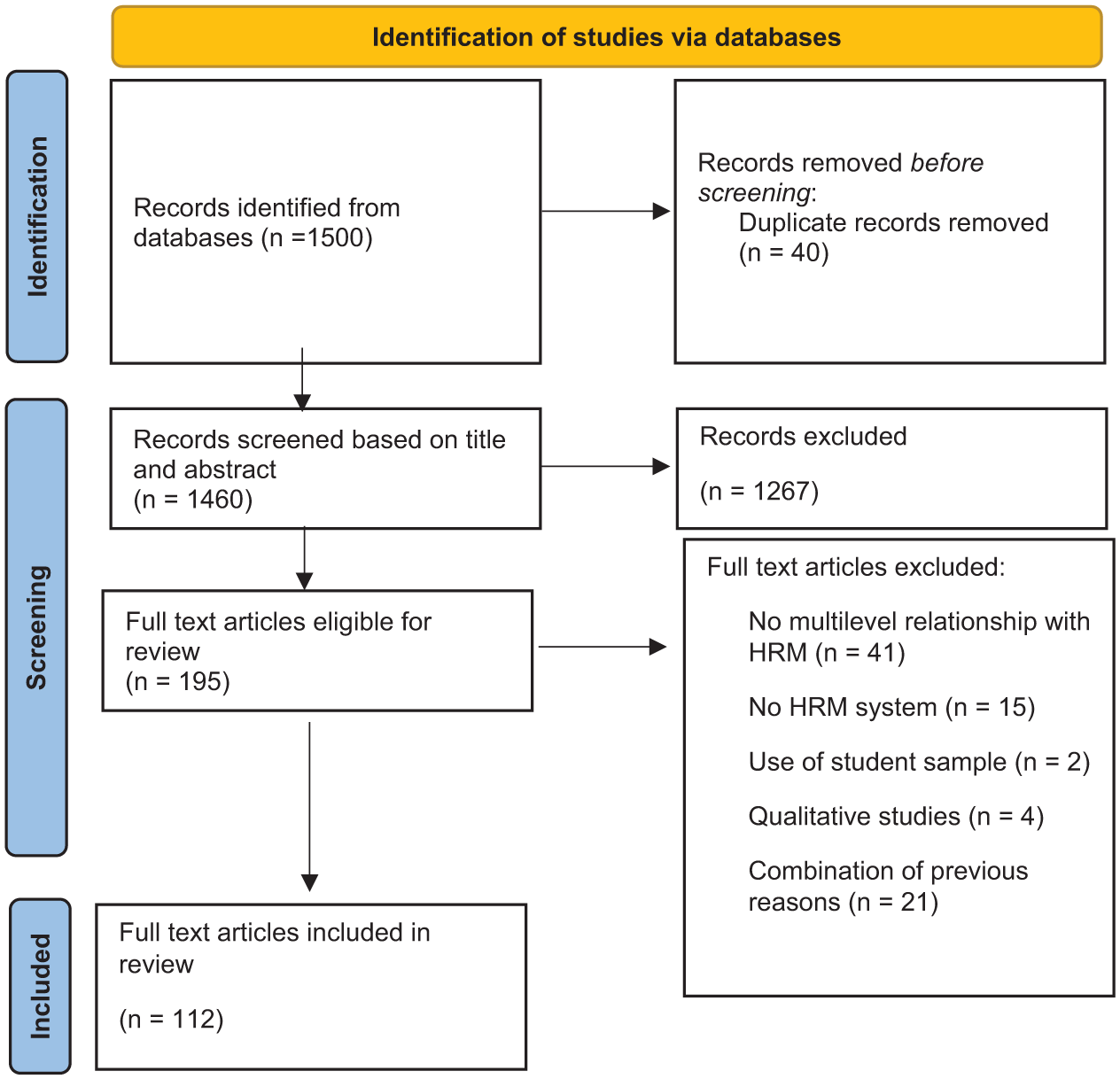
PRISMA flowchart of identification and selection of articles.
Study context
The included studies were published between the years 2001 and 2024, and the frequency of studies increased from 2016 onwards. In terms of country context, most studies were conducted in China (34.8%), Taiwan (12.5%), and Korea and the Netherlands (9.8% each). This indicates that the studies are not primarily dominated by the WEIRD (western, educated, industrialized, rich, democratic) countries and aligns with some recent reviews of the literature on international HRM (Kornau et al., 2020). In most cases, the studies collected data across multiple sectors (46.4%), while some studies focused on specific sectors, including the service sector (13.4%), the industrial sector (10.7%), and the financial sector (8.9%). An overview of the distribution of journals in which the studies were published is provided in Table S2 of the Appendix.
Our review includes 119 multilevel linkages that have been explored in these 112 studies. In multilevel research, variables are typically categorized based on their levels: those at the lower level are known as Level 1 variables, while those at the higher level are referred to as Level 2 variables. Regarding the specific relationships studied, we found that 84 out of 119 relationships included the HRM system as a Level 2 construct in relation to one (or more) Level 1 dependent variable(s). In addition, HRM was investigated as a Level 2 moderator in a cross-level relationship or a 1-1 relationship in 16 linkages. The HRM system was studied both as a Level 2 and Level 1 variable in 12 relationships, while three relationships examined an independent variable at Level 2 and the HRM system at Level 1. Finally, four relationships included the HRM system as a Level 1 variable in relation to one (or more) Level 2 dependent variable(s). In total, 10 studies were included that covered more than one of the above relationships.
Coding procedure
In developing our coding scheme, we applied criteria derived from the literature on multilevel theorizing (Paruchuri et al., 2018) and Coleman’s boat (Cowen et al., 2022). The first part of our research question focused on the theoretical justification for the HRM system conceptualization. This justification is also emphasized by Paruchuri et al. (2018), who argue that “research should clearly articulate the level at which each construct in a study is conceptualized (p. 799)” and that “. . .the decisions about the level of conceptualization and operationalizations should be theory-driven. . . (p. 799).” We therefore coded the type of HRM system used (i.e., high-performance work system (HPWS), high-involvement work system (HIWS), high-commitment work system (HCWS), and generic/unspecified HRM system), the theory used to explain the conceptualization of the HRM system, and the extent to which information was provided on the level at which the HRM system was conceptualized. Following multilevel theorizing criteria (e.g., Paruchuri et al. 2018), we subsequently evaluated the extent to which the conceptualization of the HRM system construct was explained at a certain level using appropriate theory. For instance, a study in which the HRM system was articulated at the organizational level, using a theory to explain the HRM system at an organizational level, was labeled as “coherently theoretically justified.” In case a theory was used to conceptualize the HRM system construct without explaining the level at which the HRM system was conceptualized, we labeled the study as “somewhat coherently theoretically justified.” Finally, in case no theory was used to explain the level at which the HRM system was conceptualized, we labeled the study as a “weak coherent theoretical justification.”
To answer the second part of the research question, whether the proposed HRM system multilevel linkages are coherently explained with theoretical reasoning, we coded the theories that have been used for HRM system cross-level theorizing, including the specific predictor(s) or outcome(s) studied in the multilevel link (Paruchuri et al., 2018). In doing so, we also distinguished between the different types of multilevel relationships in line with Coleman’s boat: situational mechanism (i.e., influence from macro-level to micro-level) or transformational mechanism (i.e., influence from micro-level to macro-level) (Cowen et al., 2022). To assess to what extent such theories are suitable and coherently explain the relevant multilevel relationship, we first went back to the initial theory and described it briefly, particularly focusing on the level at which the generalization of the theory/theoretical mechanism was intended. We then looked at the theoretical framework of the papers again, using the particular theory to assess whether the theory was applied accordingly or, if not a multilevel theory initially, whether it was applied as such (Paruchuri et al., 2018). Finally, we assessed whether the theory was applied as a multilevel theory by identifying whether a mechanism is proposed through which the levels are crossed/connected explicitly. This assessment is adapted from Paruchuri et al. (2018), who highlight that studies should be “. . .sensitive to or acknowledging the assumptions inherent in theorizing at each distinct level and explicitly reconciling the stated and unstated assumptions at each level (p. 799).” In this process, we identified all implicit assumptions made in the papers. As such, each paper was coded as 0 = cross-level mechanism not explained/no theory, 1 = mix of implicit and explicit assumptions used (with an open code to list the implicit assumptions), and 2 = mechanism clearly explained without implicit assumptions.
The studies were coded by the authors using a shared file. Any disagreements were discussed and resolved through consensus. As this way of working has interdependent rather than independent coders, it was not required to calculate the interrater reliability (O’Connor and Joffe, 2020).
Results
To what extent do current multilevel HRM system studies provide a coherent theoretical justification for the HRM system conceptualization?
In the 112 studies we examined, HRM systems have been conceptualized 123 times at roughly three different levels of analysis: the organizational, group (including team and department), and individual level. Table 1 indicates that the HRM system has primarily been conceptualized at the organizational (81 cases) and group levels of analysis (28 cases), at the detriment of the individual level of analysis (14 cases). Turning to the type of HRM system, Table 1 shows that a HPWS has been studied most often (73 cases), particularly at the organizational level (46 out of 73 cases) and group, including team and department, level (17 out of 73 cases). HCWSs, HIWSs, and HRM systems aimed at another type of performance and generic/unspecified HRM systems were conceptualized much less frequently (20, 12, and 18 cases, respectively).
Conceptualization of the HRM system at each level.
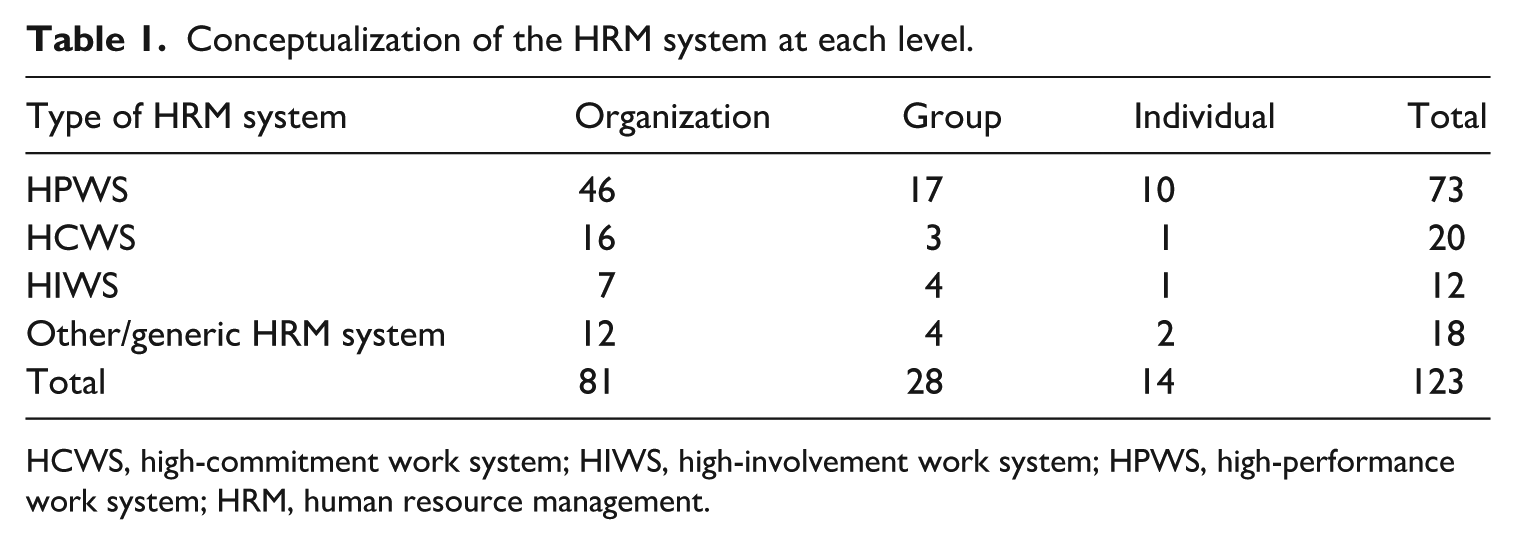
HCWS, high-commitment work system; HIWS, high-involvement work system; HPWS, high-performance work system; HRM, human resource management.
Next, we assessed the extent to which the conceptualization of the HRM system construct was explained at a certain level using appropriate theory. Figure 2 shows that overall, in the majority of cases (73 out of 123), the HRM system construct was defined coherently at its level of analysis by referring to one or more core theories. In a smaller number of cases (15 out of 123), the HRM system was somewhat coherently theoretically justified because one or more core theories were used to explain the HRM system construct, but no explicit theorizing was done regarding the level at which the HRM system was conceptualized. Finally, in a considerable number of cases (35 out of 123), a weak or no theoretical explanation for the conceptualized level of the HRM system construct was provided. Figure 2 also shows that these findings are relatively comparable across the three levels of analysis.
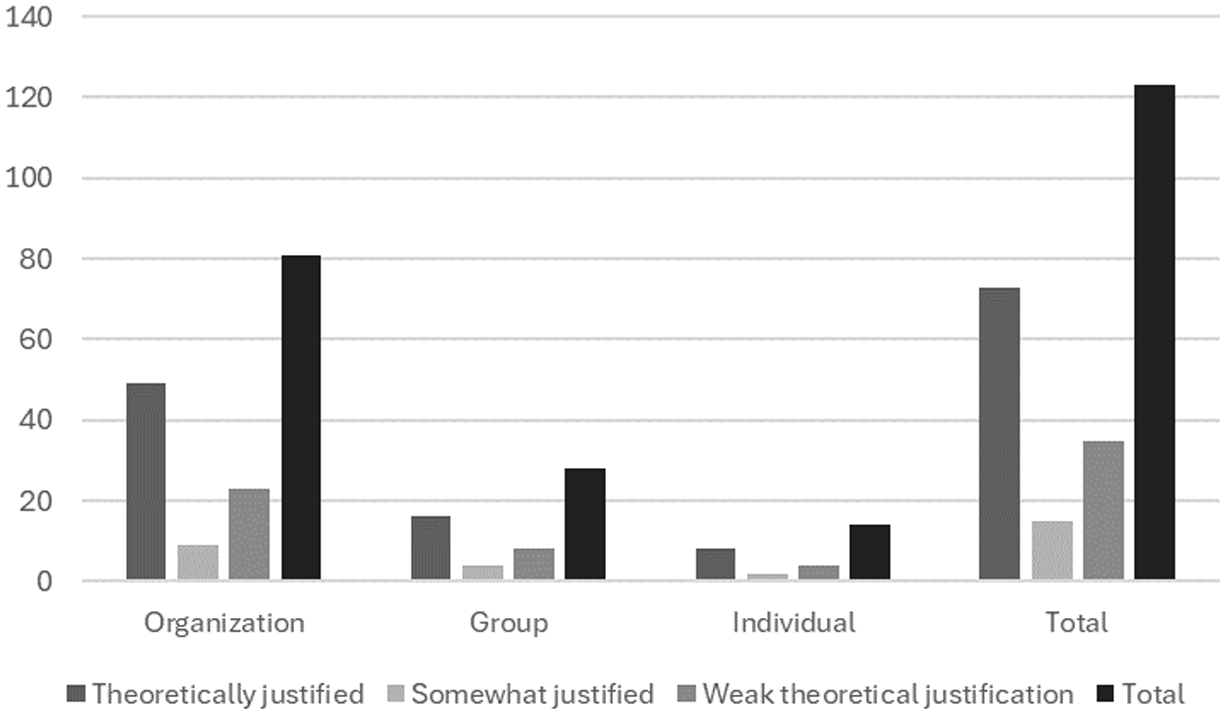
Coherency of the HRM construct conceptualization.
Taking a closer look at the specific theories used in the cases in which the level was coherently theoretically justified, we see that (sometimes in combination with other theories) the Ability, Motivation, Opportunity (AMO) model (29 cases) has been mostly applied, followed by the strategic HRM process model (18 cases), HRM system strength theory (8 cases), and social exchange theory (SET) (6 cases) (see Table 2).
Theories used to justify the level of HRM system conceptualization.
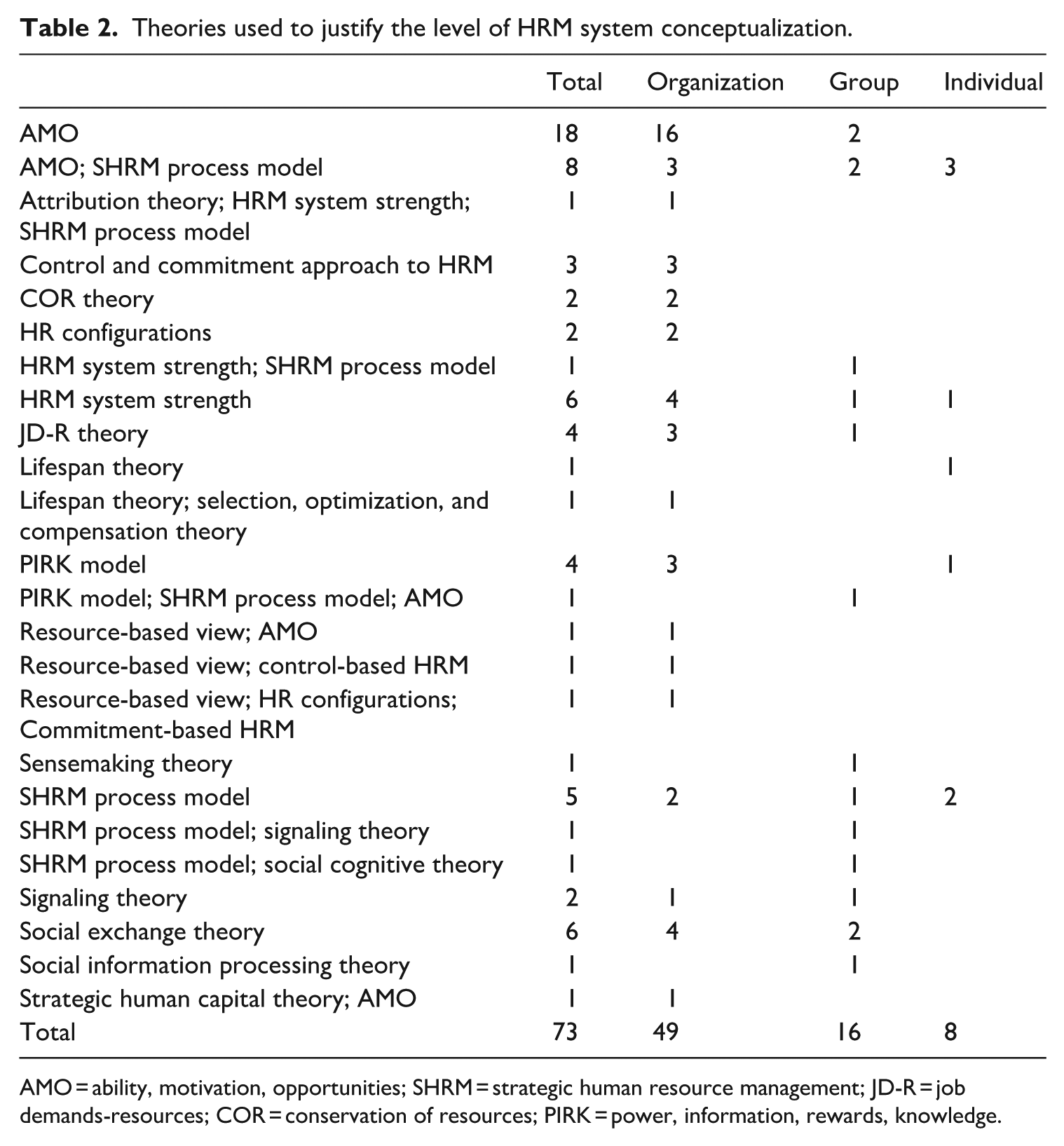
AMO = ability, motivation, opportunities; SHRM = strategic human resource management; JD-R = job demands-resources; COR = conservation of resources; PIRK = power, information, rewards, knowledge.
In the majority of organizational HRM systems conceptualizations, the AMO model has been referenced to explain the HRM construct. Following the AMO model (Appelbaum et al., 2001), studies argue that organizations seek to implement (high-performance) HR policies and practices that are grouped into three key dimensions: ability-enhancing HR practices (e.g., recruitment and training), which ensure that employees are hired and trained, motivation-enhancing HR practices (e.g., performance related pay) that motivate employees to work, and opportunity-enhancing HR practices (e.g., autonomy and information sharing) which support employees to participate and exercise their full potential (e.g., Kroon et al., 2009; Yunus et al., 2023). In the majority of group-level and individual HRM system conceptualizations, on the other hand, the strategic HRM process model developed by Nishii and Wright (2008) has been used to argue that the implementation of HRM systems by line managers and the employees’ perception of these implemented HRM systems are important concepts in linking intended HRM systems to organizational performance, thereby justifying exploring group-level implemented HRM systems and individual-level employee perceived HRM systems (e.g., Choi et al., 2019; Flinchbaugh et al., 2016; Kehoe and Wright, 2013).
In addition, following the theoretical underpinnings of the concept of HRM system strength (Bowen and Ostroff, 2004), it has been argued that the HRM system needs to send consistent and strong messages to employees, resulting in shared employee perceptions of HRM systems at the group and organization level (e.g., Chang, 2015; Ma et al., 2021). Furthermore, drawing from SET (Blau, 1964), research has conceptualized the HRM system as an organization’s mutual investment approach that is built on a reciprocal and social exchange relationship (e.g., Snape and Redman, 2010). The social exchange relationship is activated and thus implemented by line managers through such investment (e.g., Kim et al., 2023) and perceived by employees as a signal of organizational support and care.
To what extent are the proposed HRM system’s multilevel linkages coherently explained with theoretical reasoning?
In the 112 studies we reviewed, 119 HRM system multilevel linkages have been explored. Out of these 119 linkages, core theories were referenced for 109 of them to elucidate these proposed multilevel relationships. Table 3 provides a complete overview of all the main theories that have been applied to explain each linkage, distinguishing between those that involve situational mechanisms and those reflecting transformational mechanisms. Table 3 illustrates that SET is the most widely utilized theory for explaining multilevel links (20 linkages), followed by the AMO framework (9 linkages). Social information processing (SIP) theory, conservation of resources (COR) theory, the JD-R model, signaling theory, and social cognitive theory have also been frequently used to explain a cross-level link (8, 6, 5, 4, and 4 linkages, respectively). The strategic HRM process model and attribution theory have been used a few times as theoretical underpinnings of a proposed multilevel link (both 3 linkages). Finally, a significant number of linkages also drew on a combination of theories (14 linkages). SET was the most combined theory (6 linkages), followed by AMO (5 linkages) and signaling theory (4 linkages). These theories were most often combined, or with the COR theory.
Frequencies of main theories used per multilevel link.
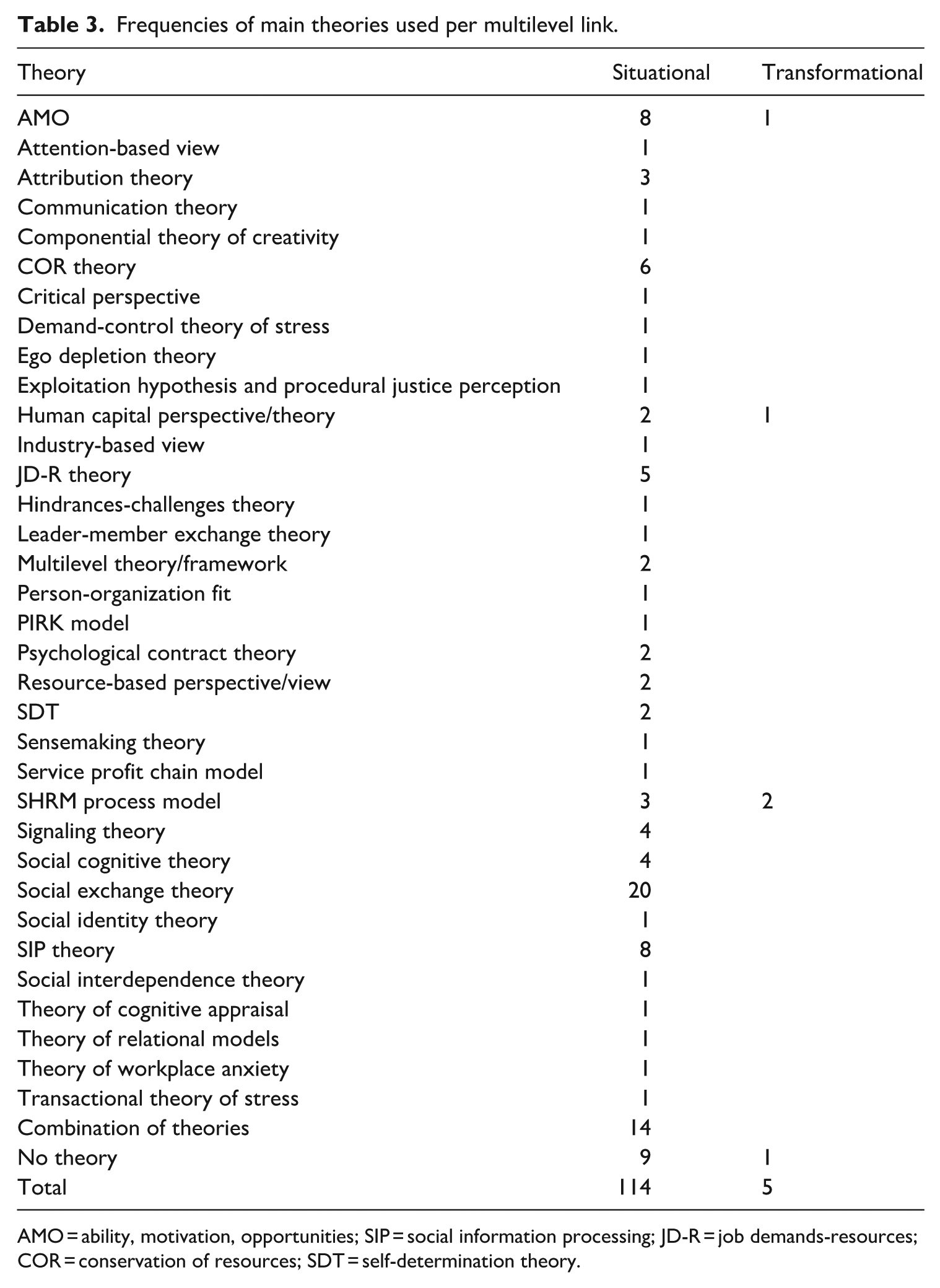
AMO = ability, motivation, opportunities; SIP = social information processing; JD-R = job demands-resources; COR = conservation of resources; SDT = self-determination theory.
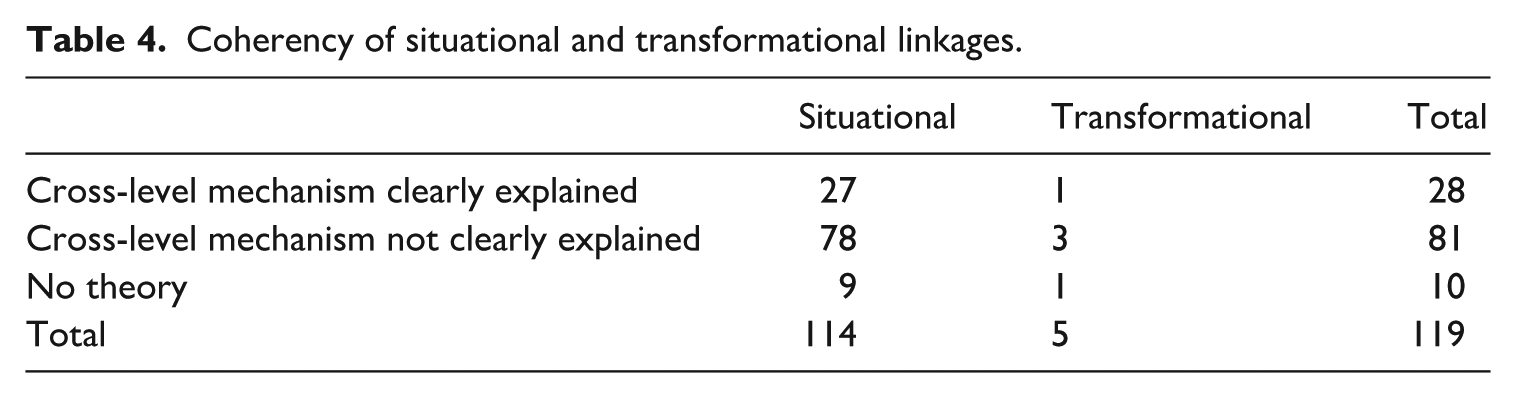
Next, we assessed to what extent these theories coherently explicate (i.e., clearly explain the cross-level mechanism without implicit assumptions) the relevant multilevel relationship by explicitly specifying the situational or transformational mechanisms in play. Of the 119 reviewed multilevel linkages, 114 linkages focused on the situational mechanism, and only 5 linkages focused on the transformational mechanism. Table 4 indicates that for most of the multilevel links that are substantiated with theory, the involved cross-level mechanism has been explained but only implicitly (81 out of 109 linkages), with a much smaller number of links where the cross-level mechanisms have been clearly explained (28 out of 109 linkages). Below, we provide a more detailed illustration of how the aforementioned theories have been applied to explain situational and transformational mechanisms. Although some other theoretical frameworks were very well suited to explain cross-level mechanisms for the specific outcomes studied (e.g., creativity; Huang et al., 2023), they do not provide additional theoretical insight for the cross-level effects of HRM systems at large and hence are not described here.
Coherency of situational and transformational linkages.
Theories used to explain situational mechanisms
First, applying the SET (Blau, 1964), it can be argued that when an organization invests in its employees through an HRM system, employees, in turn, perceive this investment and reciprocate by devoting equivalent effort toward achieving the organization’s goals. While SET focuses on the direct impact of the HRM system on employees’ attitudes and behaviors, the theory implies that these effects are mediated by how employees perceive the HRM system. Moreover, HRM system research implicitly assumes that the mechanisms of social exchange (e.g., perceived reciprocity and obligation) are universally understood and internalized by all employees in a similar manner, without considering individual differences in the interpretation of the HRM system among employees.
Our review reveals that these assumptions have been explicitly employed in only a minority of SET-based multilevel links (3 linkages), proposing that implemented HRM systems serve as a form of communication that enhances employees’ perceptions of being valued by the organization, thereby influencing their cognitive, affective, or behavioral responses, such as their level of satisfaction, commitment, or job performance (García-Chas et al., 2019; Lee et al., 2019; Zhang et al., 2019). Only a minority of the multilevel links have attempted to highlight the variability in HRM system implementation and its impact on employee perceptions. Specifically, Zhang et al. (2019) argued that employees’ perceptions of an HRM system are significantly shaped by the way their line managers implement this system. These perceptions, which are more closely tied to employees’ personal experiences, are more predictive of attitudinal and behavioral responses than HRM ratings by line managers. In addition, findings also indicated that variability in HRM system implementation results in different employee perceptions of the HRM system. In a similar vein, Lee et al. (2019) found that group leaders’ enactment of change-oriented HR practices within a workgroup contributed to the emergence of role breadth self-efficacy, felt responsibility for change, and trust in management. However, there is still an implicit assumption that when team managers implement the HRM system as intended, employees interpret these actions positively and respond with increased self-efficacy, responsibility, and trust, without considering the role that individual differences or variations in managerial behavior may play.
Second, the AMO framework highlights how HR practices are designed to improve employee abilities, motivation, and opportunity to participate, thereby leading to effective performance (Appelbaum et al., 2001). Initially, this framework centered on personal characteristics—such as personality traits and abilities that differ among individuals—that contribute to improved job performance (Blumberg and Pringle, 1982). However, the focus has shifted to AMO-enhancing HR practices, which are implemented at the organizational level to enhance individual performance (Bos-Nehles et al., 2020) and ultimately organizational performance. Our findings show that the AMO framework has been adopted as the main theory to explain 9 situational cross-level relationships. The HRM system, mainly defined as HPWS (e.g., Beltrán-Martin et al., 2017; Huang et al., 2023) at the organizational level is theorized to enhance employees’ KSAOs (i.e., knowledge, skills, abilities, and other characteristics), stimulate their motivation, and provide opportunities to utilize these resources, to improve outcomes on the employee level, such as commitment, satisfaction (Nadeem and Rahat, 2021), and individual performance (Beltrán-Martin et al., 2017; Shin et al., 2018), as well as team-level performance (Pak, 2022). Our review reveals that these explicit assumptions have been employed in a handful of proposed multilevel links drawing on the AMO framework (4 linkages) (e.g., Heffernan and Dundon, 2016; Huang et al., 2023; Mom et al., 2019; Shin et al., 2018). For example, drawing on the AMO framework, Mom et al. (2019) explained how organizational HR practices have an indirect impact on employee behavior through employees’ ability and motivation. In this way, organizations can stimulate specific types of behaviors by adopting corresponding ability or motivation-related organizational HR practices.
Third, the CORs theory (COR; Hobfoll, 2001) posits that individuals strive to obtain, retain, protect, and foster those resources that they value. More specifically, Hobfoll (2001) identified four kinds of resources whose loss and gain can impact the levels of stress experienced. These are object resources (e.g., a house), conditions (e.g., being employed), personal characteristics (e.g., resilience), and energies (e.g., money). The theory also introduces gain cycles, where initial resource gains lead to further gains for individuals and organizations by forming resource caravans (Hobfoll et al., 2018).
The idea of the gain cycle of COR theory was adequately addressed in 2 linkages, by means of theorizing HRM systems as resources (e.g., enhancing employees’ abilities, motivation, and opportunities to perform) that help employees to acquire other resources (e.g., psychological capital; Chen, 2018) and hence positive attitudes and behavior, such as thriving (Zhang et al., 2019). However, specific levels are not always explicitly referenced here, and in many multilevel HRM studies building on COR theory (e.g., Hu et al., 2022; Huang and Peng, 2023; Luu, 2020), it is assumed that HRM systems are resources that are valuable for the employee in the context of COR theory without explaining how and why. Hu et al. (2022), by exception, refer to Halbesleben et al.’s (2014) broader definition of resources as anything that helps an individual achieve their work goals or promote work growth and development to explain how an HRM system, consisting, for example, of extensive training and compensation management, provides employees with resources that create an enriching environment for their proactive behavior. Halbesleben et al. (2014), however, highlight that when measuring resources, researchers must also distinguish between the availability of resources and their value. Simply examining the availability of a resource offers incomplete information, since those resources may not be utilized or may not even be perceived as welcome (e.g., family-friendly policies; Kelly et al., 2008). Hu et al. (2022), however, implicitly assume that these implemented HR practices are used and found to be valuable. Building on the COR theory idea of resource investment, Li et al. (2020) argue that low personal resources (i.e., low proactive personality) could be substituted by organizational resources (i.e., high involvement work practices). Here again, different levels are not explicitly referred to, and it is not clear why and how high-involvement work practices function as resources.
The JD-R model (Demerouti et al., 2001) proposes that working conditions—which are categorized into job demands and job resources—impact employee health and well-being outcomes by triggering a health impairment and motivational process. Although not a multilevel theory initially, Bakker and Demerouti (2018) argue that these job resources may be located at the organizational level (e.g., pay, career opportunities, job security) or the interpersonal/team level (e.g., supervisor support, team climate) as well as at the job level. Bakker and Demerouti (2018) even propose a multilevel model of job demands and resources outlining how organizational factors such as HR practices influence individual-level job demands and resources directly or indirectly via leader behaviors and team job demands and resources. We found that the JD-R model is coherently used to explain why an implemented HRM system is related to individual health and well-being outcomes in 4 linkages (e.g., Bai et al., 2023; Chen and Hsieh, 2023; Van De Voorde et al., 2016; Vranjes et al., 2022). HR practices have been conceptualized as demands in one study (Bai et al., 2023), in one as resources (e.g., Vranjes et al., 2022), and in two as both (e.g., Chen and Hsieh, 2023; Van De Voorde et al., 2016).
Although the theory is generally well applied, it is not so clear how the organization- or unit-level HR practices lead to individual-level perceptions of job demands and resources equally and among all employees. Specifically, Yunus et al. (2023) mention that they asked senior HR executives to rate the HRM system (e.g., performance-related pay) in their organization across different jobs because employees may not be aware of the full spectrum of the organization’s HRM system, especially those that do not apply to them personally. Testing the proposition that the HRM system leads to experienced job demands and resources, Van De Voorde et al. (2016) explicitly tested the mediating role of job demands (i.e., work overload and time pressure) and job resources (i.e., job variety and job autonomy) and showed that only job resources (i.e., job variety) mediated the influence of unit-level empowerment-focused HRM practices, such as the opportunity to participate in decision-making processes, on work engagement. One potential explanation for the lack of a mediating role of job demands is that HR practices seen as job demands can be perceived as both challenging and hindering, based on the challenge-hindrance model of stress (Cavanaugh et al., 2000). Oppenauer and Van De Voorde (2018) support this line of reasoning by showing that ability- and motivation-high involvement work system practices, such as ongoing training programs, are positively related to both work overload (i.e., a hindering job demand) and job responsibility (i.e., a challenging job demand).
Signaling theory posits that signaling reduces the information asymmetry between two parties (e.g., firms and their employees) so that the receiver can more clearly understand the intentions and preferences of the sender and, therefore, react in a way that aligns more with the sender. Applied to HRM system research, HR practices can be viewed as signals from management to employees, which communicate the organization’s intentions, values, and expectations to its employees, eliciting certain attitudes and behaviors from employees (Bowen and Ostroff, 2004; Guzzo and Noonan, 1994). Guzzo and Noonan (1994) highlight that these signals can be intended as well as unintended and that signals are processed and interpreted by employees in different ways. Bowen and Ostroff (2004) emphasize strong HRM signals (e.g., distinct and consistent HR practices or an HRM system) that create shared perceptions and behaviors among employees.
Five linkages reviewed in this study, coherently applied signaling theory to underpin their cross-level relationship, arguing that the implemented HRM system signals a supportive work environment and positively impacts employee outcomes, such as job satisfaction (Garcia-Chas et al., 2016), work-role performance (García-Chas et al., 2019), or psychological contract violation (Sonnenberg et al., 2011). For example, employment security signals that the organization is interested in maintaining a long-term relationship with its employees, and the opportunity to follow a training program signals that the organization is willing to invest in its employees (Garcia-Chas et al., 2016). Although in several cases the theory is applied across levels, there is no mention of (specific) levels, and the application is often on a superficial and simplistic basis (i.e., it is not explicit as to what exactly the signal is of). Finally, we observed that signaling theory has been implicitly used for several linkages without explicitly referring to the theory. For instance, Sonnenberg et al. (2011, p.667) referred to “HRM as signaling device,” discussing how employees interpret signals sent by high commitment work systems. This implicit use of signaling theory underscores the need for more explicit theoretical grounding, particularly in multilevel theorizing, which requires a clear understanding of the assumed mechanisms.
In addition, SIP theory (Salancik and Pfeffer, 1978) proposes that individual needs, attitudes, and behaviors are shaped by the social (work) environment, which provides salient and relevant information on socially acceptable and expected needs, attitudes, and behaviors. This environment influences individuals by directing their attention to specific information, making that information more salient, and providing expectations regarding employees’ behavior and its logical consequences. HRM system research builds on this reasoning and argues that HR practices as part of the social context function as cues that make information salient and provide expectations concerning (consequences of) behavior (e.g., a HIWS system characterized by participation in decision-making and encouraging employee voice conveys the social cue that innovative behavior is expected; Wang, Cui, et al., 2022), although not explicitly referring to specific levels at which these processes unfold.
In 3 linkages, SIP reasoning has been coherently applied as a theoretical explanation for how implemented HRM systems are perceived by employees (e.g., Bos-Nehles and Meijerink, 2018; Wang, Cui, et al., 2022; Zhang et al., 2018). For example, Zhang et al. (2018) state that the argument that organizational-level HPWSs relate to employees’ perceptions of a HPWS implicitly assumes that line managers should effectively implement a HPWS espoused by the organization and transmit HR information to employees (see also Wang, Cui, et al., 2022). As such, they argue that line managers, as the immediate and the most important social context of employees, play a critical role in shaping employee perceptions and experiences of HPWSs. Similarly, Bos-Nehles and Meijerink (2018) explain this by arguing that managers provide the context in which employees form their perceptions about the presence of the HRM system.
To explain 4 of the reviewed linkages, attribution theory (e.g., Van De Voorde and Beijer, 2015) and social cognitive theory (e.g., Lee et al., 2019) have been coherently adopted. Attribution theory, originally developed by Kelley (1967), in the strategic HRM context, has been used to explain how implemented HRM systems impact employee outcomes through employees perceptions of HRM systems based on the perceived intent behind these practices (e.g., to stimulate employee well-being or reduce organizational costs—Nishii et al., 2008). Relatedly, social cognitive theory (Bandura, 1986) highlights the ongoing influence of the work context, including HIWS, on team outcomes (e.g., Wang, Guan, et al., 2022).
Theories used to explain transformational mechanisms
Transformational mechanisms were considered in only 5 of the multilevel linkages we examined, with only 1 coherent theoretical application (Mom et al., 2019). It is also worth noting that all these linkages were part of multilevel mediation models, which allowed for the examination of both downward and upward effects. More specifically, except one (Mom et al., 2019), they explored how implemented HRM systems impact unit-level outcomes via employee-perceived HRM (Ali et al., 2019; Den Hartog et al., 2013; Elorza et al., 2022; Vermeeren, 2014). The explanations given for the process of emergence, whereby individual perceptions of HRM aggregate and coalesce at the organizational or group level and subsequently impact unit-level outcomes, have been limited, relying on standard arguments linked to differences between actual and perceived HRM, at their respective levels (i.e., employee and line manager). For example, Vermeeren (2014) builds on the distinction between proximal and distal sources, and argues that individual perceptions of HR are, in aggregate, closer or proximal predictors/sources of information for organizational outcomes than implemented HR practices. More specifically, Vermeeren (2014) combines the arguments of how employees process different sources of information according to SIP with the role of employee perceptions in the strategic HRM process model. In other words, this study provides an outline of modeled relationships based on theory, but is a bit more elusive on the actual process that underlies these relationships. By exceptions, Mom et al. (2019) explain how lower-level behaviors, such as operational manager ambidexterity, coalesce to create organizational ambidexterity and theorize that this bottom-up relationship depends on firm opportunity-enhancing HR practices.
In the reviewed studies, there were no theories unique to the transformational mechanism. In fact, all of these links were explained by reference to some of the theories described above (e.g., the AMO framework, strategic HRM process model, and SIP), except for human capital theory. Originating in economics, human capital theory (Becker, 1964) posits that employees’ knowledge, skills, and abilities are valuable forms of organizational capital, akin to financial assets. Unlike resources, which are typically exploited, capital is viewed as something to be invested in. In the HRM literature, human capital theory is frequently used to explain how distinctive HR practices enhance organizational performance by developing employees’ skills, knowledge, and abilities (Winterton and Cafferkey, 2019). For example, Elorza et al. (2022, p.786) argue based on human capital theory that HIWS are conducive to enhancing human capital in the form of individual “skills, knowledge, and creativity,” which ultimately benefits organizational financial performance. However, in this study, different levels are not explicitly referred to, and it is not clear why and how organizational HIWS influence employees’ perceptions of these systems, and ultimately, organizational performance.
Discussion
This article provides one of the first systematic reviews and evaluations of multilevel theorizing in strategic HRM research, with a particular focus on the multilevel nature of HRM systems. Based on prior literature on multilevel theorizing (e.g., Boon et al., 2019; Coleman, 1990, Cowen et al., 2022; Kozlowski and Klein, 2000; Paruchuri et al., 2018; Peccei and Van De Voorde, 2019), we evaluated the coherence of multilevel theorizing in extant multilevel HRM system studies. We herewith focused on the adoption of multilevel theorizing, which enabled us to develop a unique framework that incorporates theories from the extant literature to underpin the various cross-level interrelationships of HRM systems that can serve as an initial point of departure for theoretical integration across levels in future research, thereby extending the reviews of Renkema et al. (2016, 2017), to identify key areas for future research. Despite the increasing number of empirical studies on HRM systems that analytically connect at least two levels of analysis, our findings show that ensuring theoretical integration in multilevel HRM research remains a challenging endeavor as the theories used to support multilevel HRM system theorizing often fail to fully account for the complexity of HRM systems and their effects (Cowen et al., 2022; Paruchuri et al., 2018).
First, there is significant variability in how clearly studies identify and theoretically justify the levels at which the HRM system constructs are conceptualized. Most studies looked at HPWS and situated them at the organizational or group levels of analysis. In the majority of cases, the level of the HRM construct was coherently defined using theory, sometimes even supported by visual frameworks (e.g., Huang et al., 2023; Shen, 2016). Popular theories to this end included the AMO framework, the strategic HRM process model, HRM system strength theory, and SET. However, this did not always lead to equally robust cross-level theorizing in the theory-building sections (e.g., Shen, 2016). As a result, we suggest that the constructs used in a study should be aligned with their respective levels (Paruchuri et al., 2018), and at the same time, the relationships proposed between focal constructs in a model contain adequate theorizing at the appropriate level. For example, if a study examines a construct at the individual level, but theorizes its impact at the team level, it must provide a clear justification and a compelling explanation for this cross-level theorization. This alignment ensures that the theorizing remains coherent and grounded in the appropriate context.
Second, a significant portion of the research tended to lack a theoretical underpinning that links the HRM system to a variable(s) at other levels. This is not a new issue, but one that has been highlighted in numerous other reviews like Farndale et al. (2020), Guest (1997), and Renkema et al. (2017). Moreover, this critique is not unique to HRM research, as similar concerns have been raised in the broader management literature (Devers et al., 2009; Lindebaum, 2016). This underscores that there are still accessible opportunities (i.e., “low hanging fruits”) for improvement in advancing multilevel theorizing. Nevertheless, it is reassuring to note that most of the linkages reviewed, predominantly exploring situational mechanisms involving the effects of HRM systems, did include theoretical reasoning. However, many of these theories are applied with implicit assumptions. Specifically, these studies often overlook addressing the combination of two key aspects: (1) how employees perceive the HRM system and (2) how these perceptions translate into their behavior or attitudes. This lack of clarity in explaining the multilevel perceptual and behavioral processes involved limits the understanding of how organizational-level HR practices influence individual outcomes. For multilevel research to further advance, it is essential for studies to discuss these mechanisms more explicitly (Paruchuri et al., 2018).
In summary, we conclude that the theories used to support multilevel HRM system theorizing often fail to fully capture the complexity of nested social systems. To better account for the multilevel setting of HRM systems, studies require alignment between (1) the level and conceptualization of the HRM system construct and (2) the theoretical underpinning that links the HRM system to variable(s) at other levels (Cowen et al., 2022; Paruchuri et al., 2018). To guide future studies in this area, we present an integrative framework for multilevel strategic HRM research on the effect of HRM systems on outcomes (Figure 3) and offer several recommendations based on the findings of our review. Building on this, we then expand the discussion to consider broader implications for multilevel theorizing, particularly in connection with the wider multilevel discussion in the management field (Hitt et al., 2007; Mathieu and Chen, 2011).
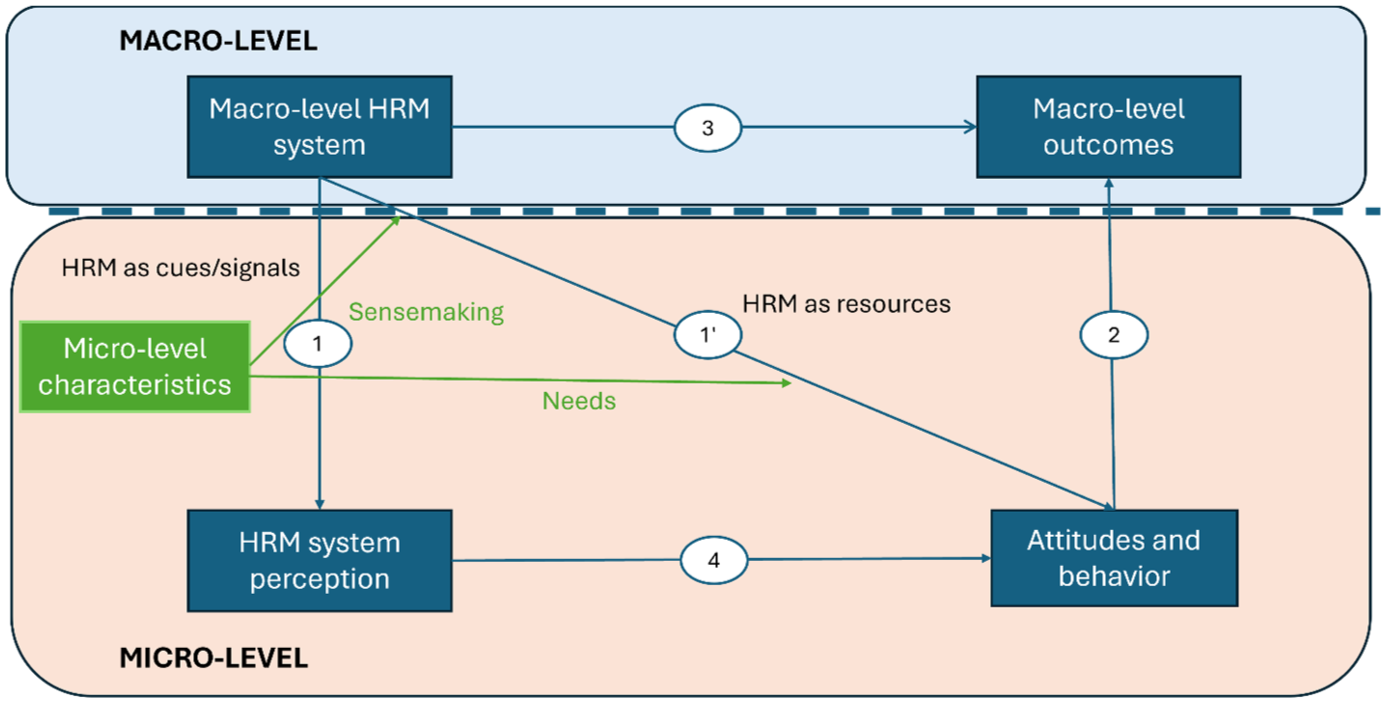
Integrative framework of theories.
A proposed integrated framework for multilevel strategic HRM research
The integrative framework (see Figure 3) we propose builds on the majority of reviewed linkages that explore HRM systems as a Level 2 construct and link them to Level 1 individual outcomes (the situational mechanism, arrow 1 and 1′ in Figure 3). Our framework aligns broadly with the stages outlined in the strategic HRM process model and combines theories emphasizing (1) the direct impact of HRM systems to improve employee abilities, motivation, and opportunities for effective performance (i.e., AMO framework), and employee wellbeing (i.e., JD-R model and COR theory) as well as (2) theories emphasizing how employees perceive and interpret HRM systems, and hence indirectly influence employee wellbeing and performance (i.e., SET, signaling, and SIP). We suggest that studies should be explicit about which of these two approaches they use.
In adopting the first approach, future research should explicitly explain why the HRM system is considered, needed, and utilized as a resource (Halbesleben et al., 2014). In addition, studies should also explicitly consider whether and why there would be variability in the macro–micro relationship among micro-level recipients. We observed that many studies implicitly assumed uniform effects of HRM systems across employees, and we believe that addressing this is an important way in which the field can be enhanced in the future. One way to address this issue is to examine contextual moderators at lower levels of analysis, since this approach takes into account the possibility that HRM systems can have differential effects on employees, depending on individual employee traits (age, gender, race, tenure, education, job tenure, etc.) or team contingencies (leadership style, team tenure, etc.). As such, we have included the moderating effect of micro-level needs on this relationship, which refers to employee needs with regard to HR practices. These needs capture what employees need from HR practices to feel well or perform, which results from individual employee traits (e.g., older employees needing HR practices that utilize their knowledge and skills, see e.g., Van Beurden et al., 2024) and from team contingencies (e.g., teams needing team-based performance pay). Lin et al. (2020), for example, examined how achievement motivation, an individual-level trait, moderates the relationship between branch-level HR practices (development- and maintenance-oriented) and employee well-being. Another example is Batistič et al. (2022), who explored the interaction between commitment-based HRM systems and leadership attachment styles (secure, anxious, and avoidant) and their impact on employee creativity.
In adopting the second approach, future research should explicitly explain the source of HR information (i.e., the signal or cue and/or who is the signaler), the characteristics of the signal (e.g., clarity, frequency, intensity and salience; Connelly et al., 2011), the medium through which the signal is conveyed (e.g., website, personal communication, or email), and how the signal is interpreted or made sense of (Guest et al., 2021). This is captured by the moderating role of sensemaking in the model, which refers to the process of interpreting or making causal evaluations and judgment about messages embedded in HRM practices (i.e., signals/cues; Guest et al., 2021). To encourage studies to explicitly address the potential variability in the macro–micro relationship at the micro level, attribution and sensemaking theory could offer valuable insights into differences in signal interpretation, as highlighted by Guest et al. (2021). For instance, Den Hartog et al. (2013) examined how employees’ perceptions of effective supervisor communication strengthen the relationship between management-rated HPWS and employee-rated HPWS.
In our integrative framework, we also show the transformational mechanism (arrow 2, see Figure 3), the macro-level associations, linking macro-level HRM systems to macro-level outcomes, such as organizational performance (arrow 3, see Figure 3), and the action-formation mechanism (arrow 4, see Figure 3). Although we follow the HRM process model in assuming arrows from macro-level HRM systems to HRM system perceptions, attitudes, behaviors, and macro-level outcomes, we would like to emphasize here that examining reversed arrows would be equally valuable. For example, job crafting behavior or negotiating idiosyncratic deals will likely influence HRM system perceptions. In addition, unmet employee needs might trigger HR co-creation where employees actively contribute to shaping HR practices (Hewett and Shantz, 2021). We will return to this point in our implications section.
Our review also highlights two key underdeveloped areas of multilevel theorizing in strategic HRM studies that warrant more systematic exploration in future research, which are not included in our integrative framework.
First, studies should move beyond the traditional paradigm by incorporating a broader range of internal and external factors. Specifically, the findings of our review show that the vast majority of multilevel HRM system studies have investigated situational mechanisms (Cowen et al., 2022). HRM systems are primarily studied at Level 2 (e.g., organizational level) and linked to a Level 1 dependent variable (e.g., individual level). The few studies that conceptualized the HRM system as a Level 1 construct have primarily taken one of two approaches: (1) theorizing HR practices as individual-level constructs predicted by leader or manager-related variables, such as line manager motivation (Bos-Nehles and Meijerink, 2018) or CEO entrepreneurial orientation (Liu et al., 2024), or (2) considering HR practices at the organizational level, predicted by industrial characteristics like institutional pressures (Feng et al., 2024) or industry capital intensity (Zhang et al., 2019). We encourage future research to delve deeper into the multilevel antecedents of HRM systems by examining HRM in a more nuanced and expanded context. This approach could also help respond to criticisms of the over-psychologization of HRM research.
When theorizing about individual-level HRM (i.e., employee-perceived HRM), Leroy et al. (2018) emphasize the concept of “human resource leadership,” highlighting the important role of leader attributes and leadership behaviors in influencing individual perceptions of HRM systems. Future research could explore how the multilevel relationship between various leader characteristics and perceived HRM is shaped through the mechanisms of strategic HRM alignment and individual environment fit (Leroy et al., 2018). On the other hand, when theorizing HRM as an organizational-level construct, Farndale and Paauwe (2018) present a broad framework that considers HRM systems as products of competitive, institutional, and historical factors, along with organizational capabilities and legitimacy. Future research could build on their framework to systematically examine the influence of the external environment on organizational-level HRM systems.
Relatedly, the expanded view on the HR ecosystem (Donnelly and Hughes, 2023; Snell and Morris, 2021; Snell et al., 2023) in the literature incorporates internal HR functions with various stakeholders and external institutions. To respond to environmental changes, firms are adapting to become more dynamic, which is fundamentally shaping the ways organizations operate by altering the interconnected relationships among firms, employees, and external stakeholders. HR ecosystem research encourages future research to adopt a multilevel HRM perspective by considering the dynamic alignment between HRM, external environment, and internal organizational functions such as culture, technology, and human capital capabilities (Snell and Morris, 2021; Snell et al., 2023). Together, these frameworks illustrate that HRM systems in organizations are complex, multilevel constellations, shaped by various factors such as budgets, market or sector-specific challenges, changes in the legal framework, and the organization’s purpose and identity. In addition, these decisions are influenced by leaders, such as top management, HR departments, or work councils, who bring their own skills, motivations, and personal characteristics into the decision-making process. Future research can build on this foundation, considering both institutional pressures and leader characteristics, to gain a deeper understanding of the higher-level complexities that shape HRM systems.
Second, transformational mechanisms are underexplored in the strategic HRM literature, highlighting the need for more multilevel research in this area. A possible explanation for this is that the theoretical underpinnings of such transformational mechanisms are underdeveloped (Peccei and Van De Voorde, 2019), while at the same time, research of this nature can necessitate company-level data, which is not readily available and requires lots of resources to gather, essentially amounting to what Wall and Wood (2005) refer to as “big science.” In the existing studies, explanations for the process of emergence, where individual perceptions of HRM aggregate and coalesce at the organizational or group level to influence unit-level outcomes, remain limited and insufficiently developed (Peccei and Van De Voorde, 2019). Therefore, future research could examine how HRM systems align individual behaviors with organizational goals and promote shared understandings and emotions among employees. While these ideas have been discussed theoretically (e.g., Bowen and Ostroff, 2004; Klein and Kozlowski, 2000), they are rarely explored and tested within a multilevel framework. In addition, researchers might study HR configurations as well as their interactions with employees as micro-foundations of firm HR capabilities that contribute to firm sustained competitive advantages (Apascaritei and Elvira, 2022; Chadwick and Flinchbaugh, 2021).
Finally, multilevel theorizing should carefully account for the distinct dynamics at each level, rather than assuming uniformity across levels (i.e., homology assumptions; Paruchuri et al., 2018). Our observation is that most studies do not explicitly emphasize why different dynamics are expected for individual versus organizational outcomes. However, there are notable exceptions to studies that do account for these distinct dynamics at various levels and could serve as references for future studies. For example, Huang et al. (2023) extend the componential theory of creativity to the multilevel context by applying it to both the individual (teacher creativity and job performance) and organizational level (school-wide HPWS and overall student quality of school life). The authors explicitly recognize that the impact on individual creativity differs from organizational-level creativity and theorize how HR affects both. In addition, Mom et al. (2019) explain how lower-level behaviors, such as operational manager ambidexterity, coalesce to create organizational ambidexterity and theorize that this bottom-up relationship depends on firm opportunity-enhancing HR practices.
Implications
Implications of the most connected levels
The most common relationship observed in the reviewed studies was the situational mechanism, where the HRM system, functioning at the organizational level, influences individual-level outcomes. By contrast, transformational mechanisms, such as those where HRM systems at the individual level influence organizational outcomes, remain largely underexplored. This reflects the ongoing dominance of downward multilevel models, a trend highlighted in past reviews (Peccei and Van De Voorde, 2019; Renkema et al., 2017). Foundational frameworks like the strategic HRM process model (Nishii and Wright, 2008) emphasize this downward influence from organizational-level HR practices to individual perceptions and behaviors. Similarly, the psychologization of HRM, through its focus on micro-level factors rooted in psychology (Godard, 2014), reinforces this trend. Fortunately, a growing number of studies are already moving further by exploring HRM systems as level 2 moderators in 1-1 links, indicating a broader recognition of HRM systems as contextual factors shaping organizational behavior (Bowen and Ostroff, 2004; Černe et al., 2018).
Compared with multilevel frameworks in the broader management literature, it becomes clear that HRM research could benefit from a more fine-grained view of the interactions between different levels. On the one hand, the labels and distinctions between levels are not always so clear-cut. For example, Geels (2002, p.1259) argues that “different levels are not ontological descriptions of reality, but analytical and heuristic concepts to understand the complex dynamics.” On the other hand, the relations between different levels might be more dynamic than Coleman’s boat (1990) suggests. Vincent et al. (2020) argue that mainstream HRM research is mainly set within static organizational boundaries, drawing on quantitative research and theories from organizational psychology. They propose a six-level political economy framework ranging from natural resources to financial and governance systems, demonstrating how HRM practices emerge from dynamic interactions across these levels. Theoretically, this suggests future multilevel HRM research should move beyond both dominant top-down models and psychological theories toward what Vincent et al. (2020) call a “kaleidoscopic imagination” that employs multiple theoretical lenses to understand these complex multilevel relationships and “meta-theoretical bricolage” that integrates these different theoretical lenses to capture the complex embedded nature of HRM phenomena across multiple levels. Methodologically, this requires shifting from the dominant quantitative focus toward more qualitative and mixed-method approaches (Fleetwood and Hesketh, 2006; Vincent et al., 2020). Qualitative research is particularly suited for investigating complex multilevel phenomena because it is more adaptable, examines how phenomena change over time and are embedded within context, and makes no assumptions about the direction or linearity of relationships. Indeed, qualitative research routinely handles complex relationships like mutual causation and feedback loops, and shifts levels based on the phenomena under study (Hitt et al., 2007; Köhler, 2024).
A particular domain where these more intricate dynamics have been highlighted in HRM literature is in discussions on HR co-creation, where employees actively contribute to shaping HR practices to better meet their needs (Hewett and Shantz, 2021). The idea of HRM co-creation stems from a service-dominant logic (Vargo and Lusch, 2016). These dynamics in value co-creation also play a crucial role in marketing processes (Cova et al., 2011). Qualitative case study research could untangle these dynamics. Baluch et al. (2025), for example, conducted an in-depth qualitative study demonstrating how multi-actor engagement with strategic HRM both reinforces and modifies intended HRM, while also being shaped by external and internal contextual pressures. Complex dynamics could be involved in transformational mechanisms as well, with individuals’ perceptions of HRM and their well-being potentially influenced by organizational performance (i.e., reversed causality) (Ogbonnaya et al., 2023; Piening et al., 2013) and vice versa (i.e., mutual causality). Another way to incorporate dynamics could be through configurational analysis. For example, developing various kinds of multi-level compilation-based well-being and performance profiles and relating them to HRM systems, for example, can provide insights into the potential trade-offs that may exist between organizational performance and employee well-being, as well as the role that HRM systems play in such trade-offs (Peccei and Van De Voorde, 2019).
More generally, systems theory could offer a valuable framework for multilevel theorizing in strategic HRM research. Specifically, by conceptualizing organizations as open systems composed of interdependent subsystems (i.e., HRM systems) operating across individual, unit, organizational, and environmental levels (Ackoff, 1981; Von Bertalanffy, 1950), researchers could better understand how HR practices as part of an HRM system could influence one another, and contribute to emergent organizational outcomes (Hughes and Dundon, 2025). This theory emphasizes feedback loops, nested structures, and equifinality, providing a more nuanced underpinning of cross-level dynamics, highlighting the complex, adaptive nature of HRM systems in achieving strategic objectives (Hughes and Dundon, 2025). Therefore, systems theory could help understand the complexity of multilevel relationships in HRM research and could be used as a theoretical lens in the context of future research in this area. For example, Ogbonnaya et al. (2023) utilize general systems theory to examine how input and output processes within systems influence each other over time, using a four-wave longitudinal research design. By adopting a fuzzy set qualitative comparative analysis, Xi et al. (2025) identified multiple pathways through which different HRM systems can achieve high employee outcomes and firm performance under specific internal and external contexts, reflecting the concept of equifinality.
Implications of conceptualizing constructs at a specific level
Our review showed that the theoretical explanations that are provided for the level at which the HRM system is conceptualized, as well as why and how, are often not as convincing or compelling as they could be. This is problematic, since the HRM construct may have a different meaning depending on the level of analysis and actor involved. Indeed, whether it is supposed to represent an aggregated, team, or organizational-level construct ultimately interferes with the validity of the constructs used in the conceptual model. In particular, this gives rise to issues surrounding falsely deducing information about individuals based on group data (ecological fallacy) and mistakenly deducing information about groups based on individual data (atomistic fallacy) (Bansal et al., 2024). Both fallacies ultimately undermine the theoretical coherence and clarity of the findings. According to Kozlowski and Klein (2000), the primary step in developing a multilevel theory or study is to clearly define, justify, and clarify the level of each key construct that makes up the conceptual model. In sum, the guidance based on these findings highlights the importance of adopting a theoretical perspective to justify why HRM systems can function at different analytical levels in conceptual models. It is imperative that a theoretical explanation justifying the treatment of the HRM systems at the specific level of analysis is provided.
Implications of explaining multilevel linkages
Our review of the multilevel linkages showed that while there are dominant theoretical frameworks to study cross-level relationships of HRM systems, such as the AMO model and SET, there is a wide range of theories used. As a result, evaluating the development of multilevel theorizing across various studies is a challenging task. Our review identified over 30 theories that are used to explain the cross-level relationships with HRM systems. This diversity of theoretical perspectives vastly complicates the process of comparing the different theorizing approaches adopted by scholars in the field of HRM. To recognize the theoretical diversity and complexity of bridging different levels of analysis, which is also a topic of current interest to general management scholarship, future research could explore the existence and adequacy of “theoretical combinations” (Cronin et al., 2022). These are meaningful complementarities and synergies that exist between different “unit theories” concentrating on specific empirical phenomena. The goal is to develop more robust “programmatic theories” that synthesize general knowledge on a specific topic. These broader theories are particularly valuable for multilevel research, as they offer a more integrated understanding of how different levels interact, thereby helping to explain cross-level processes. By contrast, single unit theories may not fully capture the complex, interconnected nature of multilevel phenomena (Cronin et al., 2022, 2021). Overall, adopting such an integrative approach would not only promote theoretical parsimony but also enhance our understanding of the cross-level effects of HRM systems and practices. Based on our integrative review, we advance that focusing on HRM as cues/signals versus HRM as resources could offer a valuable starting point for such theoretical combinations (cf. Figure 3).
Relatedly, our observation is that most studies do not explicitly emphasize why different dynamics are expected for individual versus organizational outcomes (i.e., homology assumptions; Paruchuri et al., 2018), albeit with some notable exceptions (e.g., Huang et al., 2016). More specifically, we observed that many studies implicitly assumed uniform effects of HRM systems across employees, without explaining why this is the case (i.e., the mechanisms involved). In addition, studies implicitly assume that individual perceptions of HRM converge and coalesce at the organizational or group level and subsequently impact unit-level outcomes, without explaining how and why individual perceptions emerge as properties at the group or organizational level (Kozlowski and Klein, 2000). In this regard, studies on microfoundations in strategy and organizational theory research (Aguinis et al., 2011; Felin et al., 2015; Ployhart and Hale, 2014) provide valuable insights to untangle this transformational mechanism. By elaborating on how individual attributes, behaviors, decisions, and interactions contribute to higher organizational outcomes (see examples of Helfat and Peteraf, 2015; Loon et al., 2020), these discussions offer a framework for understanding the transformational processes that HRM systems could facilitate but have yet to be fully explored in the strategic HRM research. We believe that greater clarity on the rationale for such effects is an important step that can further enhance the HRM field.
Limitations
This study has a number of limitations. First, we only focused on peer-reviewed articles, potentially overlooking valuable insights from the gray literature. While this strengthens the overall quality of the reviewed studies (Willmott, 2022), it may also introduce publication bias. However, this bias is likely mitigated when a sufficiently large number of publications are included (>40) (Mathur and VanderWeele, 2021). To keep the number of reviewed papers manageable, we also confined our search to the title, abstract, and keywords. While this is consistent with prior approaches (e.g., Jiang and Messersmith, 2018), it could lead to oversight of studies where the keywords did not feature in these particular sections.
Second, we exclusively focused on HRM systems (e.g., HPWSs, high commitment work systems, high involvement work systems, and generic HRM systems). This is in line with previous systematic literature reviews in strategic HRM research (Boon et al., 2019; Van Beurden et al., 2020) and follows the idea that an HRM system or multiple HR practices have a stronger effect on outcomes compared to a single HR practice (Combs et al., 2006). As a result, studies examining cross-level relationships of individual HR practices, more niche HRM bundles (e.g., age-related HRM, green-HRM), or those addressing features of the HRM system (e.g., strength, attributions) were excluded.
Third, as with every review, our work is limited by its ontological and epistemological choices. We strongly relied on Coleman’s boat (Coleman, 1990), which provides some clarity on the different types of multilevel relationships, although this framework has also been criticized in the literature for its methodological individualism and its focus on mechanism-based social explanations (Van Bouwel, 2019; Whittington, 2025). Scholars like Fleetwood and Hesketh (2006) and Vincent et al. (2020) have argued in the HRM literature, and Hallett and Hawbaker (2021) more generally, that this is not only a methodological choice but also relates to deeper assumptions about the nature of social reality and causation, with implications for the types of theories considered. Specifically, Coleman’s boat might disadvantage theories that emphasize structural, functional, or cultural explanations for HRM phenomena (Van Bouwel, 2019; Whittington, 2025). Relatedly, we acknowledge that adopting the criteria by Paruchuri et al. (2018) is one way of assessing coherence, following their assessment of pitfalls and strategies in multilevel theorizing. However, other multilevel criteria could be employed in future research (Renkema et al., 2017).
In addition, we excluded qualitative studies from the analyses, as these studies tend to draw from different theoretical traditions and do not always self-identify as multilevel (Köhler, 2024). In this regard, qualitative studies do not always have predefined levels and can be dynamic in nature. This omission of qualitative studies might therefore come at the detriment of a richer theoretical understanding, particularly regarding emergent, difficult-to-measure, recursive, or nonlinear dynamics associated with transformational mechanisms. Since there were only four qualitative studies that adhered to our review criteria, we assume the impact of this omission was limited. Nevertheless, we recommend future research to expand the range of qualitative investigations, which can then be cumulatively analyzed for a more fine-grained understanding of the issues raised above. In this regard, future research could also consider developing a new (and more flexible) set of multilevel criteria capable of capturing the dynamics inherent to both qualitative and quantitative research simultaneously, which would enable to inclusion of a broader set of studies. This would also enable meta-analytic studies to be employed to analytically assess the studies inherent to a review, for example, to calculate the effect sizes of particular multilevel HRM system relationships, and potential moderators of the effect sizes.
Furthermore, international HRM is often regarded as having a distinct theoretical focus at the intersection of international business and HRM (Welch and Björkman, 2015). To maintain theoretical consistency, we chose not to include multilevel studies in which the country was analytically researched as one of the two levels of analysis. In line with Vincent et al.’s (2020) observation that multilevel HRM studies are often restricted to organizational boundaries, findings from a pilot literature search showed few studies including country as one of the two analysis levels. Our critical theoretical evaluation may therefore be less applicable to studies investigating cross-country influences on strategic HRM.
Finally, our review did not specifically discern between different national cultures in interpreting the multilevel theories adopted and proposed linkages, as well as their suitability based on this context. It would be interesting for future research to involve a cultural perspective in multilevel HRM research by considering varying implications of theories in different cultural contexts. For instance, due to a stronger emphasis on hierarchy and performance in the Eastern context (e.g., China), theories such as AMO theory and social exchange model, but also stakeholder theory (Cooke et al., 2020), which imply a sense of instrumental value may better inform the top-down mechanism in multilevel HRM studies compared to those examined in the Western context.
Supplemental Material
sj-pdf-1-hum-10.1177_00187267251392079 – Supplemental material for Multilevel theorizing in strategic human resource management research: A systematic and critical review
Supplemental material, sj-pdf-1-hum-10.1177_00187267251392079 for Multilevel theorizing in strategic human resource management research: A systematic and critical review by Jeske Van Beurden, Robin Bauwens, Karina Van De Voorde, Sanne Ghielen, Steven Kilroy, Mengwei Li, Aneeqa Suhail, Kim De Meulenaere, Rawan Ghazzawi, Tina Sahakian and Dorien Kooij in Human Relations
Supplemental Material
sj-pdf-2-hum-10.1177_00187267251392079 – Supplemental material for Multilevel theorizing in strategic human resource management research: A systematic and critical review
Supplemental material, sj-pdf-2-hum-10.1177_00187267251392079 for Multilevel theorizing in strategic human resource management research: A systematic and critical review by Jeske Van Beurden, Robin Bauwens, Karina Van De Voorde, Sanne Ghielen, Steven Kilroy, Mengwei Li, Aneeqa Suhail, Kim De Meulenaere, Rawan Ghazzawi, Tina Sahakian and Dorien Kooij in Human Relations
Footnotes
Acknowledgements
We would like to thank Brigitte Kroon, Renee de Reuver, Kornelia Anna Kerti, and Rubin Steegh for their helpful comments and suggestions on the research project.
Funding
The authors received no financial support for the research, authorship, and/or publication of this article.
AI usage declaration
The authors acknowledge that they have followed Human Relations’ AI policy. No AI was used for preparing the manuscript.

Supplemental material
Supplemental material for this article is available online.
References
Supplementary Material
Please find the following supplemental material available below.
For Open Access articles published under a Creative Commons License, all supplemental material carries the same license as the article it is associated with.
For non-Open Access articles published, all supplemental material carries a non-exclusive license, and permission requests for re-use of supplemental material or any part of supplemental material shall be sent directly to the copyright owner as specified in the copyright notice associated with the article.
