



Abstract
How do marginalised cultural outsiders negotiate fit into new work settings? I draw on a discursive (re)positioning lens to examine qualitative interview accounts of a group of skilled refugees in Britain and provide insights into three temporal moves they make to portray themselves as unconstrained by a lack of host country cultural know-how, able to swiftly address gaps in knowledge and skills, and able to blend in. I theorise newcomer self-socialisation as a temporal (re)positioning dynamic that involves retrospectively defining oneself as a particular kind of person who has the potential to fit. I argue that temporal (re)positioning enables newcomers to maintain worth, secure external validation and impact on their contexts. I propose that the simultaneous foregrounding and minimising of the past is an important mechanism for skilled refugees to negotiate an ambivalent sense of fit into new work settings.
Keywords
Introduction
Agentic perspectives on organisational socialisation address how individuals adjust to new work settings, acknowledging that ‘newcomers play active roles in facilitating and shaping the process’ (Bauer et al., 1998: 174; 2007). The literature provides insights into proactive self-socialisation moves undertaken to better understand the new role and work environment (Ashford and Black, 1996; Saks et al., 2007), while also addressing more complex issues such as negotiating credibility (Bourgoin and Harvey, 2018), learning via the community (Korte and Lin, 2013) and negotiating a sense of belonging (Gilmore and Harding, 2022). Notwithstanding the important insights offered, current understandings of self-socialisation (i.e. self-initiated moves that facilitate adjustment to new work settings) appear to be underpinned by an objective view of time in which the present is seen as separate from the past (Hernes et al., 2013). This is problematic because the present, past and/or future can permeate each other in the ongoing flow of self-socialisation moves. The current self-socialisation research has been slow to address temporality, however, leading to somewhat decontextualised understandings. This situation calls for research that adopts a subjective approach to time in order to understand interpretations of the present as inextricably linked to interpretations of the past and/or future (Simpson, 2009) as opposed to being isolated moments (Dawson, 2014). Theorising temporality in newcomers’ self-socialisation points out the importance of adopting a more holistic perspective to understanding the full complexity of self-socialisation moves.
In this study, I examine temporality in a group of skilled refugees’ accounts of fitting into work settings in the UK. In a temporal sense, fitting in involves synthesising the present with the past. Skilled refugees are a compelling study group because being marginalised cultural outsiders they can feel that they are positioned ‘outside the norm’ in host country work settings, in part owing to their past (see Knappert et al., 2018; Smyth and Kum, 2010), and may thus feel the need to appropriate the past to construct themselves as less lacking in the present. While management scholarship has begun to prescribe what organisations should do to facilitate skilled refugees’ experience in new work settings (Hirst et al., 2023) and has conceptualised the various barriers they encounter in the organisational sphere (Lee et al., 2020), the initiatives of newcomer refugees have been neglected. Theorising how skilled refugees negotiate a sense of fit within host country work settings and what the resulting implications are is extremely important for developing an understanding of agentic perspectives on refugees’ inclusion. I focus on a snapshot of skilled refugees at a particular transition point, and ask how the past and present play out in a group of skilled refugees’ accounts of negotiating fit into host country organisations.
I draw on the concept of (re)positioning to examine skilled refugees’ accounts of negotiating fit. (Re)positioning, which focuses on how selves are negotiated through discourse (Van Langenhove and Harré, 1999), considers all socially meaningful speech to be acts of significance through which storylines are developed to (re)position selves in particular ways – for example, as having the potential to fit. Skilled refugee newcomers may discursively (re)position themselves to negotiate a sense of fit into new work settings, considering the positions that are attributed to them within the discursive space. (Re)positioning thus illustrates the relational nature of self-constructions. Through self-interested (re)positioning, refugee newcomers are able not only to maintain their worth, but also to shape the discursive space (Harré et al., 2009), enabling us to consider the internal and external implications of the agency exercised by skilled refugees. (Re)positioning sheds light on temporal patterns in newcomers’ self-socialisation moves because discursive negotiation of the self involves articulating meaningful links between interpretations related to the past, present and/or future.
I will first review the relevant theoretical background and introduce the study. My findings provide insights into three temporal moves used by skilled refugee newcomers to negotiate a sense of fit to their new work contexts. It is striking how the past is simultaneously foregrounded and minimised in these moves. The study makes two theoretical contributions. The first is to existing understandings of self-socialisation. I conceptualise newcomer self-socialisation as a temporal (re)positioning dynamic that involves retrospectively defining oneself as a particular kind of person who has the potential to fit into the new work setting. I argue that temporal (re)positioning enables incumbents to maintain worth, secure external validation and impact their context. The second contribution is to extant understandings of refugees’ experiences of work. I propose simultaneous foregrounding and minimising of the past as an important mechanism for skilled refugees to negotiate an ambivalent sense of fit to new work settings. I conclude by outlining the practical implications of my work.
Theoretical background
Self-socialisation
An emerging perspective in the vast organisational socialisation literature places the onus of socialisation on individuals and considers how newcomers exercise agency to shape the socialisation process. In a classic typology, Ashford and Black (1996) outline what they term ‘proactive socialisation’ moves: seeking information and feedback; modifying tasks and/or expectations in the organisation; reframing one’s own thought process; socialising with others in the organisation; and networking and relationship building. Later studies have examined the antecedents of individual-driven socialisation such as self-efficacy (Gruman et al., 2006; Saks et al., 2007) and the outcomes (Ashforth et al., 2007; Wanberg and Kammeyer-Mueller, 2000). Some studies consider cognitive learning to be a significant aspect of self-socialisation (Cooper-Thomas and Anderson, 2006) and have examined how individual proactive moves combine with organisational socialisation initiatives (Kammeyer-Mueller and Wanberg, 2003) to facilitate learning (Ashforth et al., 2007). While insightful, these positivistic studies tend to neglect the complexity of the newcomer experience, assuming that self-socialisation is a fairly straightforward process for any rational-thinking individual.
However, a stream of qualitative studies is beginning to address how newcomers navigate a variety of tensions when they enter new work settings. For instance, on entering new organisations, individuals are seen as struggling to make sense of their role, and what they can and cannot do (see Korte and Lin, 2013), and/or feeling that their competency is being questioned by their new colleagues (see Bourgoin and Harvey, 2018). Newcomers can also feel that they are positioned as strangers or outsiders in other people’s eyes (Gilmore and Harding, 2022). In a notable study of management consultants, Bourgoin and Harvey (2018) draw attention to how newcomers respond to threats to their competence. They outline three moves: crafting relevance through leveraging knowledge and experiences to appear competent while seeking new information; crafting resonance through mobilising insider knowledge and language proximity to gain acceptance; and crafting substance through presenting an image of dedication.
Other studies provide insights into the role of relationships in negotiating fit to a new context. Drawing on psychoanalytical theory to examine an ethnographer’s account of moving from a stranger to an insider, Gilmore and Harding (2022) liken the experience of beginning a new job to becoming part of a family, highlighting how ‘kin work’ is done by getting to know familiar others and becoming known by them in order to negotiate a sense of ambivalent belonging. In a study of newcomer engineers, Korte and Lin (2013) show how the quality of relationships with co-workers (in terms of camaraderie, trust and respect) shapes how newcomers fit into the social structure of the work group as well as their learning and performance and portray the idea of learning to fit as a communal process.
The literature on self-socialisation thus provides insights into an array of moves undertaken by newcomers to negotiate a sense of fit to work settings, appreciating varying degrees of complexity. However, extant understandings are limited to an exclusive focus on the actors’ ‘here and now’. Individuals can bring a significant past with them to new organisations that may inform their self-socialisation moves. Indeed, studies suggest that people tend to draw on the past to make sense of their present (Weick, 1995) and communicate who they are to others (Ibarra and Barbulescu, 2010). Emirbayer and Mische (1998: 963) propose a reconceptualisation of agency (or the capacity to act) as ‘a temporally embedded process of social engagement’ expressed through orientations towards the present, the future and the past. Unfortunately, the existing self-socialisation research, which is dominated by studies of graduate recruits in traditional work arrangements, has paid little attention to issues of temporality. This is a shortcoming, because temporal patterns are likely to be particularly pertinent in the self-socialisation of newcomers with more complex biographies (Bourgoin and Harvey, 2018). Marginalised cultural outsiders may be more likely to address the past in their self-socialisation moves than traditional newcomers because they are more likely to experience threats to their competency owing to their past experiences being devalued in their host country settings (see Cheng et al., 2021). Unfortunately, however, only a few studies have empirically examined how newcomers with complex biographies account for fitting into new work settings, leading to a lack of contextualisation in the self-socialisation literature. I thus rise to the challenge by examining how a group of skilled refugees in Britain account for negotiating fit into the host country work sphere.
Skilled refugees in host country work settings: The story so far
Refugees are individuals who have been systematically excluded and oppressed within the political system (Arendt, 1943) and compelled to flee their country of origin owing to a fear of being persecuted. Every refugee begins as an asylum-seeker, but not every asylum-seeker is granted refugee status. One body of literature addresses the labour market barriers that contribute to the underemployment of skilled refugees and/or their reduced earnings (Ives, 2007), highlighting the institutionalised devaluation of past qualifications and experience (Cheng et al., 2021; Nassli, 2023). Studies also show how all refugees are wrongly stereotyped as threats to security (Alatrash, 2018), as scrounging benefits and lacking credibility (Wehrle et al., 2018), and are portrayed as easily replaceable labour with few linguistic skills or professional networks (Beaman, 2012).
Refugees’ experiences in organisations remain underexplored in the literature, notwithstanding notable exceptions that provide insights into exploitative work practices (Campion, 2018). In a study on low-skilled Syrian refugees in Turkey, Knappert et al. (2018) highlight perceptions of exclusion, frustration and/or a reluctant acceptance of subordination, especially in the case of women. Similarly, in a study on low-skilled and skilled Syrian refugees in Germany, Gericke et al. (2018) suggest that some individuals feel insecure and/or stressed about working in their new environment. In contrast, in a study of qualified refugee teachers in Scotland, Smyth and Kum (2010) draw attention to cultural differences, linguistic challenges and a lack of professional networks that constrained individuals’ ability to effectively navigate the workplace. In a study of non-European refugee physicians in Sweden, Mozetič (2022) indicates that their respondents experienced heightened scrutiny in the workplace and felt that they needed to work harder than their Swedish counterparts to progress.
While studies have begun to offer insights into the distinctive barriers experienced by skilled and low-skilled refugee newcomers, we have little understanding of the agency exercised by incumbents to fit into host country work settings. Indeed, our understanding of agency is limited to that exercised during the pre-employment phases. For instance, low-skilled refugees are seen as playing down past work experience in their country of origin to secure jobs and/or taking up any position they are offered by settlement agencies to enter the host country labour market (Senthanar et al., 2020). Professional refugees are seen as exercising adaptive agency to acquire new competencies (Willott and Stevenson, 2013) and/or attempting to enhance their social capital (Hajro, 2017; Smyth and Kum, 2010). Because their chances of returning to their home countries are lower, refugees are seen as investing significant time and effort in acquiring social and cultural skills (Žilinskaitė and Hajro, 2023). Alternatively, they are seen as coping with labour market constraints by derogating sources of occupational threats, reframing views of the employment system to anchor elements that can be supportive to them (Wehrle et al., 2018), recrafting a new identity in order to start all over again in a new field, holding on to past occupational identity and/or bracketing the present as transitory (Nardon et al., 2021).
In the vast literature on skilled migration (see Crowley-Henry et al., 2018; Fernando and Patriotta, 2020; Hajro et al., 2023; Shirmohammadi et al., 2018), it is suggested that ‘cultural intelligence’, in terms of knowledge of different cultures, knowing how to use it and knowing how to regulate one’s thinking (see Thomas et al., 2008), is likely to help cultural outsiders fit into new work settings (Malik et al., 2014). It is also suggested that cultural intelligence facilitates the process of seeking information and interacting with insiders in new workplaces (Malik et al., 2014, 2017), although these proposals are yet to be empirically evidenced.
In short, we have limited knowledge of the agency exercised by refugees and other marginalised cultural outsiders to negotiate a sense of fit in new work settings. This is an important omission because these individuals can feel that they are positioned outside the norm in host country settings, in part owing to their past (see Smyth and Kum, 2010), and from this perspective their persistence may be contingent on exercising agency to represent themselves and their past as having the potential to fit into the present.
A temporal perspective
Temporality has been widely examined at the level of organisations. Studies provide insights into the strategic use of ‘past’ constructions to advance present organisational goals (Suddaby et al., 2020), while also highlighting how unflattering aspects of the past are mindfully played down (Anteby and Molnar, 2012) and/or how the past is presented as a foundation for future collective action (Crawford et al., 2022). Kaplan and Orlikowski (2013) coined the term ‘temporal work’ to refer to how strategic accounts of organisations are built on interpretations of the past, present and future so that they are coherent and plausible, thus enabling organisations to move forward in the face of uncertainty. The past is seen as subjective, however, offering a multitude of interpretations for actors to draw.
From a temporal perspective, newcomers’ accounts of self-socialisation into work settings would be seen as sensitised by interpretations of their past and/or anticipated future. In other words, the past must be told to confer meaning to present self-socialisation moves (Torre, 2007). Indeed, we might expect establishing connections between the past and the present to facilitate a sense of coherence and continuity for individuals – especially when they undertake uncertain macro transitions (see Ibarra and Barbulescu, 2010). For instance, in a seminal study on skilled migrants, Zikic and Voloshyna (2023) show how memories of the city of origin help incumbents navigate the new host city, providing them with a sense of spatial continuity. I will now explain my use of (re)positioning to examine temporal patterns in individuals’ accounts of self-socialisation.
(Re)positioning
(Re)positioning is rooted in discursive psychology (Davies and Harré, 1999), and is based on the premise that understandings of the social world are created and reproduced through acts of discursive positioning. The ‘act of (re)positioning’ is seen as assigning ‘fluid parts and roles to speakers that make a person’s actions intelligible and relatively determinate as social acts’ (Van Langenhove and Harré, 1999: 17). While positions may ‘locate’ people within social relations, they can change as participants continue to engage in conversations. Because actors are embedded in multiple, and contradictory, discursive contexts, there is scope to engage in self-interested (re)positioning (Ainsworth and Hardy, 2004). (Re)positioning thus illuminates how self-definitions are relationally and continuously negotiated (Davies and Harré, 2007) as individuals dynamically claim, offer, challenge, alter and appropriate subject positions within a discursive space (Harré et al., 2009). Who is considered legitimate, superior and/or inferior in a particular organisational context is discursively established as individuals are (re)positioned or (re)position themselves in conversations.
Some studies have suggested that refugee newcomers can feel that they are positioned as inferior to the norm in work settings (see Knappert et al., 2018; Nassli, 2023; Smyth and Kum, 2010). This may require individuals to respond with self-interested (re)positioning in order to rearticulate their position (Thomas and Davies, 2005), negotiating a sense of fit and maintaining their worth. However, (re)positioning is a useful concept for understanding both the internal and external implications of the agency newcomers exercise to negotiate fit. Individuals can not only leverage a discursive space to reconstruct desirable definitions of their selves; they can also contribute to shaping this discursive space. Because the discursive agency people exercise to (re)position themselves is embedded in a framework of possibilities that is maintained through linguistic practices (Davies and Harré, 1990), agents can contribute to maintaining or redefining the space in which they operate by means of (re)positioning. Language is thus seen as a medium oriented towards action (Potter et al., 1990). It is through talk that meanings are negotiated, established and made to count (see Vaara, 2002). Indeed, social scientists have explained how language serves as a resource for establishing social reality (Berger and Luckmann, 1966).
(Re)positioning is a useful theoretical tool for examining the interplay between the past and the present in how individuals negotiate fit into new work settings because temporality is embedded in the accounts people construct to (re)position themselves. Scholars have argued that meaningful accounts of personal experience must connect the various phases of an individual’s life in a storyline (McAdams, 1996). Thus, in examining (re)positioning in individuals’ accounts of negotiating fit in new work settings, we can understand how the past and present play out in people’s attempts to present themselves in particular ways with regard to fitting in. I will now examine how skilled refugees (re)position themselves to negotiate fit into new work settings in the UK, and what the implications are.
Research design
This study is underpinned by an interpretivist paradigm (Denzin and Lincoln, 2011) that helps understand knowledge through people’s subjective experiences. Because this means that it is important to gather first-hand data by talking to people, I chose a qualitative research method. The goal of qualitative research is not to discover objective facts or to generalise, but to interpret phenomena in terms of the meanings people bring to them (Denzin and Lincoln, 1994), including their meaning-making about the initial transition to host country organisations. Furthermore, in-depth qualitative interviews facilitate the development of the trust and rapport required to enable the researcher to gather intimate data that is revealing for both parties (Douglas, 1985). In the use of this approach, the researcher makes no claim to being objective, but is reflexively aware of her own subjectivities.
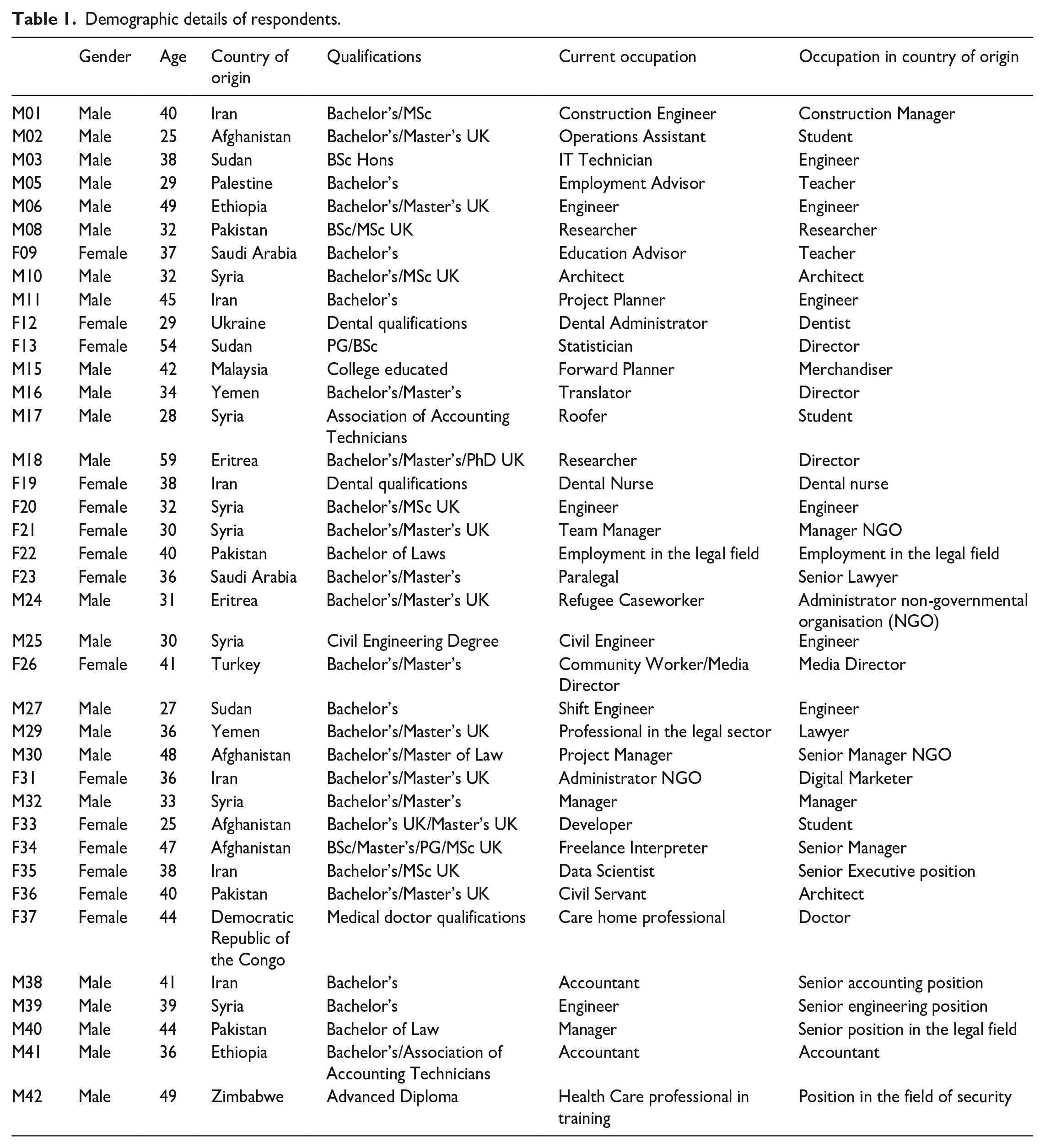
This article is based on 38 in-depth qualitative interviews with skilled refugees in the UK. All the respondents were qualified to graduate level or beyond and were between 25 and 59 years of age. They came from Iran, Syria, Pakistan, Ethiopia, Zimbabwe, Turkey, Sudan, Afghanistan, Eritrea, Malaysia, Ukraine, Saudi Arabia, Palestine, Yemen and the Democratic Republic of the Congo. At the data collection stage, all the respondents had some level of work experience in the UK on a voluntary, full-time and/or part-time basis. In the UK, individuals seeking asylum are not allowed to engage in work and employment while waiting for their refugee status to be approved (UK Visas and Immigration, 2024). They must wait until this is approved by the Home Office. The respondents worked in a wide array of sectors including law, accountancy, public relations, social work, engineering and architecture. Most respondents had completed undergraduate degrees or their equivalent in their country of origin and postgraduate qualifications in the UK. The great majority had fewer than six years of residency in the UK at the time of the interview (see Table 1 for details of the respondents).
Demographic details of respondents.
Data collection
The sampling method can be described as a combination of purposive (Palinkas et al., 2015), convenience-based (Silverman, 2000) and snowballing (Noy, 2008). Respondents were recruited through a social enterprise that specialises in helping skilled refugees find employment in the UK. The social enterprise forwarded a plan of the study to their programme leads and partner organisations to see whether any individuals who fell into the skilled category were interested in participating in a study on skilled refugees’ experiences of work in the UK. It was made clear that participation in the study was completely voluntary and that choosing to not take part would not affect an individual in any way. Some respondents introduced other relevant respondents, and the sample grew. Individuals received no financial remuneration for taking part in the study.
A comprehensive participant information sheet that clearly explained the objectives of the study as well as how data would be anonymised, stored and used for research purposes was handed out to participants before their interview. In line with standard practice, all participants signed a consent form and were aware that they had the right to withdraw from the interview at any point or to withdraw their data from the study. A pre-prepared topic guide shaped the interview, which included questions about the participants’ initial transition to new organisations, the challenges encountered, how they felt they were seen by others in the organisation, how they saw themselves in relation to standard expectations of other employees, their relationships with new colleagues and superiors and the agency exercised in their new work setting. Respondents were also asked questions about their socio-cultural backgrounds and invited to reflect on the extent to which they shaped their work-related meaning-making in the host country.
The questions were typically open-ended and were not asked in any order. The respondents often introduced their own topics and shared their views, but I ensured that all the topics in the interview guide were covered. The interviews lasted for between 60 and 90 minutes. I developed a rapport with the participants by being open and authentic rather than formal and directive (Blustein et al., 2013). While individuals acknowledged that they experienced a lack of fit when they initially transitioned to new organisations, they also explained how they attempted to negotiate a sense of fit. While follow-up and probing questions were asked, I took care to ensure that the participants were asked questions in a welcoming manner. I carried out frequent clarification checks during the interviews to ensure that my interpretations were credible and in line with the participants’ realities (Morrow, 2005). Thirty-six interviews were digitally recorded and transcribed verbatim, and one interview was not recorded owing to a technological failure. At 37 interviews, no new insights appeared to be emerging about skilled refugees’ attempts to negotiate fit in new work settings. In other words, there appeared to be evidence of theoretical saturation (Strauss and Corbin, 1998).
Data analysis
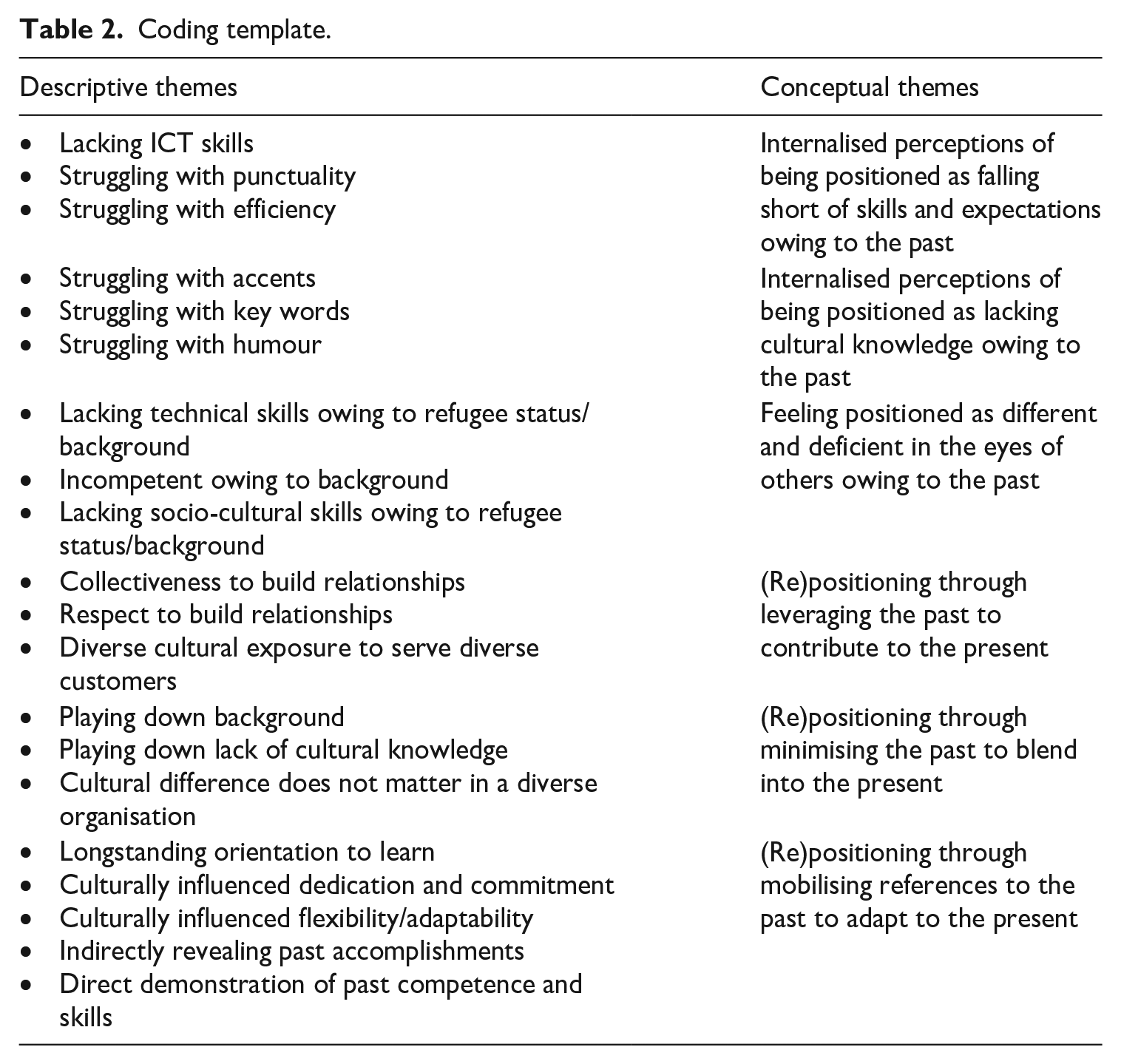
Data analysis took place throughout the research (Silverman, 2009). I used thematic analysis (King, 2004) to analyse the respondents’ accounts. Thematic analysis involves sorting data into themes. It was used because it is a flexible approach that can be modified according to the needs of the study and has the potential to yield rich insights if the analysis is conducted rigorously (Braun and Clarke, 2006). The first level of coding was descriptive. I examined the data in detail, looking for emergent themes and key differences and similarities between them. I gave these ‘codes’ descriptive labels and assigned data extracts to them. The NVivo 11 software package was used to sort and organise the data. I reviewed the descriptive codes and the data in them, amending them accordingly to ensure both consistency and manageability. I adopted what is called ‘progressive focusing’, defining empirical codes somewhat loosely at the beginning but then defining them more specifically as the analysis progressed (Hammersley and Atkinson, 1997). I tried to stay as close as possible to respondents’ voices at the first level of coding.
From the descriptive codes, I developed conceptual themes (Silverman, 2009), considering ‘what is going on here?’. I iteratively compared existing theories on discursive (re)positioning and temporal perspectives with the new empirical data to develop new theoretical understandings of self-socialisation (see Timmermans and Tavory, 2012). For instance, ‘cultural values to build relationships’ and ‘diverse cultural exposure as useful to the organisation’ were combined to form (re)positioning through leveraging the past to contribute to the present. Likewise, ‘playing down background’, ‘playing down lack of cultural knowledge’ and ‘cultural difference does not matter in a diverse organisation’ formed (re)positioning through minimising the past to blend into the present. Table 2 outlines my coding template.
Coding template.
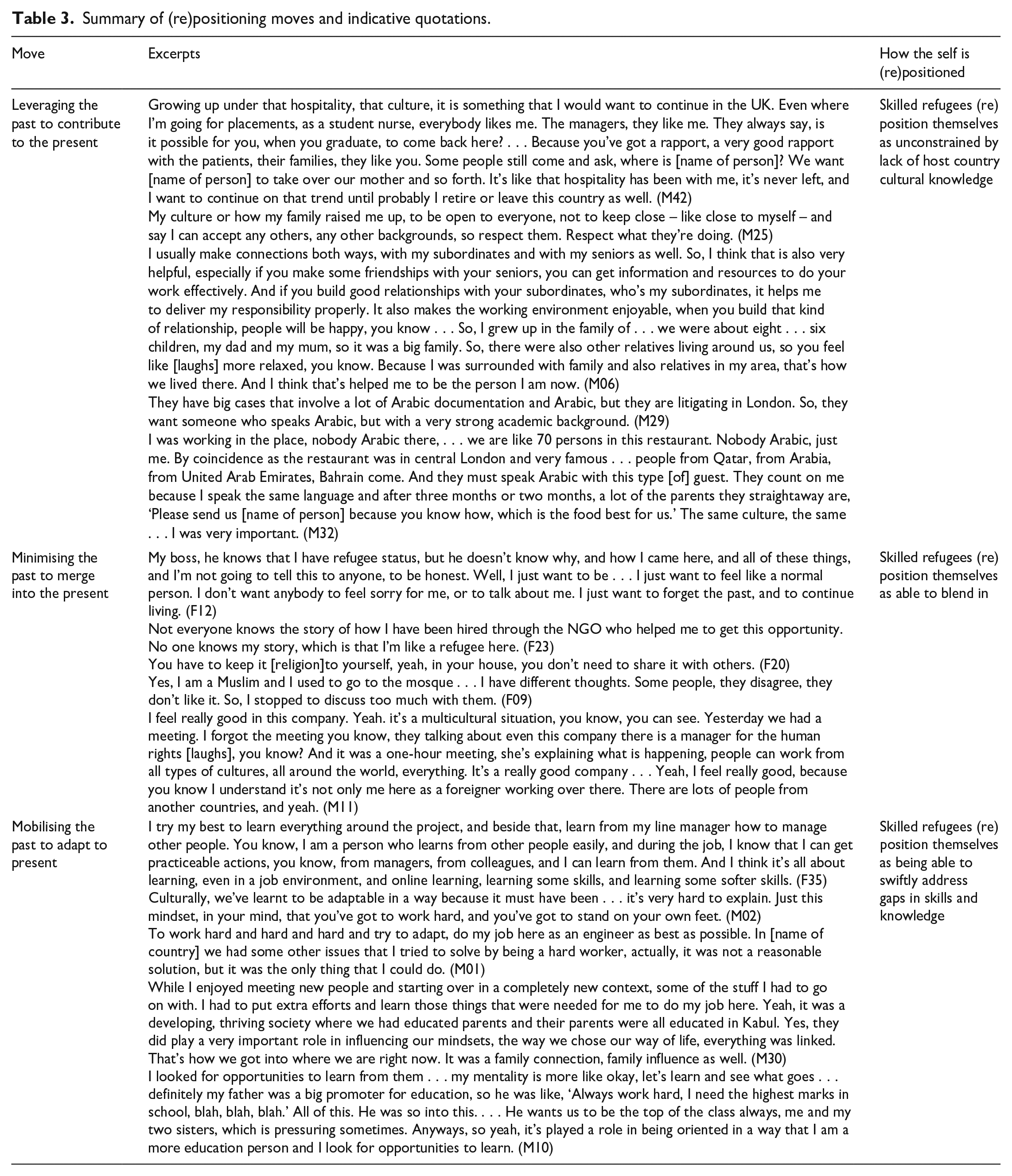
A common criticism levelled at qualitative research is that authors make up interpretations based upon somewhat thin data that they ‘cherry-pick’ to support their interpretation (Gioia et al., 2013). Accordingly, one of the most important components of qualitative research is presenting adequate data to support claims (Bansal and Corley, 2012). In Table 3, I present quotations to further support my conceptual categories. I questioned my relationship to the research (Corlett and Mavin, 2018) and considered how my position and beliefs might influence how the data were interpreted and presented. Although I have not experienced forced migration, I am an economic migrant and a member of an ethnic minority in the UK, and at certain points in my life I have felt like a cultural outsider and struggled to negotiate fit. I therefore recognised that I might feel particularly attuned to the voices of respondents who identified themselves as feeling outside the norm and acknowledged that my demographic background and experiences might potentially influence my interpretation of the data. To the extent possible, therefore, I tried to be reflexive (Morrow, 2005), continuously questioning my assumptions, attempting to challenge emerging interpretations and thinking of alternative views of the phenomena being reviewed. I also discussed my interpretations with several academic colleagues who were generous with their time and urged them to be critical. For example, when interpreting data on how the respondents felt positioned in new work settings as newcomers, I realised that I should consider individuals’ accounts as ‘felt experiences’ as opposed to facts. My findings should be trusted because I have shown data ‘as is likely to be ethically possible’ (Pratt et al., 2020: 12) in the findings section as well as in Table 3 to support the interpretive analysis I conducted (Golden-Biddle and Locke, 2007; Tobin and Begley, 2004). I have highlighted my efforts to represent the participants’ realities fairly and explained how I focused on developing a rapport with the participants during the interviews so that they would share their experiences openly, probing into participants’ meaning-making, and carrying out frequent clarification checks during the interviews to ensure that my interpretations were credible (Morrow, 2005). I have also been ‘transparent in telling’ (Pratt et al., 2020), providing details about the participants while also explaining exactly how the data were gathered and analysed.
Summary of (re)positioning moves and indicative quotations.
Findings
As the respondents reflected on their initial transitions to new work settings, they talked about how they felt positioned as outside the norm, in part owing to their past. Respondents’ accounts of falling outside the norm coalesced into three themes: internalised perceptions of falling short of standard skills and expectations; internalised perceptions of lacking cultural knowledge; and being associated with deficiencies by others. Fitting into new work settings in the present thus called for agency to (re)position themselves more favourably within the discursive space. The respondents explained how they (re)positioned themselves to negotiate a sense of fit by means of three temporal moves: leveraging the past to contribute to the present; minimising the past to merge into the present; and mobilising the past to adapt to the present. I will now examine each of these themes in turn highlighting the implications of individuals’ (re)positioning efforts.
Internalised perceptions of falling short of standard skills and expectations
Some respondents talked about how they felt they fell short of standard skills and/or expectations as they entered host country organisations. M40, who worked as an Insurance Manager, reflected on his initial experience in a UK organisation, highlighting how he felt that he lacked important information technology skills as he entered the new workplace: There are huge differences when you’re coming from a developing country to obviously, one of the developed countries of the world. The biggest problem after completing the training was getting used to the IT system they were using. It didn’t take that much time, but then it took a few more months when I became accustomed to what they were using and the software they were using, the technology they were using. (M40)
M40, who is originally from Pakistan, explains the role-related learning in his new job in terms of a distinction between technology in the more economically developed and less economically developed world. He implies that he felt positioned as falling short of standard expectations in this discourse owing to his past work experiences, although he eventually became accustomed to the new system.
Unlike M40, individuals from countries such as Iran and Syria emphasised that they did not experience any gaps in technical skills. However, they highlighted the expectation to be extremely efficient and keep to time and explained how they felt positioned as being ‘slow to fully embody these desired expectations’ because of their past work experiences. Accountant M38 from Iran explains: I work 10 hours. They work 10 hours. But in Iran, for example, they work two hours, after that, one hour, relaxing, after that, yes, the efficiency here, the efficiency is more than Iran. I was used to the Iranian systems. But when I came here, a little bit was difficult for me. (M38)
Internalised perceptions of lacking cultural knowledge
Many respondents talked about their lack of familiarity with British humour and key words, suggesting that they feel positioned as falling short of important cultural knowledge (Smyth and Kum, 2010). In the words of Data Scientist F35: Accents and especially slang and idioms sometimes I can’t understand. But especially the problem that I have . . . you know, when it’s technical speaking, I can understand most of it, but when it’s friendly chat, sometimes I cannot. There was a meeting, big meeting, in our office. It was a farewell meeting to a colleague. They were talking friendly, and they were laughing, and I just was like this, ‘Oh, what they are talking about?’ [Laughs] And I just understood that I should laugh the same as them. But, you know, understanding what people are talking friendly is tough for me. (F35)
Similarly, Team Manager F21 notes: ‘Sometimes I don’t understand their jokes, because I am not British and I didn’t grow up here although I speak English very well. This may be the time I feel excluded in the workplace’ (F21). It is notable that F21 worked for an NGO in her country of origin, and thus had some degree of exposure to the West. However, she implies that she struggled to understand British humour because her past socialisation had been in a non-western country. Indeed, many other respondents who had worked for multinational corporations and global organisations in their countries of origin also felt that they had limited knowledge of key words, accents and humour as they entered organisations in the UK.
Being associated with deficiencies by others
Some respondents talked about how they felt associated with deficiencies by others (Knappert et al., 2018) – positions they did not attribute to their own selves. They felt this was owing to their outsider status as a refugee and/or ethnic minority. M08, who spoke fluent English and had a postgraduate degree from the UK, explained how a colleague in the warehouse questioned his linguistic skills because of his refugee background: I was working at [name of warehouse], one of the gentlemen, he was a British, white gentleman and he told me, ‘We heard that you are a refugee.’ I said, ‘Yes.’ And he said, ‘Then how come you speak English?’ (M08)
In suggesting that being a refugee is inconsistent with possessing good English language skills, M08’s colleague positioned skilled refugee newcomers as a disadvantaged category in the discursive space, associating them with a deficiency owing to their past background.
M18, who has a postgraduate degree, talked about how he felt implicitly positioned as lacking technical skills by his colleagues in a university setting: ‘That’s a struggle of a refugee. Some people at [name of university] were thinking how a Black African from Africa can teach me about technology’ (M18). M18 attributes the position assigned to him to his past: to his country of origin and refugee background.
I will now examine three (re)positioning moves exercised by the respondents to negotiate a sense of fit. What is striking in these moves is the interplay between the past and the present. They were not mutually exclusive but were used simultaneously by incumbents.
Leveraging the past to contribute to the present
This move involved representing distinctive cultural values or cultural exposure linked to past socialisation in the country of origin as a resource for developing insider relationships in the present organisational context and/or contributing to the organisation’s diverse clientele. Data Scientist F35 explains: We are, most Iranians are, family based. They live together; they respect each other; they are very friendly; they love to have guests in their homes . . . In Iran, in some catastrophic happening that happened, like earthquake or other things, just people help each other. Sometimes governments stop and people try to help each other. I can say that we are friendly. We want to be friends with other people, to have some gatherings, and these things. And I think if I go to work and have my colleagues around me, this ability and this background . . . cultural background helped me to have more chats with my colleagues, to have more friends in the office environment. (F35)
F35 stereotypes herself as embodying values of collectiveness that are a feature of her culture of origin and leverages this to (re)position herself as able to develop good relationships with insiders. By implying that her distinctive cultural exposure facilitates the development of insider relationships in the UK as opposed to hindering it, F35 attempts to articulate a sense of fit within her new work setting. By representing embodied cultural values associated with their country of origin as an enabler of relationship building in the present context, skilled refugee newcomers are arguably able to (re)position themselves as unconstrained by their ‘lack of host country cultural knowledge’ and negotiate a subject position that is close to the norm. In other words, host country cultural knowledge is presented as an issue of little significance for newcomers’ fit because embodied cultural values related to the country of origin work just as well. F35 also shapes the discursive space, presenting cultural outsider status as a facilitator of relationship building.
Team Manager F21 also (re)positioned herself as able to develop insider relationships in her place of work owing to her community-oriented cultural upbringing, and attempted to negotiate a subject position close to the norm by implying that her lack of cultural knowledge is an issue of little significance for negotiating fit: I bring compassion to the workplace from my home country – my cultural upbringing. In my community, if you say you are sick, nobody would just walk away after saying ‘I hope you feel better soon.’ They would try to get you medicine and wait with you and do everything for you. They won’t leave you to solve it by yourself. This helps me in the workplace to build relationships – in managing my team. I always deal with them compassionately. (F21)
In representing embodied cultural values associated with her country of origin as an enabler of insider relationship building, F21 not only negotiates a sense of fit, but also suggests that collectivistic values linked to the past can be a strategic advantage as opposed to a hindrance, thus influencing the discursive context.
Some respondents (re)positioned themselves as able to contribute to rapidly diversifying host country organisations owing to their distinctive cultural exposure linked to their country of origin, once again implying that they are not constrained by their lack of host country cultural knowledge. Early careerist M02 explained: As I said, as businesses nowadays experience customers, clients from different backgrounds . . . So having a team from different backgrounds who could possibly answer the needs of your clients and customers and come up with ideas . . . let’s just go back to [name of organisation] because I was there, I’ve had customers from, a lot of customers, let’s say, from one side of the world, from the East. . . . because some of the people would come up and tell me that they are invited to events and they would want me to find or suggest a nice outfit for them, that would be relevant to the event and they would look much more confident in the clothes as well. So having that, I would say, knowing or understanding their point of view is very much important. I – being from a different background, diverse – understood their needs and understood them, so at the end it was a win-win for the company and for me as well. (M02)
M02 represents his distinct cultural knowledge of the East as a unique advantage, emphasising that he can understand the needs of culturally diverse customers better than other employees. He thus negotiates a sense of fit within the new work setting by presenting himself as serving niche international customers. In highlighting how he can make a distinct contribution despite his outsider status, he indicates the mutually beneficial nature of his employment and maintains his self-worth.
Minimising the past to merge into the present
This move involved playing down the lack of host country cultural knowledge or the significance of culture altogether with reference to the organisation’s focus on diversity and inclusion. By doing this, respondents are arguably able to lessen any references to their past socialisation and represent ‘outsider status’ (see Gilmore and Harding, 2022) as an issue of little significance for skilled refugee newcomers. In other words, they suggest that their propensity to negotiate fit in the new work setting is not entirely constrained by their outsider status. Architect M10, who worked, for an elite firm explained how he conceals his lack of cultural knowledge in his new workplace: Well, first of all, I would say 10% of the conversations I do not understand, I would just be laughing [laughs]. So that’s strategy number one. The other day they were talking about something, and I completely understood nothing and I was like [laughs]. (M10)
M10 chose to mindfully minimise any references to his past by playing down his lack of cultural knowledge in the present context. By doing so, he is arguably able to (re)position himself as less different from others and present ‘outsider status’ as a matter of little concern for his self-socialisation, negotiating a subject position closer to the norm.
Similarly, Team Manager F21 (re)positioned herself to minimise her Syrian background in the workplace: ‘I sometimes don’t say that I am from Syria – it is draining to engage with what people say’ (F21). By avoiding any references to Syria, women like F21 are arguably able to avoid being stereotyped owing to their refugee past and being singled out as different from their colleagues in the present work context.
Some individuals referred to diversity in the workforce and/or attention to diversity and inclusion in their organisation to minimise the significance of their past socialisation in their present context. Engineer M27 attempted to (re)position himself as one of many in his highly diverse organisation: ‘We have more than 40 nationalities in the hotels, more than 400 people, so we have many nationalities around the building, so I didn’t feel like I’m weird or foreign’ (M27). By (re)positioning himself as ‘one of the many’ through an uncritical advancement of the diversity discourse, M27 is arguably able to tell himself that his difference does not matter and mitigate any impact of feeling positioned as the other.
M02 minimised the significance of his past with reference to the diversity and inclusion agenda in his present work setting: So that was the diversity and the team building and inclusivity . . . I did not know how this diversity works and if you have different people from different backgrounds in one team, how would that work. When they share things like this, you tend to feel that this, you feel a sense of belonging isn’t it? You will feel that this might be the company you’ve been chasing because they respect you, they care for you and they’re trying to make you understand why they’re doing it. (M02)
M02 follows M27, uncritically mobilising diversity and inclusion practices to (re)position himself as feeling a sense of belonging, despite his distinctive cultural socialisation. In other words, he implies that ‘outsider status’ is not a matter of concern when it comes to negotiating fit in the new ‘diverse’ work setting and attempts to negotiate a subject position closer to the norm.
Mobilising the past to adapt to the present
This move was mobilised in two ways. First, individuals leveraged longstanding traits associated with their early socialisation to highlight their orientation to learn, their flexibility and/or their sense of dedication and commitment. By doing so, skilled refugee newcomers can represent their gaps in job-related knowledge and skills as easily remediable and (re)position themselves as able to adapt swiftly to the new job/context. Many of the respondents leveraged their longstanding orientation to learn to highlight how they adapted to their new job. In the words of Manager M40: In a developing country like, for example, Pakistan, they would sit with you and they would teach you practically, even if the computer is there, how to use it. . . . Yes, I actually kind of trained my mind and, obviously, made myself mentally and physically ready that there is nobody to sit by you and tell you bit by bit how to do that. If you’re open to new ideas, then you will learn them. If you have got a fixed-growth-type mindset, then it is a bit harder for you to adjust and then learn . . . I have always cherished the thought, the idea of learning things. (M40)
M40 implies that his longstanding learning-oriented mindset facilitated job-related learning in the present work context. Through this type of (re)positioning, newcomers who feel positioned as falling short of skill expectations imply that they are able to readily overcome shortfalls and negotiate a subject position closer to the norm.
Some respondents leveraged a culturally influenced sense of dedication and commitment to explain their adaptability to the new job: For me, as a Christian believer, I don’t work for my boss. I work for the tasks that are given to me. My task is my boss, that’s how it is. Whether my boss is with me or not for me, it doesn’t matter. Whether there is a means of control of my activities, it doesn’t influence me because I think that, because the Bible says, serve your bosses as if you are serving the Lord . . . Therefore that helps me, wherever I go, I do it for my pleasure, the first thing, for my pleasure, and then I say that my job is my boss. (M18)
By leveraging his religious faith, which is part of his early socialisation, M18 suggests that he is committed to service in any kind of job in the present context. Indeed, through such (re)positioning, respondents can articulate fit into any kind of role, even one that is not in line with their expectations.
Second, some individuals leveraged past work experiences to justify their ability to do the job in the present context. M08 explained how he drew on his past life story to educate the colleague who wrongly stereotyped him as lacking linguistic skills: He said, ‘How are you able to speak English?’ I said, ‘What do you mean by that?’ He said, ‘You’re a refugee, how can you speak like us?’ And I said, ‘Mate, I mean it’s what impression do you have of our refugees?’ Then I told him a bit of my story. I was genuinely trying to help him. I said, ‘Mate, it’s not like we are some people who are coming on the ships and we have no clue what this world is about’, or something like that. (M08)
By providing detailed insights into his own socially privileged background, M08 not only (re)positions himself to demonstrate that he has the linguistic skills required to do the job, but also problematises homogenous representations about refugees.
See Table 3 for summary details of the moves and additional supporting quotations.
Discussion
I drew on theoretical ideas of temporality that privilege an understanding of the past and present as permeating one another (Torre, 2007) and discursive (re)positioning (Harré and van Langenhove, 1999) that illustrates how definitions of selves can be reconstructed (Thomas and Davies, 2005), to examine how 37 skilled refugees account for negotiating fit into new work settings. My findings culminate in a figure that depicts skilled refugees’ negotiation of fit in the new workplace as a temporal (re)positioning process. See Figure 1.
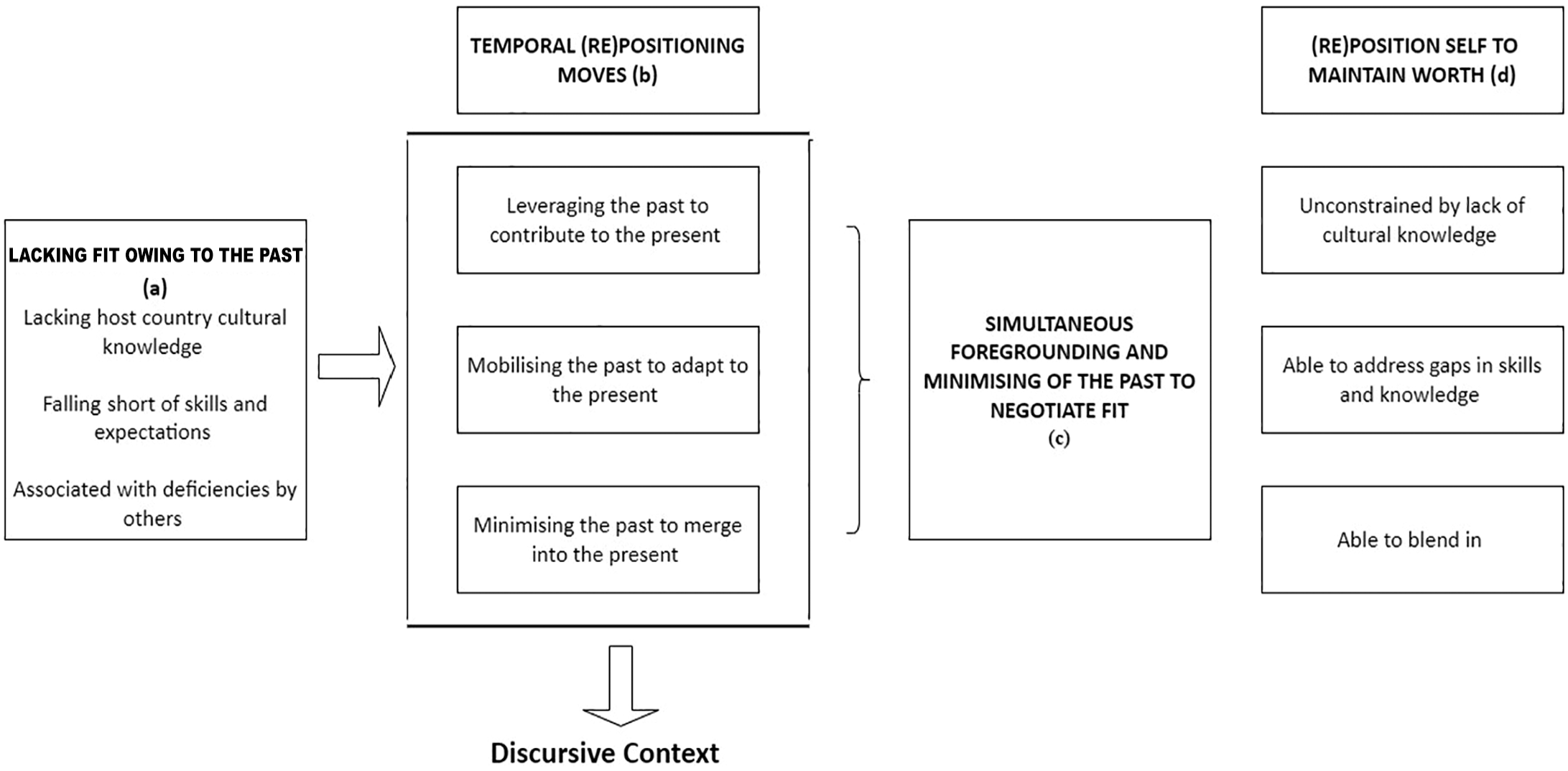
Skilled refugees’ negotiation of fit in a new work setting.
Figure 1 highlights how skilled refugee newcomers can feel positioned as lacking fit owing to their past, which manifests itself in terms of internalised perceptions of falling short of standard skills and expectations, of lacking host country cultural knowledge and/or being associated with deficiencies by others (see box a). In response, individuals engage in three temporal (re)positioning moves to negotiate a sense of fit within new work settings: leveraging the past to contribute to the present; mobilising the past to adapt to the present; and minimising the past to merge into the present (see box b). One striking aspect is how individuals simultaneously foreground and minimise their past to negotiate a sense of fit (see box c). Through temporal (re)positioning that involves simultaneously foregrounding and minimising the past, skilled refugee newcomers can maintain worth by representing themselves as being able to swiftly address any gaps in skills and knowledge, unconstrained by lack of host country cultural knowledge, and capable of blending into the new work setting (see box d).
By drawing on a (re)positioning lens that understands language as action (Potter et al., 1990), we can go beyond identity issues to consider the potential of individuals’ temporal (re)positioning moves to impact the discursive context. For instance, in ‘leveraging the past to contribute to the present’, individuals convey the idea that aspects of refugees’ past socialisation (e.g. cultural values) can facilitate their experiences in host country work settings (e.g. relationship building with insiders). Likewise, in ‘mobilising references to the past to justify the ability to adapt to the present job/work context and/or ability to do the job’, refugees’ pasts are once again represented as a potential facilitator of their self-socialisation in host country work settings. Minimising the past implies that what makes refugees different from the majority (owing to their past socialisation) is not a matter of concern or something that can be easily managed.
I will now develop two theoretical contributions to extant understandings of self-socialisation and refugees’ integration into the workplace.
A characterisation of self-socialisation as a temporal (re)positioning dynamic
Previous studies have depicted self-socialisation as a discrete doing endeavour, providing insights into straightforward proactive moves (see Ashford and Black, 1996) as well as more complex responsive moves (see Bourgoin and Harvey, 2018; Gilmore and Harding, 2022; Korte and Lin, 2013). I extend existing understandings of self-socialisation by theorising it as a temporal (re)positioning dynamic. Specifically, I explain how self-socialisation involves selectively abstracting from the past and/or selectively minimising the past to create desirable plotlines (Van Langenhove and Harré, 1999) to define oneself as having the potential to fit into the present work context. Self-socialisation is thus depicted as a discursive endeavour that involves retrospectively defining oneself as a particular kind of person who has the potential to fit into the new work setting. Indeed, the desire to depict oneself as being consistent over time in spite of changes is seen as being pertinent in cases where people undertake macro transitions (see Ibarra and Barbulescu, 2010). This may be because of patterns of continuity helping incumbents to deal with the newness of their surroundings (see Zikic and Voloshyna, 2023). This article builds on existing studies that illustrate the enabling role of continuity in transitions (Ibarra and Barbulescu, 2010; Zikic and Voloshyna, 2023) to show how rearticulating self as having the potential to fit with reference to the past enables newcomers to maintain worth to persist amid uncertainties in new work settings (see Korte and Lin, 2013). Individuals can (re)position skill gaps (Smyth and Kum, 2010) as an easily remediable endeavour and/or represent outsider status (see Gilmore and Harding, 2022) as having only a limited influence on their blending into new work settings.
Previous studies have highlighted how self-socialisation involves negotiating with other people in the new work setting (see Bourgoin and Harvey, 2018). While I confirm the need to negotiate with others, I also extend existing understandings of negotiation by depicting it as a temporal endeavour that involves retrospectively connecting the present to the past. From this perspective, self-socialisation moves such as learning through interacting with the community (see Korte and Lin, 2013) may be underpinned by a kind of (re)positioning that mobilises references to the culture of origin (e.g. a religiously inspired commitment) to highlight the quest to swiftly adapt to the new job and/or the new context. Likewise, kin-work (see Gilmore and Harding, 2022) may be underpinned by a form of (re)positioning that involves leveraging the past as a springboard to reinstate one’s ability to build insider relationships and/or minimising the past to blend in with colleagues in the present work context. Accounts that embed ‘who one claims to be in the present’ in the past are more likely to be seen as authentic and legitimate by others, and thus receive external validation (Ibarra and Barbulescu, 2010).
Previous studies imply that self-socialisation moves have limited implications for the wider work context (see Gilmore and Harding, 2022; Korte and Lin, 2013). By recognising that the discursive agency people exercise to (re)position themselves is embedded in a framework of possibilities that is maintained through linguistic practices (Davies and Harré, 1990), a (re)positioning lens illuminates self-socialisation as an endeavour that has the potential to shape the context in which it occurs. As newcomers articulate themselves as having the potential to fit with reference to discourse related to their past, their accounts achieve the function of appropriating these elements in the present context. For instance, as the utility of the past culture as a facilitator of present self-socialisation is convincingly articulated and introduced into the discursive space, longstanding negative connotations that imply that cultural difference is a barrier to fashioning an appropriate self within the new work setting (see Ibarra and Barbulescu, 2010) are challenged. New meanings that represent skilled refugees’ past as a resourceful facilitator of their present are established and introduced to the discursive space via the discursive construction of self (Potter et al., 1990). To summarise, by conceptualising self-socialisation as a temporal (re)positioning dynamic that enables newcomers to maintain worth, secure validation from others and potentially impact their context, I provide a more compelling and contextualised view of the construct to extant understandings.
Simultaneous foregrounding and minimising of the past to negotiate fit
The existing literature depicts refugees as playing down or minimising their past in order to move forward in host country settings (see Senthanar et al., 2020). In contrast, I show how the past is simultaneously foregrounded and minimised by skilled refugees to negotiate fit. While previous studies have depicted the past as a hindrance for refugees that triggers devaluation (see Cheng et al., 2021; Wehrle et al., 2018) and/or constrains individuals from moving forward when they continue to hold on to past identities (see Nardon et al., 2021), I show how the past can provide a rich well of interpretations (Torre, 2007) to justify one’s potential to contribute and/or adapt to the new work setting. Given that the past of highly skilled individuals is likely to be characterised by valuable work and life experiences, the past can serve as a powerful discursive resource to strengthen claims related to fit in the new work context. In other words, incumbents can support their self-positioning by creating a sense of coherence between ‘who they claim to be’ in the present and ‘who they were’ in the past. Thus, foregrounding interpretations of the past in self-positioning enables skilled refugees to negotiate subject positions that are closer to the norm and to move forward. Once a person has taken up a particular position as their own, they inevitably see the world from the vantage point of that position (Davies and Harré, 1999: 35). By minimising the past (at the same time), skilled refugees can avoid being seen as different in the new workplace (see Knappert et al., 2018). Furthermore, they can temporarily retreat from thinking about issues related to fit in the present and persist in the face of the uncertainty that characterises their newcomer experience.
This article makes the proposition that dynamically minimising and foregrounding the past as befits the situation is the distinctive way in which skilled refugees navigate new work settings. This is important for negotiating a sense of balance in approach because simply foregrounding the past, albeit in constructive ways, raises a risk of constructing oneself as different and thus experiencing vulnerability because of this difference. From this perspective, it is also important to minimise the past from time to time in order to blend in. While we might wonder if simultaneous minimising and foregrounding might lead to cognitive dissonance, it is notable that there was no evidence of any contradictions or any sense of struggle. The notion of double think (El-Sawad et al., 2004) might be useful for the purposes of understanding a situation where people can keep their utterances separate from their contradictory counterparts so that they never meet.
Previous studies suggest that skilled refugees attempt to adapt to the host country employment sphere by acquiring new competencies (see Willott and Stevenson, 2013) and expanding social capital (see Smyth and Kum, 2010). I propose that the simultaneous foregrounding and minimising of the past is an important mechanism for adaptability. As the familiar past is foregrounded, skilled refugees are arguably able to derive a source of strength to acquire new competencies (see Willott and Stevenson, 2013) and expand social capital (see Smyth and Kum, 2010) in new settings. They can tell themselves that they have fundamental embodied capital that facilitates adaptability. At the same time, minimising the past enables skilled refugees to preserve the energy required to adapt by avoiding the emotional consequences of being visible as the ‘other’ (see Knappert et al., 2018; Mozetič, 2022).
This article suggests that ‘cultural intelligence’ that is seen as a facilitator of self-socialisation (see Malik et al., 2014) manifests itself in terms of the ability to dynamically foreground and minimise the past as befits the situation. Knowing when to foreground and minimise the past reflects the cultural outsider’s ability to effectively utilise cultural knowledge (Thomas et al., 2008) to blend in, acquire new competencies and/or expand social capital in the present context. As skilled refugees constantly foreground and minimise their past as befits the situation within new work settings, they arguably continue to manage themselves in contradictory ways. I thus propose that simultaneous foregrounding and minimising of the past facilitates negotiating an ambivalent sense of fit in new settings (Gilmore and Harding, 2022), characterised by recognition of the need to continuously manage oneself in order to persist.
Conclusion, limitations and directions for future research
In this study, I examined how skilled refugee newcomers attempt to negotiate a sense of fit in host country work settings by mobilising references to their past. I theorised newcomer self-socialisation as a temporal (re)positioning dynamic, highlighting how articulating oneself as having potential to fit with reference to the past, enables individuals to maintain worth, secure external validation and potentially impact their context. I introduced simultaneous minimising and foregrounding of the past as a distinctive way in which skilled refugees navigate new work settings, highlighting how this allows incumbents to derive the strength they need to acquire new resources while avoiding the emotional toll of visibility as ‘the other’.
I recognise that my study is based on a small sample of skilled refugees who reflected on their experiences in an array of occupational sectors, and that there are limits to contextualising and/or generalising the findings in this case. Having said that, my intention is not to yield generalisable understandings, but rather to conceptualise the agency exercised by skilled refugees in order to integrate into host country work settings. Relatedly, I recognise the limitations of adopting an agentic perspective to study skilled refugees, acknowledging that skilled refugees may not always be able to take agentic actions to influence social structures that limit their experiences. Significantly, although skilled refugee employees may experience a lack of fit in host country organisations owing to their newcomer status, I recognise that some individuals may feel more skilled than local employees in certain areas of work. While my analysis acknowledges that skilled refugees do not always concur with the positions attributed to them in new work settings, I have not been able to address how individuals’ perceptions of strengths in certain areas of work shape the way they position themselves in new work settings. Finally, I recognise that the (re)positioning strategies that I found are embedded in the broader UK context. While I have not been able to address the precise impact of the national context on individuals’ (re)positioning moves within host country work settings, I call for cross-national multi-level comparative studies to address this important issue.
Future quantitative research studies should compare skilled refugees’ self-positioning moves between different host country contexts, occupational sectors and career stages, while also considering if the length of residence in the host country influences individuals’ self-positioning moves in new organisations. This is important to obtain a more nuanced understanding of the contextual embeddedness of self-positioning strategies. Furthermore, studies should examine if skilled refugee newcomers see themselves as more skilled than local employees in certain areas of work, and if so, how it shapes their self-positioning in host country organisations. Given that some professionals such as engineers receive rigorous training in their home countries although they are placed in jobs that are not commensurate with their skills and experience, it is important to understand how individuals’ approach to negotiating fit in host country work settings is influenced by their perceptions of being more skilled than local employees in certain areas of work. Finally, it is important to examine if the presence of other refugees in organisations shapes individuals’ self-positioning in any way.
Practical implications
My findings are relevant for employers, managers and career counsellors as they point out the unique skills and competencies possessed by cultural outsiders owing to their past socialisation experiences and highlight how these can be leveraged to facilitate adapting to the new work demands and new environments. From this perspective, career counsellors and managers can help refugee and migrant newcomers to make connections between their past experiences and present circumstances. This would enable individuals to articulate more meaningful narratives to negotiate fit into host country work settings and fulfil their needs for self-continuity. However, people must be encouraged to reflect on the fact that there can be disparities between past experiences and present circumstances, so that they are realistic in their expectations. It is not only important to help skilled refugees develop temporal self-positioning narratives; these narratives must also be validated by others in the work setting. Thus, employers must address the stereotypes attached to skilled refugees through relevant education, training and awareness-raising campaigns that illustrate the unique advantages of employing refugees. Furthermore, line managers can provide skilled refugees with opportunities to demonstrate their unique skills and strengths to other employees.
My findings also have implications for skilled refugee newcomers in highlighting how longstanding negative assumptions related to the potential of cultural outsiders to fit into new work settings can be problematised via self-narratives that show how elements of the past facilitate moving forward in the present. From this perspective, individuals can exercise agency to devise retrospective narratives that illuminate the unique strengths of their past experiences and share these narratives with other people in the organisation.
Footnotes
Acknowledgements
I thank the amazing individuals who shared their work and career stories with me. I also express my heartfelt gratitude to the British Academy for funding this research study.
Funding
The author disclosed receipt of the following financial support for the research, authorship and/or publication of this article: British Academy Mid-Career Fellowship MF21 210075.
