



Abstract
Our study investigates how affective stakeholders – emotionally invested but organizationally powerless individuals – collectively make sense of unexpected organizational events in online environments. Drawing on a netnographic analysis of a National Hockey League fan forum, we examine how Edmonton Oilers supporters responded to the unexpected trade request of star player Chris Pronger. We find that the disruption of fans’ ideal, expected future triggered intense ontological insecurity, which they attempted to repair through collective temporal sensemaking. Fans cycled through three phases – rumour, confirmation and trade – each marked by distinctive uses of past, present and future narratives to reconstruct meaning and regain a sense of control. Our findings contribute to stakeholder theory by theorizing affective stakeholders as unique actors in organizational life. We also expand temporal sensemaking theory by showing how multitemporal narratives function as coping mechanisms in virtual communities. Finally, we emphasize the empirical value of studying collective sensemaking in digital spaces, where discursive interactions unfold in real time.
There is a continuing interest in the processes of sensemaking at different organizational levels (e.g. Sandberg and Tsoukas, 2015). We know quite a bit about how employees, managers and other decision-makers make sense of situations and unexpected events (Balogun and Johnson, 2005; Gioia and Chittipeddi, 1991). Studies such as these have expanded our understanding of how people make sense of unexpected events (Maitlis and Sonenshein, 2010) such as bushfires (Dwyer et al., 2023), accidents (Mueller et al., 2023) and pandemics (Georgiou and Murillo, 2023).
When discussing individual sensemaking, the primary goal is to understand how people make sense of events that are unexpected, shocking, out of the blue or not routine (Maitlis, 2005). These events are unexpected and break with the taken-for-granted regularities and background expectancies of regular life. This pushes people outside of their ‘comfort zones’ and prevents them from understanding the world as they did previously.
A similar process occurs when examining collective sensemaking. Research on collective sensemaking has focused on how groups construct ways of understanding the impact of unexpected events that take the form of ‘discrepant cues’ (Maitlis, 2005) that cause these groups to collectively re-calibrate who they are and develop new understandings of what it means to be part of a specific group. As Stigliani and Ravasi (2012: 1233)note, unexpected events are ‘discrepancies between a current and expected state of the world [and how groups] exchange provisional understandings and try to agree on consensual interpretations and courses of action’. These discussions have typically turned to the different ways that groups shape, and reshape, their understanding of an unexpected event by collectively developing meaning through talk and interaction (e.g. Vaara and Whittle, 2022; Whittle et al., 2023) and are the result of iterative social processes that are negotiated, worked on and interpreted by, and with, others to create a new and different understanding of the event. Yet, of note is that the focus of the collective sensemaking process is not on the individual and their thoughts. Instead, collective sensemaking is a social discursive process (Glynn and Watkiss, 2020) that is best captured by examining conversations, narratives and dialogue that expose the textual processes and nuances of the group and how they, together, understand the unexpected event and the shock it has wrought on the collective identity of the group.
Further, a few studies have investigated how stakeholders make sense of actions and decisions made by organizations that have a direct impact on their lives (Gephart et al., 1990; Maitlis and Christianson, 2014). Stakeholders are groups of people who have a stake in a specific organization. Stakes can be understood as interests, investments or concerns that different groups or individuals have in relation to an organization (Freeman, 1984). Yet not all stakeholders have equal stakes in organizations. Studies have shown that some stakeholders have greater or lesser influence on the organization depending on how they are perceived (Mitchell et al., 1997). These works have identified stakeholders who are devoid of coercive power, legitimacy of standing and urgency of claims. Yet, despite being on the periphery of an organization’s interests, these stakeholders are important and require attention. We call these groups of people affective stakeholders and define them as stakeholders who are psychically or emotionally invested in an organization, use the organization as a key element of their collective identity construction and typically lack significance because their claims are devoid of organizational influence. 1 These people have been recognized as key partners of an organization (e.g. Bell and Taylor, 2016; Foster and Hyatt, 2007). But, despite their emotional attachment, loyalty and devotion, they have little to no ability to influence organizational decisions. This asymmetrical relationship means that organizational actions and decisions, oftentimes catering to the interest of more important and influential stakeholders, can negatively impact affective stakeholders. As such, unexpected events, and the organizational decisions that follow, can be particularly significant and possibly emotionally damaging to affective stakeholders because of the centrality of the organization to their collective identity and the impact that these events can have on their future expectations and thus their ontological security.
Given the decided paucity of research on the topic, our article tries to understand how affective stakeholders collectively make sense of unexpected organizational events and the subsequent organizational actions and decisions perceived as contrary to their interests and potentially harmful to their identity and wellbeing. A better understanding of how the collective sensemaking of affective stakeholders occurs can shed new light on how collective sensemaking takes place within different stakeholder communities. Therefore, our research question is how do affective stakeholders collectively make sense of unexpected organizational events?
To address this theoretical gap, we examine the collective sensemaking of fans of a National Hockey League (NHL) team after unexpected rumours about the trade request of the team’s star player shattered their expectations about the team winning the championship. We developed a netnographic analysis (Kozinets, 2010) of the real-time interactions of the fans in an online forum. Our analysis focuses on the iterative messages exchanged by fans during a 12-day period, from the beginning of the rumours until the day after the announcement of the trade. Our major finding is that unexpected organizational events may foreclose the expectations of affective stakeholders which disrupt their ontological security, causing anxiety and prompting them to engage in collective temporal sensemaking to regain a sense of control and restore their feeling of security. Our discussion explains how fans came together in an online forum to make sense of an unexpected organizational event and how their actions attempt to mitigate the feeling of helplessness and the lack of agency associated with their shattered expectations for the team.
We make three contributions with our article. First, we theorize how affective stakeholders, such as sports fans, make sense of an unexpected event that foreclosed their expectations about the future. We demonstrate how the collective sensemaking of affective stakeholders differs from stakeholders who have greater influence and impact on the focal organization. Second, we discuss the role of temporal sensemaking in dealing with unexpected events. We show that retrospective sensemaking is particularly relevant to restore a feeling of control over reality and a sense of ontological security when a group lacks control about decisions affecting their future, while prospective sensemaking opens up new future alternatives that mitigate feelings of helplessness about present decisions. Lastly, we discuss collective sensemaking in a virtual environment. This takes current discussions of collective sensemaking to social forums and social media platforms and other forms of digital communication that have been under-examined as empirical sites. Our focus on the online discussions of collective sensemaking recognizes that there has been a shift to virtual spaces and discussions and that past understandings of collective sensemaking might not necessarily apply to these contexts.
Collective sensemaking
The way people come to know the world is entwined with the actions they engage in to make the world comprehensible. Day-to-day routines and other routine-like situations are understood through well-established frames. In these situations, cognitions guide people’s patterns of action and, simultaneously, actions affect how they cognitively understand the world. Nevertheless, when new or unexpected incidents/cues/events (Maitlis and Christianson, 2014) occur, it is possible for these frames to disintegrate (Weick, 1995). These frames can become ill suited, which makes it difficult for people comprehend the situation at hand. This impacts and violates a person’s expectations such that there is a need to re-establish how the person understands the world as it stands. This process of sensemaking ‘allows people to deal with uncertainty and ambiguity by creating rational accounts of the world that enable action’ (Maitlis, 2005).
Sensemaking has most commonly been understood as a process that individuals engage in because of an incident/event/cue. However, others have discussed how it is that groups that share collective understandings make sense (e.g. Boyce, 1995; Quinn and Worline, 2008; van der Giessen et al., 2022). This focus on collective sensemaking shifts the process from an individual, cognitive approach to a collective, linguistic and material practice (Bietti et al., 2019). For example, Stigliani and Ravasi (2012) argue that linguistic turns and the presentation of artefacts were vehicles that groups used to make sense of their organizational situations not just retrospectively, but prospectively as well. This suggests that groups, when they make sense, focus on not just what happened in the past but also what they expect could happen in the future. As such, they demonstrate that sensemaking is not limited to cognitive processes but social and material practices as well.
Collective sensemaking is not merely about achieving a shared understanding among all group members. As groups attempt to process the impact of an unexpected event, individuals often arrive at divergent interpretations of the situation – understandings that can, and often do, conflict with one another. The process is complex and frequently marked by tension and disagreement. It involves negotiation, where group members work toward a minimal, workable understanding that enables coordinated action (Brown et al., 2008). The assumption that groups function with a unified ‘mind’ oversimplifies collective sensemaking by mistaking it for consensus-building.
Collective sensemaking also differs from individual sensemaking to the extent that group members usually have a different set of past experiences and expectations about the future and their understandings may shape their views about the direction and set of actions they consider more appropriate for an organization to make. We also know the linearity of clock time does not capture the complexity of the socially constructed nature of time and how time is subjectively experienced (i.e. Hernes, 2022; Shipp and Jansen, 2021). The past, present and future are understood based on the perception of a current situation at any given time. Moreover, our discussions of the present impact our understandings of the past and our conceptions of the future (Mead, 1932). It is this ability to construct and understand the past, present and future that allows people an element of control and agency over their own situation. This requires them to align not only how they see disruptive events and their causes by rationalizing the present in light of the past through retrospective sensemaking (Weick, 2001), but also what can be done in the present to achieve what they expect for the future through prospective sensemaking (Gioia and Chittipeddi, 1991). The ability to understand and make sense of unexpected events can take the form of constructing new temporal narratives aimed at creating new understandings of the situation. Temporal sensemaking thus occurs when ‘a new present is formed from which we revise the past and newly project the future’ (Wiebe, 2010: 231).
Findings such as these demonstrate that the sensemaking process occurs both backward and forward and that it occurs within groups at a collective and discursive level (Dawson and McLean, 2013). A drawback of the current literature, however, is that the focus of most studies of collective sensemaking occur within organizations and are focused on organizational members. Yet, collective sensemaking also takes place outside of organizations by groups of people who are tangentially connected to the organization. Moreover, current discussions have been mostly limited to in-person groups. However, as virtual environments become more common in all settings (e.g. work, clubs, teams) the processes of collective sensemaking in these online communities is sorely lacking. A focus on collective sensemaking by affective stakeholders in a virtual environment is an opportunity to explore these dynamics.
Affective stakeholders
The focus on the sensemaking of actors in the primary and secondary practice-world has, as a result, limited our understanding of who engages in organizational and collective sensemaking (Sandberg and Tsoukas, 2020). Some scholars have long pointed out the importance of the perceptions and understandings of stakeholders (Dutton and Dukerich, 1991). And while efforts to understand stakeholders’ sensemaking are comparatively more recent (Maitlis, 2005; Maitlis and Christianson, 2014), contemporary discussions, however, have solely focused on the agentic implications of sensemaking. In other words, stakeholders have been brought into the framework of organizational sensemaking under the assumption that they have some direct influence over the sensemaking of managers within the organization. The consequence has been that those stakeholders who are unable to influence the organization and organizational decisions have been underrepresented and understudied (Derry, 2012).
The underrepresentation of these stakeholders is a theoretical oversight. Little research has delved into the collective sensemaking process of the people who are outside the direct sensemaking activities of an organization (Derry, 2012). However, it is telling that the research that has been done on stakeholders who have limited influence on the organizations and their decisions suggests that these are groups of people who are important to organizations . For instance, scholars have noted that those stakeholders who are on the ‘fringe’ (Hart and Sharma, 2004: 10) of the organization can become an important group of stakeholders to an organization if properly identified and managed. These fringe stakeholders are ‘typically disconnected from or invisible to the firm because they are remote, weak, poor, disinterested, isolated, non-legitimate, or non-human. They may be affected by the firm but have little, if any, direct connection to the firm’s current activities’ (Hart and Sharma, 2004: 10). These peripheral stakeholders are important because they represent a potentially disruptive and productive force that has strategic value for organizations.
Similarly, others have identified other groups of stakeholders who are ‘marginal’ because they lack the ability to affect the organization’s action while being affected by these decisions (Gibson, 2017; Rossi et al., 2025). The general sentiment is that these ‘marginal’ stakeholders, despite being on the outside of the organization, deserve recognition and consideration whether that means moving the relationship beyond fairness toward justice when engaging in stakeholder relationships (Gibson, 2017) or there is an understanding of value co-creation when dealing with less influential consumers (Rossi et al., 2025).
The attempts to identify and engage those stakeholders that are unable to influence the focal organization is an oversight. The lives of stakeholders on the outside of an organization might be as disrupted as the lives of the managers and other stakeholders more directly involved with the causes and decisions related to an organizational event. For instance, tragic events can impact stakeholders outside organizations such as the case with British Petroleum (BP) and the many communities of fishermen that suffered from the effects of the Deepwater Horizon oil spill (e.g. Grattan et al., 2011, 2017). Similarly, an expected and long planned organizational action can affect an entire community. This can be seen when General Motors (GM) closed the Buick City complex in the 1990s (Martin and Oshang, 1997). The people and groups affected by these events include not only directly engaged stakeholders but also stakeholders who were dependent on the organization and had economic and emotional ties to it, although they were unable to influence how these events were understood and how the people directly involved managed the situation.
Nevertheless, we believe that affective stakeholders differ from either marginal or peripheral stakeholders because their primary connection to the focal organization is cognitive and emotional and not moral or economic. These stakeholders, we argue, enact the changing organizational reality differently than both the actors directly involved in reshaping how an organization makes sense of the situation or those stakeholders who are interested in disruption, justice or value co-creation. Affective stakeholders are not just characterized by their indirect and limited influence but also by their deep emotional and sentimental connection with the focal organization. In fact, this connection is so deep and emotional that affective stakeholders use the organization to describe who they are as a collective group. Thus, collective sensemaking is akin to helplessly watching events unfold without direct influence over the process of making sense and taking action; but their sensemaking practices differ from those who make sense of the secondary-practice world (Sandberg and Tsoukas, 2020) because they are not representing or reporting on organizational events. People and groups like fans (Foster and Hyatt, 2007) and volunteers (Clary et al., 1998) can be highly attached to organizations, much like organizational members, but are unable to assert any control or influence over the organization while also bearing the consequences of organizational actions and decisions. The impossibility of directly participating and influencing the organization suggests that when faced with emotional harm and distress caused by the organization, communities of affective stakeholders may engage in a distinct process of collective sensemaking to cope with the uncertainty and anxiety caused by unexpected organizational events.
Methods
The setting
Our story takes place in Edmonton, Alberta, Canada. Hockey is the national winter sport of Canada and has a status similar to football in England and Brazil, baseball in the United States and Rugby in South Africa. The Edmonton Oilers are a professional hockey team in the NHL, the premier professional hockey league in the world. The team was founded in 1971 and joined the NHL in 1979. During a 7-year span (1984–1990), the team won the league championship, known as the Stanley Cup, five times. It was after this period that financial pressures began to mount. 2 These financial pressures affected the team’s ability to retain high-priced players. The players widely recognized as being responsible for the team’s success – including Wayne Gretzky, arguably the best player ever to play professional hockey – were either traded or sold to other teams throughout the league. In the subsequent years, the team would struggle and never again win a Stanley Cup. In 2005, after a prolonged player lockout by the league owners, the league instituted a salary cap that was intended to help promote more parity and competitive balance across the league.
On 2 Aug 2005, the Edmonton Oilers traded defenceman Eric Brewer and two minor league players (Doug Lynch and Jeff Woywitka) to the St. Louis Blues for Chris Pronger. At the time of the trade, Pronger was widely regarded as one of the best players in the NHL. 3 Immediately after the trade, Pronger signed a 5-year, $26.5 million USD contract with the team. The fans of the Oilers viewed the trade and Pronger’s signing as a signal that the team’s General Manager, Kevin Lowe, was one of the best in the league and, because of this, many fans felt that future team success was soon to follow. This prediction of team success was soon borne out on the ice as the team, led by Pronger, made its way to the seventh and deciding game of the Stanley Cup finals. Although the team lost in the final game, for Oilers fans, it appeared as though the team was well-positioned to win multiple championships in the years to come.
Three days after the Oilers lost the Stanley Cup, on 23 June 2006, rumours began to circulate that Pronger had asked to be traded. Initially, Oilers fans were sceptical and criticized the people spreading the rumours. Over the next few hours, however, it became clear that the rumours were in fact true. Oilers fans came to recognize that the best player to play in Edmonton in over a decade wanted to leave the city after only 1 year, and they did not know the reasons why. Finally, on 3 July 2006, Chris Pronger was traded to the Anaheim Ducks for two players (Joffrey Lupul and Ladislav Smid) and three draft picks.
Netnography
Our research question is directed at understanding how the fans of the Edmonton Oilers collectively made sense of an unexpected event, Pronger’s request to be traded, and the organization’s actions leading to the eventual trade. To do so, we employed a netnographic research approach (Kozinets, 2010) to study an online community of Oilers fans. We collected online fan posts and replies (what was written) from the different threads (specific topics of discussion) listed on the Hockey Futures (hfboard) Edmonton Oilers’ webboard (https://forums.hfboards.com/forums/edmonton-oilers.38/). At the time the data was collected, this was the largest online forum for hockey fans. Unlike today, where there are multiple outlets for sports fans to gather online, the HF Boards were the most common place for Oilers fans to meet online and, therefore, the most appropriate forum to develop our research.
Like Reddit and other discussion boards, anyone who was a registered user of the webboard could create a thread. These threads were titled and then posted in the virtual discussion forum. Other registered users could then post a reply to the topic of the thread or to other posts from other posters in the thread. Each thread varied in the number of posts and replies contained within. The forum offered a rich setting for natural conversation from which we could observe the collective sensemaking of Oilers fans. The synchronic organization of the posts and replies allowed us to analyze the collective sensemaking processes and to map the processes developed by this community to make sense of and reconfigure their knowledge and expectations about their reality after the unexpected event.
Data collection
We focused our attention on collecting the posts of registered users who chose to post a comment on the Oilers webboard about Pronger’s trade request and the trade. These data were collected because they represented the real-time, naturally occurring conversations of an online community of Edmonton Oilers fans as they attempted to collectively make sense of the trade rumour, the confirmation of the rumour, the trade and the impact they perceived it had on the hockey team. Although the data are not in the traditional form of spoken dialogue between individuals, the sequence of posts has many of the characteristics that Gergen et al. (2004) argue are hallmarks of dialogues and conversations.
We limited the time period examined for our case to 12 days. We chose this time frame for a number of reasons. The first is that this mirrors research on collective sensemaking by Merkus et al. (2017) and, like their work, our article is based on a small segment of a larger research project investigating sport fan behaviour. Second, we chose this period because it coincided with the day of the first webboard posting about rumours about Pronger’s trade request (23 June 2006) and ended the day after he was traded to Anaheim (4 July 2006). The third is that this 12-day period represented the most activity on the forum after the rumour was first posted.
The threads examined started during this time frame; however, because this was part of a larger project, some posts in the later threads continued past 4 July (the day after Pronger was traded), and these informed our thinking but were not included in the formal data set. We obtained the data by searching threads for any mention of Pronger on the Edmonton Oilers hfboard archive. These threads were collected and saved as text files. We then evaluated the relevance of each of the threads to our research question. The relevant threads in our data set were those that directly related to the trade of Chris Pronger and how the fan community perceived the impact of his request during the 12-day period. The threads that did not address the impact of the event on the fan community or were outside the 12-day period were removed from our dataset.
The total number of posts collected for the larger project is presented in Figure 1. The red area of the graph indicates the number of posts published by fans during the 12-day period coinciding with the beginning of the rumours about the trade until the day after it was announced. The first post about the rumour that Pronger wanted to be traded was published on 23 June 2006 at 1.57 pm by the user Striking Oil in the thread ‘Pronger is Gonzo?’. At the end of that day, 254 other posts would be published related to the event and another 3552 posts would be exchanged until the day after the official announcement of the trade on July 3. On average, fans posted 317 posts per day. In total, 597 users posted 3807 posts in various threads related to the trade.
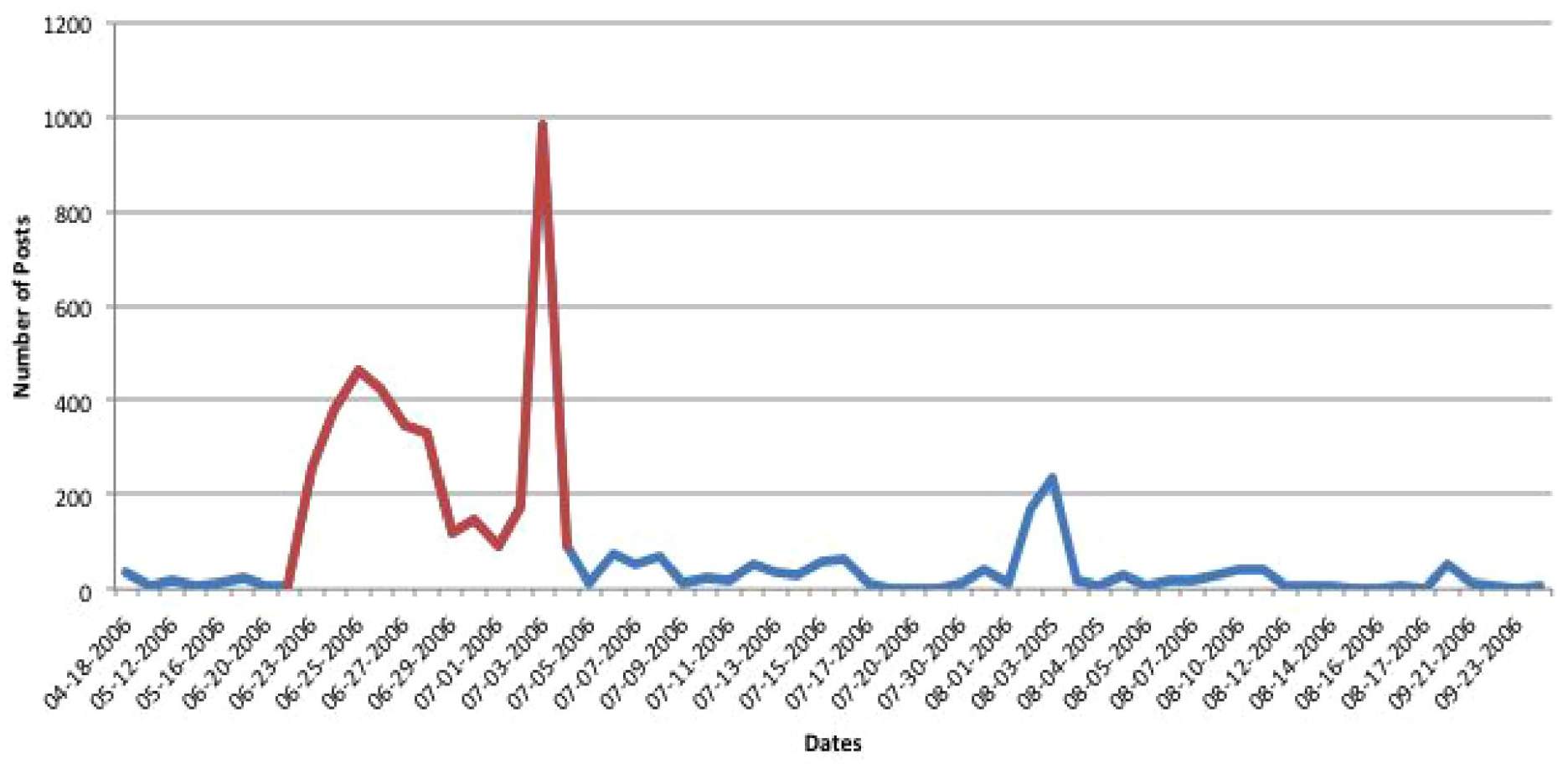
Fan posts per day.
We created a database that comprised a total of 30 different webboard threads. The smallest thread collected contained only 3 posts and replies while the largest contained 1102 posts and replies. In total, the dataset contained 651 pages of text. The posts consisted of the original poster’s topic of conversation followed by either another post by a poster or a reply to another poster’s comment. Every post lists the poster’s pseudonym, the date and the time of the post. The saved threads were entered into Atlas*Ti for subsequent analysis.
Data analysis
Our analysis examined the collective sensemaking of Oilers fans in their online posts and replies. We focused on the textual interaction among members in the forum. Specifically, we honed in on the collective construction of meaning that took place through the fan’s iterative, discursive actions. Our unit of analysis was thus on the process of collective meaning making (Treem and Leonardi, 2012) that brought a group of fans together as an online community, and not on the individual, retrospective accounts of the unexpected event. The analysis of the text was done inductively. The goal was to identify the different ways that the posters (mainly Oilers fans, but not always) on the webboards engaged with the uncertainty generated by the unexpected event and the way the posters tried to make sense of the emotional damage caused by Pronger’s unexpected actions.
When discussing sports fans, it is important to recognize that not everyone who watches or follows a ‘sports object’ (Funk and James, 2001) can be considered a fan. There are various levels of commitment and, as such, behaviours that follow depend on a person’s commitment to the sports object. Thus, the Oilers fans who posted on the site were likely either highly attracted or allegiant (Funk and James, 2001) to the Oilers. This means that the sports object, the Edmonton Oilers, is a significant factor in the way these fans construct their identity. It follows that the people in this study are likely die-hard fans or on their way to becoming die-hard fans. This means that we were not examining the collective sensemaking of all the people who follow the Oilers, but we were examining how a group of people who are highly identified with an organization collectively made sense of an unexpected organizational event. Sampling on highly identified, affective stakeholders helped us examine how seemingly routine organizational decisions impacted this group of fans.
We began our analysis by reading through all the posts and replies in the threads, which were then coded independently. Each post was labelled with one or more first-level codes that encompassed the core themes within the post. Our analysis focused on the specific ways that fans collectively constructed narratives that created a collective understanding of the unexpected event and how this impacted the collective community of Oilers fans. We soon realized that fans made recurrent references and comparisons to the team’s history. We also identified a large number of speculative posts about the future, specifically possible trade alternatives and new possible configurations of the team. We then identified and coded all the passages that had some reference to the past, present or future. Later, we grouped these references into categories and organized them as forms of collective sensemaking.
After our initial coding, we revisited the data, this time looking for key similarities and characteristics amongst the different codes. For example, we agreed that a process of collective sensemaking was taking place, and we discussed how to define the periodization of the process. We also looked at how the events, team and players were remembered and what was discussed in those memories. Further, we examined how fans helped stem their concerns by discussing what the future might hold and how these discussions of the history of the team and the future related to the present situation. To preserve the real time, naturally occurring aspect of the data, we also coded whether a post was an original post or a response to a previous thread. And, because each thread was saved with the time of the post, we also made sure to note the time of the different posts.
Together, we re-examined the codes and grouped them into common themes and defined each of these themes as a way to explain the different ways that the Oilers’ fan community collectively made sense of the unexpected event and the subsequent organizational actions, as can be seen in Table 1.
Analytic coding examples.
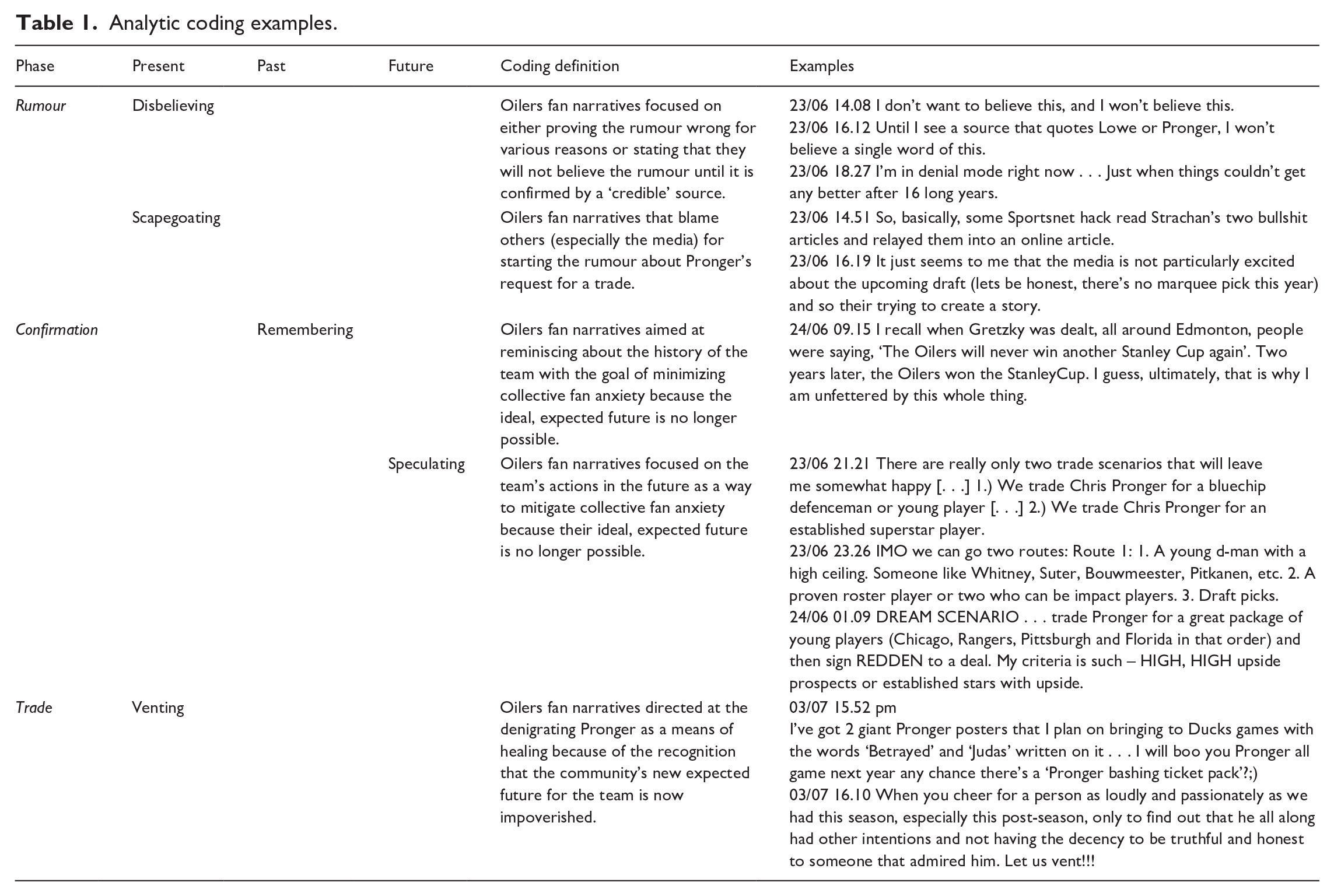
Our analysis of the evolving and iterative conversations allowed us to identify the key triggers of collective sensemaking and the primary changes in the environment that prompted the fans to engage in different forms of collective sensemaking. We then developed connections between the themes over time and mapped the evolution of the collective sensemaking among fans. Oilers fans progressed through three main phases to make sense of their situation: Rumour, Confirmation and Trade. Each of these phases is characterized by the fans’ collective engagement with their present circumstances surrounding the team. That is, fans employed different forms of collective sensemaking at different times because their understanding of the events changed, as did their ability to impact these events. In the Rumour phase, the uncertainty about the truthfulness of the rumours led the fans to comprehend the trade only as a possibility, and they became immersed in collective sensemaking aimed at disbelieving the events and scapegoating the media for circulating the information. The goal for Oilers fans at this time was to exert control over the present to preserve their expected, ideal future. The fans did so by collectively constructing narratives around why the rumour was untrue or unreliable. The Confirmation phase changed the way the fans understood the unexpected event and pushed them toward collectively remembering the history of the team as a way to put the current situation in perspective. Also, fans engaged in speculating about what the team might come to expect once the trade was completed. These different forms of collective sensemaking occurred because fans lacked influence over the situation, and their frustration drove them to construct narratives that were comforting and optimistic. Once the trade was finalized, a new phase started in which the present regained its centrality as the theatre of action. The trade brought the fans certainty about the team and the recognition that the team’s future was, in many respects, impoverished and less appealing than the expected future they had imagined a mere 12 days earlier. Thus, fans collectively made sense of the trade and rebuilt their limited agency by venting about Pronger and what had unfolded over the previous days. Below we discuss our findings in more detail.
Findings
In the following paragraphs, we discuss our findings and explain how the fans engaged in collective temporal sensemaking to understand the event and reassert a sense of control over the situation. Their goal was to stem the anxiety they felt from having their ideal, expected future disrupted and, eventually, destroyed. We argue that rumour(s) instigated collective temporal sensemaking about the present and that the confirmation of the trade request foreclosed upon the fans’ ideal expectations about the future of the team. The foreclosed future prompted fans to revisit and reconstruct their narratives about the team’s past and the fans’ expectations they had about the team’s decisions in the future. The stark realization that they lacked control over the source of their uncertainty created growing levels of anxiety and ontological distress. To compensate for their lack of influence over the present state of the organization, the fans engaged in collective temporal sensemaking in an attempt to repair their ontological security by creating narratives aimed at reshaping their collective understanding about the past, present and future of the team. In the following sections we discuss the collective temporal sensemaking of Oilers fans that occurred in response to the unexpected decision of the player to leave the team and the organizations actions to accommodate his decision. Detailed quotes are presented in Appendices A–D.
The rumour phase
Fans first mentioned Pronger’s request for a trade in the thread ‘Pronger is Gonzo?’ on 23 June 2006. The thread, started by the poster
Fans started to discuss that without Pronger, their ideal, expected future of the team, winning future Stanley Cups, may not come true. Nevertheless, this did not stop them from trying to repair the ideal, expected future they had created in which Pronger was a, if not the, key protagonist. The initial reaction of the fans was confusion and denial. They did not want to trust the rumours and placed a significant amount of effort disbelieving that their ideal, expected future was foreclosed. Another common form of collective temporal work in the present was fans criticizing the media sources disseminating the information by scapegoating the people who fans felt were responsible for delivering the bad news.
Present collective sensemaking
It took a little more than 10 minutes before the first reply to the initial post appeared. In these posts, the fans began to engage in present collective sensemaking. They collectively constructed narratives aimed at disbelieving the unsubstantiated rumours to protect against the emotional damage the rumour caused. Some fans drew upon reason and logic to disbelieve the rumour by offering evidence that it was not possible for Pronger to leave the Oilers. For example, within 11 minutes of the first post, at 14.08, Poster
As
Specifically, fans directed their ire toward the people who first brought the rumour to light. To protect themselves from the anxiety they faced the fans criticized and tried to discredit the people in the media who broke the story about the trade. For example, at 14.23
Of note, and following from the discussion above, immediately after
Like I said, bad source on the renegotiation anyway. The main point that was from two great sources, is that this is never going to happen, and that Stachan is indeed the Sportsnet source. Think about this . . . Edmonton media would be all over this, and we’d be reading about it in the Journal or hearing about it on CHED wat before it’d be on Sportsnet . . . and for such a big story, TSN isn’t touching it. This is Stachan talking to Dreger who is always wrong and has to legit sources to speak of, and then Sportsnet posting hoping to have broken a story. Pronger is here. Unless a deal is unreal, but it won’t be based on his request.
The goal for
As the interaction in Appendix A (Discussion 2) demonstrates, the fans needed a rallying cry around which to collectively construct a narrative to protect themselves, and blaming the media for a bias against the team became the easiest and most convenient path. Oilers fans collectively constructed narratives that scapegoated the media, and in particular Al Strachan, to protect themselves from the anxiety that these rumours produced because of the threat to their ideal, expected future. The fans created accounts that delegitimized the rumours because of the source. Yet, in an ironic and irrational narrative turn, the fans chose to believe a website (Spector’s Hockey), whose mandate at the time was to create hockey rumours, over a more legitimate news source, Sportsnet, because of the content and their desire to impose a specific understanding upon the current, unpalatable situation. Further, when some Oilers fans questioned whether the scapegoating accounts of other fans were, in fact, valid understandings of the situation, the response was swift and immediate, as shown in Appendix A (Discussion 3). In the excerpt,
Summary
After their collective ideal, expected future was disrupted and put into flux, Oilers fans were predominantly focused on creating narratives to protect the ideal, expected future to make sense of their present. The fans’ posts were initially disbelieving of the rumours, but these soon gave way to accounts aimed at scapegoating people and, in particular, people in the media who they thought were responsible for the rumour. The group collectively understood the rumours as ‘B/S’, a ‘hoax’ or ‘bias’ and the present collective sensemaking was aimed at discrediting and discounting the rumours. The weight of the present news was too oppressive for the fans to be able to engage with other temporal spheres of action. The uncertainty and emotional distress caused by the unexpected event appear to have stunted the fans’ ability to expand their sensemaking beyond their present feelings.
The confirmation phase
The confirmation of the trade rumour came soon after a front-page article published on TSN’s 5 website. Similar to the information available from Sportsnet, the article reported that, indeed, Pronger had asked to be traded. The news was published in the forum on Friday, June 23. In spite of TSN’s announcement, and the many others that followed, some fans continued to treat the news as mere rumours. As a result, they continued disbelieving the factuality of the rumour and scapegoating the people or groups they felt were responsible for the rumours.
Yet, for most Oilers fans, different forms of collective temporal sensemaking were initiated when Pronger’s agent confirmed that the trade request was, in fact, true. Thus, Oilers fans could no longer disbelieve the trade request or scapegoat the media and its members. The fans had to accept that the narratives they had constructed to make sense of the rumour could no longer be supported. When confronted by the facts after the rumour was confirmed, fans had to face the certainty that their ideal, expected future was indeed foreclosed. As a result, the stark fact that the rumour was true triggered different forms of collective, temporal sensemaking aimed at asserting some semblance of control over how the fans understood the situation. The fans’ vulnerability and frustration associated with the uncertainty and helplessness of their present situation pushed their focus away from the present towards temporal spaces where they could assert control over the sensemaking process.
One temporal space the Oilers fans occupied was the past. As such, Oilers fans started threads focused on remembering the history of the team. In these threads Oilers fans developed narratives that drew upon previous events in the team’s history that specifically connected the current situation they were living in the present with similar events from the past. The intent was to derive lessons from history and to reassure each other that similar things had happened in the past and that the team and the fan base had endured. The other temporal space that the fans occupied was the future. In these threads, fan narratives were also constructed as a form of reassurance. That is, fans engaged in speculating about the future decisions of the team, specifically the return (players from other teams and draft picks) that the team would receive after Pronger was traded. The realization that their ideal, expected future was foreclosed forced many fans to focus on reimagining a potentially positive future by constructing different scenarios that were supported and reinforced by the collective. In both cases, however, the intent of the collective temporal sensemaking was for the fans to shape the narrative about the current situation in ways that tempered the anxiety and discomfort they felt because of the confirmation of the trade rumour.
Past collective sensemaking
The fans’ initial reaction to the rumour was to conduct present collective sensemaking to protect their ontological security. However, when the rumour was confirmed, this triggered a shift toward past collective sensemaking. The fans focused on understanding the current situation by making comparisons to other, similar situations that had occurred previously. That is, fans collectively found outlets to make sense of their unease, anxieties and expectations by collectively constructing narratives about the history of the team. These narratives tested their existing understandings and provided the fans in the forum an opportunity to actualize and discuss the applicability of these understandings. Discussions about the past were used as guideposts to define the boundaries of the situation and the possible reasons why this was happening to the team. Fans also used past collective sensemaking to place the event in the context of the team’s history as a way to temper and minimize the anxiety they felt because of the realization that their ideal, expected future was no longer possible.
For example, just over 24 hours after the ‘Pronger is Gonzo’ thread was started, and less than 24 hours after the rumour was confirmed, poster
The initial posts in the thread seem to confirm that Pronger’s trade request was, indeed, the worst in Oilers history. Nevertheless, another poster,
These fans all chimed in to reinforce the sentiment that although Pronger’s request had severe consequences for the future of the team, this event did not approach the severity or significance of the ‘Worst Week in Oiler History’. Moreover, Oilers fans felt it necessary to explain why, as a group, the fans should not see the Pronger request as the ‘worst’. The poster
The posters in the exchange in Appendix B (Discussion 3) also reinforce the significance of the Gretzky trade and how this made them feel in comparison to the events from the previous day. The poster
The past collective sensemaking of Oilers fans continues into the early morning and the next day with more directives for how to collectively understand and process the events from the previous days. The discussion in Appendix B (Discussion 4) turns to other times in Oilers history that could be considered the ‘worst’. The poster
The fans, by collectively remembering familiar situations, jointly prepared themselves for the upcoming consequences of the trade. They were able to adjust their expectations in the present by remembering the history of the team to meet the demands of the current, distressing situation. The past collective sensemaking, despite the reasons that it was triggered, was somewhat positive and was focused on helping fans collectively draw upon the past to guide them in the present. Fans also referred to the past to make sense of the situation by remembering that even though the current situation might look bleak, the team had shown resilience in the past and, as a result, it was likely that the team would continue to endure despite the apparent upcoming challenges.
Remembering provided fans with a semblance of control over their reality by constructing narratives that put a positive spin on the current situation. In so doing, the fans offered each other some limited comfort because they could assert some control over the meanings of the past in relation to the present. While some fans emphasized how the trade resembled other, similar past experiences, others put the event into perspective and reordered the event with reference to important episodes and events in team history. These efforts, in turn, validated their current unease while offering some comfort before the inevitable trade.
Future collective sensemaking
For many fans, Pronger’s request and the subsequent confirmation of the rumour forced them to find places where they could reassert control over the situation. Given their lack of control in the present, the future also became a place where fans could exercise their agency. Looking at the future helped them reassert control over the collective sensemaking process. Instead of facing the uncertainty of the present, they saw Pronger’s trade as inevitable so, as a group, the fans concentrated on future possibilities. The fans engaged in speculating about the returns (players and draft picks) that the team would garner as a result of the Pronger trade. They used this future fiction (Beckert, 2013) to elaborate on their preferences for a given course of action to assert collective control and agency to alleviate their feelings of vulnerability.
The fans engaged in speculating by constructing narratives about new possible futures. Specifically, the fans looked at the rosters of other NHL teams and speculated about which players or combination of players would be the most suitable or desirable for the team based on a variety of highly subjective criteria. In fact, some fans would clarify they were sometimes creating a ‘dream team’ and daydreaming about possible trades. Overall, these fans used the threads as places for conversations centered on players where the fans could safely manifest their preferences and expectations about a possible trade.
For instance, there were nine threads created during the Confirmation phase that discussed the potential return of the Pronger trade and how the players and draft picks obtained in the trade would impact the team going forward. These threads had titles like ‘Chris Pronger Trade Proposals’ and ‘Pronger’s Value = ’s MASSIVE!!!’ and were focused on speculating about a new future that the fans could all agree upon. These discussions consisted of numerous lists of players from other teams and whether their skills and talent would fill the void left behind by Pronger. In so doing, the fans constructed narratives that expressed the feeling that despite the disadvantage of being forced to trade the player, the team could end up being better the following year. For example, in the conversations in Appendix C (Discussion 1), Oilers fans discuss how GM Kevin Lowe could, in fact, strengthen the team.
The sentiment in this discussion, and others, is that Pronger’s trade request, despite its ill timing and potential to disrupt the team, might lead to a positive, future outcome for the Oilers. Poster
This optimistic interpretation of the event is, again, a way for fans to assert control over a situation where they have none. The push to create a new future for the collective is apparent as the fans talk about themselves and the team as a group. In this conversation the poster
Speculating about the future, like remembering the past, although comforting for some, did not fully alleviate the anxiety caused by the event and the helplessness it engendered amongst fans. The fans had embraced Pronger as the player who would lead the current team to glory by regaining their position as Stanley Cup champions. Yet, the confirmation of the rumour led some fans toward speculating that the team’s prospects for the future were diminished and hopelessly damaged. Consequently, some of the future collective sensemaking conducted by the fans was also tinged with regret and sadness despite their hope for a positive possible future.
For example, a poster named
Summary
When Oilers fans realized that their ideal, expected future was foreclosed as a group, there was a push to find a way to deal with the anxiety and unease that followed from their ontological insecurity. This meant that the fans developed narratives around subjects that they could control: the past and the future. Although these narratives have no bearing on the actual decisions the team would make, the fans mitigated the anxiety of the situation by telling each other that the whole situation could be worse. The past and the future became refuges for the fans to protect against the inevitable.
The trade phase
The third phase of collective temporal sensemaking was triggered with the formal announcement of the trade on July 3. The most intense sensemaking took place on this day. Once the trade was concluded, the hope for a positive, possible future that the fans had speculated about was extinguished. The present was no longer a source of contentiousness for the fans now that the organization had made the irrevocable decision to trade Pronger. As such, the present regained its role as the primary place for fan collective sensemaking. This can be seen in the various manifestations of how the fans once again engaged in collective temporal sensemaking. In particular, the fans were concerned with releasing their emotions in the form of venting and moving on from the event in a meaningful way.
Present collective sensemaking
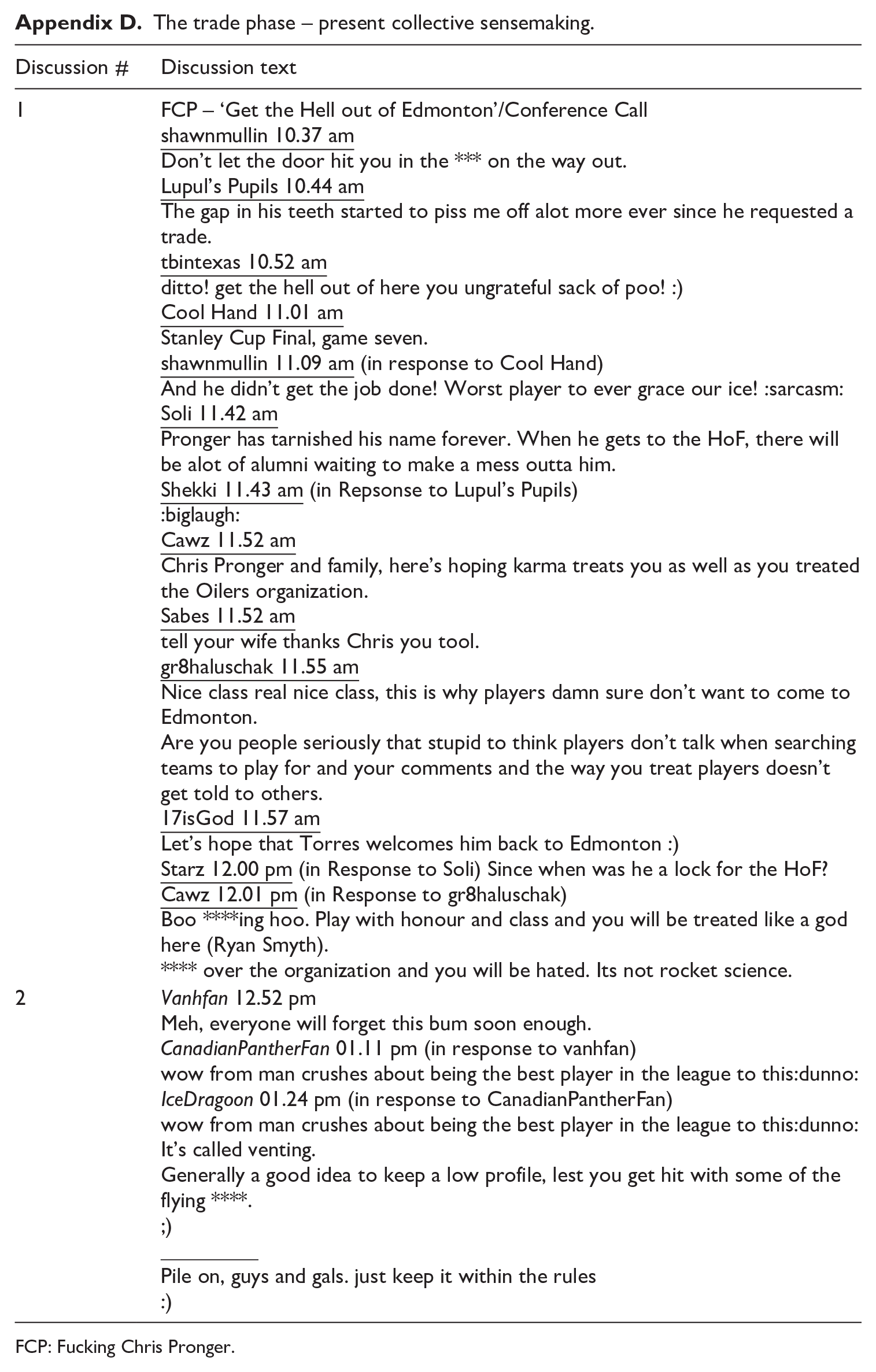
The fans collectively agreed that, regardless of the reasons, Pronger’s actions caused irreparable damage to the team and the likelihood of future success. Consequently, he was the subject of the fans’ ire. He was described as a coward who lacked the courage to take responsibility for his actions. Participation in the forum began to build up less than an hour after the Pronger trade to the Anaheim Ducks was rumoured and confirmed. The primary interaction between fans took place in in the thread named Fucking Chris Pronger (FCP) ‘Get the Hell out of Edmonton’/Conference Call on 3 July 2006 at 10.37 am. The name of the thread is the first indication that fans were unhappy with the trade and that their anger and disappointment were directed at Pronger. The FCP in the title of the thread is a direct reference to discussions in the hfboard when Pronger was initially traded to Edmonton. Some fans had been so excited that they started exclaiming that the Oilers had traded for Chris ‘Fucking’ Pronger or CFP. The thread’s title now references that most Oilers fans were so upset that they now called him ‘Fucking Chris Pronger (FCP)’. Following from the tone of the initial post, the present collective sensemaking that occurred was fans attempting to publicly express their anger and gain support from their community as can be seen from Appendix D (Discussion 1). Moreover, that they were unable to confront Pronger and reconcile why he wanted to leave meant that there was no other way for fans to assert control over their now clearly defined present and, for many, a new bleak and impoverished future.
As the thread opens, the anger is palpable as Oilers fans began venting. Although the primary collective feelings of the trade at the outset of the thread were anger and disappointment, some Oilers fans attempted to contextualize the trade. Poster
The present collective sensemaking continues further as another poster attempts to direct fan behaviour and feelings. The poster
This understanding was not only reinforced but also sanctioned through formal channels on the webboard. All discussions on the webboard were monitored by official moderators who could, at their discretion, close threads or even ban posters if discussions were inappropriate. In Appendix D (Discussion 2), the moderator
In this instance even the moderator, for all intents and purposes the judge of all that is acceptable on the board, indicates that these posts are ‘venting’ and that if other posters are not willing to accept this version of events that they should ‘keep a low profile, lest you get hit with some flying ****’. This ‘official’ version of how the event should be understood is now solidified and the venting continue in the thread for over 2 days.
These posts indicate that although there had been some doubt about how Pronger should be understood and how he should be treated, when the positive, possible future was unobtainable Oilers fans needed to express how they felt about the new, reimagined yet impoverished future they now faced. Moreover, to reassert a semblance of control over the situation and to alleviate the anxiety the fans felt, they had to control how they collectively should feel, in the moment, about what happened. The fans were disappointed that both their ideal, expected future and positive, possible future were now no longer obtainable. The only option that was left was to express their feelings with the hope that this would be cathartic.
Summary
The major question that emerged after the official announcement of Pronger’s trade was ‘what now?’. The trade, and the sedimentation of the present because of the trade pushed the fans back to the present collective sensemaking to temporarily calm their feelings of anxiety. However, the fans’ impotence in the situation never disappeared. The fans engaged in a reformulated version of present collective sensemaking to leave the past and potential future behind and to reluctantly accept the new, now impoverished, expected future the trade had created for the team. Although their venting temporarily alleviated some of the anxiety and helplessness that they felt, this present collective sensemaking was always tinged with the realization that the ideal, expected future of the team was permanently foreclosed and that a new and diminished future had taken its place.
Discussion
Our study fills a gap in the literature regarding the collective temporal sensemaking of affective stakeholders. We have argued that these stakeholders are unique because they are physically or emotionally invested in an organization, use the organization as a key element of their collective identity construction, and lack agency over organizational decisions. When these stakeholders face an unexpected event and their future is foreclosed, they attempt to alleviate their anxiety through different forms of collective temporal sensemaking. We found that Oilers fans engage in collective temporal sensemaking to re-establish control and to reassert a collective feeling of ontological security. We also explain how the collective temporal sensemaking of Oilers fans was initiated by an unexpected event that then caused them to engage with three different temporal phases that changed as a result of the progressive reduction in the levels of uncertainty about the present and future of the team.
When the fans faced an uncertain present and were forced to confront the potential of a foreclosed future, they attempted to preserve their ideal, expected future by defending against their fear of a new, alternative and potentially impoverished future. Then, as fans realized that it was certain that the present could not be changed, they returned to the past and engaged with the future to make sense of their present experiences and to provide each other comfort. This is different from other, more agentic actors who may use the past and the future pragmatically to enact new sets of actions in the present (e.g. Augustine et al., 2019; Crawford et al., 2022; Lyle et al., 2022). Our case shows, instead, that the fans, who lacked the ability to influence a situation in the present, used past and future collective sensemaking to create narratives that helped them envision a tempered, positive outcome, however unlikely. The fans enlarged their field of action and regained a semblance of control over their situation by bringing the past and the future to bear in the present. Lastly, when it was confirmed that the potential, possible future was no longer a possibility, and the actuality of the event imposed itself on the situation, the fans returned to the present. Their collective temporal sensemaking gave way to present action as a way to alleviate the anxiety and distress caused by the event and their inability to impact the situation.
Our research expands our understanding of collective sensemaking by indicating that, in addition to managers and organizational members, there are other organizational stakeholders, in particular those on the periphery and the margins, who also engage in collective temporal sensemaking to make sense of organizational decisions. These affective stakeholders, whose influence over the unexpected event and subsequent organizational actions is minimal at best, might create and deploy different and potentially more extensive narratives to manage the situation. It is precisely their lack of control over the situation that fuels the exploration of variegated alternatives because the stakeholders’ understanding of the unexpected event is based on a set of imagined, not concrete, occurrences. For instance, it might be easier for affective stakeholders to make sense of the unexpected event because their sensemaking is based on what might be. This offers affective stakeholders latitude to construct a wide variety of scenarios thus developing collective narratives that extend beyond the typical expected sensemaking responses. In other words, because affective stakeholders are limited in their present actions and have little influence over the organizational decisions, a large part of how they understand the unexpected event involves remembering the past as well as speculating about the future. Their collective response can be substantially different from the response of more agentic and pragmatically oriented actors who are not required to rework the collective memory and the collective imaginary of the organization to make sense of the event. The different forms of collective temporal sensemaking in the past and the future are practices that offset the loss of control that results from the unexpected event. This means that the collective sensemaking of affective stakeholders is based on a different set of conditions than those used by stakeholders who have greater salience and influence over the focal organization.
We posit that the more an affective stakeholder is emotionally invested in an organization and less influence they have over the sphere of action, the greater the number of alternative scenarios they might be able to, or have to, generate in relation to any unexpected event through collective temporal sensemaking. Although prospective and retrospective collective sensemaking seemed to provide partial comfort for Oilers fans, it may also increase the affective stakeholders’ feelings of helplessness and anxiety. This is evident in the actions of Oilers fans after they recognized that the new future did not resemble their ideal, expected future, which created additional dissonance and amplified the divide between their expectations and the reality and led to the venting seen in the fans’ present collective sensemaking after the trade.
Our findings also provide a more nuanced understanding of the role of temporality in collective sensemaking (e.g. Alimadadi et al., 2022; Hernes and Obstfeld, 2022; Wenzel et al., 2025; Wiebe, 2010). The literature sees retrospective sensemaking as the standard and wonders whether sensemaking can be prospective (Gioia et al., 2002; Sandberg and Tsoukas, 2015). In contrast to a strong separation between the two, we argue that past, present and future are intrinsically connected and directly involved in action (Emirbayer and Mische, 1998). For example, any account of the past necessarily impacts the way actors view the future, and this has implications for their actions in the present. The same applies when we recognize that a collective’s understanding of its present reality also influences how it perceives and relates to the past and the future. In other words, the coexistence of the past, present and future, that is the multitemporal character of social reality (Koselleck, 1985), is an intrinsic condition for collective sensemaking. However, certain events can prevent actors from referring to those temporal realities. As our case shows, when the fans’ expected future was shattered, they were left unable to immediately rebuild that future due to the uncertainty of the trade. Making sense of the future in that circumstance was not an option, and they had to look to the past of the team to find solace before they could envisage new scenarios for the future. While sensemaking is multitemporal, actors will focus on the past, present or future depending on which realities remain accessible to them. The reason why sensemaking research has discussed the past and future as sensemaking resources is that the focus has been on present-disrupting events. But the present itself can be a resource whenever there is disagreement and uncertainty about the past or the future (e.g. Kim et al., 2019). Therefore, we contend that the past, present and future exist as resources for sensemaking, but actors will rely on them differently depending on the dimensions that remain available for them.
Moreover, our findings suggest that the criticality of an event lies in the eyes of the beholder, helping fill the gap in our understanding of sensemaking in what is usually considered routine situations (Sandberg and Tsoukas, 2015). We show how not only crises and disruptive episodes but also more mundane events and organizational decisions may trigger the loss of ontological security and bring stakeholders together to engage in collective temporal sensemaking. As stated above, the narratives fans constructed by remembering and speculating were particularly helpful and reassuring because of the utility they offered to anchor the fans’ understanding of what happened and what was happening. Although these affective stakeholders constructed different narratives to help them understand the situation, as important as the content of the narrative was the collective support and security that the fan community provided throughout the 12 days. These affective stakeholders logged on to the webboard not just for communication but for support and comfort. They were able to find others who shared a similar feeling of anxiety because the organization that they held in highest esteem was being threatened. Moreover, as affective stakeholders, these fans were searching for a way to assert agency and, when there were limited options, they engaged their community and through the process of collectively understanding the situation they were able to partially and temporarily mitigate their unease.
Our study also brings to light the utility and importance of two unconventional sites for organizational research; sport and sports organizations and virtual, online environments as legitimate sites for management and organizational research. Although sport and sports organizations have been previously examined by management and organizational researchers (i.e. Branscombe and Wann, 1992; Keidel, 1987; Staw and Hoang, 1995) they have typically been treated as proxies for ‘real’ or ‘serious’ organizations (e.g. Day et al., 2012; Fonti et al., 2023; Grohsjean et al., 2016; Keidel, 1987; Marino et al., 2015). Our findings and discussion demonstrate that sports organizations, and the groups that engage with these organizations, can offer management and organizational researchers important insight into different theoretical and empirical discussions. Relegating sports organizations to the sidelines negates not only their cultural importance but also the fact that many of these organizations are multi-billion-dollar organizations. Our study is intended to contribute to and demonstrate the importance of sports organizations to the understanding of management and organizational theory.
Similarly, our research is an example of the potential of research on and in virtual environments. There has been limited research on collective sensemaking in online platforms (Georgiou and Murillo, 2023). Yet, as we demonstrate, online environments have the potential to offer insight into different theoretical discussions and empirical investigations. Our discussions of collective sensemaking builds upon other research in online communities; however, we advance discussions of collective sensemaking by using our data to show how the process unfolds and develops. In so doing, we capture and analyze how real time conversations help shape collective sensemaking. This aspect is merely one of the benefits of research in online environments. As organizations continue to move toward more virtual, collective action, research that is directed toward understanding how different organizational behaviours occur virtually has the potential to offer new insights about organizations and organizational behaviours that were previously inaccessible.
Footnotes
Appendix
The trade phase – present collective sensemaking.
| Discussion # | Discussion text |
|---|---|
| 1 | FCP – ‘Get the Hell out of Edmonton’/Conference Call Don’t let the door hit you in the *** on the way out. The gap in his teeth started to piss me off alot more ever since he requested a trade. ditto! get the hell out of here you ungrateful sack of poo! :) Stanley Cup Final, game seven. And he didn’t get the job done! Worst player to ever grace our ice! :sarcasm: Pronger has tarnished his name forever. When he gets to the HoF, there will be alot of alumni waiting to make a mess outta him. :biglaugh: Chris Pronger and family, here’s hoping karma treats you as well as you treated the Oilers organization. tell your wife thanks Chris you tool. Nice class real nice class, this is why players damn sure don’t want to come to Edmonton. Are you people seriously that stupid to think players don’t talk when searching teams to play for and your comments and the way you treat players doesn’t get told to others. Let’s hope that Torres welcomes him back to Edmonton :) Boo ****ing hoo. Play with honour and class and you will be treated like a god here (Ryan Smyth). **** over the organization and you will be hated. Its not rocket science. |
| 2 | Vanhfan 12.52 pm Meh, everyone will forget this bum soon enough. CanadianPantherFan 01.11 pm (in response to vanhfan) wow from man crushes about being the best player in the league to this:dunno: IceDragoon 01.24 pm (in response to CanadianPantherFan) wow from man crushes about being the best player in the league to this:dunno: It’s called venting. Generally a good idea to keep a low profile, lest you get hit with some of the flying ****. ;) _________Pile on, guys and gals. just keep it within the rules :) |
FCP: Fucking Chris Pronger.
Acknowledgements
We would like to thank Associate Editor Ajnesh Prasad and our 3 reviewers for their kindness, patience and guidance throughout the review process.
Funding
The author(s) received no financial support for the research, authorship and/or publication of this article.

Notes
A long-standing interest in how organizations remember, forget and rewrite their pasts shapes the research of