



Abstract
Entrepreneurship is often understood as acting boldly on the market, broadcasting one’s endeavours in persuasive success stories. We, in contrast, seek to understand less flamboyant entrepreneurial practices by examining the creativity and innovations pursued by a gendered and marginalized professional group in the public sector. Through an ethnographic study of hospital pharmacists during the COVID-19 pandemic, we seek to understand how pharmacists ‘do’ entrepreneuring at work, what practices they engage in, and how they act creatively, sometimes breaking with role expectations, and seldom receiving recognition for what they are doing. In the article, we refer to this as silent entrepreneuring – a form of entrepreneuring that simultaneously complies with and refuses entrepreneurial ideals. By adopting two contrasting but complementary analytical positions, we examine the often unspoken activities of pharmacists and how they form practices that both support and contradict each other. We conclude by suggesting that the concept of silent entrepreneuring enables a broadened understanding of organizational entrepreneurship that calls for greater sensitivity towards the different forms that entrepreneuring may take.
Introduction
The intertwining of neoliberalism and late capitalism has given rise to an imperative to align with entrepreneurial ideals (Rose, 1998). The imperative is directed at both employees in organizations (Pongratz and Voß, 2003) and citizens in society at large (Bröckling, 2016), and is gendered, albeit in subtle and often contradictory ways (Ahl and Marlow, 2021; Scharff, 2016). Entrepreneurial ideals, it suggests, are seductive in their guidelines for how to achieve successful selfhood, but often mask the dynamics of how the gendering of practices and the practicing of gender perpetuate certain assumptions (Martin, 2003). While the confident and eloquent male entrepreneur, nurturing ambitions of starting (and profiting from) a new business, is easily recognized, pharmacists in a public hospital who acted entrepreneurially during the COVID-19 pandemic were less noticed – by others and by themselves.
From the ethnographic study of pharmacists that this article builds on, we became aware of tensions between talking versus acting oneself into entrepreneurial selfhood. We also noted tensions between enabling notions of entrepreneurship as freedom and creativity and more controlling sides of entrepreneurship as a means of inconspicuously fabricating subjects through normative discourses that govern the individual and assign certain subjectivities to her (Ball, 2016; Rose, 1998; Scharff, 2016). This led us to examine assumptions of agency/structure associated with the entrepreneurial self – assumptions that we unpack by investigating practices of complying and refusing in relation to entrepreneurial norms and ideals and how entrepreneuring is narrated, or not. By introducing the concept of silent entrepreneuring, we apply a practice lens to study how professionals in public sector healthcare act entrepreneurially ‘behind the curtains’, negotiating everyday professional and gendered orders (Strauss et al., 1963), and, in extension, slowly transforming their organization (Hjorth, 2005). Silent entrepreneuring allows us to capture unrecognized practices of the mundane and to further Steyaert’s (2007) theoretical experimentation of entrepreneurship as practice and process by examining how assumptions of silence (Simpson and Lewis, 2005) both reinforce and disrupt socially entwined practices of gender and entrepreneurship (Gherardi and Poggio, 2018). In our analysis, we understand gender as a social practice and the pharmaceutical profession as a gendered profession that in the healthcare professional hierarchy is positioned as marginal. Silent entrepreneuring provides us with a lens for acknowledging ordinary, collective, untold forms of organizing (e.g. Hjorth, 2005) and highlights the subtle negotiations of socially constructed orders (Strauss et al., 1963) that are part of organizational entrepreneurship. The concept thereby enhances our understanding of the entrepreneurial in organizations (Hjorth et al., 2015) and how silence acts to disrupt a normative discourse of how and where organizational entrepreneuring takes place. Our study points to that silence might act as a force of resistance to and micro-emancipation from norms and positions of domination for marginalized organizational actors such as hospital pharmacists. The case of public sector entrepreneuring that we draw on also dislodges the assumption of the business-making individual and highlights how discourses of entrepreneurship influence everyday organizational life (e.g. Kovalainen and Sundin, 2012).
To further disentangle the normative discourse of the entrepreneur as efficient, charismatic and eloquent, we turn to the concept of ‘the entrepreneurial self’ (Bröckling, 2016) 1 , according to which the ideal entrepreneurial individual emerges as a utopian, almost ghostlike figure (Jones and Spicer, 2009). This figure is adorned with a multiplicity of shimmering facets, in which real-life individuals, aspiring to fit into organizational and societal norms, seek to reflect themselves, typically perpetuating masculine discourses (Connell, 2002). These facets are often seen as achievable, implying that the neoliberal imperative of entrepreneurial selfhood is equally accessible to all (Gill and Orgad, 2018), and conceal gendered codes that place additional pressure on women, or marginalized groups, across different professions (Sullivan and Delaney, 2017). In previous research, the relationship between living up to entrepreneurial ideals and maintaining one’s autonomy has been depicted as a struggle (Ahl and Marlow, 2021; Jones and Spicer, 2009; Scharff, 2016), related to resisting and fending off governmentality (Ball, 2016; Rose, 1998). In this struggle, opting out of manifesting desirable traits of the entrepreneurial self comes at a price for the individual. To manage this cost, whether in professional identity or recognition, we suggest that enacting entrepreneurial selfhood requires both compliance, or alignment, with entrepreneurial norms and a refusal of the same entrepreneurial norms (e.g. Ball, 2016).
Ideals of entrepreneurial selfhood are often associated with a call to ‘speak up’, to narrate one’s achievements in persuasive storytelling (e.g. Jones and Spicer, 2009; Johansson, 2004). We use the term silent entrepreneuring to side-step these assumptions of eloquence and instead investigate processes and practices that unfold quietly in organizations, often escaping attention, and suggest that these ‘doings’ rather than ‘sayings’ (Champenois et al., 2020; Martin, 2003) lay the foundation for organizational entrepreneuring. We label it silent because it is pursued by individuals who ‘do’ entrepreneuring, but who, for reasons related to occupying a gendered profession, do not narrate their endeavours. With entrepreneuring, we draw attention to how these individuals demonstrate creativity, innovation and agency beyond what is expected of them to achieve the long-term missions of their organization and profession. Silent entrepreneuring thus becomes practices that marginalized individuals engage in to form new entrepreneurial subjectivities. We take issue, in particular, with the assumption that individuals should narrate their achievements and themselves as entrepreneurial, that is, that they need to demonstrate efficiency and eloquence, to gain recognition.
To examine hospital pharmacists as engaging in silent entrepreneuring, we develop a practice lens that provides us with two analytical positions, ‘complying-through-silence’ and ‘silence-as-refusing’, that reflect different facets of entrepreneurial ideals. The analytical positions we use take inspiration from Butler’s (1997) theories of power and subordination and Fricker’s (2007) distinction between testimonial and hermeneutical epistemic injustice. Methodologically, we assume an abductive approach, moving between empirical expressions of silence and analytical positions of viewing silence as practices of complying and refusing. Silence in our study implies a withholding of own narratives of entrepreneurial agency, rather than silence in the sense of not speaking at all. The ambiguity of silence was explored using a processual, multi-method approach, encompassing observations and interviews conducted across various contexts. This approach focuses not on what silence is but rather on what it does, and enables us to understand how silent entrepreneuring makes it possible also for marginalized individuals to take on different entrepreneurial guises.
The purpose of our article is twofold: to develop a conceptual approach to study silent entrepreneuring and to use our analytical positions to unpack practices that reflect the multifaceted character of entrepreneurial selfhood – in our case pointing to how silent entrepreneuring constitutes a specific kind of gendered entrepreneuring done from a marginal positioning. The practices we identify require compliance but ambiguously also provide autonomy – in our case, developing professional roles that challenge a neoliberal logic within the public sector. Our intention in this article is not to insist that silent entrepreneuring needs to be ‘narrated’, or that silenced individuals should be made to speak, but rather that we need to acknowledge that entrepreneuring can exist in many diverse, and sometimes quiet, forms.
The negotiated role of pharmacists in the healthcare order
Our empirical case is a regional hospital in mid-Sweden and set in a public sector marked by a heavy bureaucracy, which, it is argued, stands in the way of efficient welfare production and is often considered an oxymoron to entrepreneurship (Kovalainen and Sundin, 2012). As in many other national contexts, Swedish public healthcare has undergone neoliberal reforms to make public services more efficient and to incentivize individuals to reflect themselves in entrepreneurial ideals (e.g. Doolin, 2002). During the COVID-19 pandemic, the neoliberal norms pharmacists are expected to follow were however unobtrusively circumvented, and an opportunity arose to transgress role expectations, go beyond defined work tasks, and engage in initiatives to uphold the functioning of the hospital. In designing new solutions in response to the crisis, pharmacists demonstrated creativity, innovation and agency that surpassed their ordinary professional work and demonstrated an entrepreneurial approach. In this situation, negotiated orders were to a certain extent loosened, which opened a space for pharmacists to act entrepreneurially. In our methodological approach, we observed the doings of pharmacists, and their entrepreneurial agency assumed alternative and ambiguous meanings. Their silent entrepreneuring seemed catalysed by the pandemic but reflected tensions that pre-dated the crisis, echoing underlying, gendered assumptions that constrain what can be regarded as entrepreneurial; consequently, the quiet ‘practice-breaching’ doings of pharmacists were not regarded as entrepreneuring. After the first wave of the pandemic, the hospital published a leaflet explaining how its employees had ‘conquered the crisis’, in which the contributions of pharmacists were not mentioned.
Their silent entrepreneuring, as it emerged in our study, can partly be seen as a counter-reaction to demands for efficiency and entrepreneurial selfhood that became particularly visible/audible during the pandemic. As professionals, pharmacists had to figure out how to navigate dominant discourses of management and enterprise in their construction of self-identity (Doolin, 2002) and negotiate organizational orders to maintain or increase their professional legitimacy (Strauss et al., 1963; Nugus, 2019) and ensure patient safety. As a professional group, hospital pharmacists are known for relying on their tact, diplomacy and role-taking in the negotiated order of the healthcare hierarchy (Mesler, 1989). In this hierarchy, medical and organ-specific knowledge trumps general knowledge (Nugus, 2019), and (male) medical doctors occupy the highest ranks. This makes the predominantly female profession of hospital pharmacists a relatively vulnerable group, hierarchically and gender-wise, which is reinforced by a feminization of the profession during the last decades (Stanfors, 2007). 2 The growth of the pharmaceutical industry after the Second World War has further marginalized the profession and lessened the demand for craftsman skills, such as compounding, while the increasing innovation of new drugs is associated with the large-scale pharmaceutical industry (Mesler, 1989) rather than the profession of pharmacists. For hospital pharmacists, gender, professional development and technology then interact to strengthen their subordination, rendering them invisible within the healthcare organization.
Silence in entrepreneurship and organization studies
Previous research has – rightly, in our opinion – stressed the importance of providing a voice to groups that are not habitually heard in the entrepreneurship discourse, such as women, immigrants and refugees (Simpson and Lewis, 2005). Research that combines narrative and gender aspects of entrepreneurship has suggested that female entrepreneurs encounter difficulties not only in expressing their views but also in being heard and socially constructed as legitimate (Berglund and Tillmar, 2015; Bruni et al., 2004). Whilst narratives provide insight into entrepreneurial doings, an excessive focus on sayings (rather than doings) may unwittingly reproduce an objective epistemology with aims of generalization and representation (Thompson et al., 2020).
There seems, in entrepreneurship, to be a fascination with eloquence in which storytelling emerges as a central practice (Bill et al., 2010; Jones and Spicer, 2009), as does a willingness to step up on stage and recount one’s pursuits: the reasons for success (Anderson and Warren, 2011) or – more rarely – why success was not possible (Dempsey and Sanders, 2010). Storytelling then both represents and forms entrepreneurship (Jones and Spicer, 2009), yet collective and collaborative aspects are often de-emphasized so that the successful, bold, daring individual epitomizes entrepreneurial ideals (Drakopoulou Dodd and Anderson, 2007). This approach privileges storytelling, that is, persuasive narration, over story-making, which is understood as a more bottom-up, collective approach involving interaction with a variety of actors (Johansson, 2004).
Silence is not conventionally associated with successful entrepreneuring, or organizing, and is often presented as something from which marginalized individuals suffer and which they should ‘overcome’. In organization studies, silence has traditionally been viewed as conveying oppression, while recent research has suggested that being silent/silenced does not univocally imply being deprived of agency (Fletcher and Watson, 2007; Morrison and Milliken, 2000) but may entail creativity (Bigo, 2018) and sensitivity towards others (Vu and Fan, 2022). The individual who aspires to be recognized as entrepreneurial, however, needs to reflect herself in facets of the entrepreneurial self as she walks a tightrope between ‘conflicting expectations about ‘fitting in’ and ‘standing out’ as a rule breaker, to constitute [her]self as a legitimate entrepreneurial actor’ (De Clercq and Voronov, 2009: 395). These dual expectations also apply to the larger context of an entrepreneurialized society (Ball, 2016; Scharff, 2016), in which not only managers and business owners are expected to show grit, drive and bounce-back-after-failure capacities, but everyone is expected to take on entrepreneurial qualities (Gill and Orgad, 2018). This is perhaps most noticeable when assumptions about autonomous, responsibilized and confident selfhood are unmet. A ‘deficient’ subject, who deviates from norms, and yet aspires to become entrepreneurial (Jones and Spicer, 2009), is often expected to undergo ‘a make-over’ – and thus to confirm, or perpetuate, a male-gendered order – to align with societal and organizational expectations (Ahl and Marlow, 2021; Scharff, 2016).
The public sector is no exception to this tendency and has, with the advent of neoliberalism, become an arena for a relentless hunt for justifications for the use of taxpayers’ money (Doolin, 2002). Public sector workers, like those in private (competitive) sectors, are consequently expected to manifest initiative, responsibility and self-management, including broadcasting their achievements, branding themselves as innovative, flexible and outgoing (Abildgaard and Jørgensen, 2021). In the same manner as employees in the private sector, the public sector employee needs to craft herself in line with available or appropriate facets of the entrepreneurial self and to work ceaselessly on herself (Scharff, 2016) to ‘fit in’ with entrepreneurial norms, yet also ‘to stand out’ through her drive and commitment.
Simpson and Lewis (2005), in their pioneering article on silence and visibility, underline the need to develop an analytical framework that captures not only ‘the obvious’ but also that which resides ‘between the lines’, broadening the perception of what entrepreneurship is, or might be(come). Gherardi and Poggio (2018) similarly advocate a reflexive critical perspective to reframe who can be an entrepreneur, what entrepreneurship is, and how entrepreneuring works. In our view, this implies directing focus towards public sector employees’ experimentation in organizations (Hjorth et al., 2015), and if/how socially constructed orders are re-negotiated or adjusted (Strauss et al., 1963). Although silence is seldom explicitly addressed in entrepreneurship research, processes of marginalization and exclusion are perceivable, not least via recurrent portrayals of entrepreneurs as charismatic and well-spoken, cherished for their capacity to arouse enthusiasm and mobilize others (Dodd et al., 2022; Dempsey and Sanders, 2010). The eloquent, tech and politically savvy male individual stands out in this discourse as practising a ‘loud’ and ‘spectacular’ (Bill et al., 2010) entrepreneurship, that mobilizes power structures ‘to command our attention’ (Ahmed, 2000: 53). Silence and invisibility, in contrast, are veiled phenomena that underlie processes of marginalization (Simpson and Lewis, 2005), which calls for analytical approaches on different levels. Surface-level analyses visualize marginalizing and silencing practices, while deep-level analyses enable understanding of why and how gender norms discriminate against underprivileged groups and suggest that invisibility protects those who align with power – or the male norm – and exposes those who do not.
Organizational discourses often assume hegemonic understandings of masculinity that overshadow minorities’ interests and narratives concerning – for example, emotions, discriminatory practices, ethics and self-esteem (Mills, 2002; Muzanenhamo and Chowdhury, 2023). This may explain why marginalized subjects hesitate to take on high-profile roles (Brown, 1996), and why such roles induce fear of success or avoidance of conflict (Simpson and Lewis, 2005). While the invisibility of majority groups serves as a protection from scrutiny, marginalized groups who speak up experience exposure. However, by developing alternative discourses, Berglund and Johansson (2007) show that there are latent entrepreneurial narratives that can be mobilized when a dominating discourse is destabilized, making it possible for more individuals to enact themselves into entrepreneurial beings. Broadening the entrepreneurship discourse and experimenting with its facets (Verduijn and Andersen, 2022) may, then, be a way of embracing varying entrepreneurial practices (Gartner, 2022). Examining silence in entrepreneurship, we argue, makes this possible.
Theorizing silent entrepreneuring
In this section, we outline a conceptual framework, proposing that silence in organizations can be viewed from two analytical positions: ‘complying-through-silence’ and ‘silence-as-refusing’. We focus on the interplay between these positions; how actors gain agency by alternating between positions and by acting in the space that emerges in between them. With Strauss et al. (1963), we are interested in how organizational practices are modified/changed and maintained/reproduced and how gender takes part in this, often in spontaneous and unreflected ways (Martin, 2003). We view organizational orders as social, gendered and negotiated in slow-moving processes related to power and hierarchy – and that open or restrict possibilities for (marginalized) professional groups to act entrepreneurially within the organization. Negotiated orders are reproduced as individuals adapt to and adopt them, assuming a partially pre-defined professional role but also because other organizational actors expect certain behaviours. Individuals who break with norms may appear as un-recognizable, and tension arises in that an entrepreneurial individual is expected both to fit in with and to stand out from norms (De Clercq and Voronov, 2009). We seek to theorize how silence relates to fitting in, gaining organizational acceptance, versus standing out, enacting agency and appearing entrepreneurial, by investigating the ambiguous space in between positions of ‘complying-through-silence’ and ‘silence-as-refusing’.
To develop our two analytical positions, we draw on Butler’s (1997) theories on the impact of power in forming the subject, and Fricker’s (2007) examinations of the subject’s ability to narrate herself, to act and to be acknowledged as a ‘knower’. Butler, departing from Foucault, focuses on subjectivity and – more than Foucault – delves into the processes of ‘coming into being’ as a personal struggle, exploring how individuals negotiate power and identity within specific social norms and constraints. She particularly examines contradictions in the individual’s subjection to power – a dual and simultaneous process of being subordinated by power and establishing oneself as a subject. The individual, Butler argues, cannot exist without a subordination that comes before her (e.g. through pre-existing gendered structures), and that in organizations is entwined with partly pre-created professional roles or negotiated orders (Strauss et al., 1963), to which the individual must relate. Fulfilment of pre-ascribed roles entails an alignment with the workings of power and offers the individual subjectivities that fit existing narratives and norms, outlining how she should practise her role. The subject, Butler reasons, grows attached to pre-defined roles, even if ambivalently so, and subjection to roles becomes ‘mandatory’ for gaining intelligibility, being recognized by other organizational actors as fulfilling role-related expectations. The subject, by fulfilling its role, reiterates its subjection, and power, Butler suggests, not only ‘acts on a subject’ but also simultaneously ‘enacts the subject into being’ (1997: 13). The subject may later turn ‘against itself’ and assume responsibility for its submission, engaging in ‘its own self-thwarting’ and ‘craft[ing] its own shackles’ (24). Butlerian thought thus paves the way for understanding silence as both compliance and resistance and advances the concept of silent entrepreneuring, enabling an understanding of its underlying power dimensions – and why it may be challenging for (female) subjects in marginalized roles to change practices and resist (gendered) established orders. Yet, being entrepreneurial implies precisely breaking norms, assuming roles that are less ‘recognizable’ (De Clercq and Voronov, 2009). Fricker (2007) complements Butler by highlighting the epistemic dimensions of social interactions, especially the ways knowledge and credibility impact subject formation, making some individuals access greater identity power than others. By combining Fricker and Butler, we analyse the effect of silence on the subject formation and how this influences a professional group’s capacity to ‘know’ and be ‘known’ within an organizational setting.
Our first position, complying-through-silence, assumes that subjects discern their subordination and seek to ameliorate their position – claiming agency – by ‘speaking up’, aspiring to become ‘subjects who are heard’, whose meanings and contributions are recognized (Simpson and Lewis, 2005). Our second position, silence-as-refusing, suggests that marginalized individuals may have well-founded reasons for remaining silent (e.g. Morrison and Milliken, 2000; Thiesmeyer, 2003) and that speaking is not merely a matter of making one’s voice heard, but one of enabling the subject to speak meaningfully (Brown, 1996), as a ‘knower’ (Ahmed, 2000; Fricker, 2007).
Complying-through-silence
Fricker (2007) uses the concept of ‘identity power’ to argue that whether an individual is believed and listened to depends on her role and social position (or place in the negotiated order), implying that some individuals access a ‘credibility surplus’, whereas others are exposed to a ‘credibility deficit’. Epistemic injustice takes the form either of testimonial injustice – when the individual is ignored in her capacity as a giver of knowledge, undermining her belief in herself as a knower – or hermeneutical injustice, when the individual is wronged in her capacity as a subject of social understanding, lacking a language that renders her experiences intelligible both to herself and to others (Fricker, 2007). Individuals may be silenced by power inequalities, such as the negligence of other actors, or they may silence themselves (often in response to silencing efforts by others). Aspects of identity power thus make marginalized individuals more ‘silenceable’ than others (Thiesmeyer, 2003: 10); not having sufficient identity power or access to professional narratives to explain themselves makes these individuals susceptible to dominating organizational discourses. From a managerial perspective, it may be difficult to understand why marginalized individuals or groups do not speak when invited to do so as enterprising ideals suggest that the individual should be eloquent. It can also be challenging to discern why existing organizational narratives may not offer means for marginalized groups to convey their professional experiences.
Being the target of epistemic testimonial injustice often takes the form of not being consulted or asked for one’s opinion, which induces identity-related damage, leading to a reduction in the subject’s self-esteem. The ‘under-confident subject will tend to back down in the face of challenge, or even at the very prospect of it’, Fricker writes (2007: 50), and testimonial injustice ‘emotionally bruises’ the individual (Muzanenhamo and Chowdhury, 2023: 8), functioning as a mechanism of silencing. The suppression of entrepreneurial women’s voices to account for their views because of ‘imitative’ and ‘fixing’ practices to appear entrepreneurial (Ahl and Marlow, 2021) can be seen as a form of testimonial injustice that perpetuates gender inequality.
Hermeneutical epistemic injustice renders the subject silent in processes of self-silencing, sustaining her marginalization, and occurs ‘when someone is trying to make sense of a social experience but is handicapped in this by a [. . .] gap in collective understanding’ (Fricker, 2007: 69). In organizational contexts, the consequences of not being given attention by colleagues or of not having own professional narratives are that marginalized subjects become unable to express their views, limiting their ability to frame their own experiences. A shortage of narratives indicates the relative powerlessness of a social group, and the subject who lacks narratives is not only exposed to a credibility deficit but also unable to express her views, constraining her ability to understand her experiences. A masculine discourse (Connell, 2002) may then render it difficult for women to find words for their experiences and to be recognized as entrepreneurial if, or when, they tell of their experiences (Bruni et al., 2004), leading to a compounded testimonial and hermeneutical injustice.
Silenced subjects may, however, not be prohibited from speaking, but rather encouraged to do so. An implicit ‘imperative to speak’ (Foucault, 1990) invites subjects to speak by joining in with normative discourses, fulfilling expectations of a ‘compulsory discursivity’ (Brown, 1996: 195) and creating what Foucault (1980) calls ‘unitary discourses’ that reiterate perspectives of those in power. This obligation to speak ‘unitarily’, with one voice, to maintain relations and uphold a recognizable image of oneself threatens to lead to ‘diarrhetic speech’, speech that ‘drowns’ (Brown, 1996: 193) the subject in an overflowing of words (cf. Katila et al., 2020). Speaking may then be not only a way of making oneself heard but also of resigning oneself to norms that are not one’s own (Mignolo, 2011). Declining to speak, or to speak ‘properly’ (in line with norms), indicates a ‘standing out’ that potentially exposes marginalized groups. The ambition to make herself heard, counteracting testimonial injustice, thus risks recruiting the subject into sustaining prevailing gendered orders in organizations, also cementing hermeneutic injustice by thwarting her narratives. We label this risk complying-through-silence, in which a profession’s agency becomes under-narrated.
Silence-as-refusing
In this section, we explore the ambiguities of silence by problematizing liberalist perspectives on the silent/silenced subject (Simpson and Lewis, 2005). Rather than reducing her to a figure exposed to oppression (Bigo, 2018) or permanently trapped in gendered practices (Brown, 1996), we highlight the complexity and nuance that characterize her experiences. While acknowledging that silence is an effect of power and epistemology (of who counts as a ‘knower’), we suggest that ‘overcoming’ silence is not merely a matter of empowering marginalized subjects, making them speak, but also one of understanding practices and relations that (re)produce silence and marginalization (Martin, 2003). Speaking and silence are reciprocal, involving practices in which individuals’ willingness to speak up, to share their knowledge, connects to audiences’ willingness to listen (Dotson, 2011).
Butler’s (1997) notion of the double subjugation of/to power explains why acting outside of organizational expectations – speaking up when negotiated orders dictate silence, or not speaking when expected to do so – is challenging for (marginalized) individuals. Both silence and speech are expected of them, depending on social situation and power relations (Foucault, 1990). Breaching norms entails not living up to professional expectations, risking unintelligibility (Butler, 1997); not occupying a clearly defined organizational role (from the position of complying-through-silence), or not being recognized as ‘entrepreneurial’ (from the position of silence-as-refusal). Both types of risks are more pronounced for individuals from a minority position, whose speaking up may ‘stand out’ as more provocative (Simpson and Lewis, 2005).
The analytical position of silence-as-refusing recognizes risks of unintelligibility while drawing on the Foucauldian notion that through silence individuals evade ‘the gaze of power’, and that silence, while an expression of subordination to power, simultaneously protects from power. By remaining silent, individuals preserve practices from regulatory power (Brown, 1996) and gendered and organizational expectations. Organizational scholars have pointed to practices of ‘keeping your head down’ (Smith et al., 2018: 61) and ‘lying low’ (Muzanenhamo and Chowdhury, 2023: 11) as a means to avoid managerial intervention. Silence, from this perspective, signals not submission, but an approach that allows individuals to engage in independent (entrepreneurial) action and an inconspicuous ‘handling’ of dominant norms and negotiated orders. Silence can then be seen as a way of escaping ‘obligatory’ identities suggested by discourse (Watson, 2008: 58) or as a means of preserving certain practices from regulatory power (Foucault, 1990). Individuals may thus refrain from speech, not (only) out of fear, cynicism or lack of trust (Fleming and Spicer, 2003), but as a refusal to ‘pursue identities that are primarily driven by the need for recognition’ (Smith et al., 2018: 69; see also Ball, 2016). Refusing to speak indicates a refusal of co-optation and may act as a source of reflection and readiness to embrace multiple perspectives (Bigo, 2018; Kociatkiewicz and Kostera, 2003). The analytical position of silence-as-refusing outlines an ‘ambiguity of silence in relationship to power, insisting that silence functions not only as a ‘shelter for power’ but also as a shelter from it’ (Brown, 1996: 187). We suggest that this is a productive ambivalence, where social creativity, enacted within established organizational orders, offers a space for invention and the emergence of new practices (Hjorth, 2005). This, in turn, implies that it may be tactically wise for marginalized individuals to refrain from speaking within existing organizational structures when deeming that they are unlikely to be listened to as givers of knowledge. Their silence implies a balancing of power’s need for the other’s voice to control it and the leeway potentially accessible by remaining silent. Silent entrepreneuring then emerges as a tactical navigation of compliance and resistance that in its ambiguity offers an entrepreneurial manoeuvring space while not overtly contesting power. What becomes important then may not be who is speaking and who remains silent, but who is socially constructed as a ‘knower’, which enables the subject to be heard and to negotiate her place in internal orders (Strauss et al., 1963). This negotiating, as we argue in our analysis, is facilitated by an acknowledgement of the existence of testimonial injustice and an ambition to break with unreflected practices of hermeneutic injustice.
Method
The empirical context of this study is a hospital pharmacy at a regional hospital in mid-Sweden. Hospital hierarchy is notorious for its rigidity and pharmacists occupy a marginalized, yet recognized, position in key healthcare practices related to the usage, preparation and administration of medicines (Mesler, 1989). Their numerical smallness in comparison with other healthcare professions, 3 together with their specialized expertise, contributes to the marginalization that we view as professional and gendered (see Stanfors, 2007), rather than individual. The hospital pharmacists at the hospital studied consist of two groups: hospital prescriptionists and clinical pharmacists. Hospital prescriptionists usually have a three-year university education, and expertise in how drugs can be combined to achieve desired effects, how drugs should be administered and which drugs can be substituted with others. They also work with quantitative estimates of drug usage, predict demand, order drugs and arrange storage, but do not interact with patients. Clinical pharmacists usually have a five-year university education – the same level of education as doctors – work directly with patients and have expertise in how to combine drugs on individual levels. Both hospital prescriptionists and clinical pharmacists refer to themselves as logisticians (knowing what drugs are available and where) and as pharmaceutical experts (knowing how drugs interact, their dosages and side effects). Although there are differences between the two groups, we do not address these in our analysis, and instead focus on how the double function of being seen as a logistician, but seldom as a pharmaceutical expert, leads to conflicting demands.
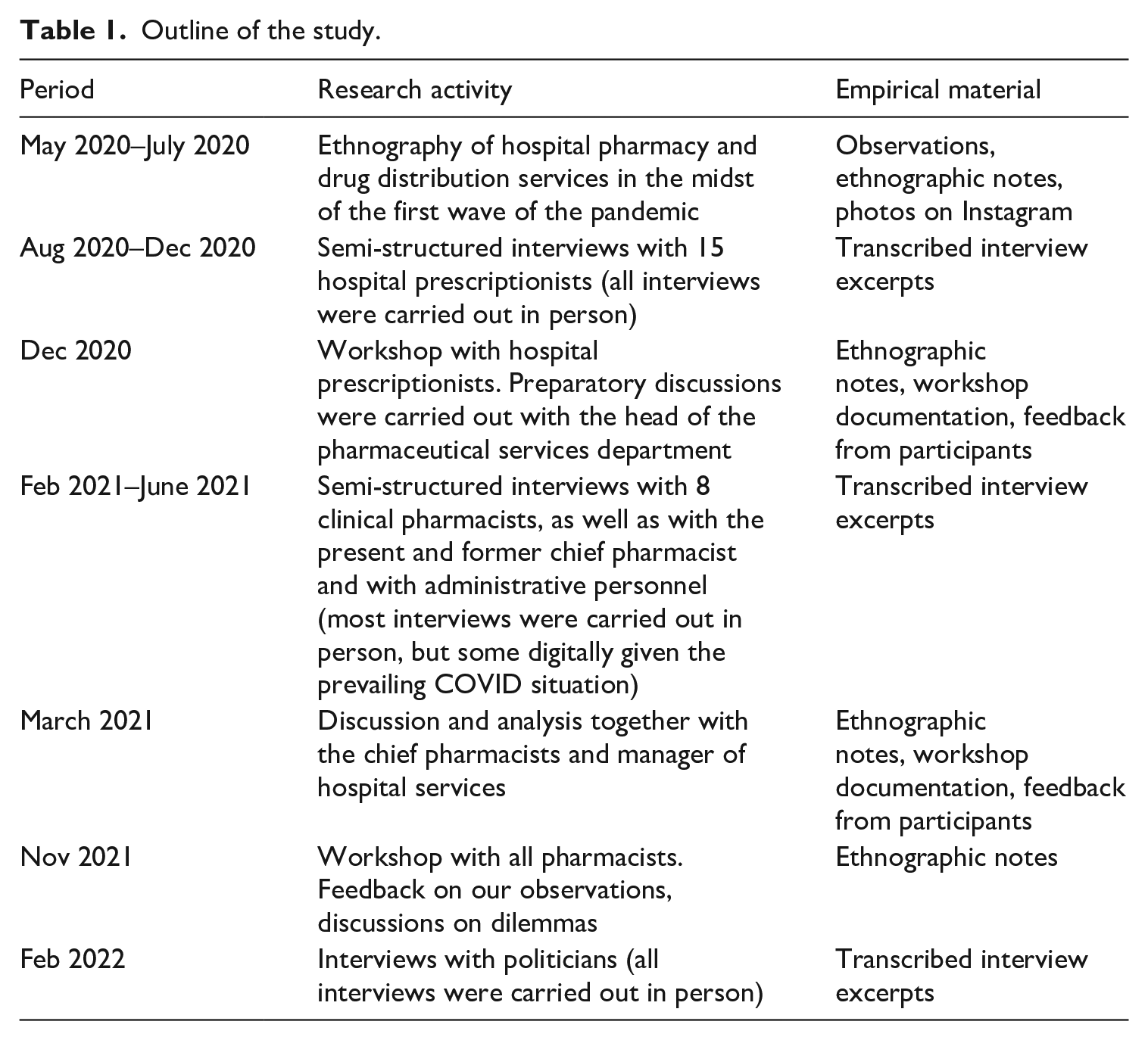
Our study was initiated during the spring of 2020 as the first wave of the coronavirus hit Sweden. Thanks to a close relative of the second author who works at the hospital, we were informed about the rapid adjustments taking place as early as March 2020. After a meeting with a relative and another employee (both managers in the regional department of pharmacy), we were granted access to follow pharmacists’ work in an ethnographic study from May 2020. As part of the ethnographic study, the second author participated in pharmacists’ routine tasks. The study was explorative, and our involvement in the daily work of pharmacists made it possible to affect and be affected by their often corporeal and wordless work (Gherardi, 2018; Katila, 2010) and the gendered aspects of their profession (Poggio, 2006). The study was later extended to include semi-structured interviews with pharmacists covering their professional roles, influence in the organization, how the organization handled the ongoing pandemic and organizational changes. During the research process, we were asked to provide feedback from the study in two workshops and saw this as an opportunity to interact with the pharmacists, anchor our understanding of the work they do and receive feedback from them. At the end of the study, we interviewed regional politicians with responsibility for healthcare about their views of hospital pharmacy and its role during the pandemic. For another perspective on the accounts of pharmacists – and to some extent to balance their silence – we interviewed other healthcare actors, such as the chief pharmacist, the head of the hospital pharmacy department and staff working closely with pharmacists, including secretaries and IT personnel. The steps of the research process are outlined in Table 1.
Outline of the study.
Studying silence poses methodological challenges, as silence cannot be referenced in the way of utterances, or narratives, but rests ‘between sincerity and mockery, between the offering and the withholding of meaning’ (MacLure et al., 2010: 498). In our study, we embraced this ambiguity and traced silence through observations, and patterns of narration or non-narration in interviews, group interviews, workshops and informal conversations. Whilst silence carries a variety of meanings (Kociatkiewicz and Kostera, 2003) – such as stillness, pause (planning what to say next), silencing (e.g. censorship), ‘eloquent silence’ as a deliberate, communicative act (Schweiger and Tomiak, 2022: 626) and non-reaction or lacking words (Fricker, 2007) – it is the ambiguity of compliance (silencing professional agency) and resistance (silencing critique of negotiated orders) that has guided our investigation.
Studying silence through a practice lens implies focusing on what individuals actually do, contrasting our observations of their ‘doing patterns’ with the ways they either articulate or refrain from articulating their doings. Silence can align with norms, making it expected, or counter norms, making it unexpected, depending on the situation and context. To capture silent entrepreneuring we remained attentive to ambiguities, noting if and how our ethnographic observations – what pharmacists said and did in different situations – diverged from statements in interviews with pharmacists and other healthcare actors. We were often surprised by the pharmacists’ silence; they neither shared stories that confirmed our observations nor supported the accounts of their work provided by other healthcare actors. We noted an empirical pattern in interviews; pharmacists avoided talking about their agency, instead responding with non-reaction, pausing, bringing up something else, or suggesting ‘this is too difficult for me to answer’. This gave the impression that they were inexperienced in narrating their professional experiences but also that, for reasons unclear to us, they chose not to do so. Considering their silence as an observable yet ambiguous empirical phenomenon, we sought theoretical concepts to interpret these patterns, which led us to engage with theories on subject formation and epistemic injustice.
We developed an abductive approach of three different phases to gain an understanding of how silence/silencing takes part in entrepreneuring at work. First, we focused on the discrepancy between our observations of pharmacists’ activities and how other professionals described their entrepreneurial initiatives while also noting that pharmacists themselves often remained silent about their efforts. In the second phase, we turned to theory and developed two analytical positions on silence: complying-through-silence and silence-as-refusing. We then identified the practices and activities associated with each position, either reflecting compliance with or refusal of organizational norms. In the third phase, we observed how practices and activities mirrored each other, and reflected key concepts related to silent entrepreneuring, such as ‘entrepreneuring’, ‘the entrepreneurial self’, ‘silence’ and ‘narrative’. The three abductive phases helped us to capture the inherent ambiguity of silence. We subsequently found the analytical positions we developed to be applicable both ‘vertically,’ in identifying specific practices and their aligned activities, and ‘horizontally,’ in discerning how practices and activities interconnected, contrasted and complemented one another.
Throughout the analysis, we have approached silent entrepreneuring as interwoven with gender (Gherardi and Poggio, 2018). It was also important not to ‘speak for’ others (Ahmed, 2000) but to focus on observations and ‘doings’, and to emphasize listening – also to silences – to create space (Kociatkiewicz and Kostera, 2003) for participants to ‘find their words’. Functioning as ‘translators’, or interpreters of silence, ‘acting with’ (Gherardi, 2018) pharmacists, we leave behind any claims of ‘objectivity’ (Hatch and Yanow, 2008), and remain aware of our respondents’ rights to be considered as knowing and independent subjects. During the study, we were in the process of becoming with data (Gherardi, 2018), transforming doings into speech, moving between pharmacists’ silence and our words, which grounded us theoretically and made us reflect on how silence and speech are often arranged hierarchically in the entrepreneurship discourse.
Our ethnographic approach helped us understand the interplay between speaking and silence, providing us with experiences from daily life in a hospital pharmacy. We realized that asking about details was vital for grasping the professional practices of pharmacists but also for ‘breaking the silence’ between us and them. Throughout the research project, we observed and talked with pharmacists in different locations and contexts, which to some extent provided us with clues to their missing narratives. We not only observed their work but also interacted with pharmacists, other healthcare workers, medicines and aligned materialities and discourses (Gherardi, 2018), which affected us and gave valuable details of the nitty-gritty of recurring activities, such as when pharmacists carefully checked expiration dates, doses and areas of application, and ensured that drugs were stored correctly. Later, these details opened our eyes to how silent entrepreneuring was done. If ethnographic detail helped us better understand the work of pharmacists, the interviews alerted us to the absence of agency in their narratives. We expected to hear how they struggled with the pandemic, but our questions were waved away, and when we asked about the values of their profession, this invoked responses that appeared perplexed and indecisive. The ‘silence’ we perceived was not (only) an absence of words but also an inability to articulate the significance of their work and a way of ‘bracketing’ oneself out of narratives. Interviews became misleading as a way to capture their silent entrepreneuring. Neither were the thematic analyses we initially conducted helpful, as they pointed to what was said and not to the voids in pharmacists’ narratives. Our theoretical framework and the three abductive phases helped alleviate this. Switching back and forth between positions of complying-through-silence and silence-as-refusing enabled us to capture the entrepreneurial agency that emerged in the ambiguities of the space in between positions.
Findings and analysis: Silent entrepreneuring
During the COVID-19 pandemic, the hospital we studied faced an unprecedented influx of patients requiring intensive care. A lack of knowledge of how to treat patients combined with challenges regarding organizational capacities and the availability of drugs. This prompted pharmacists to search for alternative drugs or alternative methods of producing drugs, to enable frontline healthcare workers, such as doctors and nurses, to fulfil their tasks. At the outset of the pandemic, we followed how pharmacists transferred ward pharmacies between units to increase hospital capacity, how they participated in re-organizing hospital units and arranged designated COVID-19 wards. As part of their efforts to counteract drug shortages, pharmacists turned to traditional methods of in-house production to secure the hospital supply of hand sanitizer. Through creative solutions and collaboration, nationally and internationally, they could also secure the supply of the anaesthetic Propofol, without which surgery and intensive care treatment were difficult. The chief pharmacist described how, when pharmacists realized there might be a shortage of sterile water (needed to humidify respirators), they initiated a search for alternative supplies: [We found] the solution in our immediate area – in the dialysis department. They have a water purification plant that produces large amounts of ‘sterile’ water . . . [that could] be infused in large volumes, with only a few filters between machine and patient. A dialysis technician quickly made a special connection so that we could safely and hygienically drain water into empty, sterile infusion bags. We have produced instructions for how the filling should take place. A microbiologist has helped us with the quality control so that we do not have a microbiological contamination.
The actions of pharmacists initiated new synchronizations among healthcare workers. Other examples of organizational collaborations, induced by pharmacists, include a referral function to provide direct and quick support to doctors and nurses, and a transfer of operations from hospital wards to the reception area to increase accessibility. The chief pharmacist explained that these changes were possible owing to ‘short decision-making paths’ and ‘quick-footed employees . . . prepared to do something completely different from ordinary tasks’.
What strikes us as we begin our interview study is that pharmacists describe, in detail, their regular work tasks but not the significance of their initiatives. They appear reluctant to talk about their efforts in connection with the pandemic, downplaying their contributions – in contrast to the accounts of the chief pharmacist and the politicians. In interviews, pharmacists circumvent questions about their professional competence, in favour of aspects related to logistics, problem-solving and how they support other healthcare workers, and in the telling of their professions, frame themselves as support staff to other healthcare workers. When, at the end of each interview, we ask them to describe their roles with three adjectives, this is perceived as a difficult question, leading to responses such as ‘that’s really tricky to answer’ or ‘I can only think of two – being careful and service-oriented.’ We note an awkwardness in efforts to explain their work experiences that we relate to an unfamiliarity with narrating agency in relation to one’s profession. Pharmacists appear uncertain about which/whose perspective to assume, tilting their accounts towards how they imagine that other actors interpret their roles, resembling what Mesler (1989: 146) refers to as role-taking, in which they ‘see themselves as others do and “align themselves” accordingly’. Below, we interpret silence in the work of pharmacists by using our two analytical positions – complying-through-silence and silence-as-refusing – and identify the two practices of tactical subordination and shielding space. We view these practices as composed of activities, often performed spontaneously and unreflectedly (Martin, 2003).
Complying-through-silence position: Unfolding the practice of tactical subordination
A complying-through-silence position highlights the challenges that marginalized individuals face when acting outside of norms. From this position, we identify activities of forethoughtful problem spotting and organizational tiptoeing that together form the practice of tactical subordination and point to how pharmacists, aware of their subordinate roles in the hospital hierarchy, comply with expectations of silence but also seek to advance in the negotiated order. Although pharmacists strive to ‘prove’ their worth, inconspicuously communicating what they do, they convey only carefully selected contributions and competencies, in line with their roles, that they deem ‘acceptable’ by other healthcare workers. The entrepreneurial facets pharmacists strive to live up to suggest a liberalist quest for recognition (Simpson and Lewis, 2005), including pro-active behaviour and affirmative creativity (Katila et al., 2020) while complying with organizational expectations. Handling this tension steers pharmacists into accentuating their roles as logisticians, silencing their pharmaceutical expertise.
Forethoughtful problem spotting
In the activity of forethoughtful problem spotting, pharmacists seek to locate potential problems before they occur – for example, by predicting shortages or medication errors. This enables other healthcare staff to work more freely and professionally while downplaying the competence and the creative imagination that the roles of pharmacists require. The activity includes not drawing attention to mistakes committed by others, but quietly organizing to impede mistakes from re-occurring. Aware of the risks, and discomforts, of speaking from below, pharmacists prefer to take action rather than to narrate their actions and, complying with expectations of silence, speak only in ways that uphold the negotiated order. They balance when to speak and when not to speak, and what to speak about – with the effect that their creativity and agency become under-narrated (and under-appreciated). We view the activity of forethoughtful problem spotting as permeated by hermeneutical injustice since there is no available discourse that acknowledges the creativity that the work of pharmacists entails. Their roles, for example, include monitoring stocks to detect shortages of medicines before they occur. Pharmacists also maintain relations with market actors that deliver drugs and keep themselves updated on possible disturbances in a market that, particularly during the pandemic but also post-pandemic, has become difficult to foresee. Pharmacists manage supplies according to the needs of each ward and take care to posit frequently used drugs at eye level in the dispensing room so that they are easier for nurses to find. They avoid placing drugs in similar packages close to each other to avoid confusion of medicines. They ensure that drugs are available in clearly marked different dosages and in various forms (tablet or liquid) to cater to patients with difficulties swallowing.
Pharmacists habitually correct mistakes they observe without informing anyone, explaining to us that they do not want to appear as ‘fault finders’. Pointing out the mistakes of others, they reason, is a function ill-fitted to their subordinate positions; instead, they prefer to work on how to organize to forestall similar mistakes in the future. Referring to themselves as background workers, they emphasize their concern for other organizational actors and patients, leading to a discrepancy between what they do and what they narrate that they do.
When shadowing one pharmacist, we note that she enters a drug supply to ‘tidy up’. She discovers a bottle that has been left standing on a desk, grabs it and quickly examines it, turning it in her hands, before putting it in the supply fridge. When we ask her about her actions, she says that this liquid does not tolerate sunlight and must be kept in a cool, dark place. Turning it in her hands, she can feel that the bottle is still cool, and by examining the expiry date and the amount left in the bottle, she makes the assessment that the liquid is still functional. What the pharmacist referred to as ‘tidying up’ thus involves a chain of professional judgements – giving a non-functional drug to a patient may have serious consequences, while throwing away drugs that are functional is wasteful. Her response about ‘tidying up’, however, makes it difficult for others to grasp the implications of what she is doing and the professional judgement and imagination it requires. ‘Tidying up’ may not in itself be creative, but the ability of pharmacists to foresee the mistakes of others signals organizational creativity (Hjorth, 2005) that risks being silenced by dominant orders.
The facets of entrepreneurial selfhood reflected in forethoughtful problem spotting underline problem prevention rather than acting on opportunities, and shed light on the ‘dull’, mundane sides of entrepreneuring (Bill et al., 2010; Steyaert, 2007). When pharmacists, in their narratives, focus on reducing mistakes rather than on the insights necessary to imagine where risks are likely to occur, they tone down their professional competence for other healthcare workers to excel in theirs. The effect is that they appear re-active, accentuating their role as logisticians – a role from which they seek to distance themselves.
Organizational tiptoeing
Another way for pharmacists to convey their professional worth is to underline the services they offer other healthcare workers. We identify this as an activity of organizational tiptoeing, where pharmacists seek to manifest their sensitivity towards the needs of doctors and nurses, and their impact on ameliorating the stressful conditions that these actors work under. Aware of professional hierarchies and testimonial injustice (not being listened to), pharmacists strive not to overtly breach negotiated orders (Nugus, 2019), and describe how they adapt to others, taking on roles as service providers, or ‘errand girls’. Instead of coming up with suggestions – or sharing their expertise – they build relations by assuming subordinate roles of ignorance, pretending not to know (Mesler, 1989), asking how they can be of service: ‘What can I do to help?’
Pharmacists recognize that the relational sensitivity they show doctors and nurses is not reciprocated. Anticipating being ignored by others, they explain that they are losing confidence in their intellectual abilities, believing that they have little to contribute (Fricker, 2007), alluding to a ‘damaged self-esteem’. Conscious of their subordination, and the care they must exercise when striving to make themselves heard, pharmacists note that other healthcare workers paradoxically seem to find their roles provocative; nurses express concern that their work tasks will be taken over by pharmacists and act to ‘guard’ their work from the assistance pharmacists offer. Pharmacists similarly believe that medical doctors find their knowledge unsettling as they are often more knowledgeable than doctors on pharmaceutical matters. To avoid conflict and ensure organizational acceptance, pharmacists explain that they hold back on their professional advice.
Their tiptoeing reflects entrepreneurial facets of willingness to adapt and relational sensitivity, which appear in the social entrepreneurship discourse as self-sacrifice (Dempsey and Sanders, 2010). Similar to the female-gendered entrepreneurs studied by Scharff (2016), pharmacists seem preoccupied with how they appear in the eyes of others and show sensitivity to others’ impressions – which reinforces their subordination. Organizational tiptoeing thus leads pharmacists to over-emphasize their role as logisticians at the expense of their role as pharmaceutical experts, and the organizational acceptance they strive for appears as conditioned by their compliance. Striving to be of service to others then leads pharmacists into activities through which they reproduce their ‘own shackles’, while, narratively, the perspectives of other healthcare actors are highlighted.
A practice of tactical subordination
Certain facets of the ideal of the entrepreneurial self are reflected in the two activities of forethoughtful problem spotting and organizational tiptoeing – such as imagination (to prevent problems) and sensitivity to the needs of others (to understand how problems can be alleviated). Through these activities, the focus is directed not at the professional expertise of pharmacists but at internal problem-solving and service provision – dimensions stressed in the literature on women’s entrepreneurship (Ahl and Marlow, 2021), and social entrepreneurship (Dempsey and Sanders, 2010), but that also lead to professional self-sacrifice and veiled vulnerability (Scharff, 2016). Images of entrepreneurial ideals suggest pro-active behaviour and creativity (Katila et al., 2020), that, although reflected in activities of forethoughtful problem spotting and organizational tiptoeing, are harder to discern in how pharmacists narrate their professional roles.
We recognize pharmacists’ quiet acceptance of ascribed roles as a practice of tactical subordination; an alignment with organizational norms in exchange for organizational acceptance. Their compliance, however, also harbours a striving for recognition by overcoming silence; entrepreneurial facets of adaptability, creative imagination and flexibility shine through when pharmacists, acting as careful readers of situations, navigate between offering their pharmaceutical competence and tactfully holding back from narrating their expertise. This practice is permeated by epistemic injustice; forethoughtful problem spotting emerges as a response to hermeneutical injustice, whereby pharmacists, in their roles as ‘background workers’ lack narratives, while in organizational tip-toeing, pharmacists anticipate testimonial injustice, not being listened to, and align with organizational narratives that stress the professional contributions of other groups. Activities of forethoughtful problem spotting and organizational tiptoeing then combine to form a practice of tactical subordination, ‘withholding’ or ‘downplaying’ their professional expertise and adjusting their ‘speaking up’ (Brown, 1996) to gendered norms so as not to provoke negative reactions while negotiating and seeking to advance their role in the hospital organization.
By tactically subordinating, pharmacists do not seek individual advantages (as the entrepreneurial discourse suggests, e.g. Drakopoulou Dodd and Anderson, 2007), nor to broadcast their achievements (Anderson and Warren, 2011), but to enhance their professional impact. Despite enacting several facets of the entrepreneurial self, they fail, however, to narrate their significance, as a professional group. As their entrepreneuring remains unspoken, they do not recognize the value of their contributions to the organization, and their ensuing silence emerges as an effect of a compounded testimonial and hermeneutical epistemic injustice (Fricker, 2007). Not being regarded as givers of knowledge, they are silenced by other organizational actors, and not being consulted or asked for their views deprives them of occasions to develop narratives, leading them to silence themselves. Through the practice of tactical subordination, pharmacists strive to overcome this silence by enacting their worthiness, which exposes them to professional dilemmas in which they need to weigh organizational acceptance – being seen and heard, saying and doing the ‘right’ things – against their professional ethos and aspects of patient safety.
Silence-as-refusing position: Unfolding the practice of shielding space
From an analytical position of silence-as-refusing, marginalized individuals may choose to remain silent, thereby refraining from aligning with negotiated orders and established organizational practices and seeking to create their own space for acting entrepreneurially. We identify meticulousness and sceptical observing as two activities that constitute the practice of shielding space, through which pharmacists partly breach entrepreneurial ideals, while still seeking to increase their agency as professional actors. Instead of pleasing others by preventing mistakes, offering services and diplomatically under-telling their expertise, they nurture collective relations within the profession to maintain their professional ethos. This enables them to form embryonic narratives focused on their roles as pharmaceutical experts that are communicated among themselves, intra-professionally. Fragments of these narratives seek to explain their conditional status in healthcare that perpetuates their organizational marginalization, and how a realization of the testimonial injustice they are exposed to motivates them to overcome injustice by gradually forming their own narratives. In remaining silent, pharmacists adopt a stance of refusal (Ball, 2016), risking their organizational intelligibility (Butler, 1997), but they also develop alternative sources of legitimacy, based not on compliance, or on their roles as logisticians, but on their professional competence, enhancing their roles as ‘knowers’.
Meticulousness
In a context with neoliberal demands for efficiency, and where doctors and nurses work under pressure (particularly during the pandemic), pharmacists stand out from norms through their conscientious work and attention to detail. We refer to this as an activity of meticulousness, an ‘unfashionable’, craftsman-like focus on minutiae – time-consuming, mundane and unnoticed – emphasizing practical and embodied dimensions of their work.
After the pandemic, the chief pharmacist initiated a project to follow up on medication errors without seeking to pinpoint those responsible for mistakes. The project stressed the importance of thorough empirical research, with the aim of enhancing patient safety, rather than increasing efficiency, and additionally sought to transfer pharmacists’ legitimacy from being based on logistics to a professionally anchored competence. Results from the project indicated that preparation rooms at the hospital were heavily contaminated with antibiotics, emanating in advice to wards to increase hygiene, but avoiding criticizing particular groups.
Upholding meticulousness, pharmacists cultivate intra-professional narratives but overtly remain silent, seemingly ‘lying low’ (Muzanenhamo and Chowdhury, 2023) while seeking to develop their experiences. Not playing along with negotiated orders, or overtly breaking with them, they enact agency by not accepting ‘inferiority and resign[ing themselves] to play the game that is not [theirs] but has been imposed upon [them]’ (Mignolo, 2011: 275), and their refusing signals a quiet disregard of epistemic injustice. Silently shunning organizational visibility but continuing with their work, they avoid drawing attention to their minority position (Simpson and Lewis, 2005). At the same time, they create space for an agency (Hjorth, 2005), overcoming hermeneutical injustice by shaping a discourse of professional knowledge and judgement. They address their organizational marginalization and conditional acceptance among themselves, and in interviews rebuke what they refer to as ‘pin statistics’ that (only) measure their services in numbers, instead of looking upon their work as an integrated part of healthcare. One pharmacist describes how doctors can re-prioritize, and exclude pharmacists from the healthcare team while acknowledging that doctors may also spread the word of their competence. Their presence on a team is thus subject to acceptance from doctors and nurses, and pharmacists develop tentative narratives for tackling this dilemma – for example, by ensuring that their medical advice is substantiated by the latest clinical evidence and that they have a ‘room of their own’ where they can share frustrations.
The activity of meticulousness reflects facets of precision and responsibility in entrepreneurial ideals, but narratively misaligns with conventional entrepreneurial story-telling. As in the practice of tactical subordination, both testimonial and hermeneutical injustice raise barriers to the development of more persuasive narratives of pharmaceutical work that can be communicated outside of the professional group.
Sceptical observing
Pharmacists carefully follow organizational changes in response to demands for efficiency and market de-regularization. By not playing along with these, they resort to sceptical observing, deliberating whether to actively take part in practices whose implications for patients and their professional roles are unclear. One pharmacist explained, ‘I’d rather take a step back and observe first.’ Engaging in sceptical observing, pharmacists notice a lack of medical competence among new actors in the privatized hospital pharmacy market and note how priorities of profitability, cost savings and efficiency are reinforced. Hesitating to reproduce these, they subtly circumvent new priorities and regulations, rather than breaking them. In interviews, they discuss how, as an effect of privatization, they are confused with outpatient pharmacists, and perceived as occupied with selling products related to beauty and skincare. Viewing themselves as ‘serious pharmacists’, concerned about the ethos in healthcare – focusing on patient safety – they realize that they are led into a sales role: ‘I feel, every single time we start up in a new place, that’s it, now we have to sell something, or now we have to be friendly and cheerful.’
One pre-pandemic organizational change implemented by the hospital management was ‘ward pharmacy’, where hospital pharmacists were assigned to a ward, normally for two hours per day, to assist nurses with the preparations of drugs. Pharmacists report diverging experiences of this change, noting that they are expected to ‘sell their services’ and that the ‘help’ they offer is subject to internal debiting. This, they argue, puts pressure on them to act as ‘salespersons’, which contradicts their professional values and complicates relations with colleagues, particularly nurses, whose collaboration they depend on. Pharmacists note that they receive little organizational support for this work; ward managers have often not informed nurses of ward pharmacy, who therefore do not make the necessary preparations, which makes the work of pharmacists futile. This is silently observed by pharmacists, who compare a lack of collaboration with their efforts ‘to deliver and do everything we can’. Some underline that they do not want the role of ‘police officers’, but seek to cooperate with ward personnel.
Relationally, ward pharmacy poses challenges to pharmacists set on gaining organizational acceptance through subordination and service provision. Ward pharmacy can be seen both as steering pharmacists into roles that further stress their subordination (Butler, 1997) and as providing an opportunity for enacting resistance. Although their experiences in ward pharmacy were varied and did not univocally lead to an enhancement of their position within negotiated orders, pharmacists report that the project provided them with insights about wards and how the organization functioned that were valuable for their entrepreneurial initiatives during the pandemic. As a result of their experiences from ward pharmacy, they became accustomed to resisting and quietly disobeying norms, including not performing tasks that other healthcare workers had not prepared for. Although not articulated, this refusal reflects entrepreneurial traits of perseverance and not giving in to obstacles. Through sceptical observing, pharmacists thus become more aware of the testimonial injustice they are exposed to, which induces them to develop alternative intra-professional narratives, reducing hermeneutical injustice and tentatively moving them beyond existing discourses.
A practice of shielding space
We view activities of meticulousness and sceptical observing as forming the practice of shielding space, which aids pharmacists in moving towards acting in line with their professional competence. Pharmacists describe how, during fragmented working days, they appreciate returning to their ward, doing ‘simple tasks’ that allow them to ‘clear the mind’ and reflect on their experiences. They emphasize the value of professional development, keeping up to date with new drugs, while retaining craftsman-like skills, and the importance of communicating with other pharmacists, giving the impression that it is only on these occasions that they share professional experiences. Increasingly discerning the epistemic injustice embedded in hospital hierarchy, they seek, through their silence, to enact professional tasks and values, using their experiences to cultivate narratives that counter hermeneutical injustice.
Meticulousness and sceptical observing are then enacted in organizational – not professional – silence. Refusing through silence, and developing burgeoning intra-professional narratives, enable pharmacists to reflect on other facets of entrepreneurial ideals, such as autonomy and independence, focusing on meticulousness rather than efficiency, and endurance, slowly shaping organizational practices. One pharmacist explained that by holding on to their values they could ‘slowly change the organization’, patiently but persistently moulding it in directions that safeguard pharmaceutical competence and care for patients. Another pharmacist stressed creating more favourable conditions ‘to find your role in the team [. . .] so you have to proceed cautiously for a little while to win in the long run’. Conscious of their lack of voice, or identity power (Fricker, 2007), pharmacists rarely ‘speak up’ (Brown, 1996) against organizational expectations or norms that disadvantage them or of which they disapprove.
Through the practice of shielding space, pharmacists create a space of their own, without provoking other organizational members but also without giving in to expectations of their submission. Silently, avoiding conflict, they build a heterotopia in which activities and norms that have become untrendy within dominant discourses (Katila et al., 2020) retain their importance. Lacking narratives that frame their experiences as meaningful, or realizing that such narratives would not be persuasive in the eyes of other healthcare workers, they hesitate to communicate their competencies and contributions. We relate this to a compounded hermeneutical and testimonial epistemic injustice: negotiated orders, credibility deficits and expectations of not being listened to lead pharmacists into enacting their entrepreneurial capacities in silence, rather than narrating them. From a silence-as-refusing position, they enact entrepreneurial capacities that exceed tasks and responsibilities habitually associated with their professional role, but still do not tell of their achievements, while, in their own spaces, such as the compounding room or on pharmacy premises, they seek to develop narratives that capture their competence, refusing to be co-opted into roles defined by others.
Discussion: Acting oneself into an entrepreneurial being
Through our practice lens, silent entrepreneuring emerges as an intertwinement of complying (tactical subordination) and refusing (shielding space) practices, with entrepreneurial agency formed in the ambiguous space in between these two practices. Our analysis suggests that practices are twinned both vertically and horizontally, ‘mirroring’ each other. In a horizontal reading of Table 2, silent entrepreneuring is interpreted as moving back and forth between aligning with negotiated orders, expressing pharmacists’ compliance, and refusing to align with norms, signalling their autonomy. A complying-through-silence position (shown on the left in Table 2) highlights entrepreneurial facets that make pharmacists’ silent entrepreneuring ‘fit in’ with neoliberal norms (Bröckling, 2016; De Clercq and Voronov, 2009), demonstrating their sensitivity towards others and their creativity to protect others, whether patients or healthcare workers, from being exposed to risks. Activities associated with complying propel the practice of tactical subordination, while still harbouring ambitions of being heard. A silence-as-refusing position directs attention to the practice of shielding space (on the right in Table 2), indicating that being silenced does not necessarily imply being deprived of agency (Bigo, 2018; Fletcher and Watson, 2007). Shielding space signals not only an unwillingness to conform to existing norms but also an ability to develop contrasting professional narratives (Berglund and Johansson, 2007), countering epistemic injustice (Fricker, 2007) and negotiated orders (Strauss et al., 1963). From a refusing position, the responses of pharmacists indicate that they are aware of their silence and use it purposefully, not being naïvely seduced by dominant discourses, and performatively, to construct space for themselves (Collinson, 2000) in which they nurture their own narratives to make sense of their experiences (Hjorth, 2005). A practice of shielding space reflects other entrepreneurial ideals, such as perseverance, autonomy and strategic thinking, and is reinforced by long-term interests related to the organization’s mission and pharmacists’ professional roles. Silence here becomes tactical, and ethically creative, reflecting an ‘epistemic disobedience’ (Mignolo, 2011) and an engagement in ‘epistemic struggle’ (Muzanenhamo and Chowdhury, 2023) to counteract both hermeneutical and testimonial epistemic injustice (Fricker, 2007).
Silent entrepreneuring as contradictory and complementary practices.
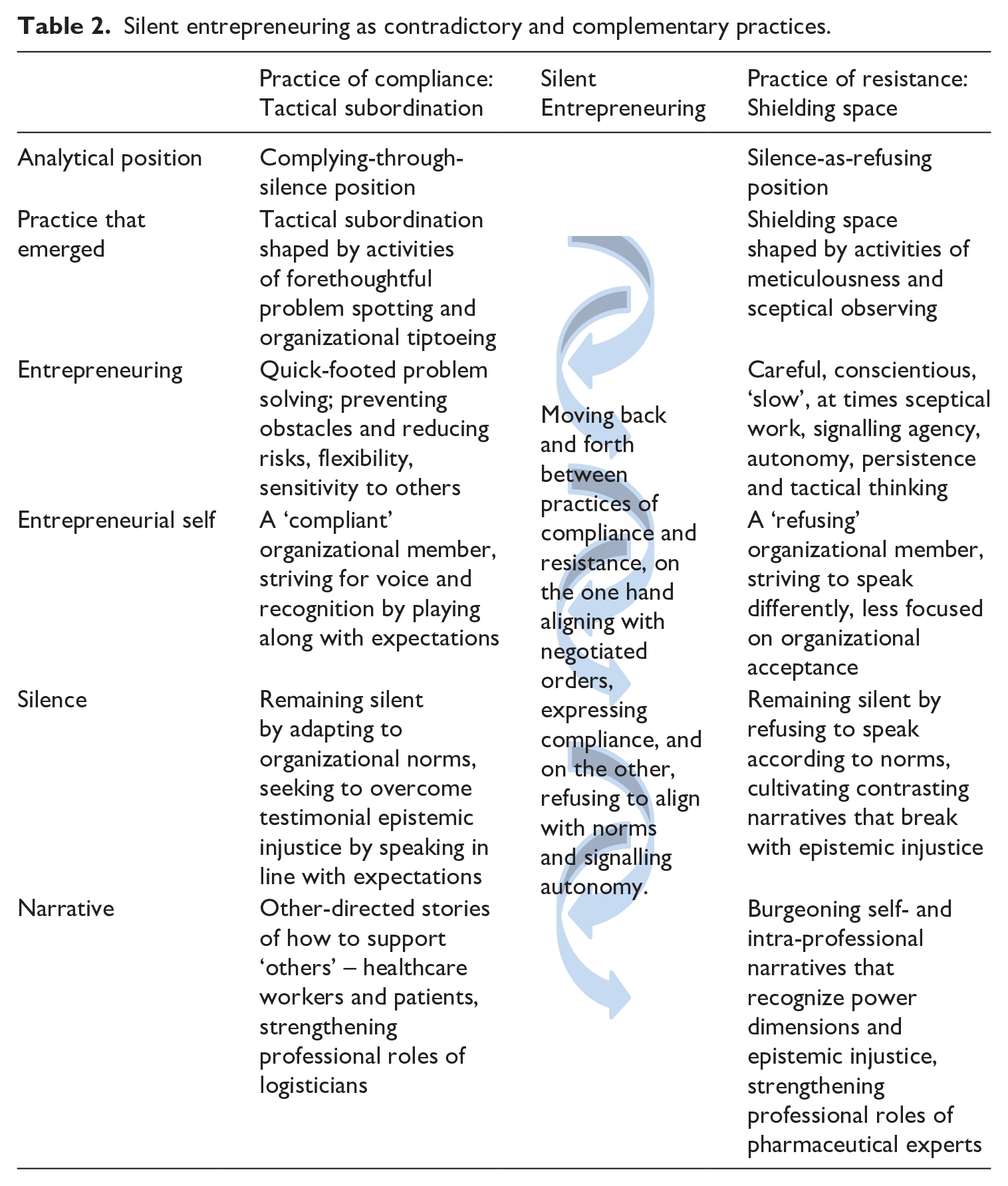
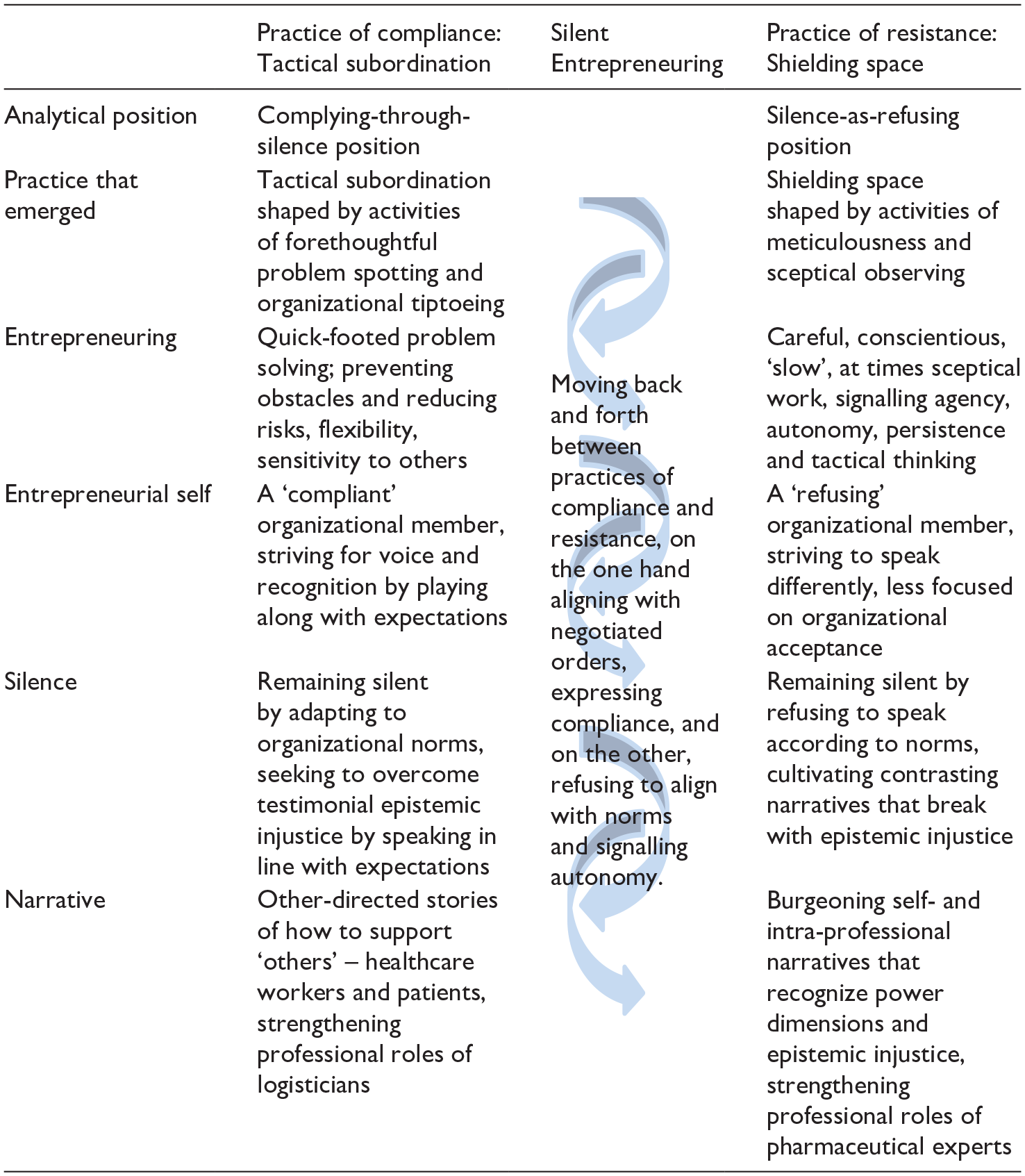
In a horizontal reading of Table 2, sets of activities interconnect, with the creative and ‘quick-footed’ work of forethoughtful problem spotting relating to and mirroring the careful, ‘slow’, untrendy activity of meticulousness. Whilst hermeneutical injustice permeates activities of problem spots, this is contested and balanced in activities of meticulousness. Horizontally read, activities of organizational tiptoeing, signalling sensitivity to the needs of others, inversely reflect those of sceptical observing, implying disobedience and avoiding being ‘recruited’ into roles of service provision (Abildgaard and Jørgensen, 2021). In the activity of organizational tiptoeing, pharmacists appear acceptant of testimonial epistemic injustice and accommodate to pre-defined roles of subordination, while in activities of sceptical observation, they use their experiences of epistemic injustice to understand and refuse negotiated orders. The intertwining of the two practices suggests that pharmacists enact both compliance with norms and resistance towards the same norms and that their agency arises in the space of this ambiguity, as oscillating between the two practices provides them with insights into negotiated orders and how their organization functions.
Silence from a complying position, then, suggests that a normalizing gaze of power (Foucault, 1990), silencing or impelling marginalized groups to speak in accordance with dominating discourses (Simpson and Lewis, 2005), steers pharmacists into complying practices. At the same time, they strive to overcome silence, which carries the risk of being recruited into speaking in line with unitary discourses. Silence, from a refusing position, ‘protects’ them from power – and it is in between these practices that we discern how pharmacists act themselves into entrepreneurial beings. Complying and refusing, they learn how to relate to power and gendering practices and build on these insights to enact shifting facets of entrepreneurial ideals, partially escaping or re-negotiating entrapment in expectations of entrepreneurial selfhood. Alternating between practices of complying and refusing makes it possible for them both to strive towards organizational acceptance and to protect professional identities and values. Entrepreneuring silently then enables tactical-productive forms of making use of a normative discourse on organizational entrepreneuring, opening a space for alternative ways of acting and for subjectivities that are not conforming with traditional norms, broadening the perspective of what entrepreneuring at work could be.
We note that the ideals hospital pharmacists reflect in shielding space correspond to masculine facets of entrepreneurial selfhood, such as assertive behaviour, self-confidence, individualism and risk-taking (Ahl and Marlow, 2021). As these facets are gender-coded, they become harder to discern when adopted by (marginalized) females. Norms associated with tactical subordination, when subjects appear as aligning with entrepreneurial ideals, typically correspond to feminine facets of entrepreneurial ideals, such as relational sensitivity and adaptability, and make pharmacists more ‘recognizable’ in feminized roles of inferiority (Ahl and Marlow, 2021). The oscillation between the two practices thus makes it possible to side-step some of the gendered tensions of entrepreneurial selfhood (Gill and Orgad, 2018; Poggio, 2006).
From a perspective attentive to power, the reproduction of the status quo becomes questioned by the silent entrepreneuring of pharmacists, and tendencies to transform negotiated orders and habitual ways of organizing begin to emerge. Through the double lens of complying-through-silence and silence-as-refusing, activities that not only uphold organizational practices but also seek to transform them become discernible. Pharmacists, for example, withhold their ‘success’ in learning about the organization and nurture a ‘tactical’ knowledge, crucial in their shielding of space. Through the refusing practice, they develop professional narratives to strengthen their professional expertise, heralding their roles as pharmaceutical experts – even if this makes them less recognizable in pre-defined roles.
In organization and entrepreneurship studies, with their expectations of eloquence and narratively confident individuals, it may be tempting to view silence as a problem to be overcome. Our perspective of silent entrepreneuring, however, suggests that by abstaining from speaking, professionals evade being drawn into discourses that ‘are not theirs’ (Mignolo, 2011) and create a platform from which they can act more independently. ‘Lying low’, they signal distance towards neoliberal ideals that may lead to overwork and self-sacrifice (Scharff, 2016), instead creating a space from which they tactically engage in an epistemic struggle (Muzanenhamo and Chowdhury, 2023) to make their perspectives credible. Their shielding of space appears not only as a refusal to play along with efficiency-orientated neoliberal norms but also as an attempt to promote values closer to their professional ethos. Silence then emerges as a tactical and productive means for creating a space between alignment with normative discourse, which reproduces power structures (Foucault, 1990), and the formation of less subordinated individual subjectivities (Butler, 1997). This makes a broader landscape of organizational entrepreneuring available (Hjorth, 2005; Gartner, 2022). The silence of pharmacists challenges the assumption that the ideal entrepreneurial subject must speak eloquently, limited by a language shaped by power. This unfolds a question about who can embody entrepreneurial qualities, urging a rethinking of organizational entrepreneuring. Importantly, this silence operates cautiously and tactically, leveraging ambiguity to create space for alternative interpretations and narratives.
Pharmacists, we suggest, may be at their most entrepreneuring not when complying-through-silence, but when breaking with expectations by refusing norms, and engaging in ‘the in-between-ness’ of the two practices. By holding on to their professional knowledge, they build a ‘credibility surplus’ (Fricker, 2007), and transform into ‘knowers’, subjects who can speak differently (Ahmed, 2000), and are less constrained by epistemic injustice. Engaging in a practice of shielding space, seeing through epistemic injustice, makes it possible for them to decline discourses that offer only subjectivities of subordination (Butler, 1997). Their lack of narratives, however, makes it difficult for other organizational actors – and researchers – to recognize their silent entrepreneuring.
We hope the concept of silent entrepreneuring developed in this article can spur researchers to continue investigating the role of silence in facilitating the recognition of entrepreneuring in organizations (Hjorth, 2005; Kovalainen and Sundin, 2012; Steyaert, 2007). The practice lens outlined in our study enables a capturing of dimensions and assumptions (Hatch and Yanow, 2008) that are habitually unspoken and unexplored, bringing to light the multiplicity of entrepreneurship and the potentialities of discovering entrepreneuring in unanticipated places (Gartner, 2022). Exploring silent entrepreneuring, we suggest, may be a way to broaden the field of ‘entrepreneurship-as-practice’ making researchers attentive to the complex ways that practices interact and reinforce each other.
Conclusions
In this article, we have developed a conceptual framework of silent entrepreneuring to unpack practices of silence in the case of hospital pharmacists. Whilst previous research has tended to favour either surface-level interpretations of organizational silence or deep-level, structural conceptualizations (e.g. Simpson and Lewis, 2005), our argument has been that an understanding of silence is facilitated by alternating between positions. We have thus extended the framework of Simpson and Lewis (2005) – an oft-cited article, although, interestingly, seldom referred to in entrepreneurship research – by developing two analytical positions with contrasting but interlinked interpretations of silence. By switching between positions, we have striven to capture different interpretations of what silence ‘does’ to entrepreneuring, in particular for a marginalized professional group. Our study suggests that silent/silenced subjects are not unequivocally exposed to power or gender stereotyping, or ‘barred’ from entrepreneurial initiatives, but that, as skilled readers of power and gender structures, negotiated orders and epistemic injustice, they have considerable agency to interpret and navigate organizational dynamics and enact own values – both in spite of and because of their silence.
A second contribution the article makes is the empirical understanding of silent entrepreneuring within the public sector. Our case indicates that silence may harbour a refusal to align with neoliberal values of efficiency. The practices of tactical subordination may then shift towards the mirror images of shielding space, and different facets of the entrepreneurial self are reflected depending on the positional perspective. Regardless of position, however, the narrative shortcomings of silently entrepreneuring professions fail to explain the significance of their ‘doings’, which makes it challenging for others to discern and acknowledge their contributions.
A third contribution of our study is the conceptualization of the ‘in-between-ness’ of practices. By examining the intertwining, in both vertical and horizontal dimensions, we contribute with the notion that practices do not unambiguously capture how ‘things really are’, but rather how they can be interpreted from different positional perspectives that may escape researchers unless we adopt different aspects (or positions) to study a complex phenomenon as organizational entrepreneuring. By our theoretical approach, we contribute to a view of practices not as sequential but as intertwined, with at times contradictory effects.
Finally, our study accentuates and corroborates gender studies of how women are either silenced/rendered unseen or conceived as reflecting typically feminine aspects of entrepreneurial ideals, further stimulating female-coded dimensions of sensitivity and flexibility. Entrepreneurial ideals, our study suggests, are selectively available to women and men. Women, particularly those from marginalized professions, need to handle not only negotiated orders and compounded testimonial and hermeneutical epistemic injustice but also to engage with gendered assumptions and practices. Their enactment of ‘male’ forms of entrepreneuring in their efforts to be recognized as professionals goes largely unrecognized, while they are more readily acknowledged when they assume expected roles of femininity.
The concept of silent entrepreneuring, we argue, offers a potential to advance our understanding of the variety and richness of the entrepreneurial in organizing while avoiding further reinforcing (utopian) ideals of the governable entrepreneurial self.
Footnotes
Acknowledgements
We would like to thank the Health Care Region for granting us access and resources to observe their work and engage in daily tasks, meetings and workshops, and the respondents for their participation in the study. Additionally, we wish to express our gratitude to the editors of this Special Issue and the three anonymous reviewers for their expertise, guidance and constructive feedback.
Funding
The author(s) received no financial support for the research, authorship and/or publication of this article.
