



Abstract
While considerable attention has been devoted to understanding how individual characteristics influence unethical actions, far less research has examined the role of social and organisational processes. We introduce the concept of organisational moral disengagement (OrgMD), drawing on Bandura’s moral agency theory, to explain how unethicality may be fostered in organisations. OrgMD is a multilevel construct, capturing perceptions of the mechanisms through which morality can be suspended in an organisation allowing unethical practices to flourish. Using four empirical studies, we validated OrgMD at both individual and organisational levels. The first three studies were conducted at individual level (Study 1: two waves, 301 workers; Study 2: two waves, 297 workers; Study 3: 297 workers), while the fourth adopted a multilevel design (3050 workers nested in 113 organisations). OrgMD, although highly correlated with personal moral disengagement, emerges as a distinct construct that operates both at individual and organisational levels. We show that when members perceive their organisation to be morally disengaged, they are more likely to engage in unethical pro-organisational behaviour and silence. The concept of OrgMD advances understanding of the social processes through which unethical organisational activities can be normalised as acceptable in organisations.
Keywords
In February 2022, Facebook settled a decade-long lawsuit for US$90m regarding its tracking of users’ data after they had logged out. Similarly, in the same year, US$26bn settlements were reached related to the USA’s synthetic opioid epidemic (Hoffman, 2021). Central to these cases were unethical activities collectively accomplished by organisational members that favoured the goals of their organisation to the detriment of users and consumers. Although individual’s personal moral disengagement (PerMD) has been recognised as a key driver of misbehaviour in the workplace (Bandura, 2016; Luan et al., 2023; Mo et al., 2023; Newman et al., 2020; Ogunfowora et al., 2022), these cases reveal a critical social and organisational component.
Decades of organisational research has investigated multiple influences on workplace unethical behaviours and practices. Much of this research has focused on the characteristics of individual transgressors (i.e. ‘bad apples’) such as PerMD. Increasingly, however, the influence of the organisational context (i.e. ‘bad barrels’) on unethical behaviour has been emphasised (Ashforth and Anand, 2003; Kaptein, 2011; Kish-Gephart et al., 2010; Kuenzi et al., 2020; Treviño et al., 2014). This growing body of research has shown that an organisation’s socio-structural and cultural environment influences organisational members’ morality and shapes (un)ethical outcomes (Kish-Gephart et al., 2010; Kuenzi et al., 2020; Roy et al., 2024; Sims and Brinkmann, 2003; Treviño et al., 2014). Ethical culture (e.g. Kaptein, 2008; Treviño et al., 1998) and ethical climate (e.g. Kuenzi et al., 2020) are the most widely studied aspects, capturing different dimensions of an organisation’s informal and formal ethical environment. However, while these constructs focus on how organisations promote ethical conduct and discourage unethical behaviours, a recent review (Roy et al., 2024) suggests that we lack constructs to examine how certain aspects of the organisational context may instead foster unethicality.
To address this omission, we focus on the role of social processes. We draw on the social cognitive theory of morality (Bandura, 2002, 2016; Bandura et al., 2000), and propose the concept of collective organisational moral disengagement (OrgMD) as a social process that is critical for understanding how unethicality may be fostered in organisations. We conceptualise and operationalise OrgMD as a multilevel construct that captures perceptions of the suspension of morality in an organisation to justify and provide exonerations for unethical activities. We show that, at both individual and organisational levels, OrgMD is associated with a higher likelihood of acting unethically by both participating in, and remaining silent about, organisational activities that violate societal and organisational norms or cause harm.
As such, the concept of OrgMD contributes to advancing understanding of the social processes through which unethical behaviour can be implicitly encouraged and normalised in organisations. This is an important matter to investigate because corporate and other organisational transgressions cannot be reduced merely to individual unethical decisions, propensities and motives (Islam, 2020). The emphasis on ‘the individual as evildoer misses the point that systems and individuals are mutually reinforcing’ (Ashforth and Anand, 2003: 1). In line with the dominant focus on individuals, moral disengagement (MD) in organisations has mainly been studied as an intra-individual personal cognitive phenomenon. However, scholars have begun to suggest that MD may spread in organisations through social contagion processes where leader’s PerMD, in particular, influences the disengagement of employees and thus contributes to it becoming a collective phenomenon (Johnson and Buckley, 2015; Martin et al., 2014; Moore, 2008; Newman et al., 2020). As highlighted by recent reviews (Johnson and Buckley, 2015; Newman et al., 2020; Ogunfowora et al., 2022), the study of MD as a collective organisational phenomenon is still rare and based on aggregation of group members’ PerMD (Ogunfowora et al., 2021).
From a social cognitive perspective, this aggregation of individual-level PerMD to try and capture OrgMD is limited. This is because a collective phenomenon emerges through interactive and synergistic dynamics that produce something that is ‘greater than the sum of its parts’ (Bandura, 2016: 13). Thus, OrgMD is not simply the aggregate of organisational members’ PerMD, but rather a distinct collective phenomenon. However, there is no organisational ‘mind’ doing the disengaging independently of members, and members are not passively shaped by a morally disengaged organisation or morally disengaged leaders. As Bandura (2001: 15) argues, ‘people are producers as well as products of social systems’. At the organisational level, OrgMD captures shared perceptions of the ways in which misconduct is reframed and morality suspended within the organisation. OrgMD encourages moral dysregulation as members act on these shared perceptions, while they are also at the same time taking part in (re)producing, mobilising and perpetuating the collective suspension of morality in their organisation, sometimes without necessarily being explicitly aware of it (Fida et al., 2021).
In this article, we make several theoretical contributions by proposing the OrgMD construct and by conducting four empirical studies (three studies at individual level and one study adopting a multilevel design). Drawing on the social cognitive theory of morality, we extend understanding of moral agency in organisations from personal to collective agency. Through the conceptualisation of OrgMD as a multilevel construct, we provide evidence of an important unethical organisational process that can help explain how unethical behaviours in organisations can be fostered through the collective suspension of morality. Furthermore, we contribute to calls for research on MD from a collective and multilevel organisational perspective (Johnson and Buckley, 2015; Newman et al., 2020; Ogunfowora et al., 2022) and specifically ‘to understand how moral disengagement materialises and shapes outcomes at multiple levels’ (Ogunfowora et al., 2022: 765). We go beyond the aggregation of members’ PerMD to advance understanding of OrgMD. We show that OrgMD has the characteristics of a multilevel construct (Chan, 1998; Kozlowski and Klein, 2000; Kozlowski et al., 2013) that resides both at individual and organisational levels, because it emerges from the interactions among members sharing the same organisational ethical context. At individual level, OrgMD captures an individual’s perception of the mechanisms for the collective suspension of morality in their organisation. At an organisational level, it refers to the shared perception of these mechanisms as distinct from the diffusion of PerMD among its members. Finally, we contribute to the literature on unethical pro-organisational behaviour (UPB) (Graham et al., 2020; Luan et al., 2023; Mo et al., 2023) and silence (Harlos, 2016; Hershcovis et al., 2021; Morrison, 2023) by showing the role of OrgMD in relation to these behaviours at both individual and organisational levels. Overall, our research furthers understanding of how perceptions of OrgMD mechanisms may enable members to ‘live with themselves’ while engaging in behaviours of commission and omission that cause harm to other people, society or the environment. Through our studies, we highlight the importance of considering the social function of morality (Ashforth and Anand, 2003; Gkeredakis et al., 2024) and here specifically the social processes of its suspension.
Conceptualising organisational moral disengagement
From personal to organisational moral disengagement
Individuals learn what is right and wrong from the societal moral universe they are socialised into. According to moral agency theory (Bandura, 2002, 2016), people are oriented to behave according to these moral standards, while refraining from behaving in ways that violate them. However, Bandura (1986, 2002, 2016) argues that although an individual might know what the right thing to do is, their moral self-regulation can be deactivated through a range of psychosocial mechanisms that enable them to selectively disengage morality, transforming behaviours that would ordinarily be seen as reprehensible into viable options. In other words, PerMD is a cognitive intra-individual process that allows individuals to bypass the moral self-regulatory system that ensures alignment between their internalised principles and enacted unethical behaviours (Bandura, 2016).
MD comprises a set of eight interrelated social cognitive mechanisms. Although each serves the same aim, they represent different ways in which moral self-sanctions can be selectively disengaged (Bandura, 1986, 2002, 2016). Moral justification, advantageous comparison and euphemistic labelling are three mechanisms that work by reconstructing the unethical behaviour. Moral justification involves the reframing of a misbehaviour, so that it appears to serve a higher moral goal (e.g. it is ok to lie to protect others). Advantageous comparison involves comparing the misconduct with something more severe to make it appear less reprehensible (e.g. taking some office supply is nothing compared with the fraud senior leaders commit). Euphemistic labelling is the use of sanitised or neutral language to describe a misconduct so that its wrongfulness is diminished (e.g. gossiping becomes ‘networking’). Next, displacement and diffusion of responsibility are two mechanisms that operate by obscuring or minimising the role of individuals in causing harm. Through the displacement of responsibility, misconduct becomes attributed as directed by superiors (e.g. just following orders), while the diffusion of responsibility dilutes accountability across the broader social group (e.g. everyone does it!). Further, the distortion of consequences mechanism operates at the outcome locus to diminish the injurious effects of the misbehaviour, making it seem less harmful (e.g. a small lie has never hurt anyone). Finally, dehumanisation and attribution of blame are two mechanisms that operate at the victim locus. While the former strips targets of their human qualities making it easier to justify the misconduct against them (e.g. that person is scum anyway), attribution of blame frames targets as responsible for the actions they received (e.g. some people deserve it).
Understanding individuals’ moral regulation requires consideration of the social function of morality. Organisational members cannot be seen as autonomous moral agents because they are influenced by the social forces of their organisation (Ashforth and Anand, 2003; Gkeredakis et al., 2024; Graham et al., 2020; Quade et al., 2022). The representation of the self as a member of an organisation – that thinks, means and behaves in a certain way – influences how the individual evaluates and regulates their own moral actions (Tajfel, 1982). Moral regulation is concerned not only with the protection of the individual but also with the preservation of the group as a whole (Haidt and Graham, 2007; Moore and Gino, 2013). Belonging to an organisation is a fundamental source of collective moral values and expectations but, as Haidt (2008) suggests, we must also pay attention to its possible negative effects, including unethical behaviours undertaken for group interests.
Bandura (2002, 2016) goes further and proposes that moral agency is related not just to individuals, but also refers to collective agents. MD by implication can also ‘operate throughout a social system in ways designed to exonerate the system as a whole’ (Bandura, 2016: 15), thereby suspending collective moral agency. Thus, members do not produce exonerations for these unethical organisational activities on their own (Bandura, 2016; White et al., 2009). When an organisation violates ethical standards, a range of organisational members are likely to have played their parts acting in concert in morally disengaged ways using ‘their expertise and social influence in the service of a detrimental enterprise’ (Bandura, 2002: 114). Building on this, we argue that organisational members act on their perception of OrgMD mechanisms for collectively justifying and exonerating unethical organisational practices as benign, or even beneficial.
Organisational moral disengagement definition
We define OrgMD as a multilevel construct capturing at the organisational level the shared perceptions of the mechanisms through which morality is suspended in their organisation to bypass generally accepted societal and organisational ethical standards. Following the multilevel literature in organisational research (Chan, 1998; Kozlowski and Klein, 2000; Kozlowski et al., 2013), OrgMD is the result of the bi-directional interactions between organisational members and their organisational context. It is captured at individual level by members’ perceptions of their organisations, it is amplified through their social interactions and it manifests as a shared perception to capture the collective phenomenon (Bandura, 2001; Kozlowski and Klein, 2000; Kozlowski et al., 2013; White et al., 2009). Such an emergent collective-level phenomenon is more than the sum of its parts and thus OrgMD is not reducible to the aggregation of members’ PerMD. Collective phenomena are constructed and continuously reconstituted by members in and through their interactions over time, thus they are the result of social processes. At the same time, the self is also socially constituted (Haidt, 2008) through socio-structural and cultural influences that both enable and constrain individuals’ cognitive and behavioural functioning. As Bandura (1986, 2001) stresses with the conception of triadic reciprocal causality, cognition and emotion, behaviour patterns and social context operate as interactive factors influencing each other bi-directionally. Hence, in a social system, such as an organisation, these influences act in concert.
As organisational members navigate their roles and responsibilities, they engage in cognitive and social processes that involve interpreting organisational events, deciphering patterns and attributing meanings based on their experiences, beliefs, values and knowledge. When members of an organisation interact, their cognitive frameworks ‘intersect’ through the exchange of ideas, perspectives and interpretations. These continuous social processes of sensemaking (Weick, 1995) lay the foundation for collective-level OrgMD that is the result of the interactive and synergistic emergence of shared perceptions of discursive and socio-structural means to justify and exonerate wrongdoing. As these shared perceptions across the organisation emerge, their convergence denotes a collective process that transcends individuals’ idiosyncrasies influencing their decision making, behaviour and interactions. Through these processes, OrgMD comes to operate throughout a social system as members act in concert on shared perceptions, transforming it into a new phenomenon that is distinct from the aggregation of members’ PerMD. However, there is no disembodied organisational ‘mind’ disengaging moral control, nor a collective entity acting unethically and causing harm independent of the organisation’s individual members (White et al., 2009). OrgMD resides in the minds of members as they perceive their organisation’s suspension of morality. Therefore, individuals are the key informants for its measurement, as well as being the appropriate level for its analysis (Dansereau et al., 1995; Mathieu and Luciano, 2019).
Although OrgMD has never been directly measured, it has been suggested in the context of well-known organisational scandals. Analysis of publicly available documents (e.g. media statements, court records, public enquiries, whistle blower accounts) (Bandura, 2016; Bandura et al., 2000; Welbourne Eleazar, 2022; White et al., 2009) have described examples of mechanisms through which morality was suspended in these cases. Drawing on these insights, we conceptualise OrgMD mechanisms as social processes based on established discursive repertoires as well as institutionalised socio-structural practices for vindicating unethical organisational activities. For instance, moral justification operates through the use of established repertoires for talking about harmful organisational practices and products in ways that render them acceptable and serving a worthy purpose (e.g. we need to do whatever it takes to save our company). Similarly, euphemistic language involves strategies for renaming, reframing or relabelling to disguise, obscure or remove moral implications from organisational practices (e.g. we just ‘gloss over’ certain facts to our customers). Unethical organisational practices can furthermore be framed as comparatively harmless (e.g. what we are doing is not as bad as what our competitors do). The distortion of consequences can be accomplished through discursive misrepresentations, obfuscations, spin and denials or other ways of rendering detrimental outcomes invisible (e.g. there is no proof of any harm caused by our products). Dehumanisation can operate through discursive othering as well as systemic depersonalisation (e.g. users are just faceless numbers to us) along with the attribution of blame to victims (e.g. our users failed to take precautions to protect their privacy). Some mechanisms, such as displacement and diffusion of responsibility, are embedded in how things are done in the organisation (Ashforth and Anand, 2003). Responsibility can be diffused through the division of labour, operational processes involving complex chains of activity and group decision making (e.g. in our organisation it is unclear how decisions are made so no one can be held accountable). Similarly, displacement of responsibility can be achieved through the formal institution of hierarchies and chains of authority (e.g. we are simply following the rules and procedures from above).
Overall, as with PerMD (Fida et al., 2015; Moore et al., 2012; Ogunfowora et al., 2022), although each of the eight OrgMD mechanisms would serve the same aim, we expect OrgMD to be unidimensional (Hypothesis H1). Based on the theorising above, we also expect OrgMD and PerMD to be factorially distinct but positively correlated (H2). In addition, given the multilevel nature of our OrgMD construct, we expect the OrgMD factor to be isomorphic between the individual and organisational levels (H3).
Organisational moral disengagement outcomes
Consistent with the literature on PerMD (Bandura, 2016; Luan et al., 2023; Newman et al., 2020; Ogunfowora et al., 2022) and the broader literature emphasising the role of organisational context on behaviours (Ashforth and Anand, 2003; Kish-Gephart et al., 2010; Kuenzi et al., 2020; Roy et al., 2024; Tenbrunsel et al., 2003), we expect OrgMD to have a significant role in influencing the likelihood of organisational members’ engaging in unethical behaviours. We anticipate OrgMD to be an antecedent of different types of unethical behaviours at both individual and organisational levels, particularly UPB (Umphress and Bingham, 2011), but also counterproductive work behaviours (CWB) (Gruys and Sackett, 2003; Spector and Fox, 2005) as well as silence (Harlos, 2016; Hershcovis et al., 2021; Morrison and Milliken, 2003).
UPB refers to ‘actions that are intended to promote the effective functioning of the organisation or its members’ but that ‘violate core societal values, morals, laws, or standards of proper conduct’ (Umphress and Bingham, 2011: 622). Examples include lying to and deceiving customers to increase profits or concealing damaging information about the organisation. These practices are engaged in by a wide range of both managers and employees, as we know from corporate scandals (Mo et al., 2023). While prior literature has identified PerMD as an antecedent of this behaviour (Luan et al., 2023; Mo et al., 2023), we contend that OrgMD plays an important role in relation to UPB at both individual and organisational levels above and beyond that of PerMD.
While PerMD is more specifically related to justification of misconduct for the individuals’ benefit (e.g. ‘Taking personal credit for ideas that were not your own is no big deal’; Moore et al., 2012: 48), we expect OrgMD to be most clearly related to the vindication of pro-organisational unethical behaviour intended to benefit the organisation (e.g. ‘In my organisation, “glossing over” certain facts to clients/customers is just our standard working practice’; see Table 2). The concept of UPB points to organisational members participating in unethical and fraudulent activities for the organisation’s benefit (Mo et al., 2023). Members of an organisation each do their part to accomplish collective tasks, including those that involve UPB. As members interact and work together, they engage in collective sensemaking (Weick, 1995), drawing on established discursive repertoires and institutionalised socio-structural practices for exonerating UPB. When shared perceptions emerge of the means for justifying unethical activities within an organisation, we would expect members to be more likely to participate in these activities. The perception of organisational mechanisms for suspending morality would facilitate bypassing organisational and broader social standards to engage in UPB.
CWB refers to a broad set of deviant behaviours aimed at damaging the organisation and their stakeholders (Bennett and Robinson, 2003; Gruys and Sackett, 2003; Spector et al., 2006). CWB can target both the organisation and its stakeholders and can vary in severity. While UPB is mainly focused on organisational benefit, CWB is generally instrumental for the individual. PerMD has been identified as a key antecedent for a broad range of these unethical behaviours (Newman et al., 2020; Ogunfowora et al., 2022). However, we would expect OrgMD to have a role in CWB above and beyond PerMD. This is because OrgMD functions as a social learning process, whereby individuals replicate what they observe within the organisation. Thus, if members perceive their organisation to be highly morally disengaged, over time they learn to perceive all types of misconduct as similarly acceptable, thus increasing their likelihood of also engaging in CWB. As Sims and Brinkmann’s (2003) analysis of the Enron scandal shows, the erosion of ethical boundaries in the organisation led to widespread unethical conduct not just for the company’s benefit but also for personal gain. Thus, we would expect that progressively high levels of OrgMD had become normalised as part of Enron’s organisational processes, influencing members’ engagement with a range of unethical behaviours.
We also expect OrgMD to have a role in relation to acts of omission, such as moral silence, at both individual and organisational levels. Silence occurs when a member of an organisation observes wrongdoing but withholds these concerns rather than sharing them with someone who could potentially address and change the situation (Morrison and Milliken, 2003; Pinder and Harlos, 2001). Although there might be several reasons for members to remain silent (Knoll and van Dick, 2013; Morrison and Milliken, 2000; Ng and Feldman, 2012), this omission has clear ethical implications. In fact, silence and the lack of voice have recently been identified as significant contributors to the enduring prevalence of sexual harassment, discrimination and safety concerns (Bishop et al., 2021; Hershcovis et al., 2021; Noort et al., 2019) as well as in corporate scandals (Sims and Brinkmann, 2003). Thus, when members perceive that unethical behaviours are justified in their organisation, they are more likely to remain silent rather than raise a concern.
Overall, where higher levels of OrgMD arise within an organisation, it can become a vicious circle that influences organisational members’ behaviour through the continuous reinforcement of shared perceptions by leaders and peers. High levels of OrgMD are likely to create a sense of pressure to conform and demonstrate their ‘team spirit’ by engaging in (exonerated) unethical activities and remaining silent about it. Through these social processes, OrgMD may become progressive, resulting in increased unethical behaviours and their routinisation and institutionalisation (Bandura, 2002).
Building on these literatures in synthesis, we hypothesise that OrgMD is positively associated with UPB (H4a), CWB (H4b) and silence (H4c) above and beyond the role of PerMD.
Operationalising organisational MD: Item development and content validation
Item development
We adopted a referent-shift model (Chan, 1998; Cole et al., 2011) to operationalise OrgMD. As theorised above, OrgMD cannot be captured through the aggregation of members’ PerMD, because it reflects members’ perceptions of a collective phenomenon (i.e. organisational MD). Our approach is consistent with that developed for collective self-efficacy, which captures individuals’ perceptions of group capabilities (Bandura, 2000). Mirroring arguments concerning collective self-efficacy, the aggregation of members’ PerMD would not ‘account for dynamic social and organisational processes that occur within groups’ (Lindsley et al., 1995: 648).
We followed a multistep content validation approach (Colquitt et al., 2019; Howard and Melloy, 2016) to develop OrgMD items. First, items for each mechanism were generated by the authors using a deductive approach considering the key literature on MD in the organisational context (Bandura, 2016; Bandura et al., 2000; Welbourne Eleazar, 2022; White et al., 2009) and work PerMD measures (Fida et al., 2015; Moore, 2008; Moore et al., 2012; White et al., 2009). Items were worded adopting the referent shift approach (e.g. In my organisation, it is ok to do something questionable, as we are simply following the rules and procedures). The initial pool of items was drafted by the second author and then revised independently by the other authors. Revisions were collectively discussed, resulting in 33 items.
Content validation
Preliminary content validation utilised a Q-sort task (Anderson and Gerbing, 1991) to investigate the degree to which each item corresponded to the theoretical OrgMD mechanism. Conceptual definitions of the eight OrgMD mechanisms were provided to six academics who were familiar with MD theory, and they were asked to indicate each item’s corresponding mechanism. The substantive agreement (psa, the proportion of respondents who correctly assigned the item to the intended OrgMD mechanism) and the substantive validity coefficient (csv, the degree to which an item was assigned to the intended mechanism more than any other OrgMD mechanism) were then computed. These results were used to identify those items with lower levels of substantive validity (psa < .75 and/or a csv < .55), which were either removed, or had their wording revised. The resulting 24 items were then reassessed by a further group of eight academics with good knowledge of MD theory, to further improve item clarity. For this process, a definition of each OrgMD mechanism was provided, followed by the items, with experts asked to rate how well each item corresponded to its intended mechanism (from 1 = ‘not at all well’ to 5 = ‘extremely well’). On average, items content validity was very good (M = 3.97; SD = 0.36). Again, these results were discussed among the authors and two items for each mechanism were retained, resulting in a final 16-item scale (see Table 2 and Appendix A).
We gathered empirical evidence on the distinctiveness of OrgMD items from other constructs related to the perception of the ethical organisational context, such as ethical climate or ethical culture, using a Q-sort task (Anderson and Gerbing, 1991; Colquitt et al., 2019). We recruited a naive sample of 30 full-time workers (average age 38 years, SD = 8.5; 50% females) via Prolific and compensated them £1.50. They rated their familiarity with constructs related to business ethics 2.00 (SD = 1.02) on a scale from 1 = ‘not familiar at all’ to 5 = ‘extremely familiar’. Participants were asked to sort 24 items as either OrgMD or ethical climate/culture: 12 OrgMD items (randomly selected), two items (randomly selected) from the ethical climate scale by Kuenzi et al. (2020), eight items (randomly selected) from the ethical culture scale by Kaptein (2008) (one item from each dimension) and finally two items (randomly selected) from the ethical culture scale by Treviño et al. (1998). In line with the procedure, they received definitions and item examples, and practice items before the task (both examples and practice items were different from those of the actual task). Overall, all the OrgMD items received from strong to very strong substantive validity. The average substantive agreement (psa) was 0.94 (SD = .05) and the average substantive validity coefficient (csv) was 0.89 (SD = .10). The same results were obtained when conducting the same task with a sample of 16 colleagues and friends in the authors’ network (average familiarity with constructs related to business ethics: 3.06; SD = 1.12): average substantive agreement (psa) was 0.95 (SD = .05) and the average substantive validity coefficient (csv) was 0.90 (SD = .10).
Empirical studies
To validate the OrgMD scale, we followed a rigorous multistep and multisampling approach using four distinct studies. 1
Study 1. Organisational moral disengagement preliminary validation
This investigates the psychometric properties of the OrgMD scale at individual level, assessing its internal, discriminant and criterion validity, along with reliability. We expected that the OrgMD scale would be unidimensional (H1), factorially distinct from PerMD (H2) and associated with both UPB and CWB, beyond the role of PerMD (H4a and H4b, respectively).
Methods
Sample and procedure
This study followed a two-wave design with a 10-month time lag between the surveys. Data were collected using Prolific Academic platform (ProA, http://www.prolific.co). The T1 sample included 301 workers (56% women) living in the United Kingdom. Their mean age was 37.5 (SD = 10.3). Most participants described themselves as White (91%), and in a permanent (91%) and full-time job (97%). Half of the sample had worked for five years or less for their current organisation. Thirty-one per cent were professionals, 18% clerical support workers and 17% middle and senior managers. The T2 sample included 199 workers (66% response rate) including 52% of women. Following attention checks analysis (Oppenheimer et al., 2009), no participants were removed. Missing data analysis suggested that these occurred at random (Little’s test: χ2 = 39.074, df = 44, p = .68). The study was approved by the Norwich Business School, University of East Anglia ethical committee. Participants were compensated £0.50.
Measures
Unless otherwise specified, we used five-point Likert scales (1 = ‘Not agree at all’ to 5 = ‘Completely agree’).
Organisational MD (OrgMD) was measured at T1 using the 16-item newly developed scale (see Table 2 and Appendix A for the list of the items).
Personal Work MD (PerMD) was measured at T1 with eight items assessing work MD (Paciello et al., 2023) (see Appendix A for the list of items).
Counterproductive Work Behaviour (CWB) was measured at T2 by using the 10-item short version of the CWB Checklist scale (Spector et al., 2010). A sample item is ‘Purposely wasted your employer’s materials/supplies’. Participants rated the frequency of their behaviour on a five-point scale (from 1 = ‘Never’ to 5 = ‘Always’).
Unethical Pro-Organisational Behaviour (UPB) was measured at T2 with six items developed by Umphress et al. (2010). A sample item is ‘If it would help my organisation, I would misrepresent the truth to make my organisation look good’.
Analytical approach
To examine the OrgMD structural validity, we first conducted a confirmatory factor analysis (CFA) by defining a one-factor model in line with our hypotheses (H1). In this model, residuals of items measuring the same mechanism were allowed to covary to account for items’ extra-covariance arising from item wording. As evidence of discriminant validity of OrgMD with respect to PerMD (H2), we compared two alternative CFA models that allowed us to test their factorial distinctiveness: in the first, OrgMD and PerMD items were loaded on two different factors; in the second, OrgMD and PerMD items were loaded into the same factor. The fit of the models was examined using chi square (χ2), the comparative fit index (CFI), the standardised root mean squared residual (SRMR) and the root mean square error of approximation (RMSEA). Chi square difference test (Δχ2) (Scott-Lennox and Lennox, 1995) was used to compare the two alternative nested models. Because Little’s test suggested that missing data occurred at random, we used full information maximum likelihood (FIML) parameter estimate method (Arbuckle, 1996). The analyses were performed using Mplus 8.7 with maximum likelihood robust estimators (MLR), owing to the presence of moderate violation of normality (Muthén and Muthén, 2017).
Finally, we tested OrgMD criterion and incremental validity. Specifically, we tested H4a and H4b with a series of hierarchical regressions with UPB and CWB at T2 as dependent variables. In one model, we first entered PerMD at T1 and then OrgMD at T1. In a second model, OrgMD was entered in Step 1 and PerMD was included in Step 2. In line with the recent meta-analysis, gender and job tenure were included as covariates (Luan et al., 2023) in Step 1. The significance of the R2 change (ΔR2) was used to test the unique variance in explaining each of the dependent variables.
Results
Table 1 shows the descriptive statistics, reliabilities and correlations among the study variables. Results of the OrgMD CFA (Table 2) supported the one-factor model (H1). The model fit the data well (χ2(96) = 197.797, p < .001; CFI = .94; SRMR = .049, RMSEA = .059, 90% CI: .047 .071, p = 1.00). The models including both OrgMD and PerMD items supported the distinctiveness of these two constructs (H2) (Model 2-factors: χ2(243) = 448.243, p < .001; CFI = .91; SRMR = .055, RMSEA = .053, 90% CI: .045 .061, p = .25; Model 1-factor: χ2(244) = 504.245, p < .001; CFI = .89; SRMR = .057, RMSEA = .060, 90% CI: .052 .067, p < .05; Δχ2(1) = 19.24, p < .001). As expected, the correlation between OrgMD and PerMD was significant (.77, p < .001).
Zero-order correlations and descriptive statistics (Study 1).
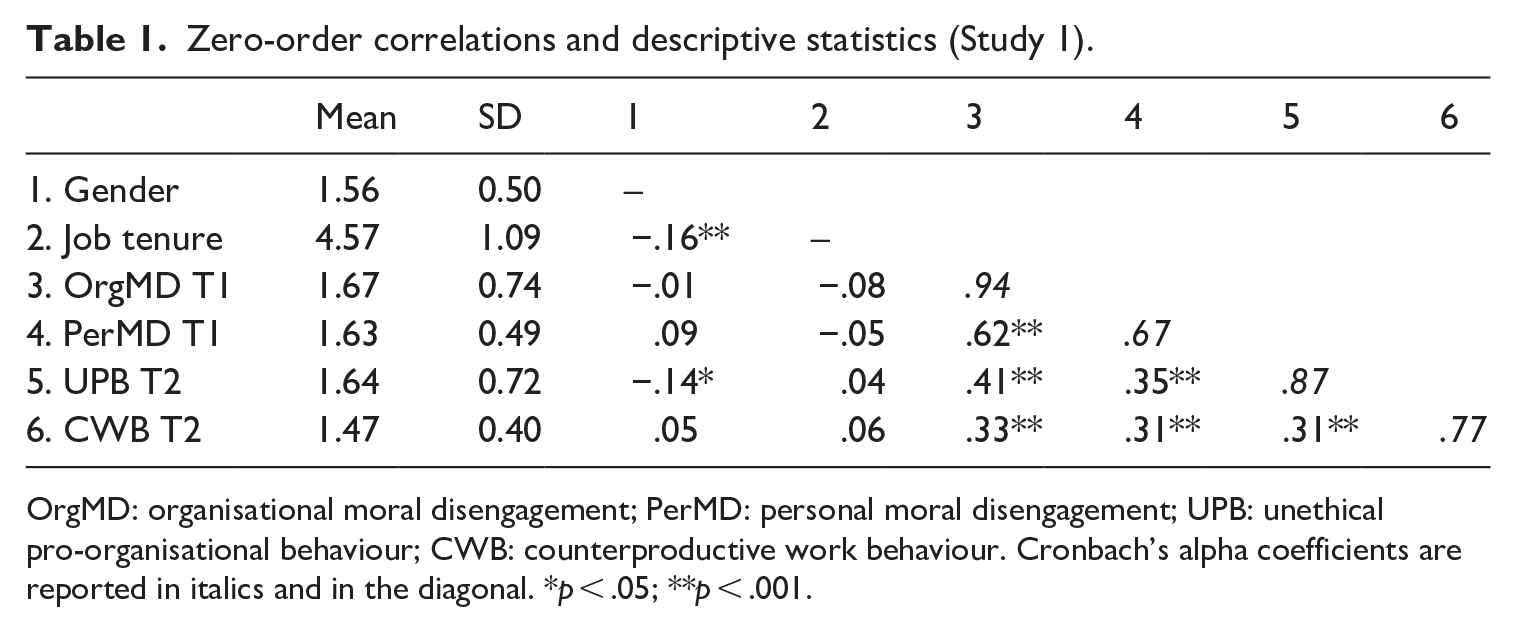
OrgMD: organisational moral disengagement; PerMD: personal moral disengagement; UPB: unethical pro-organisational behaviour; CWB: counterproductive work behaviour. Cronbach’s alpha coefficients are reported in italics and in the diagonal. *p < .05; **p < .001.
Results of the confirmatory factor analyses (Study 1, Study 2, Study 3 and Study 4).
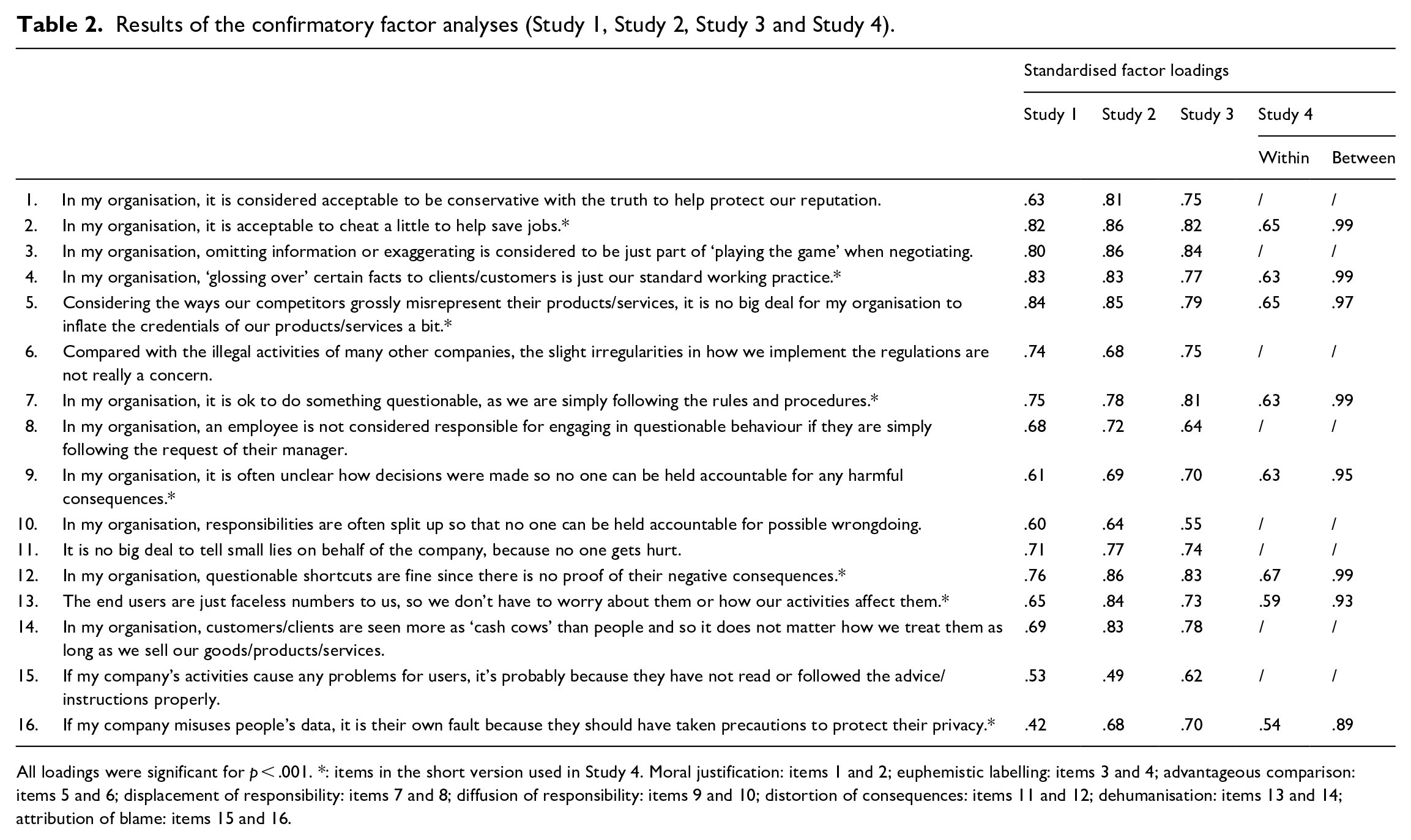
All loadings were significant for p < .001. *: items in the short version used in Study 4. Moral justification: items 1 and 2; euphemistic labelling: items 3 and 4; advantageous comparison: items 5 and 6; displacement of responsibility: items 7 and 8; diffusion of responsibility: items 9 and 10; distortion of consequences: items 11 and 12; dehumanisation: items 13 and 14; attribution of blame: items 15 and 16.
The hierarchical regressions results (Table 3) supported our hypotheses (H4a and H4b) and showed that OrgMD significantly contributed to both UPB at T2 (Model 1a ΔR2 = .05, p < .001) and CWB (Model 1a ΔR2 = .03, p < .05) above and beyond the role of PerMD. When PerMD at T2 was added at the second step, it contributed only to UPB (Model 1b ΔR2 = .02, p < .05).
OrgMD incremental validity: results of the hierarchical regression (Study 1).
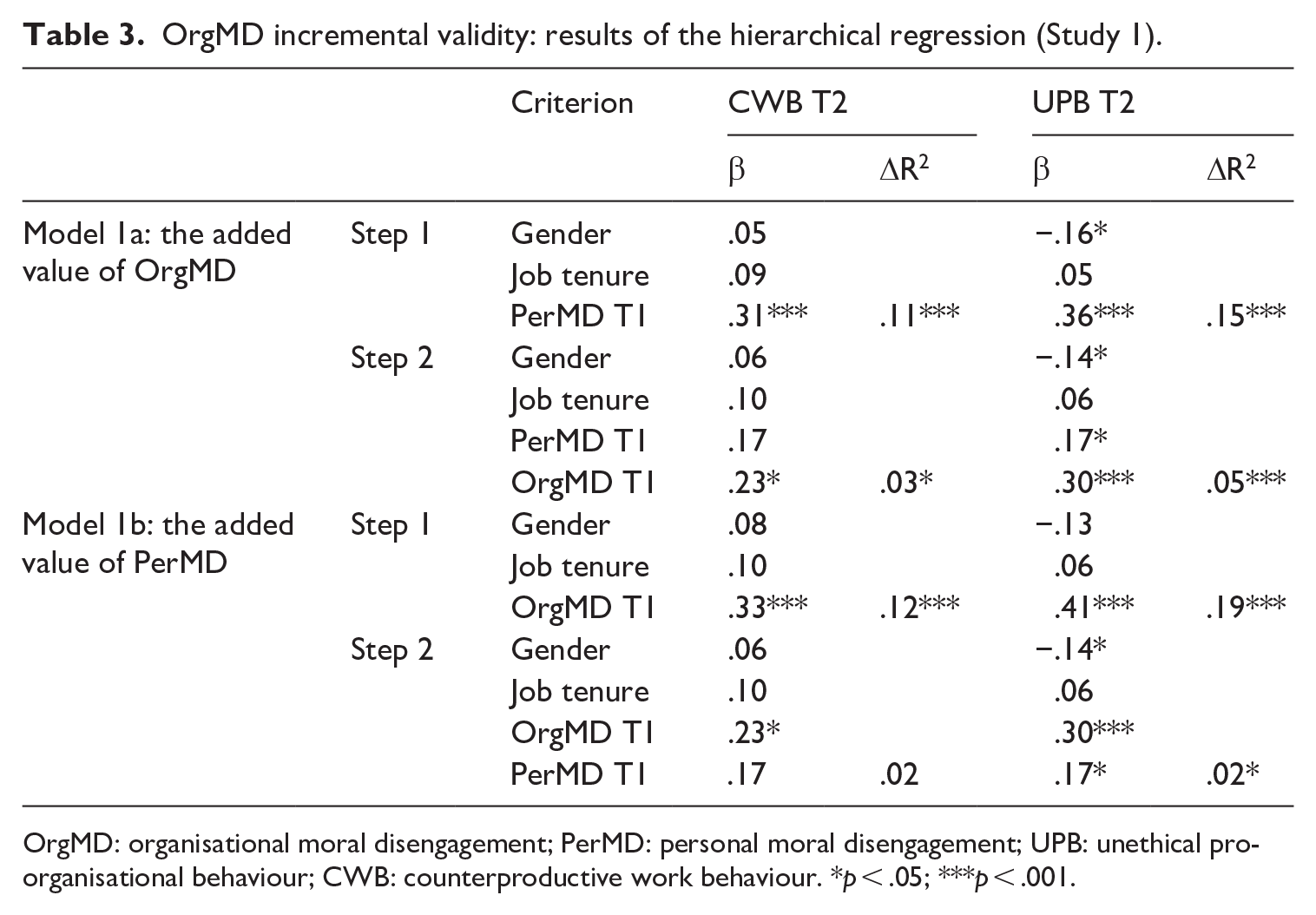
OrgMD: organisational moral disengagement; PerMD: personal moral disengagement; UPB: unethical pro-organisational behaviour; CWB: counterproductive work behaviour. *p < .05; ***p < .001.
Study 2. Organisational moral disengagement psychometric properties
This study aimed to cross-validate OrgMD’s structural validity (H1) and its discriminant validity from PerMD (H2) at individual level. We also examined OrgMD’s longitudinal invariance to determine whether its items maintained the same meaning across time, and if OrgMD could be considered as the same construct on different occasions (Little, 2013; Meredith, 1993). Concurrently, we tested for criterion validity by designing a longitudinal model where OrgMD at T1 predicted UPB at T2 when controlling for UPB and PerMD at T1 (H4a).
Methods
Sample and procedure
Study 2 used a two-wave design with a five-month time lag. Data collection was conducted by Ipsos (https://www.ipsos.com) in 2021 as part of a funded research project with approval of the Norwich Business School, University of East Anglia ethical committee. Quality data-check was conducted by Ipsos by excluding participants who failed attention checks and with too short survey completion time. The sample at T1 included 297 workers (39% women) living in the United Kingdom. Their mean age was 42 (SD = 11). Most of the participants had a White ethnicity (91%), a permanent job (90%) or a full-time job (76%). Half of the sample (55%) had worked for six years or less for their current organisation. Owing to budget constraints, data collection was stopped after reaching about 50% of the response rate (actual response rate = 52%). The sample at T2 included 154 workers (38% women). Missing data were completely at random (Little’s test: χ2 = 26.595, df = 22, p = .23).
Measures
Organisational MD at T1 and T2, PerMD at T1 and UPB at T1 and T2 were measured with the same scales of Study 1.
Analytical approach
We used the same approach described in Study 1 to investigate OrgMD’s structural validity (H1) and its discriminant validity with respect to PerMD (H2). We then examined the OrgMD longitudinal invariance by considering T1 and T2 data. Correlations among residuals of the same variable across the two time points were estimated to account for the fact that an ‘indicator-specific variance that is reliable is likely to correlate with itself over time’ (Little, 2013: 164; see also Millsap and Meredith, 2007). Longitudinal invariance (configural, metric, scalar and strict) was examined by comparing a series of nested CFA models (Meredith, 1993). The chi square difference test (Δχ2) as well as the difference in the CFI (ΔCFI) (Cheung and Rensvold, 2002) were used to assess the tenability of longitudinal invariance. Finally, we tested OrgMD criterion validity by considering UPB at both T1 and T2 (H4a). We tested a structural equation model (SEM) model with OrgMD and PerMD at T1 predicting UPB at T2 when controlling for UPB at T1. All analyses were performed using Mplus 8.7 with MLR robust estimators.
Results
Table 4 shows the descriptive statistics and correlations among the study variables. Results of the OrgMD CFA (χ2(96) = 164.073, p < .001; CFI = .96; SRMR = .033, RMSEA = .049, 90% CI: .036 .061, p = .54) (see Table 2) supported the one-factor model (H1). The comparison between the two-factor CFA including both OrgMD and PerMD items (χ2(243) = 411.125, p < .001; CFI = .94; SRMR = .045, RMSEA = .048, 90% CI: .040 .056, p = .63) and the one-factor model (χ2(244) = 702.286, p < .001; CFI = .85; SRMR = .067, RMSEA = .080, 90% CI: .073 .086, p < .05) supported the factorial distinctiveness of OrgMD with PerMD (H2, Δχ2(1) = 36.56, p < .001), further supporting its discriminant validity. Results of the SEM (χ2(650) = 1080.722, p < .001; CFI = .93; SRMR = .054, RMSEA = .047, 90% CI: .042 .052, p = .79) also supported OrgMD criterion validity (H4a). OrgMD predicted UPB at T2 (.25, p < .05) above and beyond PerMD (.05, p = .71) and UPB at T1 (.45, p < .01).
Zero-order correlations and descriptive statistics (Study 2).
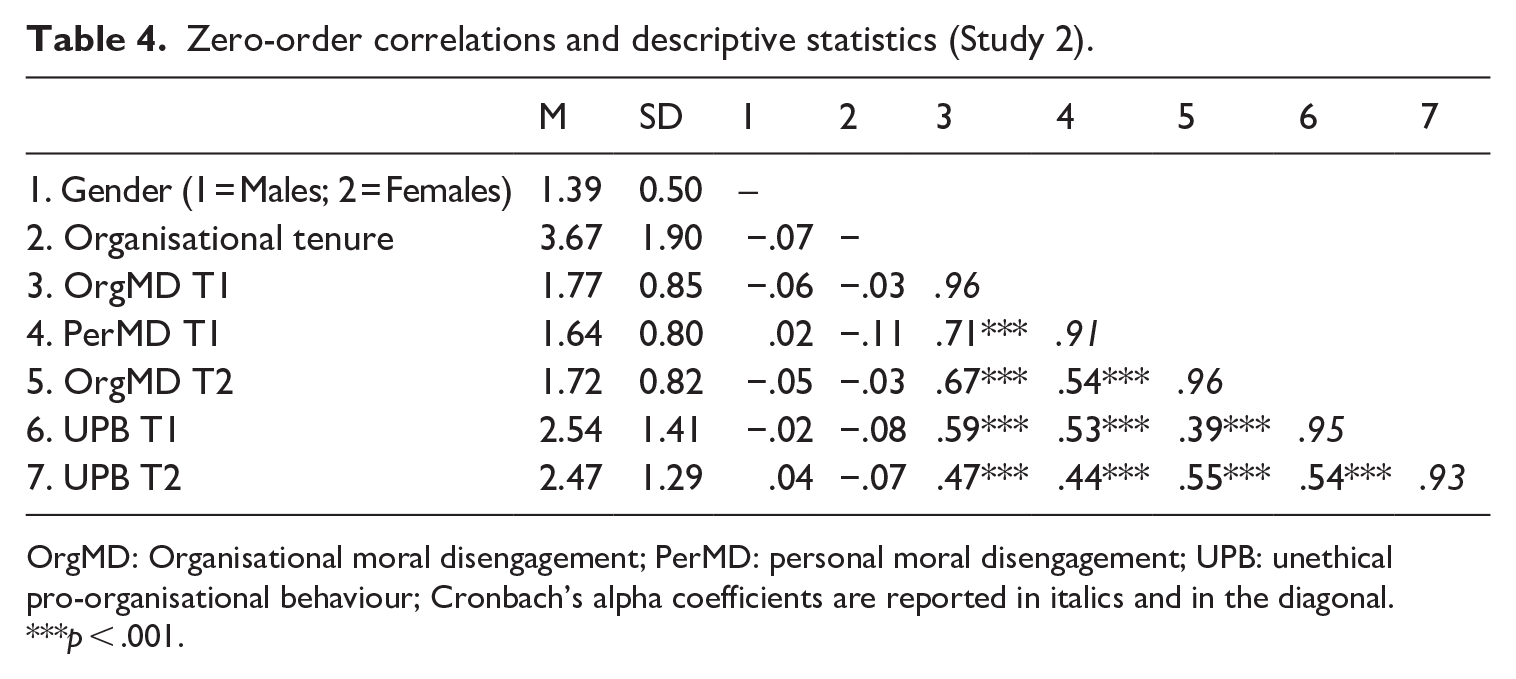
OrgMD: Organisational moral disengagement; PerMD: personal moral disengagement; UPB: unethical pro-organisational behaviour; Cronbach’s alpha coefficients are reported in italics and in the diagonal. ***p < .001.
The analysis of the longitudinal invariance (Supplementary Table 1) supported the generalisability of OrgMD factorial structure across time (Steenkamp and Baumgartner, 1998). Factorial loadings, intercepts and residual variances of all the items were invariant over time. The inclusion of the equality constraints over time did not significantly worsen the fit indices.
Study 3. Initial examination of the generalisability of OrgMD in a different country
This study aimed to investigate the generalisability of OrgMD’s structural and discriminant validity (H1 and H2) at individual level in Italy, a different country from that of Study 1 and 2. Moreover, we sought to test OrgMD’s cross-country invariance since we wondered whether the interpretative cultural context as well as a different language might influence OrgMD items’ appraisal processes. This analysis enabled us to determine whether OrgMD items hold the same meaning across the two different contexts (Meredith, 1993).
Methods
Sample and procedure
Data collection was conducted by Ipsos in 2021 (https://www.ipsos.com) as part of a funded research project. Participants completed an online survey. As per Study 2, a preliminary quality data check was conducted by Ipsos. This sample included 297 workers (39% women) living in Italy. Their mean age was 42.9 (SD = 10.9). Most of the participants had a White ethnicity (99%), a permanent job (78%) and a full-time job (75%). Of the sample, 43% had worked six years or less for their current organisation. This study was approved by the Norwich Business School, University of East Anglia ethical committee.
Measures
OrgMD and PerMD were measured with the same scale utilised in Studies 1 and 2. Cronbach’s alpha were .95 and .92, respectively.
OrgMD items were translated into Italian using Brislin’s (1970) forward and backward translation method. Items were first translated into Italian by one of the authors (Italian native speaker living in an anglophone country). This Italian version was then back-translated by another author (Italian native speaker fluent in English) who was unaware of the original English version. No inconsistencies were found during the back-translation process.
Analytical approach
We first investigated OrgMD structural validity (H1) and discriminant validity with respect to PerMD (H2) using the same CFA approach used in Study 1 and 2. We further investigated OrgMD scale structural validity by testing its cross-cultural invariance following the same statistical approach as outlined for Study 2 in relation to the longitudinal invariance: in this case, we adopted a multigroup-CFA framework using simultaneously Study 2 and Study 3 samples.
Results
OrgMD (M = 2.25, SD = 0.81) and PerMD (M = 2.04, SD = 0.80) were significantly and positively correlated (.60, p < .001). Their skewness and kurtosis ranged from 0.39 to −1.00. Results of the OrgMD CFA (χ2(96) = 149.814, p < .001; CFI = .97; SRMR = .032, RMSEA = .043, 90% CI: .029 .057, p = .78) (Table 2) supported H1. The CFA models, including both OrgMD and PerMD items, supported the distinctiveness of the two constructs (H2) (Model 2-factors: χ2(243) = 370.680, p < .001; CFI = .96; SRMR = .042, RMSEA = .042, 90% CI: .033 .050, p = .94; Model 1-factor: χ2(244) = 910.226, p < .001; CFI = .79; SRMR = .091, RMSEA = .096, 90% CI: .089 .103, p < .01; Δχ2(1) = 71.93, p < .001; ΔCFI = .17).
Analysis of the factorial cross-country invariance (Supplementary Table 1) supported the generalisability of the OrgMD scale across countries. We reached the level of partial strict invariance, with 12 non-invariant intercepts and residual variances over 16 items.
Study 4. Multilevel investigation
This study used a multilevel design to examine the OrgMD scale’s interpretative consistency when individual scores were aggregated within an organisation. We assessed OrgMD’s validity exploring isomorphism (H3) to support OrgMD’s structural validity across levels. Additionally, we preliminarily tested OrgMD’s nomological validity, hypothesising positive associations with UPB and silence beyond PerMD at both levels (H4a, H4c). At the organisational level, we examined formal aspects of the ethical infrastructure (Tenbrunsel et al., 2003) – code of conduct and reporting channels – as predictors of OrgMD, expecting negative associations (H5a, H5b). Finally, we tested whether OrgMD at the organisational level strengthened PerMD’s associations with UPB and silence at individual level (H6a, H6b).
Methods
Sample and procedure
Data were collected by Ipsos Italy (https://www.ipsos.it) within a funded research project. Medium and large private sector organisations in Italy were initially contacted by Ipsos to discuss the study’s aims and design, as well as to agree to collect the data online at both individual and organisational levels (Human Resources (HR) managers, Chief Executive Officers (CEOs) or Chief Financial Officers (CFOs)). The anonymity, privacy and confidentiality of these data at both organisational and individual levels was emphasised. Therefore, no information about the specific organisations that took part in the study was disclosed to the research team. Only participants who provided responses compatible with the quality data-check were included in the final dataset. None of the participants failed any attention checks. The final sample included 3050 workers (60% men) nested in 113 organisations (average cluster size = 27). The participants worked in the manufacturing (60%), service (27%) and retail sectors (13%). Their mean age was 41.9 (SD = 9.3). Most participants reported having a permanent job (81%) and a full-time job (92%). On average, participants worked for 39.3 hours per week (SD = 5.6). The study was approved by the Sapienza University ethical committee.
Measures at individual level
OrgMD was measured with a short version of the same scale utilised in the other studies. To select eight items for this reduced form, we combined theoretical considerations on item content and utilised the psychometric results of factor loadings obtained in the three previous studies. This approach was similar to that used by Moore et al. (2012) for their MD scale. Specifically, for each of the eight mechanisms, we selected the highest loading item in each pair. This allowed the final eight-item scale (see Table 2 and Appendix A) to maintain representativeness of the eight MD mechanisms while retaining its optimal psychometric properties.
PerMD was measured with the same scale used in the other studies.
UPB was measured using four items of the scale used for Study 1 (Umphress et al., 2010). These were selected according to the psychometric criterion of the highest factor loadings obtained by the authors of the scale (Umphress et al., 2010).
Silence was measured using one item from Knoll and van Dick (2013). The item was preceded by the following introduction: ‘In the last six months, have you ever noticed situations at work where you thought that colleagues or supervisors acted in an incorrect, inefficient, immoral or otherwise problematic way?’ Afterwards, participants were asked to rate, on a four-point scale (ranging from 1 = ‘Never’ to 4 = ‘Always’), how often they preferred to remain silent.
Measures at organisational level
Formal aspects of ethical infrastructure
These were measured by asking HR managers, CEOs or CFOs from each organisation to indicate whether their organisation had a ‘code of conduct’ (1 = ‘No’; 2 = ‘Yes’), and whether their company had ‘formal anonymous channels for reporting wrongdoing in case of ethical issues/misconduct’ (1 = ‘No’; 2 = ‘Yes’). The use of these two indicators is in line with the literature on the specific role of codes of conduct in relation to unethical behaviour and MD (Martin et al., 2014; Tenbrunsel and Messick, 1999; Tenbrunsel et al., 2003), as well as the role of voice and whistleblowing for the prevention of unethical conduct (Burke, 2013; Morrison, 2023; Rothwell and Baldwin, 2006).
Analytical approach
Unit members’ levels of agreement were examined via the inter-member agreement index (rwg) (James et al., 1984) assuming a priori rectangular distribution of the agreement (Biemann et al., 2012). The between-organisation-level variability and the reliability of the organisation-level means were examined by calculating the intra-class correlation coefficients ICC1 and ICC2. Based on established recommendations (Bartko, 1976; Shrout and Fleiss, 1979), we used the following cutoff to assess the suitability of the aggregation method: rwg ⩾ .50 (LeBreton and Senter, 2008); ICC1 ⩾ .10 (Hox et al., 2010); ICC2 ⩾ .60 (Bartko, 1976; Shrout and Fleiss, 1979).
We conducted a multilevel CFA (MLCFA) with MLR estimator to examine OrgMD structural validity at both individual and organisational level (H1). We investigated the model fit considering the chi square test, CFI, RMSEA and SRMR. Additionally, we explored the model fit at between-persons level and within-person level independently by saturating the model (i.e. estimating all covariances among the set of indicators) at the within-person and between-persons level, respectively (Ryu and West, 2009). Finally, we inspected the standardised factor loadings at both within- and between-levels.
To examine the discriminant validity of OrgMD with respect to PerMD (H2), we used the same approach as the previous studies but within a multilevel framework. Then, we tested for multilevel structural validity of OrgMD, in terms of cross-level correspondence in item content, by examining the psychometric isomorphism of OrgMD (H3). First, we examined whether the OrgMD factor structure would be the same at the two levels of analysis (i.e. strong configural isomorphic condition) (Tay et al., 2014). Next, we performed a test of strong metric isomorphism by constraining the same factor loadings to equality across levels. If the chi square difference between the strong metric and the unconstrained models was not statistically significant for p < 0.01 (Scott-Lennox and Lennox, 1995), we assumed strong metric isomorphism (Heck and Thomas, 2020).
To preliminary investigate the OrgMD nomological validity, we tested a multilevel model specifying the hypothesised associations among the study variables (H4a, H4c and H5). To maintain an appropriate sample-size-to-parameters ratio for the organisational level part of the model (Kline, 2023), a path analysis with factor scores derived from previous CFAs was conducted. Factor scores have the advantages of better preserving the properties of the underlying factor model, and to incorporate a correction for measurement error. These two features render factor scores a useful alternative when a fully latent approach is not viable, as in this case (Morin et al., 2020). To test the cross-level interaction (H6), we first checked if the slope variances of these two beta coefficients varied significantly between organisations (random slopes). Then, if significant, we added the interaction terms to the model (Aguinis et al., 2013).
Results
Table 5 shows the descriptive statistics, reliabilities, ICC1, ICC2, rwg values and correlations among the study variables. Both the ICCs and rwg values justified the measures’ aggregation to organisation level. Skewness and kurtosis ranged from −0.07 to 3.73 suggesting moderate to severe deviations from the normal distribution for some variables (OrgMD and PerMD). Results of the OrgMD multilevel CFA (χ2(40) = 38.86, p = .52; CFI = 1.00; RMSEA = .000; between-level: CFIbetween = 1.00; RMSEAbetween = .003; SRMRbetween = .008; within-level: CFIwithin = 1.00; RMSEAwithin = .000; SRMRwithin = .011) supported the one-factor model (H1) at both individual and organisational levels. Factor loadings at the two levels of analysis were adequate (see Table 2).
Zero-order correlations and descriptive statistics (Study 4).
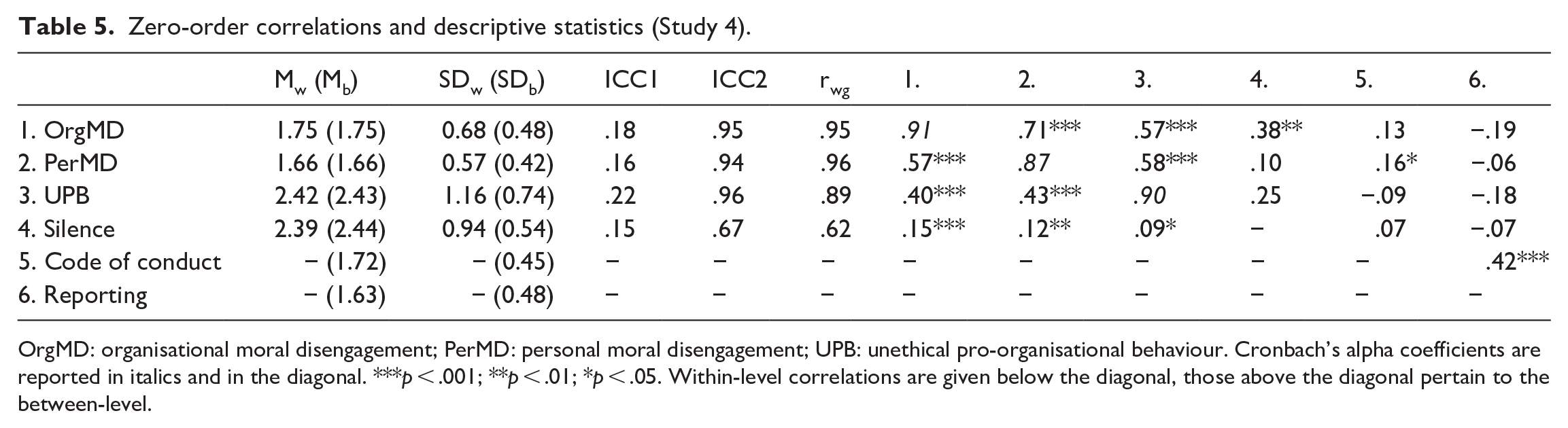
OrgMD: organisational moral disengagement; PerMD: personal moral disengagement; UPB: unethical pro-organisational behaviour. Cronbach’s alpha coefficients are reported in italics and in the diagonal. ***p < .001; **p < .01; *p < .05. Within-level correlations are given below the diagonal, those above the diagonal pertain to the between-level.
The models, including both OrgMD and PerMD items, supported the distinctiveness of the two constructs at both levels (H2) (Model 1-factor: χ2(208) = 2002.414, p < .001; CFI = .79; CFIbetween = .77; CFIwithin = .82; RMSEA = .053; RMSEAbetween = .046; RMSEAwithin = .055; SRMRbetween = .081; SRMRwithin = .064. Model 2-factors: χ2(206) = 404.315, p < .001; CFI = .98; CFIbetween = .93; CFIwithin = .99; RMSEA = .018; RMSEAbetween = .026; RMSEAwithin = .012; SRMRbetween = .029; SRMRwithin = .017. Δχ2(2) = 394.792, p < .001; ΔCFI = .19).
Results of the isomorphism model (χ2(220) = 424.996, p < .001; CFI = .98; RMSEA = .017; SRMRwithin = .019; SRMRbetween = .037; Δχ2(14) = 21.45, p = .091) supported our hypothesis (H3). Results showed that the strong metric isomorphism criteria were met, demonstrating that the relationships between the indicators and the latent variables were identical across these levels thus further supporting structural validity of the scale.
Results of the multilevel model (χ2(6) = 4.44, p = .62; CFI = 1.00; SRMRwithin = .003; SRMRbetween = .046; RMSEA = .000) (Figure 1) provided an initial support of the OrgMD nomological validity. As hypothesised, the presence of formal anonymous organisational channels for reporting wrongdoing was negatively associated with OrgMD (H5b). Unexpectedly, the presence of an organisational code of conduct was positively, rather than negatively, associated with both OrgMD (H5a) and PerMD. In line with our hypotheses, OrgMD was significantly associated with both UPB (H4a) and silence (H4c) at both individual and organisational levels. PerMD was only associated with UPB at individual level.
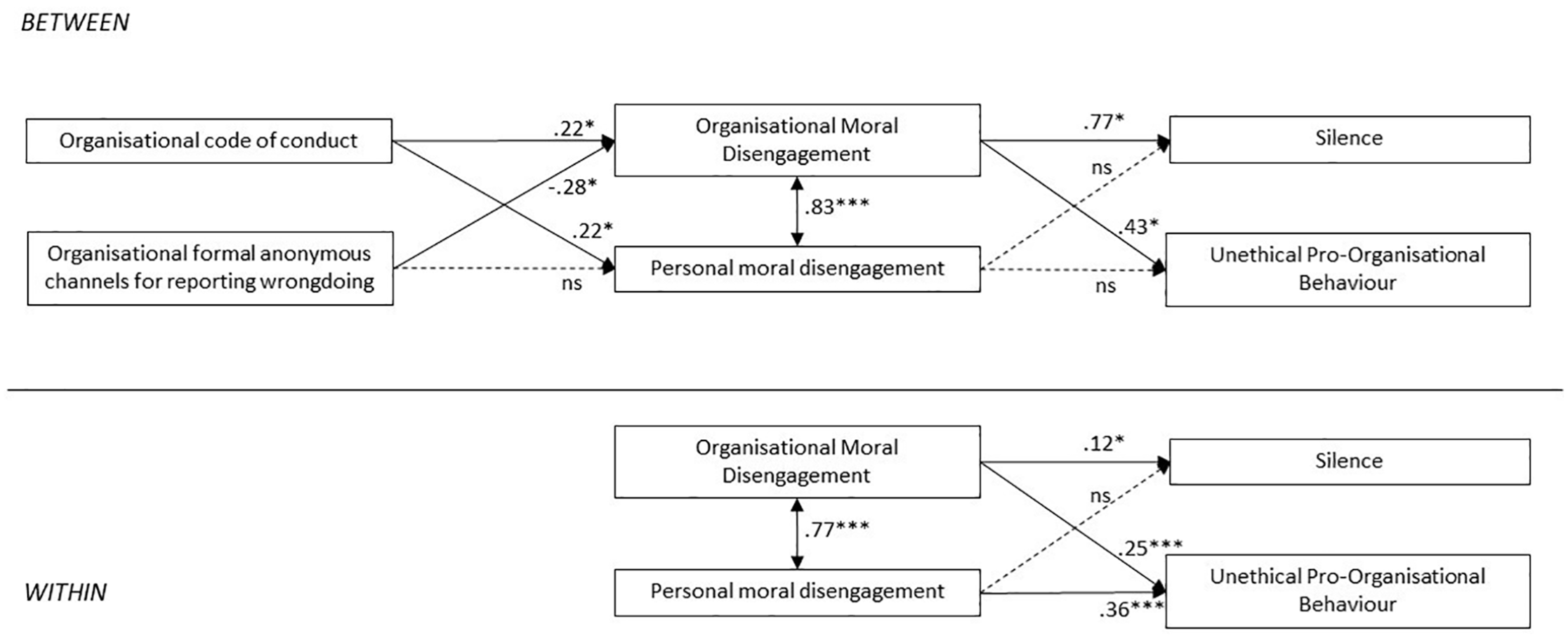
Results of the multilevel model (Study 4).
Results of the moderation analysis did not support our hypothesis (H6). Only the variance component of the random slope of PerMD on UPB was significant (p < .05), while it was not significant for PerMD on silence (p = .29). In addition, the randomisation of the slopes increased model fit for UPB (∆-2*loglikelihood = 26.824, ∆df = 1, p < .001) but not for silence (∆-2*loglikelihood = 2.900, ∆df = 1, p = .09). Nevertheless, results of the model including the cross-level interaction of the between-level OrgMD showed that it did not significantly moderate the within-level PerMD and UPB path (b = −.20, p = .052).
General discussion
Overall, findings of this research support the conceptualisation of OrgMD and the validity (content, structural, discriminant and criterion) of its operationalisation. As hypothesised and in line with literature on PerMD (Bandura et al., 1996; Fida et al., 2015; Moore et al., 2012), OrgMD was found to be unidimensional (H1) at both individual and organisational levels. Results of Study 4 showed that there is a strong metric isomorphism supporting OrgMD factorial cross-level equivalence (H3). Thus, the individual-level OrgMD measure can be safely aggregated to capture organisational-level OrgMD (Jak and Jorgensen, 2017).
Results support OrgMD’s discriminant validity in terms of factorial distinctiveness with PerMD (H2). Our results showed that OrgMD is a distinct construct from PerMD at both individual and organisational levels. This means that while the eight mechanisms are conceptually similar, they are analytically and functionally distinct. Moreover, the results from the multilevel study (Study 4) support our expectation that OrgMD is more than the sum of PerMD.
The distinctiveness between OrgMD and PerMD is further supported by the models investigating the criterion validity (H4). Results of the hierarchical regressions (Study 1) and of the SEM (Study 2 and Study 4) at individual level showed that OrgMD is significantly associated with UPB, CWB and silence above and beyond PerMD. The more members perceive their organisation to be morally disengaged the more likely they are to engage in unethical behaviours. The role of OrgMD on UPB and silence at organisational level is also supported in the multilevel study (Study 4) when investigating the nomological validity. The results suggest that OrgMD at organisational level might be more relevant than PerMD in the legitimisation of unethical behaviours that benefit organisations’ interests. This indicates that when shared perceptions of how their organisation suspends morality emerges (organisational-level OrgMD), members are more likely to comply with these expectations and to engage in UPB and silence.
Results of the multilevel model partially support our hypotheses in relation to the role of some formal elements of the ethical infrastructure on OrgMD (H5). While the presence of anonymous channels for reporting wrongdoing was negatively associated with OrgMD (H5b), the presence of an organisational code of conduct was positively, rather than negatively, associated with both OrgMD and PerMD (H5a). Although codes of conduct are expected to promote ethical behaviours in organisations (Tenbrunsel et al., 2003), there is empirical evidence that this is not always the case (Kish-Gephart et al., 2010) and that they can also have detrimental effects (Badaracco and Webb, 1995; Martin et al., 2014; Tenbrunsel and Messick, 1999). Martin et al. (2014) suggested that the relationship between an organisation’s ethical infrastructure and MD is highly complex, meaning that even in organisations that formally profess to promote ethical conduct, ‘human fallibility may leave the organization prone to collectively rationalizing and unwittingly institutionalizing unethical practice’ (Martin et al., 2014: 297). This could arise owing to a series of intervening factors, such as the desire to maintain a positive reputation or/and the reduction of cognitive effort when reflecting on ethical issues. It is also important to consider, as Tenbrunsel et al. (2003: 300) argue, that the influence of code of conducts depends on the organisational commitment to them: ‘true belief in ethical principles is reflected not so much in what is said but in what is done’. Thus, it is possible that when an organisation exhibits ‘surface or facade ethics’ (Sims and Brinkmann, 2003: 254), the social processes through which OrgMD progresses may go unnoticed. Future studies should investigate how codes of conduct are integrated in organisational processes and how they are interpreted, perceived and made sense of in the organisation (Gkeredakis et al., 2024) to better understand their role in OrgMD.
Furthermore, results of the multilevel model did not support the cross-level interaction of OrgMD at organisation level on the relationship between PerMD and both silence and UPB at individual level (H6). These results seem to suggest that the role of PerMD is not amplified in organisations with higher levels of OrgMD. One possible explanation is that PerMD may be characterised by strong, trait-like dispositional propensities (Moore, 2015). However, it is also plausible that these not significant results are owing to statistical reasons related to their magnitude, the standard deviation of lower-level slopes and the within- and between-level sample sizes (Mathieu et al., 2012). Although our results are in line with prior studies conducted in school settings (i.e. classroom-level MD did not increase the association between individual-level MD and students’ aggressive behaviours) (Bjärehed et al., 2021; Gini et al., 2022), future multilevel studies are required to understand the interplay across levels between OrgMD and PerMD.
Finally, results of the OrgMD longitudinal invariance (Study 2) show its factorial generalisability over time. Longitudinal invariance is crucial to ascertain that the processes subsumed by the passing of time did not alter the construct in such a way that OrgMD could not be considered the same construct across time. Moreover, results also support the cross-country generalisability of the OrgMD (Study 3). Results of the invariance analysis showed that most items were invariant at the highest level, and four of them were invariant only at the metric level. While this is not a concern for correlational studies, some caution should be exercised if the scale is used to compare factor and scale means across different countries.
Theoretical contributions
Our research contributes to the literature in three ways. First, we add to MD theory (Bandura, 1990, 2016) by conceptualising OrgMD as a multilevel construct. Although collective forms of MD at work have been suggested in the literature (Bandura et al., 2000; Ogunfowora et al., 2021; White et al., 2009), these studies have lacked theoretical conceptualisation (Johnson and Buckley, 2015; Ogunfowora et al., 2022). Our OrgMD captures the perceptions of how ‘our organisation’ justifies unethical activities through specific collective mechanisms to suspend morality. It is measured by capturing members’ perceptions of the social reality in their organisation. OrgMD resides both at individual level (i.e. organisational members’ perception of what is considered morally justified in their organisation) and organisation level (i.e. the shared perception of what is considered morally justified within a specific organisation). It can be seen as a form of what Bandura (2016) calls ‘systemic moral disengagement’, meaning that it operates throughout a social system to exonerate it as a whole, including its members. Our research highlights how OrgMD shapes individuals’ and organisations’ moral functioning, leaving members more prone to engage in behaviours that violate societal and organisational ethical standards.
Second, we further contribute to the literature on MD (Newman et al., 2020; Ogunfowora et al., 2022) through showing OrgMD at organisational level as being different from the aggregation of individual-level members’ PerMD. In line with Bandura (2001, 2016), we show that OrgMD cannot be explained as the aggregation of the PerMD of organisational members. Instead, it is a collective phenomenon that results from interactive and synergistic social processes between those situated within a specific organisation, transforming it into something distinct from PerMD. Thus, OrgMD captures collective processes rather than the sum of the members’ PerMD. PerMD refers to intra-individual processes of disengagement of personal moral agency, while OrgMD refers to perceptions of mechanisms for suspending collective moral agency. In other words, the structure of the construct changes from cognitive to one based on social interaction, sensemaking and communication (Hofman, 2004). Thus, although these two constructs are highly correlated, they are different with each explaining distinct elements of engagement in unethical behaviours at both individual and organisational levels.
Third, we further extend the literature on UPB and silence. While PerMD has been identified as a predictor of UPB (Luan et al., 2023; Mo et al., 2023), our investigations at both individual and organisational levels have demonstrated that OrgMD is associated with the likelihood of engagement in UPB above and beyond that of PerMD. As such, OrgMD can enable members to participate in unethical activities that serve the organisation’s interests without feeling personally accountable for any moral implications. Prior research on silence has mainly drawn on stress-related approaches such as conservation/depletion of resources (Ng and Feldman, 2012). Our study highlights the importance of integrating ethical theories to advance further understanding of how to prevent the omission of what is morally right (e.g. silence).
Limitations and future directions
While our research contributes to the understanding of the significance of OrgMD in the organisational context, it also raises further questions about its dynamics. A limitation of our research is that we collected data in the final multilevel study at only one time point. Future studies should focus on understanding OrgMD antecedents, its development and its effects over time. Further, while our OrgMD construct has been tested in two different linguistic contexts (i.e. the UK and Italy), future studies could investigate the role of cultural differences in relation to OrgMD. In addition, we call for further research to advance understanding of the social dynamics and everyday sensemaking involved, specifically how the suspension of morality is produced and maintained within organisations.
Context is an important area for future research, and a limitation of this study is not having examined how further aspects of the organisational ethical context, such as ethical culture and ethical climate (Kaptein, 2011; Kuenzi et al., 2020; Roy et al., 2024; Treviño et al., 1998), are related to or influence OrgMD. While the results of the Q-sort task provided preliminary evidence of the distinction between OrgMD and ethical climate/culture items, it would be important to empirically examine the contribution of OrgMD above and beyond these dimensions as well as investigating how these dimensions influence OrgMD. For instance, Martin et al. (2014) suggest in their conceptual work that some organisational cultures might promote the collective rationalisation of unethical practices, representing what Ashforth and Anand (2003: 9) term a ‘deviant culture’.
Specific attention should also be paid to the role of leaders (Quade et al., 2022; Thiel et al., 2012). While we would anticipate for instance ethical and responsible leadership (Brown and Treviño, 2006; Thiel et al., 2012) to counter OrgMD, we would expect unethical, abusive, toxic and dark leadership (Hassan et al., 2023) to reinforce it. Leaders are clear role models. While ethical leaders emphasise the importance of behaving ethically, highlighting organisational values and rules, and discussing ethical issues, unethical leaders promote questionable behaviours, provide exoneration for rule breaking and avoid discussing ethical issues. Critically, the impacts of leaders’ talks and actions are not confined to individual members, instead they shape collective experiences through seemingly benign activities such as empowering followers, which are found to reinforce a leader’s behaviour and lead individuals to engage in UPB (Dennerlein and Kirkman, 2022). Studies could also productively focus on the organisational systems and policies that promote such activities, including performance management, reward and recognition systems (Ashforth and Anand, 2003). In addition, future studies should investigate the role of organisational ethical sensemaking and ethical decision-making processes (Gkeredakis et al., 2024; Thiel et al., 2012) in the development and maintenance of OrgMD. Future studies might also explore how these aspects may contribute to counteracting the discursive and structural means of suspending morality in organisations, and the corresponding changes in the prevalence of unethical behaviour at work.
Another important area for future studies is to investigate the role of personal factors in relation to OrgMD. For instance, we would expect that while personal values and moral-oriented personality characteristics such as moral identity, integrity and moral self-efficacy would counter OrgMD, dark triad personality traits should exert the opposite effect. Those high in moral identity (Aquino and Reed, 2002) and moral self-efficacy (Paciello et al., 2023) have a strong moral self-regulatory system that promotes ethical behaviours. These individuals would be more likely to become aware of OrgMD mechanisms to exonerate misconduct in the organisation and call them out as well as challenge entrenched unethical practices. On the other hand, those high in narcissism, Machiavellianism and psychopathy (Paulhus and Williams, 2002) would be more prone to act on perceived OrgMD to legitimise unethical conduct.
Other limitations of this work concern the inclusion of only behavioural criteria related to unethical conduct. Future studies should investigate the role of OrgMD in relation to other forms of behaviours; such as, actions related to safety. It would also be important to consider organisational-level outcomes. For instance, we would expect higher numbers of organisational scandals and investigations. It is also plausible to hypothesise that OrgMD might have an important role in relation to individuals’ work attitudes and well-being. For instance, we anticipate a negative impact of OrgMD on job satisfaction, engagement and stress especially for those individuals with high moral traits. In line with the literature on individual–organisation fit (Chatman, 1989; Coldwell et al., 2008), when individuals with a strong sense of moral-self work in an organisation with high OrgMD, a sense of misfit is created with the resultant moral stress affecting their well-being. Finally, another limitation arises from not having included other possible OrgMD correlates to examine its validity. We considered PerMD because it is the construct that, more than others, is closely linked with OrgMD from a conceptual, theoretical and methodological perspective.
Practical implications
This research offers important insights to better understand OrgMD processes and its pervasiveness. The OrgMD measure allows the identification of possible critical ‘hot spots’ where OrgMD is prevalent and where interventions might be crucial. Further, the distinct items could form the basis for business ethics training and be used to create a reflective tool to discuss the ways in which organisations and its members might justify malpractices. These insights could be used to develop case scenarios for trainings that raise awareness about how potential misconducts can become reframed as acceptable and normalised. This type of training could contribute to the proactive prevention of collective moral decline. For instance, this preventative approach could be integrated in the appraisal process to emphasise moral decision making and behaviours. At the same time, a deeper understanding of OrgMD could help organisations to examine these issues at a systemic level (Ellemers and de Gilder, 2022), such as by re-structuring decision-making processes and simplifying supply chains to increase accountability. Interventions grounded in OrgMD could also raise awareness of the unintended consequences of organisational activities, such as the depersonalisation of users. More targeted interventions could focus on personalising and humanising customers or users to mitigate OrgMD and reduce the risks of harm.
Conclusion
OrgMD is a collective process that can be captured through organisational members’ perceptions of organisational mechanisms for suspending morality. The results of our four studies support our conceptualisation of OrgMD and its distinction from PerMD when investigating their relationships with relevant unethical behaviours and silence at both individual and organisational levels. Overall, through OrgMD, morality can be suspended in organisations, enabling members to act wrongfully and unethically in the service of their organisations.
Supplemental Material
sj-pdf-1-hum-10.1177_00187267241300866 – Supplemental material for The suspension of morality in organisations: Conceptualising organisational moral disengagement and testing its role in relation to unethical behaviours and silence
Supplemental material, sj-pdf-1-hum-10.1177_00187267241300866 for The suspension of morality in organisations: Conceptualising organisational moral disengagement and testing its role in relation to unethical behaviours and silence by Roberta Fida, Irene Skovgaard-Smith, Claudio Barbaranelli, Marinella Paciello, Rosalind Searle, Ivan Marzocchi and Matteo Ronchetti in Human Relations
Footnotes
Appendix A. Moral disengagement scales
Acknowledgements
We would like to thank the associate editor Professor Tae-Yeol Kim and the anonymous reviewers for their invaluable feedback and insightful suggestions. We are also deeply appreciative of the colleagues and friends within our professional network who provided constructive feedback during the development of our scale.
Funding
The authors disclosed receipt of the following financial support for the research, authorship and/or publication of this article: Istituto Nazionale per l’Assicurazione Contro Gli Infortuni sul Lavoro BRIC ID 26/2019.

Supplemental material
Supplemental material for this article is available online.
Notes
References
Supplementary Material
Please find the following supplemental material available below.
For Open Access articles published under a Creative Commons License, all supplemental material carries the same license as the article it is associated with.
For non-Open Access articles published, all supplemental material carries a non-exclusive license, and permission requests for re-use of supplemental material or any part of supplemental material shall be sent directly to the copyright owner as specified in the copyright notice associated with the article.
