




Abstract
Do the key drivers of alcohol misuse change as young adults transition from early to late stages of employee onboarding? To answer this question, a series of hypotheses were tested based on two waves of data collected from 1240 college graduates from four different universities in the United States who reported obtaining full-time employment following college graduation. Data on alcohol misuse and hypothesized mechanisms—peer drinking norms and work-related stressors—were collected during the early (i.e. first few months on the job: T1) and late (12 months following initial assessment: T2) stages of employee onboarding. Results indicate that both a key work-related stressor (role overload) and injunctive peer drinking norms (i.e. those focusing on others’ approval) drive alcohol misuse in the transition from early to late stages of onboarding. However, while the relationships between injunctive peer drinking norms and alcohol misuse remain constant over the two measurement points, the mediated relationships between work-related stressors and alcohol misuse via distress is curvilinear and significantly weakens from early to late onboarding. We argue that this observed attenuation suggests that some risk factors can drive alcohol misuse in a way that is non-monotonic as well as dynamic over the course of emerging adults’ career entry.
Keywords
Alcohol misuse—consumption at levels that can cause physical, psychological, and social problems (Foxcroft and Tsertsvadze, 2012)—among college students is a significant health concern in many countries (Kypri et al., 2009). A survey of over 14,000 students at 199 US colleges found 31% met criteria for alcohol misuse (Knight et al., 2002), and studies consistently categorize 40–45% of US college students as heavy episodic (binge) drinkers (Wechsler and Nelson, 2008). For employers, these numbers are concerning not only because more than half (58%) of all full-time, entry-level hires are college graduates (National Association of Colleges and Employers, 2019), but also in that studies suggest that rather than maturing out of such heavy patterns of drinking as they leave college, a sizeable proportion of graduates maintains these patterns as they enter the full-time workforce (Harford et al., 2010; Schuckit et al., 2008). More specifically, while heavy drinking in college is transitory for the majority of students, peaking at age 21 or 22 and then declining following graduation (Johnston et al., 2004; White et al., 2005), there is consistent evidence that for a sizable minority, it is anything but transitory, with heightened levels of drinking remaining stable or exacerbating following graduation (Bachman et al., 1997; Baer et al., 2001; Jackson et al., 2001; Liu et al., 2023). Moreover, Hingson et al. (2009) report that it is precisely among young adults aged 21–24 (i.e. the age that most students enter the career workforce after graduating from college) that alcohol morbidity is at its highest.
For employers and society at large, this failure of young adults to “mature out” of alcohol misuse can be costly, manifesting in higher rates of sickness absence and reduced productivity (Frone, 2013; Liu et al., 2023; Salmela et al., 2023). Indeed, the costs of alcohol misuse in the USA exceed US$250 b annually (Sacks et al., 2015) with the costs of alcohol-related absenteeism alone estimated to range between US$1.11 b (in the USA) to over US$2.22 b (in Europe) (Schou et al., 2014). Moreover, recent studies indicate that nearly 8% of young adults (mean age 25) in Norway are absent for one or more days annually owing to alcohol misuse (Schou et al., 2014), and that those young adults misusing alcohol in the first year of employment in China and the United States are at a heightened risk of subsequently becoming alcohol dependent, experiencing sleep-related problems, and/or manifesting above-average rates of sickness absence (Liu et al., 2023, 2015). This failure of new graduates to mature out of alcohol misuse as they transition into their work role may also be concerning for employers in that how young adults traverse this transition has important implications for their on-the-job learning curve and productivity, and their likelihood of remaining with the organization (Ng and Feldman, 2007). Studies suggest that how young adults manage this transition “sets the pattern” for subsequent vocation- and job-related coping and decision making (Ng and Feldman, 2007: 114) and “long-term career sustainability” (Blokker et al., 2023: 240).
Despite these trends and the costs related to them, our understanding of the work-related factors potentially contributing to the emergence, maintenance, or exacerbation of alcohol misuse among young adults transitioning from college to work remains limited. Although extensive theory and findings over the past five decades suggests that workplace stressors and the strain they generate, as well as permissive workplace drinking norms, serve as key situational risk factors for workforce alcohol misuse (for reviews, see Frone, 2013; Frone and Bamberger, 2023), the generalizability of these findings to young adults transitioning from college to work remains an open question for two reasons. First, although alcohol misuse may be used by transitioning young adults to cope with work-related stressors in the same way it is by veteran workers—at least in the early stages of the transition period when newcomers are still on formal or informal probation—these same stressors may also place structural limitations on alcohol consumption, thus serving—at least temporarily—to attenuate misuse. Accordingly, particularly for newcomers in the early stages of their transition, rather than having the monotonic and positive effect on drinking found in studies of veteran workers (for a review, see Frone, 2013), work-related stressors may have more of a curvilinear effect. Second, although peer norms often serve as a key driver of employee behavior, research suggests that these norms only do so to the extent that they are salient to the individual (Germar and Mojzisch, 2019; Guimond et al., 2018; Jonas et al., 2013). Accordingly, to the extent that newcomer social integration is anything but immediate, the role of workplace norms in driving alcohol misuse during this transition period cannot be taken for granted. In sum, the dynamic nature of transitions (Blokker et al., 2023; Grosemans et al., 2017) challenges the often taken-for-granted monotonicity and stability of these work-related risk factors on alcohol misuse among the millions of young adults transitioning each year from college to work.
Addressing these challenges is important for both theory and practice. From a theoretical perspective, while those studying occupational health psychology often model work-based risk factors as having linear and stable effects on employee wellbeing, as suggested above, there may be good reason to question this assumption particularly with respect to alcohol misuse among those transitioning into a new job or work role. Indeed, in the absence of a model explaining how the transition from college to work shapes the role and nature of work-related risk factors, we are left with a theoretical “black box” regarding this exciting, yet potentially challenging time for young employees. From a practical perspective, such a theoretical “black box” serves as a major barrier to developing effective organization-based prevention and treatment interventions addressing the challenges faced by young adults in their first year of post-college employment.
Accordingly, the current study focuses on two well-established factors consistently found to predict alcohol misuse in college students and employed individuals—peer drinking norms and work-related stress (Bacharach et al., 2002; Frone, 2013; Neighbors et al., 2007). However, rather than treating their predictive effects as monotonic and static, the current study investigates whether their effect is curvilinear (i.e. they are associated with increased alcohol misuse but only up to a point) and varies over time in the course of the transition from college to work (herein referred to as the C2W transition). We do so by first building on research concerning the mechanisms underlying alcohol misuse among college students and among employed individuals (Frone and Bamberger, 2023; Lewis and Neighbors, 2004), positing that in the course of the C2W transition, both peer drinking norms and work-related stressors play an important role in predicting alcohol misuse. Then, building on propositions central to theories of newcomer socialization (Reichers, 1987), we isolate aspects of the transition process that may question the assumed monotonic and static predictive effects of work-related stressors and peer drinking norms on alcohol misuse.
Theorizing on newcomer socialization suggests that informal social control mechanisms in the new work environment influence when and how newcomers respond to work-related situations and experiences (Ashforth and Saks, 1996; Ashforth et al., 2007; Liu et al., 2015). With respect to work-related stress, stressors may function as a risk factor for alcohol misuse among young adults transitioning from college to work (owing to new role demands and pressures that exceed personal resources; Liu et al., 2015; Nelson, 1987). At the same time, stressors may also serve as a mechanism of informal social control and a structural barrier to alcohol misuse (through informal social control and structural barriers to alcohol misuse; Heckhausen, 2006; Valsmir and Lawrence, 1997), and as such may counteract vulnerability to stress-induced drinking. For instance, supervisory pressure to arrive at work earlier the next day or boost productivity may make it more difficult for newcomers to engage in late-night partying following an intense day at work. Accordingly, we posit a non-monotonic relationship whereby the extent to which employees increase their alcohol misuse in response to the strain generated by work-related stressors diminishes as the intensity of strain increases. Similarly, building on phased theories of newcomer socialization, which characterize early onboarding (i.e. the first few months on the job) as a phase that involves high levels of stress relating to performing and mastering work-related tasks, coupled with uncertainty regarding the social and normative aspects of the new work environment (Solinger et al., 2013), we posit that work-related stressors are more salient in predicting employee alcohol misuse during the early onboarding phase, whereas peer drinking norms are more salient during the late onboarding phase (one year following post-graduation job entry).
We test these hypotheses by following a sample of young adults as they graduate college and transition into career employment in the United States, capturing alcohol misuse in terms of a central misuse behavior, namely heavy episodic drinking (HED), as well as in terms of outcomes indicative of misuse, namely alcohol-related problems (ARP). By capturing misuse along these two dimensions, we are able to examine how work-based factors impact not only one, particularly problematic drinking behavior (HED), but the behavioral and physiological consequences of all forms of alcohol misuse (including heavy modal, as opposed to strictly episodic, consumption) more generally. From a practical perspective, both misuse outcomes have relevance to employers, with HED having been consistently identified as a predictor of employee absenteeism and job impairment (e.g. Bacharach et al., 2010; Thørrisen et al., 2019), and ARP having been documented as spilling over into a wide range of work-related issues including workplace injury, aggression and presenteeism (McFarlin et al., 2001; Mangione et al., 1999; Severeijns et al., 2024; Webb et al., 1994).
Our model and findings offer both theoretical and practical contributions to the literatures on employee wellbeing and the newcomer socialization. First, in contrast to extant theories of work-related risk factors (for a review, see Frone, 2013; Frone and Bamberger, 2023) that tend to assume monotonicity in the effect of risk factors on employee alcohol misuse as well as time invariance of risk factor salience (Hartnagel, 1997; Liu et al., 2023; van der Velde et al., 1995; Winefield and Tiggemann, 1990), we propose and test a model positing effects that are non-monotonic and vary with time over the course of the C2W transition. Our findings, challenging these implicit assumptions, suggest the need to develop more nuanced, mid-range theories of onboarding and newcomer wellbeing more generally. Second, limited research attention has been given to generating knowledge that can inform workplace policy and practices related to the C2W transition. Such knowledge is important in that with advances in digital technologies and artificial intelligence, the focus is shifting away from a one-size-fits-all, policy-based approach and toward the development of more individualized, adaptive policies and interventions (Cummings et al., 2016; Eden, 2017; Howard, 2017; Howard and Jacobs, 2016), which seek to address the unique and changing needs of employees, work-units, and organizations as they evolve over time (Nahum-Shani et al., 2012a., 2012b). The development of such dynamic policies and practices requires not only identifying the mechanisms potentially driving the change in target behavior, but also understanding how the role of these mechanisms may itself change over time (Funnell and Rogers, 2011).
Peer drinking norms and work-related stress
Peer drinking norms, defined as young adults’ perceptions of the quantity and frequency of peers’ drinking behavior, and approval of drinking (Borsari and Carey, 2001), are considered the key mechanism underlying alcohol misuse among both college students (Lewis and Neighbors, 2004; Perkins et al., 2005) and employed individuals (Ames et al., 2000; Bacharach et al., 2002; Frone, 2013). This is based on the notion that individuals are motivated to adopt behaviors consistent with peer norms to gain social approval and to establish or maintain relationships with such peers. Peer drinking norms have been found to predict drinking behaviors among both student and non-student young adults (Kypri and Langley, 2003; Larimer et al., 2004; Lau-Barraco and Collins, 2011), but are a particularly salient risk factor for college students. This is attributed to the pronounced shift in influence from parents to peers during college, as well as to the prevalence of alcohol-based social opportunities on campus (Borsari and Carey, 2001). Empirical evidence suggests that college students regularly perceive their peers as holding more permissive drinking norms than they actually do (Mattern and Neighbors, 2004). As a result, college students upwardly adjust their drinking in order to conform to the overestimated perceived norm, shaping the “culture of drinking” that characterizes many US colleges (Kypri and Langley, 2003). Similar logic would suggest that in the context of the onboarding transition, young adults whose workplace peers are perceived as holding more permissive drinking norms may also upwardly adjust their own drinking to conform to the overestimated perceived workplace drinking norms:
H1a: Higher levels of permissive peer drinking norms are associated with greater alcohol misuse among young adults transitioning from college to work.
However, with respect to employed individuals, work-related stress has also been identified as an important mechanism underlying alcohol misuse (Bamberger and Bacharach, 2006; Delaney et al., 2002; Frone, 2013; Martin et al., 1992; Richman et al., 2002). Unlike peer drinking norms, which as noted above, have been posited and found to directly predict alcohol misuse, as noted by Frone (2013), the influence of aversive environmental stimuli or “stressors” on alcohol misuse is indirect, operating via the strain or distress responses such stressors generate, and individuals’ use of alcohol as a means by which to mitigate such strain. That is, because alcohol is easily available and culturally acceptable, it is an important device by which workers attempt to escape from or alleviate the psychological distress (i.e. negative emotional states) (Strohschein et al., 2005) produced by stressors in their work environment (Cooper et al., 1990) such as role demands that outstrip personal resources (Demerouti et al., 2001). For example, Davey et al. (2001) found that although employed individuals reported social factors such as celebration, and socializing with peers as the most important factors underlying alcohol consumption that results in adverse events, factors related to stress experiences (i.e. stressors) emerged as the most predictive. In an earlier study, Martin et al. (1996) found that drinking to regulate or escape unpleasant emotions, is more strongly predicted by job pressure and demands as opposed to permissive drinking norms (frequency with which alcohol is consumed when coworkers socialize), and that these stressors have a greater influence on the odds of engaging in risky drinking behaviors than social reasons for drinking. Moreover, some scholars suggest that the salience of work-related stress as a risk factor for employed adults’ alcohol misuse has likely only increased in the last decade owing to societal, economic, and technological changes, which have changed the nature of work and employment, encouraged “constant connectivity”, and thus have dramatically increased job demands (Prem, 2017; Tompa et al., 2007). Accordingly, to investigate the role of work-related stress in the C2W transition, we focus on role overload as a key stressor (i.e. the environmental demands placed on the individual) underlying employee strain (i.e. the individual’s negative response to the environmental demands, captured here in terms of psychological distress). Role overload captures the perceived quantitative and qualitative magnitude of work-role demands, or in other words the sense that in order to accomplish all of one’s assigned tasks, one must consistently invest excessive hours, and/or that the complexity of the things needing to be done may exceed one’s knowledge, skills, and abilities (Parasuraman et al., 1996). We hypothesize the following:
H1b: Role overload is associated with greater alcohol misuse among young adults transitioning from college to work.
H1c: The relationship between role overload on alcohol misuse is mediated by psychological distress.
The non-monotonic effect of work-stress in the transition from college to work
The extent to which strain (i.e. distress) mediates the relationships between work-related stressors and alcohol misuse (i.e. the indirect effect) is a function of the extent to which work-related stressors relate to strain (i.e. path a) and the extent to which strain relates to alcohol misuse (i.e. path b; see MacKinnon, 2008). During the period of onboarding, particularly for those transitioning from college to work, this mediation might not be monotonic because the constraints of employment may place a limit on the degree to which alcohol can be used as a means by which to cope with the strain associated with work-based stressors. Thus, strain likely relates to greater alcohol misuse (path b) only up to a point, with this curvilinear relationship resulting in a curvilinear mediation.
We based this conjecture on newcomer socialization theory, which suggests that institutional structures regulate, constrain, and canalize individuals’ decisions, choices, and actions (Heckhausen, 2006; Valsmir and Lawrence, 1997) through informal social control (Sampson and Laub, 1990, 1995). In the context of the transition from early- to late-stage onboarding, informal social control likely contributes to the systematic modification of risky patterns of behavior such as alcohol misuse in two ways. First, newcomers engage in self-control tactics such as impression management, seeking to control the beliefs and attributions formed by others regarding their skills, abilities, and motivations (Wang et al., 2015). Therefore, newcomers will likely drink in response to work-related distress only to the extent that doing so would not undermine their effort to make positive impressions. Second, the transition from college to work is associated with meaningful changes in routine activities that restrict opportunities to misuse alcohol, as well as with direct monitoring and social control of the organization on the employee, which increase behavior regulation (Laub and Sampson, 2003). For example, to the extent that work-related distress may stem from a sense of being overloaded with work responsibilities, and hence greater time constraints that limit immediate drinking opportunities, drinking as a viable coping strategy might be less pragmatic when work-related distress is relatively high (Armeli et al., 2000b). Similarly, the direct monitoring and social control to which newcomers, particularly in the early stages of onboarding, are often subject may incentivize newcomers to avoid alcohol misuse because more is at stake (Laub et al., 1998). This suggests that during onboarding the distress-mediated relationship between work-related stressors and alcohol misuse may not be monotonic, such that at higher levels of distress, employees may in fact be less likely to misuse alcohol as a means of coping with work-related stressors (Armeli et al., 2000b; Carney et al., 2000).
Consistent with this idea, empirical evidence suggests that workers are less likely to respond to work-related stress with increased alcohol misuse when they are motivated to cope in a more proactive manner (Armeli et al., 2000a; Moore et al., 2003). In fact, workers who are motivated to cope in a more proactive manner with work-related stress may reduce their alcohol intake so as not to undermine their attempts at controlling work pressures and demands (Moore et al., 2003). Overall, this evidence suggests that over the course of the C2W transition, work-based stressors may have a paradoxical impact on newcomer alcohol misuse. On the one hand, by heightening work-related distress, such stressors may function as a risk factor with respect to alcohol misuse. On the other hand, because—particularly for those subject to more intensive monitoring such as newcomers—such stressors may reflect structural limitations to alcohol misuse, heightened levels of work-related distress may serve as a protective “shield” limiting newcomers’ vulnerability to stress-induced drinking. Thus, we posit a non-linear relationship between work-related distress and alcohol misuse, whereby the extent to which employees respond to work-related distress by increasing alcohol misuse diminishes at heightened levels of work-related distress:
H2: During the transition from college to work, the distress-mediated indirect effect of role overload on alcohol misuse is curvilinear; this indirect effect (specifically the association between psychological distress and alcohol misuse) diminishes to the extent that psychological distress increases, up to a point where it is reversed (i.e. where distress is associated with less alcohol misuse).
The time varying effect of peer drinking norms and work-related stress
The socialization paradigm offers a sociocultural account of how the role of peer drinking norms and work-related stress varies in the transition from college to work. According to this paradigm, the C2W transition is framed as a process of uncertainty reduction, whereby recent graduates attempt to increase the predictability of interactions between themselves and others within the new work environment (Bauer et al., 2007; Ellis et al., 2015). Socialization in this context is typically defined as “a process by which an individual acquires the social knowledge and skills necessary to assume an organizational role” (Van Maanen and Schein, 1977: 3); a definition consistent with the role identity perspective of the student-to-work transition as well (Ng and Feldman, 2007).
Phased theories of newcomer socialization suggest that during the first few (6–10) months on the job (i.e. early onboarding), newcomers experience substantial social and cultural uncertainty, which attenuates over time as the individual achieves sufficient levels of social integration through informational and friendship networks (Morrison, 2002). Specifically, during the initial phases of job entry, employees are unfamiliar with social and normative aspects pertaining to their new work environment (Thomas and Anderson, 1998). Over time, as they acquire a better understanding of the set of desired behaviors, attitudes, and values expected of them in the new organization, they internalize organizational routines, goals, rules, and culture (Ostroff and Kozlowski, 1992) and adopt more of a work-role identity (Ng and Feldman, 2017). Since the impact of social norms on behavior depends on the individual’s capacity to generate realizable perceptions concerning the behaviors others find acceptable (Thomas and Anderson, 1998), peer drinking norms are more likely to shape drinking behaviors during later phases of job entry. Specifically, only when newcomers begin to identify with and deem more salient certain formal or informal groups at work, do the injunctive norms (i.e. those focusing on others’ approval; Frone, 2013) held by these groups with regard to drinking become salient (Abrams et al., 1990; Hogg and Abrams, 1993). Consistent with the theory of planned behavior (Ajzen, 1991) and reasoned action approach (Fishbein and Ajzen, 2009), we focus on injunctive (rather than descriptive norms, which pertain to the actual behavior of others), as the perceived approval or disapproval of important others is more directly related to behavioral intentions, and ultimately behavior, especially in situations where group cohesion is valued (Larimer et al., 2004) Hence, we hypothesize that:
H3: The association between permissive drinking norms and alcohol misuse intensifies over time: it is stronger during the late onboarding phase than the early onboarding phase.
Stage models of newcomer socialization also suggest that during early onboarding, new employees experience high levels of uncertainty about job-related tasks, and what is expected of them in the organization (Solinger et al., 2013). Hence, at least until they better understand the expectations of others, such uncertainty can drive newcomers to experience a heightened sense of stressor-based distress in the early stages of their onboarding. Indeed, empirical evidence suggests that work-related stress is particularly troublesome during the early phase of job entry (Nelson et al., 1988; Taris and Feij, 2004; Vandenberghe et al., 2011). Further, given that the late onboarding phase involves less direct monitoring and social control (Ashforth et al., 2007; Bauer et al., 2007; Saks and Gruman, 2012), work-related distress is also less likely to function as protective “shield” against stress-induced drinking. Since both vulnerability to and protection against stress-induced alcohol misuse are likely more salient during the early stages of job-entry, we hypothesize:
H4: The curvilinear distress-mediated indirect effect of role overload on alcohol misuse weakens over time: it is stronger during the early (vs. late) onboarding phase.
Figure 1 displays the moderated-mediation model implied by Hypotheses 1–4 developed above.
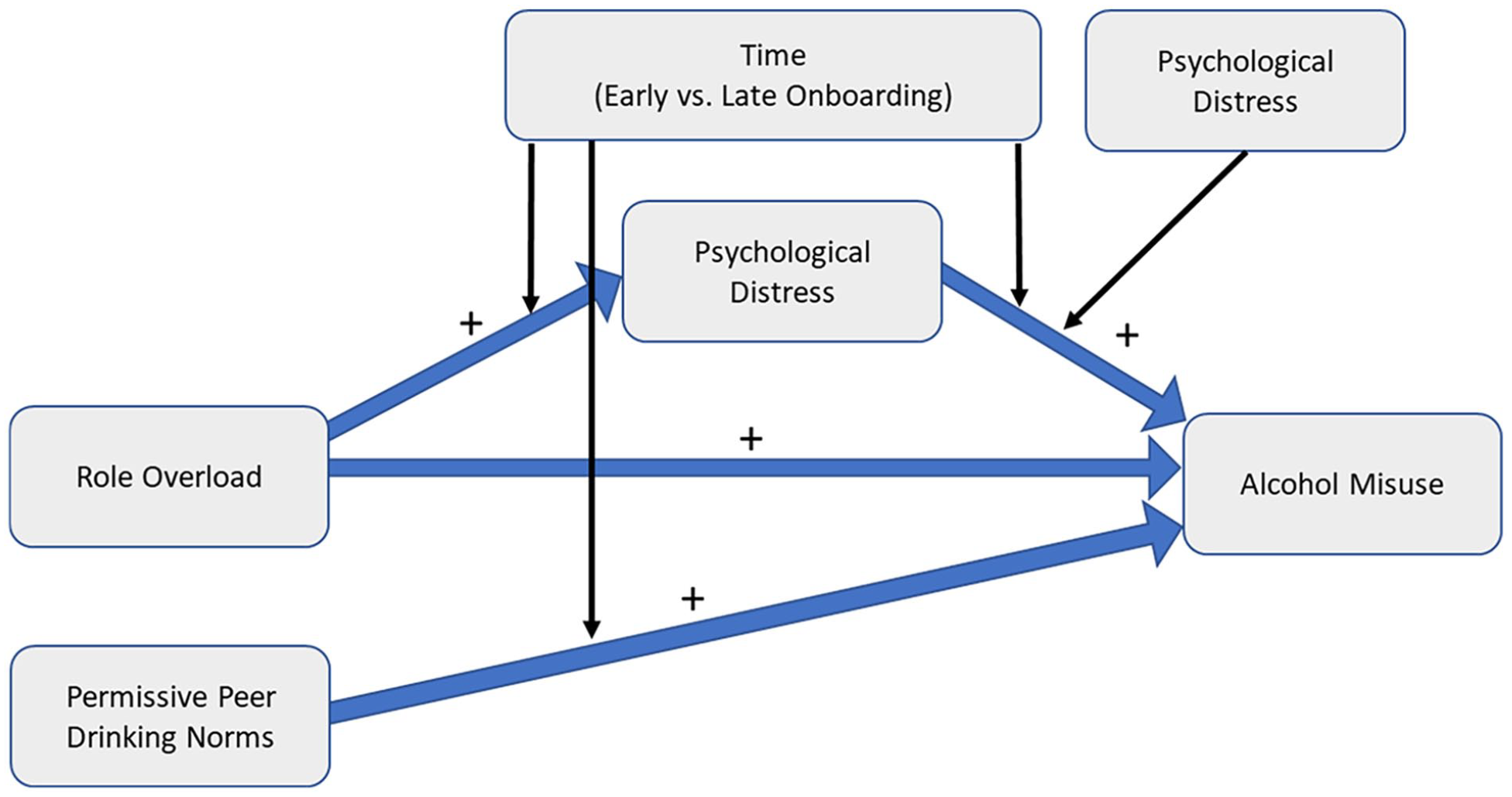
The moderated-mediation model implied by Hypotheses 1–4.
Method
The dataset
Data were taken from a longitudinal study entitled “The College-to-Work Transition & Alcohol Misuse: An Etiologic Study”, which recruited future graduates of four universities in the United States. The study was sponsored by the National Institutes of Health (NIH) and by the Smithers Institute at Cornell University and was approved by Cornell University’s Office of Research Integrity and Assurance (Protocol No. 1408004876) and subsequently by the internal review boards (IRBs) of the other participating universities.
Transparency and openness
The R code for implementing the analyses and additional materials is available in an online supplement: https://github.com/d3center-isr/College-to-Work-Transition-Study. Data are publicly available at https://www.ilr.cornell.edu/smithers-institute/resources/data-set-college-work-study. The study design and hypotheses were included in a grant application funded by the NIH, but not otherwise pre-registered. The data transparency appendix (online Appendix 1) describes how these data were used in prior studies. The current study is the first to utilize these data to investigate the dynamic impact of peer drinking norms and work-related stress on alcohol misuse in the course of early- to late-stage onboarding among emerging adults transitioning from college to work.
Sample and procedures
For the College-to-Work study, names and contact information for over 22,500 seniors in their final quarter/semester before graduation were collected from the registrars of four universities located in different parts of the USA in 2015 and 2016. Participants were randomly selected from these university roster lists and emailed with an invitation to participate. Of those randomly selected, 5401 responded to the initial screening survey, which collected information about their graduation status and plans after graduation. This coverage rate of 24%, itself indicating sufficient sampling (Fox et al., 2007; Meyer, 1979) exceeded by nearly 10 times the sampling target of 585 determined on the basis of a pre-study power analysis assuming small-size effects and statistical power of .8. Further, participation was proportionate to each school’s representation in the graduating cohort, such that 18.1%, 31.8%, 27.7%, and 22.4% were from schools in the Pacific Northwest, Midwest, Southeast, and Northeast, respectively.
Among these 5401 students, 2250 indicated that they were not graduating or were graduating but not entering the US labor market (e.g. continuing their studies, traveling), and thus were excluded from further participation. In contrast, 3151 students indicated that they were graduating and planning to begin working upon graduation. Thus, these respondents were eligible to participate in the main study. Among them, 1330 responded to the screening survey after their school-specific sample size targets in the main study had already been reached. Accordingly, these students were excluded from further participation. Another 87 students refused consent when invited to further participate in the study. The remaining 1734 students were immediately directed to a second pre-graduation online survey. Across both pre-graduation surveys, participants provided information on their demographics (e.g. gender, race), individual differences (e.g. personality traits, grade point average), student loan debt, financial stress, job search stress, and working hours in college. Among these students, 1680 completed both pre-graduation surveys, and received a US$15 e-gift certificate for their participation.
Those who completed both pre-graduation surveys were then asked to complete a follow-up survey one month afterwards; 1649 participants (98.1% retention) completed this follow-up survey. Of those, 32 participants reported to not have graduated in response to a survey item asking them to confirm whether they had graduated and hence were excluded from further participation in the study, leaving 1617 participants. Participants were additionally asked to report their current work situation (i.e. whether they were currently full-time employed) after confirming that they had indeed graduated. If the participant reported to be full-time employed in the one-month follow-up survey, they were followed up 12 months later; otherwise, they were followed up every four months thereafter (asking them to confirm that they had graduated and report their current work situation) until they reported to be full-time employed. In the latter case, participants were again followed up 12 months after they first reported to be full-time employed. Although some participants were followed up more frequently than others, participants were only compensated for completing the one-month follow-up survey and the follow-up survey administered 12 months after they first reported to be full-time employed; in each case, participants received a US$25 e-gift certificate for their effort.
Among the 1617 participants, three participants reported that they had not yet graduated in at least one of the follow-up surveys and hence were excluded from our data analytic sample. Of the 1614 participants that remained, 1240 reported to be employed at both T1 (early onboarding: the time in which the participant first reported to be full-time employed) and T2 (late onboarding: 12 months after T1) and hence were included in the final sample. The sample characteristics were representative of each participating university (detailed analytic results are available upon request) and of national student data. For example, women comprised 59% of the sample, consistent with national data on the gender breakdown of college graduates just prior to the initiation of data collection (Vincent-Lancrin, 2008).
Measures
Independent variables
Role overload (T1 and T2)—the extent that work demands exceed the available resources to meet them (Gilboa et al., 2008)—was measured, per convention (Caplan, 1971; Eden, 1982) by focusing on both quantitative (i.e. relating to the amount of work) and qualitative (i.e. relating to the complexity or difficulty of work-related tasks) aspects. Quantitative overload was assessed with a single-item measure, asking participants “How many days in the past month did you work 10 or more hours in a given 24-hour period?” (from 0 = none in the past month to 30 = 30 days in the past month). Pfeffer (2018a, 2018b) provides compelling evidence that while working a 10–12-hour shift is not uncommon in many occupations (e.g. nursing, first-responders), doing so consistently can have devastating health implications and can therefore be viewed as excessive. Qualitative role overload was measured with three items (
Dependent variables
We used two measures to capture alcohol consumption at levels that can cause physical, psychological, and social problems (i.e. alcohol misuse), namely HED and ARP. Such an operationalization is justified from both a theoretical and practical perspective. Theoretically, by capturing both concepts we are able to examine how work-based factors impact not only one, particularly problematic drinking behavior (HED), but also the behavioral and physiological consequences of all forms of alcohol misuse (including heavy modal, as opposed to strictly episodic, consumption) more generally. From a practical perspective, both misuse outcomes have relevance to employers, with HED having been consistently identified as a predictor of employee absenteeism and job impairment (e.g. Bacharach et al., 2010; Thørrisen et al., 2019) and ARP having been documented as spilling over into a wide range of work-related issues including workplace injury, aggression, and presenteeism (McFarlin et al., 2001; Mangione et al., 1999; Severeijns et al., 2024; Webb et al., 1994).
Heavy episodic drinking (HED; T1 and T2), reflecting a pattern of consumption that has consistently been associated with significant impairment, the inability to fulfill major obligations at work, school, or home, physical risk and/or interpersonal and legal problems (for reviews, see Frone, 2013; Frone and Bamberger, 2023), was assessed on the basis of the Single Alcohol Screening Question Instrument (SASQ: Canagasaby and Vinson, 2005; Williams and Vinson, 2001) by asking participants “How often in the past month did you drink more than four (if you are a woman) or five (if you are a man) standard drinks in a single day?” (from 0 = none in the past month to 30 = 30 days in the past month).
Alcohol-related problems (ARP; T1 and T2) directly captures the kinds of problems associated with the misuse of a substance such as alcohol as indicated by the DSM-IV criteria for substance abuse (American Psychiatric Association, 2000). It was measured using 19 items (
Mediator
Psychological distress (T1 and T2), an indicator of strain, was assessed using a five-item measure (
Control variables
We controlled for variables that have been shown in previous studies (see Frone, 2013) to be highly predictive of self-reported alcohol misuse. These included gender, race, age, social desirability (T0: pre-graduation), impulsivity (T0), and life stressors (T1 and T2). In addition, analyses with HED as the outcome controlled for baseline (T0) HED and analyses with ARP as the outcome controlled for baseline (T0) ARP. Social Desirability (T0)—“tendencies to distort self-report in a favorable direction” (McCrae and Costa, 1983: 882)—was assessed using a 10-item measure (
Data analytic procedure
Hypotheses H1–H4 were tested separately for the two different outcomes (i.e. ARP or HED). Time was coded 0 for T1 (early onboarding) and 1 for T2 (late onboarding). A long-format dataset was used for the repeated measurements, with two rows (one for T1 and one for T2) per participant. Regression models were estimated via Generalized Estimating Equations (GEE) with a log-link function (because the dependent variables are count outcomes) and exchangeable working correlation structure. In the case of two time points per person, this correlation structure is equivalent to the continuous-time first-order autoregressive correlation structure (i.e. AR(1)) or unstructured, because there is only one within-person correlation parameter.
Testing hypotheses concerning mediation
Hypotheses concerning mediation (i.e. H1c, H2, H4) were tested by estimating a 95% bootstrap confidence interval (e.g. Hayes, 2017) for the indirect effect. Three thousand bootstrap samples were generated; indirect effects for each bootstrap sample were calculated by multiplying (a) the association between role overload and psychological distress (path a); and (b) the association between psychological distress and ARP/HED when role overload is included in the model (path b). When hypotheses concerned associations conditional on time, these were investigated based on models that included the time indicator and interactions between time and the relevant independent variable (i.e. role overload or psychological distress).
Hypotheses concerning the curvilinear distress-mediated indirect effect were investigated using a moderated mediation framework (Hayes, 2015). Specifically, to test H2, which posits that the distress-mediated indirect effect of role overload on alcohol misuse is curvilinear, the model used to estimate path b of the indirect effect included a squared term for psychological distress (see Model 3 in Tables 2 and 3). This is akin to testing whether path b (i.e. the association between psychological distress and ARP/HED when role overload is included in the model) is moderated by psychological distress itself (Cohen et al., 2010). The estimated coefficients for psychological distress and its squared term were used to estimate the indirect effect (
Missing data
The analyses excluded participants with missing data in the outcome of interest, or one of the independent/control variables, resulting in at least N = 913 participants included in analyses involving ARP as the outcome and N = 1143 for those involving HED as the outcome. Rates of missing data for each variable are reported in Table 1. To investigate whether our results might be biased by missing data, we compared those participants who were included (Group A) and those who were not included (Group B) in the analyses, in terms of sex, age, race, and baseline drinking behaviors. For the ARP analyses, only differences in sex were found (p ⩽ 0.05), with Group A having fewer females (58%) than B (66% female). No differences were found in terms of race, age, or baseline HED. For the HED analyses, the only differences were with respect to race (p ⩽ 0.001), with Group A having more whites (70%) than B (53% white). No differences were found in terms of sex, age, or baseline ARP.
Descriptive statistics and correlations for study variables.

M: mean; SD: standard deviation; NOB: number of participants included in the calculation of summary statistics, variables measured at early onboarding phase (Time = 0), variables measured at late onboarding phase (Time = 1); NMISS: among participants included in NOB, the number of participants having a missing value; PMISS: among participants included in NOB, the percentage of participants having a missing value; α: Cronbach’s alpha; HED: heavy episodic drinking; ARP: alcohol-related problems; RAPI: Rutgers Alcohol Problem Index.
For ARP measured at early (Time = 0) and late (Time = 1) onboarding phase, NOB was restricted to only those participants who reported (within the same survey) have consumed alcohol within the past month.
p ⩽ 0.10; *p ⩽ 0.05; **p ⩽ 0.01; ***p ⩽ 0.001.
Results
Table 1 includes summary statistics of variables used in analyses. Tables 2 and 3 present the results for ARP and HED as the outcome, respectively. Tables 4 and 5 present the results for psychological distress as the outcome.
Estimates of regression models with ARP as the outcome.

QIC: Quasi-likelihood under the Independence Model Criterion; SE: Standard Error; ARP: alcohol-related problems.
p ⩽ 0.10; *p ⩽ 0.05; **p ⩽ 0.01; ***p ⩽ 0.001.
Estimates of regression models with HED as the outcome.

QIC: Quasi-likelihood under the Independence Model Criterion; SE: Standard Error; HED: heavy episodic drinking.
p ⩽ 0.10; *p ⩽ 0.05; **p ⩽ 0.01; ***p ⩽ 0.001.
Estimate of regression models with psychological distress as the outcome controlling for baseline ARP.

QIC: Quasi-likelihood under the Independence Model Criterion; SE: Standard Error; ARP: alcohol-related problems.
p ⩽ 0.10; *p ⩽ 0.05; **p ⩽ 0.01; ***p ⩽ 0.001.
Estimates of regression models with psychological distress as the outcome controlling for baseline HED.

QIC: Quasi-likelihood under the Independence Model Criterion; SE: Standard Error; HED: heavy episodic drinking.
**p ⩽ 0.01; ***p ⩽ 0.001.
Hypothesis H1a suggests that more permissive peer drinking norms are associated with an increase in alcohol misuse among young adults transitioning from college to work. The results support this hypothesis in relation to ARP as the outcome (Model 1; Table 2), but not for HED (Model 1; Table 3). Specifically, the association between permissive peer drinking norms and ARP was positive and significantly different from zero (b = 0.14, SE = 0.04, p = 0.000). The association between peer drinking norms and HED was not statistically significant (b = 0.04, SE = 0.03, p = 0.227).
Hypothesis H1b suggests that role overload (i.e. work-based stressor) is associated with an increase in alcohol misuse among young adults transitioning from college to work. The results support this hypothesis in relation to ARP as the outcome (Model 1; Table 2), showing a positive and statistically significant association for quantitative overload (b = 0.13, SE = 0.05, p = 0.018), and a positive, yet non-significant association for qualitative overload (b = 0.06, SE = 0.04, p = 0.068). Moreover, the results also support this hypothesis with regard to HED as the outcome (Model 1; Table 3). Specifically, both qualitative and quantitative overload were positively and significantly associated with HED (b = 0.07, SE = 0.03, p = 0.020; b = 0.12, SE = 0.02, p = 0.000, respectively).
Hypothesis H1c suggests that the association between role overload and alcohol misuse is mediated by psychological distress. The results support this hypothesis only with respect to ARP as the outcome. Specifically, as can be seen in Model 6 (Table 4), both qualitative and quantitative role overload were positively and significantly associated with psychological distress (path a = 0.09, SE = 0.02, p = 0.000 for both). Further, when included in a model with both quantitative and quantitative overload (Model 2; Table 2), psychological distress was positively and significantly associated with ARP (path b = 0.23, SE = 0.05, p = 0.000), while the regression coefficients for qualitative and quantitative overload were still positive but reduced in magnitude (b = 0.05, SE = 0.04, p = 0.201; b = 0.09, SE = 0.05, p = 0.067, respectively). Indirect effect estimation indicates that psychological distress significantly mediated the association between both qualitative (indirect effect = 0.021, 95% CI = [0.008, 0.035]) and quantitative (indirect effect = 0.019, 95% CI = [0.008, 0.033]) overload and ARP. The results do not support this hypothesis with respect to HED. Specifically, although the results show (Model 6; Table 5) that both qualitative and quantitative role overload are positively and significantly associated with psychological distress (path a = 0.10, SE = 0.02, p = 0.000 and path a = 0.09, SE = 0.02, p = 0.000, respectively), when included in a model with both forms of overload (Model 2; Table 3), the association between psychological distress and HED was not significant (path b = 0.00, SE = 0.03, p = 0.880). Further, indirect effect estimation indicates that psychological distress does not mediate the associations between qualitative (indirect effect = 0.001, 95% CI = [−0.005, 0.007]) and quantitative (indirect effect = 0.000, 95% CI = [−0.005, 0.006]) overload and HED.
Hypothesis 2 suggests that the distress-mediated indirect effect of role overload on alcohol misuse is curvilinear; it diminishes to the extent that psychological distress increases. This hypothesis was supported. The results indicate that the positive associations between psychological distress and both ARP (Model 3; Table 2) and HED (Model 3; Table 3) diminish as psychological distress increases (see Figure 2). This is evident in the negative quadratic coefficient for psychological distress, which was borderline significant with respect to ARP (quadratic coefficient = −0.06, SE = 0.03, p = 0.056) and statistically significant with respect to HED (quadratic coefficient = −0.07, SE = 0.02, p = 0.001). Further, analyses of the indirect effects (see Panel 2; Tables 6 and 7) show that for ARP as the outcome, the distress-mediated indirect effects of qualitative and quantitative role overload are positive and significantly different from zero at all levels of psychological distress (with lower magnitude at higher level of distress), whereas for HED the indirect effects are only significant (and positive) at relatively low levels of psychological distress.
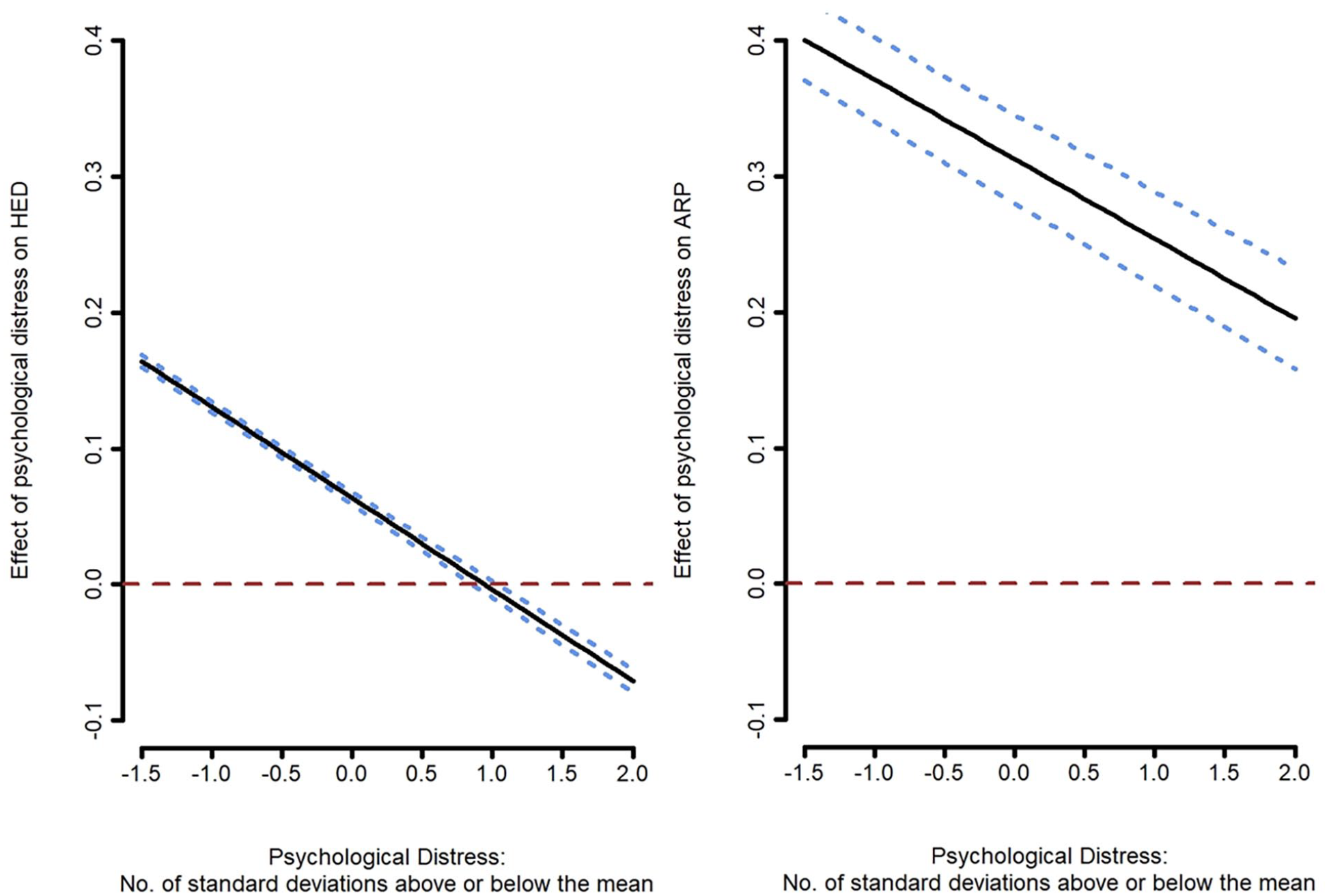
Estimated “simple slopes” (with 95%-confidence interval) of psychological distress on heavy episodic drinking (HED) (left panel) and alcohol-related problems (ARP) (right panel), conditional on psychological distress. The dashed horizontal lines represent a simple slope of zero.
Estimates and bootstrapped 95%-confidence intervals of the indirect effect of qualitative role overload and quantitative role overload with ARP as the outcome.
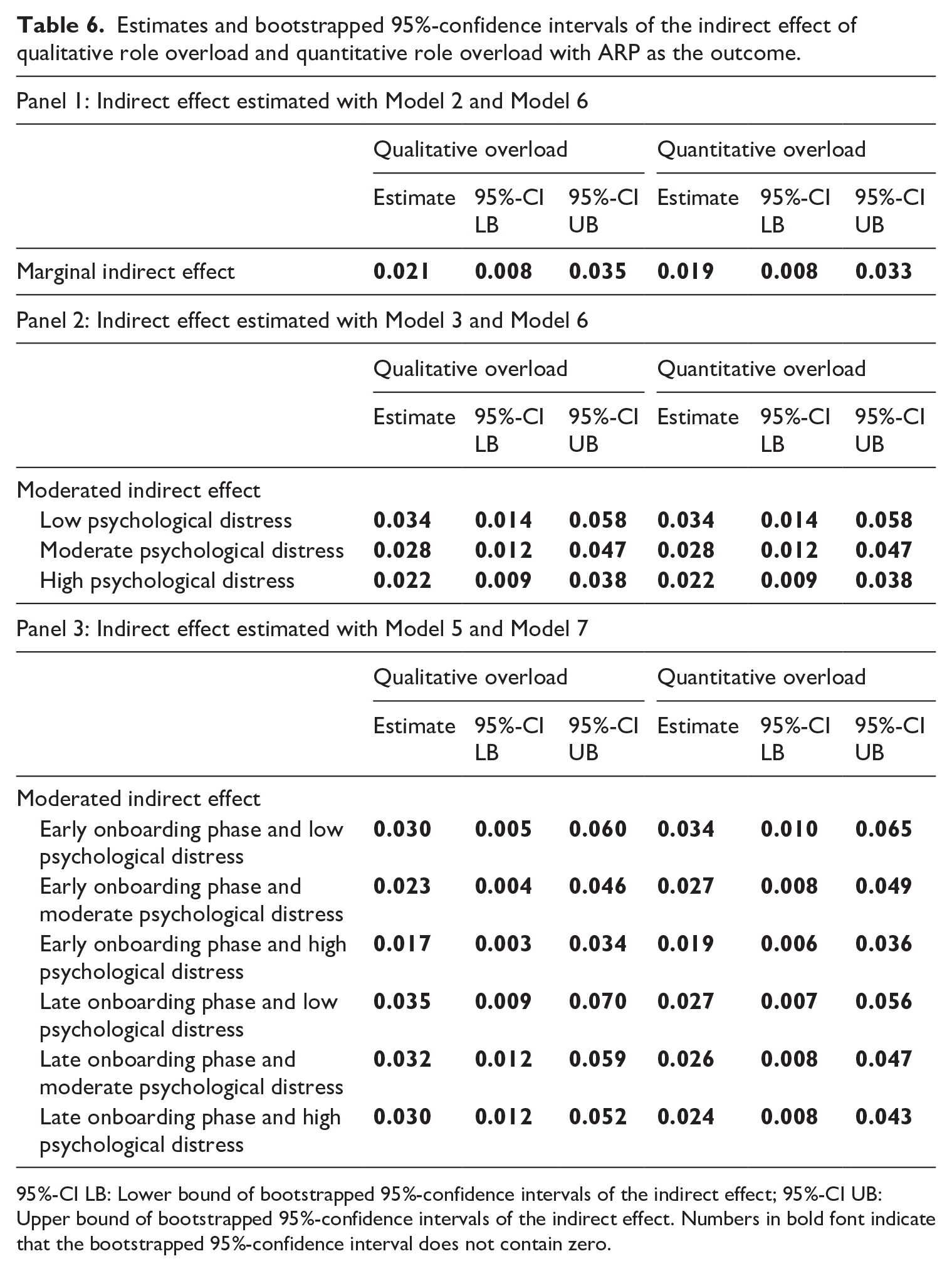
95%-CI LB: Lower bound of bootstrapped 95%-confidence intervals of the indirect effect; 95%-CI UB: Upper bound of bootstrapped 95%-confidence intervals of the indirect effect. Numbers in bold font indicate that the bootstrapped 95%-confidence interval does not contain zero.
Estimates and bootstrapped 95%-confidence intervals of the indirect effect of qualitative role overload and quantitative role overload with HED as outcome.

95%-CI LB: Lower bound of bootstrapped 95%-confidence intervals of the indirect effect; 95%-CI UB: Upper bound of bootstrapped 95%-confidence intervals of the indirect effect. Numbers in bold font indicate that the bootstrapped 95%-confidence interval does not contain zero.
Hypothesis 3 suggests that the association between more permissive peer drinking norms and alcohol misuse is stronger during the late (vs. early) onboarding phase. While the results concerning Hypothesis H1a show a significant association between more permissive peer drinking norms and ARP (Model 1; Table 2), the inclusion of a two-way interaction between peer drinking norms and the time indicator (Model 4; Table 2) showed that this association does not vary between the two measurement points (interaction between peer drinking norms and time = 0.00, SE = 0.06, p = 0.982). With respect to HED as the outcome, the results (Models 1 and 4; Table 3) show no significant association with peer drinking norms or interaction between peer drinking norms and time.
Finally, Hypothesis 4 suggests that the curvilinear distress-mediated indirect effect of role overload on alcohol misuse weakens over time. This hypothesis was not supported. Model 7 (Tables 4 and 5) shows that the associations between role overload and psychological distress (path a) do not vary between the two measurement points when controlling for baseline ARP (interaction between qualitative/quantitative role overload and time = 0.03/0.00, SE = 0.04/0.03, p = 0.375/0.995) and baseline HED (interaction between qualitative/quantitative role overload and time = 0.03/0.01, SE = 0.03/0.03, p = 0.340/0.697). Moreover, Model 5 (Tables 2 and 3) indicates that the linear and curvilinear associations between psychological distress (path b) and both ARP (interaction between psychological distress and time = −0.01, SE = 0.09, p = 0.899; interaction between the quadratic term of psychological distress and time = 0.06, SE = 0.06, p = 0.291) and HED (interaction between psychological distress and time = 0.00, SE = 0.04, p = 0.975; interaction between the quadratic term of psychological distress and time = 0.02, SE = 0.04, p = 0.604) do not vary with time. This suggests that the curvilinear distress-mediated indirect effect of role overload on alcohol misuse is stable over the two measurement points (see Figure 3(a) and 3(b) for estimated indirect effects for HED and ARP, respectively).
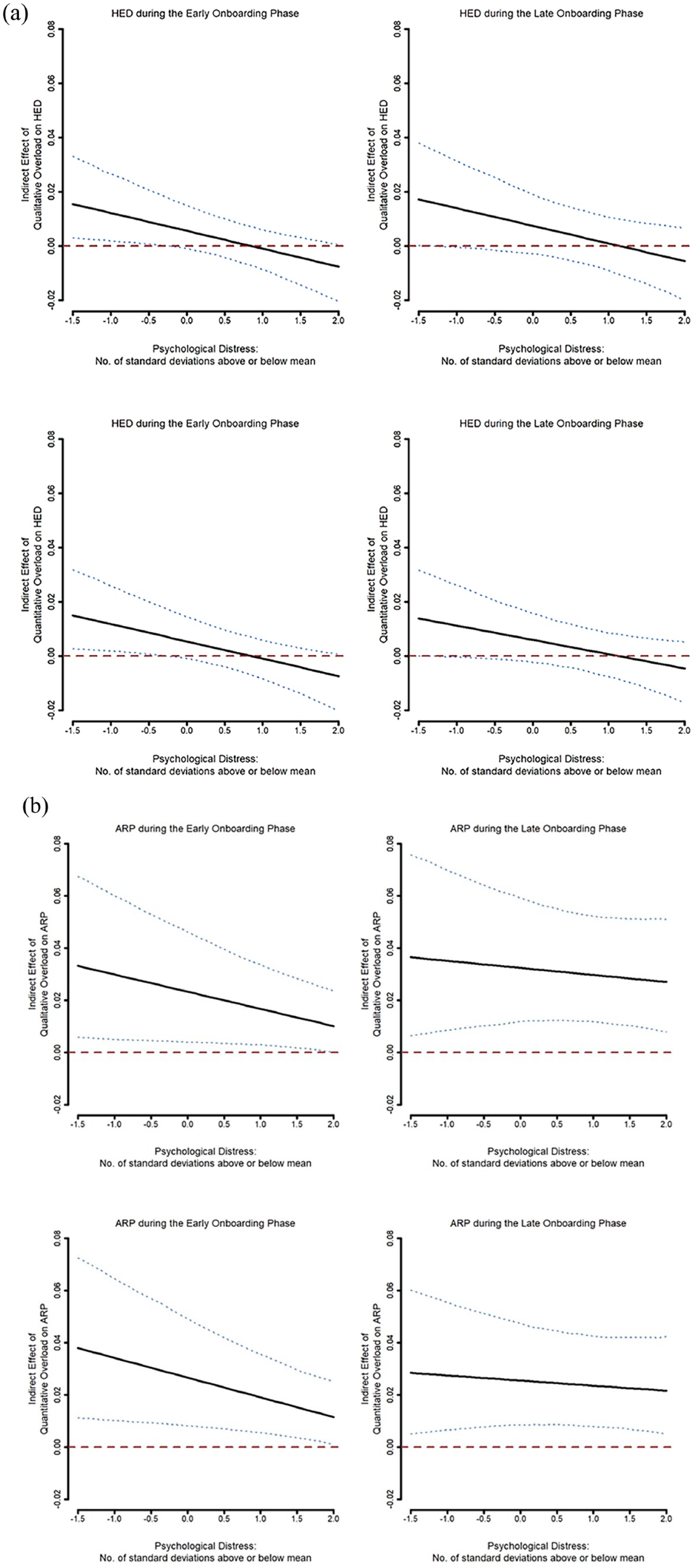
(a) Estimated indirect effects (with 95%-confidence interval) of qualitative/quantitative overload on heavy episodic drinking (HED) through psychological distress during early (left panels) and late (right panels) onboarding. The dashed horizontal lines represent an indirect effect of zero. (b) Estimated indirect effects (with 95%-confidence interval) of qualitative/quantitative overload on alcohol-related problems (ARP through psychological distress during early (left panels) and late (right panels) onboarding. The dashed horizontal lines represent an indirect effect of zero.
However, Model 4 (Tables 2 and 3) shows that the positive “total effect” of qualitative overload significantly attenuates with time for HED (interaction between qualitative role overload and time = −0.15, SE = 0.04, p = 0.001), but not for ARP (interaction between qualitative role overload and time = −0.13, SE = 0.07, p = 0.060). Simple slopes analyses (Model 4; Tables 2 and 3) indicate a positive and significant association between qualitative overload and both ARP (estimate = 0.13, SE = 0.05, p = 0.010) and HED (estimate = 0.15, SE = 0.04, p = 0.000) during early onboarding. Overall, these results indicate that the “total effect” of qualitative overload on HED (and to some extent on ARP) weakens from early to late onboarding.
Robustness check
Although we investigated workplace stress and peer norms as completely separate mechanisms that drive alcohol misuse, it may be that they interact among those transitioning from college to work. For example, ethnographic research suggests that employees may be more likely to engage in alcohol misuse as a means by which to cope with occupational stress to the extent that such behavior is deemed normative among those salient to them (Sonnenstuhl, 1996). Accordingly, we tested for such a distress–norms interaction in the current sample. Consistent with the findings of Bacharach et al. (2002), we too found no support for such an interaction with regard to either HED or ARP, even when modeling the possible curvilinear association between distress and alcohol misuse (detailed results available upon request from the authors).
Discussion
Building on the recognition that the transition from college to work provides employers with a window of opportunity to facilitate young adults’ adoption of health behaviors that are also career-conducive, our analysis focused on factors potentially underlying alcohol misuse during this transition. Considering that interventions aimed at behavioral change may be more effective to the extent that they address salient risk and protective mechanisms, and that the salience of these mechanisms may be dynamic, our analysis aimed at assessing the degree to which two key risk factors—work-related stressors and injunctive norms—may change in salience over the course of the C2W transition. A better understanding of whether, how, and when the impact of these mechanisms changes over the course of key, work-related life transitions is important to be able to develop more effective and cost-efficient interventions.
The findings from our analyses indicated that the salience of these mechanisms is indeed dynamic, and the nature of their influence in driving alcohol misuse over the course of this critical period of transition may be more nuanced than previously conceptualized. More specifically, we found that both role stressors (qualitative and quantitative overload) and permissive peer drinking norms represent risk factors for ARP and that the association between overload and ARP is mediated, as expected, by felt strain (i.e. psychological distress). Further, we found the total effect of qualitative overload on HED to significantly weaken over time. Specifically, qualitative overload was associated with increased HED only during early onboarding. This suggests that qualitative overload is a salient risk factor with respect to HED only during early onboarding, whereas peer drinking norms is a salient mechanism with respect to ARP (but not HED) during both early and late onboarding. Additionally, psychological distress showed a curvilinear association with both ARP and HED, suggesting that the positive association between psychological distress and alcohol misuse attenuates as the level of distress increases, regardless of time. This suggests that during both early and late onboarding, psychological distress functions as a risk factor with respect to alcohol misuse, as well as a protective “shield” to counteract vulnerability to stress-induced drinking.
Additionally, several of the non-significant hypothesized associations offer important insights. In particular, we found no evidence of a distress-mediated association between overload and HED at high levels of distress, as well as no evidence that the association between qualitative overload and ARP varies between the two measurement points. The absence of a significant indirect effect of overload on HED at high levels of distress is important in that it suggests that precisely when overload is more strain-inducing, the overload underlying it may serve as a beneficial control mechanism, perhaps heightening the perceived risk on the part of the newcomer of engaging in such behavior. That is, consistent with the curvilinear association posited, while distress may rise along with qualitative overload, the demands of the job itself may directly limit the interest or ability of the young newcomer to engage in such behavior. Similarly, particularly given the significant time-varying association between overload and HED, the absence of a time-varying association between qualitative overload and ARP is important in that it suggests that while HED as a specific misuse behavior may be sensitive to the young newcomer’s onboarding status, the association between qualitative overload and other forms of misuse potentially having less visible workplace implications (e.g. higher levels of modal consumption), may be less sensitive.
Overall, these results suggest that during the first year of post-college employment, work-related stress functions as a risk factor as well as a protective shield for both HED and ARP, regardless of time. However, with respect to HED, of the two risk factors investigated, work-related stress is the only one with significant findings, with work-related stressors directly predicting HED only during early onboarding. With respect to ARP, both work-related stress and peer drinking norms represent important risk factors, during both early and late onboarding.
Theoretical and practical implications
Our findings offer several important theoretical contributions to research on the role of workplace factors in the emergence, maintenance, or exacerbation of alcohol misuse among young adults transitioning from college to career employment. Most importantly, our findings indicate that certain work-based risk factors for alcohol misuse have non-linear and dynamic roles over the course of emerging adults’ career entry. More specifically, while peer-based, normative influences are salient in both earlier and later onboarding phases, work-related stressors only have a direct impact on alcohol misuse in the initial phase of onboarding. Given that this direct effect was not found to be mediated by distress during the early phases of onboarding suggests that other potential mediators may be at play as young adults navigate the first few months on the job. Mechanisms, such as fatigue (Frone, 2016) and exhaustion (Shepherd et al., 2019) should be investigated in future research as possible drivers of stress-induced drinking during early onboarding. Research is also needed to better understand the non-significance of the indirect effect of some of the stressors examined on certain forms of misuse via distress particularly in the early phase of onboarding. To what degree does this stem from a more direct, control-based, offsetting effect of overload with newcomers dissuaded from engaging in HED out of a concern that such behavior may only make it more difficult to meet job demands or even put their job at risk? It is likely that early-stage newcomers, whose behavior tends to be more “under the spotlight”, strategically select their form of misuse, consuming alcohol at times or in ways that while having fewer workplace implications nevertheless still manifest in ARPs.
We also found the association between work-based risk factors and alcohol misuse to be more nuanced than currently thought, with the strain-mediated indirect effect of work-related role stressors on misuse being curvilinear. Specifically, we found psychological distress in response to work-related stressors to increase alcohol misuse, but only up to a point. While in prior theorizing, work-stress was conceptualized merely as a risk factor with respect to alcohol misuse, consistent with newcomer socialization perspectives our results suggest that this factor may also serve as a protective “shield”. The curvilinear strain-mediated effect did not vary between early and later onboarding phases, suggesting stability in this dual function of work-stress, at least during the first year on the job. This calls for future work to investigate whether and when the protection afforded by work-stress dissipates during the period following later onboarding, leaving employees vulnerable to stress-induced drinking.
These nuanced associations may have important implications for mid-range theorizing on the role of work-based risk factors for emergent adults’ alcohol misuse. Theory has tended to assume the monotonicity and time invariance of risk factor salience, with studies hypothesizing and testing largely linear and static associations. Moreover, as noted by Frone (2013, 2019) and others (Siegrist and Rödel, 2006), these studies have often generated inconsistent results. The current findings offer a partial explanation for such inconsistent study outcomes in that, at least for emerging adults during the C2W transition, whether and how stress-related risk factors impact alcohol misuse may be a function of both the level of elicited distress, and the point in time during which that stress is experienced. Although scholars have theorized about how onboarding situations and/or socialization tactics may have non-monotonic and phase-specific effects on newcomer socialization (Bauer et al., 2007; Song et al., 2017) to the best of our knowledge, the current study is among the first to apply such an approach when examining the impact of the onboarding experience on emerging adults’ health and wellbeing.
In this regard, our model and findings have broader implications for research on newcomer socialization and on the transition from school or college to work; two literatures that have largely developed independently from one another. For example, while Wanberg’s (2012) Oxford Handbook of Organizational Socialization has several chapters on specialized groups such as expatriates, none of the chapters make any reference to the specific socialization challenges face by young adults or those transitioning into career employment for the first time. The current study highlights why it is important to bridge these two literatures and offers an example of how this may be accomplished.
Our findings also have several important practical implications. To the extent that the associations between stress-related risk factors and alcohol misuse among those transitioning from college to work may be temporally dynamic, the efficacy of organizational practices and programs aimed at preventing or treating such behaviors is likely to be contingent on their adaptive nature. Scholars have recently called for the development of interventions for a wide range of health and behavioral issues that are more flexible and adaptive (Nahum-Shani et al., 2017; Patrick et al., 2021), with evidence mounting that interventions tend to be more efficacious when they target and address time-salient mechanisms (Connell et al., 2007; Gustafson et al., 2014; Véronneau et al., 2016). Adaptive interventions do this by adjusting their focus and/or approach as the drivers of individual behavior change as a function of time or situation (Collins et al., 2004; Nahum-Shani et al., 2020). Although there have been few applications of adaptive interventions for alcohol misuse (for an exception, see McKay et al., 2015) recognizing the limitations of a “one size fits all” approach to the prevention of drinking problems among employees transitioning into a new work role, our findings suggest that the efficacy of drinking-related workplace behavioral health interventions and organizational onboarding tactics might similarly benefit from leveraging a better understanding of when and for whom certain interventions and orientation tactics may be more impactful than others.
Similarly, our findings regarding the non-monotonic associations between work-related distress and emergent adults’ alcohol misuse also have practical relevance. More specifically, the curvilinear association between overload-related distress and emerging adult misuse indicates that individuals self-regulate their consumption of alcohol at higher distress levels to avoid the potentially negative career implications of alcohol misuse. This suggests that it may be beneficial for organizations, as part of their formal onboarding process, to leverage such self-regulatory effects by better clarifying for newcomers the organization’s policies regarding alcohol consumption and the potential consequences of off-site drinking deemed to adversely impact on-the-job performance.
Finally, our findings suggest that at all phases of the onboarding process, particular attention should be paid to peer-based behavioral norms. While many onboarding programs emphasize the impact of supervisors in shaping newcomer comportment, the influence of the broader, peer-based norms to which newcomers are typically exposed tends to be neglected (Liu et al., 2015). Our findings indicate that throughout the onboarding period, these peer-based norms have a non-trivial impact on young adults’ “maturing out” of patterns of alcohol misuse. Accordingly, consistent with the ethnographic observations of Bacharach et al. (2001) in the transport sector, organizations may benefit by paying greater attention to the role that workplace peers may play in helping emergent adults transition from college to work, particularly regarding the “maturing out” of risky, college-based patterns of drinking behavior.
Limitations and implications for future research
The current study investigated the association between risk factors and alcohol misuse at only two points in time, namely shortly after job entry and then again, one year later. As noted above, we selected these two time points based on the literature on onboarding (Bauer et al., 2007), which suggests that the onboarding period covers up to the first year of employment. We opted for a one-year time frame in that the hypothesized mechanisms were expected to change in salience relatively slowly over time. Nevertheless, we cannot rule out the possibility that the change in mechanism salience occurred at some earlier point in time, or that there was more than one change in mechanism salience in the course of the year-long period studied. Accordingly, our understanding of temporal risk factor dynamics may be enhanced to the extent that scholars design studies with additional measurement occasions that are more sensitive to such potential short-wave dynamics. Additionally, our analysis examined only two main risk factors for employee alcohol misuse, namely work-related stress and peer drinking norms. However, research suggests that other important factors, including social control and alcohol availability potentially explain the variance in workforce alcohol misuse (see Frone, 2013, 2019 for review). We encourage researchers to examine the degree to which other mechanisms identified by static models as driving alcohol misuse may also be subject to change as a function of time or transition stage. We also encourage researchers to investigate the extent that our results can be generalized to older adults experiencing other work-related transitions.
Several sampling-related issues may limit the generalizability of our findings. First, our analysis focused on those graduates reporting full-time employment (defined as 35 or more hours of employment per week). Although the National Association of Colleges and Employers (NACE, 2017) reports that over 90% of college graduates entering the civilian labor market in the years of the study were employed full time we encourage future research assessing the generalizability of our findings to those employed in more part-time positions. Second, although the probability of job change in the first year of employment is low (estimated by the National Association of Colleges and Employers at under 9% in the years during which the study was conducted; Adams, 2020), it is likely that a small proportion of participants did change jobs during the onboarding period studied. We encourage future research to explore the degree to which the findings reported above may be impacted by such early employment change. Finally, given the variance across countries with respect to both student drinking culture and the way in which young adults transition into career employment, there is a high probability that our findings may be context specific to the United States. Accordingly, we also encourage research to test the generalizability of our findings to students making the transition to career employment in other countries.
Conclusion
The C2W transition is a critical phase of the life course whose outcomes likely shape employee behavior for years to come. Despite its significance, this transition period remains under-researched and poorly understood. Our analysis focused on one specific aspect of this transition, namely on the degree to which the mechanisms governing alcohol misuse may themselves shift over the course of this period of adjustment. Our findings regarding the dynamic nature of the factors potentially driving such behavior suggest that employers and policy makers may need to reconsider the way emergent adults are onboarded as they navigate the C2W transition, and design more tailored interventions to effectively leverage this transition as a window of opportunity for positive behavior change.
Supplemental Material
sj-pdf-1-hum-10.1177_00187267241298620 – Supplemental material for How and when do work stressors and peer norms impact career entrants’ alcohol-related behavior and its consequences?
Supplemental material, sj-pdf-1-hum-10.1177_00187267241298620 for How and when do work stressors and peer norms impact career entrants’ alcohol-related behavior and its consequences? by Inbal Nahum-Shani, Jamie RT Yap, Peter A Bamberger, Mo Wang, Mary E Larimer and Samuel B Bacharach in Human Relations
Supplemental Material
sj-pdf-2-hum-10.1177_00187267241298620 – Supplemental material for How and when do work stressors and peer norms impact career entrants’ alcohol-related behavior and its consequences?
Supplemental material, sj-pdf-2-hum-10.1177_00187267241298620 for How and when do work stressors and peer norms impact career entrants’ alcohol-related behavior and its consequences? by Inbal Nahum-Shani, Jamie RT Yap, Peter A Bamberger, Mo Wang, Mary E Larimer and Samuel B Bacharach in Human Relations
Footnotes
Acknowledgements
Mo Wang’s work on this article is partially supported by the Human Research Resource Center at University of Florida and the Lanzillotti-McKethan Eminent Scholar Endowment. Inbal Nahum-Shani acknowledges funding from R01DA058996; P50 DA054039; R01 DA039901. Peter Bamberger’s work on this article is partially supported by the Henry Crowne Institute for Business Research at Tel Aviv University and the Smithers Institute at Cornell University.
Funding
The authors disclosed receipt of the following financial support for the research, authorship, and/or publication of this article: US Department of Health and Human Services, National Institutes of Health (NIH/5R01AA022113); Smithers Institute at Cornell University.

Supplemental material
Supplemental material for this article is available online.
References
Supplementary Material
Please find the following supplemental material available below.
For Open Access articles published under a Creative Commons License, all supplemental material carries the same license as the article it is associated with.
For non-Open Access articles published, all supplemental material carries a non-exclusive license, and permission requests for re-use of supplemental material or any part of supplemental material shall be sent directly to the copyright owner as specified in the copyright notice associated with the article.
