



Abstract
Performance management (PM) practices were conceived to improve employees’ performance. However, one may ask: do they also have unintended and accompanying consequences on employee well-being? In this study, we set out to answer this question, and examined the influence of three PM practices, namely goal setting, monitoring, and performance evaluation, on two behavioral indicators of employee well-being: sickness absenteeism (not working owing to illness) and presenteeism (working despite illness). Our assumption, based on labor process theory, is that PM practices are an instrument of managerial control that would intensify employees’ work and, via this process, lead to more absenteeism and presenteeism. Drawing on two matched waves of the French National Working Conditions survey (N = 17,081), we found that goal setting and monitoring are associated with more absenteeism and presenteeism indirectly via work intensification. By contrast, performance evaluation reported negative, albeit weak, indirect associations with both behaviors. These results show that PM can take a toll on employees’ well-being and that the organizational and social context of attendance behaviors matters. They also hold clear practical implications for designing managerial practices that minimize their negative impact on well-being.
Keywords
Introduction
In the last decade, employee well-being and the way it is influenced by management and work practices have come to the forefront of both academics’ and practitioners’ attention, with a proliferation of articles outlining ways to improve well-being and, in general, the quality of working life (Warhurst and Knox, 2022). Particularly, recent reports document increasing ill-being among employees, which is often related to organizational and management practices aimed at enhancing people’s productivity, placing greater pressure on workers to achieve better results increasingly less time (Eurofound, 2022). Research in the field of human resource management (HRM) has traditionally focused on how to make people effective (Tweedie et al., 2019), while well-being has more rarely been investigated as a focal variable of interest (for a review, see Peccei and Van de Voorde, 2019).
From among several performance-enhancement practices, we focus on performance management (PM), composed of the three components of planning (i.e. goal setting), monitoring, and appraising (i.e. performance evaluation) (Aguinis and Pierce, 2008). PM is explicitly designed and implemented to improve employee performance and align it with the organizational goals (Aguinis, 2013). While its benefits for organizational performance are evident, it is less apparent to what extent it may enhance or, conversely, hinder an individual’s well-being. In other words, the potential unintended and accompanying consequences of PM practices for individuals’ experience at work remain unclear.
Multiple views have emerged in the literature to explain the effect of HR practices, including PM practices, on well-being (Peccei and Van de Voorde, 2019). The “mutual gains” perspective sees HR practices as able to increase employees’ effectiveness without harming their well-being (e.g. Ogbonnaya and Messersmith, 2019). The labor process critique argues for a “conflicting” situation, in which the cost of increased performance is higher stress for employees (Godard, 2001; Ogbonnaya et al., 2017). A third “employee-centric” framework challenges the traditional view of employee well-being as an instrumental by-product of performance-enhancing HR practices and legitimizes well-being as an end in itself to which HR practices should aspire (Guest, 2017).
Among these three views, the mutual gains model has been the most studied and, consequently, the most empirically supported perspective (Peccei and Van de Voorde, 2019), suggesting a tendency in the HRM field to converge on a positive alignment between HR practices and individual well-being. Such alignment may also explain why most research has investigated positive dimensions of job-related well-being, especially positive attitudes toward the job, while only seven of the 46 studies reviewed by Peccei and Van de Voorde (2019) examined negative well-being indicators (e.g. anxiety, stress, and job strain). The restricted use of positive indicators of well-being and the exclusion of negative experiences may conceal important effects of organizational practices and behaviors and limit our understanding of employee well-being (Inceoglu et al., 2018) and the effect of managerial practices on it (Grant et al., 2007). The emphasis on the countervailing consequences of PM practices appears even more central when considering the meta-analytic evidence regarding the prominent influence of the work environment on the negative dimensions of well-being, as reported in the organizational behavior and occupational health literatures (Alarcon, 2011).
To address the need to embrace a multi-dimensional view of well-being that incorporates its negative components, we specifically focus on two individual behaviors – absenteeism and presenteeism – that represent symptoms of individual and organizational ill-being (Cooper and Dewe, 2008; Johns, 2009). We argue that these behaviors are ideal indicators of employee ill- or well-being for the following reasons. Sickness absenteeism is an encompassing indicator of occupational (ill)health (Darr and Johns, 2008), including both physical and psychological health, and is also studied in the management domain owing to its negative financial impact on companies (Kehoe and Wright, 2013). Presenteeism, defined as attendance at work despite illness (Johns, 2010), could adversely impact individuals’ well-being (Skagen and Collins, 2016), especially when examining its dysfunctional component, whereby the behavior exceeds a certain perceived degree of severity of the illness, necessitating sick leave (Ruhle et al., 2020). By hindering their ability to recover (Demerouti et al., 2009) and depleting their regulatory resources (Rivkin et al., 2022), presenteeism may result in organizational costs even higher than absenteeism (Hemp, 2004). Furthermore, absenteeism and presenteeism have been identified as possible risks associated with ineffective or inappropriate HR practices (Becker and Smidt, 2016), reinforcing the need to better understand the influence of HR practices on attendance.
Hence, the present study aims to understand the role played by PM practices in influencing presenteeism and absenteeism. In so doing, we identify a key mediating mechanism. Building on the labor process critique (Godard, 2004), we argue that PM practices increase the accountability of workers and push them to produce more labor to maximize work, pointing toward an intensification approach to the organization of work. In turn, work intensification leads to higher absenteeism and presenteeism by impairing health (Demerouti et al., 2009) and eliciting self-endangering behaviors (Dettmers et al., 2016).
Leveraging a large secondary two-wave dataset, our study contributes to the literature that investigates the HRM–well-being link (Guest, 2017) and to the research domain of attendance behavior. First, we extend the debate on the suitability of HR practices with regard to well-being and contribute to unveiling potential unintended and accompanying outcomes of performance-enhancement practice for well-being, in terms of attendance behaviors. Specifically, we identify a theory-based mechanism – work intensification – that is responsible for translating “positive” managerial practices into negative employee experiences. To this scope, we focus on “symptoms” of ill-being in the workplace – namely, sickness absenteeism and dysfunctional presenteeism. In so doing, we highlight the importance of embracing a wider view of well-being and move beyond its empirical investigation as positive subjective well-being and attitudes toward the job. This enables us to expand the well-being criteria explored in relation to management practices, thereby reaching a more comprehensive understanding of how these practices relate to well-being and exposing any side effects that extremely challenging goals, continuous monitoring, and strict performance evaluations may hold for individual health-related outcomes.
Second, we broaden the range of predictors of attendance behavior as it pertains to its social-contextual influence as advocated in the literature (Lohaus and Habermann, 2019; Miraglia and Johns, 2021; Ruhle et al., 2020) by examining PM as a socially embedded practice (Levy and Williams, 2004). Indeed, PM practices are entrenched in group dynamics and leader–member dyadic processes, such as the quality of the supervisor–employee relationship, supervisory support, and trust (for a review, see Levy and Williams, 2004). These are all factors composing the social context of individual behaviors in organizations, including workplace attendance behaviors (Miraglia and Johns, 2021). Hence, our study of PM practices implemented by the management aims to expand the understanding of how the overarching context influences individual attendance at work (Ruhle et al., 2020).
It is worth noting that our investigation is based in France, which provides a fruitful opportunity to study workplace attendance behaviors and their determinants. Variation in absenteeism can be expected in the country during the period of our study (i.e. from 2013 to 2016), coinciding with an accelerated rise in sickness benefit expenditure by the French social security system compared with payroll costs (French National Audit Office, 2019). This difference shows the importance of possible determinants of expenditure such as the degradation of working conditions (DARES, 2023), emphasizing the need to prioritize the study of the work environment to understand attendance behaviors and trends. Furthermore, France has consistently ranked second highest in absenteeism among European countries, both in 2006 and 2020 (Antczak and Miszczyńska, 2021), making it meaningful to delve deeper into the mechanisms behind attendance.
PM practices through the labor process lens
Aguinis (2013: 3) defined PM as “a continuous process of identifying, measuring, and developing the performance of individuals and teams and aligning performance with the strategic goals of the organization”. Despite a lack of clear consensus regarding the specific “tasks” of PM (Schleicher et al., 2018), the literature seems to consider three main elements (Aguinis and Pierce, 2008): (1) performance planning (Aguinis, 2013), also referred to as setting performance expectations (Schleicher et al., 2018), which includes the goal setting process; (2) performance observation (Schleicher et al., 2018), also known as monitoring (Levy et al., 2017), which includes supervisors’ observation of employees’ performance (Schleicher et al., 2018) as well as technology-based systems for tracking individual contributions (such as e-monitoring; Levy et al., 2017); and (3) performance evaluation, referring to a formal assessment based on the performance information collected, which can occur multiple times per year even though it is often conducted once a year (e.g. in an end-of-year evaluation; Fletcher, 2001). We investigate these three components – goal setting, monitoring, and performance evaluation – and refer to them as PM practices.
Well-executed PM practices enhance the productivity, motivation, engagement, and commitment of employees, connecting individual goals and performance to organizational objectives (Aguinis, 2013; Schleicher et al., 2018). As such, PM certainly serves a strategic and performative function (Tweedie et al., 2019), meeting organizational needs and goals; whether this comes at the expense of employee well-being needs to be fully elucidated.
Shifting attention from an instrumental logic underpinning PM to a focus on employee interests and well-being, the labor process critique (Godard, 2001; Legge, 1995; Ramsay et al., 2000) describes PM practices as exploitative in principle (Legge, 1995). High performance is achieved only at the cost of impaired employee well-being, recalling Marx’s (1954/1867: 280) analysis of machinery “systematically employed for squeezing more labor in a given time”. In the labor process lens, managerial practices are contemporary surrogates for exploiting labor, leading to a struggle between workers and employers over converting the labor force (the potential for work) into actual work. As Thompson and Harley (2017: 149) stated, “as market mechanisms alone cannot regulate the labor process, systems of management are utilized to reduce the indeterminacy gap between labor power and actual labor”. PM practices are able to reduce this indeterminacy through (1) assigning highly demanding objectives; (2) shortening the assessment period; and (3) increasing monitoring to boost workers’ pace. Thus, PM is equivalent to a managerial control instrument (Tweedie et al., 2019).
The labor process critique emphasizes that management practices promote an intensification approach to the organization of work (Godard, 2001) by pushing employees to work more efficiently, productively, and profitably to maximize labor input (Ramsay et al., 2000; see also Braverman, 1998/1974). Work intensification describes something more than the pressure exerted by the job or the effort expended on the job (Korunka et al., 2015). It comprises amplified work speed and tensions (Green, 2004a, 2004b), an acceleration of work life, and an increased work intensity (Franke, 2015). Green (2001) also distinguished between extensive effort, which reflects the amount of time spent at work, and intensive effort, which is related to the intensity of physical and mental efforts put into work. Thus, work intensification is a multifaceted construct that encompasses more than just work demands (Green, 2004b; Paškvan et al., 2016). We define work intensification as an employee’s perceptions of an intense work experience that requires them to put in greater extensive and intensive effort; consistently work extra hours at a very fast pace; meet tight deadlines; and accomplish more tasks at the same time.
Despite a renewed interest in the subject and the publication of several reviews of PM literature in the past few years (e.g. Levy et al., 2017; Pulakos et al., 2019; Schleicher et al., 2018), empirical evidence on potentially detrimental effects or other side effects of PM on employee well-being is scarce (Tweedie et al., 2019). Drawing on the available literature, the following sections elaborate on the unintended and accompanying effects of the PM components for individuals’ experience at work, specifically work intensification.
Goal setting
The starting phase of any PM initiative is the definition of expectations, or goal setting. To motivate individuals and drive performance, goals need to be difficult (Locke and Latham, 2013), but this same characteristic may also impair employee well-being. In fact, when goals are perceived as excessively difficult, they become a source of hindrance stress (Mawritz et al., 2014).
The positive association between goal difficulty and increased effort and strain revolves around both task- and self-related processes (White et al., 1977). With respect to the first process, namely the pressure to perform, goal setting can be perceived as demanding, making employees feel more accountable for the task at hand and increasing work intensification (Peters et al., 2014). In the labor process view, goal setting is seen as a soft control that engenders consent from the worker by generating a sort of “voluntary servitude” (Burawoy, 1982/1979: 81). As such, goal setting binds individuals to pursue the direction indicated by the goals and compels them to endure the rhythms and pace of work mandated by the requests. The second process by which working toward difficult goals likely increases work intensification entails possible consequences for the self. Difficult goals may not be achieved, which generates the fear of failing and losing face and self-esteem (White et al., 1977). Thus, employees may be pushed to work at capacity so as not to fail, increasing both their extensive and intensive effort (i.e. both the time and energies spent at work, respectively).
Performance monitoring
Managerial monitoring of specific employee behaviors has been shown to positively predict employee performance in the related areas owing to employees’ greater perceptions of accountability (Mero et al., 2014). Strict monitoring of task behaviors likely signals to employees that their behavior is constantly under scrutiny, inducing them to exert greater extensive and intensive effort. Thus, increased surveillance and monitoring of workers’ activities intensifies work (Delbridge et al., 1992). This is consistent with the labor process view, which regards monitoring as a traditional managerial practice to exercise hard control over the conversion of the labor force into work (Burawoy, 1982/1979).
Recent trends toward technology-enabled (or electronic) performance monitoring may be perceived as even more controlling (Levy et al., 2017; Miller, 2003), with even stronger negative consequences. Ravid et al. (2020) reviewed the literature on the effects of electronic monitoring on employee reactions, but focused exclusively on employees’ attitudes. Surprisingly, research to date has overlooked whether e-monitoring leads to changes in employee working modalities (e.g. whether work is intensified). Levy et al. (2017) mentioned that such systems may convey information on only one aspect of performance (such as quantity or efficiency), leaving out other aspects (such as quality). This, we believe, may lead to greater perceptions of work intensification, as the aspects under scrutiny are related either to a reduction in or an optimization of the working time an employee needs to deliver a product or service – both are renowned ways of intensifying the work pace.
Performance evaluation
In a labor process perspective, the practice of individual evaluation “generates consent with respect to its rules” (Burawoy, 1982/1979: 81). In other words, employees are bound to the criteria that were set for appraising their performance. Typically, such criteria are based on input (i.e. the individual behaviors or other personal characteristics utilized during the execution of one’s work activities) and/or output (i.e. the results obtained in one’s work) (Pulakos and O’Leary, 2010). This implies that employees may be evaluated on their inputs, such as the effort invested, the hours worked, and the pace of their work – all elements that comprise work intensification (Brown and Benson, 2005). They may also be evaluated on their outputs, including respecting tight deadlines and accomplishing multiple tasks simultaneously. Brown and Benson (2005) suggested that the pursuit of high-performance ratings in the end-of-year evaluation is harmful to employees’ well-being owing to perceived work overload. We concur with this view and argue that anticipating that their job performance will be evaluated on strict, well-defined, measurable – if not quantifiable – criteria is likely to lead employees to intensify their work pace with respect to effort, extended time, and scope.
Building upon the above-presented theoretical arguments and empirical evidence, we argue that the PM practices of goal setting, monitoring, and evaluation can trigger work intensification insofar as they exert strong pressure on employees to work more quickly, for longer working times, and on more taxing tasks. Therefore, we formulate our first hypothesis:
Hypothesis 1: The PM practices of (a) goal setting, (b) monitoring, and (c) performance evaluation are positively related to work intensification.
Attendance behaviors as a result of work intensification
Absenteeism and presenteeism are two facets of attending behaviors and have shown positive meta-analytic correlations (Miraglia and Johns, 2016), indicating that they are both health-related mechanisms that the individual can use to deal with episodes of sickness. The two behaviors seem to share a similar etiology and are strongly positively related to strain factors (for a review, see Lohaus and Habermann, 2019). Job demands are positively associated with both attendance behaviors (Miraglia and Johns, 2016), especially in the presence of accumulation of demands (van Woerkom et al., 2016). As a multifaceted construct comprising greater effort, faster pace, and shorter or no break time (Burchell et al., 2002; Paškvan et al., 2016), work intensification can be regarded as one particular form of accumulation of job demands (Franke, 2015; Korunka et al., 2015). Work intensification may require extra physical, cognitive, or emotional effort, entail increased physiological and psychological costs, and, thus, cause even more elevated strain and consequent health problems (Green, 2004b). As a result of increased health issues, we argue that a greater incidence of sickness events can occur, leading to more frequent occasions when the person can choose to call in sick or continue to work despite being ill – that is, triggering absenteeism and presenteeism (Darr and Johns, 2008).
In light of the above-discussed evidence base, we propose our second hypothesis:
Hypothesis 2: Work intensification is positively related to (a) absenteeism and (b) presenteeism.
From performance management to attendance behaviors via work intensification
The possible detrimental influence of performance-enhancing practices on attendance behavior emerges from previous conceptual work in the field of absenteeism and presenteeism, suggesting how some of these practices can inadvertently elicit the behaviors. For instance, strict peer monitoring may prompt presenteeism through a normative mechanism, inducing a sense of obligation to attend at all costs to avoid loss in team productivity (Johns, 2010; Miraglia and Johns, 2021). When exploitative, PM practices can also increase competition in the workplace, damage the quality of the relationship with supervisors, and negatively influence workplace climate (London and Mone, 2014). This may damage cohesion and, more generally, social integration, not only harming individual well-being but also directly causing absenteeism (Miraglia and Johns, 2021). Moreover, Cooper and Lu (2016) theorize that different types of goals (i.e. mastery vs. performance goals) can evoke presenteeism via prompting distinct motives (i.e. approach vs. avoidance, respectively). While their conceptual model portrays goals as intra-individual psychological mechanisms that explain attendance and performance outcomes (i.e. the individual internal goal system in relation to work involvement) rather than goals that are externally set by a manager or supervisor, it hints at the role of goal setting in promoting presenteeism.
In line with our adopted theoretical framework, that is the labor process critique, we focus on work intensification as the generative mechanism linking PM practices to workplace attendance. The critical viewpoint that ascribes reduced employee well-being to HR practices attributes the detrimental effects to an increase in work intensification (Godard, 2001; Ramsay et al., 2000). For example, performance-enhancing HR practices, including performance evaluations, have been found to elicit emotional exhaustion and stress in employees by imposing higher performance expectations and intensifying the amount and pace of work (e.g. Ogbonnaya and Messersmith, 2019). Accordingly, we argue that PM practices are likely to trigger work intensification (Boxall and Macky, 2014), which, in turn, affects employee absenteeism and presenteeism. As explained above, PM practices such as extremely challenging goals, elevated performance monitoring, and strict performance evaluation criteria can increase employee felt pressure and responsibility, resulting in work intensification (Ramsay et al., 2000), which has negative consequences for employees (e.g. Wood et al., 2012). Specifically, intensified and extended effort can impair health and well-being (Franke, 2015; Holman et al., 2002; Korunka et al., 2015), which directly causes absenteeism (Böckerman et al., 2012; van Woerkom et al., 2016) and offers more occasions for working while sick. This leads to our third and final hypothesis:
Hypothesis 3: Work intensification mediates the relationship between the three PM practices and (a) absenteeism and (b) presenteeism.
Method
Sample and procedure
To test our hypotheses, we used panel data from the French National Working Conditions (CT) and Working Conditions–Psychosocial Risks (CT_RPS) surveys conducted by the Directorate for Research, Studies, and Statistics (DARES) in collaboration with the General Directorate for Administration and Public Service (DGAFP), the Directorate of Research, Studies, Evaluation, and Statistics (Drees) of the Ministry of Health, and the National Institute of Statistics and Economic Studies. The surveys were conducted three years apart, in 2013 and 2016, and included 33,673 and 24,640 respondents, respectively. These are the only French surveys on working conditions of such magnitude and they are representative of the French workers’ population. The survey sample covered employees working in the private and public sectors and spanned the primary, secondary, and tertiary industries. The data were collected via questionnaires administered through face-to-face interviews.
We matched participants on the two surveys by excluding individuals who changed their job or their organization between Time 1 (T1, 2013) and Time 2 (T2, 2016) (N = 16,592), resulting in a final sample of 17,081 individuals. Of these, 46% were men, the mean age was 44 years old (SD = 9.5), and the mean tenure was 22 years (SD = 10.2).
Attrition and other potential biases
To ensure that there is no correlation between perceived PM practices and non-response, which could indicate a potential bias owing to employees in poorer perceived working conditions less likely to respond to the surveys, we compared observations that stayed in the panel between 2013 and 2016 against those that dropped out of the panel between 2013 and 2016 on the variables of goal setting, monitoring, performance evaluation, work intensification, and one crucial control variable that is “suffering from chronic health conditions” (see Das et al., 2011). The t-tests found no significant differences in goal setting and chronic health conditions. Significant differences were reported in monitoring, performance evaluation, and work intensification. However, the means of these three variables were higher for observations that stayed in the panel between 2013 and 2016 than for the ones that dropped out (monitoring: 1.67 vs. 1.66, respectively, p < .05; performance evaluation: 1.69 vs. 1.60, respectively, p < .001; work intensification: 2.38 vs. 2.30, respectively, p < .001). Thus, the concern that workers employed in perceived poorer working conditions might be less likely to participate in the survey is strongly alleviated.
Moreover, a potential bias in the absenteeism and presenteeism estimates may arise from a “sorting of employees effect”, whereby if jobs that implement PM practices “are more demanding than other jobs, it is plausible that only healthier employees [. . .] will put themselves forward” for PM jobs (Böckerman et al., 2012: 664). To mitigate such bias, we controlled for workers’ health history through the control variable “suffering from chronic health conditions” in 2013 (i.e. at T1). Additionally, we controlled for variables such as occupation, employment contract, and activity sector, which are all intrinsically related to an individual’s work history and conditions, determining wages among other factors. Finally, as we explain below, our two-wave mediational model (Cole and Maxwell, 2003; Maxwell and Cole, 2007) specifies the dependency of the same variables over time, modeling the influence of T1 absenteeism/presenteeism on T2 absenteeism/presenteeism.
Measures
Below, we describe the scales from the 2013 CT and 2016 CT_RPS surveys, measuring the same variables at T1 and T2.
Absenteeism
Absenteeism was measured via the time lost index, using an unscaled free response format. A self-reported item asked participants to report the number of absence days owing to sickness and certified by a doctor (when ill, French employees must present a medical certification attesting the illness to call in sick, even for short-term absence) within the previous 12 months. Focusing on certified sick leave helped us to target a homogeneous absence category, limiting the broad variety of absence reasons, such as participation in union activity, training, or parental leave. The validity and reliability of self-report absenteeism have been meta-analytically confirmed, especially in relation to sickness absence (Johns and Miraglia, 2015), reducing concerns around the self-reported nature of the variable.
Presenteeism
A filter question (“Over the previous 12 months have you gone to work even though you should have taken sick leave due to your health conditions?”; “Yes” or “No”) preceded a single item asking participants to self-report the number of times (i.e. days) they have been at work despite illness during the previous 12 months (using a fill-in-the-blank format) (Johns, 2011). It is to be noted that this specific measure of presenteeism well suits the investigation of the construct as a negative indicator of well-being. Indeed, the measure captures presenteeism behaviors that exceed a certain threshold of perceived seriousness of the illness, which would have required the individual to take sick leave instead. Such a measure not only facilitates the comparison of sickness absenteeism and presenteeism, but, more importantly, signals a dysfunctional, negative behavior (Ruhle et al., 2020).
Performance evaluation
Two dichotomous items were merged to measure the degree of specificity and measurability of the performance evaluation procedure (Audenaert et al., 2019). The first question (item 1) asked: “Did you have at least one assessment per year?” (1 = “Yes”; 2 = “No”). The second question (item 2) read: “Does the assessment rely on specific and measurable criteria (objectives, outcomes, skills acquisition)?” (1 = “Yes”; 2 = “No”). We created an ordinal variable coded as: 1 if item 1 corresponded to “No”; 2 if there was an evaluation (item 1 = “Yes”), but not on specific and measurable criteria (item 2 = “No”); 3 if there was an evaluation (item 1 = “Yes”) and on specific and measurable criteria (item 2 = “Yes”). In sum, performance evaluation was coded on a scale from 1 to 3, where higher scores indicated more specific and measurable evaluation criteria.
Work intensification
This was measured by the average of five items asking participants to report about time pressure, overtime work, intense work pressure, cognitive effort, and excessive amount of work. Sample items are “I have to hurry to do my work” and “I work under pressure”. All items were measured on a four-point frequency scale (1 = “Always” to 4 = “Never”), except for the workload item (“I am asked to perform an excessive amount of work”), which was assessed via a four-point agreement–disagreement scale. Items were reversed such that higher scores are indicative of greater work intensification. These items are consistent with Green (2001, 2004a, 2004b). Cronbach’s alpha is .77 for 2013 and .77 for 2016.
Control variables
To avoid the potentially confounding effects of individual and organizational variables related to attendance behaviors, we controlled for gender, age, occupation, employment contract, chronic health conditions, and activity sector (Bouville et al., 2018; Harrison and Martocchio, 1998). Age was measured as a continuous variable, with gender (1 = Men, 2 = Women) and chronic health conditions (0 = No chronic health conditions; 1 = Suffering from chronic health conditions) as dichotomies. The remaining controls were nominal. Specifically, the occupational group included nine dummy variables (see Table 1 for details), while work contract (categories: trainee, temporary and permanent contract) and the activity sector (categories: agriculture, industry, construction, and tertiary including the public sector) were described by two and three dummy variables, respectively.
Descriptive statistics.
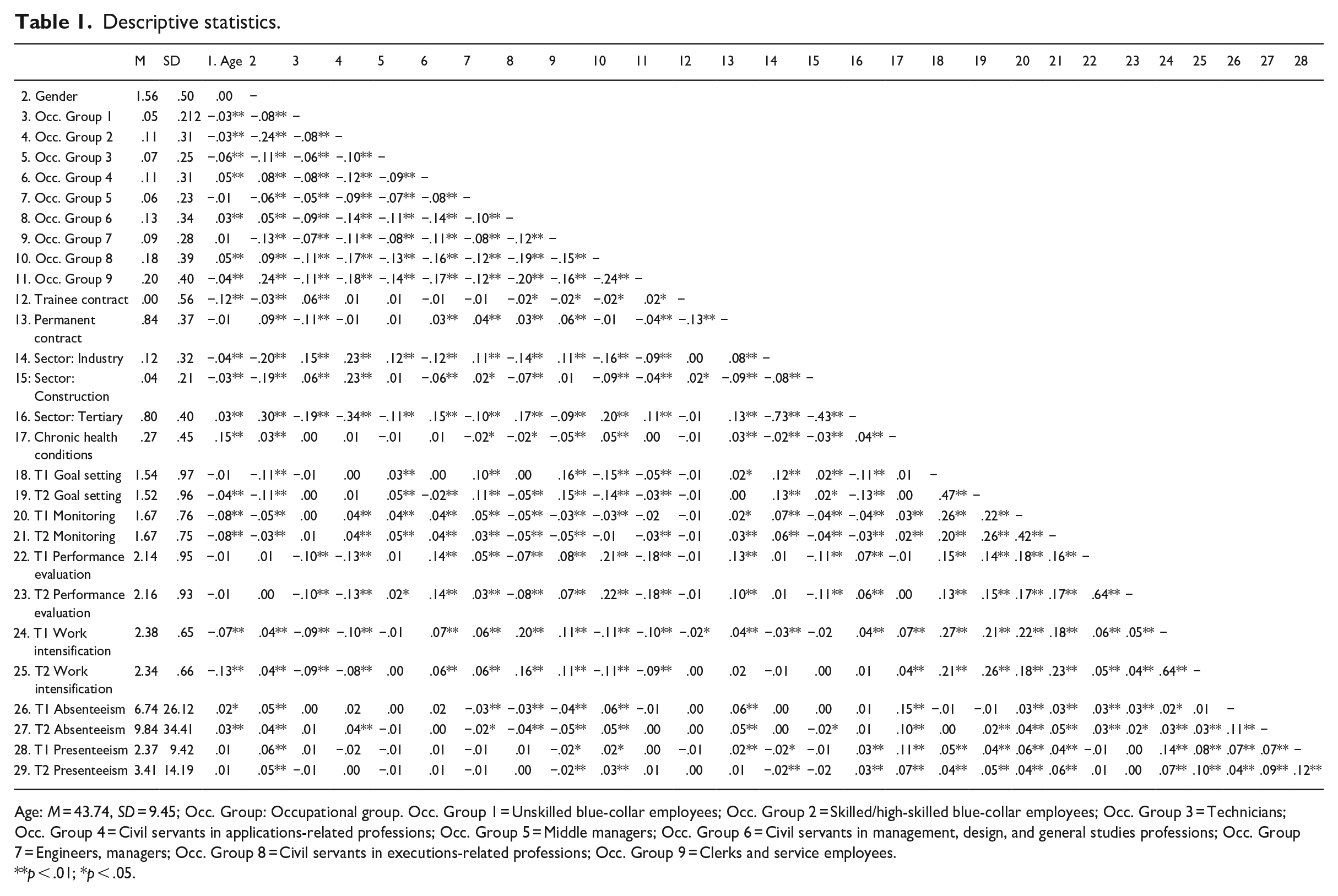
Age: M = 43.74, SD = 9.45; Occ. Group: Occupational group. Occ. Group 1 = Unskilled blue-collar employees; Occ. Group 2 = Skilled/high-skilled blue-collar employees; Occ. Group 3 = Technicians; Occ. Group 4 = Civil servants in applications-related professions; Occ. Group 5 = Middle managers; Occ. Group 6 = Civil servants in management, design, and general studies professions; Occ. Group 7 = Engineers, managers; Occ. Group 8 = Civil servants in executions-related professions; Occ. Group 9 = Clerks and service employees.
p < .01; *p < .05.
PM measurement validation
As explained, since our study builds on available secondary data, the three PM practices of goal setting, monitoring, and performance evaluations were mostly measured via a combination of dichotomous items rather than scales previously validated in the literature. To offer support for the criterion validity of these constructs, we conducted an additional validation study with a sample of 205 working adults, drawing on the multitrait, multimethod matrix approach (Campbell and Fiske, 1959) as seen in other studies using secondary data (e.g. Bilotta et al., 2022). Results demonstrated that our measure to assess goal setting and a corresponding validated scale in the literature (i.e. the Exceedingly Difficult Goals scale by Mawritz et al., 2014; α = .86) correlated at .54 (p < .001). Our monitoring measure strongly correlated with a similar scale in the literature to capture employee monitoring (Thiel et al., 2023; α = .93), reporting a correlation coefficient of .68 (p < .001). Finally, our performance evaluation item was assessed against (1) two items from the Consistent Employee Performance Management (CEPM) scale (Audenaert et al., 2019; α = .88), measuring the accuracy, consistency, and comprehensiveness of performance reviews; and (2) three items from the Performance Management System Accuracy (PMSA) scale (Sharma et al., 2016; α = .88) on the objectivity and accuracy of performance appraisal. Our item correlated with the validated CEPM scale at .52 (p < .001) and the PMSA scale at .56 (p < .001). Altogether, the results show significant, positive, and strong (Cohen, 1988) correlations between the measures used in our study and the validated scales, supporting the criterion validity of our measures and suggesting that these capture the constructs of goal setting, monitoring, and performance evaluation sufficiently well. Furthermore, the correlations between the three focal items assessing PM practices in our study and the corresponding previously validated scales are consistently stronger in magnitude than the correlations between the three focal items and the validated scales measuring different practices, supporting the differential validity of the study’s measures.
Data analysis
To test our theoretical model, we used a two-wave mediational design (Cole and Maxwell, 2003; Maxwell and Cole, 2007). Unlike cross-sectional designs, two-wave mediational models facilitate the investigation of the direction of causal influence among variables and reduce the biases in testing mediation (Cole and Maxwell, 2003; Maxwell and Cole, 2007). By specifying the dependency of the same variables over time (i.e. the autoregressive paths), mediational effects can be verified with two waves of data (Cole and Maxwell, 2003), as was the case in the present study, where all variables were measured at both points in time.
In our model, goal setting, monitoring, and performance evaluation were posited as predictors, while work intensification was posited as a mediator between each of the three PM practices and the two outcomes, namely absenteeism and presenteeism. To take the stability of the variables into account, autoregressive paths were included for each pair of the same variables at T1 and T2 (e.g. T2 performance evaluation was auto-regressed on T1 performance evaluation). The hypothesized relationships are represented by (a) the three cross-time paths from goal setting, monitoring, and performance evaluation at T1 to work intensification at T2 (H1), and (b) the two cross-time paths from work intensification at T1 to absenteeism and presenteeism at T2 (H2).
The two-wave mediational effect (H3) was tested as follows, in line with Cole and Maxwell’s (2003) recommendations. The three cross-time paths from goal setting, monitoring, and performance evaluation at T1 to work intensification at T2 denoted the expected effect of PM practices on work intensification, which is analogous to the link between X and M (the mediator) in cross-sectional mediation, that is “Path a”. The influence of work intensification on attendance behaviors was depicted by the cross-time paths from T1 work intensification to T2 presenteeism and absenteeism, which resemble the so-called “Path b” (i.e. the link between M and Y). The Product ab provides an estimate of the regression coefficient associated with the mediational effect, that is, the two-wave indirect effect of the three PM practices on attendance behaviors through work intensification. Specifically, six products (indirect effects) were tested via work intensification from goal setting to (1) absenteeism and (2) presenteeism; from monitoring to (3) absenteeism and (4) presenteeism; from performance evaluation to (5) absenteeism and (6) presenteeism. The significance of the six products was assessed through the Sobel (1982) test (Cole and Maxwell, 2003).
We tested our two-wave mediational model via Mplus 8.3 (Muthén and Muthén, 1998–2017), using negative binomial (NB) regression to account for the skewed distributions of the count variables of absenteeism and presenteeism (Johns, 2011). At both times, all variables were entered as observed variables. As the traditional fit indexes (Bollen, 1989) are not provided with NB regressions, we used the −2 log-likelihood difference, which follows the chi-square distribution, between the hypothesized model against a null model that only estimates the autoregressive paths among variables, excluding the cross-time links. Additionally, since chi-square difference tests are directly affected by sample size and may provide biased results for large samples (Bollen, 1989), we compared the Akaike (AIC) and Bayesian information criteria (BIC) between the two models. Finally, we ran an additional cross-lagged structural equation model (SEM) to check the robustness of the results of the mediation model by testing the reciprocal causal influence among variables.
Results
Table 1 presents the means, standard deviations, and the zero-order correlations among the variables at the two-time points. The results indicate T1 PM practices correlated significantly with T2 work intensification, even though performance evaluation reported weaker correlations. Furthermore, T1 work intensification was significantly associated with T2 absenteeism and presenteeism. Overall, the three PM practices at T1 reported significant correlations with T2 attendance behaviors. However, the correlations of T1 performance evaluation with T2 presenteeism and T1 goal setting with T2 absenteeism were non-significant.
To estimate the goodness of fit of our model, we examined the −2 log-likelihood difference between our posited model and a null model, which was significant (Δ = 1890.02, p = .001). This indicates that the model with more freely estimated parameters (i.e. corresponding to the cross-time paths) fits the data better than the model in which these parameters are not estimated. Moreover, AIC and BIC were smaller in our posited model than in the null one (AIC = 236317.81 vs. 238129.83; BIC = 236795.53 vs. 238311.92, respectively), which corroborates our model’s goodness of fit. Hence, we retained the hypothesized mediational model. Goal setting and monitoring related to work intensification positively, whereas, contrary to our expectations, performance evaluation related negatively (see Figure 1). Thus, Hypothesis 1 concerning the relationship between PM practices and work intensification was partially supported (specifically, H1a and H1b were supported, while H1c was not). Hypothesis 2, regarding the prediction of absenteeism and presenteeism by work intensification, was fully supported, confirming that higher perceptions of work intensification are associated with more days of absence and presenteeism at work (see Figure 1).
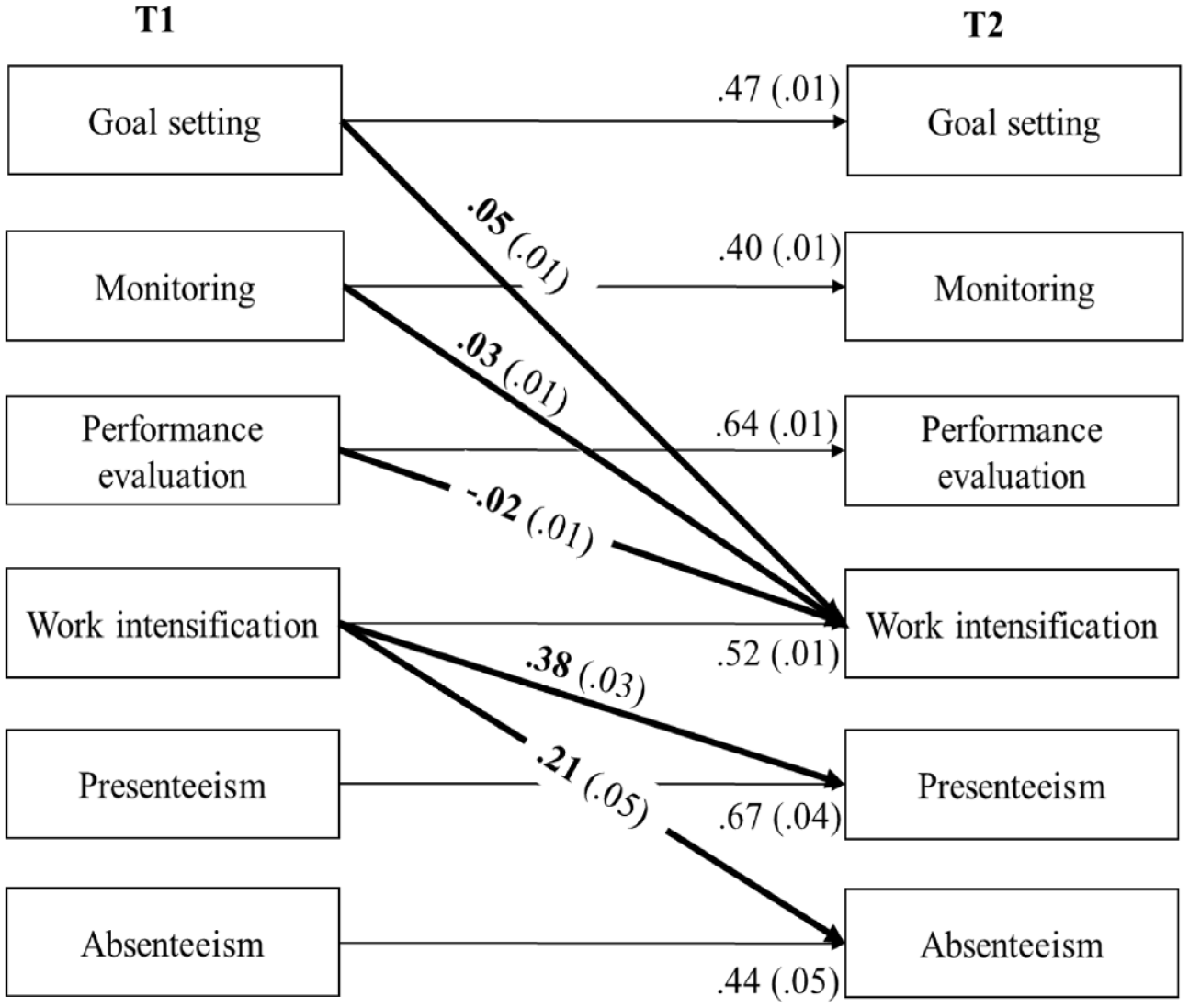
Results from the two-wave mediational model.
The joint significance of the unstandardized cross-time paths from the three PM practices to work intensification, and of the unstandardized cross-time paths from work intensification to absenteeism and presenteeism, allowed us to test mediation, by estimating the statistical significance of the unstandardized indirect effect of goal setting, monitoring, and performance evaluation on absenteeism and presenteeism through work intensification across time. The Sobel (1982) test revealed that the indirect effects from goal setting and monitoring to absenteeism (B = .01, p = .001; B = .01, p = .002, respectively) and presenteeism (B = .02, p = .000; B = .01, p = .000, respectively) were significant and positive, according to expectations. However, the indirect associations of performance evaluations with absenteeism (B = −.002, p = .035) and presenteeism (B = −.004, p = .018) were negative. Hence, Hypothesis 3 was partially supported. 1
All the control variables except the activity sector reported significant associations with T2 attendance behaviors (see Table 2). Specifically, age was positively associated with absenteeism but not presenteeism, while women reported higher levels of absence and presence despite sickness. Regarding the occupational groups, blue-collar workers (either skilled or not), civil servants in execution-related professions, and clerks and service employees showed higher levels of absenteeism and presenteeism. Moreover, all the occupational groups except civil servants in management, design, and general studies professions and engineers and managers reported more presenteeism. Interestingly, the strongest associations were observed for skilled/high-skilled blue-collar employees, civil servants in execution-related professions, and clerks and service employees. Employees with permanent contracts scored higher on absenteeism. Finally, and not surprisingly, chronic health conditions were positively associated with both attendance behaviors.
Beta coefficients, standard errors and significance values for the control variables included in the two-wave mediational model.
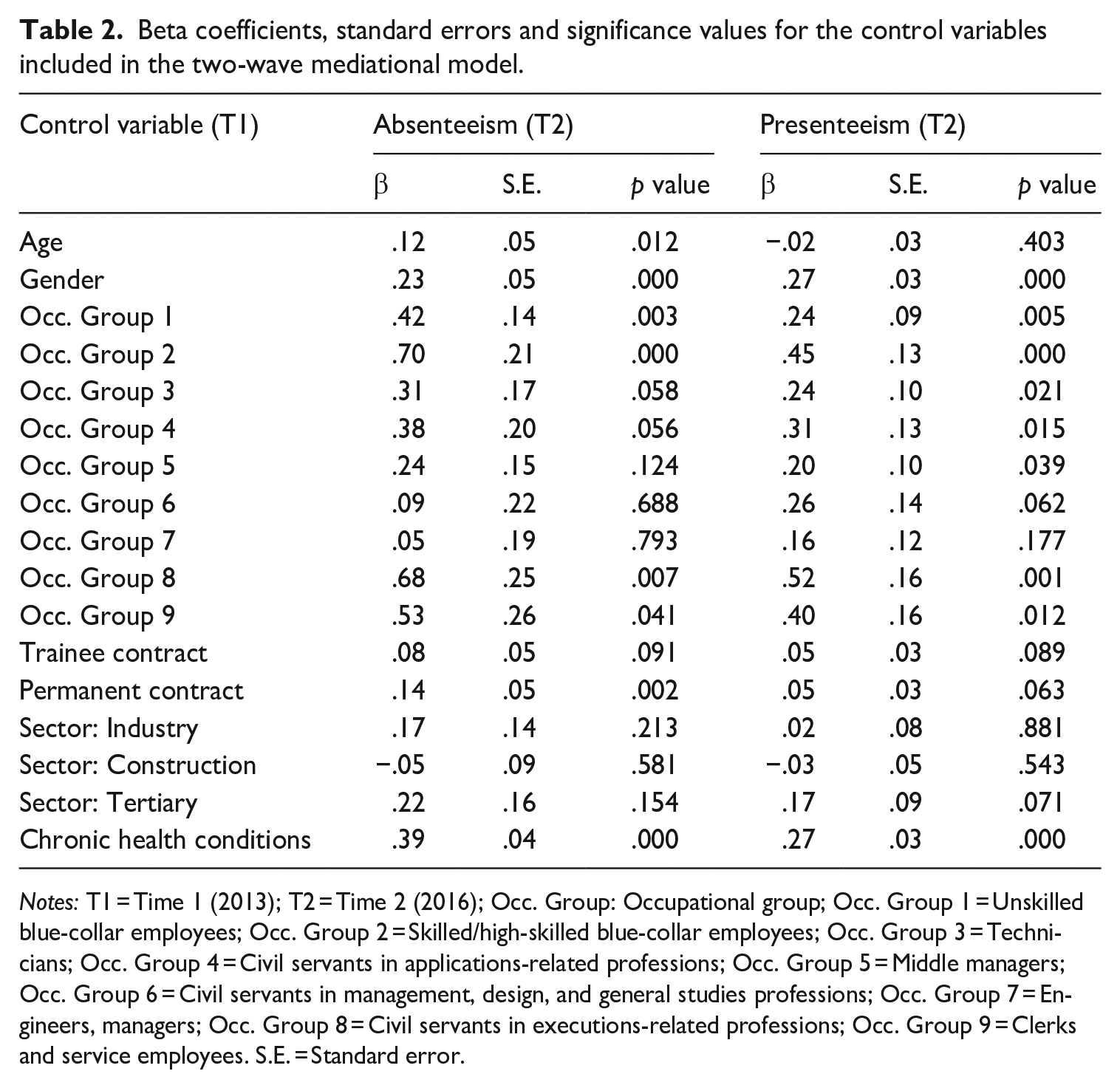
Notes: T1 = Time 1 (2013); T2 = Time 2 (2016); Occ. Group: Occupational group; Occ. Group 1 = Unskilled blue-collar employees; Occ. Group 2 = Skilled/high-skilled blue-collar employees; Occ. Group 3 = Technicians; Occ. Group 4 = Civil servants in applications-related professions; Occ. Group 5 = Middle managers; Occ. Group 6 = Civil servants in management, design, and general studies professions; Occ. Group 7 = Engineers, managers; Occ. Group 8 = Civil servants in executions-related professions; Occ. Group 9 = Clerks and service employees. S.E. = Standard error.
Robustness checks
To verify the robustness of the mediational model, we tested a reverse causality model by investigating a full cross-lagged SEM (Zyphur et al., 2020). Specifically, in addition to our hypothesized paths, we tested two sets of reverse cross-time cross-lagged paths, namely (a) from T1 absenteeism and presenteeism to T2 work intensification; and (b) from T1 work intensification to T2 PM practices.
As for the mediational model, this reverse causality model fits the data better than a null model in which these parameters are not estimated as the −2 log-likelihood difference was significant (Δ = 2083.88, p = .000). Moreover, the model’s AIC and BIC were smaller than those in the null one (AIC = 236077.40 vs. 238129.83; BIC = 236638.54 vs. 238311.92, respectively). However, examining the coefficients, neither of the reverse effects from attendance behaviors to work intensification was significant, which further corroborates the observed direction of the relationships set in Hypothesis 2. The reverse paths from T1 work intensification to T2 goal setting (β = .08, SE = .01, p = .000) and monitoring (β = .08, SE = .01, p = .000) – but not performance evaluation – were significant, indicating that reverse causal dynamics or even reciprocal ones operate plausibly in the relationship between PM practices and work intensification.
Discussion
The present study set out to investigate PM practices and their potentially negative effect on work intensification and, via this, on two behaviors indicative of employee well-being: presenteeism and absenteeism. In so doing, we believe we have made two important theoretical contributions to the literature on HR practices and well-being as well as to the research domain of attendance behaviors.
First, with respect to the HRM–well-being area, we have contributed an original view to the recent debate on the effects that HR practices may have on employee well-being. Extant HR research has predominantly focused on positive indicators of well-being (Peccei and Van de Voorde, 2019), giving rise to a symmetrical study of positive practices and positive outcomes. We chose sickness absenteeism and dysfunctional presenteeism as behaviors that subsume employee (ill)health and ill-being in their very definition and, in so doing, we have moved the field toward the study of opposite effects (Johns, 2021), uncovering truly paradoxical and negative consequences of practices that are otherwise positively framed. In fact, our results confirm initial empirical evidence that PM systems, which are designed to impact employee behavior positively, may lead to unintended and accompanying outcomes that are detrimental for individuals and organizations (e.g. gaming; Aboubichr and Conway, 2021). The results also empirically document what Boxall (2021) defined as a “misalignment” in HRM associated with overwhelming work. A misalignment occurs when performance-enhancing practices result in low-mutuality situations as they prove unsustainable for employees.
By choosing PM practices as a main predictor, and by relying on the labor process theory (Godard, 2004), we focused on the one HR practice that is, above all, designed to implement control over employees through its “performance-enhancing” declared purpose and may represent a risk when not well applied (Becker and Smidt, 2016). Differently from the labor process theory and related literature, which have mainly investigated the effects of bundles of HR practices aimed at improving individual performance (e.g. high performance work systems, HPWS) on individual outcomes (Godard, 2001; Ramsay et al., 2000), we examined a smaller set of HR practices and distinguished between distinct practices that may have a more synergistic effect on enhancing employee performance (Subramony, 2009). Thus, our results contribute to opening the black box of the labor process critique of HPWS by explaining how a smaller and complementary group of performance-enhancing practices (i.e. goal setting, monitoring, and performance evaluation) may affect employees’ experience of work and, ultimately, their well-being, operationalized as individual behaviors. Our main contribution in this area is highlighting a clear mediation route that links PM practices to both absenteeism and presenteeism via work intensification. It is the features of PM practices, and most notably goal setting and performance monitoring, that likely become overly demanding (Boxall and Macky, 2014). By being confronted with goals that are extremely taxing and often, if not regularly, struggling to meet them, employees work under increasing pressure and accumulate excessive work demands – which make up work intensification. This result is convergent with the analysis by Burawoy (1982/1979), in his book Manufacturing Consent, that the transformation of the potential for work in real work (the labor process) does not only pass through coercion, as Marx (1954/1867) thought, but also through a soft control such as the goal setting management practice that makes workers willing to deliver a sufficient effort to guarantee profits to the company. Similarly, we have shown that strict performance monitoring is detrimental to well-being as it places an employee’s behavior under great scrutiny and increases individual accountability to the extreme (Mero et al., 2014), triggering experiences of work intensification. Our results suggest that PM may involve two control strategies – direct control and responsible autonomy – simultaneously. This insight extends labor process theory, which traditionally viewed the two strategies as antagonists to one another (Friedman, 1990). We show that PM relies both on a direct control strategy through monitoring and assessment as well as a responsible autonomy strategy by assuming that workers are accountable for the assigned goals and can autonomously choose the means to attain them. Therefore, PM goes beyond the above-mentioned classical dichotomy direct control/responsible autonomy and could be considered as another way to ensure the control imperative of the labor process and secure value.
Unlike goal setting and monitoring, performance evaluation had a negative, albeit weak, indirect effect on both presenteeism and absenteeism. This result was unexpected because the labor process theory sees the performance assessment as a central pillar to control the labor process, such as increasing the productivity of the labor force (Braverman, 1998/1974; Burawoy, 1982/1979). Our result may have multiple explanations. First, it may be that the effect of performance evaluation rests on psychological processes that are different from goal setting and monitoring. Although an employee can anticipate and symbolically visualize the evaluation moment, this is less powerful with regard to driving the intensification of their work than is the pursuance of goals and the awareness of being constantly observed. Therefore, specific and measurable evaluation criteria are associated with lower work intensification, probably because they are known in advance and may allow an individual to regulate their effort and expect to receive recognition for meeting the criteria.
Furthermore, performance appraisal has been portrayed as a political process (Rosen et al., 2017), subject to organizational politics (Latham and Dello Russo, 2008) whereby managers are often inclined to manipulate performance criteria and inflate ratings with a self-serving scope (e.g. conflict avoidance, self-promotion). Employee perceptions of such politics may halt the effect of strict performance criteria on work intensification since the well-defined, quantifiable criteria for the assessment of performance may be perceived as susceptible to the rater’s subjectivity, biases, and errors (Latham and Dello Russo, 2008). For instance, employees might expect supervisors to use performance appraisal criteria leniently and/or inaccurately and, especially when perceived as biased, performance appraisal may be viewed as a compliant, ineffective exercise (Pulakos et al., 2019). Therefore, employees’ perceptions of organizational politics in performance appraisal may reduce their willingness to consider, engage with, and act upon the evaluation and feedback received (Levy and Williams, 2004), eluding any impact on the individual effort and related outcomes.
A final plausible explanation is that there is a different temporal alignment among the three PM practices and the outcomes. While goal setting occurs during the initial planning phase (at the start of the year), and monitoring corresponds to the performance enactment and observation phase (it is an ongoing phase), performance evaluation occurs more sporadically and often once a year, at the last phase. The outcome variables, on the other hand, capture behaviors of attendance across an entire year, which are more likely predicted by practices that set up the year plan (goal setting) or take place throughout the year (monitoring) than by a practice that is only occasionally implemented (performance evaluation).
Our second contribution pertains to attendance behavior, in that we have extended the understanding of the influence of the social context on attendance by focusing on socially embedded managerial practices (Levy and Williams, 2004; Miraglia and Johns, 2021). Specifically, we have shown that absenteeism and presenteeism share a similar etiology even when considering organizational and managerial practices as predictors (Gosselin et al., 2013). By leading to greater work intensification, PM practices activate a cycle of ill-being whereby both presenteeism and absenteeism are increased. Moreover, presenteeism is confirmed as a more predictable behavior than absenteeism (Miraglia and Johns, 2016), as both the direct influence of work intensification and the indirect one of PM practices appear to be of greater magnitude in the case of presenteeism than absenteeism, likely reflecting the ontological difference between the two constructs.
Furthermore, the stronger relationship of work intensification with presenteeism than absenteeism may support the so-called “substitution hypothesis”, which refers to the idea that people would be pushed toward presenteeism when they cannot be absent (Caverley et al., 2007). Having highly compelling and fast-paced – in other words, intensified – work tasks constitutes a strong reason to continue attending work even under suboptimal health conditions. Relatedly, individuals may strain to retain performance and meet the intensified work conditions at the expense of health, committing to what Karanika-Murray and Biron (2020) label over-achieving presenteeism. For instance, the requirement to meet exceedingly challenging performance-type goals may push the individual to keep working to avoid failure and disapproval (Cooper and Lu, 2016). Thus, presenteeism emerges as a self-endangering behavior (Dettmers et al., 2016) to cope with excessively demanding work associated with goal- and performance-oriented managerial practices, disregarding one’s health symptoms.
Another way in which our study advances knowledge of these behaviors is by showing their stability over time, notably over a three-year lag, as indicated by the substantial autoregressive coefficients for absenteeism and presenteeism in the two-wave mediational SEM (see Figure 1). This points to stable behavioral patterns, even controlling for chronic diseases. In the case of absenteeism, it may also allude to a detachment from one’s work, recalling the withdrawal model of absenteeism (Johns, 2009). In the case of presenteeism, it may configure as a trait-like behavior. This would be in line with research investigating presenteeism propensity, reflecting the individual tendency to continue working in the case of a health event (Gerich, 2015). PM practices also appeared quite stable over the three-year lag, as shown by the autoregression coefficients in Figure 1. This is revealing when considering that organizations undergo nearly permanent states of change (Aronowitz et al., 2015). Nevertheless, when it comes to HR practices, the rhetoric of change may overtake the actual change, revealing greater organizational inertia (Gilbert, 2005) in changing certain practices that are strongly imbued with organizational culture.
A final observation pertains to the significance of our findings. The effect sizes appear small, but they may still be meaningful. Let us consider absenteeism. With all other variables held at their mean, an increase of one standard error in monitoring, goal setting, or work intensification results in a worker being absent .82, 1.13 and 5.4 more days, respectively. In terms of monetary effects, for a daily average employer cost of €141 in France (equivalent to approximately £121 or US$153), and under the conservative assumption that the marginal benefit of reducing absenteeism is confined to the daily average employer cost regardless of other indirect costs (Pauly et al., 2002), a single standard error decrease in monitoring, goal setting, or work intensification for a worker would be respectively associated to a total saving of €115 (approximately £98 or US$124), €160 (approximately £136 or US$178), and €761 (approximately £648 or US$823) per employee per day. On the opposite, with all other variables held at their mean, when performance evaluation increases by one standard error, an employee is expected to be absent .40 days less, hence saving €56 (approximately £47 or US$60) to the organization per day.
Limitations, strengths, and directions for future research
The first area of limitations is common to all secondary datasets (Barnes et al., 2018) and regards the choice of variables to include in the study; these were dictated by the constructs measured in the two surveys and their operationalization. For example, we could not consider any practices or processes linking performance evaluations to the reward system (such as pay-for-performance measures). Such practices are often part of the PM cycle (Aguinis, 2013) and although their addition could have enriched the study with all the components of PM in organizations, they were not measured. Therefore, it would be worth including them in future studies. Similarly, goal setting was operationalized via assessing the difficulty of the set goals. Future studies could distinguish further the different types of goals set for the employee and how these interact with their individual goal system (e.g. see Cooper and Lu, 2016).
With respect to the operationalization of the variables, they are all self-report and we tried to compensate for this limitation by matching the two lagged waves. Nonetheless, experimental designs are needed to corroborate the causal chain from PM practices to absenteeism and presenteeism.
Another possible concern may be the three-year time lag between the two waves, which was imposed by the secondary data collection, whereas the literature recommends shorter time lags (Dormann and Griffin, 2015). We underline that observing significant associations after a long time, and after controlling for the stability of all the phenomena under investigation, points to quite reliable effects. Future research could investigate the relationship between PM practices and attendance behaviors over a shorter or longer time lag than ours to test the influence of the time lag on the effect sizes and directions.
A further possible limitation pertains to the relatively small effect sizes of the PM practices. Small effects are common in HRM and applied psychology (Bosco et al., 2015) research, especially if based on secondary datasets (e.g. Ogbonnaya and Messersmith, 2019). Bosco et al.’s (2015) review of effect size benchmarks in organizational psychology revealed that effect sizes of .05 correspond to the 25th percentile of the distribution of effects in the field and, more specifically, of the relationship between attitudes/evaluations and absenteeism. The effects we detected appear to be in line with this. Moreover, low effects observed in large representative samples across two points in time can have notably practical meaningfulness, as shown by the marginal effects for absenteeism mentioned above.
Finally, we used the Sobel test to assess our mediation hypothesis instead of more robust techniques such as robust bootstrapping (Alfons et al., 2022) since the latter is currently available for mediation models with continuous dependent variables rather than count dependent variables as in our case (Alfons et al., 2022). While the Sobel test suffers from some methodological limitations (MacKinnon et al., 2002), the positive flipside is that it is reliable in large samples (i.e. exceeding 140 cases), and differences in estimates between the bootstrapping procedure and the Sobel test are observed only in small samples (Koopman et al., 2014). Therefore, given the large sample size of the study (N = 17,081), the use of the Sobel test seems acceptable. Nevertheless, we call for future research to adopt more robust procedures to test mediation of work intensification between PM practices and well-being, such as ROBMED (Alfons et al., 2022) when available for count variables.
Notwithstanding our limitations, we do have some important advantages in using secondary data. First, the large sample size enabled us to have large statistical power that increased the likelihood of detecting even small effects in the population, while controlling for the influence of individual and organizational features that would otherwise be difficult to measure with a more limited primary research design (Barnes et al., 2018). This benefited the internal validity of the study.
Furthermore, the two-wave panel dataset allowed the use of cross-time modeling, which is a much stronger test for causal relationships among the variables of interest than any cross-sectional model (Cole and Maxwell, 2003). Another advantage of this specific dataset pertains to the enhanced external validity. Drawing on a large sample of French employees reinforces the representativeness and generalizability of the obtained results. In this way, we contributed empirical evidence from a cultural context (France) that is different from those where most research on HRM has been conducted (Anglo-Saxon countries). Of course, our results are embedded in a specific national context that shapes sickness benefits and related regulations for accessing sick leave. In France, an ill employee who cannot attend work must provide a medical certificate even for short-term absences. Failing to do so could lead the employer to deem the absence unjustified, potentially using repeated unexcused absences as grounds for termination. France is similar to all EU Member States in providing employee sick leave and sick benefits (European Commission, 2016). Additionally, the procedures for communicating and accessing paid sick leave in France resemble those of many other Western European nations, including Belgium, the Netherlands, Germany, Spain, and Italy, which require employees to provide a medical certificate as soon as possible (and within three days, as in Spain) after the onset of illness, even for short-term absences (European Commission, 2023). Thus, the study’s results are comparable with other European Union (EU) countries, especially in Western Europe. Nevertheless, we encourage future researchers to verify the association of PM practices with well-being in different national contexts to enhance a deeper understanding of how cultural differences shape well-being indicators (Ruhle et al., 2020).
With regard to future research directions, our robustness check shows initial evidence of a reciprocal association of work intensification with goal setting and monitoring. Future research may aim to investigate such reciprocal relationships in more depth and detail by testing possible spiral effects and explanatory mechanisms. Likely, high levels of work intensification cause employees to perceive the subsequent PM practices as more demanding. On the other hand, an intensified pace of work may call for more managerial monitoring and even more ambitious goals, as performance expectations are set higher and higher by an employee’s manager. This may inform and stimulate further research on organizational paradoxes inherent in practices that carry with them unresolvable contradictory tensions, which would ultimately make them tenable only in the short run (Pina e Cunha et al., 2017). Finally, we invite future studies to focus on alternative explanatory mechanisms of the relationship between PM practices and attendance behaviors. For instance, possibly exploitative HR practices have the potential to cause disturbances in the social dynamics of the workplace, directly affecting group attendance (Miraglia and Johns, 2021).
Practical implications
This study has straightforward managerial implications that revolve around the design of PM and, more generally, managerial practices. A recent wave of dissatisfaction with PM has gone so far as to recommend dropping evaluations altogether (Murphy, 2020). Based on our findings, we would suggest exercising caution about doing that and would rather focus on improving the other PM components before blaming the evaluation phase. In terms of goal setting, HR practitioners should train managers on how to set realistic goals, which do not prove extremely challenging or exceedingly difficult for the employee. Indications on this type of training may come from the literature on coaching leaders (Steelman and Wolfeld, 2018).
In terms of monitoring, we believe it is important to combine ongoing monitoring with ongoing explicit feedback (Pulakos et al., 2019). Collecting continuous information about employees’ performance is not the same as having regular check-ins with them. By checking in with employees, managers would provide employees with the necessary level of support, and counteract the negative aspects of monitoring – most notably, the emphasis on accountability – that are responsible for heightened work intensification. Thus, monitoring could assume a developmental connotation.
All in all, our findings point to the need to design PM practices that are evidence-based (Rousseau and Barends, 2011) so that their potentially negative impact on employee well-being is thoroughly accounted for (Becker and Smidt, 2016). In this perspective, we envision that changes in PM practices would necessarily be more substantial and comprise not only the design of practices, but also the philosophy underlying them (Renkema et al., 2017), embracing a more humane, participatory, and trust-based approach.
Footnotes
Acknowledgements
We are grateful to our Editor and three anonymous reviewers for their constructive comments and insights during the review process. We also want to thank the Conditions de Travail team for their permission to use the survey data, as well as Dominique Mahut, Malo Mofakhami, Thomas Coutrot, and Mikael Beatriz for their advice and feedback on the manuscript.
Funding
The authors disclosed receipt of the following financial support for the research, authorship, and/or publication of this article: This work was supported by the French National Research Agency [grant number ANR-19-CE26-0017].
