



Abstract
As corporate social responsibility research increasingly focuses on the role of grassroots organizations in challenging business practices, there remains a gap in understanding how these organizations prefigure alternatives to the prevailing business status quo. This study addresses this gap by developing a framework of prefigurative imaginaries, drawing from a qualitative study of a grassroots organization confronting the social irresponsibility of the Kenyan banking system in serving the poor. The framework captures how grassroots organizations use imaginaries to prefigure an alternative community currency system for enacting and foreshadowing social change. However, when attempts were made to scale up the system, these actions became disjointed, resulting in cracks within the imaginaries and the eventual abandonment of the system. Our study contributes to corporate social responsibility research by broadening its scope to include grassroots organizations and unveiling how they prefigure social change in marginalized contexts. By highlighting the significant influence of imaginaries on experiences and practices, this study underscores their role in shaping the acceptance or rejection of grassroots initiatives by the communities they aim to serve. It has implications for scholars and practitioners interested in understanding the role of imaginaries in shaping community-driven initiatives and advancing social change agendas.
Keywords
Fifteen armed guards of a special police unit walked into Emma Duka’s shop, they grabbed her and put some handcuffs on her, and took her to jail. Then they gave me [Grassroots Economics founder] a call. I gathered my laptop and all my PowerPoint and spreadsheets and books on the topic. And they began to question me, sitting there was a police officer, and I explained to him that a community currency is something that’s happening all over the world, people can make their own medium of exchange and back it with their own goods and services and whatnot and he stopped me in the middle of my PowerPoint, saying son what on earth gave you the right to come here and help these people make their own currency. (An extract of the Emma Duka folk song Video #32)
Introduction
The above extract from a folk song was based on a personal account written by the founder of a Kenyan grassroots organization called Grassroots Economics. The song describes an incident in May 2013 when the founding members of the organization were arrested by the Kenyan police for introducing a community currency in an informal settlement. Although the case was dropped in August 2013, the intense three-month court battle between Grassroot Economics and the Kenyan Central Bank was portrayed as the ‘crime of alleviating poverty’ in a local newspaper (Brown, 2013). The court case attracted widespread support from local politicians, international bloggers, non-governmental organizations (NGOs) and even the United Nations. After being discharged, the grassroots organization harnessed this unexpected wave of support to prefigure an alternative community currency system across various informal settlements in Kenya. Although the organization was successful in mobilizing humanitarian aid and technology providers to enable marginalized communities to introduce their own currencies, the community currency initiative was abandoned by the close of 2020.
Grassroots organizations, known for their deep-rooted local presence and commitment to addressing specific community challenges (Uphoff, 1993), have recently garnered attention from scholars in the field of corporate social responsibility (CSR) (Chowdhury et al., 2021). However, recent research has highlighted the risks these organizations face, including the potential for mission drift (Cornforth, 2014) and the challenge of maintaining their original values while navigating hegemonic systems (Sanders and McClellan, 2014). In response, some grassroots organizations have pursued a counterstrategy, opting for dissociating rather than embedding within existing institutional structures (Fontana and Dawkins, 2023; Uphoff, 1993). Yet, by operating at the margins, grassroots organizations encounter a different set of risks, including isolation and limitations in scaling up their initiatives to achieve broader social impact (Ramirez et al., 2023; Siedlok et al., 2023).
To explore how grassroots organizations navigate these challenges and prefigure social change while staying true to their vision for a better future, this article presents a longitudinal qualitative study of Grassroots Economics. Through the lens of prefiguration, we examine how this organization mobilized imaginaries: (1) to challenge the social irresponsibility inherent in banking systems of emerging economies, which often neglect or further marginalize vulnerable communities through debt financing (Banerjee and Jackson, 2017), and (2) to empower local communities to create their own community currency systems.
Prefiguration offers a unique approach to envisioning how desirable utopias, such as the creation of an alternative community currency system in our study, can be realized in the present (Monticelli, 2018; Schiller-Merkens, 2020). Examples of current utopia include ecovillages (Casey et al., 2020), counter-spaces (Asara and Kallis, 2022), community gardens (Crossan et al., 2016) and urban landscaping (Miles, 2007). Prefiguration is commonly understood as taking purposive actions in the present within a counter-hegemony movement. However, prefiguration scholars such as Ruth Levitas (2013: 49) caution against ‘the oversights of binding real or viable utopias closely to the present’, as this may limit our understanding of how imaginaries can drive future counter-hegemony movements rooted in grassroots organizing.
This oversight has been evident in recent research, which tends to downplay the importance of projecting the present into the future (Reedy et al., 2016; Skoglund and Böhm, 2020) because it accepts ‘current utopia’ as an endpoint of social change (Martell, 2018). Building on Levitas’ concept of the ‘imaginary reconstitution of society’, Martell (2018) proposes that the current utopia should be viewed as an imagined totality, serving as a method rather than a mere endpoint of social change. This method involves critical assessment of the present, holistic thinking about a better future and purposive efforts to transition towards it. Both Levitas (2013) and Martell (2018) emphasize the importance of imagining and imaginaries in this process. While imaginaries can be broadly defined as ‘semiotic systems that frame individual subjects’ lived experience of an inordinately complex world and/or inform collective calculation about that world’ (Jessop, 2010: 344), their potential to be mobilized by grassroots organizations to radically transform the present and pave the way for future alternatives remains largely unexplored. This gap exists in both the emerging CSR literature dedicated to grassroots organizations (Chowdhury et al., 2021; Soundararajan et al., 2018b) and the prefiguration literature focused on real utopias (Monticelli, 2018).
Prefiguration encompasses various definitions, but it primarily involves two purposive actions of enacting and anticipating: ‘to prefigure is to anticipate or enact some feature of the alternative world’ (Yates, 2015: 4). Enacting includes experimenting with new horizontal organizations and relations (Reinecke, 2018), while anticipating involves ‘building a new world in the heart of the old, in the ordinary sense, as a foreshadowing’ (Kinna, 2017: 202). The types of imaginaries involved in these actions are likely to differ for two plausible reasons. First, foreshadowing is likely to be anchored in the future, whereas enacting is likely to be anchored in the present. This temporal difference can invoke different imaginaries and trigger various translation processes that may either complement or compete with each other (Bell et al., 2021; Bhatt et al., 2023; Slawinski and Bansal, 2017). For instance, imaginaries linked to the degrowth movement focus on reshaping current practices to construct a hoped-for-future in the present (Chatterton and Pickerill, 2010), while distant future imaginaries seek to break away from the present reality (Augustine et al., 2019). Second, prefiguration and imaginaries can operate at different levels. Some literature portrays prefiguration as enacting a ‘small-scale micro-utopia’ (Martell, 2018: 446), whereas imaginaries have been conceptualized at both macro (Jessop, 2010) and field levels (Levy and Spicer, 2013). Because this cross-level interplay is so nuanced, it requires detailed attention and fine-grained analysis to understand further the transformative power of imaginaries and their potential to shape the trajectory of societal change.
In this study, we aim to answer the research question: how do grassroots organizations mobilize imaginaries to prefigure social change? To address this question, we conducted a longitudinal qualitative study centred on Grassroots Economics, a grassroots organization contesting the failures of the Kenyan banking system, particularly its neglect of the unbanked population in informal settlements. The organization introduced an alternative currency system to empower the unbanked and improve their economic conditions. By closely examining how imaginaries prefigure social change, we make two key contributions.
Our primary contribution is a theoretical framework that emphasizes the pivotal role of imaginaries in facilitating the translation of prefigurative practices from localized initiatives to large-scale deployments. This framework addresses some of the pressing inquiries raised by both prefiguration and CSR scholars, shedding light on how grassroots organizations mobilize field actors to enact and foreshadow social change. By elucidating the mechanisms through which imaginaries shape the trajectory of prefigurative initiatives, our framework offers valuable insights into the transformative potential of grassroots organizations.
Our second contribution pertains to the relational dimensions of prefigurative organizing, offering a cross-level understanding of how imaginaries disrupt and undergo revision. Through a nuanced examination of foreshadowing, particularly in the context of scaling up prefigurative initiatives, we uncover the relational dynamics at play. Our findings reveal that the mobilization of imaginaries across diverse fields often prompts revisions that can unexpectedly impact prefigurative initiatives. This insight underscores the need for a comprehensive understanding of the relational dynamics within grassroots organizations and their broader socio-political contexts that can also be of interest to both CSR and prefiguration scholars.
In the following sections, we will first review existing literature on prefiguration and social change, and then establish connections between the imaginary literature and considerations of prefiguration.
Prefiguration and social change
There are two critical inflection points in the conceptualization of prefiguration, which has its origins in the American New Left and anarchism (Yates, 2015). The first point centres on linking utopia to the embodiment of espoused values and ethical principles in social practices. In the context of anarchist prefiguration, means and ends must align ethically. This involves taking direct local actions aimed at fostering broad-horizon imaginations and behaviours, while advocating alternative relationships and ways of living. The desirable endpoints should purposively mitigate the harm of the means (Kinna, 2017). While acknowledging the diversity within anarchist thought, some anarchists have expressed reticence about spelling out their vision of the future in too much detail. This reticence stems from a commitment to anarchist principles, which eschew dogmatism about the precise forms the new society must take. This approach rejects certain methods of social change, including blueprint utopianism, ‘for it would be contrary to anarchist principles to be dogmatic about the precise forms the new society must take’ (Anarchist Writers, 2008).
The second inflection point in prefiguration centres on creating horizontal, broad-based counter-institutions through the means–ends relationship (Dinerstein and Pitts, 2022; Martinez and Himick, 2022; Zanoni et al., 2017). However, determining the causal relationships between means and ends can be challenging owing to the existence of diverse prefiguration forms and the multilevel nature of social change (Parker, 2021; Schiller-Merkens, 2022b). Certain desirable endpoints, such as embodying horizontality and intersectionality in practice, may be easier to determine in advance. However, others are highly uncertain, with the possibility that the anticipated future may never materialize (Anderson, 2010). This uncertainty is evident in the varied utopia literature, encompassing variants like current (Martell, 2018), concrete (Bloch, 1986) or real utopias (Wright, 2011), each valuing the means–ends relationship differently (Monticelli, 2018). While all of them emphasize the urgency of taking action in the present, some allow little room for imaginaries. For instance, real utopia focuses on directing means towards a specific desirable endpoint, potentially excluding other plausible imagined alternatives, which downplay the role of the imaginary in prefiguration (Levitas, 2013).
Despite the nuanced differences between the first and second inflection points, they all share a counter-perspective of prefiguration as a positive practice. This often involves organizing within the interstices of existing systems, showcasing how prefigurative movements attract further replication (Holloway, 2010; Young and Schwartz, 2012). Some prefigurative scholars consider these small-scale instantiations insufficient for macro-level social transformation and susceptible to gradual degeneration (Schiller-Merkens, 2022a; Wright, 2011). On the other hand, others believe that small-scale instantiation in the present is sufficiently generative (Holloway, 2010), serving as a method for others to follow (Levitas, 2013; Martell, 2018). While the former involves a process of scaling up and the latter focuses on scaling out, both scaling mechanisms are integral to prefiguration, emphasizing envisioning a desirable future and actions to expand counter-hegemony movements. Understanding these scaling mechanisms is crucial for advancing prefiguration as a theory of change (Monticelli, 2021). This is where we explore the interlinkages between imaginaries and social change.
Imaginaries and different futures
The concept of imaginaries has been around since the 1950s (Taylor, 2004), but current scholarship faces difficulties in theorizing or uncovering them (Rohgalf, 2013; Zanoni et al., 2017). One significant obstacle might be the necessity, as emphasized by Cornelius Castoriadis (1987), to acknowledge imaginaries as an ordinary human practice, not limited to individuals but pervading praxis, animating the social, historical and political realms.
There are at least three ways to conceptualize imaginaries. The first perspective suggests that an imaginary is influenced by prior imaginations, ‘an imaginary is in some ways stuck within (or departing from) a predefined template for context, content, and genre’ (Markham, 2021: 385). In this view, imaginaries provide continuity and stability by extending existing frames of reference from the past into the future (Pfotenhauer and Jasanoff, 2017). They describe attainable futures and prescribe the types of futures that should be pursued.
Another way to conceptualize imaginaries is through the future-making practices literature (Rindova and Martins, 2022; Wenzel et al., 2020), particularly the distant future imaginary literature, which portrays imaginary as fictional, tacit and psychologically distant (Augustine et al., 2019). These imaginaries possess image-like qualities that draw attention and motivate collective action. In some cases, such as in geoengineering, imaginaries allow proponents to focus attention on the potentialities of hypothetical technologies that do not yet have concrete applications but are being explored for future implementation (Augustine et al., 2019). This approach does not merely forecast from current conditions but relies on inserting an as-if future ‘through anticipatory experience generated through the acts of performance or play and the material organization of particular stages or sites’ (Anderson, 2010: 785).
The third conceptualization, which aligns closely with prefiguration, is the counter-imaginary, working in opposition to the dominant imaginary (Kazansky and Milan, 2021). A crisis often triggers the invocation of a counter-imaginary, such as economic imaginary at a macro level (Jessop, 2010) or climate imaginary at a field level (Levy and Spicer, 2013). More recently, civil society has also invoked counter-imaginaries at a micro level typically considered as a niche level of imaginaries that are vulnerable to degeneration (Levy and Spicer, 2013).
While each type of imaginary varies in its temporal anchor (past, future and present), the social construction of these imaginaries and their specific roles in counter-hegemony movements have not been thoroughly explored. Therefore, our research question aims to delve into the nuanced relationship between prefiguration and imaginary. We seek to understand how this interplay unfolds across different levels and the inter-temporal connection between enacting desirable structures in the present and foreshadowing actions to avoid future undesirable outcomes. By addressing these aspects, we aim to shed light on how prefiguration and imaginaries interact to shape social change and advance the transformative goals of grassroots organizations.
Research context and methods
Grassroots Economics, formerly known as Koru-Kenya, initiated its first pilot project of community currency in Mombasa County in 2010. After a year of running the project, the founder established Grassroots Economics as a non-profit foundation. In May 2013, the organization introduced its second community currency named Bangla-Pesa in Bangladesh, an informal settlement on the outskirts of Mombasa, Kenya’s second-largest city. In response, the Central Bank of Kenya instructed the local police to arrest six of its members on charges of counterfeiting. The case was then dropped in August 2013. This incident brought notoriety to the organization and legitimatized the use of community currency in marginalized communities.
Data collection and sources
In May 2019, we interviewed the founder of the grassroots organization and its main technology partner (Partner A). These interviews led us to decide to conduct a longitudinal study. In November 2019, a member of our research team visited Mombasa, where the headquarter of the organization was located. During the visit, the team member met with the founder and shadowed a field officer of Grassroots Economics in two marginalized communities near Mombasa. The shadowing process was repeated in three other informal settlements in Nairobi. Throughout this fieldwork, a total of five days of observations were carried out and documented in field notes. However, because of the international travel ban caused by the COVID-19 pandemic, we conducted online interviews instead. Additionally, we hired a local Kenyan research associate to assist us with approximately 65 days of site visits covering five informal settlements near Mombasa and Nairobi. These site visits took place between May and December 2020. On the first day of each visit, a field officer accompanied our research associate and introduced him to micro-business owners. Subsequently, our research associate returned to the same location alone and conducted further informal interactions and face-to-face interviews. These interviews followed a semi-structured protocol, focusing on the informants’ experience of using community currency in their daily trade.
After each site visit, we conducted debriefing sessions with our research associate to discuss his experiences and any empirical observations that intrigued him. As an outsider, he encountered challenges in finding micro-business owners willing to accept the community currency in exchange for their goods and services. Some micro-business owners even hiked the prices of their goods when dealing with community currency. Hence, in his subsequent visits, he focused on understanding the rationale behind the micro-business owners’ use of community currency in their daily livelihoods. This approach allowed him to gather diverse perspectives on community currency. In total, our research associate conducted interviews with 51 micro-business owners and 19 members from five savings groups. All interviews were conducted in the local language (Swahili) and later translated into English for reporting and analysis.
Our research study took place between July 2019 and December 2020, coinciding with Grassroot Economics’ partnership with a large international NGO, that we anonymized as NGO X. During this period, we interviewed NGO X and the Grassroots Economics’ founder and seven field officers and its partner organizations, including technology Partner A, technology Partner B and Community S. Technology partner A is a non-profit foundation focusing on blockchain protocols for virtual currency conversion, technology Partner B works on cash transfer programming for crisis-affected areas, and Community S is an online community interested in token engineering and digital infrastructures. In cases where more insights were needed, we conducted follow-up interviews with the Grassroots Economics founder and Community S. These interviews were particularly valuable in understanding how visualization tools including data simulation models were incorporated to address operational challenges when community currency was deployed at scale.
Furthermore, we supplemented our research with archival data to gain a comprehensive understanding of the transition from the initial community currency to its extensive deployment in five marginalized areas in Kenya. The archival data included official blog posts from Grassroots Economics, as well as associated news articles, videos and documents, including press releases. By analysing this archival data, we were able to capture various perspectives on interim struggles, coalition-building and significant events throughout the project. Table 1 provides a summary of our data sources and how we incorporated them into our analysis.
Multimethod data sources.
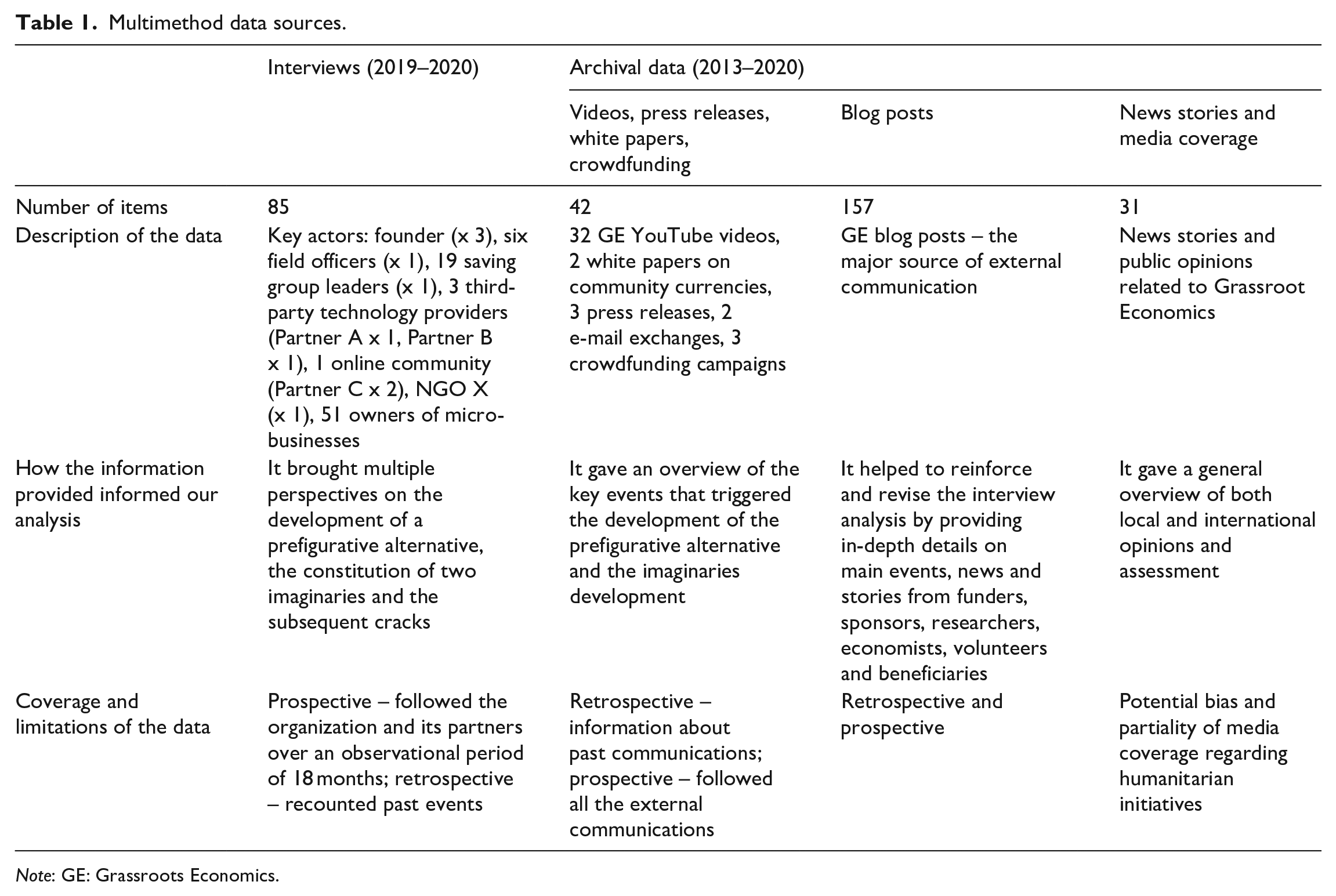
Note: GE: Grassroots Economics.
Data analysis
Our analytical approach was iterative involving a continuous process of analysing the data, emergent constructs and relevant literature (Locke, 2012). Following extensive exploration, we adopted the theoretical lens of prefiguration, focusing on imaginaries and their roles in prefiguring social change. Our analysis comprised four main steps.
In the first step, supported by our archival database, we began by addressing the broad question of ‘what happened and who did what’ (Langley, 1999). We utilized the chronology of 157 blog posts to understand how the grassroots organization introduced the community currency in different locations, gaining insights into everyday struggles and actions taken to prefigure social change. This information allowed us to construct a temporal map detailing the main events that shaped the initiative, serving as a central component of our analysis.
Our temporal map traced back to May 2013 when the second community currency, Bangla-Pesa, was launched. Continuously updated throughout our coding and fieldwork between November 2019 and December 2020, this map revealed two distinct periods: ‘grassroots organizing’ and ‘scaling upwards’. The former (2013–2018) involved implementing the alternative currency system as a small-scale local solution across various informal settlements, while the latter (2018–2020) marked the large-scale deployment facilitated by the partnership with NGO X, transitioning to a digital token system called Sarafu on a blockchain. Figure 1 illustrates the two periods and the main events identified during this study.
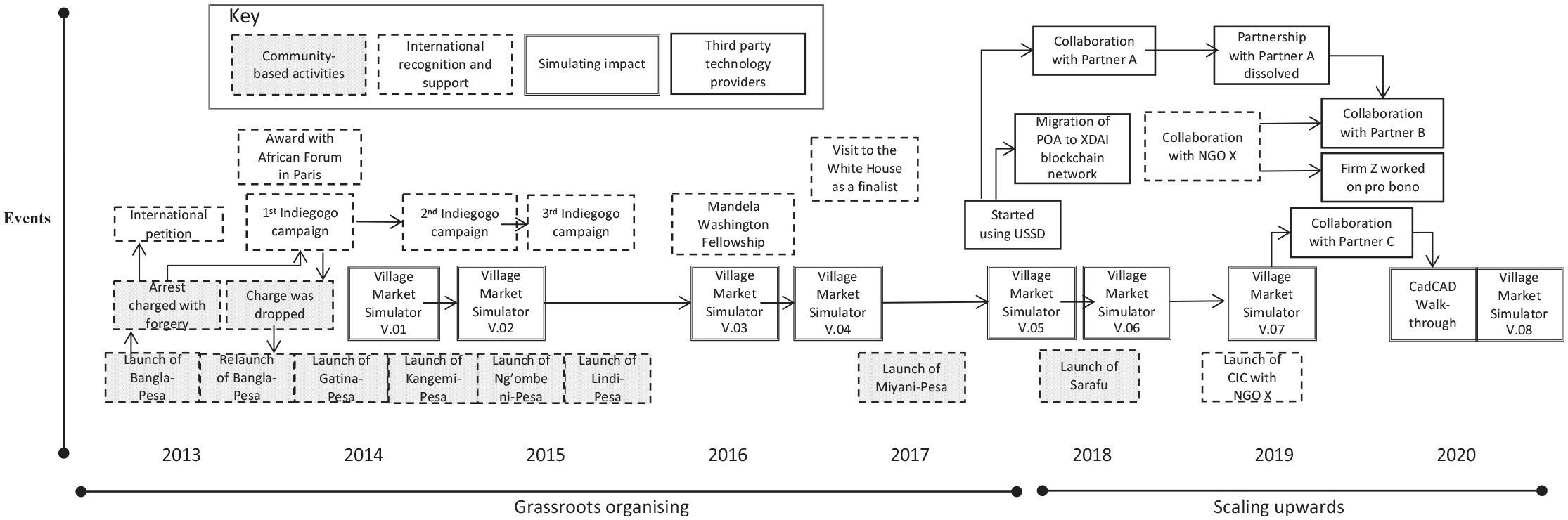
Chronology of main events.
In the second step of our analysis, we conducted open coding of all interview transcripts and archival data using Nvivo (1.7.1). To ensure reliability and consistency, the authors independently coded the data in five separate rounds, discussing the codes and coding process after each round. This approach facilitated a shared understanding of the alternative currency system from various perspectives. Initially, we used sentences and paragraphs as coding units, labelling them with in vivo terms or descriptive phrases (Corley and Gioia, 2004). We organized these codes chronologically and then merged similar ones into more abstract first-order codes through an inductive process. For instance, in period 1, we created the first-order code ‘creating a network of businesses and community-based organizations’ by merging descriptive phrases like ‘Bangladesh Business Network received its official registration papers from the Kenyan government as a community-based organization’ and ‘as a Kanyorosha community, we have started an organization called the Gatina business organization to empower parents’. We followed the same coding procedure for period 2, combining similar in vivo codes and descriptive phrases such as ‘involve the chief or the village elders from the beginning’ and ‘have the buy-in of the local government’ into the first-order code ‘securing buy-in from local elders and government’.
In the third step, we sought relationships in the data and used axial coding to establish connections among the first-order codes, leading us to derive broader second-order constructs (Locke, 2012). This process identified seven second-order constructs aggregated into three dimensions. The first aggregate, termed ‘prefigurative alternative’, captured two second-order constructs: ‘forming horizontal networks’, and ‘creating new means and ends’. These two constructs describe how an alternative currency system was implemented and organized across different informal settlements. The second aggregate, termed ‘performative economics imaginary’ comprised three second-order constructs – ‘projecting and performing impact’, ‘theorizing change’ and ‘theorization–reality crack’. These constructs captured the characteristics, that gave this imaginary its capacity to prefigure social change and notably explained how the imaginary departed from reality in period 2. Lastly, the third aggregate, termed ‘technology-for-good imaginary’ included the three second-order constructs: ‘championing smart innovations’, ‘technology–coalition crack’ and ‘seizing technological momentum to achieve the SDGs [Sustainable Development Goals]’. The last three constructs captured how the imaginary brought together different field actors and the inherent tensions within the technology coalition. Our coding is represented in a data coding structure (Gioia et al., 2013), shown in Figure 2. In Appendices 1–3, we provide illustrative quotes for each aggregate dimension.
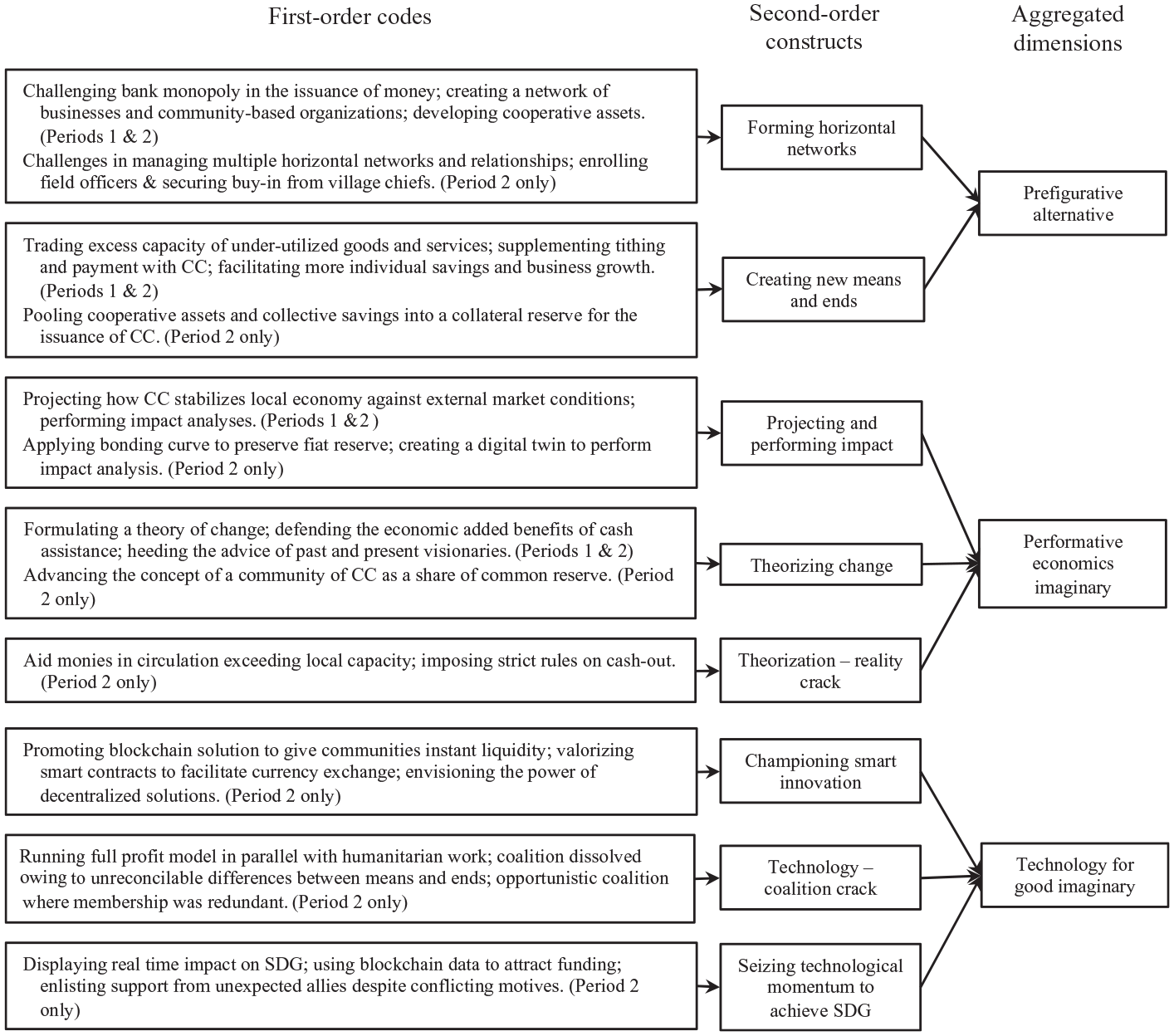
Data coding structure.
In the last step, we sought to answer our research question, explaining how the grassroots organization mobilized imaginaries to enact and foreshadow social change. This final step allowed us to validate our empirical constructs and synthesize our findings into a theoretical framework of prefigurative imaginaries. A prefigurative imaginary is defined as the collective envisioning of alternative social structures, practices or values guiding present-day actions towards a desired future. This framework, depicted in Figure 3, illustrates the recursive relationship between prefiguration and imaginaries and is further elaborated upon in our research findings.
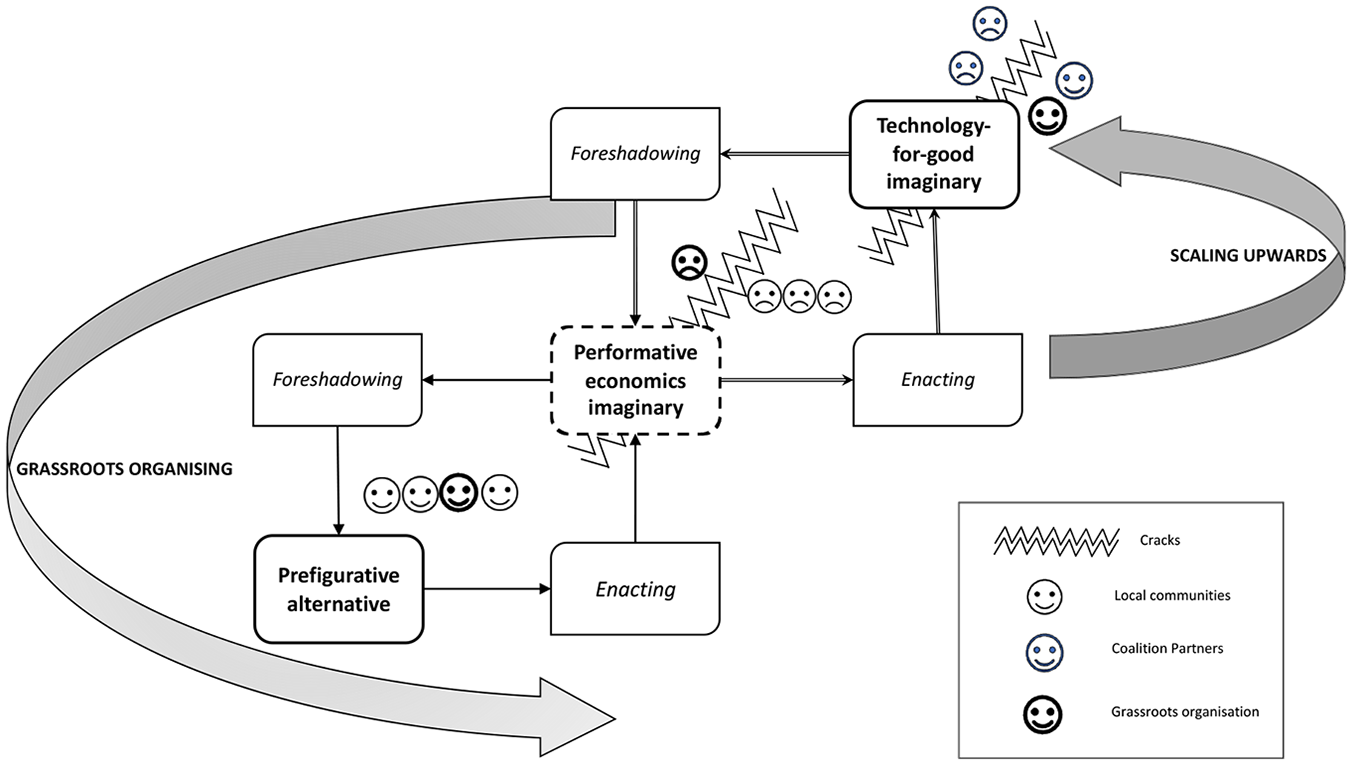
A framework of prefigurative imaginaries.
Grassroots Economics and the mobilization of imaginaries to prefigure social change
In our exploration of Grassroots Economics, we reveal the pivotal role played by imaginaries in enacting and foreshadowing social change. Examining the contested local implementation of a community currency as a prefigurative alternative, we trace its evolution, leading initially to the emergence of a performative economic imaginary. This imaginary equipped the proponent with the foresight to foreshadow future challenges. However, the emergence of a technology-for-good imaginary during efforts to scale up the prefigurative alternative introduced unexpected challenges, ultimately prompting the abandonment of the alternative community currency system. The findings underscore the intricate journey of how a grassroots organization mobilized imaginaries to prefigure social change through enacting and foreshadowing actions, highlighting their significant influence on experiences and practices, ultimately shaping the acceptance or rejection of grassroots initiatives within the communities they aimed to serve.
Period 1: Grassroots organizing (2013–2017)
In the first period, Grassroots Economics intentionally positioned the alternative currency system outside traditional economic practices. This form of grassroots organizing refers to activities that occur in the interstices or gaps of dominant systems, enacting social change through the creation of a horizontal network of small businesses. Using an alternative community currency system, this small business network was able to trade daily when there was a chronic shortage of fiat currency.
Prefigurative alternative
Grassroots Economics started its prefigurative alternative by forming horizontal networks and creating new means and ends. In November 2012, the organization assisted a group of micro-business owners in forming the Bangladesh Business Network. This network arrangement is common in Kenya, where members engage in trading with each other and participate in their local savings groups to save and rotate collective savings. Distinct from the national fiat currency (Kenyan shillings), the community currency became an alternative medium of exchange to facilitate the trading of unsold goods and services. Backed by mutual guarantees among network members, initially trading took place exclusively between members allowing them to act as both suppliers and customers for each other. The members soon realized the potential to accrue greater benefits by extending the exchanges to include non-business entities. New members were frequently brought in through horizontal peer-to-peer relationships: ‘When you become a member, you bring in four people who know you well. They become like your referees’ (Video #3).
As networks grew, the pool of resources available as collateral for the issuance of community currency increased. Using it as a promissory note, members began to explore additional applications and extended the network of trading possibilities: When I buy fish worth 100 Kenyan shillings [Ksh] from Pamela, she accepts Ksh 90 and 10 in community currency vouchers; the 10 community currency [CC] voucher I give her acts as a promise that when she comes to my shop to buy tomatoes, I shall accept some of the payment in community currency. That way, we are both able to save Ksh and use them to cater to other household needs. (Blog #63)
The alternative community currency system, originally designed for trading, evolved into a versatile tool for creating new means and ends, catering to community needs. For instance, schools accepted community currency for tuition fees, allowing education to continue during challenging times. Churches also utilized the community currency to pay for community services, creating a circular flow of exchanges, and extending the benefits to more recipients. Some schools took advantage of this opportunity and established permaculture gardens, providing a local source of produce for network members to buy. Additionally, the community currency was used to cover a portion of the labour cost involved in maintaining these gardens. This circular flow and extended use of the community currency further enriched the horizontal networks and their participants: When the community is involved in the program, especially the youth, the business network can pay part of the labour fees in community currency from the community basket whenever the need for payment arises [. . .] once we harvest the vegetables we could have the business community buy-in part Ksh and CC and at a subsidized rate than they would get at the market and have the schools in turn purchase goods or services from the business community on normal days and especially during market days. (Blog #70)
From the start, Grassroots Economics placed a strong emphasis on the lived experiences and activities of beneficiaries as living testimonies to the effectiveness of the community currency prefigurative alternative. To showcase successful stories, Grassroots Economics employed small-scale surveys as a method to systematically gather data on exchanges and experiences using community currency. These surveys served as a qualitative and quantitative tool, capturing not only the economic transactions but also the nuanced narratives of individuals engaging with the community currency and the impact across individual and community levels. Second, to ensure transparency and accessibility, Grassroots Economics regularly published summarized findings, including charts, on its official blog. The blog served as a platform for sharing narratives, insights and visual representations of the economic activities and notably the positive impact on social change to counter the centralized and often neglectful practices of the mainstream banking institutions. The culmination of these efforts contributed to the development of a performative economics imaginary. This imaginary was rooted in the real experiences, activities and data collated from the lived realities of the beneficiaries. It became a powerful tool not only to actively engage beneficiaries in living out desired futures in the present but also gave Grassroots Economics the capacity to foreshadow an alternative economic future that aligned with its prefigurative objectives.
Performative economics imaginary
Two pivotal actions were central to this imaginary: projecting and performing impact and theorizing change. These actions contributed to Grassroots Economics’ capacity to foreshadow social change. In projecting and performing impact, Grassroots Economics utilized a series of videos featuring simulated models to project the benefits of community currency within their envisioned ‘local village economy’. These visualizations went beyond mere representation; they served as a form of foreshadowing, providing glimpses into a future where community currency could challenge existing monetary systems. In the first video, titled ‘Grassroots Economics Market Village Simulator #01’ with the caption ‘interest-bearing debt and inequality’, the simulation not only vividly illustrated the flaws of the current monetary system but also foreshadowed the potential consequences of relying on private banks for money creation (see Figure 4a): [T]hese very wealthy people now on top are sort of like your 1% that you would see today . . . 97% of our money supply in the world is created by private banks for profit today . . . so how could we redesign a system? A lot of people promote the idea of taking away the power of private banks and lenders to create credit and issue high-interest loans. (Video #2)
This foreshadowing was a dynamic process, allowing viewers to anticipate the transformative impact of community currency, especially in mitigating reliance on debt financing. The simulated model (as shown in Figure 4b) then showed how using community currency can mitigate reliance on debt financing. The simulated model became a tool for projecting a future where community currency fostered a reduction in inequality, promoted a more equitable distribution of resources and challenged conventional economic practices. Grassroots Economics effectively used this foreshadowing capacity to communicate the significance of their initiative in paving the way for a more just economic framework: Instead of going into debt, they can use community currency as a sort of barter exchange, and immediately you can see the trade starting to jump back up on the right and the left, you can see the inequality dropping quite a bit that’s because now people are less and less enticed into interest-bearing loans. So, those people that were making money off their money now are making less and they’re spending it back into the community. So, you get sort of a trickle-down effect. You can see the trade coming back, and inequality going down. (Video #2)
To perform impact analyses, Grassroots Economics introduced a new parameter, focusing on ‘local currency circulation’ as a key indicator. The performative economics imaginary was leveraged to create an as-if future scenario, advocating for ‘a more responsible way of doing social development work’ (Founder interview #1), centred on locally controlled means of exchange ‘based on cooperative assets such as fish farms, maize mills, coconut oil, and wholesale shops’ (Founder interview #1). Linking the positive impact of local currency circulation with communal assets provided Grassroots Economics with a mechanism to formulate its theory of change, allowing the organization to foreshadow and articulate a pathway towards future social and economic transformation. The theory of change became a narrative of prefiguration, outlining how local businesses could employ local labour and build a thriving community: That’s ultimately the theory of change is that these local businesses now would be employing that local labour if the external market ends up shutting down for any reason and building up a thriving local community, so that’s kind of our goal. You can play around here [simulation] with adding a bigger market and looking at what happens in these markets if the external markets turn on and off [. . .] and what creates stable market places in the absence of the national currency. (Video #11)
The insights gained from renowned community currency experts contributed to the foreshadowing aspect of the performative economics imaginary. Grassroots Economics, by drawing on this expertise, gained a deeper understanding of the historical impact of aid programmes and unintended consequences on local economies. This historical perspective became a tool for foreshadowing the potential pitfalls of traditional aid approaches and informed a more strategic approach to positive change:
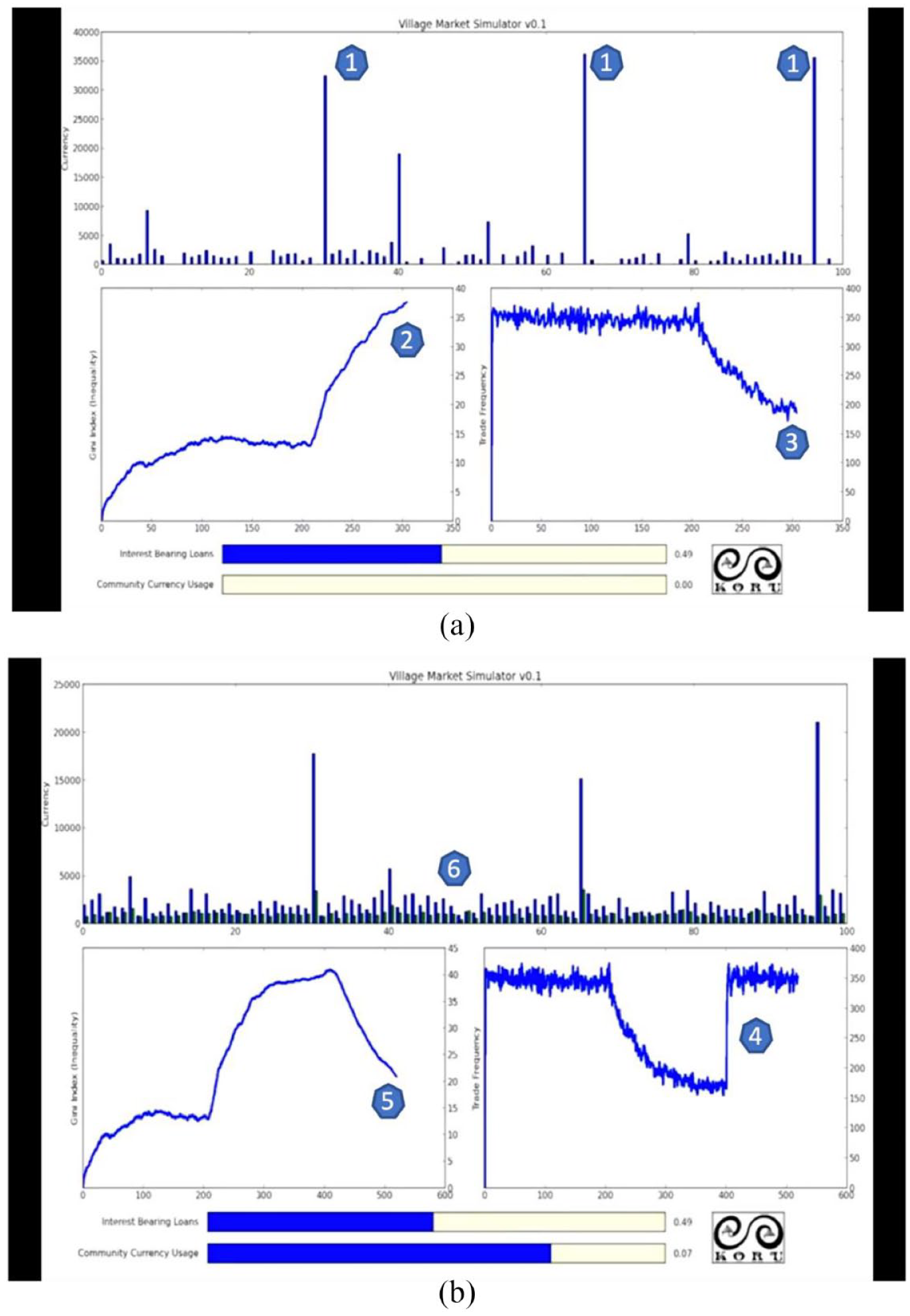
(a) A view of the village simulator 01 as an illustration of the performative economics imaginary.
In the past, traditional aid organizations and development programmes have failed to address the fundamental problems plaguing the economic infrastructure of marginalized communities across the world. Pumping typical aid into these economies often exacerbates unsustainable food systems and market dynamics by reinforcing the existing economic structure. The bulk of the aid flows out of the community too quickly to provide lasting impact and key resources [. . .] remain largely underutilized. (Blog #115)
By contrasting the historical failures of traditional aid organizations with the potential benefits of directing cash assistance towards cooperative assets, Grassroots Economics actively engaged in foreshadowing a future where humanitarian aid contributed to local sustainability rather than offering a temporary fix. In essence, the performative economic imaginary, with its dual components of projecting and performing impact and theorizing change, became a dynamic component for foreshadowing social change. Grassroots Economics actively shaped a narrative of a future where community currency challenged existing economic structures and paved the way for a more equitable and sustainable socio-economic landscape.
While the performative economics imaginary facilitated the adoption of community currencies in marginalized communities, it became evident that each community had its unique local conditions. Some communities relied on a larger aggregate of cooperative assets, such as a maize mill, while others operated on a smaller asset basis, like a voucher for school fees. This diversity made it challenging for communities to trade with each other using multiple community currencies, prompting Grassroots Economics to reconsider their economic theorization of community currency as a share of a common reserve and to ensure transactions and utilization of community currencies across different communities: A single community currency is very fragile. [. . .] Let’s treat the currency as shares of a common reserve and so we’ll be essentially creating a kind of a credit system and then the next step to this is sort of rethink what can act as that reserve. What gives the system collateral? [. . .] such that people can trust the system how can you connect all these community currencies right through this idea of common reserves? (Video #16)
To realize the envisioned future of community currency as shares of a common reserve, Grassroots Economics recognized the need for transitioning from paper-based community currencies to a digital token. The digital token became the backbone of an envisioned digital infrastructure for managing a network of community currencies where various communities contributed their cooperative assets to a common reserve. This transition marked the beginning of the second period, focusing on scaling up the alternative currency system.
Period 2: Scaling upwards (2018–2020)
By 2018, Grassroots Economics had undertaken a significant step, transitioning all its paper-based community currencies to a digital token system built on blockchain technology. Recognizing the widespread belief in blockchain’s potential to revolutionize traditional financial systems, providing a scalable and decentralized solution to societal challenges, Grassroots Economics strategically positioned this transition to harness the broader technological optimism permeating society: We have seen the crypto world generate roughly $300 billion for new currencies, and we believe the same mechanics can be applied to help communities create wealth on a local level through the use of blockchain-based community currencies that fill regional trade gaps, enable basic income and food security, and promote thriving local and interconnected global markets. (2018 press release from Grassroots Economics)
This pivotal transition communicated the idea that embracing blockchain solutions could overcome the limitations inherent in traditional currency systems, fostering economic inclusivity and empowering marginalized communities. Beyond positioning their alternative currency system as a blockchain-enabled approach to address economic and social challenges, this narrative contributed to the emergence of the technology-for-good imaginary, framing technology as a catalyst for positive social change. This newfound technological optimism attracted professionals from diverse sectors, including a large technology provider (Provider A), an international humanitarian organization (NGO X), an online open-source community (Community S) and an international consultancy firm (Firm Z). Each partner brought unique expertise and resources, expanding Grassroots Economics’ reach and impact beyond its scope.
Technology-for-good imaginary
The partnership with Partner A stemmed from a shared vision of championing smart innovation to address grand challenges. Partner A brought specialized knowledge in blockchain technology, contributing expertise in the design and implementation of smart contracts and open-source protocols. This partnership introduced a decentralized exchange solution aimed at reducing reliance on traditional financial systems. The goal was to eliminate drawbacks inherent in existing currency exchange models, especially those penalizing small-scale and niche currencies. This transformative solution ensured that small-scale currencies, prevalent in local community communities, could enjoy convertibility and constant liquidity without the need for large trade volumes: This innovation allows new and niche currencies and small-scale currencies of which most local currencies are, to essentially be able to be convertible and have constant liquidity [. . .] without having this dependency on having large trade volumes, which most of these currencies don’t have. (Partner A interview)
The smart innovation contributed to the ongoing narrative of how technology-for-good imaginary could accelerate societal progress. NGO X saw this as an opportunity to revolutionize conventional aid disbursement practices by delivering a ‘humanitarian solution in a box’: If we don’t change our approach, we won’t ever change the situations out there. In that instance, that’s how the community currency works. The other reason for us to do this, is not just a response and the relief aspect of it [. . .] but also the simulation side, because now we’ve created these different types of simulators around Monte Carlo and complexity theory and artificial intelligence and machine learning, and ultimately what we’re going to do is to create this humanitarian solution in a box. (NGO X interview)
With the vision that smart innovation presented an opportunity to address future challenges transparently, securely, and efficiently, the partnership with NGO X brought in new aid donations to support the creation of a fiat reserve to bolster Grassroots Economics’ alternative currency system, enhancing the prefigurative alternative’s capacity to enact social change and address socio-economic challenges.
Following its partnership with NGO X, Grassroots Economics reached out to Community S, bringing together experts in science, economics and engineering. This diverse expertise offered Grassroots Economics a robust technological foundation and further fundraised US$100,000 for developing a digital currency simulation. This simulation aimed to enhance Grassroots Economics’ prefigurative capacity to foreshadow future challenges by serving as a testing ground to assess the scalability of the alternative currency system.
Despite the initial momentum, the technology coalition encountered challenges. In December 2019, Partner A decided to withdraw support from the technology coalition. With Partner A’s profit model based on using its existing intermediary token, Grassroots Economics’ decision to issue its own version of a digital token diverged from Partner A’s profit model, leading to the emergence of a technology–coalition crack: ‘Their [Partner A] whole profit model was built around using their own intermediary token. [. . .] Essentially, it would be a PR project for them, but they didn’t want to put any resources into it’ (Founder interview #3).
This crack in the technology coalition underscored the challenges and conflicts that could arise when profit models clashed with the transformative aspirations of social impact initiatives. Swiftly following Partner A’s withdrawal, technology Partner B stepped in to support the implementation of the digital infrastructure initiative. However, the partnership continued to present difficulties, particularly when Grassroots Economics viewed the technology partners as opportunistic and redundant: They [Partner B] probably don’t have a profit model at all and that’s a little bit dangerous in a sense. It’s like getting cheap programmers to do infrastructure work because they’re sort of promoting a profit model that may not work, and so we make sure that we have the redundancy that we don’t have to need them. (Founder interview #2)
Nonetheless, despite the conflicting profit models within the technology coalition, Grassroots Economics foreshadowed the invaluable benefits of securely storing data on a public ledger outweighing potential conflicts. Specifically, the utilization of digital technology enabled a visual demonstration of the real-time impact of its community currency on attaining the United Nations SDGs. This visualization of impact allowed Grassroots Economics to reinforce its technology-for-good imaginary by enacting the urgency of seizing technological momentum to achieve the SDGs; specifically, when the transparency of funds moving through communities was manifested in a web-based dashboard solution (as shown in Figure 5) developed in collaboration with a large international consultancy, Firm Z: The aspect of being able to witness the impact of these funds moving through communities is a whole new ballgame and that’s part of the thing too of just bringing transparency out to saying okay, you’re claiming these SDG impacts. (Founder interview #2)
The pro bono involvement of Firm Z provided NGO X, the main backer of Grassroots Economics in the scaling-upwards period, with significant validation for their new approach to utilizing the alternative currency system for humanitarian aid disbursement: Our mandate was essential to break things. [. . .] For us, it was more of to go out there and almost get our financing, to get a grant, and to get validation from a third party rather than ask for validation internally, and [. . .] that’s why we went to an international funder [Y] and this large consultancy firm [Z] and a few other groups to get them to finance them, and that it became validated. (NGO X interview)
However, despite the earlier positive impact of the technology-for-good imaginary on the enactment of the alternative currency system by Grassroots Economics, unintended consequences started to pile up during the scaling-upwards period that weakened both the prefigurative alternative and its supporting imaginaries. First, the formation of multiple additional horizontal networks in the form of saving groups that were facilitated by the mobilization of the technology-for-good imaginary placed a significant burden on Grassroots Economics and its field officers, straining its capacity to manage a larger network effectively: ‘In the future, it might be hard for us because right now we are at 141 savings groups, and lately, a lot have been forming on their own through self-registration’ (Field officer 1).
To assert greater control over its community currency operations, Grassroot Economics expanded its field officer team, albeit facing challenges in securing buy-ins from local chiefs and governments. This shift towards a more centralized approach deviated from the organization’s previous decentralized grassroots organizing, posing additional implementation challenges. Moreover, as Grassroots Economics experienced a surge in user registration for its digital token during the scaling-upwards period, the demand intensified on micro-business owners to accept digital tokens as payment for goods and services. However, these micro-business owners relied on frequent conversion of tokens to Kenyan shillings to replenish their inventory. This cashing-out pressure prompted a subsequent revision of the performative economics imaginary.
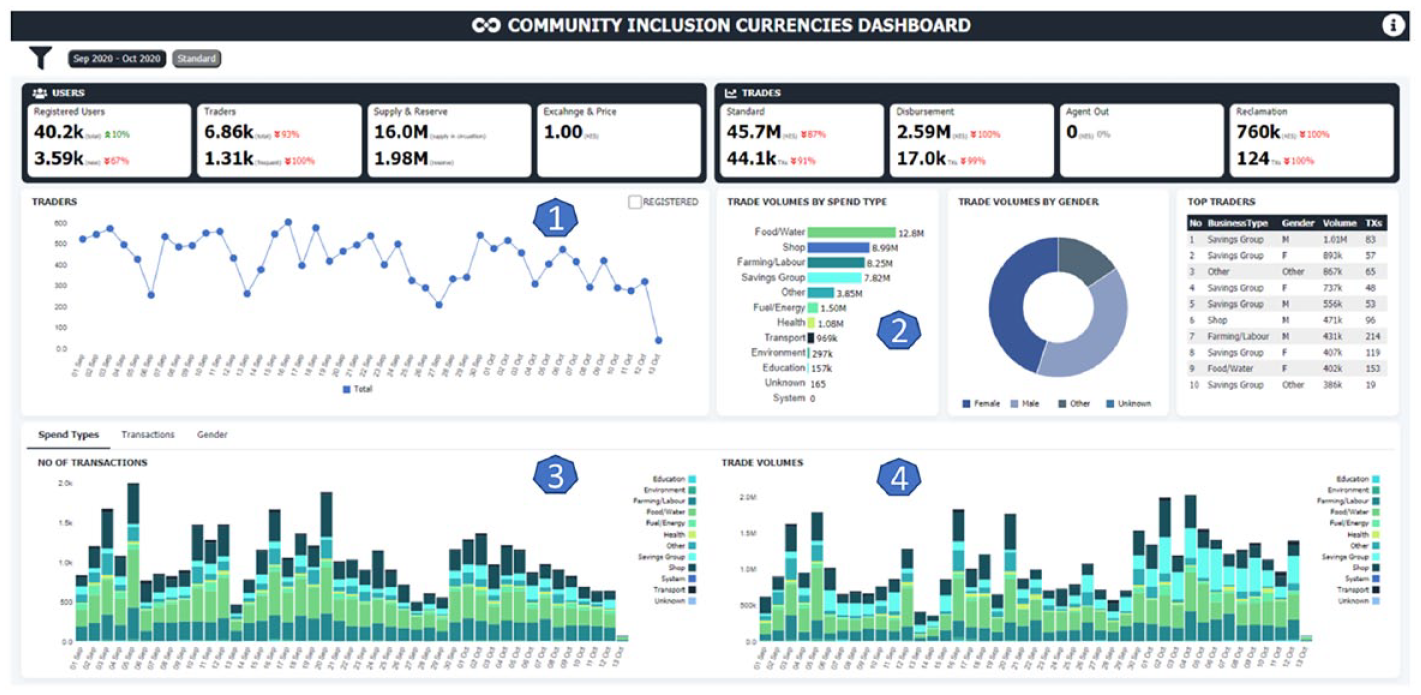
A web-based dashboard displaying impact based on daily transaction as an illustration of the technology-for-good imaginary.
Performative economics imaginary revised
While the technology-for-good imaginary brought additional donations to the fiat reserve, frequent cashing out could pose a significant risk of depleting the fiat reserve held by Grassroots Economics. In response, Grassroots Economics revised its performative economics imaginary by foreshadowing the potential depletion of the fiat reserve caused by frequent cashing out as an ‘inventory control problem’. This shift in emphasis marked the emergence of a theorization–reality crack, highlighting the growing gap between theoretical concepts and practical implementation challenges: [T]he big problem we have is an inventory control problem. Here is how you make sure that they [GE] don’t run out of fiat reserve for their operations and withdrawals [. . .] The goal is to figure out optimal parameters, and this is what we’ve built so far in this model [. . .] that allows us to then go in and test the different assumptions with this digital twin to make sure that we get all these little allocations right. (Community S Video #27)
To minimize the potential adverse effects of converting community currency tokens back to fiat currency, Community S introduced a set of exchange conditions by implementing a ‘bonding curve’ within the digital currency simulation. This curve provided an automated mechanism for determining the price of a digital token of community currency, linking it to the underlying fiat reserve. Consequently, whenever digital tokens were exchanged for fiat money, the value of the tokens decreased accordingly (see Figures 6a and b): Because we’re creating the currency, $1 goes in $4 comes out, so if everyone redeemed that immediately the currency would collapse right? So, if everyone traded in dollars that they were given, the shillings that they got in disbursements, and tried to redeem those immediately, there wouldn’t be enough reserve for everyone. So, the policy that is currently in place, is savings groups are only allowed to buy back fiat if they can only redeem up to 50% of their holdings. (Community S interview #2)
Despite the theoretical conceptualization of the bonding curve and buyback policies to safeguard Grassroots Economics’ fiat reserve, this made it difficult for micro-business owners to predict their cash-out values, leading to fluctuations in the value of community currency. As noted by a savings group leader, sudden ‘price spikes in commodities caused the value of community currency to decrease’ (Savings group leader #6). These fluctuations prompted micro-business owners to charge higher prices in community currency compared with Kenyan shillings for the same goods during exchange. This trading behaviour introduced significant currency volatility and the potential risk of speculation, further exacerbating the theorization–reality crack: How do you make sure that this model [simulation] is telling us all this information? [. . .] Unfortunately, we’ve spent so much time fundraising to do this, that we’re not able to keep up with Grassroot Economics’ actual changes on the ground [. . .] It may not be the buyback policy, but you just want to be careful when you open up vulnerable populations to speculative behaviour because the bonding curve if set up without the appropriate rules could be seen as a speculative tool, and speculative tools can create hump and dumps and then the village that requires or works on this currency, could be worse off because of it. (Community S interview #2)
Over time, Grassroots Economics imposed more restrictive rules on the frequency and amount of cashing out through savings groups. These rules made it difficult for micro-business owners to restock as illustrated by the frustrations and uncertainties owing to the inability to access cash for restocking: I am not accepting community currency despite the overwhelming number of customers who got community currency because I have to wait for one month to cash out in Kenyan shillings. But I need to go to the market twice weekly, and in the market, they are not aware of the community currency. I am now thinking to remove the sticker showing that I am accepting community currency. (Micro-business owner #9)
Additionally, during the scaling-upwards period, Grassroots Economics issued community currency at a ratio of 4 to 1 with fiat currency: that is, four tokens of community currency were issued for every Kenyan shilling. The over-issuance of community currency increasingly grew as a central concern for micro-business owners: ‘[Grassroot Economics] needs to regulate the flow of community currency just as the central bank does to the Kenyan shillings and stop issuing so much community currency, which only increases the inflation of prices in goods and services’ (Micro-business owner #44). However, Grassroots Economics held the view that more community currency in circulation would allow local businesses to build a thriving local economy: [T]he basic premise there is that you’re creating sort of a share value for underlying asset plus the sort of social backing the collateral that you get as a service for a business so like an example, if I’m a bread store and I put in a $100 of tokens as a collateral fund as a reserve, and I issue a bunch of these tokens, and I issue let’s say 400 of these tokens well if I can spend those into circulation like employee salary advances and buying stuff in my supply chain, then great I’ve just essentially made some money. (Founder interview #2)
Over time, the influence of performative economics and technology-for-good imaginaries began to reshape the course and outcomes of the prefigurative alternative. In period 1, the initial emphasis on issuing community currency aimed at unlocking local potential by utilizing under-utilized goods and services. However, in period 2, a shift occurred towards prioritizing the safeguarding of the fiat reserve, driven by the technology-for-good imaginary. This shift inadvertently brought about increased complexity and a larger network of savings groups, challenging the organization’s ability to manage operations effectively. This predicament was further intensified by the revisions incurred by the performative economics imaginary that led to unintended discontent among the very communities that community currency aimed to benefit. As a result, the interaction between these imaginaries unintentionally widened the disparity between the theoretical idea of issuing community for positive socio-economic impact and the practical reality of an excess of currency in circulation.
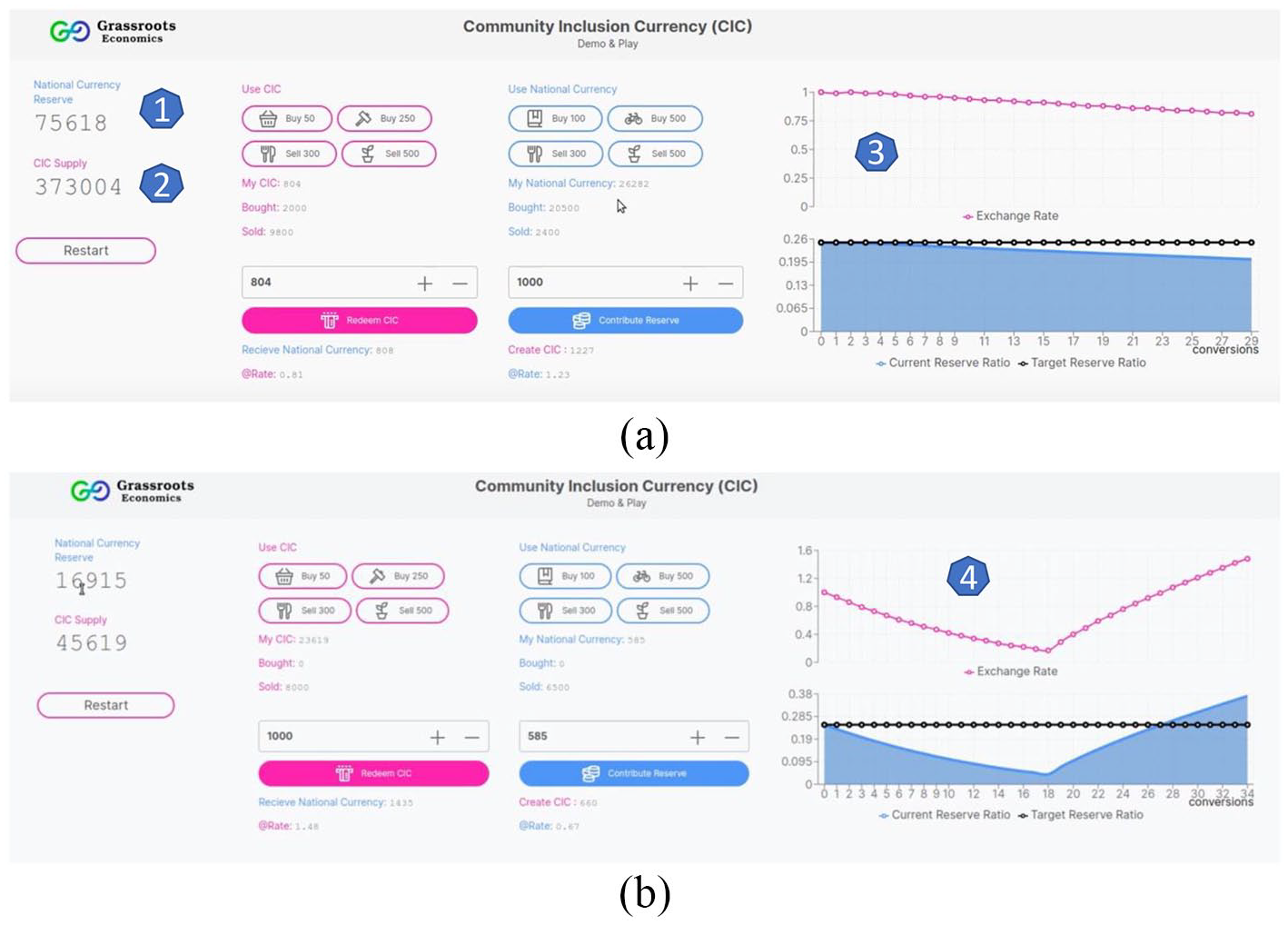
(a) A simulated view of the relationship between cashing out and the common reserve.
The imaginaries, rooted in data simulations and blockchain solutions, became a potent tool for Grassroots Economics to enact positive social change. However, the very digital tools that empowered Grassroots Economics to foreshadow social change also laid the groundwork for the theorization–reality crack, manifested as discrepancies between the envisioned decentralized, community-driven model and the practical challenges of implementing and overseeing a growing network. Grassroots Economics, in theorizing community currencies as shares of a common reserve, faced real-world challenges in coordinating multiple horizontal networks and ensuring the responsible issuance and management of community currencies.
The pressure on savings groups and their members to create new means and ends at scale, an expectation driven by the theorization of decentralized credit systems, clashed with the reality of limited resources and varying capacities within diverse communities. This crack exposed the tensions between the theoretical models conceived in the performative economics imaginary and the operational complexities encountered during large-scale implementation. As a result, by August 2020, the issuance, disbursement and notably cashing out of community currency into fiat currency were abandoned.
Discussion
Our study aimed to explore how a grassroots organization in Kenya mobilizes imaginaries to prefigure social change. Illustrated in Figure 3, our framework succinctly captures this process, showcasing the recursive interplay between prefiguration and imaginaries. In the following subsections, we unpack the theoretical and practical implications of our findings for prefiguration and imaginaries, as well as their broader implications for CSR.
Theoretical contributions
Our framework advances the theory of prefiguration and imaginary in two key ways. First, it extends recent work on prefigurative organizing that centres on how marginalized communities utilized shared cultural histories and experiences to break away from past inequalities and overcome marginalization (Bhatt et al., 2023). As prefigurative organizing involves analysing the social practices that shape how proponents of a counter-hegemony movement work towards achieving their desirable futures in the present (Casey et al., 2020; Clarence-Smith and Monticelli, 2022), our findings deepen this insight. The study demonstrates how a grassroots organization strategically leveraged these shared experiences to construct an imaginary centred around the realization of ‘a local village economy’, employing simulation models to foreshadow future outcomes (Oomen et al., 2022). This process gives rise to what we term the performative economics imaginary, enhancing the grassroots organization’s capacity to conceptualize and communicate the impact of its initiatives.
Additionally, our study illustrates how grassroots organizations can use imaginaries to replicate small-scale, localized initiatives across similar interstitial conditions (Monticelli, 2018; Wright, 2011), fostering generative outcomes often overlooked in existing literature (D’Alisa and Kallis, 2020; Schiller-Merkens, 2020). By facilitating trans-local crossing and the bridging of similar interstitial spaces (Casey et al., 2020), emerging imaginaries reshape everyday practices (Ehrnström-Fuentes and Biese, 2022) to address the social challenges. This exploration underscores the potential for grassroots initiatives to transition from localized endeavours to broader deployments, reaching a larger community of beneficiaries.
Second, our study contributes a relational perspective to prior research, highlighting how imaginaries can offer a shared vision of desirable futures that attract different actors to unite (Levy and Spicer, 2013). It sheds light on how grassroots organizations rally actors from various fields to prefigure social change, converging around different types of imaginaries that they collectively shape. This relational aspect underscores the nuanced interplay between actors with varying goals and approaches, exemplified by the technology coalition partnership. Despite their divergent perspectives, these partners are drawn together by the technology-for-good imaginary, which acts as an instrumental tool, simplifying complexity through selection and retention, as aptly summarized by Jessop (2010: 344): Technologies have a key role in the selection and retention of specific imaginaries insofar as they provide reference points not only in meaning-making but also in the coordination of actions within and across specific personal interactions, organisations and networks, and institutional orders.
Hence, our findings suggest that technology-related imaginaries can enhance specific prefigurative actions. In our context, the technology-for-good imaginary directs actors’ focus on specific socio-economic activities, such as the local circulation of aid money and cashing-out rules, transforming them into subjects of observation and calculation. These imaginaries wield influence over both humanitarian and non-humanitarian organizations, shaping their endeavours in tackling social issues.
Thus, our prefigurative imaginary framework offers a structured and meaningful approach for various actors seeking to address a wide range of complex problems, including humanitarian challenges (Pradilla et al., 2022; Reinecke and Ansari, 2020) by directing their attention on selected areas curated by prefigurative imaginaries. However, imaginaries can also have unintended consequences on prefiguration, particularly when employed to foreshadow future undesirable outcomes (Anderson, 2010).
In our study, the technology-for-good imaginary not only accelerated prefigurative practices at the local village level but also prompted the grassroots organization to revisit its initial imaginary, the performative economics imaginary. This revision had ripple effects at the local level, where the enactment of social change became increasingly out of sync with real-life situations. This disconnect arose as restrictive rules were imposed at both the coalition and grassroots organization levels, intended to safeguard a common fiat reserve and to avert potential future undesirable outcomes.
By examining the cross-level nature of prefiguration, our framework elucidates how prefiguration facilitates the enactment of imaginaries and how foreshadowing can exacerbate cracks within the process. This insight underscores the importance of considering the relational dynamics between imaginaries and prefigurative practices, highlighting the need for a nuanced understanding of how imaginaries shape and influence the trajectory of social change initiatives.
Implications for CSR research
The implications of our findings extend beyond grassroots organizations to the wider context of CSR research (Chowdhury et al., 2021), particularly in understanding the role of prefigurative imaginaries in enhancing small business social responsibility (Soundararajan et al., 2018a).
Historically, CSR research has primarily focused on actors entrenched within the core of capitalism, including large private companies, governments, multi-stakeholder initiatives and cross-sector partnerships (Clarke and Crane, 2018; de Bakker et al., 2019; Matten and Moon, 2020), aiming to reform the system from within by ‘addressing the shortcomings of the current model of global capitalism’ (de Bakker et al., 2020: 1295). However, both prefiguration and CSR scholars have highlighted the importance of studying marginalized aspects of society (Bhatt et al., 2023), including small business (Spence, 2016), which challenges the social irresponsibility of large corporate entities (Fontana and Dawkins, 2023; Noronha et al., 2020) and prefigures social change outside the core of the capitalist system (Casey et al., 2020; Monticelli, 2018; Reinecke, 2018).
Recognizing the presence of imaginaries, including counter-imaginaries, across different societal contexts is crucial. These imaginaries exist not only within the core but also at the periphery of our societies, spanning both the Global North and the Global South (Gümüsay and Reinecke, 2022). The perspective of prefigurative imaginaries, derived from the contextualized experiences of grassroots organizations in Kenya, holds significant promise for future CSR research. It offers an opportunity for a more nuanced analysis of how imaginaries are mobilized to shape the outcomes and impact of CSR activities at the local level.
Moreover, CSR scholars specializing in deliberation and deliberative practices can leverage these localized and contextual contingencies to deepen their understanding of the relational dynamics that shape efforts to reform global capitalism (Dentoni et al., 2018; Giamporcaro et al., 2023; Pek et al., 2023). The incorporation of prefigurative imaginaries into CSR research stands to enrich our understanding of how diverse actors enter to prefigure various forms of social change. By recognizing the role of imaginaries, including counter-imaginaries, across different societal contexts, CSR scholars can develop more comprehensive analyses that capture the complexities of transformative processes.
Practical implications in delivering social change through imaginaries
Our research findings shed light on the challenges of using imaginaries to drive social change for proponents of counter-hegemony movements. First, we identified one prefigurative imaginary, the performative economy imaginary, which enabled the grassroots organization to introduce a new way of projecting and performing impact based on aid circulation in the local economy. This provided a rallying point for redirecting attention and allowed humanitarian organizations to experiment with a radically different approach by multiplying and diversifying small endeavours (Cameron and Hicks, 2014). However, introducing this new way of projecting and performing impact also disrupted the local productive capacities instead of harnessing them. Hence, our findings suggest that prefigurative imaginaries can become detached from the local context, losing sight of the essential ‘editing rules’ vital for assimilating social changes within a local context (Claus et al., 2021).
Second, the subsequent degeneration can be attributed to the inherent challenges of sustaining imaginaries as a cohesive whole when introducing more restrictive conditions and redundant partnerships. Although the two identified imaginaries eventually brought together the necessary financial and infrastructural resources to enable marginalized communities to issue their community currency, the additional localized changes required to realize this desirable future eventually led its recipients to reject it. This failure raises the risk of collateral damage and unintended consequences that may worsen the conditions for people living in marginalized communities.
Third, the use of multiple imaginaries highlights the ongoing struggle of counter-hegemony proponents to secure capital for developing the necessary technological infrastructures for marginalized communities. This challenge becomes particularly daunting when delivering technological innovation for social and development projects because actors outside the humanitarian sector are more likely to provide the essential resources, such as technological and scientific expertise and knowledge, that a grassroots organization needs to support its everyday actions and practices (Yates, 2015). Moreover, large grant schemes, particularly for major challenges (Grodal and O’Mahony, 2017), increasingly attract actors outside the humanitarian sector to contribute to humanitarian projects, highlighting the importance of studying economics and technology-driven imaginaries that align with the visions of grassroots organizations.
Lastly, our findings reveal that even successful partnerships with humanitarian organizations through the interplay of different imaginaries over time are fraught with risks of degeneration, particularly when different time scales are at play (Reinecke and Ansari, 2015). In our study, the grassroots organization sought to accelerate change to align with the window of humanitarian initiatives, leading to unrealistic expectations that often disrupt the existing social life and order within the marginalized communities (Banerjee and Jackson, 2017). Over time, this contributed to a growing sense of distrust (Claus et al., 2021). Hence, our findings caution against the unintended consequences of using imaginaries to expedite the delivery of economic and technological infrastructures, emphasizing the importance of a shared commitment to desirable outcomes over opportunistic orientations.
Concluding remarks
Studying how a grassroots organization mobilized imaginaries to prefigure social change allowed us to theorize how a generative process can turn degenerative, complementing existing focuses on strategy and scaling mechanisms (Schiller-Merkens, 2020).
Our prefigurative framework underscores the need to explore how grassroots proponents leverage time to accelerate the realization of desirable futures. Additionally, future research can examine how multiple imaginaries interact with each other, considering that the temporal structures of imaginaries are inseparably linked with politics, economics, technologies and other factors. By adopting a counter-perspective, future research can gain a more comprehensive understanding of how imaginaries transition the present to a better future, completing the cycle of social change.
Our framework of prefigurative imaginaries sheds light on the recursive interplay of enacting and foreshadowing, illustrating how everyday actions in the present shape the next steps, with the recognition that desirable futures are actively under-constructed (Rindova and Martins, 2022; Wenzel et al., 2020). In other words, prefigurative imaginaries could enable the proponents of counter-hegemony movements including grassroots organizations to identify the boundary and temporal conditions, navigating between enacting desirable structures in the present and foreshadowing actions to avert future undesirable outcomes. This approach highlights the complex dynamics of social change and the importance of considering both the present realities and future aspirations when mobilizing imaginaries for transformative actions.
Footnotes
Appendix
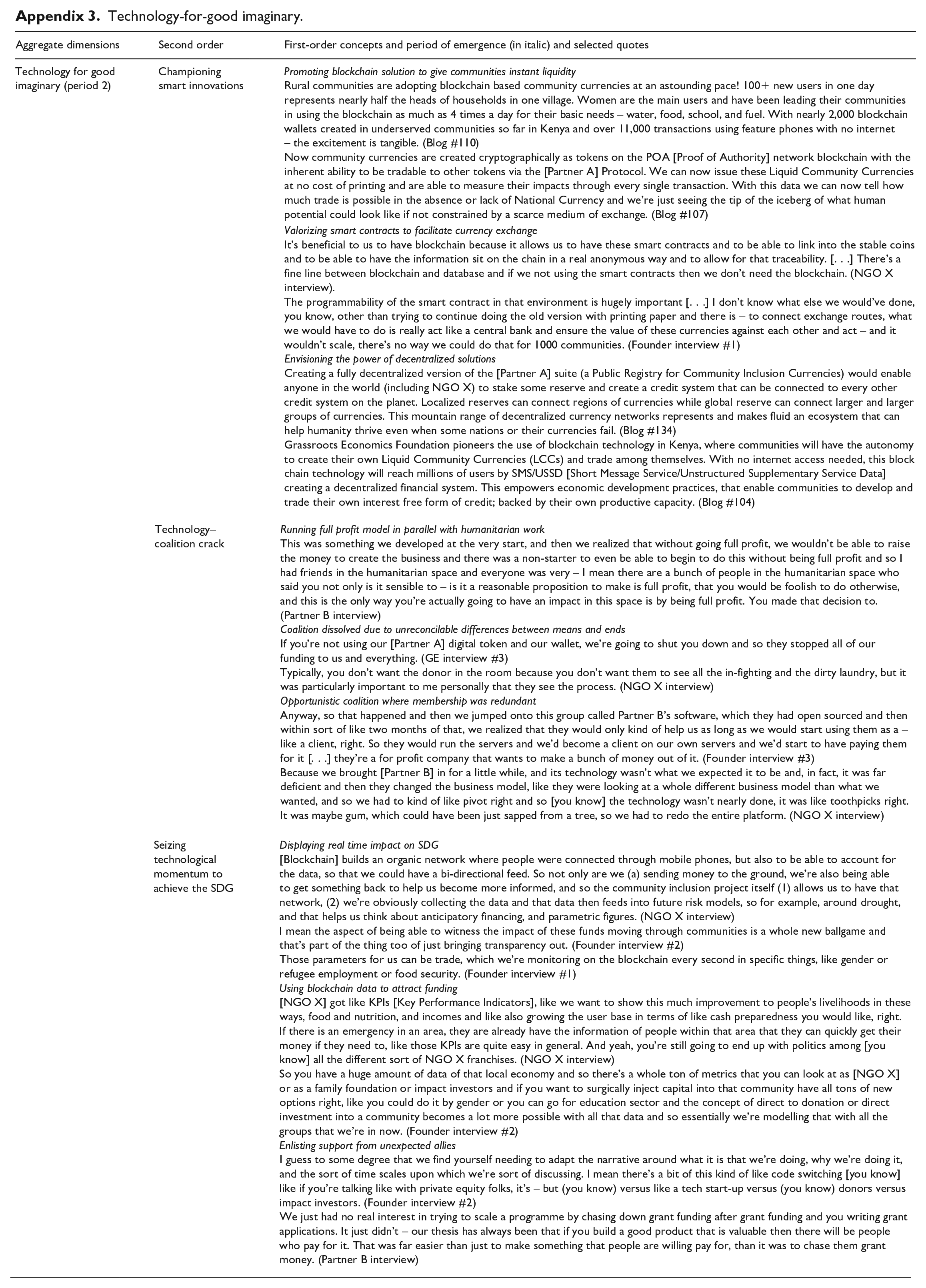
Technology-for-good imaginary.
| Aggregate dimensions | Second order | First-order concepts and period of emergence (in italic) and selected quotes |
|---|---|---|
| Technology for good imaginary (period 2) | Championing smart innovations | Promoting blockchain solution to give communities instant liquidity
Rural communities are adopting blockchain based community currencies at an astounding pace! 100+ new users in one day represents nearly half the heads of households in one village. Women are the main users and have been leading their communities in using the blockchain as much as 4 times a day for their basic needs – water, food, school, and fuel. With nearly 2,000 blockchain wallets created in underserved communities so far in Kenya and over 11,000 transactions using feature phones with no internet – the excitement is tangible. (Blog #110) Now community currencies are created cryptographically as tokens on the POA [Proof of Authority] network blockchain with the inherent ability to be tradable to other tokens via the [Partner A] Protocol. We can now issue these Liquid Community Currencies at no cost of printing and are able to measure their impacts through every single transaction. With this data we can now tell how much trade is possible in the absence or lack of National Currency and we’re just seeing the tip of the iceberg of what human potential could look like if not constrained by a scarce medium of exchange. (Blog #107) |
| Valorizing smart contracts to facilitate currency exchange
|
||
| Technology–coalition crack | Running full profit model in parallel with humanitarian work
|
|
| Seizing technological momentum to achieve the SDG | Displaying real time impact on SDG
|
Acknowledgements
This research was funded by the HEFCE Global Challenges Research Fund (Grant number: NTU-GCFR-QR/RD040) administrated through Nottingham Trent University. We are greatly indebted to Grassroots Economics and the micro-business owners for their participation in our research. We thank the special issue editors and the reviewers for their important guidance and engagement with our work. We benefited greatly from discussions with colleagues when we presented earlier versions of the paper at EGOS, PROS and Audencia. A special thank goes to Juliane Reinecke for her meticulous and constructive comments. Finally, we thank David Leslie and Abdiaziz Ahmed for their assistance in data collection.
Correction (May 2024):
Article updated to correction the country in the affiliation “University of Jordan School of Business, Jordan”.
Funding
The authors disclosed receipt of the following financial support for the research, authorship and/or publication of this article: HEFCE Global Challenges Research Fund, Grant/Award Number: NTU-GCFR-QR/RD040.
