



Abstract
Boundary objects help collaborators create shared meaning and coordinate their work across differences. Acknowledging the complex dynamics of such processes, we propose a multimodal alternative to studies’ traditionally static view of boundary objects and ask: How do boundary objects “shape-shift”? How do they emerge in varying forms across visual, verbal, and embodied modes, and in what ways does this “shape-shifting” affect meaning-making? Adopting a “strong” multimodal lens, we show how boundary objects expand in form as collaborative work proceeds through shifting shapes both across and within modes. We also show how they contract over time, reemerging exclusively in some and not other shapes, often in simplified forms. These dynamics both enable and constrain meaning-making. Expanding shapes of the boundary object allow collaborators to develop rich shared understandings. Contracting shapes, in turn, condense meaning-making into efficient communication among those familiarized with the object, yet obscure meaning-making for newcomers who cannot make sense of its contracted shapes. Our study sheds new light on boundary objects’ multimodal nature and demonstrates how objects’ shifting shapes affect meaning-making. More generally, we offer a rich empirical account of how modes enmesh in practice, unveiling their processual and inseparable complexion.
Keywords
From cross-functional projects to multidisciplinary groups to interorganizational teams, more and more collaborative work constellations can nowadays be found in the organizational landscape (Majchrzak et al., 2015). Actors from different professions, organizations, or industries team up to reap the benefits of a richer pool of resources, skills, and insights (Akkerman and Bakker, 2011). However, these collaborative work constellations also confront actors with new challenges (Nathues et al., 2023). Meaning-making—here defined as creating shared understandings of issues at stake across collaborators’ differences in perspectives, terminologies, and experiences—is one of the most intricate hurdles and most vital success factors of collaborative work (Bechky, 2003a; Huxham and Vangen, 2004; Jørgensen et al., 2012). Without shared understandings that ground and guide a group’s collaborative endeavors, progressing and thriving together is hardly possible. Indeed, “[t]o form a group with members truly working together towards genuinely shared goals, a team calls for a substantial degree of shared meanings” (Einola and Alvesson, 2019: 1896).
Previous work suggests that “boundary objects” may serve as crucial aids and remedies for meaning-making in collaborative work (Bechky, 2003b), for example in the form of project management software (Barrett and Oborn, 2010), strategy tools (Spee and Jarzabkowksi, 2009), or flowcharts (Swan et al., 2007). As artifacts representing knowledge in ways understandable across different viewpoints, they help collaborators produce shared understandings (Star and Griesemer, 1989). In doing so, boundary objects are central means for collaborators to proceed with their joint work even when faced with divergent and possibly colliding ways of communicating and interpreting.
Collaborative work’s dynamic nature and recent shifts in understanding boundaries as processual and continually renegotiated (e.g., Comeau-Vallée and Langley, 2019; Quick and Feldman, 2014) exhort us to “move beyond a conception of boundary objects as static devices” (Langley et al., 2019: 720). A processual take on boundary objects also seems more sensible when considering meaning-making’s complex and fragile nature (Jørgensen et al., 2012). Indeed, when the meanings we produce are dynamic and always partly open to variation (Vásquez et al., 2016), then so might the boundary objects that help produce them.
Yet, in spite of some notable exceptions that have begun to demonstrate boundary objects’ fluid nature (e.g., Doolin and McLeod, 2012; Ewenstein and Whyte, 2009; Gal et al., 2008; Jornet and Steier, 2015), most studies continue to prioritize objects’ effects on changing boundaries over exploring boundary objects’ own dynamic nature. More precisely, though boundary objects’ functions are known to modify in relation to collaboration stage, setting, or the people involved (Carlile, 2002), much less is still known about how the boundary object itself changes form—“shape-shifts”—in order to preserve or extend its functionality. This is surprising, given that already Star’s (1989) original conception stressed boundary objects’ fluid and dynamic nature. Thus, rather than assuming that meaning-making only happens around a static boundary object, one would expect this object to “shape-shift” as collaborative work progresses. It is also problematic, fostering a tendency of failing to notice how meaning-making is supported or thwarted through changes in a boundary object’s shape. For example, could shared understandings still be accomplished when a physical boundary object becomes just a single phrase or simple gesture?
In this project, we aim to understand better the patterns of meaning-making and boundary objects’ shifting shapes. Building on extant processual takes on boundaries and collaborative work (Comeau-Vallée and Langley, 2019; Langley et al., 2019; Quick and Feldman, 2014), we seek to provide an equally dynamic portrayal of the artifacts that collaborators use as they make sense of each other’s differences and their joint work. Drawing on a “strong” multimodal lens (Zilber, 2018) and mobilizing insights from ethnomethodology and conversation analysis (Garfinkel, 1967; Schegloff, 1991; Vygotsky, 1934/1986), we focus on how boundary objects change form across visual, verbal, and embodied modes and how these dynamics affect meaning-making. We ask: How do boundary objects shape-shift in collaborative work, and how do these dynamics influence meaning-making?
We examine these questions through a longitudinal video ethnography conducted in an interorganizational project team. Based on our analyses, we illuminate two primary dynamics: expanding and contracting. We show how a boundary object’s shapes expand into visual, verbal, and embodied modes (e.g., when hand gestures mimic a visually displayed shape) and broaden within these modes (e.g., as modified visual versions). We also show how these shapes contract over time, reemerging exclusively in some and not other modes (e.g., reemerging solely in verbal shapes and no longer in visual form), often in simplified ways (e.g., a single word). Expanding shapes of the boundary object support meaning-making: they enable team members to see, think, speak, and move in synchronizing ways, the broadened repertoire of the boundary object’s shapes supporting their creation of shared understandings. In turn, contracting shapes both support and thwart meaning-making. On the one hand, they streamline and simultaneously enrich meaning-making among those familiarized with these shapes, as professionals can rely on simple but sophisticated communicative references that carry the history of all the meaning-being-made-before. On the other hand, however, they constrain shared understandings when team composition fluctuates. Meaning is obscured for newcomers who cannot make sense of the object’s contracted shapes, such that a previously powerful boundary object becomes an obstacle for further collaborative work.
This article extends research on boundary objects by shedding new light on their shape-shifting dynamics. Our analyses tease out boundary objects’ fluid, multimodal, and relational nature and reveal the consequentiality of their shifting shapes for how meaning-making succeeds or falls apart in collaborative work. More generally, this article extends the literature on multimodality (Boxenbaum et al., 2018; Knight and Wenzel, forthcoming; Zilber, 2018) by offering a rich empirical account of how modes intertwine in practice. Hence, our article highlights modes’ processual and inseparable character rather than their assumed reification.
Theoretical background
Boundary objects and meaning-making
Boundary objects are meaning-making devices that help collaborators coordinate and accomplish work across organizational, disciplinary, or other distinctions (Bechky, 2003b; Star, 2010). Defined as artifacts that “inhabit several intersecting worlds and satisfy the informational requirements of each of them” (Star and Griesemer, 1989: 393), they represent knowledge in forms understandable across perspectives and constitute helpful tools to articulate and learn about differences (Akkerman and Bakker, 2011). Because they are “plastic enough to adapt to local needs [. . .] yet robust enough to maintain a common identity across sites” (Star and Griesemer, 1989: 393), boundary objects provide footholds around which shared understandings of issues at stake can be created. As such understandings are crucial for productive collaborative work across differences (e.g., Bechky, 2003a; Einola and Alvesson, 2019; Jørgensen et al., 2012), boundary objects are central, if not indispensable, features of such work (Caccamo, 2020). They enhance the capacity of ideas, thoughts, and opinions to translate across varying contexts and viewpoints, providing the shared reference base that groups need to collaborate productively (Bittner and Leimeister, 2014).
Ever since Star and Griesemer (1989) coined the term “boundary object,” extant literature has explored a great variety of artifacts as enabling meaning-making. Amongst others, studied boundary objects include project management software (Barrett and Oborn, 2010), robot arms (Hsiao et al., 2012), bioreactors (Nicolini et al., 2012), strategy tools (Spee and Jarzabkowksi, 2009), or metaphors (Koskinen, 2005). Another group of important boundary objects are visual artifacts. For example, Henderson (1991) and Bechky (2003b) showed how engineering drawings enabled meaning-making between occupational groups, and others studied how flowcharts or timelines facilitated knowledge-sharing and alignment across organizational sections (Carlile, 2002; Swan et al., 2007). Yet, others examined how architectural sketches made boundaries more and less visible (Comi and Whyte, 2018; Ewenstein and Whyte, 2009) or how PowerPoint slides contributed to coordinating work and reconciling divergent interpretations (Knight et al., 2018; Nicolini et al., 2012).
Previous work has demonstrated that boundary objects’ usages and usefulness can change across situations (Levina and Vaast, 2005). For instance, their functions can evolve from informing to integrating (Ojansivu et al., 2021), or objects can be replaced altogether as projects mature and artifacts become increasingly futile (Leonardi et al., 2019). Oswick and Robertson (2009: 190) even caution that boundary objects can constrain meaning-making—constituting “barricades and mazes” rather than “bridges and anchors”—without, however, specifying the processes through which such outcomes are produced. Clearly, then, writings on boundary objects have begun acknowledging these artifacts’ dynamic nature. That said, authors seem so focused on boundary objects’ changing functions and effects on collaborative work that they tend to leave uninvestigated the varied shapes in which these objects (re)emerge (see also Ewenstein and Whyte, 2009). For instance, Comi and Vaara’s (2021) study of an architectural project sheds light on contestations and renegotiations of meaning through different ways of using a design as a boundary object, not the potentially manifold forms in which the boundary object itself appeared in the team’s discussions.
So, whereas boundary objects’ functions and effects are reported to be dynamic, much of the literature continues to sketch relatively static images of the concept itself (Langley et al., 2019). Somewhat simplistically, boundary objects are considered to stay within the confinements of singular shapes. In so doing, research tends to overlook how boundary objects may change form and migrate into different ways of expressing themselves, such as by being “embodied, voiced, printed, danced, and named” (Star, 2010: 603). Of course, some artifacts may take on boundary object functionalities precisely because they sustain an unchanging and recognizable appearance. Yet, others might do so precisely because they change form—a point made already in Star’s (1989) original conception and stressed once more in her more recent work (Star, 2010). For a more complete understanding of boundary objects, we thus need to consider and better comprehend both dynamics: when they maintain the same form and when they shape-shift.
The few studies that have started to grapple with boundary objects’ shifting shapes insightfully confirm their dynamic nature. For example, Gal et al. (2008) studied how 2D paper drawings and CAD models were replaced by 3D technologies and the implications of these changes for organizational identities. Similarly, Ewenstein and Whyte (2009) focused attention on the ongoing accomplishment of boundary objects by reconstructing changes along visual, physical, and digital versions. Doolin and McLeod (2012), in turn, conceptualized boundary objects as “shifting assemblages” whose shapes evolved, matured, and altered relative to the settings they were entangled in. Finally, Jornet and Steier (2015) explored how a museum space operated as a boundary object not solely through floor plans and mock-ups but also through its appearances in talk and gestures.
These studies demonstrate that boundary objects come in different shapes over time and that these dynamics are an effortful, ongoing, and situated accomplishment with crucial consequences for how collaborative work progresses. Yet, we continue to lack a precise understanding of how boundary objects (re)emerge in different shapes and the implications of these processes for meaning-making. This is the puzzle and motivation of our study.
A multimodal lens on the shifting shapes of boundary objects
Collaborators engage through a variety of “modes,” defined as “semiotic resources for making meaning” (Kress, 2010: 79). Talk, pictures, objects, notes, gestures, or other types of embodiments—ways of conversing and creating shared understandings are multiple and not reducible to the spoken word (Dameron et al., 2015). Multimodal approaches direct analytical attention to these various ways of communicating and highlight how interactions play out across visual, verbal, and embodied modes (Streeck et al., 2011). Hence, multimodal approaches provide us with useful conceptual handles for shedding light on boundary objects’ shifting shapes as different appearances of the same artifact within and across modes.
Reviewing the multimodality literature brings to the fore a set of studies connecting verbal and visual ways of meaning-making. For instance, Barberá-Tomás et al. (2019) analyzed how written text and graphical representations conjointly produced emotional meanings around pollution, which created the energy needed to act against it. Höllerer et al. (2018) demonstrated how pictures extended what was verbally conveyed in the talk and writing surrounding the global financial crisis. In turn, Paroutis et al. (2015) studied how managers interacted with a strategy tool in both visual and verbal ways during a workshop, leading managers to a collective understanding of a strategic issue.
These endeavors enrich our understanding of how meaning-making processes unfold across modes. At the same time, they remain limited in their consideration of ways of engaging. For example, extant research on multimodality pays little attention to one of the most important parts of communicating: the body (Dameron et al., 2015; Wenzel and Koch, 2018). Moreover, modes tend to be treated as relatively distinct and static categories. Though visual and verbal dimensions are portrayed as complementing or contradicting each other, they remain conceptually separate (Knight and Wenzel, forthcoming). An image is approached as something different and distinct from text, with little appreciation for how something that is visually displayed might migrate into what is written or said (and vice versa). That is problematic as it downplays much of the complexity that makes meaning-making so dynamic and fragile (cf. Dille and Plotnikof, 2020; Vásquez et al., 2016).
Recent calls within the multimodality literature stress the need to go beyond the verbal and visual and treat different modes not as separable but as interacting and co-emerging (Boxenbaum et al., 2018; Dille and Plotnikof, 2020; Knight and Wenzel, forthcoming). Particularly Zilber’s (2018) provocations on a “strong” multimodal view question modes’ clear-cut separation. Her conceptualization regards modes not as reified categories but as situated enactments inseparably enmeshed. Thus, allied to “strong” takes on sociomateriality (Orlikowski, 2007) or communicative constitutive theorizing (Ashcraft et al., 2009), Zilber’s (2018) “strong” multimodal view negates the classical divide between the social world as one domain and the material world as another. Instead, materiality itself is understood as a communicational and social performance, a process of materialization rather than a given quality (Cooren, 2018).
When we then understand meaning-making in communication as always comprising more than talk alone, questions of materiality or materialization also become matters of multimodal enactment. A picture, as a boundary object, may be visually displayed on a screen or as a print-out, but it may just as well materialize through verbal modes (e.g., “the picture I showed in our last meeting”) or an embodied hand gesture that mimics the picture’s content. Hence, through different modes, collaborators may make present the very same artifact in varying shapes. We understand modes as different yet inseparable layers of communicating and meaning-making, and shapes as the particular appearance(s) of an artifact. Thus, within one mode (e.g., visuality), a boundary object can take on multiple situationally enacted shapes (e.g., a visual in its original form and with an icon added).
When understanding the role of multimodality in meaning-making as such, how do boundary objects emerge and reemerge in varying shapes through different ways of communicating? We leverage Zilber’s (2018) “strong” multimodal view to illuminate this question and help us answer our research questions: How do boundary objects shape-shift in collaborative work, and how do these dynamics influence meaning-making?
Methods
Context and case
This study’s research context is a Dutch interorganizational collaboration initiative, which the first author joined as an academic researcher. Her role was that of a non-participant observer; she followed the collaborative work happening within the initiative without actively contributing herself. The initiative was established to strengthen organizations’ product lifecycle management and received financial support from a regional development fund. In total, the initiative brought together representatives from 23 organizations, consisting of high-tech companies and service providers that differed on characteristics such as maturity, structures, or markets. The representatives formed interorganizational project teams to work on joint challenges and facilitate cross-boundary learning. For example, teams worked on blockchain technology, cooperation agreements, or business model transformations. This study is built on observations and analyses of one of the initiative’s teams, working on servitization. All participating professionals were interested in implementing servitization ideas more firmly in their offerings but did not yet know exactly what that would imply. They did not know each other or their organizations before coming together in the team but were hoping to collectively create a better understanding of servitization—an outcome they also had to demonstrate in the form of a report at the project end. No formal team leader was assigned; instead, everyone was mutually responsible for pushing forward their collaborative work.
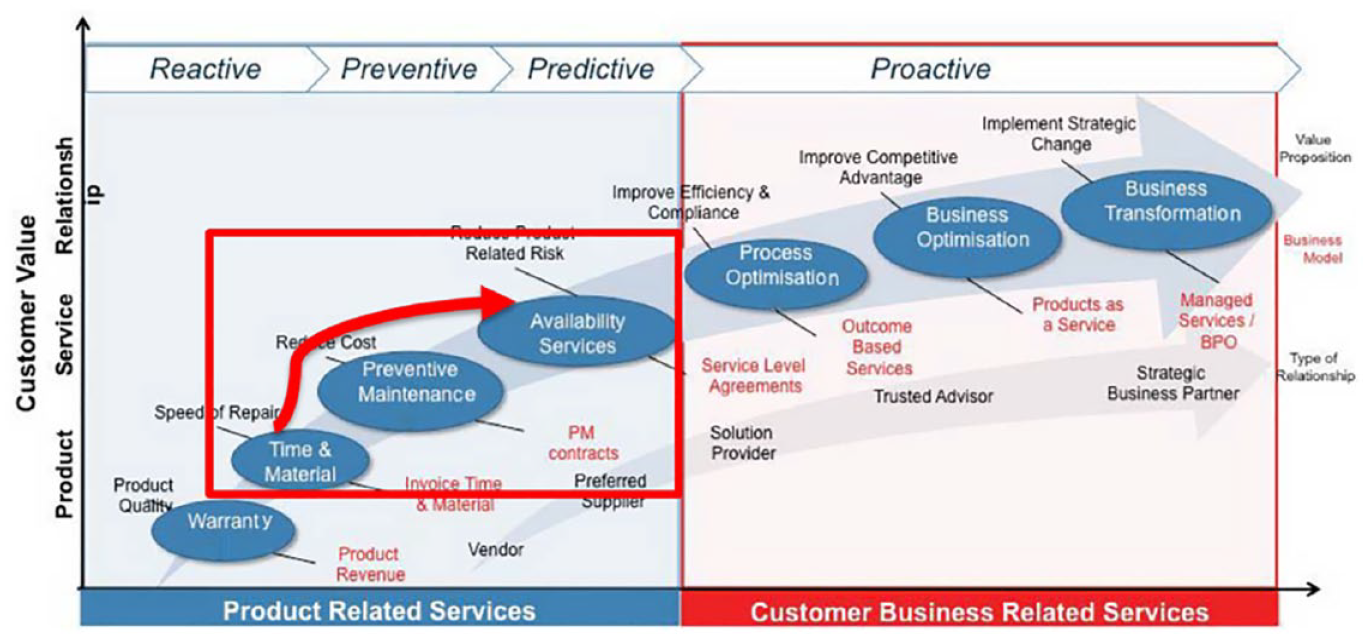
Initially, we approached the overall initiative with a broad interest in the artifacts members used. We identified multiple artifacts during our observations, such as project plans, recurring examples, prototype drawings, and analogies. However, as we followed the dynamics in the servitization team, we were struck by the prominence of one particular artifact (Figure 1): team members frequently used a specific visual roadmap and appeared to greatly value this artifact.
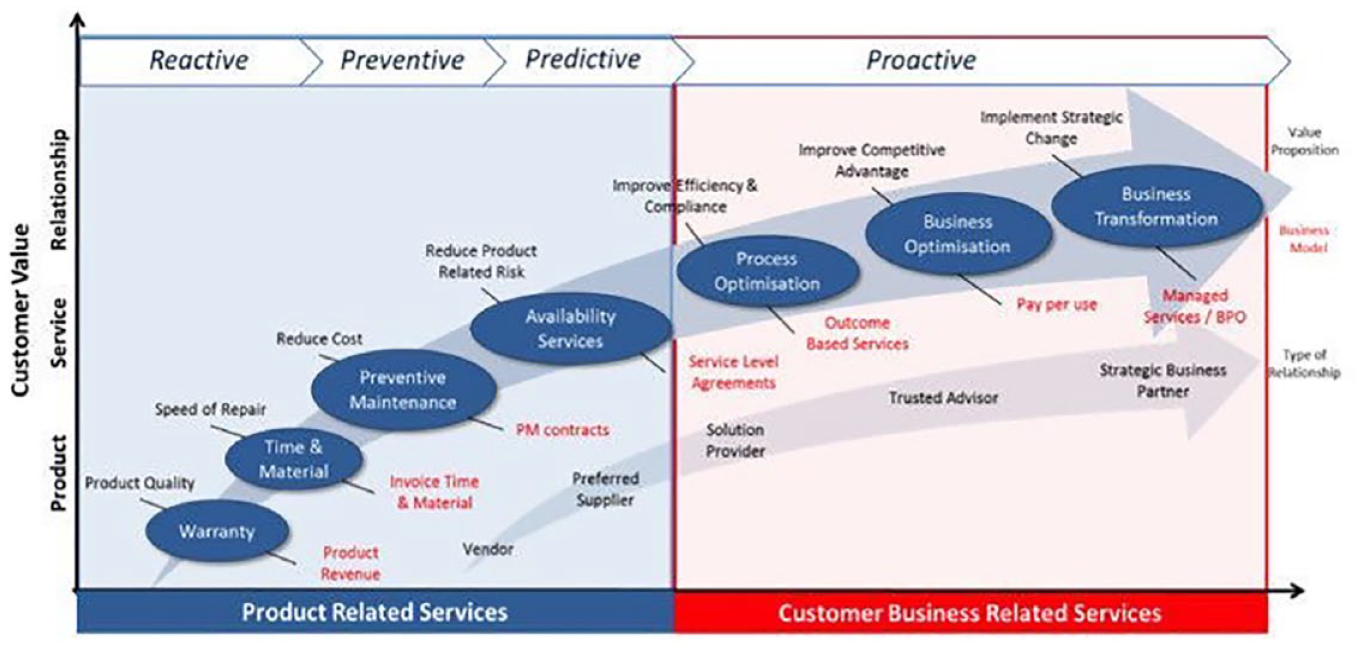
Original boundary object; © Noventum Service Management (permission granted).
Prior literature on boundary objects led us to appreciate this roadmap as an artifact through which the collaborators created shared understandings of the topics and objectives of their joint work. Against the background of this literature’s tendency to advance a relatively static conceptualization of boundary objects’ shapes, we were furthermore intrigued by the roadmap’s continual reemergence through different visual, verbal, and embodied modes. Consequently, we decided to narrow our study’s focus on this particular artifact’s “shape-shifting,” including how these dynamics enabled or constrained meaning-making. In that sense, the servitization team’s collaborative work served as a revealing case for us, rendering boundary objects’ shifting shapes and the implications of these dynamics for meaning-making accessible for a more thorough investigation.
All team meetings were attended by five or six members, though with fluctuations as members changed or left companies, were replaced, or new members joined (see Figure 1 of the online Supplement for a visual overview). These discontinuities led to two successive meeting gaps of 5 to 6 months, occurring first after the project ran for 9 months. When members resumed after the first gap, one company withdrew and a new organization joined, further shaking up the team composition. We stopped following the team after the tenth meeting when the boundary object of interest (the roadmap) was no longer used.
Data collection
In line with our interest in situated meaning-making processes and ethnomethodological and conversational analytical research traditions (Garfinkel, 1967; Schegloff, 1991; Vygotsky, 1934/1986), our analysis builds on naturally occurring interaction data. Specifically, we collected video data of team meetings, produced field notes of these meetings and ethnographic side conversations with team members, and gathered all team documents. This allowed us to identify the boundary object’s shifting shapes and examine meaning-making processes in situ rather than relying on retrospective accounts and recollections of members.
We video-recorded the team meetings with a small 360-degree camera placed on the meeting table. That way, we had the entire room and all team members (not just those speaking at a given moment) on video, while avoiding the disturbance multiple cameras might have caused. The first author was present in the meetings to operate the 360-degree camera and first-hand observe the collaborative work. We collected the team’s documents by accessing members’ shared online databases. In total, we collected 21 hours of video-recorded team meetings, 40 pages of field notes, and 34 documents, such as meeting slides, project plans, or white papers. For additional details, please refer to Table 1 of the online Supplement.
Analyses
Our analyses proceeded in two main steps: tracing the boundary object’s shifting multimodal shapes and, subsequently, exploring the implications of these dynamics for meaning-making.
Tracing the boundary object’s shifting multimodal shapes
Consulting the insightful but somewhat fragmented literature on multimodality, we designed an analytical process that matched our interest in the boundary object’s shifting shapes within and across modes. Specifically, we combined (or bricolaged; Pratt et al., 2022) Meyer et al.’s (2013) practice approach to visuality with Nathues et al.’s (2021) analytical framework on how objects, voices, and so forth, can be materialized in and through talk, Gylfe et al.’s (2016) methodological steps on embodied cognition, and Clarke et al.’s (2021) steps on gestures. This toolset allowed us to direct our analytical attention to a variety of potential shapes through which the boundary object could emerge as team members engaged with it. At the same time, it allowed us to acknowledge, follow, and better comprehend how different modes blurred into each other, thus keeping with Zilber’s (2018) “strong” approach to multimodality.
Following LeBaron et al.’s (2018) suggestions for video analysis, we began by watching all video recordings in detail to discern the moments in which the boundary object in question (the roadmap) was present in its original visual form but also appeared in different shapes. We looked not only at the graphics the team members used but also listened to the words they uttered and watched how they moved their bodies. Whenever we identified an instance where the roadmap emerged, we marked it using the qualitative analysis software Atlas.ti. In total, this first step led us to bracket 61 episodes, ranging between 30 seconds and 20 minutes.
We transcribed these 60 episodes, including visible and embodied details. Iterating between the transcripts, the video recordings, and the collected documents, we then identified more systematically the visual, verbal, and embodied shapes through which the roadmap appeared in the interactions. We documented when the original roadmap was displayed and pointed attention to but also specified its adapted visual versions, for example, with added boxes. We also inventoried when members picked up parts of the roadmap (e.g., its forms or vocabulary) in their own visual creations. We drew inspiration from Nathues et al.’s (2021) framework to specify how the roadmap materialized through talk. We counted instances where members referred to the artifact as “arrow” or “in that graphic, you know, somewhere left bottom” as explicit verbal invocations. When members used the artifact’s words or contents in their explanations (e.g., “then you are sitting in vendor relations”), we considered these as more implicit verbal materializations. Members often invoked gestures resembling the roadmap’s upward curve. We categorized instantiations of these gestures as embodied shapes of the boundary object (Clarke et al., 2021; Gylfe et al., 2016). For completeness, we also noted the other ways members engaged with the artifact through their bodies (e.g., leaning toward or pointing at it). The artifact partly appeared through one singular mode at a time (e.g., as a graphic on screen) but partly also through multiple modes simultaneously, for instance, when members verbally described the roadmap and gesticulated its curve (“so here you foresee the possibility to grow from left bottom to the next phase ((gesticulating upwards curve))?”). For all instances, we also kept note of which team member made present the artifact.
By plotting and comparing empirical evidence of the boundary object’s fluctuating shapes side by side in a table, we abstracted two primary shape-shifting dynamics: expanding and contracting. Specifically, we found that the boundary object’s shapes expanded as collaborative work proceeded through intermodal shape-shifting across visual, verbal, and embodied modes as well as intramodal shape-shifting within them. We identified intermodal shifts when the roadmap was made present in one mode and, within the same episode or in a subsequent one, the same or a different team member invoked the object in a new mode (e.g., from visual to verbal mode). In turn, we identified intramodal shifts when a new shape of the object within the same mode appeared (e.g., an adapted visual version). Both processes contributed to the boundary object’s expanding shapes, starting in meeting 2 and lasting until meeting 5. Then, we found that the object’s shapes contracted, with the object reemerging primarily in verbal and bodily shapes (i.e., contracting intermodally), often in simplified ways such as just a single word or quick gesture (i.e., contracting intramodally). Please consult Table 2 of the online Supplement for an overview of the roadmap’s shapes.
Identifying the implications for meaning-making
Next, for each of the 61 episodes in which we had identified the presence of the roadmap, we specified the boundary object’s implications for how team members were accomplishing meaning-making: how exactly did the artifact enable or constrain the creation of shared understandings across its varying shapes? We paid particular attention to how the artifact helped or hindered team members in creating shared understandings of their work’s topic (i.e., servitization) and everyone’s interests, objectives, and preferences regarding this topic.
To derive conclusions about how the boundary object’s shifting shapes supported or thwarted meaning-making, we zoomed into the smallest details of communication, looking for analytical cues of shared understandings such as affirmations, nodding, clarifying questions, using the same words as a previous interlocutor, progressively less complex explanations, or coproduction and co-completion of utterances (Clark and Wilkes-Gibbs, 1986; Cooren, 2004; Deppermann and Schmidt, 2021; Holler and Wilkin, 2009; Lerner, 1993). We also considered signs of disengaging behavior and lack of shared understandings, such as staring at phone or laptop screens, head-shaking, or appearing puzzled and confused. For completeness, we also specified by whom the roadmap was used and detailed what exactly it was used for in meaning-making. Eventually, we plotted the artifact’s multimodal shapes and implications for meaning-making onto a timeline covering all 61 episodes to help us better comprehend how the roadmap affected shared understandings within the team over time. By comparing and identifying differences in the boundary object’s shapes as well as differences in how the team made shared understandings of their work in response (or not), we used this timeline to temporally bracket (Langley, 1999) how collaborative work in the team evolved. We identified four phases, each indicative of different shapes and implications of the boundary object on meaning-making. The phases structure our Findings section; additional details can be accessed in Table 3 of the online Supplement.
We also presented our findings to the team members. They confirmed our analytical insights, specifically regarding the roadmap’s initial prominence and its later confusion. Looking back, one member described the team’s later phases as “the graphic lost its power,” “disconnects and gaps emerged,” and “the team spirit faded away.” Our member checks revealed that the members struggled to finish their project. The new and old members neither connected on the roadmap nor on any other object, which is why they “didn’t become a team again.” However, we also learned that old members continued believing in the artifact’s meaning-making powers (“I still think that the visual has great value”) and were still using it in their organizations to foster shared understandings (“In fact, I do exactly the same: I leverage this visual to tell the complete story of servitization, to keep all stakeholders on board.”).
Findings
This section presents a detailed empirical narrative of the focal boundary object’s shifting shapes and the resulting implications for meaning-making. The narrative broadly follows a conceptualized composition format (Berends and Deken, 2021), that is, it zooms into particular moments of the collaboration while leveraging the shape-shifting dynamics we identified as theoretical signposts. Video stills have been transformed into sketch designs to protect anonymity, and faces and company logos have been blurred.
Phase I: A potential boundary object
Phase I marks the collaboration’s start, and members need to figure out what they want to work on. Though their project has been given an official name that includes “servitization,” everyone’s knowledge of this subject is limited. Members also need to learn about each other’s organizations and their different maturities, needs, and wishes regarding servitization.
At one point in meeting 2, James introduces a graphic to the team. This graphic has been created by an outside consultancy company. It portrays servitization as a step-wise roadmap, illustrated by two upward-curve-shaped arrows (Figure 1). From this moment onwards, James repeatedly insists on visually displaying the artifact, or he makes it an explicit part of discussions by using it in his explanations or inquiring his colleagues about it (in meeting 3, in nine episodes in total). Some other team members begin using it, too, to clarify differences between organizations and help them better understand each other, and first ideas of what servitization is and potential project objectives start to form.
Expansion dynamics: intermodal shape-shifting
Early in meeting 3, team members are discussing a presentation they prepared to communicate their work to other participants of the overarching initiative. One slide shows the roadmap (Figure 1):
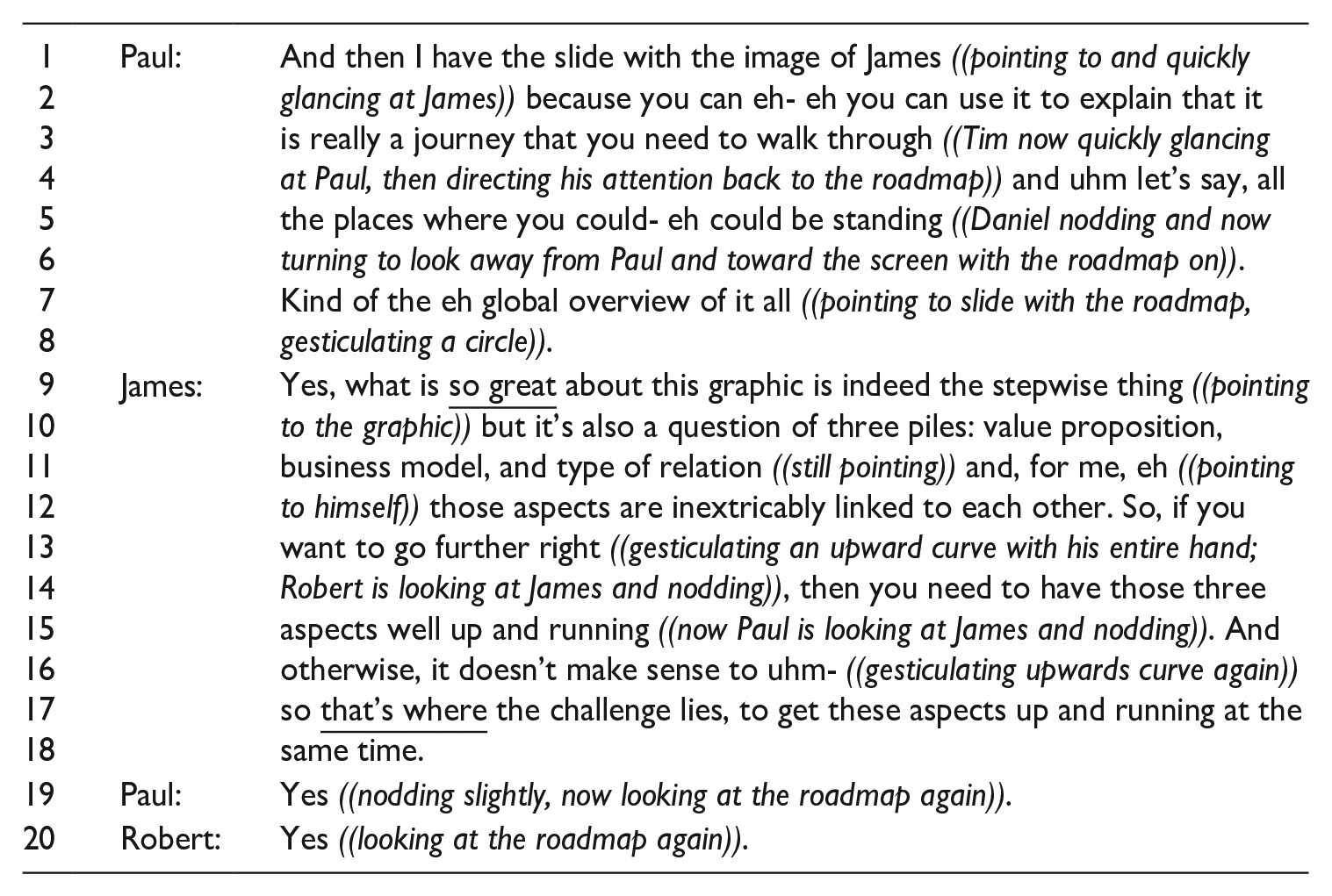
Paul walks the team through the presentation. A slide with the roadmap is displayed, and he is explaining the graphic’s potential meanings and usages. He explicitly links the graphic to “James” (line 1) and is also speaking with a somewhat general “you” (lines 1–5) when talking about the team’s possible “journey” (line 3) the roadmap displays, instead of with a more collective team voice (“we”). Paul is partly contributing to positioning the roadmap as an artifact that could guide the team’s work, using it to create shared understandings about servitization (note also Daniel’s nodding in line 5). However, for the largest part, the roadmap remains connected to “James” (line 1) as its leading advocate.
James is confirming Paul’s explanations (line 9) and gives a more accurate description of why the roadmap could be valuable, highlighting what he considers its most important aspects (lines 9–18). Amongst others, he is verbally drawing attention to the artifact’s “stepwise” (line 9) program and its “three piles” (line 10), concluding that “the challenge lies” (line 17) in “hav[ing] those three aspects well up and running” (lines 14–15). James is using the artifact to foster a shared understanding of servitization’s main challenges among members and to sketch a potential collaborative direction for their joint work. As he is doing so, the visually displayed roadmap expands in shape by intermodally shifting into what James vocalizes: it is not just present in visual form but also materializing through the words James is uttering. Both Paul and Robert affirm James’s elaborations (lines 14–15; 19–20), hinting at the possible emergence of shared meanings in the team.
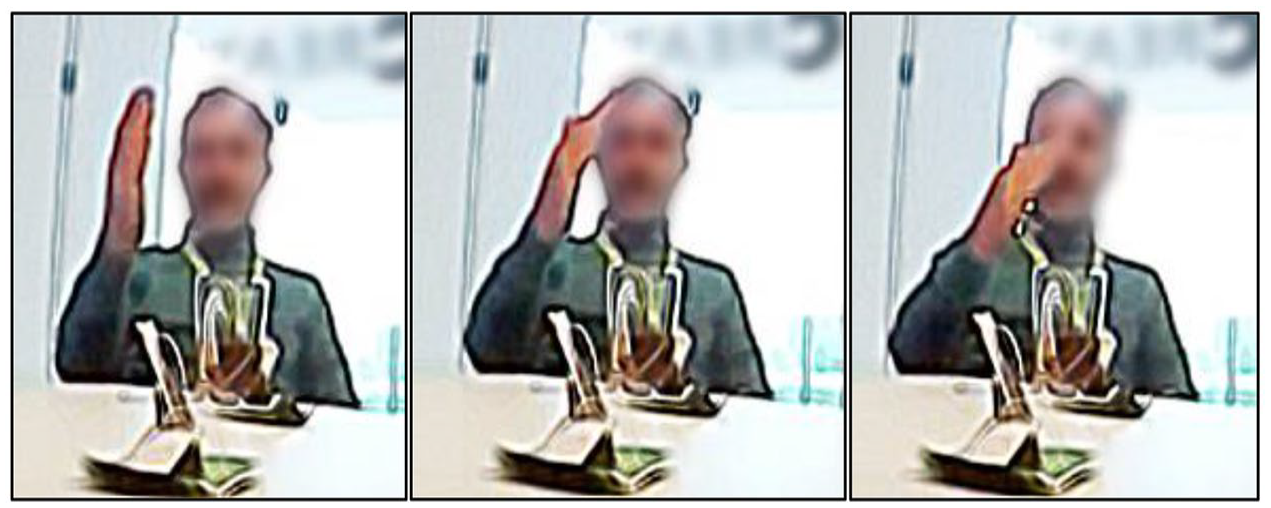
Besides the roadmap’s presence in James’s words, James is also channeling attention to the artifact by pointing to it (lines 9–11) and making representational gestures that mimic the roadmap’s upward curve (lines 13, 16; Figure 2). Thus, the artifact does not only intermodally shift into James’s utterances but, likewise, into his bodily movements, once more expanding in shape. The roadmap gains verbal and embodied forms, the repertoire of its shapes widening with James using the object to help create shared understandings.

James’s representative gesture of the roadmap.
Expansion dynamics: intramodal shape-shifting
Meeting 3 proceeds, and James continues enacting representative gestures of the roadmap; they accompany his explanations and the artifact’s visual displays. Though most of James’s utterances show a future orientation (he is making sense of the next steps companies need to take on their servitization journey), at one point, James starts reflecting on the developments in his organization in the recent past. The original roadmap is displayed on a screen:
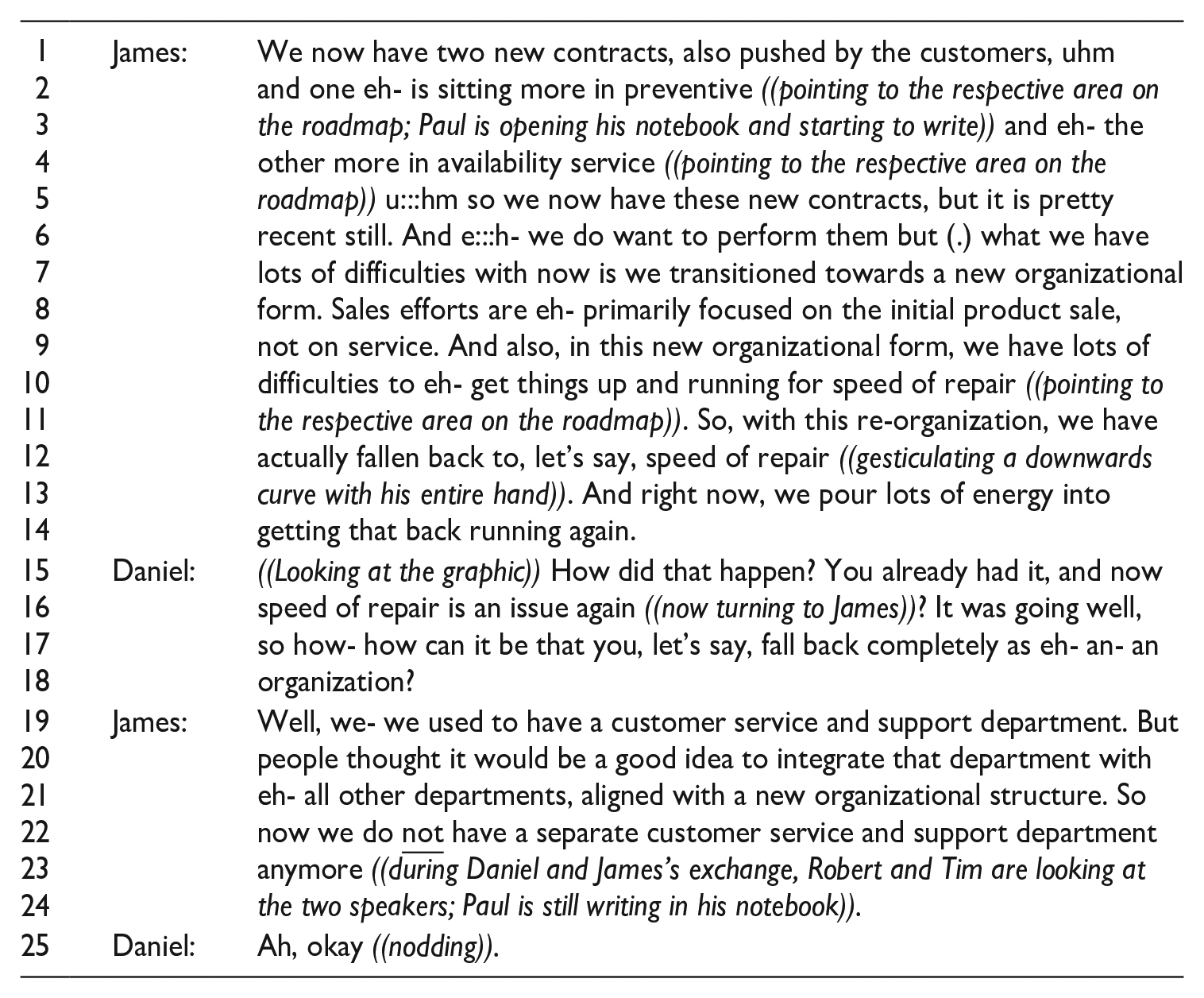
James is talking to his team colleagues about two new contracts his company has signed, using the roadmap to indicate these contracts’ servitization stages. Thus, the artifact is used by James to create a shared understanding among all members about his organization’s status quo. Specifically, James is pointing to the artifact (lines 2–5, 10–11) and is also employing its exact words (“preventive,” line 2; “availability service,” line 4; “speed of repair,” lines 10 and 12), which allows him to unambiguously categorize these contracts and, thus, supports shared understandings. In the previous example, James’s vocalizations about the roadmap homed in on the overall servitization journey it displayed; now, James is talking about more isolated spots on the graphic. Hence, the artifact is materializing in James’s words in a different shape, expanding in form by intramodally shifting within the verbal mode. Daniel shows an intention to engage in meaning-making, too. For instance, note how he is directing his gaze toward the roadmap (line 15) and using the roadmap’s words (“speed of repair,” line 16) when inquiring for more details. The graphic forms a joint reference base from which shared understandings are produced (“Ah, okay,” line 25).
James is also elaborating in more detail on the “difficulties” (line 7) he is encountering in his organization about delivering their new contracts’ services. In particular, he is explaining how new organizational structures make providing services more complicated (lines 6–14) as they make his company “fall back” (line 12) on the roadmap’s steps. While talking about these backward developments, James is moving his hand in the curved form we have seen before. Yet, this time, his gesturing moves downwards instead of upwards. Once again, the roadmap’s shapes are expanding, this time by intramodally shifting into a novel embodied shape of the artifact (Figure 3).
James’s representative gesture of the roadmap, now downwards.
Overall, it is still early days for the team, and the roadmap’s presence is primarily pushed by James. The artifact is mostly present through visual displays of its original version. However, it also already is expanding in shapes, finding its way into James’s bodily movements and members’ talk. In parallel, initial shared understandings around the topic of servitization as well as the differences between each other’s organizations emerge.
Phase II: An actual boundary object
The project proceeds. Members now better understand servitization and each other’s varying needs but also agree that everyone seeks to facilitate servitization activities in their companies. The updated project plan words their goals as follows: “The primary goals are that members learn from each other and set important steps toward servitization.” The plan also includes the roadmap, positioning it as a central element of the collaborative work. In addition to its placement in the project plan, the artifact is frequently used in members’ interactions (in total, in 21 episodes across meetings 4 and 5).
Continued expansion dynamics: intermodal shape-shifting
Members are in their fourth meeting, trying to understand better why servitization remains such a challenge. The original roadmap is visually displayed. It is now Robert, not James, who is drawing attention to it:
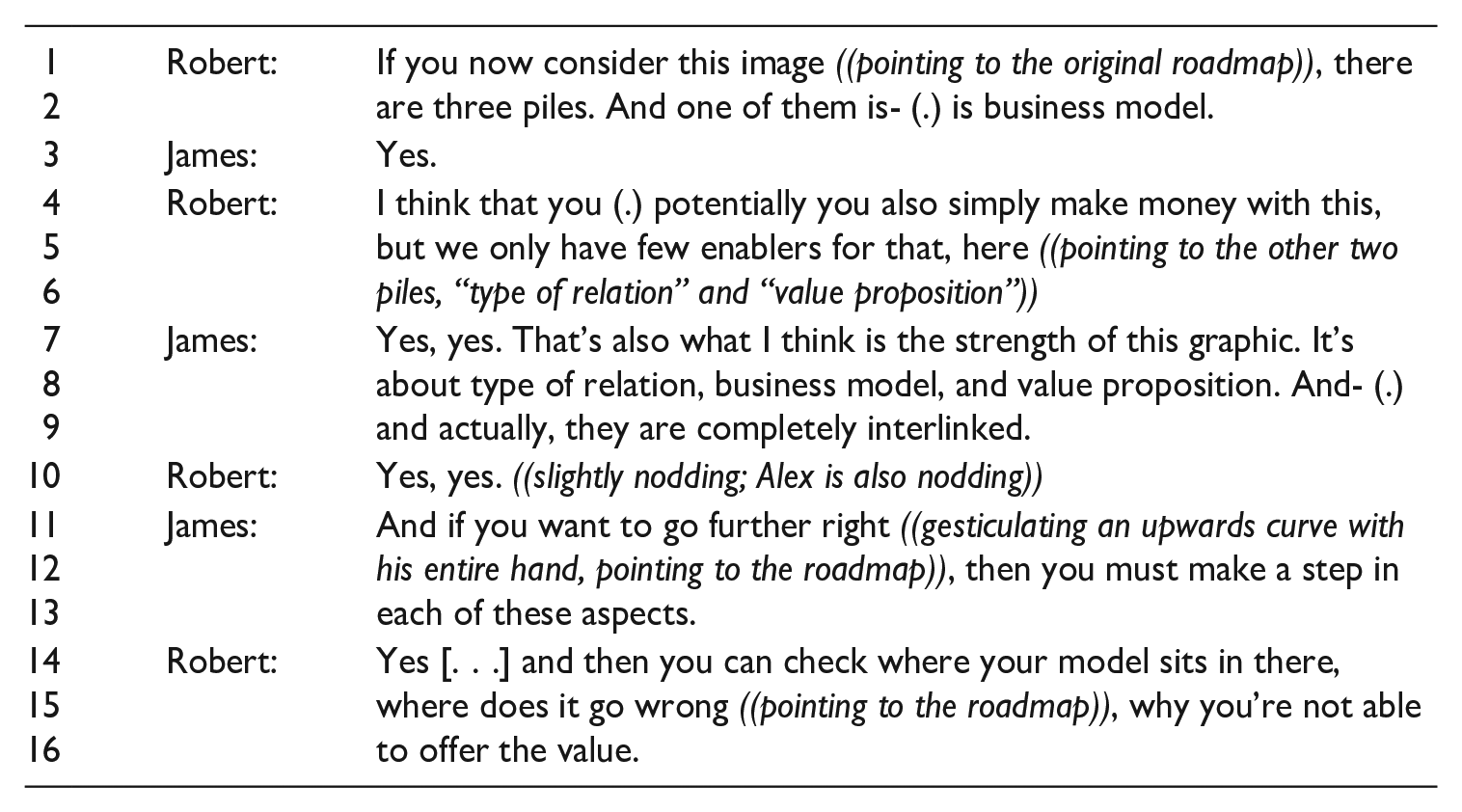
Looking for answers to why servitization proves challenging to implement, Robert is drawing attention to the roadmap’s “three piles” (line 2); the very aspect of the graphic that James has emphasized the most. Here, Robert is leveraging the graphic to co-construct meaning; the fact that he is focusing on an aspect that James stressed before shows that understandings about servitization are indeed traveling between members. Team members build upon each other’s contributions and, in this way, extend their shared understanding of servitization. As James has extensively explained in previous meetings but also is repeating here again, servitization can only work if efforts are put into different aspects simultaneously (“it’s about type of relation, business model, and value proposition,” lines 7–8) as “they are completely interlinked” (line 9). The roadmap’s upward curve is materializing in James’s hand movement (lines 11–12) when he is emphasizing the artifact’s stepwise journey (Figure 4). Thus, in the process of meaning-making we can observe here, the graphic is visually displayed but also shifts into what James utters and how he moves his body, being present in the discussion in multiple interrelated shapes all at the same time. These expanding shapes support the team’s meaning-making (note the affirmations in line 10). Shared understandings are co-created on different modal layers in parallel, enriching members’ meaning-making.
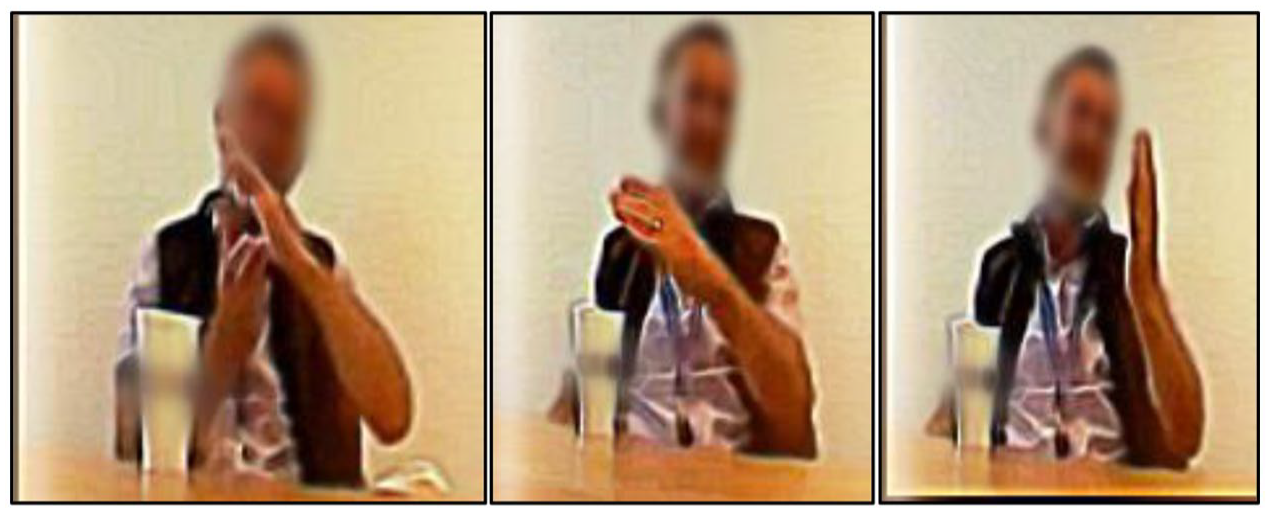
James’s representative gesture of the roadmap.
Indeed, Robert’s elaborations reference the roadmap, too. Specifically, Robert is repeatedly pointing to the artifact (line 1; lines 5–6; line 15) and is using the graphic’s terminology (“business model,” line 2). Hence, the artifact also is made present through verbal expressions by Robert. The connections between the roadmap and the team’s collaborative work have spread beyond James through different modes, with the artifact now being a central reference point for the team to engage in collective meaning-making.
Another example of that is Robert’s gesture (Figure 5) when, in meeting 5, he is explaining his company’s servitization stage. Before, only James had used this gesture. Now, the roadmap’s expanding shapes travel between members, in parallel to shared understandings growing and strengthening in the team:
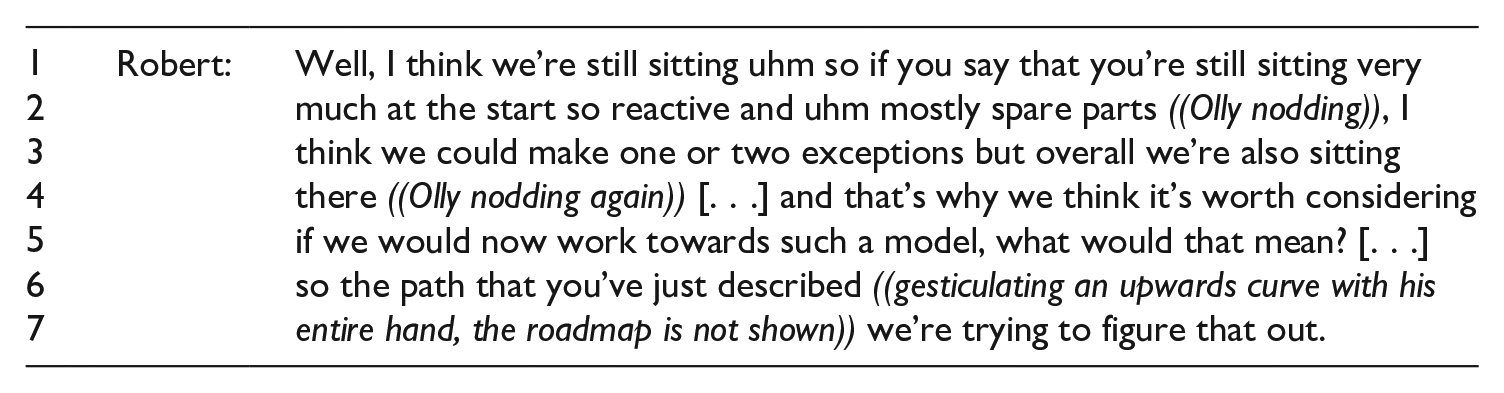
Once again using the roadmap’s exact words, Robert is positioning his company “very much at the start so reactive and uhm mostly spare parts” (lines 1–2). When enacting his upwards-shaped gesture (Figure 5), he is also verbally referring to “the path” (line 6). Notably, this time, the roadmap is not shown; it becomes expressed solely through Robert’s words and bodily movement. Members have created solid shared understandings so that, by now, verbal and embodied shapes of the graphic appear sufficient for them to engage in meaning-making.

Robert’s representative gesture of the roadmap.
Continued expansion dynamics: intramodal shape-shifting
While shared understandings strengthen in the team, members are also still in the process of learning more about their organizations. Meeting 4 takes place at Organization C, and Paul uses that occasion to provide more details about one of his company’s products. To support collaborative meaning-making, he leverages an adapted version of the roadmap (Figure 6):
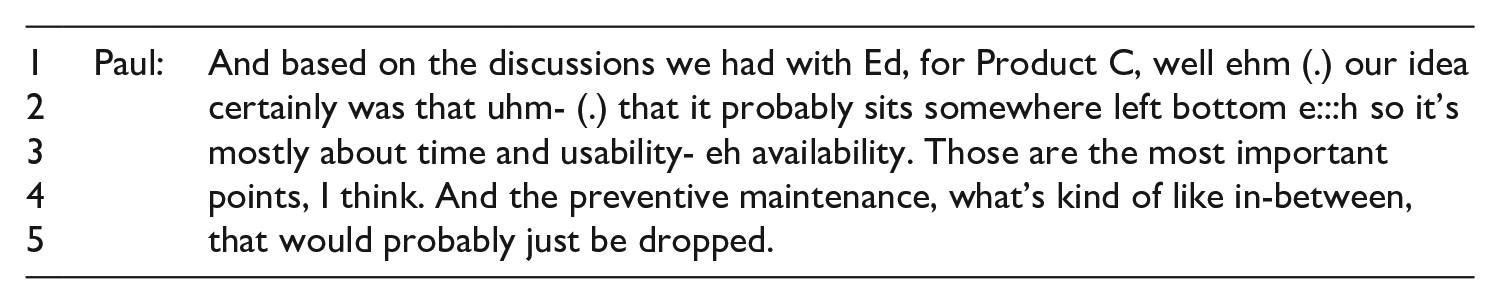
The visual with Paul’s adaptions (added box and arrow).
Paul has added a box and an arrow to the artifact that signify where “Product C” (line 1) is sitting (“Time & Material”) and where this product would ideally go (“Availability Services”), which supports him in getting across his explanations. Paul’s additions also indicate that the “Preventive Maintenance” step is less relevant for his company, which he explains, too (lines 4–5). Essentially, the adapted roadmap becomes a medium through which Organization C, or more specifically, Product C, communicates. The roadmap’s intramodally expanding shape into a new visual version permeates the boundary between Organization C and the project team, thereby supporting members’ shared understanding of one another. In a conversation with Paul, he explained adapting the roadmap to us as follows: “I created my own version to clarify to my team colleagues what is going on at Organization C. I embraced the power of the visual and the story that is behind it.”
Overall, in phase II, stronger ties between the roadmap and the team are built. Members beyond James leverage the artifact to work through differences in understandings and contexts. Hence, the artifact functions as an actual boundary object; it takes on an active role in helping members create shared understandings. Numerous appearances of the graphic across and within modes strengthen its central position and important meaning-making function. Shapes of the roadmap continue expanding while shared understandings grow from a global understanding of servitization to a more precise one: members are now all able to position their organization in relation to the artifact. Noteworthily, whereas in phase I the original roadmap was visually displayed in all episodes, in phase II, its verbal and embodied shapes appear sufficient to make present the artifact and support members’ meaning-making.
Phase III: An interwoven boundary object
The collaboration proceeds further. Members develop specific plans for their organizations to push servitization to the next level. For example, participants from Organization A focus on how to foster a servitization mindset at their service desk, and the others explore the added value that servitization would bring customers. The roadmap continues to help members make shared sense of their efforts (appearing in 23 episodes across meetings 6 and 7). For example, its stages and features allow them to differentiate present and prospective scenarios or distinguish between customer groups. However, rather than continuing to expand in shapes, the boundary object’s shape-shifting dynamics appear to reach a tipping point and start narrowing down. Shapes of the roadmap are contracting, no longer including its original visual shape. Instead, the boundary object is present through three adapted visual versions and, primarily, simple references in members’ words and bodies. These contracted shapes simultaneously streamline and enrich team members’ meaning-making.
Contraction dynamics enabling meaning-making
Meeting 6 has been running for an hour, and James has just explained his plans for implementing servitization in Organization A when Paul starts probing for further details. Notably, the roadmap is not displayed but made present solely through hand movements and verbal references to its colors, red and blue:
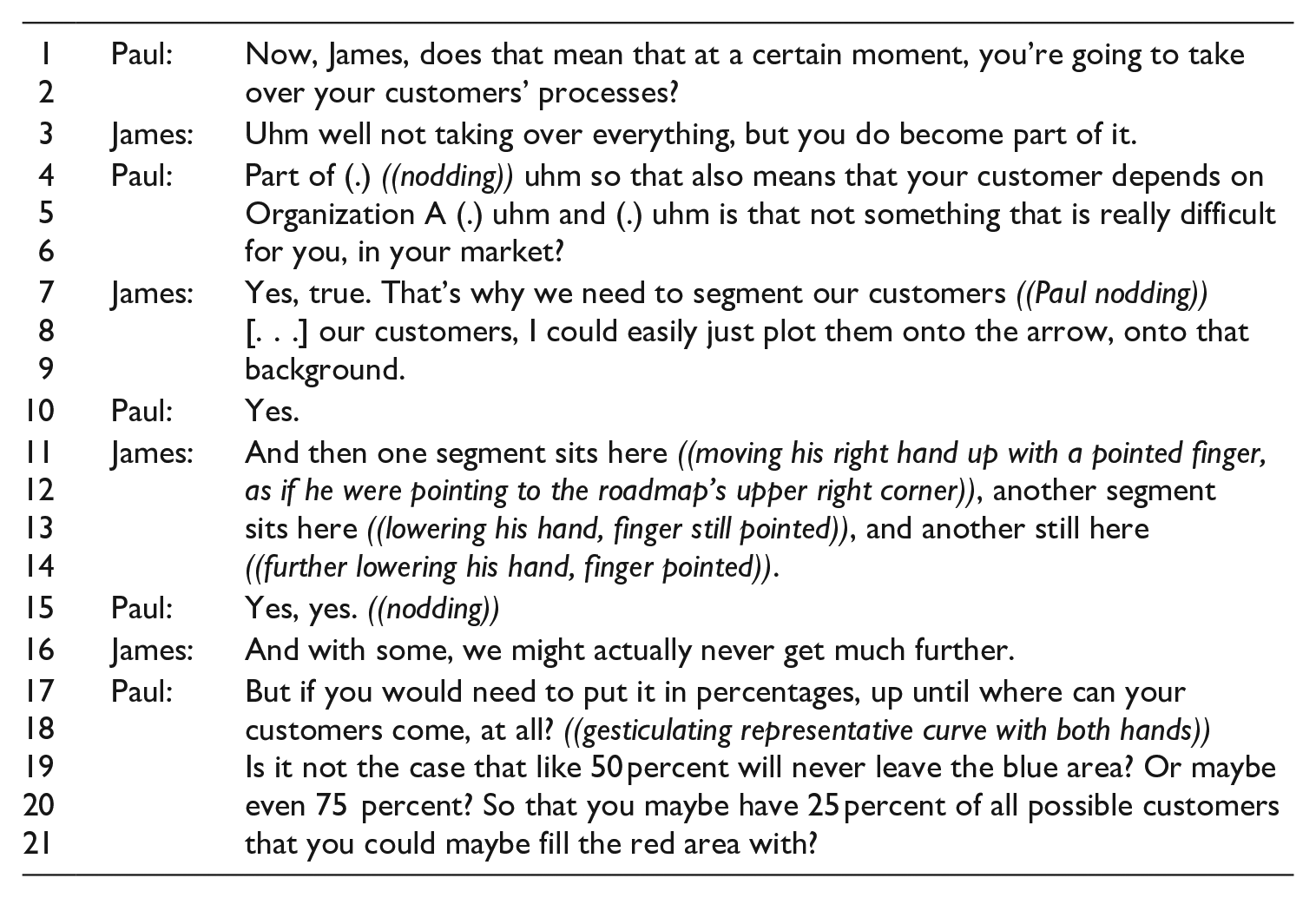
Paul is asking James for more details about their customers’ processes (lines 1–2). However, he does not appear convinced by James’s response (line 3) as he keeps questioning, now focusing on the feasibility of James’s plans (lines 4–6). James acknowledges Paul’s doubts, providing a more elaborate answer. Specifically, he starts explaining how customers need to be segmented (line 7), which Paul noddingly acknowledges (line 7). James is then invoking the roadmap that has been guiding the team’s meaning-making through a simple, verbal reference (“the arrow,” line 8) and starts locating customers “onto that background” (lines 8–9), presumably to prove the customer segmentation’s feasibility and come to a shared understanding with Paul. The roadmap is not shown but made present solely through this simple verbal shape as well as James’s movement: when talking about where customers would sit on the graphic, he is moving his hand (lines 11–14), tracing the visual curve from top right to left bottom as if it were displayed right in front of him and the others (Figure 7). The graphic is supporting James and Paul’s shared understanding through these subtle (verbal and embodied) shapes, providing a powerful joint reference base for their discussion even when made present solely through implicit, fleeting, and contracted cues.
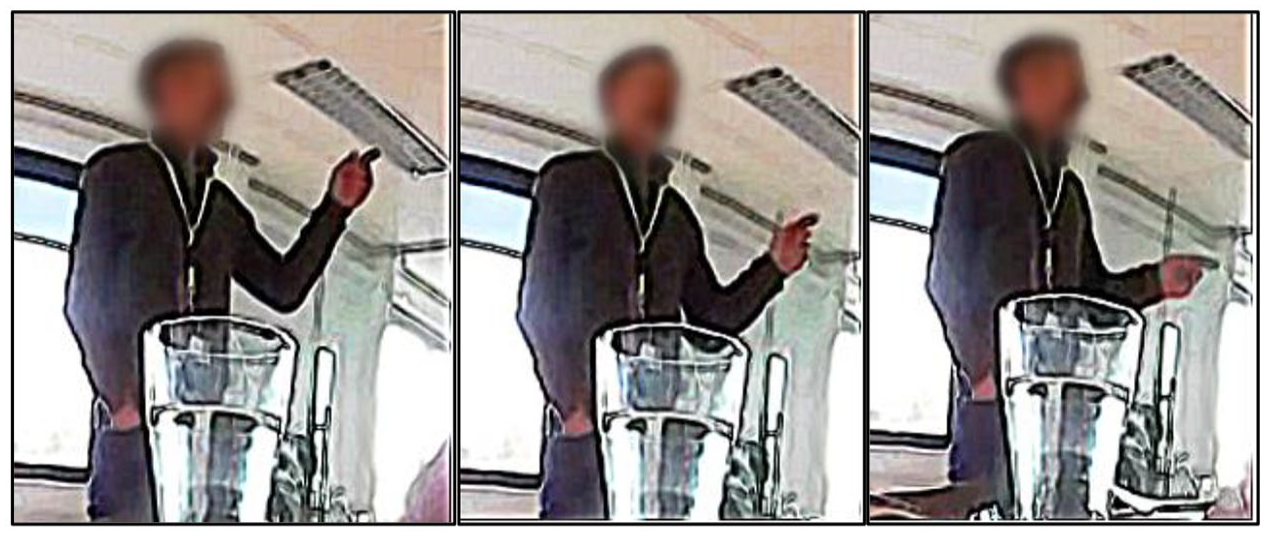
James’s representative gesture of the roadmap.
Indeed, Paul is invoking the artifact through similar embodied modes (line 18, Figure 8) in his reaction to James, gesticulating its upward curve with both hands. This further evinces that team members are operating from a strong shared understanding in their meaning-making, grounded in the graphic’s varied shapes. However, despite James’s more profound explanations, Paul still seems unconvinced (lines 17–21). He appears to be doubting that James’s servitization plans can ever be implemented many of their customers, invoking the roadmap’s “blue area” (lines 19–20) and “red area” (line 21) for support. Again, the artifact is not shown; it is invoked solely through simple verbal and embodied modes, which appear sufficient for James and Paul to know precisely what the other is talking about. Both invoke the artifact to help them make better sense of their discussion, providing a robust interactional ground for their exchange, even when they end up disagreeing here.
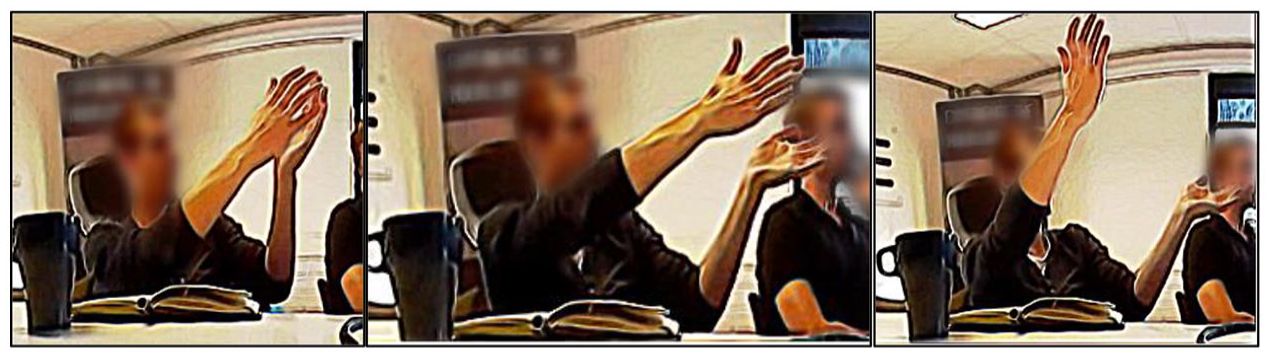
Paul gesticulates the upwards curve with both hands.
Later in the meeting, Paul explains his plans for his company’s servitization. Once again, the roadmap is not shown:
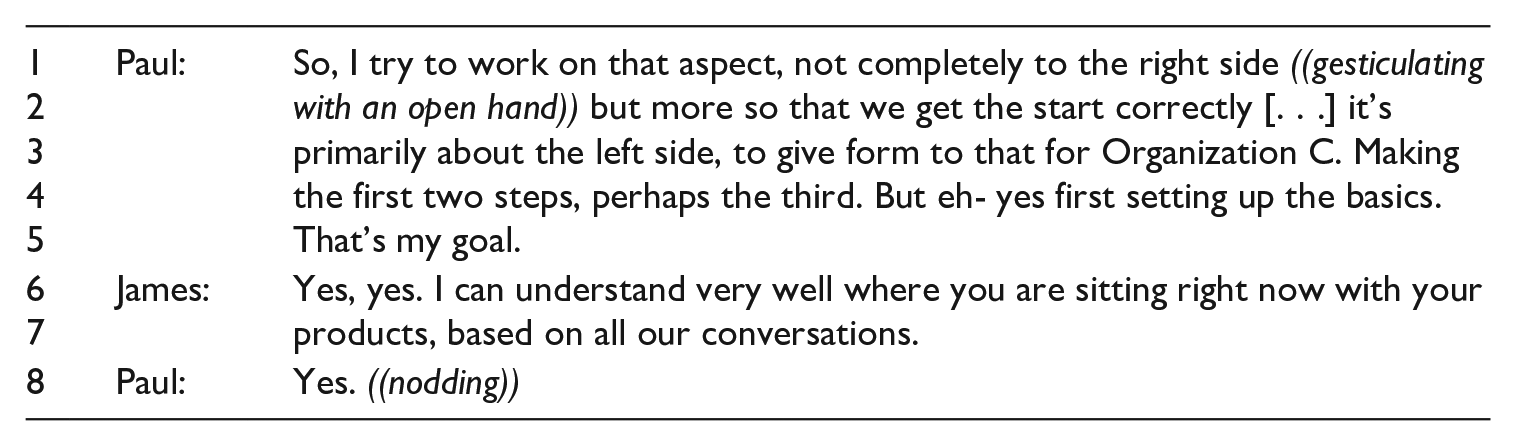
Paul makes present the graphic exclusively through what he says and how he moves his body. For example, he is explaining how his organization does not seek to go “completely to the right side” (line 1) but is more focused on “the left side” (line 3) and on “making the first two steps, perhaps the third” (lines 3–4). While vocalizing these details, he is moving his hand in the upward-curved shape that came to represent the roadmap over time (Figure 9). Even when not displayed, the roadmap guides what team members work on and helps them create shared understandings, as James’s reaction illustrates (“I can understand very well,” line 5). Hence, the graphic, in its contracted verbal and embodied shapes, is leveraged by members to support their explanations, help them convey meaning, and communicate with the rest of the team in simple but greatly meaningful terms.

Paul’s representative gesture of the roadmap.
Overall, in phase III, the roadmap functions as a deeply interwoven boundary object and is an indispensable part of members’ meaning-making. Members are so fluent in “speaking the graphic” that they understand the artifact’s most implicit shapes. The roadmap’s colors convey meaning even when not visible, and its extension into members’ bodies seems almost excessively natural. Indeed, the artifact is so firmly woven into all members’ words and bodies that its visual presence stops appearing almost altogether. The vast repertoire of visual, verbal, and embodied shapes contracts into primarily subtle spoken and bodily materializations. Members can move forward based on the strong shared understandings established by now—made present through, most often, nothing more than a word or gesture.
Phase IV: A boundary object creating new boundaries
However, the team is then shaken up: two members from a new organization join, and Robert, Olly, and Tim leave. Because of the fluctuation, the members need to get acquainted with one another and their organizations again. When Paul and James use the roadmap to explain their organizations’ products and servitization objectives to the newcomers in meeting 8, the situation hence feels like a déjà vu. However, in contrast to the collaboration’s beginnings, James and Paul now make present the roadmap exclusively in its contracted verbal and embodied shapes (in five episodes in meeting 8, of which it is visually displayed not once). Subsequently, the artifact starts disappearing from the team’s interactions (being present only twice in meeting 9, in verbal and embodied shapes) before evaporating altogether (in meeting 10, it is no longer present). New members cannot make sense of the object’s contracted appearances, and the previously powerful boundary object becomes an obstacle to further collaborative work.
Contraction dynamics constraining meaning-making
Early in meeting 8, Paul explains Organization C’s servitization activities and ambitions to the new members, trying to create shared understandings within the novel team constellation. However, though he is verbally referring to the roadmap, he does not show it:
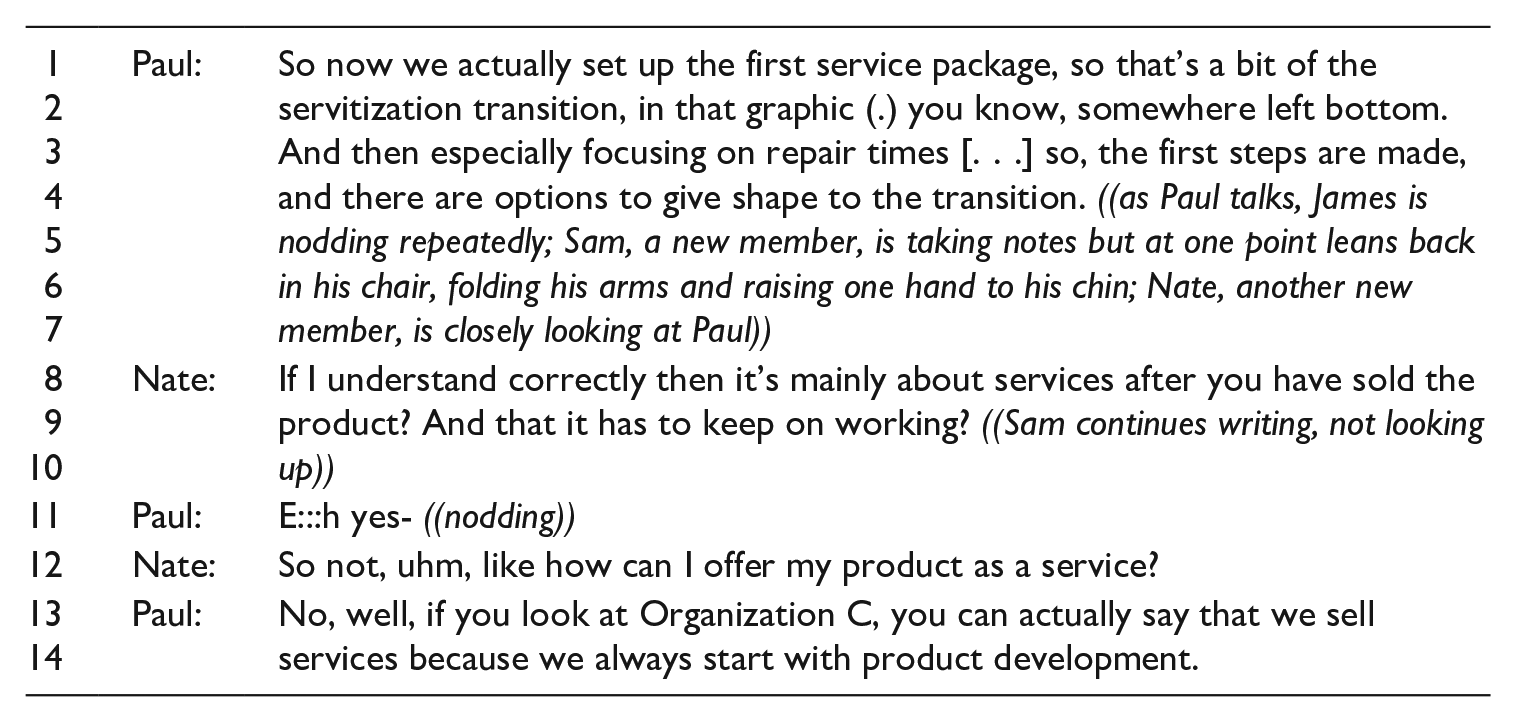
In his elaborations, Paul is making present the roadmap only through verbal references (e.g., “in that graphic,” “somewhere left bottom,” or “repair times,” lines 2–3). Nate, one of the new members, is showing difficulties in understanding Paul, as indicated by his questions (lines 8–9, line 12) but also by Paul’s hesitant and corrective answers (line 11, lines 13–14). Paul and Nate do not seem to understand one another very well, such that meaning-making between them fails. Sam, another new member, also appears disengaged from the discussion, steadily writing in his notebook without once looking up.
Just moments later, the conversation moves to the case the new members want to add to the collaboration. Luke speaks about one of his organization’s products when Paul and James once more direct the conversation to the roadmap without its being visually displayed:
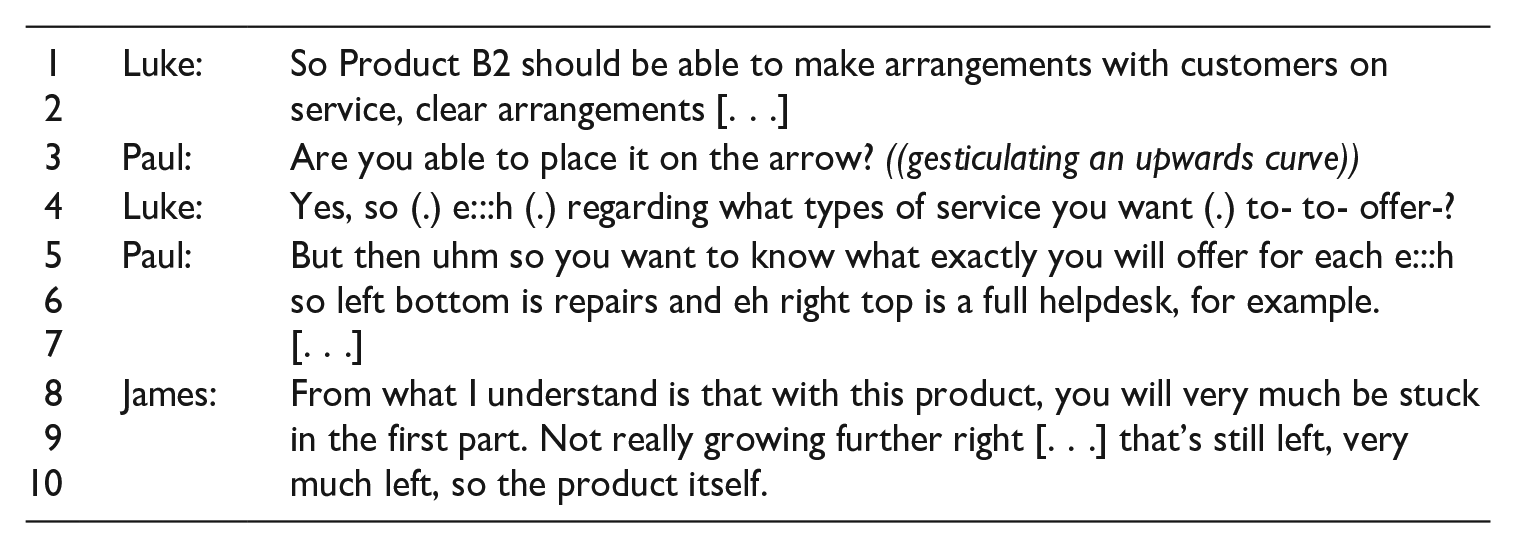
Paul and James are referring to the roadmap as “arrow” (line 3), are materializing it through the representative gesture that became its natural embodied shape (line 3), or are talking about being “stuck in the first part” and not “growing further right” (line 9). However, just like Nate, Luke is showing difficulties in responding, indicated by his hesitant tone and question (line 4). Presumably, he cannot make sense of the artifact’s verbal and embodied appearances in Paul’s talk and hand movement (line 3, Figure 10). Once again, meaning-making fails between the old and new team members.

Paul’s representative gesture of the roadmap.
Paul is then specifying his question to Luke (lines 5–6). Only those who have sat with the team for many meetings can “see” the roadmap in his talk, such as when he is referring to “left bottom is repairs” or “right top is a full helpdesk” (line 6). As a new member, these contracted shapes (i.e., the verbal materializations but also the embodied shape from before (line 3, Figure 10)) must be more difficult to catch and correctly interpret for Luke, who has not witnessed the graphic’s expanding shapes across and within modes over time. It is then James who locates Organization C’s product on the roadmap, explicitly placing it in the “first part” and “very much left” (lines 9–10).
Overall, in phase IV, James and Paul continue where they left off in their handling of the roadmap, relying exclusively on the artifact’s contracted verbal and embodied shapes. In a later conversation we had with James, he explained this as follows: “We would have had to put in the same effort again while not making any progress on top of where I was already in my mind.” The roadmap’s contracted shapes are greatly meaningful for James and Paul, yet they are not at all meaningful for the new members. Consequently, old and new members fail at creating shared understandings. The team breaks apart, with one part having the graphic deeply woven into their minds, words, and bodies, and the other part lacking this intimate familiarity with the artifact and thus not making sense of its verbal and embodied shapes. Members find themselves on split rather than common ground, the roadmap becoming a boundary object that creates new boundaries and no longer supports the entire team’s meaning-making. Subsequently, the artifact disappears from the team’s collaborative work. Single words or simple gestures no longer suffice as meaningful boundary objects. As James phrased it in another conversation we had with him: “The graphic lost its team-wide matter, and the total subject of servitization lost its team-wide matter.”
Discussion
What happens to meaning-making when boundary objects shape-shift over time, such as when new versions develop or visual artifacts turn into simple phrases and gestures? The empirical narrative presented before has provided insights into these dynamics. We now seek to more profoundly discuss and theorize our empirical observations. We first focus on this article’s contributions to the literature on boundary objects. Subsequently, we discuss our contributions to the multimodality literature as well as the practical implications of our work.
Boundary objects as shape-shifters: Enabling and constraining meaning-making
This article provides novel and fine-grained insights into how boundary objects shape-shift. By so doing, it adds to the literature on boundary objects, offering a processual account of their shifting shapes and meaning-making implications. Whereas previous work has tended to sketch images of more or less static artifacts in light of changing boundaries, our analyses extend our understanding of boundary objects’ fluid nature (e.g., Doolin and McLeod, 2012; Ewenstein and Whyte, 2009) by conceptualizing them as multimodal accomplishments.
Precisely, our analyses point to two shape-shifting dynamics through which boundary objects can change form and, in so doing, become deeply enmeshed in the day-to-day fabric and meaning-making processes of collaborative work: expanding and contracting. Together, the shape-shifting dynamics pronounce boundary objects as malleable and pliable; their form not being something that is given or can be presumed but something that is situationally performed (Star, 2010). Language and bodies are constitutive of boundary objects’ forms and functions as much as more physical matters (Jornet and Steier, 2015), which is what makes these artifacts able to shape-shift within and across modes.
Better comprehending these shape-shifting dynamics is important because, as our analyses have shown, boundary objects that reemerge in different shapes can have varying implications for meaning-making, which by itself already is a complex and fragile process (cf. Vásquez et al., 2016). Specifically, the expansion and contraction dynamics we have identified offer an explanation for why a shape-shifting boundary object enables meaning-making in some situations and constrains it in others. In the case we studied, expanding shapes of the artifact allowed team members to create shared understandings in diverse and communicationally rich ways. That is, members leveraged the artifact not just in its visual forms but also drew on verbal and embodied shapes, the object providing a multimodal hook on which to hang their explanations (see also Bechky, 2003a). Once team members were intimately familiarized with the artifact and strong shared understandings were formed, the object’s shapes contracted again, albeit to different forms than the original visual version: the vast repertoire of visual, verbal, and embodied shapes contracted into exclusively spoken and bodily materializations. For familiarized members, these subtle shapes carried the entire history of collaborative meaning-making (Holler and Wilkin, 2009), so contraction dynamics simultaneously simplified and enriched their communication: the simplest references sufficed to ensure everyone was speaking about the same topic (see also Bechky, 2003a; Garfinkel, 1967; Vygotsky, 1934/1986). However, the artifact’s contracted shapes also constrained meaning-making when newcomers joined the team who were not familiarized with the artifact and did not contribute to its expanding shapes. Figure 11 visualizes these dynamics in a conjunctive process model (Cloutier and Langley, 2020). The differently colored squares represent different modes; color nuances signify novel shapes within a mode with less saturation indicating a simpler and more implicit shape (e.g., a single word).
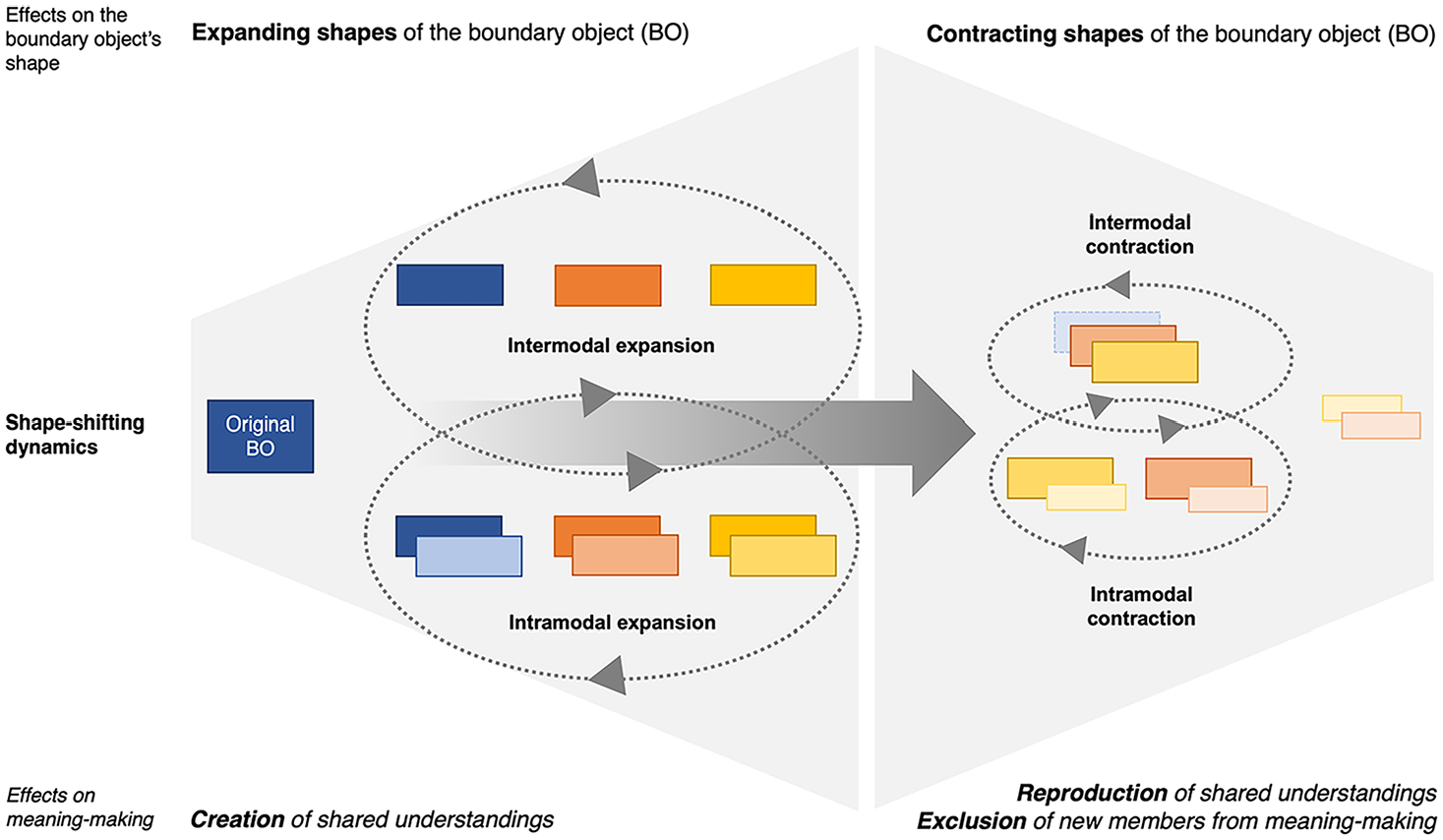
Expansion and contraction dynamics of a shape-shifting boundary object and how they affect collaborative meaning-making; the differently colored squares represent different modes; color nuances signify novel shapes within a mode, with less saturation indicating a simpler and more implicit shape.
Theorizing from our findings, on the one hand, boundary objects’ expanding and contracting multimodal shapes signal that an artifact is firmly embedded in and, thus, vitally important for meaning-making. As collaborators repeatedly leverage an artifact in their discussions, it can change into new forms and migrate into utterances and bodily movements, which nurtures and tightens the connections between the artifact and the collaborators using it. That way, boundary objects appearing in increasingly diverse shapes eventually become invaluable and “ready-to-hand” (Star, 1999: 380) meaning-making devices that enable collaborators to create shared understandings across modes, allowing them to literally think, see, speak, and move in synchronized ways. In close resemblance with Harvey’s (2014) idea of “creative synthesis,” the boundary object then “act[s] like a map” (325), grounding, guiding, and continuously pushing forward the collaborative work.
However, on the other hand, boundary objects’ varied multimodal shapes confuse and stall meaning-making when new collaborators come on board who cannot make sense of an artifact’s appearances in, for example, talk and bodies. Indeed, artifacts can become so sunken into a team’s way of being that they do not only invisibly support collaborative work but also hamper it by constraining meaning-making—“one person’s infrastructure is another’s [. . .] difficulty,” as Star (1999: 380) aptly phrased it. In response to Star’s (2010: 612) question, “Could not a word be a boundary object?”, our case hence demonstrates that single words or simple gestures can be helpful boundary objects for some, yet they can just as well be too implicit to make any proper meaning for others.
These findings add nuance to our understanding of boundary objects not solely as supportive but also as hindering devices, highlighting the fickle tipping point between an artifact being a “bridge” versus a “maze” (Oswick and Robertson, 2009). As our study shows, questions of boundary objects’ functions and effects are not only questions of context, collaborators, and collaboration stage (Carlile, 2002) but likewise of potentially diverse forms of the artifact itself. Thus, though much literature has emphasized boundary objects’ supportive nature for building shared understandings and common ground (e.g., Henderson, 1991; Koskinen, 2005; Ojansivu et al., 2021), this article provides a more balanced account.
Our findings also draw attention to boundary objects’ deeply relational character. In many ways, we could infer from our findings that boundary objects emerge and reemerge not just through different modes but also in and through relations. That is, objects’ diversifying shapes and whether collaborators can recognize them are a matter of the connections and degree of familiarity established between an artifact and those who use it (see also Star, 2010). Collaborators who have built strong connections with a boundary object can mobilize and make sense of it in diverse, multimodal forms; those who have not struggle with grasping these varied and often implicit shapes. Hence, an artifact (or a particular shape of it) is not constraining per se; whether it supports or thwarts meaning-making depends on context, situation, those using it, how it is being used, its usage before, and so forth. This insight stresses boundary objects’ fundamentally relational nature: no boundary object, in whatever shape it materializes, is a discrete entity—rather, its emergence, changes, and consequences are a matter of entangled relations (see also Star, 1999, 2010). Boundary objects are not things but things-in-process (Lutters and Ackerman, 2007)—meshworks of humans and non-humans, constantly unfolding in and through relations.
Taking boundary objects’ relational character seriously stresses their precarity. When enabling and constraining implications are ultimately a matter of the relations established between artifacts and collaborators, then changes in context and/or constellation can cause ruptures that initially might appear minuscule but have the power to completely sway the dynamics of collaborative work. To illustrate, the artifact we studied in one moment was a robust meaning-making device that literally moved members’ thoughts, words, and bodies in synchronized ways. Yet, in the very next moment, the artifact’s strong relations with only a part of the team completely shifted the dynamics when new members could not make sense of its contracted appearances in talk and gestures. Enabling effects turned into constraining ones, only for the boundary object to vanish altogether from the collaboration shortly afterward. As in Weick’s (1996) Mann Gulch case, dropping the roadmap—instead of “dropping one’s tool” (p. 308)—might have offered the team, in its new constellation, the chance to begin building new common ground among all members. However, with some members sticking to what, to them, became a ready-at-hand and unambiguous meaning-making device, shared sense-making failed and the team fell apart.
In sum, this article’s findings extend our understanding of boundary objects’ processual, multimodal nature and draw attention to their fundamentally relational character. We encourage future research to dig deeper into these aspects, particularly boundary objects’ relationality, which we have only started to unpack in this final section of the article. We need rich, longitudinal studies that move boundary objects’ processual, multimodal, and relational nature from the periphery to the center of attention, further elucidating boundary objects’ shape-shifting dynamics and unpacking in more detail the relations that form, flow, and ebb between artifacts, collaborators, meanings, situations, and so forth. Related questions are: How do boundary objects shape-shift when the original artifact is not visually displayed but verbally expressed? If boundary objects emerge in relations, what other actors and agencies are part of these relations beyond the collaborators? The thoughts on multimodality we will detail in the next section might be helpful for such and similar endeavors.
In addition, we need research that takes into consideration broader context aspects as well as collaborators’ “inner worlds.” Basing this project on primarily video data of team interactions and zooming in on one boundary object’s shifting shapes revealed rich new insights but might have distracted us from other potential dynamics, such as inner reflection processes (e.g., what exactly were team members thinking in the moments the roadmap was used?) or background aspects (e.g., was James particularly trained by his organization in utilizing the roadmap in the way he evangelized it?). Although these matters were not relevant to our objective, they constitute promising starting points for future research endeavors. These could, for example, include interviews to learn more about collaborators’ motives and interpretations of why certain artifacts are used or sessions in which video recordings are re-watched with team members, asking them to reflect on their interactions.
Toward an empirical account of “strong” multimodality
This article constitutes a rare, if not the first, empirical account of “strong” multimodality (Zilber, 2018) in organizational research: we have treated the visual, verbal, and embodied modes of communication as co-emerging, interdependent, and equally consequential, enabled by fine-grained analyses of rich audiovisual data. Our account of boundary objects’ shape-shifting dynamics provides novel insights into how different modes enmesh in practice, substantiating emerging understandings of modes’ processual and inseparable nature (Boxenbaum et al., 2018; Dille and Plotnikof, 2020; Knight and Wenzel, forthcoming).
Much of the multimodality literature continues to treat modes as independent, reified, and clearly separable. Though it is acknowledged that modes can complement or contradict each other (e.g., when a visual strengthens the message conveyed by a text, Höllerer et al., 2018), they often remain conceptualized as ways of expression existing in separable domains (e.g., the “visual” vs the “verbal” realm). Spurred by the growing prominence of the “visual turn” in organizational research (Meyer et al., 2013), multimodality research is furthermore marked by an overemphasis on visual matters at the expense of more embodied aspects (Boxenbaum et al., 2018; see also Dameron et al., 2015). In contrast, this article simultaneously considers visual, verbal, and embodied modes and illustrates how the very same boundary object can emerge in varying multimodal shapes. Hence, our findings problematize the separation of modes, demonstrating how an artifact that is visually present can readily migrate into what is said and how bodies are moved.
One crucial implication this insight stresses is that visual, verbal, and embodied modes can be equally important and blur into each other as inseparable sites of meaning-making. As a case in point, had we considered the boundary object we studied to be present solely when visually displayed, we would have missed many of its meaning-making implications. In fact, we would likely have missed the minuscule but consequential details that eventually stalled collaborative work. Our findings thus chime in with others who have drawn attention to a substantial blind spot in organizational theorizing (Boxenbaum et al., 2018; Zilber, 2018): when research focuses on single modes and theorizes multimodal phenomena in reified rather than processual terms, it risks bypassing decisive details and telling just parts of the story.
Taking seriously that communication comprises multiple interweaving modes requires analyses with a fine-grained sensitivity for different ways of expression and studies that attune toward modes’ emerging and shifting connections. The material understanding of communication (Cooren et al., 2012) that we also drew inspiration from can prove fruitful for such endeavors. When we approach communication as a process of materializing, then the classical divide between the world of discourse and sociality on the one hand and the world of materiality on the other begins to dissolve (Cooren, 2018). Combined with methodological guidance on visuality and embodiment (e.g., Clarke et al., 2021; Gylfe et al., 2016; Meyer et al., 2013) and applied to rich audiovisual data, such a take on communication can hence be a valuable anchor point for more complete and “stronger” considerations of multimodality in organization studies (see also Boxenbaum et al., 2018). It can help us further reveal modes’ co-constitutiveness as every mode then, by implication, also has a material dimension. In particular, the notion of ventriloquism (Cooren, 2010) might be of use, providing an analytical apparatus (Nathues et al., 2021) for deliquescing classical separations between sociality and materiality. Though organizational practices are not yet often analyzed as multimodal accomplishments, we hope that this article can inspire such endeavors in order to further gauge and unpack modes’ complexity, inseparability, and consequentiality.
Practical implications
Although our analyses are limited to a specific setting and boundary object, we see two practical implications. First, our study demonstrates how artifacts can become essential features of collaborative meaning-making as part of what members say, do, and see: they partake in work not just by being there physically or visually but also through uttered words and body movements. Thus, collaborators will benefit from attuning to objects’ shifting shapes. These varying shapes enable understanding each other among those who are familiarized with them. Yet, newcomers in a team may be unable to trace the heritage and meaning of, for example, an intimately interwoven phrase or gesture.
Second, and more broadly, our study then also draws further attention to the complexity of communication surrounding professionals in their everyday work. Whenever they communicate, professionals engage in rich, multimodal ways. Talk, but just as well visual and embodied expressions, can speak volumes (Höllerer et al., 2018; Wenzel and Koch, 2018) and make important differences in how conversations, situations, and meaning-making unfold. “A picture is worth a thousand words,” but so might a single phrase or a simple gesture, we would add. It remains up to us to elucidate what exactly we make each of them mean.
Supplemental Material
sj-pdf-1-hum-10.1177_00187267241236111 – Supplemental material for Shape-shifting: How boundary objects affect meaning-making across visual, verbal, and embodied modes
Supplemental material, sj-pdf-1-hum-10.1177_00187267241236111 for Shape-shifting: How boundary objects affect meaning-making across visual, verbal, and embodied modes by Ellen Nathues, Mark van Vuuren, Maaike D Endedijk and Matthias Wenzel in Human Relations
Footnotes
Acknowledgements
The authors wish to thank the LOST (Leuphana Organization & Social Transformation) group, the members of the Viadrina Virtual Paper Sessions, as well as the RMI Institute at University Witten/Herdecke for invaluable comments on earlier versions of this article. Thanks also to the participants of the EGOS 2021 sub-theme “Organizing Difference” and the Organizational Communication division of the 2022 International Communication Association conference, where previous versions of this manuscript have been presented. Special thanks go to Boris Brummans, Boukje Cnossen, and Dennis Schoeneborn for their great insight and advice. The authors also wish to thank their editor, Zhijun Chen, and the three anonymous reviewers for their helpful guidance, as well as the team that they followed for allowing them this rich insight into their work.
Funding
The authors disclosed receipt of the following financial support for the research, authorship, and/or publication of this article: This research was partially funded by the European Funds for Regional Development (EFRO) under project number PROJ-00729.

Supplemental material
Supplemental material for this article is available online.
References
Supplementary Material
Please find the following supplemental material available below.
For Open Access articles published under a Creative Commons License, all supplemental material carries the same license as the article it is associated with.
For non-Open Access articles published, all supplemental material carries a non-exclusive license, and permission requests for re-use of supplemental material or any part of supplemental material shall be sent directly to the copyright owner as specified in the copyright notice associated with the article.
